Abstract
In 2009, Noor and Waseem studied an important third-order iterative method. The convergence
order is obtained using Taylor expansion and assumptions on the derivatives of order up to
four. In this paper, we have obtained convergence order three for this method using assumptions
on the first and second derivatives of the involved operator. Further, we have extended the method
to obtain a fifth- and a sixth-order methods. The dynamics of the methods are also provided in this
study. Numerical examples are included. The same technique can be used to extend the utilization of
other single or multistep methods.
MSC:
47H99; 49M15; 65J15; 65D99; 65G99
1. Introduction
Due to its wide application in various fields, such as Engineering [1], Applied sciences [2,3], Mathematics [4], Medicine and Scientific computing [5,6], finding a solution of the nonlinear equation
is an important problem in computational mathematics. Here, is a Fréchet differentiable operator between Banach spaces T and and is an open convex set. Since a closed form solution for (1) is difficult to obtain (in general), iterative methods are usually employed to approximate the solution of (1). While studying iterative methods, the order of convergence is an important concern. In this paper, we consider the iterative method studied in [7] by Noor and Waseem. The method in [7] is defined for by
where .
Noor and Waseem in [7] obtained a convergence order three for (2) using Taylor expansion. The analysis in [7] uses assumptions on the derivatives of F of order up to four.
Recall [4,8] that an iterative method is of order if
where c is called an asymptotic error constant or rate of convergence.
Observe that the assumption on the derivative of F up to order four reduces the applicability of the method to the problems involving operator, whose higher order derivatives are not bounded. For example, let be defined by
Then, we obtain by this definition
Note that the fourth derivative of the function f is not bounded.
Later, in [9], the convergence of method (2) is proved using the assumptions only on the first derivative of F. However, the order of convergence is not obtained in [9].
Since the order of convergence is an important matter, our goal in this paper is to obtain the convergence order of (2), without using higher-order derivatives. In this direction, we obtain the convergence order three for (2) using assumptions on the derivatives of F of order up to two. Indeed, this is a considerable achievement. Note that, we are not using Taylor series expansion in our studies. Our new idea can be used to study and obtain convergence order of the other similar methods as well [1,2,6,10,11,12,13,14]. It is envisioned to study such similar methods in the future, since our technique does not depend on the method but only on the inverses of the linear operators involved.
Further, we extended the order of method (2) to five and six using the Cordero et al. [1,3] technique. The new methods are defined for as follows:
and
where .
The rest of the paper is organized as follows. In Section 2, Section 3 and Section 4, we provide the convergence analysis of the methods in (2), (3) and (4), respectively. Numerical examples are provided in Section 5. The dynamics of the methods (2), (3) and (4) are given in Section 6. Finally, the paper ends with the conclusions in Section 7.
2. Convergence Analysis of (2)
For our convergence analysis, we introduce some functions and scalars. Let and be the given parameters. Let the functions be defined by
and let Then, are nondecreasing and continuous functions. Further, and Therefore, there exist smallest zeros for the equations
Let the functions be defined by
and Then, is a nondecreasing and continuous function, and Therefore, has the smallest zero
Let
Then, for all we have
and
Throughout the paper, and for some
Our analysis is based on the following assumptions:
(a1) is a simple solution of (1) and ;
(a2) ;
(a3) ;
(a4) ;
(a5)
Theorem 1.
Suppose the conditions (a1)–(a4) hold. Then, the sequence defined by (2), starting from is well defined and remains in for and converges to a solution of (1). Moreover, we have the following estimates
and
Proof.
The proof is by induction. Suppose Then by (a2), we have
By the Banach Lemma on invertible operators [4], we have
Using the Mean Value Theorem, we have
Next, since we have
Thus, by (11) and (a2), we obtain
Then, the iteratation and (9) holds for
Next, we shall prove is well defined. Note that
Hence, by (a2) we get
Therefore,
Let
and
Then, by the Mean Value Theorem for second derivatives, we can write in turn that
where
and
Observe that by (14) and (a4), we have
Similarly, we obtain
To compute the second term in (15), we observe that
Notice that
where
Then, since , we have so the iteratate
3. Convergence Analysis of (3)
Let be defined by
and Then, and as Therefore, has the smallest zero
Let
Then, for we have
We have the following theorem for method (3).
Theorem 2.
Suppose the conditions (a1)–(a5) hold. Then, the sequence defined by (3), starting from is well defined and remains in for and converges to a solution of (1). Moreover, we have the following estimates
and
Proof.
Observe that by taking and in Theorem 1, we have
and the iterate Note that
Thus, by (a5), we have
□
4. Convergence Analysis of (4)
Let be defined by
and Then, and as Therefore, has a smallest zero
Let
Then, for we have
We have the following theorem for method (4).
Theorem 3.
Suppose conditions (a1)–(a5) hold. Then, the sequence defined by (4), starting from is well defined and remains in for and converges to a solution of (1). Moreover, we have the following estimates
and
We complete this section by providing a result for the uniqueness of the solution , that applies to all the methods given in this paper.
Proposition 1.
Suppose:
(1) There exist a simple solution of the Equation (1) for some and a parameter such that
for each
(2) There exists such that
Set Then, Equation (1) is uniquely solvable at in the region
5. Examples
Three examples are presented in this section.
Example 1.
Let Define the function F on D for by
Then, the Fréchet-derivatives are given by
and
The conditions (a1)–(a5) are validated if and Then, the parameters are:
Example 2.
Let the space of continuous functions defined on and be equipped with the max norm. Let Define the function F on D by
We have that
Then, we get that for the conditions (a1)-(a5) hold, provided and and Then the parameters are:
Example 3.
Getting back to the motivational example at the introduction of this paper, we have Then the parameters are:
In the next example, we compare method (3) with the fifth-order iterative method studied in [16]. Furthermore, we provide the iterates for the methods (2) and (3).
6. Basins of Attractions
In this section, we study the basin of attraction and Julia sets corresponding to methods (2), (3) and (4). Recall that the collection of all initial points from which the iterative method converges to a solution of a given equation are called the basins of attraction or Fatou sets, of an iterative method [11]. The complement of the Fatou set is known as a Julia set. We provide the basins of attraction associated with the roots of the following three systems of equations.
Example 5.
with solutions { }.
Example 6.
with solutions { }.
Example 7.
with solutions { }.
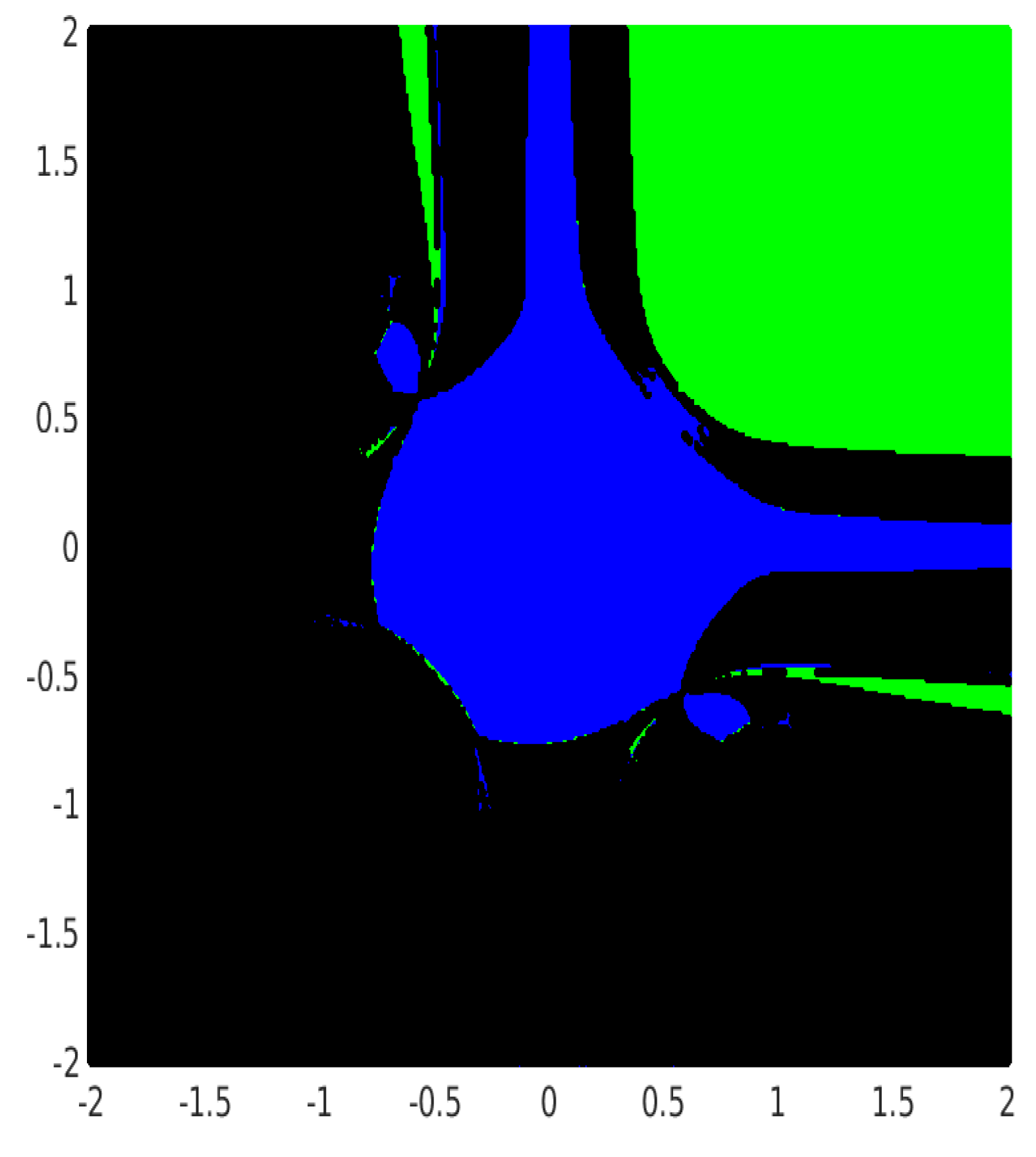
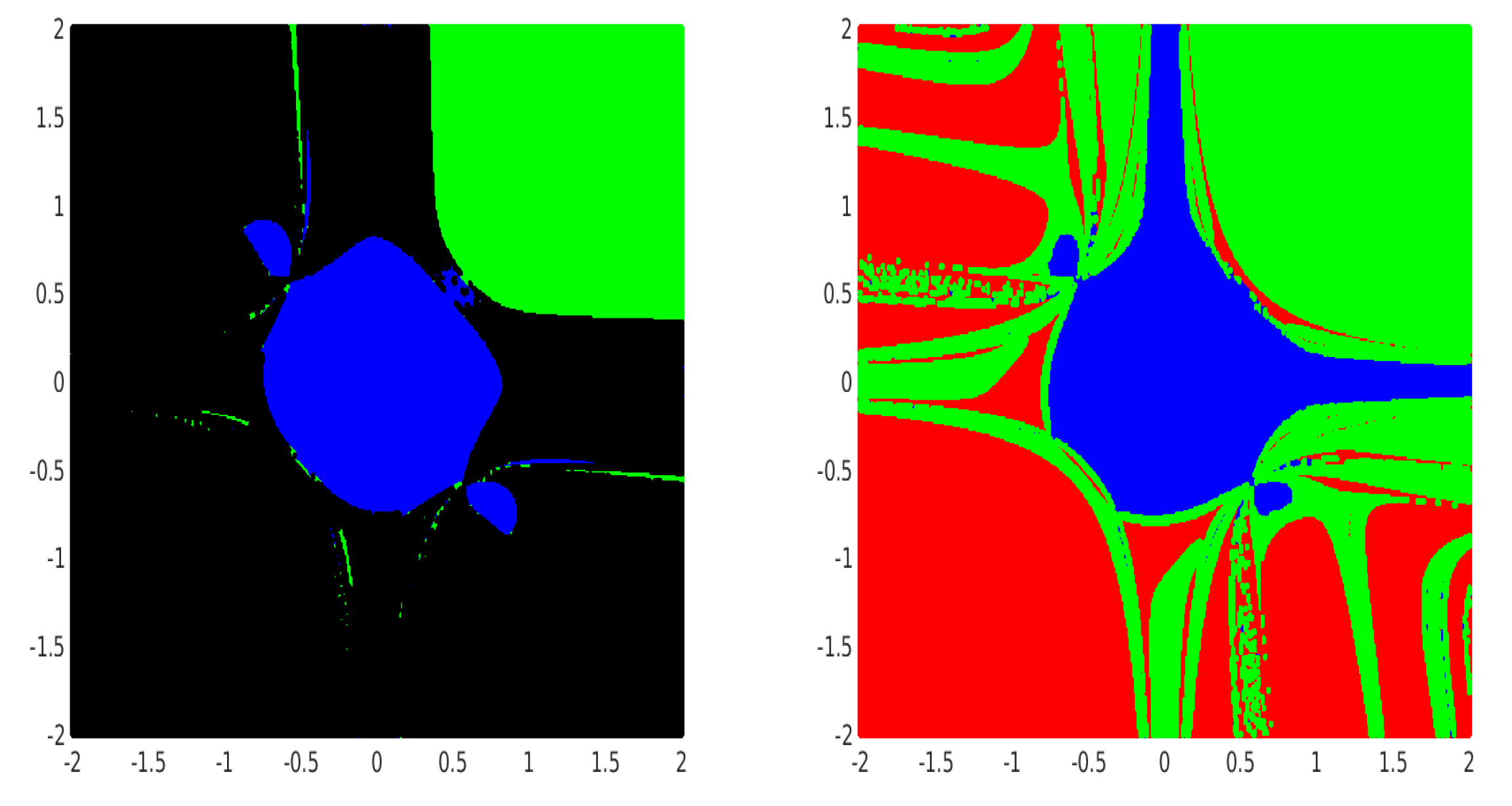
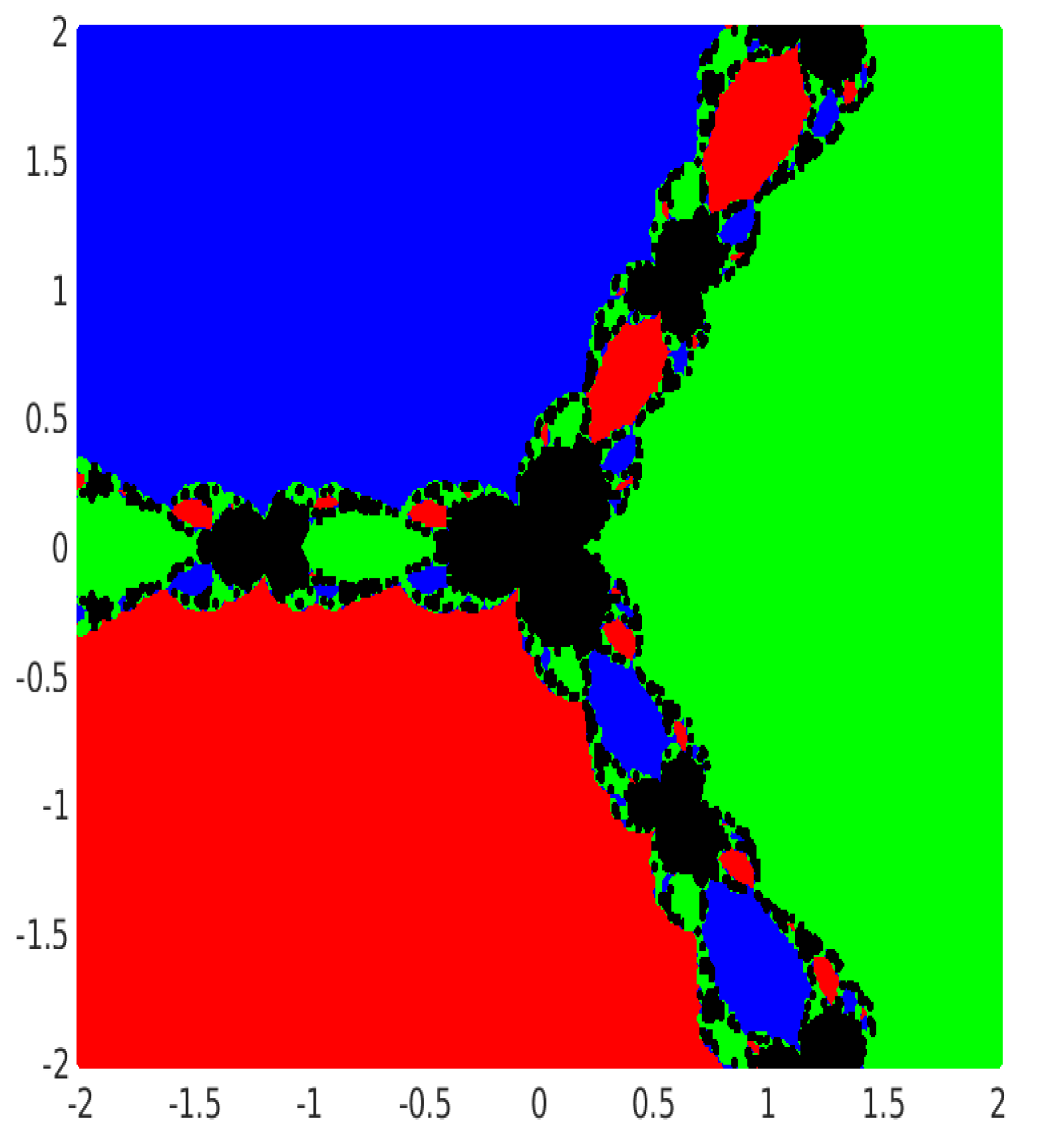
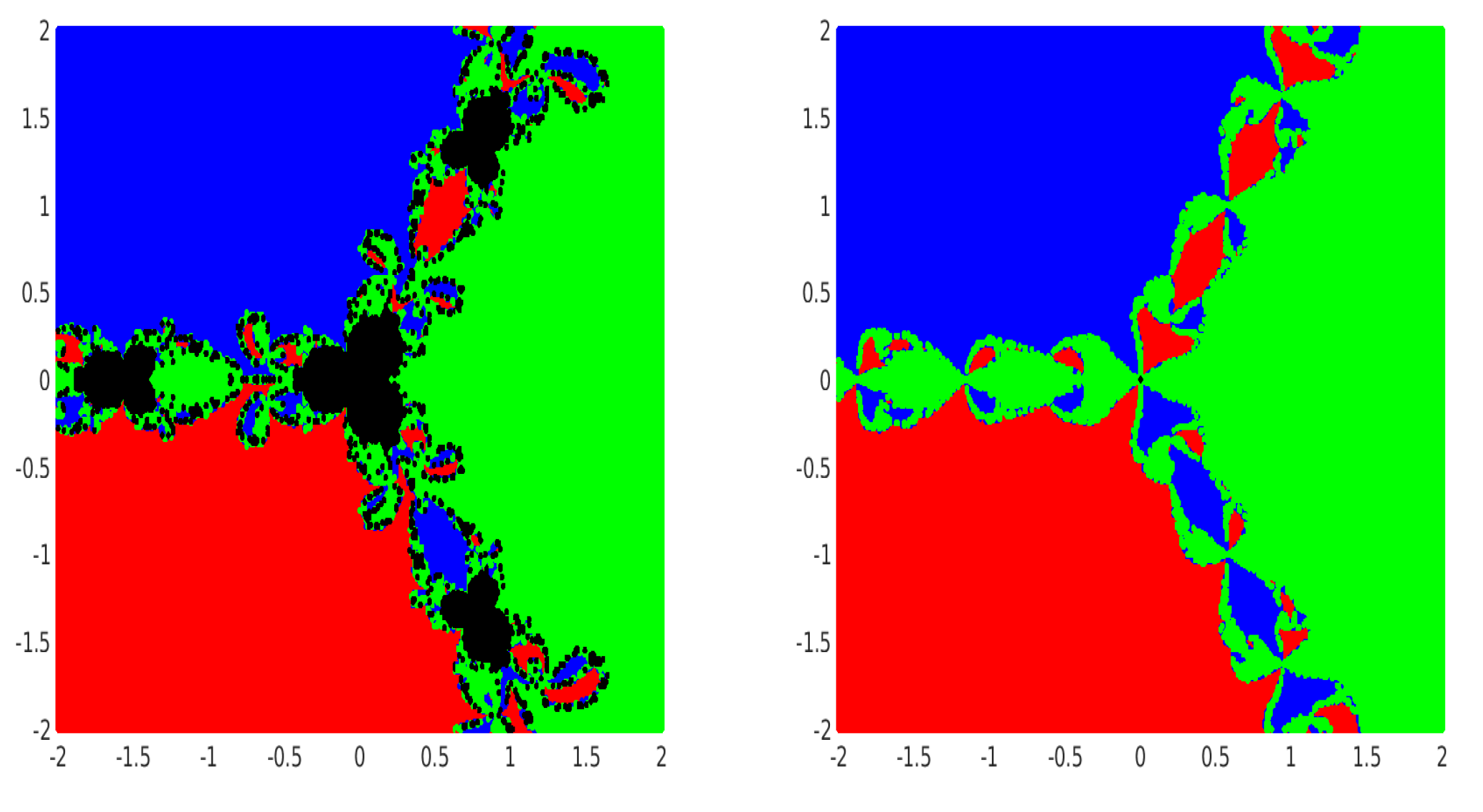
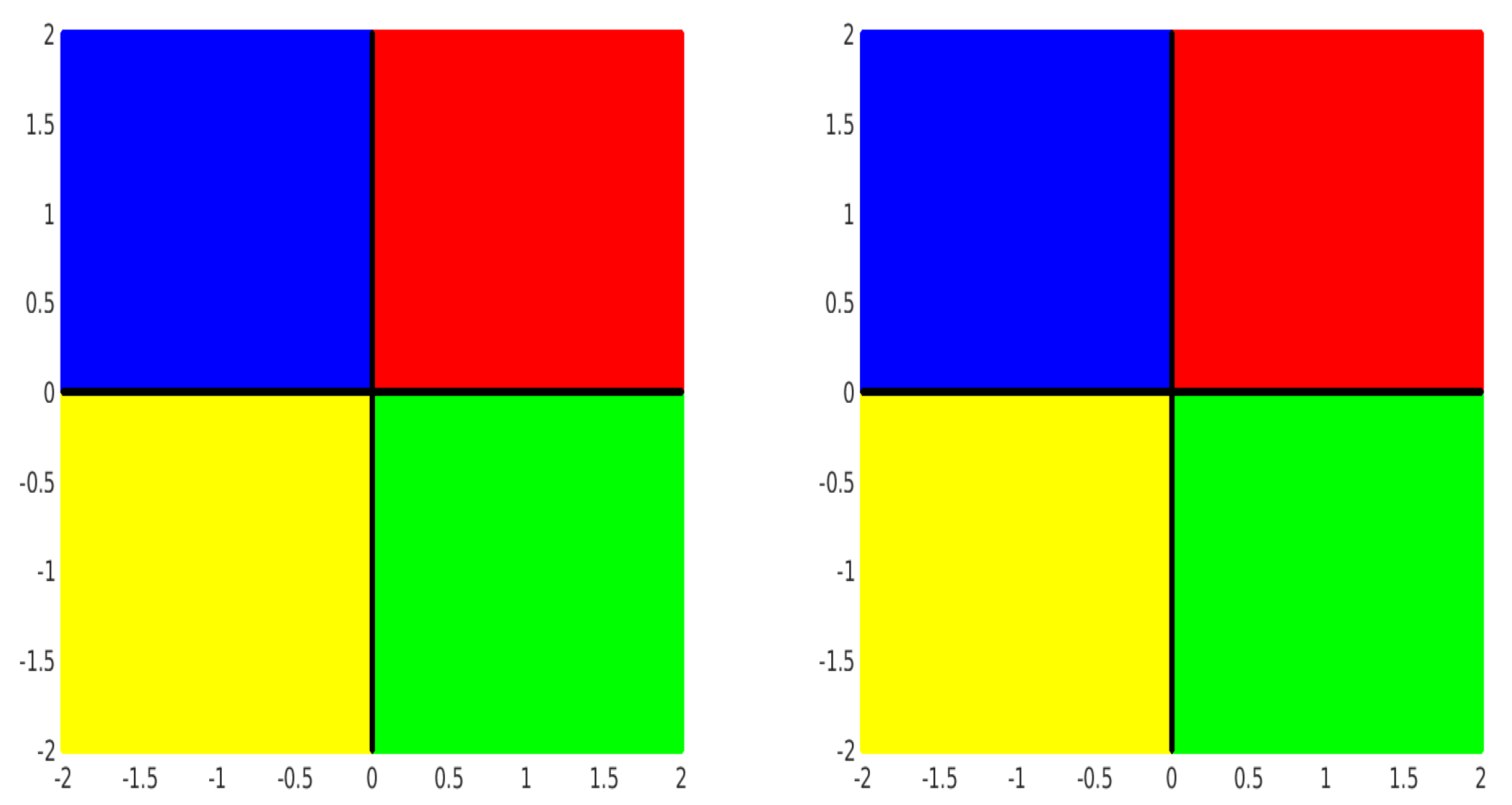
For generating the basin of attraction associated with each root of a given system of nonlinear equations, we consider the rectangular region , which contains all the roots of test problems. We consider an equidistant grid of points in and choose these points as the initial guess , for the methods (2), (3) and (4). A fixed tolerance and a maximum of 50 iterations are used for all the cases. A color is being assigned to each attracting basin corresponding to each root. If we do not obtain the desired tolerance with the fixed iterations, we do not continue and we decide that the iterative method starting at does not converge to any of the roots and assign black color to those points. In this way, we distinguish the basins of attraction by their respective colors for distinct roots of each method.
Figure 1, Figure 2, Figure 3, Figure 4, Figure 5 and Figure 6 demonstrates the basin of attraction corresponding to each root of above Examples (Examples 5–7) for the methods (2), (3) and (4). The Julia set (black region), which contains all the initial points from which the iterative method does not converge to any of the roots, can easily be observed in the figure.
Figure 1.
Dynamical plane of the methods (2) with basins of attraction for the Example 5.
Figure 3.
Dynamical plane of the methods (2) with basins of attraction for Example 6.
Figure 5.
Dynamical plane of method (2) with basins of attraction for Example 7.
The figures presented in this work were created on a 16-core 64 bit Windows machine with Intel Core i7-10700 CPU @ 2.90GHz using MATLAB programming language.
7. Conclusions
A process is developed to determine the convergence order of method (2), method (3) and method (4). The analysis involves only the first and second derivative in contrast to the earlier works using the fourth derivative [7]. Moreover, computable error distances are also provided, which are not given before [7]. Hence, the applicability of these methods is extended. The new process does not depend on these methods. Therefore, it can also be used to extend the usage of other methods of higher order using inverses of linear operators. This is our future topic of research.
Author Contributions
Conceptualization and validation by S.G., J.P., R.S. and I.K.A. All authors have read and agreed to the published version of the manuscript.
Funding
This research received no external funding for APC.
Institutional Review Board Statement
Not applicable.
Informed Consent Statement
Not applicable.
Data Availability Statement
Not applicable.
Acknowledgments
The authors Santhosh George and Jidesh P wish to thank the SERB, Govt. of India for the Project No. CRG/2021/004776. Ramya. S thanks Govt. of India for INSPIRE fellowship.
Conflicts of Interest
The authors declare no conflict of interest.
References
- Cordero, A.; Hueso, J.L.; Martínez, E.; Torregrosa, J.R. Increasing the convergence order of an iterative method for nonlinear systems. Appl. Math. Lett. 2012, 25, 2369–2374. [Google Scholar] [CrossRef]
- Behl, R.; Maroju, P.; Martínez, E.; Singh, S. A study of the local convergence of a fifth order iterative scheme. Indian J. Pure Appl. Math. 2020, 51, 439–455. [Google Scholar]
- Cordero, A.; Martínez, E.; Toregrossa, J.R. Iterative methods of order four and five for systems of nonlinear equations. J. Comput. Appl. Math. 2012, 231, 541–551. [Google Scholar] [CrossRef]
- Argyros, I.K. The Theory and Applications of Iteration Methods, 2nd ed.; Engineering Series; CRC Press, Taylor and Francis Group: Boca Raton, FL, USA, 2022. [Google Scholar]
- Magréñan, A.A.; Argyros, I.K.; Rainer, J.J.; Sicilia, J.A. Ball convergence of a sixth-order Newton-like method based on means under weak conditions. J. Math. Chem. 2018, 56, 2117–2131. [Google Scholar] [CrossRef]
- Shakhno, S.M.; Gnatyshyn, O.P. On an iterative Method of order 1.839… for solving nonlinear least squares problems. Appl. Math. Appl. 2005, 161, 253–264. [Google Scholar]
- Noor, M.A.; Waseem, M. Some iterative methods for solving a system of nonlinear equations. Comput. Math. Appl. 2009, 57, 101–106. [Google Scholar] [CrossRef]
- Kelley, C.T. Iterative Methods for Linear and Nonlinear Equations; SIAM: Philadelphia, PA, USA, 1995. [Google Scholar]
- Argyros, I.K.; George, S.; Argyros, C. On the semi-local convergence of a Noor- Waseem third order method to solve equations. Adv. Appl. Math. Sci. 2022, 21, 6529–6543. [Google Scholar]
- Mannel, F. On the order of convergence of Broyden’s method: Faster convergence on mixed linear-nonlinear systems of equations and a conjecture on the q-order. Calcolo 2021, 58, 47. [Google Scholar] [CrossRef]
- Magréñan, A.A.; Gutiérrez, J.M. Real dynamics for damped Newton’s method applied to cubic polynomials. J. Comput. Appl. Math. 2015, 275, 527–538. [Google Scholar] [CrossRef]
- Schuller, G. On the order of convergence of certain Quasi-Newton-methods. Numer. Math. 1974, 23, 181–192. [Google Scholar] [CrossRef]
- Sharma, J.R.; Guha, R.K.; Sharma, R. An efficient fourth order weighted—Newton scheme for systems of nonlinear equations. Numer. Algorithms 2013, 62, 307–323. [Google Scholar] [CrossRef]
- Traub, J.F. Iterative Methods for the Solution of Equations; Prentice-Hall: Hoboken, NJ, USA, 1964. [Google Scholar]
- Ostrowski, A.M. Solution of Equations in Euclidean and Banach Spaces; Academic Press: Amsterdam, The Netherlands, 1973. [Google Scholar]
- Iliev, A.; Iliev, I. Numerical Method with Order t for Solving System Nonlinear Equations. In Collection of Works from the Scientific Conference Dedicated to 30 Years of FMI; 2000; pp. 105–112. Available online: https://www.researchgate.net/publication/308470689_Numerical_Method_with_Order_t_for_Solving_System_Nonlinear_Equations (accessed on 20 October 2022).
Publisher’s Note: MDPI stays neutral with regard to jurisdictional claims in published maps and institutional affiliations. |
© 2022 by the authors. Licensee MDPI, Basel, Switzerland. This article is an open access article distributed under the terms and conditions of the Creative Commons Attribution (CC BY) license (https://creativecommons.org/licenses/by/4.0/).