Abstract
Fixed-point results on covariant maps and contravariant maps in a -algebra-valued bipolar metric space are proved. Our results generalize and extend some recently obtained results in the existing literature. Our theoretical results in this paper are supported with suitable examples. We have also provided an application to find an analytical solution to the integral equation and the electrical circuit differential equation.
Keywords:
C★-algebra-valued bipolar metric space; covariant maps; contravariant maps; common fixed point MSC:
47H10; 54H25; 54C30
1. Introduction
The Banach contraction principle [1] of 1922 forms the basis for metric fixed-point theory. The principle is not just a source of inspiration but also a point of origin for establishing the fixed-point results both of Hausdorff and of non-Hausdorff topological spaces with vast applications not just in science, technology, engineering, and mathematics (STEM) but also in economics, game theory, and other fields as well. Using this principle, fixed-point results have been established in various topological spaces. Due to its generalized nature, metric space is the obvious choice for any mathematician for applications in real-life situations.
Metric fixed-point theory is used to solve different types of mathematical problems such as dynamic programming, variational inequalities, nonlinear differential equations, fractal dynamics, and satellite launch. It also ensures that patients receive the most appropriate diagnosis, and it examines the intensity of the spread of contagious diseases in a variety of cities.
The study of new space discoveries in mathematics and their basic properties are always favorite topics of interest among the mathematical research community. In this context, the concept of 2-metric spaces was introduced initially by Gahler [2] in his series of papers, and it drew attention to new dimensions for ordinary metric spaces. Since the metric for a pair of points is non-negative real, i.e., , it has wide scope for further study.
Various types of distances such as those between points of a set are considered in metric spaces and their generalization. However, we come across situations where distances arise between elements of two different sets rather than between points of a unique set, wherein the distances between the same type of points are either not known or not defined, due to lack of data. In a Euclidean space, the distance between points and lines; in a metric space, the distance between sets and points; and the reaction rates of pairs from disjoint sets of chemical substances are some examples of such distances. The concept of probabilistic metric spaces in which the probabilistic distance between two points is considered has provided a new dimension for the study of stars in the universe.
Mutlu et al. [3] formalized these types of distances as the bipolar metric, considering them only isometrically without analyzing their topological structures in detail. They introduced the concept of bipolar metric spaces (bpms) and proved certain fixed-point theorems.
Definition 1
([3]). Let Φ and Λ be non empty sets. Let be a map satisfying:
- (a)
- if and only if , for all
- (b)
- , for all
- (c)
- = for all
- (d)
- , for all and .
The pair is a bpms.
Remark 1.
Suppose (a) in the above definition is replaced with as: implies ; then, is a bipolar pseudo-metric space.
In the recent past, mathematicians have established many fixed-point results under various contractive conditions in the setting of bpms (see [4,5,6,7,8,9,10,11,12,13,14,15,16,17,18,19,20,21,22,23,24,25]).
Ma et al. [26] defined the concept of -algebra-valued metric space and proved Banach’s contraction principle. Later, fixed-point results in the setting of a -valued contractive-type map were established by Batul and Kamran [27]. For further details on -algebra, please refer to [28,29,30,31]. Recently, Guna et al. [25] introduced the notion of -algebra-valued bipolar metric space and proved fixed-point results therein. Inspired by the proven results, we establish fixed-point results in the setting of -algebra-valued bipolar metric space and find its application to prove the existence of unique solutions to integral equations.
The rest of the paper is organized as follows: In Section 2, we present certain basic concepts and monographs that are required for our main result. In Section 3, we present our main result of establishing the fixed-point results for covariant and contravariant maps in the setting of -algebra-valued bipolar metric space. We support our main results with suitable non-trivial examples. We present an application to analyze the applicability of our main result for finding the existence of a unique common solution for an integral equation and a voltage differential equation in an electric circuit.
2. Preliminaries
Let us begin with some basic concepts and definitions, which are very essential in the sequel.
An algebra , with a conjugate linear involution map , is called a ★-algebra, if and for all . If contains the identity element ∈, then is a unital ★-algebra. A complete normed unital ★-algebra is called a Banach ★-algebra where the norm on is sub-multiplicative and satisfies for all . If for all , in a Banach ★-algebra , then is known as a -algebra. is called a positive element, if and its spectrum , where = .
denotes the collection of all positive elements that defines a partial order ⪰ on . That is,
Let be the zero element. Then, , if is positive. Each positive element of a -algebra has a unique positive square root denoted by in .
Hereafter, represents a unital -algebra with identity element . Additionally, = and =.
Definition 2
([26]). Let be a -algebra, and Φ, Λ≠ϕ. Let be a map satisfying
- (a)
- iff , for all
- (b)
- , for all
- (c)
- , for all and .
The 4-tuple is a -algebra-valued bipolar metric space.
Lemma 1
([29,31]). Let be a unital -algebra, where is the identity element.
- (A1)
- If , then if and only if .
- (A2)
- If with , then is invertible and .
- (A3)
- Suppose that with and , then .
- (A4)
- By , we denote the set for all . Let , if with , and is an invertible operator, then
Remark 2.
It may be noted that in a -algebra, if , one cannot conclude that .
Definition 3.
Let and be two -algebra-valued bipolar metric spaces and given a map .
- (B1)
- If and , then Υ is called a covariant map, or a map from to , and this is written as⇉.
- (B2)
- If and , then Υ is called a contravariant map from , and this is denoted as:.
Definition 4.
Let be a -algebra-valued bipolar metric space.
- (C1)
- A sequence on the set is called a bisequence on .
- (C2)
- A point is said to be a left point, if , a right point if and a central point if . Similarly, a sequence on the set Φ and a sequence on the set Λ are called left and right sequence, respectively, with respect to .
- (C3)
- A sequence converges to a point ϖ (with respect to ) if is a left sequence, ϖ is a right point, and , or ifis a right sequence, ϖ is a left point, and .
- (C4)
- If both and converge (with respect to ), then the bisequence is said to be convergent (with respect to ). If and both converge (with respect to ) to a same point , then this bisequence is said to be biconvergent (with respect to ).
- (C5)
- A bisequence on is said to be a Cauchy bisequence (with respect to ), if .
- (C6)
- is complete if every Cauchy bisequence (with respect to ) is convergent.
3. Main Results
Now, we present our first fixed-point result using covariant maps in the setting of bpms.
Theorem 1.
Let be a complete -algebra-valued bipolar metric space. Suppose are covariant maps such that
where with . Then, have a unique common fixed point.
Proof.
If , then we are done. Suppose not. Let and . For each , define , and , is a bisequence on . Let and . Then, for each ,
and
Therefore, is a Cauchy bisequence in with regard to . By the completeness of , we have, and , where . Since is a Cauchy bisequence, we have . Now,
As ,
Therefore, .
Note that,
Therefore, . Hence, is the common fixed point of and . To prove uniqueness, suppose that is another common fixed point of and such that . Then,
From the norm of ,
The above inequality holds only when . Hence, . □
Example 1.
Let , , and . Define by
for all and , where is a constant. Consider the partial ordering ⪯ on such that,
Then, is a complete -algebra-valued bipolar metric space.
Define by
and
for all . Now, we consider two cases:
Case 1: Let and , then
where
and .
Case 2: Let and , then
where
and . Both the cases satisfy Theorem 1, and is the unique fixed point of Υ.
Now, we prove a similar result for contravariant maps.
Theorem 2.
Let be a complete -algebra-valued bipolar metric space. Suppose are contravariant maps such that
where with . Then, have a unique common fixed point.
Proof.
If , then we are done. Suppose not. Let and . For each , define , and , . Then, bisequence on . Let . Then, for each ,
Therefore, is a Cauchy bisequence in with respect to . By the completeness of , it follows that and , where . Since is a Cauchy bisequence, we have . Now,
As ,
Therefore, . Note that,
Therefore, . Hence, is a common fixed point of and . Let be a another common fixed point of and such that . Then,
Using the norm of , we have
The above inequality holds only when . Hence, . □
Example 2.
Let , , , and be defined by
for all and , where is a constant. Let ⪯ be the partial order on given by
Then, is a complete -algebra-valued bipolar metric space. Define by
for all . We have the following two cases:
Case 1: Let and ; then,
where
and .
Case 2: Let and ; then,
where
and .
The above two cases satisfy Theorem 2, and is the unique fixed point of Υ.
4. Application
Now, we present an application of Theorem 1 to integral equations.
Theorem 3.
Consider the equations
where is a Lebesgue measurable set. Suppose
- (T1)
- and ,
- (T2)
- there is a continuous function and such thatfor ,
- (T3)
- .
Then, the integral equations have a unique common solution in .
Proof.
Consider two normed linear spaces and , where are Lebesgue measurable sets and . Let . Consider defined by , where is the multiplication operator defined by for . Then, is a complete -algebra-valued bipolar metric space.
Define the covariant maps by
Set , then and . For any ,
One can easily see that Theorem 1 is satisfied as , and hence the integral equations have a unique common solution. □
5. Application to Electric Circuit Differential Equation
In this section, we study the existence and unique solution to an electric circuit differential equation as an application of Theorem 1.
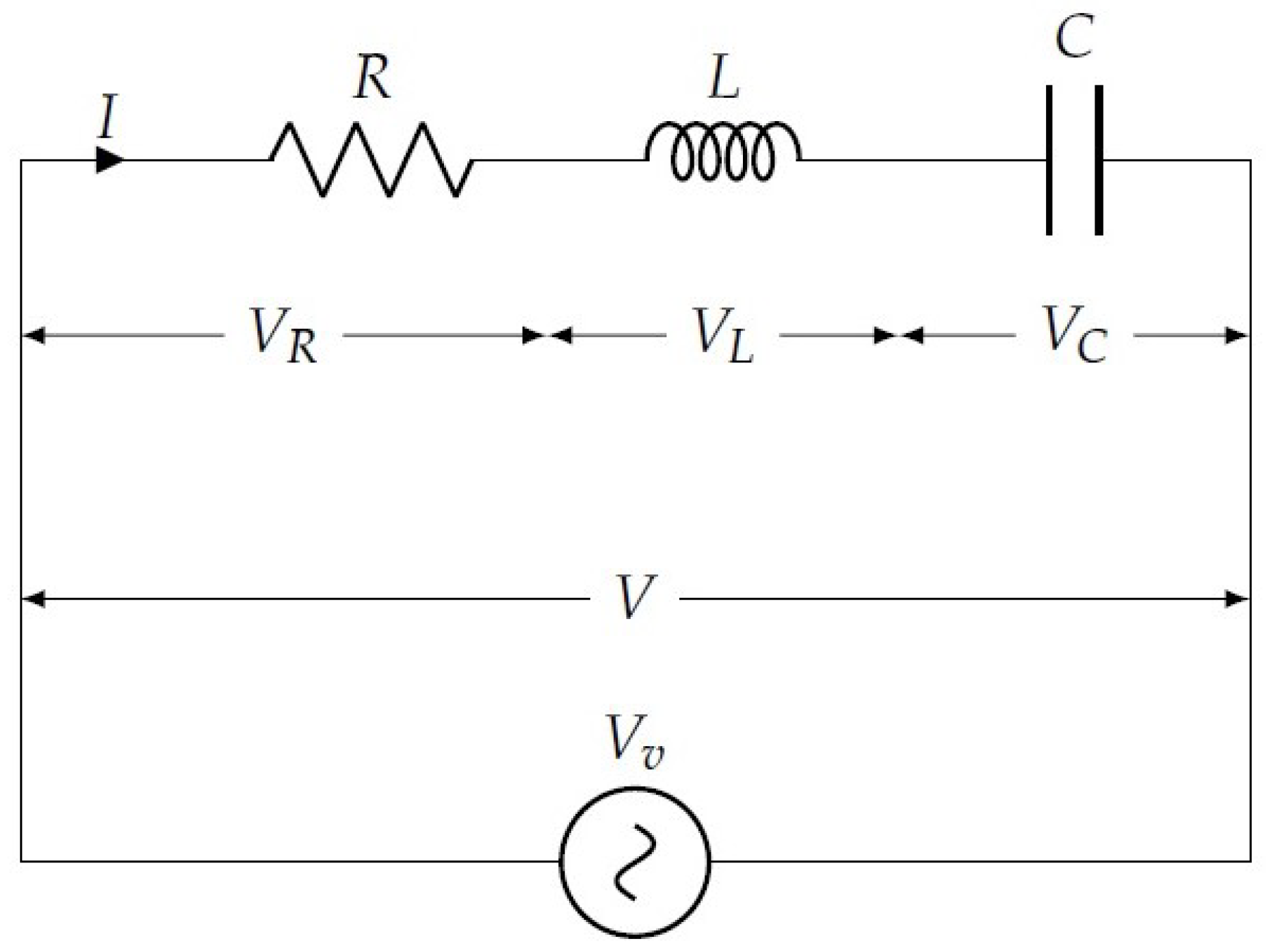
Let us consider a series electric circuit that contains a resistor (, Ohms), a capacitor (, Faradays), an inductor (, Henries), a voltage (, Volts), and an electromotive force (, Volts), as in the following scheme, Figure 1.
Figure 1.
RLC circuit in series.
Considering the definition of the intensity of electric currents , where denote the electric charges and the time, let us recall the following usual formulas:
In a series circuit, the current flowing through the circuit is uniform. So, have the same value throughout the entire circuit.
One of the fundamental laws of circuit theory is Kirchhoff’s voltage law. It states that the algebraic sum of all the voltages around any closed loop in a circuit is equal to zero. Kirchhoff’s Voltage Law is based on the fact that while moving along a closed loop or a circuit, one can find that the starting and ending points are the same. The voltage drop in the circuit equals the voltage source. This implies that there is no voltage loss in the circuit. Voltage drop, if any, will be equal to the voltage source encountered along the way. Mathematically, the sum of the voltage drops equals the sum of the voltage rises across any circuit. Accordingly, we have the following:
The above voltage equation can be expressed as follows:
where and - the nondimensional time for the resonance case in physics.
Moreover,
where, represents the Green function associated with the second order differential Equation (1).
In these conditions, Equation (1) can be expressed as the following set of integral equations.
and is a monotonically nondecreasing map for all .
Let be the set of all continuous functions defined in with values in the interval , and let be the set of all continuous functions defined on with values in the interval . Let and be defined by
for all and , where is a constant. Then, is a complete -algebra-valued bipolar metric space.
Now, let us give the main result of this section.
Theorem 4.
Let be maps such that the following assertions hold:
- (i)
- is a continuous function;
- (ii)
- , is a monotonically non-decreasing function for all such that for , we have the inequality:
- (iii)
- .
Then, the voltage differential Equation (1) has a unique common solution.
Proof.
Define the covariant maps by
and
Now,
where
and . Therefore,
All conditions of Theorem 1 are satisfied. Hence, the differential voltage Equation (1) has a unique common solution. □
6. Conclusions
It has been established that the generalization of the Banach contraction principle in various topological spaces helps in establishing fixed-point results under varius contractive conditions. We established fixed-point results using covariant and contravariant maps in the setting of the -algebra-valued bipolar metric space, supplemented with suitable examples. The derived results have been applied to analyze the existence of the unique common solution to integral equations and the voltage differential equations of electric circuits. This research explores the possibility of establishing fixed-point results using the Ćirić type, the Nadler type, the Prešić type, and the Meir–Keeler type of contractions, in the setting of -algebra-valued bipolar metric space and its applications therein.
Author Contributions
Investigation: G.M. and A.J.G.; methodology: R.R., G.M. and S.R (Stojan Radenović); project administration: R.R. and S.R. (Slobodan Radojevic); software: A.J.G. and V.S.; supervision: R.R., S.R. (Slobodan Radojevic) and S.R. (Stojan Radenović); writing original draft: R.R., V.S. and O.A.A.A.; and writing review and editing: R.R., O.A.A.A., V.S. and S.R. (Stojan Radenović). All authors have read and agreeed to the published version of the manuscript.
Funding
This work has received no external funding.
Institutional Review Board Statement
Not applicable.
Informed Consent Statement
Not applicable.
Data Availability Statement
Not applicable.
Acknowledgments
The research is supported by the Deanship of Scientific Research, Prince Sattam Bin Abdulaziz University, Alkharj.
Conflicts of Interest
The authors declare no conflict of interest.
References
- Banach, S. Sur les operations dans les ensembles abstraits et leurs applications aux equations integrales. Fundam. Math. 1922, 3, 133–181. [Google Scholar] [CrossRef]
- Gahler, S. 2-metricsche Räume und ihre topologische struktur. Math. Nachr. 1963, 26, 115–148. [Google Scholar] [CrossRef]
- Mutlu, A.; Gürdal, U. Bipolar metric spaces and some fixed point theorems. J. Nonlinear Sci. Appl. (JNSA) 2016, 9, 5362–5373. [Google Scholar] [CrossRef]
- Gürdal, U.; Mutlu, A.; Özkan, K. Fixed point theorems for multivalued mappings on bipolar metric spaces. Fixed Point Theory 2020, 21, 271–280. [Google Scholar]
- Kishore, G.N.V.; Agarwal, R.P.; Rao, B.S.; Rao, R.V.N.S. Caristi type cyclic contraction and common fixed point theorems in bipolar metric spaces with applications. Fixed Point Theory Appl. 2018, 2018, 21. [Google Scholar] [CrossRef]
- Kishore, G.N.V.; Prasad, D.R.; Rao, B.S.; Baghavan, V.S. Some applications via common coupled fixed point theorems in bipolar metric spaces. J. Crit. Rev. 2019, 7, 601–607. [Google Scholar]
- Kishore, G.N.V.; Rao, K.P.R.; Sombabu, A.; Rao, R.V.N.S. Related results to hybrid pair of mappings and applications in bipolar metric spaces. J. Math. 2019, 2019, 8485412. [Google Scholar] [CrossRef]
- Rao, B.S.; Kishore, G.N.V.; Kumar, G.K. Geraghty type contraction and common coupled fixed point theorems in bipolar metric spaces with applications to homotopy. Int. J. Math. Trends Technol. (IJMTT) 2018, 63, 25–34. [Google Scholar] [CrossRef]
- Kishore, G.N.V.; Rao, K.P.R.; IsIk, H.; Rao, B.S.; Sombabu, A. Covariant mappings and coupled fixed-point results in bipolar metric spaces. Int. J. Nonlinear Anal. Appl. 2021, 12, 1–15. [Google Scholar]
- Mutlu, A.; Özkan, K.; Gürdal, U. Locally and weakly contractive principle in bipolar metric spaces. TWMS J. Appl. Eng. Math. 2020, 10, 379–388. [Google Scholar]
- Gaba, Y.U.; Aphane, M.; Aydi, H. Contractions in Bipolar Metric Spaces. J. Math. 2021, 2021, 562651. [Google Scholar] [CrossRef]
- Bajović, D.; Mitrović, Z.D.; Saha, M. Remark on contraction principle in conetvs b-metric spaces. J. Anal. 2020, 29, 273–280. [Google Scholar] [CrossRef]
- Bartwal, A.; Dimri, R.C.; Prasad, G. Some fixed point theorems in fuzzy bipolar metric spaces. J. Nonlinear Sci. Appl. 2020, 13, 196–204. [Google Scholar] [CrossRef]
- Debnath, P.; Konwar, N.; Radenović, S. Metric Fixed Point Theory: Applications in Science, Engineering and Behavioural Sciences; Springer Nature: Singapore, 2021. [Google Scholar]
- Mani, G.; Gnanaprakasam, A.J.; Mitrović, Z.D.; Bota, M.F. Solving an Integral Equation via Fuzzy Triple Controlled Bipolar Metric Spaces. Mathematics 2021, 9, 3181. [Google Scholar] [CrossRef]
- Kishore, G.N.V.; Rao, B.S.; Radenović, S.; Huang, H. Caristi Type Cyclic Contraction and Coupled fixed-point results in Bipolar Metric Spaces. Sahand Commu. Math. Anal. (SCMA) 2022, 17, 1–22. [Google Scholar] [CrossRef]
- Murthy, P.P.; Mitrović, Z.D.; Dhuri, C.P.; Radenović, S. The common fixed points in a bipolar metric space. Gulf J. Math 2022, 12, 31–38. [Google Scholar] [CrossRef]
- Mutlu, A.; Ozkan, K.; Gürdal, U. Coupled fixed point theorems on bipolar metric spaces. Eur. J. Pure Appl. Math. 2017, 10, 655–667. [Google Scholar]
- Rao, B.S.; Kishore, G.N.V.; Rao, S.R. Fixed point theorems under new Caristi type contraction in bipolar metric space with applications. Intern. Eng. Technol. 2018, 7, 106–110. [Google Scholar]
- Rao, B.S.; Kishore, G.N.V. Common fixed point theorems in bipolar metric spaces with applications to integral equations. Intern. Eng. Technol. 2018, 7, 1022–1026. [Google Scholar]
- Roy, K.; Saha, M. Generalized contractions and fixed point theorems over bipolar conetvs b-metric spaces with an application to homotopy theory. Mat. Vesn. 2020, 72, 281–296. [Google Scholar]
- Roy, K.; Saha, M. Sequential bipolar metric space and well-posedness of fixed point problems. Int. J. Nonlinear Anal. Appl. 2021, 12, 387–398. [Google Scholar]
- Roy, K.; Saha, M.; George, R.; Gurand, L.; Mitrović, Z.D. Some covariant and contravariant fixed point theorems over bipolar p-metric spaces and applications. Filomat 2022, 36, 1755–1767. [Google Scholar] [CrossRef]
- Rawat, S.; Dimri, R.C.; Bartwal, A. F -bipolar metric spaces and fixed point theorems with applications. J. Math. Comput SCI-JM 2022, 26, 184–195. [Google Scholar] [CrossRef]
- Mani, G.; Gnanaprakasam, A.J.; Haq, A.U.; Baloch, I.A.; Jarad, F. Coupled fixed point theorems on C★-algebra-valued bipolar metric spaces. AIMS Math. 2022, 7, 7552–7568. [Google Scholar] [CrossRef]
- Ma, Z.H.; Jiang, L.N.; Sun, H.K. C*-algebras-valued metric spaces and related fixed point theorems. Fixed Point Theory Appl. 2014, 206. [Google Scholar] [CrossRef]
- Batul, S.; Kamran, T. C★-valued contractive type mappings. Fixed Point Theory Appl. 2015, 2015, 142. [Google Scholar] [CrossRef]
- Davidson, K.R. C★-Algebras by Example. Fields Inst. Monogr. 1996, 6, 309. [Google Scholar]
- Murphy, G.J. C*-algebra and Operator Theory; Academic Press: San Diego, CA, USA, 1990; ISBN 978-0-08-092496-0. [Google Scholar]
- Xu, Q.H.; Bieke, T.E.D.; Chen, Z.Q. Introduction to Operator Algebras and Non Commutative Lp Spaces; Science Press: Beijing, China, 2010. (In Chinese) [Google Scholar]
- Douglas, R.G. Banach Algebra Techniques in Operator Theory; Springer: New York, NY, USA, 1972; 216p. [Google Scholar] [CrossRef]
Publisher’s Note: MDPI stays neutral with regard to jurisdictional claims in published maps and institutional affiliations. |
© 2022 by the authors. Licensee MDPI, Basel, Switzerland. This article is an open access article distributed under the terms and conditions of the Creative Commons Attribution (CC BY) license (https://creativecommons.org/licenses/by/4.0/).