Abstract
Shewhart charts are the most commonly utilised control charts for process monitoring in industries with the assumption that the underlying distribution of the quality characteristic is normal. However, this assumption may not always hold true in practice. In this paper, the weighted-variance mean charts are developed and their population standard deviation is estimated using the three subgroup scale estimators, namely the standard deviation, median absolute deviation and standard deviation of trimmed mean for monitoring Weibull distributed data with different coefficients of skewness. This study aims to compare the out-of-control average run length of these charts with the pre-determined fixed value of the in-control ARL in terms of different scale estimators, coefficients of skewness and sample sizes via extensive simulation studies. The results indicate that as the coefficients of skewness increase, the charts tend to detect the out-of-control signal more rapidly under identical magnitude of shift. Meanwhile, as the size of the shift increases under the same coefficient of skewness, the proposed charts are able to locate the shifts quicker and the similar scenarios arise as a sample size raised from 5 to 10. A real data set from survival analysis domain which, possessing Weibull distribution, was to demonstrate the usefulness and applicability of the proposed chart in practice.
Keywords:
weighted-variance; asymmetric control limits; mean chart; Weibull distribution; scale estimator; average run length MSC:
62P30; 62F35; 82-10
1. Introduction
In many industrial processes, it is of utmost importance to ensure that the quality levels of products or services are properly maintained. Control charts appear to be the most effective tool for process monitoring to detect unexpected behaviour such as increases in the process dispersion and/or changes in location parameter with respect to a target value that allow for prompt inquiry and remedial action. Shewhart control charts are among the most common and extensively used by practitioners. One of the fundamental assumptions of Shewhart charts is that the underlying distribution of the quality characteristics is normal. This assumption, however, may not hold true in practice [1,2,3,4,5,6]. Several strategies to create control charts for skewed data have been offered including the increase in sample size, transforming the original data to an approximately normal distribution and nonparametric approach. However, these strategies may have several drawbacks such as the cost of gathering a large sample size, difficulty of finding an appropriate transformation function, and being less efficient as compared to the parametric approaches.
Recently, there has been a great deal of work on the control charts with asymmetric control limits which are constructed for the skewed population. The first approach is to derive the exact distributions of sample statistics to construct location and dispersion control charts, some of which include [2,6,7,8,9]. The advantage of these charts is that it provides a close form of control limits and seems to work adequately when the empirical distribution of the sample statistic is close to the exact distribution. When exact distribution of sample statistic used to monitor the process is not available, the second approach is based on bootstrap methods to obtain the control limits of control charts [10,11,12,13]. As pointed by [10], the bootstrap methods seem to produce estimates that are closer on average to the true values than the standard Shewhart method, in which, the latter benefit is not translated into their performance in terms of in-control average run length. Similar observation can be found in [11,12,13]. The third approach employs the approximation procedures to obtain heuristic control charts. The main feature of these charts is that the control limits are adjusted according to the coefficient of skewness of a population distribution so that the probability of type I risk remains as close as the desired level. For instance, ref. [14] proposed the weighted-variance (WV) mean and range control charts. Their method produces asymmetric control limits which cater for different skewness of the underlying distribution. The simulation result indicates that the WV mean chart provides a closer coverage probability to the target value than the Cowden and Shewhart charts under the assumption that the data follow a Weibull distribution. The authors of [15] offered the WV mean and range control charts, in which the population standard deviation was estimated using the mean of sample standard deviations or sample ranges to obtain the control limits. Simulation results also revealed that the WV and Shewhart mean control charts gained a comparable probability of type I risk for a symmetrical distribution, and better still, the WV chart outperformed the Shewhart chart and geometric midrange chart of Ferrell when the underlying populations are skewed. Meanwhile, research in [1] constituted the scaled weighted-variance (SWV) mean chart which was an extension of the WV control chart of [14]. Simulations have shown that SWV control chart gives a closer probability of type I risk than the Shewhart and WV charts. However, the estimated probability of type I risk is still approximately one to two times larger than the target value for the large skewness and small sample size under a Weibull distribution. Furthermore, the out-of-control average run length (ARL1) of the SWV chart is always less than the Shewhart and WV charts in the case of a negative shift. In addition, ref. [16] considered a skewness correction (SC) method for correcting the Shewhart mean chart’ control limits according to the coefficients of skewness of the distribution. All indications are that the SC chart yields a closer probability of type I risk value to the target value in comparison to the WV and Shewhart charts under different underlying distributions. Nevertheless, the WV chart is not only easier to be computed in contrast to the SC chart in practice but also that the probability of type I risk of SC chart is larger than the target value for sample size which is smaller than five and the skewness which is larger than one.
Besides considering the asymmetric control limits of the location and dispersion control charts under skewed distributions, robust estimators which are less sensitive to distributional distortions can be substituted into the non-robust estimators in these charts, and control limits are formulated based on some specific skewed distributions. Various works on control charts that are based on robust estimators to strengthen their robustness are developed. Examples of robust estimators used in control charts include trimmed mean (TM) and TM of the ranges [17], interquartile range (IQR) [18], median absolute deviation (MAD) [19,20,21], median absolute deviation from the median [22], M-estimator [23,24], square A estimator [25] and screening method [26]. Recent research to compare the performances of various control charts using different robust location and/or scale estimators under non-skewed/skewed distribution can be found in [27,28,29,30,31].
To the best of our knowledge, there have been few studies on robust heuristic control charts. Ref. [32], for instance, developed the robust WV and SC range charts by substituting the range with an IQR to investigate the influence of the robust estimator on control chart performance in a skewed population with a moderate sample size. Comparative studies show that the non-robust charts perform poorly for the contaminated skewed data. However, the robust SC chart yields the largest ARL in contrasting to the robust Shewhart and WV charts for all skewed distributions under contamination. To this end, ref. [27] proposed the robust versions of modified Shewhart charts which are the modified MV and SC methods based on the TM and IQR estimators to construct the control limits of robust control charts for monitoring the skewed and contaminated process. Although the performance of proposed methods differs with various coefficients of skewness and sample sizes, they are quite favourable substitution in process monitoring when the mean of a skewed population is contaminated. Such research is still in its infancy and may have a contribution to make unravelling to the understanding of these concerns.
Moreover, when dealing with quality characteristic in survival analysis and reliability analysis, one of the issues is that the normal distribution may not be appropriate to describe their variations in which case it may possess Weibull distribution in most of the situations. Therefore, control charts having Weibull distributed properties has much potential in application with statistical process monitoring. Among the charts encompassing these areas, at present, include Shewhart-type and charts for monitoring scale and shape parameters of a Weibull distributed process by transforming a Weibull distribution to a normal distribution [33], maximum exponential weighted moving average (MaxEWMA) chart to inspect a Weibull process with individual measurements [34], Shewhart control charts to monitor the Weibull mean through reparameterization of its probability density function expressed in term of process mean [6], moving average-EWMA chart for the number of defective counts which follows Weibull distribution [35] and also the Shewhart control charts to monitor over the Weibull mean by means of Gamma distribution via transformation [36].
Another concern that needs to be addressed is that the scaling factors of some existing robust scale estimators to estimate population standard deviation are computed based on the assumption of normality. As a result, it tends to be inappropriate to apply into the existing scaling factors in construction of the control limits for location or dispersion charts when the underlying population distribution is skewed. Investigation on this area has not yet been much explored that it may deserve more attention.
The contributions of this study are four folds. Firstly, we present the scaling factors of subgroup standard deviation, subgroup MAD and subgroup standard deviation of the trimmed mean (TS) as scale estimators for the population standard deviation under the Weibull distribution with different coefficients of skewness as well as various sample sizes. These scaling factors are useful inputs to formulate location charts where the population standard deviation is estimated by means of these scale estimators. Secondly, the modified WV mean chart is constructed by incorporating different scale estimators to establish the asymmetric control limits for Weibull data with different coefficients of skewness. The factors and multipliers of the asymmetric control limits are then determined for the pre-fixed probability of type I risk for various coefficients of skewness and sample sizes. Thirdly, we investigate the effects of scale estimator, coefficient of skewness and sample size on the in-control and out-of-control ARL performances for these charts. Lastly, we apply the proposed control charts to the data set concerning the failure times of accelerated life test experiment excerpted from [37].
The remainder of this paper is organised as follows: A general formulation of control chart and Shewhart mean charts with symmetric control limits are introduced in Section 2. Section 3 illustrates the scaling factors of different scale estimators and the development of the modified WV mean control charts. Section 4 presents the simulation studies to assess the in-control and out-of-control ARLs performance for different charts in terms of the scale estimators adopted, coefficients of skewness and sample sizes. The application of real data set to demonstrate the usefulness of the proposed charts will be presented in Section 5. Finally, Section 6 will conclude this paper.
2. Symmetric Control Limits of Mean Control Charts
Suppose be a random sample of size from a symmetrical distribution with mean and standard deviation . The control limits and centre line of the -sigma mean control chart can be determined using
where LCL and UCL are, respectively, the lower and upper control limits, CL is the centre line and is the “distance” of the control limits from the centre line, expressed in standard deviation units. A common choice for is 3 as the usual 3-sigma symmetric control limits implying that the probability of type I risk, when the data are normally distributed.
2.1. Shewhart Mean Control Charts
In practice, the process mean and standard deviation are unknown. Therefore, these two parameters can be estimated based on the samples. Let be the -th observation in the -th subgroup having a normal distribution with unknown and unknown where Let be the means of subgroups with each subgroup containing n observations. The control limits and CL of the Shewhart mean () control chart are as follows:
where is an estimator of and is the estimator of which can be computed from one of the following two scale estimators: (i) and (ii) , with and are, respectively, the -th subgroup range () and standard deviation () of observations, and and are the scaling factors depending on . For the data distributed according to a normal distribution, and values for different can be found in [38].
3. Scale Estimators and Modified Weighted-Variance Mean Control Charts
The modified WV mean charts are formulated to obtain the asymmetric control limits for different coefficients of skewness of a Weibull distribution. Since the population standard deviation is unknown, we estimate the population standard deviation by relating it with each of the scale estimators through a linear function incorporating with a scaling factor.
Assume that a random variable has a Weibull distribution with probability density function given by
where is the scale parameter and is the shape parameter. The first three central moments are (i) mean: , (ii) variance: , and (iii) skewness: . Table 1 shows the different coefficients of skewness for a Weibull distribution with their corresponding when . Note that corresponds to the symmetrical distribution with zero skewness.
Table 1.
Parameters and the corresponding levels of skewness of a Weibull distribution.
3.1. Scaling Factors of Scale Estimators
The scaling factor, that relates the population standard deviation, with scale estimator, is obtained such that . There are three different scale estimators considered which are as below:
- Mean of subgroup standard deviations
- 2.
- Mean of subgroup MADs
- 3.
- Trimmed mean of subgroup standard deviations of trimmed mean
The estimated average scaling factors of these scale estimators were established via simulation using subgroups and replications. Table 2 reports the estimated scaling factors, and of the scale estimators for ranging from 2 to 20 and different coefficients of skewness of a Weibull distribution.
Table 2.
Estimated scaling factors of three scale estimators with different and of a Weibull distribution.
3.2. Modified Weighted-Variance (WV) Mean Control Charts
WV mean () and range () control charts for skewed population distribution was proposed by [14]. Instead of formulating the WV charts with range as the scale estimator, we proposed using the modified WV (denoted as WV hereafter) charts with their population standard deviation estimated on the basis of different scale estimators expressed as follows:
- WV mean charts
The control limits and CL of the WV chart are
where is estimated using sample means and mean of subgroup means, which is defined as , with for or for , and is the estimated population standard deviation computed using scale estimator where standard deviation (S), MAD (M) and TM (T), as given in Section 3.1. The values of and are, respectively, the lower () and upper () constants of a WV chart which are depending on and coefficients of skewness of the population distribution.
For a fixed value of the probability of type I risk, , the constants and of the WV charts can be specified using
where and are, respectively, the average simulated values of the pre-calculated lower and upper control limits with each simulated control limits are obtained using percentile method such that , is an average value of the subgroup means based on subgroups of size , is the estimated standard deviation of , and , with for or for . The averages of and based on replications are reported in Table 3.
Table 3.
Constants of the WV mean charts with different and of a Weibull distribution.
The asymmetric control limits for WV control charts with different scale estimators are given as follows:
- 2.
- Modified WV mean charts
- WV chart with mean of subgroup standard deviations (denoted as ):where and are, respectively, the multipliers of the lower and upper control limits.
- WV chart with mean of subgroup MADs (denoted as ):where and are, respectively, the multipliers of the lower and upper control limits.
- WV chart with trimmed mean of subgroup standard deviations of trimmed mean (denoted as ):where and are, respectively, the multipliers of the lower and upper control limits. Meanwhile, the multipliers of all WV charts are tabulated Table 4.
Table 4. Multipliers for the WV mean charts with different and of a Weibull distribution.
4. Sensitivity Analysis
To assess the performance of the WV charts with different scale estimators, the sensitivity analysis was carried out in two scenarios: in-control and out-of-control ARL. In Scenario I, the in-control ARL performance of the modified WV charts using the constant 3 (denoted as 3-sigma), and and (denoted as -sigma, in Section 3.2 were computed and compared across their scale estimators, coefficients of skewness and sample sizes. While in Scenario II, the performance of these charts was evaluated using -sigma control limits when the mean, standard deviation and skewness are shifted simultaneously.
4.1. Comparison of In-Control ARL in Scenario I
ARL is the average number of points that must be plotted before a point indicates an out-of-control condition. When the process is in-control, the higher is desirable, indicating that the control chart provides less frequent false alarm. For the data under a normal distribution, the Shewhart mean charts with 3-sigma limits gives the when .
To investigate the changes in of the WV charts with 3-sigma and -sigma control limits for the fixed value of , we had performed extensive simulation studies developed using R programming language. To be explicit, the sequence of simulation steps is elaborated below:
- First, a dataset consisting of samples of size is generated from the Weibull distribution with shape parameter which corresponds to mean = 0.99, standard deviation = 0.03 and skewness, .
- On the basis of the simulated samples, both and are estimated using and as described in Section 2.1 and Section 3.2, respectively, while is estimated using one of the three scale estimators as indicated in Section 3.1. The process is repeated for 10,000 runs to acquire the average values for the estimated population mean, and standard deviation.
- It is then followed by the calculation of the 3-sigma and -sigma control limits of the WV chart as specified in Section 3.2, and to determine the final control limits, the steps 1 and 2 are repeated for 10,000 runs to obtain the average values of the corresponding limits.
- Upon completion of step 3, the series of subgroup samples of size from the identical distribution as in step 1 are generated and the respective subgroup means for each sample will be computed until the first subgroup mean exceeds the control limits which will be recorded as a run length.
- To achieve a specific accuracy, step 4 is repeated for 10,000 times so that the average run length for in-control case can be determined by taking the average value of these 10,000 replicates.
- For other combination of cases, the similar procedure as demonstrated in steps 1 to 5 is employed under different types of scale estimators with various sample sizes and coefficients of skewness for Weibull distribution.
Table 5 reports the results of of these charts for and . Results indicated that the s for all the WV charts with -sigma control limits are approximately 370 implying the appropriateness of the suggested constants and multipliers (see Table 3 and Table 4) for different coefficients of skewness. However, for the WV charts with 3-sigma control limits, the s are highly affected by the coefficients of skewness. This indicates that the inappropriate use of the constants will affect the performance of the control charts. Table 6 highlights the average lengths of the -sigma control limits for the modified WV charts. The average lengths of each WV control charts are approximately equal regardless of the scale estimators and becoming larger as the coefficients of skewness increase.
Table 5.
for the WV mean control charts with different and of a Weibull distribution.
Table 6.
Average length of the control limits for the WV control charts.
4.2. Comparison of Out-of-Control ARL in Scenario II
When abnormal fluctuations occur in the process, the smaller is desirable indicating that the control chart will be able to detect the shift quicker. To explore the performance and behaviour from the proposed scale estimators, this section will make comparison on the WV charts under different scale estimators as elaborated in Section 3.
For illustrative purposes, random subgroups of size were generated from a Weibull distribution with shape parameter for , where represents the size of shift of the shape parameter. For the case where the data follow a Weibull distribution with parameter , the control limits for the WV charts were constructed based on 30 subgroups, and to obtain the final control limits, the procedure was then repeated for 10,000 runs to gain the average values of the limits for the charts. This is followed by the computation of estimates from the newly generated subgroups from the Weibull distribution with shape parameter . The number of samples required to exceed the control limits is recorded as out-of-control run length. More precisely, the is determined from the average of 10,000 simulated runs.
Table 7 presents the of WV charts for the case where the size of shift, , with different values of and . From the result, when the process is in-control, the data stemming from the Weibull distribution with the shape parameter give the in-control statistics with the skewnessin (SKin) , meanin (Meanin) = 0.99, standard deviationin (SDin) = 0.03 and coefficient of variationin (CVin) = 0.03. Meanwhile, when the process is out-of-control in which the data coming from the Weibull distribution with shifted shape parameter , all the out-of-control statistics are shifted with the small change in mean of about 0.01. In general, as decreases, the in-control and out-of-control statistics indicate that the skewness, mean and standard deviation increase simultaneously. Furthermore, the CV value for in-control and out-of-control statistics also tend to become larger as the values become smaller (or for large skewness). Consider , and the case , we observed that the for WV charts require around 16 to 17 samples to detect the shift and values of WV charts are not affected by the scale estimators. As for the case , the data shape distribution skewed positively with SKin = 2.0, Meanin = 1.00 and SDin = 1.00. Meanwhile, when the shape parameter is shifted to , the skewness is increased to SKout = 3.22, and their mean is increased to Meanin = 1.5. It is noted that the change in mean of 0.5 (or CV from CVin = 1.00 to CVout = 1.76) will require eight samples for the shift to be detected.
Table 7.
values of the WV mean chart for the case .
For , we found that the of the WV charts regardless of the scale estimators are consistently smaller than those based on under the same coefficient of skewness. Moreover, the values become smaller when decreases resulting in the larger values of skewness and CV, that is, the charts are able to detect the shift more quickly. The remaining shape parameters with the same size of shift are reported in Table 7.
Table 8 shows the values of WV charts for when in which the left panel of the Table 8 reports the results for . For the WV chart with (skewness = ), it can be seen that the chart is able to detect the shift sooner when size of shift changes from 0.8 to 0.2 (or equivalent to the larger change in skewness and CV values). Similar patterns are observed across the values ranging from 0.8 to 0.2 for various values. However, under the same when values are varied from small to large, that is, when all the Meanin, SDin and SKin are increased simultaneously, we observed that the shift tends to be detected quicker by the chart. In the meantime, the analogous patterns are noticed when adopting the WV and WV charts. As shown in the right panel of the Table 8, the for the are presented and once again, all WV charts appear to the shift faster. Furthermore, it was observed that chart is able to detect shift marginally quicker than other charts specifically for the case when and SKin .
Table 8.
values of the WV mean chart for different values.
5. Empirical Example
This section employed the proposed control charts for the data excerpted from [37]. The data set containing the simulated failure times from an accelerated life test experiment consists of 30 subgroups of size each. The p-value of the goodness-of-fit test is found to be 0.858 which indicates that the data can be modelled by the Weibull distribution with and . Using these estimate values, the corresponding calculated skewness (see Section 3) is 2.25 implying that the distribution of the data is positively skewed.
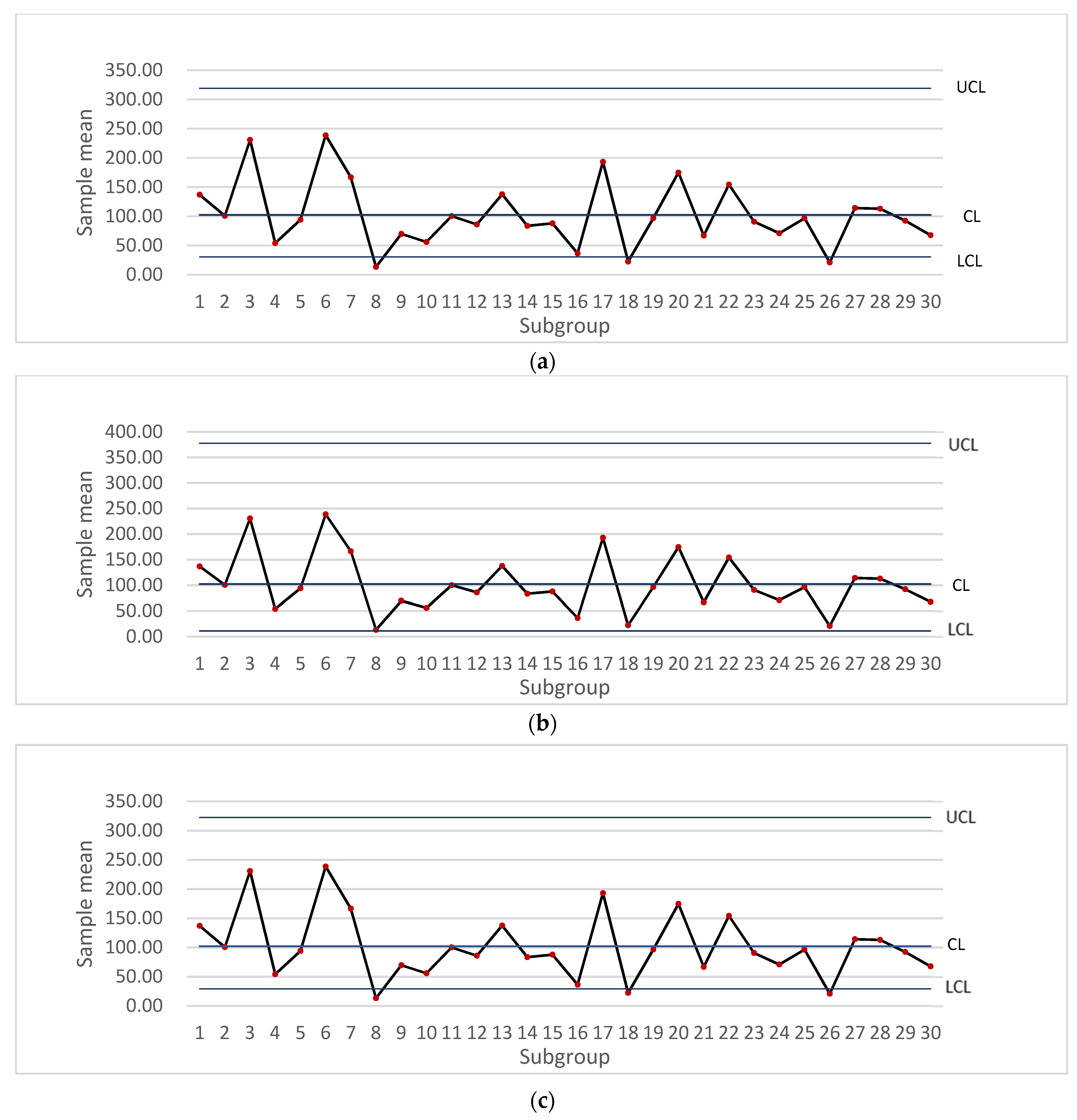
To set up the three MV mean control charts, we first compute the respective averages of subgroup means and scale estimates together with . On the basis of Table 4, the multipliers of these charts are adopted, respectively, when . The lower and upper control limits of WV is [30.58, 318.99], WV is [11.17, 377.62] and WV is [29.32, 322.52]. As observed in Figure 1a–c, the plots of MV mean charts based on the three scale estimators show that only WV does not detect out-of-control signal. As opposed to that, it is worth noting that both WV and WV incorrectly signal out-of-control in this specific application indicated by points 8, 18 and 26, respectively.
Figure 1.
(a) WV ; (b) WV ; (c) WV control charts for the failure times data.
6. Conclusions
To summarise, in this paper, the WV approach to construct the asymmetric control limits of the control charts is offered for monitoring the data stemming from the skewed distribution. The proposed WV approach intends to construct the mean chart with three different scale estimators encompassing the standard deviation, MAD and trimmed standard deviation, for monitoring the data generated from a Weibull distribution with different coefficients of skewness. Consequently, the WV mean charts’ constants based on the probability of type I risk of 0.0027 are determined via extensive simulation studies.
In terms of the , the results suggested that for WV mean charts regardless of the scale estimators with -sigma asymmetrical control limits attain the target value with a fixed probability of type I risk for different coefficients of skewness. However, for 3-sigma control limits is highly affected by the skewness of the underlying distribution. It can be seen that all three charts appear to perform poorly when with the increase in the coefficients of the skewness and it turns out that WV is relatively the best which can also be enhanced by increasing the sample size. As for the of the WV mean charts under different coefficients of skewness, all charts perform equally well irrespective of the scale estimators used. When the coefficient of skewness increases, these charts are able to detect shift faster. Furthermore, as the size of the shift ( for the shape parameter decreases from 0.4 to 0.2, all charts manage to detect shift more rapidly () for different coefficients of skewness of the data. Analogously, larger sample size tends to improve the performance of these charts as well in detecting the shift. Meanwhile, an empirical data set excerpted from [37] via failure times from an accelerated life test experiment were carried out to assess the performance of the proposed charts. The findings seem to suggest that the control chart based on WV measure may gain some potential benefit as compared to those based on WV and WV .
Despite the encouraging results of this study, the WV mean chart may be extended to employing more appealing robust location or scale estimator such as M-estimator and M-Scale in determining their control limits when the underlying distribution is skewed. Perhaps, future research could also examine the effect of the outliers on the performance of ARL for these charts. Moreover, as the control limits of WV charts are derived specifically under Weibull distributed data with different coefficients of skewness, the bootstrap control chart might be another domain that worth exploring which encompasses more flexible skewed distributions with a wider range of coefficient of skewness.
Author Contributions
Conceptualization, K.H.N. (Kok Haur Ng); Data curation, J.J.Z.; Formal analysis, J.J.Z. and K.H.N. (Kok Haur Ng); Funding acquisition, K.H.N. (Kok Haur Ng); Methodology, J.J.Z., K.H.N. (Kok Haur Ng) and K.H.N. (Kooi Huat Ng); Software, J.J.Z.; Supervision, K.H.N. (Kok Haur Ng); Validation, K.H.N. (Kok Haur Ng); Visualization, Y.B.K.; Writing—original draft, J.J.Z., K.H.N. (Kok Haur Ng), K.H.N. (Kooi Huat Ng), S.P. and Y.B.K.; Writing—review and editing, K.H.N. (Kok Haur Ng), K.H.N. (Kooi Huat Ng), S.P. and Y.B.K. All authors have read and agreed to the published version of the manuscript.
Funding
This work was partially supported by the Ministry of Higher Education (MOHE), Malaysia under the Fundamental Research Grant Scheme (FRGS) with grant no: FP018-2013A.
Institutional Review Board Statement
Not applicable.
Informed Consent Statement
Not applicable.
Data Availability Statement
The simulated failure times were excerpted from [34].
Acknowledgments
The authors would like to thank the editors and anonymous reviewers for their valuable and constructive comments to improve the quality of the paper.
Conflicts of Interest
The authors declare no conflict of interest.
References
- Castagliola, P. control chart for skewed populations using a scaled weighted variance method. Int. J. Reliab. Qual. Saf. Eng. 2000, 7, 237–252. [Google Scholar] [CrossRef]
- Li, C.I.; Su, N.C.; Su, P.F.; Shyr, Y. The design of and R control charts for skew normal distributed data. Commun. Stat.–Theory Methods 2014, 43, 4908–4924. [Google Scholar] [CrossRef]
- Huang, W.H.; Wang, H.; Yeh, A.B. Control charts for the lognormal mean. Qual. Reliab. Eng. Int. 2015, 32, 1407–1416. [Google Scholar] [CrossRef]
- Huberts, L.C.; Schoonhoven, M.; Goedhart, R.; Diko, M.D.; Does, R.J. The performance of control charts for large non-normally distributed datasets. Qual. Reliab. Eng. Int. 2018, 34, 979–996. [Google Scholar] [CrossRef]
- Khan, N.; Aslam, M.; Khan, M.Z.; Jun, C.H. A variable control chart under the truncated life test for a Weibull distribution. Technologies 2018, 6, 55. [Google Scholar] [CrossRef]
- Fernandes, F.H.; Ho, L.L.; Bourguignon, M. About Shewhart control charts to monitor the Weibull mean. Qual. Reliab. Eng. Int. 2019, 35, 2343–2357. [Google Scholar] [CrossRef]
- Chen, H.; Kuo, W.L. Comparisons of the symmetric and asymmetric control limits for and R charts. Comput. Ind. Eng. 2010, 59, 903–910. [Google Scholar] [CrossRef]
- Kao, S.C. and R control charts based on weighted variance with left-right tail-weighted ratio for skewed distributions. Commun. Stat. Simul. Comput. 2017, 46, 2714–2732. [Google Scholar] [CrossRef]
- Bilal, M.; Mohsin, M.; Aslam, M. Weibull-exponential distribution and its application in monitoring industrial process. Math. Probl. Eng. 2021, 2021, 6650237. [Google Scholar] [CrossRef]
- Jones, L.A.; Woodall, W.H. The performance of bootstrap control charts. J. Qual. Technol. 1998, 30, 362–375. [Google Scholar] [CrossRef]
- Nichols, M.D.; Padgett, W.J. A bootstrap control chart for Weibull percentiles. Qual. Reliab. Eng. Int. 2006, 22, 141–151. [Google Scholar] [CrossRef]
- Lio, Y.L.; Park, C. A bootstrap control chart for Birnbaum–Saunders percentiles. Qual. Reliab. Eng. Int. 2008, 24, 585–600. [Google Scholar] [CrossRef]
- Burkhalter, R.; Lio, Y. Bootstrap control charts for the generalized Pareto distribution percentiles. Chil. J. Stat. 2021, 12, 3–21. [Google Scholar]
- Choobineh, F.; Ballard, J.L. Control-limits of QC charts for skewed distributions using weighted-variance. IEEE Trans. Reliab. 1987, 36, 473–477. [Google Scholar] [CrossRef]
- Bai, D.S.; Choi, I.S. and R control charts for skewed populations. J. Qual. Technol. 1995, 27, 120–131. [Google Scholar] [CrossRef]
- Chan, L.K.; Cui, H.J. Skewness correction and R charts for skewed distributions. Nav. Res. Logist. 2003, 50, 555–573. [Google Scholar] [CrossRef]
- Langenberg, P.; Iglewicz, B. Trimmed mean and R charts. J. Qual. Technol. 1986, 18, 152–161. [Google Scholar] [CrossRef]
- Rocke, D.M. and charts: Robust control charts. J. Roy. Stat. Soc. D-Sta 1992, 41, 97–104. [Google Scholar]
- Abu-Shawiesh, M.O.A. A simple robust control chart based on MAD. J. Math. Stat. 2008, 4, 102–107. [Google Scholar]
- Adekeye, K.S. Modified simple robust control chart based on median absolute deviation. Int. J. Probab. Stat. 2012, 1, 91–95. [Google Scholar] [CrossRef]
- Abbas, T.; Zaman, B.; Atir, A.; Riaz, M.; Akbar Abbasi, S. On improved dispersion control charts under ranked set schemes for normal and non-normal processes. Qual. Reliab. Eng. Int. 2019, 35, 1313–1341. [Google Scholar] [CrossRef]
- Ali, A.; Mahmood, T.; Nazir, H.Z.; Sana, I.; Akhtar, N.; Qamar, S.; Iqbal, M. Control charts for process dispersion parameter under contaminated normal environments. Qual. Reliab. Eng. Int. 2016, 32, 2481–2490. [Google Scholar] [CrossRef]
- Shahriari, H.; Maddahi, A.; Shokouhi, A.H. A robust dispersion control chart based on M-estimate. Int. J. Ind. Syst. 2009, 2, 297–307. [Google Scholar]
- Mutlu, E.Ç.; Alakent, B. Revisiting reweighted robust standard deviation estimators for univariate Shewhart S-charts. Qual. Reliab. Eng. Int. 2019, 35, 995–1009. [Google Scholar] [CrossRef]
- Kao, S.C. A robust standard deviation control chart based on square A estimator. Qual. Reliab. Eng. Int. 2022, 38, 2715–2730. [Google Scholar] [CrossRef]
- Schoonhoven, M.; Does, R.J. A Robust Standard Deviation Control Chart. Technometrics 2012, 54, 73–82. [Google Scholar] [CrossRef]
- Karagöz, D. Asymmetric control limits for range chart with simple robust estimator under the non-normal distributed process. Math. Sci. 2018, 12, 249–262. [Google Scholar] [CrossRef]
- Adekeye, K.S.; Adewara, J.A.; Aako, O.L.; Olaomi, J.O. Performance of median absolute deviation and some alternatives to median absolute deviation control charts for skewed and heavily tailed process. Qual. Reliab. Eng. Int. 2021, 37, 3431–3440. [Google Scholar] [CrossRef]
- Ho, Y.C.; Kao, S.C.; Chou, C.F. Robustness of dispersion control charts in skewed distributions. Int. J. Ind. Eng. 2021, 28, 372–389. [Google Scholar]
- Ng, K.H.; Soon, P.K.; Liew, J.Y.; Ng, K.H. On the sensitivity of robust control charts in monitoring contaminated data. Songklanakarin J. Sci. Technol. 2021, 43, 1610–1619. [Google Scholar]
- Mehmood, R.; Lee, M.H.; Iqbal, M.R.; Hassan, S. New robust location control charts for unknown process distribution with practical significance. Soft Comput. 2022, 26, 137–153. [Google Scholar] [CrossRef]
- Karagöz, D. Robust control chart for monitoring the skewed and contaminated process. Hacettepe J. Math. Stat. 2018, 47, 223–242. [Google Scholar] [CrossRef]
- Faraz, A.; Saniga, E.M.; Heuchenne, C. Shewhart control charts for monitoring reliability with Weibull lifetimes. Qual. Reliab. Eng. Int. 2015, 31, 1565–1574. [Google Scholar] [CrossRef]
- Wang, F.K. MaxEWMA control chart for a Weibull process with individual measurements. Qual. Reliab. Eng. Int. 2017, 33, 369–379. [Google Scholar] [CrossRef]
- Khan, N.; Nawaz, M.S.; Sherwani, R.A.; Aslam, M. Moving average EWMA chart for the Weibull distribution. Commun. Stat. Simul. Comput. 2021, 1–10. [Google Scholar] [CrossRef]
- Vasconcelos, R.M.; Quinino, R.C.; Ho, L.L.; Cruz, F.R. About Shewhart control charts to monitor the Weibull mean based on a Gamma distribution. Qual. Reliab. Eng. Int. 2022, 38, 4210–4222. [Google Scholar] [CrossRef]
- Whitmore, G.A.; Lee, M.L.T. A multivariate survival distribution generated by an inverse Gaussian mixture of exponentials. Technometrics 1991, 33, 39–50. [Google Scholar] [CrossRef]
- Montgomery, D.C. Statistical Quality Control: A Modern Introduction, 8th ed.; John Wiley & Sons: Hoboken, NJ, USA, 2020. [Google Scholar]
Publisher’s Note: MDPI stays neutral with regard to jurisdictional claims in published maps and institutional affiliations. |
© 2022 by the authors. Licensee MDPI, Basel, Switzerland. This article is an open access article distributed under the terms and conditions of the Creative Commons Attribution (CC BY) license (https://creativecommons.org/licenses/by/4.0/).