1. Introduction
In a previous paper [
1], the following problem was studied: what is the probability
that a “leader” exists in a set
of
n i.i.d.
d-dimensional random vectors,
. Various formulae were established. In most cases,
as
If
, it is said that “
has the leader property”. This property is, rather, an exception, not a rule, among the
d-dimensional probability distributions.
The problem was prompted by the relevance of various rankings, which are fashionable today and which are obtained by the unidimensionalization of a data set using different algorithms. For instance: the ranking of the countries by HDI—human development index or by corruption index, of musical hits, of universities, of researchers, or of scientific journals by various ISI factors.
The topic the Pareto maxima or minima in random sets is approached in several articles, such as [
2,
3].
A series of papers study the expected number of maximal vectors in a set of
n elements from a
d-dimensional space: in [
4], this is derived a recurrence relation for computing the average number of maximal vectors under the assumption that all
relative orderings are equally probable, while in [
5], the expected number of maximal vectors is determined explicitly for any
n and
d assuming that the vectors are distributed identically and that the d components of each vector are distributed independently and continuously. See other similar results in [
6].
The asymptotic behaviour of this quantity as
n tends to infinity has also been investigated. For instance, in [
7], the authors proved that the number of maximal points is approximately normally distributed, under given conditions. In addition, see [
4] or [
8].
On the other hand, in [
9] is presented an exact expression for the variance in the number of maxima in a three-dimensional cube.
In [
10], the authors derive a general asymptotic formula for the variance in the number of maxima in a set of independent and identically distributed random vectors in
, where the components of each vector are independently and continuously distributed.
However, the authors in [
1] were not interested in finding Pareto maxima or minima but in the existence of real maximum or minimum in a finite random set. That is, in the existence of a first or last element.
In [
1], the focus was on discrete or absolutely continuous vectors
.
Here, we consider an in-between case: suppose that there exists an imponderable (meaning that it cannot be measured) uni-dimensional random variable which determines the ranking.
Next, suppose that we can measure various effects of X assumed to be functions In this case, the vector becomes . We may hope that now it is easier to compute the probabilities and to decide their limits
It is well-known (see [
11]) that we can always replace the random variable
X by
where
U is uniformly distributed on
and
is the quantile of the distribution function of
X. Thus, there is no restriction if we consider that
X itself is uniformly distributed.
The challenge is to determine the properties of for which has a leader.
3. General Results
Here we show some results that hold without any restrictions on the dimension d of the space. The function is supposed to be bounded measurable and injective.
Definition 1. A partially ordered set C has the property L if it has a last element, that is, if there exists such that for every We say that C has the property F if it has a first element, that is, if there exists an element such that for every Finally, the set C has the property FL if it has both a first element and a last element.
One of the results from [
1], namely, Proposition 2, p. 5, is that: if a distribution
F has the leader/anti-leader/order property, its support
must have the properties L/F/FL.
The support of the distribution F, denoted by is defined to be the intersection of all closed sets M with
In our case, if , it is more or less obvious that the support of F is the closure of the image of :
Thus,
Proposition 2. Let is a random variable uniformly distributed on , let be a bounded measurable function. Let F be the distribution of Then, the following assertions hold:
If then there exists such that for all If then there exists such that for all In the particular case when is increasing then Otherwise written, the function must have a global maximum. If is increasing, this is at
If then there exists such that for all If then there exists such that for all In the particular case when is increasing then Otherwise written, the function must have a global minimum. If is increasing, this is at
If then there exists such that for all If then there exist such that for all Otherwise written, the function must have both a global maximum and a global minimum. In the particular case when is increasing then
Proof. Obvious. The set has a last element if there exists such that for all However, that is equivalent to the fact that for all or, which is the same thing, that for all Now, if then for some □
The next result establishes some relations between the functions defined in (15).
Proposition 3. For an arbitrary function , consider the functions defined by relation (15). Then, the following hold:
- 1.
where is a constant.
- 2.
for any The equality is possible if and only if a.s.
Proof. Let the constant and arbitrarily. Then:
Write relations (15) as , with Remark that and that is all. The equality occurs if and only if a.s. or if a.s. for all
Let such that is an increasing function. The following are obvious:
Remark 5. Ifandthen Remark 6. If then has the same as for instance and so on.
Remark 7. Obviously, if f is non-decreasing then
Actually, this is a good opportunity to check formulae (4)–(6):
Indeed,
In the same way,
In addition, according to Proposition 3 (2),
Thus, and
If we are interested only in and not in , then the following result may help.
Proposition 4. Suppose that has the property that is an increasing function. Then for every the following are true Proof. Obvious. If is increasing then and As the probabilities defined in and verify with and and as , it is obvious that
The same holds for b and □
Finally, we will need the following result ([
1], Lemma 5, p. 18).
Proposition 5. - 1.
Let be continuous at . Then for any
- 2.
Let be increasing and differentiable such that and let g be as above. Then for any
- 3.
Let be continuous.
Then for any
Now we can prove the general result.
Theorem 1. Let be measurable bounded function with the properties: is increasing; is differentiable, increasing in a neighborhood of and such that is continuous is differentiable, decreasing in a neighborhood of and such that its derivative is continuous. The following assertions hold.
- (i)
If If then
- (ii)
If If then
- (iii)
Always
- (iv)
If there exists such that for then
Proof. If then we may choose an small enough such that thus,
If then let be small enough so that on the interval the mapping is an increasing differentiable, and on the interval , the function is a decreasing differentiable.
Then Let ; hence,
It follows that according to Proposition 5 (2).
Next Let ; hence, The same trick.
Finally, If or there is nothing to prove.
If
and
, then
according to Proposition 3 (2). For any
we shall denote
If
then let
be fixed. Let
be small enough such that the mapping
is increasing and differentiable on the interval
and
for every
, the function
is decreasing, and differentiable on the interval
. We shall denote
Let Thus, and . As then . It follows that
As it results that
But thus,
and it remains that
According to (ii), these inequalities can be written as:
As is arbitrarily small, we infer that
To conclude,
(iv). An immediate consequence of the proof of (iii). □
Remark 8. In the above theorem, it is important that at least one of the components of is increasing. Otherwise, all the assertions fail to be true. Consider for example the case when is measurable non decreasing and is any measurable function. If all the quantities are always equal to 1. The reason is that the image of is an increasing curve: if then Many similar examples could be constructed.
4. The Bidimensional Case
We study the case with as a uniformly distributed random variable and a measurable function. Therefore, the function from the previous section is and
We shall consider the functions defined in relations
More exactly, let
for each
.
Let us denote
for each
The next result is a consequence of Proposition 1.
Lemma 1. Let λ be the Lebesgue measure and the functions defined according to (31), (32) and (33).
where the sets and are defined by notation and
Proof. As X is uniformly distributed, it follows that for any borel set Therefore, Next
proving the assertion (34).
The proof of (35) is the same.
Regarding (36),
. □
Definition 2. Let be a measurable function and the functions defined according to (31), (32), (33). We shall say that
f is L-acceptable
if
f is F-acceptable
if
f is F, L-acceptable
if
In words, if with then f is L-acceptable if the distribution function of , has the leader property. In addition, f is F-acceptable if F has the anti-leader property and f is F, L-acceptable if F has the order property.
Obviously, if f is L-acceptable then because otherwise if then . In the same way, if f is F-acceptable then and if f is F,L-acceptable then
According to Proposition 2, if f is L-acceptable then must have a last element.
Remark 9. Let us mention the following interesting fact: A function f is F,L-acceptable if and only if f is both F-acceptable and L -acceptable.
Indeed, if f is F-acceptable then and if f is L-acceptable then
According to Theorem 1 (3), . Therefore, if f is both F-acceptable and L-acceptable it results that and by definition this means that f is F,L-acceptable.
It is known (see [
1]) that
implies that
has a last element. Thus, a natural question is:
If has a last element is it true or not that f is L-acceptable?
For general distribution functions
F we know from [
1] that the answer is no. However, this is a particular case and one could expect that in particular cases the answer is yes.
The answer is still no.
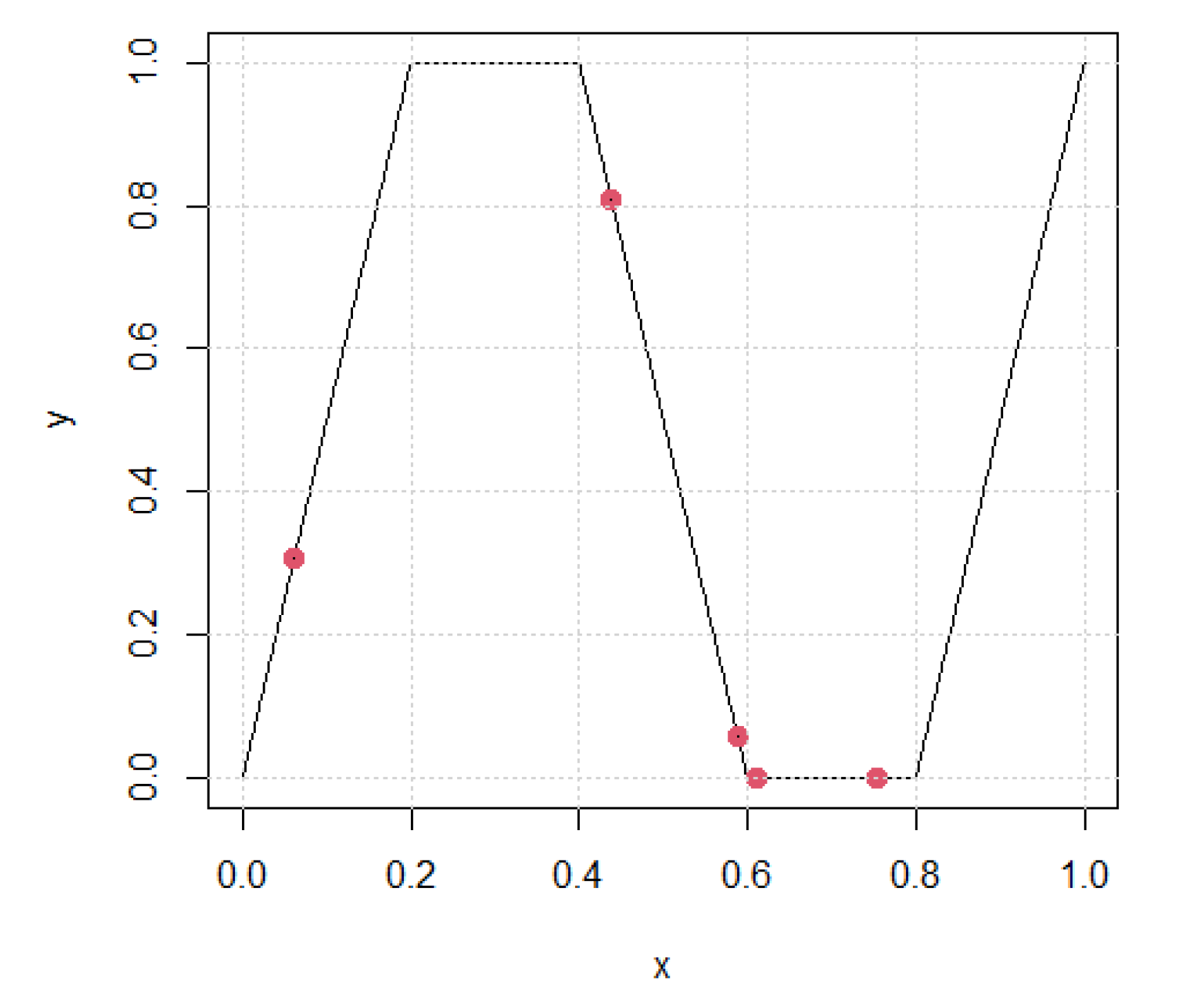
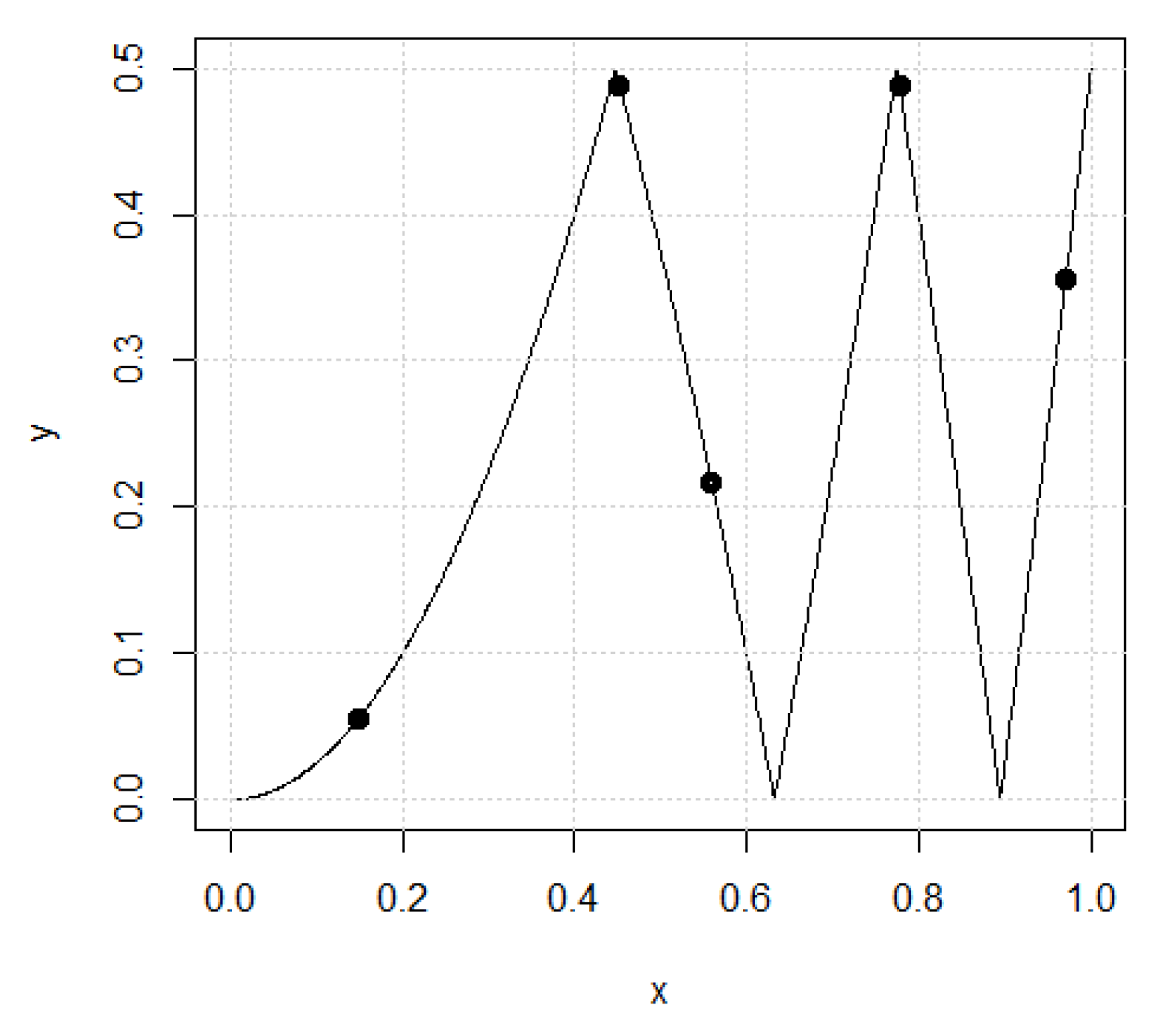
Counterexample 1. Let defined by
In this case,
has
as last element and
as first element (see
Figure 1), but
f is neither F-acceptable nor L-acceptable.
Indeed, writing the functions (29), (30) and (31) as
It follows that
Thus meaning that f is not L-acceptable neither F-acceptable. The fact that should be obvious due to the symmetry of the graph of f with respect to the point
The probability that and are comparable is equal to and the probability that are ordered is equal to
After all, this is not surprising because
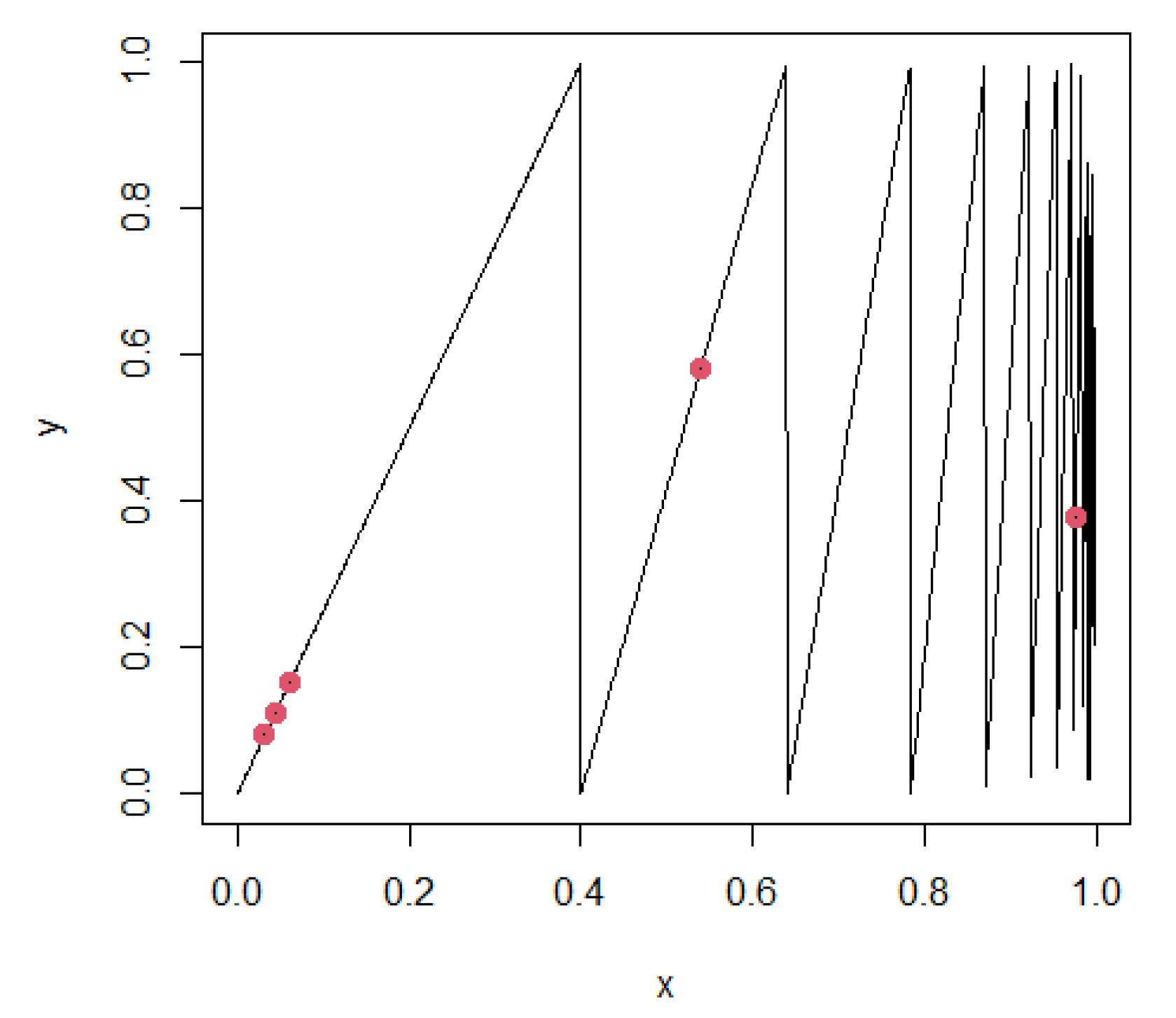
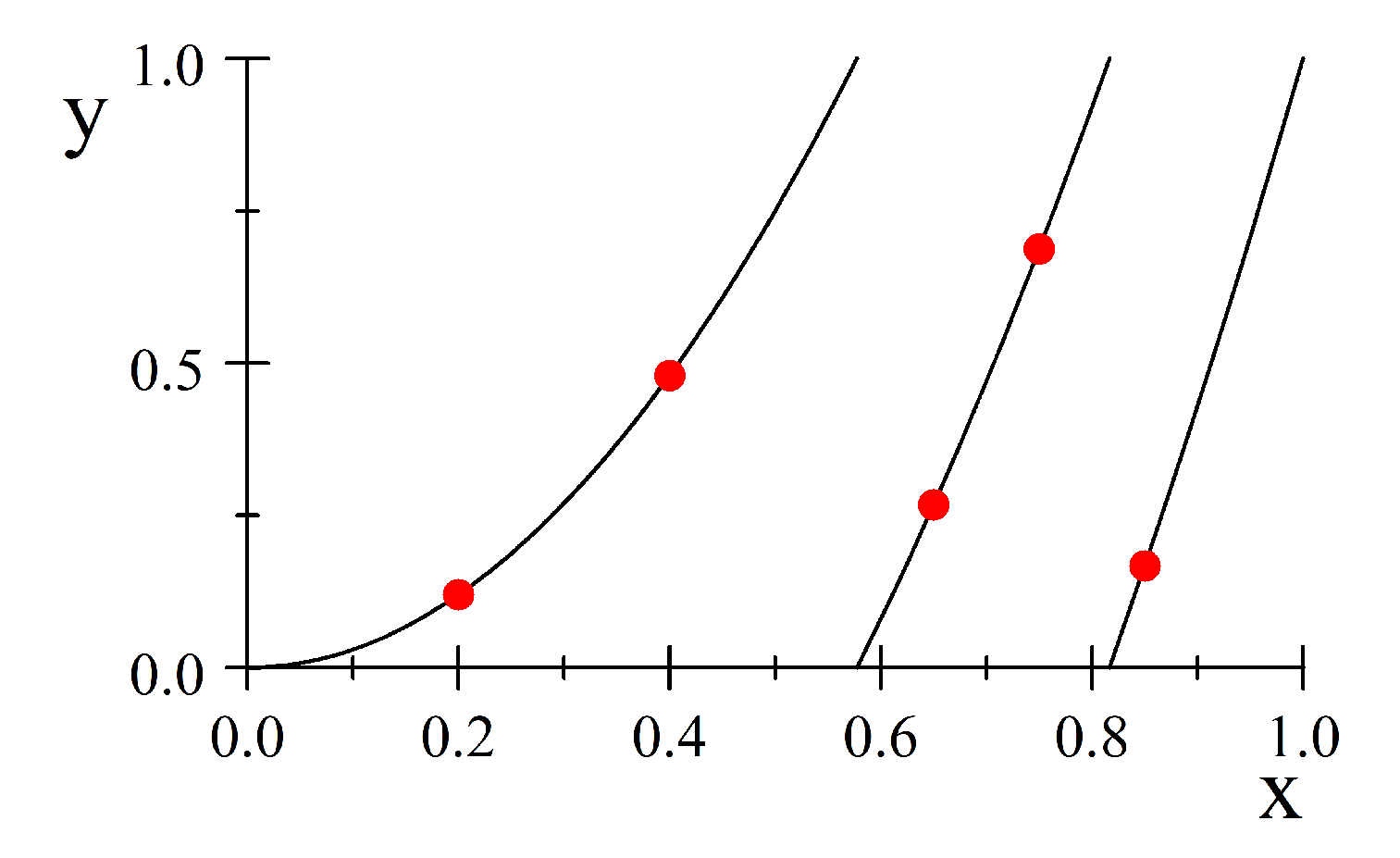
Counterexample 2. We define the function f as follows:
Let let the sequence with
Let defined by
for each
In this case,
contains the segment
; hence, it has a last element: the point
(see
Figure 2)
After some calculus, the value of the function for and becomes
Then,
.
Let us notice that Indeed, this inequality is equivalent to
, which is obvious.
Notice that and Thus
It follows that
Moreover, the sequence of functions defined by is decreasing to 0 as . It follows that the sequence itself is decreasing and
According to the monotone convergence theorem ( Beppo Levi),
To conclude, although has a last element and f is not L-acceptable.
The following simple result gives necessary conditions for f to be L (or F or F,L)-acceptable.
Proposition 6. Let be a measurable function and defined in (31)–(33).
- (a)
If and there exists an with the property that is differentiable and increasing, then If then f is L-acceptable.
- (b)
If and there exists an with the property that is differentiable and decreasing, then If then f is F-acceptable.
- (c)
If there exists an with the property then hence, according to Theorem 1,
Proof. (a) We shall find the exact value of the limit
a.
According to (22), Notice that since, according to our hypothesis, for all
Let us change the variable to We can write
Let
As thus, according to Proposition 5 (1)
The proof for (b) is similar.
(c) Let and be fixed.
We have
Denote
Then and According to Proposition 3 (2), in order to check that , it is enough to verify that
Let If we take into account that , it follows that ; thus, and
In the same way we obtain that
Let Then either or because otherwise, we have that which is a contradiction of the hypothesis It follows that □
Example 1. f is L-acceptable but is not F-acceptable.
Let The support of F (meaning the graph of f) has the last element but it does not have a first element since Here, Regarding it can be calculated.
Elementary computations yield
Thus
and On the other hand, hence
Example 2. A family of functions where all cases may occur.
Let and the function be defined as:
In order to compute , let be small enough.Then
and
with
If we put it follows that
Change the variable to Then,
There are two cases:
A. and are commensurable: are natural numbers. Then, If the limit becomes
Thus, in this case,
B. and are not commensurable. In that case, there exist positive integers such that
For we get
If then hence and the result is the same.
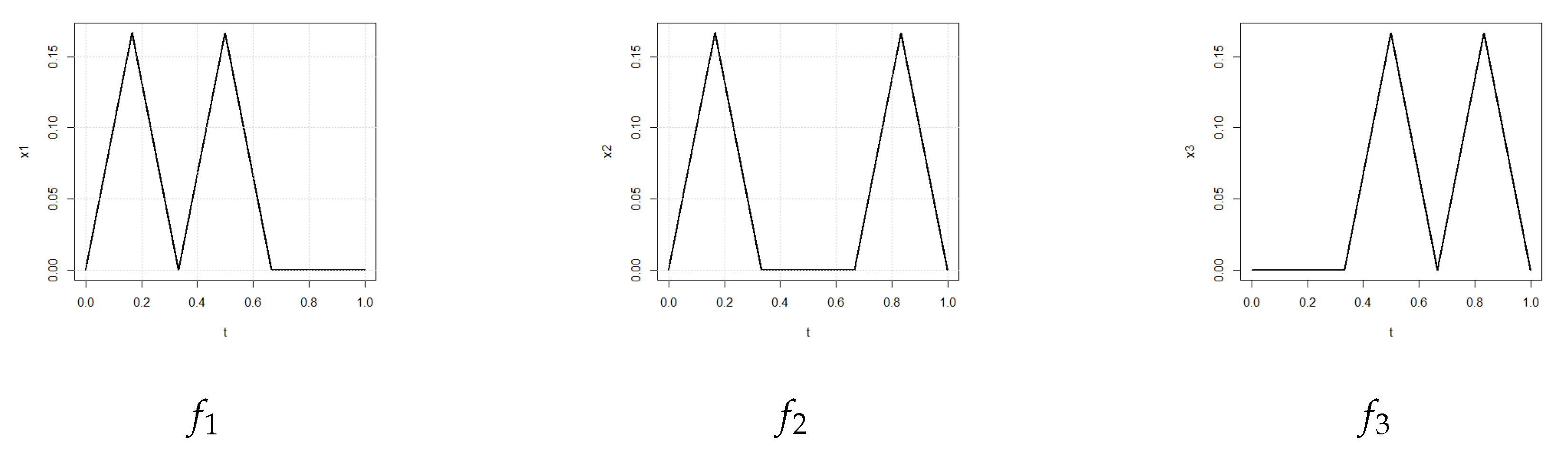
To conclude,
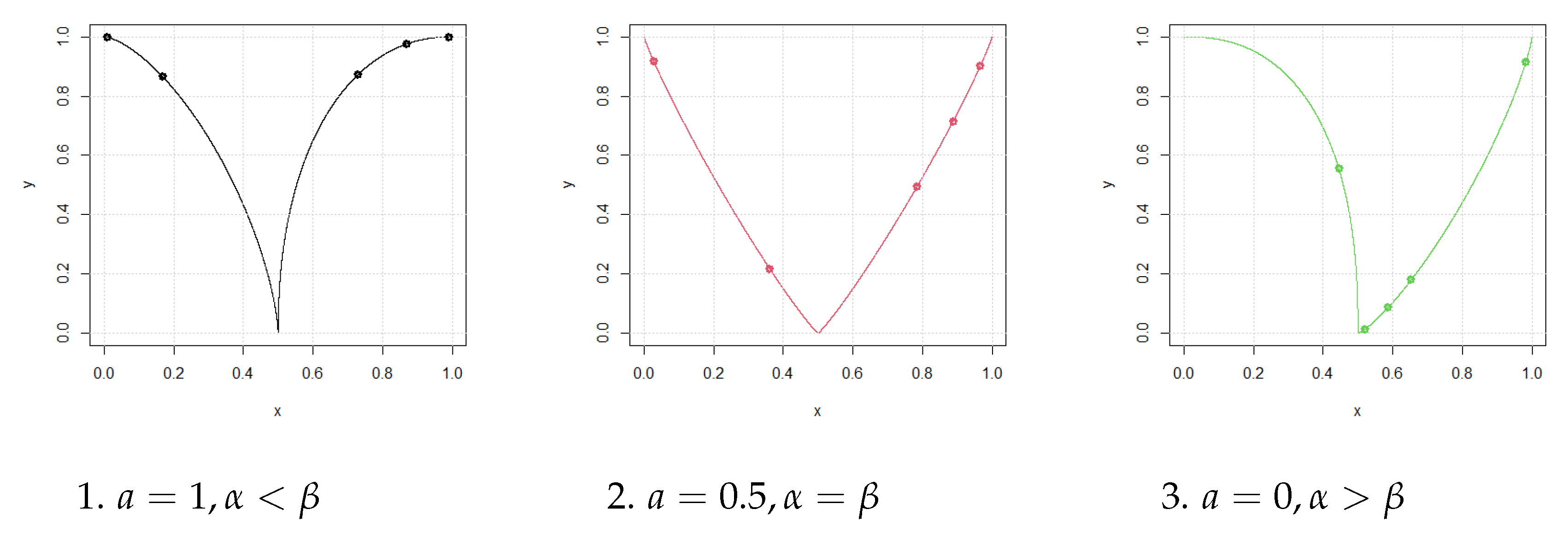
(see
Figure 3)
Therefore if F has no leader even if has the last element and f is not L- acceptable. What is interesting is that if then meaning that, in the long run, the occurrence of a leader is sure.
If the function f is not increasing, but it lies in-between two increasing differentiable functions , the following result might help.
Theorem 2. Let and be increasing and derivable functions such as .
1. If then 2. If then Proof. 1. Let be fixed and such that The relation implies that ; thus, Then
However, ; therefore,
(since are increasing and ) It results that
and, if we denote
with
According to Proposition 5 (2) mentioned above, It follows that
2. Let be fixed and such that . Then and
It follows that
and, if we denote
with and
Thus (see Proposition 5 (2)) □
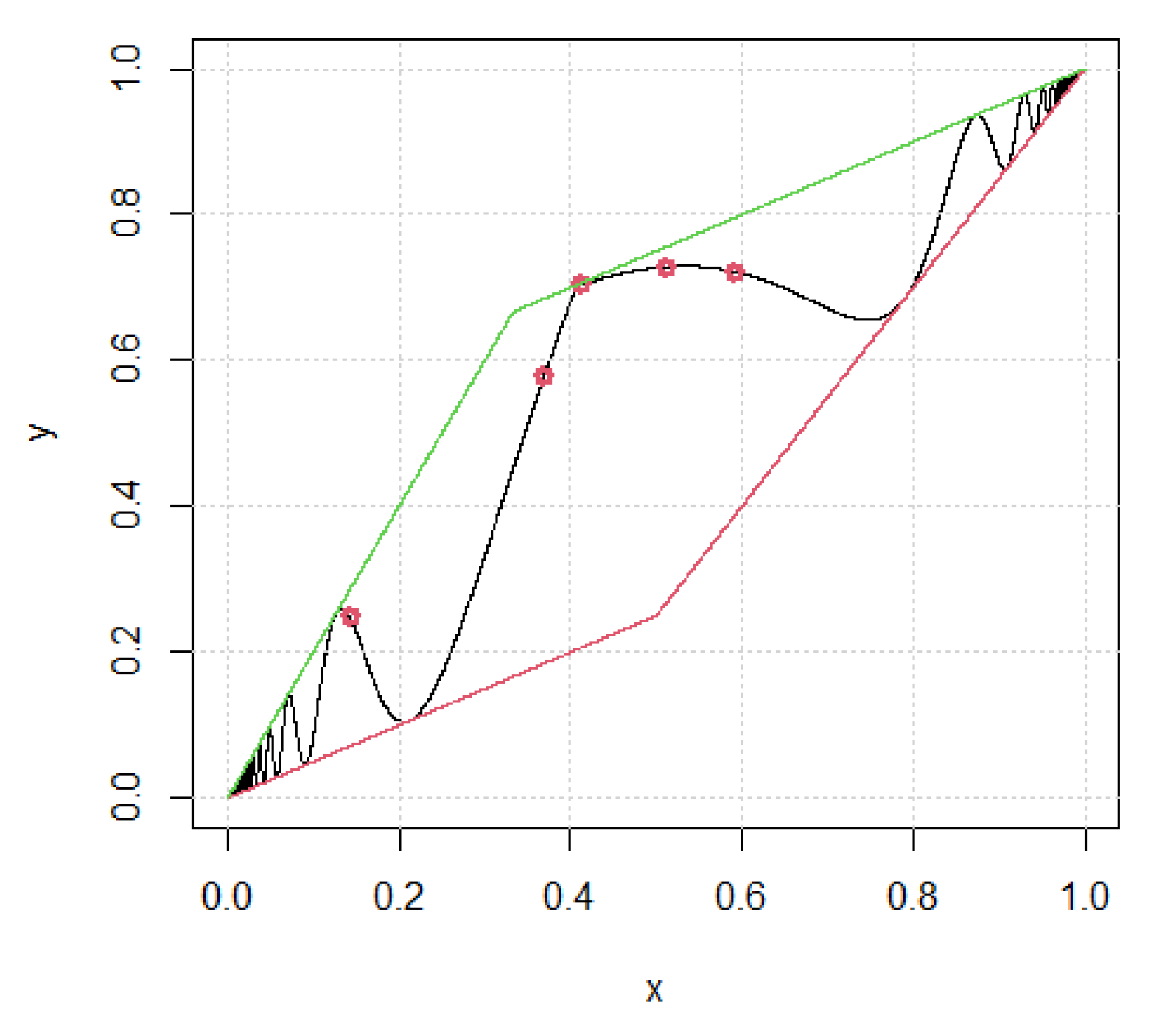
Example 3. Let where α is the solution of the equation , more exactly
(see Figure 4) Then while
Next, we present a class of functions having the property F,L-acceptable.
5. Functions with the Property F, L-Acceptable: Piecewise Monotonous Functions
Definition 3. The function is called piecewise monotonous if there exist such that the restrictions of f on the interval denoted by are monotonous;
We study two extreme cases.
The first one: alternate monotonicity.
All the restrictions are non-decreasing, while all are non-increasing, with an odd number.
Proposition 7. Let such that . Suppose that there exists with such that the functions , are differentiable, increasing for odd i and decreasing for even Let then, as long as the formulae (38)–(40) make sense, Proof. Let and be fixed. We want to calculate and
For let be such that or, equivalent, Then
For the derivative is
As is odd, is increasing; hence, Moreover, lies between and and j is odd. As on the interval the function is increasing it follows that
On the other hand, lies between and and j is odd. On the interval the function is decreasing hence Therefore
We have Let The integral becomes
According to Proposition 5 (2),
On the other hand where is fixed.
We shall follow the same procedure: for let such as Then
and the derivative is
With the change in variable the integral becomes
According to Proposition 5 (2), we find that
Next, in order to prove that one should check that for x and small enough and that is true according to Proposition 6 (c). □
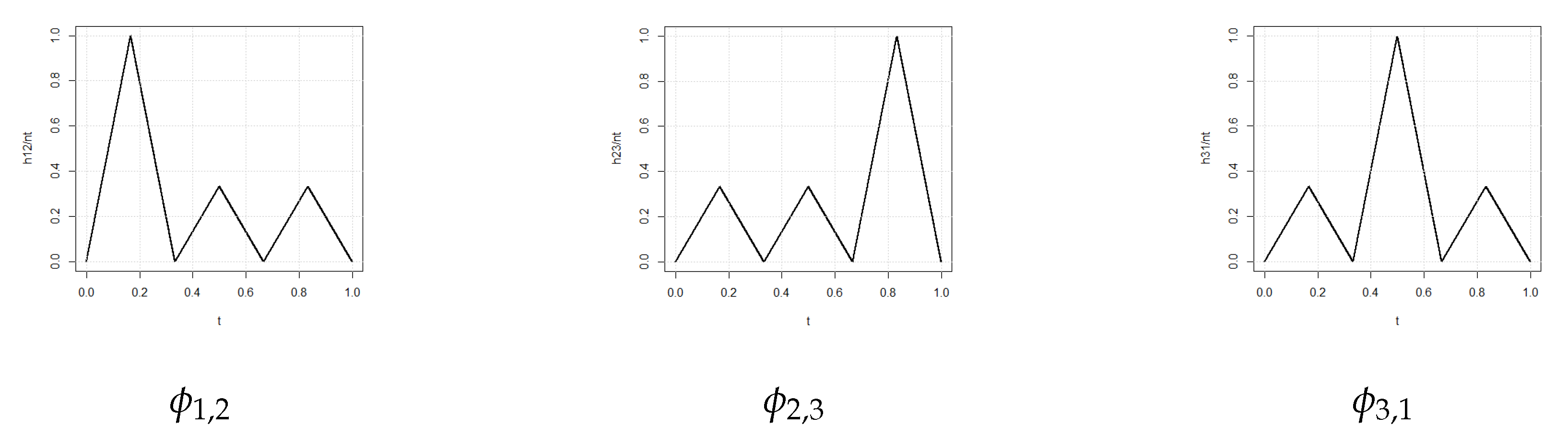
Example 4. In the particular case that are affine, it is easy to see that and with , Another example (see Figure 5): . Here ={2,4} The second case: the same monotonicity.
Proposition 8. Let such that . Suppose that there exist such that the functions , are differentiable, increasing for every If then, as long as the formulae (41)–(43) make sense, Proof. Let and be fixed.
We want to calculate
For let be such that or, equivalent, Then
For the derivative is
As is increasing Therefore,
We have Let The integral becomes
In the same way as in the previous proposition
On the other hand where is fixed.
We shall follow the same procedure: for let such as Then
and the derivative is
With the change in variable the integral becomes
Therefore
The fact that is motivated in the same way as in proposition 7. □
Example 5. In the particular case that are affine, it is easy to see that and with ,
Another example (see Figure 6): . Here ={2}.
Remark 10. Actually, we do not need all the functions to be differentiable, or even continuous. The only functions that matter are for
Remark 11. In general, various situations may occur: some of the functions could be increasing, others could be decreasing. Moreover, some of them could be non-increasing or non-decreasing. In all these situations, formulae can be computed but they are very cumbersome and we decided not to consider them.