Abstract
This research is concerned with a nonlinear p-Laplacian-type wave equation with a strong damping and logarithmic source term under the null Dirichlet boundary condition. We establish the global existence of the solutions by using the potential well method. Moreover, we prove the stability of the solutions by the Nakao technique. An example with illustrative figures is provided as an application.
Keywords:
global existence; energy decay; viscoelastic wave equation; strong damping; p-Laplacian; logarithmic nonlinearity MSC:
35L20; 35B40; 45K05
1. Introduction
Many dynamical systems in physics and engineering have been designed and proposed by means of semilinear hyperbolic equations. For instance, logarithmic nonlinearity has received a great deal of attention from many scientists and researchers, and it has introduced many issues, including the wave equation. This type of nonlinearity appears naturally in supersymmetric field theory and inflation cosmology and has numerous applications in many branches of physics, such as nuclear physics, optics and geophysics [1,2,3]. In the past decades, many authors have studied the well-posedness, regularity and blow-up of the solution for wave equations in a bounded domain of . For example, Sattinger in [4] treated the following semilinear wave equation with polynomial nonlinearity
and showed, by introducing the concept of the potential well, the existence of the local as well as the global solutions for Equation (1). Messaoudi, in [5], proved that the obtained solution of the problem
for , where p is a real number, in a bounded domain with initial and boundary conditions of the Dirichlet type, blow-up in a finite time if and the initial energy is sufficiently negative. Filippo Gazzola and Marco Squassina, in [6], established a blow-up result with an arbitrarily high initial energy for the semilinear Cauchy problem
where , in an open bounded Lipschitz subset of , provided that and . This result was later extended by Wang in [7] to the whole space for the nonlinear Klein–Gordon equation with polynomial nonlinearity of the form
where . On the other hand, for the p-Laplacian wave equations, the authors in [8] gave, by the multiplier method, the energy decay of the solution of the following problem
where . Later, in [9], the authors proved an exponential and polynomial decay rate of the solutions by using the inequality of Nakao for the Problem (2). In the case of logarithmic nonlinearity, Ma et al. [10] studied the following problem
and proved that the blow-up of the solution occurs in infinite time. In addition, the existence of global solutions was shown by the use of a family of potential wells which includes the single potential well W as a particular case together with the perturbation energy technique. Di et al. [11] considered the strongly damped nonlinear wave equation
where . They discussed the uniqueness, global existence, energy decay estimates and finite time blow-up phenomena to Problem (3) by modifying the potential well method. Tae Gab Ha et al. [12] introduced the following equation
for where . The existence, uniqueness and regularities of the weak solution to the Problem (4) are proved for all and by applying the Faedo–Galerkin method and the contraction mapping principle. A finite time blow-up property of the solutions was also derived at three different energy levels, , and . This result was later pursued by Liao [13] for certain solutions with a high initial energy. Meanwhile, explicit upper and lower bound estimates to the blow-up time have been proved. Inspired by the above studies, in this work, we investigate the global behaviour of solutions for a delayed viscoelastic-type Petrovesky wave equation with a p-Laplacian operator and logarithmic source under some appropriate conditions.
We consider the initial-boundary value problem of the following nonlinear wave equation with strong damping and logarithmic source terms
where , , is a bounded domain of , and , with smooth boundary , and are given initial data. Problem (5) describes an evolution problem with an interior logarithmic source and the investigation of this problem answers the question what will happen if one replaces the power source term by other source terms, for example, the logarithmic source term? This paper provides an affirmative reply to such a situation.
The rest of this paper can be sketched out concisely as follows: In Section 2, we introduce some basic concepts and state the important and necessary results. In Section 3.1, we shall use the Galerkin approximation technique combined with the potential well method to prove the global existence of weak solutions. Meanwhile, we will derive the decay rate of the energy functional using Nakao’s inequality and some techniques on logarithmic nonlinearity in Section 3.2. The numerical examples and simulation are provided in Section 4. Finally, a conclusion is drawn in Section 5.
2. Preliminaries
In this section, we present some material and assumptions needed for the proof of our results. For a Banach space X, denotes the norm of X. For simplicity, we denote by and by . Here, is the standard p-Laplace operator defined by
for and where .
Lemma 1.
Theorem 4.4 in [14]. Let Ω be a bounded domain with Lipschitz boundary. In the space , the norm and are equivalent norms.
Lemma 2.
Theorem 5.4 in [15]. Let Ω be a domain in that has the cone property; then, for and , there exist the following imbeddings
There exists constants depending on Ω and q such that
Lemma 3.
(Logarithmic Sobolev Inequality) [16]. Let . Then, for any and , we can write
where
Lemma 4.
(Generalised Young’s Inequality) Suppose that and σ are positive constants and . Then, Young’s inequality reads
We prove the global existence and the blow-up property for solutions of Problem (5) under the following suitable assumptions.
- (H1)
- The relaxation function is a twice-differentiable and bounded function satisfying andThere exist constants depending on such thatwhenever .
- (H2)
- The exponent p satisfies for and for .
- (H3)
- Assume that l satisfies whenever and whenever .
To obtain the main result, we have the lemmas as follows.
Lemma 5.
[17] Suppose that is a bounded nonnegative function nonincreasing on where and satisfying
for some positive constants and σ. Then, we have
where .
To deal with the time delay term, we introduce the following new variable to represent the delay term as in [18]
Therefore, satisfies
Let be a positive constant satisfying
Multiplying the first equation in (9) by and integrating over , using integration by part, we see that
Using Young’s inequality, we have
Next, we introduce two potential energy functionals on as follows:
By a direct computation,
Clearly,
Define the Nehari’s manifold
Next, let us define the stable set W and the unstable set V as follows:
The mountain pass level d, also known as potential well depth, is characterized by
3. Global Existence and Energy Decay
First, we state and prove a few lemmas.
Lemma 6.
The depth d of the potential well d is positive.
Proof.
Fix , and using the fact for and for all , we arrive at
Taking such that , we deduce
which implies
Therefore,
The proof is complete. □
Lemma 7.
For any , there exists a unique such that the following assertions hold:
- (i)
- , ;
- (ii)
- is increasing in the interval , decreasing in the interval and takes its maximum at where ;
- (iii)
- for , for and .
Proof.
For , we know that
Taking the derivative of , we obtain
Making (24) equal zero is equivalent to
We define
The function is increasing on , and we remark that
Therefore, there exists a unique such that , on and on . We can clearly perceive that there exists a unique such that Again, we have
We also obtain for , for and for , and we have (ii). Because which is verified by a direct computation, then one has (iii). □
Lemma 8.
Proof.
Arguing by contradiction, we suppose that there exists such that , and then we obtain or . Going back to (21), we have . Then, gives and (17) implies . This leads to a contradiction. Assuming that is the first time such that and , then in the interval and which implies . Using (21), we have which contradicts the nonincreasing property of . Thus, the proof of Lemma (8) is completed. □
Now, under the hypotheses (H1)–(H4), we shall use the Galerkin approximation technique combined with the potential well method to prove the global existence of weak solutions for Problem (9) as long as . Meanwhile, we shall obtain the asymptotic stability of the global solutions.
3.1. Global Existence for Low Initial Energy
Theorem 1.
Assume that assumptions (H1)–(H3) are in place and satisfying the compatibility condition . Then, for given initial data , , the Cauchy problem (9) possesses a unique global weak solution
In addition, said solution satisfies the energy inequality
Proof.
The main idea is to use the Galerkin method. Let be fixed, and for each , define the linear space dense in , where is an orthonormal basis of generated by the eigenvectors of , on , where are the corresponding eigenvalues. Now, we define the sequence satisfying . Then, we may extend by over such that forms a basis of and denote the space generated by . We define
as the approximated solutions which satisfy the nonlinear ordinary differential equations for ,
and
where are chosen in so that
and such that
As . Thanks to the Sobolev embeddings and using the generalised Hölder inequality with exponents and , the nonlinear term makes sense
and using the fact for and for all , we can estimate
as follows by choosing ,
where
We may show by the standard theory of ordinary differential equation that the initial value Problems (27) and (28) is uniquely solvable. More precisely, we obtain a local solution extended to a maximal interval with , owing to Zorn lemma because the unknown functions and their time derivatives are continuous, and by using the embedding , we deduce the solution . Next, using a standard compactness argument, we shall obtain a priori estimates for the solution of systems (27) and (28), so that it can be extended to a global solution defined for all . Multiplying (27) by , summing with respect to i and integrating by parts over the time variable from 0 to , we shall obtain from (21) the following estimate
Replacing with in (31) and integrating over to arrive at
Replacing in (28) with , multiplying by and adding those equations with respect to i from 1 to n, we obtain
Integrating in terms of , we obtain that
On one hand, from the mean value theorem, we assert that
where , and . Moreover, by the Minkowski inequality and the fact [19]
for any . We obtain by applying Hölder’s inequality with and p
Together with strongly in as , we derive
By taking , we obtain for sufficiently large n
Together with strongly in as , we deduce that
By (29), we achieve almost everywhere in , which implies by the continuity of the function that
So, by (40), we obtain as that
By taking and Hölder’s inequality, we deduce for sufficiently large n that
and consequently, for almost everywhere in ,
According to (36), (38) and (41), we assert that an , which together with (34) implies for sufficiently large n that
Noting that as , we see that implies for sufficiently large n, and using Lemma (8), we prove that for sufficiently large n. Therefore, we conclude that
Setting
On the other hand, for and applying Lemma 3, we obtain
Choosing and using (45), we deduce that which implies that is bounded in and hence is bounded in . Applying Dunford–Pettis’ Theorem, we observe from (45)–(47) that there exist subsequences and such that
Using (48), (49) and [20], we deduce that
and a.e , for all . Clearly, (52) implies
a.e . On the other hand, a direct calculation using (35), (45) and Lemma 2 with gives
Recalling Lion’s ([21], Lemma 1.3), we arrive at
weakly star in . Differentiating (27) with respect to and after multiplying by and summing over i from 1 to n, we have
On one hand, we have
and
So,
Hence,
On the other hand, it is convenient to observe that
Differentiating (8) with respect to gives
Replacing with , multiplying by and summing over i from 1 to n, we obtain
Therefore, we obtain
Integrating (60) with respect to , we have
Now, we estimate each term on the right-hand side of (62). Taking into account the Cauchy–Schwarz and Hölder inequalities, we have for any
and
Moreover,
Using Hypothesis (H1), we obtain
Therefore,
By (H2) and using the similar arguments as the estimate (66), we obtain
On one hand, using hypothesis (H2) with (44), we obtain
Choosing in (35) and after using generalised Young’s inequality with exponents , and , we will establish the following estimate for
indeed,
On one hand, as estimate (63), we obtain
On the other hand, we have
Using Hölder’s inequality with exponents , and , we obtain
Testing (27) by and choosing , we obtain
Now, we choose small enough so that
After that, according to (10), we may choose large enough such that
Putting , Inequality (74) becomes
Differentiating both sides of the equation , we obtain
A simple integration of (78) gives
So, by a standard comparison theorem, we obtain . Although blows up in finite time, there exists a time such that , where and is independent of n. Therefore, (74) and conditions (75) and (76) ensure that
Applying Dunford–Pettis’ Theorem, we observe from (81) and (82) that there exist subsequences and such that
Using (83) and (84) and [20], we deduce that in for all , and a.e , . Replacing in (27) with , multiplying by and summing over i from 1 to n, we obtain
Integrating by parts and noting that on , we have
and
On the other hand,
Replacing with , multiplying by and summing over i from 1 to n, we obtain
Therefore, we obtain
On the other hand, it is convenient to observe that
Therefore, (93) is rewritten as
Therefore,
Choosing large enough such that , and after applying Gronwall’s inequality, we obtain
At this step, similar as in [22], we have . Taking a nonnegative function, where is the space of -function with compact support in , and multiplying (27) by . Integrating the obtained result over , we conclude
Multiplying (28) by and integrating the result over , we obtain
Recalling convergences (48)–(51), (53) and (83), we can pass to the limit as n goes to ∞ in (103) and (104) to obtain
and
Then, the local existence of weak solutions is established. □
3.2. General Decay of Global Solution
We will derive the decay rate of the energy functional for Cauchy problem (9) by Nakao’s method, as in [23].
Theorem 2.
Assume that the assumptions (H1)–(H3) hold. Let be given. The energy associated to Problem (9) satisfies for a positive constant ,
Proof.
By mean value theorem, there exists and such that
Multiplying the first equation of (9) by and integrating by parts the result over , we obtain
By integrating by parts and using Cauchy–Schwarz inequality, we deduce
We notice that
and
Moreover, by (21), we have
Therefore,
and
Moreover, we have
By using Hölder’s inequality, we observe that
Similarly, we obtain
Taking and noting that , we have
On the other hand,
Because , we conclude by applying the mean theorem that
After utilizing Young’s inequality, we have
By taking , we have . Utilising Lemma 5, we conclude that
By taking , using (127) and because , we have
Utilizing Lemma 5 with , we conclude that
Therefore, we completed the proof of Theorem (105). □
4. An Example and Numerical Study
In this section, we present an illustrative example which guarantees our main results. Furthermore, we provide nice algorithms which help us to calculate all the numerical results.
Example 1.
Consider the initial-boundary value problem of nonlinear wave equation with strong damping and logarithmic source terms.
for , and . Clearly, , , , and
Consider positive constants ; then, we have
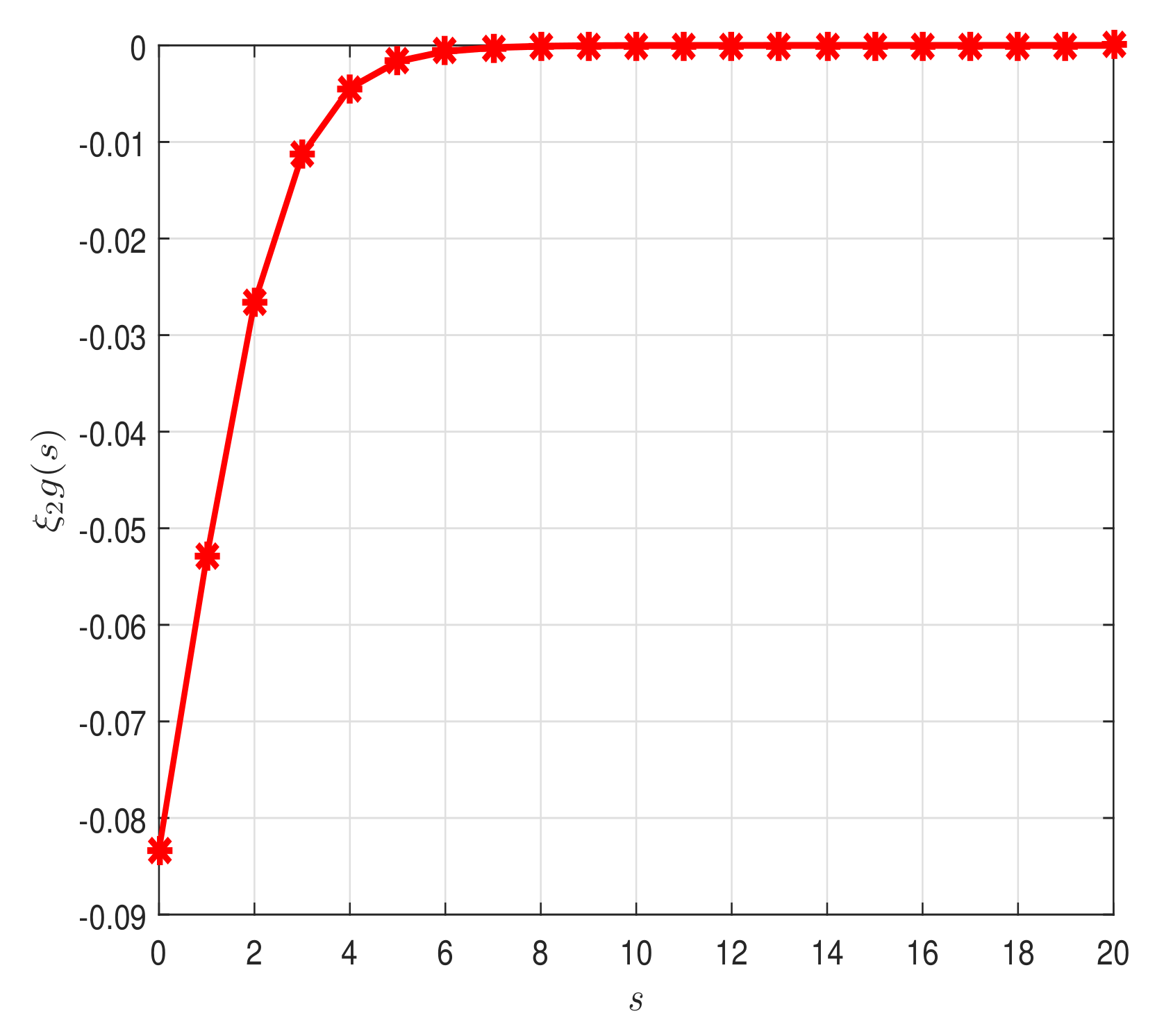
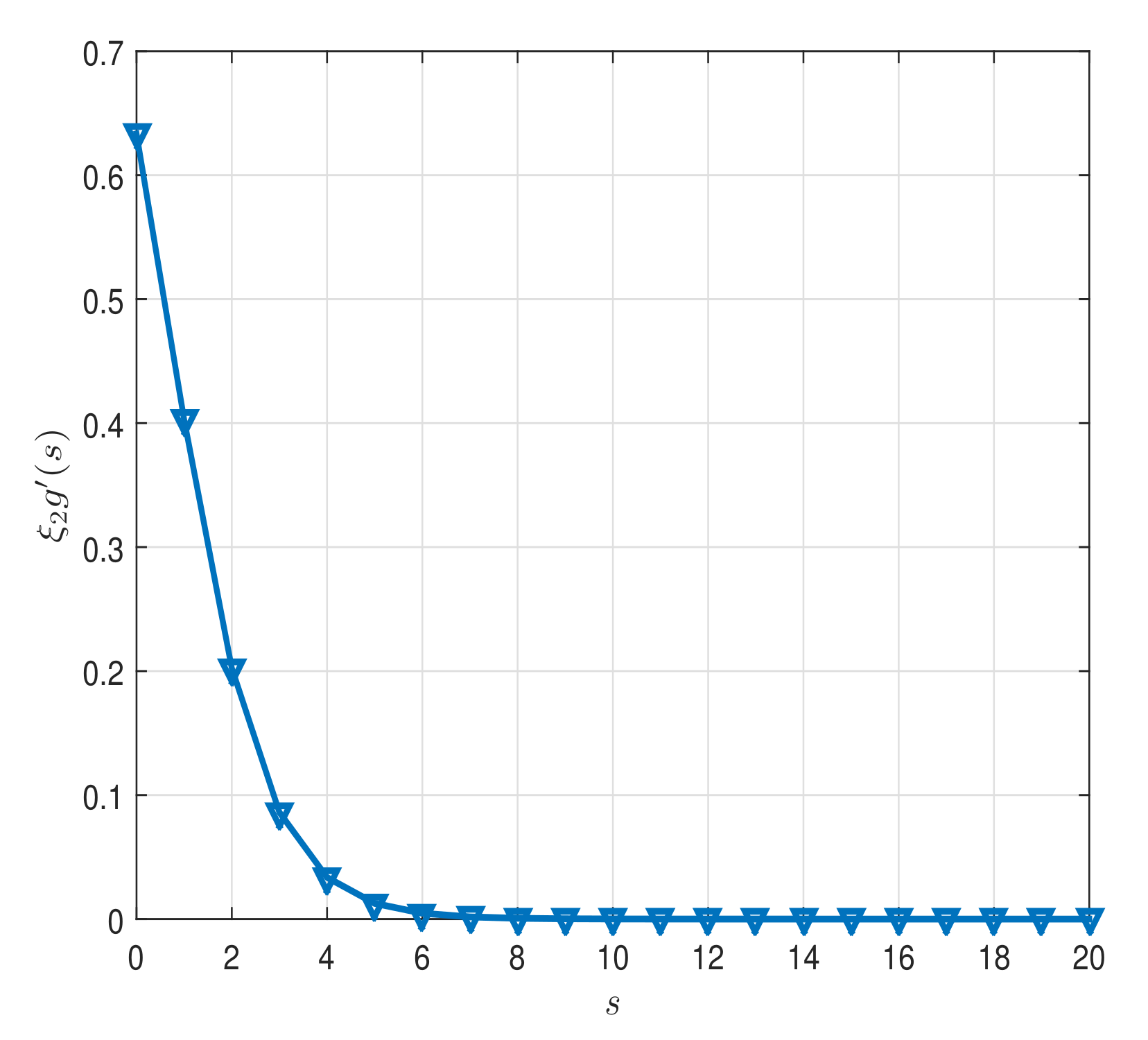
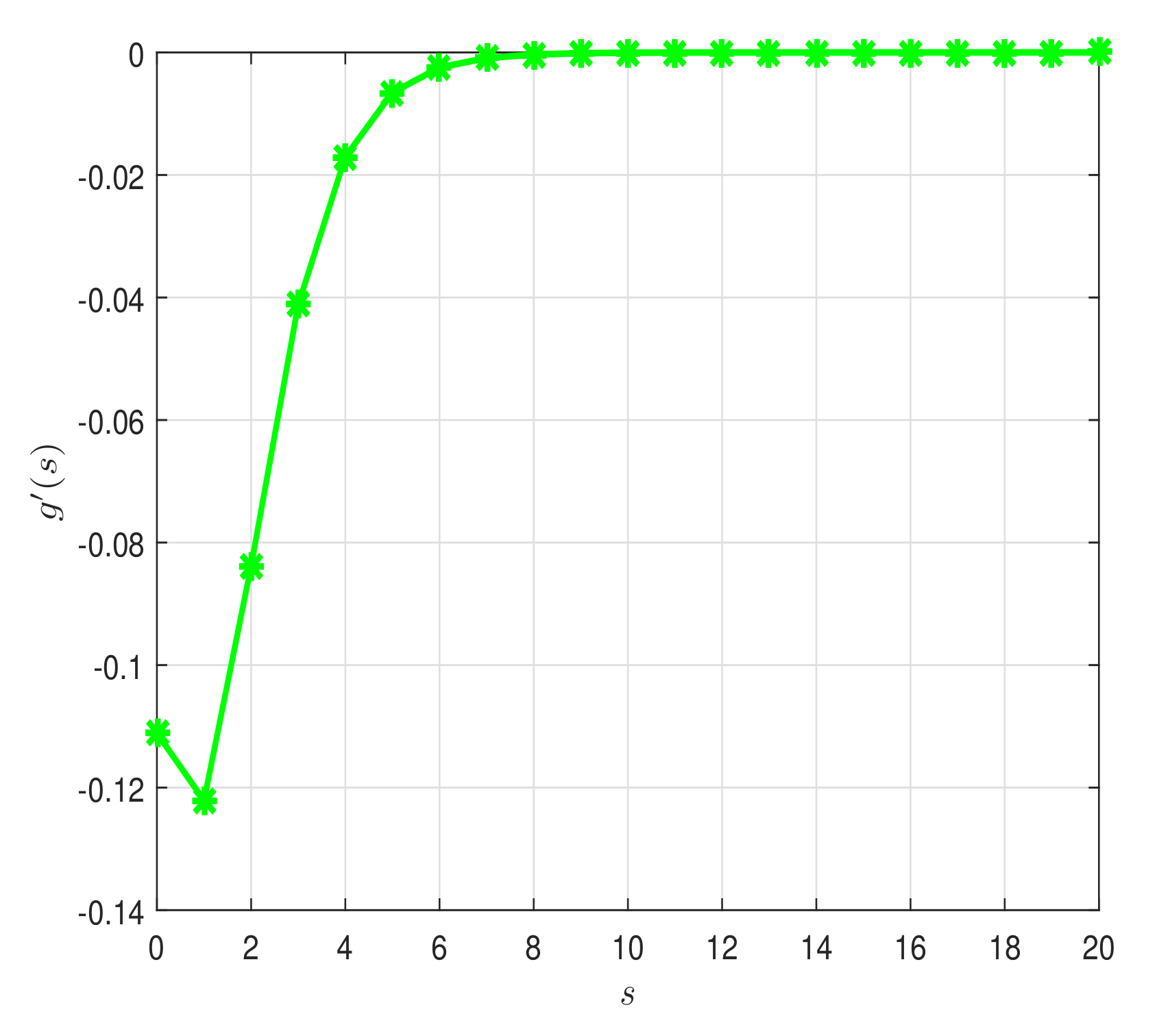
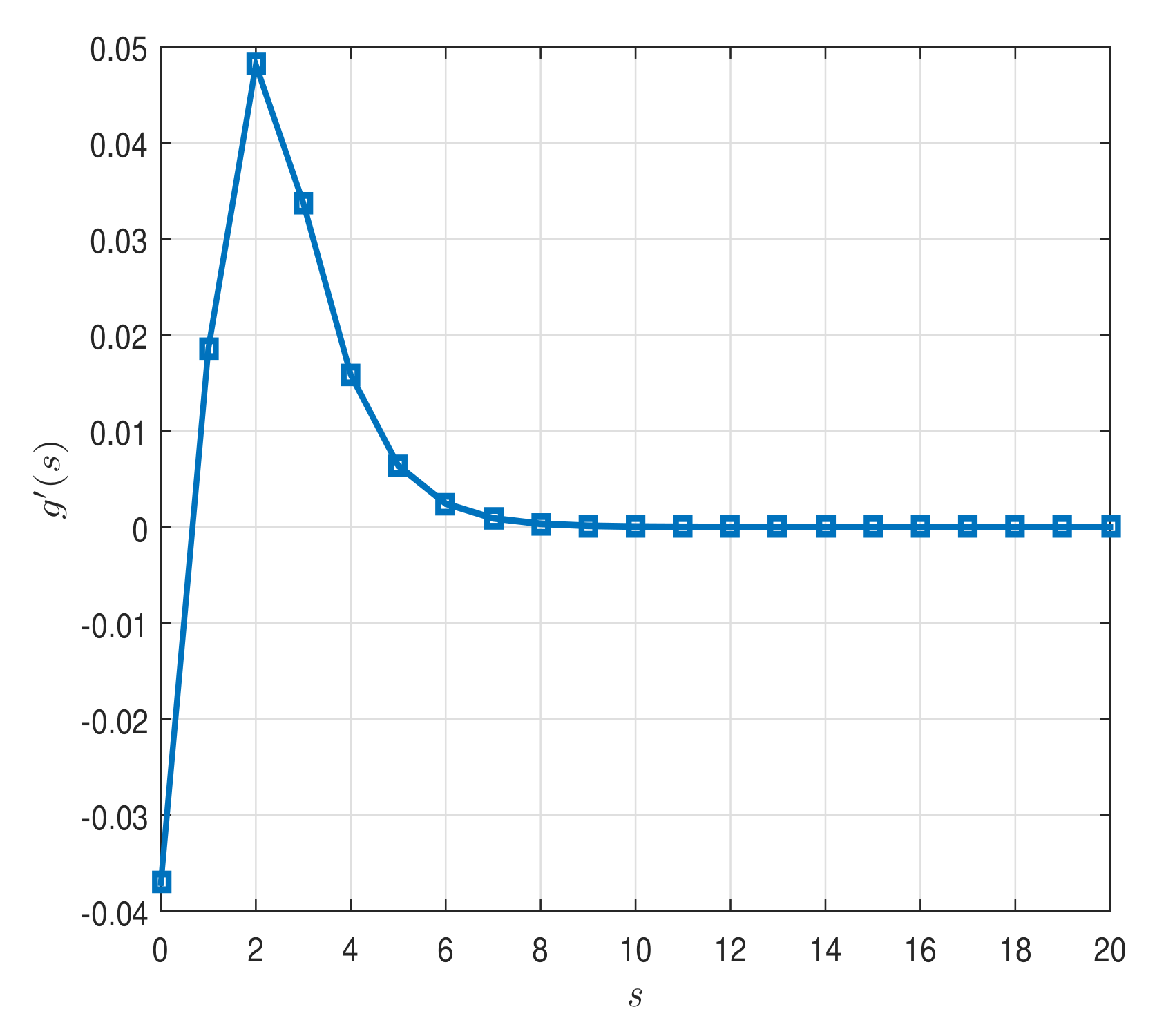
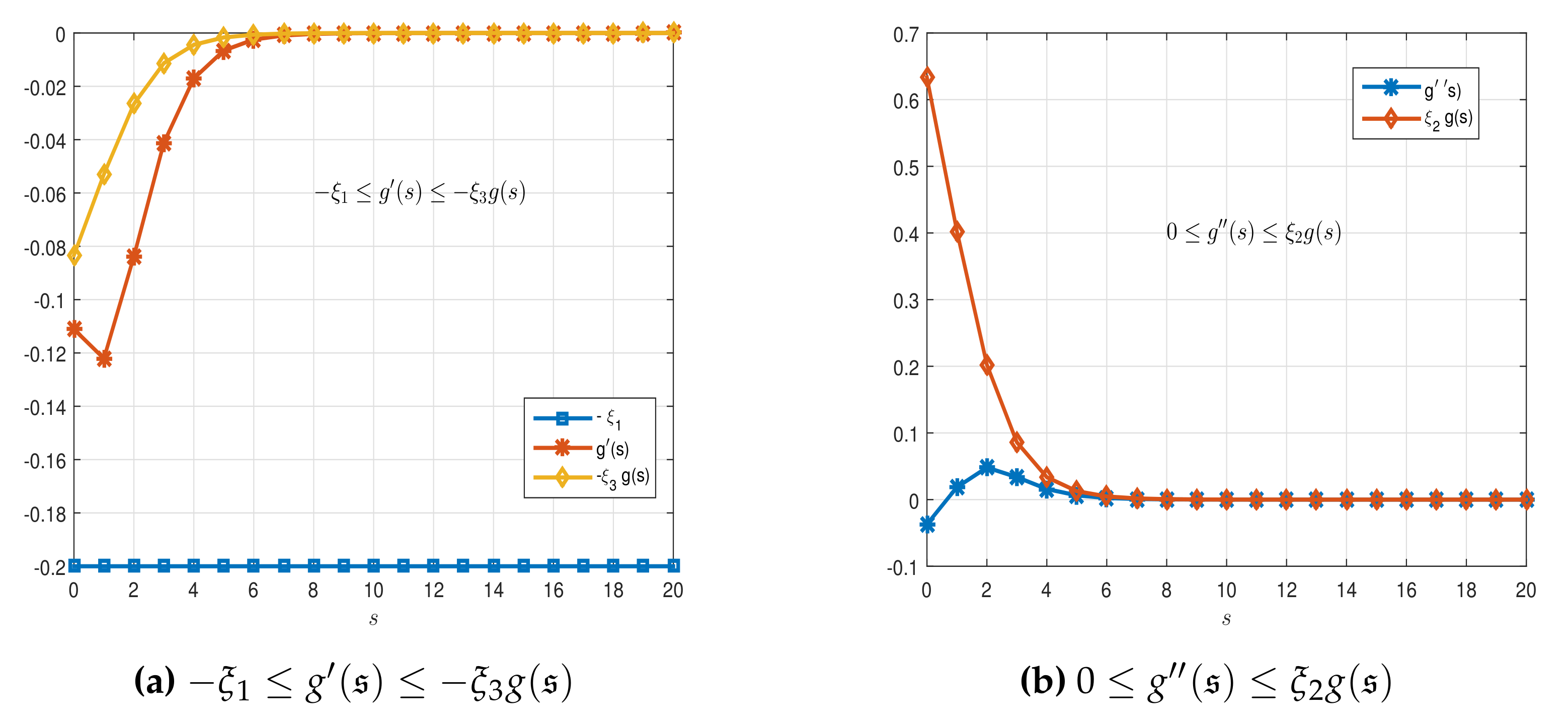
whenever . Table 1 shows the numerical results. Figure 1, Figure 2, Figure 3, Figure 4 and Figure 5 show graphical representation of the variables. Therefore, assumptions (H1)–(H3) hold and so the Cauchy problem (128) possesses a unique global weak solution See Figure 6a,b.
Table 1.
Numerical values of in Example 1 for .
Figure 1.
Two-dimensional graph of for in Example 1.
Figure 2.
Two-dimensional graph of for in Example 1.
Figure 3.
Two-dimensional graph of for in Example 1.
Figure 4.
Two-dimensional graph of for in Example 1.
Figure 5.
Two-dimensional graph of for in Example 1.
Figure 6.
Graphical representation of (H1) and (H2) for in Example 1.
In addition, by using Equation (11), the energy functional associated to Problem (128) is obtained as
where
In addition, the solution satisfies the energy inequality
5. Conclusions
Evolution problems with an interior logarithmic source have a wide range of applications in physics, such as nuclear physics, optics and geophysics. In recent years, there have been many works concerning the global existence and stabilisation of the wave equation, including a constant delay or time-varying delay. However, to the best of our knowledge, there is no decay result for the nonlinear p-Laplacian viscoelastic Petrovesky equation with a delay term and logarithmic nonlinearity. In this paper, we study the global existence of solutions for a delayed viscoelastic-type Petrovesky wave equation with a p-Laplacian operator and logarithmic source under some appropriate conditions. By making some essential assumptions on the memory kernel function and exponents , we proved that the rate of decay of the total energy is exponential or polynomial, depending on the exponent l. The illustrative examples are designed to validate the theoretical findings. The equation under the equation studies and evolution problems with an interior logarithmic source answer the question as to what will happen if one replaces the power source term by other source terms, for example, the logarithmic source term. This paper provides an affirmative reply to such a situation.
Author Contributions
B.B.: actualisation, formal analysis, methodology, initial draft, validation, investigation and was a major contributor in writing the manuscript. J.A.: methodology, actualisation, validation, investigation, formal analysis and initial draft. M.E.S.: validation, actualisation, formal analysis, methodology, investigation, simulation, initial draft, software and was a major contributor in writing the manuscript. N.F.: investigation, editing—review the manuscript, formal analysis and funding. All authors have read and agreed to the published version of the manuscript.
Funding
This research received no external funding.
Data Availability Statement
Not applicable.
Acknowledgments
J. Alzabut and N. Fatima are thankful to Prince Sultan University for their endless research support.
Conflicts of Interest
The authors declare that they have no competing interests.
References
- Barrow, J.D.; Parsons, P. Inflationary models with logarithmic potentials. Phys. Rev. D 1995, 52, 5576. [Google Scholar] [CrossRef] [PubMed]
- Górka, P. Logarithmic Klein–Gordon equation. Acta Phys. Pol. 2009, 40, 3477–3482. [Google Scholar]
- Zhao, K. Global stability of a novel nonlinear diffusion online game addiction model with unsustainable control. AIMS Math. 2022, 7, 20752–20766. [Google Scholar] [CrossRef]
- Sattinger, D.H. On global solution of nonlinear hyperbolic equations. Arch. Ration. Mech. Anal. 1968, 30, 148–172. [Google Scholar] [CrossRef]
- Messaoudi, S.A. Blow up and global existence in a nonlinear viscoelastic wave equation. Math. Nachrichten 2003, 260, 58–66. [Google Scholar] [CrossRef]
- Gazzola, F.; Squassina, M. Global solutions and finite time blow up for damped semilinear wave equations. Ann. Inst. H. Poincaré Anal. Non Linéaire 2006, 23, 185–207. [Google Scholar] [CrossRef]
- Wang, Y.J. A suffiecient condition for finite time blow up of the nonlinear Klein-Gordon equations with arbitrarily positive initial energy. Proc. Am. Math. Soc. 2008, 136, 3477–3482. [Google Scholar] [CrossRef]
- Wu, Y.; Xue, X. Uniform decay rate estimates for a class of quasilinear hyperbolic equations with nonlinear damping and source terms. Appl. Anal. 2013, 92, 1169–1178. [Google Scholar] [CrossRef]
- Pişkin, E.; Boulaaras, S.; Irkil, N. Qualitative analysis of solutions for the p-Laplacian hyperbolic equation with logarithmic nonlinearity. Math. Methods Appl. Sci. 2021, 44, 4654–4672. [Google Scholar] [CrossRef]
- Ma, L.; Fang, Z.B. Eenrgy decay estimates and infinite blow-up phenomena for a strongly damped semilinear wave equation with logarithmic nonlinear source. Math. Methods Appl. Sci. 2018, 41, 2639–2653. [Google Scholar] [CrossRef]
- Di, H.; Shang, Y.; Song, Z. Initial boundary value problems for a class of strongly damped semilinear wave equations with logarithmic nonlinearity. Nonlinear Anal. Real World Appl. 2020, 51, 102968. [Google Scholar] [CrossRef]
- Ha, T.G.; Park, S.H. Blow-up phenomena for a viscoelastic wave equation with strong damping and logarithmic nonlinearity. Adv. Differ. Equ. 2020, 2020, 1–17. [Google Scholar] [CrossRef]
- Menglan, L. The Lifespan of Solutions for a Viscoelastic Wave Equation with a Strong Damping and Logarithmic Nonlinearity; Evolution Equations & Control Theory: Paris, France, 2021. [Google Scholar]
- Zang, A.; Fu, Y. Interpolation inequalities for derivatives in variable exponent Lebesgue–Sobolev spaces. Nonlinear Anal. 2008, 269, 3629–3636. [Google Scholar] [CrossRef]
- Adams, R.A. Sobolev Spaces. In Pure and Applied Mathematics; Academic Press: Cambridge, MA, USA, 1975; p. 65. [Google Scholar]
- Boulaaras, S. Existence of positive solutions for a new class of Kirchhoff parabolic systems. Rocky Mt. J. Math. 2020, 50, 445–454. [Google Scholar] [CrossRef]
- Nakao, M. Asymptotic stability of the bounded or almost periodic solution of the wave equation with nonlinear dissipation term. J. Math. Anal. Appl. 1977, 58, 336–343. [Google Scholar] [CrossRef]
- Datko, R.; Lagnese, J.; Polis, M.P. An example on the effect of time delays in boundary feedback stabilization of wave equations. SIAM J. Control Optim. 1986, 24, 152–156. [Google Scholar] [CrossRef]
- Kafini, M.; Messaoudi, S. Local existence and blow up of solutions to a logarithmic non linear wave equation with delay. Appl. Anal. 2019, 99, 530–547. [Google Scholar]
- Simon, J. Compact sets in the space Lp(O, T, B). Ann. Mat. Pura Ed. Appl. 1986, 146, 65–96. [Google Scholar] [CrossRef]
- Lions, J.L. Quelques Méthodes de Résolution des Problémes aux Limites non Linéaires; Dunod: Paris, France, 1969. [Google Scholar]
- Cao, Y.; Liu, C. Initial boundary value problem for a mixed pseudo-parabolic p-Laplacian type equation with logarithmic nonlinearity. Electron. J. Differ. Equ. 2018, 2018, 1–19. [Google Scholar]
- Nakao, M. A difference inequality and its application to nonlinear evolution equations. J. Math. Soc. Jpn. 1978, 30, 747–762. [Google Scholar] [CrossRef]
Publisher’s Note: MDPI stays neutral with regard to jurisdictional claims in published maps and institutional affiliations. |
© 2022 by the authors. Licensee MDPI, Basel, Switzerland. This article is an open access article distributed under the terms and conditions of the Creative Commons Attribution (CC BY) license (https://creativecommons.org/licenses/by/4.0/).