1. Introduction
This paper focuses on the unicyclic graphs [
1]. In what follows, we first describe some notations and definitions that are used in the following sections, and then give a brief review on the history of (edge) metric dimension.
Throughout the paper, we only consider graphs that are finite, simple, and undirected. We use and to denote the vertex set and edge set of a graph G, respectively. The degree of a vertex in G, denoted by , is the number of vertices adjacent to v. If a vertex has degree k (respectively, at least k) in G, then we call it a k-vertex (respectively, -vertex) of G. The distance between two vertices of a connected graph G is the length of a shortest path from to , and the distance between a vertex and an edge is defined as , where . A path from a vertex v to an edge e refers to a path from v to an arbitrary endpoint of e. Throughout this paper, the notation (respectively, ) is used to denote a shortest path from vertex u to vertex v (respectively, vertex u to edge e). Let G be a connected graph and . For any (respectively, ), we say that S distinguishes u and (respectively, e and ) if there exists a vertex such that (respectively, ); it is also said that v distinguishes (respectively, ). Then, S is referred to as a metric generator if S distinguishes any two vertices of G. Similarly, we call S an edge metric generator of G if S distinguishes any two edges of G. The minimum k for which G has a metric (respectively, edge metric) generator of cardinality k is called the metric (respectively, edge metric) dimension of G, denoted by dim(G) (respectively, edim(G)).
One of the first people to define metric dimension was Slater [
2], who used the term ‘location number’ originally in connection with a location problem of uniquely determining the position of an intruder in a network. This concept was independently discovered by Harary and Melter [
3], who were the first to use the term ‘metric dimension’. Metric dimension is an important concept in graph theory, and has many applications in diverse areas, such as image processing and pattern recognition [
4,
5], and robot navigation [
6], to name a few. The problem of determining the metric dimension of a graph is
NP-complete. Recently, motivated by an observation that there exist graphs where any metric generator does not distinguish all pairs of edges, Kelenc et al. [
7] proposed the concept of the
edge metric generator, which aims to distinguish edges instead of vertices, and made a comparison between these two dimensions. They also proved that determining the edge metric dimension is
NP-hard, and proposed some open problems, most of which have been settled subsequently [
8,
9]. Since then, researchers have shown an increased interest in determining edge metric dimension for special classes of graphs, for example, generalized Petersen graphs [
10,
11], convex polytopes [
12,
13], graph operations [
14], hollow coronoid [
15], windmill graphs [
16], möbius networks [
17], etc. For more information on edge metric dimension, please refer to recent papers [
18,
19].
By the similarity of the metric dimension and the edge metric dimension, it is interesting to study the relation between them. In [
7], it was found that there exist graphs whose metric dimension is less than, equal to, or greater than their edge metric dimension. In [
8], it was proved that
is not bounded from above. More recently, Knor et al. [
20] further studied the ratio
, and by constructing graphs based on a family of special unicyclic graphs they proved that there are graphs
G for which both
and
can be arbitrarily large. They also posed two problems on how to characterize a unicyclic graph
G with
or
.
Problem 1 ([
20]).
Determine unicyclic graphs G with or . For a unicyclic graphs
G, Sedlar and Škrekovski [
21] obtained the bounds on metric and edge metric dimensions, and proved that
. Furthermore, they proposed a similar problem to Problem 1.
Problem 2 ([
21]).
Determine unicyclic graphs G when the difference , , and . In this paper, for a unicyclic graph
G, by introducing four classes of subgraphs, we obtain the exact values of edim
and dim
. Our results settle the above two problems. Although these problems were addressed in a recent published paper [
1], our work presents the results in a completely different way. It is a pity that we did not find the work in [
1] until recently. We still want to make it clear that we did not copy anything from [
1] and the configurations of unicyclic graphs characterized in our paper are different from those in [
1]. More specifically, the approach in [
1] was to characterize indistinguishable configurations of vertices (respectively, edges) in a unicyclic graph and then determine the vertex metric generator (respectively, edge metric generator). Our approach is to construct a configuration in which all vertices or edges can be distinguished in a unicyclic graph, and then characterize the odd graphs and even graphs with respect to the cardinality of a smallest vertex metric generator (respectively, edge metric generator).
The section below describes terminologies and notation we adopt in our proofs and some (known and new) conclusions.
2. Preliminaries
We follow the same notations in [
21] with a slight change. Given a graph
G, we use
and
to denote the resulting graph obtained from
G by deleting all vertices in
(and all of their incident edges) and all edges in
, respectively, where
and
. Especially, when
and
, we replace them with
and
, respectively. For two integers
such that
, we use
to denote the set
. The focus of this paper is on unicyclic graphs, which are graphs containing exactly one cycle. Let
G be a unicyclic graph. For the sake of convenience, we use
and
(or simply
and
ℓ when
G is clear from the context) to denote the unique cycle of
G and the length of
, respectively, and denote by
and
the sets of unicyclic graphs with
(mod 2) and
(mod 2), respectively. Clearly,
.
In what follows, for any unicyclic graph
G, we always let
. Note that
is a forest. For each
, we denote by
the component of
containing
, and call
the
master of every vertex of
(it is necessary here to clarify that
is also its own master). For any
, we say that
is
S-active if
contains a vertex of
S, and use
to denote the set of all
S-active vertices on
. For a vertex
, if
is a
-vertex or
is a
-vertex, then we call
u a
branching vertex of
G. Clearly, if
contains no branching vertex, then
is a path. For every vertex
u with
, a
thread attached to
u is a path
such that
is a 2-vertex for
,
is an 1-vertex, and
, where
. By
we denote the set of threads that are attached to
u. A
-vertex
is called a
bad vertex of
G if there is a thread attached to
u. A
branch-resolving set of
G is a set
such that for every
-vertex
v, at least
threads in
contain a vertex of
S. Indeed, we are interested in the branch-resolving set containing the minimum number of vertices. Obviously, the cardinality of any minimum branch-resolving set, denoted by
, is determined by
Observe that each thread has exactly one 1-vertex; therefore, we can choose a minimum branch-resolving set which consists of only 1-vertices. We use to denote the set of all such minimum branch-resolving sets of G. When , we can label vertices on in a specific way: and the maximum i such that is an S-active vertex and should be as small as possible. Such labeling is called normal labeling with respect to S of (or simply normal labeling of ).
Let G be a unicyclic graph and be three vertices on . If , then are said to form a geodesic triple. Let and is S-active}. Notice that when is labeled normally, if , then , , and form a geodesic triple for and and and . In addition, if (mod 2) and , then either or contains three vertices that form a geodesic triple.
The following part of this section moves on to describe some basic conclusions. We first present three known results given by Sedlar and Škrekovski [
21].
Lemma 1 ([
21]).
Let G be a unicyclic graph. If S is a metric generator (respectively, edge metric generator), then and S is a branch-resolving set. Lemma 2 ([
21]).
Let G be a unicyclic graph and a branch-resolving set of G. If contains three vertices that form a geodesic triple, then S is a metric generator (and also an edge metric generator) of G. Lemma 3 ([
21]).
Let G be a unicyclic graph. If is a branch-resolving set of G such that , then any two vertices (also any two edges) from each , , can be distinguished by S. What follows are three useful lemmas by which we derive our main results in the subsequent sections.
Lemma 4. Suppose that G is a unicyclic graph with , where . Let be two S-active vertices such that ( is labeled normally). If neither nor is a bad vertex, then any two vertices (respectively, any two edges ) such that (respectively, ) can be distinguished by S.
Proof. Let and . It suffices to deal with (respectively, ), since the case that (respectively, ) can be addressed in a similar way. Without loss of generality, assume that (respectively, ) and let (respectively, or ), where and . By Lemma 3, we only consider the case (respectively, ). Let and . In the remainder of the proof, we suppose that (respectively, ). Clearly, (respectively, , otherwise (respectively, ). Moreover, since , (respectively, ). We denote by (respectively, ) the vertex that has the minimum distance with ( is possible).
(respectively, )
Beginning with the premise
(respectively,
), we have
(respectively,
). Now, suppose that
(respectively,
). Then,
Case 1.
. Then,
. By Equation (
1),
. Thus,
(respectively,
when
and
when
). If
, then
(respectively,
when
and
when
), which implies (by Equation (
1)) that
(or
when
, since
(mod 2) in this case), a contradiction. If
, then
(respectively,
when
and
when
), which implies (by Equation (
1)) that
, a contradiction.
Case 2. . Then, (respectively, ) implies that (respectively, ). Notice that (respectively, ). We have that is disconnected. Let be the component of that contains (respectively, or one endpoint of when ). Clearly, . Since is not a bad vertex, . Let and let (respectively, ) be the vertex that has the minimum distance with . Clearly, . Observe that . Thus, (except for the case that , for which ) and . We also assume that (respectively, ) is not on ; otherwise (respectively, ). Thus, and (respectively, and ). As a result, (respectively, ). If (respectively, ), then , i.e., , a contradiction. □
Lemma 5. Let and . Suppose that contains two vertices, say , such that . Then, each vertex for can distinguish two vertices and (respectively, two edges and ) for and such that and (respectively, and ).
Proof. For convenience, we use to denote or for , and let (respectively, ). Then, for any (), and . By and (respectively, and ), we deduce that and . Let , where is the master of vertices of , .
Case 1. . In this case, . When , . If , then either (when ) which implies that , or (when ). When , . If , then either (when ), or (when ). Clearly, each of these cases yields a contradiction.
Case 2. . If is on , it is clear that (respectively, ). Thus, suppose that is not on . Let be the common vertex shared by and that has the minimum distance with . Then, and . Note that , , and . When , we have that . When , we have that . □
Lemma 6. Suppose that G is a unicyclic graph. Then, for any , two vertices and (respectively, two edges and )) such that , say and cannot be distinguished by if and only if one of the following conditions holds, where and (respectively, and ).
- (i)
, , and ;
- (ii)
, , , and ;
- (iii)
, , and ; or and .
Proof. Notice that when (i) holds, , and ; when (ii) holds, , and ; when (iii) holds, , and ; or , and . One can readily check that and when one of the above three conditions holds.
Now, suppose that
(respectively,
) cannot be distinguished by
S, i.e.,
and
. Then,
Clearly, (otherwise, but , a contradiction).
Case 1.
. Then,
, and
By Equation (
2), if
, then we derive
, a contradiction. Therefore,
, and hence
.
Case 2.
. When
,
, and
By Equation (
2), we derive
, a contradiction. When
,
, and
By Equation (
2), if
, then
, a contradiction. Therefore, it holds that
, by which we derive
and
.
Case 3.
. When
,
, and
By Equation (
2), we deduce that either
(when
) or
(when
), a contradiction. Therefore,
. Moreover, when
,
, and
By Equation (
2), we deduce that
and
. When
, then
and
, which implies that
. □
3. Metric Dimension
This section is devoted to the argument of our main results for metric dimension. Similar conclusions for edge metric dimension are presented in the next section. To achieve our purpose, we need to construct four families of graphs G for which dim(G) = or edim(G) = . The first two families of graphs (for metric dimension) are described here (Definition 1), while the other two families of graphs (for edge metric dimension) are introduced in the following section (Definition 2).
Definition 1. Suppose that G is a unicyclic graph of length and . If satisfies either or the following two conditions (i) and (ii) hold, then we call G an odd-graph; if satisfies the following three conditions, (i), (ii), and (iii), then we call G an even-graph.
- (i)
Neither nor is a bad vertex.
- (ii)
If , for every .
- (iii)
If and contains no branching vertex for every , then the length of is at most .
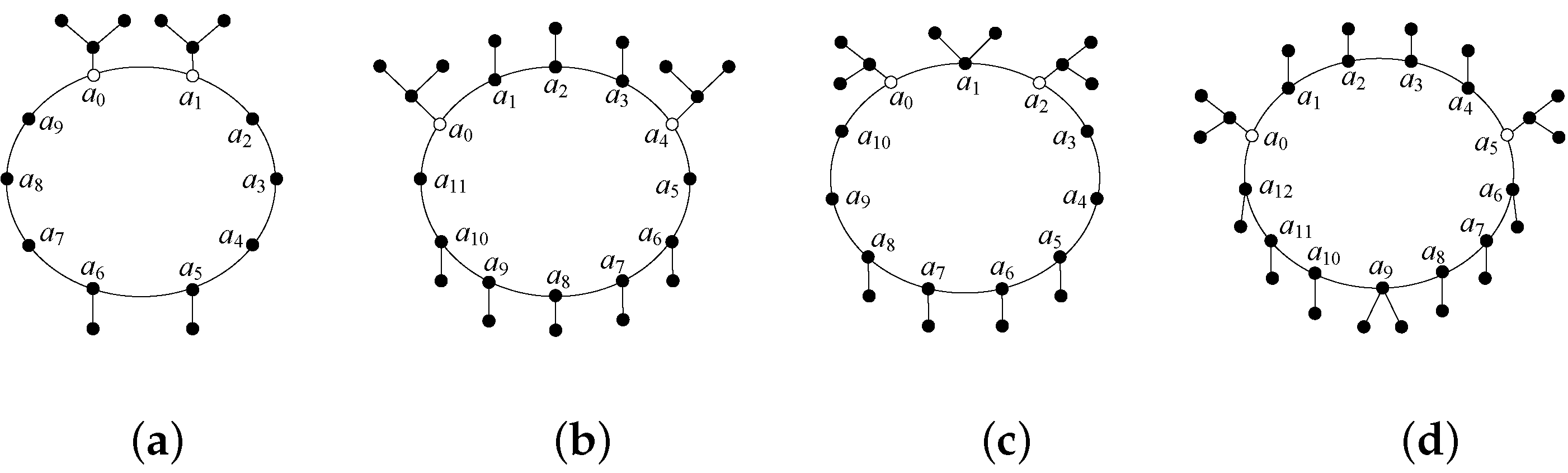
We use and to denote the set of all odd- graphs and even- graphs, respectively. See Figure 1 for some examples of odd- graphs and even- graphs. We observe that when , is enough to distinguish two vertices not in the same for , by which we obtain the following conclusion, but this result does not hold for .
Lemma 7. Let . Then, is a metric generator if there are two S-active vertices with distance .
Proof. By symmetry, let and , where . Let be two distinct vertices, and and () be the masters of x and y, respectively. By Lemma 3, let . Moreover, if , say (the other cases can be discussed in the same way), then under the condition of we deduce that (since and ). Therefore, we assume and . Then, by Lemma 6, x and y can be distinguished by , i.e., and . Moreover, since and are S-active vertices, we let ), ), =, and = . Then, and . This implies that x and y can be distinguished by S. □
Let us now turn to a more general sufficient condition for a unicyclic graph G satisfying = .
Lemma 8. Suppose that G is a unicyclic graph such that , where . Label normally. If there exists an integer such that and , then = .
Proof. By Lemma 1, it suffices to prove that
S is a metric generator. If
(mod 2) and
, then the conclusion follows from Lemma 7. Thus, assume that
. Let
be two distinct vertices in
G, whose masters are
and
(
), respectively. By Lemmas 3 and 4, assume that
(say
) and
. Let
,
,
, and
. In the below, we suppose that
By Lemma 6, one of the following conditions holds: (i) , , and ; (ii) , , , and ; (iii) , , and ; or and .
For (i), by (Definition 1 (ii)), we deduce that and , a contradiction. For (ii), we have that (mod 2) and . Therefore, by (Definition 1 (iii)), there exists a vertex such that contains a branching vertex. Thus, , say . By Lemma 5, x and y can be distinguished by w. For (iii), we have that and (which implies that ), a contradiction to (Definition 1 (ii)). □
Based on Lemma 8, we can obtain one of our main results (for metric dimension) as follows.
Theorem 1. Suppose that G is a unicyclic graph with , where . Label normally and let . S is a metric generator if and only if or contains three vertices that form a geodesic triple.
Proof. By Lemmas 2 and 8, it suffices to consider the necessity. Let S be a metric generator. Suppose that does not contain three vertices that form a geodesic triple, which implies . In particular, when and , it has that and for every and every , a contradiction. In the below, we assume that and we prove that .
Suppose, to the contrary, that (respectively, ). Then, at least one of the following conditions (i) and (ii) (respectively, (i), (ii), and (iii)) holds.
- (i)
or is a bad vertex.
- (ii)
When , there exists a such that .
- (iii)
When and contains no branching vertex for every , there exists some such that the length of is at least .
For (i), suppose that is a bad vertex (the case for can be discussed similarly). By the selection of S, there is a thread attached to which contains no vertex of S. Let be the vertex adjacent to , . Then, for any . Thus, S cannot distinguish u and , a contradiction.
For (ii), consider the vertex that is adjacent to . If , then , and hence for any . Thus, S cannot distinguish u and , a contradiction. If , then , and hence for any . Thus, S cannot distinguish u and , a contradiction.
For (iii), S contains only vertices in . Let be the vertex that has distance with . Consider the vertex . Since and , we have that for any and for any . Thus, S cannot distinguish u and , a contradiction. □
Notice that for every two distinct vertices we can always find a vertex such that form a geodesic triple. Thus, by Lemmas 1 and 2, we have that 2 ≤ dim(G) when , dim(G) when , and dim(G) when . Then, the following result holds by Theorem 1.
Corollary 1. Given a unicyclic graph G and , we label normally and let when . If , it holds that
- (1)
When , .
- (2)
When , .
- (3)
When , if or contains three vertices that form a geodesic triple, then ; otherwise, .
Moreover, if , it holds that
- (1)
When , if there are two vertices on (say and ) such that , then dim(G) = 2; otherwise dim(G) = 3.
- (2)
When , let . If there exists a vertex such that (let ) or (let ), then dim(G)=; otherwise, dim(G) = + 2.
- (3)
When , if or contains three vertices that form a geodesic triple, then dim(G) = ; otherwise, dim(G) = .
4. Edge Metric Dimension
The previous section showed that the metric dimension of unicyclic graphs can be exactly determined by the aid of odd- and even- graphs. This section moves on to consider the edge metric dimension of unicyclic graphs. Before proceeding further, it is important to introduce the other two families of graphs.
Definition 2. Suppose that G is a unicyclic graph of length and . If satisfies the following condition (i), (ii), and (iii), then we call G an edge-odd-graph; if satisfies the following conditions (i), (ii), and (iv), then we call G an edge-even-graph.
- (i)
Neither nor is a bad vertex.
- (ii)
When , for every .
- (iii)
When and contains no branching vertex for every , then the length of is at most .
- (iv)
When and both and contain no branching vertex for every and , if , then the length of is at most .
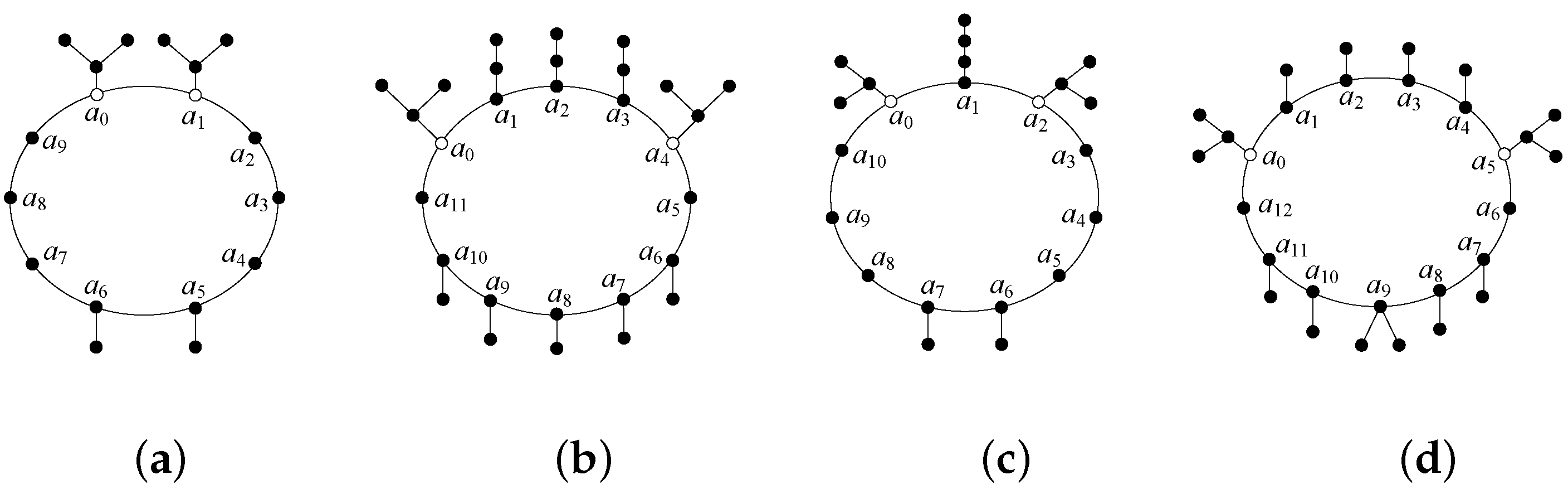
We use and to denote the set of all edge-odd- graphs and edge-even- graphs, respectively. See Figure 2 for some examples of edge-odd- graphs and edge-even- graphs. Let us now turn to the discussion of the edge metric dimension of unicyclic graphs based on edge-odd and edge-even graphs. Although the conclusions (and their proofs) in this section are analogous to those in
Section 3, there are still a number of important differences between them. Thus, we fully describe them as well.
Lemma 9. Let G be a unicyclic graph with , where . Label normally. If there exists a such that and , then = .
Proof. By Lemma 1, it suffices to show that S is an edge metric generator. Note that is labeled normally. If there exists some for which , then contains three vertices that form a geodesic triple, and S is an edge metric generator of G by Lemma 2. Thus, we assume that contains no branching vertex for every .
Let
be an arbitrary pair of edges in
G. Clearly, if both
and
, then
and
can be distinguished by
, and also by
S. By Lemmas 3 and 4,
and
can be distinguished by
S if
and
for some
or
. In the below, we assume that
for some
,
, and there does not exist any
such that
. Let
and
. This also implies that
and
. Now, suppose that
We derive a contradiction or show that and can be distinguished by a vertex in .
Case 1.
. Let
, where
and
. By
(Definition 2 (ii)), we have that
or
(note that
). Moreover, when
, it follows that
; otherwise,
, a contradiction to Equation (
4).
Case 1.1.
. Then,
and
. If
, then either
(when
) or
(when
), a contradiction to Equation (
4). If
, then
and
. By Equation (
4), we deduce that
, a contradiction. If
, then
and
+
j (notice that in this case
does not exist when
(mod 2) and
). By Equation (
4), we deduce that
, a contradiction.
Moving on now to consider
, it follows that
and
. Then, by Equation (
4), we derive
and
. This shows that there does exist a
for which
, since if not,
contains no branching vertex for every
while
has length of at least
, a contradiction to
(Definition 2 (iii)). Let
and we will prove that
and
can be distinguished by
w.
For this, we construct a new graph that is obtained from G by subdividing edge (i.e., delete , add a new vertex, say , and join to and ). Let and consider . Clearly, , , and . With regard to , a normal labeling can be obtained based on by relabeling with and with for every . Notice that , , , and . Thus, and . Then, by Lemma 5, . For graph G (and also for ), if is on , then clearly . We therefore assume that is not on , which implies that . Additionally, when (in ) , it holds that (in G) and hence ; when (in ) , it holds that (in G) and hence . As a conclusion, .
Case 1.2.
. Then,
, and
and
. Furthermore, if
, then
, and
(when
) or
(when
). By Equation (
4), we derive
(when
) or
(when
), a contradiction. If
, then
, and
and
. By Equation (
4), we have
, a contradiction.
Case 2.
. Let
for some
and
. Without loss of generality, we assume that
. Then, by Equation (
4) and Lemma 6, one of the following conditions holds: (i)
,
, and
; (ii)
,
,
, and
; (iii)
,
, and
; or
and
.
For (i), by (Definition 2 (ii)), we deduce that and , a contradiction. For (ii), we have that (mod 2), , and (which implies that the length of is at least ). Therefore, by (Definition 2 (iv)), there exists a vertex such that contains a branching vertex. Thus, , say . By Lemma 5, x and y can be distinguished by w. For (iii), we have that and , a contradiction to (Definition 2 (ii)). □
Theorem 2. Suppose that G is a unicyclic graph such that , where . Label normally and let . S is an edge metric generator if and only if or contains three vertices that form a geodesic triple.
Proof. The sufficiency follows from Lemmas 2 and 9. Suppose that S is an edge metric generator, and there are not three S-active vertices forming a geodesic triple. This shows that , and when and (however, in this case for every and every , where , a contradiction). In the below, we assume that and we will prove that . To the contrary, if (respectively, ), then at least one of the following conditions (i), (ii), and (iii) (respectively, (i), (ii), and (iv)) holds.
- (i)
or is a bad vertex.
- (ii)
When , there exists a such that .
- (iii)
When and contains no branching vertex for every , there exists a such that is a path of length at least .
- (iv)
When and both and contain no branching vertex for every and , there exists a and a such that and has length at least .
For (i), suppose that is a bad vertex. By the selection of S, there is a thread attached to such that . Let such that . Then, for any . Therefore, S cannot distinguish and .
For (ii), consider the vertex that is adjacent to . If , then , and hence for any . Therefore, S cannot distinguish and . If , then for any . Therefore, S cannot distinguish and .
For (iii), (mod 2) and S contains only vertices in . Let be the edge that has distance with . Consider edge where . Observe that ; we have and . Therefore, for any and for any . Therefore, S cannot distinguish and .
For (iv), (mod 2) and S contains only vertices in . Let be the edge that has distance exactly with , and , where . Observe that . We have that and . Therefore, for any and for any . Therefore, S cannot distinguish and . □
Again, since for every two distinct vertices we can always find a vertex such that form a geodesic triple, it follows by Lemmas 1 and 2 that 2 ≤ edim(G) when , edim(G) when , and edim(G) when . Thus, the following result holds by Theorem 2.
Corollary 2. Given a unicyclic graph G and , we label normally and let when . Then,
- (1)
When , if there are two vertices on , say and , such that , then edim(G) = 2; otherwise edim(G) = 3.
- (2)
When , let . If there exists a vertex such that (let ) or (let ), then edim(G)=; otherwise, edim(G) = + 2.
- (3)
When , if or contains three vertices that form a geodesic triple, then edim(G)=; otherwise, edim(G) = .
5. Remarks and Conclusions
According to Definitions 1 and 2, we see that
and
. Therefore, by Corollaries 1 and 2, we can determine the relation between metric dimension and edge metric dimension for unicyclic graphs, as shown in
Table 1, and give an answer to Problems 1 and 2. Indeed, by
Table 1, we can generate an efficient algorithm to compute the value of
,
, and
.
It is worth re-emphasizing here that although Sedlar and Škrekovski in [
1] described a method to determine the (edge) metric dimension of unicyclic graphs, our work differs from theirs in a number of respects. First, our motivation to construct the four families of graphs was to characterize the structures of graphs
G with
=
and
, respectively, which is different from that in [
1] (indeed, our approach is completely opposite to that in [
1]). Second, in the case of
, based on the four families of graphs that we constructed, we obtained a necessary and sufficient condition for a set of vertices to be a metric (respectively, edge metric) generator of a unicyclic graph (Theorems 1 and 2). Third, in the case of
, we used a straightforward way to determine (edge) metric dimension, while in [
1], the authors introduced an indirect definition based on their configurations to accomplish this, namely,
-positivity and
-negativity (a similar definition for edge metric dimension).
Our approach is more intuitive than the method in [
1] and our discussions give a more thorough analysis on (edge) metric generator of a unicyclic graph (we characterize necessary and sufficient conditions for a vertex subset to be a (edge) metric generator). Moreover, our result can also be used to analyze dimensions for cactus graphs, which is left as future work. What follows is a direct application to a class of double-cyclic graphs.
A
double-cyclic graph is a graph that contains exactly two edge disjoint cycles. Similarly, for a double-cyclic graph
G, a
branch-resolving set of
G is a set
such that for every
-vertex
v, at least
threads in
contain a vertex of
S, where
is the set of threads that are attached to
v, and
Clearly, dim. Here, we consider a special class of double-cyclic graphs, which are defined as follows.
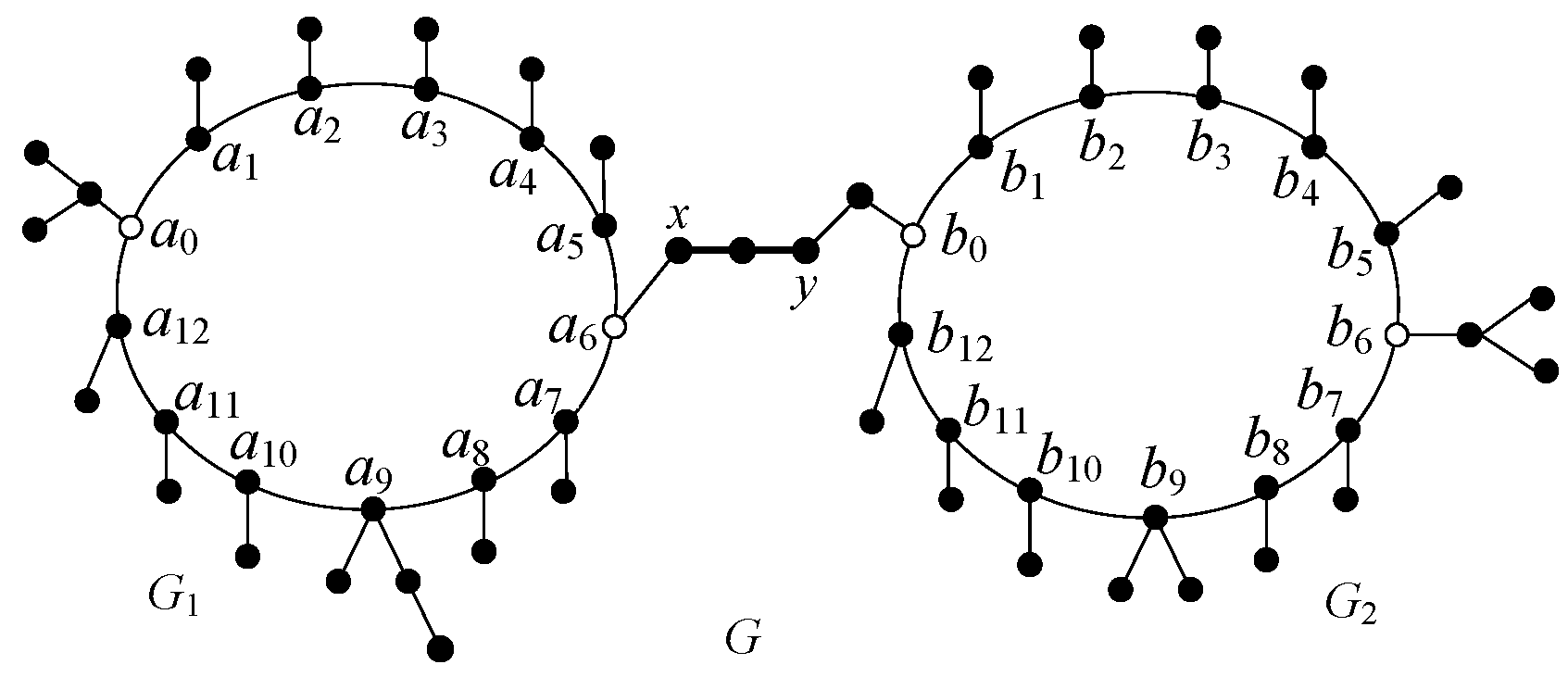
Definition 3. Let and be two unicyclic graphs such that for , and for . Now, we construct a class of double-cyclic graph, denoted by , by connecting two vertices (say x and y respectively, where and ) by an path with ends x and y such that the resulting graph G satisfies . See Figure 3 for an example. Lemma 10. Let and , , is the unicyclic graph defined in Definition 3. Let for . If , then any two vertexes u and v such that and can be distinguished by .
Proof. Denote by and the masters of u and v, respectively. Let and is the master of s. Then, and . Let and is the master of t.
Notice that . If , then . On the other hand, and . Now, suppose that . We have that . Observe that . It follows that y is not on the path . Then, , which indicates that , a contradiction. Thus, . □
Theorem 3. Let , and , , is the unicyclic graph defined in Definition 3. Let for . If , then, dim(G) = dim() + dim() = L() + L().
Proof. Since and for , it follows by Lemma 8 that is a metric generator of and = dim() = L(). Let u and v be any two vertices in G. If u and v belong to the same for some , then they can be distinguished by . If one of u and v belongs to , say u, then they can be distinguished by (when ) or (when ). If u and v belong to and , respectively, then by Lemma 10 they can be distinguished by . This implies that dim(G) ≤ dim() + dim() = L() + L(). On the other hand, since , we have that dim(G) ≥ L() + L() = dim() + dim(). Therefore, the conclusion holds. □