Abstract
In this paper, the improved split-step method, named the split-step composite method, is proposed to study the mean-square stability for stochastic differential equations with a fixed time delay. Under the global Lipschitz and linear growth conditions, it is proved that the split-step composite method with shows mean-square stability. An approach to improving numerical stability is illustrated by choices of parameters of this method. Some numerical examples are presented to show the accordance between the theoretical and numerical results.
Keywords:
stochastic delay differential equations; mean-square stability; split-step composite θ method; split-step θ method MSC:
37M05
1. Introduction
Stochastic delay differential equations have been widely applied in many applications such as signal processing, biological systems, and financial engineering [1,2,3]. As one of central problems in numerical analysis of stochastic systems, the stability theory has attracted a great deal of attention [4,5]. Due to the characteristics of stochastic delay differential equations themselves, it is not easy to obtain an analytical solution of equations; therefore, numerical solution analysis has certain theoretical value and practical significance.
Stability analysis of numerical methods for stochastic delay differential equations has made some achievements [6,7]. The split-step method, as an important numerical method, has been applied to various stochastic systems. Rathinasamy [8] investigated mean-square stability of the split-step method for stochastic delay Hopfield neural networks under suitable conditions. Cao et al. [9] studied the exponential mean-square stability of the split-step method for stochastic differential equations with a fixed time delay. Huang [10] proved that the split-step method with still unconditionally preserves the exponential mean-square stability of the underlying systems under a coupled condition on the drift and diffusion coefficients. Rathinasamy and Balachandran [11] analyzed the T-stability of the split-step method for linear stochastic delay integro-differential equations. The mean-square stability of the split-step composite method for stochastic differential equation has been introduced by Guo et al. [12].
In the paper, we construct the split-step composite method for stochastic delay differential equations and improve stability by changing the values of parameters and . It is proved that the mean-square stability of the split-step composite method is superior to that of the split-step method. In Section 2, we introduce the split-step composite method. The stability of this method for linear stochastic delay differential equations is analyzed in Section 3. In Section 4, corresponding numerical examples further illustrate the obtained theoretical results. The conclusions will be expressed in the last section.
2. Preliminaries and the Split-Step Composite Method
Throughout this paper, unless otherwise specified, let be a complete probability space with a filtration , which increases and is right-continuous, and contains all P-null sets. and P are the sample space and probability, respectively. Let be the Euclidean norm. The Wiener process is defined on [13].
Consider the following stochastic delay differential equation [13]
where , is a constant. Let the -valued initial segment be an -measurable one-dimensional random variable such that , where . is one-dimensional Wiener process.
We impose some assumptions for Equation (1).
Assumption 1.
and satisfy the global Lipschitz condition and the linear growth condition.
(1). Global Lipschitz condition: there is positive constant K, such that for all , and
(2). Linear growth condition: there is positive constant , such that
holds for every and .
The split-step composite method is an improved numerical method, parameter is introduced on the basis of the split-step method. Now, we present the split-step composite method [12]
where parameters and , is an approximation to analytical solution , is the given step-size with for a positive integer m, N is a given positive integer, are independent distributed stochastic variables, , and . When the parameter , it is the split-step method [14,15]. When the parameters and , it is the split-step back-Euler method [16,17]. When the parameters and , it is the split-step forward-Euler method [18]. The split-step method, split-step back-Euler method, and split-step forward-Euler method are different numerical methods. The split-step method achieves stability by changing the value of , while the other two methods are ysed to adjust the stability by changing the step size or equation coefficients [19,20].
Definition 1
([13]). If there is a constant and , such that
then the solution of Equation (1) is said to be pth-moment exponentially stable, E is expectation. When , it is said to show mean-square stability.
3. Stability of the Split-Step Composite Method
In this section, we will discuss the stability of the split-step composite method for linear stochastic delay differential equations
where .
Definition 2
([13]). The numerical method applied to Equation (1) is said to present mean-square stability if for every step size h, the numerical approximation produced by the split-step composite θ method satisfies
Theorem 1.
Let be the coefficients of Equation (4), θ and λ be parameters, and h be the step size. If satisfy
and the parameter , then the split-step composite θ method shows mean-square stability.
Proof.
The split-step composite method is applied to Equation (4). The numerical scheme is constructed as follows:
namely
substituting (8) into the second equation of (7), we have
Squaring both the above equation, we obtain
Using the inequality and taking mathematical expectation on (9), we obtain
that is
where
and the condition (6) holds. It is obvious that if
the above inequality is equivalent to
If , then from condition (6) we have and
Thus, when , the inequality (12) holds. We obtain the relationship of from , that is
The theorem is proven. □
4. Numerical Example
Taking coefficients of Equation (4) as . The coefficients satisfy the condition (6). We use Matlab to randomly generate 2000 discrete trajectories, that is
where is the numerical solution of i trajectories at the time .
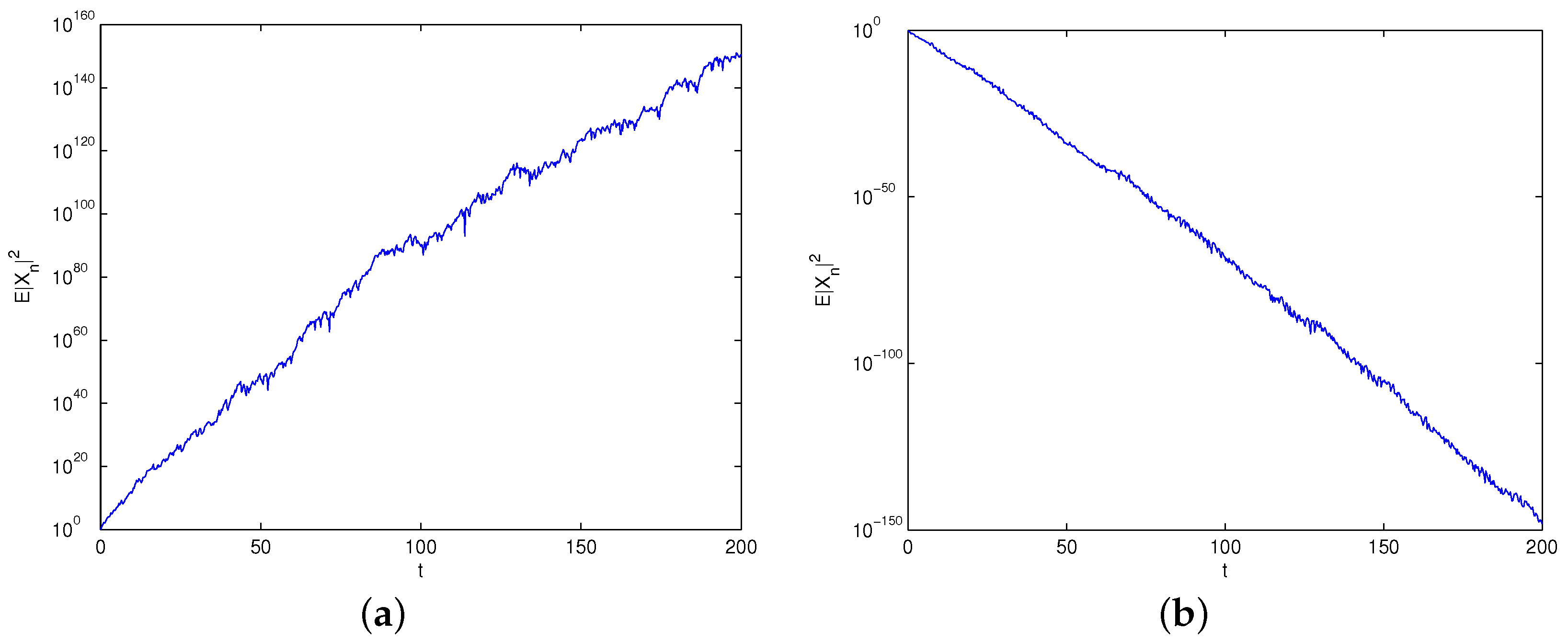
Parameter can be fixed with step-size . Figure 1 shows that the split-step composite method does not show mean-square stability when , while for , the split-step composite method is stable. When the parameter is closer to 1, the split-step composite method is more stable.
Figure 1.
The split-step composite method with (a) ; (b) .
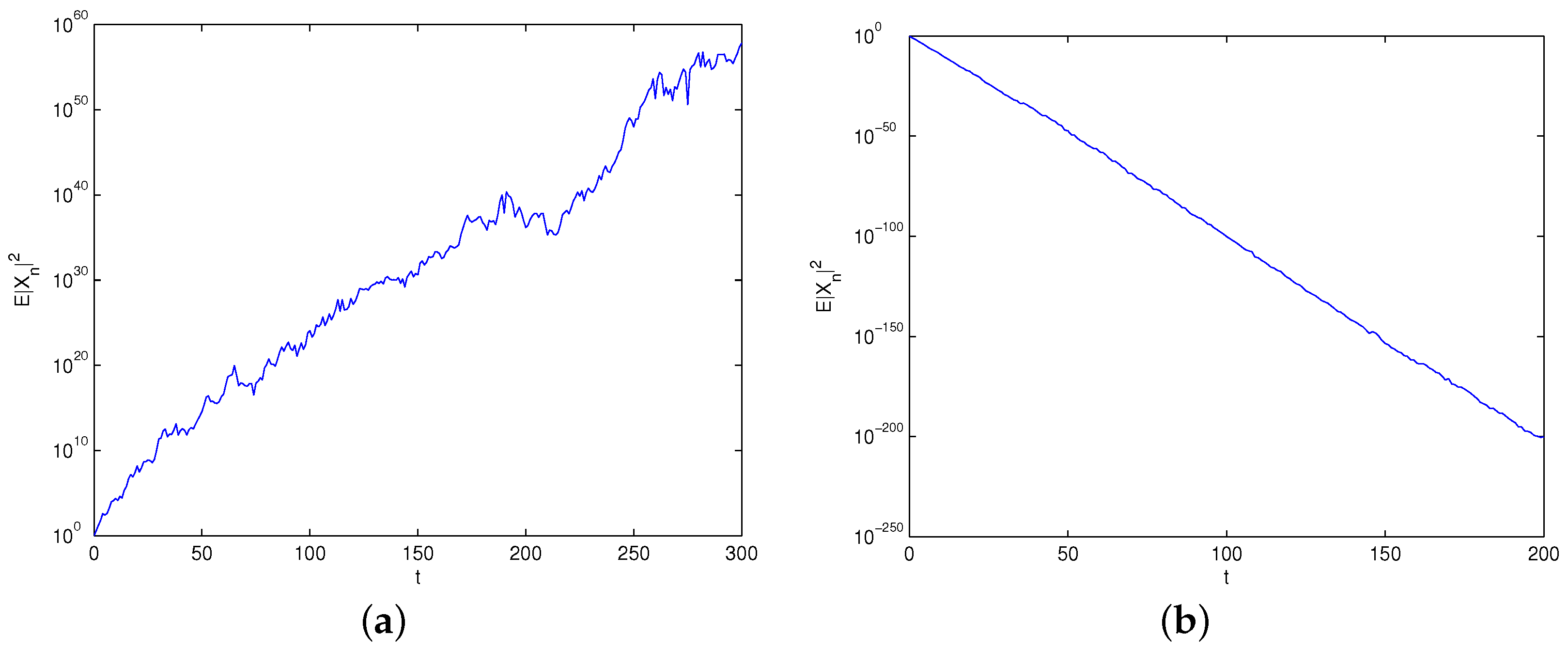
Parameter can be fixed with step-size . We change the value of parameter to , as shown in Figure 2. From Figure 2, the second-order moment of numerical solution blows up when and tends to be zero for , as observed. Appropriately adjusting the parameter value can improve stability.
Figure 2.
The split-step composite method with (a) ; (b) .
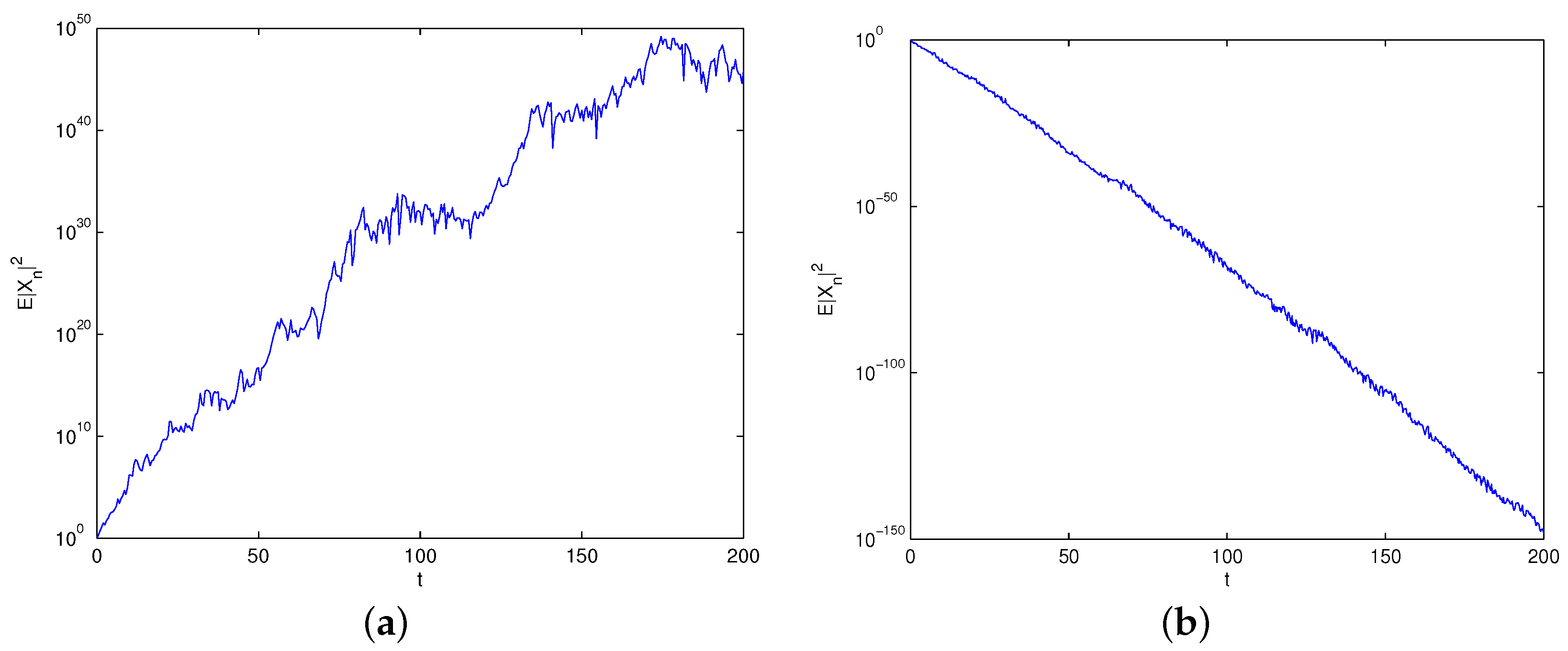
Fix parameters when . We choose the step-size , , and the computer simulation result is shown in Figure 3. It is shown that the split-step composite method can maintain stability when .
Figure 3.
The split-step composite method with (a) ; (b) .
5. Conclusions
We discuss the stability of the split-step composite method for stochastic delay differential equations in the paper. It is proven that the split-step composite method with shows mean-square stability. We can maintain and improve the stability of the split-step composite method for stochastic systems by adjusting the values of parameters and . Meanwhile, it is proven that the split-step composite method is superior to that of the split-step method.
Author Contributions
Conceptualization, Y.Z.; methodology, Y.Z.; software, Y.Z.; formal analysis, E.Z.; investigation, E.Z.; data curation, Y.Z.; writing—original draft preparation, Y.Z.; writing—review and editing, E.Z. and L.L.; visualization, L.L.; supervision, L.L. All authors have read and agreed to the published version of the manuscript.
Funding
This work was supported by Youth Scholars Fund of Harbin Universities of Commerce under Grant 18XN010, Doctor’s fund of Harbin Universities of Commerce under Grant 2019DS048, and the National Social Science Fund of China under Grant 21BTJ061.
Institutional Review Board Statement
Not applicable.
Informed Consent Statement
Not applicable.
Data Availability Statement
Not applicable.
Conflicts of Interest
The authors declare no conflict of interest.
References
- Zhao, G.H.; Song, M.H.; Yang, Z.W. Mean-square stability of analytic solution and Euler–Maruyama method for impulsive stochastic differential equations. Appl. Math. Comput. 2015, 251, 527–538. [Google Scholar] [CrossRef]
- Lu, C.; Ding, X.H. Persistence and extinction for a stochastic logistic model with infinite delay. Electron. J. Differ. Equ. 2013, 262, 1–16. [Google Scholar]
- Zhou, Q.; Wan, L. Exponential stability of stochastic delayed Hopfield neural networks. Appl. Math. Comput. 2008, 199, 84–89. [Google Scholar] [CrossRef]
- Baker, C.T.H.; Buckwar, E. Numerical analysis of explicit one-step methods for stochastic delay differential equations. LMS J. Comput. Math. 2000, 3, 315–335. [Google Scholar] [CrossRef]
- Wu, F.; Mao, X.; Szpruch, L. Almost sure exponential stability of numerical solutions for stochastic delay differential equations. Numer. Math. 2010, 115, 681–697. [Google Scholar] [CrossRef]
- Wang, X.; Gan, S. The improved split-step backward Euler method for stochastic differential delay equations. Int. J. Comput. Math. 2011, 88, 2359–2378. [Google Scholar] [CrossRef]
- Wang, Z.; Zhang, C. Mean-square stability of milstein method for solving nonlinear stochastic delay differential equations. Math. Appl. 2008, 21, 201–206. [Google Scholar]
- Rathinasamy, A. The split-step θ methods for stochastic delay Hopfield neural networks. Appl. Math. Model. 2012, 36, 3477–3485. [Google Scholar] [CrossRef]
- Cao, W.R.; Hao, P.; Zhang, Z.Q. Split-step θ method for stochastic delay differential equations. Appl. Numer. Math. 2012, 76, 19–33. [Google Scholar] [CrossRef]
- Huang, C.M. Mean square stability and dissipativity of two classes of theta methods for systems of stochastic delay differential equations. J. Comput. Appl. Math. 2014, 259, 77–86. [Google Scholar] [CrossRef]
- Rathinasamy, A.; Balachandran, K. T-stability of the split-step θ methods for linear stochastic delay integro-differential equations. Nonlinear Anal. Hybrid Syst. 2011, 5, 639–646. [Google Scholar] [CrossRef]
- Guo, Q.; Li, H.Q.; Zhu, Y. The improved split-step θ methods for stochastic differential equation. Math. Meth. Appl. 2014, 37, 2245–2256. [Google Scholar] [CrossRef]
- Mao, X.R. Stochastic Differential Equations and Their Applications; Harwood: New York, NY, USA, 1997. [Google Scholar]
- Ding, X.; Ma, Q.; Zhang, L. Convergence and stability of the split-step θ method for stochastic differential equations. Comput. Math. Appl. 2010, 60, 1310–1321. [Google Scholar] [CrossRef]
- Zhao, J.J.; Yi, Y.L.; Xu, Y. Strong convergence and stability of the split -step theta method for highly nonlinear neutral stochastic delay integro differential equation. Appl. Numer. Math. 2020, 157, 385–404. [Google Scholar] [CrossRef]
- Higham, D.J.; Mao, X.R.; Stuart, A.M. Strong convergence of Euler-type methods for nonlinear stochastic differential equations. SIAM J. Numer. Anal. 2002, 40, 1041–1063. [Google Scholar] [CrossRef]
- Yue, C.; Zhao, L.B. Strong convergence of split-step backward Euler method for stochastic delay differential equations with a nonlinear diffusion coefficient. J. Comput. Appl. Math. 2021, 382, 113068. [Google Scholar] [CrossRef]
- Wang, P.; Li, Y. Split-step forward methods for stochastic differential equations. J. Comput. Appl. Math. 2010, 233, 2641–2651. [Google Scholar] [CrossRef]
- Liu, L.N.; Mo, H.Y.; Deng, F.Q. Split-step theta method for stochastic delay integro-differential equations with mean square exponential stability. Appl. Math. Comput. 2019, 353, 320–328. [Google Scholar] [CrossRef]
- Liu, X.H.; Deng, F.Q.; Liu, L.N.; Luo, S.X.; Zhao, X.Y. Mean square stability of two classes of θ methods for neutral stochastic delay integro-differential equation. Appl. Math. Lett. 2020, 109, 106544. [Google Scholar] [CrossRef]
Publisher’s Note: MDPI stays neutral with regard to jurisdictional claims in published maps and institutional affiliations. |
© 2022 by the authors. Licensee MDPI, Basel, Switzerland. This article is an open access article distributed under the terms and conditions of the Creative Commons Attribution (CC BY) license (https://creativecommons.org/licenses/by/4.0/).