


Abstract
In this paper, we introduced a new source condition and a new parameter-choice strategy which also gives the known best error estimate. To obtain the results we used the assumptions used in earlier studies. Further, we studied the proposed new parameter-choice strategy and applied it to the method (in the finite-dimensional setting) considered in George and Nair (2017).
Keywords:
nonlinear ill-posed equations; finite dimension; iterative method; Lavrentiev regularization; a new parameter-choice strategy MSC:
41H25; 65F22; 65J15; 65J22; 47A52
1. Introduction
Let be a nonlinear monotone operator, i.e.,
defined on the real Hilbert space . Here and below and , respectively, denote the inner product and corresponding norm in and , respectively, denote open and closed ball in with center and radius We are concerned with finite dimensional approximation of the ill-posed equation
which has a solution for exact data However, we have for some are the available data, such that
Due to the ill-posedness of (1), one has to apply regularization method to obtain an approximation for For (1) with monotone Lavrentiev regularization (LR) method is widely used (see [1,2,3,4,5,6]). In (LR) method the solution of the equation
is used as an approximation for Here (and below) is an initial approximation of with for some The solution of (3), with y in place of is denoted by , i.e., (cf. [5])
Let and be as in Equations (3) and (4), respectively. Then, we have the following inequalities (cf. [5]).
and hence,
and
For proving our result, we assume that, either is self-adjoint or is positive type, i.e.,
and
(see [7]). Here and below is the Fréchet derivative of (if is self-adjoint, then ).
Remark 1.
If is positive type, then
Further as in [8] (Lemma 2.2) one can prove
So, the results in this paper hold for positive type operator up to a constant. Therefore, for convenience, hereafter we assume is self-adjoint.
In earlier studies such as [4,5,6,9,10], the following source condition:
or
was used to obtain an estimate for In fact, if the source condition (8) is satisfied, then, we have [5]
and if (9) is satisfied, then, we have [2]
In this study, we introduce a new source condition,
where and We shall use this source condition (10) to obtain a convergence rate for and to introduce a new parameter-choice strategy.
Remark 2.
(a) Note that in a posteriori parameter-choice strategy, the regularization parameter α (depending on δ and ) is chosen at the time of computing (see [11]). The new source condition (10) is used to choose the parameter α (depending on δ and ) and independent of before computing (see Section 2) and also it gives the best known convergence order (see Remark 4). This is the innovation of our approach.
The following formula ([12], p. 287) for fractional power of positive type operators is used in our analysis.
where
and z is a complex number such that
Let and . Then, we have
Note that, if is self-adjoint, then, A is self-adjoint. Further, suppose is positive type, then we have
i.e., A is positive type.
Next, we shall prove that (10) implies
for some constants and . For this, we use the standard non-linear assumptions in the literature (cf. [4,13]).
Assumption 1.
For every and there exists and an element with
and
Suppose (10) holds for then
so by the definition of A and Assumption 1, we have
where Further note that
Suppose
where Observe that
So implies i.e., (10) implies (12). Similarly one can show that (10) implies
for some constant Throughout the paper, we use the relation (Fundamental Theorem of Integration),
for all x and u in a ball contained in
Remark 3.
In general, it is believed that (see [5]) a priori parameter-choice strategy is not a good strategy to choose α since the choice is depending on the unknown In this study, we introduce a new parameter-choice strategy which is not depending on unknown ν and gives the best known convergence order
In some recent papers, the first author and his collaborators considered iterative methods [14,15] for obtaining stable approximate solutions for (3) (see [8,16]). In most of the iterative methods Fréchet derivative of the operator involved is used. In [10], Semenova considered the iterative method defined for fixed by
Note that, the above iterative method is derivative-free. Convergence analysis in [10] is based on the assumption that is Lipschitz continuous and the Lipschitz constant R satisfies
where is a constant. Contraction mapping arguments are used to prove the convergence in [10].
In [16], George and Nair considered the method (13), but with independent on the regularization parameter and the Lipschitz constant instead of The source condition on in [16] depends on the known and the analysis in [16] is not based on the contraction mapping arguments as in [10].
The purpose of this paper is threefold: (1) introduce a new source condition, (2) introduce a new parameter-choice strategy, and (3) apply the parameter-choice strategy to the (finite–dimensional setting of the) method in [16].
The remainder of the paper is organized as follows. In Section 2, we present the error bounds under the source condition (10) and a new parameter-choice strategy. In Section 3, we present the finite dimensional realization of method (13). In Section 4, we present the finite dimensional realization of (10). Section 5 contains the numerical example and the conclusion is given in Section 6.
2. Error Bounds under (10) and a New Parameter Choice Strategy
First we obtain an estimate for using (10).
Theorem 1.
Let Assumption 1 and (10) be satisfied. Then,
Proof.
Since and we have
i.e.,
or
where
□
Theorem 2.
Suppose Assumption 1 and (10) hold. Then,
In particular, if then
Proof.
Follows from (6) and Theorem 1. □
Remark 4.
Note that the best value for is attained when , i.e., and in this case the optimal order is However, the above choice of α is depending on the unknown In view of this, our aim is to choose α (not depending on ν), so that we obtain
A New Parameter Choice Strategy
For define
where
Theorem 3.
For each and the function is continuous, monotonically increasing and
Proof.
Note that
where is the spectral family of Note that for each
is strictly increasing and satisfies and Hence, by Dominated Convergence Theorem is strictly increasing, continuous, □
In addition to (2), we assume that
for some The following theorem is a consequence of the intermediate value theorem.
Next, we shall show that if satisfies (10) and (20) hold, then Our proof is based on the following moment inequality for positive type operator B (see [12], p. 290)
Proof.
We have,
where Let Note that,
where By Assumption 1, we obtain
i.e.,
and hence
Proof.
Thus,
□
Combining Theorems 5 and 6, we obtain:
In [16], the following estimates was given (see [16], Theorem 2.3)
where and with Suppose
Proof.
Follows from the inequality
Equation (31), Theorems 6 and 7. □
3. Finite Dimensional Realization of (13)
Consider a family of orthogonal projections of onto the range of Let there exists such that
and let
We assume that;
- (i)
- (ii)
- there exists such that
- (iii)
- there exists such that
Remark 5.
- (a)
- Suppose is self-adjoint for Then, and by Assumption 1, we have Hence,so,Therefore, in this case, we can take,
- (b)
- Suppose, is not self-adjoint for In this case, under the additional assumption (see [17])with we have
Therefore, in this case, we can take,
From now on, we assume and with
First we shall prove that
has a unique solution under the assumption
Proof.
Since is monotone, we have
so is monotone and Hence by Minty–Browder Theorem(see [18,19]), Equation (34) has a unique solution for all and
Next, we shall prove that Note that by (34), we have
So, we have
and hence
i.e., □
The method: The rest of this section, is assumed to be positive self-adjoint operator. We consider the sequence defined iteratively by
where
Note that if exists, then the limit is the solution of (34).
Proof.
Note that by (3), we have
□
Remark 6.
If and then by Theorems 2 and 9, we have
Theorem 10.
Let and Then, and Further
where and .
Proof.
We shall show the following using induction;
- (1a)
- (1b)
- the operatoris positive self-adjoint, well defined and
- (1c)
Clearly, Furthermore, we have by Proposition 1, so by (32), is a well defined and positive self-adjoint operator with So (1a) and (1b) hold for
Note that
Since,
we have
Since is a positive self-adjoint operator ( cf. [20]),
and since and , we have
Therefore,
Thus, by (44), we have
Therefore, we have
and
Thus, So, for (1a)–(1c) hold. The induction for (1a)–(1c) is completed, if we simply replace in the preceding arguments with , respectively. The result now follows from (1c). □
Theorem 11.
Then,
Proof.
By Theorems 9 and 10, we have
Here, we used the fact that for and Thus, we obtain the required estimate in the theorem. □
Finite dimensional realization of (20) is considered next.
4. Finite Dimensional Realization of the a New Parameter Choice Strategy (20)
For define
The proof of the next theorem is similar to that of Theorem 3, so the proof is omitted.
Theorem 12.
For each the function for defined in (49), is continuous, monotonically increasing and
In addition to (2), we assume that
for some and . The proof of the following theorem follows from the intermediate value theorem.
Proof.
By (24), the result follows once we prove This can be seen as follows,
where, we used Next, we shall show that is bounded. Note that,
so, we have
and hence
Proof.
Thus
□
By combining Theorems 11, 14 and 15, we have the following Theorem.
Remark 7.
Note that in the proposed method a system of equation is solved to obtain the parameter α and used it for computing Whereas in the classical discrepancy principle one has to compute α and in each iteration step. This is an advantage of our proposed approach.
5. Numerical Examples
The following steps are involved in the computation of
Step I Compute satisfying (51)
Step II Choose n such that
Step III Compute using (38).
To compute consider a sequence of finite dimensional subspaces, where with as the linear splines (in a uniform grid of points in ), so that dimension Since are some scalars. Then, from (38), we have
where is the projection on to with In this case one can prove as in [21] that So we have taken in our computation. Since we approximate
where are grid points. So satisfies (58), if satisfies the equation
where
and
To compute the satisfying (51), we follow the following steps:
Let Then so for some scalars Note that or where
Since we have Further and satisfies the equations
and
respectively, where
and
We compute in (51), using Newton’s method as follows. Let Then
where Let
The satisfies the equation
So,
and
Then, using Newton’s iteration we compute the iterate as; In our computation, we stop the iterate when
We consider a simple one dimensional example studied in [5,7,22,23] to illustrate our results in the previous sections. We also compare our computational results with that adaptive method considered in [16,24]. Let us briefly explain the adaptive method considered in [16]. Choose For each j find such that
Then, find k such that
Choose, as the regularization parameter.
Example 1.

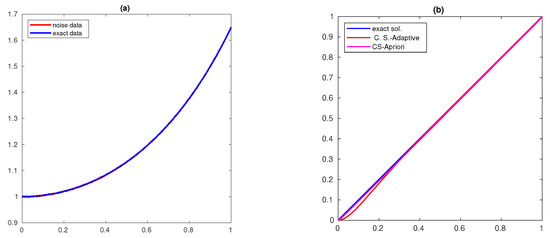
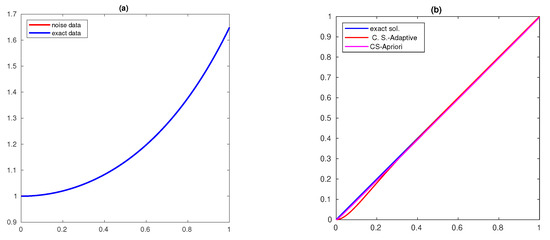
Let be a constant. Consider the inverse problem of identifying the distributed growth law in the initial value problem
from the noisy data One can reformulate the above problem as an (ill-posed) operator equation with
Then is given by
It is proved in [7], that is positive type (sectorial) and spectrum of is the singleton set Further it is proved in [5] that satisfies Assumption 1 and that provided and Now since we have
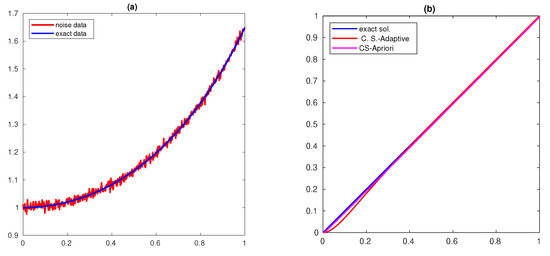
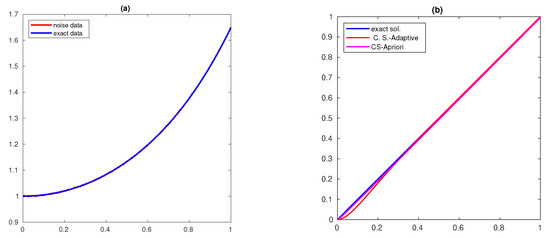
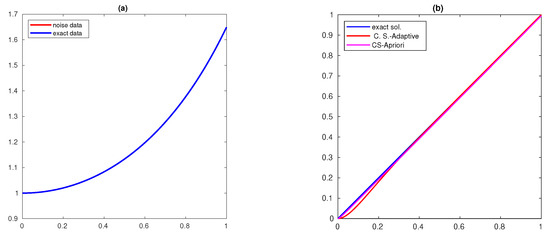
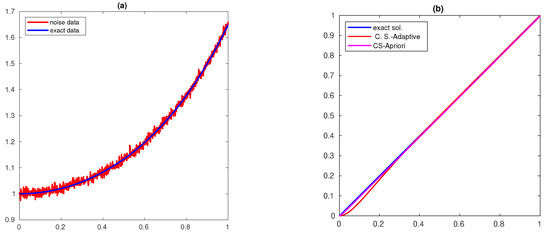
where This shows the source condition (10) is satisfied. For our computation we have taken and In Table 1, we present the relative error and α values using a new method (51) and adaptive method considered in [16] for different values of δ and Furthermore, we provide computational time (CT) for both the methods mentioned above. The relative error obtained for our a new method (51) is lesser than that the adaptive method in [16] for various δ values. As the relative error decreases the accuracy of reconstruction increases.
Table 1.
Relative errors using discrepancy principle.
The solutions obtained for different δ values () for are shown in Figure 1, Figure 2 and Figure 3, respectively, and for and are shown in Figure 4, Figure 5 and Figure 6, respectively. The exact and noisy data are shown in subfigure (a) of these figures and the computed solution is shown in subfigure(b) (C.S-A priori denotes the figure corresponding to the method (51)). The computed solution for the new method is closer to the actual solution.
Figure 1.
(a) data and (b) Solution with and .
Figure 2.
(a) data and (b) Solution with and .
Figure 3.
(a) data and (b) Solution with and .
Figure 4.
(a) data and (b) Solution with and .
Figure 5.
(a) data and (b) Solution with and .
Figure 6.
(a) data and (b) Solution with and .
6. Conclusions
We introduced a new source condition and a new parameter-choice strategy. The proposed a new parameter-choice strategy is independent of the unknown parameter and it provides the optimal order for
Author Contributions
Conceptualization and validation by S.G., J.P., K.R. and I.K.A. All authors have read and agreed to the published version of the manuscript.
Funding
The authors Santhosh George and Jidesh P wish to thank the SERB, Govt. of India for the financial support under Project Grant No. CRG/2021/004776. Krishnendu R thanks UGC India for JRF.
Institutional Review Board Statement
Not applicable.
Informed Consent Statement
Not applicable.
Data Availability Statement
Not applicable.
Conflicts of Interest
The authors declare no conflict of interest.
References
- George, S.; Nair, M.T. A modified Newton-Lavrentiev regularization for non-linear ill-posed Hammerstein-type operator equations. J. Complex. 2008, 24, 228–240. [Google Scholar] [CrossRef]
- Hofmann, B.; Kaltenbacher, B.; Resmerita, E. Lavrentiev’s regularization method in Hilbert spaces revisited. Inverse Probl. Imaging 2016, 10, 741–764. [Google Scholar] [CrossRef]
- Janno, J.; Tautenhahn, U. On Lavrentiev regularization for ill-posed problems in Hilbert scales’. Numer. Funct. Anal. Optim. 2003, 24, 531–555. [Google Scholar] [CrossRef]
- Mahale, P.; Nair, M.T. Lavrentiev regularization of non-linear ill-posed equations under general source condition. J. Nonlinear Anal. Optim. 2013, 4, 193–204. [Google Scholar]
- Tautenhahn, U. On the method of Lavrentiev regularization for non-linear ill-posed problems. Inverse Probl. 2002, 18, 191–207. [Google Scholar] [CrossRef]
- Vasin, V.; George, S. An analysis of Lavrentiev regularization method and Newton type process for non-linear ill-posed problems. Appl. Math. Comput. 2014, 230, 406–413. [Google Scholar]
- Nair, M.T.; Ravishankar, P. Regularized versions of continuous Newton’s method and continuous modified Newton’s method under general source conditions. Numer. Funct. Anal. Optim. 2008, 29, 1140–1165. [Google Scholar] [CrossRef]
- George, S.; Sreedeep, C.D. Lavrentiev’s regularization method for nonlinear ill-posed equations in Banach spaces. Acta Math. Sci. 2018, 38B, 303–314. [Google Scholar] [CrossRef]
- George, S. On convergence of regularized modified Newton’s method for non-linear ill-posed problems. J. Inverse Ill-Posed Probl. 2010, 18, 133–146. [Google Scholar] [CrossRef]
- Semenova, E.V. Lavrentiev regularization and balancing principle for solving ill-posed problems with monotone operators. Comput. Methods Appl. Math. 2010, 10, 444–454. [Google Scholar] [CrossRef]
- De Hoog, F.R. Review of Fredholm equations of the first kind. In The Application and Numerical Solution of Integral Equations; Anderssen, R.S., De Hoog, F.R., Luckas, M.A., Eds.; Sijthoff and Noordhoff: Alphen aan den Rijn, The Netherlands, 1980; pp. 119–134. [Google Scholar]
- Krasnoselskii, M.A.; Zabreiko, P.P.; Pustylnik, E.I.; Sobolevskii, P.E. Integral Operators in Spaces of Summable Functions; Noordhoff International Publishing: Leyden, The Netherlands, 1976. [Google Scholar]
- Mahale, P.; Nair, M.T. Iterated Lavrentiev regularization for non-linear ill-posed problems. ANZIAM J. 2009, 51, 191–217. [Google Scholar] [CrossRef]
- Argyros, I.K. The Theory and Applications of Iteration Methods, 2nd ed.; Engineering, Series; CRC Press: Boca Raton, FL, USA; Taylor and Francis Group: Abingdon, UK, 2022. [Google Scholar]
- Argyros, I.K. Unified Convergence Criteria for Iterative Banach Space Valued Methods with Applications. Mathematics 2021, 9, 1942. [Google Scholar] [CrossRef]
- George, S.; Nair, M.T. A derivative–free iterative method for nonlinear ill-posed equations with monotone operators. J. Inverse Ill-Posed Probl. 2017, 25, 543–551. [Google Scholar] [CrossRef]
- Kaltenbacher, B. Some Newton-type methods for the regularization of nonlinear ill-posed problems. Inverse Probl. 1997, 13, 729–753. [Google Scholar] [CrossRef]
- Deimling, K. Nonlinear Functional Analysis; Springer: New York, NY, USA, 1985. [Google Scholar]
- Alber, Y.; Ryazantseva, I. Nonlinear Ill-Posed Problems of Monotone Type; Springer: Berlin/Heidelberg, Germany, 2006. [Google Scholar]
- Nair, M.T. Functional Analysis: A First Course; Fourth Print, 2014; PHI-Learning: New Delhi, India, 2002. [Google Scholar]
- Groetsch, C.W.; King, J.T.; Murio, D. Asymptotic analysis of a finite element method for Fredholm integral equations of the first kind. In Treatment of Integral Equations by Numerical Methods; Baker, C.T.H., Miller, G.F., Eds.; Academic Press: Cambridge, MA, USA, 1982; pp. 1–11. [Google Scholar]
- Hofmann, B.; Scherzer, O. Factors influencing the ill-posedness of nonlinear inverse problems. Inverse Probl. 1994, 10, 1277–1297. [Google Scholar] [CrossRef]
- Groetsch, C.W. Inverse Problems in the Mathematical Sciences; Vieweg: Braunschweig, Germany, 1993. [Google Scholar]
- Pereverzev, S.; Schock, E. On the adaptive selection of the parameter in regularization of ill-posed problems. SIAM J. Numer. Anal. 2005, 43, 2060–2076. [Google Scholar] [CrossRef]
Publisher’s Note: MDPI stays neutral with regard to jurisdictional claims in published maps and institutional affiliations. |
© 2022 by the authors. Licensee MDPI, Basel, Switzerland. This article is an open access article distributed under the terms and conditions of the Creative Commons Attribution (CC BY) license (https://creativecommons.org/licenses/by/4.0/).