Abstract
This paper investigates the adaptive state-feedback stabilization problem for stochastic nonlinear systems. Compared with the existing results, we consider more general and more practical systems, i.e., systems with time-varying powers and unknown covariance simultaneously. We propose a new adaptive state-feedback control method, which ensures that the closed-loop system is globally stable in probability and the states are regulated to the origin almost surely. Finally, the feasibility of the design method is verified by two examples.
MSC:
93E03
1. Introduction
In many industrial applications, due to the ubiquity of stochastic noise and nonlinearity, real systems are often modeled by stochastic differential equations [1,2], which attract researchers to pay more and more attention to the control of stochastic systems. The prior work is reported in [3,4,5,6,7], which was further developed by [8,9,10,11,12,13]. Recently, there have been many reports on designs for stochastic high-order nonlinear systems [14,15,16,17,18,19]. The authors of [15] proposed a new stochastic homogeneous domination method to relax the power restrictions in [14]. The authors of [18] focused on the cooperative control problem of multiple nonlinear systems perturbed by second-order moment processes in a directed topology. The authors of [19] developed a state-feedback controller by using a combination of backstepping method and type-3 fuzzy neural network. All the results reported in [14,15,16,17,18,19] require that the order should be constant. For stochastic systems with time-varying powers, Ref. [20] is the first paper to work out the state-feedback stabilization problem. The authors of [21] solved the decentralized stabilization problem of large-scale stochastic systems with time-varying powers. However, in [20,21], it is required that their covariances are known identity matrices.
The designs above are for systems without unknown parameters. Nevertheless, parameter uncertainties are common and inevitable in many systems [22,23]. For systems with unknown parameters, adaptive control is an effective approach, with a strong ability to compensate for unknown parameters and fast convergence speed. Thus, stochastic adaptive control is a useful method to process unknown covariance. The authors of [24] considered stochastic nonlinear systems with a non-vanishing noise vector field and unknown covariance, and constructed an adaptive controller for strict-feedback systems. The authors of [25] extended the results in [24] to output-feedback stabilization. The authors of [26] proposed a novel least-squares algorithm to estimate the unknown covariance and designed adaptive control to guarantee that the states are regulated to zero almost surely. Although the authors of [24,25,26] considered stochastic systems with unknown covariance, it should be highlighted that the powers of their systems are constant, and they did not consider time-varying powers. However, many real applications require the order to be time-varying. For instance, the powers of boiler-turbine units [27] and underactuated mechanical systems [28] are time-varying.
On the basis of the above observations, we study the adaptive state-feedback stabilization problem for stochastic nonlinear systems with time-varying powers and unknown covariance. The main contributions include:
(1) The system model we take into account is more applicable than the existing results [14,15,16,17,18,19,20,21,24,25,26]. Unlike the systems studied in [14,15,16,17,18,19,20,21] with known identity matrix, this paper studies the systems with unknown covariance, whose characteristics are that the systems are affected by the noise of unknown intensity. Different from the systems with constant powers [24,25,26], this paper considers the time-varying power model, which makes the results more general. In fact, the inherent time-varying characteristics and unknown factors of the system make the design and stability analysis full of challenges.
(2) We propose a new adaptive control scheme. Since the powers are time-varying and the covariance is unknown, the control schemes in [14,15,16,17,18,19,20,21,24,25,26] are invalid here. We use the time-varying power’s bounds to design a new time-invariant controller to ensure that the closed-loop system is globally stable in probability and the states are regulated to the origin almost surely.
2. Problem Formulation
Consider the following system
where and are the system state and control input, respectively. The functions and are assumed to be smooth, and . is an dimensional standard Wiener process, which is defined on the complete probability space with the filtration satisfying the general conditions, and is Borel measurable and bounded, and the matrix is nonnegative-definite for each . is a continuously bounded function, which satisfies with and being constants. The power sign function is defined as with .
To realize this control objective, we need the following assumption.
Assumption 1.
There are two nonnegative smooth functions and , such that
Remark 1.
It should be noted that is unknown because the system (1) is affected by arbitrary bounded intensity noise. One of the difficulties of this paper is to deal with this item. When the power is constant, Assumption 1 is the same as the assumed condition in [14,15,16,17,18,19,20,21]. How to deal with the unknown and the time-varying power is nontrivial.
For a bounded function
The space of matrices with real entries will be denoted by , denotes the Frobenius norm of . A detailed explanation is given in [24].
3. Controller Design
In this section, for the system (1) under Assumption 1, we first construct an adaptive state-feedback controller and then analyze the stability of the closed-loop system.
3.1. Controller Design
In this part, our control objective is controller design. Before that, we need to deal with the unknown parameters. Since is unknown, it is not necessary to estimate the entire matrix . Instead, by using an estimate , we only need to estimate the unknown parameter .
Proof.
Firstly, introduce the coordinate transformation
where is the virtual controller and . By using Itô’s differentiation rule, we have
where with .
Next, the following is a detailed derivation of the controller.
Step 1. From (3), we obtain
Choose with being any constant and . From (4) and Assumption 1, we get
where is irrelevant to .
Let
Thus, if we choose as
we can get
where and are irrelevant to .
Step 2. By (3), we have
By using Lemma 2.1 in [30], we obtain
where
By using Lemma 2.1 in [30] and Assumption 1, we have
where is irrelevant to , and
Let
Choosing the virtual controller as
we have
where , and are irrelevant to .
Deductive Step. Suppose that steps have been completed, there exists a virtual controller as
such that the positive definite Lyapunov function satisfies
where is any constant, and are irrelevant to .
For completing the induction, we choose the following Lyapunov function at the ith step.
By using Lemma 2.1 in [30], we get
where and are irrelevant to .
By Assumption 1 and using Lemma 2.1 in [30], we have
where and are irrelevant to .
Let
Clearly, setting the virtual controller as
we get
where and are irrelevant to .
Step n. Choose
where is a constant.
Design the adaptive law as
and the controller as
Choosing appropriate such that , we have
where is a constant to be designed, and is a smooth function irrelevant to . □
Remark 2.
Although [24,25,26] solve the adaptive control problems for stochastic nonlinear systems with unknown covariance, their powers are . In this paper, the power is time-varying and non-differentiable, which makes the deduction of the controller much more difficult. To solve this problem, we introduce two constants and , which are reasonably used in the design process, see (7) and (12). In this way, the controller (43) can be designed independently of , which is crucial to guarantee stability.
Remark 3.
In the derivation process, there is a complex term , which is produced inevitably (see (5) and (11)). Because is unknown, it is difficult to deal with this term directly. To solve this problem, we first estimate with and replace the resulting ρ with (see (19) and (34)). Then, we combine the terms with to design , which can be found in (6), (22) and (42). Finally, the adaptive law (42) is derived. This is one of the main innovations of this paper.
3.2. Stability Analysis
Firstly, we prove a lemma, which is crucial in proving that the system (1) has a unique solution.
Lemma 1.
For , the function satisfies the local Lipschitz condition.
Proof.
If , we get
Then, we have
thus, is a differentiable function in and so meets the local Lipschitz condition in .
As , we get
For , is a differentiable function in , so meets the local Lipschitz condition in . Similarly, as , the conclusion is valid.
Therefore, the conclusion holds for . □
Next, we present the stability results.
Theorem 1.
If Assumption 1 holds, we obtain that
(1) For each , the closed-loop system has an almost surely unique solution on ;
(2) The equilibrium of the closed-loop system is globally stable in probability;
(3) For each exists and is finite.
Proof.
By (1), (43) and using Lemma 1, we conclude that the system (1) fulfills the local Lipschitz condition. By using (44) and (45), we get
By using Lemma 5 in [31] and Lemma 5 in [29], we get
Remark 4.
In the stability analysis process, we use two constants and to overcome the difficulties caused by , see (47), which is one of our major contributions.
4. Two Simulation Examples
In this part, we give two examples to illustrate the design methods.
Example 1.
Consider the global stabilization for the following system
where , , . Clearly, system (48) satisfies Assumption 1.
According to our design process, the control u is
and the adaptive law is
where
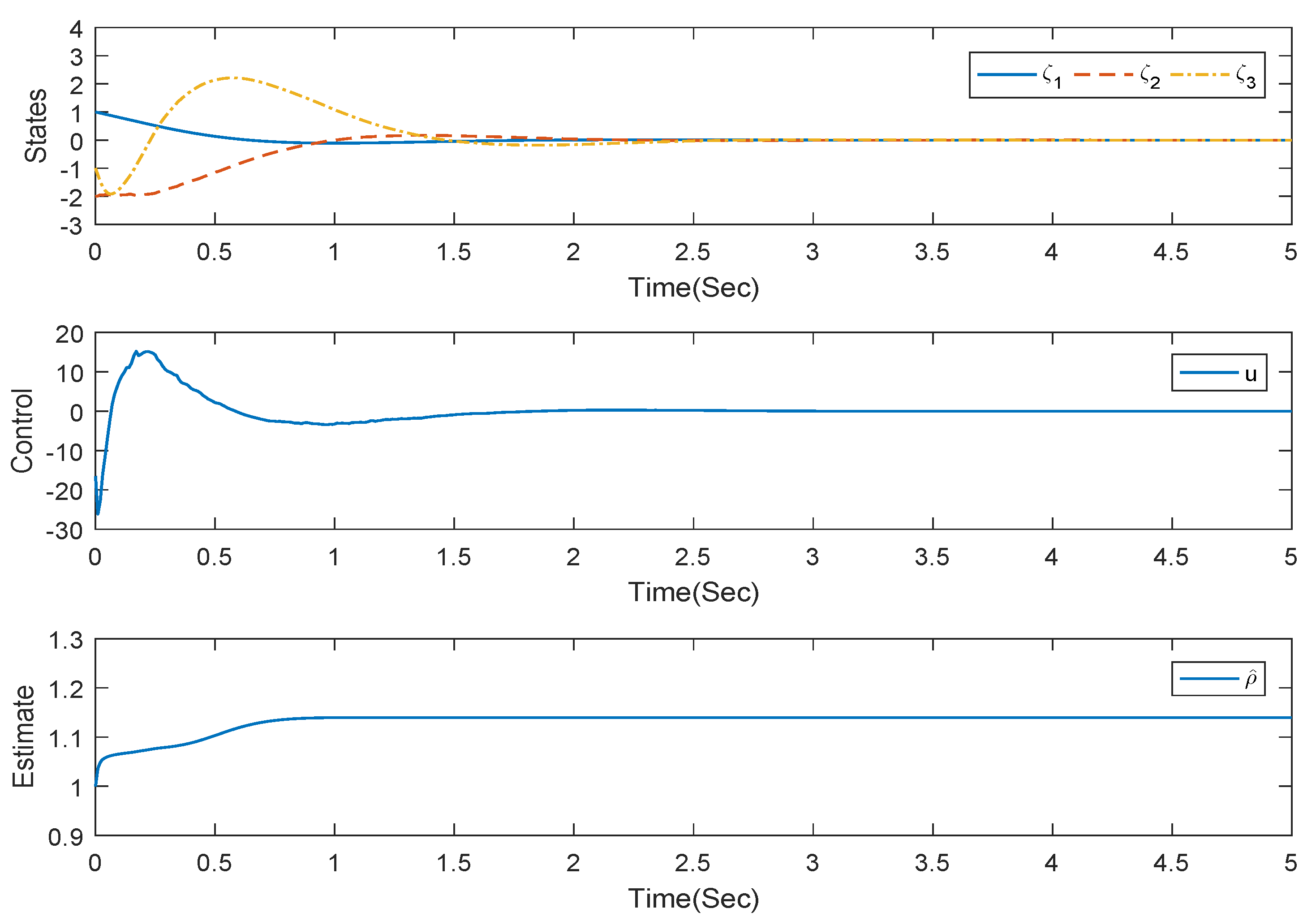
In the simulation, we set parameters as , and the initial conditions as . Finally, we obtain Figure 1, which illustrates that the responses of are bounded, and converge to zero. Thus, the example presents the merit of the control scheme proposed in Section 3.
Example 2.
Consider the one-link manipulator which contains motor dynamics and stochastic disturbances [33].
The system is described as
where denote the link position, velocity, and acceleration, respectively. is the torque produced by the electrical subsystem, and is the torque disturbance with constant and the torque stochastic disturbance ω defined in system (1). is an unknown nonnegative-definite matrix for each . u is the control input used to represent the electromechanical torque. In addition, and are defined in [33].
To obtain a state model for the one-link manipulator system, we introduce , . Then, from (52), we get the state-space form as
We choose . Obviously, (53) is a special form of the stochastic nonlinear system (1) and system (53) satisfies Assumption 1.
By following the design procedure developed in Section 3, the control u is
where
and the adaptive law is
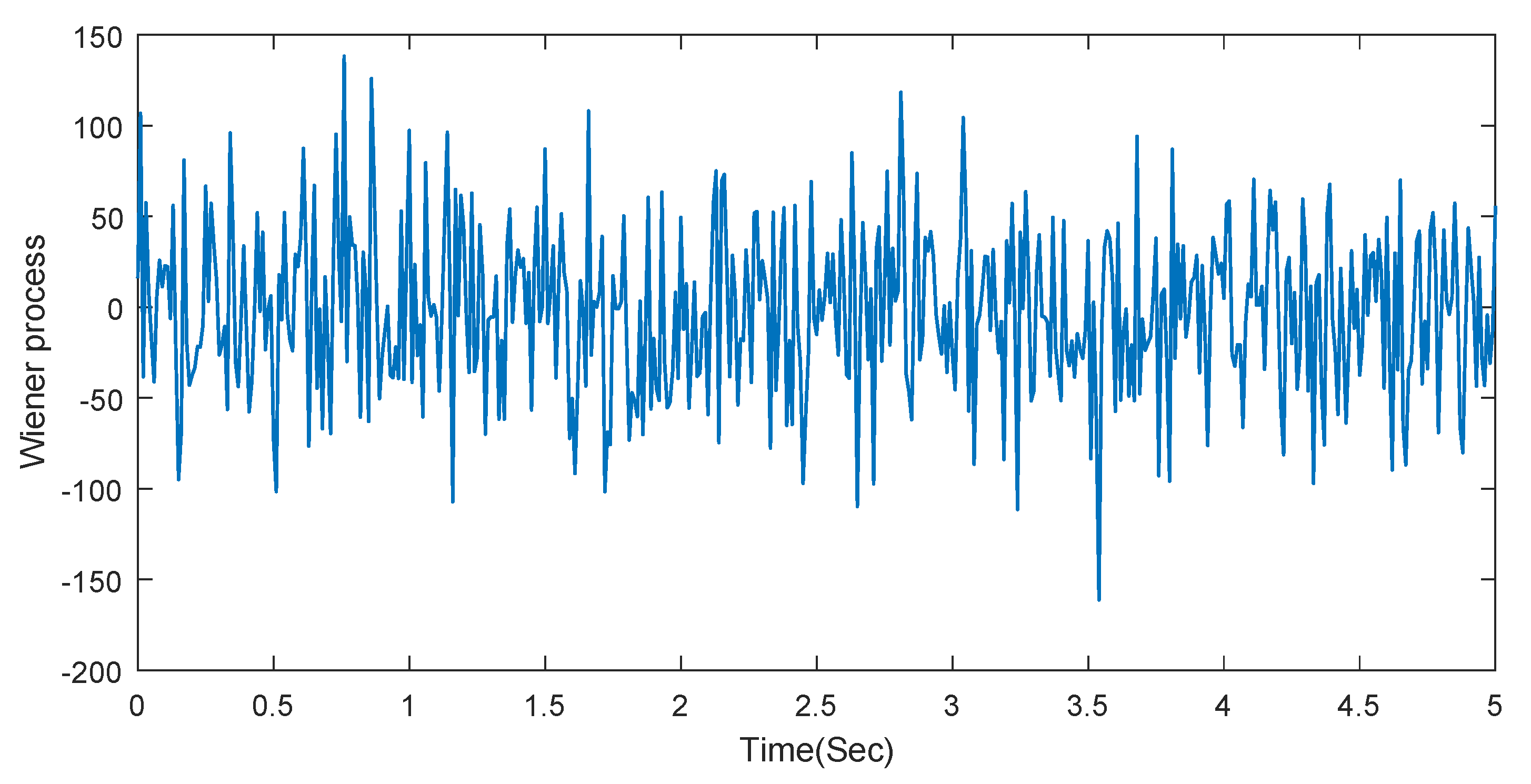
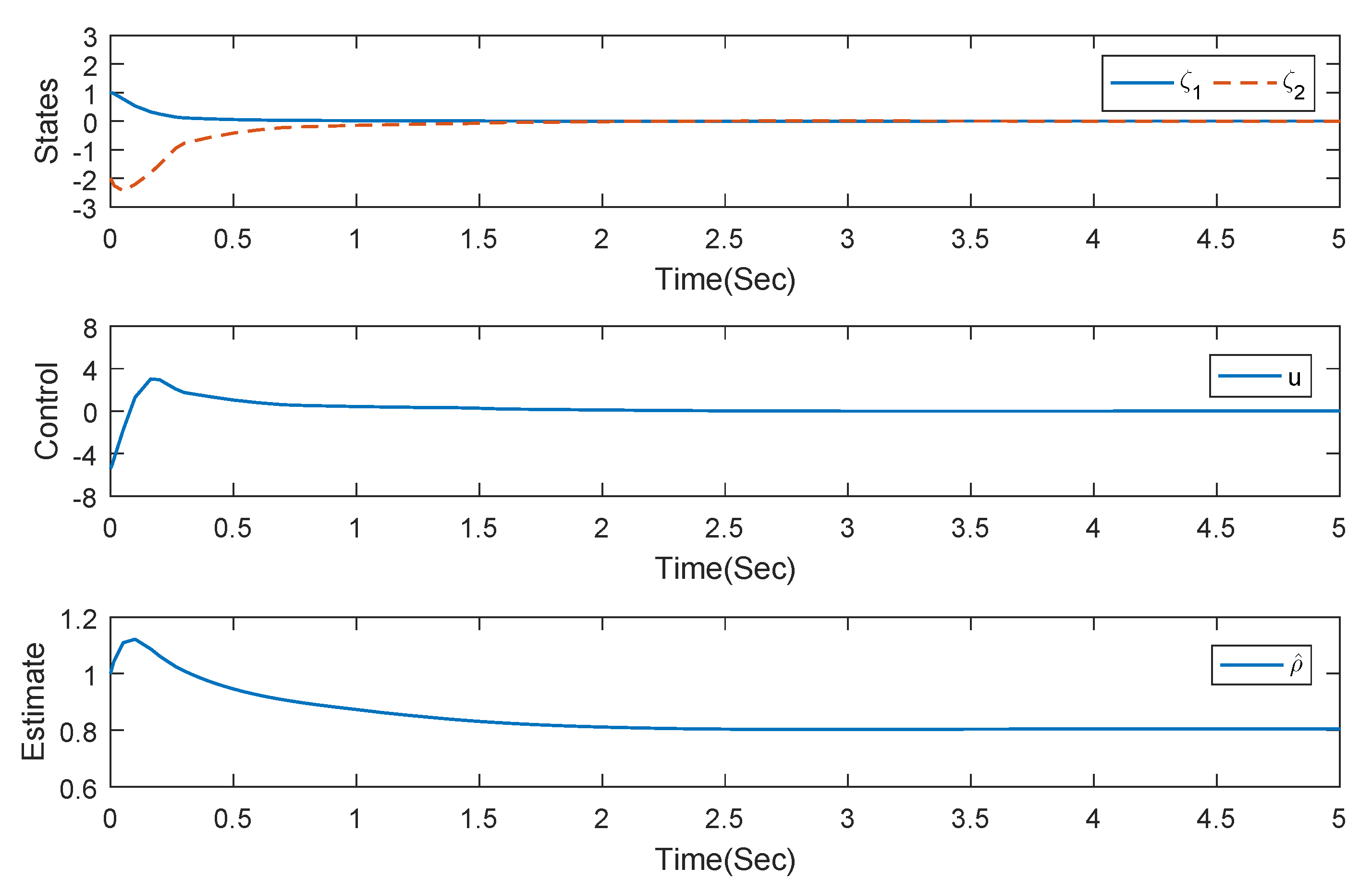
We select the parameters , and the initial values of the system states of (53) are . In the simulation, we use the Matlab module “Band-Limited White Noise” to describe the Wiener process. The parameters of “Band-Limited White Noise” are Noise power [20], Sample time 0.01 s, and Seed value [23341]. We obtain Figure 2, which shows that the states in the system (53) are regulated to zero. Therefore, the effectiveness of the adaptive law and the controller design developed in Section 3 is demonstrated. We show the response of the Wiener process in Figure 3.
Figure 3.
The response of the Wiener process.
5. Concluding Remarks
This paper has solved the adaptive stabilization problem for stochastic nonlinear systems with time-varying powers and unknown covariance. The constructed controller ensures that the closed-loop system is globally stable in probability and the states are regulated to the origin almost surely.
There are some related problems to be studied, such as how to extend the result to more general systems [34,35,36,37,38,39]. Specifically, we require that the system structure is fixed in this paper, but the structure of the actual system is likely to change [36,38]. Our next work is to extend the results in this paper to systems with Markovian switching [34]. In addition, in this paper, we require all the states of the systems are measurable, without considering the case of unmeasurable states [35,37,39]. Thus, how to design the output-feedback controller with unmeasurable states is an interesting problem. Moreover, as we discussed earlier, in practical applications, both systems reported in [27,28] are systems with time-varying power. How to apply the results of this paper to these practical systems is an important future work.
Author Contributions
Conceptualization, H.W.; writing—original draft preparation, J.G.; methodology, J.G. and H.W.; writing—review and editing, W.L. and B.N. All authors have read and agreed to the published version of the manuscript.
Funding
This work is funded by Shandong Province Higher Educational Excellent Youth Innovation team, China (No. 2019KJN017), and Shandong Provincial Natural Science Foundation for Distinguished Young Scholars, China (No. ZR2019JQ22).
Institutional Review Board Statement
Not applicable.
Informed Consent Statement
Not applicable.
Data Availability Statement
Not applicable.
Conflicts of Interest
The authors declare no conflict of interest.
References
- Mao, X.R. Stochastic Differential Equations and Applications; Horwood: London, UK, 1997; Available online: https://pureportal.strath.ac.uk/en/publications/stochastic-differential-equations-and-applications (accessed on 16 June 2022).
- Protter, P. Stochastic Integration and Differential Equations; Springer: New York, NY, USA, 2013; Available online: https://xueshu.dailyheadlines.cc/books?hl=zh-CN&lr=&id=2a37CAAAQBAJ&oi=fnd&pg=PA1&ots=nf9izKvtkd&sig=JD6GhA4rj4bgCZtmLep1PacmbYY (accessed on 16 June 2022).
- Deng, H.; Krstic, M. Stochastic nonlinear stabilization, part I: A backstepping design. Syst. Control Lett. 1997, 32, 143–150. [Google Scholar] [CrossRef]
- Krstic, M.; Deng, H. Stabilization of Uncertain Nonlinear Systems; Springer: New York, NY, USA, 1998; Available online: https://book.douban.com/subject/2863479/ (accessed on 16 June 2022).
- Pan, Z.G.; Basar, T. Adaptive controller design for tracking and disturbance attenuation in parametric strict-feedback nonlinear systems. IEEE Trans. Autom. Control 1998, 43, 1066–1083. [Google Scholar] [CrossRef]
- Pan, Z.G.; Basar, T. Backstepping controller design for nonlinear stochastic systems under a risk-sensitive cost criterion. SIAM J. Control Optim. 1999, 37, 957–995. [Google Scholar] [CrossRef]
- Deng, H.; Krstic, M. Output-feedback stochastic nonlinear stabilization. IEEE Trans. Autom. Control 1999, 44, 328–333. [Google Scholar] [CrossRef]
- Wu, Z.J.; Xie, X.J.; Shi, P.; Xia, Y.Q. Backstepping controller design for a class of stochastic nonlinear systems with Markovian switching. Automatica 2009, 45, 997–1004. [Google Scholar] [CrossRef]
- Liu, L.; Xie, X.J. Output-feedback stabilization for stochastic high-order nonlinear systems with time-varying delay. Automatica 2011, 47, 2772–2779. [Google Scholar] [CrossRef]
- Cui, M.Y.; Xie, X.J.; Wu, Z.J. Dynamics modeling and tracking control of robot manipulators in random vibration environment. IEEE Trans. Autom. Control 2012, 58, 1540–1545. [Google Scholar] [CrossRef]
- Li, W.Q.; Yao, X.X.; Krstic, M. Adaptive-gain observer-based stabilization of stochastic strict-feedback systems with sensor uncertainty. Automatica 2020, 120, 109112. [Google Scholar] [CrossRef]
- Li, W.Q.; Krstic, M. Mean-nonovershooting control of stochastic nonlinear systems. IEEE Trans. Autom. Control 2021, 66, 5756–5771. [Google Scholar] [CrossRef]
- Li, W.Q.; Krstic, M. Stochastic nonlinear prescribed-time stabilization and inverse optimality. IEEE Trans. Autom. Control 2022, 67, 1179–1193. [Google Scholar] [CrossRef]
- Xie, X.J.; Tian, J. State-feedback stabilization for high-order stochastic nonlinear systems with stochastic inverse dynamics. Int. J. Robust Nonlinear 2007, 17, 1343–1362. [Google Scholar] [CrossRef]
- Li, W.Q.; Xie, X.J.; Zhang, S.Y. Output-feedback stabilization of stochastic high-order nonlinear systems under weaker conditions. SIAM J. Control Optim. 2011, 49, 1262–1282. [Google Scholar] [CrossRef]
- Li, W.Q.; Liu, L.; Feng, G. Output tracking of stochastic nonlinear systems with unstable linearization. Int. J. Robust Nonlinear 2018, 28, 466–477. [Google Scholar] [CrossRef]
- Jiang, M.M.; Xie, X.J.; Zhang, K.M. Finite-time stabilization of stochastic high-order nonlinear systems with FT-SISS inverse dynamics. IEEE Trans. Autom. Control 2018, 64, 313–320. [Google Scholar] [CrossRef]
- Li, W.Q.; Liu, L.; Feng, G. Cooperative control of multiple nonlinear benchmark systems perturbed by second-order moment processes. IEEE Trans. Cybern. 2020, 50, 902–910. [Google Scholar] [CrossRef] [PubMed]
- Huang, H.F.; Shirkhani, M.; Tavoosi, J.; Mahmoud, O. A new intelligent dynamic control method for a class of stochastic nonlinear systems. Mathematics 2022, 10, 1406. [Google Scholar] [CrossRef]
- Li, W.Q.; Liu, Y.; Yao, X.X. State-feedback stabilization and inverse optimal control for stochastic high-order nonlinear systems with time-varying powers. Asian J. Control 2021, 23, 739–750. [Google Scholar] [CrossRef]
- Li, H.J.; Li, W.Q.; Gu, J.Z. Decentralized stabilization of large-scale stochastic nonlinear systems with time-varying powers. Appl. Math. Comput. 2022, 418, 126787. [Google Scholar] [CrossRef]
- Ioannou, P.A.; Sun, J. Robust Adaptive Control; PTR Prentice-Hall: Hoboken, NJ, USA, 1996; Available online: https://www.researchgate.net/publication/200031814_Robust_Adaptive_Control?ev=pub_cit (accessed on 16 June 2022).
- Astrom, K.J.; Wittenmark, B. Adaptive Control, 2nd ed.; Addison-Wesley: New York, NY, USA, 2008; Available online: https://xueshu.dailyheadlines.cc/books?hl=zh-CN&lr=&id=4CLCAgAAQBAJ&oi=fnd&pg=PP1&dq=+Adaptive+control&ots=zHqTooZjO9&sig=0R3IuUg9pgP5K3e0Jez6OS1AhSk (accessed on 16 June 2022).
- Deng, H.; Krstic, M.; Williams, R. Stabilization of stochastic nonlinear systems driven by noise of unknown covariance. IEEE Trans. Autom. Control 2001, 46, 1237–1253. [Google Scholar] [CrossRef]
- Deng, H.; Krstic, M. Output-feedback stabilization of stochastic nonlinear systems driven by noise of unknown covariance. Syst. Control Lett. 2000, 39, 173–182. [Google Scholar] [CrossRef]
- Li, W.Q.; Krstic, M. Stochastic adaptive nonlinear control with filterless least-squares. IEEE Trans. Autom. Control 2021, 66, 3893–3905. [Google Scholar] [CrossRef]
- Liu, J.Z.; Yan, S.; Zeng, D.L.; Hu, Y.; Lv, Y. A dynamic model used for controller design of a coal fired once-through boiler-turbine unit. Energy 2015, 93, 2069–2078. [Google Scholar] [CrossRef]
- Rui, C.; Reyhanoglu, M.; Kolmanovsky, I.; Cho, S.; McClamroch, N.H. Nonsmooth stabilization of an underactuated unstable two degrees of freedom mechanical system. In Proceedings of the 36th IEEE Conference on Decision and Control, San Diego, CA, USA, 12 December 1997; Volume 4, pp. 3998–4003. [Google Scholar] [CrossRef]
- Chen, C.C.; Qian, C.; Lin, X.; Liang, Y.W. Smooth output feedback stabilization for nonlinear systems with time-varying powers. Int. J. Robust Nonlinear 2017, 27, 5113–5128. [Google Scholar] [CrossRef]
- Lin, W.; Qian, C.J. Adding one power integrator: A tool for global stabilization of high-order lower-triangular systems. Syst. Control Lett. 2000, 39, 339–351. [Google Scholar] [CrossRef]
- Zhai, J.; Karimi, H.R. Global output feedback control for a class of nonlinear systems with unknown homogenous growth condition. Int. J. Robust Nonlinear 2019, 29, 2082–2095. [Google Scholar] [CrossRef]
- Li, W.Q.; Jing, Y.W.; Zhang, S.Y. Adaptive state-feedback stabilization for a large class of high-order stochastic nonlinear systems. Automatica 2011, 47, 819–828. [Google Scholar] [CrossRef]
- Li, W.Q.; Krstic, M. Prescribed-time control of stochastic nonlinear systems with reduced control effort. J. Syst. Sci. Complex. 2021, 34, 1782–1800. [Google Scholar] [CrossRef]
- Schioler, H.; Simonsen, M.; Leth, J. Stochastic stability of systems with semi-Markovian switching. Automatica 2014, 50, 2961–2964. [Google Scholar] [CrossRef]
- Dani, A.P.; Chung, S.J.; Hutchinson, S. Observer design for stochastic nonlinear systems via contraction-based incremental stability. IEEE Trans. Autom. Control 2014, 60, 700–714. [Google Scholar] [CrossRef]
- Niu, B.; Liu, M.; Li, A. Global adaptive stabilization of stochastic high-order switched nonlinear non-lower triangular systems. Syst. Control Lett. 2020, 136, 104596. [Google Scholar] [CrossRef]
- Li, W.Q.; Liu, L.; Feng, G. Distributed output-feedback tracking of multiple nonlinear systems with unmeasurable states. IEEE Trans. Syst. Man Cybern. 2021, 51, 477–486. [Google Scholar] [CrossRef]
- Zhu, C.L.; He, L.; Zhang, K.J.; Sun, W.; He, Z.X. Optimal timing fault tolerant control for switched stochastic systems with switched drift fault. Mathematics 2022, 10, 1880. [Google Scholar] [CrossRef]
- Li, W.Q.; Krstic, M. Prescribed-time output-feedback control of stochastic nonlinear systems. IEEE Trans. Autom. Control 2022. [Google Scholar] [CrossRef]
Publisher’s Note: MDPI stays neutral with regard to jurisdictional claims in published maps and institutional affiliations. |
© 2022 by the authors. Licensee MDPI, Basel, Switzerland. This article is an open access article distributed under the terms and conditions of the Creative Commons Attribution (CC BY) license (https://creativecommons.org/licenses/by/4.0/).