


Abstract
In this paper, we consider and study a system of generalized variational inclusions involving Cayley operators and an XOR-operation in q-uniformly smooth Banach spaces. To obtain the solution of the system of generalized variational inclusions involving Cayley operators and an XOR-operation, we use some properties of Cayley operators as well as an XOR-operation. We also discuss the convergence criterion. In support of our main result, we provide an example.
Keywords:
variational inclusion system; solution; Cayley operator; XOR-operation; smooth Banach space MSC:
47H05; 49H10; 47J25
1. Introduction
In the early 1960s, Hartman and Stampacchia [1] introduced the concept of variational inequalities, which later proved to be a powerful tool for solving many problems of mathematics and other technologies. Variational inclusions which are generalized forms of variational inequalities have been broadly studied by several authors to deal with the problems occurring in mechanics, economics, financial modelling, structural analysis, oceanography, image restoration and applied sciences. For more details on variational inequalities (inclusions), see [2,3,4,5,6,7,8,9,10,11,12,13] and references therein. A system of variational inclusions was considered and studied by Pang [14], Cohen and Chaplais [15], Ansari and Yao [16], Ceng et al. [17], Fang et al. [18], Yan et al. [19], Qiu and Liu [20] and many others.
In mathematics, a set of simultaneuous inequalities, also known as a system of inequalities or an inequality system, is a finite set of inequalities for which a common solution is obtained.
In 1846, Cayley originally described the Cayley transform, which is a mapping between skew-symmetric matrices and special orthogonal matrices. The nice applications of the Cayley transform can be found in real analysis, complex analysis and quaternionic analysis, see for example [21,22,23].
A Boolean logic operation called the XOR-operation is widely used in cryptography as well as generating parity bits for error checking and fault tolerance. XOR compares two input bits and generates one output bit. It is a simple logic; that is, if the bits are the same, the result is zero, and if the bits are different, the result is one. It is well known that the XOR-operation is commutative and associative.
The applications of the XOR-operation can be found in memory-optimized doubly linked lists, swapping, XOR ciphers, comparing two values, gray codes, generating pseudo-random numbers, implementation of multi-layer perception in neural network, etc. A way to use XOR in cryptography is shown below.
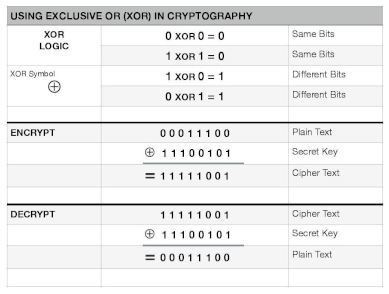
Motivated by the above discussion, in this paper, we consider and study a system of generalized variational inclusions involving Cayley operators and an XOR-operation in q-uniformly smooth Banach spaces. An existence and convergence result is established, and for illustration an example is provided.
2. Basic Tools
Throughout the paper, unless otherwise specified, we assume to be a real ordered Banach space with its norm . Let be the topological dual of , be the duality pairing between and , be the family of non-empty subsets of and be the family of compact subsets of . Suppose is the Hausdorff metric on . Let be a cone and ≤ be the partial ordering induced by cone .
The generalized duality mapping is defined by
where is a constant. It is well known that for , the generalized duality mapping coincides with the normalized duality mapping.
The modulus of smoothness of is the function such that
A Banach space is called uniformly smooth if
and q-uniformly smooth if there exists a constant such that
The following result of Xu [24] is important to prove our main result.
Lemma 1.
Let be a real uniformly smooth Banach space. Then is q-uniformly smooth if and only if there exists a constant such that for all ,
Definition 1.
A mapping is called Lipschitz continuous, if there exists a constant such that
Definition 2.
Let be a multi-valued mapping, then is called D-Lipschitz continuous if there exists a constant such that
The following concepts and results can be found in [25,26,27,28].
Definition 3.
For arbitrary elements , if holds, then x and y are said to be comparable to each other (denoted by ).
Definition 4.
For arbitrary elements , let and for the set exist, where means the least upper bound and means the greatest lower bound for the set . Then some binary operations are mentioned below:
- (i)
- is called OR-operation,
- (ii)
- is called AND-operation,
- (iii)
- is called the XOR-operation,
- (iv)
- is called the XNOR-operation.
Proposition 1.
Let ⊕ be an XOR-operation and ⊙ be an XNOR-operation. Then the following are true.
- (i)
- ,
- (ii)
- if , then ,
- (iii)
- , if ,
- (iv)
- if , then if and only if ,
- (v)
- ,
- (vi)
- ,
- (vii)
- , then .
Definition 5.
Let be a single-valued mapping. Then
- (i)
- A is called ξ-order non-extended mapping if there exists a constant such that
- (ii)
- A is called a comparison mapping if , then and , for all ,
- (iii)
- A is called strongly comparison mapping, if A is comparison mapping and if and only if , for all .
Definition 6.
Let be a single-valued mapping and be a multi-valued mapping. Then
- (i)
- M is called weak-comparison mapping if , and if , then there existssuch that , for all ,
- (ii)
- M is called -weak-non-ordinary difference mapping with respect to A if it is a weak comparison and for each there exist and and such that
- (iii)
- M is called ρ-order different weak-comparison mapping with respect to A, if there exists and for all there exist such that
- (iv)
- A weak-comparison mapping M is called -weak ANODD if it is an -weak-non-ordinary difference mapping and ρ-order different weak-comparison mapping associated with A, and
Definition 7.
Let A be ξ-ordered non-extended mapping and M is -non-ordinary difference mapping with respect to A. The resolvent operator associated with A and M is defined by
Lemma 2.
Let be an ordered -weak ANODD mapping and be a ξ-ordered non-extended mapping with respect to A. Then for , the following relation holds:
Definition 8.
The generalized Cayley operator is defined as:
Proposition 2.
The generalized Cayley operator is Lipschitz continuous provided is -Lipschitz continuous, , for all .
Proof.
For all , using Lemma 2, we evaluate
Since by (1) of Proposition 1 and using Lipschitz continuity of A, we obtain
that is
where . □
Definition 9.
Let be a single-valued mapping and be a multi-valued mapping. Then
- (i)
- B is said to be accretive if
- (ii)
- B is said to be strongly accretive if there exists a constant such that
- (iii)
- N is said to be accretive if for all ,
Definition 10.
A multi-valued mapping is called B-accretive, if N is accretive and
Definition 11.
Let N be a B-accretive multi-valued mapping. The resolvent operator associated with B and N is defined as:
Theorem 1.
([29]). Let be a strongly accretive mapping with constant r and be B-accretive multi-valued mapping. Then the resolvent operator is Lipschitz continuous with constant , that is,
Definition 12.
The generalized Cayley operator is defined as:
Proposition 3
([30]). The generalized Cayley operator is Lipschitz continuous, that is
where the mapping is Lipschitz continuous with constant .
3. Problem Structure and Iterative Scheme
Let be an ordered real Banach space. Let and be single-valued mappings. Let and be multi-valued mappings. Let for be generalized Cayley operators. We consider the following problem.
Find such that
Problem (5) is called a system of generalized variational inclusions involving Cayley operators and an XOR-operation.
For suitable choices of operators involved in the system of generalized variational inclusions involving Cayley operators and an XOR-operation (5), one can find problems studied in [19,31].
The following Lemma ensures the equivalence between a system of generalized variational inclusions involving Cayley operators and an XOR-operation (5) and a set of fixed point equations.
Lemma 3.
constitute the solution for the system of generalized variational inclusions involving Cayley operators and an XOR-operation (5), if and only if the following equations are satisfied:
Proof.
Proof is easy and depends on the definition of the resolvent operators and . □
Applying Lemma 3, we suggest the following iterative scheme for solving a system of generalized variational inclusions involving Cayley operators and an XOR-operation (5).
Iterative Scheme 3.1.
For any given, choose and compute the sequencesandby the following scheme:
Let and such that
where are constants and .
Theorem 2.
Let be a real ordered q-uniformly smooth Banach space. Let be single-valued mappings such that is Lipschitz continuous in both the arguments with constants and , respectively; is Lipschitz continuous in both the arguments with constants and , respectively. Let be multi-valued mappings such that is D-Lipschitz continuous with constant and is D-Lipschitz continuous with constant . Let be single-valued mappings such that A is ξ-ordered non-extended mapping and Lipschitz continuous with constant is strongly accretive with constant and Lipshcitz continuous with constant . Let be multi-valued mappings such that M is -weak ANODD mapping and N is B-accretive mapping. Let be the resolvent operators such that satisfy the condition (1) and satisfy the condition (3). Suppose be the generalized Cayley operators such that satisfy the condition (2), satisfy the condition (4). Let , for all . Suppose that the following conditions are satisfied:
where and . Then the system of generalized variational inclusions involving Cayley operators and an XOR-operation (5) admits a solution , and the sequences and generated by scheme 3.1 strongly converge to and v, respectively.
Proof.
Using (8) of scheme 3.1 and (iii) of Proposition 1, we have
Using Lemma 2 and commutativity of ⊕ operation, (14) becomes
Using of Proposition 1, from (15), we have
As for all n, using of Proposition 1 and Lipschitz continuity of A, from (16), we obtain
Using Lipschitz continuity of in both the arguments, D-Lipschitz continuity of and Lipschitz continuity of the generalized Cayley operator , we have
Applying Lemma 1, we obtain
We have
where .
Using (19), (18) becomes
Combining (17) and (20), we obtain
Applying (9) of scheme 3.1, Theorem 1 and Lipschitz continuity of B, we obtain
where .
Using Lipschitz continuity of in both the arguments, D-Lipschitz continuity of and Lipschitz continuity of the generalized Cayley operator , we have
Applying the same technique as used for (19), we have
where .
Combining (24) with (23), we have
Using (25) , (22) becomes
Adding (21) and (22), we have
where
By conditions (12) and (14), it is clear that , and consequently (27) implies that and are both Cauchy sequences. Thus, there exists such that and , as . From (10) and (11) of scheme 3.1 and the D-Lipschitz continuity of and , it follows that and are also Cauchy sequences in . Thus, there exists such that and , as . It is also easy to show that , see [2]. By the continuity of all the operators involved in a system of generalized variational inclusions involving Cayley operators and an XOR-operation (5) and from Lemma 3, we conclude that
Thus, the result follows. □
4. Example
In support of Theorem 2, we provide the following example.
Example 1.
Let with the usual norm. Let be single-valued mappings such that
- (i)
- Then for any , we havethat is, is Lipschitz continuous in the first argument with constant . it is easy to show that is Lipschitz continuous in the second argument with constant .In the same manner one can show that is Lipschitz continuous in both the arguments with constants and , respectively.
- (ii)
- Suppose that are the multi-valued mappings defined as:Now,Clearly, is D-Lipschitz continuous with constant . Similarly, it can be shown that is D-Lipschitz continuous with constant .
- Let be the single-valued mappings such that
Clearly, A is Lipschitz continuous mapping with constant and B is Lipschitz continuous mapping with constant . In addition, A is ξ-ordered non-extended mapping with constant , and B is strongly accretive with constant . - (iii)
- Let be the multi-valued mappings such thatFor , it is clear that M is -weak ANODD mapping with , and N is B-accretive mapping.
- (iv)
- In view of the above calculations, we obtain the resolvent operators and such thatwhere and .The resolvent operator satisfies the condition (1) that isThe resolvent operator satisfies the condition (3) for ; that is
- (v)
- Using the values of and calculated in step (v), we obtain the generalized Cayley operators as:We calculate and below:It is easy to check that the generalized Cayley operator satisfies condition (2) and the generalized Cayley operator satisfies condition (4) with the above calculated and , respectively.
- (vi)
- Thus, all the conditions of Theorem 2 are satisfied and the system of generalized variational inclusions involving Cayley operators and an XOR-operation admits a solution . Consequently, the sequences and converge strongly to and v, respectively.
5. Conclusions
This study is focussed on a system of generalized variational inclusions involving Cayley operators and an XOR-operation in q-uniformly smooth Banach spaces. It is well known that variational inclusions, Cayley operators as well as an XOR-operation have applications in all modern sciences and technologies. That is why we have considered and studied a system of generalized variational inclusions involving Cayley operators and an XOR-operation. An existence and convergence result is proved for the system of generalized variational inclusions involving Cayley operators and an XOR-operation in q-uniformly smooth Banach spaces. An example is provided for illustration.
Author Contributions
Conceptualization, J.I., R.A. and Y.W.; Data curation, A.K.R. and Monirul Islam; Formal analysis, J.I., A.K.R. and R.A.; Funding acquisition, R.A. and Y.W.; Investigation, A.K.R., M.I. and Y.W.; Methodology, J.I.; Project administration, R.A. and Y.W.; Resources, J.I.; Software, M.I.; Visualization, A.K.R. and M.I. All authors have read and agreed to the published version of the manuscript.
Funding
This work was supported by the National Natural Science Foundation of China (Grant no. 12171435).
Institutional Review Board Statement
Not applicable.
Informed Consent Statement
Not applicable.
Data Availability Statement
Not applicable.
Acknowledgments
The authors are thankful to referees for their valuable suggestions.
Conflicts of Interest
The authors declare no conflict of interest.
References
- Hartman, P.; Stampacchia, G. On some non-linear elliptic differential-functional equations. Acta Math. 1966, 115, 271–310. [Google Scholar] [CrossRef]
- Ahmad, R.; Siddiqi, A.H. Mixed variational-like inclusions and Jη-proximal operator equations in Banach spaces. J. Math. Anal. Appl. 2007, 327, 515–524. [Google Scholar] [CrossRef] [Green Version]
- An, N.T.; Dong, P.D.; Qin, X. Robust feature selection via nonconvex sparsity-based methods. J. Nonlinear Var. Anal. 2021, 5, 59–77. [Google Scholar]
- Ceng, L.C. A subgradient-extragradient method for bilevel equilibrium problems with the constraints of variational inclusion systems and fixed point problems. Commun. Optim. Theory 2021, 2021, 4. [Google Scholar]
- Ceng, L.C. On a viscosity iterative algorithm for variational inclusion problems and the fixed point problem of countably many nonexpansive mappings. Appl. Set-Valued Anal. Optim. 2021, 3, 203–214. [Google Scholar]
- Cubiotti, P.; Yao, J.C. On the Cauchy problem for a class of differential inclusions with applications. Appl. Anal. 2020, 99, 2543–2554. [Google Scholar] [CrossRef]
- Glowinski, R.; Lions, J.L.; Trémolières, R. Numerical Analysis of Variational Inequalities; North-Holland: Amsterdam, The Netherlands, 1981. [Google Scholar]
- Liu, L.; Cho, S.Y.; Yao, Y.C. Convergence analysis of an inertial Tseng’s extragradient algorithm for solving pseudomonotone variational inequalities and applications. J. Nonlinear Var. Anal. 2021, 5, 627–644. [Google Scholar]
- Liu, L.; Yao, J.C. Iterative methods for solving variational inequality problems with a double-hierarchical structure in Hilbert spaces. Optimization 2022. [Google Scholar] [CrossRef]
- Olona, M.A.; Alakoya, T.O.; Owolabi, A.O.E.; Mewomo, O.T. Inertial algorithm for solving equilibrium, variational inclusion and fixed point problems for an infinite family of strict pseudocontractive mappings. J. Nonlinear Funct. Anal. 2021, 2021, 10. [Google Scholar]
- Shehu, Y.; Izuchukwu, C.; Qin, X.; Yao, J.C. Strongly convergent inertial extragradient type methods for equilibrium problems. Appl. Anal. 2021. [Google Scholar] [CrossRef]
- Yao, Y.; Postolache, M.; Yao, J.C. Strong convergence of an extragradient algorithm for variational inequality and fixed point problems. Sci. Bull. Ser. A 2020, 82, 3–12. [Google Scholar]
- Zong, C.; Tang, Y. Dual three-operator splitting algorithms for solving composite monotone inclusion with applications to convex minimization. J. Appl. Numer. Optim. 2021, 3, 533–554. [Google Scholar]
- Pang, J.S. Asymmetric variational inequality problems over product sets: Applications and iterative methods. Math. Program. 1988, 31, 206–219. [Google Scholar] [CrossRef]
- Cohen, G.; Chaplais, F. Nested monotony for variational inequalities over product of spaces and convergence of iterative algorithms. J. Optim. Theory Appl. 1988, 59, 369–390. [Google Scholar] [CrossRef] [Green Version]
- Ansari, Q.H.; Yao, J.C. A fixed point theorem and its applications to a system of variational inequalities. Bull. Aust. Math. Soc. 1999, 59, 433–442. [Google Scholar] [CrossRef] [Green Version]
- Ceng, L.C.; Petruse, A.; Qin, X.; Yao, J.C. A modified inertial subgradient extragradient method for solving pseudomonotone variational inequalities and common fixed point problems. Fixed Point Theory 2020, 21, 93–108. [Google Scholar] [CrossRef]
- Fang, Y.P.; Huang, N.J.; Thompson, H. A new system of variational inclusions with (H,η)-monotone operators in Hilbert spaces. Comput. Math. Appl. 2005, 49, 365–374. [Google Scholar] [CrossRef] [Green Version]
- Yan, W.; Fang, Y.P.; Huang, N.J. A new system of set-valued variational inclusions with H-monotone operators. Math. Inequal. Appl. 2005, 8, 537–546. [Google Scholar] [CrossRef]
- Qiu, Y.Q.; Liu, L.Y. A new system of generalized quasi-variational-like inclusions in Hilbert spaces. Comput. Math. Appl. 2010, 59, 1–8. [Google Scholar] [CrossRef] [Green Version]
- Ali, I.; Ahmad, R.; Wen, C.F. Cayley inclusion problem involving XOR-operation. Mathematics 2019, 7, 302. [Google Scholar] [CrossRef] [Green Version]
- Helmberg, G. Introduction to Spectral Theory in Hilbert Space: The Cayley Transform; North-Holland Series in Applied Mathematics and Mechanics; Courier Dover Publications: Mineola, NY, USA, 1969; Volume 6. [Google Scholar]
- Rather, Z.A.; Ahmad, R.; Wen, C.F. Variational-like inequality problem involving generalized Cayley operator. Axioms 2021, 10, 133. [Google Scholar] [CrossRef]
- Xu, H.K. Inequalities in Banach spaces with applications. Nonlinear Anal. Theory Methods Appl. 1991, 16, 1127–1138. [Google Scholar] [CrossRef]
- Li, H.G. A nonlinear inclusion problem involving (α,λ)-NODM set-valued mappings in ordered Hilbert space. Appl. Math Lett. 2012, 25, 1384–1388. [Google Scholar] [CrossRef]
- Li, H.G.; Li, L.P.; Jin, M.M. A class of nonlinear mixed ordered inclusion problems for ordered (αA,λ)-ANODM set-valued mappings with strong comparison mapping A. Fixed Point Theory Appl. 2014, 2014, 79. [Google Scholar] [CrossRef] [Green Version]
- Li, H.G.; Pan, X.B.; Deng, Z.Y.; Wang, C.Y. Solving frameworks involving (γG,λ)-weak-GRD set-valued mappings in positive Hilbert spaces. Fixed Point Theory Appl. 2014, 2014, 146. [Google Scholar] [CrossRef] [Green Version]
- Li, H.G.; Qiu, D.; Zou, Y. Characterizations of weak-ANODD set-valued mappings with applications to approximate solution of GNMOQV inclusions involving ⊕ operator in ordered Banach spaces. Fixed Point Theory Appl. 2013, 2013, 241. [Google Scholar] [CrossRef] [Green Version]
- Fang, Y.P.; Huang, N.J. H-accretive operator and resolvent operator technique for variational inclusions in Banach spaces. Appl. Math. Lett. 2004, 17, 647–653. [Google Scholar] [CrossRef] [Green Version]
- Ahmad, R.; Ali, I.; Rahaman, M.; Ishtyak, M.; Yao, J.C. Cayley inclusion problem with its corresponding generalized resolvent equation problem in uniformly smooth Banach spaces. Appl. Anal. 2020, 101, 1354–1368. [Google Scholar] [CrossRef]
- Lan, H.Y.; Kim, J.H.; Cho, Y.J. On a new system of nonlinear A-monotone multivalued variational inclusions. J. Math. Anal. Appl. 2007, 327, 481–493. [Google Scholar] [CrossRef] [Green Version]
Publisher’s Note: MDPI stays neutral with regard to jurisdictional claims in published maps and institutional affiliations. |
© 2022 by the authors. Licensee MDPI, Basel, Switzerland. This article is an open access article distributed under the terms and conditions of the Creative Commons Attribution (CC BY) license (https://creativecommons.org/licenses/by/4.0/).