Feature Selection Using Artificial Gorilla Troop Optimization for Biomedical Data: A Case Analysis with COVID-19 Data
 , , ,
, , ,  ,
,  and
and
Abstract
1. Introduction
- To learn about the latest metaheuristic FS assignments as well as their benefits and drawbacks;
- To propose a discrete version of the AGTO, entitled DAGTO, for handling FS work in the biomedical era;
- To introduce a DAGTO with various combinations of objective functions to discover Pareto fronts for the FS work by simultaneously optimizing filter and wrapper conditions for the first time;
- To boost the diversity of the population and speed up its convergence, we present an efficient and effective gorilla initialization technique based on label mutual information (MI);
- To offer a comprehensive assessment report on the achievement of DAGTO in FS task using clinical information by executing four distinct variations of DAGTO according to the objective functions used;
- To compare the introduced SO-DAGTO strategy to three standard single-objective mechanisms and MO-DAGTO approaches to four popular multi-criteria frameworks, and to prove if the offered strategies outcompete benchmarking approaches in minimizing feature subset width and rising accuracy rate;
- To use the “knee point” concept for selecting the best one from the external repository, in the case of MO-DAGTOs; and
- To validate the efficiency of the provided technique by testing with a real-world COVID-19 dataset.
2. Background
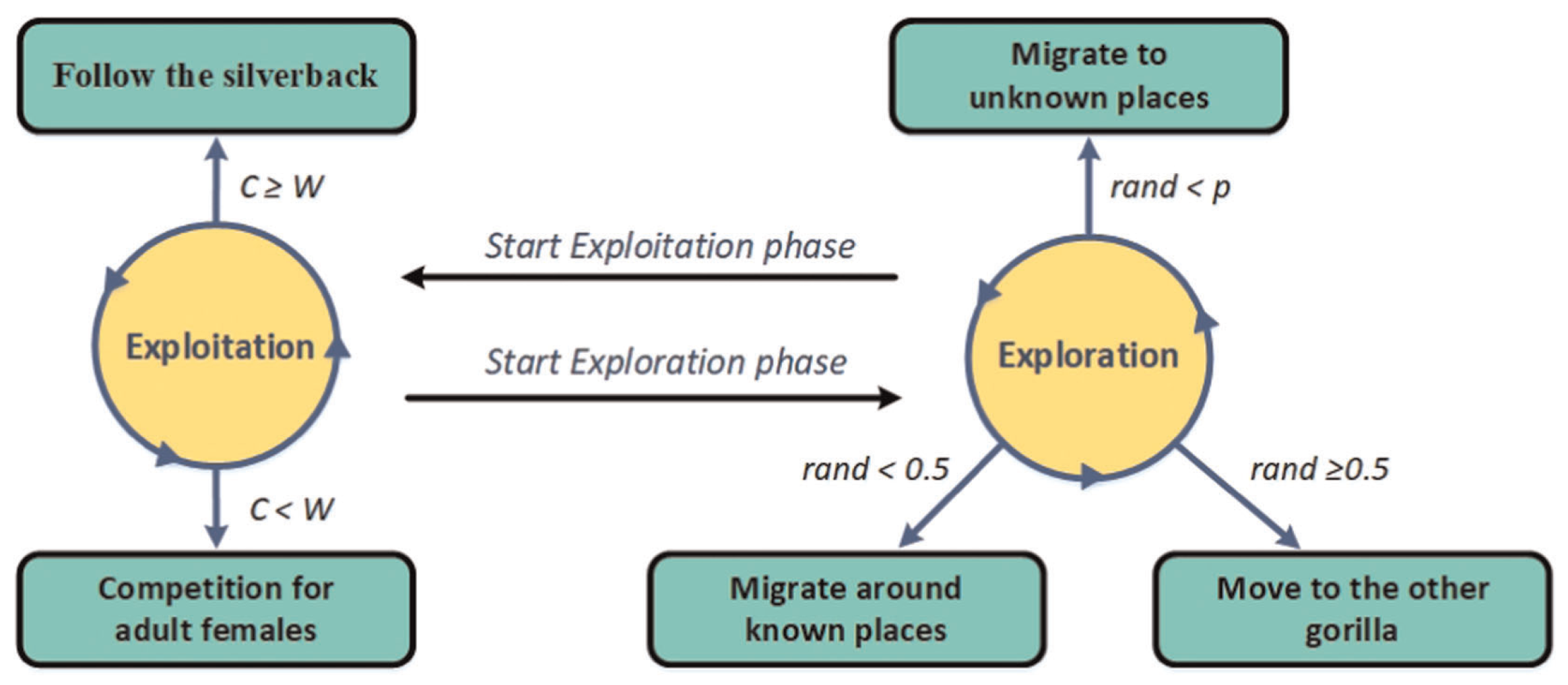
2.1. Artificial Gorilla Troop Optimizer (AGTO)
2.1.1. Exploration Phase
- is the the gorilla’s present location;
- is the candidate gorilla location in the following iteration;
- , , and are random numbers between 0 and 1;
- p is a parameter with range in [0–1] that must be set prior to the optimization procedure;
- and are the minimum and maximum values of the variables, respectively;
- is a randomly chosen gorilla; and
- is a randomly chosen candidate gorilla:
2.1.2. Exploitation Phase
- Follow the Silverback: The silverback is a young and fit gorilla, and the other males in the troop are likewise young and sharply observe him. They also obey all of silverback’s commands to travel to diverse locations in search of food supplies and to stay with him. This behaviour is simulated by using the following Equation (7):where
- Competition for Adult Females: When juvenile gorillas enter adolescence, they engage in risky competition with other males in order to pick grown-up females and to expand their troop. These brawls can extend for days and include several individuals. This process is simulated using Equation (10).
2.2. Single-Objective vs. Multi-Objective Optimization
- For all C: A1 is not inferior than A2
- There is a c: A1c is surely superior than A2c
2.3. Related Work
2.3.1. Filter-Based FS Techniques
2.3.2. Wrapper-Based FS Techniques
2.3.3. Hybrid Filter-Wrapper FS Techniques
3. Proposed Techniques
3.1. Single-Objective DAGTO (SO-DAGTO)
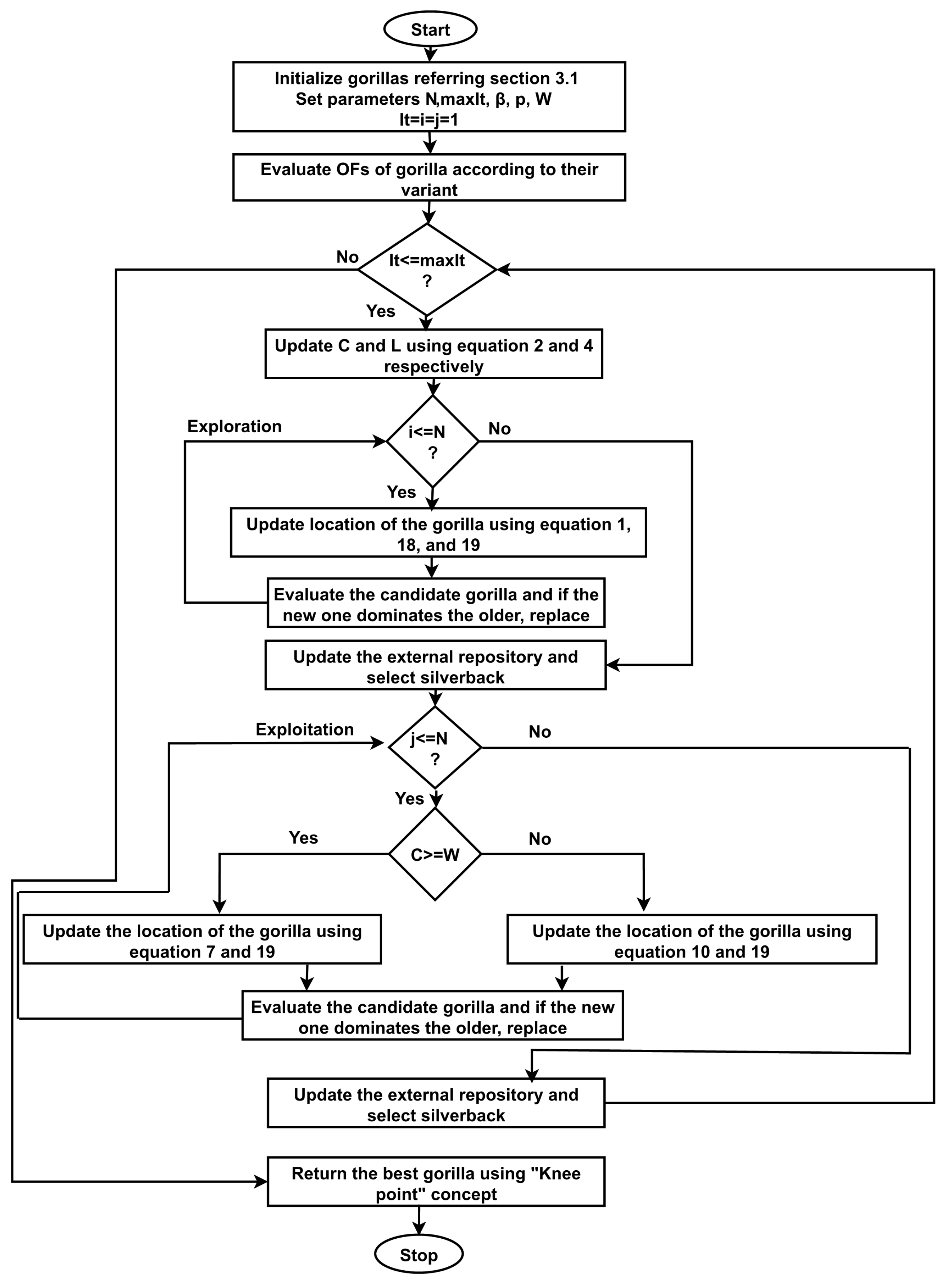
- Steps of Single-objective DAGTO: The step-by-step procedure for single-objective DAGTO is given below:
- (a)
- Step 1: Gorilla initialization based on MI: The goal of FS is to get rid of features that are not needed. During initialization of the gorilla, the insignificant features should have fewer chances to participate in the optimization process and reducing the gorilla’s search space. The MI, which is more sensitive to non-linear dependency, is used in this paper to quantify the amount of information shared between two variables (e.g., feature and class attribute). It is expressed aswhere is the entropy for and is the conditional entropy for given . The greater the MI value of a feature , the more important it is, and the more likely it is to be picked up as an initial selection. Based on this concept, we define a probability to determine the likelihood of a feature being picked up by an initial gorilla. It is defined asFurthermore, the greater the MI value of a feature, the higher the feature’s likelihood. A gorilla is created based on the likelihood of by selecting its elements one by one from the entire feature set. As an example, the components of the ith gorilla, i.e., , are chosen in the following manner. Specifically, a feature will be selected for the gorilla,where is a random number between 0 and 1, and is the probability of the kth feature. We have used this initialization technique for of the gorilla population. The positions of the rest of the gorillas are randomly initialized to enhance the diversity of the population.
- (b)
- Step 2: Fitness Assessment: To assess the individual solution in wrapper FS, a fitness/objective function is necessary. Feature selection’s main purpose is to improve prediction accuracy while reducing the number of characteristics. More to the point, the objective function (OF), which includes both criteria, is used in this variant of the proposed work and is described as [58],where is the error rate of the learning algorithm, is the size of the feature substring, L is the original dimension, and (here ) is a control parameter for the effect of classification performance and feature size.
- (c)
- Step 3: Gorilla Location Update: Each gorilla position is initially updated by using Equation (1) and it is denoted as . As FS is a discrete optimization issue, a sigmoid transfer function is applied here to transmute the original AGTO to DAGTO, i.e., to compute the probability value by using the following Equation (18),Then, each candidate gorilla location is calculated in the discrete domain by using the following Equation (19),where i is the ith bit of the gorilla’s position, L is the true dimension and is a random number in the range . In following, each candidate gorilla is evaluated by using the fitness function given in Equation (17) and if new locations are found to be better than the older ones, then the corresponding replacement occurs. As a next step, a “silverback” solution is chosen, which is the best option for the updated population to continue the exploitation phase. In this stage, depending on the value of C and W described in Section 2.1.2, Equations (7) and (10) are used to alter the location of individual gorillas in the population. More to the point, the continuous location space is converted to a discrete one by employing the above Equation (19). If an updated gorilla position is found to be fitter than the existing one, it will be replaced.
- (d)
- Step 4: Finding Silverback: At the completion of every repetition, the fittest alternative (the one having a minimum value) is treated as a temporary silverback solution. As a result, it is compared with the older silverback and if it is found to be better, it replaces the existing one, otherwise not.
- Algorithm for Single-objective DAGTO for FS: The detailed algorithm for the proposed single-objective DAGTO is given in Algorithm 1. There, in line 8, the exploration phase starts, while in line 14, the group is created. Furthermore, in line 18 the exploitation phase is taking place, whereas the corresponding group is created in line 26.
Algorithm 1 Single-objective DAGTO for FS - 1:
- input Population size N, maximum number of iterations and parameters and p
- 2:
- output The and its value
- 3:
- Set the initial gorilla location as given in Section 3.1
- 4:
- Compute the of each gorilla
- 5:
- for to do
- 6:
- Alter the C using Equation (2)
- 7:
- Alter the L using Equation (4)
- 8:
- for all Gorilla do
- 9:
- Alter the gorilla location by Equation (1)
- 10:
- Apply sigmoid to convert the gorilla location into probability figure
- 11:
- Compute candidate gorilla position in discrete domain using Equation (19)
- 12:
- end for
- 13:
- for to N do
- 14:
- Compute of each candidate gorilla ()
- 15:
- If is fitter than , replace it, where G is the candidate Gorilla location
- 16:
- end for
- 17:
- Set best location as the Silverback
- 18:
- for all Gorilla do
- 19:
- if then
- 20:
- 21:
- else
- 22:
- 23:
- end if
- 24:
- end for
- 25:
- for to N do
- 26:
- Compute of each candidate gorilla ()
- 27:
- If is fitter than , replace it, where G is the candidate Gorilla location
- 28:
- end for
- 29:
- Set best location as the Silverback
- 30:
- end for
- Complexity Analysis: The computational complexity of single-objective DAGTO for FS depends on three important steps: initialization, evaluation, and update of the gorilla location. The initialization of gorilla, as explained in Section 3.1, requires basic operations, and the evaluation of all gorillas needs the calculation of and N. The complexity of the position update procedure depends on both exploration and exploitation stages. In each case, an update operation is executed on all the gorilla solutions, and the fittest one is selected, requiring.Thus, the total computational complexity of single-objective DAGTO is, where Q is the number of samples in the training dataset and the computational complexity of KNN model on Q samples is .
3.2. Multi-Objective DAGTOs (MO-DAGTO1, MO-DAGTO2, and MO-DAGTO3)
- Steps of Multi-objective DAGTOs: The step-by-step procedure of the proposed MO-DAGTOs is illustrated in Figure 2 and the three different cases are elaborated upon below.
- (a)
- Step 1: Gorilla Initialization based on MI: For all these three variants of the proposed multi-objective DAGTO, the exact same population initialization strategy, based on MI, is followed as described in Section 3.1.
- (b)
- Step 2: Fitness Assessment:
- MO-DAGTO1: This first variant treats FS as a two-objective discrete optimization task whose intention is to reduce the feature dimension and simultaneously improve the classification efficiency. Therefore, each gorilla in the population is assessed by employing the following two s [48],where P is the location string of a gorilla with length L.
- MO-DAGTO2: This second variant considers FS as a two-criteria hybrid filter wrapper optimization challenge. The sole aim of FS is to shrink the number of attributes along with the classification error. Thus, the first objective function is formulated by using Equation (22) [58],whereand is the length of the feature substring, L is the total feature_count, and is a controlling parameter, as already mentioned.In order to select the appropriate characteristics, one must look for a group of features that collectively have the most relevance to the target and the least redundancy among themselves. Therefore, the maximum of the correlation among the attribute substring, the target attribute and the reduction of the dependency between the characteristics in an attribute substring are normally emphasised for FS purposes. MI as well as the Pearson correlation coefficient (PCC) are typical characteristics of relevance or interdependency. This motivated us to formulate the second objective function by using Equation (24) [23], which we aim to maximize,where are the discrete characteristics present in the feature subgroup and is a class attribute.
- MO-DAGTO3: When two characteristics are highly linked, removing one does not have a significant impact on the prediction strength of the other. As a result, unnecessary characteristics can be removed by reducing their interdependence. Therefore, this variant treats FS as a tri-objective hybrid filter-wrapper optimization task, wherein the first two s are the same as in MO-DAGTO2, and the third is calculated asmeasures both linear and non-linear dependence between variables in a feature space in this case. As a result, reducing may result in a redundancy reduction.
- (c)
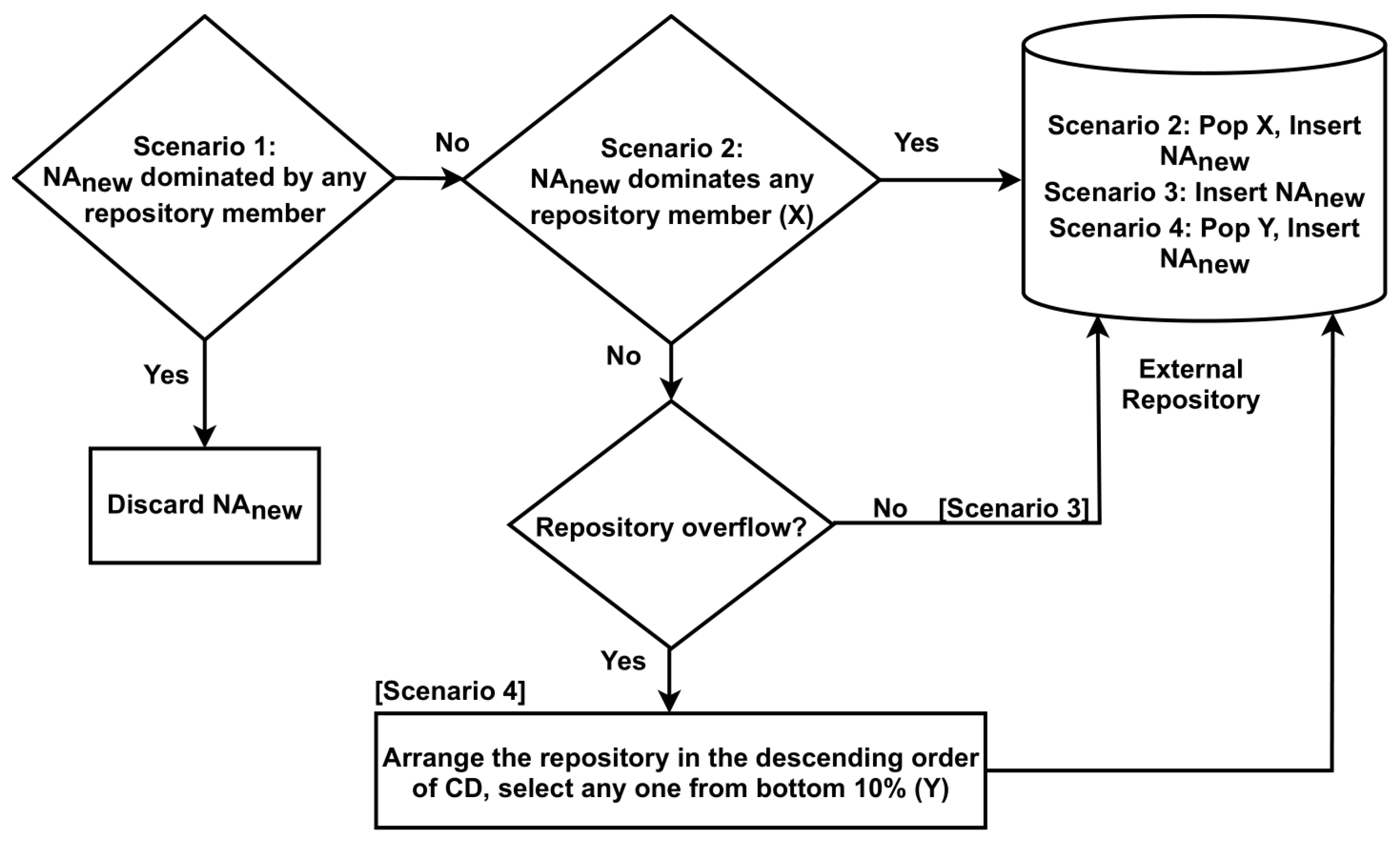
- Step 3: Repository Maintenance: After the exploration and exploitation phases of the proposed variants, an external storehouse is needed to keep all the non-dominated (ND) solutions so far because any multi-objective approach outputs a set of Pareto solutions rather than one. When inserting a new ND solution into the external repository, the following situations may arise and the following actions should be taken.
- If the is dominated by any member of the external repository, then it is discarded.
- If any existing member of the repository is dominated by the new one, then will replace that solution.
- Insert into the external repository if and the archive members are not dominating each other, i.e., they are all non-dominated solutions, and the repository capacity is greater than the current repository size.
- If neither nor the current repository solutions are dominated, but the repository overflows, throw any solution from the most gathered region and then push to the archive [48].
The pictorial representation of repository update is illustrated in Figure 3. - (d)
- Step 4: Gorilla Location Update: Each gorilla position is first updated by using Equation (1), and it can be denoted as . As FS is a discrete optimization issue, a sigmoid transfer function is applied here to convert the original AGTO to DAGTO, i.e., to compute the probability value by using Equation (18). Then each candidate gorilla location is calculated in the discrete domain by using Equation (19). After that, each candidate gorilla is evaluated by using the objective functions according to their variants, and if the older gorilla location is dominated by the new location, then the corresponding replacement occurs. As the MO-DAGTO1, MO-DAGTO2, and MO-DAGTO3 are all under the category of multi-objective optimization problems, a solution is considered better than another solution if is not dominated by as explained in Section 2.2. Then, a silverback solution is chosen, which is the best solution for the updated population to continue the exploitation phase. A silverback is picked from the top of the reservoir, which is arranged in decreasing order of , during the exploration and exploitation process. As a result, selecting a solution from the front of the repository implies the selection of the best option from the unique solution existing in the less populated region. In the exploitation phase, depending on the value of C and W described in Section 2.1.2, Equations (7) and (10) are used to twist the location of individual gorillas in the population. As a result, the continuous location space is converted to a discrete one by employing Equation (19). If an updated gorilla position dominates the existing one, it will be replaced.
- (e)
- Step 5: Returning the Best Solution by using the Concept of Knee: The external repository contains all the solutions that are not mutually dominated after the given number of iterations maxIt. As a screening method, the “knee point” concept is utilized here to pick an optimum combination of features from a group of non-dominated ones [59,60].
- Complexity Analysis: The initialization and fitness computation of gorillas, as explained in Section 3.1 for single-objective DAGTO, requires . During each iteration, the position update, the fitness calculation, the finding of non-dominated solutions, and the selection of silverback operations are performed twice, one for exploration and another for exploitation phase. Mathematically, this can be calculated as:Here, we have used the idea of a dominance tree for extracting the Pareto solutions, which reduces the number of comparisons, causing a complexity of . To find the silverback, the repository needs to be arranged on the basis of decreasing values, which requires . The final output of multi-objective DAGTO is the best of the repository and it is chosen as the knee point in the Pareto front. The complexity of calculating the knee point (assuming the case when all N solutions are in the repository) is . Finally, the time complexity of the proposed multi-objective techniques can be expressed as
4. Setup for the Experiments
4.1. Datasets
4.2. Benchmark Methods and Performance Criteria for Comparison
4.3. Parameter Settings
4.4. Design of Experiments
- Single-objective DAGTO
- Experiment 1: Performance comparison of the proposed single-objective DAGTO with other benchmark methods, like HLBDA, BSHO, and QBHHO.
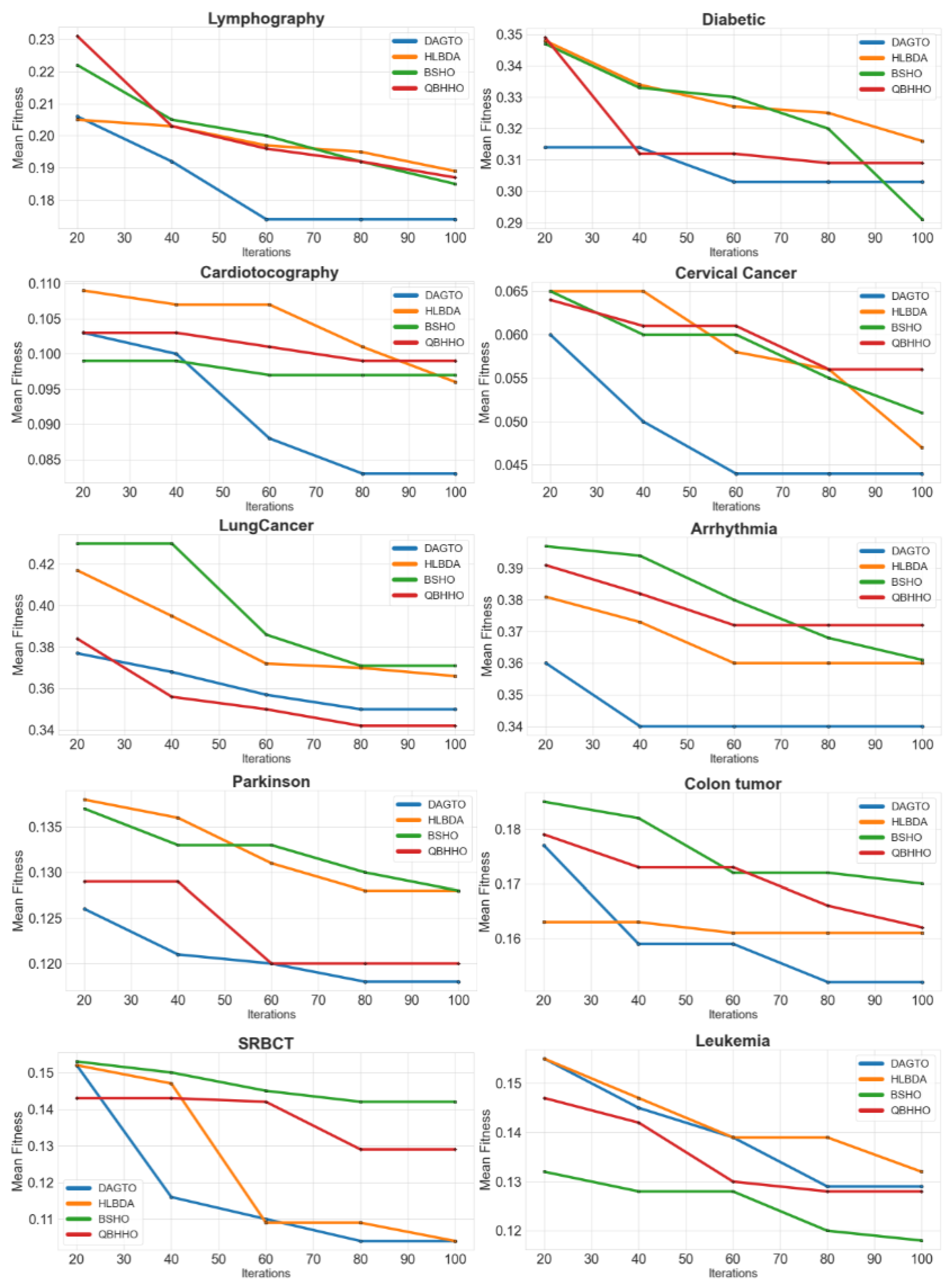
- Experiment 2: Convergence analysis of all the four single-objective FS approaches.
- Experiment 3: Implementation of a Wilcoxon signed rank test to prove the superiority of the proposed approach.
- Multi-objective DAGTOs
- Experiment 4: Performance comparison between all the proposed multi-objective DAGTO variants using the multi-objective performance indicators discussed in Section 4.2.
- Experiment 5: Conduct of a Wilcoxon signed rank test on hyper volume (HV) to verify the efficiency of the best variant out of three.
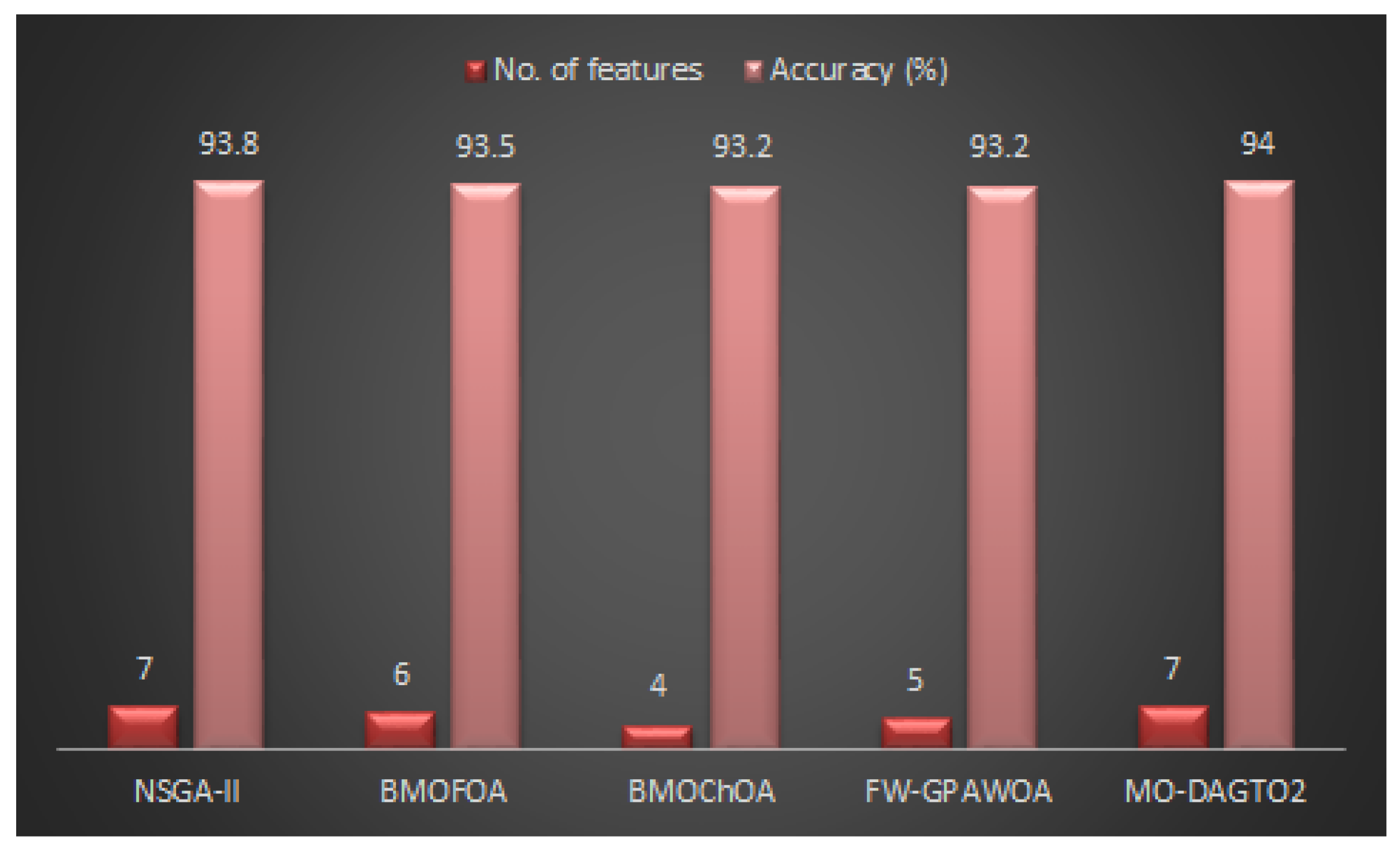
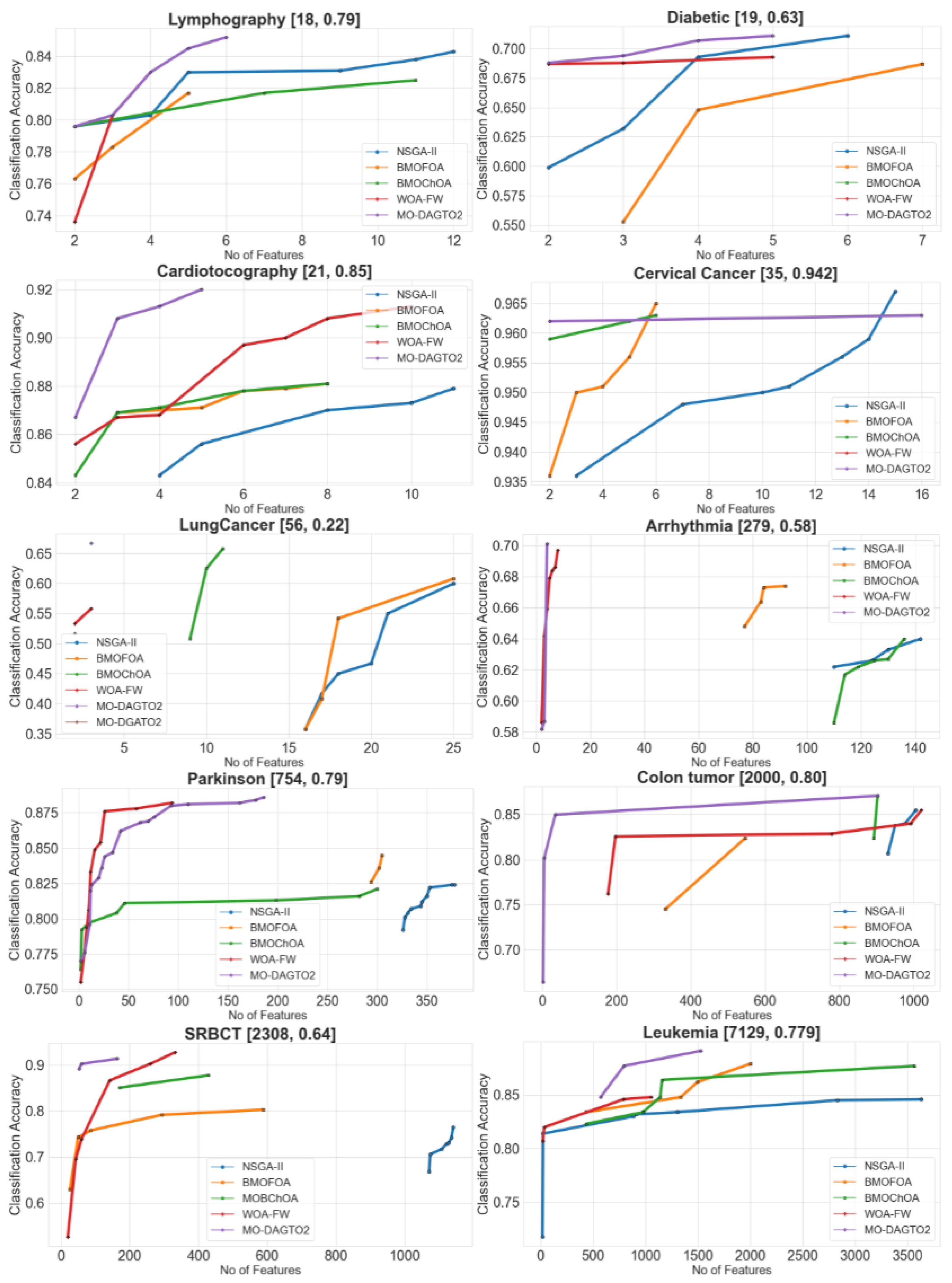
- Experiment 6: Performance comparison between best variants of multi-objective DAGTO and four well-known multi-objective FS techniques using average feature size and average classification accuracy for equitable and fair comparison.
- Experiment 7: Conduct of a Wilcoxon signed rank test on HV to verify the significance of the proposed approach with respect to the others (NSGA-II, BMOFOA, BMOChOA, and FW-GPAWOA).
- Experiment 8: Execution time comparison.
- Experiment 9: Comparison between the proposed SO-DAGTO and the best of the MO-DAGTOs, which is proven to be MO-DAGTO2.
5. Experimental Results and Discussion
5.1. Single-Objective DAGTO
5.1.1. Experiment 1
5.1.2. Experiment 2
5.1.3. Experiment 3
5.2. Multi-Objective DAGTOs
5.2.1. Experiment 4
5.2.2. Experiment 5
- Null hypothesis (p-value > ): performance of MO-DAGTO2 is similar “=” to that of MO-DAGTO1 and MO-DAGTO3.
- Alternative hypothesis (p-value < ): performance of MO-DAGTO2 is significantly superior “+” (or inferior “−”) to that of MO-DAGTO1 and MO-DAGTO3.
5.2.3. Experiment 6
5.2.4. Experiment 7
5.2.5. Experiment 8
5.2.6. Experiment 9
6. Advantages (Pros) of the Suggested Fs Methods
- This is the first attempt to apply MO-DAGTO for solving discrete optimization tasks such as feature selection.
- MO-DAGTO2 is a multi-objective approach and thus can help medical professionals to make better decisions due to the availability of a large number of optimal solutions.
- It can simultaneously optimize filter and wrapper criteria, resulting in a stronger set of features that really affect the disease and by using which, one can easily and correctly predict a particular issue.
- When comparing MO-DAGTO2 against the other standard multi-objective FS techniques, it is proven to be superior at providing the best Pareto fronts respecting the lower number of traits and higher accuracy it offers.
- The most distinctive feature of this suggested method is its ability to build a reservoir of Pareto optimal solutions, each of which is extremely unique due to the crowding distance.
- In our wrapper evaluation, we choose KNN as a classification algorithm because it is a superior supervised classifier with low computational complexity.
- The suggested MO-DAGTO2 algorithm, with a fusion of both filter and wrapper approaches, achieves better classification accuracy by incorporating short length feature substrings, according to the experimental observations of all nine FS algorithms.
- Because of the great gorilla initialization methodology based on mutual information, the rate of convergence of all four suggested DAGTO algorithms is high when compared to others.
- Because of the greater HV and spread values, the MO-DAGTO2 approach generates Pareto fronts that can control a huge volume in the objective plane.
- Among all the above discussed multi-objective FS strategies, MO-DAGTO2 has the greatest contribution toward discovering the true Pareto front as the SCC values are very impressive in most of the datasets. This indicates its rapid convergence toward the optimal solution set.
7. Case Study with COVID-19 Dataset
8. Conclusions and Future Research
Author Contributions
Funding
Institutional Review Board Statement
Informed Consent Statement
Data Availability Statement
Conflicts of Interest
References
- Chandrashekar, G.; Sahin, F. A survey on feature selection methods. Comput. Electr. Eng. 2014, 40, 16–28. [Google Scholar] [CrossRef]
- Guyon, I.; Elisseeff, A. An Introduction to Variable and Feature Selection. J. Mach. Learn. Res. 2003, 3, 1157–1182. [Google Scholar]
- Liu, H.; Yu, L. Toward Integrating Feature Selection Algorithms for Classification and Clustering. IEEE Trans. Knowl. Data Eng. 2005, 17, 491–502. [Google Scholar]
- Erguzel, T.T.; Tas, C.; Cebi, M. A wrapper-based approach for feature selection and classification of major depressive disorder-bipolar disorders. Comput. Biol. Med. 2015, 64, 127–137. [Google Scholar] [CrossRef] [PubMed]
- Huang, H.; Xie, H.; Guo, J.; Chen, H. Ant colony optimization-based feature selection method for surface electromyography signals classification. Comput. Biol. Med. 2012, 42, 30–38. [Google Scholar] [CrossRef]
- Sahebi, G.; Movahedi, P.; Ebrahimi, M.; Pahikkala, T.; Plosila, J.; Tenhunen, H. GeFeS: A generalized wrapper feature selection approach for optimizing classification performance. Comput. Biol. Med. 2020, 125, 103974. [Google Scholar] [CrossRef]
- Sreejith, S.; Nehemiah, H.K.; Kannan, A. Clinical data classification using an enhanced SMOTE and chaotic evolutionary feature selection. Comput. Biol. Med. 2020, 126, 103991. [Google Scholar] [CrossRef]
- Vivekanandan, T.; Iyengar, N.C.S.N. Optimal feature selection using a modified differential evolution algorithm and its effectiveness for prediction of heart disease. Comput. Biol. Med. 2017, 90, 125–136. [Google Scholar] [CrossRef]
- Xue, B.; Zhang, M.; Browne, W.N.; Yao, X. A Survey on Evolutionary Computation Approaches to Feature Selection. IEEE Trans. Evol. Comput. 2016, 20, 606–626. [Google Scholar] [CrossRef]
- Benyamin, A.; Gharehchopogh, F.S.; Mirjalili, S. Artificial gorilla troops optimizer: A new nature-inspired metaheuristic algorithm for global optimization problems. Int. J. Intell. Syst. 2021, 36, 5887–5958. [Google Scholar]
- Ginidi, A.; Ghoneim, S.M.; Elsayed, A.; El-Sehiemy, R.; Shaheen, A.; El-Fergany, A. Gorilla Troops Optimizer for Electrically Based Single and Double-Diode Models of Solar Photovoltaic Systems. Sustainability 2021, 13, 9459. [Google Scholar] [CrossRef]
- Sayed, G.I.; Hassanien, A.E. A Novel Chaotic Artificial Gorilla Troops Optimizer and Its Application for Fundus Images Segmentation. In Proceedings of the International Conference on Advanced Intelligent Systems and Informatics; Springer: Cham, Switzerland, 2021; pp. 318–329. [Google Scholar]
- Yusta, S.C. Different metaheuristic strategies to solve the feature selection problem. Pattern Recognit. Lett. 2009, 30, 525–534. [Google Scholar] [CrossRef]
- Kira, K.; Rendell, L.A. A Practical Approach to Feature Selection. In Proceedings of the 9th International Workshop on Machine Learning (ML), Aberdeen, UK, 1–3 July 1992; Morgan Kaufmann: Burlington, UK, 1992; pp. 249–256. [Google Scholar]
- Peng, H.; Long, F.; Ding, C.H.Q. Feature Selection Based on Mutual Information: Criteria of Max-Dependency, Max-Relevance, and Min-Redundancy. IEEE Trans. Pattern Anal. Mach. Intell. 2005, 27, 1226–1238. [Google Scholar] [CrossRef]
- Battiti, R. Using mutual information for selecting features in supervised neural net learning. IEEE Trans. Neural Netw. 1994, 5, 537–550. [Google Scholar] [CrossRef] [PubMed]
- Xue, B.; Cervante, L.; Shang, L.; Browne, W.N.; Zhang, M. Multi-objective Evolutionary Algorithms for filter Based Feature Selection in Classification. Int. J. Artif. Intell. Tools 2013, 22, 1350024. [Google Scholar] [CrossRef]
- Labani, M.; Moradi, P.; Jalili, M. A multi-objective genetic algorithm for text feature selection using the relative discriminative criterion. Expert Syst. Appl. 2020, 149, 113276. [Google Scholar] [CrossRef]
- Cervante, L.; Xue, B.; Shang, L.; Zhang, M. A Multi-objective Feature Selection Approach Based on Binary PSO and Rough Set Theory. In Proceedings of the 13th European Conference on Evolutionary Computation in Combinatorial Optimization (EvoCOP), Vienna, Austria, 3–5 April 2013; Volume 7832, pp. 25–36. [Google Scholar]
- Xue, B.; Cervante, L.; Shang, L.; Browne, W.N.; Zhang, M. A multi-objective particle swarm optimisation for filter-based feature selection in classification problems. Connect. Sci. 2012, 24, 91–116. [Google Scholar] [CrossRef]
- Hancer, E.; Xue, B.; Zhang, M.; Karaboga, D.; Akay, B. A multi-objective artificial bee colony approach to feature selection using fuzzy mutual information. In Proceedings of the IEEE Congress on Evolutionary Computation (CEC), Sendai, Japan, 25–28 May 2015; pp. 2420–2427. [Google Scholar]
- Cervante, L.; Xue, B.; Zhang, M.; Shang, L. Binary particle swarm optimisation for feature selection: A filter based approach. In Proceedings of the IEEE Congress on Evolutionary Computation (CEC), Brisbane, Australia, 10–15 June 2012; pp. 1–8. [Google Scholar]
- Nayak, S.K.; Rout, P.K.; Jagadev, A.K.; Swarnkar, T. Elitism based Multi-Objective Differential Evolution for feature selection: A filter approach with an efficient redundancy measure. J. King Saud Univ. Comput. Inf. Sci. 2020, 32, 174–187. [Google Scholar] [CrossRef]
- Ali, M.U.; Yusof, U.K.; Naim, S. Filter-Based Multi-Objective Feature Selection Using NSGA III and Cuckoo Optimization Algorithm. IEEE Access 2020, 8, 76333–76356. [Google Scholar]
- Narendra, P.M.; Fukunaga, K. A Branch and Bound Algorithm for Feature Subset Selection. IEEE Trans. Comput. 1977, 26, 917–922. [Google Scholar] [CrossRef]
- Whitney, A.W. A Direct Method of Nonparametric Measurement Selection. IEEE Trans. Comput. 1971, 20, 1100–1103. [Google Scholar] [CrossRef]
- Marill, T.; Green, D.M. On the effectiveness of receptors in recognition systems. IEEE Trans. Inf. Theory 1963, 9, 11–17. [Google Scholar] [CrossRef]
- Pudil, P.; Novovicová, J.; Kittler, J. Floating search methods in feature selection. Pattern Recognit. Lett. 1994, 15, 1119–1125. [Google Scholar] [CrossRef]
- Liu, X.; Liang, Y.; Wang, S.; Yang, Z.; Ye, H. A Hybrid Genetic Algorithm With Wrapper-Embedded Approaches for Feature Selection. IEEE Access 2018, 6, 22863–22874. [Google Scholar] [CrossRef]
- Chuang, L.; Tsai, S.; Yang, C. Improved binary particle swarm optimization using catfish effect for feature selection. Expert Syst. Appl. 2011, 38, 12699–12707. [Google Scholar] [CrossRef]
- Mafarja, M.M.; Mirjalili, S. Hybrid Whale Optimization Algorithm with simulated annealing for feature selection. Neurocomputing 2017, 260, 302–312. [Google Scholar] [CrossRef]
- Al-Tashi, Q.; Abdulkadir, S.J.; Rais, H.M.; Mirjalili, S.; Alhussian, H. Binary Optimization Using Hybrid Grey Wolf Optimization for Feature Selection. IEEE Access 2019, 7, 39496–39508. [Google Scholar] [CrossRef]
- Sayed, S.A.; Nabil, E.; Badr, A. A binary clonal flower pollination algorithm for feature selection. Pattern Recognit. Lett. 2016, 77, 21–27. [Google Scholar] [CrossRef]
- Hancer, E.; Xue, B.; Karaboga, D.; Zhang, M. A binary ABC algorithm based on advanced similarity scheme for feature selection. Appl. Soft Comput. 2015, 36, 334–348. [Google Scholar] [CrossRef]
- Kashef, S.; Nezamabadi-pour, H. An advanced ACO algorithm for feature subset selection. Neurocomputing 2015, 147, 271–279. [Google Scholar] [CrossRef]
- Muni, D.P.; Pal, N.R.; Das, J. Genetic programming for simultaneous feature selection and classifier design. IEEE Trans. Syst. Man, Cybern. Part B 2006, 36, 106–117. [Google Scholar] [CrossRef]
- Ghaemi, M.; Feizi-Derakhshi, M. Feature selection using Forest Optimization Algorithm. Pattern Recognit. 2016, 60, 121–129. [Google Scholar] [CrossRef]
- Al-Tashi, Q.; Abdulkadir, S.J.; Rais, H.M.; Mirjalili, S.; Alhussian, H.; Ragab, M.G.; Alqushaibi, A. Binary Multi-Objective Grey Wolf Optimizer for Feature Selection in Classification. IEEE Access 2020, 8, 106247–106263. [Google Scholar] [CrossRef]
- Piri, J.; Mohapatra, P. An analytical study of modified multi-objective Harris Hawk Optimizer towards medical data feature selection. Comput. Biol. Med. 2021, 135, 104558. [Google Scholar] [CrossRef]
- Nouri-Moghaddam, B.; Ghazanfari, M.; Fathian, M. A novel multi-objective forest optimization algorithm for wrapper feature selection. Expert Syst. Appl. 2021, 175, 114737. [Google Scholar] [CrossRef]
- Behravan, I.; Dehghantanha, O.; Zahiri, S.H. An optimal SVM with feature selection using multi-objective PSO. In Proceedings of the 1st Conference on Swarm Intelligence and Evolutionary Computation (CSIEC), Bam, Iran, 9–11 March 2016; pp. 76–81. [Google Scholar]
- Bouraoui, A.; Jamoussi, S.; Ayed, Y.B. A multi-objective genetic algorithm for simultaneous model and feature selection for support vector machines. Artif. Intell. Rev. 2018, 50, 261–281. [Google Scholar] [CrossRef]
- dos Santos, B.C.; Nobre, C.N.; Zárate, L.E. Multi-Objective Genetic Algorithm for Feature Selection in a Protein Function Prediction Context. In Proceedings of the IEEE Congress on Evolutionary Computation (CEC), Rio de Janeiro, Brazil, 8–13 July 2018; pp. 1–6. [Google Scholar]
- Emmanouilidis, C.; Hunter, A.; MacIntyre, J.; Cox, C. A multi-objective genetic algorithm approach to feature selection in neural and fuzzy modeling. Evol. Optim. 2001, 3, 1–26. [Google Scholar]
- Huang, B.Q.; Buckley, B.; Kechadi, M.T. Multi-objective feature selection by using NSGA-II for customer churn prediction in telecommunications. Expert Syst. Appl. 2010, 37, 3638–3646. [Google Scholar] [CrossRef]
- de Oliveira, L.E.S.; Sabourin, R.; Bortolozzi, F.; Suen, C.Y. Feature Selection Using Multi-Objective Genetic Algorithms for Handwritten Digit Recognition. In Proceedings of the 16th International Conference on Pattern Recognition (ICPR), Quebec City, QC, Canada, 11–15 August 2002; pp. 568–571. [Google Scholar]
- Piri, J.; Mohapatra, P.; Dey, R. Fetal Health Status Classification Using MOGA–CD Based Feature Selection Approach. In Proceedings of the IEEE International Conference on Electronics, Computing and Communication Technologies (CONECCT), Bangalore, India, 2–4 July 2020; pp. 1–6. [Google Scholar]
- Piri, J.; Mohapatra, P.; Dey, R. Multi-objective Ant Lion Optimization Based Feature Retrieval Methodology for Investigation of Fetal Wellbeing. In Proceedings of the 3rd International Conference on Inventive Research in Computing Applications (ICIRCA), Coimbatore, India, 2–4 September 2021; pp. 1732–1737. [Google Scholar]
- Piri, J.; Mohapatra, P.; Singh, D.; Samanta, D.; Singh, D.; Kaur, M.; Lee, H. Mining and Interpretation of Critical Aspects of Infant Health Status Using Multi-Objective Evolutionary Feature Selection Approaches. IEEE Access 2022, 10, 32622–32638. [Google Scholar] [CrossRef]
- Xue, B.; Fu, W.; Zhang, M. Differential evolution (DE) for multi-objective feature selection in classification. In Proceedings of the Genetic and Evolutionary Computation Conference (GECCO), ACM, Vancouver, BC, Canada, 12–16 July 2014; pp. 83–84. [Google Scholar]
- Moradi, P.; Gholampour, M. A hybrid particle swarm optimization for feature subset selection by integrating a novel local search strategy. Appl. Soft Comput. 2016, 43, 117–130. [Google Scholar] [CrossRef]
- Xue, B.; Zhang, M.; Browne, W.N. Particle swarm optimisation for feature selection in classification: Novel initialisation and updating mechanisms. Appl. Soft Comput. 2014, 18, 261–276. [Google Scholar] [CrossRef]
- Hammami, M.; Bechikh, S.; Hung, C.; Said, L.B. A Multi-objective hybrid filter-wrapper evolutionary approach for feature selection. Memetic Comput. 2019, 11, 193–208. [Google Scholar] [CrossRef]
- Emary, E.; Yamany, W.; Hassanien, A.E.; Snasel, V. Multi-Objective Gray-Wolf Optimization for Attribute Reduction. Procedia Comput. Sci. 2015, 65, 623–632. [Google Scholar] [CrossRef]
- Taha, A.M.; Chen, S.; Mustapha, A. Bat Algorithm Based Hybrid Filter-Wrapper Approach. Adv. Oper. Res. 2015, 2015, 961494. [Google Scholar] [CrossRef]
- Saxena, A.; Shrivas, M.M. Filter–GA Based Approach to Feature Selection for Classification. Int. J. Future Revolut. Comput. Sci. Commun. Eng. 2017, 3, 202–212. [Google Scholar]
- Got, A.; Moussaoui, A.; Zouache, D. Hybrid filter-wrapper feature selection using whale optimization algorithm: A multi-objective approach. Expert Syst. Appl. 2021, 183, 115312. [Google Scholar] [CrossRef]
- Too, J.; Abdullah, A.R.; Saad, N.M. A New Quadratic Binary Harris Hawk Optimization for Feature Selection. Electronics 2019, 8, 1130. [Google Scholar] [CrossRef]
- Li, W.; Zhang, G.; Zhang, T.; Huang, S. Knee Point-Guided Multiobjective Optimization Algorithm for Microgrid Dynamic Energy Management. Complexity 2020, 2020, 8877008. [Google Scholar] [CrossRef]
- Zhang, X.; Tian, Y.; Jin, Y. A Knee Point-Driven Evolutionary Algorithm for Many-Objective Optimization. IEEE Trans. Evol. Comput. 2015, 19, 761–776. [Google Scholar] [CrossRef]
- Zhu, Z.; Ong, Y.; Dash, M. Markov blanket-embedded genetic algorithm for gene selection. Pattern Recognit. 2007, 40, 3236–3248. [Google Scholar] [CrossRef]
- Too, J.; Mirjalili, S. A Hyper Learning Binary Dragonfly Algorithm for Feature Selection: A COVID-19 Case Study. Knowl.-Based Syst. 2021, 212, 106553. [Google Scholar] [CrossRef]
- Kumar, V.; Kaur, A. Binary spotted hyena optimizer and its application to feature selection. J. Ambient. Intell. Humaniz. Comput. 2020, 11, 2625–2645. [Google Scholar] [CrossRef]
- Deb, K.; Agrawal, S.; Pratap, A.; Meyarivan, T. A fast and elitist multiobjective genetic algorithm: NSGA-II. IEEE Trans. Evol. Comput. 2002, 6, 182–197. [Google Scholar] [CrossRef]
- Piri, J.; Mohapatra, P.; Pradhan, M.R.; Acharya, B.; Patra, T.K. A Binary Multi-Objective Chimp Optimizer With Dual Archive for Feature Selection in the Healthcare Domain. IEEE Access 2022, 10, 1756–1774. [Google Scholar] [CrossRef]
- Auger, A.; Bader, J.; Brockhoff, D.; Zitzler, E. Theory of the hypervolume indicator: Optimal μ-distributions and the choice of the reference point. In Proceedings of the 10th ACM/SIGEVO Conference on Foundations of Genetic Algorithms (FOGA), ACM, Orlando, FL, USA, 9–11 January 2009; pp. 87–102. [Google Scholar]
- Chen, X.; Tang, Y.; Mo, Y.; Li, S.; Lin, D.; Yang, Z.; Yang, Z.; Sun, H.; Qiu, J.; Liao, Y.; et al. A diagnostic model for coronavirus disease 2019 (COVID-19) based on radiological semantic and clinical features: A multi-center study. Eur. Radiol. 2020, 30, 4893–4902. [Google Scholar] [CrossRef]
- Sahlol, A.T.; Yousri, D.; Ewees, A.A.; Al-qaness, M.A.A.; Damasevicius, R.; Elaziz, M.A. COVID-19 image classification using deep features and fractional-order marine predators algorithm. Sci. Rep. 2020, 10, 15364. [Google Scholar] [CrossRef] [PubMed]
- Ali, S.; Zhou, Y.; Patterson, M. Efficient Analysis of COVID-19 Clinical Data using Machine Learning Models. Med. Biol. Eng. Comput. 2022, 60, 1881–1896. [Google Scholar] [CrossRef]
- Ali, S.; Ali, T.E.; Khan, M.A.; Khan, I.; Patterson, M. Effective and scalable clustering of SARS-CoV-2 sequences. In Proceedings of the ICBDR 2021: 2021 the 5th International Conference on Big Data Research, Tokyo, Japan, 25–27 September 2021. [Google Scholar]
- Kuzmin, K.; Adeniyi, A.E.; DaSouza, A.K.; Lim, D.; Nguyen, H.; Molina, N.R.; Xiong, L.; Weber, I.T.; Harrison, R.W. Machine learning methods accurately predict host specificity of coronaviruses based on spike sequences alone. Biochem. Biophys. Res. Commun. 2020, 533, 553–558. [Google Scholar] [CrossRef]
- Drakopoulos, G.; Stathopoulou, F.; Kanavos, A.; Paraskevas, M.; Tzimas, G.; Mylonas, P.; Iliadis, L. A Genetic Algorithm for Spatiosocial Tensor Clustering. Evol. Syst. 2020, 11, 491–501. [Google Scholar] [CrossRef]




| SID | Name | #Samples | #Characteristics | #Target Labels |
|---|---|---|---|---|
| D1 | Lymphography | 148 | 18 | 3 |
| D2 | Diabetic | 1151 | 19 | 2 |
| D3 | Cardiotocography | 2126 | 21 | 3 |
| D4 | Cervical Cancer | 858 | 35 | 2 |
| D5 | Lung Cancer | 32 | 56 | 3 |
| D6 | Arrhythmia | 452 | 279 | 16 |
| D7 | Parkinson | 756 | 754 | 2 |
| D8 | Colon Tumor | 62 | 2000 | 2 |
| D9 | SRBCT | 83 | 2308 | 4 |
| D10 | Leukemia | 72 | 7129 | 2 |
| Approaches | Parameters | Values |
|---|---|---|
| Single objective (Population Size = 20, Maximum Number of Iterations = 100) | ||
| HLBDA | pl | 0.4 |
| dl | 0.7 | |
| BSHO | [5, 0] | |
| M | [0.5, 1] | |
| 0.99 | ||
| 0.01 | ||
| QBHHO | 0.99 | |
| Single-objective DAGTO | 3 | |
| W | 0.8 | |
| p | 0.03 | |
| Multi objective (Population Size = 20, Maximum Number of Iterations = 100, Repository Size = 50) | ||
| NSGA-II | Crossover rate (CR) | 0.8 |
| Mutation rate (MR) | 0.01 | |
| BMOFOA | Transfer rate | 10% |
| Lifetime | 20 | |
| LSC | 2 | |
| GSC | 7 | |
| BMOChOA | Chaotic map | Tent |
| Multi-objective DAGTOs | 3 | |
| W | 0.8 | |
| p | 0.03 | |
| Datasets | Criteria | SO-DAGTO | HLBDA | BSHO | QBHHO |
|---|---|---|---|---|---|
| Lymphography | Mean_fitness | 0.184 | 0.197 | 0.2 | 0.201 |
| Avg_accuracy | 0.813 | 0.804 | 0.816 | 0.816 | |
| Avg_feature_size | 6.66 | 7 | 13 | 13.33 | |
| Avg_execution time (min) | 5.01 | 4.78 | 5.02 | 4.56 | |
| Diabetic | Mean_fitness | 0.307 | 0.33 | 0.324 | 0.318 |
| Avg_accuracy | 0.689 | 0.686 | 0.7 | 0.649 | |
| Avg_feature_size | 7 | 7 | 9.6 | 6 | |
| Avg_execution time (min) | 8.02 | 8.13 | 7.86 | 7.73 | |
| Cardiotocography | Mean_fitness | 0.091 | 0.104 | 0.097 | 0.101 |
| Avg_accuracy | 0.924 | 0.908 | 0.915 | 0.91 | |
| Avg_feature_size | 8 | 8 | 7 | 11 | |
| Avg_execution time (min) | 11.01 | 10.97 | 11.06 | 10.96 | |
| Cervical Cancer | Mean_fitness | 0.048 | 0.058 | 0.058 | 0.059 |
| Avg_accuracy | 0.956 | 0.968 | 0.945 | 0.953 | |
| Avg_feature_size | 6 | 12 | 13.6 | 12 | |
| Avg_execution time (min) | 5.12 | 4.89 | 5.05 | 5.02 | |
| Lung Cancer | Mean_fitness | 0.36 | 0.384 | 0.397 | 0.354 |
| Avg_accuracy | 0.65 | 0.63 | 0.618 | 0.643 | |
| Avg_feature_size | 22 | 42.1 | 28 | 13 | |
| Avg_execution time (min) | 2.00 | 2.02 | 3.19 | 2.00 | |
| Arrhythmia | Mean_fitness | 0.344 | 0.366 | 0.38 | 0.377 |
| Avg_accuracy | 0.629 | 0.624 | 0.606 | 0.611 | |
| Avg_feature_size | 61 | 131 | 108 | 105 | |
| Avg_execution time (min) | 5.79 | 5.43 | 5.87 | 5.38 | |
| Parkinson | Mean_fitness | 0.12 | 0.132 | 0.132 | 0.123 |
| Avg_accuracy | 0.89 | 0.878 | 0.88 | 0.887 | |
| Avg_feature_size | 255.23 | 251.3 | 248 | 271.34 | |
| Avg_execution time (min) | 10.32 | 11.01 | 10.87 | 10.12 | |
| Colon Tumor | Mean_fitness | 0.159 | 0.161 | 0.176 | 0.17 |
| Avg_accuracy | 0.84 | 0.855 | 0.838 | 0.838 | |
| Avg_feature_size | 962 | 1000.3 | 1129 | 850.4 | |
| Avg_execution time (min) | 9.53 | 9.68 | 9.46 | 9.48 | |
| SRBCT | Mean_fitness | 0.117 | 0.124 | 0.146 | 0.137 |
| Avg_accuracy | 0.878 | 0.883 | 0.864 | 0.867 | |
| Avg_feature_size | 654 | 754 | 804 | 976 | |
| Avg_execution time (min) | 13.22 | 13.75 | 12.89 | 12.38 | |
| Leukemia | Mean_fitness | 0.139 | 0.1424 | 0.125 | 0.135 |
| Avg_accuracy | 0.862 | 0.86 | 0.887 | 0.87 | |
| Avg_feature_size | 1811 | 3201 | 2003.87 | 1991.13 | |
| Avg_execution time (min) | 28.04 | 26.87 | 27.09 | 26.49 |
| Datasets | SO-DAGTO vs. HLBDA | SO-DAGTO vs. BSHO | SO-DAGTO vs. QBHHO |
|---|---|---|---|
| Lymphography | = | + | + |
| Diabetic | = | + | + |
| Cardiotocography | + | = | + |
| Cervical Cancer | + | + | + |
| Lung Cancer | + | + | − |
| Arrhythmia | + | + | + |
| Parkinson | + | + | = |
| Colon Tumor | = | + | + |
| SRBCT | + | + | + |
| Leukemia | + | − | − |
| Datasets | Methods | Avg_Accuracy | Avg_Feature_Size | HV | #Pareto Solutions |
|---|---|---|---|---|---|
| Lymphography | MO-DAGTO1 | 0.824 | 3 | 0.204 | 2 |
| MO-DAGTO2 | 0.825 | 4 | 0.384 | 5 | |
| MO-DAGTO3 | 0.81 | 5.5 | 0.178 | 6 | |
| Diabetic | MO-DAGTO1 | 0.673 | 2 | 0.1 | 1 |
| MO-DAGTO2 | 0.7 | 3.5 | 0.241 | 4 | |
| MO-DAGTO3 | 0.69 | 4.25 | 0.245 | 4 | |
| Cardiotocography | MO-DAGTO1 | 0.904 | 5.14 | 0.15 | 7 |
| MO-DAGTO2 | 0.902 | 3.5 | 0.242 | 4 | |
| MO-DAGTO3 | 0.846 | 6.77 | 0.121 | 9 | |
| Cervical Cancer | MO-DAGTO1 | 0.962 | 3 | 0.292 | 3 |
| MO-DAGTO2 | 0.963 | 9 | 0.493 | 2 | |
| MO-DAGTO3 | 0.96 | 4.66 | 0.318 | 3 | |
| Lung Cancer | MO-DAGTO1 | 0.675 | 2 | 0.1 | 1 |
| MO-DAGTO2 | 0.592 | 2.5 | 0.368 | 2 | |
| MO-DAGTO3 | 0.575 | 2.25 | 0.226 | 4 | |
| Arrhythmia | MO-DAGTO1 | 0.62 | 3 | 0.297 | 3 |
| MO-DAGTO2 | 0.623 | 3 | 0.314 | 3 | |
| MO-DAGTO3 | 0.64 | 4.88 | 0.117 | 9 | |
| Parkinson | MO-DAGTO1 | 0.84 | 5 | 0.15 | 7 |
| MO-DAGTO2 | 0.846 | 62 | 0.363 | 18 | |
| MO-DAGTO3 | 0.86 | 6.33 | 0.122 | 9 | |
| Colon Tumor | MO-DAGTO1 | 0.85 | 123 | 0.1 | 1 |
| MO-DAGTO2 | 0.8 | 236.2 | 0.393 | 4 | |
| MO-DAGTO3 | 0.81 | 956.85 | 0.144 | 7 | |
| SRBCT | MO-DAGTO1 | 0.69 | 151.14 | 0.177 | 7 |
| MO-DAGTO2 | 0.903 | 92.33 | 0.305 | 3 | |
| MO-DAGTO3 | 0.67 | 1026.22 | 0.122 | 9 | |
| Leukemia | MO-DAGTO1 | 0.81 | 174.25 | 0.275 | 4 |
| MO-DAGTO2 | 0.872 | 964 | 0.305 | 3 | |
| MO-DAGTO3 | 0.83 | 941.28 | 0.163 | 7 |
| MO-DAGTO2 vs. | MO-DAGTO1 | MO-DAGTO3 | ||
|---|---|---|---|---|
| -Value | Significance | -Value | Significance | |
| Lymphography | 3.870 × 10 | + | 2.671 × 10 | + |
| Diabetic | 2.432 × 10 | + | 4.270 × 10 | − |
| Cardiotocography | 1.520 × 10 | + | 1.113 × 10 | + |
| Cervical Cancer | 4.890 × 10 | + | 7.564 × 10 | + |
| Lung Cancer | 2.980 × 10 | + | 4.867 × 10 | + |
| Arrhythmia | 0.071 | = | 3.560 × 10 | + |
| Parkinson | 4.983 × 10 | + | 6.480 × 10 | + |
| Colon Tumor | 3.591 × 10 | + | 4.238 × 10 | + |
| SRBCT | 5.390 × 10 | + | 6.123 × 10 | + |
| Leukemia | 0.068 | = | 4.219 × 10 | + |
| Datasets | Methods | Avg_Acc | Avg_Feature_Size | IGD | HV | Spread | SCC |
|---|---|---|---|---|---|---|---|
| Lymphography | NSGA-II | 0.823 | 7.16 | 0.088 | 0.178 | 0.695 | 0 |
| BMOFOA | 0.795 | 3.75 | 0.028 | 0.245 | 0.658 | 0 | |
| BMOChOA | 0.812 | 6.66 | 0.102 | 0.334 | 0.961 | 0 | |
| FW-GPAWOA | 0.789 | 3 | 0.091 | 0.301 | 0.724 | 1 | |
| MO-DAGTO2 | 0.825 | 4 | 0.264 | 0.384 | 0.845 | 3 | |
| Diabetic | NSGA-II | 0.658 | 3.75 | 0.073 | 0.254 | 0.786 | 0 |
| BMOFOA | 0.629 | 4.66 | 0.148 | 0.312 | 0.845 | 0 | |
| BMOChOA | 0.688 | 2 | 1.179 | 0.1 | 0 | 1 | |
| FW-GPAWOA | 0.689 | 3.33 | 0.177 | 0.3 | 0.78 | 0 | |
| MO-DAGTO2 | 0.7 | 3.5 | 0.084 | 0.241 | 0.667 | 3 | |
| Cardiotocography | NSGA-II | 0.864 | 7.6 | 0.022 | 0.201 | 0.62 | 0 |
| BMOFOA | 0.875 | 5.8 | 0.024 | 0.199 | 0.592 | 0 | |
| BMOChOA | 0.868 | 4.6 | 0.015 | 0.204 | 0.734 | 0 | |
| FW-GPAWOA | 0.89 | 6.25 | 0.091 | 0.134 | 0.58 | 0 | |
| MO-DAGTO2 | 0.902 | 3.5 | 0.055 | 0.242 | 0.677 | 2 | |
| Cervical Cancer | NSGA-II | 0.952 | 10.42 | 0.269 | 0.152 | 0.581 | 0 |
| BMOFOA | 0.951 | 4 | 0.189 | 0.201 | 0.642 | 0 | |
| BMOChOA | 0.961 | 4.33 | 0.073 | 0.315 | 0.786 | 0 | |
| FW-GPAWOA | 0.962 | 2 | 0.159 | 0.255 | 0 | 1 | |
| MO-DAGTO2 | 0.963 | 9 | 0.257 | 0.493 | 1.248 | 1 | |
| Lung Cancer | NSGA-II | 0.473 | 19.5 | 1.114 | 0.199 | 0.569 | 0 |
| BMOFOA | 0.464 | 18.6 | 1.039 | 0.238 | 0.639 | 0 | |
| BMOChOA | 0.597 | 10 | 0.895 | 0.29 | 0.548 | 0 | |
| FW-GPAWOA | 0.545 | 2.5 | 0.631 | 0.353 | 0.668 | 0 | |
| MO-DAGTO2 | 0.592 | 2.5 | 0.592 | 0.368 | 0.808 | 0 | |
| Arrhythmia | NSGA-II | 0.63 | 126.5 | 0.118 | 0.222 | 0.375 | 0 |
| BMOFOA | 0.664 | 84 | 0.121 | 0.219 | 0.329 | 0 | |
| BMOChOA | 0.619 | 122.33 | 0.227 | 0.162 | 0.316 | 0 | |
| FW-GPAWOA | 0.664 | 5.125 | 0.255 | 0.135 | 0.578 | 0 | |
| MO-DAGTO2 | 0.623 | 3 | 0.015 | 0.314 | 0.756 | 1 | |
| Parkinson | NSGA-II | 0.811 | 346.4 | 0.036 | 0.111 | 0.195 | 0 |
| BMOFOA | 0.835 | 300.33 | 0.308 | 0.26 | 0.199 | 0 | |
| BMOChOA | 0.802 | 109.875 | 0.046 | 0.139 | 0.834 | 0 | |
| FW-GPAWOA | 0.83 | 25.4 | 0.023 | 0.114 | 0.869 | 0 | |
| MO-DAGTO2 | 0.85 | 62.55 | 0.055 | 0.363 | 0.585 | 0 | |
| Colon Tumor | NSGA-II | 0.835 | 966 | 0.307 | 0.22 | 0.26 | 0 |
| BMOFOA | 0.784 | 438.5 | 0.472 | 0.167 | 0.769 | 0 | |
| BMOChOA | 0.839 | 896.33 | 0.396 | 0.265 | 0.212 | 1 | |
| FW-GPAWOA | 0.822 | 633.2 | 0.136 | 0.215 | 0.761 | 0 | |
| MO-DAGTO2 | 0.8 | 236.2 | 0.06 | 0.393 | 1.427 | 4 | |
| SRBCT | NSGA-II | 0.722 | 1111.286 | 0.121 | 0.145 | 0.237 | 0 |
| BMOFOA | 0.745 | 209 | 0.093 | 0.227 | 1.081 | 2 | |
| BMOChOA | 0.864 | 299.5 | 0.451 | 0.408 | 0.947 | 0 | |
| FW-GPAWOA | 0.776 | 142.83 | 0.049 | 0.205 | 0.949 | 1 | |
| MO-DAGTO2 | 0.903 | 92.33 | 0.27 | 0.305 | 0.904 | 3 | |
| Leukemia | NSGA-II | 0.817 | 1371.714 | 0.048 | 0.162 | 0.893 | 2 |
| BMOFOA | 0.855 | 1316.5 | 0.168 | 0.258 | 0.788 | 0 | |
| BMOChOA | 0.849 | 1454.2 | 0.116 | 0.213 | 0.941 | 0 | |
| FW-GPAWOA | 0.83 | 475.5 | 0.171 | 0.275 | 1.055 | 2 | |
| MO-DAGTO2 | 0.872 | 964 | 0.28 | 0.305 | 0.832 | 2 |
| MO-DAGTO2 vs. | NSGA-II | BMOFOA | BMOChOA | FW-GPAWOA | ||||
|---|---|---|---|---|---|---|---|---|
| -Value | Signf | -Value | Signf | -Value | Signf | -Value | Signf | |
| Lymphography | 2.387 × 10 | + | 3.114 × 10 | + | 0.069 | = | 8.393 × 10 | + |
| Diabetic | 1.000 | = | 3.762 × 10 | − | 2.918 × 10 | + | 0.0761 | = |
| Cardiotocography | 9.113 × 10 | + | 7.391 × 10 | + | 9.778 × 10 | + | 5.213 × 10 | + |
| Cervical Cancer | 2.125 × 10 | + | 3.613 × 10 | + | 9.210 × 10 | + | 7.120 × 10 | + |
| Lung Cancer | 5.912 × 10 | + | 7.112 × 10 | + | 6.452 × 10 | + | 1.000 | = |
| Arrhythmia | 2.987 × 10 | + | 2.135 × 10 | + | 6.432 × 10 | + | 3.762 × 10 | + |
| Parkinson | 3.127 × 10 | + | 9.923 × 10 | + | 8.312 × 10 | + | 5.328 × 10 | + |
| Colon Tumor | 7.560 × 10 | + | 3.190 × 10 | + | 9.569 × 10 | + | 4.238 × 10 | + |
| SRBCT | 2.013 × 10 | + | 4.612 × 10 | + | 2.678 × 10 | − | 3.780 × 10 | + |
| Leukemia | 3.456 × 10 | + | 1.784 × 10 | + | 1.001 × 10 | + | 0.0827 | = |
| Datasets | NSGA-II | BMOFOA | BMOChOA | FW-GPAWOA | MO-DAGTO2 |
|---|---|---|---|---|---|
| Lymphography | 5.67 | 5.18 | 4.39 | 4.18 | 6.09 |
| Diabetic | 8.12 | 7.04 | 7.23 | 7.02 | 8.13 |
| Cardiotocography | 18.21 | 10.67 | 8.98 | 7.89 | 13.78 |
| Cervical Cancer | 4.12 | 4.89 | 2.23 | 2.03 | 5.81 |
| Lung Cancer | 4.37 | 5.03 | 3.12 | 3.04 | 6.03 |
| Arrhythmia | 9.01 | 8.03 | 7.61 | 7.01 | 10.35 |
| Parkinson | 14.78 | 13.67 | 14.11 | 14.56 | 17.04 |
| Colon Tumor | 5.89 | 7.02 | 5.19 | 5.17 | 5.96 |
| SRBCT | 12.90 | 10.34 | 12.34 | 12.89 | 14.04 |
| Leukemia | 17.21 | 15.45 | 16.78 | 17.45 | 19.14 |
| Dataset | Method | Avg_acc | Avg_Feature_Size | Optimum Solution |
|---|---|---|---|---|
| Lymphography | SO-DAGTO | 0.813 | 6.66 | [5,0.831] |
| MO-DAGTO2 | 0.825 | 4 | [2,0.796] | |
| Diabetic | SO-DAGTO | 0.689 | 7 | [7,0.7] |
| MO-DAGTO2 | 0.7 | 3.5 | [2,0.688] | |
| Cardiotocography | SO-DAGTO | 0.924 | 8 | [7,0.93] |
| MO-DAGTO2 | 0.902 | 3.5 | [3,0.908] | |
| Cervical Cancer | SO-DAGTO | 0.956 | 6 | [3,0.958] |
| MO-DAGTO2 | 0.963 | 9 | [2,0.962] | |
| Lung Cancer | SO-DAGTO | 0.65 | 22 | [36,0.658] |
| MO-DAGTO2 | 0.592 | 2.5 | [3,0.667] | |
| Arrhythmia | SO-DAGTO | 0.629 | 61 | [61,0.644] |
| MO-DAGTO2 | 0.623 | 3 | [4,0.701] | |
| Parkinson | SO-DAGTO | 0.89 | 255.23 | [264,0.872] |
| MO-DAGTO2 | 0.85 | 62.55 | [162,0.882] | |
| Colon Tumor | SO-DAGTO | 0.84 | 962 | [970,0.857] |
| MO-DAGTO2 | 0.8 | 236.2 | [903,0.871] | |
| SRBCT | SO-DAGTO | 0.878 | 654 | [556,0.89] |
| MO-DAGTO2 | 0.903 | 92.33 | [164,0.914] | |
| Leukemia | SO-DAGTO | 0.862 | 1811 | [1674,0.877] |
| MO-DAGTO2 | 0.872 | 964 | [794,0.877] |
| SNO | Name | Details | Values |
|---|---|---|---|
| 1 | case_month | Date received by CDC | March 2020, April 2020, ... , August 2021 |
| 2 | res_state | State name of USA | AK, CO, FL, ... , UT, VT |
| 3 | state_fips_code | Federal Information Processing Standards (FIPS) code for states | |
| 4 | res_county | Country name | |
| 5 | county_fips_code | FIPS code foe countries | |
| 6 | age_group | Patients’s age group | 0–17, 18–49, 50–64, and 65+ years |
| 7 | Sex | Gender of patient | M, F, other, unknown |
| 8 | Race | Race of patient | American Indian/Alaska Native, Asian, Black, Multiple/Other, Native Hawaiian/Other Pacific Islander, White, Unknown |
| 9 | Ethnicity | Hispanic, Non-Hispanic, Unknown | |
| 10 | case_positive_specimen_interval | Weeks between the initial positive specimen collection and the earliest date of collection | |
| 11 | case_onset_interval | Weeks between earliest date and date of symptom onset | |
| 12 | Process | Under what process was the case first recognised | Clinical evaluation, routine surveillance, multiple,... |
| 13 | exposure_yn | Any of the following known exposures, such as local or international travel, incarceration, a community event, or contact with a previously reported case of COVID-19, did the patient have in the 14 days before becoming ill? | Yes, unknown |
| 14 | current_status | Current status of the patient | Laboratory-confirmed case, Probable case. |
| 15 | symptom_status | Symptom status of the patient | Asymptomatic, Symptomatic, Unknown |
| 16 | hosp_yn | Was the patient hospitalized? | Yes, no, unknown |
| 17 | icu_yn | Was the patient admitted to an ICU? | Yes, no, unknown |
| 18 | underlying_conditions_yn | Whether the patient is having diabetes, hypertension, cardiovascular disease, etc. | Yes, no |
| 19 | death_yn | Whether the patient die as a result of this illness | Yes, no, unknown |
| Methods | Accuracy | Sensitivity | Specificity | Precision | FPR | Error | |
|---|---|---|---|---|---|---|---|
| KNN | BFS | 0.93 | 0.978 | 0.385 | 0.967 | 0.615 | 0.051 |
| AFS | 0.94 | 0.977 | 0.482 | 0.973 | 0.518 | 0.046 | |
| LR | BFS | 0.934 | 1 | 0.004 | 0.947 | 0.996 | 0.053 |
| AFS | 0.934 | 1 | 0 | 0.947 | 1 | 0.053 | |
| SVM | BFS | 0.934 | 1 | 0 | 0.947 | 0.5 | 0.041 |
| AFS | 0.934 | 1 | 0 | 0.947 | 1 | 0.053 | |
| RF | BFS | 0.946 | 0.982 | 0.5 | 0.974 | 0.5 | 0.041 |
| AFS | 0.95 | 0.981 | 0.459 | 0.972 | 0.541 | 0.041 | |
| DT | BFS | 0.935 | 0.976 | 0.472 | 0.972 | 0.528 | 0.048 |
| AFS | 0.942 | 0.982 | 0.442 | 0.971 | 0.558 | 0.044 |
Publisher’s Note: MDPI stays neutral with regard to jurisdictional claims in published maps and institutional affiliations. |
© 2022 by the authors. Licensee MDPI, Basel, Switzerland. This article is an open access article distributed under the terms and conditions of the Creative Commons Attribution (CC BY) license (https://creativecommons.org/licenses/by/4.0/).
Share and Cite
Piri, J.; Mohapatra, P.; Acharya, B.; Gharehchopogh, F.S.; Gerogiannis, V.C.; Kanavos, A.; Manika, S. Feature Selection Using Artificial Gorilla Troop Optimization for Biomedical Data: A Case Analysis with COVID-19 Data. Mathematics 2022, 10, 2742. https://doi.org/10.3390/math10152742
Piri J, Mohapatra P, Acharya B, Gharehchopogh FS, Gerogiannis VC, Kanavos A, Manika S. Feature Selection Using Artificial Gorilla Troop Optimization for Biomedical Data: A Case Analysis with COVID-19 Data. Mathematics. 2022; 10(15):2742. https://doi.org/10.3390/math10152742
Chicago/Turabian StylePiri, Jayashree, Puspanjali Mohapatra, Biswaranjan Acharya, Farhad Soleimanian Gharehchopogh, Vassilis C. Gerogiannis, Andreas Kanavos, and Stella Manika. 2022. "Feature Selection Using Artificial Gorilla Troop Optimization for Biomedical Data: A Case Analysis with COVID-19 Data" Mathematics 10, no. 15: 2742. https://doi.org/10.3390/math10152742
APA StylePiri, J., Mohapatra, P., Acharya, B., Gharehchopogh, F. S., Gerogiannis, V. C., Kanavos, A., & Manika, S. (2022). Feature Selection Using Artificial Gorilla Troop Optimization for Biomedical Data: A Case Analysis with COVID-19 Data. Mathematics, 10(15), 2742. https://doi.org/10.3390/math10152742