1. Introduction
In this paper, all graphs considered are finite, simple, and connected. Let
G be such a graph with vertex set
and edge set
, where
and
. Let
denote the degree of vertex
, which is simply written as
.
denote the neighbor set of
. The distance between vertices
and
in
G is the length of the shortest path connecting
to
, which is denoted as
. We use the notation
instead of
. The diameter of
G, denoted by
, is the maximum distance between any pair of vertices of
G. The Harary matrix of
G, which is also called the reciprocal distance matrix, is an
matrix defined as [
1]
Henceforth, we consider for .
The transmission of vertex , denoted by or , is defined to be the sum of the distances from to all vertices in G, that is, . A graph G is said to be k-transmission regular graph if for each . Transmission of a vertex v is also called the distance degree or the first distance degree of v.
Definition 1. Let G be a graph with . The reciprocal distance degree of a vertex v, denoted by , is given byLet be the diagonal matrix defined by . Sometimes we use the notation instead of for .
Definition 2. A graph G is called a k-reciprocal distance degree regular graph if for all
The Harary index of a graph
G, denoted by
, is defined in [
1] as
In [
2], Bapat and Panda defined the reciprocal distance Laplacian matrix as
. It was proved that, given a connected graph
G of order
n, the spectral radius of its reciprocal distance Laplacian matrix
if and only if its complement graph, denoted by
, is disconnected. In [
3], Alhevaz et al. defined the reciprocal distance signless Laplacian matrix as
Recently, the lower and upper bounds of the spectral radius of the reciprocal distance matrices and reciprocal distance signless Laplacian matrices of graphs were given in [
3,
4,
5,
6], respectively.
In [
7], the author, using the convex linear combinations of the matrices
and
, introduces a new matrix, that is generalized reciprocal distance matrix, denoted by
, which is defined by
Since
,
and
, then
and
have the same spectral properties. To this extent these matrices
,
, and
may be understood from a completely new perspective, and some interesting topics arise. For the these matrices
,
, and
, some spectral extremal graphs with fixed structure parameters have been characterized in [
8,
9]. It is natural to ask whether these results can be generalized to
.
Since is real symmetric matrics, we can denoted to the eigenvalues of The maximum eigenvalue is called the spectral radius of the matrix , denoted by .
This paper is organized as follows. In
Section 2, we give some definitions, notations, and lemmas of generalized reciprocal distance matrix. In
Section 3, we give the upper and lower bounds of the spectral radius of the generalized reciprocal distance matrix
by using the reciprocal distance degree and the second reciprocal distance degree. In
Section 4, we give the bounds of the spectral radius of the generalized reciprocal distance matrix of
, where
is the line graph of graph
G.
2. Lemmas
In this section, we give some definitions, notations, and lemmas to prepare for subsequent proofs.
Definition 3. Let G be a graph with , the reciprocal distance matrix and the reciprocal distance degree sequence Then the second reciprocal distance degree of a vertex , denoted by , is given by Definition 4. A graph G is called a pseudo k-reciprocal distance degree regular graph if for all
Definition 5. The Frobenius norm of an matrix isWe recall that, if M is a normal matrix then where are the eigenvalues of M. In particular, Lemma 1 ([
6])
. Let G be a graph of order n with reciprocal distance degree sequence and second reciprocal distance degree sequence . Then Lemma 2 (Perron–Frobenius theorem [
10])
. If A is a non-negative matrix of order n, then its spectral radius is an eigenvalue of A and it has an associated non-negative eigenvector. Furthermore, if A is irreducible, then is a simple eigenvalue of A with an associated positive eigenvector. Lemma 3 ([
7])
. Let G be a graph with vertices and Harary index . ThenThe equality holds if and only if G is a reciprocal distance degree regular graph. Lemma 4 ([
11])
. Let be an nonnegative matrix with spectral radius and row sums Then,Moreover, if A is an irreducible matrix, then equality holds on either side (and hence both sides) of the equality if and only if all row sums of A are all equal. Lemma 5 ([
6])
. Let G be a graph on n vertices. Let and be the maximum and the minimum reciprocal distance degree of G, respectively. Then, for any , Lemma 6 (Cauchy alternating theorem [
12])
. Let A be a real symmetric matrix of order n and B be a principal submatrix of order m of A. Suppose A has eigenvalues , and B has eigenvalues . Then, for all , . Lemma 7. Let G be a graph on vertices with . The G has exactly two distinct generalized reciprocal distance eigenvalues if and only if G is a complete graph. In particular, and for .
Proof. Let . Clearly, the spectrum of the generalized reciprocal distance matrix of the complete graph is .
Let
G be a graph with generalized reciprocal distance matrix
. If
G has exactly two distinct
-eigenvalues, then
. Since
G is a connected graph and
is an irreducible matrix. Then, from Lemma 2,
is the greatest and simple eigenvalue of
. Thus, the algebraic multiplicity of
is
, i.e.,
Now, to prove that , we show that the diameter of G is 1. That is, we prove that G does not contain an shortest path , for .
We suppose that
G contains an induced shortest path
,
. Let
B be the principal submatrix of
indexed by the vertices in
. Then by Lemma 6, we have
Using the equalities given in (
1), we obtain
Thus, for
, the matrix
has at most two different eigenvalues. By definition, we can get the generalized reciprocal distance matrix of
, that is
Using the software Maple 18, it is easy to calculate that the generalized reciprocal distance spectrum of the path of order 3 is , this is false.
Therefore, G does not have two vertices at distance two or more. Then, . □
Lemma 8 ([
13])
. If are real numbers such that , thenThe equality holds if and only if . Lemma 9 (Rayleigh quotient theorem [
14])
. let M be a real symmetric matrix of order n whose eigenvalues are . Then, for any n-dimensional nonzero column vector x, Lemma 10 ([
15])
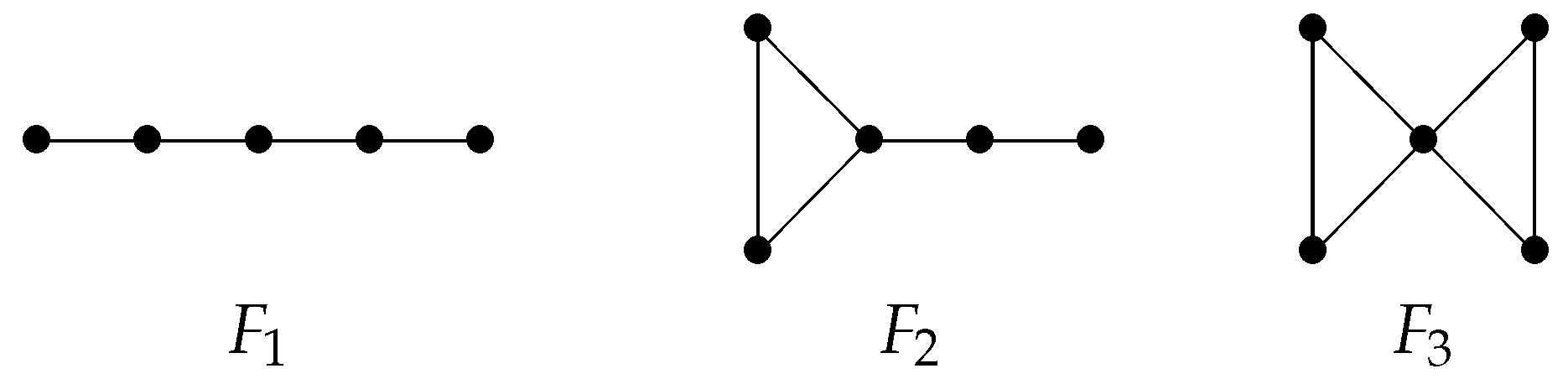
. If and if none of the three graphs , , and depicted in Figure 1 are induced subgraphs of G, then . 3. Bounds of of Graphs
In this section, we find bounds of the spectral radius of generalizes reciprocal distance matrix in terms of parameters associated with the structure of the graph.
Let be the n-dimensional vector of ones.
Theorem 1. Let G be a graph with reciprocal distance degree sequence . ThenThe equality holds if and only if G is a reciprocal distance degree regular graph. Proof. Let
be the unit positive Perron eigenvector of
corresponding to
. We take the unit vector
. Then, we have
Since
, we obtain
Now, assume that the equality holds. By Equation (
2), we have that
is the positive eigenvector corresponding to
. From
, we obtain that
, for
. Therefore, graph
G is a reciprocal distance degree regular graph.
Conversely, if
G is a reciprocal distance degree regular graph, then
. From Lemma 2,
. So
The equality holds. □
Theorem 2. Let G be a graph with reciprocal distance degree sequence and second reciprocal distance degree sequence . ThenThe equality holds if and only if G is a pseudo reciprocal distance degree regular graph. Proof. Using , the proof is similar to Theorem 1. □
Remark 1. The lower bound given in Theorem 2 improves the bound given in Theorem 1, and the bound given in Theorem 1 improves the bound given in Lemma 3.
In fact, from Lemma 1, we have By Cauchy–Schwarz inequality Moreover, we recall that, . Thus Theorem 3. Let G be a graph with reciprocal distance degree sequence and second reciprocal distance degree sequence . Then Proof. Let
. Then
, and the row sum of
should be
Hence,
Now, let
be the unit Perron vector corresponding to
. Clearly,
and
. By Lemma 4, we have
□
Theorem 4. Let G be a graph with n vertices, and be the maximum reciprocal distance degree and the maximum second reciprocal distance degree of G, respectively. ThenThe equality holds if and only if G is a reciprocal distance degree regular graph. Proof. Since
, it can be obtained by simple calculation
For any vertex , when the inequality is equal, , . That is, G is a reciprocal distance degree regular graph.
On the contrary, when G is a reciprocal distance degree regular graph, the inequality is equal. □
Theorem 5. Let G be a graph with n vertices, and be the minimum reciprocal distance degree and the minmum second reciprocal distance degree of G, respectively. ThenThe equality holds if and only if G is a reciprocal distance degree regular graph. Proof. The method is the same as Theorem 4. □
Theorem 6. Let G be a graph with reciprocal distance degree sequence and second reciprocal distance degree sequence . ThenThe equality holds if and only if G is a reciprocal distance degree regular graph. Proof. Let be the eigenvector corresponding to the eigenvalue of the matrix , , .
Through simple calculation, the value of the
-th element of
is
Because
row
s and
t in Equation (
4) are
After shifting the item of Equations (
5) and (
6), we can get
Multiply Equation (
7) and (
8) to simplify
. Then
Suppose
G is a
k-reciprocal distance regular graph,
. According to Lemma 2,
, so Equation (
3) holds. On the contrary, if inequality (
3) is equal,
can be obtained from (
7) and (
8), that is,
, which means that
G is a reciprocal distance degree regular graph. □
Theorem 7. Let G be a graph with reciprocal distance degree sequence and second reciprocal distance degree sequence . ThenThe equality holds if and only if G is a reciprocal distance degree regular graph. Proof. The method is the same as Theorem 6. □
Theorem 8. Let G be a graph of order n and , thenThe equality holds if and only if . Proof. We recall that
, and
. Clearly,
By Lemma 8,
with equality holds if and only if
The upper bound (
9) is equivalent to
with the necessary and sufficient condition for the equality given in (
10).
Now, suppose that the equality holds. Therefore, the equality condition for (
11) can be given in (
10), and we obtain that
G has only two distinct generalized reciprocal distance eigenvalues. Hence, from Lemma 7,
.
Conversely, from Lemma 7 the generalized reciprocal distance eigenvalues of are and , for . Then, the equality holds. □