1. Introduction
The trending time-varying time series models have gained a lot of attention during the last three decades because they are increasingly used to observe changes in their dynamic structure, which have been applied to economics and finance [
1,
2]. When the time span of interest covers different economic periods, the parameters of the corresponding statistical models should be allowed to change with time; see references [
3,
4,
5,
6,
7], among others. Varying coefficient models are flexible models for describing the dynamic structure of data, which have been extensively studied based on mean regression, for example, references [
8,
9,
10,
11,
12], among others and the references therein. However, the important features of the joint distribution of the response and the covariates can not be well captured by mean regression.
In this paper, we consider the time-varying coefficient quantile regression models: the conditional
th quantile of
given
and a prespecified quantile
,
where
,
are responses,
is a
p-dimensional vector of unspecified functions defined on
,
are
p-dimensional explanatory variables. We can write Equation (
1) in the form
where the errors
satisfy
almost surely. Quantile regression has also been emerged as an essential statistical tool in many scientific fields; see [
13]. To simplify notations, we omit the subscript
from the function
and
subsequently.
To estimate the varying coefficients in quantile regression models in Equation (
2), references [
7,
14,
15] used the kernel method, and references [
16,
17] considered regression splines. To our knowledge, wavelet has not been considered in quantile regression with varying coefficients. Wavelet techniques can detect and represent localized features and can also create localized features on synthesis while being efficient in terms of computational speed and storage. It has received much attention from mathematicians, engineers and statisticians. Wavelet has been introduced for nonparametric regression, for example, references [
18,
19,
20,
21,
22], and so on. For wavelet smoothing applied to nonparametric models, reference [
18] is a key reference that introduces wavelet versions of some classical kernel and orthogonal series estimators and studies their asymptotic properties. Reference [
23] provided asymptotic bias and variance of a wavelet estimator for a regression function under a stochastic mixing process. Reference [
24] considered a wavelet estimator for the mean regression function with strong mixing errors and investigated their asymptotic rates of convergence by using the thresholding of the empirical wavelet coefficients. References [
25,
26] showed Berry–Esseen-type bounds on wavelet estimators for semiparametric models under dependent errors. For varying coefficient models, references [
27,
28] provided wavelet estimation and studied convergence rate and asymptotic normality under i.i.d. errors, and reference [
29] discussed these asymptotics of the wavelet estimators based on censored dependent data. However, all of the above wavelet estimators are based on mean regression by the least-squares method.
In the paper, we propose a quantile-wavelet method for time-varying coefficient models in Equation (
2) with an
-mixing errors stochastic process. The proposed methodology is quite general in the sense that we do not require coefficient
to be smooth curves of a common degree, it does not suffer from the curse of dimensionality, it is robust to outlier or heavy-tailed data, and it is a dynamic model for nonlinear time series. Bahadur representation, rate of convergence and asymptotic normality of quantile-wavelet estimators will be established. Bahadur representation theory seeks to approximate a statistical estimate by a sum of variables with a higher-order remained. It has been a major statistical theory issue since Bahadur’s pioneering work on quantiles [
30]; see [
31], among others. Recently, reference [
32] investigated the Bahadur representation for sample quantiles under
-mixing sequence; reference [
33] gave an
M-estimation for time-varying coefficient models with
-mixing errors and established Bahadur representation in probability. In the paper, we will establish Bahadur representation with probability 1 (almost surely) for quantile-wavelet estimates in the models Equations (
1) and (
2).
Throughout, we assume that
is a stationary
-mixing sequence. Recall that a sequence
is said to be
-mixing (or strong mixing) if the mixing coefficients
converge to zero as
, where
denotes the
-field generated by
. We refer to the monograph of [
34,
35] for some properties or more mixing conditions.
The rest of this article is organized as follows. In
Section 2, we present wavelet kernel and quantile-wavelet estimation for the model (
2). Bahadur representation of quantile-wavelet estimators and their applications are given in
Section 3. Technical proofs are provided in
Section 4. Some simulation studies are conducted in
Section 5.
2. Quantile-Wavelet Estimation
In the paper, the time-varying coefficient function is retrieved by a wavelet-based reproducing kernel Hilbert space (RKHS). An RKHS is a Hilbert space in which all the point evaluations are bounded linear functions. Let
be a Hilbert space of functions on some domain
. For
, then there exists an element
, such that
where
is the inner product in
. Set
, which is called the reproducing kernel. Let
, and then
.
A multiresolution analysis is a sequence of closed subspaces
in
such that they lie in a containment hierarchy,
where
is the collection of square-integrable functions over the real line. The hierarchy Equation (
3) is constructed such that (i)
V-spaces are self-similar,
, and (ii) there exists a scaling function
whose integer-translate
, and for which the set
is an orthonormal basis. Wavelet analysis requires a description of two related and suitably chosen orthonormal basic functions: the scaling function
and the wavelet
. A wavelet system is generated by dilation and translation of
and
through
Therefore,
and
are the orthogonal bases of
and
, respectively. From Moore-Aronszajn’s theorem [
36], it follows that
is a reproducing kernel of
. By self-similarity of multiresolution subspaces,
is a reproducing kernel of
, and then the projection of
g on the space
is given by
It motivates us to define a quantile-wavelet estimator of
by
where
with
called the loss (“check”) function,
is the indicator function of any set
B, and
are intervals that partition [0, 1], so that
. One way of defining the intervals
is by taking
,
, and
,
.
Note that many other nonparametric methods can be used here, including spline and Kernel approaches. However, they might not be rich enough to characterize the local properties of the time-varying coefficient function. In the following section, we will present the asymptotic properties of the quantile-wavelet estimator Equation (
4).
3. Bahadur Representation and Its Applications
Let be the collection of all functions on with order in Sobolev space, which is a very general space. The degree of smoothness of the true coefficient functions determines how well the functions can be approximated. Functions belonging to for are not continuously differentiable. It is worth stressing that the wavelet approach allows us to obtain rates under much weaker assumptions than second-order differentiability. Denote ; is the norm, and C is used to denote positive constants whose values are unimportant and may change from line to line in the proof.
Our main results will be established under the following assumptions.
(A1.) (i) is a stationary -mixing sequence with with , , where d is defined in (A7)(i); (ii) the noisy errors has almost surely, and a continuous, positive conditional density in a neighborhood of 0 given the , , and , a.s.; (iii) , are non-singular matrices.
(A2.) belongs to Sobolev space with order .
(A3.) satisfies the Lipschitz of the order condition of order .
(A4.) has compact support, is in the Schwarz space with order , and satisfies the Lipschitz condition with order l. Furthermore, as , where is the Fourier transform of .
(A5.) .
(
A6.) We also assume that for some Lipschitz function
,
(A7.) The tuning parameter m satisfies (i) with ; (ii) let and for , for . Assume that .
Remark 1. These conditions are mild. Condition (A1) is the standard requirement for moments and the mixing coefficient for an α-mixing time series. Conditions (A2)–(A6) are the mild regularity conditions for wavelet smoothing, which have been adopted by [18]. In condition (A7), m acts as a tuning parameter, such as the bandwidth does for standard kernel smoothers; (A7) (i) is for Bahadur representation and rate of convergence, and (A7) (ii) combining with (A7) (i) is for asymptotic normality of the quantile-wavelet estimator. Our results are as follows.
Theorem 1. (Bahadur representation) Support that (A1)–(A5) and (A7) (i) hold, thenwithand Remark 2. Theorem 1 presents the strong Bahadur representation of a quantile-wavelet estimator for a time-varying coefficient model. Here, , a.s., which is comparable with the Bahadur order , of [37], where the bandwidth . Reference [37] is based on kernel local polynomial M-estimation, and requires that the function has the second-order differentiability. However, we do not need the strong, smooth conditions. The function is not differentiable when , . The Bahadur representation of the quantile-wavelet estimator of Theorem 1 can be applied to obtain the following two results.
Corollary 1. (Rate of uniform strong convergence) Assume that (A1)–(A5) and (A7) (i) hold, then Remark 3. Corollary 1 provides the rate of uniform strong convergence of quantile-wavelet estimator for model Equation (2). We consider the rate in the case of , under which is a lower rate of convergence than one of . If we take with , then . If we further take , then one obtainswhich is comparable with the optimal convergence rate of the nonparametric estimation in nonparametric models. The result is better than the ones of [27,28] based on the local linear estimator for the varying-coefficient model. In addition, we also do not require the unknown coefficient to be smooth curves of a common degree. Corollary 2. (Asymptotic normality) Support that (A1)–(A7) holds, thenwhere with and . Remark 4. To obtain an asymptotic expansion of the variance and an asymptotic normality, we need to consider an approximation to based on its values at dyadic points of order m, as reference [18] has done. The is the piecewise-constant approximation of at resolution , which can avoid the instability of the variance of . From the proof of Corollary 2, it can see that the main term of the variance of is with and . When the dyadic t and m sufficiently large, , the variance of is asymptotically stable. See [18] for the details. 4. Lemmas and Proofs
Lemma 1 ([
18,
38])
. Suppose that (A4) holds. We have(i) and , where k is a positive integer and is a constant depending on k only.
(ii) .
(iii) , where c is a positive constant.
(iv) uniformly in , as .
Lemma 2 ([
18])
. Suppose that (A4)–(A5) hold and satisfies (A2)–(A3). Thenwhere Lemma 3 ([
39])
. Let be a sequence of random convex functions defined on a convex, open subset Θ
of . Suppose is a real-valued function on Θ
for which with probability 1, for each fixed θ
in Θ.
Then for each compact subset K of Θ,
with probability 1, Lemma 4. Let be a stationary sequence satisfying the mixing condition for some , ; and with . Further, assume that . If Conditions (A4) and (A5) hold. Then Remark 5. In Lemma 4, we assume that is a sequence of a 1-dimensional random variable. In fact, for the fixed p, we also have the same result as Lemma 4.
Proof. The theorem is similar to Lemma A.4 in [
29] but has some differences. We suppose
. If
, the method of the proof is the same. Let
. Partition the interval [0, 1] into
subintervals
of equal length. Let
be the centers of
. Notice that
Let
, and take
for some
. Note that
By the Borel–Cantelli lemma,
, a.s., for sufficiently large
i. Hence,
for all sufficiently large
n. In addition,
From Equations (
7) and (
8), we respectively have
Let
. Note that
. By Theorem 2.18 (ii) in Fan and Yao (2003) [
35], take
, for any
and sufficiently large M, for each
, we have
where
,
,
Taking
, we obtain
. Assume
,
. We have
since we have
when
and
are small enough with
. By the Borel–Cantelli Lemma and Equation (
10), we prove Lemma 4. □
Lemma 5. Under conditions in Theorem 1, we havewhere . Proof. Let
. By Lemmas 2 and 4, we have
This completes the proof of Lemma 5. □
Lemma 6. Under conditions in Theorem 1, for fixed , we haveandwhere is defined by (18) in the proof of Theorem 1. Proof. For Equation (
12), by Condition (A1) (iii) and Lemma 4, one obtains
Note that
. Thus, Equation (
12) holds.
Now, let us prove Equation (
13). Notice that, for any
,
where
, and
with
. Let
. To prove Equation (
13), we only need to show that
by the proof of Lemma 4. By Equation (
15) and Jensen’s inequality, one obtains
By Lemma 4, we obtain Equation (
13).
In the sequence, we will give the proofs of the main results. □
Proof of Theorem 1. Recall that
and
minimize
Let
and
. The behavior of
follows from consideration of the objective function
The function
is obviously convex and is minimized at
. It is sufficient to show that
converges to its expectation since it follows from Lemma 3 that the convergence is also uniform on any compact set
K of
. Using the identity of [
40],
where
; we may write
where
with
.
To obtain strong Bahadur representation of the quantile-wavelet estimator, we first need to show the uniform approximation of
on
with probability 1 for the fixed
by the three terms in Equation (
16). By Lemma 6, we have
uniformly on
. Let
. We have
Second, the strong Bahadur representation requires the existence of one compact subset
K with probability measure 1 that will suffice for all
. We prove it by applying a stronger convexity lemma (See Lemma 3) than one of [
41]. However, the arguments to prove it are essentially the same as in [
41].
Let
. It is easy to see that
has a bounded second moment and hence is stochastically bounded. Since the convex function
converges with probability 1 to the convex function
, it follows from the convexity Lemma 3 that for any compact subset
,
The argument will be complete if we can show for each
that, with probability 1,
Because
is almost surely converged by Lemmas 4 and 5, it is bounded with probability 1. The compact subset
K can be chosen to contain
, a closed ball with center
and radius
, thereby implying that
Now, we consider the behavior of
outside
K. For any
, with
and
a unit vector. Define
as the boundary point of
that lies on the line segment form
to
, that is,
. Convexity of
and the definition of
imply
The last expression does not depend on
. It follows that
As
is positively defined, then according to (
21), with probability 1,
for enough
n. This implies that for any
and for large enough
n, the minimum of
must be achieved with
, i.e.,
, that is,
We complete the proof of Theorem 1. □
Proof of Corollary 1. From Theorem 1, and Lemmas 4 and 5, it is easy to obtain the result of Corollary 1. □
Proof of Corollary 2. From Theorem 1 and Lemma 5, we only verify the asymptotic normality of
□
First, we compute its variance-covariance matrix. Let
. We know
. Let
and
with
specified later. We have
For
, by Theorem 3.3 and Lemma 6.1 in [
18], one obtains
For
, since
, take
such that
. Let
be the
th component of
. By Lemma 1, we have
For
, let
be the
th component of
. Noting that
, by Proposition 2.5 (i) in [
35], we have
From Equations (
22)–(
25), we obtain
Similar to the proof of Theorem 2 in [
42], by using the small-block and large-block technique and the Cramér–Wold device, one can show that
This, in conjunction with Theorem 1 and the Slutsky Theorem, proves Corollary 2.
5. Simulation Study
To explore the numerical performances of quantile wavelet estimation, we compare our estimator with a local linear kernel [
43] and Spline [
44] by quantile regression. We call them QR-Wavelet, QR-Local-linear and QR-Spline methods, respectively. In the simulation study, our goal is to show that the QR-wavelet is robust to heavy-tailed data and more adaptive to a nonsmooth nonparametric function than local linear and spline methodologies. The data are of the form:
where
are random design points generated from the normal distribution
independently, and
with
F being the distribution function of
. Here,
is subtracted from
to make the
th quantile
zero for identifiability.
We set , 300 and 500; , 0.25, 0.50, 0.75 and 0.90; comes from the normal distribution with and the t distribution with d degrees of freedom (denoted as ) with , respectively. We consider two special curves of for as follows:
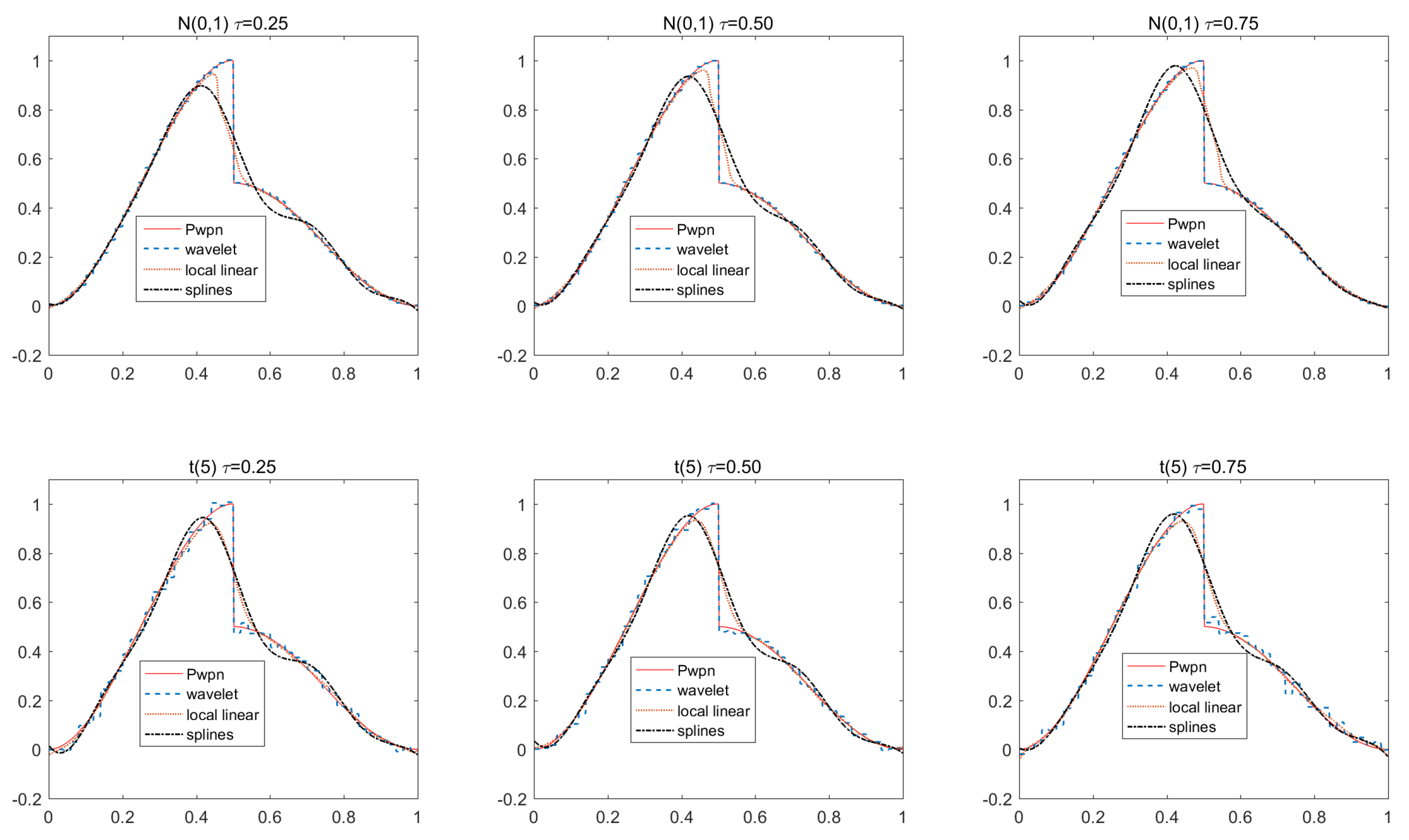
Case 1. Pwpn (piecewise polynomial function): . The function is generally smooth except for a jump at .
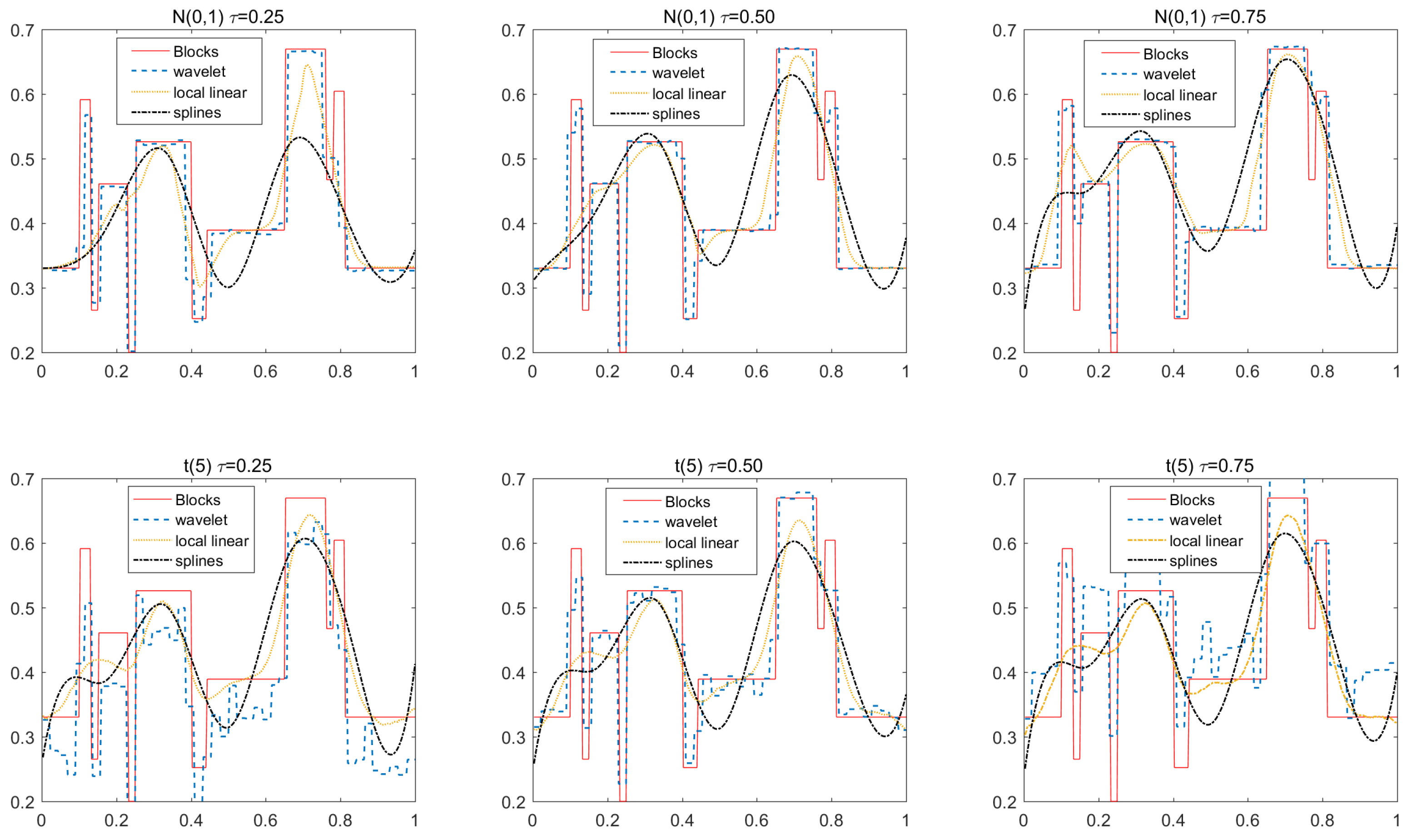
Case 2. Blocks: , where with . It is a step function with many jumps. Many jumps bring difficulties for the local linear and spline smoothing methods.
Pwpn and Blocks are shown in
Figure 1 and
Figure 2, respectively. In the study, we use the Haar wavelet, which is the simplest of the wavelets. For a given sample size, take
in the QR-wavelet,
h is chosen by “leave-one-out" cross-validation procedures and use the Gaussian kernel
in the QR-local-linear. In the QR-splines, we use three degrees of the piecewise polynomial (cubic splines) and the knots
. The performances of the estimators are evaluated via the mean square error (MSE) based on the 200 repetitions, which is defined by
where
is a sequence of regular grid points. These results of MSE for
are listed in
Table 1 for Case I (Pwpn) and
Table 2 for Case II (Blocks). The actual functions and their estimated curves for the two cases are depicted in
Figure 1 and
Figure 2 when
, and
, 0.5 and 0.75, respectively.
From
Table 1 and
Table 2, we can make the following observations: (i) The MSEs of each time-varying coefficient
obtained by wavelet, local linear and spline techniques decrease with increasing the sample size
n. The accuracy of QR-wavelet is obviously higher than that of QR-local linear and QR-splines. (ii) All QR methods work well when the random error comes from the
t distribution with five freedoms; that is, QR is robust to heavy-tailed data. Based on MSE only, for Pwpn that is generally smooth except for a jump, all three methods perform almost equally well, but for Blocks with many jumps, the QR-wavelet performs better than QR-local linear and QR-splines. (iii) All three methods perform well for different quantile levels, especially for high and low quantile levels (
(high),
(low)). We also conducted some experiments based on the above setting by using least square estimation, and found that their estimators lead to systematic bias, especially at high and low quantile levels. However, QR-wavelet generally performs better than QR-local linear and QR-splines at these extreme quantile levels when there is a large sample size (e.g.,
) and multiple jump points (e.g., Blocks). From
Figure 1 and
Figure 2, the estimators based on QR-local-linear and QR-splines are not better than those of QR-wavelet. For example, in Pwpn, QR-local linear and QR-splines cannot characterize the shape of the function in the interval
; in Blocks, they cannot find their jumping points, while QR-wavelet detects these jumping points and represents the localized features of Pwpn and Blocks as a whole. Compared with the local linear and spline methods, the wavelet technique has great advantages in characterizing the local features of underlying curves. Therefore, the QR-wavelet overwhelmingly outperforms the QR-local-linear and QR-splines for the discontinuous/irregular functional coefficients in our time-varying coefficient models.