


Abstract
Drought and flood disasters are common events threatening the safety of human lives, and full-time water conservancy emergency rescue teams play an important role in fighting against these disasters. In this paper, a competency assessment indicator system full-time water conservancy emergency rescue teams was first constructed by the Delphi Method. Four first-level, seventeen second-level and sixty third-level competency assessment indicators are proposed. Secondly, the weights of assessment indicators for a full-time water conservancy emergency rescue team at all levels were obtained by an analytic hierarchy process. Thirdly, based on that established assessment indicator system, the competency of the water conservancy emergency rescue team in Province A was assessed using a fuzzy comprehensive evaluation. Finally, the assessment results for the full-time water conservancy emergency rescue team in Province A were obtained. This study concludes by noting some practical implications of the results.
Keywords:
full-time water conservancy emergency rescue team; assessment indicator system; analytic hierarchy process; fuzzy comprehensive evaluation; emergency management MSC:
90-08; 90B50
1. Introduction
In the process of further promoting the emergency management of water availability, China still faces certain problems. Natural risks such as floods have increased, prevention and control have become more difficult, and emergencies are prone to occur. The COVID-19 epidemic and the “July 20” Catastrophic Rainstorm Disaster in Zhengzhou, Henan Province in 2021 are examples of this. Therefore, as the final barrier to for preventing and controlling major risks, emergency rescue is of great importance to resist disasters, reduce losses and protect lives. China’s emergency rescue teams are mainly composed of full-time, military and part-time emergency rescue teams [1,2]. Among these, full-time emergency rescue teams, including comprehensive fire rescue teams and various professional emergency rescue teams, are responsible for risk prevention, response and emergency rescue during various natural disasters and accidents [3]. The full-time water conservancy emergency rescue team is one of the key forces in charge of flood and drought control.
In recent years, several studies on the construction and management of full-time emergency rescue teams and the optimization of competency systems have emerged [4,5,6]. Scholars have been looking for new perspectives in the study and discussion of the organizational competency of full-time emergency rescue teams [7,8], including mine rescue [9], coal mine rescue [10,11] and emergency healthcare teams [12]. Other scholars have studied the organizational competency of emergency rescue teams in the face of highly uncertain, complex and dynamic crisis emergencies, by tracking and comparing the behaviors and characteristics of high-performance teams and low-performance teams during different stages of emergency management [13]. In the process of emergency rescue, the connection between each link and the deployment of various elements should be managed and promoted by full-time rescue teams, including the formulation, promotion and implementation of rescue plans and regulations, as well as the reasonable operation of rescue materials and information [14], covering all periods of rescue [15]. Therefore, the state needs to continuously improve emergency management forces at different levels, promote the adjustment of institutional functions, and strengthen the comprehensive coordination of emergency management [16]. Meanwhile, rescue teams need to select optimal rescue schemes according to the emergency rescue time [17], their own competency [17,18], available resources and other conditions [19,20]. Therefore, attention should be paid to the training of emergency personnel; at the same time, the emergency abilities and technical proficiency of all kinds of emergency personnel need to be further improved [21].
Methods of emergency rescue measures and competency assessments include the analytic hierarchy process (AHP) [22,23], fuzzy comprehensive evaluation [24,25], TOPSIS comprehensive evaluation [9,26], the catastrophe progression method [27], cloud model [28], multiple correspondence analysis [29], etc. Among these, AHP and fuzzy comprehensive evaluation have been used to study emergency rescue in more detail. For example, Zhang et al. [30] used AHP and fuzzy comprehensive evaluation to establish an assessment indicator system of emergency plans for business production safety accidents. Jing et al. [31] used AHP and fuzzy comprehensive evaluation to build a competency model of railway earthquake emergency rescue personnel. Ruan et al. [32] used fuzzy comprehensive evaluation to calculate subjective indicator scores, and AHP to estimate weight distribution, in the process of establishing a comprehensive assessment indicator system for the containment rescue measures of the national nuclear emergency engineering rescue team. The combination of these two methods [33] makes the results more accurate, because a single assessment method often cannot obtain accurate assessment results [34]. It also makes the system stronger and can better solve fuzzy and unquantifiable problems.
The full-time water conservancy emergency rescue team in Province A has gradually improved, but there are still some problems. For example, in the preparation process, material reserves have been insufficient; in the response process, the team is not efficient; in the execution process, command and coordination need to be enhanced. However, there is no suitable system or model to clarify these issues. Although scholars have made many contributions to emergency rescues, there are still two problems that need to be handled:
- (1)
- There is a lack of research on the competency of full-time water conservancy emergency rescue teams. Scholars have studied fire [35,36,37], safety accidents [28,30] and other emergencies. Considering the special nature of water conservancy, including factors such as seasonality and continuity, research on the competency of full-time water conservancy emergency rescue teams is very important.
- (2)
- There is a lack of research on the construction of an assessment indicator system using a life-cycle approach. The life-cycle approach is a crisis management theory based on four stages of a process, and it is conducive to the management and control of a whole event [38]. However, most studies have been based on relevant documents [24,30], event characteristics [22], expert opinions [7,25], etc. Due to the lack of theoretical basis, systematization and scientificity need to be improved. Therefore, it is necessary to construct an assessment indicator system from the perspective of a life-cycle approach.
Motivated by the above problems, this study first constructed a competency assessment indicator system for a full-time water conservancy emergency rescue team using the Delphi Method. Then, we obtained the weights of assessment indicators using AHP and constructed a competency assessment model with fuzzy comprehensive evaluation. Finally, we applied the constructed assessment model to Province A to test the practical value of the model, and to identify practical implications according to the competency assessment results of the full-time water conservancy emergency rescue team in Province A.
The remainder of this study is organized as follows. Section 2 introduces the Delphi method as well as AHP, and puts them into practice to construct the competency assessment indicator system for a full-time water conservancy emergency rescue team, and to obtain the weights of evaluation indicators. Section 3 presents comprehensive evaluation results obtained through a constructed competency evaluation model of a full-time water conservancy emergency rescue team, using fuzzy comprehensive evaluation. Section 4 discusses the practical implications of this. Section 5 summarizes the main work and contributions of this paper.
2. Methods
In this section, the Delphi method and AHP are introduced. The fuzzy comprehensive evaluation results for a full-time water conservancy emergency rescue team are presented in Section 3.
2.1. Delphi Method
The Delphi method is a collective, anonymous exchange of ideas in the form of a correspondence consultation [39]. Based on the life-cycle approach and organizational competency theory, through two rounds of expert feedback using the Delphi method, this study obtained an assessment indicators database applicable to a full-time water conservancy emergency rescue team, and then constructed the competency assessment indicator system.
According to the principles of “strategic orientation with clear goals”, “prominent emphasis and overall consideration”, “emphasis on operation and strong applicability “, and “normative system and moderately advanced indicators” [40,41], the content analysis method was applied to select relevant competency assessment indicators. The steps for selecting competency assessment indicators were as follows:
- (1)
- Framing the research question: The research question concerned the construction of the competency assessment indicator system for a full-time water conservancy emergency rescue team.
- (2)
- Determining the scope of the research and samples: Specifically, references were selected from the full-text database of the China Academic Journals Network (CNKI), and the research period lasted until 10 April 2022. Overall, 171 relevant pieces of the literatures were selected.
- (3)
- Defining the analysis unit of the study: The analysis unit of the study was full-time emergency rescue water conservancy teams.
- (4)
- Constructing categories of competency assessment indicators and a quantitative system: Specific category standards were determined according to expert interviews, and each category item was coded.
- (5)
- Pretesting: Reliability was verified and content was encoded according to the definition. In the process of sample testing, “1” was denoted when the two coders had the same views; if they were inconsistent, they were denoted as “0”. If the consistency ratio reached over 80%, it was considered that the reliability analysis for this process had been passed. After calculation, the coders’ consistency ratio reached 95.5%, indicating that the coding process passed the reliability test.
- (6)
- Data analysis: According to organizational competency theory, through the study of the available literature, competency assessment indicators that are comprehensive, obvious, easy to measure, easy to examine and applicable were sorted. The assessment indicators can objectively and accurately reflect the reality and characteristics of full-time water conservancy emergency rescue teams.
Seventy-two competency assessment indicators of full-time water conservancy emergency rescue teams were determined after preliminary selection. These were as follows: preplan compiling, completeness of emergency plan, operation of emergency plan, risk assessment ability, laws and regulations, team-building, job qualifications, staff number, cooperation with other teams, material reserves, number/category/specification, equipment maintenance, simple equipment production, equipment procurement, training and development, physical fitness, technical knowledge, teamwork ability, research learning, amount of research, time of research, new knowledge/new methods, crisis consciousness, information acquisition ability, information access, information transfer mode, daily monitoring ability, special period search ability, task-switching ability, task-recognition ability, material equipment ability, team-building ability, goods loading time, quick delivery ability, quick configuration and startup ability, route-planning ability, time-control ability, delivery-support ability (traffic control department), parallel disposal ability, communication ability (on-site), coordinating-routes ability, technical guidance, envision-solution ability, professional technical ability, plan execution, man-machine cooperation ability, equipment start-up time, safe operation, field-warning ability, organizational motivation ability (leadership), strain ability, vigilance ability, personnel and material allocation ability, team motivation, command and coordination ability, professional advice, decision-making ability, organizing ability, comprehensive support ability, logistics ability, emergency material preparation ability (electric power), emergency shelter, emergency communication equipment, publicity ability, restoring-order ability, safe evacuation, functional recovery ability of equipment, summarizing-learning ability, post-emergency assessment ability, learning-improvement ability, summarizing learning procedures, and plan-revision ability.
Then, we invited fifteen experts from the water conservancy industry and emergency management field to form a team to use the Delphi Method. The composition of these experts is shown in Table A1 (see the Appendix A). The preliminary selected competency assessment indicator tables for the full-time water conservancy emergency rescue team were sent to all experts in the form of a letter. Then, the experts revised the assessment indicators according to their professional knowledge and work experience [39].
According to the analyzed literature mentioned above, a semi-open questionnaire was created focusing on capacity assessment indicators for full-time water conservancy emergency rescue teams. The feedback results from fifteen experts in the first round are shown in Table A2 (see the Appendix A). In Table A2, “1” and “7” mean “strongly disagree” and “strongly agree”, respectively, with the degree of agreement increasing between these.
The experts completed fifteen valid questionnaires in the first round. According to the results, the average scores of all assessment indicators were more than 4.5 points and assessment indicators such as scientificity of emergency plans, emergency rescue experience and professional level (dress, technical knowledge) were added. Three assessment indicators including “risk assessment ability”, “technical knowledge” and “time control ability” were deleted. In addition, suggestions regarding modifying the names of certain assessment indicators are shown in Table A2.
In the first round, seven assessment indicators were added, and thirty-five assessment indicators were modified. More than two-thirds of the experts agreed. However, some experts were not satisfied with certain assessment indicators. Therefore, according to the feedback provided by the experts in the first round, the second-round semi-open questionnaire was created. Then, the questionnaires were sent to fifteen experts by e-mail, as agreed, and experts were invited to unify the names of assessment indicators. Experts revised the assessment indicators again according to their professional knowledge and work experience, and the expert feedback is shown in Table A3 (see the Appendix A).
In the second round, experts changed the names of some assessment indicators, added nine assessment indicators regarding funds and systems, and deleted “legal compliance of emergency plan”. Meanwhile, “prototype equipment design ability” and “simple equipment production” were merged into “design and production”.
After two rounds of Delphi Method feedback, the competency assessment indicator database for full-time water conservancy emergency rescue teams was formed. Then, the final seventy-seven assessment indicators were processed by stratification, and the second- and third-level assessment indicators of the competency assessment indicator system were determined. Then, according to the life-cycle approach, the first-level assessment indicators were established for the competency assessment of water conservancy full-time emergency rescue teams; these indicators were organizational readiness competency, organizational response competency, organizational execution competency and organizational recovery competency. The first- and second-level assessment indicators are shown in Figure 1; , , and represent the first-, second- and third-level assessment indicators, respectively. Combined with the characteristics of the full-time water conservancy emergency rescue team and the requirements of emergency management construction, the competency assessment indicator system and spiral organizational competency model of the full-time water conservancy emergency rescue team were constructed, as shown in Table A4 (see the Appendix A) and Figure 2.
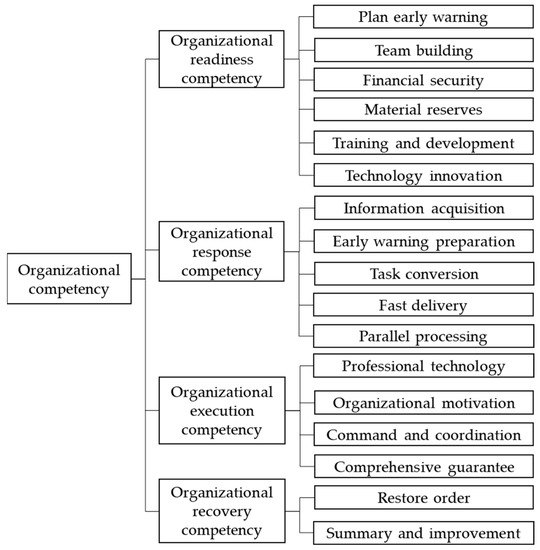
Figure 1.
First-level and second-level assessment indicators of full-time water conservancy emergency rescue teams.
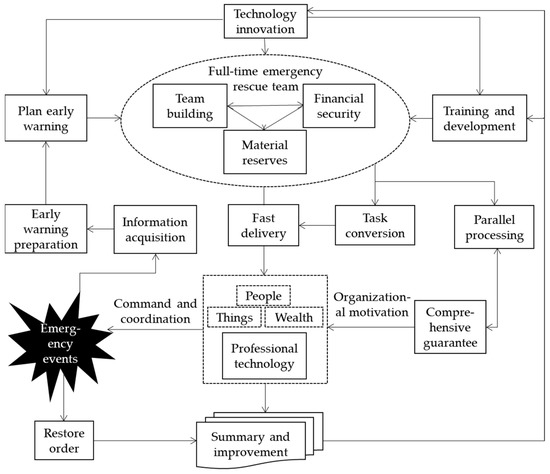
Figure 2.
Spiral organizational competency model of full-time water conservancy emergency rescue teams.
Then, according to the constructed assessment indicator system, using AHP we calculated the weights of the evaluation indicators for a full-time water conservancy emergency rescue team.
2.2. Analytic Hierarchy Process
AHP is a method for decomposing the factors related to decision-making into levels of objectives, criteria, schemes, etc., and analyzing them layer by layer on this basis [42,43]. In this part of the study, AHP was used to obtain the weights of assessment indicators for a competency assessment indicator system.
- (1)
- Determining the weights of expertise.
Due to differences in the ability and understanding of the experts, as well as their status and identity, the weighting of their expertise was set differently [44]. Various factors that can influence the weight of expertise, such as experts’ social network, educational background, time spent working, etc. [45,46,47,48]. Referring to Wang et al. [47], Han et al. [46], and Zhang et al. [45], five criteria were selected in this paper to determine the weighting of expertise; the five criteria were professional title, educational background, scientific research achievements, professional relevance and working time. In the future, it will be interesting to utilize other approaches to determine the weighting of expertise.
Let represent expert m: , , , and represent the assessment values of the professional title, educational background, scientific research achievements, professional relevance and working time of expert m, respectively. represents the assessment value for the five criteria of expert m; represents the weight coefficients of different criteria; represents the number of experts; represents the weighting of expert m.
Then, is given by the following:
In this study, we assumed that = 0.1, = 0.1, = 0.5, = 0.2, and = 0.1. Then, we invited four emergency center experts and three professors of Hohai University. The information about the experts is shown in Table A5 (see the Appendix A). Based on the expert information regarding five criteria, we determined the weighting of the experts. According to the Equations (1) and (2), the weightings of the seven experts were 0.148, 0.136, 0.137, 0.142, 0.148, 0.146, 0.143 respectively.
- (2)
- Determining the weights of assessment indicators.
The judgment matrix is the matrix form of expert assessment [49]. To determine the weights of assessment indicators using AHP, the judgment matrix was constructed by comparing the importance of assessment indicators in pairs [50]. The relative importance of each assessment indicator was quantified using a certain digital scale [51].
In the judgment matrix, the most common method is to use 1–9 and the reciprocal for comparison [34]. The degree of importance increases with the increase in number. A score of “1” means that the vertical indicator is equally important compared with the horizontal indicator, and “9” means that the vertical indicator is significantly more important than the horizontal indicator [52]. If the horizontal indicator is considered more important than the vertical indicator, it is marked “1/9”- “1”. The specific rules are shown in Table A6 [51] (see the Appendix A), and the judgment matrix is shown in Table A7 (see the Appendix A). The consistency ratio (CR) is often used to test the consistency of the judgment matrix [34,53]. If , the consistency is acceptable [52].
In Table A7, represents the order of the judgment matrix, represents assessment indicators, and represents the digital scale given by experts for the relative importance of assessment indicators according to the assessment rules. represents consistency index, represents the maximum eigenvalue of the judgment matrix, and represents random index [49]; can be obtained by:
Seven experts assessed the relative importance of the assessment indicators at all levels, according to the actual situation of the full-time water conservancy emergency rescue team in Province A and their own professional knowledge. Then, the judgment matrices were formed. In this study, Expert Choice 11.5 software was used to calculate the weights of the three levels of assessment indicators. After being calculated by Equations (3) and (4), the consistency test was passed. The results from one expert are shown in Table A8, Table A9 and Table A10 (see the Appendix A).
Let , and represent the weights of first-, second- and third-level assessment indicators made by the expert m, respectively. , and represent the collective weights of first-, second- and third-level assessment indicators, respectively.
According to Equations (1) and (2), is given, then , and can be calculated by the following.
According to Equations (5)–(7), the weights of first-level assessment indicators were 0.43, 0.20, 0.22 and 0.15, and the other results are shown in Table A11 (see the Appendix A).
Then, based on the weights of assessment indicators, we constructed a competency assessment model for the full-time water conservancy emergency rescue team in Province A.
3. Results
This study used fuzzy comprehensive evaluation to construct the competency assessment model for a full-time water conservancy emergency rescue team in Province A.
3.1. Background
In China, Province A is a low-lying area with poor runoff. The time distribution of precipitation is uneven, and droughts and floods occur one after another. The natural conditions highlight the special importance of water conservancy work in the economic and social development of Province A. The full-time water conservancy emergency rescue team in Province A was established in 1966, and currently there are about 90 rescue team members who can be mobilized. In accordance with the requirements of “militarization of action, specialization of technology and modernization of equipment”, the rescue team carries out practical training before the flood season every year. This rescue team plays an efficient, mobile and rapid emergency rescue role, and is the “main force” for flood-fighting and disaster rescue in Province A. Although the emergency rescue training in Province A has gradually been strengthened and the professional level of emergency rescue has gradually improved, there remain some problems. For example, in the preparation process, material reserves are insufficient; in the response process, the team is not efficient; in the execution process, command and coordination need to be enhanced. To solve these problems, it is necessary to study the competence of the full-time water conservancy emergency rescue team in Province A.
3.2. Fuzzy Comprehensive Evaluation
Fuzzy comprehensive evaluation is used for the overall evaluation of things or events that are restricted by multiple factors [54]. This method is objective, scientific, and can combine qualitative and quantitative indicators [55]. It has great advantages in dealing with problems that are fuzzy, uncertain, and difficult to quantify [56]. Thus, fuzzy comprehensive evaluation was used to reach the comprehensive assessment result. Firstly, assessment indicators’ grades were judged; then, fuzzy membership matrices were constructed, and finally, comprehensive assessment results were obtained. The concrete steps were as follows:
- (1)
- Obtaining third-level assessment indicator assessment information.
We invited the participation of four emergency center experts and three professors of Hohai University. These experts used a five-grade linguistic term to assess the full-time water conservancy emergency rescue team in Province A, provided as follows: Level I, Level II, Level III, Level IV and Level V, from low to high.
Based on materials and field investigation, experts considered the third-level assessment indicators of organizational competency of the full-time water conservancy emergency rescue team in Province A. The assessment information matrixes of the third-level assessment indicators given by the seven experts are shown in Table A12 (see the Appendix A).
- (2)
- Constructing the fuzzy membership matrix.
The percentage statistical method was applied to convert the grades assessed by experts into fuzzy membership degrees. The fuzzy membership matrix was constructed using the proportion of the number of experts rated as being at a certain level for each assessment indicator, as shown in Table A12.
Let , , , and represent fuzzy comprehensive evaluation sets of the first-, second-, third- and target levels of the assessment indicators.
Combining the weights of assessment indicators and the fuzzy membership matrix, the fuzzy comprehensive evaluation sets of the second-, first- and target levels of assessment indicator were calculated by the following:
According to Equations (8) and (9), the second-level and first-level assessment indicator information matrixes are shown in Table A13 and Table A14 (see the Appendix A). Based on the principle of maximum membership degree, the corresponding assessment grades of the largest numbers in , and were the comprehensive assessment results of the second-level assessment indicator, first-level assessment indicator and target layer.
According to Table A14 and Equation (10), the assessment information matrix of the target layer was . Therefore, the assessment grade of the full-time water conservancy emergency rescue team in Province A is level IV.
- (3)
- Obtaining comprehensive assessment results.
There are three sections of the comprehensive assessment results as follows: (1) Importance comparison of assessment indicators: The importance of each assessment indicator to the assessment object can be determined by comparing the weight, so that strategic actions can be taken or resources can be allocated. (2) Fuzzy comprehensive evaluation set analysis: Through the analysis of fuzzy comprehensive evaluation sets, the comprehensive assessment results for the competency of the full-time water conservancy emergency rescue team were obtained, reflecting the current state of the full-time water conservancy emergency rescue team. (3) Optimization measures: The reasons for the current state of the full-time emergency water conservancy rescue team were analyzed, and optimization measures were taken according to the assessment results and for internal reasons, and systematic suggestions for the modernization of emergency management were put forward.
According to the results of the membership degree, the competency of the full-time water conservancy emergency rescue team in Province A was comprehensively assessed, as shown in Figure 3.
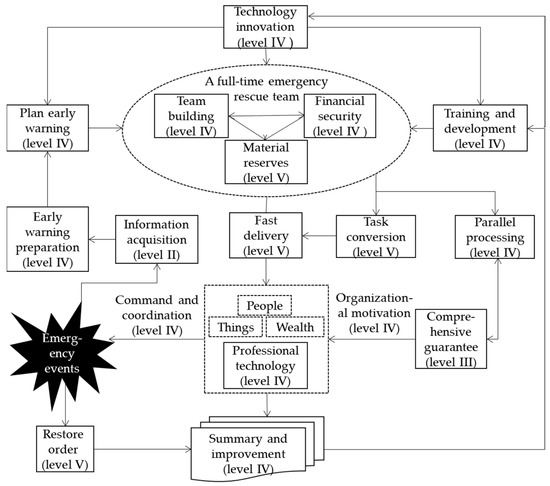
Figure 3.
Spiral organizational competency model of the full-time water conservancy emergency rescue team in Province A.
The competency of the full-time water conservancy emergency rescue team in Province A was found to be level IV overall, meaning that they are well-qualified for professional emergency rescue tasks. The organizational recovery competency shown by the first-level assessment indicators was very strong, reaching level V, and the organizational readiness, response and execution competency were all level IV, ahead of the construction requirements for emergency management. For the information acquisition relating to organizational response competency and comprehensive guarantee of organizational execution competency, the assessment results were level II and level III, respectively, revealing obvious shortcomings.
In addition, the figure shows that the full-time water conservancy emergency rescue team needs to further improve in the following aspects: training and development, technological innovation, financial security of organizational readiness competency, early warning preparation, parallel processing of organizational response competency, organizational motivation, command and coordination, comprehensive guarantee of organizational execution competency, etc.
4. Discussion
According to the competency assessment results for the full-time water conservancy emergency rescue team in Province A, we obtained the following practical implications:
- (1)
- Investigation of the construction of thewater conservancy full-time emergency rescue team. The process of the construction of a water conservancy full-time emergency rescue team requires finding the overall competency of the current team, as well as viewing the overall competency level, structure and other characteristics from different angles and levels, and then identifying the prominent problems and key tasks in the construction of water conservancy full-time emergency rescue teams, and formulating an implementation plan accordingly.
- (2)
- Improving the organizational readiness competency ofthe full-time water conservancy emergency rescue team. In accordance with the requirements of “long-term preparation, key construction”, it is necessary to focus on strengthening the basic work of emergency management, and to take precautions. First of all, the reserve management of emergency materials and equipment should be strengthened, and an emergency material support system constructed. Secondly, regular or irregular emergency drills should be carried out, including desktop drills, practical exercises and other methods to test and revise plans, and to solidify knowledge into abilities that can be called on in practice at any time. Finally, in-depth work exchanges should be carried out to promote knowledge sharing, and efforts should be made to establish a specialized, responsive and skilled full-time water conservancy emergency rescue team that is capable of preventing and managing various disasters.
- (3)
- Enhancing the response competency of thefull-time water conservancy emergency rescue team. In accordance with the principle of “rapid response and overall planning”, a peacetime and wartime conversion mechanism should be established to continuously improve the early handling capacity of the full-time water conservancy emergency rescue team. According to the emergency plan, the full-time emergency rescue team of water conservancy implements joint disposal mechanisms such as investigation, express delivery, information submission and parallel disposal, to prevent flood and drought disasters from a range of incidents, from a “grey rhino incident” to a “black swan incident”.
- (4)
- Improving the execution competency of the full-time water conservancy emergency rescue team. In accordance with the principle of “full incentives, rewards and punishments”, it is necessary to implement a suitable national wage system, offer duty and overtime subsidies, make good use of spiritual incentives, and provide timely commendations at the end of rescue and disaster relief. Additionally, sound accountability mechanisms in the process of emergency rescue should be established, and incompetent behaviors penalized according to the regulations and facts. This is especially relevant for cooperation among departments, so as to reduce the weak links in water emergency operations. A post-supervision system to ensure accountability should be set up to avoid mere formality regarding accountability.
- (5)
- Summarizing the construction of thefull-time water conservancy emergency rescue team. Following regular assessment after disaster relief, the team’s competency assessment and corresponding work should be put into practice. Problems, vulnerabilities and weaknesses existing in emergency rescue work should be quickly uncovered after the assessment of the rescue team. A rectification plan should be formed “better later than never”, and a system of rectification work should be established so that the rectification can be fully implemented.
5. Conclusions
This study puts forward a new competency assessment indicator system for a full-time water conservancy emergency rescue team using AHP. It also assesses a full-time water conservancy emergency rescue team in Province A using fuzzy comprehensive evaluation. The contributions of this paper are described as follows:
- (1)
- This study constructed a novel competency assessment indicator system for full-time water conservancy emergency rescue teams, which can promote the standardization and refinement of emergency rescue work. The full-time water conservancy emergency rescue team is the backbone force especially responsible for flood and drought control, and plays an important role in dealing with flood and drought disasters. The existing competency assessment indicator system is mainly focused on sudden emergency events and safety accidents, and there has been a lack of research on full-time water conservancy emergency rescue teams. In this paper, assessment indicators of full-time water conservancy emergency rescue teams have been further enriched and expanded.
- (2)
- This study determined competency assessment indicators of full-time water conservancy emergency rescue teams, based on a life-cycle approach, and can comprehensively and systematically reflect the rescue team both in whole and in part. The research constructed an assessment indicator system for emergency rescue based on relevant documents, emergency features and expert opinions, providing strong subjectivity and weak systematization. The life-cycle approach can provide a clear theoretical framework for the construction of an organizational competency model, starting from the four stages of crisis management. Therefore, competency assessment indicators of water conservancy emergency rescue teams were based on a life-cycle approach.
- (3)
- This paper used fuzzy comprehensive evaluation to assess the competency of a full-time water conservancy emergency rescue team, and has great advantages for dealing with the complex and unquantifiable competency assessment of the rescue team. Competency assessments of emergency rescue teams are based on precise numerical values existing research. However, the collected assessment information is often imprecise, and it is difficult for experts to assess the competency of emergency rescue teams using precise values. Fuzzy comprehensive evaluation can combine qualitative and quantitative assessment indicators, and can deal well with complex and unquantifiable problems. Therefore, fuzzy comprehensive evaluation was used to assess the competency of the full-time water conservancy emergency rescue team.
In the future, we can improve the method and conduct further research. Big data, artificial intelligence and other means can be used to determine the assessment indicators and determine the levels of assessment indicators, to improve the accuracy of competency assessments of full-time water conservancy emergency rescue teams.
Author Contributions
Conceptualization, C.F. and L.Z.; Data curation, W.W.; Funding acquisition, C.F.; Methodology, Y.C., Y.Z. and S.T.; Supervision, C.F., L.Z., W.W. and B.L.; Validation, B.L.; Visualization, L.Z.; Writing—original draft, Y.C.; Writing—review & editing, Y.Z. All authors have read and agreed to the published version of the manuscript.
Funding
This research was funded by Fundamental Research Funds for the Central Universities: B200207090 and B200207091.
Data Availability Statement
The data presented in this study are available in Appendix A.
Conflicts of Interest
The authors declare no conflict of interest.
Appendix A

Table A1.
Composition of experts.
Table A1.
Composition of experts.
| Classifications | Number | Percentage (%) |
|---|---|---|
| Male | 13 | 86.7 |
| Female | 2 | 13.3 |
| Sub-senior | 5 | 33.3 |
| Senior | 10 | 66.7 |
Table A2.
Results of the first round of questionnaires.
Table A2.
Results of the first round of questionnaires.
| No. | Indicators | Indicators’ Frequency | Indicators Modified by Experts | |||||||||
|---|---|---|---|---|---|---|---|---|---|---|---|---|
| 1 | 2 | 3 | 4 | 5 | 6 | 7 | Mean | Median | Standard Deviation | |||
| 1 | Preplan compiling | 1 | 13 | 1 | 6 | 6 | 0.37 | |||||
| 2 | Completeness of emergency plan | 1 | 1 | 12 | 1 | 5.87 | 6 | 0.62 | ||||
| 3 | Operation of emergency plan | 1 | 14 | 5.93 | 6 | 0.25 | ||||||
| 4 | Risk assessment ability | 1 | 2 | 11 | 1 | 5.8 | 6 | 0.65 | Delete | |||
| 5 | Laws and regulations | 1 | 13 | 1 | 6 | 6 | 0.37 | Legal compliance of emergency plan | ||||
| 6 | Team-building | 1 | 3 | 10 | 1 | 5.73 | 6 | 0.68 | ||||
| 7 | Job qualifications | 4 | 11 | 5.73 | 6 | 0.44 | ||||||
| 8 | Staff number | 1 | 13 | 1 | 6 | 6 | 0.37 | |||||
| 9 | Cooperation with other teams | 1 | 4 | 1 | 9 | 5.2 | 6 | 1.05 | Cooperation ability | |||
| 10 | Material reserves | 2 | 3 | 8 | 2 | 4.87 | 6 | 1.38 | ||||
| 11 | Number/Category/Specification | 3 | 1 | 11 | 5.53 | 6 | 0.81 | Prototype equipment design ability | ||||
| 12 | Equipment maintenance | 14 | 1 | 6.07 | 6 | 0.25 | ||||||
| 13 | Simple equipment production | 13 | 2 | 6.13 | 6 | 0.34 | ||||||
| 14 | Equipment procurement | 1 | 4 | 9 | 1 | 5.33 | 6 | 1.14 | Equipment purchasing suggestion ability | |||
| 15 | Training and development | 4 | 10 | 1 | 5.53 | 6 | 0.96 | |||||
| 16 | Physical fitness | 14 | 1 | 6.07 | 6 | 0.25 | Individual ability training | |||||
| 17 | Technical knowledge | 1 | 1 | 5 | 7 | 1 | 5.4 | 6 | 0.95 | Delete | ||
| 18 | Teamwork ability | 1 | 4 | 9 | 1 | 5.67 | 6 | 0.70 | Team cooperation ability training (internal cooperation) | |||
| 19 | Research learning | 4 | 1 | 8 | 2 | 5.53 | 6 | 1.02 | ||||
| 20 | Amount of research | 1 | 12 | 2 | 6.07 | 6 | 0.44 | Research ability | ||||
| 21 | Time of research | 2 | 5 | 1 | 7 | 4.87 | 5 | 1.15 | ||||
| 22 | New knowledge/new methods | 1 | 3 | 11 | 5.67 | 6 | 0.60 | Learning ability | ||||
| 23 | Crisis consciousness | 3 | 5 | 6 | 1 | 5.33 | 5 | 0.87 | Learning consciousness (crisis) | |||
| 24 | Information acquisition ability | 1 | 2 | 9 | 3 | 5.93 | 6 | 0.77 | ||||
| 25 | Information access | 1 | 2 | 12 | 5.73 | 6 | 0.57 | Information channel construction (acquisition, transmission) | ||||
| 26 | Information transfer mode | 2 | 13 | 5.87 | 6 | 0.34 | ||||||
| 27 | Daily monitoring ability | 1 | 9 | 5 | 6.27 | 6 | 0.57 | |||||
| 28 | Special period search ability | 4 | 5 | 6 | 6.13 | 6 | 0.81 | |||||
| 29 | Task-switching ability | 5 | 7 | 3 | 5.87 | 6 | 0.72 | |||||
| 30 | Task-recognition ability | 1 | 9 | 5 | 6.27 | 6 | 0.57 | |||||
| 31 | Material equipment ability | 3 | 9 | 3 | 5.67 | 6 | 0.71 | |||||
| 32 | Team-building ability | 11 | 4 | 6.27 | 6 | 0.44 | ||||||
| 33 | Goods loading time | 1 | 1 | 13 | 5.8 | 6 | 0.54 | Loading efficiency of materials | ||||
| 34 | Quick delivery ability | 3 | 9 | 3 | 6 | 6 | 0.63 | |||||
| 35 | Quick configuration and startup ability | 1 | 7 | 7 | 5.4 | 5 | 0.61 | Quick configuration and start-up ability (lifting equipment) | ||||
| 36 | Route-planning ability | 14 | 1 | 6.07 | 6 | 0.25 | ||||||
| 37 | Time-control ability | 3 | 11 | 1 | 5.87 | 6 | 0.50 | Delete | ||||
| 38 | Delivery-support ability (Traffic Control Department) | 4 | 1 | 10 | 5.41 | 6 | 0.88 | Aid access ability (Traffic Control Department) | ||||
| 39 | Parallel disposal ability | 1 | 1 | 4 | 9 | 6.4 | 6 | 0.88 | ||||
| 40 | Communication ability (on-site) | 1 | 9 | 5 | 5.27 | 5 | 0.57 | Route contingency ability, solution deducting ability, remote consulting ability | ||||
| 41 | Coordinating-routes ability | 1 | 10 | 4 | 5.2 | 5 | 0.54 | |||||
| 42 | Technical guidance | 9 | 2 | 4 | 5.07 | 4 | 0.96 | |||||
| 43 | Envision-solution ability | 5 | 4 | 6 | 5.07 | 5 | 0.85 | |||||
| 44 | Professional technical ability | 1 | 3 | 10 | 1 | 5.73 | 6 | 0.68 | ||||
| 45 | Plan execution | 3 | 12 | 5.6 | 6 | 0.80 | ||||||
| 46 | Man-machine cooperation | 4 | 11 | 5.73 | 6 | 0.44 | ||||||
| ability | ||||||||||||
| 47 | Equipment start-up time | 6 | 9 | 5.2 | 6 | 0.98 | Ability to ensure proper operation of equipment | |||||
| 48 | Safe operation | 14 | 1 | 6.07 | 6 | 0.25 | ||||||
| 49 | Field-warning ability | 1 | 12 | 2 | 6.07 | 6 | 0.44 | |||||
| 50 | Organizational motivation ability (leadership) | 1 | 11 | 3 | 6.13 | 6 | 0.50 | |||||
| 51 | Strain ability | 1 | 2 | 3 | 9 | 5.13 | 6 | 0.96 | On-site emotional management (tension, calm), boost morale (team motivation) | |||
| 52 | Vigilance ability | 1 | 2 | 6 | 6 | 5.13 | 5 | 0.88 | ||||
| 53 | Team motivation | 5 | 2 | 8 | 5.2 | 6 | 0.91 | |||||
| 54 | Personnel and material allocation ability | 2 | 4 | 9 | 5.47 | 6 | 0.72 | |||||
| 55 | Command and coordination ability | 3 | 12 | 5.8 | 6 | 0.40 | ||||||
| 56 | Professional advice | 3 | 3 | 9 | 5.4 | 6 | 0.80 | Ability to make professional decisions and recommendations | ||||
| 57 | Decision-making ability | 2 | 1 | 7 | 5 | 5 | 5 | 0.97 | ||||
| 58 | Organizing ability | 1 | 3 | 11 | 5.6 | 6 | 0.80 | Organization and execution ability (coordination command) | ||||
| 59 | Comprehensive support ability | 1 | 3 | 6 | 5 | 6 | 6 | 0.89 | ||||
| 60 | Logistics ability | 1 | 7 | 7 | 6.4 | 6 | 0.61 | |||||
| 61 | Emergency material preparation ability (electric power) | 1 | 4 | 9 | 1 | 5.67 | 6 | 0.70 | On-site emergency response ability (supplies, electricity, shelter plans, communications plans) | |||
| 62 | Emergency shelter | 1 | 9 | 5 | 5.27 | 5 | 0.57 | |||||
| 63 | Emergency communication equipment | 1 | 7 | 7 | 5.4 | 5 | 0.61 | |||||
| 64 | Publicity ability | 1 | 5 | 9 | 6.53 | 7 | 0.62 | |||||
| 65 | Restoring-order ability | 11 | 4 | 6.27 | 6 | 0.44 | ||||||
| 66 | Safe evacuation | 1 | 2 | 6 | 6 | 5.13 | 5 | 0.88 | ||||
| 67 | Functional recovery ability of equipment | 1 | 7 | 7 | 6.4 | 6 | 0.61 | |||||
| 68 | Summarizing-learning ability | 3 | 4 | 8 | 5.33 | 6 | 0.79 | |||||
| 69 | Post-emergency assessment ability | 1 | 8 | 6 | 6.33 | 6 | 0.60 | |||||
| 70 | Learning-improvement ability | 1 | 3 | 4 | 7 | 6.13 | 6 | 0.96 | Feedback ability (department, leader), plan making and implementation ability (plan, training program) | |||
| 71 | Summarizing learning procedures | 3 | 6 | 6 | 6.2 | 6 | 0.75 | |||||
| 72 | Plan-revision ability | 5 | 8 | 2 | 5.8 | 6 | 0.65 | |||||
| Added indicators | Scientificity of emergency plan, emergency rescue experience, professional level (dress, technical knowledge), training ability building (training system construction, expert database, trainer training, social force training), rectification plan implementation (whether to integrate constructive suggestions into the subsequent improved emergency plan), on-site quick guidance ability, danger judgment and prediction ability | |||||||||||
Table A3.
Results of the second round of questionnaires.
Table A3.
Results of the second round of questionnaires.
| No. | Indicators | Indicators’ Frequency | Indicators Modified by Experts | |||||||||
|---|---|---|---|---|---|---|---|---|---|---|---|---|
| 1 | 2 | 3 | 4 | 5 | 6 | 7 | Mean | Median | Standard Deviation | |||
| 1 | Preplan compiling | 1 | 7 | 7 | 6.4 | 6 | 0.61 | Plan early warning | ||||
| 2 | Completeness of emergency plan | 1 | 2 | 12 | 6.73 | 7 | 0.57 | Completeness | ||||
| 3 | Operability of emergency plan | 2 | 2 | 11 | 6.6 | 7 | 0.71 | Operability | ||||
| 4 | Scientificity of emergency plan | 1 | 14 | 6.93 | 7 | 0.25 | Scientificity | |||||
| 5 | Legal compliance of emergency plan | 5 | 1 | 6 | 1 | 2 | 4.8 | 5 | 1.37 | Delete | ||
| 6 | Team building | 1 | 2 | 12 | 6.73 | 7 | 0.57 | Team building | ||||
| 7 | Job qualifications | 1 | 3 | 11 | 6.67 | 7 | 0.60 | |||||
| 8 | Staff number | 2 | 13 | 6.87 | 7 | 0.34 | ||||||
| 9 | Emergency rescue experience | 1 | 2 | 12 | 6.73 | 7 | 0.57 | |||||
| 10 | Cooperation ability | 1 | 1 | 13 | 6.8 | 7 | 0.54 | |||||
| 11 | Professional level | 2 | 13 | 6.87 | 7 | 0.34 | ||||||
| 12 | Material reserves | 1 | 14 | 6.93 | 7 | 0.25 | ||||||
| 13 | Equipment purchasing suggestion ability | 1 | 1 | 1 | 12 | 6.6 | 7 | 0.88 | Purchasing management, Specification scale | |||
| 14 | Prototype equipment design ability | 1 | 1 | 6 | 7 | 6.27 | 7 | 0.85 | Design and production | |||
| 15 | Simple equipment production | 1 | 5 | 9 | 6.53 | 7 | 0.62 | |||||
| 16 | Equipment maintenance | 2 | 13 | 6.87 | 7 | 0.34 | Maintenance, Patrol inspection | |||||
| 17 | Training and development | 1 | 14 | 6.93 | 7 | 0.25 | ||||||
| 18 | Individual ability training | 1 | 5 | 9 | 6.53 | 7 | 0.62 | Individual training | ||||
| 19 | Team cooperation ability training | 1 | 6 | 8 | 6.47 | 7 | 0.62 | Team training | ||||
| 20 | Training ability building | 1 | 2 | 12 | 6.73 | 7 | 0.57 | Development system | ||||
| 21 | Research learning | 1 | 5 | 9 | 6.53 | 7 | 0.62 | Technological innovation | ||||
| 22 | Learning consciousness | 3 | 12 | 6.8 | 7 | 0.40 | Scientific research consciousness | |||||
| 23 | Research ability | 1 | 2 | 12 | 6.73 | 7 | 0.57 | |||||
| 24 | Learning ability | 6 | 1 | 4 | 4 | 5.4 | 6 | 1.25 | Innovation ability | |||
| 25 | Rectification plan implementation | 2 | 13 | 6.87 | 7 | 0.34 | Implementation of rectification | |||||
| 26 | Information acquisition ability | 4 | 11 | 6.73 | 7 | 0.44 | Information acquisition | |||||
| 27 | Information channel construction | 3 | 12 | 6.8 | 7 | 0.40 | Channel construction | |||||
| 28 | Daily monitoring ability | 1 | 4 | 10 | 6.6 | 7 | 0.61 | Daily monitoring | ||||
| 29 | Special period search ability | 6 | 9 | 6.6 | 7 | 0.49 | Special patrol | |||||
| 30 | Task-switching ability | 7 | 8 | 6.53 | 7 | 0.50 | Task conversion | |||||
| 31 | Task-recognition ability | 4 | 11 | 6.73 | 7 | 0.44 | Task identification | |||||
| 32 | Material equipment ability | 2 | 13 | 6.87 | 7 | 0.34 | Material allocation | |||||
| 33 | Team-building ability | 5 | 10 | 6.67 | 7 | 0.47 | Team formation | |||||
| 34 | Loading efficiency of materials | 3 | 12 | 6.8 | 7 | 0.40 | Loading efficiency | |||||
| 35 | Quick delivery ability | 4 | 11 | 6.73 | 7 | 0.44 | Fast delivery | |||||
| 36 | Route-planning ability | 3 | 12 | 6.8 | 7 | 0.40 | Route planning | |||||
| 37 | Quick configuration and start-up ability | 5 | 10 | 6.67 | 7 | 0.47 | Quick configuration | |||||
| 38 | Aid access ability | 4 | 11 | 6.73 | 7 | 0.44 | Aid acquisition | |||||
| 39 | Parallel disposal ability | 5 | 10 | 6.67 | 7 | 0.47 | Parallel processing | |||||
| 40 | Route contingency ability | 6 | 9 | 6.6 | 7 | 0.49 | Route strain | |||||
| 41 | Solution deducting ability | 7 | 8 | 6.53 | 7 | 0.50 | Scheme deduction | |||||
| 42 | Remote consulting ability | 8 | 7 | 6.47 | 6 | 0.50 | Remote consultation | |||||
| 43 | Professional technical ability | 6 | 9 | 6.6 | 7 | 0.49 | Professional technology | |||||
| 44 | Plan execution | 3 | 12 | 6.8 | 7 | 0.40 | Plan implementation | |||||
| 45 | Man–machine cooperation ability | 4 | 11 | 6.73 | 7 | 0.44 | Man–machine Coordination | |||||
| 46 | Safe operation | 2 | 13 | 6.87 | 7 | 0.34 | Safe operation | |||||
| 47 | Field-warning ability | 1 | 14 | 6.93 | 7 | 0.25 | On-site warning | |||||
| 48 | On-site quick guidance ability | 2 | 13 | 6.87 | 7 | 0.34 | Quick coaching | |||||
| 49 | Ability to ensure proper operation of equipment | 3 | 12 | 6.8 | 7 | 0.40 | Operation guarantee | |||||
| 50 | Danger judgment and prediction ability | 4 | 11 | 6.73 | 7 | 0.44 | Danger prediction | |||||
| 51 | Organizational motivation ability | 6 | 9 | 6.6 | 7 | 0.49 | Organizational motivation | |||||
| 52 | On-site emotional management | 5 | 10 | 6.67 | 7 | 0.47 | Emotion management | |||||
| 53 | Boost morale | 4 | 11 | 6.73 | 7 | 0.44 | Team motivation | |||||
| 54 | Command and coordination ability | 2 | 13 | 6.87 | 7 | 0.34 | Command and coordination | |||||
| 55 | Personnel and material allocation ability | 3 | 12 | 6.8 | 7 | 0.40 | Resource allocation | |||||
| 56 | Ability to make professional decisions and recommendations | 1 | 14 | 6.93 | 7 | 0.25 | Decision-making advice | |||||
| 57 | Organization and execution ability | 3 | 12 | 6.8 | 7 | 0.40 | Organization and implementation | |||||
| 58 | Comprehensive support ability | 1 | 14 | 6.93 | 7 | 0.25 | Comprehensive guarantee | |||||
| 59 | Logistics ability | 4 | 11 | 6.73 | 7 | 0.44 | Logistic service | |||||
| 60 | On-site emergency response ability | 3 | 12 | 6.8 | 7 | 0.40 | On-site emergency | |||||
| 61 | Publicity ability | 4 | 11 | 6.73 | 7 | 0.44 | ||||||
| 62 | Restoring-order ability | 2 | 13 | 6.87 | 7 | 0.34 | Restore order | |||||
| 63 | Safe evacuation | 1 | 14 | 6.93 | 7 | 0.25 | Safe evacuation | |||||
| 64 | Functional recovery ability of equipment | 4 | 11 | 6.73 | 7 | 0.44 | Functional recovery | |||||
| 65 | Summarizing-learning ability | 5 | 1 | 9 | 6.27 | 7 | 0.93 | Summary and improvement | ||||
| 66 | Post-emergency assessment ability | 1 | 6 | 8 | 6.47 | 7 | 0.62 | Post assessment | ||||
| 67 | Feedback ability | 6 | 9 | 6.6 | 7 | 0.49 | ||||||
| 68 | Plan making and implementation ability | 2 | 13 | 6.87 | 7 | 0.34 | Improvement scheme | |||||
| Added indicators | Reserve funds, training funds, early warning preparation, management responsibilities, management mechanism, grading system, financial security, daily funds, scientific research funds | |||||||||||
Table A4.
Competency assessment indicator system for the full-time water conservancy emergency rescue team.
Table A4.
Competency assessment indicator system for the full-time water conservancy emergency rescue team.
| Organization readiness competency | Plan early warning | Completeness , Operability , Scientificity |
| Team building | Job qualifications , Staff number , Emergency rescue experience , Cooperation ability , Professional level | |
| Financial security | Daily funds , Reserve funds , Training funds , Scientific research funds | |
| Material reserves | Specification scale , Purchasing management , Design and production , Maintenance ,Patrol inspection | |
| Training and development | Individual training , Team training , Development system | |
| Technological innovation | Scientific research consciousness , Innovation ability , Research ability , Implementation of rectification | |
| Organizational response competency | Information acquisition | Channel construction , Daily monitoring , Special patrol |
| Early warning preparation | Grading system , Management responsibilities , Management mechanism | |
| Task conversion | Task identification , Team formation , Material allocation , Loading efficiency | |
| Fast delivery | Route planning , Quick configuration , Aid acquisition | |
| Parallel processing | Route strain , Scheme deduction , Remote consultation | |
| Organizational execution competency | Professional technology | Plan implementation , Quick coaching , Safe operation , Man-machine cooperation , On-site warning , Operation guarantee , Danger prediction |
| Organizational motivation | Emotion management , Team motivation | |
| Command and coordination | Resource allocation , Decision-making advice , Organization and implementation | |
| Comprehensive guarantee | Logistic service , On-site emergency , Publicity ability | |
| Organizational recovery competency | Restore order | Safe evacuation , Functional recovery |
| Summary and improvement | Post assessment , Feedback ability , Improvement scheme |
Table A5.
The information of experts.
Table A5.
The information of experts.
| Experts | Professional Title | Educational Background | Scientific Research Achievements | Professional Relevance | Working Time |
|---|---|---|---|---|---|
| Expert 1 | 100 | 90 | 90 | 75 | 85 |
| Expert 2 | 90 | 75 | 80 | 80 | 80 |
| Expert 3 | 80 | 80 | 80 | 80 | 90 |
| Expert 4 | 90 | 80 | 80 | 90 | 90 |
| Expert 5 | 80 | 80 | 90 | 90 | 85 |
| Expert 6 | 80 | 90 | 85 | 90 | 90 |
| Expert 7 | 75 | 80 | 85 | 90 | 85 |
Table A6.
Competency assessment indicators’ relative importance assessment rules.
Table A6.
Competency assessment indicators’ relative importance assessment rules.
| Digital Scale | Definition |
|---|---|
| 1 | The vertical indicator is as important as the horizontal indicator |
| 3 | The vertical indicator is slightly more important than the horizontal indicator |
| 5 | The vertical indicator is obviously more important than the horizontal indicator |
| 7 | The vertical indicator is more important than the horizontal indicator |
| 9 | The vertical indicator is extremely more important than the horizontal indicator |
| 2, 4, 6, 8 | Intermediate case of the above adjacent judgment |
| 1/9-1 | If the ratio of indicator to indicator is , the ratio of indicator to indicator is . |
Table A7.
Judgment matrix model.
Table A7.
Judgment matrix model.
| Indicators | … | ||||
|---|---|---|---|---|---|
| … | |||||
| … | |||||
| … | |||||
| … | … | … | … | … | … |
| … |
Table A8.
Judgment matrices and weights of first-level assessment indicators.
Table A8.
Judgment matrices and weights of first-level assessment indicators.
| First-Level Indicators | First-Level Indicators | CR | Weights | |||
|---|---|---|---|---|---|---|
| 1 | 1/2 | 1/2 | 1/3 | 0.01 | 0.43 | |
| 2 | 1 | 1 | 1 | 0.20 | ||
| 2 | 1 | 1 | 1 | 0.20 | ||
| 3 | 1 | 1 | 1 | 0.17 | ||
Table A9.
Judgment matrices and weights of second-level assessment indicators.
Table A9.
Judgment matrices and weights of second-level assessment indicators.
| Second-Level Indicators | CR | Weights | ||||||
|---|---|---|---|---|---|---|---|---|
| 1 | 3 | 1/3 | 1 | 1 | 1/5 | 0.03 | 0.15 | |
| 1/3 | 1 | 1/7 | 1/5 | 1/5 | 1/9 | 0.49 | ||
| 3 | 7 | 1 | 3 | 3 | 1/3 | 0.06 | ||
| 1 | 5 | 1/3 | 1 | 1 | 1/5 | 0.13 | ||
| 1 | 5 | 1/3 | 1 | 1 | 1/5 | 0.13 | ||
| 5 | 9 | 3 | 5 | 5 | 1 | 0.04 | ||
| 1 | 5 | 3 | 1 | 5 | 0.03 | 0.07 | ||
| 1/5 | 1 | 1/3 | 1/5 | 1 | 0.36 | |||
| 1/3 | 3 | 1 | 1/3 | 3 | 0.16 | |||
| 1 | 5 | 3 | 1 | 3 | 0.07 | |||
| 1/5 | 1 | 1/3 | 1/3 | 1 | 0.34 | |||
| 1 | 1/5 | 1/9 | 1/7 | 0.06 | 0.66 | |||
| 5 | 1 | 1/5 | 1/3 | 0.20 | ||||
| 9 | 5 | 1 | 3 | 0.05 | ||||
| 7 | 3 | 1/3 | 1 | 0.09 | ||||
| 1 | 7 | 0.00 | 0.13 | |||||
| 1/7 | 1 | 0.87 | ||||||
Table A10.
Judgment matrices and weights of third-level assessment indicators.
Table A10.
Judgment matrices and weights of third-level assessment indicators.
| Third-Level Indicators | CR | Weights | |||||||
|---|---|---|---|---|---|---|---|---|---|
| 1 | 5 | 7 | 0.06 | 0.07 | |||||
| Operability | 1/5 | 1 | 3 | 0.28 | |||||
| Scientificalness | 1/7 | 1/3 | 1 | 0.65 | |||||
| Job qualifications | 1 | 1/3 | 3 | 1/5 | 3 | 0.08 | 0.14 | ||
| Staff number | 3 | 1 | 9 | 1/3 | 5 | 0.06 | |||
| Emergency rescue experience | 1/3 | 1/9 | 1 | 1/9 | 1/5 | 0.54 | |||
| Cooperation ability | 5 | 3 | 9 | 1 | 7 | 0.03 | |||
| Professional level | 1/3 | 1/5 | 5 | 1/7 | 1 | 0.23 | |||
| Daily funds | 1 | 6 | 1 | 1/3 | 0.07 | 0.14 | |||
| Reserve funds | 1/6 | 1 | 1/7 | 1/6 | 0.67 | ||||
| Training funds | 1 | 7 | 1 | 1/3 | 0.13 | ||||
| Scientific research funds | 3 | 6 | 3 | 1 | 0.06 | ||||
| Specification scale | 1 | 1/4 | 1/3 | 3 | 1/3 | 0.09 | 0.24 | ||
| Purchasing management | 4 | 1 | 1/3 | 5 | 3 | 0.08 | |||
| Design and production | 3 | 3 | 1 | 5 | 3 | 0.06 | |||
| Maintenance | 1/3 | 1/5 | 1/5 | 1 | 1/5 | 0.48 | |||
| Patrol inspection | 3 | 1/3 | 1/3 | 5 | 1 | 0.14 | |||
| Individual training | 1 | 1/3 | 3 | 0.04 | 0.26 | ||||
| Team training | 3 | 1 | 5 | 0.11 | |||||
| Development system | 1/3 | 1/5 | 1 | 0.63 | |||||
| Scientific research consciousness | 1 | 1/3 | 1/5 | 1 | 0.01 | 0.41 | |||
| Innovation ability | 3 | 1 | 1 | 3 | 0.12 | ||||
| Research ability | 5 | 1 | 1 | 3 | 0.11 | ||||
| Implementation of rectification | 1 | 1/3 | 1/3 | 1 | 0.36 | ||||
| Channel construction | 1 | 1/3 | 1 | 0.00 | 0.43 | ||||
| Daily monitoring | 3 | 1 | 3 | 0.14 | |||||
| Special patrol | 1 | 1/3 | 1 | 0.43 | |||||
| Grading system | 1 | 3 | 1 | 0.00 | 0.20 | ||||
| Management responsibilities | 1/3 | 1 | 1/3 | 0.60 | |||||
| Management mechanism | 1 | 3 | 1 | 0.20 | |||||
| Task identification | 1 | 1/3 | 1 | 1/5 | 0.02 | 0.39 | |||
| Team formation | 3 | 1 | 3 | 1/3 | 0.15 | ||||
| Material allocation | 1 | 1/3 | 1 | 1/5 | 0.39 | ||||
| Loading efficiency | 5 | 3 | 5 | 1 | 0.07 | ||||
| Route planning | 1 | 3 | 1/3 | 0.04 | 0.26 | ||||
| Quick configuration | 1/3 | 1 | 1/5 | 0.64 | |||||
| Aid acquisition | 3 | 5 | 1 | 0.10 | |||||
| Route strain | 1 | 7 | 5 | 0.06 | 0.07 | ||||
| Scheme deduction | 1/7 | 1 | 1/3 | 0.65 | |||||
| Remote consultation | 1/5 | 3 | 1 | 0.28 | |||||
| Plan implementation | 1 | 1/5 | 3 | 5 | 1/7 | 1/3 | 1/3 | 0.06 | 0.16 |
| Quick coaching | 5 | 1 | 5 | 7 | 1/3 | 1 | 3 | 0.05 | |
| Safe operation | 1/3 | 1/5 | 1 | 1 | 1/5 | 1/3 | 1/3 | 0.25 | |
| Man-machine Coordination | 1/5 | 1/7 | 1 | 1 | 1/9 | 1/5 | 1/5 | 0.36 | |
| On-site warning | 7 | 3 | 5 | 9 | 1 | 3 | 5 | 0.03 | |
| Operation guarantee | 3 | 1 | 3 | 5 | 1/3 | 1 | 1 | 0.07 | |
| Danger prediction | 3 | 1/3 | 3 | 5 | 1/5 | 1 | 1 | 0.08 | |
| Emotion management | 1 | 1/3 | 0.00 | 0.75 | |||||
| Team motivation | 3 | 1 | 0.25 | ||||||
| Resource allocation | 1 | 1 | 1/5 | 0.00 | 0.46 | ||||
| Decision-making advice | 1 | 1 | 1/5 | 0.46 | |||||
| Organization and Implementation | 5 | 5 | 1 | 0.08 | |||||
| Logistic service | 1 | 1/3 | 1/5 | 0.04 | 0.64 | ||||
| On-site emergency | 3 | 1 | 1/3 | 0.26 | |||||
| Publicity ability | 5 | 3 | 1 | 0.10 | |||||
| Safe evacuation | 1 | 1/5 | 0.00 | 0.83 | |||||
| Functional recovery | 5 | 1 | 0.17 | ||||||
| Post assessment | 1 | 1/5 | 1/3 | 0.04 | 0.64 | ||||
| Feedback ability | 5 | 1 | 3 | 0.11 | |||||
| Improvement scheme | 3 | 1/3 | 1 | 0.25 | |||||
Table A11.
Weights of competency assessment indicators of the full-time emergency rescue team.
Table A11.
Weights of competency assessment indicators of the full-time emergency rescue team.
Table A12.
Assessment information matrixes of third-level indicators.
Table A12.
Assessment information matrixes of third-level indicators.
| Assessment Information | Membership Degrees | Assessment Grades | |||||||||
|---|---|---|---|---|---|---|---|---|---|---|---|
| I | II | III | IV | V | I | II | III | IV | V | ||
| Completeness | 0 | 0 | 0 | 2 | 5 | 0.00 | 0.00 | 0.00 | 0.29 | 0.71 | Level V |
| Operability | 0 | 0 | 0 | 6 | 1 | 0.00 | 0.00 | 0.00 | 0.86 | 0.14 | Level IV |
| Scientificalness | 0 | 0 | 1 | 5 | 1 | 0.00 | 0.00 | 0.14 | 0.72 | 0.14 | Level IV |
| Job qualifications | 0 | 2 | 4 | 1 | 0 | 0.00 | 0.29 | 0.57 | 0.14 | 0.00 | Level III |
| Staff number | 0 | 0 | 1 | 6 | 0 | 0.00 | 0.00 | 0.14 | 0.86 | 0.00 | Level IV |
| Emergency rescue experience | 0 | 0 | 0 | 3 | 4 | 0.00 | 0.00 | 0.00 | 0.43 | 0.57 | Level V |
| Cooperation ability | 0 | 0 | 1 | 5 | 1 | 0.00 | 0.00 | 0.14 | 0.72 | 0.14 | Level IV |
| Professional level | 0 | 0 | 0 | 2 | 5 | 0.00 | 0.00 | 0.00 | 0.29 | 0.71 | Level V |
| Daily funds | 0 | 0 | 1 | 1 | 5 | 0.00 | 0.00 | 0.14 | 0.14 | 0.72 | Level V |
| Reserve funds | 0 | 0 | 1 | 5 | 1 | 0.00 | 0.00 | 0.14 | 0.72 | 0.14 | Level IV |
| Training funds | 0 | 0 | 2 | 5 | 0 | 0.00 | 0.00 | 0.29 | 0.71 | 0.00 | Level IV |
| Scientific research funds | 1 | 1 | 5 | 0 | 0 | 0.14 | 0.14 | 0.72 | 0.00 | 0.00 | Level III |
| Specification scale | 0 | 0 | 0 | 1 | 6 | 0.00 | 0.00 | 0.00 | 0.14 | 0.86 | Level V |
| Purchasing management | 0 | 0 | 0 | 6 | 1 | 0.00 | 0.00 | 0.00 | 0.86 | 0.14 | Level IV |
| Design and production | 0 | 0 | 2 | 2 | 3 | 0.00 | 0.00 | 0.29 | 0.29 | 0.42 | Level V |
| Maintenance | 0 | 0 | 0 | 2 | 5 | 0.00 | 0.00 | 0.00 | 0.29 | 0.71 | Level V |
| Patrol inspection | 0 | 0 | 1 | 1 | 5 | 0.00 | 0.00 | 0.14 | 0.14 | 0.72 | Level V |
| Individual training | 0 | 0 | 1 | 5 | 1 | 0.00 | 0.00 | 0.14 | 0.72 | 0.14 | Level IV |
| Team training | 0 | 0 | 1 | 6 | 0 | 0.00 | 0.00 | 0.14 | 0.86 | 0.00 | Level IV |
| Development system | 0 | 0 | 2 | 5 | 0 | 0.00 | 0.00 | 0.29 | 0.71 | 0.00 | Level IV |
| Scientific research consciousness | 0 | 1 | 2 | 4 | 0 | 0.00 | 0.14 | 0.29 | 0.57 | 0.00 | Level IV |
| Innovation ability | 0 | 0 | 1 | 6 | 0 | 0.00 | 0.00 | 0.14 | 0.86 | 0.00 | Level IV |
| Research ability | 0 | 0 | 2 | 5 | 0 | 0.00 | 0.00 | 0.29 | 0.71 | 0.00 | Level IV |
| Implementation of rectification | 0 | 0 | 1 | 6 | 0 | 0.00 | 0.00 | 0.14 | 0.86 | 0.00 | Level IV |
| Channel construction | 0 | 2 | 4 | 1 | 0 | 0.00 | 0.29 | 0.57 | 0.14 | 0.00 | Level III |
| Daily monitoring | 0 | 0 | 1 | 6 | 0 | 0.00 | 0.00 | 0.14 | 0.86 | 0.00 | Level IV |
| Special patrol | 1 | 5 | 1 | 0 | 0 | 0.14 | 0.72 | 0.14 | 0.00 | 0.00 | Level II |
| Grading system | 0 | 0 | 1 | 6 | 0 | 0.00 | 0.00 | 0.14 | 0.86 | 0.00 | Level IV |
| Management responsibilities | 0 | 0 | 2 | 5 | 0 | 0.00 | 0.00 | 0.29 | 0.71 | 0.00 | Level IV |
| Management mechanism | 0 | 0 | 2 | 1 | 4 | 0.00 | 0.00 | 0.29 | 0.14 | 0.57 | Level V |
| Task identification | 0 | 0 | 1 | 1 | 5 | 0.00 | 0.00 | 0.14 | 0.14 | 0.72 | Level V |
| Team formation | 0 | 0 | 2 | 1 | 4 | 0.00 | 0.00 | 0.29 | 0.14 | 0.57 | Level V |
| Material allocation | 0 | 0 | 2 | 2 | 3 | 0.00 | 0.00 | 0.29 | 0.29 | 0.42 | level IV |
| Loading efficiency | 0 | 0 | 1 | 1 | 5 | 0.00 | 0.00 | 0.14 | 0.14 | 0.72 | Level V |
| Route planning | 0 | 0 | 1 | 1 | 5 | 0.00 | 0.00 | 0.14 | 0.14 | 0.72 | Level V |
| Quick configuration | 0 | 0 | 1 | 0 | 6 | 0.00 | 0.00 | 0.14 | 0.00 | 0.86 | Level V |
| Aid acquisition | 0 | 1 | 4 | 2 | 0 | 0.00 | 0.14 | 0.57 | 0.29 | 0.00 | Level III |
| Route strain | 0 | 1 | 1 | 5 | 0 | 0.00 | 0.14 | 0.14 | 0.72 | 0.00 | Level IV |
| Scheme deduction | 0 | 1 | 2 | 4 | 0 | 0.00 | 0.14 | 0.29 | 0.57 | 0.00 | Level IV |
| Remote consultation | 0 | 1 | 1 | 5 | 0 | 0.00 | 0.14 | 0.14 | 0.72 | 0.00 | Level IV |
| Plan implementation | 0 | 0 | 0 | 2 | 5 | 0.00 | 0.00 | 0.00 | 0.29 | 0.71 | Level V |
| Quick coaching | 0 | 1 | 2 | 4 | 0 | 0.00 | 0.14 | 0.29 | 0.57 | 0.00 | Level IV |
| Safe operation | 0 | 1 | 5 | 1 | 0 | 0.00 | 0.14 | 0.72 | 0.14 | 0.00 | Level III |
| Man-machine Coordination | 0 | 0 | 1 | 1 | 5 | 0.00 | 0.00 | 0.14 | 0.14 | 0.72 | Level V |
| On-site warning | 0 | 2 | 4 | 1 | 0 | 0.00 | 0.29 | 0.57 | 0.14 | 0.00 | Level III |
| Operation guarantee | 0 | 0 | 0 | 5 | 2 | 0.00 | 0.00 | 0.00 | 0.71 | 0.29 | Level IV |
| Danger prediction | 0 | 1 | 1 | 5 | 0 | 0.00 | 0.14 | 0.14 | 0.72 | 0.00 | Level IV |
| Emotion management | 0 | 1 | 2 | 4 | 0 | 0.00 | 0.14 | 0.29 | 0.57 | 0.00 | Level IV |
| Team motivation | 0 | 1 | 2 | 3 | 1 | 0.00 | 0.14 | 0.29 | 0.43 | 0.14 | Level IV |
| Resource allocation | 0 | 0 | 2 | 5 | 0 | 0.00 | 0.00 | 0.29 | 0.71 | 0.00 | Level IV |
| Decision-making advice | 0 | 0 | 0 | 2 | 5 | 0.00 | 0.00 | 0.00 | 0.29 | 0.71 | Level V |
| Organization and Implementation | 0 | 0 | 1 | 6 | 0 | 0.00 | 0.00 | 0.14 | 0.86 | 0.00 | Level IV |
| Logistic service | 0 | 0 | 2 | 4 | 1 | 0.00 | 0.00 | 0.29 | 0.57 | 0.14 | Level IV |
| On-site emergency | 0 | 0 | 2 | 5 | 0 | 0.00 | 0.00 | 0.29 | 0.71 | 0.00 | Level IV |
| Publicity ability | 0 | 1 | 6 | 0 | 0 | 0.00 | 0.14 | 0.86 | 0.00 | 0.00 | Level III |
| Safe evacuation | 0 | 0 | 0 | 1 | 6 | 0.00 | 0.00 | 0.00 | 0.14 | 0.86 | Level V |
| Functional recovery | 0 | 0 | 0 | 1 | 6 | 0.00 | 0.00 | 0.00 | 0.14 | 0.86 | Level V |
| Post assessment | 0 | 0 | 0 | 2 | 5 | 0.00 | 0.00 | 0.00 | 0.29 | 0.71 | Level V |
| Feedback ability | 0 | 2 | 5 | 0 | 0 | 0.00 | 0.29 | 0.71 | 0.00 | 0.00 | Level III |
| Improvement scheme | 0 | 1 | 1 | 5 | 0 | 0.00 | 0.14 | 0.14 | 0.72 | 0.00 | Level IV |
Table A13.
Assessment information matrixes of second-level indicators.
Table A13.
Assessment information matrixes of second-level indicators.
| Membership Degrees | Assessment Grades | |||||
|---|---|---|---|---|---|---|
| Level I | Level II | Level III | Level IV | Level V | ||
| Plan early warning | 0.00 | 0.00 | 0.06 | 0.60 | 0.34 | Level IV |
| Team building | 0.00 | 0.06 | 0.15 | 0.44 | 0.35 | Level IV |
| Financial security | 0.04 | 0.04 | 0.33 | 0.34 | 0.25 | Level IV |
| Material reserves | 0.00 | 0.00 | 0.10 | 0.30 | 0.60 | Level V |
| Training and development | 0.00 | 0.00 | 0.21 | 0.74 | 0.05 | Level IV |
| Technological innovation | 0.00 | 0.05 | 0.23 | 0.72 | 0.00 | Level IV |
| Information acquisition | 0.05 | 0.38 | 0.31 | 0.26 | 0.00 | Level II |
| Early warning preparation | 0.00 | 0.00 | 0.24 | 0.57 | 0.19 | Level IV |
| Task conversion | 0.00 | 0.00 | 0.23 | 0.21 | 0.56 | Level V |
| Fast delivery | 0.00 | 0.04 | 0.26 | 0.13 | 0.57 | Level V |
| Parallel processing | 0.00 | 0.14 | 0.20 | 0.66 | 0.00 | Level IV |
| Professional technology | 0.00 | 0.09 | 0.27 | 0.38 | 0.26 | Level IV |
| Organizational motivation | 0.00 | 0.14 | 0.29 | 0.52 | 0.05 | Level IV |
| Command and coordination | 0.00 | 0.00 | 0.17 | 0.65 | 0.18 | Level IV |
| Comprehensive guarantee | 0.00 | 0.05 | 0.48 | 0.42 | 0.05 | Level III |
| Restore order | 0.00 | 0.00 | 0.00 | 0.14 | 0.86 | Level V |
| Summary and improvement | 0.00 | 0.10 | 0.18 | 0.38 | 0.34 | Level IV |
Table A14.
Assessment information matrixes of first-level indicators.
Table A14.
Assessment information matrixes of first-level indicators.
| Membership Degrees | Assessment Grades | |||||
|---|---|---|---|---|---|---|
| Level I | Level II | Level III | Level IV | Level V | ||
| 0.00 | 0.03 | 0.16 | 0.51 | 0.30 | Level IV | |
| Organizational response competency | 0.00 | 0.07 | 0.24 | 0.43 | 0.26 | Level IV |
| Organizational execution competency | 0.00 | 0.08 | 0.30 | 0.47 | 0.15 | Level IV |
| Organizational recovery competency | 0.00 | 0.06 | 0.11 | 0.29 | 0.54 | Level V |
References
- Qian, H.; Mei, J. Research on Layout Design of China’s Natural Disaster Regional Emergency Rescue Center. J. Catastrophology 2020, 35, 194–199. [Google Scholar] [CrossRef]
- Zhang, Z. Key Measures to Enhance the Comprehensive Emergency Capability of Chinese Military. J. Catastrophology 2013, 28, 143–146. [Google Scholar] [CrossRef]
- Zhang, L.; Guo, H.T.; Wang, X.; Wang, Y.D. Retrospective on the Construction and Practice of a State-Level Emergency Medical Rescue Team. Disaster Med. Public Health Prep. 2014, 8, 422–425. [Google Scholar] [CrossRef]
- Komol, M.M.R.; Sagar, M.S.I.; Mohammad, N.; Pinnow, J.; Elhenawy, M.; Masoud, M.; Glaser, S.; Liu, S.Q. Simulation Study on an ICT-Based Maritime Management and Safety Framework for Movable Bridges. Appl. Sci. 2021, 11, 7198. [Google Scholar] [CrossRef]
- Huang, K.; Nie, W.; Luo, N. Scenario-Based Marine Oil Spill Emergency Response Using Hybrid Deep Reinforcement Learning and Case-Based Reasoning. Appl. Sci. 2020, 10, 5269. [Google Scholar] [CrossRef]
- Kang, J.; Kim, S.; Kim, J.; Sung, N.; Yoon, Y. Dynamic Offloading Model for Distributed Collaboration in Edge Computing: A Use Case on Forest Fires Management. Appl. Sci. 2020, 10, 2334. [Google Scholar] [CrossRef] [Green Version]
- Guo, Z.; Ji, Z.; Wu, X. Study on index system of capability evaluation on professional emergency rescue teams of natural disasters and accidents. J. Saf. Sci. Technol. 2021, 17, 136–141. [Google Scholar] [CrossRef]
- Lin, X.; Liu, K.-J.; Zhang, Y.-G.; Dan, Y.; Xing, D.-G.; Chen, L.; Du, D.-Y. China Medical Team: Medical rescue for “4.25” Nepal earthquake. Chin. J. Traumatol. 2017, 20, 235–239. [Google Scholar] [CrossRef]
- Yang, S.; Jing, Y.; Jiang, R. Construction of evaluation index system for emergency rescue capabilities of mine rescue teams. China Saf. Sci. J. 2021, 31, 180–188. [Google Scholar] [CrossRef]
- De-yong, G.U.O.; Yan, F.U.; Li-min, Y.U.; Jun-bo, Z. Information management system for coal mine emergency rescue by Oracle. J. Univ. Sci. Technol. Beijing 2009, 31, 281–284. [Google Scholar] [CrossRef]
- Zhang, X.S.; Li, S.S.; Zhang, X.H. Evaluation of emergency rescue ability based on RS-IPA: Evidence from coal mining firms. Nat. Hazards 2021, 106, 1915–1929. [Google Scholar] [CrossRef]
- Rezapour, S.; Baghaian, A.; Naderi, N.; Farzaneh, M.A. Dynamic on-site treatment strategy for large-scale mass casualty incidents with rescue operation. Comput. Ind. Eng. 2022, 163, 107796. [Google Scholar] [CrossRef]
- Uitdewilligen, S.; Waller, M.J. Information sharing and decision-making in multidisciplinary crisis management teams. J. Organ. Behav. 2018, 39, 731–748. [Google Scholar] [CrossRef]
- Jianhua, Z.; Jingfu, S.; Weiwei, Z.; Sheng, L.I. Suggestions on Construction of Emergency Management Mechanism for Chinese Regional Power System. Autom. Electr. Power Syst. 2009, 33, 40. [Google Scholar] [CrossRef]
- Sperling, M.; Schryen, G. Decision support for disaster relief: Coordinating spontaneous volunteers. Eur. J. Oper. Res. 2022, 299, 690–705. [Google Scholar] [CrossRef]
- Tang, S.C.; Wang, B.; Dai, X.G.; Bai, Y.Y. Research on SaaS-Based Mine Emergency Rescue Preplan and Case Management System. Adv. Intell. Syst. Comput. 2016, 555, 1–8. [Google Scholar] [CrossRef]
- Song, Y.; Song, Y.; Liu, D.; Wang, Z. Earthquake emergency rescue teams assignment model based on time satisfaction and competence. China Saf. Sci. J. 2018, 28, 180–185. [Google Scholar] [CrossRef]
- Zhang, S.; Liao, C.; Zhu, K.; Yu, S. Optimal Scheduling Strategy with Emergency Rescue Team’s Characteristics Taken into Consideration. Manag. Rev. 2019, 31, 225–237. [Google Scholar] [CrossRef]
- Alhindi, A.; Alyami, D.; Alsubki, A.; Almousa, R.; Al Nabhan, N.; Al Islam, A.B.M.A.; Kurdi, H. Emergency Planning for UAV-Controlled Crowd Evacuations. Appl. Sci. 2021, 11, 9009. [Google Scholar] [CrossRef]
- Hai Van, P.; Moore, P. Emergency Service Provision Using a Novel Hybrid SOM-Spiral STC Model for Group Decision Support under Dynamic Uncertainty. Appl. Sci. 2019, 9, 3910. [Google Scholar] [CrossRef] [Green Version]
- Li, C.; Hu, B. China’s Environmental Emergency Response System and Suggestions. Environ. Prot. 2020, 48, 34–39. [Google Scholar] [CrossRef]
- Kang, D.; Liu, L.; Ji, H. Construction of emergency rescue system for Petrochemical Industry Park. Chem. Ind. Eng. Prog. 2016, 35, 963–969. [Google Scholar] [CrossRef]
- Ji, W.; Qu, J.; Xu, L. Disaster Mitigation Capacity Evaluation of Emergency Shelters of Lanzhou City based on AHP and GIS Techniques. Remote Sens. Technol. Appl. 2021, 36, 948–958. [Google Scholar] [CrossRef]
- Luo, F.; Yuan, Z. Study on the Evaluation Model of the Airline Emergency Incident Disposal. Technol. Ind. 2021, 21, 186–190. [Google Scholar] [CrossRef]
- Wang, T.; Zhang, S.; Wu, Y.; Zhang, H. Evaluation of Infectious Disease Prevention and Control Ability of Medical Buildings in Harbin, China. Herd-Health Environ. Res. Des. J. 2022, 15, 55–74. [Google Scholar] [CrossRef] [PubMed]
- Sun, K.; Ma, W.; Li, Q. Decision-making of IAHP-intuitionistic fuzzy set-based emergency rescue scheme. Water Resour. Hydropower Eng. 2018, 49, 135–140. [Google Scholar] [CrossRef]
- Cheng, L.; Zhou, R.; Yan, J.; Guo, H. Construction and application of maturity evaluation model of coal mine emergency rescue ability. China Saf. Sci. J. 2021, 31, 180–186. [Google Scholar] [CrossRef]
- Zhang, W.; Zhang, J.; Yuan, D.; Cheng, R. Comprehensive Evaluation of Safety Accident Emergency Capability for Construction Enterprises Based on Measurement-Cloud Model. Saffty Environ. Eng. 2021, 28, 51–57,64. [Google Scholar] [CrossRef]
- Corral-De-Witt, D.; Carrera, E.V.; Munoz-Romero, S.; Tepe, K.; Luis Rojo-Alvarez, J. Multiple Correspondence Analysis of Emergencies Attended by Integrated Security Services. Appl. Sci. 2019, 9, 1396. [Google Scholar] [CrossRef] [Green Version]
- Zhang, L.; Bai, P.; Wang, Z.; Guo, H.T. Assessment of accident emergency plan based on analytic hierarchy process and fuzzy comprehensive evaluation. J. Saf. Sci. Technol. 2015, 11, 126–131. [Google Scholar] [CrossRef]
- Jing, J.; Yu, Y.; Jiang, Y. Research on Intelligent Evaluation Model of Railway Internationalized Earthquake Emergency Rescue Talents Based on Analytic Hierarchy Process and Fuzzy Theory. Shock. Vib. 2021, 2021, 1–9. [Google Scholar] [CrossRef]
- Ruan, F.; Chen, C.-H.; Cheng, Y.; Wang, J.-Y.; Chen, L.-W. Study on evaluation method for nuclear emergency rescue measures at containment vessel. Ann. Nucl. Energy 2021, 151, 107942. [Google Scholar] [CrossRef]
- Xiong, Y.; Kong, D.Z.; Cheng, Z.B.; Wu, G.Y.; Zhang, Q. The Comprehensive Identification of Roof Risk in a Fully Mechanized Working Face Using the Cloud Model. Mathematics 2021, 9, 2072. [Google Scholar] [CrossRef]
- Wang, J.; Cao, A.; Wu, Z.; Sun, Z.; Lin, X.; Sun, L.; Liu, W.; Liu, X.; Li, H.; Sun, Y.; et al. Dynamic Risk Assessment of Ultra-Shallow-Buried and Large-Span Double-Arch Tunnel Construction. Appl. Sci. 2021, 11, 1721. [Google Scholar] [CrossRef]
- Jung, S.; Cha, H.S.; Jiang, S. Developing a Building Fire Information Management System Based on 3D Object Visualization. Appl. Sci. 2020, 10, 772. [Google Scholar] [CrossRef] [Green Version]
- Lin, C.; Yu, Y.; Wu, D.; Gong, B. Traffic Flow Catastrophe Border Identification for Urban High-Density Area Based on Cusp Catastrophe Theory: A Case Study under Sudden Fire Disaster. Appl. Sci. 2020, 10, 3197. [Google Scholar] [CrossRef]
- Caliendo, C.; Genovese, G.; Russo, I. A Numerical Study for Assessing the Risk Reduction Using an Emergency Vehicle Equipped with a Micronized Water System for Contrasting the Fire Growth Phase in Road Tunnels. Appl. Sci. 2021, 11, 5248. [Google Scholar] [CrossRef]
- Liu, H.; Wu, Q.; Li, W.J.; Su, J. Policy for Whole Life Cycle Safety Guarantee of Tunnel Engineering. Tunn. Constr. 2021, 41, 75–82. [Google Scholar] [CrossRef]
- Mohandes, S.R.; Sadeghi, H.; Fazeli, A.; Mahdiyar, A.; Hosseini, M.R.; Arashpour, M.; Zayed, T. Causal analysis of accidents on construction sites: A hybrid fuzzy Delphi and DEMATEL approach. Saf. Sci. 2022, 151, 105730. [Google Scholar] [CrossRef]
- Song, J.; Zhu, Y. Organizing of the professional marine search and rescue team of China. J. Dalian Marit. Univ. 2004, 30, 36–39. [Google Scholar] [CrossRef]
- Chang, K.J.; Wang, W.J. Ranking the collaborative competencies of local emergency managers: An analysis of researchers and practitioners? perceptions in Taiwan. Int. J. Disaster Risk Reduct. 2021, 55, 102090. [Google Scholar] [CrossRef]
- Altuzarra, A.; Gargallo, P.; Moreno-Jiménez, J.M.; Salvador, M. Identification of Homogeneous Groups of Actors in a Local AHP-Multiactor Context with a High Number of Decision-Makers: A Bayesian Stochastic Search. Mathematics 2022, 10, 519. [Google Scholar] [CrossRef]
- Gundogdu, F.K.; Duleba, S.; Moslem, S.; Aydin, S. Evaluating public transport service quality using picture fuzzy analytic hierarchy process and linear assignment model. Appl. Soft Comput. 2021, 100, 106920. [Google Scholar] [CrossRef]
- Amenta, P.; Lucadamo, A.; Marcarelli, G. On the choice of weights for aggregating judgments in non-negotiable AHP group decision making. Eur. J. Oper. Res. 2021, 288, 294–301. [Google Scholar] [CrossRef]
- Zhang, H.J.; Dong, Y.C.; Xiao, J.; Chiclana, F.; Herrera-Viedma, E. Consensus and opinion evolution-based failure mode and effect analysis approach for reliability management in social network and uncertainty contexts. Reliab. Eng. Syst. Saf. 2021, 208, 107425. [Google Scholar] [CrossRef]
- Han, S.; Chen, Z.; Chen, Z.; Shi, Y. Early Warning System Efficiency Evaluation Based on Group Decision and AHP. Mod. Radar 2022, 44, 58–62. [Google Scholar] [CrossRef]
- Wang, J.; Wu, B.; Xu, Y.; Han, W.; Li, S.; Feng, C.; Li, J. Improved AHP Method to Optimize the Weight of Water Supply Performance Indicators. Sci. Technol. Manag. Res. 2019, 39, 49–55. [Google Scholar] [CrossRef]
- Dong, Y.; Zhao, S.; Zhang, H.; Chiclana, F.; Herrera-Viedma, E. A Self-Management Mechanism for Noncooperative Behaviors in Large-Scale Group Consensus Reaching Processes. IEEE Trans. Fuzzy Syst. 2018, 26, 3276–3288. [Google Scholar] [CrossRef]
- Kuo, T. Interval multiplicative pairwise comparison matrix: Consistency, indeterminacy and normality. Inf. Sci. 2020, 517, 244–253. [Google Scholar] [CrossRef]
- Wu, Z.B.; Tu, J.C. Managing transitivity and consistency of preferences in AHP group decision making based on minimum modifications. Inf. Fusion 2021, 67, 125–135. [Google Scholar] [CrossRef]
- Wu, Z.B.; Jin, B.M.; Fujita, H.; Xu, J.P. Consensus analysis for AHP multiplicative preference relations based on consistency control: A heuristic approach. Knowl.-Based Syst. 2020, 191, 105317. [Google Scholar] [CrossRef]
- Kuo, T.; Chen, M.H. On Indeterminacy of Interval Multiplicative Pairwise Comparison Matrix. Mathematics 2022, 10, 592. [Google Scholar] [CrossRef]
- Zhang, H.; Dong, Y.; Xiao, J.; Chiclana, F.; Herrera-Viedma, E. Personalized individual semantics-based approach for linguistic failure modes and effects analysis with incomplete preference information. IISE Trans. 2020, 52, 1275–1296. [Google Scholar] [CrossRef] [Green Version]
- Zhang, Z.; Liu, H.; Song, T.; Elken, W. Assessment and mechanism analysis of the geo-integrated risk of Indochina Peninsula. World Reg. Stud. 2021, 30, 1151–1162. [Google Scholar] [CrossRef]
- Wang, C.; Li, L. Construction of Credit Evaluation System for Small and Medium—Sized Enterprises. Econ. Manag. 2021, 35, 78–86. [Google Scholar] [CrossRef]
- Qiao, H.T.; Wen, S.Y.; Wu, L.Z.; Zeng, B. Research on wind power project investment risk evaluation based on fuzzy-gray clustering trigonometric function. Energy Rep. 2022, 8, 1191–1199. [Google Scholar] [CrossRef]
Publisher’s Note: MDPI stays neutral with regard to jurisdictional claims in published maps and institutional affiliations. |
© 2022 by the authors. Licensee MDPI, Basel, Switzerland. This article is an open access article distributed under the terms and conditions of the Creative Commons Attribution (CC BY) license (https://creativecommons.org/licenses/by/4.0/).