Adaptive Color Image Encryption Scheme Based on Multiple Distinct Chaotic Maps and DNA Computing
 ,
,  and
and 
Abstract
:1. Introduction
- The proposed scheme uses a logistic map, a tent map, and a 2D Henon map. Each chaotic map separately encrypts the red channel, green channel, and blue channel, respectively.
- The use of low-dimensional maps ensures that the proposed algorithm has better computational efficiency. At the same time, the scheme performs better than some recently proposed state-of-the-art image encryption schemes.
- Adaptive encryption helps to determine various preliminary conditions and control variables of the chaotic maps by making the secret keys plain image dependent. So, every time the plain image is changed, different secret keys will be generated. This makes the scheme robust against the chosen and known plaintext attacks.
- Further enhancement in the efficiency of the scheme is provided by involving DNA computation in the diffusion phase.
2. Related Work
3. Preliminaries
3.1. Logistic Map
3.2. Tent Map
3.3. Henon Map
3.4. DNA Coding
3.5. DNA Computing
4. Proposed Scheme
4.1. The Encryption Algorithm
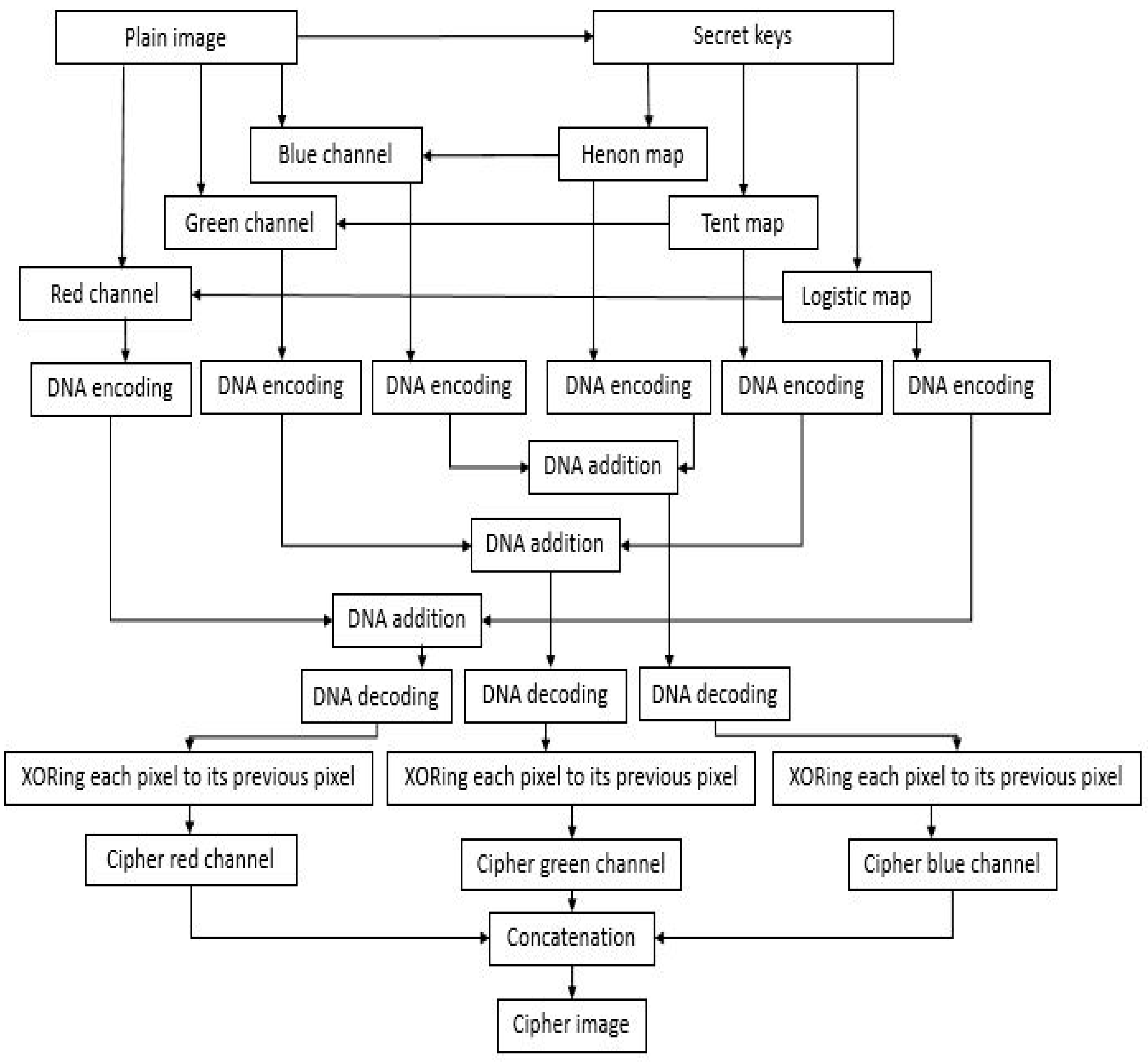
- Step 1: In the proposed scheme, the first step is the key generation phase. In this phase, three chaotic maps are used: a tent map, a logistic map, and a Henon map. The preliminary conditions and control variables of all three maps are dynamically controlled using statistical plain image characteristics such as the mean, variance, and median. This makes the secret keys dependent on the plain image so that any change in the image may be reflected in the output as well. In this scheme, a random plain image pixel block is chosen. The arithmetic means, variance, and median of this pixel block are determined and then normalized. The normalized mean is employed to obtain the starting conditions of the logistic map and tent map and to obtain control variable ‘b’ of the Henon map. Likewise, the use of normalized variance is made to obtain the control parameters of the logistic map and tent map, and control variable ‘a’ of the Henon map. The two starting conditions of the Henon map are obtained using the normalized median of the block.
- Step 2: In this step, the permutation process is carried out. Permutation involves changing the pixel positions to reduce the correlation among the neighboring pixels in the plain image. The original color image with size M × N × 3 is initially taken as the input and then split into red, green, and blue channels, each reshaped to a size of . The preliminary condition and control parameter values are given to the logistic map and it is iterated times to generate a PRN sequence, which is then employed to permute the red channel of the image. Similarly, on giving the values of the preliminary condition and control variable, the tent map is iterated times and a PRN sequence is generated. This sequence is used in scrambling the green channel of the image. Finally, the Henon map is iterated times to generate two PRN sequences. One of these sequences is used in the permutation of the blue channel of the image. So, in the permutation phase, three permuted images are obtained.
- Step 3: This step involves the DNA-encoding phase. In this phase, the three permuted images obtained are encoded into three DNA sequences , , and according to a DNA-encoding rule, each with a size of . In the proposed algorithm, the encoding is performed as per DNA rule 3. After giving different values of preliminary conditions and control variables, the logistic and tent map are iterated again times to generate two new PRN sequences. These two sequences, along with the other sequence from the Henon map, are also encoded into DNA sequences as per the same rule 3 to get three more DNA sequences: , , respectively.
- Step 4: This step involves the substitution process of the suggested algorithm. In any encryption algorithm, substitution is of great significance and is incorporated in changing or modifying the pixel values. In this phase, DNA computation is carried out on the six DNA sequences obtained so far. The is added with the as per DNA addition rule 3. Likewise, the is added with the and finally is added with as per the same rule 3. Thus, at the end of the substitution phase, we get three DNA sequences.
- Step 5: This step involves the DNA decoding process. In this phase, each of the three DNA sequences obtained in the substitution phase is decoded into a binary stream according to the DNA decoding rule 3 and then the binary stream is converted into decimal form. After reshaping the decimal sequence, each element is XORed with the elements preceding that index in the sequence to finally get the three ciphered channels. The concatenation of these channels gives the final encrypted image.
4.2. The Decryption Algorithm
5. Experimental Results and Security Analysis
5.1. Keyspace Analysis
5.2. Key Sensitivity Analysis
5.3. Statistical Attack Analysis
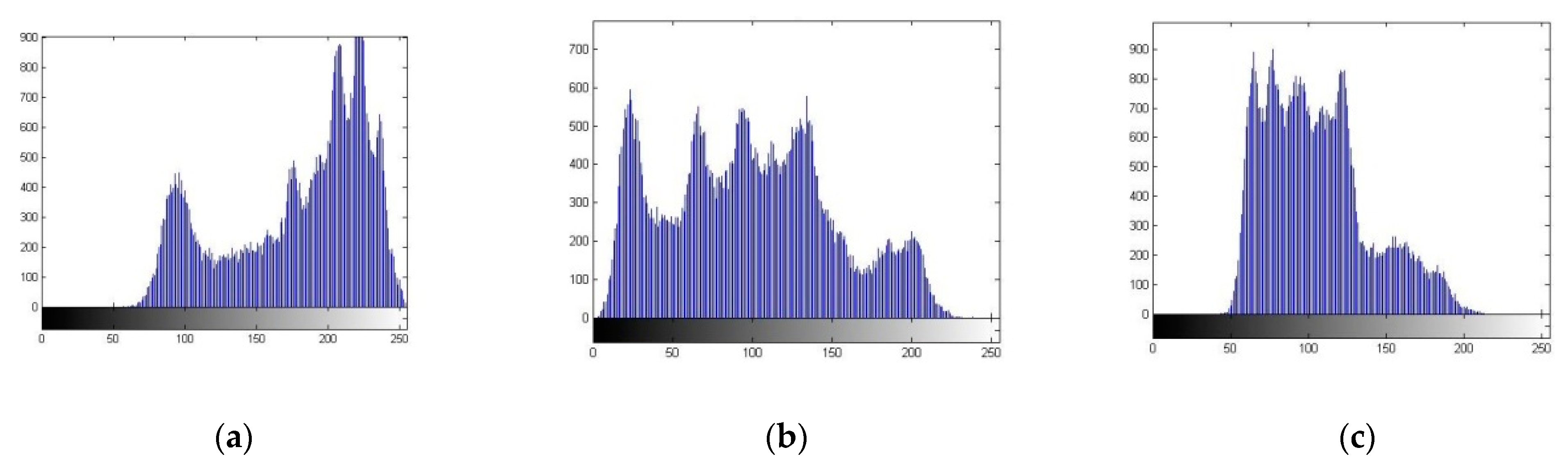
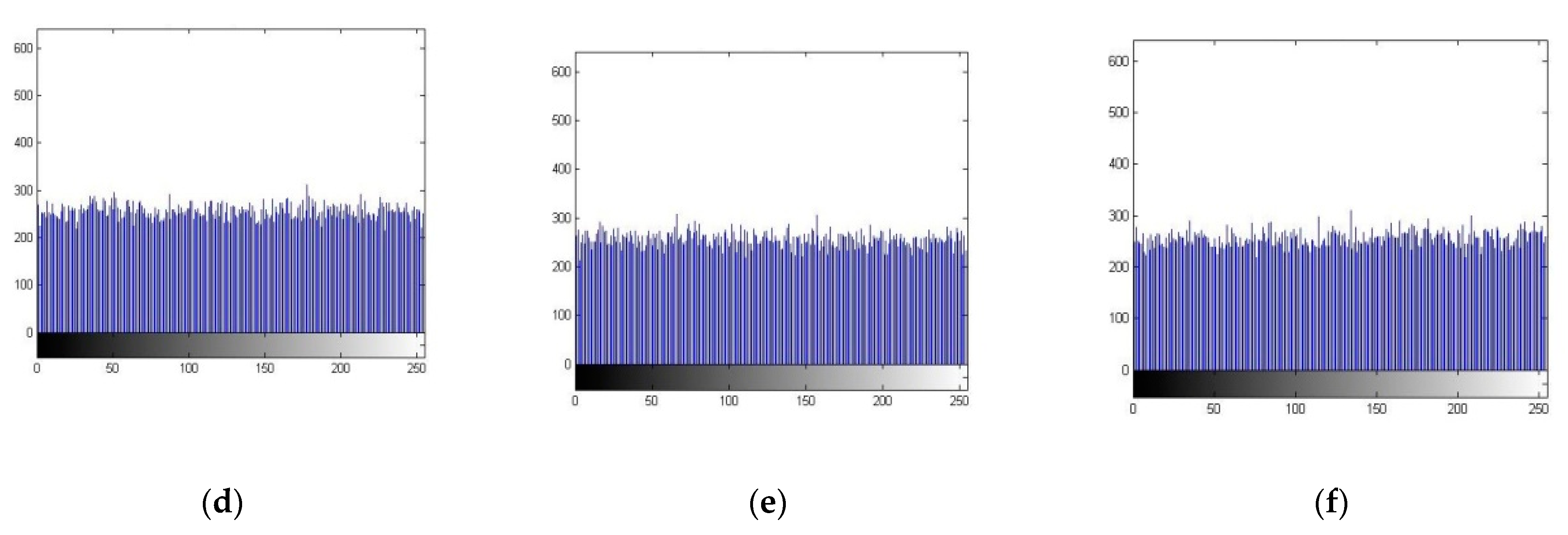
5.3.1. Histogram Analysis
5.3.2. Information Entropy Analysis
5.3.3. Correlation Coefficient Analysis
5.4. Peak Signal to Noise Ratio (PSNR)
5.5. Structural Similarity (SSIM)
5.6. Differential Attack Analysis
5.7. Robustness Analysis
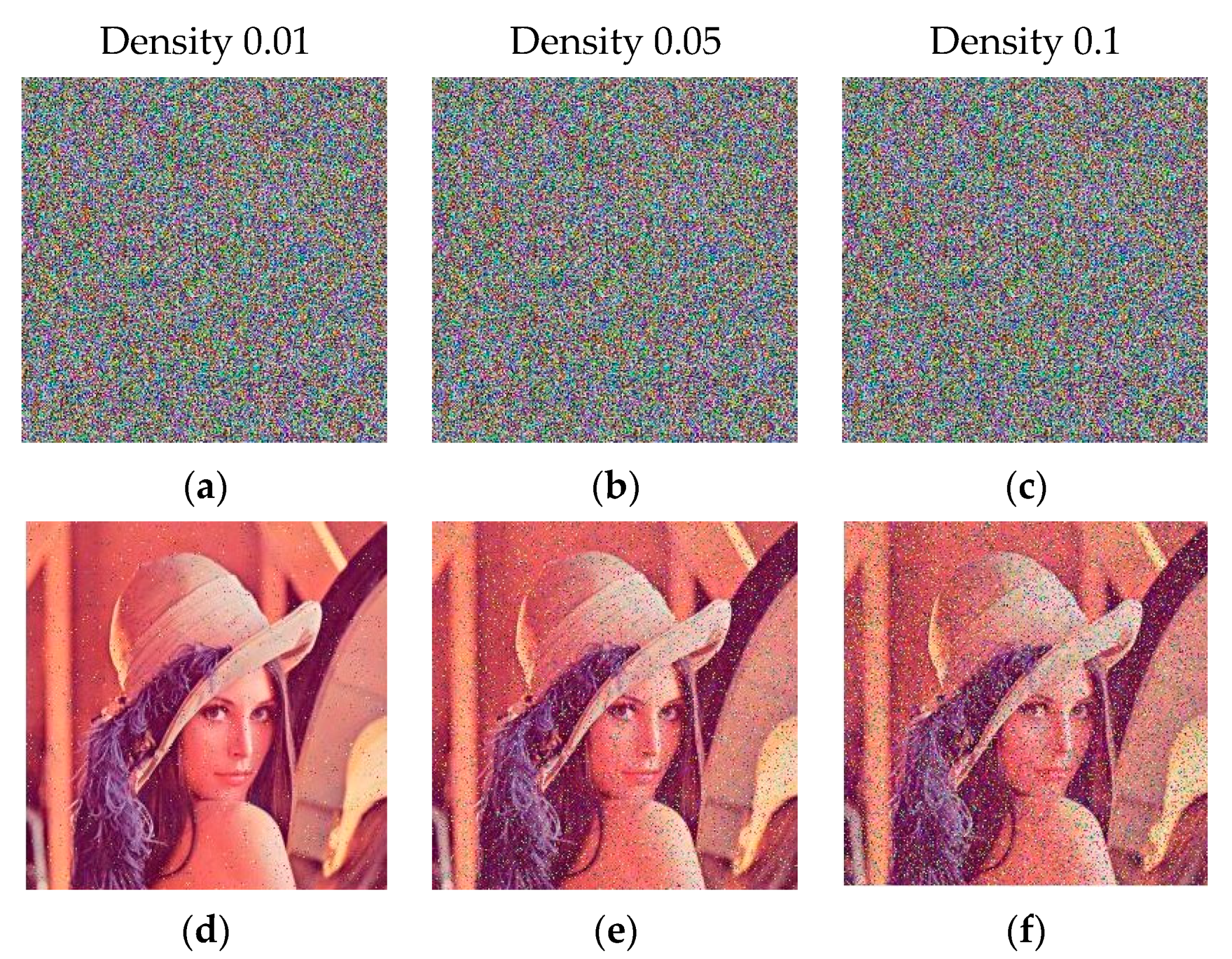
5.7.1. Noise Attack Analysis
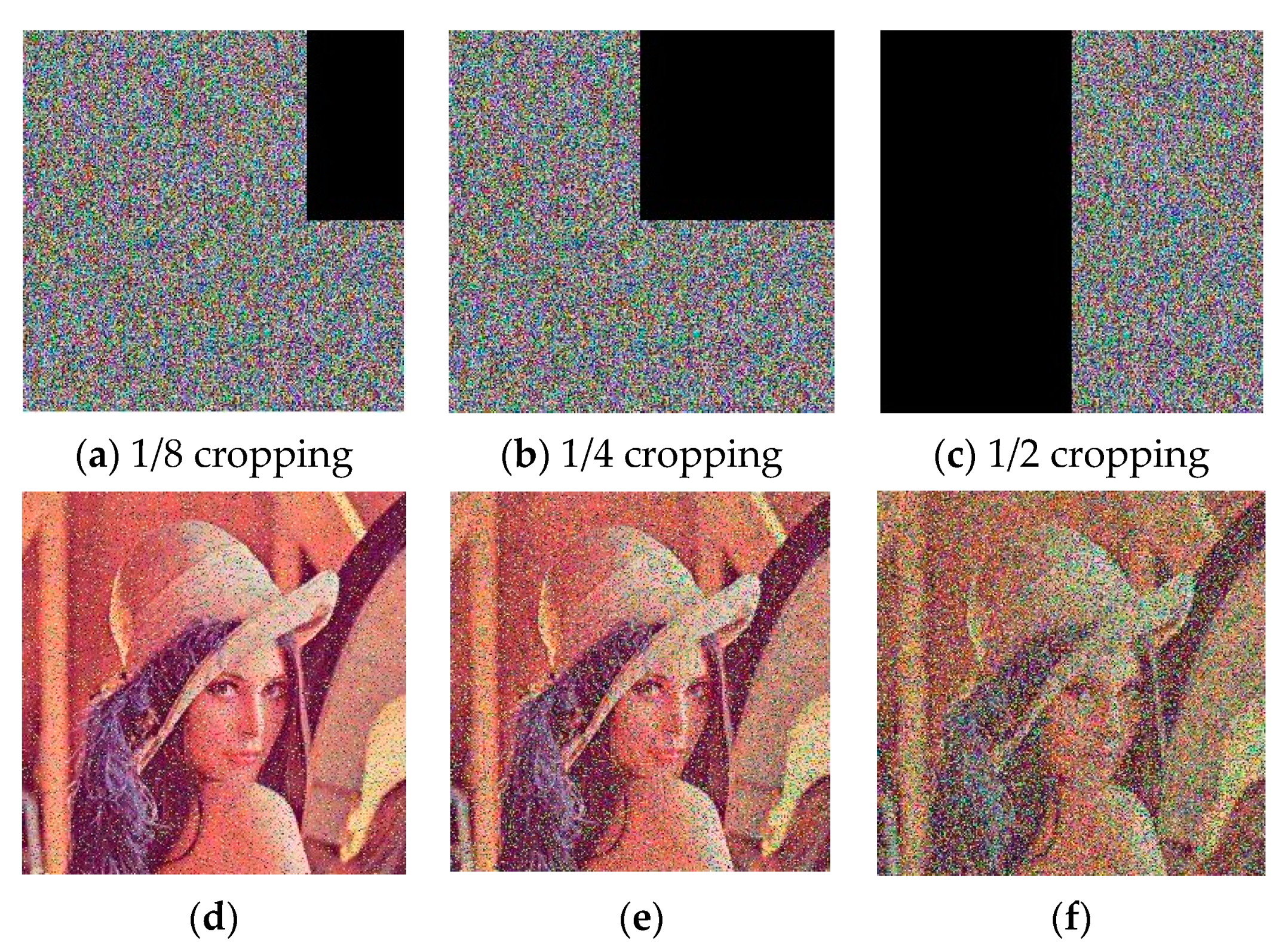
5.7.2. Cropping Attack Analysis
5.8. Computational Complexity Analysis
5.9. Speed Analysis
6. Conclusions
Author Contributions
Funding
Institutional Review Board Statement
Informed Consent Statement
Conflicts of Interest
References
- Alvarez, G.; Li, S. Some basic cryptographic requirements for chaos-based cryptosystems. Int. J. Bifurc. Chaos 2006, 16, 2129–2151. [Google Scholar] [CrossRef] [Green Version]
- Liu, H.; Kadir, A.; Niu, Y. Chaos-based color image block encryption scheme using S-box. AEU Int. J. Electron. Commun. 2014, 68, 676–686. [Google Scholar] [CrossRef]
- Feynman, R.; Vernon, F., Jr. The theory of a general quantum system interacting with a linear dissipative system. Ann. Phys. 1963, 24, 118–173. [Google Scholar] [CrossRef] [Green Version]
- Zhou, Y.; Bao, L.; Chen, C.L.P. A new 1d chaotic system for image encryption. Signal Process 2014, 97, 172–182. [Google Scholar] [CrossRef]
- Toughi, S.; Fathi, M.H.; Sekhavat, Y.A. An image encryption scheme based on elliptic curve pseudo-random and advanced encryption system. Signal Process 2017, 141, 217–227. [Google Scholar] [CrossRef]
- Ahmad, M.; Ahmad, T. Securing multimedia color imagery using multiple high dimensional chaos-based hybrid keys. Int. J. Commun. Netw. Distrib. Syst. 2014, 12, 113–128. [Google Scholar]
- Wu, X.; Li, Y.; Kurths, J. A new color image encryption scheme using CML and a fractional-order chaotic system. PLoS ONE 2015, 10, e0119660. [Google Scholar] [CrossRef] [Green Version]
- Liu, H.; Wang, X. Color image encryption using spatial bit-level permutation and high-dimension chaotic system. Opt. Commun. 2011, 284, 3895–3903. [Google Scholar] [CrossRef]
- Zhang, W.; Wong, K.W.; Yu, H.; Zhu, Z.L. A Symmetric color image encryption algorithm using the intrinsic features of bit distributions. Commun. Nonlinear Sci. Numer. Simul. 2013, 18, 584–600. [Google Scholar] [CrossRef]
- Celik, K.; Kurt, E. A new image encryption algorithm based on the Lorenz system. In Proceedings of the IEEE 8th International Conference on Electronics, Computers and Artificial Intelligence (ECAI), Ploiesti, Romania, 30 June–2 July 2016; pp. 1–6. [Google Scholar]
- Wu, X.J.; Wang, D.W.; Kurths, J.; Kan, H.B. A novel lossless color image encryption scheme using 2D DWT and 6D hyperchaotic system. Inf. Sci. 2016, 349–350, 137–153. [Google Scholar] [CrossRef]
- Bhat, G.M.; Mustafa, M.; Parah, S.A.; Ahmad, J. Field programmable gate array (FPGA) implementation of novel complex PN-code-generator-based data scrambler and descrambler. Maejo Int. J. Sci. Technol. 2010, 4, 125–135. [Google Scholar]
- Parah, S.A.; Ahad, F.; Sheikh, J.A.; Bhat, G.M. On the realization of robust watermarking system for medical images. In Proceedings of the 2015 Annual IEEE India Conference (INDICON), New Delhi, India, 17–20 December 2015; pp. 1–5. [Google Scholar] [CrossRef]
- Bhat, G.M.; Mustafa, M.; Ahmad, S.; Ahmad, J. VHDL modeling and simulation of data scrambler and descrambler for secure data communication. Indian J. Sci. Technol. 2009, 2, 41–43. [Google Scholar] [CrossRef]
- Huang, H. Novel scheme for image encryption combining 2D logistic-Sine-Cosine map and double random-phase encoding. IEEE Access 2019, 7, 177988–177996. [Google Scholar] [CrossRef]
- Nkandeu, Y.P.K.; Tiedeu, A. An image encryption algorithm based on substitution technique and chaos mixing. Multimed. Tools Appl. 2019, 78, 10013–10034. [Google Scholar] [CrossRef]
- Cheng, G.F.; Wang, C.H.; Chen, H. A Novel Color Image Encryption Algorithm Based on Hyperchaotic System and Permutation-Diffusion Architecture. Int. J. Bifurc. Chaos 2019, 29, 1950115. [Google Scholar] [CrossRef]
- Liu, L.; Miao, S. A new simple one-dimensional chaotic map and its application for image encryption. Multimed. Tools Appl. 2018, 77, 21445–21462. [Google Scholar] [CrossRef]
- Parsa, S.; Shabir, P.; Bhat, G.M.; Khan, M. A Security Management Framework for Big Data in Smart Healthcare. Big Data Res. 2021, 25, 100225. [Google Scholar] [CrossRef]
- Xiang, H.; Liu, L. An improved digital logistic map and its application in image encryption. Multimed. Tools Appl. 2020, 79, 30329–30355. [Google Scholar] [CrossRef]
- Zhang, S.J.; Liu, L.; Xiang, H.Y. A Novel Plain-Text Related Image Encryption Algorithm Based on LB Compound Chaotic Map. Mathematics 2021, 9, 2778. [Google Scholar] [CrossRef]
- Li, C.; Xie, T.; Liu, Q.; Cheng, G. Cryptanalyzing image encryption using a chaotic logistic map. Nonlinear Dyn. 2014, 78, 1545–1551. [Google Scholar] [CrossRef] [Green Version]
- Zeng, L.; Liu, R.; Zhang, L.Y.; Liu, Y.; Wong, K.W. Cryptanalyzing an image encryption algorithm based on scrambling and Veginère cipher. Multimed. Tools Appl. 2016, 75, 5439–5453. [Google Scholar] [CrossRef] [Green Version]
- Liu, L.; Zhang, Q.; Wei, X. A RGB image encryption algorithm based on DNA encoding and chaos map. Comput. Electr. Eng. 2012, 38, 1240–1248. [Google Scholar] [CrossRef] [Green Version]
- Wang, X.Y.; Zhang, H.L.; Bao, X.M. Color image encryption scheme using CML and DNA sequence operations. BioSystems 2016, 144, 18–26. [Google Scholar] [CrossRef] [PubMed]
- Rehman, A.; Liao, X.; Ashraf, R.; Ullah, S.; Wang, H. A color image encryption technique using exclusive-OR with DNA complementary rules based on chaos theory and SHA-2. Optik 2018, 159, 348–367. [Google Scholar] [CrossRef]
- Farah, M.A.B.; Guesmi, R.; Kachouri, A.; Samet, M. A novel chaos-based optical image encryption using fractional Fourier transform and DNA sequence operation. Opt. Laser Technol. 2020, 121, 105777. [Google Scholar] [CrossRef]
- Mondal, B.; Mandal, T. A lightweight secure image encryption scheme based on chaos and DNA computing. J. King Saud Univ. Comput. Inf. Sci. 2017, 29, 499–504. [Google Scholar] [CrossRef] [Green Version]
- Wu, J.; Liao, X.; Yang, B. Image Encryption Using 2D Henon-Sine Map and DNA Approach. Signal Process. 2018, 153, 11–23. [Google Scholar] [CrossRef]
- Zefreh, E.Z. An image encryption scheme based on a hybrid model of DNA computing, chaotic systems, and hash functions. Multimed. Tools Appl. 2020, 79, 24993–25022. [Google Scholar] [CrossRef]
- Zhan, K.; Wei, D.; Shi, J.; Yu, J. Cross-utilizing hyperchaotic and DNA sequences for image encryption. J. Electron. Imaging 2017, 26, 013021. [Google Scholar] [CrossRef]
- Liu, Z.T.; Wu, C.X.; Wang, J.; Hu, Y.H. A Color Image Encryption Using Dynamic DNA and 4-D Memristive Hyper-Chaos. IEEE Access 2019, 7, 78367–78378. [Google Scholar] [CrossRef]
- Liu, Q.; Liu, L.F. Color Image Encryption Algorithm Based on DNA Coding and Double Chaos System. IEEE Access 2020, 8, 83596–83610. [Google Scholar] [CrossRef]
- Elmanfaloty, R.A.; Alnajim, A.M.; Abou-Bakr, E. A finite precision implementation of an image encryption scheme based on DNA encoding and binarized chaotic cores. IEEE Access 2021, 9, 136905–136916. [Google Scholar] [CrossRef]
- Khan, M.; Masood, F. A novel chaotic image encryption technique based on multiple discrete dynamical maps. Multimed. Tools Appl. 2019, 78, 26203–26222. [Google Scholar] [CrossRef]
- Xuejing, K.; Zihui, G. A new color image encryption scheme based on DNA encoding and spatiotemporal chaotic system. Signal Process. Image Commun. 2020, 80, 115670. [Google Scholar] [CrossRef]
- Valandar, M.Y.; Barani, M.J.; Ayubi, P. A fast color image encryption technique based on the three-dimensional chaotic map. Opt. Int. J. Light Electron. Opt. 2019, 193, 162921. [Google Scholar] [CrossRef]
- Elshamy, A.M.; Hussein, A.I.; Hamed, H.F.A.; Abdelghany, M.A.; Kelash, H.M. Color Image Encryption Technique Based on Chaos. Procedia Comput. Sci. 2019, 163, 49–53. [Google Scholar] [CrossRef]
- Alghafis, A.; Firdousia, F.; Khan, M.; Batoola, S.I.; Amin, M. An efficient image encryption scheme based on chaotic and Deoxyribonucleic acid sequencing. Math. Comput. Simul. 2020, 177, 441–466. [Google Scholar] [CrossRef]
- Zheng, J.; Liu, L. Novel image encryption by combining dynamic DNA sequence encryption and the improved 2D logistic sine map. IET Image Process. 2020, 14, 2310–2320. [Google Scholar] [CrossRef]
- Zang, H.; Tai, M.; Wei, X. Image encryption schemes based on a class of uniformly distributed chaotic systems. Mathematics 2022, 10, 1027. [Google Scholar] [CrossRef]
- Broumandnia, A. Image encryption algorithm based on finite fields in chaotic maps. J. Inf. Secur. Appl. 2020, 54, 102553. [Google Scholar] [CrossRef]
- Nardo, L.G.; Nepomuceno, E.G.; Arias-Garcia, J.; Butusov, D.N. Image encryption using finite precision error. Chaos Solitons Fractals 2019, 123, 69–78. [Google Scholar] [CrossRef]
- Zhang, X.; Yan, X. Adaptive chaotic image encryption algorithm based on RNA and pixel depth. Electronics 2021, 10, 1770. [Google Scholar] [CrossRef]
- May, R.M. Simple mathematical models with very complicated dynamics. In The Theory of Chaotic Attractors; Springer: New York, NY, USA, 2004; pp. 85–93. [Google Scholar]
- Adleman, L.M. Molecular computation of solutions to combinatorial problems. Science 1994, 266, 1021–1024. [Google Scholar] [CrossRef] [PubMed] [Green Version]
- Roberts, K.; Alberts, B.; Johnson, A.; Walter, P.; Hunt, T. Molecular Biology of the Cell; Garland Science: New York, NY, USA, 2002. [Google Scholar]
- Ping, P.; Fan, J.; Mao, Y.; Xu, F.; Gao, J. A chaos-based image encryption scheme using digit-level permutation and block diffusion. IEEE Access 2018, 6, 67581–67593. [Google Scholar] [CrossRef]
- Samiullah, M.; Aslam, W.; Nazir, H.; Lali, M.I.; Shahzad, B.; Mufti, M.R.; Afzal, H. An image encryption scheme based on DNA computing and multiple chaotic systems. IEEE Access 2020, 8, 25650–25663. [Google Scholar] [CrossRef]
- Wu, X.; Kurths, L.; Kan, H. A robust and lossless DNA encryption scheme for color images. Multimed. Tools Appl. 2018, 77, 12349–12376. [Google Scholar] [CrossRef]
- Belazi, A.; Talha, M.; Kharbech, S.; Xiang, W. Novel medical image encryption scheme based on chaos and DNA encoding. IEEE Access 2019, 7, 36667–36681. [Google Scholar] [CrossRef]
- Sun, S. A novel hyperchaotic image encryption scheme based on DNA encoding, pixel-level scrambling and bit-level scrambling. IEEE Photon. J. 2018, 10, 1–14. [Google Scholar] [CrossRef]



| 1 | 2 | 3 | 4 | 5 | 6 | 7 | 8 | |
|---|---|---|---|---|---|---|---|---|
| A | 00 | 00 | 01 | 01 | 10 | 10 | 11 | 11 |
| T | 11 | 11 | 10 | 10 | 01 | 01 | 00 | 00 |
| G | 01 | 10 | 00 | 11 | 00 | 11 | 01 | 10 |
| C | 10 | 01 | 11 | 00 | 11 | 00 | 10 | 01 |
| + | A | T | G | C |
|---|---|---|---|---|
| A | T | C | A | G |
| T | C | G | T | A |
| G | A | T | G | C |
| C | G | A | C | T |
| − | A | T | G | C |
|---|---|---|---|---|
| A | G | C | A | T |
| T | A | G | T | C |
| G | C | T | G | A |
| C | T | A | C | G |
| ⊕ | A | T | G | C |
|---|---|---|---|---|
| A | G | C | A | T |
| T | C | G | T | A |
| G | A | T | G | C |
| C | T | A | C | G |
| Images | Proposed | [33] | [35] | [39] | ||||
|---|---|---|---|---|---|---|---|---|
| Entropy Value, H(S) | %Age = H(S)/8 × 100 | Entropy Value, H(S) | %Age = H(S)/8 × 100 | Entropy Value, H(S) | %Age = H(S)/8 × 100 | Entropy Value, H(S) | %Age = H(S)/8 × 100 | |
| Lena (256 × 256 × 3) | R = 7.9973 | 99.966 | R = 7.9892 | 99.865 | R = 7.9973 | 99.966 | R = 7.9976 | 99.970 |
| G = 7.9972 | 99.965 | G = 7.9902 | 99.877 | G = 7.9972 | 99.965 | G = 7.9975 | 99.968 | |
| B = 7.9974 | 99.967 | B = 7.9896 | 99.870 | B = 7.9975 | 99.968 | B = 7.9974 | 99.967 | |
| Baboon (256 × 256 × 3) | R = 7.9972 | 99.965 | - | - | R = 7.9972 | 99.965 | R = 7.9972 | 99.965 |
| G = 7.9970 | 99.962 | G = 7.9970 | 99.962 | G = 7.9972 | 99.965 | |||
| B = 7.9973 | 99.966 | B = 7.9977 | 99.971 | B = 7.9972 | 99.965 | |||
| Peppers (256 × 256 × 3) | R = 7.9974 | 99.967 | - | - | - | - | R = 7.9967 | 99.958 |
| G = 7.9971 | 99.963 | G = 7.9970 | 99.962 | |||||
| B = 7.9972 | 99.965 | B = 7.9973 | 99.966 | |||||
| Peppers (256 × 256 × 3) | R = 7.9992 | 99.990 | - | - | R = 7.9993 | 99.991 | - | - |
| G = 7.9993 | 99.991 | G = 7.9992 | 99.990 | |||||
| B = 7.9992 | 99.990 | B = 7.9993 | 99.991 | |||||
| Images | Proposed | [35] | [39] |
|---|---|---|---|
| Lena (256 × 256 × 3) | CHR = 0.0018 | CHR = 0.0017 | CHR = 0.0003 |
| CHG = −0.0032 | CHG = 0.0011 | CHG = 0.001 | |
| CHB = 0.0022 | CHB = −0.0030 | CHB = −0.0009 | |
| CVR = 0.0028 | CVR = −0.0004 | CVR = 0.003 | |
| CVG = 0.0286 | CVG = 0.0076 | CVG = −0.004 | |
| CVB = 0.1074 | CVB = 0.0050 | CVB = −0.0008 | |
| CDR = 0.0016 | CDR = 0.0049 | CDR = 0.0008 | |
| CDG = 0.0022 | CDG = −0.0002 | CDG = 0.002 | |
| CDB = −0.00075 | CDB = 0.0049 | CDB = 0.002 | |
| Baboon (256 × 256 × 3) | CHR = −0.0037 | CHR = −0.0007 | CHR = 0.0005 |
| CHG = 0.0010 | CHG = 0.0057 | CHG = −0.00003 | |
| CHB = 0.0091 | CHB = 0.0056 | CHB = 0.005 | |
| CVR = −0.1196 | CVR = 0.0023 | CVR = 0.002 | |
| CVG = −0.0889 | CVG = 0.0043 | CVG = 0.005 | |
| CVB = 0.0313 | CVB = 0.0002 | CVB = 0.0009 | |
| CDR = −0.0043 | CDR = −0.0077 | CDR = 0.006 | |
| CDG = 0.00059 | CDG = −0.0002 | CDG = 0.005 | |
| CDB = 0.0070 | CDB = −0.0040 | CDB = −0.004 | |
| Peppers (256 × 256 × 3) | CHR = −0.0027 | - | CHR = 0.003 |
| CHG = 0.00023 | CHG = −0.009 | ||
| CHB = −0.00084 | CHB = −0.003 | ||
| CVR = −0.0174 | CVR = −0.001 | ||
| CVG = 0.0105 | CVG = −0.004 | ||
| CVB = −0.0732 | CVB = −0.0002 | ||
| CDR = 0.0022 | CDR = 0.006 | ||
| CDG = −0.0017 | CDG = −0.0002 | ||
| CDB = −0.0029 | CDB = −0.0008 | ||
| Peppers (512 × 512 × 3) | CHR = −0.0015 | CH = 0.0008 CV = 0.0013 CD = 0.0011 | - |
| CHG = −0.0011 | |||
| CHB = 0.000349 | |||
| CVR = −0.0210 | |||
| CVG = 0.0111 | |||
| CVB = −0.1088 | |||
| CDR = −0.00082 | |||
| CDG = 0.00023 | |||
| CDB = 0.0037 |
| Images | Proposed | [39] | [35] |
|---|---|---|---|
| Lena (256 × 256 × 3) | SSIMR = 0.0101 | SSIMR = 0.0091 | - |
| SSIMG = 0.0089 | SSIMG = 0.0061 | - | |
| SSIMB = 0.0112 | SSIMB = 0.0087 | - | |
| PSNRR = 8.3348 | PSNRR = 8.7544 | PSNRR = 7.7930 | |
| PSNRG = 8.5570 | PSNRG = 8.4328 | PSNRG = 7.7739 | |
| PSNRB = 10.4662 | PSNRB = 8.0809 | PSNRB = 7.7363 | |
| Baboon (256 × 256 × 3) | SSIMR = 0.0111 | SSIMR = 0.0103 | - |
| SSIMG = 0.0102 | SSIMG = 0.0094 | - | |
| SSIMB = 0.0094 | SSIMB = 0.0105 | - | |
| PSNRR = 9.1395 | PSNRR = 8.9018 | PSNRR = 7.7432 | |
| PSNRG = 9.4347 | PSNRG = 9.5258 | PSNRG = 7.7427 | |
| PSNRB = 8.6421 | PSNRB = 8.6235 | PSNRB = 7.7482 | |
| Peppers (256 × 256 × 3) | SSIMR = 0.0118 | SSIMR = 0.0093 | - |
| SSIMG = 0.0092 | SSIMG = 0.0070 | ||
| SSIMB = 0.0083 | SSIMB = 0.0074 | ||
| PSNRR = 9.4346 | PSNRR = 8.2465 | ||
| PSNRG = 7.7963 | PSNRG = 7.4135 | ||
| PSNRB = 8.2885 | PSNRB = 7.3602 | ||
| Peppers (512 × 512 × 3) | SSIMR = 0.0118 | - | - |
| SSIMG = 0.0085 | - | ||
| SSIMB = 0.0071 | - | ||
| PSNRR = 9.4433 | PSNRR = 7.7618 | ||
| PSNRG = 7.6337 | PSNRG = 7.7478 | ||
| PSNRB = 8.1225 | PSNRB = 7.7635 |
| Images | Proposed | [39] | [35] | [33] | [32] |
|---|---|---|---|---|---|
| Lena (256 × 256 × 3) | N = 99.61 U = 32.95 | N = 99.57 U = 33.49 | N = 99.59 U = 33.37 | N = 99.61 U = 32.20 | N = 99.61 U = 30.41 |
| Baboon (256 × 256 × 3) | N = 99.62 U = 33.05 | N = 99.60 U = 33.53 | N = 99.60 U = 33.46 | - | N = 99.62 U = 29.78 |
| Peppers (256 × 256 × 3) | N = 99.60 U = 33.50 | N = 99.52 U = 33.50 | - | - | N = 99.61 U = 32.19 |
| Peppers (512 × 512 × 3) | N = 99.61 U = 33.50 | - | N = 99.60 U = 33.41 | - | - |
| Salt and Pepper Noise Density | PSNR | MSE | ||||
|---|---|---|---|---|---|---|
| R | G | B | R | G | B | |
| 0.01 | 25.0491 | 25.6354 | 26.4249 | 203.3168 | 177.6411 | 148.1111 |
| 0.05 | 17.8247 | 18.6317 | 19.7586 | 1873.0 | 891.1748 | 687.4135 |
| 0.1 | 15.0764 | 15.7996 | 16.8090 | 2022.7 | 1710.5 | 1355.8 |
| Cropping Level | PSNR | MSE | ||||
|---|---|---|---|---|---|---|
| R | G | B | R | G | B | |
| 1/8 | 15.7048 | 17.4616 | 18.0581 | 1748.2 | 1166.6 | 1016.9 |
| 1/4 | 12.7580 | 14.4784 | 15.0746 | 3445.8 | 2318.7 | 2021.2 |
| 1/2 | 9.7916 | 11.5753 | 12.0974 | 6822.1 | 4524.2 | 4011.8 |
| Operations | Number of Times Repeated |
|---|---|
| Permutation | 3 × (M × N) |
| DNA encoding_1 | 3 × 4 × (M × N) |
| DNA encoding_2 | 3 × 4 × (M × N) |
| DNA addition | 3 × 4 × (M × N) |
| DNA decoding | 3 × 4 × (M × N) |
| XOR | 3 × (M × N) |
| Scheme | Computational Complexity |
|---|---|
| Proposed | O(59 × M × N) |
| [49] | O(168 × M × N) |
| [50] | O(69 × M × N) |
| [51] | O(124 × M × N) |
| [52] | O(579 × M × N) |
| Image | Average per Channel Encryption Time (s) | Average per Channel Decryption Time (s) |
|---|---|---|
| Lena (256 × 256 × 3) | R = 1.3847 G = 1.5412 B = 1.5293 | R = 0.9633 G = 0.9485 B = 0.9887 |
| Lena (512 × 512 × 3) | R = 4.9086 G = 5.0535 B = 5.0043 | R = 3.3672 G = 3.3942 B = 3.4466 |
Publisher’s Note: MDPI stays neutral with regard to jurisdictional claims in published maps and institutional affiliations. |
© 2022 by the authors. Licensee MDPI, Basel, Switzerland. This article is an open access article distributed under the terms and conditions of the Creative Commons Attribution (CC BY) license (https://creativecommons.org/licenses/by/4.0/).
Share and Cite
Mansoor, S.; Sarosh, P.; Parah, S.A.; Ullah, H.; Hijji, M.; Muhammad, K. Adaptive Color Image Encryption Scheme Based on Multiple Distinct Chaotic Maps and DNA Computing. Mathematics 2022, 10, 2004. https://doi.org/10.3390/math10122004
Mansoor S, Sarosh P, Parah SA, Ullah H, Hijji M, Muhammad K. Adaptive Color Image Encryption Scheme Based on Multiple Distinct Chaotic Maps and DNA Computing. Mathematics. 2022; 10(12):2004. https://doi.org/10.3390/math10122004
Chicago/Turabian StyleMansoor, Shaista, Parsa Sarosh, Shabir A. Parah, Habib Ullah, Mohammad Hijji, and Khan Muhammad. 2022. "Adaptive Color Image Encryption Scheme Based on Multiple Distinct Chaotic Maps and DNA Computing" Mathematics 10, no. 12: 2004. https://doi.org/10.3390/math10122004
APA StyleMansoor, S., Sarosh, P., Parah, S. A., Ullah, H., Hijji, M., & Muhammad, K. (2022). Adaptive Color Image Encryption Scheme Based on Multiple Distinct Chaotic Maps and DNA Computing. Mathematics, 10(12), 2004. https://doi.org/10.3390/math10122004