1. Introduction
Holistic education seeks to educate the entire person, moving beyond the mere transmission of knowledge. As
Schreiner (
2009) summarized, this paradigm seeks to “[criticize] conventional education, [develop] a specific way of reasoning and acting, [foster] an appreciation of spirituality, [cultivate] a multidimensional approach to truth, and [promote] a change from transmission to transformation as aim of education” (p. 755). This approach, as
Hare (
2010) suggests, prepares students for the complexities of lifelong learning by focusing on essential life skills, attitudes, and personal awareness. At its core, holistic education depends on the cultivation of teachers who themselves ‘care for their own bodies, minds, and spirits’ (
Miller, 2010, pp. 12–13). The call for holistic teacher education is therefore clear, yet a conspicuous silence often exists at its heart: the themes of life and death. This omission presents a critical opportunity to deepen the practice of holistic teacher education by engaging with these most fundamental human experiences.
Life and death education aims to examine the interconnection of these two phenomena, cultivate rational attitudes towards them across the lifespan, and promote psychological resilience in the face of loss and mortality (
Gao et al., 2024;
Kortes-Miller, 2014). Historically treated as a taboo subject in many cultures, death was systematically avoided in public discourse before the mid-20th century (
Fonseca & Testoni, 2012). Yet, its presence is inescapable, continually impacting schools and creating “a relatively normal and current need… [that is] [in]sufficiently reflected in curricula” (
Rodríguez et al., 2022, p. 10). The COVID-19 pandemic, in particular, sharpened this need, bringing questions of mortality and anxiety to the fore for students (
Weisskirch & Crossman, 2022). Compounding this, university students frequently report feeling profoundly unprepared to handle death-related experiences (
Pereira et al., 2025). In this context,
Sonbul (
2021) has acknowledged death education as an integral part of the educational process in the pursuit of human happiness and psychological well-being.
Empirical studies across diverse global contexts suggest that engaging with life and death themes can prompt individuals to reflect on their lived experiences, balance their inner selves, and understand their connection to community and culture (
Fujii, 2023;
Gao et al., 2024). This process appears to facilitate intellectual, emotional, and moral development, fostering a life wisdom that resonates deeply with the core aims of holistic education. However, despite this conceptual resonance, the intersection of these two fields remains underexplored. Existing research has predominantly treated them as parallel, with research on holistic teacher education falling short of providing adequate and concrete pedagogical contents to address the topic of life and death, whereas research on life and death focuses mainly on its need for or effects on students, leaving the educators’ perceptions and experiences underexplored. This creates a specific research gap: while the need for life and death education is acknowledged, there is limited understanding of how the very educators tasked with this sensitive work perceive their own readiness, and how these perceptions could inform the design of teacher education that is genuinely holistic. In particular, the development of the latter in mainland China faces distinct challenges, shaped by a cultural context where death often remains a potent taboo (
B. Chen, 2012;
Song et al., 2025). Moreover, discussions of life are frequently restricted to physical safety (
Ma, 2023).
To address this precise gap, this research seeks to investigate the intersection of the two fields, reframing educators’ subject readiness in life and death education as an essential source of data to envision holistic teacher training. Specifically, this research investigates how Chinese university educators’ perceptions of their own preparation, or the distinct lack of it, in life and death education might be leveraged to foster more holistic teacher education programs. In doing so, it directly addresses the underexplored link between educator self-perception and curriculum design for holistic training. The significance of this inquiry lies not only in its potential to inform curriculum design and enhance educator well-being, but also in its capacity to empower educators to foster more resilient and compassionate learning communities, thereby gently challenging long-standing cultural silences.
3. Methodology
The study was conducted at a university in Southern China and conceived as a qualitative investigation, an approach chosen for its capacity to illuminate the complex, nuanced perceptions of individuals within their specific contexts. The primary objective was to develop a substantive understanding of how university educators’ sense of preparedness, or the lack of it, in the area of life and death education could be harnessed. To this end, the research was guided by the principles of Grounded Theory (GT), as initially formulated by
Glaser et al. (
1968) and later refined by
Charmaz (
2014). This study adopted a Grounded Theory approach because the research aim was not to test predefined hypotheses, but to generate an explanatory model grounded in educators’ lived experiences of preparing for life and death education within a culturally taboo context. This choice was deliberate; GT is uniquely suited to exploring an under-researched process of how educators negotiate this sensitive topic by building theory directly from their experiences. Grounded Theory’s process-oriented analytical procedures enabled a systematic linkage between the research question and analysis by tracing how educators’ personal experiences, professional boundary negotiations, and perceived systemic constraints interact to inform the design of more holistic teacher education programmes. Thus, the methodology is directly aligned with the research question of ‘how’ perceptions can be leveraged, as GT focuses on uncovering social processes and generating explanatory frameworks rather than testing pre-existing variables.
3.1. Participants & Instrument
Participants were selected using purposive sampling to ensure they could provide information-rich accounts related to the research aim. Inclusion criteria required participants to be currently employed as university educators, have direct teaching responsibilities with undergraduate students, and be willing to reflect on both their personal experiences and professional preparation related to life and death related issues. In the end, eight university educators currently affiliated with the southern China university, a group acquainted with the researchers who likely facilitated initial access and trust were recruited. While this familiarity encouraged openness, it was a factor that required scrutiny to mitigate potential biases. The sample, aged 24 to 44, included two male and six female educators holding positions ranging from assistant instructor to Associate professor. Their disciplines were predominantly within the Humanities and Social Sciences, with one participant from Science and Technology. Their highest academic qualifications ranged from Master’s to PhD. The specific demographics of the participants are presented in
Table 1.
The instrument for data collection was a semi-structured interview protocol. This instrument was developed in line with the Grounded Theory approach to ensure consistency while preserving the flexibility needed to pursue emergent lines of inquiry. The interview protocol began with questions about participants’ professional passions, then progressed to explore their personal history with life-and-death themes, their perceived readiness, and the influence of personal experiences. Later sections probed their views on current gaps in teacher education and, crucially, their visions for a more holistic programme, directly addressing the leveraging aspect of the research question. A question such as “Reflecting on your own journey, what do you believe is currently missing from mainstream teacher education in terms of preparing educators for the existential and emotional dimensions of teaching?” was designed to elicit deeply considered, conceptual responses. This structure was designed to sequentially map onto the analytical goal of GT, moving from descriptive personal accounts to conceptual insights about systemic change.
3.2. Data Collection & Analysis
Data collection adhered to approved ethical protocols. Data were collected through eight online interviews, each lasting approximately 60 min, using the Tencent Meeting platform. The interviews were conducted in Mandarin, and were audio-recorded, transcribed and translated into English. Data analysis followed the iterative procedures of Grounded Theory, including initial, focused, and theoretical coding. Initial coding involved line-by-line analysis of transcripts to identify actions and meanings expressed by participants; focused coding then synthesized the most frequent and significant codes into higher-level categories; and theoretical coding examined relationships among these categories to develop an integrative explanatory model. Constant comparison was applied throughout analysis to refine categories and ensure that the emerging theory remained grounded in the data. To ensure trustworthiness, inter-coder agreement and member checking were employed during the coding and analysis process. This staged analytical process directly served the research aim: initial coding captured raw perceptions, focused coding identified key patterns in their preparation (or lack thereof), and theoretical coding constructed the model of ‘negotiation’ that explains how these perceptions can be leveraged.
For the initial coding stage, line-by-line examination was carried out to label the core actions, events, and ideas that generated a wide array of codes that captured the immediate concerns and experiences of the participants. For example, one participant, Su, reflected on the complete absence of formal instruction on the topic, stating, “I think there wasn’t any obvious explicit education… it feels like no one teaches you. You should experience and go through it yourself” (P2, L64–66). This was coded as ‘Lack of Formal Education’. To decrease the bias and enhance data credibility, inter-coder agreement was employed in this stage. All samples of transcripts were independently coded by two researchers who were familiar with qualitative research. Those initial codes were then shared with other researchers, before finally being critically compared and discussed by all researchers until consensus was reached.
In the focused coding stage, the most significant and frequent initial codes were synthesized into more abstract and selective categories through constant comparison. These categories began to explain larger patterns across the dataset, moving from describing what is in the data to beginning to explain why and how. For instance, the initial codes of ‘Lack of Formal Education’, Learning Through Life Experience’ (as seen in Zhang’s work with leprosy patients), and ‘Self-Directed Learning’ were grouped under the focused category ‘Pathways to Understanding Death’.
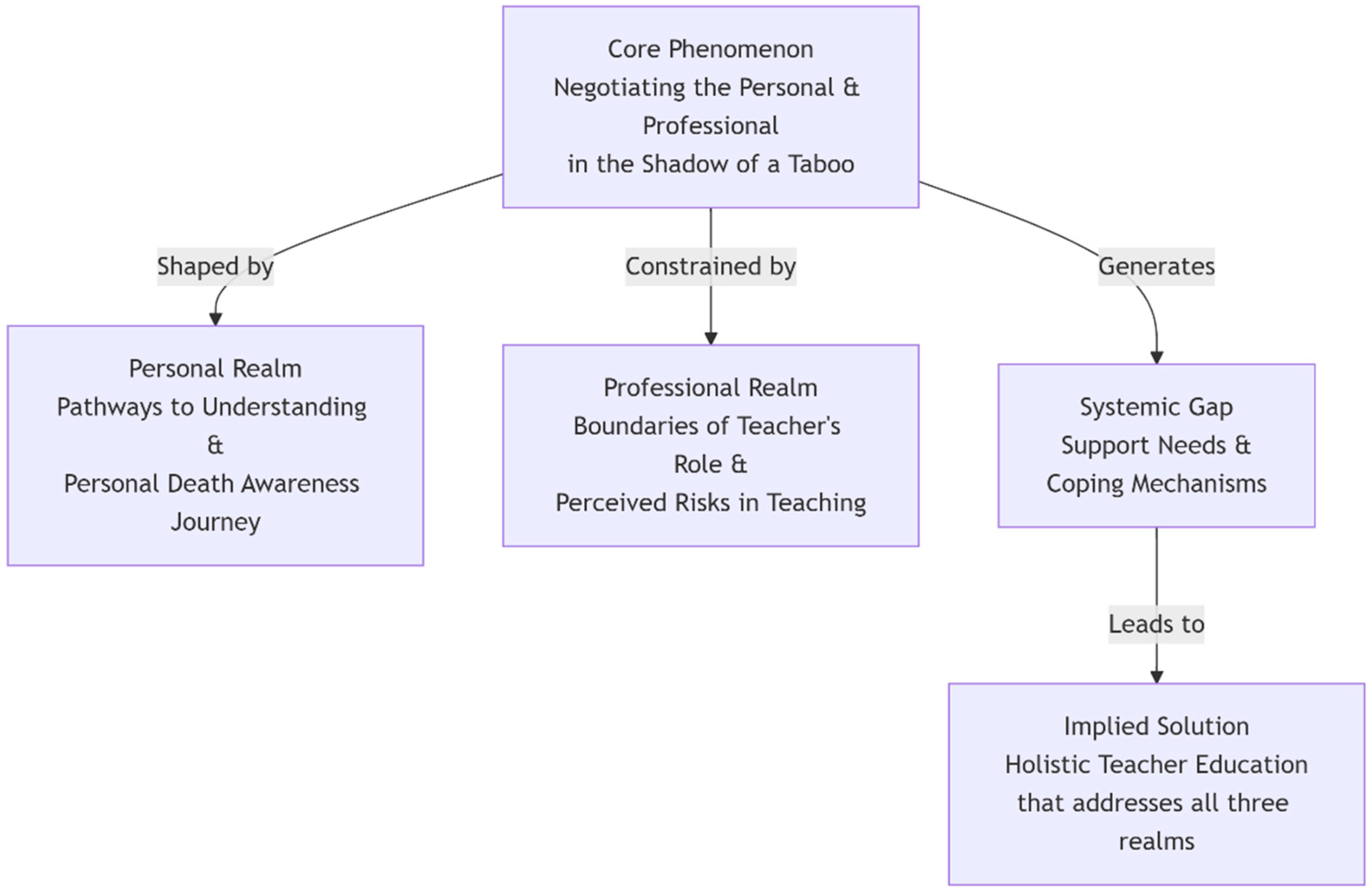
Theoretical coding involved developing a theoretical framework to explain the relationships between the focused categories. In this stage, member checking was employed to increase the accuracy of data. The emerging theory was shared with three participants who confirmed our main findings and provided invaluable feedback in an online meeting. The core category that emerged from this analysis is ‘Negotiating the Personal and Professional in the Shadow of a Taboo’. This core theory posits that university educators operate within a field of tension created by a systemic silence on life-and-death issues. They bring their personal, often unprocessed, and experientially formed understandings of life and death into a professional context that offers no clear guidelines on this topic. The theory explains that educators are constantly ‘negotiating’ this tension by drawing on their personal journeys to inform their empathy, while simultaneously enforcing strict professional boundaries to manage perceived risks and role confusion. This difficult negotiation, in turn, generates a clearly articulated need that is currently unmet by mainstream teacher education for structured support systems for the participants and their students. The entire process occurs ‘in the shadow of a taboo’, reflecting the broader cultural and institutional avoidance of the topic that shapes their perceptions and constraints. This final, integrative model is the direct theoretical outcome of the Grounded Theory process and provides the explanatory framework that answers the ‘how’ of our research question.
Figure 1 below illustrates this theoretical model.
4. Results and Discussion
The analysis reveals a profound systemic silence at the heart of these educators’ professional formation, a void their personal histories have been compelled to fill. Grounded in the data, a substantive, process-oriented theory emerged, as captured in
Figure 1, which posits that educators are constantly Negotiating the Personal & Professional in the Shadow of a Taboo. This theory posits that educators’ engagement with life and death education is static stage but a dynamic process, driven by systematic gaps and mediated by personal and professional forces. This process is structured by three interconnected realms—the personal, professional, and systematic. The following sections, structured around these three realms, present the key findings before synthesizing them into the integrated theoretical model. The four analytical themes that constitute this theory illustrate how educators navigate life’s most fundamental domain without a guide, their pathways illuminated only by the uneven terrain of personal experience. These findings directly address our research question by demonstrating that educators’ perceptions of their preparation, or the stark lack thereof, offer not merely identification of a barrier but critical, actionable insights for constructing genuinely holistic teacher education programs. The following sections will delineate this system, explaining how the conditions in one realm cause responses in another, ultimately shaping educators’ readiness and practice.
4.1. A Universal Deficit in Formal Preparation
Across all interviews, participants reported a complete absence of formal education related to life and death throughout their schooling and professional training. This absence, framed as ‘A Universal Deficit in Formal Preparation,’ was consistently described as spanning primary, secondary, and higher education.
As Su articulated, the prevailing message was that “you should experience and go through it yourself” (P2, L64–66). This sentiment of being left to one’s own devices was universal. Je emphasized the sheer lack of any structured learning, stating, “I tried hard and couldn’t recall anything… I believe there was no direct, formal education in the form of a course” (P13, L74–79). Another participant, Zhang, confirmed this with precision: “Strictly speaking, in terms of programs or training explicitly labeled ‘Life Education’ or ‘Death Education’, I really haven’t participated in any” (P24, L35–38).
The deficit extended beyond the mere absence of courses to a deeper lack of guided discourse. Xi pointed out that even informal discussions were missing, noting, “There was no such education, and no one ever raised this topic for discussion” (P30, L102–103). This silence was so pervasive that for some, like Ma, the concept of formal death education seemed almost foreign: “I have never heard of death education… I think it’s a very Western concept” (P20, L58–60). Lo reinforced the totality of this absence, confirming that it spanned her entire academic journey: “From primary school to my Master program, there was no such course” (P45, L210–211).
This collective experience forms the foundational empirical finding. This universal deficit, as illustrated in the ‘Personal Realm’ of our theoretical model, means that any holistic teacher education initiative cannot assume or build upon prior knowledge. It must instead confront a near-total blank slate, a point starkly summarized by Rui’s simple, definitive statement, “No, never” (P34, L120), when asked if she had ever received any form of life and death education. This finding empirically substantiates previous studies on the scarcity of life and death education within taboo contexts (
Ma, 2023;
Mak, 2013).
Analytically, this finding suggests that the omission becomes particularly conspicuous when held against holistic education’s aim to educate the entire person—mind, body, and spirit (
Miller, 2010). How can an education claim to be whole while systematically sidestepping the existential bookends of life? Analytically, we interpret this systemic silence as having effectively normalized the idea that life and death are private matters of solitary endurance rather than subjects for communal pedagogical exploration, thereby casting the long ‘shadow’ under which educators now operate. More than mere background, this systematic gap functions as a fundamental force that directly transfers the responsibility for understanding from the institutional realm to the personal realm, thereby establishing unstructured personal experience as the primary source of knowledge.
4.2. The Personal as the Primary Educator: Varied Pathways to Understanding
Compelled to navigate this systemic void, the participants’ understandings were forged not in a classroom but in the unpredictable fires of personal experience. This reliance on the personal as the primary educator, a key component of the ‘Personal Realm’ in our model, has created ‘Varied Pathways to Understanding,’ leading to a wide spectrum of attitudes and comfort levels. For some, like Su, childhood encounters with loss cast a long shadow, fostering a protective caution: “from then on, I never kept pets again… because I’m afraid that later… they will all leave you early” (P4, L141–150). For others, like Zhang, transformative professional encounters provided a powerful counter-narrative, revealing “how powerful human vitality is” (P28, L182–189). Intellectual exploration served as another pathway, with Je finding that reading philosophical works decreased his death anxiety (P14, L107–112), while Lo’s direct personal loss was complicated by regret, making the topic feel personally perilous (P47, L226–233).
We argue that these empirical accounts demonstrate that personal history, while constituting individual context, acts as the primary educator in the absence of systematic support, which extends the finding that personal growth shapes attitudes towards death education (
Rodríguez et al., 2022). Furthermore, this mosaic of pathways, from traumatic to transformative, suggests a standardized curriculum would likely fail to resonate. Instead, a holistic program must be fundamentally sensitive to these divergent entry points. It must first create a safe space for educators to reflect upon their own journeys, as these ‘Pathways to Understanding’ directly shape the ‘Personal Death Awareness Journey’ that influences every professional decision. As
Phan et al. (
2025a) suggest, cultivating a ‘holistic self’ begins with this self-awareness. Failing to address this foundational layer may mean building subsequent professional skills on unstable, unexamined ground.
4.3. Navigating Professional Boundaries: Risk, Role, and Readiness
The deeply personal nature of these understandings inevitably collides with the professional sphere, giving rise to the complex navigation captured by our core phenomenon. Educators expressed significant caution, articulating a web of ‘Perceived Risks in Teaching’ that directly map onto the ‘Professional Realm’ of our model, which constrains their practice. A primary concern was perceived student immaturity and risk; Yun worried that students might find death “terrifying… or romanticizing” rather than meaningful (P58, L128–135). This perspective, while protective, may also project a broader cultural anxiety onto the student body.
This fear is compounded by a fiercely guarded definition of the teacher’s role, which participants consistently distinguished from that of a therapist. Su questioned the “suitability of the teacher-student relationship for discussing such topics” (P3, L115–117), and Yun sharply defined their role as “knowledge transmitters, not influencers of morality, heart, or emotion” (P63, L438–439). This self-conception, while being shaped by their personal teaching philosophy, presents a stark contrast to the holistic ideal of the teacher as an educator of the whole person (
Schreiner, 2009) and signals a retreat to a safer, more narrowly defined professional identity. Underpinning these concerns is a profound lack of readiness. Lo’s candid admission, “I genuinely lack specialized knowledge… I haven’t dealt with this issue very well myself” (P51, L387–390), reveals the crux of the problem. Educators feel ill-equipped in both pedagogical skill and their own existential peace, a finding that aligns with global surveys (
Rodríguez et al., 2022) but is sharpened here by personal unresolvedness.
We conceptualize these intertwined professional fears of role ambiguity, inadequate training, and potential repercussions as the core mechanism of ‘Perceived Risks in Teaching.’ This construct theoretically advances prior work that linked attitudes to educator type (e.g., early childhood education teachers and counselors) (
Rodríguez et al., 2022) by providing a more fundamental, explanatory account. It functions as a critical filter through which educators constantly assess the potential outcomes of translating personal understandings into professional practice. High perceived risk thus directly undermines their willingness to engage, resulting in their avoidance and negative feelings observed in this and earlier research across time and contexts (
Mak, 2013). Therefore, our findings theorize that such persistent negative feelings and affect are not merely educators’ personal emotional reactions but are often grounded in the professional realm within a specific cultural context.
The implication is not to turn educators into therapists, but to equip them to operate confidently within their legitimate ‘Boundaries of Teacher’s Role’. Training must therefore directly address these ‘Perceived Risks in Teaching’ by building practical skills in triage, referral, and empathetic responding—how to listen and validate without feeling compelled to counsel. This reframes the educator as a knowledgeable bridge to a wider support system, not the final destination for student struggles.
4.4. Envisioning Holistic Support: A Call for Optional, Practical, and Multi-Tiered Systems
When envisioning solutions, the participants’ proposals moved beyond a simple curriculum module toward a multi-faceted ecosystem in response to the dynamic interplay of three core challenges: a systemic deficit, unstructured personal understandings, and the professional boundaries underpinned by perceived risk. This vision directly addresses the ‘Systemic Gap’—the ‘Support Needs & Coping Mechanisms’—that our model shows is generated by the core negotiation.
For students, they envisioned elective courses that balance rational understanding with emotional exploration. Je imagined an elective would be “cool” (P16, L230–233), while Lo suggested it could “create a counterbalance between rationality and emotion” (P50, L366–369), framing it as a skill-building exercise rather than therapy.
For themselves, however, the priority shifted markedly inward. There was a strong emphasis on training that focuses first on self-care. Su argued that “the real training is not about how they can help students, but rather… how they can… protect themselves” (P8, L300–308). Ma’s proposal for a workshop series that first addresses teachers’ own perspectives before moving to practical classroom strategies reflects this necessary progression from the personal to the professional (P83, L584–589). This staged model provides a structured container for the very negotiation our theory describes.
Ultimately, participants recognized that even the best courses are insufficient without a wider supportive infrastructure. Lo’s poignant reflection on her isolation during personal loss that “there was no one to talk to” (P47, L180–185) highlights a critical systemic failure. Moreover, both Je and Zhang underscore the significance of ’inclusiveness’ in the community. For example, Je believed that it was hard for instructors to provide life and death education to all undergraduate students in this stage because it “requires [more] relative tolerance/inclusivity” (P12, L454–455). Therefore, Zhang suggested that one of the solutions is “to create a more accepting, more tolerant/inclusive surrounding environment” (P15, L477–478).
4.5. Synthesizing the Findings: An Integrated Theoretical Model
The findings presented across the three realms culminate in the integrated model presented in
Figure 1. The universal deficit (Personal Realm) forces a reliance on varied personal pathways, which then collide with the constraints of the Professional Realm (perceived risks and rigid role definitions). This negotiation, occurring in the shadow of a cultural taboo, generates a clearly identified Systemic Gap. The educators’ proposed solutions directly target each component of this model, calling for programmes that are awareness-based (addressing the Personal Realm), boundary-conscious (addressing the Professional Realm), and systemically minded (addressing the Systemic Gap). This analysis moves beyond describing themes to explaining the dynamic process of negotiation, thereby providing a theoretical framework that answers how educators’ perceptions can be leveraged. It clarifies that the leverage point lies not in any single realm, but in designing interventions that simultaneously address the interconnected conditions across all three.
The multi-tiered vision that emerges: integrating personal development, professional skills, and reinforced institutional support creates a web of resilience. It ensures the educator is an informed bridge within a caring and inclusive community and not a lone pillar of support, thereby making the profound work of holistic education a sustainable possibility. This integrated vision constitutes the ‘Implied Solution’ in our model: a Holistic Teacher Education that addresses all three realms.
5. Conclusions
This study, guided by a Grounded Theory approach, sought to understand how university educators’ perceptions of their preparation in life and death education could inform more holistic teacher education. The investigation yielded more than a catalog of gaps; it produced a substantive, explanatory theory, illustrated in
Figure 1, which captures the core phenomenon of educators
Negotiating the Personal & Professional in the Shadow of a Taboo. Critically, it outlines how a systematic gap (the absence of formal education) causes a dependency on personalized pathways to understanding (unstructured personal experiences), which, in turn, creates the tension in the standardized, professional realms governed by the mechanism of perceived risks. While this newly constructed theory is grounded in the specific context of a mainland Chinese university, its core process may resonate with educators in other educational settings who face similar cultural silences or systematic avoidance. For instance, in regions where death remains a cultural taboo and teacher training lacks formal support, educators are likely to navigate a similar tension between personal experience and professional boundaries. Thus, this model may inform the conceptualized consideration of integrating existential themes into holistic teacher education across different cultural–institutional landscapes.
By adopting a perspective shift, the findings demonstrate that leveraging these perceptions necessitates a fundamental re-imagining of teacher development, one that is as multi-layered as the phenomenon itself. The path forward, as charted by the educators’ experiences, must be built on principles that directly respond to the theoretical model. Programmes must be awareness-based, acknowledging the universal formal deficit and the profound influence of personal pathways to understanding. They must be boundary-conscious, equipped to address the professional constraints by providing practical skills for navigating the emotional terrain of classrooms without blurring the lines between teaching and counseling. The goal should be empowerment-focused, shifting from creating experts to fostering self-aware educators who are confident in their ability to triage, respond initially, and refer effectively.
Finally, and perhaps most critically, this endeavor must be systemically-minded. A standalone course is an insufficient solution to the systemic gap identified. True integration requires weaving teacher training into the institution’s wider well-being ecosystem, ensuring robust mental health resources for both staff and students. This systemic reinforcement ensures no educator feels alone, positioning them as a vital bridge within a caring community rather than the sole pillar of support.
The value of this theory lies in its integrative power, synthesizing previously fragmented observations into a coherent explanatory framework. Critically, it demonstrates that practical interventions which disregard any one of its interconnected realms are likely to fail. Ultimately, by centering the voices of educators, this study shows that the cultural silence around life and death is not an empty space but a dynamic field of tension and unmet need. Addressing this silence by honoring the personal, clarifying the professional, and reinforcing the systemic holds the promise of a teacher education that is truly holistic. Such an approach would not only gently challenge a long-standing taboo but also foster the resilience, compassion, and psychological well-being that lie at the very heart of educating the whole person.
Limitations and Directions for Future Research
Nevertheless, this study has several limitations. First, the gender imbalance among participants, with a predominance of female educators, may bias the results towards more positive and open attitudes on life and death education, as prior studies suggest gender-based attitude differences (e.g.,
Rodríguez et al., 2022). Second, the underrepresentation of educators from Science and Technology limits the perspective. Their understanding and training needs regarding life-and-death issues within holistic teacher education could be different and were not fully captured. Third, the study was conducted at a single university in Southern China. While this provided a rich, context-specific understanding, the findings are necessarily shaped by the institutional culture and local interpretations of the cultural taboo. The transferability of the theoretical model, while it may be theoretically feasible as mentioned above, should be tested in other regions within or beyond China in future research. These future directions are not merely expansions of scope but are necessary to refine the theoretical model, test its boundaries, and ensure its relevance across diverse educational and cultural landscapes.