Article

Preservice Elementary Teachers’ Perceptions of Integrated STEM After Participating in an Integrated STEAM Course


School of Inclusive Teacher Education, College of Education and Human Development, Bowling Green State University, Bowling Green, OH 43403, USA
*
Author to whom correspondence should be addressed.
Educ. Sci. 2026, 16(2), 214; https://doi.org/10.3390/educsci16020214
Submission received: 25 December 2025 / Revised: 24 January 2026 / Accepted: 28 January 2026 / Published: 1 February 2026
(This article belongs to the Special Issue Cultivating Teachers for STEAM Education)

Abstract

(1) Background: Although integrated STEM education is an important policy focus, teacher preparation to implement high-quality integrated STEM and STEAM learning experiences in an equitable manner is not widespread. Teacher beliefs significantly impact how they teach; therefore, this study explores preservice teachers’ self-reported perceptions of teaching integrated STEM after participating in an integrated STEAM course. (2) Methods: We employed qualitative methods to explore 47 preservice elementary teachers’ perceptions about teaching integrated STEM based on their lived experiences in an integrated STEAM course. Guided by our conceptual framework, we used deductive methods to better understand preservice elementary teachers’ perceptions. We also used open coding to understand their lived experiences in the course. Pattern coding was used in the second cycle to identify themes. (3) Findings: Three primary themes emerged, including understanding integrated STEM frameworks through a transdisciplinary and critical lens; perceiving STEAM is engaging because it is relevant; and developing self-efficacy for future STEAM integration without infrastructure. (4) Conclusions: Although preservice elementary teachers had positive experiences in the course and believe integrated STEM and STEAM to be important, more work is needed to develop their understanding of equitable integrated STEM and STEAM instruction.

1. Introduction

Integrated science, technology, engineering, and mathematics (STEM) education is a policy priority for many governments (National Academy of Engineering & National Research Council, 2014), a focus area of educational research (e.g., Johnson et al., 2020), and an implementation area for many school districts (Ehlert & Roberts, 2021). This policy priority connects global concerns about the workforce, economic competition, and the need for innovations that can address the world’s most pressing wicked problems (Plank & Chelednik, 2025; National Academy of Engineering & National Research Council, 2014). In classrooms, teachers believe STEM education is important for their students (Margot & Kettler, 2019; Nesmith & Cooper, 2020). Teachers recognize that integrated STEM education allows students to apply content knowledge (Asghar et al., 2012), connect to future careers and real-world problem solving (Bruce-Davis et al., 2014; Bryan et al., 2015), build engagement and confidence (Herro & Quigley, 2017; Stubbs & Myers, 2016), and learn from failure and mistakes (Roberts & Schnepp, 2020). Although teachers perceive many values and derive many benefits from integrated STEM learning, there are numerous barriers to widespread, high-quality implementation, particularly at the elementary level. For example, many teachers lack experience and training to implement integrated STEM education (McMullin & Reeve, 2014), often because teacher education programs do not offer coursework in integrated STEM education, particularly at the elementary level (Nesmith & Cooper, 2020; Radloff & Guzey, 2016). This lack of experience and training can have long-term impacts on achieving policy goals of a more STEM-literate population and workforce, as many students, particularly low-income students, become disinterested in integrated STEM topics in elementary school (Epstein & Miller, 2011). Thus, not only is elementary teacher preparation important in STEM, but understanding how preservice elementary teachers (PSETs) report perceiving integrated STEM teaching and learning is essential.
Much of the criticism of STEM education over the past decade centers on its frequent association with economic productivity and technical efficiency. This argument does not provide a strong rationale for learners and leaves little room for creativity and human flourishing. In response, the inclusion of the arts and humanities, commonly referred to as STEAM, has gained momentum as a way to broaden the purposes of STEM education (Bush & Cook, 2018; Danielson et al., 2022; Quigley & Herro, 2016). STEAM, however, was never intended as a departure from STEM; instead, it reflects an effort to build on existing disciplines while addressing their limitations. Both approaches emphasize the importance of interdisciplinary and transdisciplinary approaches over the traditional siloed approach, in which each discipline is taught and learned in isolation (Bush & Cook, 2018). STEAM and integrated STEM are both grounded in values of creativity, expression, relevance, empathy, and technical problem-solving. However, the different purposes, orientations, and outcomes advocated for in STEM and STEAM are often significant.
Much of the policy discourse surrounding integrated STEM education emphasizes efficiency, workforce preparation, and national competitiveness, particularly in relation to global economic positioning (National Research Council, 2011). This framing has shaped how STEM is perceived and implemented across the PK-12 educational landscape and in teacher preparation programs. Integrated STEAM education takes a more humanizing approach, centering on empathy, students’ lived experiences, creative problem-solving and sensemaking, personal expression, and ethical engagement in addressing real-world problems (Bush & Cook, 2018). From this perspective, STEAM is not simply “STEM plus art” but rather an approach to learning that foregrounds transdisciplinary problem-solving, in which disciplinary boundaries are secondary to the problem, the living things affected by the problem, and the sociocultural context in which the learning occurs.
In teacher education, integrated STEAM learning experiences have been shown to positively influence preservice teachers’ dispositions (e.g., An, 2020), knowledge of practices for integrating disciplines (An, 2020; Webb & LoFaro, 2020), and self-efficacy for teaching integrated STEAM (Webb & LoFaro, 2020). Therefore, our purpose is to present PSETs’ perceptions of teaching integrated STEAM after participating in an integrated STEAM course within an elementary education program. Specifically, we examined PSETs participating in an integrated STEAM learning environment to leverage its broader appeal to diverse learners (Bequette & Bequette, 2012) and to ensure teaching is about the student rather than the subject matter (Cook et al., 2017).
In this study, we intentionally conceptualize STEAM as existing along a continuum of discipline integration (Plank & Chelednik, 2025), with fully transdisciplinary STEAM representing the most complex form of integration. At this level, problems do not exist within a single discipline, and solutions require students to draw flexibly from multiple ways of knowing, including artistic, cultural, and community-based knowledge (Quigley & Herro, 2019). However, we also recognize that, for PSETs, who are often generalists and report low confidence in science and mathematics (Bursal & Paznokas, 2006; Hembree, 1990; Vinson, 2001), less complex forms of integration may be appropriate and necessary (Plank & Chelednik, 2025). In elementary classrooms, integrated STEM and STEAM instruction can appear similar to an outside observer. This lack of clarity is particularly pronounced when teachers operate within the constraints of scripted curricula and high-stakes accountability measures. Teacher education research supports the idea that PSETs benefit from graduated entry points into integrative teaching, rather than immediate expectations for fully transdisciplinary STEAM enactment (Quigley & Herro, 2016). When PSETs are asked to implement justice-oriented transdisciplinary STEAM without sustained scaffolding across coursework and eventually field experiences and student teaching, their efforts can be superficial at best and possibly harmful (Plank & Chelednik, 2025; Quigley et al., 2017). While STEAM has the capacity to disrupt inequities, implementation without fidelity can reinforce them. We argue, instead, that elementary teacher preparation should make room for multiple entry points into STEAM, allowing PSETs to leverage integrated STEM approaches while gradually expanding toward a ceiling of more transdisciplinary, equity-centered STEAM practices.

1.1. Elementary Preservice Teachers’ Perceptions of Integrated STEAM Education

Although a growing body of research has examined teachers’ perceptions of integrated STEM (e.g., Hamad et al., 2022; Margot & Kettler, 2019; Sandall et al., 2018) and integrated STEAM education (e.g., Breda et al., 2023; Camacho-Tamayo & Bernal-Ballen, 2023; Herro & Quigley, 2017), far fewer studies look at PSET perceptions of integrated STEAM. Those that do typically narrow their focus to understanding benefits of integrated STEAM education on disciplinary learning (e.g., Webb & LoFaro, 2020; Alkhatatneh, 2024; Indriyanti et al., 2021), specific competencies (e.g., ElSayary et al., 2022), or more specific affective domains such as attitudes (e.g., Ortiz-Revilla et al., 2023) and dispositions (e.g., An, 2020). Typically, these studies demonstrate positive outcomes in preservice teachers’ knowledge, skills, and/or dispositions resulting from their experiences in integrated STEAM learning environments.
Given the potential benefits of integrated STEAM education, the lack of research on PSETs’ perceptions of STEAM is problematic. Part of this could be due to the lack of consistent operationalization of important constructs in integrated STEM (Bryan et al., 2015) and STEAM education (Roberts & Roberts, 2023). Additionally, the topic of perceptions can be ill-defined and applied in varied contexts as described above. Even without a robust body of literature on PSETs’ perceptions of integrated STEAM, several studies have focused on perceptions in integrated STEM and STEAM learning environments (e.g., P. L. Brown et al., 2016; Roberts et al., 2018; Bush et al., 2020). For our purposes, we define perception as a general impression based upon multiple experiences (Farland-Smith & Tiarani, 2016). This definition aligns with our focus on PSETs’ lived experiences in this study.

1.2. Elementary Preservice Teacher Preparation in Integrated STEM/STEAM Education

Research-informed practices for elementary teacher preparation in STEAM education are severely lacking in the literature (Corp et al., 2020). The studies that do exist address program changes (e.g., Murphy & Mancini-Samuelson, 2012; Rinke et al., 2016), pedagogical changes to coursework (e.g., Radloff & Guzey, 2017), or adding a STEM-focused component to an existing course (e.g., Maiorca et al., 2023) do not specifically examine how preservice teachers experience integrated and transdisciplinary STEAM learning or how these experiences shape their beliefs about future teaching practice.
In contrast, discipline-based education research has provided clearer insights into elementary preservice teacher preparation in the individual STEM disciplines. For example, PSETs have long been characterized as having higher mathematics anxiety (Hembree, 1990; Vinson, 2001) and lower confidence in teaching mathematics (Bursal & Paznokas, 2006) and science (Jarrett, 1999). Teacher preparation programs may feel pressure to prioritize core content due to accreditation and licensure testing requirements. These pressures can lead to a diminished emphasis on pedagogical innovations or integrative approaches such as STEAM. Integrated STEAM education offers an alternative entry point, particularly for PSETs who feel hesitant or anxious about science or mathematics. By starting with and centering the human dimensions of learning, STEAM may invite participation from preservice teachers and eventually their future students, who otherwise might hesitate due to feeling marginalized or intimidated by traditional STEM coursework due to lack of representation and relevancy (Bush et al., 2024).
A key concept in understanding PSET learning in integrated STEM and STEAM environments is teacher self-efficacy. Teacher self-efficacy refers to educators’ beliefs about their own capacity to plan instruction, facilitate learning, and adapt their teaching in response to their students’ needs (Bandura, 1997). Zee and Koomen (2016) found that self-efficacy is associated with more responsive instructional practices, resilience, and positive academic and socioemotional outcomes for their students. Bandura (1997) identified four key sources of self-efficacy, including mastery experiences, vicarious learning, social persuasion, and physiological and emotional states. These sources are often found in early PSET coursework, where they are actively forming their beliefs about the scope of teaching and about whether they can succeed in the teaching profession. Integrated STEAM learning environments can serve as a source of multiple forms of self-efficacy for PSETs. In university teacher education contexts, collaborative problem-based design challenges can provide opportunities for mastery experiences. At the same time, PSETs can observe their peers’ instructional decision-making, which serves as a source of vicarious learning. Feedback from the PSETs’ instructors and peers can serve as a source of social persuasion. Finally, emotionally supportive learning environments can reduce anxiety while sparking curiosity and joy for PSETs (An, 2020; Webb & LoFaro, 2020). Unfortunately, little is known about how PSETs make sense of these experiences or how confidence developed in coursework interacts with increasing awareness of the educational landscape, including structural constraints in PK-12 settings.
Given the positive association between teacher self-efficacy and student learning, and the limited research examining PSETs’ lived experiences in integrated STEAM contexts, this study addresses a critical gap. We examine PSETs’ perceptions of integrated STEAM teaching and learning following participation in an introductory STEAM course during their first or second year at the university. We pay particular attention to how these experiences shape emerging self-efficacy beliefs and their views of future implementation. Understanding these perceptions is essential for designing teacher education programs and micro experiences that not only build confidence but also prepare PSETs to navigate and critically examine the structural conditions that shape what is possible in their future classrooms.

1.3. Equitable STEM/STEAM Education

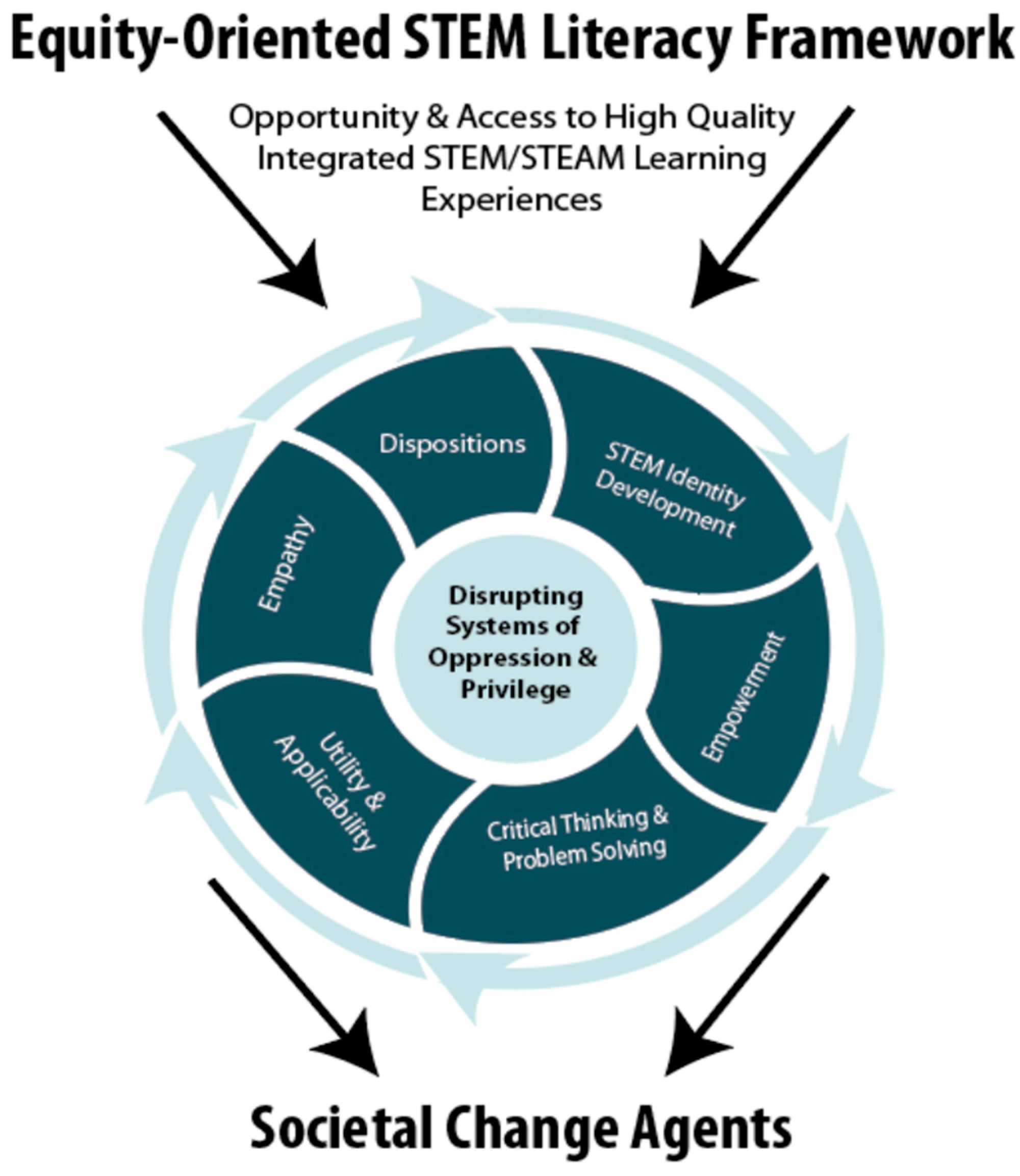
Jackson et al. (2021) offered an equity-oriented conceptual framework for K-12 STEM literacy. The elementary preservice teachers’ course in this study was designed with this framework as a guide. This framework (see Figure 1) argues that to disrupt systems of oppression and privilege that have systematically excluded many populations from STEM, every student must have access to high-quality, integrated STEM/STEAM learning experiences. Additionally, this framework centers the learner as a change agent, which is a markedly different approach than frameworks that focus on workforce development (Bhattacharjya, 2025) or STEAM as a way to broaden participation (e.g., Quigley & Herro, 2019). The choice to center the learner, their access and experiences in high-quality integrated STEM/STEAM learning experiences, and the positive outcomes expected from engagement in those learning experiences directly frame the approach in this study. The research question focuses on individual’s perceptions of their lived experiences, similar to how the framework focuses on access and opportunity to high-quality integrated STEM/STEAM learning experiences for each and every student. The analytical methods are informed by the framework. The framework authors operationalized high-quality integrated learning experiences through the integrated STEM practices (Roberts et al., 2022). Thus, the ISPs were used as an analytic tool, as others have done (Edelen et al., 2024).
High-quality integrated STEM/STEAM learning experiences are characterized by the Integrated STEM Practices (ISPs; Roberts et al., 2022; Jackson et al., 2021). The four practices are: (1) use critical and creative thinking to seek solutions; (2) collaborate and use appropriate tools to engage in iterative design; (3) communicate solutions based on evidence and data; and (4) recognize and use structures based on real-world systems. These characteristics enable teacher educators to support elementary generalists in the content that content administrators expect them to teach, while remaining broad enough to focus on design-based projects that teachers can readily transform into transdisciplinary STEAM scenarios. The ISPs were developed by synthesizing ideas from disciplinary practice standards (i.e., Standards for Mathematical Practice, Science and Engineering Practices, Technology and Engineering Practices), all of which emphasize problem-solving (Roberts et al., 2022). When engaging in these high-quality integrated STEM/STEAM learning experiences, Jackson et al. (2021) argue students experience integrated STEM/STEAM grounded in empathy, see the utility of disciplinary ideas being applied in real-world settings, use and develop critical thinking and problem-solving skills, develop positive STEM identities and productive STEM dispositions, and, ultimately become empowered to use their knowledge to become societal change agents. Following Edelen et al.’s (2024) example, using Jackson et al.’s (2021) conceptual framework as the analytical guide. We used the six components and the ISPs to conduct a deductive qualitative analysis.

2. Materials and Methods

2.1. Research Aims

This study aimed to assess PSETs’ perceptions of equitable STEAM teaching and learning following participation in a required introductory STEAM course. Using a qualitative design grounded in collaborative, iterative inquiry, we drew on two complementary frameworks: the Integrated STEM Practices (ISPs; Roberts et al., 2022; Jackson et al., 2021) and Equity-Oriented STEM Literacy Framework (Jackson et al., 2021). While the Equity-Oriented STEM literacy framework has already been used in both STEM and STEAM contexts, the ISPs have been applied primarily in STEM-focused contexts. We considered several existing STEAM-specific frameworks that emphasize integration, creativity, or design-based learning (e.g., The STEAM Learning Architecture, Glass et al., 2024; Al-Mutawah et al., 2022; STEAMComp Edu Framework, Spyropoulou & Kameas, 2024; Road-STEAMer, Chappell et al., 2025). While these frameworks offer valuable guidance, we selected the ISPs in combination with the Equity-Oriented STEM Literacy Framework because together they foreground both access to high-quality learning experiences and the sociopolitical dimensions of participation. This pairing allowed us to examine not only whether integration occurred, but who had access to meaningful sensemaking within those experiences. Access to high-quality learning experiences is foundational within the Equity-Oriented STEM Literacy Framework. The Integrated STEM Practices framework operationalizes what such access looks like in practice (Jackson et al., 2023), making it a necessary entry point for examining how equity-oriented outcomes might develop over time. Without access to meaningful, integrated learning experiences, we would not expect PSETs or student growth in agency, identity, or critical sensemaking to follow. In this work, we intentionally extended the ISPs into a STEAM context to examine how PSETs make sense of equity, integration, and transdisciplinary learning in practice. We acknowledge this extension as both innovative and provisional, and we return to this tension in the discussion. Specifically, we sought to answer the following research question: What are the preservice teachers’ perceptions of equitable STEAM after engaging in a formal STEAM learning experience?

2.2. Participants

There were 47 participants in the study. Participants were PSETs enrolled in a traditional, inclusive early childhood and elementary (PK-5) generalist teacher preparation program at a large, public, comprehensive, predominantly White institution in Northwest Ohio. Students in this program receive either a generalist single license or a dual license in special education upon graduation. PSETs were recruited from their sophomore-level STEAM methods course. 62% of these preservice teachers were first-year students that were classified as sophomores, due to enrollment in high school college-credit programs.

2.3. Setting

To support preservice teachers’ science and mathematics content knowledge and to meet state standards for teacher preparation, the Introduction to STEAM Education course is required for all PSETs in the program and meets for four hours each week. From a programmatic standpoint, the Introduction to STEAM course was designed to reinforce content knowledge in science and mathematics while also introducing PSETs to equity-centered, transdisciplinary approaches to STEAM teaching and learning. Given that many PSETs identify science and mathematics as areas of anxiety (Bursal & Paznokas, 2006), the course was intentionally designed to create conditions that support the development of teaching self-efficacy alongside content understanding.
PSETs engaged in a sequence of intradisciplinary, multidisciplinary, project-based interdisciplinary, integrated STEM, and transdisciplinary STEAM learning experiences through four scaffolded design challenges. These challenges were grounded in the ISPs and the Equity-Oriented STEM Literacy Framework and required PSETs to collaboratively design, enact, and revise STEAM instructional units. The Introduction to STEAM course was intentionally designed to provide PSETs with multiple vicarious learning opportunities. By allowing PSETs to observe their peers teach, they had an opportunity to better understand and navigate instructional decision-making. Creating a culture of realistic public practice also allowed PSETs to make their thinking visible, support each other, and refine their teaching practices over the course of the semester.
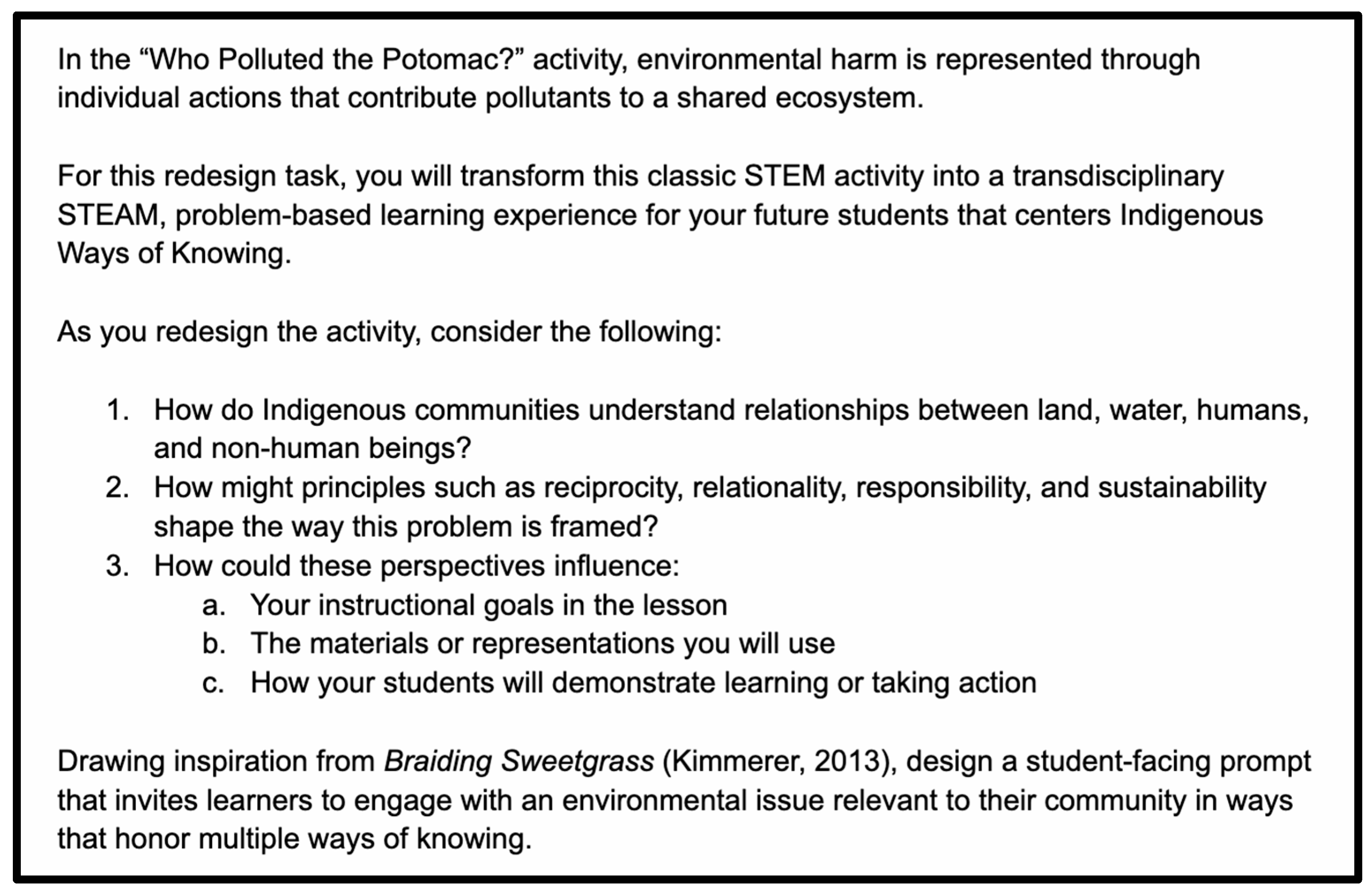
To make equity-oriented commitments explicit rather than implicit, design challenges included prompts that asked PSETs to engage with non-dominant ways of knowing. For example, one transdisciplinary STEAM challenge foregrounded Indigenous epistemologies by asking PSETs to consider how local Indigenous communities understand land, water, and sustainability, and how these perspectives might shape instructional goals, materials and assessment decisions (Figure 2). Including these prompts positioned equity in STEAM as an epistemological and curricular concern rather than solely a matter of representation. However, because many PSETs were encountering Indigenous Ways of Knowing for the first time, the course functioned as an entry point rather than a mastery experience, underscoring the need for sustained engagement with equity concepts across multiple STEAM courses and programmatic experiences. Vicarious learning occurred through structured peer observation and feedback cycles, including microteaching experiences and collaborative analysis of mixed-reality Mursion simulations. During these activities, PSETs alternated between teaching, observing, and providing feedback. A central feature of the course was the use of Swivl Mirror, an artificial-intelligence-supported reflective tool that guided PSETs through structured video-based reflection. Swivl Mirror combines instructor-authored prompts with AI-generated follow-up questions that respond to users’ spoken reflections. This tool was used after each design challenge to support metacognition, make instructional thinking visible, and encourage iterative refinement of practice (Swivl, n.d.).
Through Swivl Mirror reflections, PSETs were encouraged to make their thinking visible. PSETs modeled vulnerability, made mistakes in front of their peers, and had opportunities to demonstrate growth by implementing real-time feedback from their instructor, peers, and the Swivl AI-generated feedback. These experiences provided low-stakes, developmentally appropriate opportunities that were neither evaluative nor performative. Developing a learning environment like this reinforces teaching as an adaptive and collaborative practice.
Engaging in these reflections encouraged PSETs to examine sources of self-efficacy, including their emotional responses, perceived successes, and challenges. PSETs also made connections between observed peer practices and their own. Collectively, these course structures created a co-constructed learning environment that supported mastery experiences, vicarious learning, social persuasion, and positive emotional engagement. These conditions are foundational for building early teaching self-efficacy in integrated STEAM.
The focus is on reinforcing content knowledge in science and mathematics. However, it is also important for the PSETs to explore transdisciplinary learning and think about teaching STEAM equitably. Therefore, the PSETs experienced intradisciplinary, multidisciplinary, and project-based learning, as well as interdisciplinary and integrated STEM and transdisciplinary STEAM instructional units. After a series of four design challenges that leveraged the equity-oriented STEM literacy framework and ISPs, the PSETs were asked to reflect on their experiences using Swivl Mirrors. Mirror by Swivl is a device equipped with artificial intelligence to facilitate critical reflection. The accompanying software, MirrorTalk, automates the PSETs’ reflection process and promotes metacognition by providing insights from artificial intelligence (Swivl, n.d.).

2.4. Data Sources

The data sources for this study were Swivl Mirror reflections. These were the culminating reflections following the preservice teachers’ completion of their four STEAM challenges. The starting question on the final reflection was “How has using the Swivl mirrors influenced your ability to reflect?” The instructor independently formulated this question along with a series of questions including “describe ways that you can connect various aspects of Social Studies into STEAM” to understand PSETs’ conceptualizations of the arts and humanities in the “A” of STEAM. PSETs were also asked to share their understanding of Indigenous Ways of Knowing and their relevance to STEAM and to describe how they would go about transforming a classic STEM lesson like “Who Polluted the Potomac” into a transdisciplinary STEAM scenario. Before moving into AI-generated follow up questions, PSETs had a chance to disclose their main take-aways from the course as a preservice teacher.
Afterwards, the Swivl Mirror AI technology generated follow-up questions. Examples include: “What similar teaching techniques or strategies have you encountered in the past that resonate with your current reflections? Can you think of a specific aspect of your hands-on approach that could be altered—perhaps by changing the materials or the way you present them? How might you rearrange your lesson plans to allow for more flexible and responsive teaching based on student feedback? What additional resources or tools could enhance your teaching effectiveness and provide a greater impact on your students’ learning? Is there an element of your teaching that you could simplify or streamline to make it more effective for your students? Who else, such as a colleague or mentor, could provide a fresh perspective on your teaching strategies and help you improve? Imagine if you reversed the roles in your classroom: how would students teaching a lesson about your hands-on approach change the dynamics and impact of learning?” (Swivl, n.d.) While follow-up questions varied slightly across participants, they consistently prompted reflection on instructional decision-making, responsiveness to learners, and opportunities for refinement. Swivl Mirror was used exclusively to support and structure participant reflection. The AI-generated prompts functioned as reflective scaffolds during data generation. However, artificial intelligence was not used in the coding, analysis, or interpretation of data.

2.5. Data Analysis

Data analysis was conducted through an iterative, multi-phase process that combined inductive and deductive qualitative approaches. First, all video reflections were transcribed verbatim. All three members of the research team independently conducted inductive open coding to attend closely to participants’ lived experiences and language consistent with a phenomenological orientation (Creswell, 2014). During this phase, the three coders generated descriptive codes that captured salient ideas such as emotional responses to teaching, perceptions of integration, and moments of uncertainty or growth.
Following initial open coding, the research team met to compare codes, discuss discrepancies, and refine a shared codebook. Agreement was established through consensus rather than statistical inter-rater reliability, as the goal was interpretive alignment rather than quantification. In the second phase, deductive coding was conducted using a priori codes derived from the Integrated STEM Practices and the Equity-Oriented STEM Literacy Frameworks. These framework-based codes were applied to the data to examine how PSETs articulated equity, integration, and disciplinary connections in their Swivl reflections. Table 1 presents the full set of a priori codes used in this phase.
In the final analytic phase, the team engaged in pattern coding (Saldaña, 2016) to examine relationships across inductive and deductive codes. Codes were clustered based on conceptual similarity, frequency, and explanatory power, resulting in broader themes that captured recurring patterns in participants’ perceptions. Throughout this process, the team actively sought disconfirming evidence and examined contradictory cases to refine theme boundaries and ensure analytic rigor. Themes were finalized through iterative discussion and were considered trustworthy when they were supported by multiple data excerpts across participants and aligned with, yet not constrained by, the two guiding frameworks. Due to the fact that data sources consisted of self-reported reflections, findings reflect PSETs’ perceptions and sensemaking rather than direct observation of instructional practice.

2.6. Researcher Reflexivity and Methodological Considerations

This study was conducted by a research team that included the course instructor, course designer, previous course instructor, and researchers with experience in STEAM teacher education, equity-oriented pedagogy, and qualitative research. As instructors and researchers, we recognize that our dual roles shaped both the design of the course and the framing of the research questions. To mitigate the influence of these roles on our analysis, data was examined collaboratively, with multiple researchers engaging in independent coding and iterative consensus-building.
We also acknowledge that Swivl Mirror, as an artificial-intelligence-supported reflective tool, functioned as an active mediator in the data generation process rather than a neutral prompt. The AI-generated follow-up questions likely shaped the depth, direction, and focus of participants’ reflections, potentially amplifying certain forms of pedagogical reasoning while constraining others. For that reason, data included in the results comes from the researcher generated questions. However, rather than treating this as a limitation to be eliminated, we approached AI mediation as a feature of contemporary teacher learning environments that warrants critical examination.
Finally, we recognize the methodological tension inherent in extending the Integrated STEM Practices to a STEAM context. While the course intentionally foregrounded arts-based and transdisciplinary approaches, participants’ reflections often revealed uneven integration across disciplines. We therefore interpret our findings as illustrative of PSETs’ developing understandings of equitable STEAM, situated within the constraints of early coursework, rather than as evidence of fully realized transdisciplinary practice.
Following a STEM-based environmental simulation “Who Polluted the Potomac?” PSETs were asked to redesign the activity as a problem-based STEAM learning experience that explicitly centered Indigenous epistemologies, including relationality, reciprocity, and sustainability. The prompt positioned equity as an epistemological and curricular concern, guiding PSETs to consider how non-dominant ways of knowing might shape instructional goals, materials, and assessment decisions. While the prompt made equity-oriented commitments explicit, many PSETs were encountering these perspectives for the first time, highlighting the course’s role as an entry point rather than a mastery experience.

3. Results

The following themes emerged from our data analysis: (1) Understanding Integrated STEM Frameworks Through a Transdisciplinary and Critical Lens; (2) STEAM is Engaging Because It is Relevant; and (3) Self-Efficacy for Future STEAM Integration without Infrastructure. *Indicates pseudonyms.

3.1. Theme 1: PSETs’ Reported Understandings of Integrated STEM Frameworks Through a Transdisciplinary and Critical Lens

Through a transdisciplinary STEAM lens, PSETs reflected on their learning experiences using Swivl Mirrors, documenting moments in which they engaged with the Integrated STEM Practices and the Equity-Oriented STEM Literacy Framework (Jackson et al., 2021). Many PSETs noted that STEAM learning experiences prompted them to consider the utility and applicability of disciplinary content and to reflect on how they could meaningfully apply it to real-world problem scenarios.

3.1.1. Reported Connections Across Disciplines and Real-World Contexts

As an example, Amy* reflected on how teachers can integrate knowledge and skills from different disciplines in STEAM, sharing: “We discovered that it takes a lot of thinking to bring together all the parts of STEAM.” Other students talked about integrating knowledge and skills through occupational identity development and real-world connections. Anita spoke about an earlier assignment in Scratch, saying, “The skills I practice in the Scratch assignment might apply to our [final] project in the future and a different class or even my career, because it lets me see how I can integrate many skills into one to create something.”
PSETs highlighted how they learned through the design process and connected knowledge across the STEAM scenarios as learners. Abigail offered an idea for her future students, saying, “I think you could kind of mimic what we did in class, and also like how we polluted the water, but also you could practice researching and implementing ways of better clearing the water and filtering it out, which can also be beneficial to teach students.”

3.1.2. Learning Through Design, Iteration, and Disposition Development

PSETs also reflected on dispositions as they grappled with challenging problems. One student shared how her mindset helped with challenging content and group dynamics. “Certain aspects of the assignments definitely involved a lot of problem-solving skills, as we were kind of unfamiliar with how to use the programs and tools at first. We were just doing a lot of trial and error to figure out what was going to work best. Overall, I think working with a group of people has pros and cons. If you can be, you know, compassionate and empathetic and kind, it usually works out better than just working alone.”

3.1.3. Equity-Oriented Intentions and Persistent Misconceptions

Empathy and Indigenous Knowledge: Some PSETs attempted to incorporate Indigenous Ways of Knowing into their STEAM designs. However, their reflections frequently revealed misunderstandings, such as treating Indigenous peoples and knowledge as historical artifacts or monolithic worldviews rather than a living, contemporary system. These misunderstandings may, in part, be due to the educational context in a state with no federally recognized tribes. While there are ongoing misconceptions about Indigenous Ways of Knowing (Kimmerer, 2011), the PSETs worked to identify instances and approaches for incorporating Indigenous Ways of Knowing into their understanding and application of the Equity-Oriented STEM Literacy Framework and the ISPs. The PSETs’ reflections align with the two frameworks’ emphasis on expanding access to high-quality, integrated STEM and STEAM learning experiences, which can support the movement to disrupt systems of oppression and privilege in education (Jackson et al., 2021).
While many PSETs expressed intent to engage with equity-oriented components of STEAM, their reflections also revealed significant tensions and misconceptions, particularly in relation to Indigenous Ways of Knowing. “Through looking at different Indigenous Ways of Living, we included that in our pop-up book project so that you can include it in the arts part of STEAM and engineering, and looking at different ways people have lived.” In this quote, Talia*, like many of her classmates, talks about Indigenous people only through a historical, past-tense lens.
Similarly, Oaklyn* shared her definition of Indigenous Ways of Knowing and the relevance of these concepts to STEAM, saying it is “with Native Americans and understanding how they lived and their knowledge…because we need to know how they lived and their knowledge. It was the foundation of what we know now with modern technology because they basically started it.” While this is an asset-based affirmation of contributions to the STEM field, it perpetuates a misconception about what Indigenous Ways of Knowing are and the current existence of Indigenous cultures in the United States.
These findings raise serious concerns about the adequacy of a single-course intervention for disrupting deeply rooted settler-colonial narratives. Despite explicit equity-oriented intentions, several PSETs reproduce the deficit and historical framings of Indigenous peoples that erase contemporary Indigenous presence and knowledge systems. This suggests that introducing Indigenous Ways of Knowing without sustained engagement, community partnership, or explicit critical framing may inadvertently reinforce the very misconceptions such instruction seeks to disrupt. Future iterations of the course will require deeper collaboration with Indigenous education scholars and community partners, as well as expanded instructional time dedicated to unpacking settler colonialism and contemporary Indigenous sovereignty. These changes are necessary if equity-oriented STEAM instruction is to avoid reproducing harm.

3.1.4. Emerging Empowerment, and Critical Awareness Through Collaboration

Despite these tensions, many PSETs also described moments of empowerment and emerging critical awareness as they engaged in collaborative, iterative STEAM design. Many PSETs described moments of empowerment during their solution iterations in engineering design projects. Numerous students described increased confidence, motivation, and opportunities to engage in critical thinking. Aria said that she has “gotten so many examples of like activities and lessons and how to teach STEAM scenarios. I feel like so much more confident than I did versus how I thought and felt at the beginning of the semester.”
Finally, PSETs described collaborative processes and iterative design. PSETs described engaging with the four Integrated STEM Practices and the Equity-Oriented STEM Literacy Framework throughout the Introduction to Elementary STEAM course through theoretical examination and practical application. PSETs identified opportunities to apply the framework’s components to their STEAM experiences, despite the ISP’s current focus on STEM rather than STEAM. They also identified connections to the Equity-Oriented STEM Literacy Framework that are relevant to problem-based, authentic transdisciplinary STEAM scenarios. Specifically, PSETs pinpointed moments where they could apply critical and creative thinking to solve real-world problems and foster empathy within STEAM problem scenarios.
Victor* explored the further development of empathy in the course. He said that it is “kind of good to work together and figure out everyone’s strengths and how we can cooperate together to help each other and solve important problems in groups.”
Overall, these findings suggest that PSETs are beginning to internalize integrated STEM and equity-oriented frameworks through transdisciplinary STEAM experiences, while simultaneously revealing the limits of early exposure and the need for sustained, scaffolded engagement with critical and cultural dimensions of equity.

3.2. Theme 2: STEAM Is Engaging Because It Is Relevant

PSETs described their experiences with transdisciplinary STEAM in the course as broadly engaging, challenging, and, at times, joyful. Their reflections emphasized how the transdisciplinary learning scenarios can feel immersive and even relevant to their individual lived experiences. Several reflections noted connections to local contexts, such as environmental justice issues in the Maumee River region.

3.2.1. Local Contexts and Justice-Oriented Relevance

PSETs frequently describe engagement emerging from locally grounded, justice-oriented problem contexts that connect disciplinary learning to students’ lived experiences. Group members* Audrey, Aurora, Kennedy, and Natalie described an instructional unit they could design that integrates various elementary STEM standards, social justice, and the Maumee River. “I would bring in water and create a model for students. We could look at frozen water and it melting into liquids. We could look at the Maumee River and how its water is affected by humans.” Beyond states of matter, Aurora wanted to focus more on pollution in the Maumee River. She said that her future students “need to figure out how to either stop pollution or get some of the pollution out, given a strict budget and a certain amount of time.” Kennedy focused more on Chemistry and the impact of dumping different pollution sources in the Maumee. Meanwhile, Natalie suggested a focus on geographic mapping, in which students could explore landforms, runoff patterns, and pollution sources associated with businesses in their community.

3.2.2. Productive Challenge and Joyful Engagement

Engagement was also shaped by the cognitive demands of problem-based STEAM scenarios, which POSETs described as both challenging and joyful. PSETs recognized both real-world systems and structural interconnections. The problem-based nature of STEAM scenarios presented locally relevant challenges (Pang et al., 2021) that PSETs found stimulating and capable of fostering critical thinking and creative problem-solving. The PSETs used Swivl Mirror AI-augmented reflections to brainstorm modifications to existing STEM lessons that would make them both transdisciplinary and culturally relevant for their future students (B. A. Brown et al., 2019). Although participants acknowledged the cognitive demands of the problem-based scenarios that were leveled up beyond elementary expectations to give them a sense of the challenge and what their students would be feeling, many still characterized the experience as joyful. This joyful feeling suggests that the challenge and positive feelings were able to coexist within the transdisciplinary learning environment. It also aligns with prior research indicating that teacher educators can support positive outcomes for PSETs’ dispositions through participation in relevant STEAM learning environments (An, 2020).
While students found the trial-and-error process at times overwhelming, they also found value in it. Victor* shared that he recommended that future students “keep trying even if there’s a lot of trial and error in a particular assignment. You get practice in feeling what it feels like to mess up, take a step back, see why you messed up, and then think of ways to improve it.”
Talia found joy in this process. She said she “didn’t know anything about STEAM before this class, but I really liked it.” She found the most joy when the instructor authentically integrated the arts and humanities.

3.2.3. Arts and Humanities as Meaningful, Not Additive, Components of STEAM

For many PSETs, engagement depended when the arts and humanities were positioned as integral disciplinary lenses rather than superficial additions. The integration of the arts and humanities (the “A” in STEAM) also enhanced the perceived relevance of learning experiences.
“Art isn’t something that you just slap on. It is its own discipline.” Juliana* said that she was having “fun with what [she does], especially with the STEAM stuff. It doesn’t have to be the stereotypical science and math learning that’s very cut-and-dry. There’s so much room for creativity.” Earlier in the reflection, she described how she connected a class activity to an issue concerning the water quality of the Maumee River in her community.
Despite expressing challenges with problem-based scenarios, PSETs described the experience overall as joyful and motivating. Pepper described her experience, saying that she enjoyed using “science to figure out engineering processes and environmental interactions. Social Studies really connects stuff like that in real life.”
STEAM is engaging because it demonstrates the relevance, local applicability, and immersive nature of transdisciplinary challenges, which are critical drivers of engagement and shape PSETs’ perceptions of STEAM as an enjoyable and meaningful pedagogical approach. These findings suggest that STEAM is engaging for PSETs not simply because it is a hands-on learning experience. Instead, it is because it is locally relevant, cognitively demanding, creative, and connected to real-world systems that matter to learners and their communities.

3.3. Theme 3: Self-Efficacy for Future STEAM Implementation Without Infrastructure

While PSETs expressed growing confidence and enthusiasm for STEAM, they also named persistent structural barriers in early childhood and elementary settings within the broader educational landscape. This tension between theory and practice is understandable given their developing self-efficacy, shaped by mastery experiences and evolving beliefs about student capability, alongside their recognition of the limited infrastructure and support within the educational landscape. This lack of critical infrastructure threatens the ability of PSETs to ultimately apply their learning from the STEAM course, let alone actually sustain the pedagogical innovations in their future career. This theme captures a paradox: while PSETs developed strong beliefs in their instructional capabilities, they simultaneously recognized that existing curricular structures, time constraints, and classroom management demands may hinder the sustainable implementation of these practices in their future classrooms.

3.3.1. Growing Confidence in Transdisciplinary STEAM Design

Despite recognizing structural challenges, many PSETs described increased confidence in their ability to design and implement transdisciplinary STEAM learning experiences. Kehalani* argued that STEAM is an “easy way to incorporate science in social studies.” Another PSET reported increased confidence in designing and implementing problem-based learning. Juliana* said, “I didn’t realize how easily you could incorporate different topics into one problem, in one activity. I think I always thought it would take a long time to craft something like that, and sometimes I still think it would. But I learned that it’s not as hard as it looks, or I just became more confident with it.”
PSETs articulated their ability to transform classic STEM and integrated STEAM activities into authentic, transdisciplinary STEAM scenarios. Their experiences as learners within the STEAM course, coupled with the critical reflections facilitated by Swivl Mirrors and augmented by artificial intelligence, appeared to build their confidence in designing and implementing similar learning experiences for their future students.

3.3.2. Shifts in Beliefs About Student Capability

Several PSETs also described shifts in their beliefs about what elementary students are capable of when provided with appropriate scaffolding. For example, one PSET noted how her beliefs changed as a result of her experiences engaging in an integrated STEM and STEAM instructional unit as a learner.
“Students are a lot more capable than we think they are. Coming into [this] class, I was like ‘Students are not going to be able to do any of this.’ Like I feel as college students, it’s too challenging for us, so I cannot even imagine how it is for them, but I think I don’t give them enough credit for how much they are capable of. They can do projects like this, but they might need a little bit more scaffolding… It is something they would enjoy too, with a little challenge.”—Bellamy*
This finding addresses a crucial gap in elementary teacher preparation: teachers often lack the experience, training, or confidence to teach STEAM (Herro & Quigley, 2017).

3.3.3. Structural Barriers and the Limits of a Single Course

At the same time, PSETs consistently named structural constraints that shaped what they perceived as feasible in real classroom contexts. Participants at times defaulted to STEM-only thinking rather than transdisciplinary STEAM. PSETs’ prior experiences may influence this tendency, particularly in relation to PK-12 students and the regional educational landscape.
PSETs’ reflections also revealed persistent structural barriers to preparing for challenges in their future careers, including building a collaborative learning environment (classroom management), logistics (time constraints), and limited resources (funding disparities). These tensions suggest that a single STEAM course, particularly early in a teacher preparation program, cannot, on its own, transform teaching practice. Consequently, there is a need for sustained programmatic support and systemic change beyond the university setting.

3.3.4. Reflective Practice as an Emerging Skill

PSETs also described reflection itself as a developing practice, requiring additional time and support. Addie shared that “[Using the Swivl Mirrors] has made me a little better at reflecting, but I could still use some more practice. I think those recordings were painful to listen to.”
Amy concluded that the Swivl Mirrors “allowed me to be more open. I would say that, and they also allow me to say what I actually want to say, so I don’t feel as nervous reflecting.”
This theme underscores the need for an early STEAM course in teacher preparation programs to address PSET dispositions and skills. While an early STEAM course can meaningfully support PSETs’ developing self-efficacy, sustained programmatic support and systemic change are still necessary for these pedagogical commitments to be enacted and maintained in practice. Additionally, researchers and practitioners need to consider how to shape the educational structures that determine what is possible for in-service teachers in classrooms.

4. Discussion

This study explored how PSETs made sense of STEAM after participating in a transdisciplinary, equity-focused STEAM course early in their teacher preparation program. Across the participants’ reflections, we found several patterns that speak to both the potential and the limits of early STEAM coursework. Together, the findings suggest that introducing STEAM early can support the development of teaching self-efficacy and make visible the structural conditions that shape what PSETs imagine as possible in their future classrooms. In other words, the Introduction to STEAM course did not simply build the PSETs’ confidence. It also surfaced the realities of the educational systems they anticipate entering. Attending to both of these dimensions will help researchers and practitioners understand how transdisciplinary STEAM can move from preservice to inservice. As noted in the researcher reflexivity statement, these findings should be interpreted in light of both the instructor-researcher positioning of the research team and the AI-mediated nature of the reflective prompts, which shaped how PSETs articulated their experiences of STEAM learning. The findings suggest that while PSETs began to recognize the importance of equity-oriented STEAM, many were still in early stages of sensemaking. This is not unexpected but serves as a limitation for this study given the time constraints of the course. Equity-oriented teaching requires unlearning dominant narratives, examining positionality, and developing new pedagogical processes that evolve over time rather than develop fully within a single course. Other limitations should be considered when interpreting the findings of this study. For example, the data are based on PSETs’ self-reported perceptions rather than direct observation of classroom enactment or analysis of instructional artifacts. Therefore, the findings reflect how the PSETs ultimately described their thinking and experiences instead of more objective observations of their enactment. The claims are therefore limited to the PSETs’ reported understandings and sensemaking within the context of the Introduction to Teaching Elementary STEAM course. Given the fact that the study is situated within a single institutional context and course design, its generalizability is limited. While the findings do offer insight into how PSETs make sense of equity-oriented STEAM prompts within this setting, they may not be able to transfer directly to other contexts including different education programs, levels of disciplinary integration, or institutional contexts.

4.1. Sources of Self-Efficacy in the Introduction to STEAM Education Course

PSETs’ reflections point to multiple sources of developing self-efficacy for STEAM teaching that align with Bandura’s (1997) framework. Across the course, PSETs described gaining confidence through repeated opportunities to engage in the four transdisciplinary design challenges that required them to grapple with complex problems and instructional designs. Designing and revising STEAM instructional units, in particular, appeared to strengthen participants’ beliefs in their ability to think critically and plan instruction that extended beyond intradisciplinary teaching.
Course structures also mattered. Standards-based grading, which allowed PSETs to revise and resubmit work, shifted how a lot of the participants talked about assessment in relation to the course. Rather than framing assignments as high-stakes evaluations, the PSETs described them as opportunities to practice, receive feedback, and improve over time. This emphasis on mastery supported a sense of accomplishment even when their initial attempts were unsuccessful.
Vicarious learning emerged as another important mechanism for supporting PSETs’ teaching self-efficacy. Throughout the course, PSETs observed their peers navigating uncertainty during microteaching and Mursion simulations, and many referenced these moments when reflecting on their own learning. Watching classmates struggle, adapt, and receive real-time feedback appeared to normalize the iterative process and reposition teaching as a collaborative act and an evolving practice rather than a flawless performance of expertise. Feedback from peers and the instructor further reinforced incremental growth.
As discussed in the methods and reflexivity section, Swivl Mirror functioned not only as a data collection tool but also as a mediating learning structure, shaping the forms of reflection and pedagogical reasoning that participants made visible in their final reflections. This mediation is particularly relevant for understanding how vicarious learning and social persuasion were experiences, as AI-generated prompts may have foregrounded iteration, responsiveness, and instructional adaptation.
Finally, participants frequently described the learning environment itself as emotionally supportive. Feelings of curiosity, enjoyment, and collective problem-solving were often mentioned alongside moments of frustration. Together, these experiences exposed PSETs to early sources of teaching self-efficacy that may continue to develop as they move into methods of coursework, field placements, student teaching, and beyond.

4.2. Relevance and Engagement in STEAM

The second theme centers on relevance and engagement, with PSETs frequently describing STEAM learning as meaningful and motivating. Engagement was strongest when learning experiences were clearly local, place-based, or personally relevant. Participants often emphasized how community-connected problems and real-world contexts made abstract content feel more accessible and worthwhile.
This emphasis on relevance aligns with prior STEAM research suggesting that meaningful contexts can support motivation and identity development (Bequette & Bequette, 2012; Herro & Quigley, 2017). In this study, authentic problems, community resource mapping, and the meaningful integration of diverse conceptions of the arts and humanities contributed not only to engagement but also to how participants began to see themselves as future educators.
Consistent with Jackson et al. (2021), these shifts in engagement and identity were most evident when STEAM experiences were designed as integrated and purpose-driven rather than as isolated activities. Participants also suggested that future mathematics and science methods courses could strengthen these connections by continuing to prioritize locally relevant, culturally meaningful problems. Doing so may help reinforce confidence while making the interconnectedness of content areas more visible across the program.

4.3. Structural Tensions and the Need for Stronger STEAM Frameworks

The third theme in our study reveals a persistent tension in STEAM teacher education. Although participants expressed enthusiasm for STEAM and confidence as learners, these beliefs did not consistently translate into how they imagined teaching in their future classrooms. Many PSETs described imagining that they would be running up against familiar constraints, including standardized testing pressures, limited instructional time, curriculum mandates, and broader accountability policies.
In some cases, participants defaulted to STEM-centric ways of thinking when envisioning classroom practice. These responses were often grounded in lived experience, both from their own schooling and from what they observed in field placements. Such patterns are notable given existing scholarship demonstrating that transdisciplinary STEAM approaches, including the arts and humanities, can broaden participation in STEM and computer science for historically marginalized learners (Quigley et al., 2024; Rabalais, 2014; Wajngurt & Sloan, 2019).
These findings suggest that a single course, even one intentionally designed around equity and transdisciplinary learning, is unlikely to disrupt deeply embedded disciplinary norms on its own. In our experience as teacher educators, this appears especially true when STEAM coursework occurs later in a preparation program or remains disconnected from methods courses and field experiences. Participants’ reflections point to the need for multi-course scaffolding and systemic support if justice-oriented STEAM is to be sustained beyond university teacher preparation settings.
The findings also raise questions about the adequacy of existing STEAM frameworks. Many commonly used models, including those drawn upon in this study, originated in integrated STEM contexts and may not fully account for equity-centered, transdisciplinary goals. Participants’ reflections suggest that STEAM frameworks would benefit from more explicit attention to cultural knowledge, empathy, and collaborative problem-solving in order to avoid either superficial or simply additive implementations.

4.4. Equity Implications

Although the Introduction to STEAM course aimed to authentically integrate Indigenous Ways of Knowing alongside Western science and engineering, some PSET reflections revealed lingering misconceptions. This finding highlights the need for deeper pedagogical scaffolding in equity-oriented STEAM, as well as more explicit integration of social studies and civic learning within transdisciplinary approaches. PSETs also need ongoing explicit instruction on culturally relevant, responsive, and sustaining pedagogies and practices. Jackson et al.’s (2021) Equity-Oriented STEM Literacy Framework provides a valuable scaffold. Still, teacher preparation programs need to also address the structural and systemic factors that can either enable or hinder implementation beyond coursework. Ways to address systemic and structural factors might include research-practice partnerships with cooperating mentor teachers and partner school districts to understand barriers to transdisciplinary STEAM in PK-12 settings. Framing equity as contingent on access helps explain why early experiences matter, but are insufficient on their own. The work of equity-oriented STEAM is demanding, iterative, and relational. It requires repeated opportunities for practice, reflection, and revision across time.

4.5. Programmatic Recommendations

Much of the existing research on STEAM education centers on inservice elementary and early childhood educators (Johnston et al., 2022), secondary and middle childhood contexts (Quigley & Herro, 2016), higher education and post-graduate programs (Henriksen, 2017), and informal or out-of-school learning environments (Perignat & Katz-Buonincontro, 2019). Compared with other areas, existing scholarship has paid little attention to how PSETs experience and sustain integrated and transdisciplinary STEAM learning within undergraduate elementary teacher preparation programs, particularly during the first two years of coursework.
From our experience as teacher educators, this is a crucial time when professional identities and beliefs are actively forming. The findings of this study emphasize the urgent need for research and programmatic design focused on multi-course, developmentally sequenced STEAM experiences for generalist programs in elementary and middle childhood. A central implication of this study is that a single STEAM course, even though it was intentionally designed to emphasize equity, reflection, and transdisciplinary problem-solving, is insufficient for teacher educators to support their PSETs to counter disciplinary norms and the structural constraints of the current educational landscape.
PSET participants developed both confidence and enthusiasm for STEAM as learners. However, they frequently defaulted to non-integrated, STEM-only framings when envisioning future classroom enactment. From our perspective as methods instructors, this pattern reflects our students’ lived experiences in PK-12 schooling in the region, our state’s licensure-driven coursework, and the limited field placements we can offer that often prioritize discipline-specific instruction and standardized assessment performance over integrative or justice-oriented approaches.
To address this mismatch, teacher preparation programs may need to move beyond isolated course-level innovations and consider how STEAM can be scaffolded across an entire program of study. Participants’ reflections suggest that when STEAM learning is confined to a single course, it can feel disconnected from the broader messages they receive about teaching in schools. Designing more longitudinal pathways, ones that intentionally link coursework, field experiences, student teaching, and the early years of induction, may help reduce this disconnect.
In practice, this could involve reinforcing early STEAM coursework through aligned field placements, content methods courses, and coaching structures, as well as partnerships with cooperating mentor teachers and administrators who are prepared to support innovative pedagogies. Without these kinds of support, we have seen that PSETs end up having to reconcile the conflicting expectations on their own. Several participants noted that while they were encouraged to experiment and innovate in university settings, the classrooms they observed during fieldwork frequently emphasized compliance, pacing guides, and test preparation. Prior research on teacher learning has similarly emphasized the importance of coherence across coursework and fieldwork for supporting sustained pedagogical change (Hammerness, 2006).
Strengthening coherence across mathematics and science methods coursework appears to be a particularly important next step. Although the Introduction to STEAM course provided transdisciplinary, equity-centered learning experiences, participants’ reflections suggest that these experiences may not be taken up or revisited in later methods courses. We also know this as faculty who teach some of the methods courses. When subsequent coursework continues to prioritize discipline-specific content and standardized assessment preparation without explicit connections to STEAM, PSETs will be left to make those connections independently.
Programs might address this tension by intentionally designing mathematics and science methods courses that build on shared frameworks and practices introduced earlier. For example, methods instructors could revisit common real-world problems in the region, use shared language around integrated practices, or coordinate field-based assignments during pre-student teaching and student teaching that foreground collaborative planning and student sensemaking. Over time, such alignment may help normalize STEAM as a legitimate approach to teaching core content rather than positioning it as an enrichment activity optional add-on.
Importantly, coherence does not require positioning STEAM in opposition to licensure requirements or accountability systems. Instead, aligned program design can support PSETs in learning how integrative, justice-oriented pedagogies deepen disciplinary understanding while remaining responsive to policy contexts. In this way, methods courses represent a critical opportunity to sustain the relevance and context-based learning introduced in early STEAM coursework.
As demonstrated in this study, PSET engagement and identity development were strongest when STEAM learning was grounded in authentic, community-connected problems. Mathematics and science methods courses, along with the humanities, can extend this work by revisiting similar contexts or design constraints while also deepening attention to discipline-specific pedagogical content knowledge. When instructional strategies, assessment practices, and curricular decisions are connected to shared transdisciplinary contexts, PSETs may be more likely to view STEAM as both accessible and instructionally legitimate.
The findings also point to the need for clearer program-level frameworks for conceptualizing STEAM, particularly in programs that prepare elementary and middle childhood generalists. Participants varied widely in how they understood STEAM, with some articulating its transdisciplinary potential and others describing it as STEM with added creativity or an art project. This variation suggests a need for explicit discussion of different levels of integration, including when less complex forms of integration may serve as developmentally appropriate entry points. Drawing on guidance from the Handbook on Research on STEM Education handbook (Johnson et al., 2020), teacher educators can help preservice teachers better understand when, why, and how different approaches to integration align with disciplinary and equity goals.
Finally, participants’ reflections highlight the potential role of structured reflective tools, including AI-assisted video reflection platforms such as Swivl, in supporting self-efficacy and metacognitive growth across programs (Livers et al., 2025). When introduced early and used consistently, these tools can help normalize productive struggle and make learning trajectories more visible over time. At the same time, reflective practices alone are insufficient. Teacher preparation programs must also attend to the structural conditions of early childhood and elementary schools, such as time, resources, curricular flexibility, and administrative support, that shape whether STEAM instruction is feasible and sustainable in practice. These findings should not be interpreted as a failure of the course design, but rather as evidence that equity-oriented STEAM learning is cumulative and developmental. Sustained opportunities across methods, coursework and field experiences are necessary for PSETs to move beyond surface-level engagement toward more robust, justice-oriented practice.

5. Conclusions

This study suggests that integrated STEAM coursework can support PSETs’ engagement, perceptions of integrated STEM and STEAM, and developing teaching self-efficacy (Webb & LoFaro, 2020), while also making visible the structural barriers that complicate transdisciplinary enactment in schools. Participants expressed enthusiasm for equity-centered, transdisciplinary learning and described growing confidence in their instructional capabilities. At the same time, these emerging beliefs were often tempered by accountability pressures, discipline-specific curricular norms, and a persistent disconnect between innovative university coursework and more traditional fieldwork experiences.
Even when explicitly prompted to reflect on STEAM, many participants reverted to more familiar STEM framings. These responses underscore how prior schooling experience, anxiety towards disciplines within STEM (Bursal & Paznokas, 2006) and programmatic structures shape what preservice teachers come to see as realistic or legitimate teaching practice. For content generalists in particular, STEAM may be perceived as aspirational rather than readily accessible without sustained support.
Taken together, these findings highlight an enduring challenge in elementary teacher education: preparing preservice teachers for transformative, justice-oriented practice within systems that continue to reward standardization and compliance. Although integrated STEM education remains a prominent policy priority, access to high-quality, equity-oriented STEAM experiences within teacher preparation is uneven (McMullin & Reeve, 2014; Nesmith & Cooper, 2020; Radloff & Guzey, 2016). Research on transdisciplinary STEAM learning for PSETs, especially in the early years of preparation, remains limited. Participants in this study recognized the potential of STEAM to support diverse learners and authentic problem-solving. However, they also described barriers that felt difficult to overcome without broader programmatic and structural change.
Addressing these tensions likely requires a shift away from one-off courses and toward more coherent, longitudinal program design. Intentionally scaffolding STEAM across coursework, field experiences, and induction may help preservice teachers better integrate what they learn in university settings with what they observe and enact in schools. Research-practice partnerships offer one promising mechanism for supporting this kind of alignment by creating shared spaces for identifying and addressing problems of practice across contexts. University teacher educators/researchers are uniquely positioned to launch and serve as brokers to facilitate these connections in such partnerships (Plank et al., 2023; Wentworth et al., 2022).
Teacher preparation programs must also find ways to hold together the realities of licensure and assessment requirements with the transformative potential of student-centered, justice-oriented pedagogy (Rosen et al., 2024). Providing preservice teachers with repeated opportunities to successfully experience STEAM as learners, curriculum designers, and facilitators, while also supporting critical examination of the systems they will enter, may help bridge this divide. Viewed in this way, the findings suggest that integrated STEAM coursework can build confidence and illuminate the limits of what a single course can accomplish on its own.
Future research should examine how coherence across STEAM, mathematics, and science methods coursework shapes PSETs’ instructional decision-making during fieldwork and induction years. Because the STEAM course in this study intentionally integrated social studies content through the arts and humanities, future work should also consider how social studies methods courses contribute to PSETs’ understanding of real-world contexts and authentic problems. Longitudinal, multi-course studies could explore how shared frameworks, aligned assignments, and coordinated field experiences support the sustained enactment of transdisciplinary, equity-centered practices within accountability-driven school environments.
Extending this line of inquiry, there is a need for longitudinal, systems-oriented research that follows preservice teachers across the full continuum of preparation and early career teaching. Studies that intentionally connect introductory STEAM coursework with methods courses, out-of-school learning experiences, coached field placements, student teaching, induction supports, and in-service professional learning can provide insight into how perceptions, self-efficacy, and instructional practices evolve over time. Research-practice partnerships offer a particularly promising infrastructure for sustaining this work by aligning universities, PK-12 schools, informal education partners, instructional coaches, and administrators around shared problems of practice (Coburn & Penuel, 2016; Farrell et al., 2022).
As acknowledged in the reflexivity statement, the application of the ISPs within a STEAM context introduces methodological tension, as participants’ reflections revealed uneven integration of the arts alongside stronger connections to science and mathematics. Rather than viewing this as a limitation, we interpret this tension as characteristic of early-stage STEAM learning and as evidence of the need for longitudinal, scaffolded program design. This study reinforces what many teacher educators and researchers know intuitively, that equity-oriented STEAM teaching is challenging work. It asks PSETs to rethink content, pedagogy, and power simultaneously. Rather than expecting immediate transformation, teacher preparation programs must create conditions for sustained engagement with this work over time.
Ultimately, this study affirms that while teacher preparation is necessary to realize the promise of integrated and transdisciplinary STEAM education, it is not sufficient in itself. Structural transformation within elementary education, supported by aligned policies, professional learning, and administrative leadership, is essential for translating preservice teachers’ confidence into sustained classroom practice. By centering equity, coherence, and developmental appropriateness in program design, teacher educators and researchers can work toward a preparation-to-practice pipeline that supports meaningful, inclusive, and transformative STEAM learning for all students.

Author Contributions

Conceptualization, H.M.P., S.D.L. and T.R.; methodology, H.M.P., S.D.L. and T.R.; software, H.M.P.; formal analysis, H.M.P.; investigation, H.M.P. and S.D.L.; resources, H.M.P., S.D.L. and T.R.; data curation, H.M.P. and S.D.L.; writing—original draft preparation, H.M.P., S.D.L. and T.R.; writing—review and editing, H.M.P., S.D.L. and T.R.; supervision, H.M.P. and S.D.L.; project administration, H.M.P. and S.D.L.; funding acquisition, S.D.L. All authors have read and agreed to the published version of the manuscript.

Funding

This research received no external funding.

Institutional Review Board Statement

The study was conducted in accordance with the Declaration of Helsinki, and approved by the Institutional Review Board of Bowling Green State University (protocol code 2240224-3, with approval granted on 6 December 2024).

Informed Consent Statement

Informed consent was obtained from all subjects involved in the study.

Data Availability Statement

The datasets presented in this article are not readily available because the data are part of an ongoing study.

Acknowledgments

This study was supported by an internal grant, the Shanklin AI Innovation Award awarded by Bowling Green State University.

Conflicts of Interest

The authors declare no conflicts of interest. The funders had no role in the design of the study; in the collection, analyses, or interpretation of data; in the writing of the manuscript; or in the decision to publish the results.

Abbreviations

The following abbreviations are used in this manuscript:
PSETPreservice Elementary Teacher
STEMScience, technology, engineering, and mathematics
STEAMScience, technology, engineering, the arts, and mathematics

References

  1. Alkhatatneh, S. (2024). Mathematics teachers’ perceptions the steam approach: Science, technology, engineering, arts, and mathematics and its relationship with some variables. Journal of Curriculum and Teaching, 13(4), 71–92. [Google Scholar] [CrossRef]
  2. Al-Mutawah, M. A., Thomas, R., Preji, N., Alghazo, Y., & Mahmoud, E. (2022). Theoretical and conceptual framework for a STEAM-based integrated curriculum. Journal of Positive School Psychology, 6(5), 5045–5067. [Google Scholar] [CrossRef]
  3. An, S. (2020). The impact of STEAM integration on preservice teachers’ disposition and knowledge. Journal of Research in Innovative Teaching & Learning, 13(1), 27–42. [Google Scholar] [CrossRef]
  4. Asghar, A., Ellington, R., Rice, E., Johnson, F., & Prime, G. M. (2012). Supporting STEM education in secondary science contexts. Interdisciplinary Journal of Problem-Based Learning, 6(2), 4. [Google Scholar] [CrossRef]
  5. Bandura, A. (1997). Self-efficacy: The exercise of control. Freeman. [Google Scholar]
  6. Bequette, J. W., & Bequette, M. B. (2012). A place for art and design education in the STEM conversation. Art Education, 65(2), 40–47. [Google Scholar] [CrossRef]
  7. Bhattacharjya, M. (2025). Future-proofing education: Developing transdiscipllinary STEAM models to prepare learners for a workforce in the forthcoming era of automation. Transdisciplinary Journal of Engineering & Science, 16(6), 67–97. [Google Scholar] [CrossRef]
  8. Breda, A., Garcia, V., & Santos, N. (2023). Teachers’ perceptions of STEAM education. International Journal of Technology in Education, 6(4), 700–719. [Google Scholar] [CrossRef]
  9. Brown, B. A., Boda, P., Lemmi, C., & Monroe, X. (2019). Moving culturally relevant pedagogy from theory to practice: Exploring teachers’ application of culturally relevant education in science and mathematics. Urban Education, 54(6), 775–803. [Google Scholar] [CrossRef]
  10. Brown, P. L., Concannon, J. P., Marx, D., Donaldson, C., & Black, A. (2016). An examination of middle school students’ STEM self-efficacy, interests and perceptions. Journal of STEM Education: Innovations and Research, 17(3). [Google Scholar]
  11. Bruce-Davis, M. N., Gubbins, E. J., Gilson, C. M., Villanueva, M., Foreman, J. L., & Rubenstein, L. D. (2014). STEM high school administrators’, teachers’, and students’ perceptions of curricular and instructional strategies and practices. Journal of Advanced Academics, 25(3), 272–306. [Google Scholar] [CrossRef]
  12. Bryan, L. A., Moore, T. J., Johnson, C. C., & Roehrig, G. H. (2015). Integrated STEM education. In STEM road map (pp. 23–38). Routledge. [Google Scholar]
  13. Bursal, M., & Paznokas, L. (2006). Mathematics anxiety and preservice elementary teachers’ confidence to teach mathematics and science. School Science and Mathematics, 106(4), 173–180. [Google Scholar] [CrossRef]
  14. Bush, S. B., & Cook, K. L. (2018). K-12 STEM and STEAM education in the United States: Vision and best practices. Teachers College Record. [Google Scholar]
  15. Bush, S. B., Cook, K. L., Edelen, D., & Cox, R., Jr. (2020). Elementary students’ STEAM perceptions: Extending frames of reference through transformative learning experiences. The Elementary School Journal, 120(4), 692–714. [Google Scholar] [CrossRef]
  16. Bush, S. B., Edelen, D., Roberts, T., Maiorca, C., Ivy, J. T., Cook, K. L., Tripp, O. L., Burton, M., Alameh, S., Jackson, C., Mohr-Schroeder, M. J., Schroeder, D. C., McCurdy, R. P., & Cox, R., Jr. (2024). Humanistic STE (A) M instruction through empathy: Leveraging design thinking to improve society. Pedagogies: An International Journal, 19(1), 60–79. [Google Scholar] [CrossRef]
  17. Camacho-Tamayo, E., & Bernal-Ballen, A. (2023). Validation of an instrument to measure natural science teachers’ self-perception about implementing STEAM approach in pedagogical practices. Education Sciences, 13(8), 764. [Google Scholar] [CrossRef]
  18. Chappell, K., Hetherington, L., Juilliard, S., Aguirre, C., & Duca, E. (2025). A framework for effective STEAM education: Pedagogy for responding to wicked problems. International Journal of Educational Research Open, 9, 100474. [Google Scholar] [CrossRef]
  19. Coburn, C. E., & Penuel, W. R. (2016). Research–practice partnerships in education: Outcomes, dynamics, and open questions. Educational Researcher, 45(1), 48–54. [Google Scholar] [CrossRef]
  20. Cook, K., Bush, S., & Cox, R. (2017). From STEM to STEAM. Science and Children, 54(6), 86. [Google Scholar] [CrossRef]
  21. Corp, A., Fields, M., & Naizer, G. (2020). Elementary STEM teacher education: Recent practices to prepare general elementary teachers for STEM. In The Handbook of research on STEM education. Routledge. [Google Scholar]
  22. Creswell, J. W. (2014). Research design: Quantitative, qualitative, and mixed method approaches (4th ed.). SAGE Publications, Inc. [Google Scholar]
  23. Danielson, R. W., Grace, E., White, A. J., Kelton, M. L., Owen, J. P., Saba Fisher, K., Martinez, A. D., & Mozo, M. (2022). Facilitating systems thinking through arts-based STEM integration. In Frontiers in education (Vol. 7, p. 915333). Frontiers Media SA. [Google Scholar] [CrossRef]
  24. Edelen, D., Cook, K., Tripp, L. O., Jackson, C., Bush, S. B., Mohr-Schroeder, M. J., Schroeder, D. C., Roberts, T., Maiorca, C., Ivy, J., Burton, M., & Perrin, A. (2024). “No, this is not my boyfriend’s computer”: Elevating the voices of youth in STEM education research leveraging photo-elicitation. Journal for STEM Education Research, 7, 444–462. [Google Scholar] [CrossRef]
  25. Ehlert, J., & Roberts, T. (2021). Exploring public schools’ approaches to STEM: A pilot study. In Proceedings of the 120th annual convention of the school science and mathematics association (Vol. 8, pp. 22–29). Mathematics Association (SSMA). [Google Scholar]
  26. ElSayary, A., Zein, R., & Antonio, L. S. (2022). Using interactive technology to develop preservice teachers’ STEAM competencies in early childhood education programs. Eurasia Journal of Mathematics, Science and Technology Education, 18(2), em2079. [Google Scholar] [CrossRef] [PubMed]
  27. Epstein, D., & Miller, R. T. (2011). Slow off the mark: Elementary school teachers and the crisis in science, technology, engineering, and math education. Center for American Progress. [Google Scholar]
  28. Farland-Smith, D., & Tiarani, V. (2016). Eighth grade students conceptions of how engineers use math and science in the field of engineering: A comparison of two cohorts. Journal of Education and Training Studies, 4(10), 182–192. [Google Scholar] [CrossRef]
  29. Farrell, C. C., Penuel, W. R., Allen, A., Anderson, E. R., Bohannon, A. X., Coburn, C. E., & Brown, S. L. (2022). Learning at the boundaries of research and practice: A framework for understanding research–practice partnerships. Educational Researcher, 51(3), 197–208. [Google Scholar] [CrossRef]
  30. Glass, E., Urrea, C., & Diaz, J. (2024). STEAM learning architecture: A framework for educational innovation. A project of pK-12 at MIT open learning. [White paper]. Available online: https://openlearning.mit.edu/sites/default/files/2024-03/Learning_Architecture_White_Paper_FINAL.pdf (accessed on 15 December 2025).
  31. Hamad, S., Tairab, H., Wardat, Y., Rabbani, L., AlArabi, K., Yousif, M., Abu-Al-Aish, A., & Stoica, G. (2022). Understanding science teachers’ implementations of integrated STEM: Teacher perceptions and practice. Sustainability, 14(6), 3594. [Google Scholar] [CrossRef]
  32. Hammerness, K. (2006). From coherence in theory to coherence in practice. Teachers College Record, 108(7), 1241–1265. [Google Scholar] [CrossRef]
  33. Hembree, R. (1990). The nature, effects, and relief of mathematics anxiety. Journal for Research in Mathematics Education, 21(1), 33–46. [Google Scholar] [CrossRef]
  34. Henriksen, D. (2017). Creating STEAM with design thinking: Beyond STEM and arts integration. The STEAM Journal, 3(1), 11. [Google Scholar] [CrossRef]
  35. Herro, D., & Quigley, C. (2017). Exploring teachers’ perceptions of STEAM teaching through professional development: Implications for teacher educators. Professional Development in Education, 43(3), 416–438. [Google Scholar] [CrossRef]
  36. Indriyanti, N. Y., Kartika, E. F. R., & Susanti, E. (2021). Pre-service teachers’ perception in integrating STEAM in chemistry learning. AIP Conference Proceedings, 2331(1), 040031. [Google Scholar] [CrossRef]
  37. Jackson, C., Cook, K. L., Bush, S. B., Mohr-Schroeder, M., Maiorca, C., & Roberts, T. (2023). Simplifying STEM [6–12]: Four equitable practices to inspire meaningful learning (Vol. 1). Corwin Press. [Google Scholar]
  38. Jackson, C., Mohr-Schroeder, M. J., Bush, S. B., Maiorca, C., Roberts, T., Yost, C., & Fowler, A. (2021). Equity-oriented conceptual framework for K-12 STEM literacy. International Journal of STEM Education, 8(1), 38. [Google Scholar] [CrossRef]
  39. Jarrett, O. S. (1999). Science interest and confidence among preservice elementary teachers. Journal of Elementary Science Education, 11(1), 49–59. [Google Scholar] [CrossRef]
  40. Johnson, C., Mohr-Schroeder, M. J., Moore, T., & English, L. (2020). Handbook of research on STEM education. Routledge. [Google Scholar]
  41. Johnston, K., Kervin, L., & Wyeth, P. (2022). STEM, STEAM and makerspaces in early childhood: A scoping review. Sustainability, 14(20), 13533. [Google Scholar] [CrossRef]
  42. Kilpatrick, J., Swafford, J., & Findell, B. (2001). Adding it up: Helping children learn mathematics. National Academies Press. [Google Scholar]
  43. Kimmerer, R. W. (2011). Restoration and reciprocity: The contributions of traditional ecological knowledge. In D. Egan, E. E. Hjerpe, & J. Abrarnss (Eds.), Human dimensions of ecological restoration. Society for Ecological Restoration and Island Press. [Google Scholar] [CrossRef]
  44. Kimmerer, R. W. (2013). Braiding sweetgrass: Indigenous wisdom, scientific knowledge and the teachings of plants. Milkweed editions. [Google Scholar]
  45. Livers, S. D., Plank, H., & Roberts, T. (2025). Using artificial intelligence to foster and expand teacher candidates’ reflective practice. In Convention of the school science and mathematics association (p. 130). SSMA. [Google Scholar]
  46. Maiorca, C., Martin, J., Burton, M., Roberts, T., & Tripp, L. O. (2023). Model-eliciting activities: Pre-service teachers’ perceptions of integrated STEM. Education Sciences, 13(12), 1247. [Google Scholar] [CrossRef]
  47. Margot, K. C., & Kettler, T. (2019). Teachers’ perception of STEM integration and education: A systematic literature review. International Journal of STEM Education, 6(1), 2. [Google Scholar] [CrossRef]
  48. McMullin, K., & Reeve, E. (2014). Identifying perceptions that contribute to the development of successful project lead the way pre-engineering programs in Utah. Journal of Technology Education, 26(1), 22–46. [Google Scholar] [CrossRef]
  49. Murphy, T. P., & Mancini-Samuelson, G. J. (2012). Graduating STEM competent and confident teachers: The creation of a STEM certificate for elementary education majors. Journal of College Science Teaching, 42(2), 18. [Google Scholar]
  50. National Academy of Engineering & National Research Council. (2014). STEM integration in K-12 education: Status, prospects, and an agenda for research. The National Academies Press. [Google Scholar] [CrossRef]
  51. National Research Council. (2011). Successful K-12 STEM education: Identifying effective approaches in science, technology, engineering, and mathematics. The National Academies Press. [Google Scholar]
  52. Nesmith, S. N., & Cooper, S. (2020). Elementary STEM learning. In C. Johnson, M. J. Mohr-Schroeder, T. Moore, & L. English (Eds.), Handbook of research on STEM education (pp. 101–114). Routledge. [Google Scholar]
  53. Ortiz-Revilla, J., Ruiz-Martín, Á., & Greca, I. M. (2023). Conceptions and attitudes of pre-school and primary school teachers towards STEAM education in Spain. Education Sciences, 13(4), 377. [Google Scholar] [CrossRef]
  54. Pang, V. O., Alvarado, J. L., Preciado, J. R., & Schleicher, A. R. (2021). Culturally relevant education: Think local within a holistic orientation. Multicultural Perspectives, 23(1), 3–16. [Google Scholar] [CrossRef]
  55. Perignat, E., & Katz-Buonincontro, J. (2019). STEAM in practice and research: An integrative literature review. Thinking Skills and Creativity, 31, 31–43. [Google Scholar] [CrossRef]
  56. Plank, H., Anderson, E. R., & Quigley, C. (2023). Leveraging university partners as brokers to navigate research–practicec partnerships during intertwined global pandemics. Emerald Publishing Limited. [Google Scholar]
  57. Plank, H., & Chelednik, H. (2025). Transdisciplinary pedagogies in pre-service teacher preparation to address wicked problems. In Wicked problems in PreK-12 science education (pp. 217–228). Routledge. [Google Scholar]
  58. Quigley, C. F., & Herro, D. (2016). “Finding the joy in the unknown”: Implementation of STEAM teaching practices in middle school science and math classrooms. Journal of Science Education and Technology, 25(3), 410–426. [Google Scholar] [CrossRef]
  59. Quigley, C. F., & Herro, D. (2019). An educator’s guide to steam: Engaging students using real-world problems. Teachers College Press. [Google Scholar]
  60. Quigley, C. F., Herro, D., & Jamil, F. M. (2017). Developing a conceptual model of STEAM teaching practices. School Science and Mathematics, 117(1–2), 1–12. [Google Scholar] [CrossRef]
  61. Quigley, C. F., Herro, D., Plank, H., Owens, A., & Abimbade, O. (2024). Transforming computer science education: Exploration of computer science interest and identity of historically underrepresented youth. Computer Science Education, 34(4), 778–805. [Google Scholar] [CrossRef]
  62. Rabalais, M. E. (2014). STEAM: A national study of the integration of the arts into STEM instruction and its impact on student achievement. University of Louisiana at Lafayette. [Google Scholar]
  63. Radloff, J., & Guzey, S. (2016). Investigating preservice STEM teacher conceptions of STEM education. Journal of Science Education and Technology, 25, 759–774. [Google Scholar] [CrossRef]
  64. Radloff, J., & Guzey, S. (2017). Investigating changes in preservice teachers’ conceptions of STEM education following video analysis and reflection. School Science and Mathematics, 117(3–4), 158–167. [Google Scholar] [CrossRef]
  65. Rinke, C. R., Gladstone-Brown, W., Kinlaw, C. R., & Cappiello, J. (2016). Characterizing STEM teacher education: Affordances and constraints of explicit STEM preparation for elementary teachers. School Science and Mathematics, 116(6), 300–309. [Google Scholar] [CrossRef]
  66. Roberts, T., Jackson, C., Mohr-Schroeder, M. J., Bush, S. B., Maiorca, C., Cavalcanti, M., Schroeder, D. C., Delaney, A., Putnam, L., & Cremeans, C. (2018). Students’ perceptions of STEM learning after participating in a summer informal learning experience. International Journal of STEM Education, 5(1), 35. [Google Scholar] [CrossRef]
  67. Roberts, T., Maiorca, C., Jackson, C., & Mohr-Schroeder, M. (2022). Integrated STEM as problem-solving practices. Investigations in Mathematics Learning, 14(1), 1–13. [Google Scholar] [CrossRef]
  68. Roberts, T., & Roberts, A. C. (2023). Promises and perils of STEM education: Synthesizing teacher, student, and research perceptions. In R. J. Tierney, F. Rizvi, & K. Erkican (Eds.), International encyclopedia of education (4th ed., Vol. 11, pp. 262–269). Elsevier. [Google Scholar] [CrossRef]
  69. Roberts, T., & Schnepp, J. (2020). Building problem-solving skills through STEAM. Technology and Engineering Teacher, 79(8), 8–18. [Google Scholar]
  70. Rosen, S. M., Jacobs, C. E., Whitelaw, J., Mallikaarjun, V. R., & Rust, F. (2024). Justice-centered reflective practice in teacher education: Pedagogy as a process of imaginative and hopeful invention. Education Sciences, 14(4), 376. [Google Scholar] [CrossRef]
  71. Saldaña, J. (2016). The coding manual for qualitative researchers (3rd ed.). Sage. [Google Scholar]
  72. Sandall, B. K., Sandall, D. L., & Walton, A. L. (2018). Educators’ perceptions of integrated STEM: A phenomenological study. Journal of STEM Teacher Education, 53(1), 3. [Google Scholar] [CrossRef]
  73. Spyropoulou, N., & Kameas, A. (2024). Augmenting the impact of STEAM education by developing a competence framework for STEAM educators for effective teaching and learning. Education Sciences, 14(1), 25. [Google Scholar] [CrossRef]
  74. Stubbs, E. A., & Myers, B. E. (2016). Part of what we do: Teacher perceptions of STEM integration. Journal of Agricultural Education, 57(3), 87–100. [Google Scholar] [CrossRef]
  75. Swivl. (n.d.). Available online: https://www.swivl.com/mirror/ (accessed on 20 October 2024).
  76. Vinson, B. M. (2001). A comparison of preservice teachers’ mathematics anxiety before and after a methods class emphasizing manipulatives. Early Childhood Education Journal, 29, 89–94. [Google Scholar] [CrossRef]
  77. Wajngurt, C., & Sloan, P. J. (2019). Overcoming gender bias in STEM: The effect of adding the arts (STEAM). InSight: A Journal of Scholarly Teaching, 14, 13–28. [Google Scholar] [CrossRef]
  78. Webb, D. L., & LoFaro, K. P. (2020). Sources of engineering teaching self-efficacy in a STEAM methods course for elementary preservice teachers. School Science and Mathematics, 120(4), 209–219. [Google Scholar] [CrossRef]
  79. Wentworth, L., Conaway, C., Shewchuk, S., & Arce-Trigatti, P. (2022). RPP brokers handbook, v.2: A guide to brokering in education research-practice partnerships. National Network of Education Research-Practice Partnerships (NNERPP). [Google Scholar]
  80. Zee, M., & Koomen, H. M. (2016). Teacher self-efficacy and its effects on classroom processes, student academic adjustment, and teacher well-being: A synthesis of 40 years of research. Review of Educational Research, 86(4), 981–1015. [Google Scholar] [CrossRef]
Figure 1. Equity-Oriented STEM Literacy Framework (Jackson et al., 2021).
Education 16 00214 g001
Figure 2. Example Equity-Oriented Prompt in STEM to STEAM Design Challenge. (Kimmerer, 2011, 2013).
Education 16 00214 g002
Table 1. A Priori Codebook Using Integrated STEM Practices (Roberts et al., 2022) and Equity-Oriented STEM Literacy Framework (Jackson et al., 2021).
Parent CodeCodeDescription
Integrated STEM Practices
(ISPs)
ISP #1—Use Critical and Creative Thinking to Seek SolutionsEncourages students to engage in open-ended problem solving, fostering innovation and resilience by applying both analytical and imaginative approaches.
ISP #2—Collaborate and Use Appropriate Tools to Engage in Iterative DesignEmphasizes teamwork and the utilization of relevant tools and technologies to develop, test, and refine solutions through an ongoing design process.
ISP #3—Communicate Solutions Based on Evidence and DataFocuses on the importance of clearly and persuasively articulating findings and using data–driven reasoning to support conclusions and decisions.
ISP #4—Recognize and Use Structures in Real World SystemsEncourages students to engage in open-ended problem-solving, fostering innovation and resilience through the application of both analytical and imaginative approaches.
Equity-Oriented STEM Literacy Framework PracticesCritical Thinking and Problem SolvingSTEM learning environments provide rich learning experiences in which students have the opportunity to apply their critical thinking skills to solve complex problems
Utility and ApplicabilityAddress the extent to which students recognize STEM as it relates to the real world and the skills associated with the STEM area that are useful to address real-world issues.
Identity DevelopmentIntersectional, influenced by community as well as parents and peers, seeing utility and application in subject matter.
DispositionsProductive STEM dispositions include seeing STEM as sensible, practical, and worthwhile (Kilpatrick et al., 2001, p. 116). Operationalized productive STEM dispositions to include one’s attitude toward, interest in, and motivation for STEM.
EmpathyA student’s ability to mentally identify with and fully comprehend another person is described as empathy, which importantly focuses on feeling with, not just feeling for.
EmpowermentThe instruction students receive and the education they experience in formal and informal STEM learning environments empower them and positively influence their long-term persistence.
Disclaimer/Publisher’s Note: The statements, opinions and data contained in all publications are solely those of the individual author(s) and contributor(s) and not of MDPI and/or the editor(s). MDPI and/or the editor(s) disclaim responsibility for any injury to people or property resulting from any ideas, methods, instructions or products referred to in the content.