


Abstract
Underrepresentation of English Learners (ELs) and students with disabilities in advanced learning opportunities is a long-standing equity issue. However, increasing access alone does not guarantee authentic engagement. This case study examined how elementary-age gifted English learners in early elementary, including a student with a speech and language impairment, engaged with an advanced elementary mathematics curriculum. Triangulated data were collected from 11 recorded lessons and transcripts, systematic observation coding, field notes, and a teacher interview. Situated within a larger quasi-experimental project but using an embedded instrumental case study design, the study drew on 11 video-recorded lessons, systematic direct observation (modified BOSS, 2624 coded intervals), field notes, and a post-program teacher interview. Descriptive analyses and logistic regression showed that student engagement was highly contingent on both instructional design and teacher facilitation. Whole-class instruction, often overly didactic, yielded passive or off-task behaviors, especially for the EL with disabilities. In contrast, structured small-group tasks and clearly assigned roles fostered greater participation and verbal engagement. Findings suggest that placement in advanced settings is necessary but insufficient; engagement must be continuously scaffolded through interactive formats, clear roles, and language-supportive routines so that ELs and ELs with disabilities can participate fully.
1. Introduction
English learners (ELs) and students with disabilities (SWDs) have historically been underrepresented in gifted and talented programs in the United States. According to a data report from the U.S. Department of Education, ELs make up 10% of all K-12 students, yet account for only about 3% of those in gifted programs (U.S. Department of Education (USDOE)—Office of Civil Rights, 2024). Similarly, SWDs are identified at rates that are 1/8 to 1/6 of their enrollment in schools (Peters & Johnson, 2023). This absence of ELs and SWDs in advanced academic programs not only reflects systemic barriers in identification and access, but it also perpetuates those inequities by limiting our understanding of how these learners perform and engage when given opportunities for advanced work (Mun et al., 2020). Dually identified students who are ELs with disabilities (ELDs) are exceedingly rare in gifted classrooms, meaning educators have little guidance on effective practices for this group of learners. Their underrepresentation and relative invisibility pose a critical problem: as schools strive to open advanced learning opportunities to more diverse students, there is a risk that simply placing these students in rigorous programs without adequate support could lead to frustration or failure. Researchers warn that inclusive efforts must be accompanied by aligned instructional strategies and supports, or else students may not fully benefit from the opportunities provided (N. M. Aguirre & Hernandez, 2021). Alarmingly, most teachers receive minimal training in differentiating advanced curriculum for culturally and linguistically diverse learners (Ford et al., 2008). Without empirical insight into how young ELs and ELDs in early elementary grades engage with challenging content, well-intentioned reform initiatives may falter due to a lack of appropriate pedagogical knowledge. Compounding this challenge, persistent under-identification and systemic barriers make it unusually difficult to observe ELs in advanced learning environments. To help fill this gap, this case study examines how two first-grade gifted EL and ELD engage with an advanced mathematics curriculum in a local gifted program. We seek to identify the specific instructional contexts, supports, and interpersonal dynamics that enable or constrain each student’s active participation, and how those conditions may differ by learner profile. The research questions are:
- How do two English Learner students, one with and one without a disability, engage behaviorally with an advanced mathematics curriculum in an afterschool program?
- What instructional features and classroom interactions support or hinder their engagement in advanced math tasks?
2. Literature Review
2.1. Gifted English Learners
This study adopts a developmental conception of giftedness that emphasizes potential and growth in response to learning opportunities rather than a fixed, innate trait (Gagné, 1995; Subotnik et al., 2011). Within this context, gifted English learners (ELs) are students who demonstrate advanced aptitude and/or high potential in one or more domains while also being officially classified by their schools as developing English proficiency (Mun et al., 2020). They express their giftedness through advanced learning behaviors, such flexible problem solving or rapid concept acquisition. However, EL status can complicate the visibility of giftedness because traditional screening and referral pathways often rely on language-dependent measures and teacher perceptions that may conflate English proficiency with academic capability (Gubbins et al., 2018). A further layer of complexity arises for dually identified gifted English learners with disabilities (ELDs). These twice-exceptional learners may present uneven profiles in which disability-related needs can mask high academic potential, particularly when identification depends on narrow achievement snapshots (Peters & Johnson, 2023). As a result, scholars have advocated for identification procedures and program designs that create multiple avenues for ELs to demonstrate advanced thinking and treat language development and disciplinary learning as mutually supportive rather than competing goals (Campbell, 2021).
2.2. Features of Advanced Mathematics
Advanced mathematics differs qualitatively from general mathematics instruction in both content and pedagogy. It emphasizes complex, non-routine problem solving, concept exploration beyond grade-level standards, and reasoning and proof rather than rote computation (VanTassel-Baska & Stambaugh, 2005). Teaching for understanding—a hallmark of advanced curricula—centers on engaging students with ill-defined problems that lack an obvious answer or a specific method for reaching a solution (Hiebert & Grouws, 2007). Such problems are deliberately designed to foster productive struggle as students test strategies, refine solutions, and build confidence through persistence. In this study, a representative task from the weight unit required students to use a balance scale and objects that varied in material and density (e.g., marbles, foam blocks, cotton balls, golf balls) to complete this challenge: Make two sealed bags that weigh the same using different combinations and quantities of objects. Unlike a typical math worksheet that ask students to circle the heavier object in an obvious one-to-one picture comparison (e.g., bus vs. paper clip), this task was intentionally designed to challenge misconceptions about weights such as “more objects means heavier” or “bigger objects weigh more”. Through hands-on testing, students observe that one marble may outweigh several foam blocks, or a cotton ball and a golf ball can appear similar in volume while differing substantially in weight. As students experiment and revise, they begin to grasp the big idea that weight is an attribute that is not determined by size, volume, or number of items alone. Students must generate hypotheses, interpret tool-based feedback, and justify equivalence using comparative language (heavier, lighter, equal). This experiential learning task engages students in high-level mathematical practices and concepts that are beyond the typical first-grade learning goals.
2.3. Teaching Advanced Math to English Learners
The research on ELs in gifted or advanced programs is limited. In a systematic review of literature on ELs in gifted education, Mun et al. (2020) identified only four empirical studies that examined the effects of instructional or curricular interventions. While the evidence base may the slim, the premise that ELs can engage in cognitively demanding problem solving has been well-established. Mid-20th-century work associated with Wertheimer’s “productive thinking” tradition documented that immigrant, low-income students in New York City demonstrated strong problem-solving when instruction emphasized critical thinking and experiential learning (Luchins & Luchins, 1970). This historical lesson is especially relevant for contemporary research on gifted ELs and ELDs: the quality of the curriculum and instruction is a key determinant of student success.
In advanced mathematics, the very features that make the content advanced also intensify language, processing, and participation demands for the students (Schleppegrell, 2007). Young gifted ELs may understand the mathematical relationships they are exploring but struggle to express reasoning fluently in English, or they might misunderstand a subtle language cue in a complex word problem. To overcome these challenges without “dumbing down” the curriculum, scholars emphasize that mathematical sensemaking and language development should occur simultaneously, supported through visual and concrete representations, multimodal explanations (e.g., gesture, enactment), and intentional use of bilingual resources and home language repertoires (J. M. Aguirre & Bunch, 2012; J. Moschkovich, 2013; Schleppegrell, 2007). These supports allow students to communicate ideas through multiple channels while building the academic language needed for explanation and justification. A parallel set of challenges emerges for students with disabilities, particularly those with speech and language impairments or executive-function needs, whose difficulties may center on processing lengthy oral instructions, organizing multi-step work, or sustaining attention. These students can benefit from teaching approaches that incorporate explicit modeling, guided practice, and visual supports (Gersten et al., 2009). Together, this literature converges on a consistent principle: rigor and support must go hand-in-hand (Stanley & MacCann, 2005; Reis, 2003).
2.4. Engagement Behaviors
Classroom engagement is a multidimensional construct encompassing behavioral, cognitive, and emotional components (Fredricks et al., 2004). When students feel capable, are appropriately challenged, and find the material meaningful, they are more likely to be motivated and actively engaged (Blumenfeld et al., 2006). In contrast, when students feel disconnected from the content, or experience repeated failure without adequate support, their motivation erodes. This leads to disengagement, which may take the form of passive compliance, emotional withdrawal, or disruptive behavior (Skinner et al., 2008). Therefore, engagement is best understood as a situated, dynamic phenomenon that fluctuates with the degree of alignment between students’ motivational needs and the learning environment (Fredricks & McColskey, 2012). When classrooms support students’ needs for competence, autonomy, and relatedness, engagement is more likely to take productive forms, which are associated with stronger academic outcomes (Lei et al., 2018) and adaptive dispositions such as resilience and the development of a science identity (Attard, 2012).
Observable behaviors are practical indicators of how students are interacting with the learning environment, and the participation demands it places on them (Booren et al., 2012). This framing is particularly important for gifted ELs and ELDs in advanced math classrooms, where participation often requires students to make thinking visible, either through active participation in hands-on tasks, group discussion, or written explanations. In such contexts, reduced engagement may reflect barriers to access rather than limited mathematical capability (O’Connor et al., 2017). For example, young ELs may appear quiet or off-task because they are processing the content more slowly or struggling to understand instructions. Likewise, students with learning disabilities or attention deficits might find it hard to follow a fast-paced lesson (François-Sévigny et al., 2022) or to engage with material presented in a single modality (e.g., only oral directions). In these cases, behaviors interpreted as disengagement may reflect a mismatch between task expectations and learners’ linguistic or cognitive needs (J. N. Moschkovich, 2015; Reis et al., 2014). Accordingly, this study conceptualizes engagement as context-dependent participation and examines how instructional formats and teacher practices support or constrain engagement for gifted ELs, including a gifted EL with a disability.
2.5. Instructional Setting and Student Engagement
Each instructional setting (whole-class format, small group work, peer pairs, or individual tasks) offers different opportunities for student participation. Studies consistently show that well-designed cooperative learning environments tend to increase both the quantity and quality of student engagement in learning tasks (Johnson & Johnson, 2009). In small-group or partner-based activities, students have greater opportunities to talk, ask questions, and receive immediate feedback compared to large lecture-style instruction. For multilingual learners, the more intimate setting can lower the social and linguistic stakes, offering a safer space to rehearse ideas and build toward full-class mathematical discourse (Gupta & Lee, 2015). Structured small groups with defined roles distribute cognitive demand, making complex tasks more manageable while creating clear entry points for diverse learners (Boaler, 2016). This is highly relevant for ELs and SWDs in advanced classes, who might otherwise be perceived as less capable simply because of language or disability-related challenges. By allowing more interaction, agency, and immediate feedback, such formats reduce the passivity often seen in traditional whole-class lectures and encourage all students to be active contributors (Webb et al., 2006).
Although studies frequently highlight small-group and independent work for fostering engagement, the same literature stresses that these gains are not uniform (Cohen et al., 1999). For students with emerging linguistic or executive-function needs, these formats can pose barriers when task complexity, pacing, or discourse demands outstrip available supports. Research shows that, despite good intentions, group work frequently falls short of its inclusive potential when implemented without sufficient structure or facilitation. Gillies and Boyle (2010) found that teachers using cooperative learning often struggled to establish clear goals, assign roles, and guide equitable participation, resulting in uneven student contributions. In such cases, unstructured small-group interaction can reproduce existing status hierarchies, intensifying marginalized students’ vulnerabilities (Esmonde, 2009). Similarly, independent tasks can also be a double-edged sword. When tasks are well specified and students have access to visual schedules or self-management supports, independent practice can increase engagement and task initiation for students with disabilities (Liang et al., 2024). But when directions are vague, transitions are long, or self-regulation demands exceed students’ current organizational skills, disruption increases, particularly for learners already at risk for behavioral regulation (Day et al., 2015). Taken together, the literature supports a contingent view: instructional settings are opportunities, not guarantees for productive engagement. Effective partner work, small group, independent task hinges on intentional design with explicit directions, clear expectations, and ongoing teacher mediation to ensure that all learners can participate meaningfully.
2.6. Summary of Prior Research
Prior research suggests several instructional principles that are likely to support engagement for gifted ELs and ELDs in advanced mathematics. First, engagement is more likely when students participate in hands-on and discourse-rich sensemaking supported by multimodal representations and opportunities to communicate beyond speech alone (J. M. Aguirre & Bunch, 2012; J. Moschkovich, 2013; Schleppegrell, 2007). Second, peer and small-group formats can expand participation opportunities, but only when groupwork is intentionally structured to prevent uneven contributions (Cohen & Lotan, 2014; Esmonde, 2009). Third, independent work can support autonomy and consolidation when it is sequenced after modeling and collaborative exploration and when learners—especially those with disabilities—have access to explicit routines and self-management supports (Gersten et al., 2009; Liang et al., 2024). These principles inform the present study’s focus on how instructional settings and teacher strategies shape engagement for two gifted ELs in advanced math class.
3. Methods
This instrumental case study (Stake, 1995) frames the examination of the two focal learners as a way to illuminate a broader phenomenon of interest: the instructional conditions that enable gifted ELs and ELDs to actively engage with advanced mathematics. This case study was conducted as part of a larger quasi-experimental project that randomly assigned eligible students to an advanced mathematics intervention or to a comparison condition. The present study draws on data from the intervention group and focuses on two purposively selected first-grade English learners.
3.1. School Context
Jackson Elementary (pseudonym) is a Title I elementary school in New York City, serving a predominantly Hispanic, low-income student population. Academic performance at Jackson Elementary lags substantially behind state averages (see Table 1). Only 21% of Jackson students met the ELA proficiency benchmark and 24% met the mathematics benchmark (Grades 3–8). Outcomes for subgroups show even wider disparities. Among English learners, just 6% achieved proficiency in ELA and 10% in math. Jackson does not operate a school-day gifted program. As part of a federally funded grant, it began to pilot an after-school advanced mathematics program to expand access for gifted ELs, including those with disabilities.
Table 1.
Demographic and Performance Summary for Jackson Elementary.
3.2. Study Context
This case study was conducted within a larger grant-funded project that used a quasi-experimental design to compare achievement between gifted English learners who received an advanced mathematics curriculum (intervention) and peers who received the school’s adopted math program (comparison). The Mentoring Young Mathematicians (M2) was selected as the intervention curriculum due to its strong alignment with best practices in gifted and mathematics education. M2 is an inquiry-based curriculum designed to foster deep mathematical understanding in elementary-age students through cognitively demanding tasks, creative problem solving, and mathematical communication (Casa et al., 2017; Gavin et al., 2013).
In the larger project, student eligibility was determined with a local-norms process identifying the top 25% within school (Peters et al., 2019), supplemented by teacher and parent nominations. Students were then randomly assigned to intervention or comparison, and both groups received approximately 80 h of instruction in kindergarten and 100 h in first grade. All students completed the CogAT at kindergarten entry, and NWEA MAP Growth Math was administered at three time points (start of K, end of K, end of Grade 1) to track growth. The NWEA MAP Growth Math test was used to assess students’ math skills at three time points: at the start of kindergarten (Pretest), at the end of kindergarten (Post-K), and at the end of first grade (Post-G1) to track growth. The students’ performance on the New York State English as a Second Language Achievement Test (NYSESLAT) was obtained from school records.
3.3. Student Participants
This study used purposeful sampling to select two students from the intervention group whose contrasting profiles could shed light on how engagement unfolds in advanced mathematics settings for English learners (ELs), with and without disabilities. Drawing from a maximum variation sampling approach (Patton, 2015), we chose two students based on their contrasting learner profiles and relevance to the study’s central question: what does engagement look like for ELs with different needs in the same classroom. Pseudonyms are used for all participants.
- Alex is a Latino EL student identified for the program based on strong classroom performance and a demonstrated interest in mathematical problem-solving. His CogAT grade percentile rank (GPR) was 59, and his NWEA MAP scores consistently exceeded national and district norms across time points in both math and reading (see Table 2). His NYSESLAT score placed him at the “Transitioning” level in kindergarten and “Expanding” by the end of first grade. Teachers described Alex as confident and highly self-directed. He tends to grasp new ideas quickly and often volunteers answers by raising his hand during class discussions.
- Erica, also Latino and in the same grade, is an EL with a documented speech and language impairment receiving special education services under an IEP. Her CogAT GPR matched Alex’s (59), indicating comparable general reasoning potential at baseline. Her academic profile reflected lower achievement percentiles than Alex’s, though still well above her peers in the intervention and comparison groups, as well as district averages. Her NYSESLAT proficiency level was “Transitioning” for both years. Teachers described her as observant and motivated, yet often hesitant to speak up in class.
Table 2.
Descriptive Statistics of NWEA MAP Growth Math & Reading, and CogAT Scores.
By examining these two students side-by-side, we aimed to understand the shared and unique factors influencing engagement in advanced math for English learners with contrasting academic profiles. The small number of cases aligns with case study methodology’s emphasis on depth over breadth and facilitates rich within- and cross-case analysis (Miles & Huberman, 1994).
3.4. Data Collection
We used multiple data sources to capture the students’ behavioral engagement, including: (a) behavioral coding of each student’s on-task/off-task behavior during the math classes, (b) recordings and verbatim transcripts of these classes, (c) field notes by trained observers, and (d) a semi-structured interview with the teacher, Mrs. K, at the conclusion of the program.
We employed systematic direct observations to document each student’s engagement across different instructional settings. Over a two-month period in spring 2025, the two focal students were observed in 11 after-school math sessions for 30 min each. Two trained observers, both with doctoral degrees in education, used a modified Behavioral Observation of Students in Schools (BOSS) protocol (Shapiro, 2004) for momentary time-sampling of student behavior. At each 15-s interval, the observers coded the predominant instructional setting (noting whether the student was participating in a Whole-Class [W] activity, a Partner work [P], a Small-Group [G] activity with 3–4 classmates, or Independent [I] task). Simultaneously, the focal student’s on- and off-task behavior was coded using a partial-interval recording system: if the behavior occurred at any point during the 15-s interval, it was marked as present.
On-task behavior was further classified as either active or passive engagement. Active engagement was coded when the student was physically participating in the academic task (Motor Engagement, ME) or verbally (Verbal Engagement, VE). For example, writing, manipulating math materials, or pointing to answers counted as ME, while answering a question or explaining a solution counted as VE. Passive engagement (PE) was coded when the student was attentively listening or watching without disruptive behavior (e.g., quietly observing a teacher demonstration). Off-task behavior was categorized into three subtypes: Passive Interference (PI), marked by disengagement without disruption (e.g., staring off into space for >5 s); Motor Interference (MI) for off-task physical movements (e.g., fidgeting, playing with objects unrelated to the task); and Verbal Interference (VI) to indicate vocal distractions (e.g., whispering to a peer about non-math topics). Observational definitions and examples for each code can be found in Table 3. To establish reliability, the two observers double-coded 25% of the sessions, and achieved a high inter-observer agreement (Cohen’s κ = 0.92). The two observers hold advanced degrees in education and participated in all eleven sessions.
Table 3.
Operational Definitions and Examples of Target Behaviors.
Each session was recorded and transcribed verbatim. Field notes were written after each session. Within one month of the final session, the teacher completed a 45-min semi-structured interview to provide participant perspectives on student engagement. Ms. K was asked about her perception of the focal students’ engagement (e.g., “What did you notice about Alex’s participation in class?”) and instructional strategies for English learners and students with disabilities (e.g., “What do you do to get students’ attention or help them stay on task?”). The interview was conducted by the author.
3.5. Quantitative Data Analysis
To address our first research question (RQ 1) on how instructional setting and learner characteristics relate to engagement, we aggregated and analyzed the coded observations in two ways. First, we compiled descriptive statistics on engagement by setting for each student—calculating the proportion of intervals coded as active, passive, or off-task in each instructional format (whole-class, partner, small-group, independent). These descriptive data were used to compare overall engagement profiles between the two students and to identify any obvious setting-specific trends (e.g., whether active engagement was higher in small-group contexts). Next, we conducted a binomial logistic regression to test the effects of instructional setting, student identity, and their interaction on the likelihood of active engagement. For this analysis, we aggregated the behavioral codes into two categories: Active (ME or VE) versus Non-active (PE, PI, VI, MI). This yielded a binary code for each interval indicating whether the student was actively engaged (1) or not (0). We aggregated the codes for two reasons. Conceptually, it allowed us to confidently indicate whether a student is visibly participating at the moment. Statistically, it avoids tiny cell counts from rare categories (MI or VI) and produces more stable, interpretable odds ratios in a logistic model. The predictor variables were Instructional Setting and Student. We used dummy coding for the three non-baseline settings (Partner, Small-Group, Independent), with Whole-Class as the reference condition. The Student variable was coded 0 for Alex and 1 for Erica. We also included a Setting × Student interaction term to examine whether the impact of each setting differed between the two students. Wald chi-square and odds ratios were calculated for main and interaction effects.
3.6. Qualitative Data Analysis
We conducted a qualitative analysis of the transcripts to explore the effects of instructional features and classroom interactions on student engagement (RQ 2). Time stamps in the transcripts were aligned with the 15-s interval codes to create a chronological “engagement trace” for each student in each session. This alignment allowed us to pinpoint what was happening instructionally at moments when engagement shifted, for instance, identifying when an off-task code coincided with a transition period in the lesson). We then selected four lessons (Days 1, 5, 7, and 10) as exemplar cases for deeper narrative analysis.
Day 1: Unit launch, low active engagement
This was the first lesson in the measurement unit, in which the teacher introduced the concept of comparing weight using a pan balance. The majority of instructional time was in whole-class setting (29 of the 30-min class period). Both students showed low levels of active engagement.
Day 5: Mid-unit, peak active engagement
Both students showed high counts of active engagement with minimal off-task behavior. The instructional format was balanced between whole-class and small-group. Erica reached her highest count of verbal/motor active engagement codes on this day.
Day 7: Mid-unit, increase in off-task behavior
During small-group segments, both students showed strong active engagement. In contrast, during the extended whole-class period (~24 min), Erica’s off-task behavior spiked, while Alex exhibited intermittent active participation.
Day 10: Late-unit, mixed instructional formats
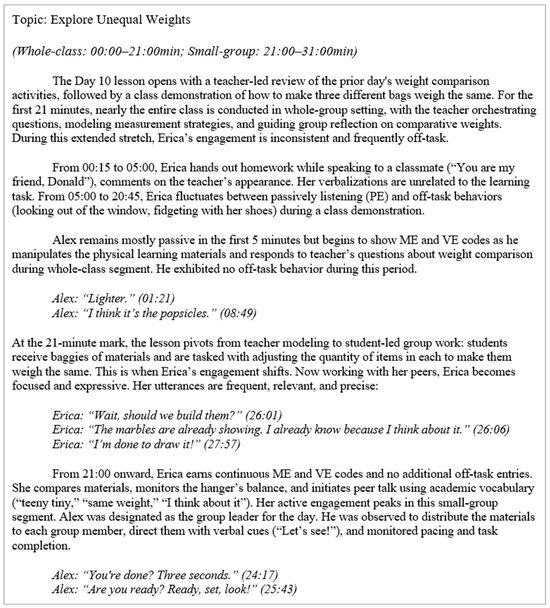
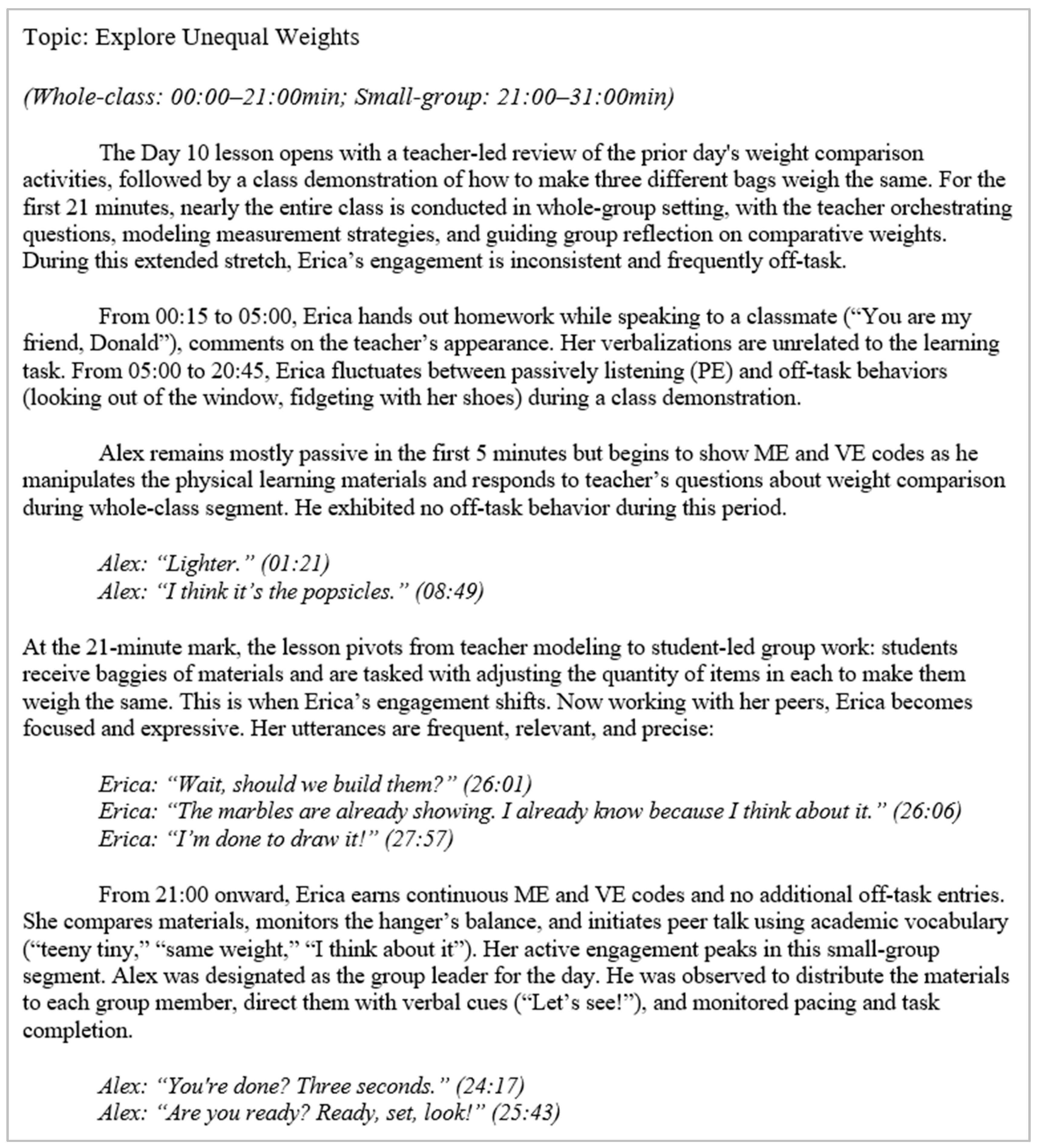
The lesson combined whole-class, brief small-group, and independent work (W = 21.5 min; G = 2.75 min; I = 5.75 min). Erica remained mostly engaged while performing her independent task; her off-task episodes were clustered in whole-class segment.
For each of the lessons, we constructed narrative vignettes that synthesized the transcript with coded data and field notes. The vignettes are contextualized portraits of key moments in the lesson, illustrating how teacher-student and peer interactions unfolded and how the focal students’ engagement behaviors changed in real time. These vignettes serve as complements to the quantitative data, to help explore how and why certain settings or instructional practices were effective (or not) in eliciting engagement from students. See an example of a vignette in Figure 1.
Figure 1.
Narrative Vignette for Exemplar Lesson on Day 10.
4. Results
4.1. Comparison of Engagement Patterns (RQ1)
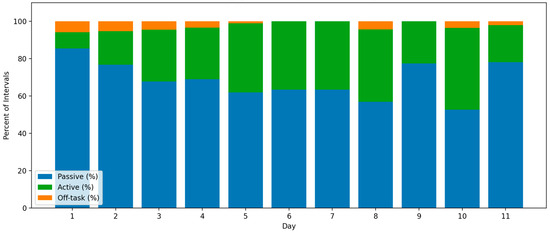
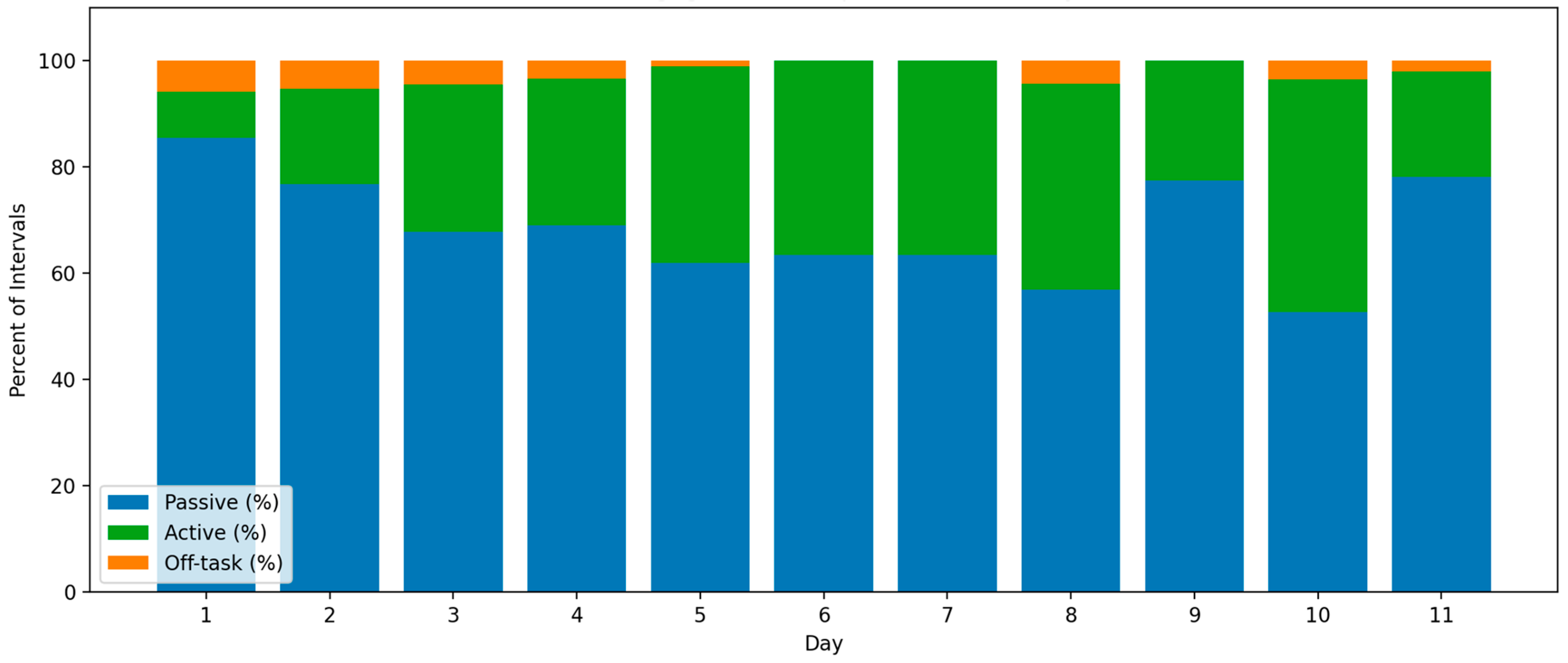
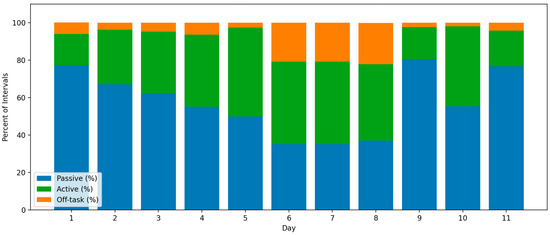
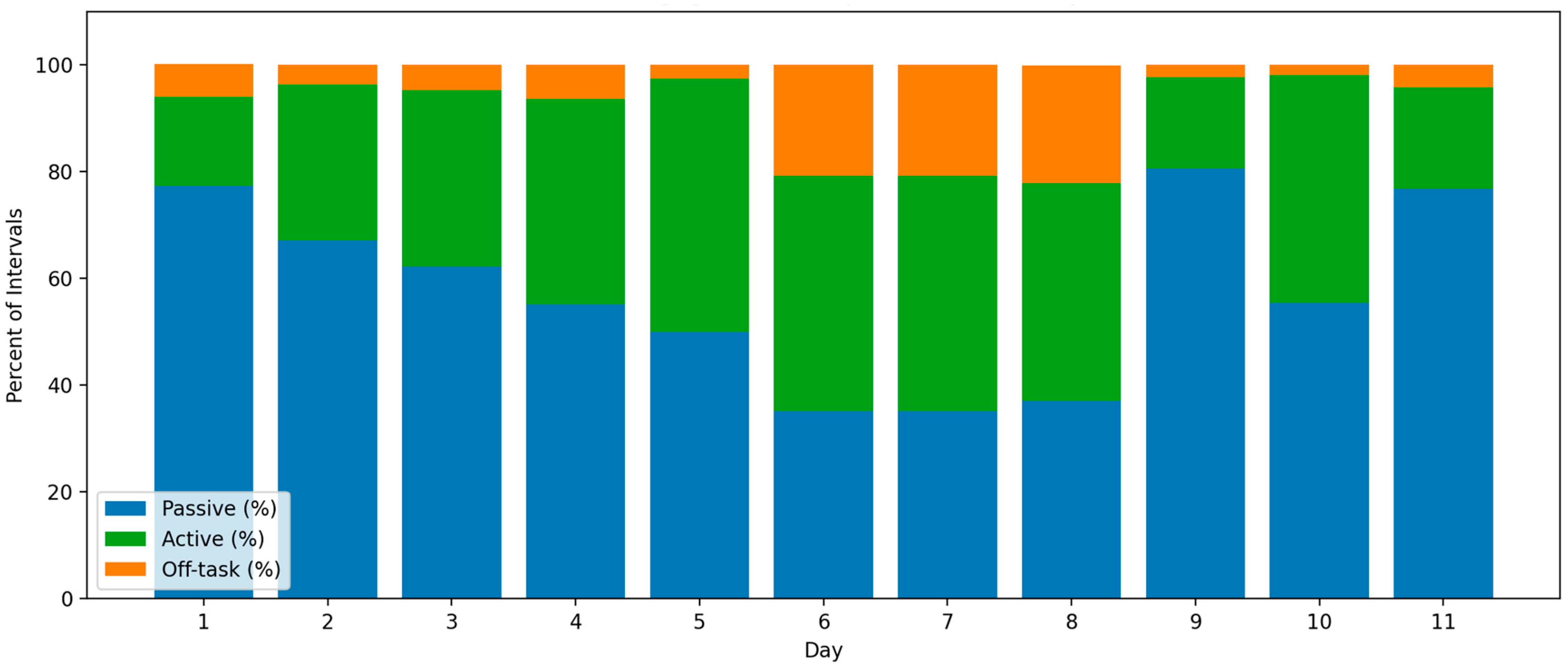
Table 4 presents daily counts and percentages of passive (PE), active (VE/ME), and off-task (PI/VI/MI) behaviors for Alex and Erica across an 11-day instructional unit on measurement of weight. The Δ values indicating whether Erica showed more (+) or less (−) of that behavior than Alex. The two focal students exhibited different baseline engagement profiles. Alex’s behavior was predominantly on-task and passive: out of 1913 intervals observed for him, 68.5% were coded as passive engagement (PE). He had substantial active participation in class (28.8% ME or VE) and was rarely off task (2.7%). In contrast, Erica showed a more mixed profile with both higher active engagement (33.9%) and higher off-task behavior (8.7%). In other words, although Erica’s active engagement rate was comparable to Alex’s, her off-task episodes occurred roughly three times as often (8.7% vs. 2.7%). Notably, both students showed gains in active engagement across the observation period, though their trajectories differed. Early sessions (Days 1–3) saw mostly passive engagement from both. By the later sessions (Days 8–11), each student was participating more actively in class. However, Erica’s off-task spiked at 33% in the middle of the unit on Days 6 and 7, suggesting that certain content or formats posed engagement challenges for her that were less evident for Alex. Figure 2 and Figure 3 illustrate the engagement patterns for Alex and Erica respectively.
Table 4.
Summary of Behavior Codes Across Eleven Days of Observation.
Figure 2.
Engagement Pattern for Alex.
Figure 3.
Engagement Pattern for Erica.
4.2. Engagement by Instructional Setting
4.2.1. Descriptive Patterns
Table 5 summarizes the frequency and distribution of coded engagement behaviors for Alex and Erica across four instructional formats: whole-class (W), partner (P), small-group (G), and independent work (I). Since we used partial-interval coding, if a behavior (passive, active, or off-task) had occurred at any point within an interval, it is coded as present. The table presents the total number of behavior codes logged in each setting, followed by separate counts and percentages for passive engagement, active engagement, and off-task behavior. Within each instructional format, percentages are presented two ways: (a) the percentage of that setting’s codes falling into each behavior category (e.g., 83.8% of Erica’s small-group behavior codes were active), and (b) the proportion of that behavior across the student’s overall behavioral profile (e.g., 10.4% of Erica’s total active engagement codes occurred during small-group instruction).
Table 5.
Summary of Behavior Codes in Each Instructional Setting.
Clear patterns emerged when engagement was disaggregated by instructional settings. In whole-class, typically characterized by the teacher leading discussion or demonstration with the entire group, both students had the lowest active engagement rates (~19%). Correspondingly, whole-class segments saw the highest incidence of off-task behavior for Erica at 11.5%, over four times the rate of Alex’s off-task behavior in that setting (2.4%). During partner work, both students demonstrated a notable increase in active engagement, reaching similar levels (Alex: 62%; Erica: 67%). There was a divergence in the students’ engagement profiles in small-group setting (3–4 students per group): Alex’s active engagement was ~57%, while Erica’s jumped to 84% of intervals, the highest active rate observed for either student in any context. This seems to indicate that Erica thrived in the small-group format. Alex also benefited from group work compared to whole-class, though to a lesser degree than Erica. The difference in engagement patterns was also present during independent task periods. Alex showed moderate level of active engagement, with 104 of his 220 codes marked as VE or ME (47.3%), a rate that was consistent with his participation in small-group (56.8%) and partner (62.1%) settings. In contrast, Erica exhibited a much higher proportion of active behaviors at 77.5%. This 30-percentage-point gap was the largest observed across any of the settings and behaviors.
4.2.2. Inferential Findings
To deepen our understanding of the engagement patterns observed, we conducted an inferential analysis using logistic regression. Specifically, we examined how instructional setting, student identity, and their interaction predicted the likelihood of active engagement. To focus on academically productive engagement, VE and ME were collapsed into an active category, whereas passive engagement (PE) and all three interference behaviors (PI, VI, & MI) were combined into a single non-active class.
A binomial logistic regression was used to predict the likelihood of observing an active engagement behavior (1) compared to a non-active (0). The model included fixed effects for instructional setting (dummy-coded with whole-class as the reference category), student (Alex as the reference), and their interaction. Wald χ2 tests evaluated main and interaction effects; odds ratios (ORs) and 95% confidence intervals (CIs) were obtained (see Table 6). The omnibus model was significant, χ2(7) = 514.7, p < 0.001, indicating that instructional setting and student identity (and their interaction) together reliably predicted the likelihood of active engagement. The model explained approximately 42% of the variance in engagement outcomes (Nagelkerke R2 = 0.42).
Table 6.
The Effects of Instructional Setting and Student Identity on Active Engagement.
There was a significant main effect for instructional setting, Wald χ2(3) = 269.3, p < 0.001. Both Alex and Erica had similar low active engagement baseline (19%) in whole-class. Using whole-class as the reference, each alternative setting significantly increased the odds of active engagement. For Alex, his odds of being actively engaged were 7.16 times higher in partner work, 5.76 times higher in small-group, and 3.87 times higher during independent work when compared to the whole-class setting. In contrast, the main effect of student (comparing Erica to Alex) was not significant, Wald χ2(1) = 0.01, p = 0.904, OR = 1.01. This suggests that overall, across all contexts, Erica was about equally likely as Alex to be actively engaged.
The student × setting interaction effect was significant (Wald χ2(3) = 152.8, p < 0.001), which indicated that the impact of instructional setting on engagement differed for the two students. In line with the descriptive comparisons, Erica’s active engagement rose more substantially in non-whole class settings than Alex. For instance, in partner work, Erica’s odds of active engagement were an additional 1.48 times higher relative to Alex’s (interaction OR = 1.48, p = 0.012). The interaction effects were even larger in small-group and independent settings. In small-group activities, Erica’s odds of being actively engaged were over four times greater relative to Alex’s (interaction OR = 4.01, p < 0.001), and 4.26 times greater in independent task settings (interaction OR = 4.26, p < 0.001). In summary, the quantitative results show that moving away from a whole-class format dramatically improved the likelihood of active engagement for both students, and especially for Erica, the dually identified gifted student with disability.
4.3. Classroom Conditions That Shape Engagement (RQ2)
To understand the mechanisms behind the engagement patterns, we examined the classroom discourse and activities in the exemplar lessons, with attention to how the teacher’s moves and the instructional context influenced each student’s engagement. Overall, the qualitative data revealed that engagement was co-constructed through teacher scaffolding, peer interaction, and the provision of hands-on tasks. Erica’s engagement, in particular, was highly sensitive to the level of support and interactivity in the environment, whereas Alex demonstrated more self-initiated engagement even with minimal prompts.
4.3.1. Whole-Class Instruction
During extended whole-class instruction, Erica and Alex mostly sat quietly and listened, registering predominantly PE (passive engagement) codes at 69% to 79% respectively. Their active codes were comparable at about 19% of coded behaviors in this setting; however, those numbers mask notable qualitative differences in the nature of their engagement. Alex’s participation was more voluntary and self-initiated, whereas Erica spoke only when directly called on by the teacher. For instance, when Mrs. K posed a question to the class about the “mystery box” activity, Alex blurted out a guess spontaneously (“I think it’s something important about space”), earning a VE code for his self-initiated response. Erica, by contrast, stayed silent during this discussion. Although she appeared to be attentive without any off-task codes, she did not volunteer to speak. Mrs. K reflected on Erica’s classroom participation by noting, “She doesn’t usually raise her hand. I have to call on her, and even then, she sometimes doesn’t answer or gives really short answers”. This observation aligns with Erica’s data. On Day 1, Erica registered 7 verbal engagement (VE) codes, 6 of which occurred during choral responses alongside other students. Her only individually coded verbal contribution came when Mrs. K called on her directly at the 7-min mark: “Erica, what is lighter than your shirt?” to which she replied, “Uh … a pencil?”. This episode typifies Erica’s verbal engagement during teacher-led instruction: brief, hesitant, and entirely in response to the teacher. When whole-class discussions were dominated by lengthy teacher explanations or recaps of procedures, Erica’s engagement would often wane. Observers noted instances of her gaze drifting or minor fidgeting (PI/MI codes) during these protracted teacher talk, suggesting that she struggled to remain engaged when not actively involved. By comparison, Alex generally maintained passive attention and occasionally volunteered responses. Thus, although both students appeared similarly engaged on the surface when looking at percentages, there are subtle differences in their participatory styles, the quality and independence of their contributions.
4.3.2. Transitions to Interactive Formats
The qualitative shift in both students’ engagement when moving from whole-class to more interactive formats is noteworthy, especially for Erica. The Day 7 session provides a vivid within-lesson contrast of settings. For roughly the first 21 min, the teacher led a whole-class review and demonstration on balancing weights. The latter 10 min shifted to small-group exploration where students filled Ziploc bags with items like glue sticks, erasers, and marbles, trying to make the bags weigh the same. During the whole-class phase, Erica exhibited multiple off-task behaviors such as glancing around and tapping her foot. When the format switched to small-group work, Erica became noticeably more animated. She was arranging the items into bags and talking with her classmates about how to put in or remove items to create bags of equal weights. Erica had multiple turns of speech, including explaining the result (“The marble is heavier than the cubes”) and even taking on a helping role by explaining the information to another student who was absent earlier. This change was also noted by Mrs. K in her interview: “Erica really becomes more interested in what we are doing when she can use materials. I think it gives her something concrete to focus on”. On Day 7, Erica achieved one of her active engagement counts of the entire unit, with about two-thirds of them occurring in the 10 min of small-group time. Tellingly, that same day was her worst day for off-task behavior (33%), all of which were registered during the initial whole-class portion. This dramatic change highlights how Erica’s engagement fluctuates by setting: teacher-centric format yielded inattention and disruptive behavior, whereas the student-centered format promoted active participation. This incidence illustrates how a shift to interactive, student-centered activities can support young learners in “doing” math, rather than just listening to math.
4.3.3. Teacher Discourse & Support Strategies
The role of the teacher was crucial in mediating engagement for Erica and Alex. Several teacher discourse and instructional scaffolds were observed to have positive impacts. In instances where Mrs. K recognized signs of waning attention, she would shift gears by pausing a lecture to say “Turn to your partner and discuss”. When these opportunities for student talk were introduced, it broke the monotony of the didactic lecture, and help re-orient the students to each other and the content. An example can be seen on Day 5, Erica was largely passive throughout the teacher-led segment without any voluntary participation, either through physical movements or verbal responses. Sensing this, the teacher included Erica in a round-robin question (“Which is heaviest?” regarding the apple, pennies, banana comparison). Erica managed to focus just enough to answer correctly (“Pennies.”) when it was her turn. This was a prompted contribution—Erica likely would not have volunteered it otherwise—but it had the effect of breaking her silence and giving her a moment of success (the bag of 50 pennies was indeed heavier than a banana; her answer was correct). It was apparent that the teacher’s ability to modulate discourse—alternating between telling and asking, between providing information and inviting participation—played a critical role in co-regulating student engagement.
For Alex, teacher support was geared more toward understanding and navigating roles and expectations in partner and small-group work. Mrs. K had noticed that when students were asked to work together, Alex tended to work ahead on his own, effectively treating the task as individual assignment. “Alex can get very focused on what he is doing,” Mrs. K stated in her when reflecting on students’ collaborative learning skills. To support his participation in peer learning, Mrs. K made a point of checking in with him during group work, offering gentle prompts like “work with your partner” or “let’s see what she’s doing” to redirect his attention to his peers. On Day 10, she took a more intentional step by assigning him the role of group leader. She instructed, “Make sure everyone makes a prediction before you do the next part,” thereby giving Alex a clear social responsibility in addition to the academic task. This strategy served dual functions: it capitalized on Alex’s academic strengths while promoting more collaborative behaviors. Alex was observed to take initiative in directing the task. Frequent ME and VE codes were record as he took charge of selecting materials (“Let’s do the cubes first”) for the group experiment. Alex remained on pace with his classmates and demonstrated sustained verbal and physical engagement. He had clearly benefited from well-defined expectations that provided both structure and purpose for peer engagement.
5. Discussion
5.1. Engagement Is Context-Dependent
This case study positions engagement in advanced mathematics as participation access, a context-dependent phenomenon shaped by the fit between learners’ needs and the participation opportunities afforded by instructional design. This framing is particularly consequential for gifted ELs and ELDs, whose access to advanced learning opportunities is often shaped by identification pathways, service coordination, and the extent to which classroom participation norms recognize diverse ways of demonstrating mathematical competence (J. N. Moschkovich, 2015; Peters & Johnson, 2023). In advanced math contexts where participation often requires students to make thinking visible, engagement becomes tightly coupled with language, discourse, and self-regulation demands. Consequently, reduced visibility of participation, especially from dually identified students like Erica, may signal instructional barriers rather than limited mathematical capability (Kangas, 2021).
The results support this interpretation by showing that Erica’s early quietness did not translate into lower overall active engagement by the end of the unit. In the early sessions (Days 1–3), her participation was more passive and often took the form of brief, teacher-elicited responses, consistent with the possibility that the initial instructional demands limited her access to visible participation. Over time, however, Erica’s active engagement increased as the instructional context provided more accessible participation pathways. As a result, when engagement was aggregated across the full 11-day period, Erica’s active engagement rate (33.9%) was comparable to or higher than Alex’s (28.8%), indicating a steeper positive-engagement growth trajectory that ultimately closed any early participation gap.
5.2. Whole-Class Instruction Poses as a Barrier to Participation
Disaggregating engagement by instructional format (Table 6) points to where barriers were most pronounced. Whole-class instruction produced similarly low (~19%) active engagement for both students. This pattern is consistent with research emphasizing that whole-class, teacher-led discourse can amplify linguistic processing demands and participation risks for multilingual learners, particularly when instruction relies heavily on extended verbal explanation and rapid turn-taking (Turner et al., 2013). For students with learning disabilities, these same conditions can elevate executive-function demands, making it more difficult to maintain engagement when access to reasoning is mediated primarily through oral language and listening endurance (Imeraj et al., 2013). Within this context, Alex and Erica’s low engagement can be seen as the result of limited access than as lack of ability. In these lessons, whole-class instruction was largely teacher-led, which offered limited opportunities for students to use mathematical language or interact with manipulatives. From an access perspective, low active engagement here can be interpreted as a mismatch between learners’ needs (e.g., language practice, concrete representations, peer interactions) and the didactical learning environment. At the same time, reduced visibility of engagement should not be treated as a lack of interest or competence.
5.3. Small-Group Design Increases Engagement
The small-group setting emerged as the most consistent accessible instructional format for Erica. Her active engagement in small-group reached 83.8%, compared to 56.8% for Alex (Table 6), and she exhibited almost no off-task behavior. This pattern suggests that when instruction shifted toward hands-on, collaborative exploration, the environment provided more accessible pathways for Erica to demonstrate and sustain engagement. The inferential results corroborate this context-dependent isolating interpretation. Logistic regression results (Table 6) showed that the odds of active engagement increased for both students in small-group format. However, Erica’s gains were disproportionately larger (interaction OR = 4.01, p < 0.001), indicating that changes in instructional format had a stronger impact on her active engagement than on Alex’s. From an English learner perspective, small-group structures can reduce participation pressure by increasing turn-taking opportunities and allowing students to rehearse ideas with peers before sharing publicly (Lee et al., 2013; Webb et al., 2014). Small-group work may have been even more conducive for Erica because it reduced the executive-function and self-regulation load associated with whole-class lecture. For students with learning disabilities or attention-related needs, long stretches of teacher talk can make it difficult to maintain engagement (Hart et al., 2011), even when conceptual understanding is within reach. By contrast, hands-on small-group tasks distribute cognitive demands across students and materials. Students can communicate mathematical meaning through gestures, pointing, and manipulating objects. This finding is consistent with the teacher’s observation that Erica becomes more interested in class when she can use the hands-on materials. It also aligns with research indicating that engagement and learning are supported when mathematical activity is grounded in representations that students can manipulate and reference during interaction (Pape & Tchoshanov, 2001).
5.4. Independent Work and Autonomy
It is worth noting that independent tasks, often thought to be challenging for students with learning or language needs, were successful here when appropriately scaffolded. Independent work was preceded by ample preparation (teacher modeling and peer-mediated exploration) and accompanied by concrete materials or visual aids while students worked solo. Although Erica showed limited active participation during whole-class segments when most modeling occurred, she was often passively attentive. This suggests that learning was taking place through listening and observation even without overt behaviors like raising hands or calling out answers. Her high engagement during independent work (77.5% on Day 10) further indicates that these preparatory supports helped make the independent task accessible. So, simply leaving a student to work alone does not inherently promote autonomy, unless the student has the tools and prior experience to succeed (Saligumba & Tan, 2018). And when those conditions are met, independent work can validate a student’s sense of competence and growth.
5.5. Format Effects Are Conditional
It should be noted that no single instructional format was universally optimal or problematic; rather, the effectiveness of each setting was conditional on how it was implemented and on the individual student’s needs. Whole-class instruction, for the most part, tended to be disengaging for Erica in the way it was used in these observed lessons. However, whole-class format can potentially be made more engaging with strategies like planned questions, quick activities, or multimedia demonstrations that involve all students. In our data, we saw hints of this, e.g., the “mystery box” whole-class demonstration initially piqued the students’ interest, as it involved a novel object and invited speculation. The format was whole-class, but the method was interactive and narrative-driven, yielding a better engagement outcome than a pure lecture. Thus, it is how the teacher uses the format that matters. Similarly, small-group settings did not guarantee higher engagement unless they were strategically organized. However, purposeful role assignments can serve as a powerful tool. When the teacher explicitly designated Alex as the group leader with a specific directive—“Make sure everyone makes a prediction before you do the next part”—his engagement was channeled productively, and he supported his peers rather than working ahead solo. This finding echoes research on cooperative learning that emphasizes the value of assigned roles and structured interdependence (Abdullah & Jacobs, 2004; Cohen & Lotan, 2014). Structures like assigned roles, planned turn-taking, and peer accountability not only foster broader engagement but also help tailor group tasks to students’ strengths and growth areas.
5.6. Recommendation for Practice
To maximize engagement for gifted English learners in advanced programs, our findings point to a few evidence-based strategies. First, prioritize interactive, student-centered learning experiences. In this study, the most robust engagement occurred when students were doing math, such as manipulating objects or exchanging ideas with classmates, rather than listening passively. Teachers should incorporate frequent opportunities for discourse and movement even when teaching advanced content. This can include think-pair-share prompts, learning stations, exploratory labs, or role-play scenarios related to the concept at hand. Such approaches can make rigorous material accessible and stimulating, echoing research that active learning supports both engagement and achievement (Freeman et al., 2014). Second, scaffold participation deliberately, especially in group settings. As discussed, assigning rotating roles and clear responsibilities can strengthen students’ sense of accountability (Abdullah & Jacobs, 2004). Additionally, teachers can scaffold engagement by modeling how to collaborate (e.g., demonstrating how to listen to a peer’s idea and build on it) and set norms that value each student’s contribution. Third, enrich whole-class and independent work with the appropriate support. Extended teacher-led segments can create long periods in which students’ participation is limited to passively listening. Whole-class instruction can be made interactive through questions, stories, or physical activities to create regular opportunities for students to make their thinking visible. Independent work is more likely to build autonomy when students first explore ideas with the teacher and peers, and then have visual and tactile aids available while working on their own (J. Moschkovich, 2013). This way, students can use what they learned earlier to check their work, get unstuck, and stay engaged without needing constant help.
Overall, both students benefited when advanced mathematical participation was supported through multimodal tools, peer rehearsal opportunities, and structured discourse routines that made the content accessible while preserving high cognitive demand. However, the dually identified gifted ELD student struggled more in whole-class lessons and was much more engaged when instruction was hands-on, structured, and included clear roles and opportunities to interact with peers. The significant setting × student effect suggests that disability-related needs amplify the impact of intentional design. This means dually identified learners may require more explicit and consistent supports for staying focused and managing multi-step tasks, alongside language and participation supports that help them follow directions and communicate mathematical reasoning.
6. Conclusions
This mixed-methods case study underscores that access to advanced coursework is not equivalent to access to advanced learning. Simply placing gifted ELs or ELDs into advanced classes, or assigning them challenging tasks, does not guarantee meaningful participation or growth. In this study, engagement functioned as a highly context-dependent phenomenon, fluctuating with the students’ linguistic and cognitive needs and the participation opportunities in the classroom. The findings also suggest that there is no single instructional “silver bullet.” While interactive formats were associated with higher active engagement, particularly for the dually identified ELD student, the effectiveness of any setting depended on intentional design and implementation. Small-group work was most productive when structured to distribute participation (e.g., clear roles, peer accountability), and independent work was most engaging when it functioned as supported autonomy, sequenced after collaborative exploration and accompanied by accessible tools and representations. Conversely, any format could become disengaging or ineffective when participation pathways are not deliberately engineered. Taken together, these findings challenge the assumption that simply enrolling underrepresented students in gifted programs will, by itself, reverse opportunity gaps. True inclusion requires more than placement. It requires ongoing pedagogical support, deliberate structuring of participation, and responsiveness to individual learning needs.
7. Limitations
While the study yields valuable insights into student engagement in inclusive, enriched settings, several limitations must be acknowledged. First, the study examines two focal students taught by one instructor in one after-school program. As such, the findings should not be interpreted as statistically generalizable to the broader population of gifted English learners. Instead, the contribution is best understood as context-rich case evidence that clarifies how engagement may vary across instructional formats and participation structures in an advanced mathematics setting. Second, student engagement was inferred from observations, transcripts, and a teacher interview, without direct student self-report. Thus, claims about motivation or affect are limited. For example, some motor behaviors coded as off-task (e.g., foot tapping) may reflect self-regulation rather than inattention. The behavioral codes should not be interpreted as definitive evidence of comprehension or interest without students’ own accounts of these events. Relatedly, although inter-observer agreement was strong, systematic observation can be subject to observer effects and the constraints of partial-interval coding, which captures the occurrence of a behavior, but not its duration or function. Third, conclusions about the affordances and challenges of different instructional formats (e.g., whole-class, partner, small-group, independent work) are based on how those formats were enacted by one teacher in one program. Engagement patterns may differ under other enactments of the same curriculum, different participation norms, or school contexts. Finally, this case study centers on an 11-session instructional unit during the first-grade year. It did not track students’ engagement for the whole duration of the program or explore whether the observed engagement patterns persisted in subjects other than mathematics. These limitations underscore the importance of interpreting the study’s findings as exploratory rather than conclusive. Future research should seek to expand the sample size, incorporate student self-report and affective indicators, and examine how adaptive instructional strategies can be scaled across diverse learning environments.
Funding
This research was funded by Unites States Department of Education (US DOE) Jacob Javits Gifted and Talented Students Program, grant number S206A170028.
Institutional Review Board Statement
The research was approved by St. John’s University (Protocol Number IRB-FY2020-271) and New York City Department of Education (Protocol Number 1906). The study was approved by the Institutional Review Board of St. John’s on 5 February 2018.
Informed Consent Statement
Informed consent was obtained from all subjects involved in the study.
Data Availability Statement
Data are unavailable due to privacy or ethical restrictions.
Acknowledgments
During the preparation of this manuscript/study, the author used Grammarly to assist with APA formatting and minor language edits such as spelling and grammatic errors. The author has reviewed and edited all AI-generated content and take full responsibility for the content of this publication.
Conflicts of Interest
The author has no potential conflicts of interest with respect to the research, authorship, and/or publication of this article.
References
- Abdullah, M., & Jacobs, G. (2004). Promoting cooperative learning at primary school. TESL-EJ, 7(4), n4. [Google Scholar]
- Aguirre, J. M., & Bunch, G. C. (2012). What’s language got to do with it?: Identifying language demands in mathematics instruction for English language learners. In S. Celedon-Pattichis, & N. G. Ramirez (Eds.), Beyond good teaching: Advancing mathematics education for ELLs (pp. 183–194). National Council of Teachers of Mathematics. [Google Scholar]
- Aguirre, N. M., & Hernandez, N. E. (2021). Differentiating the curriculum for gifted second language learners: Teaching them to think. In J. A. Castellano, & A. D. Frazier (Eds.), Special populations in gifted education (pp. 273–285). Routledge. [Google Scholar]
- Attard, C. (2012). Applying a framework for engagement with mathematics in the primary classroom. Australian Primary Mathematics Classroom, 17(4), 22–27. [Google Scholar]
- Blumenfeld, P. C., Kempler, T. M., & Krajcik, J. S. (2006). Motivation and cognitive engagement in learning environments. In R. K. Sawyer (Ed.), The cambridge handbook of the learning sciences (pp. 475–488). Cambridge University Press. [Google Scholar]
- Boaler, J. (2016). Mathematical mindsets: Unleashing students’ potential through creative math, inspiring messages and innovative teaching. Jossey-Bass. [Google Scholar]
- Booren, L. M., Downer, J. T., & Vitiello, V. E. (2012). Observations of children’s interactions with teachers, peers, and tasks across preschool classroom activity settings. Early Education & Development, 23(4), 517–538. [Google Scholar]
- Campbell, M. C. (2021). Identifying and supporting gifted English language learners: Equitable programs and services for ELLs in gifted education. Routledge. [Google Scholar]
- Casa, T. M., Firmender, J. M., Gavin, M. K., & Carroll, S. R. (2017). Kindergarteners’ achievement on geometry and measurement units that incorporate a gifted education approach. Gifted Child Quarterly, 61(1), 52–72. [Google Scholar] [CrossRef] [Scilit]
- Cohen, E. G., & Lotan, R. A. (2014). Designing groupwork: Strategies for the heterogeneous classroom (3rd ed.). Teachers College Press. [Google Scholar]
- Cohen, E. G., Lotan, R. A., Scarloss, B. A., & Arellano, A. R. (1999). Complex instruction: Equity in cooperative learning classrooms. Theory Into Practice, 38(2), 80–86. [Google Scholar] [CrossRef] [Scilit]
- Day, S. L., Connor, C. M., & McClelland, M. M. (2015). Children’s behavioral regulation and literacy: The impact of the first grade classroom environment. Journal of School Psychology, 53(5), 409–428. [Google Scholar] [CrossRef] [Scilit]
- Esmonde, I. (2009). Ideas and identities: Supporting equity in cooperative mathematics learning. Review of Educational Research, 79(2), 1008–1043. [Google Scholar] [CrossRef] [Scilit]
- Ford, D. Y., Grantham, T. C., & Whiting, G. W. (2008). Culturally and linguistically diverse students in gifted education: Recruitment and retention issues. Exceptional Children, 74(3), 289–306. [Google Scholar] [CrossRef] [Scilit]
- François-Sévigny, J., Pilon, M., & Gauthier, L. A. (2022). Differences in parents and teachers’ perceptions of behavior manifested by gifted children with ADHD compared to gifted children without ADHD and non-gifted children with ADHD Using the Conners 3 Scale. Brain Sciences, 12(11), 1571. [Google Scholar] [CrossRef] [Scilit] [PubMed]
- Fredricks, J. A., Blumenfeld, P. C., & Paris, A. H. (2004). School engagement: Potential of the concept, state of the evidence. Review of Educational Research, 74(1), 59–109. [Google Scholar] [CrossRef] [Scilit]
- Fredricks, J. A., & McColskey, W. (2012). The measurement of student engagement: A comparative analysis of various methods and student self-report instruments. In A. Christenson, A. Reschly, & C. Wylie (Eds.), Handbook of research on student engagement (pp. 763–782). Springer. [Google Scholar]
- Freeman, S., Eddy, S. L., McDonough, M., Smith, M. K., Okoroafor, N., Jordt, H., & Wenderoth, M. P. (2014). Active learning increases student performance in science, engineering, and mathematics. Proceedings of the National Academy of Sciences of the United States of America, 111(23), 8410–8415. [Google Scholar] [CrossRef] [Scilit]
- Gagné, F. (1995). From giftedness to talent: A developmental model and its impact on the language of the field. Roeper Review, 18(2), 103–111. [Google Scholar] [CrossRef] [Scilit]
- Gavin, M. K., Casa, T. M., Firmender, J. M., & Carroll, S. R. (2013). The impact of advanced geometry and measurement curriculum units on the mathematics achievement of first-grade students. Gifted Child Quarterly, 57(2), 71–84. [Google Scholar] [CrossRef] [Scilit]
- Gersten, R., Chard, D. J., Jayanthi, M., Baker, S. K., Morphy, P., & Flojo, J. (2009). Mathematics instruction for students with learning disabilities: A meta-analysis of instructional components. Review of Educational Research, 79(3), 1202–1242. [Google Scholar] [CrossRef] [Scilit]
- Gillies, R. M., & Boyle, M. (2010). Teachers’ reflections on cooperative learning: Issues of implementation. Teaching and Teacher Education, 26(4), 933–940. [Google Scholar] [CrossRef] [Scilit]
- Gubbins, E. J., Siegle, D., Hamilton, R., Peters, P., Carpenter, A. Y., O’Rourke, P., Puryear, J., McCoach, D. B., Long, D., Bloomfield, E., Cross, K., Mun, R. U., Amspaugh, C., Langley, S. D., Roberts, A., & Estepar-Garcia, W. (2018). Exploratory study on the identification of English learners for gifted and talented programs. University of Connecticut, National Center for Research on Gifted Education. [Google Scholar]
- Gupta, A., & Lee, G. L. (2015). Dialogic teaching approach with English language learners to enhance oral language skills in the content areas. International Journal of Language and Linguistics, 2(5), 10–17. [Google Scholar]
- Hart, K. C., Massetti, G. M., Fabiano, G. A., Pariseau, M. E., & Pelham, W. E., Jr. (2011). Impact of group size on classroom on-task behavior and work productivity in children with ADHD. Journal of Emotional and Behavioral Disorders, 19(1), 55–64. [Google Scholar] [CrossRef] [Scilit]
- Hiebert, J., & Grouws, D. A. (2007). The effects of classroom mathematics teaching on students’ learning. In F. K. Lester (Ed.), Second handbook of research on mathematics teaching and learning (pp. 371–404). Information Age Publishing. [Google Scholar]
- Imeraj, L., Antrop, I., Sonuga-Barke, E., Deboutte, D., Deschepper, E., Bal, S., & Roeyers, H. (2013). The impact of instructional context on classroom on-task behavior: A matched comparison of children with ADHD and non-ADHD classmates. Journal of School Psychology, 51(4), 487–498. [Google Scholar] [CrossRef] [Scilit]
- Johnson, D. W., & Johnson, R. T. (2009). An educational psychology success story: Social interdependence theory and cooperative learning. Educational Researcher, 38(5), 365–379. [Google Scholar] [CrossRef] [Scilit]
- Kangas, S. E. (2021). “Is it language or disability?”: An ableist and monolingual filter for English learners with disabilities. TESOL Quarterly, 55(3), 673–683. [Google Scholar] [CrossRef] [Scilit]
- Lee, N., Cortada, J., & Grimm, L. (2013). WIDA focus on: Group work for content learning. WIDA Consortium, University of Wisconsin-Madison.
- Lei, H., Cui, Y., & Zhou, W. (2018). Relationships between student engagement and academic achievement: A meta-analysis. Social Behavior and Personality: An International Journal, 46(3), 517–528. [Google Scholar] [CrossRef] [Scilit]
- Liang, Z., Lee, D., Zuo, J., & Liang, S. (2024). The use of visual schedules to increase academic-related on-task behaviors of individuals with autism: A literature review. International Journal of Developmental Disabilities, 1–14. [Google Scholar] [CrossRef] [Scilit]
- Luchins, A. S., & Luchins, E. H. (1970). Wertheimer’s seminars revisited: Problem solving and thinking: Vol. 3. Faculty-Student Association, SUNY at Albany. [Google Scholar]
- Miles, M. B., & Huberman, A. M. (1994). Qualitative data analysis: An expanded sourcebook (2nd ed.). Sage Publications, Inc. [Google Scholar]
- Moschkovich, J. (2013). Equitable practices in mathematics classrooms: Research-based recommendations. Teaching for Excellence and Equity in Mathematics, 5(1), 22–25. [Google Scholar] [CrossRef] [Scilit]
- Moschkovich, J. N. (2015). Academic literacy in mathematics for English learners. The Journal of Mathematical Behavior, 40, 43–62. [Google Scholar] [CrossRef] [Scilit]
- Mun, R. U., Hemmler, V., Langley, S. D., Ware, S., Gubbins, E. J., Callahan, C. M., McCoach, D. B., & Siegle, D. (2020). Identifying and serving English learners in gifted education: Looking back and moving forward. Journal for the Education of the Gifted, 43(4), 297–335. [Google Scholar] [CrossRef] [Scilit]
- O’Connor, C., Michaels, S., Chapin, S., & Harbaugh, A. G. (2017). The silent and the vocal: Participation and learning in whole-class discussion. Learning and Instruction, 48, 5–13. [Google Scholar] [CrossRef] [Scilit]
- Pape, S. J., & Tchoshanov, M. A. (2001). The role of representation (s) in developing mathematical understanding. Theory Into Practice, 40(2), 118–127. [Google Scholar] [CrossRef] [Scilit]
- Patton, M. Q. (2015). Qualitative research & evaluation methods: Integrating theory and practice (4th ed.). Sage. [Google Scholar]
- Peters, S. J., & Johnson, A. (2023). Where are the gifted English learners and students with disabilities? (EdWorkingPaper: 23-742). Annenberg Institute at Brown University. [CrossRef]
- Peters, S. J., Rambo-Hernandez, K., Makel, M. C., Matthews, M. S., & Plucker, J. A. (2019). The effect of local norms on racial and ethnic representation in gifted education. AERA Open, 5(2), 2332858419848446. [Google Scholar] [CrossRef] [Scilit]
- Reis, S. M. (2003). Reconsidering regular curriculum for high achieving students, gifted underachievers, and the relationship between gifted and regular education. In J. Borland (Ed.), Rethinking gifted education (pp. 186–200). Teachers College Press. [Google Scholar]
- Reis, S. M., Baum, S. M., & Burke, E. (2014). An operational definition of twice-exceptional learners: Implications and applications: Implications and applications. Gifted Child Quarterly, 58(3), 217–230. [Google Scholar] [CrossRef] [Scilit]
- Saligumba, I. P. B., & Tan, D. A. (2018). Gradual release of responsibility instructional model: Its effects on students’ mathematics performance and self-efficacy. International Journal of Scientific & Technology Research, 7(8), 276–291. [Google Scholar]
- Schleppegrell, M. J. (2007). The linguistic challenges of mathematics teaching and learning: A research review. Reading & Writing Quarterly, 23(2), 139–159. [Google Scholar] [CrossRef] [Scilit]
- Shapiro, E. S. (2004). Academic skills problems workbook (3rd ed.). The Guilford Press. [Google Scholar]
- Skinner, E., Furrer, C., Marchand, G., & Kindermann, T. (2008). Engagement and disaffection in the classroom: Part of a larger motivational dynamic? Journal of Educational Psychology, 100(4), 765–781. [Google Scholar] [CrossRef] [Scilit]
- Stake, R. E. (1995). The art of case study research. SAGE Publications. [Google Scholar]
- Stanley, G., & MacCann, R. G. (2005). Removing incentives for ‘dumbing down’ through curriculum re-structure and additional study time. Education Policy Analysis Archives, 13(2), n2. [Google Scholar] [CrossRef] [Scilit]
- Subotnik, R. F., Olszewski-Kubilius, P., & Worrell, F. C. (2011). Rethinking giftedness and gifted education: A proposed direction forward based on psychological science. Psychological Science in the Public Interest, 12(1), 3–54. [Google Scholar] [CrossRef] [Scilit] [PubMed]
- Turner, E., Dominguez, H., Maldonado, L., & Empson, S. (2013). English learners’ participation in mathematical discussion: Shifting positionings and dynamic identities. Journal for Research in Mathematics Education, 44(1), 199–234. [Google Scholar] [CrossRef] [Scilit]
- U.S. Department of Education (USDOE)—Office of Civil Rights. (2024). Profile of English learner students in U.S. public schools during the 2020–21 school year. Available online: https://www.ed.gov/sites/ed/files/about/offices/list/ocr/docs/crdc-el-students-snapshot.pdf (accessed on 22 July 2025).
- VanTassel-Baska, J., & Stambaugh, T. (2005). Challenges and possibilities for serving gifted learners in the regular classroom. Theory Into Practice, 44(3), 211–217. [Google Scholar] [CrossRef] [Scilit]
- Webb, N. M., Franke, M. L., Ing, M., Wong, J., Fernandez, C. H., & Shin, N. (2014). Engaging with others’ mathematical ideas: Interrelationships among student participation, teachers’ instructional practices, and learning. International Journal of Educational Research, 63, 79–93. [Google Scholar] [CrossRef] [Scilit]
- Webb, N. M., Nemer, K. M., & Ing, M. (2006). Small-group reflections: Parallels between teacher discourse and student behavior in peer-directed groups. The Journal of the Learning Sciences, 15(1), 63–119. [Google Scholar] [CrossRef] [Scilit]

Disclaimer/Publisher’s Note: The statements, opinions and data contained in all publications are solely those of the individual author(s) and contributor(s) and not of MDPI and/or the editor(s). MDPI and/or the editor(s) disclaim responsibility for any injury to people or property resulting from any ideas, methods, instructions or products referred to in the content. |
© 2026 by the author. Licensee MDPI, Basel, Switzerland. This article is an open access article distributed under the terms and conditions of the Creative Commons Attribution (CC BY) license.