


Abstract
While researchers of children in early years education promote the development of computational thinking (CT) abilities, many teachers are unaware of, or resistant to, the idea of teaching CT to such young children. This study explored the possibility of utilising everyday items and topics to develop CT abilities in a class of 24 four-to-five-year-old children. Over six weekly sessions, the children took part in innovative guided play activities integrated with class topics: Celebrations, Forest School and Christmas. Each session consisted of two activities: Task A consisted of deconstructing, evaluating and choosing equipment or items, and Task B consisted of sequencing and debugging the order of the activity, e.g., wrapping a birthday present. Two methods of assessment were utilised: quantitative where children were asked to do simple pencil and paper tasks and the sequencing or placement of pictures to record their accuracy; and qualitative where children were individually asked to explain their results. The findings indicate progress was made in task performance and the development of children’s logical reasoning and thinking abilities.
1. Introduction
Globally, we are becoming much more reliant on digital technology, as a result, government policies increasingly reflect the need for teaching programming and coding at all education levels (K. Bers, 2021; Fleer, 2021). English government guidelines state that teaching for some aspects of coding should start in Key Stage 1 for children aged five to seven years old (Department for Education [DfE], 2013), but research suggests that teaching could start earlier, in pre-school (K. Lee & Cho, 2021; J. Lee et al., 2023). Many pre-school children use digital technologies such as smartphones and tablets and their interest and motivation could be harnessed for learning about aspects of programming and coding (M. Bers et al., 2014; K. Lee & Cho, 2021). However, early years teachers often have little pedagogical knowledge of teaching digital technology (Yildirim, 2021) and following the 2021 Department for Education’s EYFS framework revision, the specific Early Learning Goal (ELG) for technology was removed and is instead integrated at practitioners’ discretion rather than as a mandated element of the early years (DfE, 2023). Consequently, it can be a challenge to educate children in computational thinking (CT) skills, especially when teaching the basics of Literacy and Mathematics are considered a priority (Wang et al., 2021a).
Some researchers suggest that programming and coding can be taught through robotic toys such as Bee-Bots, utilising and teaching aspects of computational science involving, for example, evaluating and problem-solving (M. Bers et al., 2014; Hagon et al., 2020; Terroba et al., 2022). Other researchers suggest that an aspect of computational science, CT, can be taught without the use of robotic toys through unplugged play activities (K. Lee & Cho, 2021). While CT covers the types of thinking associated with programming and coding (K. Bers, 2021) one of the basic requisites of CT concerns the ability to think logically and to evaluate or reason why a code ‘works or not’ (Papert, 1990). This exploratory case study examines whether a class of four- to-five-year-old children can develop aspects of CT while taking part in guided activities relating to the Early Learning Guides of the English National Curriculum (DfE, 2023). This innovative approach is designed to encourage and enable integrated teaching of CT within the early years’ curriculum.
1.1. What Is Computational Thinking?
Computational thinking (CT) is a relatively new concept in the field of computer science, and complex to define (K. Bers, 2021; Brennan & Resnick, 2012; G. Bull et al., 2020; Kanaki & Kalogiannakis, 2022). Often described as deriving from aspects of computer science such as programming sequences of code into algorithms, testing the codes, debugging errors in a code, and rectifying those errors, these skills are relevant beyond the use of computers (Armoni, 2016; Wang et al., 2021a; Wing, 2006). Indeed, CT may be considered the basis for creativity or ‘constructional thinking’ not only in Science, Technology, Engineering and Mathematics (STEM) but also in the creative arts (Papert, 1988, 1990) and may be described as an on-going process of thinking and problem-solving (K. Lee & Cho, 2021). One operational definition of CT comes from the International Society for Technology in Education (ISTE) & The Computer Science Teachers Association (CSTA) (2011) and is outlined as formulating problems for use with computers and their tools; logically organising and analysing data; representing data through abstractions; algorithmic ordering of steps; processing data to achieve the most efficient order of steps; and generalising these steps to a variety of problems.
One of the features of CT which is crucial to learning to program, and code, is the concept of evaluating information using logical reasoning skills (Seidman, 1989). It is necessary to be able to think critically when working out possibilities for coding, e.g., navigating robotic toys, and identifying coding errors (see K. Bers, 2021; Flood et al., 2022; Wang et al., 2021b). Also, it is considered important to provide students with opportunities in their lessons to develop logical reasoning skills, for example, in Mathematics, and this ability can also contribute to learning in other STEM subjects such as Technology and Science (Trentin et al., 2017). Utilising the definition from ISTE and CSTA, and Hagon’s model of CT abilities (Critten et al., 2024) this diagram simplifies some of the key concepts and elements leading to the creation of algorithmic codes (see Figure 1).
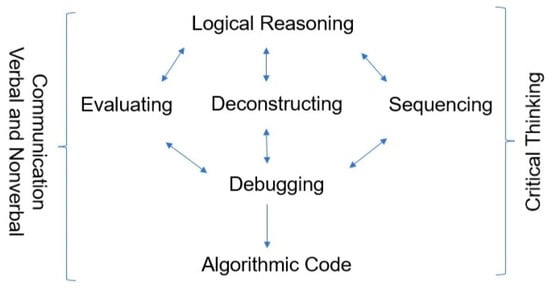
Figure 1.
Linking key elements of CT: developing an algorithmic code.
To develop the necessary critical thinking skills needed to encourage CT abilities, it is helpful to outline the key elements that can be taught in the early years before designing a programme of activities. Three elements of logical reasoning, evaluating, deconstructing and sequencing, are considered by many researchers to be integral parts of CT (K. Bers, 2021; Papert & Harel, 1991; Wang et al., 2021a). Evaluation is a key component of CT as it consists of an assessment and problem-solving process when editing and revising possible solutions (K. Bers, 2021; Relkin & Strawhacker, 2021). Deconstruction is the analysis and breaking down of a problem into smaller pieces rather than trying to solve a complicated problem as a whole (J. Lee et al., 2023). Sequencing is the recognition, understanding and ordering of patterns or algorithmic codes and is often learnt by young children using mathematical learning goals such as making sets or continuing patterns (Presser et al., 2023). Once an algorithmic or pictorial code (J. Lee & Junoh, 2019) has been completed, it is evaluated to see if it has been correctly designed and is error-free. If it is incorrect, then the problem has to be identified and edited and revised (debugged) (M. U. Bers, 2018). Once these CT processes have been completed, the results should be an algorithmic code or a step-by-step plan for solving problems and these can be as simple as a recipe for making a sandwich (J. Lee et al., 2023) or designing a route for a Bee-Bot (K. Bers, 2021; Hagon et al., 2020). Underlying all these CT processes is the verbalisation and communication of ideas between children and their peers and children and teachers as described below. Rather than focusing on the teaching of digital skills that constantly evolve, CT enables children to learn a more holistic set of skills that will enable learning and growth irrespective of the digital device and application. CT skills are device/application agnostic in that they allow a child to have the foundational skills necessary to tackle a multitude of tasks for both computer science-based and wider non-tech-based scenarios. Given the necessity for children to be able to evaluate and think logically, how can CT abilities be taught in the early years?
1.2. Teaching and Assessing Computational Thinking in Young Children
Recently, a number of studies have focused on teaching CT through the use of robotic toys such as the Bee-Bot, online software programs such as Scratch (K. Bers, 2021; Gomes et al., 2018; Fessakis et al., 2013; Hagon et al., 2020) or a segmented toy such as a caterpillar: Code-a-pillar (Wang et al., 2021b). However, using screen-type games or robotic devices does not necessarily explicitly teach CT abilities but rather CT concepts are considered to develop through the experience of using these games and devices (J. Lee et al., 2023).
Furthermore, while language software programs such as Scratch and Alice can be used to reliably teach and assess CT in children aged eight to eleven years, it is much more difficult to do this with four- to five-year-olds even when using robotic toys (Kanaki & Kalogiannakis, 2022). There also is the question of whether children in the early years have the cognitive abilities to understand some of the concepts of CT. In addition, it could be that ‘unplugged’ non-robotic, guided play activities may provide a more nuanced approach to teaching and assessing CT in the early years (K. Lee & Cho, 2021) due also in part to the interest and engagement children have with play and familiar toys.
Guided play activities also lend themselves nicely to the scaffolding approach many teachers use to encourage learning in the classroom via the gradual development of ideas and understanding (Spadafora & Downes, 2020). Scaffolding can be achieved by learning through observation and experiencing changes in the environment; by learning through play and interacting with others; or by being explicitly taught using guided play activities (Critten et al., 2022; Hagon et al., 2020). Utilising guided play activities aids teachers in assessing what children already know, thereby establishing foundations to scaffold their lessons (see the zone of proximal learning, Vygotsky et al., 1980). In addition, a key component of successfully learning through scaffolding is language and communication. The teachers and the children need to be able to collaborate, and children also need to work with peers so that they can express and communicate their ideas (K. Bers, 2021; Critten et al., 2022; Spadafora & Downes, 2020; Wang et al., 2023).
However, activities and resources that may support such group interaction for CT in the early years are not available for teachers either because they are not produced commercially or are not appropriate for the age group, leaving teachers no option but to create their own (Yildirim, 2021). This exacerbates the problems that early years’ teachers often face about CT, i.e., lack of knowledge of what skills are involved and how to operationalise it in the classroom, and a lack of understanding that it has a positive effect on children’s thinking abilities (Critten et al., 2024; Wang et al., 2021a; Yildirim, 2021).
To address the challenge, Critten et al. (2024) posited that the Early Learning Guides (DfE, 2023) could be integrated with aspects of CT shown in Figure 1. Guided play activities could be developed from these ideas and utilised in whole class lessons or in small group work. Critten et al. demonstrated how the ELGs can be mapped to CT skills that can be taught at pre-school and provide a crucial starting point for developing the activities used in the present study. Table 1 is derived from their theory and also identifies those skills that were a focus in this project.

Table 1.
The mapping of CT skills (see Figure 1) to Early Years Foundation Stage Early Learning Goals.
1.3. The Present Study
Despite calls for teaching CT skills in the early years by researchers (K. Lee & Cho, 2021; J. Lee et al., 2023) there are several challenges to achieving this goal, including the lack of relevant computer science education for teachers; the fact that teaching CT is not required in the EYFS curriculum according to the English Early Learning Guides (ELG) (DfE, 2023); and guidance is not available about how to operationalise CT in the classroom (Yildirim, 2021). Furthermore, attempts by researchers to use robotic toys to assess children in this age group have proved difficult (Kanaki & Kalogiannakis, 2022). However, Critten et al. (2024) have suggested that if aspects of CT are integrated with existing ELGs, then CT can be taught through guided play activities in whole class lessons or in small group work.
We utilised a mixed methods approach to assess the children’s CT abilities. We collected quantitative data to record the children’s accuracy in their task performance, and qualitative data by interviewing the children and asking for justifications about their task-related decisions to gain insight into their underlying knowledge and understanding (Pine & Messer, 2000). This involved video recordings and noting any gestures or non-verbal communication that the children used when providing their verbal explanations as this can also signify their understanding and help to appropriately scaffold learning (Wang et al., 2021b, 2023).
1.4. Research Questions
In relation to our tasks, we wanted to answer the following question, as it would indicate whether the tasks were suitable for use by teachers in classrooms:
- 1.
- Were the tasks appropriate for the ages and abilities of the children and allow scaffolding of learning?
In relation to the effectiveness of the tasks in developing CT skills, we wanted to answer the second question:
- 2.
- Did the children’s behaviour and explanations demonstrate evidence of emerging CT abilities?
2. Methods and Materials
2.1. Design
Our approach was grounded in our multi-disciplinary background which involves education, educational technology and psychology. We follow a Vygotskian approach in believing in the importance of social interaction to the development of children’s thinking and support scaffolding as a means to this end (Vygotsky et al., 1980). Coupled with a socio-cultural approach, we use concepts from cognitive psychology to help explain the children’s problem-solving behaviours (Becker et al., 2023; R. Bull & Scerif, 2001; Siegler, 2016). In addition, our aim is to carry out research that helps practitioners and provides a basis for new and innovative teaching.
2.2. Participants
An opportunity sample of twenty-four children (twelve girls, twelve boys), aged between four years 0 months and five years 0 months (mean age: four and a half years), from a reception class (first term) in an Infant School participated in this exploratory study. The children were divided into four groups which took turns to work with the researchers during six weekly, morning sessions. Each group had six or seven children of mixed ability, gender, ages and ethnic backgrounds. Each group session lasted approximately 30 min; video-recordings and photos were taken of the children’s work.
2.3. Ethical Approval and Informed Consent
Ethical approval was given by The Open University, number HREC/4500/Critten. Governors and senior staff at the school were approached to support the study. Letters were sent to parents/carers explaining the purpose of the study and requesting consent first for their children to participate and second for permission for their child to be videoed or have photos taken during the sessions. All photos of the children were taken using side or back views to ensure anonymity. Children were asked for their assent at the beginning of each session, but mindful of their emotional wellbeing we let children leave part way through if they wanted—although the majority stayed throughout each of the sessions.
2.4. Materials and Activity
Each weekly guided play session followed a similar structure, and they were designed to gradually scaffold the development of CT skills (see Table 1 and Table 2). All sessions were video-recorded by a laptop, individual interviews were recorded on a mobile phone, and photographs were taken during the sessions. The laptop and mobile phone were password-protected. At the start of each session, there was an introduction when the children all said hello and told us their names to promote a sense of familiarity between the researchers and the group, and this was followed by Task A and Task B activities which are outlined in Table 2 and described later. Each weekly session had a separate theme related to topics being explored in class: Wrapping a birthday present; Forest School uniform; Forest School map; Icing a biscuit; Father Christmas outfit; and Wrapping a Christmas present (see Table 3).
Table 2.
General structure of each session, task purpose and mapping to CT skills.
Table 3.
Materials and images used in each session.
Two tasks were completed each week: Task A involved giving the children 12 pictures on a work sheet: six pictures that were relevant to an activity or task, e.g., in session five, a Father Christmas outfit and six pictures that were not relevant, i.e., distractors. For example, in the Father Christmas outfit task, session 5 (see Figure 2), the children were first shown a large picture of Father Christmas and the researchers discussed with the children the items in the picture. Then each child in the group had to circle the correct pictures: jumper (sweater), jacket, boots, hat, gloves and toy sack. The distractors were the fairy wings, sunglasses, sandals, woolly hat, Christmas tree and bells. Some of the children in each group were questioned about their choices to see if they understood the activity and if they could debug any errors.
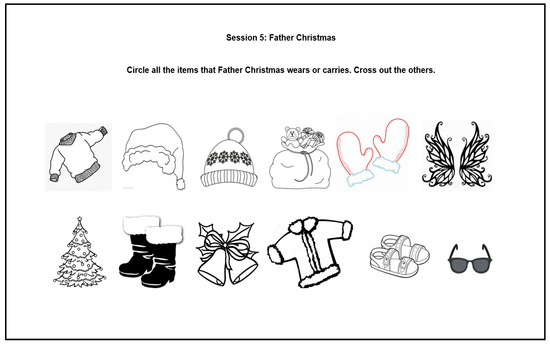
Figure 2.
Task A, Father Christmas outfit. The children had to circle the correct items and either leave unmarked or cross out the incorrect items.
In the introduction to Task B, the children were shown how to complete a sequenced activity related to that session’s theme and the items introduced in Task A, e.g., in session 6, how to wrap a Christmas present. They were given time to see the sequence of events, and at various points were asked what would happen next. Children were asked to join in by making suggestions or by helping with the activity. Then the children were given a task to evaluate their knowledge and understanding. For example, in session 6, wrapping a Christmas present, six pre-cut photos of a child completing the task were provided (see Figure 3) and the children were asked to order them in an appropriate sequence by sticking the pictures into a numbered grid line of six rectangles on an A4 printed sheet. At the end of Task B, all the children were questioned by one of the researchers, firstly to see if they understood the activity, secondly to hear the children explain their sequence and lastly to see if they sequenced the picture codes correctly. We also wanted to find out if the children would identify and correct any errors.
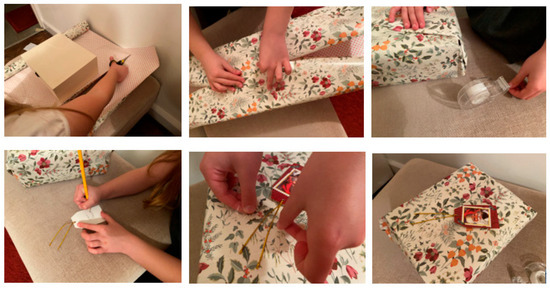
Figure 3.
Wrapping a Christmas present. These pictures were given to the children in a random order, and they had to sequence them correctly as shown above.
Colour photos were used for practical tasks such as icing a biscuit and wrapping a present; black and white clip art images were sometimes used for other tasks. Table 3 shows the materials needed for each session.
2.5. Quantitative Data Analysis
In Task A, each child was given a score of one for each correctly identified item and a score of one when a distractor item was not identified as relevant (left unmarked or crossed out). In both cases the maximum score was six, so a perfect score of Task A would be twelve. In Task B, each child was given a score of one for each item (usually a picture) that was correctly positioned in a sequence of six, achieving a maximum score of six for the correct sequence (algorithm) of images in the Picture code (sessions 2–6) and for the matching/continuing patterns in Session 1.
Overall development of children’s understanding was also measured by comparing Task A scores in Session 1 and 6 using the Session 1, Task A score as a pre-test compared to the Session 6, Task A score as a post-test as they both involved deconstruction and evaluation skills using the theme of wrapping a birthday or Christmas present. All the scores were entered into an SPSS software (IBM SPSS Statistics 26) programme and descriptive statistics were calculated.
2.6. Qualitative Data Analysis
The video clips were analysed to record the children’s behaviours and communication abilities both with their peers and with the researchers. We particularly wanted to record the children’s interview answers as an assessment of their thinking and logical reasoning abilities. We used exemplars of the children’s work sheets and of their interviews to illustrate the differences and similarities between the children, and the development of their CT abilities. Photos of the activities were taken as a record of the tasks and the children’s involvement in the process.
3. Results
The following section examines the quantitative and qualitative data for Tasks A and B.
3.1. Task A
Table 4 shows that while performance in terms of accuracy of identifying the correct items remained fairly steady, there was noticeable improvement in identifying the distractor items. This reflects an interesting change in the way children learned to reason about distractors over time and apply CT skills of deconstruction, evaluation and debugging. In the first two sessions, many of the children circled all of the items rather than thinking about whether an item was correct or a distractor. This suggests that their initial accuracy in identifying the correct items was arbitrary, random or impulsive or some of the children did not fully understand the task. When the children were questioned about their choices, they often refused to change their answers even when they were reminded that not all the items selected were correct.
Table 4.
Descriptive statistics of Task A across all six sessions: the number of correct items and the number of correct distractors.
Examining the children’s work and verbal explanations illustrates their ideas and thinking about Task A sessions. For example, Emma was working out the correct items for the Winter Forest School uniform in Session 2 (see Table 2, Session 2). In this task the children were asked to circle the correct items and leave or cross out the distractors (see Figure 4 and Table 5).
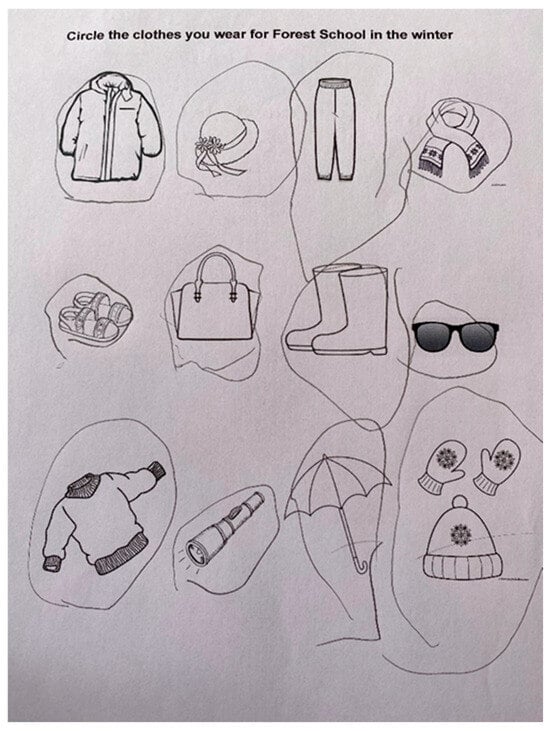
Figure 4.
Emma’s worksheet for Task A in Session 2: she had to circle six correct items worn by children in Forest School but circled them all (see Table 4 with Emma’s responses to the researcher).
Table 5.
Emma working out the correct items to wear at Winter Forest School.
Emma had circled all the other pictures without any hesitation. She was reminded to only circle the correct pictures, but she circled all of them. Interestingly, she did not pick up clues when she was asked questions about wearing a sun-hat or sandals in the winter. Her answers suggesting she was thinking about what she would wear in general, rather than thinking logically about winter specifically. However, by week 5, (see Figure 5) Emma was more able to distinguish between the correct items worn or held by Father Christmas and the distraction items. She verbally questioned the relevance of items as she worked her way through each image, demonstrating that she was evaluating items and thinking abstractly whether each item was correct, showing development of her CT skills not just in terms of deconstruction, evaluation, and debugging, but also as related language development. For example, she thought aloud whether Father Christmas wore a jumper or not, and decided he did not, although it had been in the original large picture, “He had a coat” and crossed out the jumper.
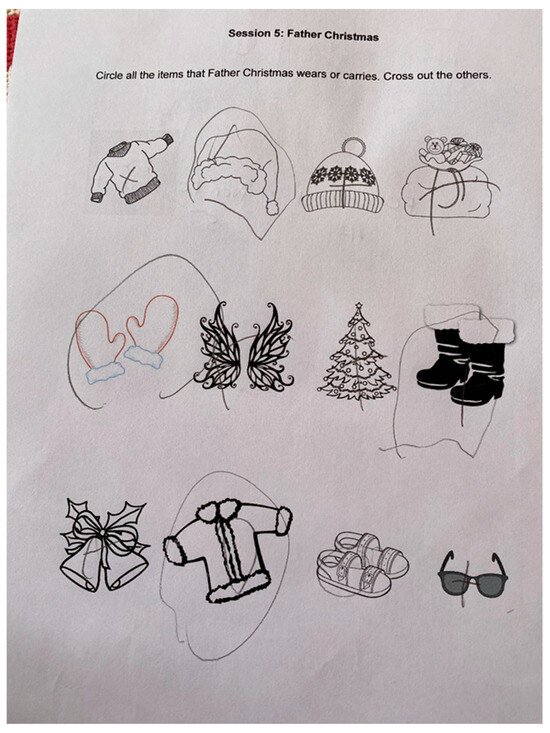
Figure 5.
Task A Session 5: Emma’s worksheet showing the items worn or carried by Father Christmas (the children were shown a large figure of Father Christmas). Emma has circled four correct items but omitted the jumper and the sack of toys.
3.2. Task B
In contrast to Task A, there was not a steady improvement in performance over time (Table 6). Indeed, the children found the CT skills of ordering, sequencing, and directionality easiest for the ‘Forest School map: Henry the hedgehog’s route’ from session 3 compared to the dressing tasks in sessions 2 and 5 (Winter Forest School uniform and Father Christmas outfit). The reasons for this are further explored in Section 4.
Table 6.
Descriptive statistics of the results of Task B: ordering and sequencing. Maximum score = 6.
These pictures from Session 4 (see Figure 6) are an illustration of the children’s own experience of one of the activities involving icing biscuits in which the children themselves completed the task. The first picture shows the children making the icing and decorating the biscuits, while the second picture shows the sequence of the activity completed correctly by one of the children.
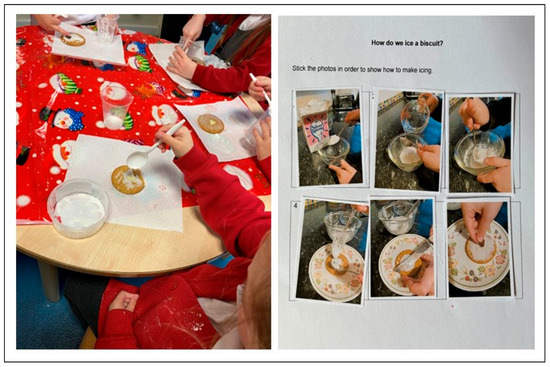
Figure 6.
Session 4: Icing biscuits. The picture on the left shows the children making icing and decorating their biscuits; the picture on the right shows the sequencing of the activity as a picture code completed by one of the children.
Differences between children are illustrated using exemplars showing the children’s ability to correct or debug their picture codes in Task B. Reflecting some of the difficulties children experienced in Session 5: Father Christmas outfit, Lee went through the order of his picture code (see Figure 7 and Table 7):
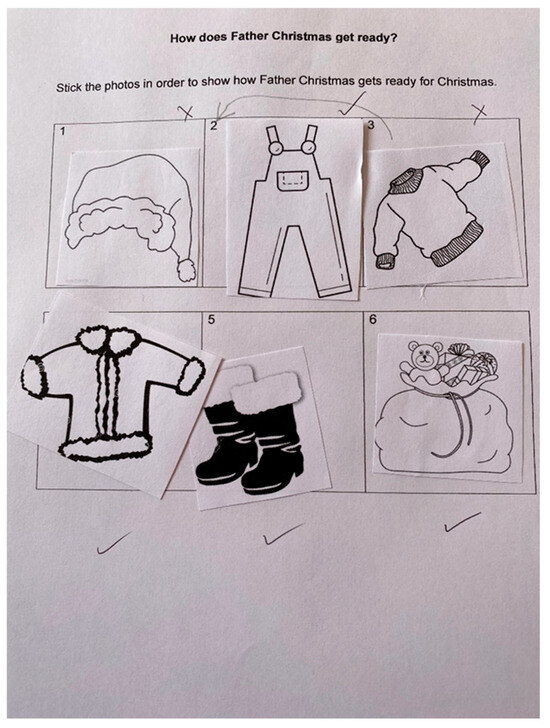
Figure 7.
Lee’s worksheet showing his answers to Task B (Session 5) in which he had to order the items in which Father Christmas put on to get ready to leave his home.
Table 7.
Lee’s responses to questions about his worksheet.
Lee agreed to change the jumper and dungarees around on the picture code, but refused to change the Father Christmas hat, which he picked up first to stick in the picture code. Looking at the video clips, Lee picked out the hat when working on the large image of Father Christmas. It may be that the hat had special significance to him, or he just liked it.
In Session 6: Wrapping a Christmas present, Aalifa explained the order of her picture codes (see Figure 8 and Table 8).
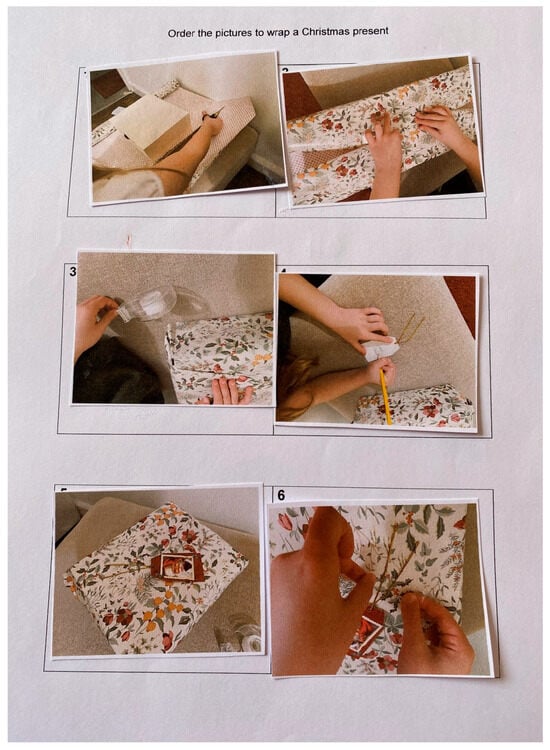
Figure 8.
Aalifa’s picture code in Task B (Session 6), sticking the pictures in the correct order. The first four pictures are correct but the last two are the wrong way round (see Figure 3 for the correct order).
Table 8.
Aalifa’s responses to questions about her picture code for wrapping a Christmas present.
Aalifa clearly understood the task and was able to evaluate and verbally rationalise the sequence of the task but was reluctant to debug the picture code illustrating that she understood the basic principles of the task although she did not wish to alter her worksheet.
3.3. Examples of Verbal and Non-Verbal Communication
Interviewing children allowed us to see whether the children were able to express and share their ideas and understanding either verbally or non-verbally via gestures such as pointing. We observed examples of children’s self-commentary during the tasks; children helping with or working with others on their tasks; and communicating their ideas with a researcher.
Self-commentary (i.e., private speech) included identifying pictures aloud, or commenting on their own work, for example, in Task A, “Did Father Christmas have fairy wings? No” (crosses out the picture of the fairy wings). “Have boots? Yes” (circles the boots). Some children communicated their ideas with their peers during our group discussions, especially during the Task B Dressing Father Christmas task where children were each given an article of clothing (see Figure 9) and asked to dress the cardboard figure, where they either commented that the clothing was correct or wrong, and moving the clothing out of the way. There were discussions on whether the green jumper should go under or over the dungarees; the hat went on first or last; the boots were put on under or over the dungarees, and the children swapped the clothes around as they talked about them.
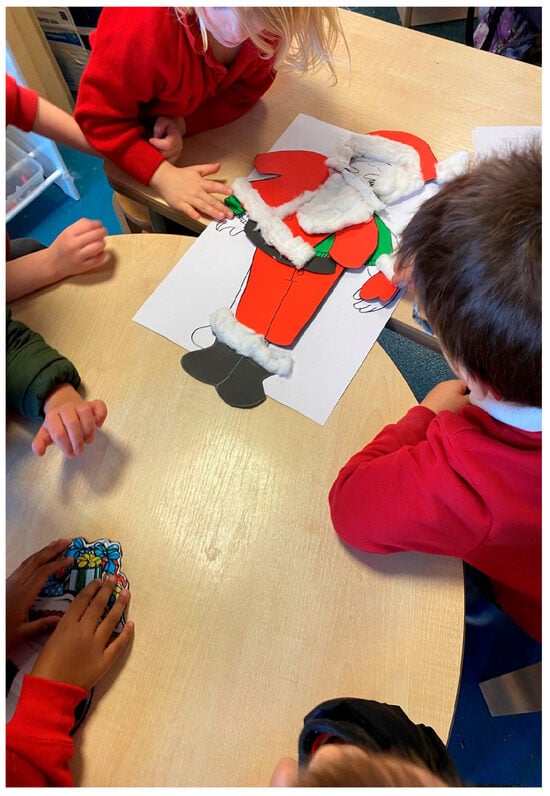
Figure 9.
The children were all given a piece of Father Christmas’s outfit plus his beard and a sack of presents. They were asked to work out between them the sequence of how he got dressed before completing their own paper-based picture code.
We found that some of the children had problems with verbally expressing their ideas or finding the vocabulary for items or verbs such as in Task B of Week 4: Icing biscuits but did respond to both verbal and non-verbal prompts. Soran (see Table 9) had correctly placed the six pictures in order on the picture code worksheet, so he clearly was able to logically think through and perform the coding task but had difficulties putting his reasoning into words. Prompting Soran with the initial phoneme of the answers and gesturing the actions helped him to answer the questions verbally. It might be that Soran was shy and did not want to answer questions, or it could be that he either did not understand the questions or had word-finding or vocabulary-finding difficulties.
Table 9.
Explaining Task B: ordering the sequence of icing biscuits.
4. Discussion
This study was designed to examine whether guided play activities within a classroom of 4–5-year-old children would encourage the development of some early CT abilities such as logical reasoning skills, deconstruction, evaluation, sequencing and debugging (K. Bers, 2021; Flood et al., 2022; Seidman, 1989; Wang et al., 2021b). This innovative approach was also designed so that practitioners, even those without pedagogic knowledge of computer science, could teach a set of CT skills by integrating them with the ELGs (see Table 1, Critten et al., 2024). Furthermore, this could be accomplished with simple materials and without the need for computers, screens and robotic toys (see J. Lee et al., 2023).
Each of the research questions will now be discussed in turn.
1. Were the tasks appropriate for the ages and abilities of the children and allow scaffolding of learning?
The tasks were designed to appeal to four- and five-year old children by linking them to topics familiar to them from their usual classroom activities and everyday life, e.g., Forest School, birthdays, Christmas. The children really enjoyed the sessions and were willing to engage as evidenced by the work they produced, e.g., Figure 4, Figure 5, Figure 6, Figure 7, Figure 8 and Figure 9 and the discussions they had with researchers, e.g., Table 4, Table 6, Table 7 and Table 8. Furthermore, they enjoyed working in groups to perform tasks and interacting with other peers to compare ideas, e.g., Figure 9: Dressing Father Christmas.
The quantitative descriptive data from Tasks A and B also confirm that the level of difficulty was appropriate for children, i.e., no extreme floor or ceiling effects suggesting they were too difficult or too easy, but, in general, more success than failure. There was also a healthy distribution of accuracy scores showing that the tasks were sensitive enough to reflect individual differences in children’s CT abilities. This would allow teachers to both assess ability and track it, something that the use of robotic toys has previously not been able to do reliably in this age group (e.g., Kanaki & Kalogiannakis, 2022).
In trialling an ‘unplugged’ nonrobotic approach (J. Lee et al., 2023), it was important to choose simple play activities that could be appropriately scaffolded to gradually support children’s learning and indicate what children were able to do and what they would need help to achieve next (e.g., Hagon et al., 2020; Spadafora & Downes, 2020; Vygotsky et al., 1980). The effectiveness of this approach in allowing teachers to question, challenge and encourage children’s understanding are evidenced by exchanges in Table 4, Table 6, Table 7 and Table 8 with Emma, Lee, Aalifa and Soran where the children sometimes came to recognise errors they may have made (irrespective of whether they actually corrected them in their work, i.e., Aalifa) and start to show emerging nonverbal and verbal ability to explain their work, e.g., Soran.
Finally, the value and appropriateness of these tasks for teachers of children aged four to five years is reflected in the general improvements many of the children made over time in their CT skills and the depth of information that can be gathered for assessment purposes during the sessions via discussions. This will be explored in more depth in relation to Research Question 2.
However, before that it is worth briefly reflecting on the apparently anomalous findings of Session 3, Task B ‘Forest school map: Henry the Hedgehog’s route’ (see Figure 10). Why was this sequencing/ordering task apparently so much easier and more accessible than the others? It may be that the children were most interested in this task as it directly related to something they were concurrently experiencing at school, i.e., weekly outdoor lessons in Forest School. Furthermore, the landmarks on the map were the same as at their school providing a concrete example. A second and related possibility is that there was greater scaffolding provided in this task compared to the others. For the introduction to the task, the children were each given a picture of the landmarks and a hedgehog toy and then asked to make up their own routes between the landmarks. This scaffolding may have more effectively ensured that the children fully understood the activity before being presented with the paper task, helping the children to think more abstractly (Spadafora & Downes, 2020).
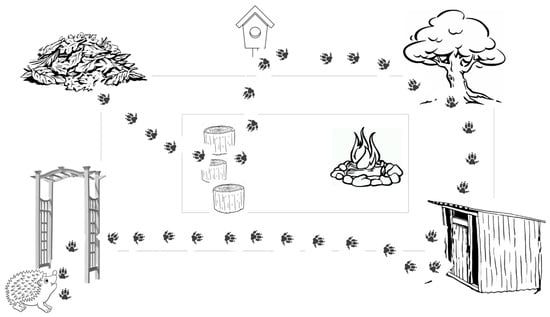
Figure 10.
Forest School Map of the route for Henry the hedgehog to find a place to hibernate during the winter. The children had to order the sequence of the landmarks in a picture code.
In summary the tasks can be recommended to teachers as appropriate for assessing and scaffolding children’s CT abilities for this age group and address the current gap in available resources for teachers (Yildirim, 2021). However, the case of the ‘Henry the Hedgehog’ Forest School task highlights the need for teachers to flexibly evaluate the tasks they use as for various reasons some may prove more easier (or too difficult) than others depending on the children’s level of real-world experience with the topic at the time.
Research Question 2. Did the children’s performance and explanations demonstrate evidence of emerging CT abilities?
For Task A we found that the children were able to show CT skills in terms of deconstruction, evaluation, and debugging and there was an overall improvement in the mean number of correct items and distractors correctly identified in Task A from Session 1 compared to Session 6. The most notable finding being the improvement in children’s ability to deconstruct and evaluate the distractors. By corollary, as the children’s logical thinking became more explicit, their CT skills related to language abilities appeared to develop, e.g., focusing, answering questions and vocabulary-growth; they also became more able to explain the reasons for their choices, e.g., Emma’s progress throughout the sessions (see also Pine & Messer, 2000). More specifically, Emma was achieving task success perhaps because she was also able to verbally express her ideas by either self-commenting, by listening to others, or by talking through her ideas with the researchers, thus changing her underlying representations of how to complete the tasks (Karmiloff-Smith, 1995; Pine & Messer, 2000). This confirms assertions by researchers that children in the early years can be taught CT skills (K. Lee & Cho, 2021; J. Lee et al., 2023) despite the fact it is not mandatory within the ELG (DfE, 2023).
In relation to Task B, the findings were more complex. Compared to Task A there was not a clear improvement in task performance across the six sessions. However, many children were demonstrating the CT skills of sequencing and debugging, most successfully for the ‘Henry the Hedgehog’ task as already described. It is also clear that the children were showing additional language abilities in relation to evaluating, sequencing, and debugging by attempting to explain what they were doing and justify their actions. Although children did not always recognise their errors or indeed, if they did, amend their work to correct their errors, e.g., Lee and Aalifa, their verbal explanations were invaluable to gain further insight into their understanding and current state of logical reasoning abilities (Karmiloff-Smith, 1995; Pine & Messer, 2000). Most importantly, the findings from Task B indicate the role of nonverbal communication in assessing children’s developing CT skills.
This is particularly reflected by Aalifa and Soran perhaps because they have English as an Additional Language (EAL). Aalifa’s vocabulary abilities (Table 7) showed that she was able to speak in short phrases, but she also used gestures to explain the tasks. Furthermore Soran (Table 8), despite task success, found it very difficult to name the items in the pictures unless given a prompt and he also used gestures to show the processes of stirring and spreading. By discussing the children’s work with them, whether they display their knowledge by gestures or verbally, teachers will be able to gauge their understanding and scaffold their next lessons appropriately (Wang et al., 2021b).
Limitations and Implications
One of the reasons we designed the research activities to take place in the classroom alongside groups of other children working on separate tables was to illustrate that these classroom tasks could take place every day and do not need special arrangements. However, we found that the noise levels were quite high at times, and it was sometimes difficult to hear the children’s verbalisations. The use of smartphones recording individual interviews was very helpful in picking up the children’s verbal responses where the laptop microphone was inadequate. Many of the children in this class were from multi-cultural backgrounds where English was spoken as a second language, so this may have affected the children’s understanding of the tasks especially in the initial sessions.
As the activities took place alongside typical classroom group work, there is some evidence that these types of CT activities could become part of normal classroom routines in the early years. The introductions for Tasks A and B could easily take place as whole class lessons where the children could be shown the method of the task, e.g., making icing or dressing for Forest School. Equipment and items used in the activities could be placed in part of the classroom for the children to experiment with as part of their group sessions although some of the activities may need adult supervision.
There may be some need to support teachers in the way of training or guidance from subject coordinators or Ed Techs to help develop the activities and support with assessing the outcomes of the tasks. Teachers who have taken part in research (Dong, 2018) suggest that while CT activities can be beneficial to children, there is a cost in the time and effort needed to develop the resources and monitor and supervise the tasks in the classrooms. In addition, the resources employed for the tasks in the present study are much more financially affordable for schools compared to robotic toys such as Bee-Bots.
Further research is needed into the possible provision of CT abilities being developed in children in the early years. Currently a number of studies have been published showing that children work well and enjoy learning about CT through the use of robots, particularly Bee-Bots; however, the lack of financial resources in early years settings provide reasons why an alternative way of teaching CT is necessary especially using guided play activities as a teaching approach.
5. Conclusions
In conclusion, this study has demonstrated that over the six-week sessions, the tasks were appropriate for the children’s age and abilities, the tasks were engaging and that teachers should be able to accurately assess children’s abilities and then provide further scaffolding where necessary to develop them. We also found evidence from the quantitative and qualitative data that children were able to demonstrate their understanding of CT concepts such as deconstruction, evaluation, sequencing, debugging and associated language abilities. Furthermore, some children showed improvements in these skills over the six-week period which is impressive for the age of the children in such a short time. These results provide new insights into the children’s emerging CT abilities and highlight that it is possible to teach and assess CT in the early years. Overall, the findings underscore the need for simple changes to the early year’s curriculum and the training of teachers in CT and offer valuable contributions to the field of computational education.
Author Contributions
Conceptualization, H.H. and V.C.; methodology, V.C., H.H. and D.M.; software, V.C. and D.M.; validation, all authors; formal analysis, V.C. and D.M.; investigation, V.C. and H.H.; resources, V.C. and H.H.; data curation, V.C. and D.M.; writing—original draft preparation, V. C.; writing—review and editing, all authors; visualization, V.C., H.H. and D.M.; supervision, all authors; project administration, all authors; funding acquisition, none acquired. All authors have read and agreed to the published version of the manuscript.
Funding
This research received no external funding.
Institutional Review Board Statement
The study was conducted in accordance with the Declaration of Helsinki, and approved by Human Research Ethics Committee (protocol code: 4500 and date of approval: 28 September 2022).
Informed Consent Statement
Informed consent was obtained from all subjects involved in the study.
Data Availability Statement
The data supporting the conclusions of this article will be made available by the corresponding author on request..
Conflicts of Interest
The authors declare no conflicts of interest.
References
- Armoni, M. (2016). Computing in schools, computer science, computational thinking, programming, coding: The anomalies of transitivity in K-12 computer science education. ACM Inroads, 7(4), 24–27. [Google Scholar] [CrossRef]
- Becker, I., Rigaud, V. M., & Epstein, A. (2023). Getting to know young children: Alternative assessments in early childhood education. Early Childhood Education Journal, 51(5), 911–923. [Google Scholar] [CrossRef]
- Bers, K. (2021). Coding as a playground: Programming and computational thinking in the early childhood classroom (eye on education). Routledge. [Google Scholar]
- Bers, M., Flannery, L., Kazakof, E., & Sullivan, A. (2014). Computational thinking and tinkering: Exploration of an early childhood robotics curriculum. Computers and Education, 72, 145–157. [Google Scholar] [CrossRef]
- Bers, M. U. (2018). Coding and computational thinking in early childhood: The impact of ScratchJr in Europe. European Journal of STEM Education, 3(3), 8. [Google Scholar] [CrossRef] [PubMed]
- Brennan, K., & Resnick, M. (2012, April 13–17). New frameworks for studying and assessing the development of computational thinking. The 2012 Annual Meeting of the American Educational Research Association (Vol. 1, p. 25), Vancouver, BC, Canada. [Google Scholar]
- Bull, G., Garofalo, J., & Rich Hguyen, N. (2020). Thinking about computational thinking. Journal of Digital Learning in Teacher Education, 36(1), 6–18. [Google Scholar] [CrossRef]
- Bull, R., & Scerif, G. (2001). Executive functioning as a predictor of children’s mathematics ability: Inhibition, switching, and working memory. Developmental Neuropsychology, 19(3), 273–293. [Google Scholar] [CrossRef] [PubMed]
- Critten, V., Hagon, H., & Messer, D. (2022). Can pre-school children learn programming and coding through guided play activities? A case study in computational thinking. Early Childhood Education Journal, 50(6), 969–981. [Google Scholar] [CrossRef]
- Critten, V., Hagon, H., & Unlu, M. A. (2024). A Curriculum framework and assessment approach for computational thinking in the early years. International Journal of Computer Science Education in Schools, 6(4). [Google Scholar] [CrossRef]
- Department for Education (DfE). (2013). National curriculum in England: Computing programmes of study. National curriculum—Computing key stages 1 to 2. Available online: https://www.gov.uk/government/publications/national-curriculum-in-england-computing-programmes-of-study/national-curriculum-in-england-computing-programmes-of-study (accessed on 1 January 2023).
- Department for Education (DfE). (2023). Early years foundation stage statutory framework. Statutory Framework for the Early Years Foundation Stage.
- Dong, C. (2018). ‘Young children nowadays are very smart in ICT’—Preschool teachers’ perceptions of ICT use. International Journal of Early Years Education, 33(2), 345–358. [Google Scholar] [CrossRef]
- Fessakis, G., Gouli, E., & Mavroudi, E. (2013). Problem solving by 5–6 years old kindergarten children in a computer programming environment: A case study. Computers and Education, 63, 87–97. [Google Scholar] [CrossRef]
- Fleer, M. (2021). Re-imagining play spaces in early childhood education: Supporting girls’ motive orientation to STEM in times of COVID-19. Journal of Early Childhood Research, 19(1), 3–20. Available online: https://uk.sagepub.com/en-gb/journals-permissions (accessed on 1 January 2023). [CrossRef]
- Flood, V. J., Wang, X. C., & Sheridan, M. (2022, June 6–10). Embodied responsive teaching for supporting computational thinking in early childhood. The 16th International Conference of the Learning Sciences-ICLS 2022 (pp. 855–862), Hiroshima, Japan. [Google Scholar]
- Gomes, T. C. S., Falcão, T. P., & Tedesco, P. C. D. A. R. (2018). Exploring an approach based on digital games for teaching programming concepts to young children. International Journal of Child-Computer Interaction, 16, 77–84. [Google Scholar] [CrossRef]
- Hagon, H., Critten, V., & Messer, D. (2020). An introduction to unplugged coding for preschool children. Hello World, 13, 57–59. Available online: https://helloworld.raspberrypi.org/issues/13 (accessed on 9 September 2025).
- International Society for Technology in Education (ISTE) & The Computer Science Teachers Association (CSTA). (2011). Operational definition of computational thinking for K–12. Education. Available online: https://cdn.iste.org/www-root/Computational_Thinking_Operational_Definition_ISTE.pdf (accessed on 9 September 2025).
- Kanaki, K., & Kalogiannakis, M. (2022, September 16–18). Algorithmic thinking in early childhood. The 6th International Conference on Digital Technology in Education (pp. 66–71), Hangzhou, China. [Google Scholar] [CrossRef]
- Karmiloff-Smith, A. (1995). Beyond modularity: A developmental perspective on cognitive science (learning, development, and conceptual change). MIT Press. [Google Scholar]
- Lee, J., Joswick, C., & Pole, K. (2023). Classroom play and activities to support computational thinking development in early childhood. Early Childhood Education Journal, 51(3), 457–468. [Google Scholar] [CrossRef]
- Lee, J., & Junoh, J. (2019). Implementing unplugged coding activities in early childhood classrooms. Early Childhood Education Journal, 47(6), 709–716. [Google Scholar] [CrossRef]
- Lee, K., & Cho, J. (2021). Computational thinking evaluation tool development for early childhood software education. JOIV: International Journal on Informatics Visualization, 5(3), 313–319. [Google Scholar]
- Papert, S. (1988). Does easy do it? Children, games, and learning. Game Developer Magazine, 5(6), 88–89. [Google Scholar]
- Papert, S. (1990). Mindstorms: Children, computers and powerful ideas. New York: Basic Books, 10(1990), 1095592. [Google Scholar]
- Papert, S., & Harel, I. (1991). Situating constructionism. Available online: http://www.papert.org/articles/SituatingConstructionism.htm (accessed on 1 January 2023).
- Pine, K. J., & Messer, D. J. (2000). The effect of explaining another’s actions on children’s implicit theories of balance. Cognition and Instruction, 18(1), 35–51. [Google Scholar] [CrossRef]
- Presser, A. E. L., Young, J. M., Rosenfeld, D., Clements, L. J., Kook, J. F., Sherwood, H., & Cerrone, M. (2023). Data collection and analysis for preschoolers: An engaging context for integrating mathematics and computational thinking with digital tools. Early Childhood Research Quarterly, 65, 42–56. [Google Scholar] [CrossRef]
- Relkin, E., & Strawhacker, A. (2021). Unplugged learning: Recognizing computational thinking in everyday life. In M. Bers (Ed.), Teaching computational thinking and coding to young children (pp. 41–62). IGI Global Scientific Publishing. Available online: https://www.igi-global.com/chapter/unplugged-learning/286042 (accessed on 1 January 2023).
- Seidman, R. H. (1989). Computer programming and logical reasoning: Unintended cognitive effects. Journal of Educational Technology Systems, 18(2), 123–141. [Google Scholar] [CrossRef]
- Siegler, R. S. (2016). Continuity and change in the field of cognitive development and in the perspectives of one cognitive developmentalist. Child Development Perspectives, 10(2), 128–133. [Google Scholar] [CrossRef]
- Spadafora, N., & Downes, T. (2020). Scaffolding in learning. In Encyclopedia of evolutionary psychological science. Springer Nature Switzerland AG. [Google Scholar]
- Terroba, M., Ribera, J. M., Lapresa, D., & Anguera, M. T. (2022). Observational analysis of the development of computational thinking in early childhood education (5 years old) through an intervention proposal with a ground robot of programmed directionality. European Early Childhood Education Research Journal, 30(3), 437–455. [Google Scholar] [CrossRef]
- Trentin, M. A. S., Pazinato, A., & Teixeira, A. C. (2017). The development of mathematical logical reasoning through computer programming: The case of the computer programming Olympics for basic education students. Creative Education, 8(1), 81. [Google Scholar] [CrossRef][Green Version]
- Vygotsky, L. S., Cole, M., John-Steiner, V., & Souberman, E. (1980). Mind in society: The development of higher psychological processes. Harvard University Press. [Google Scholar][Green Version]
- Wang, X. C., Choi, Y., Benson, K., Eggleston, C., & Weber, D. (2021a). Teacher’s role in fostering preschoolers’ computational thinking: An exploratory case study. Early Education and Development, 32(1), 26–48. [Google Scholar] [CrossRef]
- Wang, X. C., Flood, V. J., & Cady, A. (2021b, June 8–11). Computational thinking through body and ego syntonicity: Young children’s embodied sense-making using a programming toy. The 15th International Conference of the Learning Sciences-ICLS 2021, Bochum, Germany. [Google Scholar]
- Wang, X. C., Flood, V. J., & Xing, G. Y. (2023, June 9–10). Preschoolers’ embodied and shared self-regulation through computational thinking. The 17th International Conference of the Learning Sciences-ICLS 2023 (pp. 1470–1473), Montreal, QC, Canada. [Google Scholar]
- Wing, J. M. (2006). Computational thinking. Communications of the ACM, 49(3), 33–35. [Google Scholar] [CrossRef]
- Yildirim, B. (2021). Preschool STEM activities: Preschool teachers’ preparation and views. Early Childhood Education Journal, 49(2), 149–162. [Google Scholar] [CrossRef]
Disclaimer/Publisher’s Note: The statements, opinions and data contained in all publications are solely those of the individual author(s) and contributor(s) and not of MDPI and/or the editor(s). MDPI and/or the editor(s) disclaim responsibility for any injury to people or property resulting from any ideas, methods, instructions or products referred to in the content. |
© 2025 by the authors. Licensee MDPI, Basel, Switzerland. This article is an open access article distributed under the terms and conditions of the Creative Commons Attribution (CC BY) license (https://creativecommons.org/licenses/by/4.0/).