


Abstract
Additive manufacturing (AM), or 3D printing, is increasingly recognised as a disruptive production technology with the capacity to reduce greenhouse gas (GHG) emissions across manufacturing and transportation sectors. By enabling material efficiency, lightweighting, part consolidation, and decentralised, on-demand production, AM offers pathways to lower embodied energy, minimise waste, and shorten supply chains. This review critically evaluates AM’s role in decarbonisation, with a focus on clean transportation applications, including electric vehicles, fuel cells, and hydrogen storage systems. Case studies quantify energy savings, operational efficiency gains, and life-cycle GHG reductions compared to conventional manufacturing routes. The analysis also addresses technical and economic limitations—such as material availability, scalability, certification, and cost competitiveness—and explores synergies with circular economy principles, digital design optimisation, and artificial intelligence. Policy recommendations and industry–academia collaboration models are proposed to accelerate AM adoption, integrate renewable energy sources, and strengthen recycling infrastructure. By synthesising technical, economic, and policy perspectives, the study positions AM as a critical enabler of net-zero manufacturing and a catalyst for sustainable industrial transformation.
1. Introduction
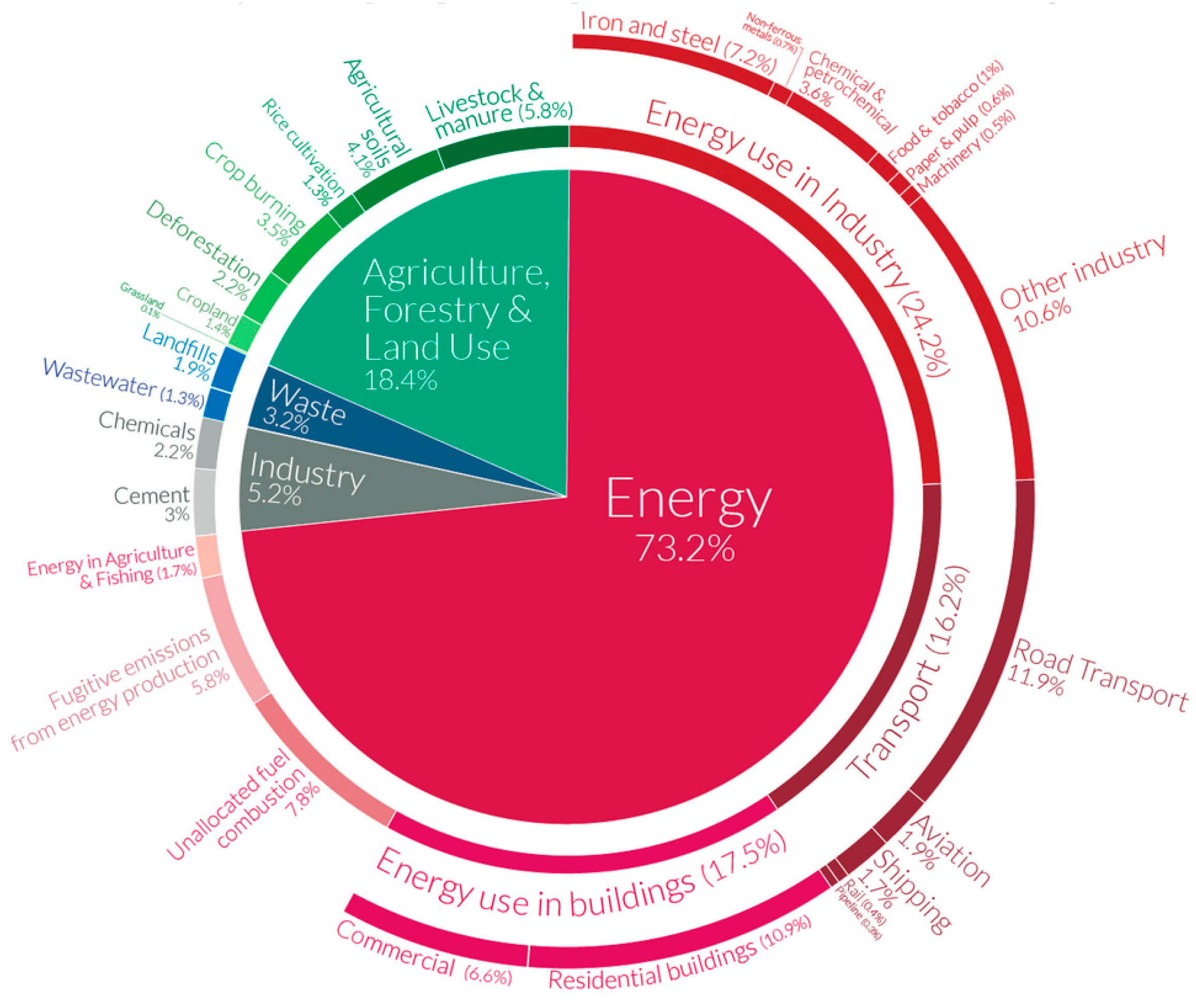
In recent years, the rapid advancement of additive manufacturing (AM), also known as 3D printing, alongside the urgent global drive toward decarbonization, has positioned AM as a disruptive manufacturing technology with significant potential to mitigate climate change impacts [1,2,3]. The transportation sector alone is responsible for approximately 16.2% of global greenhouse gas (GHG) emissions, with road transport contributing about 11.9%—making it the single largest sub-sectoral source of emissions globally [4,5]. Conventional vehicle manufacturing processes and their extended supply chains are highly energy- and material-intensive, often producing significant waste and relying on fossil-fuel-powered logistics, which account for a substantial share of total product lifecycle emissions [6].
Industrial manufacturing more broadly accounts for 24.2% of direct GHG emissions globally [7], with additional emissions from electricity generation used in manufacturing pushing the figure close to 30%. Within this sector, traditional subtractive manufacturing processes such as milling, forging, casting, and machining can result in material buy-to-fly ratios as high as 20:1 in aerospace applications, meaning that up to 95% of the original material is wasted [8]. AM, by contrast, builds parts layer-by-layer, achieving near-net-shape geometries that can reduce material waste by 70–90% [9].
One of AM’s most impactful contributions to transportation decarbonization lies in lightweighting through topology optimization. In the automotive industry, every 10% reduction in vehicle mass can lead to an approximate 6–8% improvement in fuel economy for internal combustion engine vehicles and a 13–15% increase in electric vehicle range [10]. AM-enabled lattice structures and part consolidation have achieved weight reductions of 20–60% in components such as brake calipers, suspension arms, and structural brackets [11,12]. Airbus reported that replacing conventionally manufactured titanium brackets with AM-designed equivalents resulted in 55% weight savings, translating to 465,000 L of fuel saved and 1200 metric tonnes of CO2 emissions avoided annually per aircraft fleet [13].
In addition to improving material efficiency and reducing lightweighting, AM has the potential to transform conventional energy-intensive supply chains. The conventional manufacturing model involves centralized production facilities and complex multi-tier supply networks, with components shipped long distances for assembly and final distribution. Transportation logistics can account for up to 50% of lifecycle emissions for certain manufactured goods [14]. By enabling localized, on-demand production, AM reduces the need for large inventories and long-haul shipping, cutting transportation-related emissions by 20–50% in documented case studies [15,16].
AM’s role in clean transportation extends to the production of next-generation powertrain components for electric vehicles (EVs) and hydrogen fuel cell systems. In EVs, AM is used to fabricate optimized battery enclosures, cooling systems, and motor housings with integrated thermal management features, improving efficiency and extending battery life [17]. In hydrogen technologies, AM enables the production of complex bipolar plates, fuel cell stacks, and electrolyzer components that enhance mass transport and durability, reducing overall system size and weight [18,19]. These improvements have direct implications for reducing operational energy consumption and, consequently, GHG emissions.
Globally, policy frameworks such as the European Green Deal, the United States’ 2030 emissions reduction target under the Paris Agreement, and China’s Made in China 2025 initiative explicitly recognize AM as an enabling technology for low-carbon manufacturing and transportation [20,21,22,23]. When integrated with renewable energy and circular economy strategies—including the reuse, remanufacture, and recycling (3R) of feedstocks—AM has the potential to support net-zero manufacturing systems by 2050 [23]. Despite these benefits, challenges remain in achieving large-scale adoption of AM for GHG reduction in transportation, including high feedstock costs, production scalability, certification barriers, and dependence on clean electricity sources [24,25,26]. Nevertheless, life-cycle assessment (LCA) studies consistently demonstrate that the environmental benefits of AM are highly context-dependent, shaped by both the location of production and the source of electricity. By relocating production closer to the point of use, AM reduces transportation, packaging, and warehousing burdens, while enabling on-demand manufacturing that minimizes overproduction and waste [27,28]. These distributed manufacturing (DM) models are especially advantageous for customized, lightweight, or low-volume parts, where LCAs report lower energy intensity and smaller carbon footprints compared with conventional subtractive or injection-moulding routes [29,30,31]. Case studies further show that AM-enabled supply chain localization can cut logistics-related emissions by 20–50%, complementing lightweighting and material efficiency gains [15,16]. However, these benefits are not consistently realized across all applications. Environmental performance varies by feedstock, build orientation, print parameters, and post-processing requirements [32,33]. Most critically, electricity sourcing is the dominant factor shaping AM’s life-cycle outcomes, particularly for energy-intensive processes such as fused filament fabrication (FFF), laser sintering, and powder-bed fusion [29,32]. Fossil-intensive grids can diminish or even negate AM’s potential advantages, whereas renewable-powered AM consistently enhances performance by lowering both cumulative energy demand and GHG emissions [33].
Empirical evidence reinforces this conclusion: photovoltaic-powered distributed AM has achieved up to 74% reductions in energy demand compared with conventional manufacturing [28], while renewable integration has been shown to amplify the benefits of supply-chain localization [27]. Stand-alone solar-driven AM systems—including photovoltaic-powered RepRap units and Markus Kayser’s Solar Sinter concentrator project—demonstrate the technical feasibility of fully decoupling AM from fossil-based infrastructures under certain conditions [34,35]. At the level of broader energy systems, renewable-heavy electricity grids provide a complementary pathway, progressively lowering the carbon footprint of grid-connected AM without specialized hardware [19,31]. These findings indicate that with renewable energy integration, AM can achieve GHG reductions of 30–50% per part relative to conventional manufacturing routes [36]. Off-grid solar-powered AM and renewable-intensive grid integration thus represent dual but complementary strategies: the former enabling autonomous, localized, fossil-free production, and the latter enabling large-scale industrial decarbonization of AM supply chains—positioning AM as a critical tool in the global transition to sustainable, low-carbon transportation.
This paper provides a comprehensive review of how AM contributes to reducing greenhouse gas emissions, with focus on the transportation sector. This study examines: (i) the fundamentals of greenhouse gas emissions, carbon accounting, and sustainability frameworks; (ii) additive manufacturing (AM) process families, their advantages, and current applications; and (iii) AM-enabled pathways for decarbonizing manufacturing and transportation, including the challenges, policy recommendations, and future directions required to support global net-zero targets. A full description of the review methodology, including search strategy, databases, coding framework, and inclusion/exclusion process, is provided in the Supplementary File (Figure S1).
2. Greenhouse Gas Emissions and Sustainability Context
2.1. Overview of Global GHG Emissions from the Manufacturing and Transportation Sectors
Global air-quality data from the World Health Organization (WHO) indicate that approximately 92% of the world’s population is exposed to pollutant concentrations exceeding accepted safety thresholds [5]. The economic consequences are severe: particulate matter, nitrogen oxides (NOx), and CO2 emissions impose an estimated external cost of €330–€940 billion annually, with direct costs of ~€24 billion per year [4]. These translate into reduced productivity, lower agricultural yields, structural damage, escalating healthcare costs, and over half a billion premature deaths annually in Europe alone [6]. Sectoral analysis by Climate Watch and the World Resources Institute (Figure 1) attributes 24.2% of global GHG emissions to energy use in industry, making it the largest single source, while the construction sector accounts for ~34% of global energy consumption and 37% of CO2 emissions [37]. The transportation sector contributes 16.2% of global GHG emissions, with road transport alone responsible for 11.9%—the highest of any subsector [37].
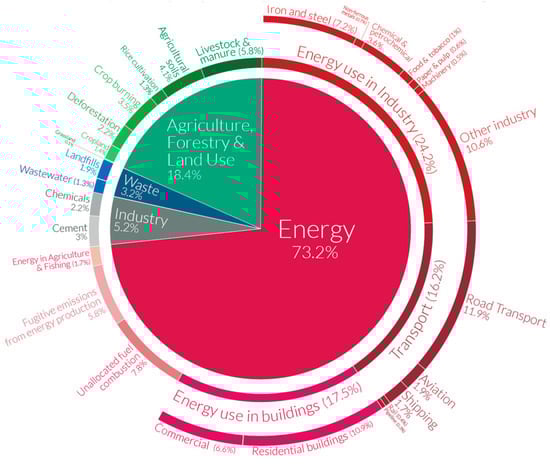
Figure 1.
Percentage breakdown of global greenhouse gas emissions in the major sectors of the economy.(Data source: Climate Watch and the World Resources Institute [37].
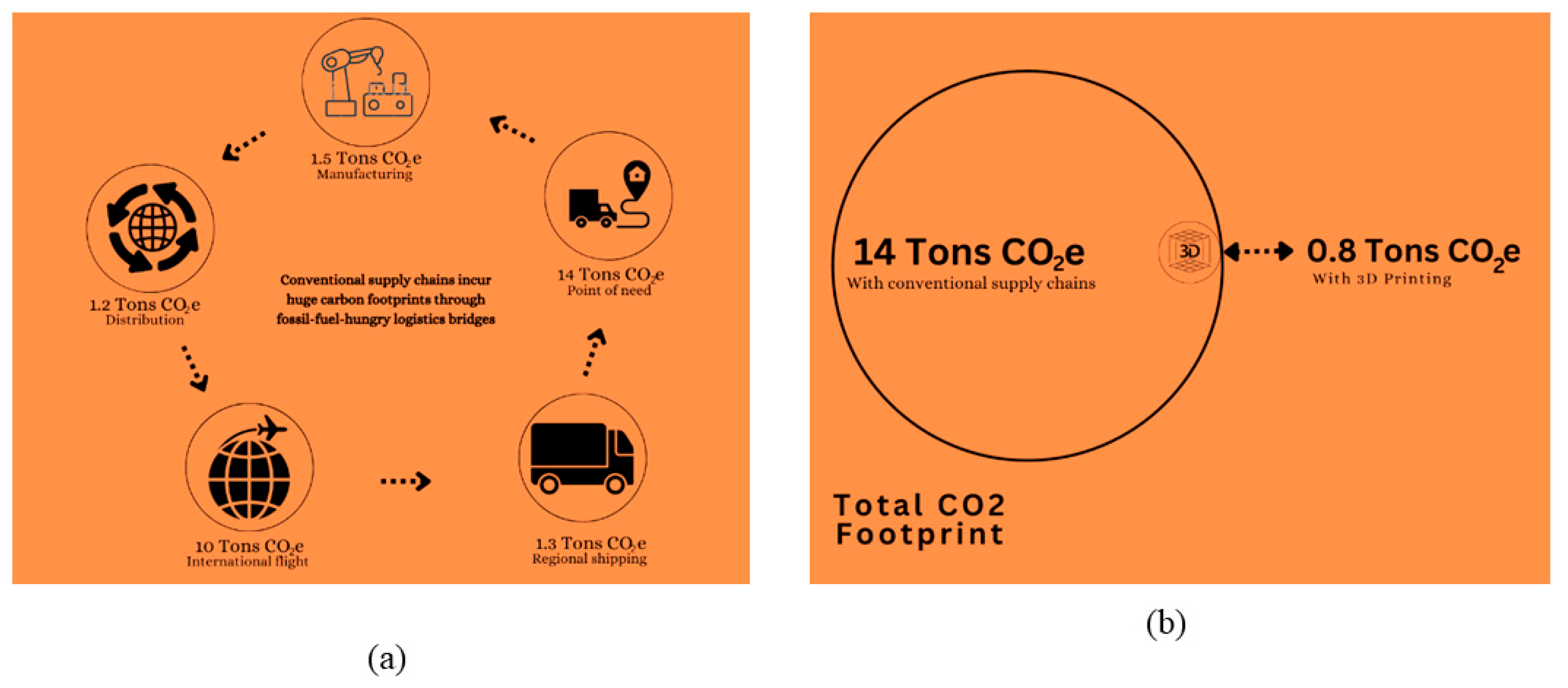
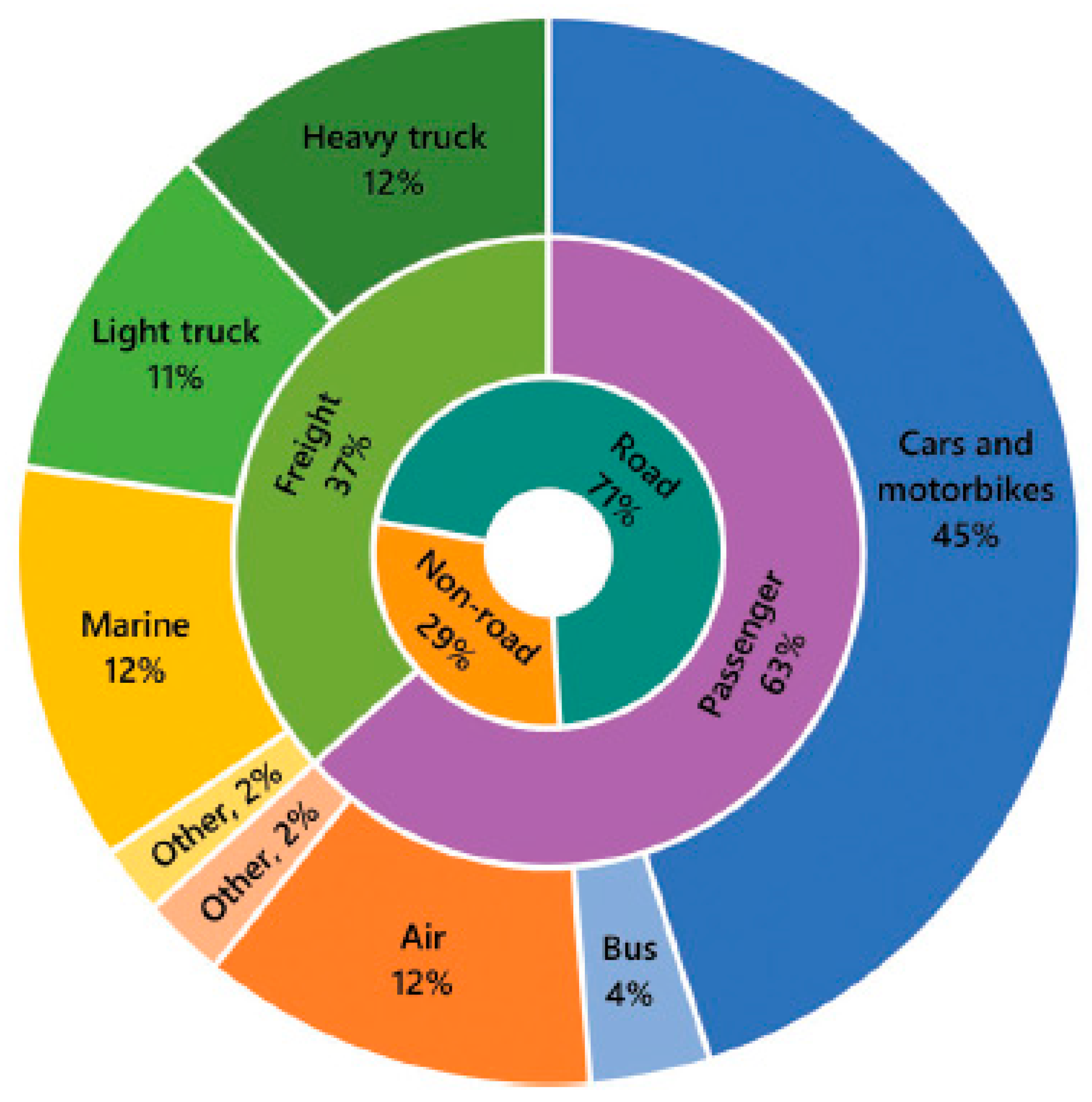
In manufacturing supply chains, life-cycle assessments show that the logistics phase can generate more CO2 emissions (up to 10 t per product (Figure 2) than the production phase itself [38], underscoring the need to address both industrial production and distribution networks in decarbonization strategies (Figure 3). According to the U.S. Energy Information Administration (EIA), transportation accounted for 28% of U.S. energy consumption in 2022 [39]. AM, through its distributed and virtual warehouse model, can help reduce this burden by eliminating the need for long-distance transport of goods. By enabling localized, on-demand production, AM shortens supply chains, lowers energy consumption, and accelerates decarbonization. Digital blueprints can be shared and printed directly onsite, reducing both transportation costs and emissions [40].
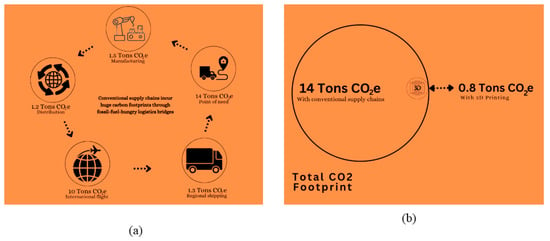
Figure 2.
(a) High carbon emissions by the conventional manufacturing and shipment process (b) Comparing the total carbon footprints of the conventional manufacturing and shipment with AM (Data source: Markforged [40]).
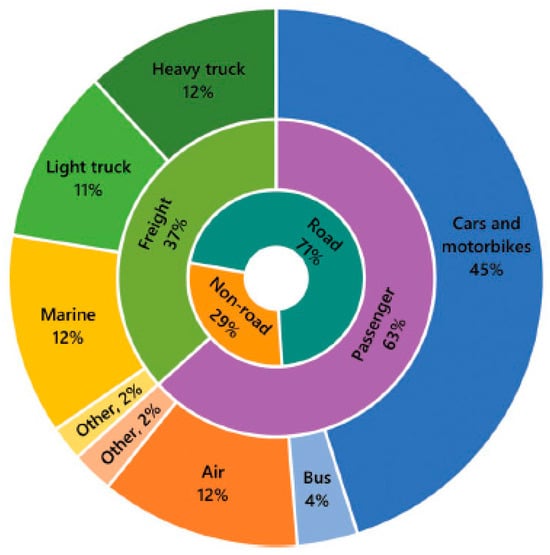
Figure 3.
Global representation of energy usage in the transport sector (Data source: Energy Information Administration [41]).
2.2. Environmental and Policy Drivers for Carbon Reduction
To address rising emissions, multiple policy drivers are converging. For example, the United Nations (UN) Net-Zero Coalition calls for carbon emissions to be reduced throughout the current decade to keep warming below 1.5 °C by 2050 [10,11]. In most jurisdictions, ban on fossil-fuel internal combustion engines (ICEs) by 2040 has been proposed [7]. Achieving net-zero—defined here as a condition where the amount of carbon released is less than that removed from the atmosphere [12,13]—requires systemic transformation of energy and manufacturing systems. In this paper, the term “clean energy sources” refers to environmentally friendly power generation technologies that emit little to no GHGs, including renewable energy (i.e., self-replenishing sources) [15], green energy (i.e., sources that do not harm the environment) [16] and clean energy (sources that do not pollute the environment).
2.3. Rationale for Exploring AM as a Mitigation Tool
Migrating from a hydrocarbon-based energy infrastructure to one grounded in clean energy demands research, development, and deployment of enabling technologies. Thus, AM—formally defined as the process of joining materials layer-by-layer from 3D model data (ISO/ASTM 52900:2021 [24]. AM contributes to greenhouse gas reduction through several interrelated mechanisms. First, supply-chain decarbonization is achieved via AM’s “zero-inventory” digital warehousing capabilities, which enable hyperlocal, on-demand production and bypass carbon-intensive global logistics networks [38,42,43,44,45,46]. This capability proved critical during the COVID-19 pandemic, when the fragility of conventional supply chains became evident [43,47,48]. Second, material efficiency is realised through AM’s ability to reduce material waste by up to 40% [49] and lower production energy consumption by more than 50% compared to traditional manufacturing methods [50]. Third, lifecycle performance is enhanced by consolidating multiple components into a single print, thereby reducing emissions associated with assembly, transportation, and maintenance [42,51]. Finally, AM’s cross-sector applicability has already been demonstrated, with measurable emissions reduction potential in construction [14,52,53], automotive, steelmaking, and renewable energy systems [14,17,18]. Recent industry surveys underscore the perceived sustainability benefits of AM, with reported impacts including waste reduction (40%), shorter supply chains (36%), reduced transportation requirements (31%), and an overall carbon emissions reduction (30%). Notably, 98% of manufacturers surveyed identified AM as a key enabler for achieving net-zero targets [54,55,56].
3. AM Process Families, Main Advantages and Applications
3.1. Overview of AM Process Families
In this study, Additive Manufacturing (AM)—formally defined as the process of joining materials layer-by-layer from directly from digital models or 3D model data in accordance with ISO/ASTM 52900:2021 [24]. It is classified into seven primary process families, as summarized in Table 1, which provides their nomenclature, brief descriptions, and key references.

Table 1.
Nomenclature of Additive Manufacturing (AM) Process Families in accordance with ISO/ASTM 52900:2021.
3.2. Core Advantages of AM from a Supply-Chain Perspective
One of the most significant decarbonization pathways enabled by AM lies in supply chain restructuring. Through on-demand production and virtual warehousing, AM facilitates hyperlocal manufacturing close to the point of use, thereby reducing dependence on global, carbon-intensive logistics networks [38,42,43,46,62]. Table 2 summarises the three categories of greenhouse gas (GHG) emissions—Scope 1 (direct emissions), Scope 2 (indirect emissions from purchased energy), and Scope 3 (value-chain emissions)—and highlights how AM can contribute to their reduction. By enabling localised production, optimised material use, and integration with renewable-powered systems, AM offers opportunities to decarbonise not only operational processes but also supply chains and end-of-life pathways, positioning it as a key lever for value-chain sustainability.
Table 2.
Overview of Scope 1, Scope 2, and Scope 3 Emissions and the Potential of Additive Manufacturing (AM) in Value-Chain Decarbonisation.
3.3. Core Advantages of AM from a Material Fabrication Perspective
AM offers a range of fabrication advantages that translate directly into greenhouse-gas (GHG) emissions reduction. Material efficiency is a key benefit, with AM capable of reducing material waste by up to 40% compared with conventional subtractive manufacturing approaches [49]. Energy savings in production are equally significant, with studies reporting over 50% reductions in production-phase energy consumption when AM is deployed in place of traditional fabrication methods [50]. The design freedom inherent to AM enables lightweight, high-strength structures to be produced without additional manufacturing steps [21], lowering the in-use carbon footprint of transportation and other energy-intensive applications [23,52]. Multi-material and functional integration, such as embedding sensors or cooling channels directly within a single printed component, can enhance performance while reducing the need for secondary manufacturing processes [64]. Furthermore, reuse of feedstocks—particularly in powder bed fusion (PBF) systems—allows for the recycling of unfused powders, reducing virgin material demand and supporting circular economy principles [65,66].
3.4. AM Applications in Renewable Energy
Additive Manufacturing (AM) is increasingly demonstrating tangible benefits across diverse renewable energy sectors by enabling performance improvements, material efficiency, and localized production that collectively lower lifecycle greenhouse gas (GHG) emissions. In fuel cells, AM’s ability to produce hierarchical porous structures enhances electrochemical performance, while lightweight, low-cost components further reduce operational emissions. Similar advantages extend to hydropower, geothermal, and wind energy systems, where AM facilitates cost-effective, lightweight, and transport-free fabrication of large or complex components, improving efficiency and reducing embodied carbon. In energy storage applications, AM enables optimized designs for thermal management, structural integration, and weight reduction, thereby extending lifespan and improving energy efficiency. Table 3 presents a consolidated summary of these applications, highlighting the AM technologies used, the specific renewable energy areas targeted, the performance improvements achieved, and their associated emissions-reduction impacts. Collectively, these advances illustrate AM’s role as an enabling technology that not only optimizes the performance of renewable energy devices but also mitigates emissions at multiple stages of the supply chain and product lifecycle.
Table 3.
Renewable Energy Applications of Additive Manufacturing: Performance Gains, Emissions Impact, and Key References.
3.5. Bridging to Renewable Energy Applications
The combined supply-chain and fabrication advantages of AM make it particularly valuable for the renewable energy sector, where high-performance, lightweight, and custom geometries can substantially enhance the efficiency of energy generation and storage systems. For instance, powder bed fusion (PBF) has been used to fabricate liquid/gas diffusion layers for fuel cells that exhibit power densities up to ten times higher than those of conventionally manufactured counterparts [67,68,69]. Similarly, lightweight end plates produced via laser powder bed fusion (LPBF) have achieved weight reductions of approximately 48% while lowering production costs by over 95% [73]. In the wind energy domain, on-site AM of large-scale turbine towers—up to 200 m in height—has eliminated transportation constraints associated with oversized components, enabling increased tower height and thereby improving overall power output [74,75].
3.6. AM Application in Renewable Energy: Technical, Economic and Regulatory Limitations
Table 4 summarises the principal disadvantages associated with AM in renewable-energy applications, their root causes, and the mitigation strategies proposed in the literature and industry practice. By framing these limitations alongside potential solutions, the table serves as both a reality check and a roadmap for stakeholders seeking to integrate AM into decarbonisation pathways.
Table 4.
Limitations of Additive Manufacturing in Renewable Energy Applications, Typical Drivers, and Mitigation Strategies.
The limitations outlined in Table 4 above pose real challenges to scaling AM in renewable energy manufacturing; however, the proposed mitigation strategies indicate that these barriers are manageable. In Table 5, the limitations of AM in renewable-energy applications, their underlying drivers, and mitigation strategies are outlined. Technical barriers—such as high energy use, build-size limits, and material variability—are being reduced through process optimisation, hybrid manufacturing, and certified feedstocks. Economic constraints like capital and material costs are expected to ease as supply chains mature, utilisation increases, and recycling closes material loops. Regulatory and standards gaps remain, requiring coordinated action between industry, policymakers, and certification bodies. Together, these efforts position AM not only as a supplementary tool but as a pivotal enabler of decarbonised manufacturing and transport.
Table 5.
Principal limitations of AM in renewable-energy applications, their drivers, and potential mitigation strategies.
4. The Role of AM in Decarbonizing Manufacturing
4.1. Integration of AM’s GHG Reduction Mechanism
Additive Manufacturing (AM) offers multiple, interlinked pathways to reducing greenhouse gas (GHG) emissions, addressing both direct manufacturing impacts and wider supply chain inefficiencies. One of the most significant decarbonization mechanisms lies in supply chain restructuring. Through on-demand production and virtual warehousing, AM facilitates hyperlocal manufacturing close to the point of use, thereby reducing reliance on global, carbon-intensive logistics networks [38,42,43,44,45,46]. The COVID-19 pandemic revealed the vulnerability of conventional supply chains [43,47,48], whereas AM’s digital workflows enable rapid reconfiguration and localized production in response to shifting demand. Furthermore, part consolidation, where multiple components are integrated into a single printed unit, reduces the need for assembly steps and eliminates transportation of subassemblies [42,51]. Digital file storage replaces the requirement for large physical inventories, reducing storage energy use and associated emissions [63]. Together, these measures directly lower Scope 3 emissions by shortening transportation routes, minimizing warehousing needs, and reducing overproduction.
In addition to supply chain optimization, AM delivers substantial material and process efficiencies. Compared with conventional subtractive manufacturing, AM can reduce material waste by up to 40% [49] and cut production energy use by over 50% [50]. These efficiencies lower embodied energy in products and reduce emissions throughout the manufacturing phase. Finally, AM contributes to improved lifecycle performance by consolidating multiple parts into single builds, which not only reduces assembly energy but also decreases transportation and maintenance requirements across the product’s life [42,51]. This capability is particularly impactful in sectors where lightweighting, topology optimization, and design integration directly translate into operational energy savings—such as in renewable energy infrastructure and transportation systems [14,17,18]. Recent industry surveys reinforce AM’s perceived sustainability benefits, reporting waste reductions of 40%, supply chain shortening by 36%, transportation reductions of 31%, and overall carbon emissions reductions of 30%. Notably, 98% of manufacturers surveyed considered AM a key enabler for achieving net-zero targets [54,55,56].
Table 6 integrates quantitative evidence from the literature and recent industry surveys to illustrate the greenhouse-gas (GHG) reduction potential of additive manufacturing (AM) across its three principal decarbonization mechanisms: supply-chain restructuring, material efficiency, and lifecycle performance improvements. Supply-chain optimization through hyperlocal, on-demand production and digital warehousing eliminates carbon-intensive global logistics and reduces storage-related emissions, directly addressing Scope 3 sources [38,42,43,45,46,47,48,51,62,63]. Material efficiency gains, enabled by near-net-shape fabrication and topology optimization, have been shown to reduce waste by up to 40% and manufacturing energy use by over 50% compared with conventional methods [49,50]. Lifecycle benefits such as part consolidation, lightweighting, and performance-oriented geometries lower both production-phase and operational-phase emissions, with demonstrated impacts in automotive, renewable energy, and heavy industry [14,17,18,42,51]. Survey data further reinforce these findings, with manufacturers reporting waste, transport, and overall emissions reductions of 30–40%, and 98% identifying AM as central to achieving net-zero objectives [54,55,56].
Table 6.
Quantitative greenhouse gas (GHG) reduction potential of AM across key decarbonization mechanisms.
4.2. Distributed Manufacturing and Life-Cycle Performance of AM
Life-cycle assessment (LCA) studies consistently highlight that the environmental benefits of AM in distributed manufacturing (DM) scenarios are context-dependent, shaped by where and how production occurs. By relocating production closer to the point of use, AM reduces transportation, packaging, and warehousing burdens, while enabling on-demand manufacturing that minimizes overproduction and waste [27,28]. These localized models are especially beneficial for customized, lightweight, or low-volume parts, where LCAs report lower energy intensity and carbon footprints compared with conventional subtractive or injection-moulding methods [29,30,31]. Documented case studies further show that supply chain localization through AM can cut logistics-related emissions by 20–50%, complementing material and lightweighting gains [15,16].
From a system-wide perspective, outcomes are not universally positive. Environmental performance varies by feedstock, build orientation, print parameters, and post-processing requirements [32,33]. Most critically, the carbon intensity of the electricity mix determines whether AM’s advantages materialize. Fossil-intensive grids can diminish or negate benefits, while renewable-powered AM has been shown to achieve 30–50% per-part GHG reductions relative to conventional routes [36].
A comparative synthesis is provided in Table 7, highlighting trade-offs between conventional and AM-based distributed manufacturing across material efficiency, logistics, energy dependence, and circularity potential.
Table 7.
Comparative findings from LCA studies on AM versus conventional manufacturing.
4.3. Renewable Energy Integration in AM Systems
Electricity sourcing is the dominant factor shaping AM’s life-cycle outcomes, particularly for energy-intensive processes such as fused filament fabrication (FFF), laser sintering, and powder-bed fusion [29,32]. Coupling AM directly with renewable energy significantly enhances sustainability performance by reducing cumulative energy demand and GHG emissions [33].
Empirical studies confirm this potential: photovoltaic-powered distributed AM has achieved up to 74% reductions in energy demand relative to conventional manufacturing [28], while renewable integration consistently amplifies the benefits of supply-chain localization [27]. Beyond grid-connected renewables, stand-alone solar-driven AM systems—ranging from RepRap units operating on photovoltaics to Markus Kayser’s Solar Sinter concentrator projects—demonstrate that AM can be decoupled from fossil-based infrastructure under certain conditions [34,35].
From a system-wide perspective, renewable-heavy electricity grids provide a complementary pathway, gradually lowering the carbon footprint of industrial AM without specialized hardware [19,31]. Collectively, off-grid renewable AM and grid-integrated renewables represent dual strategies: one enabling autonomous, localized, fossil-free production, and the other enabling large-scale decarbonization across industrial supply chains.
A comparative summary is presented in Table 8, contrasting fossil-powered AM, PV-powered distributed AM, solar-concentrator AM, and renewable grid integration approaches.
Table 8.
Comparative pathways for renewable energy integration in AM.
4.4. Quantitative Impact in Context
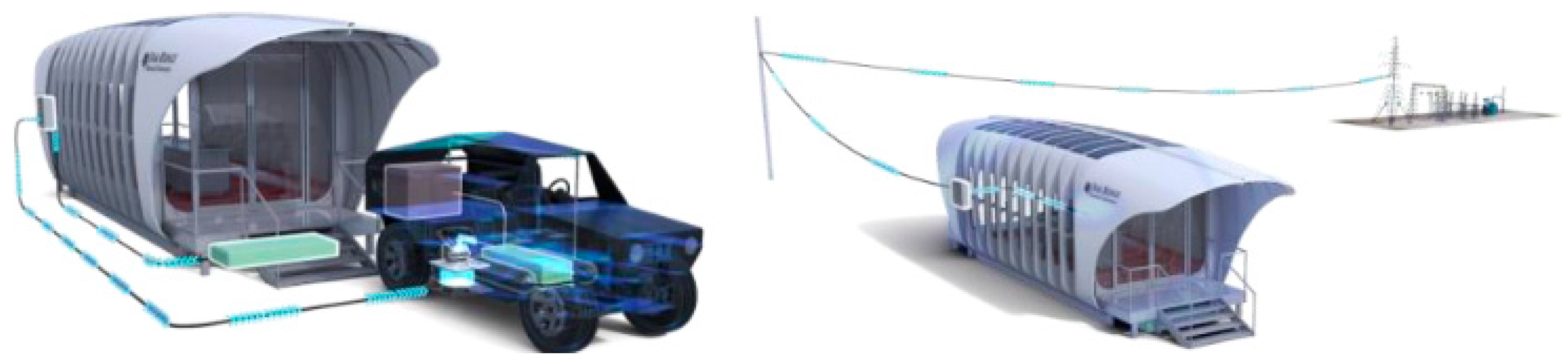
As shown by Dzogbewu and De Beer [14], AM significantly enhances the efficiency of clean energy generation, storage, and transmission. Transitioning cars and motorbikes from internal combustion engines (ICEs) to clean energy devices could be pivotal. According to the Paris Collation and Climate Watch/World Resources Institute, replacing all ICEs with electric vehicles (EVs) by 2050 could reduce global carbon emissions by 11.9%. AM can support every phase of developing clean energy infrastructure for the transportation sector through its dematerialization strategies [99,100]. For instance, a Spanish company has demonstrated that AM can cut material usage by 75% when 3D printing transmission networks for green energy, which can also be applied to EV charging and refueling systems [100]. Similarly, a collaborative initiative between AMIE (Additive Manufacturing Integrated Energy), Oak Ridge National Laboratory (ORNL), and the Governor’s Chair for Energy and Urbanism successfully 3D printed an integrated clean energy infrastructure system (Figure 4) [101].
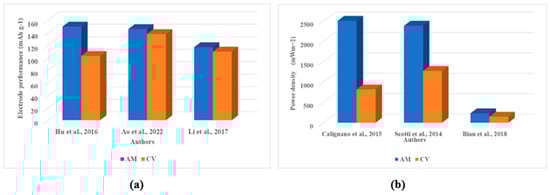
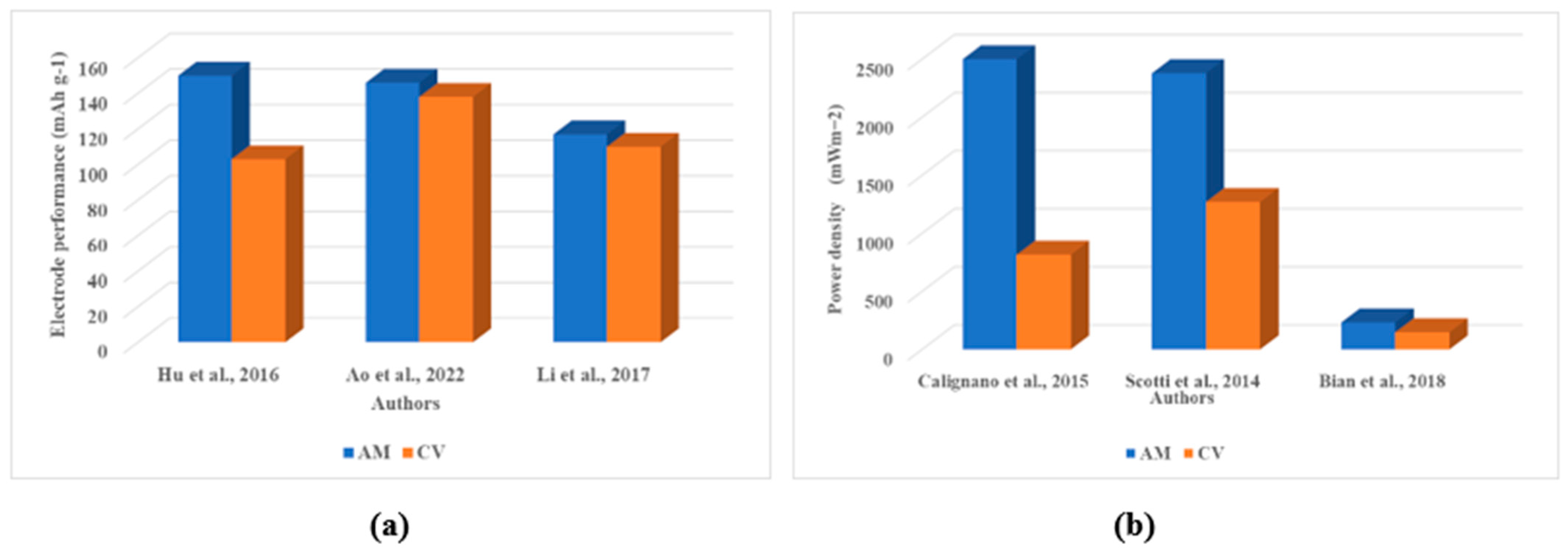
Figure 4.
(a) Increase in operational performance of 3D printed batteries compared with conventional (CV) batteries; (b) Increase in operational efficiency of AM fuel cells compared to conventional (CV) manufactured fuel cells. Ref: (a) Hu et al. [76], Ao et al. [77], Li et al. [78]. (b) Calignano et al. [102], Scotti et al. [103] and Bian et al. [69].
To support this shift, AM is being used to construct EV refueling and recharging stations with advanced eco-friendly materials (Figure 5). For example, Mighty Builders [52] developed a polymer composite that is 30% lighter than concrete, recyclable, and exhibits five times greater tensile and flexural strength, making it a sustainable alternative to conventional cement and synthetic stone. These novel feedstocks, often in liquid or semi-liquid form, allow 3D printing of infrastructure without cementitious materials that worsen carbonization. Developing such materials accelerates EV adoption, particularly for battery electric vehicles (BEVs), which can recharge using diverse clean energy sources including solar, hydro, geothermal, and wind power (Figure 5) [14].
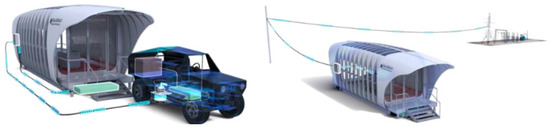
Figure 5.
A schematic representation of an integrated 3D-printed clean energy infrastructure Source: [101].
Table 9 summarises the principal mechanisms through which AM) contributes to greenhouse gas (GHG) reduction, drawing on evidence from preceding sections.
Table 9.
Summary of AM Applications in Clean Transportation and Their Impact on Greenhouse Gas Emissions.
4.5. Policy Formation and Future Directions
Global efforts to achieve net-zero carbon emissions by 2050 are reshaping national energy strategies toward clean generation and sustainable manufacturing [123]. Governments increasingly deploy policy incentives—tax breaks, grants, and preferential procurement—to promote electric mobility and renewable-powered economies [124]. Table 10 presents previous frameworks and technical relevance from the literature. A review of previous policy frameworks reveals that successful clean energy transitions hinge on three factors: clear timelines, alignment of technology readiness with infrastructure development, and integration of circular economy principles. Countries with ambitious deadlines, such as the Netherlands’ 2030 ICE ban, have driven rapid innovation and adoption, often leveraging decentralised manufacturing and AM-enabled supply chains. Conversely, policy gaps—such as lagging certification standards or fossil-heavy energy grids—can slow progress and even offset environmental gains. The integration of additive manufacturing into these policies has shown potential to enhance local production, reduce transport emissions, and enable recycling of high-value materials. These lessons inform the next stage of recommendations, ensuring future policies are both technologically feasible and environmentally sustainable.
Table 10.
Previous Policy Frameworks and Technical Relevance.
5. Conclusions and Perspective
This review began by categorising the principal additive manufacturing (AM) process families and examining their potential role in reducing greenhouse gas (GHG) emissions across manufacturing, transportation, and renewable energy sectors. It critically assessed AM’s direct and indirect decarbonisation pathways, including supply-chain restructuring, material and energy efficiency, and design-enabled performance improvements. Applications discussed span electric vehicles, fuel cells, hydropower, geothermal energy, wind energy, and battery storage systems, with emphasis on quantitative emission-reduction impacts and sector-specific case studies.
The integration demonstrates that AM’s advantages—such as decentralised, on-demand production, zero-inventory digital warehousing, and part consolidation—can significantly cut Scope 1, 2, and particularly Scope 3 emissions by shortening logistics chains, minimising material waste, and lowering production-phase energy demand. Lightweighting through topology optimisation, multi-material integration, and reuse of feedstocks further enhance product efficiency and promote circular economy principles. However, realising these benefits at scale remains contingent on overcoming persistent technical and economic barriers. Current limitations include restricted material portfolios, variability in mechanical properties, insufficient certification and standardisation, high capital and operational costs, and lower throughput compared to conventional mass-production methods. Environmental benefits may also be undermined if AM systems are powered by carbon-intensive electricity grids or if feedstock recycling is not systematically implemented.
The integration of AM into clean energy technology manufacturing—such as fuel cell diffusion layers, large wind turbine components, and optimised battery housings—has already shown measurable efficiency gains and cost reductions. Yet, scaling these innovations will require coordinated progress in several areas: (i) decarbonising energy inputs for AM processes, (ii) advancing feedstock recycling infrastructure, (iii) developing high-performance, low-carbon materials compatible with AM, and (iv) embedding lifecycle assessment (LCA) tools into design workflows to quantify and optimise environmental performance. The emerging synergy between AM and artificial intelligence (AI) is particularly promising, enabling automated material selection, process optimisation, and supply-chain mapping based on carbon-intensity metrics.
From a policy perspective, supportive regulatory frameworks, investment incentives, and industry–academia collaboration will be essential to accelerate adoption. Clear certification pathways for AM-produced critical energy components, coupled with international standards for multi-material and hybrid manufacturing, can improve trust and interoperability. Furthermore, targeted government programmes—such as transitioning public vehicle fleets to AM-enabled clean energy systems—could demonstrate scalability while delivering rapid urban air-quality benefits.
Despite the technical and policy challenges, the evidence reviewed indicates that AM has the potential to become a cornerstone technology in the transition to net-zero manufacturing and clean transportation. If combined with renewable-powered production, advanced recycling strategies, and intelligent design tools, AM could enable a manufacturing ecosystem that is not only more efficient and adaptive but also significantly less carbon-intensive. The next decade will be pivotal in determining whether these opportunities are fully realised; success will depend on sustained innovation, strategic investment, and cross-sector commitment to a shared decarbonisation agenda.
Supplementary Materials
The following supporting information can be downloaded at: https://www.mdpi.com/article/10.3390/technologies13100428/s1, Methodology, Figure S1: Flow chart for exclusion and inclusion of published documents [137,138,139,140,141,142,143].
Author Contributions
Conceptualization: T.C.D., and D.J.d.B.; methodology, T.C.D. and D.J.d.B.; software, T.C.D.; validation, T.C.D. and I.K.N.; formal analysis, T.C.D. and I.K.N.; investigation, T.C.D. and D.J.d.B.; resources, T.C.D., and D.J.d.B.; data curation, T.C.D. and D.J.d.B.; writing—original draft preparation, T.C.D. and I.K.N.; writing—review and editing, T.C.D., I.K.N. and D.J.d.B.; supervision, T.C.D. and D.J.d.B.; project administration, T.C.D. and D.J.d.B.; funding acquisition, T.C.D. and D.J.d.B. All authors have read and agreed to the published version of the manuscript.
Funding
This work is supported by the South African Research Chairs Initiative of the Department of Science and Technology and National Research Foundation of South Africa (Grant No. SARC 20150101-097994).
Institutional Review Board Statement
Not applicable.
Informed Consent Statement
Not applicable.
Acknowledgments
We acknowledge the administrative and technical support provided by the Central University of Technology, Bloemfontein, South Africa and School of Atmospheric Science and Remote Sensing, Wuxi University.
Conflicts of Interest
The authors declare no conflicts of interest.
References
- Chua, K.; Khan, I.; Malhotra, R.; Zhu, D. Additive manufacturing and 3D printing of metallic biomaterials. Eng. Regen. 2021, 2, 288–299. [Google Scholar] [CrossRef]
- Rust, B.; Tsaponina, O.; Maniruzzaman, M. Recent Innovations in Additive Manufacturing Across Industries: 3D Printed Products and FDA’s Perspectives. In 3D and 4D Printing in Biomedical Applications: Process Engineering and Additive Manufacturing; Wiley: Hoboken, NJ, USA, 2019; pp. 443–462. [Google Scholar]
- Velásquez-García, L.F.; Kornbluth, Y. Biomedical applications of metal 3D printing. Annu. Rev. Biomed. Eng. 2021, 23, 307–338. [Google Scholar] [CrossRef] [PubMed]
- Walton, H.; Dajnak, D.; Beevers, S.; Williams, M.; Watkiss, P.; Hunt, A. Understanding the health impacts of air pollution in London. Lond. Kings Coll. Lond. Transp. Lond. Greater Lond. Auth. 2015, 1, 6–14. [Google Scholar]
- United Nations. Transforming Our World:The 2030 Agenda for Sustainable Development; UN: New York, NY, USA, 2023. [Google Scholar]
- Free, G.; Van de Bund, W.; Gawlik, B.; Van Wijk, L.; Wood, M.; Guagnini, E.; Koutelos, K.; Annunziato, A.; Grizzetti, B.; Vigiak, O. An EU Analysis of the Ecological Disaster in the Oder River of 2022; Publications Office of the European Union: Luxembourg, 2023. [Google Scholar]
- Burch, I.; Gilchrist, J. Survey of Global Activity to Phase out Internal Combustion Engine Vehicles; Center of Climate Protection: Santa Rosa, CA, USA, 2018. [Google Scholar]
- Oladunni, O.J.; Mpofu, K.; Olanrewaju, O.A. Greenhouse gas emissions and its driving forces in the transport sector of South Africa. Energy Rep. 2022, 8, 2052–2061. [Google Scholar] [CrossRef]
- Albuquerque, F.D.; Maraqa, M.A.; Chowdhury, R.; Mauga, T.; Alzard, M. Greenhouse gas emissions associated with road transport projects: Current status, benchmarking, and assessment tools. Transp. Res. Procedia 2020, 48, 2018–2030. [Google Scholar] [CrossRef]
- Cochran, I.; Pauthier, A. A Framework for Alignment with the Paris Agreement: Why, What and How for Financial Institutions; Institute for Climate Economics: Paris, France, 2019. [Google Scholar]
- Barston, R.; Barston, R. The Paris Agreement; Modern Diplomacy: Paris, France, 2019; pp. 492–505. [Google Scholar]
- Fankhauser, S.; Smith, S.M.; Allen, M.; Axelsson, K.; Hale, T.; Hepburn, C.; Kendall, J.M.; Khosla, R.; Lezaun, J.; Mitchell-Larson, E. The meaning of net zero and how to get it right. Nat. Clim. Change 2022, 12, 15–21. [Google Scholar]
- Grubler, A.; Johansson, T.; Mundaca, L.; Nakicenovic, N.; Pachauri, S.; Riahi, K.; Rogner, H.; Strupeit, L. Energy Primer. In Global Energy Assessment-Toward a Sustainable Future; Cambridge University Press: Cambridge, UK; New York, NY, USA; International Institute for Applied Systems Analysis: Laxenburg, Austria, 2012; pp. 99–150. [Google Scholar] [CrossRef]
- Dzogbewu, T.C.; de Beer, D.J. Additive manufacturing of selected ecofriendly energy devices. Virtual Phys. Prototyp. 2023, 18, e2276245. [Google Scholar] [CrossRef]
- Ellabban, O.; Abu-Rub, H.; Blaabjerg, F. Renewable energy resources: Current status, future prospects and their enabling technology. Renew. Sustain. Energy Rev. 2014, 39, 748–764. [Google Scholar] [CrossRef]
- Staffell, I.; Scamman, D.; Abad, A.V.; Balcombe, P.; Dodds, P.E.; Ekins, P.; Shah, N.; Ward, K.R. The role of hydrogen and fuel cells in the global energy system. Energy Environ. Sci. 2019, 12, 463–491. [Google Scholar]
- Verhoef, L.A.; Budde, B.W.; Chockalingam, C.; Nodar, B.G.; van Wijk, A.J. The effect of additive manufacturing on global energy demand: An assessment using a bottom-up approach. Energy Policy 2018, 112, 349–360. [Google Scholar] [CrossRef]
- Dzogbewu, T.C.; Fianko, S.K.; Amoah, N.; Jnr, S.A.; de Beer, D. Additive manufacturing in South Africa: Critical success factors. Heliyon 2022, 8, e11852. [Google Scholar] [CrossRef]
- Graziosi, S.; Faludi, J.; Stanković, T.; Borgianni, Y.; Meisel, N.; Hallstedt, S.I.; Rosen, D.W. A vision for sustainable additive manufacturing. Nat. Sustain. 2024, 7, 698–705. [Google Scholar] [CrossRef]
- Agnusdei, L.; Del Prete, A. Additive manufacturing for sustainability: A systematic literature review. Sustain. Futures 2022, 4, 100098. [Google Scholar]
- Chibinyani, M.I.; Dzogbewu, T.C.; Maringa, M.; Muiruri, A.M. Reduced order topology optimisation of a planar honeycomb defined by a linear elastic Ti6al4V (ELI) material model. S. Afr. J. Ind. Eng. 2022, 33, 299–317. [Google Scholar]
- Wang, Y.; Ahmed, A.; Azam, A.; Bing, D.; Shan, Z.; Zhang, Z.; Tariq, M.K.; Sultana, J.; Mushtaq, R.T.; Mehboob, A.; et al. Applications of additive manufacturing (AM) in sustainable energy generation and battle against COVID-19 pandemic: The knowledge evolution of 3D printing. J. Manuf. Syst. 2021, 60, 709–733. [Google Scholar] [CrossRef] [PubMed]
- Rasaki, S.A.; Liu, C.; Lao, C.; Zhang, H.; Chen, Z. The innovative contribution of additive manufacturing towards revolutionizing fuel cell fabrication for clean energy generation: A comprehensive review. Renew. Sustain. Energy Rev. 2021, 148, 111–369. [Google Scholar] [CrossRef]
- ISO/ASTM 52900:2021(en); Additive Manufacturing—General Principles—Fundamentals and Vocabulary. International Organization for Standardization: Geneva, Switzerland, 2021. Available online: https://www.iso.org/obp/ui/#iso:std:iso-astm:52900:ed-2:v1:en (accessed on 11 August 2024).
- Kumar, A.; Dixit, A.R.; Sreenivasa, S. Mechanical properties of additively manufactured polymeric composites using sheet lamination technique and fused deposition modeling: A review. Polym. Adv. Technol. 2024, 35, e6396. [Google Scholar] [CrossRef]
- Sarila, V.; Koneru, H.P.; Pyatla, S.; Cheepu, M.; Kantumunchu, V.C.; Ramachandran, D. An overview on 3D printing of ceramics using binder jetting process. Eng. Proc. 2024, 61, 44. [Google Scholar]
- Cerdas, F.; Juraschek, M.; Thiede, S.; Herrmann, C. Life cycle assessment of 3D printed products in a distributed manufacturing system. J. Ind. Ecol. 2017, 21, S80–S93. [Google Scholar] [CrossRef]
- Chang, C.-Y.; Huang, H.-M.; Lan, Y.-P.; Lu, T.-C.; Kuo, H.-C.; Wang, S.-C.; Tu, L.-W.; Hsieh, W.-F. Growth and Characteristics of a-Plane GaN/ZnO/GaN Heterostructure. MRS Online Proc. Libr. (OPL) 2013, 1538, 303–307. [Google Scholar]
- Faludi, J.; Bayley, C.; Bhogal, S.; Iribarne, M. Comparing environmental impacts of additive manufacturing vs traditional machining via life-cycle assessment. Rapid Prototyp. J. 2015, 21, 14–33. [Google Scholar] [CrossRef]
- Liu, Z.; Islam, F.; Era, I.Z.; Grandhi, M. LCA-based environmental sustainability assessment of hybrid additive manufacturing of a turbine blade. Green Manuf. Open 2023, 1, 7. [Google Scholar] [CrossRef]
- Gouveia, J.R.; Pinto, S.M.; Campos, S.; Matos, J.R.; Costa, C.; Dutra, T.A.; Esteves, S.; Oliveira, L. Life cycle assessment of a circularity case study using additive manufacturing. Sustainability 2022, 14, 9557. [Google Scholar] [CrossRef]
- Kokare, S.; Oliveira, J.; Godina, R. Life cycle assessment of additive manufacturing processes: A review. J. Manuf. Syst. 2023, 68, 536–559. [Google Scholar] [CrossRef]
- Saade, M.R.M.; Yahia, A.; Amor, B. How has LCA been applied to 3D printing? A systematic literature review and recommendations for future studies. J. Clean. Prod. 2020, 244, 118803. [Google Scholar] [CrossRef]
- Gwamuri, J.; Franco, D.; Khan, K.Y.; Gauchia, L.; Pearce, J.M. High-efficiency solar-powered 3-D printers for sustainable development. Machines 2016, 4, 3. [Google Scholar] [CrossRef]
- Khan, K.Y.; Gauchia, L.; Pearce, J.M. Self-sufficiency of 3-D printers: Utilizing stand-alone solar photovoltaic power systems. Renew. Wind Water Sol. 2018, 5, 5. [Google Scholar] [CrossRef]
- Caussin, E.; Moussally, C.; Le Goff, S.; Fasham, T.; Troizier-Cheyne, M.; Tapie, L.; Dursun, E.; Attal, J.P.; François, P. Vat photopolymerization 3D printing in dentistry: A comprehensive review of actual popular technologies. Materials 2024, 17, 950. [Google Scholar] [CrossRef]
- Ritchie, H.; Rosado, P.; Roser, M. CO2 and greenhouse gas emissions. Our World in Data. 2023. Available online: https://ourworldindata.org/co2-and-greenhouse-gas-emissions (accessed on 20 September 2025).
- Fianko, S.K.; Amoah, N.; Jnr, S.A.; Dzogbewu, T.C. Green supply chain management and environmental performance: The moderating role of firm size. Int. J. Ind. Eng. Manag. 2021, 12, 163–173. [Google Scholar]
- U.S. Energy Information Administration (EIA). Use of energy for transportation, Use of Energy Explained. Available online: https://www.eia.gov/energyexplained/use-of-energy/transportation.php (accessed on 23 August 2024).
- Dzogbewu, T.C.; de Beer, D.J. The role of PGMs in decarbonizing the atmosphere: Additive manufacturing in perspective. Manuf. Rev. 2024, 11, 16. [Google Scholar] [CrossRef]
- Afrifa Jnr, S.; Dzogbewu, T.C.; Dzansi, D.Y.; de Beer, D.J. Moving beyond technical competence in 3D printing industry in South Africa: The effect of emotional intelligence and organizational emotional climate in driving job performance. Afr. J. Sci. Technol. Innov. Dev. 2024, 16, 899–913. [Google Scholar] [CrossRef]
- Dzogbwu, T.; Jnr, S.A.; Amoah, N.; Fianko, S.K.; Imdaadulah, A.; De Beer, D. Supply chain disruptions and resilience in manufacturing industry during Covid-19: Additive manufacturing intervention in perspective. J. Ind. Eng. Manag. 2023, 16, 509–520. [Google Scholar] [CrossRef]
- Dzogbewu, T.C.; Afrifa Jnr, S.; Amoah, N.; Fianko, S.K.; de Beer, D. Additive manufacturing interventions during the COVID-19 pandemic: South Africa. Appl. Sci. 2021, 12, 295. [Google Scholar] [CrossRef]
- Dzogbewu, T.C. Laser powder bed fusion of Ti6Al4V lattice structures and their applications. J. Met. Mater. Miner. 2020, 30, 68–78. [Google Scholar]
- Panagiotopoulou, V.C.; Stavropoulos, P.; Chryssolouris, G. A critical review on the environmental impact of manufacturing: A holistic perspective. Int. J. Adv. Manuf. Technol. 2022, 118, 603–625. [Google Scholar]
- Dzogbewu, T.C.; Fianko, S.K.; Jnr, S.A.; Amoah, N. Assessment of the mediating effects of external integration on manufactury firms operational performance. J. Ind. Eng. Manag. (JIEM) 2021, 14, 718–732. [Google Scholar] [CrossRef]
- Talaat, F.M.; Hassan, E. Artificial intelligence in 3D printing. In Enabling Machine Learning Applications in Data Science: Proceedings of Arab Conference for Emerging Technologies 2020; Springer: Berlin/Heidelberg, Germany, 2021; pp. 77–88. [Google Scholar]
- Tan, K. The framework of combining artificial intelligence and construction 3D printing in civil engineering. MATEC Web Conf. 2018, 206, 01008. [Google Scholar] [CrossRef]
- Berman, B. 3-D printing: The new industrial revolution. Bus. Horiz. 2012, 55, 155–162. [Google Scholar]
- Raimi, D.; Campbell, E.; Newell, R.G.; Prest, B.; Villanueva, S.; Wingenroth, J. Global Energy Outlook 2022: Turning Points and Tension in the Energy Transition; Resources for the Future: Washington, DC, USA, 2022. [Google Scholar]
- Jung, S.; Kara, L.B.; Nie, Z.; Simpson, T.W.; Whitefoot, K.S. Is additive manufacturing an environmentally and economically preferred alternative for mass production? Environ. Sci. Technol. 2023, 57, 6373–6386. [Google Scholar] [CrossRef]
- Wang, D.; Zhang, T.; Guo, X.; Ling, D.; Hu, L.; Jiang, G. The potential of 3D printing in facilitating carbon neutrality. J. Environ. Sci. 2023, 130, 85–91. [Google Scholar]
- Kioumarsi, M.; Shafei, B. The 1st International Conference on Net-Zero Built Environment: Innovations in Materials, Structures, and Management Practices; Springer Nature: Berlin/Heidelberg, Germany, 2025; Volume 237. [Google Scholar]
- Singh, B.J.; Sehgal, R. Applications of 3D printing, rapid prototyping, and digital manufacturing for low carbon development. In Sustainability in Smart Manufacturing; CRC Press: Boca Raton, FL, USA, 2024; pp. 37–60. [Google Scholar]
- Persad, J.; Rocke, S. A survey of 3D printing technologies as applied to printed electronics. IEEE Access 2022, 10, 27289–27319. [Google Scholar] [CrossRef]
- Faheem, A.; Hasan, M.A.; Badhotiya, G.K.; Ali, S.M. A systematic literature review to examine the role of additive manufacturing in achieving sustainable development goals. Sustain. Oper. Comput. 2024, 5, 216–226. [Google Scholar] [CrossRef]
- Asami, K.; Lozares, J.M.C.; Ullah, A.; Bossen, B.; Clague, L.; Emmelmann, C. Material extrusion of metals: Enabling multi-material alloys in additive manufacturing. Mater. Today Commun. 2024, 38, 107–889. [Google Scholar]
- Lima, E.; Relvas, C.; Ramos, A.M. The Tolerancing Obtained with Binder Jetting Additive Manufacturing Process in 17-4PH Steel-Case Study. Key Eng. Mater. 2023, 956, 99–106. [Google Scholar]
- Geng, Z.; Bidanda, B. Geometric precision analysis for Additive Manufacturing processes: A comparative study. Precis. Eng. 2021, 69, 68–76. [Google Scholar] [CrossRef]
- Büßenschütt, K.; Köhnen, P.; Kies, F.; Koß, S.; Schleifenbaum, J.H.; Haase, C. High-speed direct energy deposition as a high-throughput design tool for laser-based additive manufacturing. Addit. Manuf. Lett. 2024, 8, 100–188. [Google Scholar]
- Nabavi, S.F.; Dalir, H.; Farshidianfar, A. A comprehensive review of recent advances in laser powder bed fusion characteristics modeling: Metallurgical and defects. Int. J. Adv. Manuf. Technol. 2024, 132, 2233–2269. [Google Scholar] [CrossRef]
- Dzogbewu, T.C. Laser powder bed fusion of Ti6Al4V-xCu: Process parameters. J. Met. Mater. Miner. 2021, 31, 62–70. [Google Scholar]
- Javaid, M.; Haleem, A.; Singh, R.P.; Suman, R.; Rab, S. Role of additive manufacturing applications towards environmental sustainability. Adv. Ind. Eng. Polym. Res. 2021, 4, 312–322. [Google Scholar] [CrossRef]
- Prauzek, M.; Kucova, T.; Konecny, J.; Adamikova, M.; Gaiova, K.; Mikus, M.; Pospisil, P.; Andriukaitis, D.; Zilys, M.; Martinkauppi, B. Iot sensor challenges for geothermal energy installations monitoring: A survey. Sensors 2023, 23, 5577. [Google Scholar] [CrossRef]
- Thejane, K.; Chikosha, S.; Du Preez, W.B. Characterisation and monitoring of TI6AL4V (ELI) powder used in different selective laser melting systems. S. Afr. J. Ind. Eng. 2017, 28, 161–171. [Google Scholar] [CrossRef]
- Warner, J.H.; Ringer, S.P.; Proust, G. Strategies for metallic powder reuse in powder bed fusion. A Rev. J. Manuf. Process. 2024, 110, 263–290. [Google Scholar]
- Mo, J.; Dehoff, R.R.; Peter, W.H.; Toops, T.J.; Green Jr, J.B.; Zhang, F.-Y. Additive manufacturing of liquid/gas diffusion layers for low-cost and high-efficiency hydrogen production. Int. J. Hydrogen Energy 2016, 41, 3128–3135. [Google Scholar] [CrossRef]
- Bian, B.; Shi, D.; Cai, X.; Hu, M.; Guo, Q.; Zhang, C.; Wang, Q.; Sun, A.X.; Yang, J. 3D printed porous carbon anode for enhanced power generation in microbial fuel cell. Nano Energy 2018, 44, 174–180. [Google Scholar] [CrossRef]
- Bian, B.; Wang, C.; Hu, M.; Yang, Z.; Cai, X.; Shi, D.; Yang, J. Application of 3D printed porous copper anode in microbial fuel cells. Front. Energy Res. 2018, 6, 50. [Google Scholar] [CrossRef]
- He, Y.-T.; Fu, Q.; Pang, Y.; Li, Q.; Li, J.; Zhu, X.; Lu, R.-H.; Sun, W.; Liao, Q.; Schröder, U. Customizable design strategies for high-performance bioanodes in bioelectrochemical systems. Iscience 2021, 24, 102163. [Google Scholar] [CrossRef]
- Zhou, S.; Li, M.; Wang, P.; Cheng, L.; Chen, L.; Huang, Y.; Yu, S.; Mo, F.; Wei, J. Printed solid-state batteries. Electrochem. Energy Rev. 2023, 6, 34. [Google Scholar] [CrossRef]
- Mottaghi, M.; Pearce, J.M. A review of 3D printing batteries. Batteries 2024, 10, 110. [Google Scholar] [CrossRef]
- Herzog, D.; Röver, T.; Abdolov, S.; Becker, F.; Gentner, C. Optimization and design for additive manufacturing of a fuel cell end plate. J. Laser Appl. 2022, 34, 042027. [Google Scholar] [CrossRef]
- Carron, W.S.; Snowberg, D.; Murdy, P.; Hughes, S. Using Large-Scale Additive Manufacturing for Wind Turbine Blade Core Structures; National Renewable Energy Laboratory (NREL): Golden, CO, USA, 2023. [Google Scholar]
- Alber, J.; Assfalg, L.; Nayeri, C.N.; Paschereit, C.O.; Lahr, M.; Semmler, L.; Twele, J.; Fortmann, J.; Fischer, J.; Latoufis, K. 3D printed rotor blades for a research wind turbine: Aerodynamic and structural design and testing. J. Phys. Conf. Ser. 2022, 2265, 042070. [Google Scholar] [CrossRef]
- Hu, J.; Jiang, Y.; Cui, S.; Duan, Y.; Liu, T.; Guo, H.; Lin, L.; Lin, Y.; Zheng, J.; Amine, K. 3D-printed cathodes of LiMn1−xFexPO4 nanocrystals achieve both ultrahigh rate and high capacity for advanced lithium-ion battery. Adv. Energy Mater. 2016, 6, 1600856. [Google Scholar] [CrossRef]
- Ao, S.; Guo, Z.; Song, Y.; Fang, D.; Bao, Y. Clog-free, low-cost, and uniform electrode inks for 3D printed lithium-ion batteries. ACS Appl. Energy Mater. 2022, 5, 6970–6979. [Google Scholar] [CrossRef]
- Li, J.; Leu, M.C.; Panat, R.; Park, J. A hybrid three-dimensionally structured electrode for lithium-ion batteries via 3D printing. Mater. Des. 2017, 119, 417–424. [Google Scholar] [CrossRef]
- Holechek, J.L.; Geli, H.M.; Sawalhah, M.N.; Valdez, R. A global assessment: Can renewable energy replace fossil fuels by 2050? Sustainability 2022, 14, 4792. [Google Scholar] [CrossRef]
- Kim, S.; Rahman, M.A.; Arifuzzaman, M.; Gilmer, D.B.; Li, B.; Wilt, J.K.; Lara-Curzio, E.; Saito, T. Closed-loop additive manufacturing of upcycled commodity plastic through dynamic cross-linking. Sci. Adv. 2022, 8, eabn6006. [Google Scholar] [CrossRef] [PubMed]
- Pugliese, R.; Regondi, S. Artificial intelligence-empowered 3D and 4D printing technologies toward smarter biomedical materials and approaches. Polymers 2022, 14, 2794. [Google Scholar] [CrossRef]
- Choi, S.; Cheung, H. Digital fabrication of multi-material objects for biomedical applications. In Biomedical Engineering, Trends in Materials Science; IntechOpen: London, UK, 2011. [Google Scholar][Green Version]
- Gebler, M.; Uiterkamp, A.J.S.; Visser, C. A global sustainability perspective on 3D printing technologies. Energy Policy 2014, 74, 158–167. [Google Scholar] [CrossRef]
- Frazier, W.E. Metal additive manufacturing: A review. J. Mater. Eng. Perform. 2014, 23, 1917–1928. [Google Scholar] [CrossRef]
- Ngo, T.D.; Kashani, A.; Imbalzano, G.; Nguyen, K.T.; Hui, D. Additive manufacturing (3D printing): A review of materials, methods, applications and challenges. Compos. Part B Eng. 2018, 143, 172–196. [Google Scholar] [CrossRef]
- Gebhardt, A.; Hötter, J.-S. Additive Manufacturing: 3D Printing for Prototyping and Manufacturing; Carl Hanser Verlag GmbH Co. KG: Munich, Germany, 2016. [Google Scholar]
- Gu, D.D.; Meiners, W.; Wissenbach, K.; Poprawe, R. Laser additive manufacturing of metallic components: Materials, processes and mechanisms. Int. Mater. Rev. 2012, 57, 133–164. [Google Scholar] [CrossRef]
- King, W.E.; Anderson, A.T.; Ferencz, R.M.; Hodge, N.E.; Kamath, C.; Khairallah, S.A.; Rubenchik, A.M. Laser powder bed fusion additive manufacturing of metals; physics, computational, and materials challenges. Appl. Phys. Rev. 2015, 2, 041304. [Google Scholar] [CrossRef]
- Lewandowski, J.J.; Seifi, M. Metal additive manufacturing: A review of mechanical properties. Annu. Rev. Mater. Res. 2016, 46, 151–186. [Google Scholar] [CrossRef]
- Council, J.D.M. Department of Defense Additive Manufacturing Strategy; Deputy Director for Strategic Technology Protection and Exploitation; Office of the Under Secretary of Defense for Research and Engineering: Washington, DC, USA, 2021. [Google Scholar]
- Campbell, T.; Williams, C.; Ivanova, O.; Garrett, B. Could 3D Printing Change the World? Technologies, Potential, and Implications of Additive Manufacturing; Atlantic Council: Washington, DC, USA, 2011; Volume 3, p. 18. [Google Scholar]
- Spierings, A.B.; Levy, G.; Wegener, K. Designing material properties locally with additive manufacturing technology SLM. In Proceedings of the 2012 International Solid Freeform Fabrication Symposium, Austin, TX, USA, 6–8 August 2012; Available online: https://www.researchgate.net/publication/289299664_Designing_material_properties_locally_with_additive_manufacturing_technology_SLM (accessed on 13 September 2025).
- ASTM F2792-12a; Standard Guide for Additive Manufacturing—General Principles—Part 1: Terminology. ASTM International: West Conshohocken, PA, USA, 2020.
- Ford, S.; Despeisse, M. Additive manufacturing and sustainability: An exploratory study of the advantages and challenges. J. Clean. Prod. 2016, 137, 1573–1587. [Google Scholar] [CrossRef]
- ISO/ASTM 52901; Additive Manufacturing—General Principles—Requirements for Purchased am Parts. ASTM International: West Conshohocken, PA, USA, 2015.
- Leal, R.; Barreiros, F.; Alves, L.; Romeiro, F.; Vasco, J.; Santos, M.; Marto, C. Additive manufacturing tooling for the automotive industry. Int. J. Adv. Manuf. Technol. 2017, 92, 1671–1676. [Google Scholar] [CrossRef]
- Thompson, M.K.; Moroni, G.; Vaneker, T.; Fadel, G.; Campbell, R.I.; Gibson, I.; Bernard, A.; Schulz, J.; Graf, P.; Ahuja, B. Design for Additive Manufacturing: Trends, opportunities, considerations, and constraints. CIRP Ann. 2016, 65, 737–760. [Google Scholar] [CrossRef]
- Pinther, K.; Weigand, A. Flow of Forms/Forms of Flow: Design Histories Between Africa and Europe; Transcript Verlag: Bielefeld, Germany, 2019; Volume 37. [Google Scholar]
- Budzik, G.; Tomaszewski, K.; Soboń, A. Opportunities for the application of 3D printing in the critical infrastructure system. Energies 2022, 15, 1656. [Google Scholar] [CrossRef]
- Story, S.Y. 3D Printed Infrastructure: Bridges, Towers, and Beyond. Available online: https://www.re-thinkingthefuture.com/architectural-community/a12381-3d-printed-infrastructure-bridges-towers-and-beyond/ (accessed on 23 August 2024).
- Biswas, K.; Rose, J.; Eikevik, L.; Guerguis, M.; Enquist, P.; Lee, B.; Love, L.; Green, J.; Jackson, R. Additive manufacturing integrated energy—Enabling innovative solutions for buildings of the future. J. Sol. Energy Eng. 2017, 139. [Google Scholar] [CrossRef]
- Calignano, F.; Tommasi, T.; Manfredi, D.; Chiolerio, A. Additive manufacturing of a microbial fuel cell—A detailed study. Sci. Rep. 2015, 5, 17373. [Google Scholar] [CrossRef]
- Scotti, G.; Matilainen, V.; Kanninen, P.; Piili, H.; Salminen, A.; Kallio, T.; Franssila, S. Laser additive manufacturing of stainless steel micro fuel cells. J. Power Sources 2014, 272, 356–361. [Google Scholar] [CrossRef]
- Pollet, B.G.; Staffell, I.; Shang, J.L. Current status of hybrid, battery and fuel cell electric vehicles: From electrochemistry to market prospects. Electrochim. Acta 2012, 84, 235–249. [Google Scholar] [CrossRef]
- Dzogbewu, T.C.; du Preez, W.B. Additive manufacturing of titanium-based implants with metal-based antimicrobial agents. Metals 2021, 11, 453. [Google Scholar]
- Dzogbewu, T.C. Laser powder bed fusion of Ti15Mo. Results Eng. 2020, 7, 100155. [Google Scholar] [CrossRef]
- Green Car Congress. Sakuu Announces Successful 3D Printing of Fully Functional Lithium Metal Solid-State Batteries, 17 November. Available online: https://www.greencarcongress.com/2022/11/20221117-sakuu.html (accessed on 13 August 2024).
- Pusateri, V.; Hauschild, M.Z.; Kara, S.; Goulas, C.; Olsen, S.I. Quantitative sustainability assessment of metal additive manufacturing: A systematic review. CIRP J. Manuf. Sci. Technol. 2024, 49, 95–110. [Google Scholar] [CrossRef]
- Sakuu. Sakuu Announces Successful 3D Printing of Fully Functional High-Performance Patterned Batteries. Available online: https://www.sakuu.com/news/sakuu-announces-successful-3d-printing-of-fully-fu (accessed on 23 July 2024).
- Pesce, A.; Hornés, A.; Núñez, M.; Morata, A.; Torrell, M.; Tarancón, A. 3D printing the next generation of enhanced solid oxide fuel and electrolysis cells. J. Mater. Chem. A 2020, 8, 16926–16932. [Google Scholar] [CrossRef]
- Shin, J.; Kim, K.; Han, K.; In, J.M.; Chang, H.-J.; Shim, S.; Kim, S. Crashworthiness evaluation of a hydrogen bus fuel system. Int. J. Automot. Technol. 2022, 23, 1483–1490. [Google Scholar] [CrossRef]
- Miramontes, E.; Jiang, E.A.; Love, L.J.; Lai, C.; Sun, X.; Tsouris, C. Process intensification of CO2 absorption using a 3D printed intensified packing device. AIChE J. 2020, 66, e16285. [Google Scholar] [CrossRef]
- Mann, M.; Palmer, S.; Lee, D.; Kurup, P.; Remo, T.; Jenne, D.S.; Richardson, B.S.; Love, L.J.; Post, B.K. The Current State of Additive Manufacturing in Wind Energy Systems; Oak Ridge National Laboratory (ORNL): Oak Ridge, TN, USA, 2017. [Google Scholar]
- Sluijter, S.; Boon, J.; James, J.; Krishnamurthy, S.; Lind, A.; Blom, R.; Andreassen, K.; Cormos, A.M.; Sandu, V.; de Boer, R. 3D-printing of adsorbents for increased productivity in carbon capture applications (3D-CAPS). Int. J. Greenh. Gas Control 2021, 112, 103512. [Google Scholar]
- Steimel, A. Electric Traction-Motive Power and Energy Supply: Basics and Practical Experience; Oldenbourg Industrieverlag: Munich, Germany, 2008. [Google Scholar]
- Ghaviha, N. Increasing Energy Efficiency in Electric Trains Operation: Driver Advisory Systems and Energy Storage; KTH Royal Institute of Technology: Stockholm, Sweden, 2018. [Google Scholar]
- Letafat, A.; Rafiei, M.; Ardeshiri, M.; Sheikh, M.; Banaei, M.; Boudjadar, J.; Khooban, M.H. An Efficient and Cost-Effective Power Scheduling in Zero-Emission Ferry Ships. Complexity 2020, 2020, 6487873. [Google Scholar] [CrossRef]
- Pivetta, D.; Dall’Armi, C.; Taccani, R. Multi-objective optimization of hybrid PEMFC/Li-ion battery propulsion systems for small and medium size ferries. Int. J. Hydrogen Energy 2021, 46, 35949–35960. [Google Scholar]
- Singh, H.; Mishra, R. Performance analysis of solar parabolic trough collectors driven combined supercritical CO2 and organic Rankine cycle. Eng. Sci. Technol. Int. J. 2018, 21, 451–464. [Google Scholar]
- Bewlay, B.; Nag, S.; Suzuki, A.; Weimer, M. TiAl alloys in commercial aircraft engines. Mater. High Temp. 2016, 33, 549–559. [Google Scholar] [CrossRef]
- FAA. United States Aviation Climate Action Plan. Federal Aviation Administration. Available online: https://www.faa.gov/sites/faa.gov/files/2021-11/Aviation_Climate_Action_Plan.pdf (accessed on 13 August 2024).
- Dzogbewu, T.C. Additive manufacturing of TiAl-based alloys. Manuf. Rev. 2020, 7, 35. [Google Scholar] [CrossRef]
- International Energy Agency (IEA). Net zero by 2050: A Roadmap for the Global Energy Sector. Summary for Policymakers. Available online: https://iea.blob.core.windows.net/assets/7ebafc81-74ed-412b-9c60-5cc32c8396e4/NetZeroby2050-ARoadmapfortheGlobalEnergySector-SummaryforPolicyMakers_CORR.pdf (accessed on 13 August 2024).
- OECD. Taxing Energy Use for Sustainable Development Opportunities for Energy Tax and Subsidy Reform in Selected Developing and Emerging Economies; OECD: Paris, France, 2021. [Google Scholar]
- Santos, G.; Rembalski, S. Do electric vehicles need subsidies in the UK? Energy Policy 2021, 149, 111890. [Google Scholar] [CrossRef]
- HM Government. Taking Charge: The Electric Vehicle Infrastructure Strategy. Available online: https://www.gov.uk/government/publications/uk-electric-vehicle-infrastructure-strategy (accessed on 13 August 2024).
- Ramadan, M.M. A comparison of American and Chinese policies for electric vehicle technologies. MIT Sci. Policy Rev. 2022, 3, 11–16. [Google Scholar] [CrossRef]
- Yeung, G. ‘Made in China 2025’: The development of a new energy vehicle industry in China. Area Dev. Policy 2019, 4, 39–59. [Google Scholar] [CrossRef]
- Zenglein, M.J.; Holzmann, A. Evolving made in China 2025. MERICS Pap. China 2019, 8, 78. [Google Scholar]
- Åhman, M. Government policy and the development of electric vehicles in Japan. Energy Policy 2006, 34, 433–443. [Google Scholar] [CrossRef]
- Crothers, B. This Chinese City Has 16,000 Electric Buses And 22,000 Electric Taxis; Forbes Media LLC: Jersey City, NJ, USA, 2021. [Google Scholar]
- Robertson-Fall, T. Why Renewable Energy Infrastructure Needs to Be Built for a Circular Economy; Ellen MacArthur Foundation: Isle of Wight, UK, 2022. [Google Scholar]
- Mohanty, C. Reduce, reuse and recycle (the 3Rs) and resource efficiency as the basis for sustainable waste management. In Proceedings of the Synergizing Resource Efficiency with Informal Sector Towards Sustainable Waste Management, New York, NY, USA, 9 May 2011. [Google Scholar]
- Berkemeier, A.; Kühnel, L.; Dürigen, D.; Hoffmann, H.; Zeidler, H.; Bullinger, A.C.; Wagenführ, A. SAMSax—An innovative living lab for the advancement of a circular economy through additive manufacturing technologies. Sustainability 2024, 16, 823. [Google Scholar] [CrossRef]
- Orr, G. Diffusion of innovations, by Everett Rogers (1995). Retrieved January 2003, 21, 2005. [Google Scholar]
- ISO/ASTM TR 52912:2020; Additive Manufacturing—Design—Functionally Graded Additive Manufacturing. International Organization for Standardization (ISO): Geneva, Switzerland, 2020. Available online: https://www.iso.org/standard/71905.html (accessed on 2 May 2024).
- Fathima Musfira, A.; Ibrahim, N.; Harun, H. A Thematic Review on Digital Storytelling (DST) in Social Media. 2022. Available online: https://nsuworks.nova.edu/tqr/vol27/iss8/10/ (accessed on 2 May 2024).
- Dawadi, S. Thematic analysis approach: A step by step guide for ELT research practitioners. J. NELTA 2020, 25, 62–71. [Google Scholar] [CrossRef]
- Naeem, M.; Ozuem, W.; Howell, K.; Ranfagni, S. A step-by-step process of thematic analysis to develop a conceptual model in qualitative research. Int. J. Qual. Methods 2023, 22, 16094069231205789. [Google Scholar] [CrossRef]
- Passas, I. Bibliometric analysis: The main steps. Encyclopedia 2024, 4, 1014–1025. [Google Scholar] [CrossRef]
- Fu, Y.; Mao, Y.; Jiang, S.; Luo, S.; Chen, X.; Xiao, W. A bibliometric analysis of systematic reviews and meta-analyses in ophthalmology. Front. Med. 2023, 10, 1135592. [Google Scholar] [CrossRef]
- Cooper, I.D. Bibliometrics basics. J. Med. Libr. Assoc. 2015, 103, 217. [Google Scholar] [CrossRef] [PubMed]
- Wang, Q.; Su, M.; Li, R. Is China the world’s blockchain leader? Evidence, evolution and outlook of China’s blockchain research. J. Clean. Prod. 2020, 264, 121742. [Google Scholar] [CrossRef]
Disclaimer/Publisher’s Note: The statements, opinions and data contained in all publications are solely those of the individual author(s) and contributor(s) and not of MDPI and/or the editor(s). MDPI and/or the editor(s) disclaim responsibility for any injury to people or property resulting from any ideas, methods, instructions or products referred to in the content. |
© 2025 by the authors. Licensee MDPI, Basel, Switzerland. This article is an open access article distributed under the terms and conditions of the Creative Commons Attribution (CC BY) license (https://creativecommons.org/licenses/by/4.0/).