
Abstract
Flocking navigation and obstacle avoidance in complex environments remain challenging for multiple unmanned aerial vehicle (multi-UAV) systems, especially when only one UAV (termed as information UAV) knows the predetermined path and the communication range is limited. To this end, we propose a hierarchical weighting Vicsek model (HWVEM). In this model, a hierarchical weighting mechanism and an obstacle avoidance mechanism are designed. Based on the hierarchical weighting mechanism, all the UAVs are divided into different layers, and assigned with different weights according to the layer to which they belong. The purpose is to align the rest of UAVs with the information UAV more efficiently. Subsequently, the obstacle avoidance mechanism that utilizes only the local information is developed to ensure the system safety in an environment filled with obstacles differing in size and shape. A series of simulations have been conducted to demonstrate the high performance of HWVEM in terms of convergence time, success rate, and safety.
1. Introduction
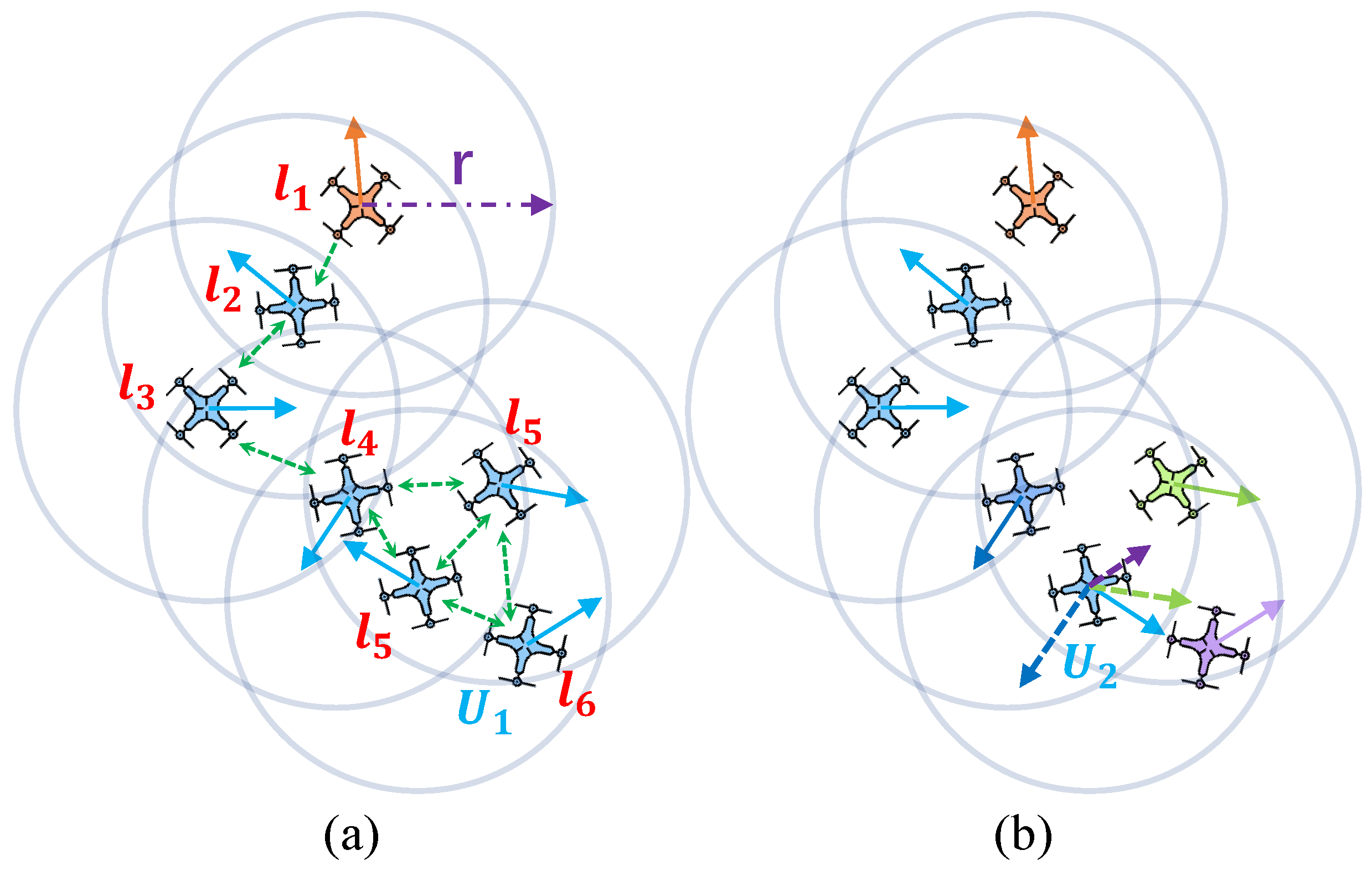
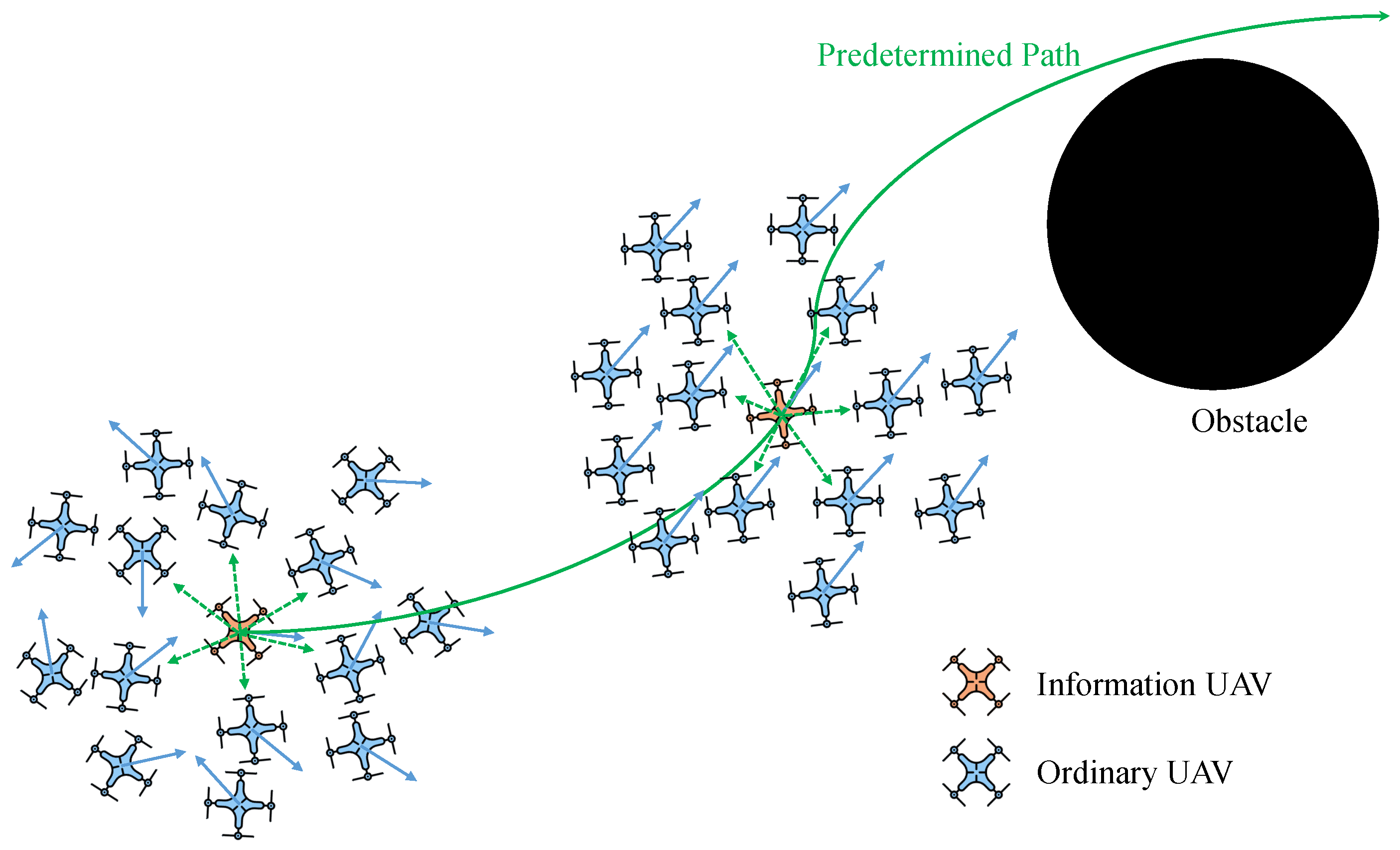
Unmanned aerial vehicle (UAV) swarm is an inevitable trend for the aerospace industry [1], and flocking navigation is one of its spotlights. Flocking behavior refers to a group-level phenomenon that occurs through simple individual interactions, where individuals are guided by the local rules rather than central coordination [2,3,4]. Navigation requires the group to move along a preset path [5] while all of the members should be able to avoid obstacles they confront [6], as shown in Figure 1.
Figure 1.
The scenario of flocking navigation with obstacle avoidance. The Information UAV (the red UAV) adjusts its heading angle according to the predetermined path information it learns in advance. The objective of this paper is to make sure that all the blue UAVs follow the red one closely and avoid the obstacle successfully.
Recently, many approaches have been developed to realize flocking navigation for multi-UAV systems. For example, Yan et al. [7] considered the leader-followers flocking problem of fixed-wing UAVs in the context of deep reinforcement learning. The followers can always follow the leader closely. However, it assumes that all followers can obtain the position and velocity information of the leader no matter how large the group is. Chen et al. [8] addressed the coordinated path following problem of fixed-wing UAVs on a 2D plane and derived the sufficient conditions for the stability of the closed-loop system. However, in the system, every UAV is required to possess the ability to plan its own path. Hoang et al. [9] proposed a novel control strategy for a swarm of UAVs that adopts an adaptive weight allocation mechanism based on the current context. The scheme performs better than the conventional one, yet all the UAVs must know the position of the target point.
Most of the previous studies either predefine the path of every UAV, or give the information of the leader to them [7,8,9,10,11], both of which are hard to realize in practice. Firstly, the mechanism of receiving the path information remotely from the ground station requires a communication device to be equipped on each UAV, which in turn burdens the data transmission load. Secondly, the UAV can execute the path planning based on the perceived information, but in practice the capability varies a lot; maybe only a few of them can obtain the goal position and plan the path correctly. Thirdly, the non-cooperation goal location may not be interpreted precisely, and the information transmission may be blocked due to the communication interruption. Therefore, determining how to navigate the multi-UAV system with only one individual knowing the path information is of great importance. Additionally, determining how to realize path following and obstacle avoidance within a limited interaction radius is also a challenging task.
To realize flocking navigation, all of the flocking members must follow the trajectory that is created by the Information UAV (a UAV with the predetermined path information). As a classic flocking model, the Vicsek model (VEM) describes a system where the member aligns to the average movement direction of its neighbors, and all the members in the flocking are finally aligned [12]. Inspired by the VEM, it can be seen that as long as all the members align themselves with the information UAV within a short enough time, they can follow tightly with the information UAV, and hence the system can move along the desired path.
There have been a lot of studies on how to improve the alignment speed of the Vicsek model [13,14,15]. Nevertheless, most of them are only applicable in converging to a random rather than a desired direction. To solve the problem, we proposed the weighting Vicsek model (WVEM) to induce all individuals to converge to the reference state [16]. In WVEM, the individuals are divided into three types according to whether they can directly interact with the information UAV. The individuals of the same type are assigned with the same constant contribution intensities. However, the convergence efficiency is not fast enough for large-scale multi-UAV systems. In this paper, we further propose a hierarchical weighting Vicsek model (HWVEM) to improve the convergence performance. Compared with WVEM, HWVEM distinguishes the influence of different individual in a more detailed way and sets the weight of each individual more flexibly and reasonably. WVEM can be regarded as the simplest form of HWVEM, and HWVEM is more general and normative.
The main contributions of this paper are twofold. Firstly, we propose the hierarchical weighting mechanism to induce all the individuals to align with the information UAV. All the individuals are divided into many layers based on their topological distance from the information UAV. The contribution intensity of each individual is assigned dynamically to ensure that the key information is always provided enough influence. Secondly, the obstacle avoidance mechanism is designed to ensure the system safety in an obstacle-existing environment with obstacles. The mechanism induces the UAVs to align with the edge of the obstacles in a tangential direction and it can be added into other models conveniently.
3. Numerical Simulation and Analysis
This section first conducts numerical simulation experiments to test the alignment performance and verify the effectiveness of the designed hierarchical weighting mechanism. Then, the proposed HWVEM-based algorithm is applied to a complex mission scenario to demonstrate the flocking navigation and obstacle avoidance.
3.1. The Verification of the Model Alignment Performance
This section verifies whether all UAVs can converge to a fixed direction, which is the foundation of achieving flocking navigation. The attraction term and repulsion term are ignored and the simulation is carried out in a periodic boundary environment. We use the convergence time as performance metric:
denotes the minimum time steps required for the system to reach the desired consistency degree . represents the consistency degree between all UAVs’ heading angles and the reference state ,
where
The smaller the is, the shorter the time it is for all UAVs to converge to the reference state, the better the system performance is achieved.
3.1.1. Contribution of Each Weighting Term
We first evaluate the model performance with different layer weighting parameters. The reference state is set to . An exclusive information UAV is set with a heading angle fixed, its initial position is at the lower left corner of the area. To stress that the feasibility of the alignment to the reference state is the focus of our studies, the noise will not be taken into account here. The following settings are the same: . Three sets of groups are discussed: . The initial position and velocity of UAV also influence the convergence performance, and thereby the 100 simulations with different initial states are carried out for each parameter to avoid the randomness and obtain the general results.
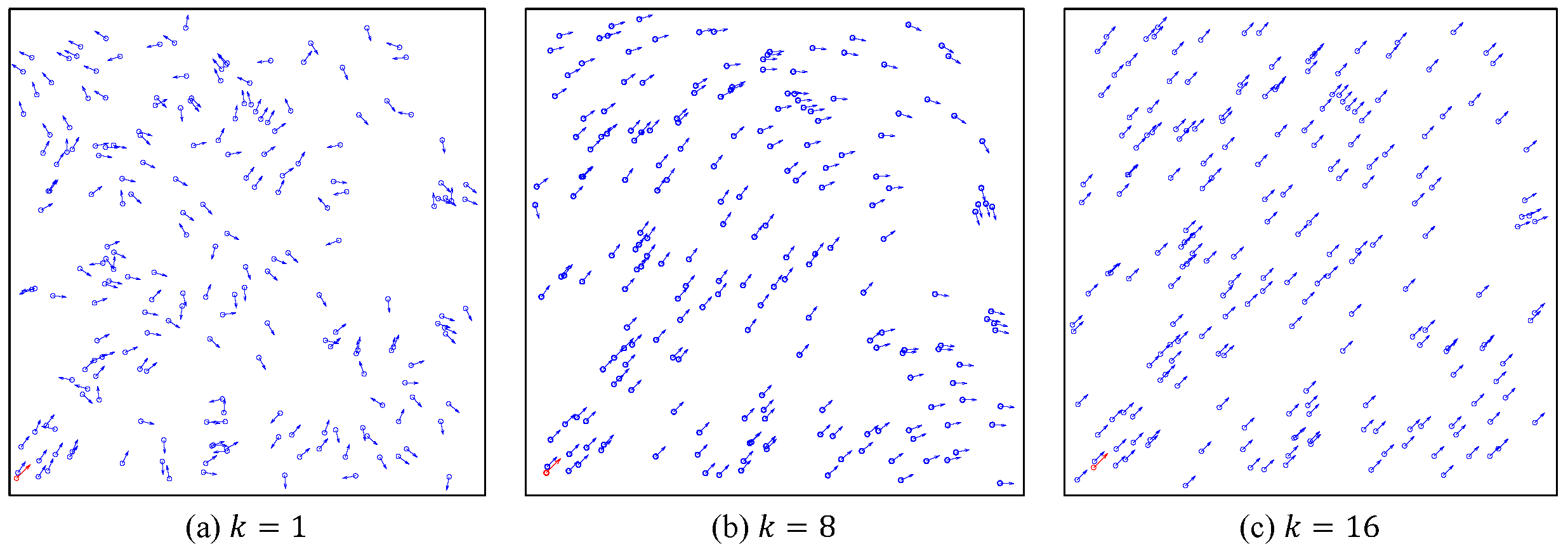
Figure 4 shows the process of the multi-UAV system evolution. All of the individuals have transformed from the initial chaos and disorder to the final alignment, strongly testifying the reliability of the proposed model.
Figure 4.
The process of one evolution with . The red individual represents the information UAV.
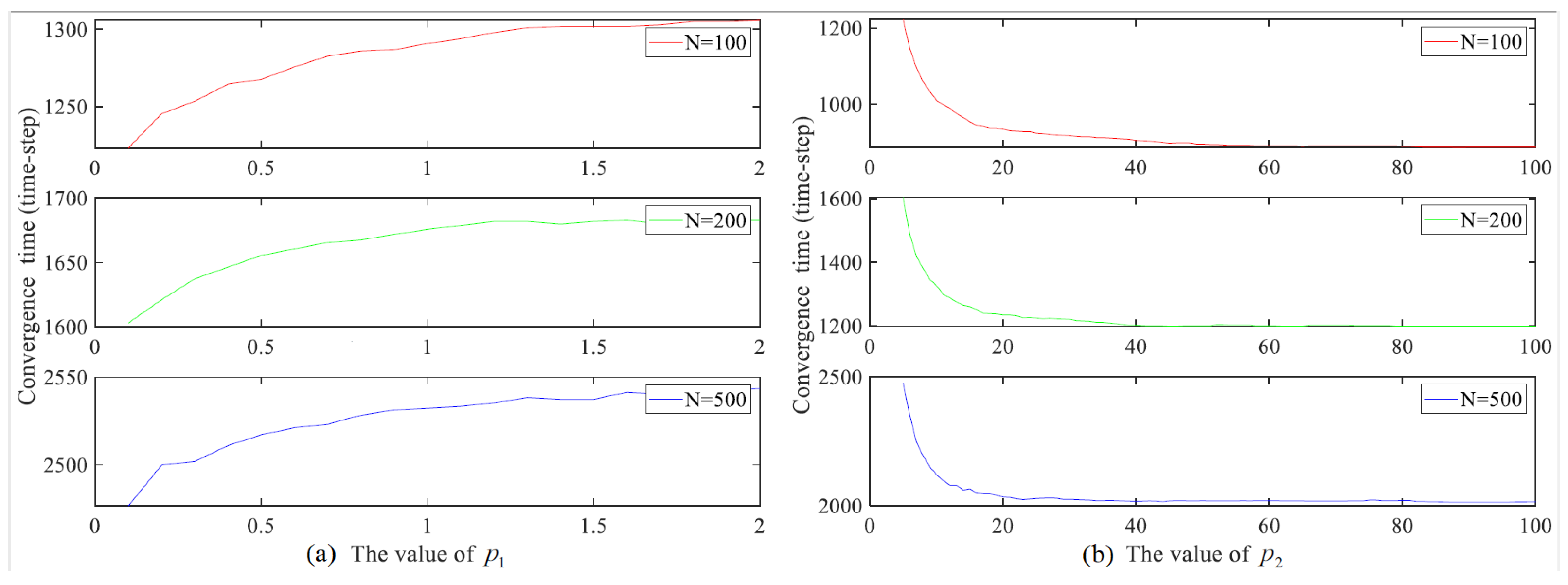
Figure 5 shows the average convergence time of the system with different layer weighting parameter. Intuitively, the convergence time increases with the increase of while decreasing with the increase of . The relative weight of the upper layer UAV and the given UAV decreases, following the increase of while increasing with the growing of . The upper layer UAV is closer to the reference state and is assigned with higher relative weight, which can induce the given UAV to align with the upper layer UAV faster, and thus the given UAV can converge to the reference state faster. Furthermore, as shown in Figure 5b, when the value of is quite large, especially , the convergence time is no longer significantly reduced. The reason is that the system performance has reached saturation. On one hand, as long as the given individual is affected by the upper layer individual, it can take the fastest action to align with the upper individual. On the other hand, even if the influence of the upper-layer continues to be improved, the given individual cannot take faster action to align to the reference state. Therefore, when is large enough, the system performance will not be further promoted with the increase of .
Figure 5.
The performance of different group with different layer weighting parameter. (a) Different values of with . (b) Different values of with .
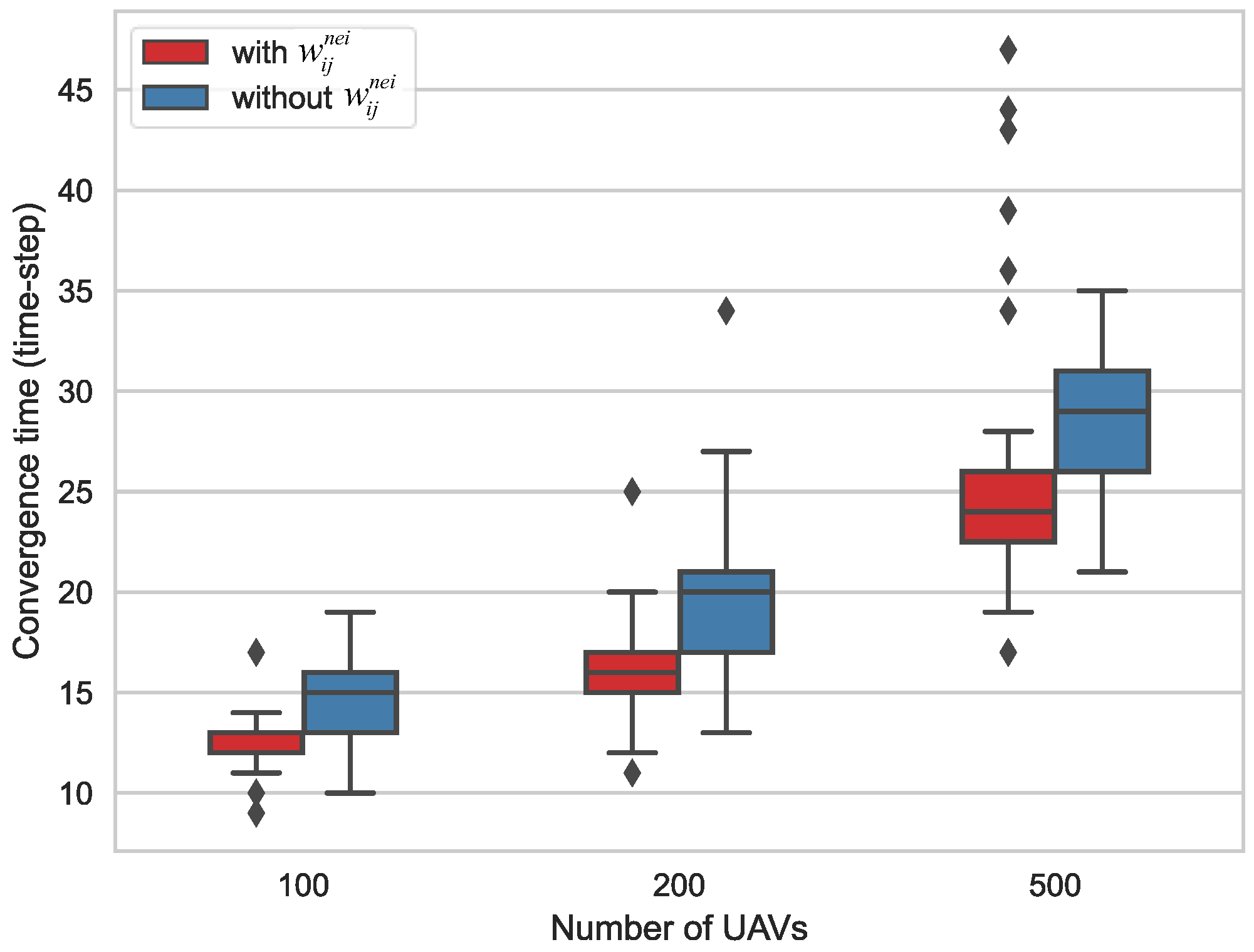
Then, the ablation experiment is carried out to verify the contribution of the mechanism of weighting the neighborhood layer status. The ablation results are shown in Figure 6.
Figure 6.
The box-plot for system performance under different application circumstances of the neighborhood layer status. The red boxes represent the system performance with the mechanism of weighting the neighborhood layer and the blue boxes without. The black rhombus are the extreme outliers.
As shown in Figure 6, the larger the group, the longer the convergence time. Obviously, weighting the neighborhood layer status brings better system performance. When the upper layer is lack of individuals, by this mechanism the contribution intensities can be improved to a certain extent compared to not applying the mechanism. The individuals can be induced to align with the upper layer individual and the reference state more quickly. When there are too few individuals of other layers, the contribution intensities provided by the mechanism are limited. The individuals of the upper layer are sufficient to induce the given individual to align with the reference state with the shortest time. This result demonstrates that the proposed mechanism of weighting the neighborhood layer status can improve the system performance.
3.1.2. Comparisons of Different Models
To further evaluate the performance of HWVEM, we compare it with five baseline models, i.e., the classic Vicsek model (VEM), the classic Vicsek model with one information UAV (VEM-A), the improved Vicsek model (IVEM) [15], the improved Vicsek model with one information UAV (IVEM-A), the weighting Vicsek model (WVEM) [16]. In IVEM, the individual obeys the rule of moving toward the middle of two neighbors’ motion directions with the maximum deviation. The updated model of the individual heading angle is as follows,
Furthermore, to make IVEM adapt to the mission scenario and make sure all the individuals converge to the desired direction, a simple improved model named IVEM-A is proposed. In IVEM-A, the information UAV is introduced. If an individual can interact with the information UAV, it will take action based on the information of its neighbors, where the influence weight of the information UAV is 100 and ordinary UAV is 1. According to our previous work, the parameters are purposely set for WVEM and the system can reach saturation (excellent) performance. means the weight of the UAVs who directly interact with the information UAV and means the UAVs who not. For HWVEM, we simply set . In these experiments, the reference state is set to . The following settings are the same: . Three sets of groups are discussed: . The simulations with different initial states are carried out 100 times for each model.
Table 1 shows the alignment performance of these models. Obviously, the convergence time of IVEM is shorter than VEM and the method of IVEM can enhance the convergence efficiency. As can be seen, both VEM-A and IVEM-A can induce the system to converge to the reference state while the system inspired by VEM or IVEM cannot. The only difference between VEM-A and VEM, and also between IVEM and IVEM-A, is the information UAV, which indicates that the information UAV is the foundation for the system to converge to the reference state. In VEM-A or IVEM-A, the individuals are constantly directly or indirectly affected by the information UAV, leading to the tendency that they align with the information UAV and eventually align to the reference state. However, the convergence time increases greatly.
Table 1.
The alignment performance of VEM, VEM-A, IVEM, IVEM-A, WVEM and HWVEM.
Compared with VEM-A and IVEM-A, the convergence time of WVEM is significantly shorter. WVEM proposes a fairly simple weighting mechanism. When considering the contribution intensity of an individual to the new preferred movement direction of the given individual, the highest weight is assigned to the information UAV, the second is assigned to the individuals directly interacting with the information UAV, and the least is assigned to other UAVs. By assigning the higher weight to the individual who is closer to the reference state, the whole system is induced to converge in a faster way to the reference state. Therefore, the system performance of WVEM is more superior, which demonstrates that an appropriate weighting mechanism can shorten the convergence time.
The time required by HWVEM is drastically shorter than WVEM. That is because HWVEM occupies the following improvements. Firstly, the exploration of the identity information of the UAV in HWVEM is more comprehensive and precise. The influence of the different individuals can be distinguished in a more detailed way and the weight of each individual can be set more flexibly. Secondly, the designed contribution intensity in HWVEM is no longer constant but dynamic. The designed rule is more reasonable and convincing. It can determine the intensity easily and flexibly and adapt to the large-scale multi-UAV system with lots of layers. Therefore, HWVEM performs better than WVEM and the weighting mechanism of HWVEM is more valid than WVEM.
3.2. Flocking Performance in Complex Scenario
The UAVs driven by VEM and IVEM cannot converge to the reference state, so they cannot accomplish flocking navigation. Other models acquire different convergence time, and parts of UAVs cannot keep up with the information UAV in time in complex mission scenarios and thus lose track and fail to complete the task. This section will remove periodic boundary and add the attraction term and repulsion term to evaluate the task performance of the flocking algorithms based on VEM-A, IVEM-A, WVEM, and HWVEM, respectively. The influence of weighting parameters setting for HWVEM is also considered and two sets of parameters whose alignment performances vary greatly are chosen: for HWVEM-I and for HWVEM-II. In Figure 5 in Section 3.1.1, we can simply conclude that the alignment performance of HWVEM-II is much better than HWVEM-I.
We define the success rate as metric to evaluate the task performance. represents the proportion of the number of individuals that complete the task to the total individuals,
where represents the number of the UAVs that achieve the task successfully. The larger the and , the better the task performance. If a UAV follows the information UAV closely from the beginning to the end, it is considered to be successful. Besides, to evaluate the safety, two metrics are proposed: the minimum distance between individuals and the minimum distance from the individual to the obstacle during the entire process. The larger the and , the safer the swarm.
In the experiments, a certain degree of noise is introduced to test the system robustness. The following settings are the same: . To reduce computational burden and take the actual group into account, three sets of groups are discussed: . One-hundred simulations with different initial states are carried out for each model.
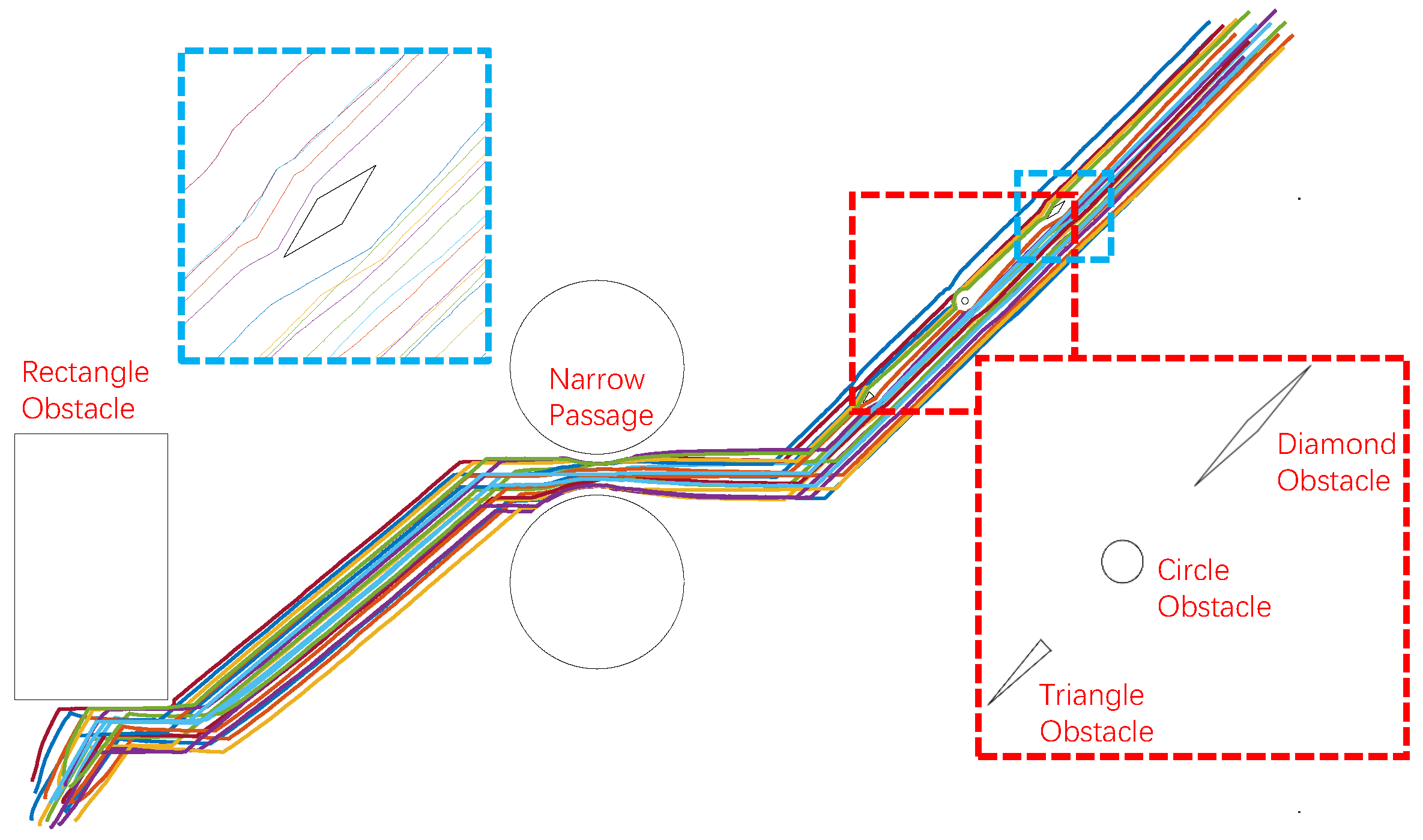
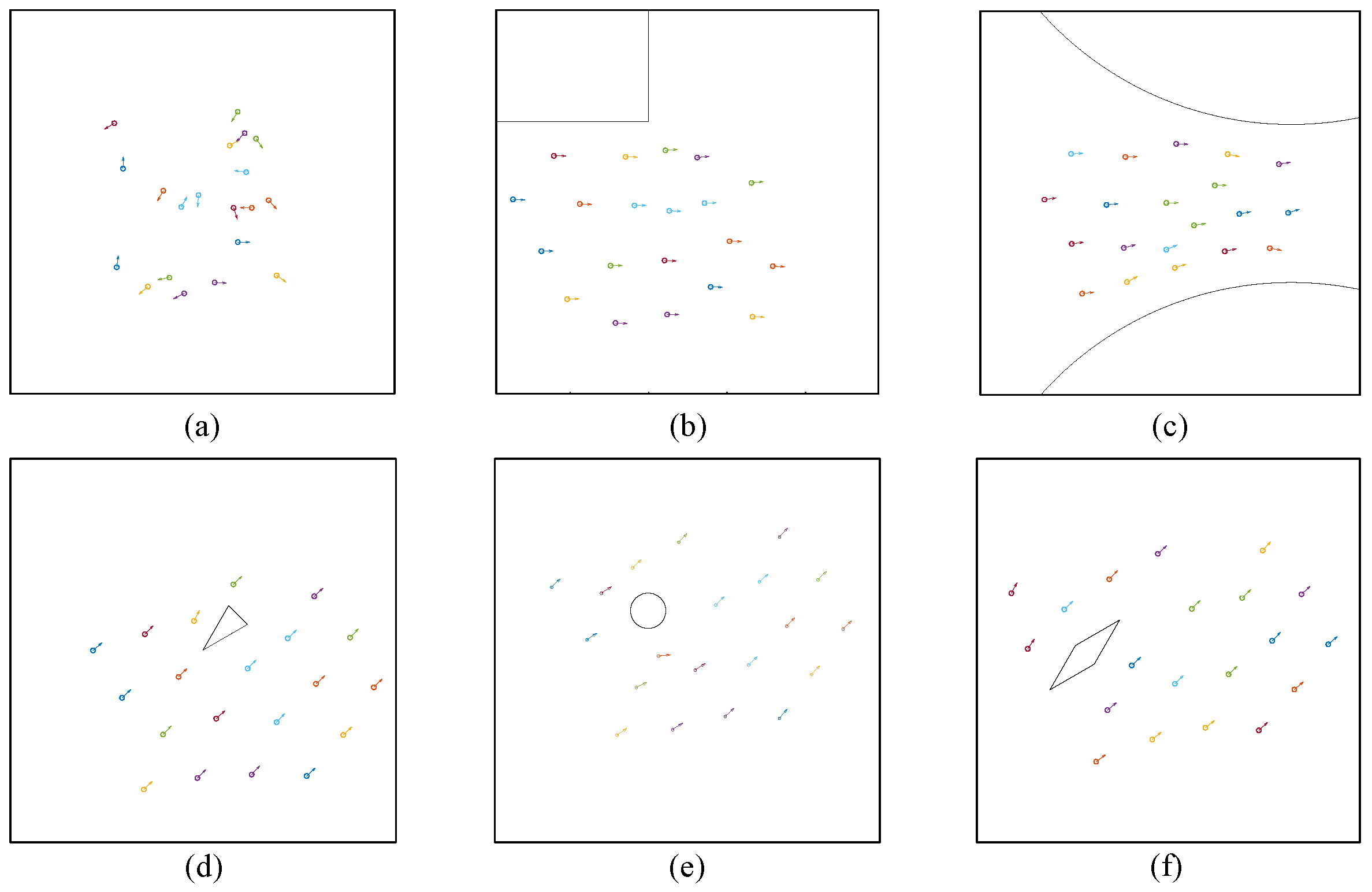
Figure 7 shows the entire mission scenario and task execution of HWVEM and Figure 8 displays the snapshots. As shown in Figure 7, the mission scenario is comprehensive, including traveling through narrow areas, and bypassing tiny or huge obstacles. The shapes of the obstacles include spheres, rectangles, diamonds, and triangles. In this experiment, all UAVs align with the information UAV within a short time and follow closely with the information UAV during the entire process, which illustrates that the swarm moves along the predetermined path successfully. Besides, the safety is demonstrated because no collision happened during the whole process. These results verified the feasibility and adaptability of HWVEM. The system can still complete the mission in the presence of noise, which shows that the model is robust and can be used to guide the actual flocking.
Figure 7.
The scene of the system executing the mission. The inset of red dotted line represents the setup of the obstacles. The blue dotted line shows the detail that the individual avoids the obstacle.
Figure 8.
The snapshots of the multi-UAV system executing the mission. (a) ; (b) ; (c) ; (d) ; (e) ; (f) .
As shown in Table 2, when , all five models possess a relatively high success rate. Since the group is not large, every model can induce the UAVs to align with the information UAV within a short enough time. Nevertheless, VEM-A and IVEM-A acquire the lowest success rate, which is consist with their alignment performances.
Table 2.
The task performance of VEM-A, IVEM-A, WVEM, HWVEM-I and HWVEM-II.
When , the task performances of VEM-A and IVEM-A decline sharply. Once the system reaches a certain large group, the difference of task performance between the models begins to manifest. The task performance of HWVEM is the best, which is consistent with the alignment performance. It implies the rationality of our idea.
When , the performance of HWVEM-II is significantly higher than HWVEM-I. The better the parameters for the system convergence performance, the better the performance of the multi-UAV system executing the mission, which emphasizes the importance of the weighting parameter configurations.
Additionally, the values of and of different models are always similar, which shows the same system safety. The values are always positive and the minimal values are . It shows that a certain degree of security of the multi-UAV system can be guaranteed.
4. Conclusions
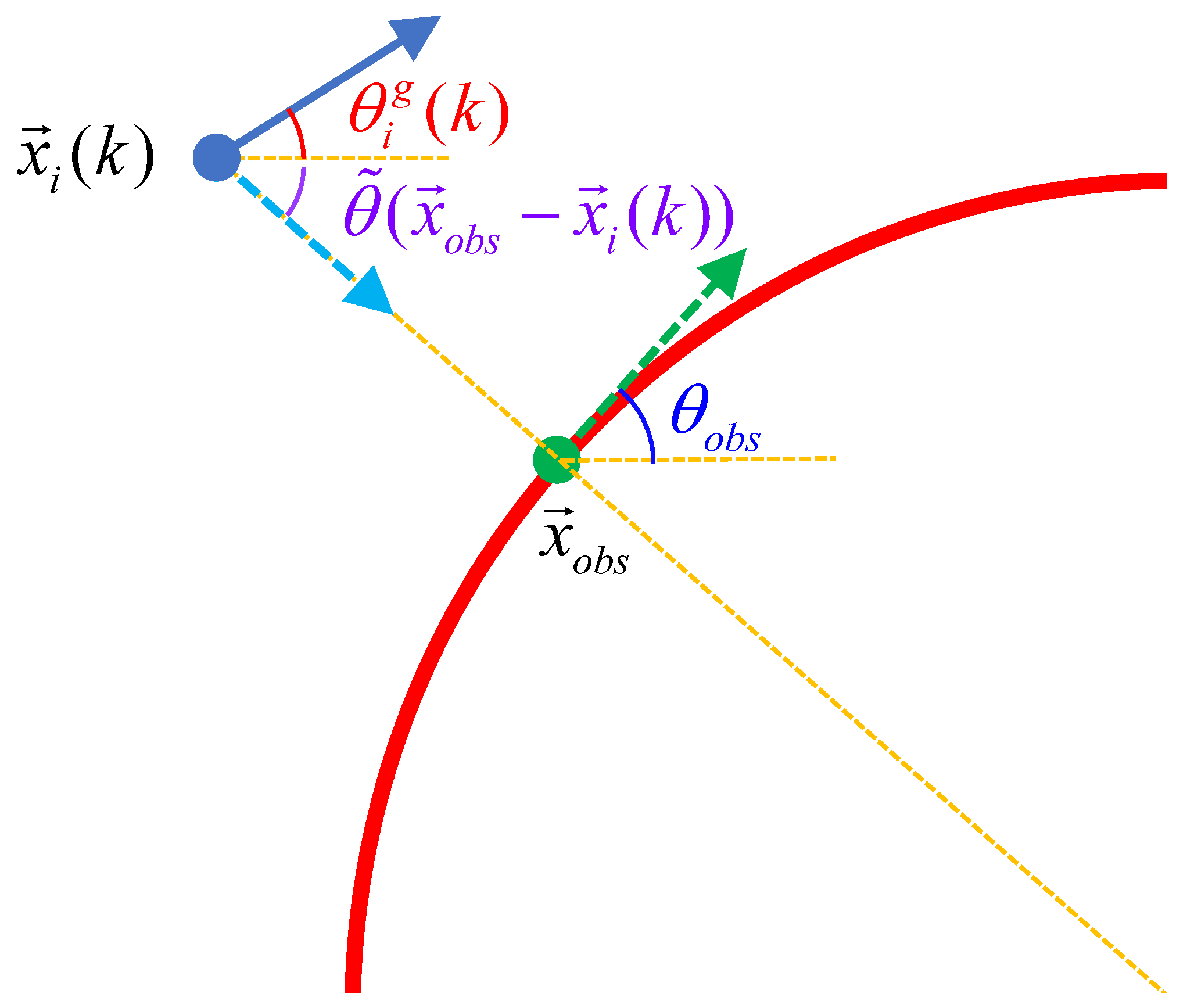
This paper proposed a HWVEM based on VEM to achieve the flocking navigation and obstacle avoidance for the multi-UAV system in which only one UAV knows the predetermined path. According to the hierarchical weighting mechanism, all UAVs are divided into different layers based on their topological distance with the information UAV. The contribution intensity of each individual is assigned reasonably and flexibly, which is composed of three parts: the absolute layer weight, the relative layer weight, and the weight of the neighborhood layer status. The rationality of each part has been verified through numerous experiments. The proposed obstacle avoidance mechanism consists of two steps: occasion and behavior. Specifically, when the obstacle obstructs the genuine desired movement direction of the UAV, the UAV will align its heading angle to the tangent direction of the obstacle. The feasibility and reliability of HWVEM have been verified by comparing it with several baseline models in comprehensive mission scenario. Additionally, the system can still achieve mission in the presence of noise, which demonstrates the robustness of HWVEM and its potential in the real world. In the future, we will further evaluate our proposed model in the real-world environment. Another promising direction is to search the optimal weights for HWVEM via intelligent optimization algorithms, such as genetic algorithm (GA) and particle swarm optimization algorithm (PSO).
Author Contributions
Conceptualization, X.X.; Data curation, D.T.; Formal analysis, C.Y.; Funding acquisition, H.Z.; Investigation, X.L.; Methodology, C.Y.; Project administration, Y.C.; Resources, X.X.; Software, X.L.; Supervision, H.Z.; Validation, X.L.; Visualization, X.L. and C.Y.; Writing—original draft, X.L.; Writing—review & editing, C.Y., H.Z. and Y.C. All authors have read and agreed to the published version of the manuscript.
Funding
This research was supported by National Nature Science Foundation under grant 61803377 and Postgraduate Scientific Research Innovation Project of Hunan Province under grant CX20210001.
Institutional Review Board Statement
Not applicable.
Informed Consent Statement
Not applicable.
Data Availability Statement
The data used to support the findings of this study are available from the corresponding author upon request.
Conflicts of Interest
The authors declare they have no conflict of interest.
References
- Kim, A.R.; Keshmiri, S.; Blevins, A.; Shukla, D.; Huang, W. Control of Multi-Agent Collaborative Fixed-Wing UASs in Unstructured Environment. J. Intell. Robot. Syst. 2019, 97, 205–225. [Google Scholar] [CrossRef]
- Parrish, J.; Edelstein-Keshet, L. Complexity, pattern, and evolutionary trade-offs in animal aggregation. Science 1999, 284, 99–101. [Google Scholar] [CrossRef] [PubMed]
- Couzin, I. Collective minds. Nature 2007, 445, 715. [Google Scholar] [CrossRef] [PubMed]
- Vicsek, T.; Zafeiris, A. Collective motion. Phys. Rep. 2012, 517, 71–140. [Google Scholar] [CrossRef]
- Beaver, L.E.; Malikopoulos, A.A. An Overview on Optimal Flocking. arXiv 2020, arXiv:2009.14279. [Google Scholar]
- Olcay, E.; Schuhmann, F.; Lohmann, B. Collective navigation of a multi-robot system in an unknown environment. Robot. Auton. Syst. 2020, 132, 103604. [Google Scholar] [CrossRef]
- Yan, C.; Xiang, X.; Wang, C. Fixed-Wing UAVs flocking in continuous spaces: A Deep reinforcement learning approach. Robot. Auton. Syst. 2020, 131, 103594. [Google Scholar] [CrossRef]
- Chen, H.; Cong, Y.; Wang, X.; Xu, X.; Shen, L. Coordinated Path-Following Control of Fixed-Wing Unmanned Aerial Vehicles. IEEE Trans. Syst. Man Cybern. Syst. 2021, 99, 1–15. [Google Scholar]
- Hoang, D.; Tran, D.M.; Tran, T.S.; Pham, H.A. An adaptive weighting mechanism for reynolds rules-based flocking control scheme. Peerj Comput. Sci. 2021, 7, 1–15. [Google Scholar] [CrossRef] [PubMed]
- Hayes, A.T.; Dormiani-Tabatabaei, P. Self-organized flocking with agent failure: Off-line optimization and demonstration with real robots. In Proceedings of the IEEE International Conference on Robotics & Automation, Washington, DC, USA, 11–15 May 2002; IEEE: Piscataway, NJ, USA, 2002. [Google Scholar]
- Zhou, H.; Zhao, H.; Han, T.; Huang, H.Q. Cooperative flight and evasion control of uav swarm based on rules. Syst. Eng. Electron. 2016, 38, 1374–1382. [Google Scholar]
- Vicsek, T.; Czirók, A.; Ben-Jacob, E.; Cohen, I.; Shochet, O. Novel type of phase transition in a system of self-driven drones. Phys. Rev. Lett. 1995, 75, 1226–1229. [Google Scholar] [CrossRef]
- Zhang, J.; Zhao, Y.; Tian, B.; Peng, L.; Zhang, H.T.; Wang, B.H.; Zhou, T. Accelerating consensus of self-driven swarm via adaptive speed. Phys. Stat. Mech. Its Appl. 2009, 388, 1237–1242. [Google Scholar] [CrossRef]
- Gao, J.; Chen, Z.; Cai, Y.; Xu, X. Approach to enhance convergence efficiency of Vicsek model. Control. Decis. 2009, 24, 1269–1272. [Google Scholar]
- Chen, S.; Shu, J.; Nie, S.; Cen, Y. Convergence Efficiency of a Class of Improved Vicsek Model. Inf. Control. 2011, 40, 318–322. [Google Scholar]
- Liu, X.; Xiang, X.; Chang, Y.; Yan, C.; Zhou, H.; Tang, D. Hierarchical Weighting Vicsek Model for Flocking Navigation of Drones. Drones 2021, 5, 74. [Google Scholar] [CrossRef]
- Jia, Y.; Vicsek, T. Modelling Hierarchical Flocking. New J. Phys. 2019, 21, 093048. [Google Scholar] [CrossRef]
- Vásárhelyi, G.; Virágh, C.; Somorjai, G.; Tarcai, N.; Szörényi, T.; Nepusz, T.; Vicsek, T. Outdoor flocking and formation flight with autonomous aerial robots. In Proceedings of the 2014 IEEE/RSJ International Conference on Intelligent Robots and Systems, Chicago, IL, USA, 14–18 September 2014; pp. 3866–3873. [Google Scholar]
- Reynolds, C.W. Flocks, Herds, and Schools: A Distributed Behavioral Model. ACM SIGGRAPH Comput. Graph. 1987, 21, 25–34. [Google Scholar] [CrossRef]
Publisher’s Note: MDPI stays neutral with regard to jurisdictional claims in published maps and institutional affiliations. |
© 2021 by the authors. Licensee MDPI, Basel, Switzerland. This article is an open access article distributed under the terms and conditions of the Creative Commons Attribution (CC BY) license (https://creativecommons.org/licenses/by/4.0/).