

Physically Interpretable and AI-Powered Applied-Field Thrust Modelling for Magnetoplasmadynamic Space Thrusters Using Symbolic Regression: Towards More Explainable Predictions




Abstract
1. Introduction
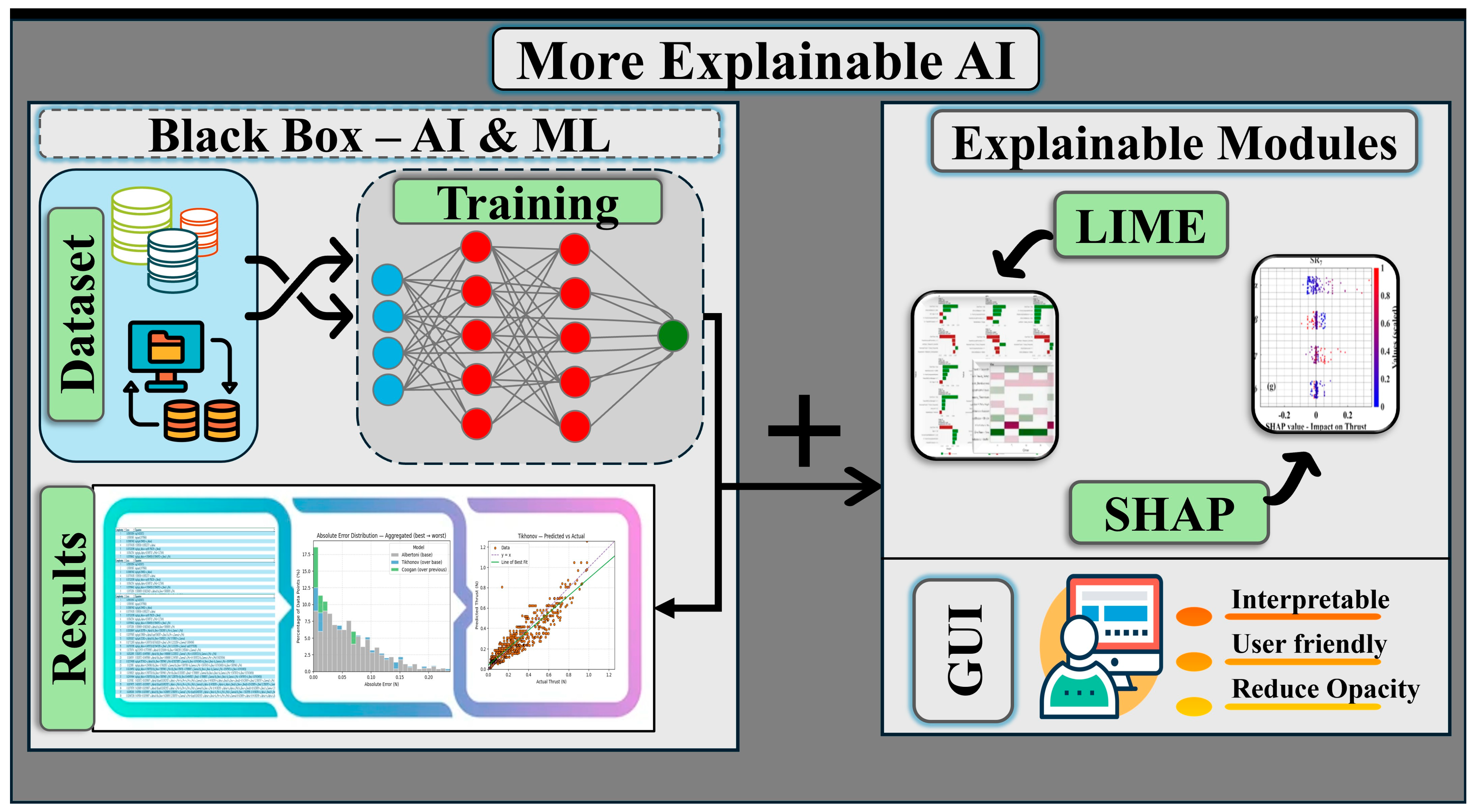
- Physics-aware SR with composite-term constrained search space: The search space for the SR model is constrained via physically meaningful custom composite-terms, producing closed-form surrogate correlations that remain directly comparable and auditable against established AF-MPDTs scaling relations.
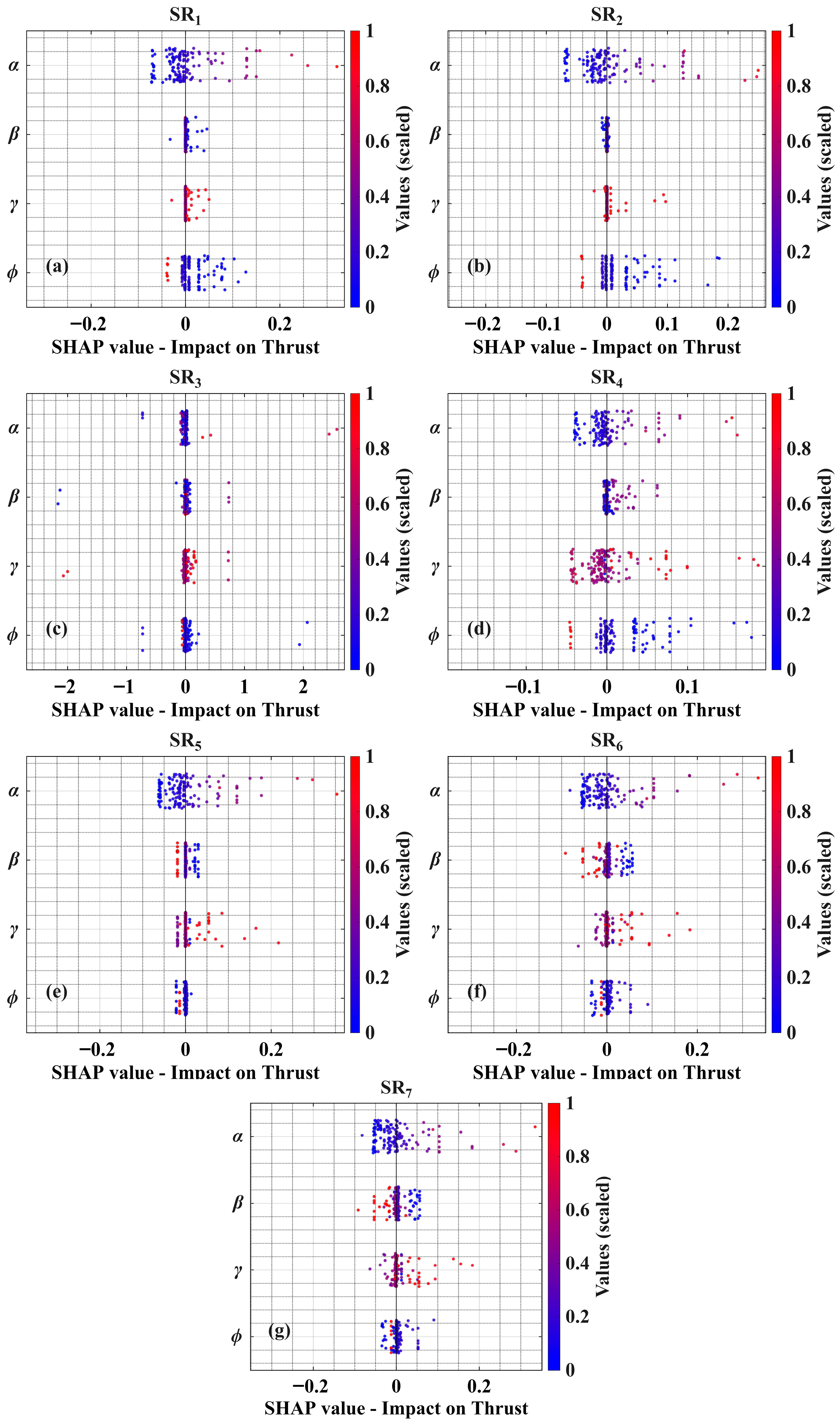
- Low-thrust applied-field scope with interpretable driver/modulator structure: Under analysis is a bounded low-thrust envelope (0–1 N) dominated by applied-field effects; the discovered correlations are interpreted in an engineering sense by analysing the explicit structures in terms of the dominant driver and the modulator composites, inclusive of a SHAP analysis.
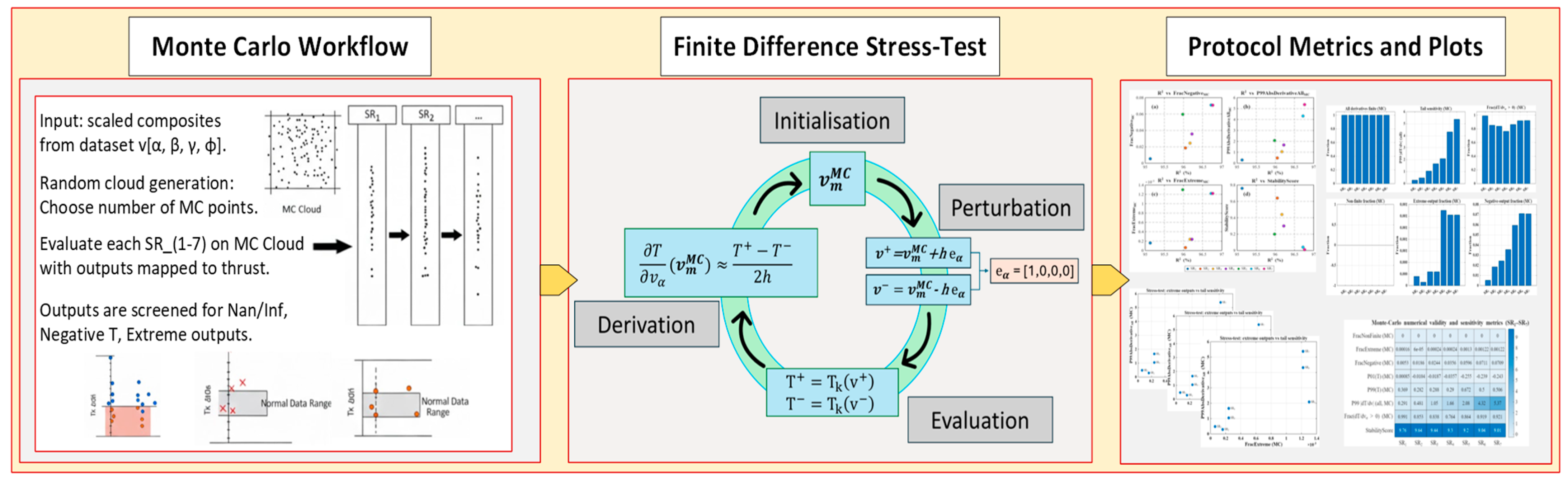
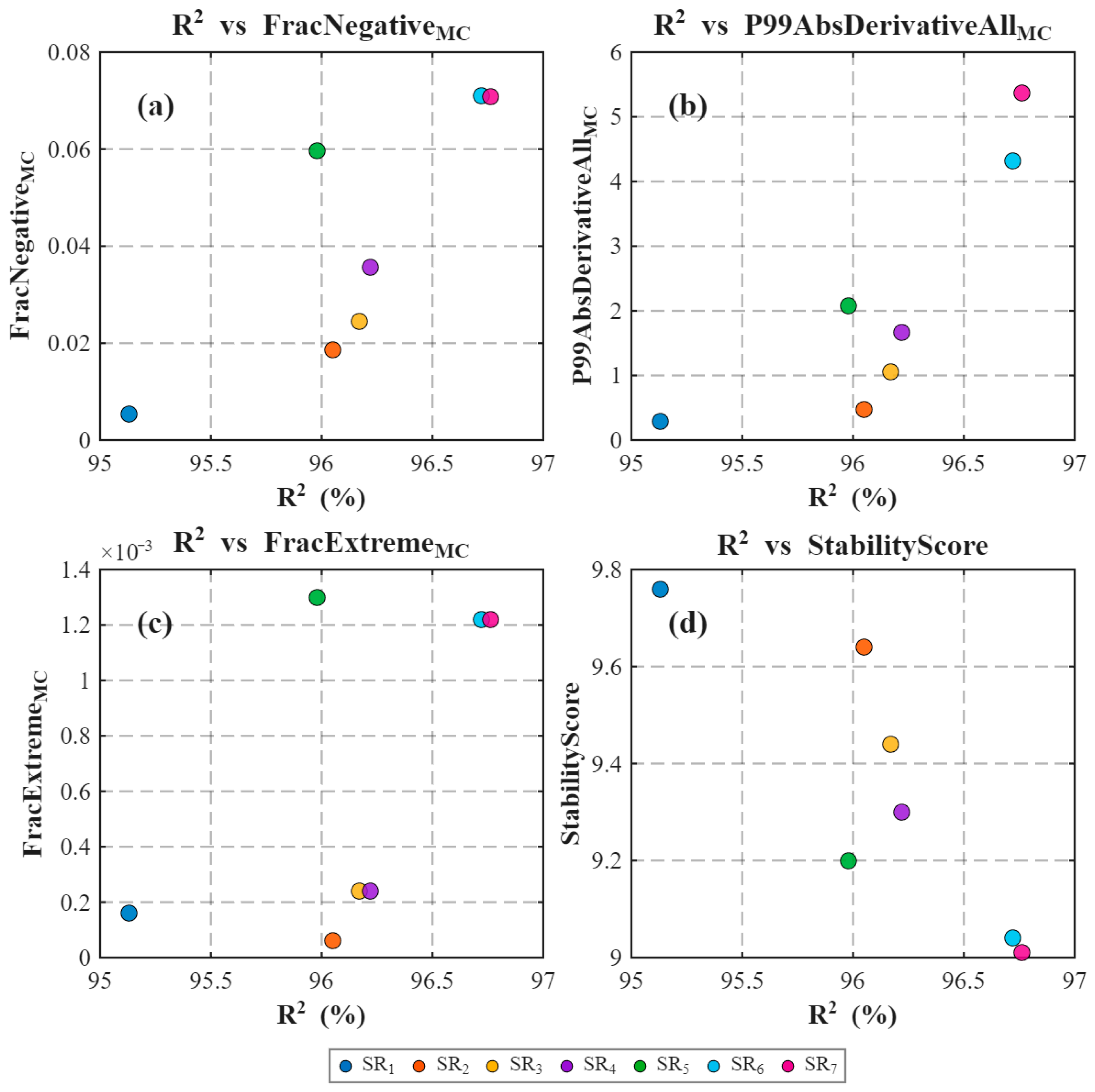
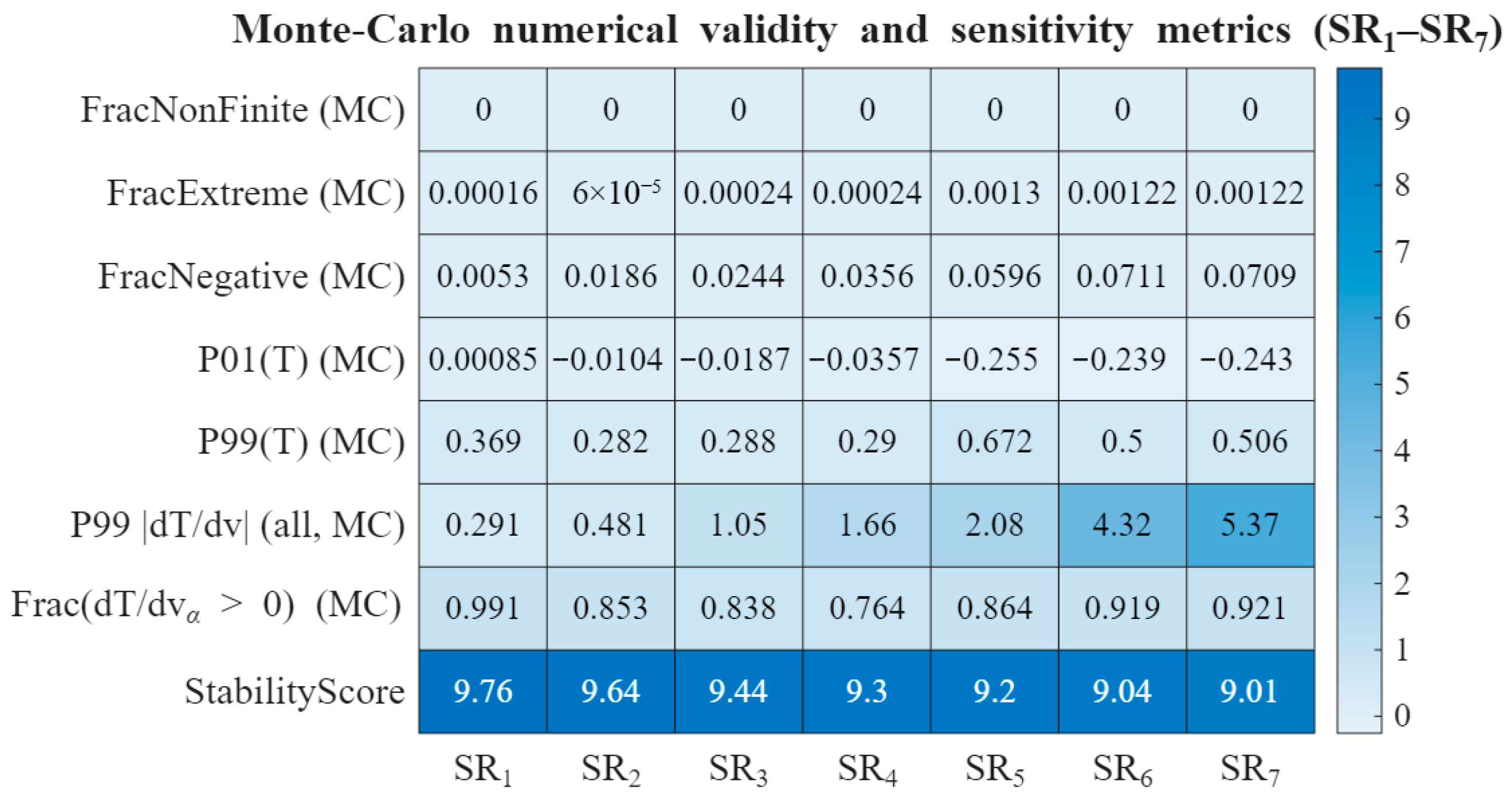
- Post-discovery robustness and physics-consistency screening: We introduce a protocol for stress-testing each SR correlation within the feasible composite-term envelope using MC sampling and finite-difference local sensitivities. This produces envelope-validity and tail-sensitivity metrics, summarised into a StabilityScore. The protocol includes a driver-direction consistency check via ∂T/∂vα, allowing physical consistency checks for the SR correlations. The protocol results allow an accuracy–complexity–stability trade-off analysis.
2. Methodology
2.1. Overview of Symbolic Regression
2.2. Dataset and Composite-Term Structure Preprocessing
2.3. Performance Evaluation Metrics
2.4. Robustness and Physics-Consistency Screening of SR Correlations (MC Envelope + Local Sensitivity)
- FracFiniteMC: fraction of MC samples for which T is finite (not NaN/Inf). This measures the proportion of the envelope where the expression remains numerically evaluable.
- FracNonFiniteMC =1 − FracFiniteMC: fraction of MC samples producing NaN/Inf. This detects hidden singularities and invalid operations (e.g., division by near-zero denominators) that may not be triggered at the finite dataset points but exist within the feasible envelope [70,71,73]. This directly targets mathematical fragility that can make an explicit equation appear interpretable while being unreliable under envelope-level probing [42,69].
- FracNegativeMC: fraction of finite MC samples with T < 0. Negative thrust is physically implausible for the thrust definition and envelope studied; this metric quantifies sign-violation frequency within the stated domain.
- MedianTMC: median of T over finite MC predictions. Behaves as a robust central-tendency indicator, less sensitive to outliers/heavy tails than the mean.
- P01TMC and P99TMC: first and 99th percentiles of over finite MC predictions. It provides tail diagnostics to characterise whether the expression develops heavy tails or edge-of-envelope bias, even while remaining finite [74].
- FracExtremeMC: fraction of finite MC predictions producing “extreme” outputs relative to the equation’s robust span on the dataset.
- Definition used: robust bounds are defined per equation from the dataset as and , with span . Predictions are flagged “extreme” if they fall outside
3. Results and Discussion
3.1. Hyperparameter Tuning
| Algorithm 1. Tree-Structured Parzen Estimator (TPE) |
| Inputs: : number of initial random trials : total evaluation budget : number of candidate samples per iteration G (·): quantile rule returning g (fraction treated as “good”) k (·): kernel/mixture family for density estimation B (·): bandwidth (scale) rule for the density estimator W (·): optional trial-weighting rule (often uniform) : tree-structured search space (conditional parameters allowed) ε: small constant (optional) , best observed hyperparameter configuration (1) Initialise the dataset: is its objective value. (2) Initialisation phase (random exploration): , from the prior over . . – 1, Split D into the following:
. |
3.2. Discovered SR Equations
3.3. Performance Metrics for the Proposed SR Equations
3.4. Trade-Off Between Complexity and Accuracy
3.5. Interpretability Boundaries and Physical Validity
3.5.1. Accuracy–Stability Trade-Off and Interpretability Boundary
3.5.2. Interpreting Validity Protocol Metrics in the Context of AF-MPDT Composite-Terms
3.5.3. Summary Comparison: Linking Accuracy, Stability, and Complexity
3.6. Interpretability Boundaries, Physical Validity, and Generalisation
4. Conclusions
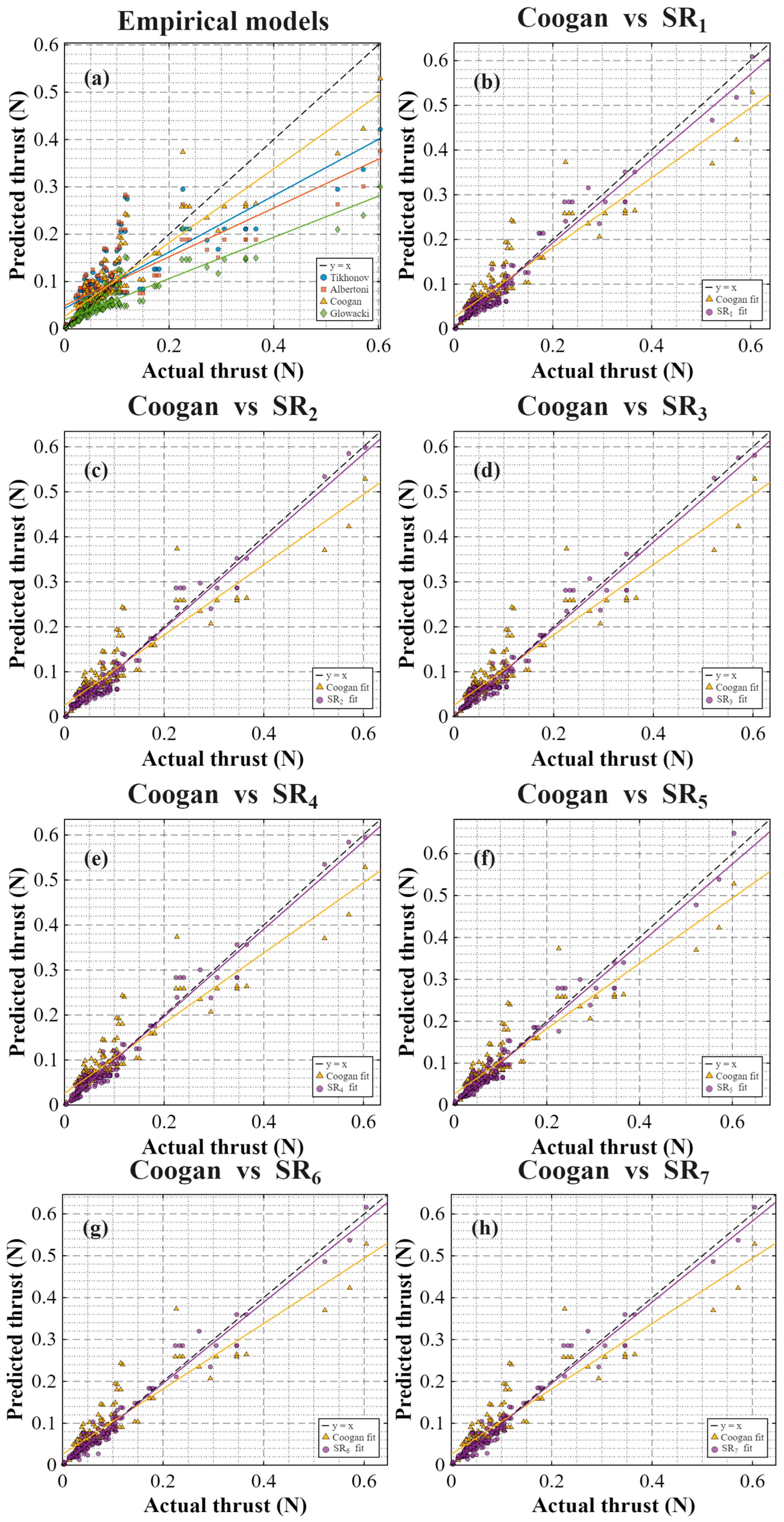
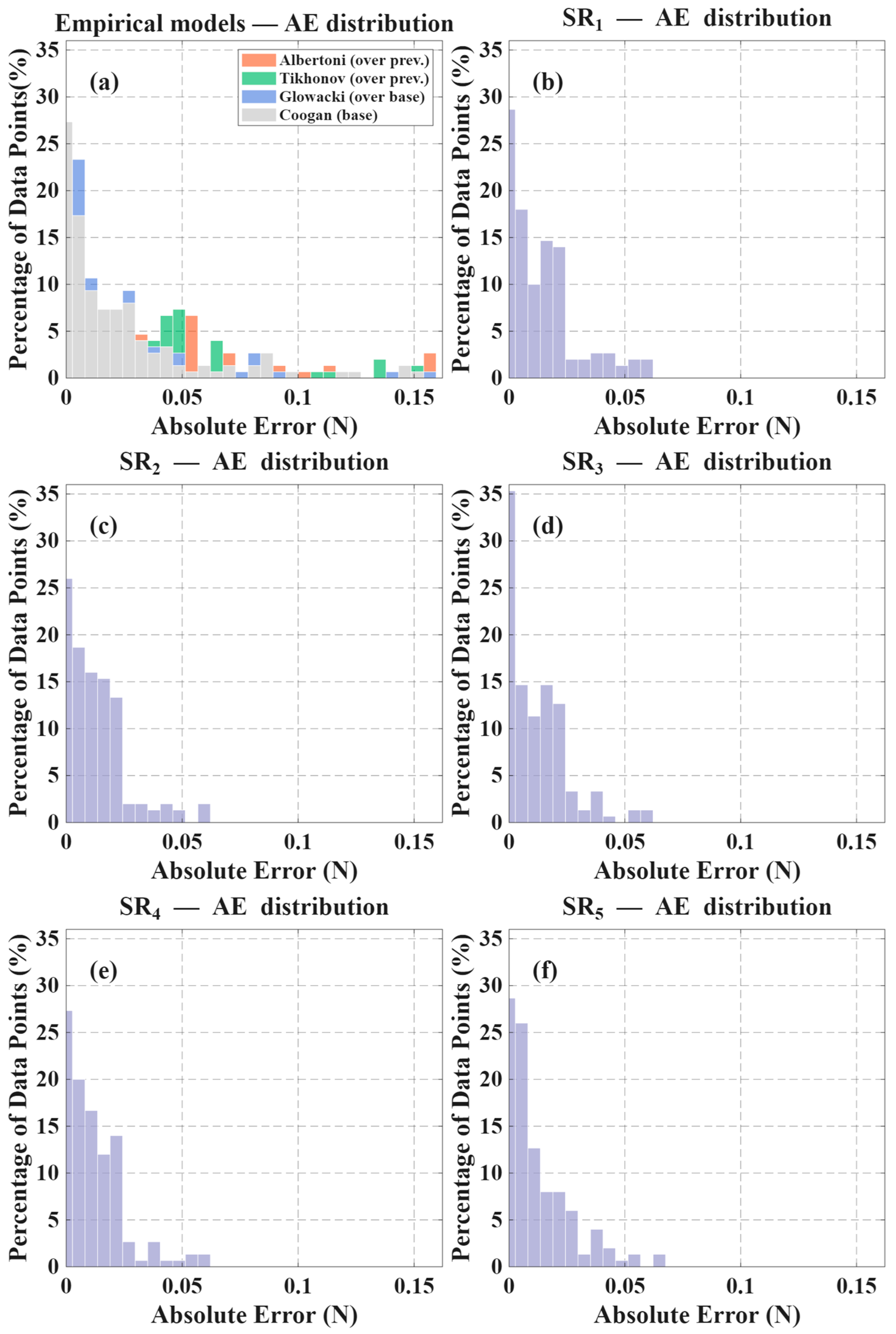
- SR yields high predictive performance relative to literature correlations under the operational envelope provided by the pre-processing and filtering methods. The best performance from the literature models for this subset comes from Coogan’s model with R2 = 84.21%, , and . In contrast, all developed SR equations perform better, achieving while reducing the errors with the lowest reported and . This indicates that the SR is capable of better capturing the variance in the data while increasing the prediction accuracy compared to the baseline models for a low-thrust, applied-field-dominant regime of coaxial AF-MPDTs.
- A complexity–accuracy trade-off is observed in the developed equations, where complexity serves as a proxy for interpretability observed in the closed-form surrogate correlations. The set from delivers improvements against benchmark models at the same or lower levels of complexity than Coogan’s model (C = 25). Additional performance improvement is observed for at higher complexities. The results support a selection of SR5′s superior predictive performance (R2 = 95.98%, RMSE = 0.0199, MAE = 0.0143) and lower complexity (C = 24) as the best fit of the study, providing a more interpretable physics-bounded higher-performing equation than those in the literature. The trade-off implies complexity can be used as a filter for the selection of the desired equation, dependent on the engineering design objective, whether it be accuracy or interpretability. Complexity and StabilityScore are found to be inverse: as complexity increases, StabilityScore decreases.
- Variance capture does not guarantee proportional accuracy in the low-thrust regime for empirical formulas in the literature. For all semi-empirical metrics, Coogan has the highest while the lowest MAPE (27.13%) belongs to Glowacki’s model, indicating that Coogan’s model produces larger deviations for predictions. Our SR models are capable of reaching a lower error (20.34%), confirming that our approach improves not only variance capture but also proportional accuracy, which is important in low-thrust regimes where MAPE can be more stringent.
Author Contributions
Funding
Data Availability Statement
Acknowledgments
Conflicts of Interest
Appendix A
Appendix A.1

| Model | Nvar | Nconst | Nbin | Npow | Nlog | Complexity |
|---|---|---|---|---|---|---|
| Albertoni et al. | 4 | 4 | 6 | 1 | 0 | 19 |
| Tikhonov et al. | 3 | 1 | 3 | 0 | 0 | 6 |
| Glowacki et al. | 11 | 17 | 23 | 4 | 1 | 71 |
| Coogan et al. (Equation (19)) | 5 | 5 | 6 | 3 | 0 | 25 |
| (Equation (12)) | 5 | 4 | 7 | 1 | 0 | 19 |
| (Equation (13)) | 8 | 4 | 10 | 1 | 0 | 22 |
| (Equation (14)) | 9 | 4 | 11 | 1 | 0 | 23 |
| (Equation (15)) | 10 | 4 | 12 | 1 | 0 | 25 |
| (Equation (16)) | 11 | 4 | 14 | 0 | 0 | 24 |
| (Equation (17)) | 15 | 14 | 27 | 2 | 0 | 63 |
| (Equation (18)) | 16 | 17 | 30 | 3 | 0 | 75 |
Appendix A.2
- Notation
- Let T(x) be the thrust predicted by a given SR equation at input x in scaled composite space.
- Dataset (Data) predictions: {Tdata,i}_{i = 1…Ndata}.
- MC envelope predictions: {TMC,i}{i = 1…NMC}, where x_i ~ Uniform in (α, β, γ, ϕ) space.
- Finite indicator: 1finite(T) = 1 if T is finite (not NaN/Inf), else 0.
- Percentile operator: Pq({·}) denotes the q-th percentile (e.g., q = 1 or 99) over finite values.
- Central finite-difference partial derivative in scaled space (step h):
- A. MC envelope validity metrics
References
- Mohan, N.; Ferguson, A.E.; Cech, H.; Bose, R.; Renatin, P.R.; Marina, M.K.; Ott, J. A Multifaceted Look at Starlink Performance. In Proceedings of the WWW ′24: The ACM Web Conference 2024, Singapore, 13–17 May 2024; Volume 12. [Google Scholar] [CrossRef] [Scilit]
- Kingdon, J. 3 months transit time to Mars for human missions using SpaceX Starship. Sci. Rep. 2025, 15, 17764. [Google Scholar] [CrossRef] [Scilit] [PubMed]
- NASA. Artemis II News and Updates—NASA. Available online: https://www.nasa.gov/artemis-ii-news-and-updates/ (accessed on 7 November 2025).
- Russell, C.; Raymond, C. The dawn mission to minor planets 4 vesta and 1 ceres. In The Dawn Mission to Minor Planets 4 Vesta and 1 Ceres; Springer Nature: Berlin/Heidelberg, Germany, 2012; Volume 9781461449034, pp. 1–574. [Google Scholar] [CrossRef] [Scilit]
- Foing, B.; Racca, G.; Marini, A.; Evrard, E.; Stagnaro, L.; Almeida, M.; Koschny, D.; Frew, D.; Zender, J.; Heather, J.; et al. SMART-1 mission to the Moon: Status, first results and goals. Adv. Space Res. 2006, 37, 6–13. [Google Scholar] [CrossRef] [Scilit]
- Oz, İ.; Yilmaz, Ü. Design Tradeoffs in Full Electric, Hybrid and Full Chemical Propulsion Communication Satellite. Sak. Univ. J. Comput. Inf. Sci. 2019, 2, 124–133. [Google Scholar] [CrossRef] [Scilit]
- Palaszewski, B.; Meyer, M.; Johnson, L.; Goebel, D.; White, H.; Coote, D. In-Space Chemical Propulsion Systems Roadmap; Glenn Research Center: Cleveland, OH, USA, 2017. [Google Scholar]
- Goddard, R.H. The Green Notebooks; The Dr. Robert H. Goddard Collection at the Clark University Archives; Clark University Archives: Worchester, MA, USA, 1906. [Google Scholar]
- Goebel, D.M.; Katz, I. Fundamentals of Electric Propulsion: Ion and Hall Thrusters; JPL Space Science and Technology Series; John Wiley & Sons: Hoboken, NJ, USA, 2008. [Google Scholar]
- Krülle, G.; Auweter-Kurtz, M.; Sasoh, A. Technology and application aspects of applied field magnetoplasmadynamic propulsion. J. Propuls. Power 1998, 14, 754–763. [Google Scholar] [CrossRef] [Scilit]
- Collier-Wright, M.; Bögel, E.; La, M.; Betancourt, R. High-Power Electric Propulsion as an Enabler for Moon Missions. In Proceedings of the International Astronautical Congress 2021, Dubai, United Arab Emirates, 25–29 October 2021. [Google Scholar]
- La, M.; Betancourt, R.; Herdrich, G.; Bauer, M. High Temperature Superconductors as game changers for Plasma based Space Propulsion Systems for GEO Satellites, Drag Compensation of Large Space Structures and Beyond Earth Orbit Missions. In Proceedings of the Space Propulsion Conference 2018, Sevilla, Spain, 14–18 May 2018. [Google Scholar]
- Polk, J.; Choueiri, E.; Sheppard, A.; Smith, E.F.; Goebel, D.M.; Martin, A.; Polzin, K.A. Development of High Power Lithium Magnetoplasmadynamic Thrusters to Support Human Mars Exploration. In Proceedings of the 38th International Electric Propulsion Conference, Toulouse, France, 23–28 June 2024. [Google Scholar]
- Han, M.; Rana, H. Applied-Field Magnetoplasmadynamic Thrusters for Deep Space Exploration. arXiv 2024, arXiv:2410.17478. [Google Scholar] [CrossRef] [Scilit]
- Almeida, T.P.; Bonab, S.A.; Yazdani-Asrami, M. Data-driven thrust prediction in applied-field magnetoplasmadynamic thrusters for space missions using artificial intelligence-based models. Mach. Learn. Sci. Technol. 2025, 6, 025050. [Google Scholar] [CrossRef] [Scilit]
- Voronov, A.S.; Troitskiy, A.A.; Egorov, I.D.; Samoilenkov, S.V.; Vavilov, A.P. Magnetoplasmadynamic thruster with an applied field based on the second generation high-temperature superconductors. In Journal of Physics: Conference Series; IOP Publishing Ltd.: Bristol, UK, 2020. [Google Scholar] [CrossRef] [Scilit]
- Boxberger, A.; Herdrich, G. Integral Measurements of 100 kW Class Steady State Applied-Field Magnetoplasmadynamic Thruster SX3. In Proceedings of the 35th International Electric Propulsion Conference, Atlanta, GA, USA, 8–12 October 2017. [Google Scholar]
- Glowacki, J.; Webster, E.; Hellmann, S. Thrust and Efficiency Characterization of a Low-power Applied-field Magnetoplasma dynamic Thruster with a Superconducting Magnet. In AIAA Science and Technology Forum and Exposition, AIAA SciTech Forum 2025; American Institute of Aeronautics and Astronautics Inc, AIAA: Reston, VA, USA, 2025. [Google Scholar] [CrossRef] [Scilit]
- Tikhonov, V.B.; Semenikhin, S.A.; Brophy, J.R.; Polk, J.E. Performance of 130 kw MPD Thruster with an External Magnetic Field and Li as a Propellant. In Proceedings of the 25th International Electric Propulsion Conference, Cleveland, OH, USA, 24–28 October 1997. [Google Scholar]
- Myers, R.M. Scaling of 100 kW class applied-field MPD thrusters. In AIAA/ASME/SAE/ASEE 28th Joint Propulsion Conference and Exhibit; American Institute of Aeronautics and Astronautics: Reston, VA, USA, 1992; Volume 1992. [Google Scholar] [CrossRef] [Scilit]
- Albertoni, R.; Paganucci, F.; Andrenucci, M. A phenomenological performance model for applied-field MPD thrusters. Acta Astronaut. 2015, 107, 177–186. [Google Scholar] [CrossRef] [Scilit]
- Fradkin, D.B.; Blackstock, A.W.; Roehling, D.J.; Stratton, T.F.; Williams, M.; Liewer, K.W. Experiments using a 25-kw hollow cathode lithium vapor MPD arcjet. AIAA J. 2012, 8, 886–894. [Google Scholar] [CrossRef] [Scilit]
- Herdrich, G.; Boxberger, A.; Petkow, D.; Gabrielli, R.; Andrenucci, M.; Albertoni, R.; Paganucci, F.; Rossetti, P.; Fasoulas, S. Advanced scaling model for simplified thrust and power scaling of an applied-field magnetoplasmadynamic thruster. In Proceedings of the 46th AIAA/ASME/SAE/ASEE Joint Propulsion Conference & Exhibit, Nashville, TN, USA, 25–28 July 2010. [Google Scholar] [CrossRef] [Scilit]
- La, M.; Betancourt, R.; Bögel, E.; Herdrich, G. Downscaling the 100kW SX3-AF-MPD to the 5kW SUPREME Thruster. J. Electr. Propuls. 2024, 4, 28. [Google Scholar]
- Coogan, W.J.; Choueiri, E.Y. A critical review of thrust models for applied-field magnetoplasmadynamic thrusters. In Proceedings of the 53rd AIAA/SAE/ASEE Joint Propulsion Conference, Atlanta, GA, USA, 10–12 July 2017. [Google Scholar] [CrossRef] [Scilit]
- Balkenhohl, J.; Glowacki, J.; Rattenbury, N.; Cater, J. A review of low-power applied-field magnetoplasmadynamic thruster research and the development of an improved performance model. J. Electr. Propuls. 2023, 2, 1. [Google Scholar] [CrossRef] [Scilit]
- Glowacki, J.; Webster, E.; Hellmann, S.; Balkenhohl, J.; Rattenbury, N.; Cater, J. Performance and Model Comparisons for Kilowatt-Class Applied-Field Magnetoplasmadynamic Thrusters Operating at Magnetic Flux Densities up to Tesla-Level Magnitudes. In Proceedings of the 39th International Electric Propulsion Conference, London, UK, 14–19 September 2025. [Google Scholar] [CrossRef]
- Goodwill, J.; Wilson, C.; MacKinnon, J. Current AI technology in space. Precis. Med. Long Safe Permanence Hum. Space 2025, 239–250. [Google Scholar] [CrossRef] [Scilit]
- Yazdani-Asrami, M.; Song, W.; Morandi, A.; De Carne, G.; Murta-Pina, J.; Pronto, A.; Oliveira, R.; Grilli, F.; Pardo, E.; Parizh, M.; et al. Roadmap on artificial intelligence and big data techniques for superconductivity. Supercond. Sci. Technol. 2023, 36, 043501. [Google Scholar] [CrossRef] [Scilit]
- Ford, O.; Bonab, S.A.; Yazdani-Asrami, M. Artificial intelligence-aided liquid hydrogen tank modelling for sustainable aviation. Energy Rep. 2025, 14, 4609–4623. [Google Scholar] [CrossRef] [Scilit]
- Bonab, S.A.; Yazdani-Asrami, M. Artificial intelligence-based model to predict the heat transfer coefficient in flow boiling of liquid hydrogen as fuel and cryogenic coolant in future hydrogen-powered cryo-electric aviation. Fuel 2024, 381, 133323. [Google Scholar] [CrossRef] [Scilit]
- Yan, D.; Sadeghi, A.; Yazdani-Asrami, M.; Song, W. Artificial-Intelligence-Driven Model for Resistive Superconducting Fault Current Limiter in Future Electric Aircraft. IEEE Trans. Appl. Supercond. 2024, 34, 5601616. [Google Scholar] [CrossRef] [Scilit]
- Alipour Bonab, S.; Berg, F.; Song, W.; Colle, A.; Yazdani-Asrami, M. Advanced deep-learning model for temporal-dependent prediction of dynamic behaviour of AC losses in superconducting propulsion motors for hydrogen-powered cryo-electric aircraft. Commun. Eng. 2025, 4, 221. [Google Scholar] [CrossRef] [Scilit] [PubMed]
- Ali, S.; Abuhmed, T.; El-Sappagh, S.; Muhammad, K.; Alonso-Moral, J.M.; Confalonieri, R.; Guidotti, R.; Del Ser, J.; Díaz-Rodríguez, N.; Herrera, F. Explainable Artificial Intelligence (XAI): What we know and what is left to attain Trustworthy Artificial Intelligence. Inf. Fusion 2023, 99, 101805. [Google Scholar] [CrossRef] [Scilit]
- Yazdani-Asrami, M.; Fang, L.; Pei, X.; Song, W. Smart fault detection of HTS coils using artificial intelligence techniques for large-scale superconducting electric transport applications. Supercond. Sci. Technol. 2023, 36, 085021. [Google Scholar] [CrossRef] [Scilit]
- Bonab, S.A.; Yazdani-Asrami, M. Investigation on the heat transfer estimation of subcooled liquid hydrogen for transportation applications using intelligent technique. Int. J. Hydrogen Energy 2024, 84, 468–479. [Google Scholar] [CrossRef] [Scilit]
- Ulchi Suresh, N.V.; Sadeghi, A.; Yazdani-Asrami, M. Critical current parameterization of high temperature Superconducting Tapes: A novel approach based on fuzzy logic. Superconductivity 2023, 5, 100036. [Google Scholar] [CrossRef] [Scilit]
- Chai, Z.H.; Parashar, T.N. Utilization of Accurate Thrust and Voltage Models for Applied-Field Magnetoplasmadynamic Thrusters. 2025 Reg. Stud. Conf. 2025, 17, AIAA 2025-106786. [Google Scholar] [CrossRef] [Scilit]
- Almeida, T.P.; Bonab, S.A.; Asrami, M.Y. Enhancing Thrust Prediction for AF-MPDTs using XGBoost Machine Learning Technique. In Proceedings of the 21st PEGASUS Aero Student Conference, Prague, Czech Republic, 23–25 April 2025. [Google Scholar]
- Hassija, V.; Chamola, V.; Mahapatra, A.; Singal, A.; Goel, D.; Huang, K.; Scardapane, S.; Spinelli, I.; Mahmud, M.; Hussain, A. Interpretability of Black-Box Models: A Review on Explainable Artificial Intelligence (XAI). Cogn. Comput. 2024, 16, 45–74. [Google Scholar] [CrossRef] [Scilit]
- Doshi-Velez, F.; Kim, B. Towards A Rigorous Science of Interpretable Machine Learning. March 2017. Available online: http://arxiv.org/abs/1702.08608 (accessed on 10 October 2025).
- Lipton, Z.C. The Mythos of Model Interpretability. arXiv 2017, arXiv:1606.03490. [Google Scholar] [CrossRef] [Scilit]
- Ahmed, I.; Jeon, G.; Piccialli, F. From Artificial Intelligence to Explainable Artificial Intelligence in Industry 4.0: A Survey on What, How, and Where. IEEE Trans. Ind. Informatics 2022, 18, 5031–5042. [Google Scholar] [CrossRef] [Scilit]
- Adadi, A.; Berrada, M. Peeking Inside the Black-Box: A Survey on Explainable Artificial Intelligence (XAI). IEEE Access 2018, 6, 52138–52160. [Google Scholar] [CrossRef] [Scilit]
- Faraji, F.; Reza, M. Machine Learning Applications to Computational Plasma Physics and Reduced-Order Plasma Modeling: A Perspective. J. Phys. D Appl. Phys. 2025, 58, 102002. [Google Scholar] [CrossRef] [Scilit]
- Bartlett, D.J.; Desmond, H.; Ferreira, P.G.; Kronberger, G. Introduction to the Special Issue on Symbolic Regression in the Physical Sciences. arXiv 2025, arXiv:2512.15920. [Google Scholar]
- Jorns, B. Predictive, data-driven model for the anomalous electron collision frequency in a Hall effect thruster. Plasma Sources Sci. Technol. 2018, 27, 104007. [Google Scholar] [CrossRef] [Scilit]
- Carabantes, M. Black-box artificial intelligence: An epistemological and critical analysis. AI Soc. 2019, 35, 309–317. [Google Scholar] [CrossRef] [Scilit]
- An, J.; Zhang, Y.; Joe, I.; An, J.; Zhang, Y.; Joe, I. Specific-Input LIME Explanations for Tabular Data Based on Deep Learning Models. Appl. Sci. 2023, 13, 8782. [Google Scholar] [CrossRef] [Scilit]
- Lundberg, S.M.; Lee, S.I. A Unified Approach to Interpreting Model Predictions. In Advances in Neural Information Processing Systems 30; NeurIPS Proceedings: San Diego, CA, USA, 2017; Volume 2017, pp. 4766–4775. [Google Scholar]
- Koza, J.R. Genetic programming as a means for programming computers by natural selection. Stat. Comput. 1994, 4, 87–112. [Google Scholar] [CrossRef] [Scilit]
- La Cava, W.; Orzechowski, P.; Burlacu, B.; de França, F.O.; Virgolin, M.; Jin, Y.; Kommenda, M.; Moore, J.H. Contemporary Symbolic Regression Methods and their Relative Performance. arXiv 2021, arXiv:2107.14351. [Google Scholar] [CrossRef] [Scilit]
- Manti, S.; Lucantonio, A. Discovering interpretable physical models using symbolic regression and discrete exterior calculus. Mach. Learn. Sci. Technol. 2024, 5, 015005. [Google Scholar] [CrossRef] [Scilit]
- Kronberger, G. The Inefficiency of Genetic Programming for Symbolic Regression-Extended Version. arXiv 2024, arXiv:2404.17292. [Google Scholar]
- Udrescu, S.M.; Tegmark, M. AI Feynman: A physics-inspired method for symbolic regression. Sci. Adv. 2020, 6, eaay2631. [Google Scholar] [CrossRef] [Scilit]
- Cranmer, M. Interpretable Machine Learning for Science with PySR and SymbolicRegression.jl. arXiv 2023, arXiv:2305.01582. [Google Scholar]
- Vladislavleva, E.J.; Smits, G.F.; den Hertog, D. Order of nonlinearity as a complexity measure for models generated by symbolic regression via pareto genetic programming. IEEE Trans. Evol. Comput. 2009, 19, 333–349. [Google Scholar] [CrossRef] [Scilit]
- Acheson, C.R. A Central-Cathode Electrostatic Thruster Featuring a High-Temperature Superconducting Applied Field Module. Ph.D. Thesis, Victoria University of Wellington, Wellington, New Zealand, 2024. [Google Scholar]
- Tikhonov, V.; Semenikhin, S.; Brophy, J.R.; Polk, J.E. The experimental performances of the 100 kW Li MPD thruster with external magnetic field. In Proceedings of the 24th International Electric Propulsion Conference, IEPC-95-105, Moscow, Russia, 19–23 September 1995. [Google Scholar]
- Tikhonov, V.B.; Semenikhin, S.A.; Alexandrov, V.A.; Popov, G.A. Research of plasma acceleration processes in self-field and applied magnetic field thrusters. In Proceedings of the 23rd International Electric Propulsion Conference, IEPC-93-076, Seattle, WA, USA, 13–16 September 1993. [Google Scholar]
- Tahara, H.; Yasui, H.; Kagaya, Y.; Yoshikawa, T. Development of a Quasi-Steady MPD arcjet thruster for Near-Earth missions. In Proceedings of the 19th International Electric Propulsion Conference, Colorado Springs, CO, USA, 11–13 May 1987. [Google Scholar] [CrossRef] [Scilit]
- West, R.M. Best practice in statistics: The use of log transformation. Ann. Clin. Biochem. Int. J. Biochem. Lab. Med. 2021, 59, 162–165. [Google Scholar] [CrossRef] [Scilit]
- Myers, R.M. Geometric Scaling of Applied-Field Magnetoplasmadynamic Thrusters. J. Propuls. Power 1995, 11, 343–350. [Google Scholar] [CrossRef] [Scilit]
- Makke, N.; Chawla, S. Interpretable scientific discovery with symbolic regression: A review. Artif. Intell. Rev. 2024, 57, 2. [Google Scholar] [CrossRef] [Scilit]
- Ochella, S.; Shafiee, M. Performance Metrics for Artificial Intelligence (AI) Algorithms Adopted in Prognostics and Health Management (PHM) of Mechanical Systems. J. Phys. Conf. Ser. (JPCS) 2021, 1828, 012005. [Google Scholar] [CrossRef] [Scilit]
- Akiba, T.; Sano, S.; Yanase, T.; Ohta, T.; Koyama, M. Optuna: A Next-generation Hyperparameter Optimisation Framework. arXiv 2019, arXiv:1907.10902. [Google Scholar]
- Myers, R.M.; Soulas, G.C. Anode Power Deposition in Applied-Field MPD Thrusters. In Proceedings of the 28th Joint Propulsion Conference and Exhibit, Nashville, TN, USA, 6–8 July 1992. [Google Scholar]
- Bergstra, J.; Bardenet, R.; Bengio, Y.; Kégl, B. Algorithms for Hyper-Parameter Optimisation. In Proceedings of the Advances in Neural Information Processing Systems 30, Long Beach, CA, USA, 4–9 December 2017. [Google Scholar]
- Rudin, C. Stop explaining black box machine learning models for high stakes decisions and use interpretable models instead. Nat. Mach. Intell. 2019, 1, 206–215. [Google Scholar] [CrossRef] [Scilit]
- Oberkampf, W.L.; Roy, C.J. Verification and Validation in Scientific Computing; Cambridge University Press: Cambridge, UK, 2010. [Google Scholar]
- Roache, P.J. Verification and Validation in Computational Science and Engineering; Hermosa Publishers: Albuquerque, NM, USA, 1998. [Google Scholar]
- Robert, C.P.; Casella, G. Monte Carlo Statistical Methods, 2nd ed.; Springer: New York, NY, USA, 2004. [Google Scholar]
- Press, W.H.; Teukolsky, S.A.; Vetterling, W.T.; Flannery, B.P. Numerical Recipes: The Art of Scientific Computing, 3rd ed.; Cambridge University Press: Cambridge, UK, 2007. [Google Scholar]
- Saltelli, A.; Ratto, M.; Andres, T.; Campolongo, F.; Cariboni, J.; Gatelli, D.; Saisana, M.; Tarantola, S. Global Sensitivity Analysis: The Primer; Wiley: London, UK, 2008. [Google Scholar] [CrossRef] [Scilit]
- Gupta, M.; Cotter, A.; Pfeifer, M.; Voevodski, K.; Canini, T.; Mangylov, A.; Moczydlowski, W.; Van Esbroeck, A. Monotonic calibrated interpolated look-up tables. J. Mach. Learn. Res. 2016, 17, 1–47. [Google Scholar]
- Saha, S.; Bonab, S.A.; Yazdani-Asrami, M. Estimation of performance parameters for direct methanol fuel cell with Fe-N-C cathodes using gradient boost models. J. Physics Energy 2025, 8, 015012. [Google Scholar] [CrossRef] [Scilit]
- Shekhar; Sambyo, K.; Gupta, S.K. Extra tree regressor and Tree-structured parzen estimator based machine learning model for predicting nanofluid’s Nusselt number. Eng. Res. Express 2025, 7, 015284. [Google Scholar] [CrossRef] [Scilit]
- Ozaki, Y.; Tanigaki, Y.; Watanabe, S.; Onishi, M. Multiobjective tree-structured parzen estimator for computationally expensive optimisation problems. In Proceedings of the GECCO 2020—Proceedings of the 2020 Genetic and Evolutionary Computation Conference, Cancun, Mexico, 8–12 July 2020; pp. 533–541. [Google Scholar] [CrossRef] [Scilit]
- Ozaki, Y.; Tanigaki, Y.; Watanabe, S.; Nomura, M.; Onishi, M. Multiobjective Tree-Structured Parzen Estimator. J. Artif. Intell. Res. 2022, 73, 1209–1250. [Google Scholar] [CrossRef] [Scilit]
- James, G.; Geoffrey, J. MPD Thruster Performance Analytic Models. AIP Conf. Proc. 2003, 654, 516–524. [Google Scholar] [CrossRef] [Scilit]
- Misuri, T.; Andrenucci, M. Victor B. Tikhonov’s MHD Channel Theory: A Review. Available online: https://electricrocket.org/IEPC/IEPC-2007-319.pdf (accessed on 23 September 2025).



| Parameter Symbol | Description | Unit | Range |
|---|---|---|---|
| TTotal | Measured total thrust | N | 0.001–0.981 |
| J | Discharge current | A | 10–1400 |
| BA | Applied magnetic field strength at the tip of the cathode in T | T | 0.025–0.68 |
| ṁ | Mass flow rate | mg/s | 0.83–68 |
| Ramax | Maximum radius of the anode | mm | 1.6–40 |
| Rc | Radius of the cathode | mm | 0.8–14 |
| Ramin | Minimum radius of the anode | mm | 1–26 |
| La | Length of the anode | mm | 3–145 |
| Rbi | Inner solenoid radius | mm | 25–111 |
| Rbo | Outer solenoid radius | mm | 62.9–156 |
| Lca | Length of the cathode | mm | −16–145 |
| V | Discharge voltage | V | 14–449 |
| SR Hyperparameters | Search Space | TPE Optimal Value |
|---|---|---|
| n_iterations | [100–10,000] | 1000 |
| max_size | [30–800] | 400 |
| population_size | [80–220] | 150 |
| optimiser_iterations | [40–200] | 100 |
| Model | R2 (%) | RMSE | MAE | MAPE (%) | Complexity |
|---|---|---|---|---|---|
| Albertoni et al. | 58.39 | 0.0641 | 0.0411 | 60.13 | 19 |
| Tikhonov et al. | 67.02 | 0.0571 | 0.0368 | 55.15 | 6 |
| Glowacki et al. | 68.17 | 0.0560 | 0.0288 | 27.13 | 71 |
| Coogan et al. (Equation (22)) | 84.21 | 0.0395 | 0.0247 | 34.59 | 25 |
| (Equation (15)) | 95.13 | 0.0219 | 0.0163 | 28.55 | 19 |
| (Equation (16)) | 96.05 | 0.0197 | 0.0150 | 29.24 | 22 |
| (Equation (17)) | 96.17 | 0.0194 | 0.0143 | 29.12 | 23 |
| (Equation (18)) | 96.22 | 0.0193 | 0.0146 | 26.55 | 25 |
| (Equation (19)) | 95.98 | 0.0199 | 0.0143 | 24.59 | 24 |
| (Equation (20)) | 96.72 | 0.0180 | 0.0123 | 20.34 | 63 |
| (Equation (21)) | 96.76 | 0.0179 | 0.0123 | 20.72 | 75 |
| Model | R2(%) | StabilityScore | MC | Complexity |
|---|---|---|---|---|
| SR1 | 95.13 | 9.76 | 0.991 | 19 |
| SR2 | 96.05 | 9.64 | 0.853 | 22 |
| SR3 | 96.17 | 9.44 | 0.838 | 23 |
| SR4 | 96.22 | 9.3 | 0.764 | 25 |
| SR5 | 95.98 | 9.2 | 0.864 | 24 |
| SR6 | 96.72 | 9.04 | 0.919 | 63 |
| SR7 | 96.76 | 9.01 | 0.921 | 75 |
Disclaimer/Publisher’s Note: The statements, opinions and data contained in all publications are solely those of the individual author(s) and contributor(s) and not of MDPI and/or the editor(s). MDPI and/or the editor(s) disclaim responsibility for any injury to people or property resulting from any ideas, methods, instructions or products referred to in the content. |
© 2026 by the authors. Licensee MDPI, Basel, Switzerland. This article is an open access article distributed under the terms and conditions of the Creative Commons Attribution (CC BY) license.
Share and Cite
Rosa-Morales, M.; Ravichandran, M.; Song, W.; Yazdani-Asrami, M. Physically Interpretable and AI-Powered Applied-Field Thrust Modelling for Magnetoplasmadynamic Space Thrusters Using Symbolic Regression: Towards More Explainable Predictions. Aerospace 2026, 13, 245. https://doi.org/10.3390/aerospace13030245
Rosa-Morales M, Ravichandran M, Song W, Yazdani-Asrami M. Physically Interpretable and AI-Powered Applied-Field Thrust Modelling for Magnetoplasmadynamic Space Thrusters Using Symbolic Regression: Towards More Explainable Predictions. Aerospace. 2026; 13(3):245. https://doi.org/10.3390/aerospace13030245
Chicago/Turabian StyleRosa-Morales, Miguel, Matthew Ravichandran, Wenjuan Song, and Mohammad Yazdani-Asrami. 2026. "Physically Interpretable and AI-Powered Applied-Field Thrust Modelling for Magnetoplasmadynamic Space Thrusters Using Symbolic Regression: Towards More Explainable Predictions" Aerospace 13, no. 3: 245. https://doi.org/10.3390/aerospace13030245
APA StyleRosa-Morales, M., Ravichandran, M., Song, W., & Yazdani-Asrami, M. (2026). Physically Interpretable and AI-Powered Applied-Field Thrust Modelling for Magnetoplasmadynamic Space Thrusters Using Symbolic Regression: Towards More Explainable Predictions. Aerospace, 13(3), 245. https://doi.org/10.3390/aerospace13030245