


Abstract
Climate change is increasing the frequency and intensity of Marine Heatwave (MHW) events, threatening Western Tropical Pacific Small Island Developing States (SIDSs). MHWs critically threaten the fisheries sector which vitally supports food and nutrition security in local communities and local livelihoods. Currently, MHW risk to fisheries in Western Tropical Pacific SIDSs remains underexplored. Vanuatu is a Western Tropical Pacific SIDS which requires expanded MHW risk knowledge to improve the adaptive capacity of fisheries. A fundamental method for expanding MHW risk knowledge is tailored risk assessment. This study conducts the initial steps in a tailored MHW risk assessment methodology, displaying how a tailored indicator selection and weighting process can inform effective MHW risk assessment for fisheries in Western Tropical Pacific SIDSs. Hazard, vulnerability, and exposure indicators were selected through a combined process utilising a literature review and participatory research survey. Survey results were also used to develop a user-informed indicator weighting scheme. Selected indicators included sea surface temperature (SST), coral bleaching/mortality, and chlorophyll-a concentration (hazard); terrestrial-based food and income generation, fishing skills and technology, fishery fish diversity/fishery flexibility, and primary production of commercial fisheries (vulnerability); seagrass population/C content, coral habitat health/crown-of-thorns prevalence, crab stock health, and fish mortality/fish stock health (exposure). These indicators and their assigned weights are recommended for use in a future MHW risk assessment for Vanuatu fisheries. A tailored, fisheries-specific MHW risk assessment could advise local decision-makers on where/when MHW risk is high and aid the implementation of more effective fisheries risk management.
1. Introduction
1.1. Marine Heatwaves in the Western Tropical Pacific
Small Island Developing States (SIDSs) in the Western Tropical Pacific are particularly exposed to Marine Heatwave (MHW) events, which are likely to be exacerbated by heightening climate change [1,2]. MHWs have several definitions within the literature; here, we apply the internationally recognised definition that an MHW is a prolonged extreme ocean warming event, with anomalously high sea surface temperatures (SSTs) exceeding the 90th percentile, persisting for five consecutive days or more in a specific spatial area [3,4,5,6,7]. The impacts of such events can be detrimental to marine ecosystems and key industries like fisheries [5]. Fisheries is a vital sector in Western Tropical Pacific SIDSs which is threatened by MHWs. The fisheries sector critically provides a key source of food and nutrition security for local communities and significantly contributes to local livelihoods in countries like Fiji, Kiribati, and Vanuatu. Earlier studies report that the fisheries sector can experience severe impacts from MHW events, often resulting in long-term destruction [8]. Severe and long-term MHW impact on fisheries is commonly linked to the ecological damage generated by an MHW event [9]. Currently, the impacts of MHWs on fisheries in Western Tropical Pacific SIDSs are underexplored.
Vanuatu is a promising option for case study in which to explore the risk of MHW impacts to fisheries in Western Tropical Pacific SIDSs. In the past, when MHW events have occurred across the Western Tropical Pacific, impacts have been similarly felt in countries like Fiji, Kiribati, and Vanuatu (e.g., fish kills during the February/March 2016 MHW) [6]. Like many Western Tropical Pacific SIDSs, communities in Vanuatu frequently depend on coastal and ocean resources [6] but have low capacity to cope with and adapt to MHW impacts. The geography, level of economic development, limited resources, and physical isolation of Vanuatu communities contribute to this low adaptive capacity [2,10]. Both coastal fisheries (e.g., near-shore artisanal fisheries) and offshore fisheries (e.g., deep-sea fisheries) are important in Vanuatu [11]. Near-shore artisanal fisheries are key to the food security and income generation in local communities. Deep-sea fisheries are critical for Vanuatu’s food security and economic development [11]. Other countries like Fiji may have larger fisheries production, but fisheries are just as critical in Vanuatu as in other Western Tropical Pacific SIDSs.
The occurrence of MHWs in the Pacific are generally driven by the El Niño Southern Oscillation (ENSO) [7,12], the Interdecadal Pacific Oscillation (IPO), and the North Pacific Gyre Oscillation (NPGO) and Pacific Decadal Oscillation (PDO) [6], along with air-sea heat fluxes resultant of circulation processes [6]. Vanuatu’s climate is primarily affected by ENSO as an irregular periodic variation in SSTs and winds. There are three ENSO phases including El Niño (warm phase), neutral (transitional phase) and La Niña (cool phase). In the western tropical Pacific, including Vanuatu, MHW occurrence is commonly associated with the La Niña phase. However, past evidence shows that MHWs can occur during an El Niño (e.g., an MHW event occurred across Vanuatu during an El Niño in 2016) [13].
1.2. Marine Heatwave Risk Management in Vanuatu
To ensure the resilience of Vanuatu communities, the risk that MHWs pose to fisheries must be extensively investigated, and effective risk management strategies should be implemented [4]. Effective and resilient MHW risk management requires two key components: proactivity and suitability [6]. Proactivity entails managing a natural hazard risk situation prior to the occurrence of a hazard event (e.g., a MHW), rather than responding to the hazard event after it has become a crisis [14]. Suitability is the level of appropriateness that MHW management strategies have for local application in vulnerable areas. An MHW risk management strategy focused on fisheries would be suitable if it could be independently implemented by local stakeholders and/or local communities. Furthermore, MHW risk management must consider both the ecological risk and human risk posed by MHWs [2,9,15]. Current MHW risk management practices in Vanuatu are insufficient due to the absence of management strategies that specifically address MHW risk to fisheries. When climate risk/MHW risk management has been implemented, strategies have lacked proactivity and/or suitability [5]. Community-based adaptation has previously been used for general climate risk management across Western Tropical Pacific SIDSs but has had limited success in Vanuatu due to the different local communities of Vanuatu having distinct priorities [16].
Limited preparedness efforts specific to MHWs have mainly been considered through climate monitoring via ocean monitoring buoys and climate projections, and through the establishment and management of Marine Protected Areas (MPAs) [16,17]. Existing climate monitoring and projections can produce important data for Vanuatu fisheries; however, the production of this data has not been distinctly integrated into fisheries-specific MHW risk management processes [13]. Eriksson et al. [4] explain that MPAs have the potential to reduce the vulnerability of fisheries and increase climate change resilience in fishing communities. However, there is no definitive evidence that MPAs have increased fisheries resilience, specifically to MHWs, in Vanuatu. Therefore, it is implausible to consider current climate monitoring and projections or the use of MPAs in Vanuatu as fisheries-specific and/or resilient MHW risk management tools [18].
Increasingly effective monitoring of Vanuatu’s MHW risk could be advised by previous monitoring programmes and tools implemented in Vanuatu to observe other climate impacts. Vanuatu’s Volunteer Rainfall Observer Network utilises rainfall observations recorded by volunteers, integrating local knowledge with modern weather forecasting. Programmes like ePOPPetites Ondes Participatives have been implemented to develop a network of local citizens for the monitoring and sharing of climate-related environmental information [16]. Additionally, the Vanuatu Government has already developed a Climate Atlas for all six provinces of Vanuatu [19]. This is a significant step in preparing for climate hazard impacts, making Vanuatu among the few countries within the Western Tropical Pacific to utilise comprehensive climate maps for regional climate resilience and adaptation. Tailored, climatological rainfall and temperature maps, based on data from the Vanuatu Meteorology and Geohazards Department (VMGD), are provided in the Climate Atlas for each province on an annual and monthly scale [19]. Climate Atlas maps can increase understanding of long-term climate patterns, and directly inform on the hazard component of climate hazards like drought, tropical cyclones (TCs), and floods. This tool has the potential to support decision-making across sectors and increase the proactivity and suitability of climate risk management. Although the climatological maps provided by the Climate Atlas are not highly relevant to the hazard conditions of MHWs, the processes used to develop this tool and the emphasis on informing more proactive and suitable risk management across sectors and provinces in Vanuatu is relevant for monitoring MHW hazard risk and increasing preparedness to MHWs in Vanuatu.
The Intergovernmental Panel on Climate Change (IPCC) Working Group II outlines that individual fishers in Vanuatu have implemented management responses to heightened ocean temperatures. In the province of Efate, fisherman use two key adaptation strategies to manage impacts from climate hazard events: livelihood diversification (e.g., participation in the tourism sector) and the use of new fishing areas in response to changing marine conditions [16]. Although these strategies have the potential to manage climate hazard impacts for individual fisher people, such strategies are likely more reactive to changing conditions rather than proactive for the effective management of risk [6].
To expand the capacity of communities in Vanuatu to establish resilient and targeted MHW risk management strategies for fisheries, MHW risk knowledge must first be expanded [4]. Risk knowledge addresses the patterns and trends in natural hazards, and the vulnerabilities that exist in a given area from which disaster risk can arise [20]. Risk knowledge is a concept that has been explored previously in Pacific SIDSs like Vanuatu for hazards like TCs, droughts, and floods. However, MHW risk knowledge continues to be limited [12], and fisheries-specific MHW risk knowledge for Vanuatu is underexplored [2].
1.3. Efficient Marine Heatwave Risk Assessment
Effective risk assessment is a key method noted by disaster risk management studies to expand risk knowledge and increase risk preparedness [12,21]. Vanuatu’s Climate Change and Disaster Risk Reduction Policy 2022–2030 outlines how risk assessment is essential to disaster risk reduction and climate change adaptation [22]. It is stated that risk assessment should be the foundation of all climate change and disaster risk reduction activities. Actions needed for risk assessment in Vanuatu include undertaking risk mapping to inform planning at local, provincial, and national scales, building capacity in geographic information systems (GISs) as a tool for risk assessment, and involving relevant stakeholders in the risk assessment process [22].
MHW risk assessments examine the ecological, societal, and climatic threat of MHWs in a specified area [12]. A sectoral specific MHW risk assessment would examine these aspects in the context of a key sector of the area under investigation. An efficient MHW risk assessment investigates the three core aspects of disaster risk to ensure a comprehensive indication of risk is attained: hazard, vulnerability, and exposure. Hazard considers the climatic disturbances that transpire throughout an MHW event that are capable of damaging livelihoods, resources, and the environment in a given area. Vulnerability refers to the extent to which livelihoods, resources, and the environment are open to being affected by or unable to cope with adverse impacts when an MHW event takes place [23]. Exposure includes the total population as well as its livelihoods, resources, and environmental factors in each area where an MHW event could transpire [23]. As part of an MHW risk assessment, a hazard, vulnerability, exposure, and overall risk index would be produced, reflecting risk levels across the area of investigation.
Effective MHW risk assessment would be dynamic rather than static, as MHW risk is dynamic in both space and time [24,25]. Dynamic MHW risk assessment includes consideration of both the spatial and temporal components of MHWs [26]. This is done through the incorporation of historic, periodically updated, and simulated indicator data gathered for an area of interest. In dynamic risk assessment, the three core components of MHW risk (hazard, vulnerability, and exposure) are considered equally. Although recognised as more robust for informing resilient risk management, dynamic MHW risk assessments are not common [27]. Globally, most previously performed MHW risk assessments have been static [27]. Static risk assessments only outline risk factors for a specific temporal and spatial scale and generally consider only one or two risk components (commonly hazard and/or vulnerability) [25].
It is recognised that effective MHW risk assessment must also be tailored [28,29]. Vanuatu’s Climate Change and Disaster Risk Reduction Policy 2022–2030 recommends that climate adaptation and disaster risk reduction be tailored and implemented on the most localised scale as possible, considering critical sectors and stakeholders [22]. A tailored MHW risk assessment would specifically describe MHW risk in a distinct area and output user-specific information [30]. The selection of contextually specific risk indicators and the development of a user-informed indicator weighting scheme are considered to be the first steps in a tailored risk assessment methodology [29,31]. The incorporation of input from local experts and users into the indicator selection and weighting process can crucially aid in determining the most relevant hazard, vulnerability, and exposure indicators that consider the distinct climatic, socio-economic, and geographic characteristics of the area under investigation [30]. In an investigation of disaster risk visualisation, Twomlow et al. [29] highlight that end-user perspectives play a crucial part in the tailored selection of disaster risk indicators.
Participatory research is recognised as a promising technique through which end-users can be included in disaster risk assessment. It is stated in Vanuatu’s Climate Change and Disaster Risk Reduction Policy 2022–2030 that participatory research needs to be incorporated in future risk assessment and risk reduction efforts [22]. As stated in Aitkenhead et al. [21], “this technique includes collaboration with stakeholders in a capacity-building process as well as consideration of local peoples and expert observations into knowledge systems”. In a study of climate risk for Emae Island in Vanuatu, Jackson et al. [2] demonstrated the usability of participatory research in climate risk assessment. Potential climate risk indicators were identified, and qualitative data was collected for such indicators, using various participatory research methods, including semistructured interviews, informal discussions, and participatory hazard mapping. Such inclusion of end-users through participatory research, for tailored indicator selection, has been commonly omitted from not only MHW risk assessment in Vanuatu, but also from global studies assessing MHW risk [32].
Additionally, it is emphasised in the literature that to efficiently assess MHW risk, both ecological and human indicators must be incorporated, rather than the sole consideration of one or the other [12,15]. Vanuatu’s Climate Change and Disaster Risk Reduction Policy 2022–2030 states that risk management should not only focus on human-focused preparedness and adaptation, but also environmental adaptation and risk reduction. Risk management actions should consider and build upon taboos, conservation areas, and vulnerable ecosystems [22]. A fisheries-focused MHW risk assessment for Vanuatu should evaluate the connection between ecological and human-based MHW impacts that influence the fisheries sector [15]. Globally, this approach is commonly lacking in risk assessment studies, limiting our existing comprehension of the risk that MHW events pose to individual organisms, ecosystems, and their socioeconomic services [12].
1.4. Marine Heatwave Risk Assessment Knowledge Gaps
In Vanuatu, there has been limited investigation of MHW risk knowledge and risk management. This remains a novel topic throughout all Pacific SIDSs. Of the limited number of studies that have assessed MHW risk in Vanuatu, a specific focus on the fisheries sector is commonly neglected, and the following characteristics of efficient risk assessment methodology are widely omitted: dynamic inclusion of hazard, vulnerability, and exposure indices [12], the tailored selection and weighting of MHW risk indicators [32], and the inclusion of ecological and human-focused indicators to holistically explore MHW risk [12]. Table 1 outlines these key knowledge gaps that are apparent in past risk assessment studies considering MHWs in Vanuatu. It is crucial that such knowledge gaps are addressed in future MHW risk assessment for Vanuatu. The initial steps of an MHW risk assessment, indicator selection and weighting, must be the first point at which these knowledge gaps are addressed, to ensure that the subsequent formulation and calculation of a MHW risk index is accurate and informative [33].

Table 1.
Key knowledge gaps for risk assessment methodology efficiency evident in previous research investigating MHW risk in Vanuatu.
1.5. Aims and Objectives
Accordingly, this research aims to create a foundation for an efficient fisheries-specific MHW risk assessment in Vanuatu. Key knowledge gaps found in previously utilised MHW risk assessment methodology are addressed in the development of a tailored indicator selection and user-informed indicator weighting process.
This research will seek to contribute to answering the following research questions:
- How can the development of an effective MHW risk assessment methodology expand risk knowledge for key sectors in Western Tropical Pacific SIDSs?
- How can a tailored indicator selection and weighting process inform more effective MHW risk assessment for fisheries in western tropical Pacific SIDSs?
This study particularly intends to achieve the following:
- Establish the initial step in an efficient, fisheries-specific MHW risk assessment for Vanuatu.
- Utilise participatory research methods to guide the tailored selection of hazard, vulnerability, and exposure indicators, incorporating both ecological and human impact indicators, proposed for use in a fisheries-specific MHW risk assessment for Vanuatu.
- Determine the extent of data availability for proposed indicators, including whether data is available on dynamic temporal and spatial scales.
- Incorporate local user and decision-maker perspectives in the development of a weighting scheme for the proposed hazard, vulnerability, and exposure indicators based on their relative importance for indicating MHW risk to Vanuatu fisheries.
This research is a vital first step in the development of an efficient MHW risk assessment specific to the fisheries sector in Vanuatu. This study was used to inform subsequent research presented by Aitkenhead et al. [38], in which the remaining steps of an efficient MHW risk assessment were investigated for fisheries in Vanuatu. The research presented here investigated the first steps in an efficient MHW risk assessment methodology (indicator selection and weighting), with the majority of the research completed prior to the data collection, index calculations, and risk mapping conducted by Aitkenhead et al. [38]. The MHW risk assessment conducted by Aitkenhead et al. [38] utilised the hazard, vulnerability, and exposure index composition and the indicator weighting scheme proposed in this paper. The MHW risk assessment methodology developed in the combined body of research (Aitkenhead et al. [38] and this study) is intended to inform local decision-makers of priority areas and guide MHW risk management strategies to improve fisheries and community resilience. The methodological framework initially outlined here and built upon by Aitkenhead et al. [38] has the potential to be adapted for use in other Western Tropical Pacific SIDSs to similarly investigate the risk of climate hazards like MHWs to key sectors like fisheries.
2. Materials and Methods
2.1. Study Area: Vanuatu
Vanuatu is a SIDS located in the South Pacific Ocean. Vanuatu encompasses approximately 80 islands (Figure 1) [10]. Vanuatu encompasses a land area of 12,335 km2. The land throughout Vanuatu spans from rugged mountains and high plateaus to rolling hills and low plateaus. Vanuatu is mostly coastal, with offshore coral reefs a key characteristic of the country and vital to local communities [10]. The climate in Vanuatu is tropical, with conditions generally fluctuating on a yearly basis, with ENSO as the main driver [7,12]. The varying climatic conditions of Vanuatu frequently amass to natural hazard events such as TCs, drought, and MHWs [7,12]. The Vanuatu economy is driven by several key sectors including tourism, agriculture, and fisheries. These sectors widely support food security within the country [6]. As Vanuatu has a history of malnutrition, food security is vital for the resilience of local communities [10].

Figure 1.
The administrative boundaries of Vanuatu, including Vanuatu’s six provinces (in green) including Malampa (capital: Lakatoro), Penama (capital: Saratamata), Sanma (capital: Luganville), Shefa (capital: Port Vila), Tafea (capital: Isangel), and Torba (capital: Sola). The location of Vanuatu in the Pacific is also shown [39].
2.2. Study Design
This study develops a methodology utilising best-practice techniques to accomplish the first step in an efficient, fisheries-focused MHW risk assessment for Vanuatu. This initial step includes the tailored selection and weighting of dynamic hazard, vulnerability, and exposure indicators for fisheries-specific MHW risk in Vanuatu, holistically incorporating both ecological and human-based indicators. Both coastal fisheries (e.g., near-shore artisanal fisheries) and offshore fisheries (e.g., deep-sea fisheries) are considered with the intention of informing a holistic view of risk to the Vanuatu fisheries sector. End-user/decision-maker perspectives are included in the indicator selection and indicator weighting process via participatory research surveys. Notably, indicators that have dynamic data available on both temporal and spatial scales are prioritised over static indicators.
To complete the first steps in an efficient, fisheries-focused MHW risk assessment for Vanuatu, a three-part methodology was utilised:
- A literature review was performed to establish a list of potentially relevant hazard, vulnerability, and exposure indicators for use in an MHW risk assessment for fisheries in Vanuatu.
- Participatory research was conducted via the development and dispersal of a survey which was completed by local participants in Vanuatu, to guide the tailored selection of fisheries-specific MHW risk indicators.
- A suitable indicator weighting scheme for the selected hazard, vulnerability, and exposure indicators was constructed, guided by survey results.
2.2.1. Literature Review—Investigation of Potential Indicators
A literature search was performed to produce a list of potentially useful hazard, vulnerability, and exposure indicators that could be used in a fisheries-focused MHW risk assessment for Vanuatu. The literature search was originally conducted in 2022 to inform the participatory research survey. The search was repeated in 2025 so that any additional, relevant sources published between 2022-2025 could be included in the literature review. Sources relaying information on indicators, factors, characteristics, and impacts relevant to MHW risk in study areas with similar socio-economic, ecological, and/or climatic characteristics to Vanuatu, were examined. Criteria for the inclusion and exclusion of sources to be included in the literature review were developed based on the relevance to this study (Table 2). The search parameters used for the literature review are outlined in Table 3. The search parameters aimed to seek sources with information on indicators relevant to MHW hazard, vulnerability, exposure, and risk and encompass work conducted on the global scale as well as more localised scales of Pacific Islands and Vanuatu. A more general search of climate change exposure in Vanuatu is also included, acknowledging that MHW conditions may have been described in past studies exploring climate change impacts without the term ”Marine Heatwave” being specifically mentioned.
Table 2.
Criteria for the inclusion and exclusion of sources for use in the literature review.
Table 3.
Search parameters used to find sources to be included in the literature review.
Overall, a total of 86 sources were selected for analysis in the literature review [2,3,4,6,7,10,12,15,40,41,42,43,44,45,46,47,48,49,50,51,52,53,54,55,56,57,58,59,60,61,62,63,64,65,66,67,68,69,70,71,72,73,74,75,76,77,78,79,80,81,82,83,84,85,86,87,88,89,90,91,92,93,94,95,96,97,98,99,100,101,102,103,104,105,106,107,108,109,110,111,112,113,114,115,116,117]. Each indicator noted in the literature, as well as key points of relevant past studies, was recorded. The literature review results were used to develop a list of potential hazard, vulnerability, and exposure indicators likely appropriate for use in a fisheries-focused MHW risk assessment for Vanuatu. This list of potential indicators was refined based on the following criteria: (i) The indicator is appropriate for the climatic, socio-economic, and/or geographic characteristics of Vanuatu, specifically in the context of the fisheries sector; (ii) Data is available for Vanuatu; and (iii) Data is of a high spatial and temporal resolution (at least on the regional scale in Vanuatu and covers at least 2 years throughout the past 20 years). Ideally, indicator data would span a 10 to 20-year record; as data availability is generally limited in Vanuatu, a more lenient record of at least 2 years throughout the past 20 years is accepted in this research. The indicators identified by the literature review as useful for MHW risk assessment in Vanuatu and found to have sufficient data availability were assessed as potential indicators in the participatory research survey to determine if end-users/decision-makers recommended them for use and deemed them important in this context.
2.2.2. Participatory Research—Survey Development and Distribution
To conduct the participatory research component of the methodology, a survey was developed and distributed to collect both qualitative and quantitative data. The survey was designed with the intention of participants selecting indicators they believed were most appropriate for assessing MHW risk to fisheries in Vanuatu. The survey consisted of seven key questions assessing 13 potential MHW risk indicators. To reduce survey fatigue, it was ensured that the survey could be completed in approximately 20 min [2]. Most questions were ranking-style questions focused on the selection of tailored hazard, vulnerability, and exposure indicators, and the assignment of weights to each indicator. A description of the research topic and intention was given at the beginning of the survey, as the research involved scientifically complex components but participants were not required to have a background in/extensive knowledge of science. The full survey is provided in Appendix A. Ethics approval was obtained from the RMIT Human Research Ethics Committee (HREC) (project number: 25578). A consent form was circulated to prospective participants, to gain consent prior to inclusion in the study and distribution of the survey, to comply with human ethics requirements. A copy of the consent form is provided in Appendix B.
To further ensure the smooth rollout of the survey, and that the content would be understood, a survey workshop was held at the Vanuatu Fisheries Department (VFD) in Port Villa, Vanuatu on 11 October 2022. During this workshop, researchers presented information to staff of the VFD. The presented content included an overview of the research project and a step-by-step synopsis of each survey question.
The consent form and survey were distributed to prospective participants over a two-week period from 11 October to 28 October 2022. Prospective survey participants included the fisheries staff who attended the workshop, as well as their colleagues who could not attend, and other relevant fisheries stakeholders that could be contacted via email. The network of the VFD was utilised to source all survey participants. The VFD has an extensive network including local community members, local fisher persons and other related stakeholders across all provinces of Vanuatu. In total, 12 complete surveys were received. The survey participants spanned a wide age range, and were located throughout numerous provinces in Vanuatu (Penama (n = 3), Shefa (n = 4), Malampa (n = 4) and Tafea (n = 1)) (n= number of participants). When reporting results, to adhere to the de-identification of survey participants, participants are referred to as P1, P2, P3, … P12.
2.2.3. Statistical Analysis of Data
Data from each survey question was analysed in Microsoft Excel (Version 2102). To investigate data trends for the survey questions associated with indicator ranking (survey questions 4–6), several statistical tests were completed. These tests were used to determine if there were significant differences between how the potential indicators for each index (hazard, vulnerability, and exposure) were ranked in terms of importance. Test assumptions were checked by plotting the data distribution on boxplots. All assumptions were met, so further statistical tests could then be performed.
A single-factor ANOVA (Analysis of Variance) was performed to analyse the results of survey question 4 (hazard indicator rankings). This tested if there was significant difference between the rankings allocated to each hazard indicator included in the survey (SST, coral bleaching/mortality and chlorophyll-a concentration). The test statistic (F-value), degrees of freedom, and p-value were recorded. An ANOVA was similarly repeated to examine the results of survey questions 5 (vulnerability indicator rankings) and 6 (exposure indicator rankings), to test for significant differences in the participant-given rankings for all vulnerability indicators and all potential exposure indicators. If significant differences were found, additional statistical tests were conducted to specifically compare the participant-given ranks of each potential indicator in each index (hazard, vulnerability, and exposure). For example, a t-test was conducted to determine if there was significant difference between the participant-given ranks for SST compared to coral bleaching and another was conducted to compare SST to chlorophyll-a concentration.
An F-test was conducted to analyse if there was significant variance between participant-given ranks for SST versus coral bleaching/mortality, SST versus chlorophyll-a concentration, and coral bleaching/mortality versus chlorophyll-a concentration. The f-statistic, degrees of freedom, and p-value were recorded. A Student’s t-test (assuming equal or unequal variance, depending on F-test findings) was then performed to examine if there was a significant difference in the participant-given ranks for SST versus coral bleaching/mortality, SST versus chlorophyll-a concentration, and coral bleaching/mortality versus chlorophyll-a concentration. The t-statistic, degrees of freedom, and p-value were recorded. These sets of tests were repeated to similarly analyse if there was a significant difference in the participant-given ranks between each potential indicator for the vulnerability and exposure indices. All statistical tests used α = 0.05. If a significant difference was identified between two indicators, it was interpreted that these indicators had significantly different ranks and therefore were seen of varying value as MHW indicators by survey participants.
2.2.4. Constructing a Weighting Scheme for Proposed Indicators
A list of confirmed indicators, recommended for use in an MHW risk assessment for fisheries in Vanuatu, was produced for each of the hazard, vulnerability, and exposure indices based on the literature review and end-user/decision-maker opinion provided in the participatory research survey results. An indicator weighting scheme was developed following a rank-ordering weighting method [28] informed by the results of questions 4–6 of the participatory research survey. A weight value between 0 and 1 was assigned to each confirmed indicator for each of the three indices (hazard, vulnerability, and exposure), based on the participant-given ranks for each indicator within each index. Weights closer to 1 reflect high importance and relevance to assessing MHW risk for fisheries in Vanuatu and those closer to 0 reflect comparatively low importance and relevance. It is important to note that indicators are weighted based on their importance within each of the three indices (hazard, vulnerability, and exposure). This means that weights can be compared between indicators informing the same index, rather than across indices. For example, SST is weighted relative to the weight of coral bleaching/mortality and chlorophyll-a concentration rather than the weight assigned to terrestrial-based food and income generation. Overall, it was ensured that indicator weights for each index would equal 1 (e.g., in the hazard index, if all of the hazard indicator’s weight values were added together, it would equal to 1) to allow for future data standardisation through fuzzy membership in GIS and future index calculation according to Equation (1) (as seen in Aitkenhead et al. [38]).
where I is the index (hazard, vulnerability, or exposure), n is the number of indicators, refers to the standardised indicators, and wi refers to indicator weight.
The final assignment of weights was based on set guidelines informed by the participant-given ranks and the statistical analyses of ranking results.
For the hazard index (consisting of 3 indicators):
- Indicators that had their most common participant-given ranks differ by 1 (e.g., 1st vs. 2nd) and displayed a significant difference in ranking results were assigned moderately to largely different weights (weight difference of 0.10 to 0.20).
- Indicators that had their most common participant-given ranks differ by 2 (e.g., 1st vs. 3rd) and displayed significant difference in ranking results were assigned very largely different weights (weight difference of >0.20).
For the vulnerability and exposure indices (consisting of 4 indicators each):
- Indicators that had their most common participant-given ranks differ by 1 (e.g., 1st vs. 2nd) and displayed no significant difference in ranking results were assigned similar weights (weight difference of 0 to 0.05).
- Indicators that had their most common participant-given ranks differ by >1 (e.g., 1st vs. 3rd) and displayed no significant difference in ranking results were assigned slightly to moderately different weights (weight difference of 0.06 to 0.10).
- Indicators that had their most common participant-given ranks differ by 1–2 (e.g., 1st vs. 2nd or 3rd) and displayed significant difference in ranking results were assigned moderately to largely different weights (weight difference of 0.10 to 0.20).
- Indicators that had their most common participant-given ranks differ by 3 (e.g., 1st vs. 4th) and displayed significant difference in ranking results were assigned very largely different weights (weight difference of >0.20).
3. Results
3.1. Literature Review—Investigation of Previously Used Indicators
A total of 86 sources [2,3,4,6,7,10,12,15,40,41,42,43,44,45,46,47,48,49,50,51,52,53,54,55,56,57,58,59,60,61,62,63,64,65,66,67,68,69,70,71,72,73,74,75,76,77,78,79,80,81,82,83,84,85,86,87,88,89,90,91,92,93,94,95,96,97,98,99,100,101,102,103,104,105,106,107,108,109,110,111,112,113,114,115,116,117] were analysed, and 21 indicators were identified. Previously used hazard indicators included SST; coral bleaching/mortality; chlorophyll-a concentrations; marine heatwave cumulative intensity (MHCI) value; water column nutrient status (Table 4). Previously used vulnerability indicators included terrestrial-based food and income generation; fishing skills and technology; human malnutrition; fish nutritional value; disease/illness prevalence; fishery fish diversity/fishery flexibility; primary production of commercial fisheries; occupational multiplicity (Table 4). Previously used exposure indicators included market access; physical capital (e.g., infrastructure, water tanks, and strong dwellings); seagrass population/C content in seagrass; coral habitat health/crown-of-thorns (COT) prevalence; crab stock health; fish mortality/fish stock health; seabird forage success; sea cucumber stock health (Table 4). A summary of the literature investigation is provided in Table 4, including a description of each previously used indicator and examples of how they have been utilised in past studies.
Table 4.
A summary of the literature investigation outlining relevant previously used MHW risk indicators. Each previously used MHW risk indicator is defined and described in terms of use/mention in past studies.
Table 5 shows the decided applicability of each previously used indicator found in the literature review for measuring MHW risk in Vanuatu, specifically for the fisheries sector. Out of the 21 indicators identified in the literature review, 13 indicators were deemed appropriate for use in the context of Vanuatu fisheries (considering coastal, offshore, commercial, and subsistence fisheries, as well as human and ecological MHW impacts).
Table 5.
The likely applicability of previously used MHW indicators, examined in the literature review, for use in a fisheries-specific MHW risk assessment in Vanuatu. The decided applicability of each indicator is noted and key information on data availability is provided.
Potential indicators that were identified by the literature review as useful in a fisheries-focused MHW risk assessment for Vanuatu, and determined to be appropriate for use in the study context and meet the data requirements for this research, include the following:
- SST.
- Coral bleaching/mortality.
- Chlorophyll-a concentration.
- Terrestrial-based food and income generation.
- Fishing skills and technology.
- Human malnutrition.
- Fish nutritional value.
- Fishery fish diversity/fishery flexibility.
- Primary production of commercial fisheries.
- Seagrass population/C content in seagrass.
- Coral habitat health/COT prevalence.
- Crab stock health.
- Fish mortality/fish stock health.
These indicators were included in the participatory research survey for assessment and ranking by end-users/decision-makers.
3.2. Participatory Research—Survey Results
3.2.1. Participant Demographics
Most survey participants were staff members of the VFD (Appendix C, Table A1). The gender of participants was varied (50% male, 50% female) (Appendix D, Table A2). Most survey participants were from Malampa or Shefa province (Appendix E, Table A3). Torba and Sanma provinces were unrepresented among the survey participants (Appendix E, Table A3).
3.2.2. Hazard, Vulnerability, and Exposure Indicator Selection
All potential hazard indicators assessed in the survey (SST, coral bleaching/mortality, and chlorophyll-a concentration) were selected to be appropriate for inclusion in a fisheries-specific MHW risk assessment for Vanuatu by all 12 participants.
Four of the six potential vulnerability indicators assessed in the survey were deemed to be appropriate for inclusion in a fisheries-specific MHW risk assessment for Vanuatu by all participants: terrestrial (land)-based food and income generation, fishing skills and technology, fishery fish diversity/fishery flexibility, and primary production of commercial fisheries. Several participants recommended the exclusion of human malnutrition (n = 4) and fish nutritional value (n = 3) from the proposed vulnerability index. The reasons for this exclusion included:
- “The two indicators are excluded because most communities in Vanuatu now consume canned food and processed fish and rely more on processed food than fresh seafood so the indicator will be less effective.” (P11)
- “There are other factors that can cause human malnutrition and reduction in fish nutritional value. For example, human malnutrition in Vanuatu will highly likely be caused by the impacts of cyclones. As for the reduction in fish nutritional value, chemical runoffs could be a cause of that. So these two indicators will not be reliable.” (P12)
Each of the three potential exposure indicators assessed in the survey (Seagrass population, coral habitat health/COT prevalence, crab stock health, and fish mortality/fish stock health) were deemed by all survey participants as appropriate for inclusion in a fisheries-focused MHW risk assessment in Vanuatu.
3.2.3. Hazard Indicator Ranking
SST was ranked 1st by the majority of participants (83%) (Figure 2). The most common ranking combination for hazard indicators was SST as 1st, coral bleaching/mortality as 2nd and chlorophyll as 3rd (with 58% of participants (n = 7) giving this combination) (Figure 2).
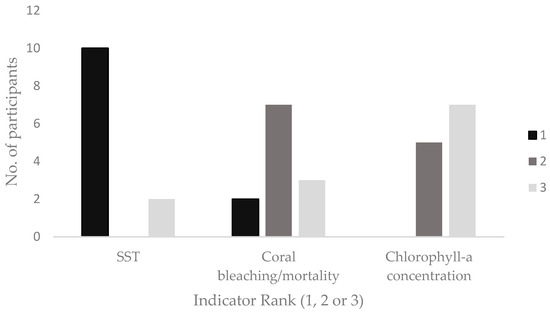
Figure 2.
Indicator ranks given to each of the three potential hazard indicators by survey participants with a rank of 1 represented by black bars, 2 represented by dark grey, and 3 represented by light grey.
The ANOVA test displayed that the differences between the rankings of each of the hazard indicators were significant (f2 = 10.81, p = 0.0002). The t-test results showed that there were significant differences between indicator rankings for each set of hazard indicators: SST vs. coral bleaching (t22 = −2.53, p = 0.009), SST vs. chlorophyll-a concentration (t22 = −4.64, p = <0.0001), and coral bleaching/mortality vs. chlorophyll-a concentration (t22 = −2.05, p = 0.03).
3.2.4. Vulnerability Indicator Ranking
The indicator most commonly ranked as 1st was terrestrial-based food and income generation (n = 5 participants allocated this rank) (Figure 3). Human malnutrition and fish nutritional value were the two indicators commonly ranked the lowest and thus seen as the least important vulnerability indicators (Figure 3).

Figure 3.
Indicator ranks given to each of the six potential vulnerability indicators by survey participants, with a rank of 1 represented by black bars, 2 represented by dark grey, 3 represented by light grey, 4 represented by brown, 5 represented by orange, and 6 represented by light orange/yellow. Indicator names are abbreviated TBFIG—terrestrial-based food and income generation, FS&T—fishing skills and technology, HM—human malnutrition, FNV—fish nutritional value, FFD/FF—fishery fish diversity/fishery flexibility, and PPCF—primary production of commercial fisheries.
In the ANOVA test results, significant differences were found between the rankings given to each of the potential vulnerability indicators (f5 = 5.85, p = 0.0001). Significant differences in indicator rankings were reflected in t-test results for most sets of potential vulnerability indicators. Significant differences were found in the rankings between the following indicators: terrestrial-based food and income generation and fishing skills and technology (t18 = −1.39, p = 0.09), terrestrial-based food and income generation and human malnutrition (t22 = −3.43, p = 0.001), terrestrial-based food and income generation and fish nutritional value (t22 = −1.92, p = 0.03), fishing skills and technology and human malnutrition (t22 = −2.81, p = 0.005), fishing skills and technology and fishery fish diversity/fishery flexibility (t22 = 2.38, p = 0.01), fishing skills and technology and primary production of commercial fisheries (t22 = 2.03, p = 0.03), human malnutrition and fishery fish diversity/fishery flexibility (t22 = 4.95, p = <0.0001), human malnutrition and primary production of commercial fisheries (t22 = 4.44, p = 0.0001), fish nutritional value and fishery fish diversity/fishery flexibility (t22 = 2.80, p = 0.005) and fish nutritional value and primary production of commercial fisheries (t22 = 2.51, p = 0.01).
3.2.5. Exposure Indicator Ranking
Seagrass population/C content was most commonly ranked as 1st (n = 6) and thus seen as most important among exposure indicators (Figure 4). All participants ranked crab stock health as 4th (Figure 4). Crab stock health was therefore seen as the least important exposure indicator.
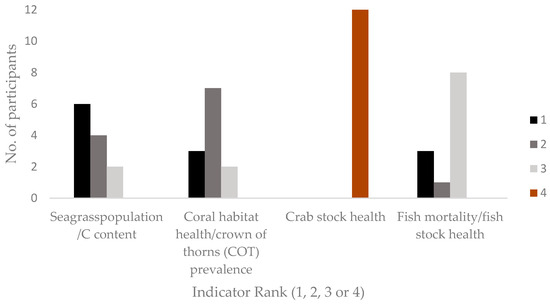
Figure 4.
Indicator ranks given to each of the four potential exposure indicators by survey participants with a rank of 1 represented by black bars, 2 represented by dark grey, 3 represented by light grey, and 4 represented by brown.
ANOVA results show significant differences between the rankings given to the exposure indicators (f3 = 28.26, p =< 0.0001). The t-test results show that a significant difference was found between the rankings for the following sets of exposure indicators: seagrass population/C content vs. crab stock health (t11 = −10.38, p = <0.0001), seagrass population/C content vs. fish mortality/fish stock health (t22 = −2.18, p = 0.02), coral habitat health/COT prevalence vs. crab stock health (t11 = −10.79, p = <0.0001), and crab stock health vs. fish mortality/fish stock health (t10 = 5.87, p = <0.0001). Please note, all test statistics are included as tables in the Supplementary Materials (S1–S9).
3.2.6. Other Potential Indicators for Consideration
Participants suggested additional indicators, potentially useful for inclusion in a hazard index. These included:
- Ocean acidification indicator.
- Tropical cyclone indicator.
- Heavy rainfall indicator.
- Rainfall (precipitation) indicator.
3.3. Confirmed Indicators and the Developed Weighting Scheme
All potential hazard and exposure indicators that were identified as useful by the literature review and determined to meet the data requirements of this research were confirmed by survey participants as appropriate indicators recommended for use in a future MHW risk assessment for Vanuatu fisheries. Human malnutrition and tish nutritional value were identified by the literature as useful vulnerability indicators and determined to have appropriate data but were recommended for exclusion by survey participants. Therefore, these indicators are not recommended for use in an MHW risk assessment for Vanuatu fisheries. All other potential vulnerability indicators were selected for use by survey participants.
Table 6 presents the confirmed list of indicators selected for use in an MHW risk assessment for Vanuatu fisheries and their assigned weight values, according to the literature investigation and participatory research survey results. SST was determined to be the most important hazard indicator; terrestrial (land)-based food and income generation was determined to be the most important vulnerability indicator; seagrass population/C content was determined to be the most important exposure indicator. Therefore, these indicators were assigned the greatest weights in their respective index (Table 6).
Table 6.
Confirmed MHW risk indicators recommended for use to compose the hazard, vulnerability, and exposure indices in an MHW risk assessment for Vanuatu fisheries, and their assigned weights. The final rank and weight presented in this table for each indicator were based on the survey results and the statistical test results presented in the Supplementary Materials (S1–S9).
4. Discussion
4.1. Selected Hazard, Vulnerability, and Exposure Indicators
4.1.1. Selected Hazard Indicators
SST is a commonly used MHW hazard indicator in MHW risk research throughout the world [40,42]. In the context of Vanuatu, space-based monitoring data is available for SST on an extensive spatial (1/4 deg grid) and temporal (1981–present) scale. In past disaster risk research [21,121,122], it has been demonstrated that space-based monitoring products are key to hazard monitoring, as space-based observations are increasingly accurate compared to ground-based observations [121]. SST is determined to be a hazard indicator with the potential to indicate specific hazard impacts to the fisheries sector in Vanuatu. A consistent link has been found between SST and the ranges and abundances of key fish species [42]. As expected, survey participants confirmed SST as a useful hazard indicator and recommended it be included in an MHW risk assessment for Vanuatu fisheries.
Coral bleaching/mortality is similarly noted in the literature as a valid hazard indicator for MHWs [6,56,70]. Particularly, coral bleaching/mortality is described as an ecologically important indicator of MHW hazard impacts. In Vanuatu, coral is a foundation species critical to the function of marine ecosystems; its abundance is vital to the resilience of marine ecosystems in response to MHW events [123]. The Vanuatu fisheries sector is heavily dependent on the services provided by marine ecosystems to operate. Therefore, a coral bleaching/mortality indicator would critically inform on MHW risk to fisheries [12]. The importance of this indicator was confirmed by survey participants, and it is recommended for use in a future MHW risk assessment for Vanuatu fisheries.
Many global studies have suggested the usefulness of chlorophyll-a concentrations as a MHW hazard indicator [7,124]; however, no previous studies conducted within Pacific SIDSs, assessing MHW risk, have utilised it. In the literature, chlorophyll-a concentration is strongly linked to MHW impacts on marine ecosystems and the fisheries sector [124]. Additionally, there is extensive space-based observational data available for this indicator [7]. Despite the lack of research on the use of chlorophyll-a concentration as an indicator of MHW hazard in Pacific SIDSs, its association to MHW impacts in other regions and its wide data availability led to its inclusion for analysis in the participatory research survey. The usefulness of this indicator in assessing MHW risk to marine ecosystems and fisheries in Vanuatu was confirmed by all participants in the research surveys. Therefore, it is recommended for inclusion in a future fisheries-specific MHW risk assessment in Vanuatu.
4.1.2. Selected Vulnerability Indicators
Terrestrial (land)-based food and income generation was selected as a vulnerability indicator, with the literature suggesting its usefulness [4] and survey participants unanimously confirming its applicability for this study. This indicator can provide insight into the pressure that may be applied to fisheries in Vanuatu if an MHW was to occur. Vanuatu communities rely heavily on fisheries as a key source of nutrition and income [125]. The other major industry supporting the needs of Vanuatu communities is land-based agriculture [126]. If an MHW occurs in Vanuatu, communities will be increasingly threatened if terrestrial (land)-based food and income generation cannot support local need and compensate for potential reduction in fisheries production.
The primary production of commercial fisheries is described as critical by literature sources [90] and is seen as an important indicator for MHW vulnerability by survey participants. MHWs are known to directly impact fish species that are key to commercial fishery production around the world [15,90]. The production of fisheries in Vanuatu is no exception. The production of commercial fisheries in Vanuatu has been found to be unstable during disaster events in the past [123]. For example, the Vanuatu fisheries sector underwent significant damage resulting in limited production, costing approximately VUV 268 million, following TC Pam in 2015 [8].
Although not extensively explored as an MHW indicator, fishing skills and technology was noted by the literature sources as useful and confirmed as an important MHW vulnerability indicator by survey participants. This is not unexpected, as recent investigations into disaster risk for fisheries in Pacific SIDSs have noted critical links between the level of fishing skills and technology in a community and the extremity of disaster impacts on fisheries [4,84]. During TC Pam, impacts on fisheries throughout Vanuatu were heightened if there was a reduced range of fishing skills and if rudimentary technology was used [97]. Furthermore, lack of fishing skills and technology across Vanuatu communities reduced the capacity for marine resources to support recovery after the TC event [4].
Another key factor strongly linked to the disaster risk of fishing communities in Vanuatu is the diversity of fish used in fisheries/the overall flexibility of fisheries [12,84]. It was consistently noted throughout the literature review that reduced diversity and flexibility of fisheries commonly results in increased vulnerability of fishing communities to MHW impacts [12,41,84]. This may be due to the direct relationship between fishery diversity and flexibility and the adaptive capacity of fishing communities. At the small-scale fishery and community level, adaptive responses generally only occur in situations where diversity and flexibility are present [84]. Furthermore, the ecological resilience of marine ecosystems commonly relies on fish diversity, as it increases the range of response to damages and magnifies the chances of species compensating for one another to sustain overall ecosystem function [127]. Survey results confirmed the literature findings, with all participants noting that fishery fish diversity/fishery flexibility would be a useful MHW vulnerability indicator for Vanuatu.
4.1.3. Selected Exposure Indicators
Seagrass population/C content in seagrass was recognised in the literature as a valuable MHW exposure indicator [40,97]; this was confirmed by all survey participants. Seagrass populations vitally support marine ecosystems around Vanuatu by providing food and shelter for other important species, like marine turtles and dugongs, as well as by providing a key ecosystem service—carbon sequestration [97]. Seagrass population can be damaged during MHW events. This poses a significant risk to the health of the overall marine ecosystem upon which the fishing industry relies [40,128]. As a result, it is likely that seagrass population/C content in seagrass can give vital insight into the severity of impacts when MHWs occur and indicate the exposure level of fisheries.
Coral habitat health/COT prevalence is another factor likely vital for indicating the exposure of Vanuatu fisheries to MHW impacts. This is suggested by both the literature review and survey results. Differing from coral bleaching/mortality, which is seen as a MHW hazard indicator, coral habitat health/COT prevalence indicates the overall health of coral systems, rather than indicating solely on coral bleaching and death. The health of coral systems prior to the occurrence of an MHW event can influence the severity level of impacts that might be experienced by marine ecosystems and fisheries. The health of coral systems also plays a pivotal role in marine ecosystem recovery following an MHW event [4]. Like seagrass meadows, coral reefs support diversity in the marine species that provide critical resources for local communities and the fisheries sector in Vanuatu [129]. Bell et al. [37] highlight that extreme ocean warming events are highly likely to be destructive to coral reef habitats which underpin small-scale, coastal fisheries in the Pacific.
Fish mortality/fish stock health is recognised by literature sources as a potentially useful MHW exposure indicator [6,40,42]; survey participants also highlighted its value. Healthy fish stocks are critical to the society and economy of Vanuatu [130]. The threat of MHW impacts on important fish species across Vanuatu (e.g., tuna) is therefore of high concern [37]. Increased SSTs associated with MHW events can adversely impact life stage duration, growth rates, and energetic demand rates of fish [41]. As a result, the distribution of key fish species can be significantly altered [40]. This can cause serious reductions in fish stocks and the overall catch potential of fisheries throughout Vanuatu [6,42].
Crab stock health vitally supports the livelihoods in local Vanuatu fishing communities. Specifically, coconut crabs (Birgus latro) are noted as key to the livelihoods of Vanuatu fisher people [131]. In Vanuatu, coconut crab populations are mainly located in the Banks/Torres islands, Santo/Malo, and Maewo islands in the north, and in Erromango Island in the south [129]. In these areas, coconut crabs form a critical source of local income [131]. Extreme events like MHWs have been known to impact coconut crab populations and decrease crab stocks [99,132]. Increased SSTs associated with MHW events can impact the development, size, and distribution of coconut crabs [118]. The importance of crab stock health as an MHW indicator was recognised by survey participants, with all participants selecting it as a useful MHW exposure indicator for Vanuatu fisheries.
4.1.4. Other Suggested Indicators
Other potential indicators for use in assessing MHW risk to Vanuatu fisheries, suggested by survey participants, were deemed to be not as relevant a as the ones suggested by the literature review and confirmed in the survey. A TC indicator would not be highly relevant to this research, as it would primarily inform on another hazard, rather than MHWs. Although TCs and MHWs are known to be linked in occurrence, and have similar impacts on Pacific SIDSs, an indicator of TCs would not directly and accurately inform on MHW risk to Vanuatu fisheries [133].
Rainfall indicators were also suggested as potentially useful for MHW risk assessment. MHWs can influence rainfall patterns, through changing SSTs and wind patterns [68]. However, rainfall can also be influenced by many other climatic drivers and hazard events; thus, it would be an indirect indicator for MHW risk. It is deemed that more direct indicators of MHW risk for fisheries in Vanuatu are more relevant and recommended for use over indirect indicators.
Ocean acidification is its own phenomena, distinct from MHWs, which impacts marine ecosystems. It is caused by different processes, although it may have compounding impacts (e.g., coral reefs may be more vulnerable to one if already deteriorated by the other) [69]. Thus, ocean acidification is not an appropriate indicator for MHW risk.
4.2. Proposed Index Composition and Weighting
Informed by participant rankings, the proposed hazard index has SST weighted the most (0.50), coral bleaching/mortality weighted second (0.30), and chlorophyll-a concentration the least (0.20). SST has been historically recognised as a core factor to MHW occurrence [134] and has been consistently used as a factor to define MHWs in past studies [6,12]. Thus, it is expected that it be highly regarded as an MHW hazard indicator. Although coral bleaching/mortality and chlorophyll-a have been linked to the occurrence of MHWs by numerous previous studies [80,135,136,137,138,139], some argument remains around their direct link to MHW hazard conditions. Correlations have been identified between the occurrence of MHW events and coral bleaching [137], but direct causation has not been explicitly proven [136]. Coral bleaching can occur from thermal stress not necessarily associated with an MHW event [135]. Similarly, changes in chlorophyll-a concentrations have been found to be associated with MHWs [80,138], but the occurrence of an MHW event does not always affect chlorophyll-a concentrations [7,139].
For the vulnerability index, terrestrial (land)-based food and income generation was weighted the most, with fishery fish diversity/fishery flexibility and primary production of commercial fisheries weighted slightly less, and fishing skills and technology weighted the least. In terms of MHW risk to fishing communities, terrestrial (land)-based food and income generation is likely the most important indicator of overall community vulnerability in Vanuatu. Besides fisheries food and income generation, terrestrial (land)-based food and income generation is the major method by which communities can maintain food security and local livelihoods [126]. If the fisheries sector is negatively impacted, communities may become completely reliant on terrestrial (land)-based food and income generation; it must be stable to ensure community resilience. The three other vulnerability indicators are directly linked to the vulnerability of the fisheries sector. Fishery fish diversity/fishery fish flexibility is commonly noted in past studies as vital for the resilience of fisheries [84]. It is consistently noted that primary production of commercial fisheries needs to be high enough to cope during and after an MHW event. Fishing skills and technology has only been noted by some studies examining MHW vulnerability [10,40]. As it has not been widely explored in the context of MHW vulnerability, it is logical to assign the lowest weight to this indicator.
In the exposure index, seagrass population/C content was weighted the highest based on survey results. Coral habitat health/COT prevalence and fish mortality/fish stock health were similarly weighted as second- and third-highest, respectively. Crab stock health was deemed less important by survey participants and was therefore weighted the least. It is reasonable to weight fish mortality/fish stock health and crab stock health as third and fourth; although fish and crab species are important to Vanuatu fisheries, the fishing industry does not solely rely on them. The Vanuatu fishing industry is highly diverse, utilising a range of species (mollusc species, lobsters, sea cucumbers, turtles, etc.) throughout the country [11].
It is unexpected that seagrass population/C content was weighted more than coral habitat health/COT prevalence. Coral reef habitat dominates the coastline of Vanuatu; there is over 1200 km2 of coral reef along the Vanuatu coast [140]. Coral reef habitat importantly supports the socio-economic services of Vanuatu communities and underpins the fisheries sector [141]. Thus, coral reef habitat has been noted as essential to the resilience of Vanuatu communities [141]. Seagrass meadows are also prevalent around Vanuatu, supporting many vital species and critical ecosystem services [140]. However, the total area covered by seagrass meadows around Vanuatu is currently unknown. Due to the domination of coral habitat around Vanuatu, it was expected that coral habitat health/COT prevalence would be weighted the highest out of all MHW exposure indicators. A possible reason for seagrass population/C content in seagrass being ranked higher than coral habitat health/COT prevalence is its significance for dugong species [142]. Seagrass meadows provide crucial habitat for dugongs. Dugongs maintain coastal ecosystems, are culturally significant in Vanuatu, and are utilised by fisheries across Western Tropical Pacific SIDSs [142]. Dugongs are globally vulnerable (International Union for Conservation of Nature (IUCN) red list). Without healthy seagrass populations, dugongs would likely become extinct, detrimentally altering marine ecosystems.
4.3. Review of Methodology
4.3.1. Indicator Selection
The tailored selection of risk indicators is generally observed through assessing indicator appropriateness to the particular characteristics of a study area, and the ability of indicators to consider user needs. In disaster risk assessment methodology, indicator appropriateness is commonly decided by expert or local opinion and academic views [143]. This is achieved by the use of two main methods: indicator selection through literature review or participatory research [144]. The first method has been frequently used in past disaster risk assessments [143,145,146]. Although this method can aid in the tailored selection of indicators specific to the geographic, socioeconomic, and climactic features of a study area, it does not specifically address user needs [143]. This is where participatory research is beneficial; user needs can be considered when the indicator selection process incorporates the surveying and/or interviewing of users [2]. In this study, both methods were combined to select MHW risk indicators appropriate for Vanuatu’s climatic, geographic, and socio-economic features, as well as for user needs (specifically for locals involved in fisheries) [28,29].
A total of 86 sources were investigated in the literature review. Ideally, a larger body of literature would be examined. However, as MHW risk assessment in Pacific SIDSs is a relatively new research avenue, there is not a wide range of literature that fit the source criteria. The literature review outlined many MHW risk indicators used/described in global studies that mention and/or assess MHWs. Out of these indicators, some were limited in their data availability, and, as a result, were excluded as potential indicators to be assessed in the participatory research survey.
Furthermore, the selected indicators recommended for use in a future MHW risk assessment had the best possible data availability, but in some cases, data was still not available on the most ideal spatial and temporal scales. Ideally, data would be available on a localised scale (e.g., area councils rather than provinces) and would be updated daily or monthly rather than yearly. However, this is currently not possible, particularly for most socio-economic indicators in Pacific SIDSs. For some selected indicators, like terrestrial-based food and income generation, consistent data records with wide time spans are not available. Historical baselines used in a future MHW risk assessment would be slightly limited due to reduced time spans in indicator data records. Additionally, not all indicator data is updated on regular temporal scales. These temporal inconsistencies are a potential limitation for dynamic risk assessment. Risk assessments that are not optimally dynamic can have reduced usability. Ideally, MHW risk would be assessed on regular, monthly time scales to highlight changing risk levels and proactively inform disaster risk management. If monthly data was not available for all indicators, monthly MHW risk assessment and reporting may not be as informative as it could be. This assessment is intended to be as dynamic as possible within the bounds of the study context. Limited data availability remains a consistent obstacle to disaster risk assessment throughout Pacific SIDSs [21,147]. Future research could focus on increasing overcoming this obstacle through the use of alternative data sources and/or data interpolation.
A potential opportunity has arisen from this limitation. This research provides an opportunity to establish an MHW risk assessment database for all selected indicators, to be consistently updated in the future when conducting risk assessment. If the MHW risk assessment was to inform critical decision-makers throughout Vanuatu, there would be motivation for resources to be dedicated to the creation and maintenance of such a database. A fisheries-specific MHW risk indicator database would not only improve risk data and knowledge for Vanuatu fisheries but could aid other related research and broader disaster risk research for Western Tropical Pacific SIDSs.
4.3.2. Indicator Weighting
Indicator weighting through literature review and expert/end-user/decision-maker opinion is an indicator weighting methodology commonly used in disaster risk assessment studies [144]. The indicator weighting method used in this study was locally informed rank-based weighting [148]. Wang et al. [33] describe this method of locally informed rank-based weighting as a semi-quantitative approach that is widely used. The benefits of this method include simplicity, accounting for data scarcity, and effectiveness on regional scales. A potential downfall is that weights will be subjective. This downfall does not likely impact the study results; local judgement tends to be based on years of experience and knowledge which can be greatly informative [149].
The particular methodological process applied in this research is adapted from Asare-Kyei et al. [28], who used a participatory approach to confirm the selection of risk indicators and rank each selected indicator. Asare-Kyei et al. [28] consulted relevant stakeholders who had experienced impacts from natural hazard events to produce a thorough compilation of risk indicators and appropriate indicator weights [28]. Our study similarly sought to compile a comprehensive list of tailored hazard, vulnerability, and exposure indicators and suitable indicator weights; it is reasonable that we adapt the methodology of Asare-Kyei et al. [28] for use in this research.
However, the weighting scheme developed in this study may be limited, as it was solely informed by the participatory research survey which had a small sample size and potential biases. A total of 12 participants completed the research survey, which contributed to the development of indicator weights. There was difficulty in attaining additional survey results due to survey fatigue and geographic isolation among the potential participant groups. These factors also prevented the potential facilitation of participant interviews to expand the dataset. The smaller sample size may limit the ability for results to be generalisable and heightens uncertainty in the reliability of results. The limited sample size could limit the accuracy of calculated indicator weights. However, consistent responses were seen for indicator ranks across participants, with the majority opinion able to be identified for most indicator ranks, regardless of in which stakeholder group and in which area of Vanuatu they were located. The only inconsistency where majority opinion could not clearly be identified was seen in the rankings of fishery fish diversity/fishery flexibility. This indicator had an equal number of participants ranking it as 2nd and 4th. Most other participants who did not rank it as 2nd or 4th, ranked it as 1st. Therefore, when determining if 2nd or 4th was a more representative rank of fishery fish diversity/fishery flexibility importance, the higher rank of 2nd was seen as more accurate the and it was given a final rank of 2 out of the 4 selected vulnerability indicators.
Other stakeholders who did not participate in the survey could provide opposing perspectives and different rank results, therefore shifting the weight calculations. If the weight calculations do not accurately reflect the importance of each indicator to Vanuatu fisheries, the future calculation of hazard, vulnerability, and exposure indices could be less reliable, and the subsequent risk index could be less informative. To address this limitation, it is recommended that a sensitivity analysis be performed once the subsequent fisheries-specific MHW risk assessment is conducted. Sensitivity analysis is a consistently recognised validation method and provides insight into the likely accuracy of indicator selection and weighting [38]. Future work should also use data triangulation through participant observation and in-depth interviews to further validate the indicator weighting results. The nature of this study is exploratory, introducing an initial novel approach to an under-researched topic; thus, the weighting results are likely still useful (at the very least as a foundation for future weighting scheme development). Smaller sample sizes can still provide critical insight into the specific perspectives and experiences of local Vanuatu communities [2].
Additionally, all survey participants were sourced through the network of the VFD, introducing the potential for selection bias. Collaboration with the VFD allowed for access to a range of stakeholders and provided a pathway to build trust with local communities regarding this research. However, the participatory recruitment process could have excluded valuable participants like informal fisher people and isolated community members from rural coastal communities. Furthermore, the geographic representation of the survey sample was not as expansive as it could be. Ideally, the sample would include participants from all provinces of Vanuatu. In this research, Torba and Sanma provinces were unrepresented, with most participants located in the central and southern provinces of Vanuatu. This could influence the weighting results, as participants may have ranked the different indicators based on their own experiences during the occurrence of MHW impacts. For example, if a participant had personally observed fish kills but not the presence of COT, the participant may rank fish mortality as a more important indicator of MHW exposure. Previous MHW impacts experienced in Torba and Sanma communities could have differed from those experienced throughout the rest of the country; thus, local fisher people and stakeholders from those provinces may have ranked the MHW risk indicators differently. The applicability of the weighting scheme may therefore be affected by the lack of representation for Torba and Sanma in the survey results.
Although the specific nuances of all provinces may not have been considered for the weight calculations, the importance of key MHW risk factors on the national scale are likely captured by the representation of four out of six Vanuatu provinces. In the past, major ecological and human MHW impacts for the fisheries sector in Vanuatu have commonly been experienced/observed by several provinces at a time. Torba and Sanma have been known to experience similar impacts to provinces like Malampa and Penama during previous MHW events. For example, a 2016 MHW event in Vanuatu manifested around Torba, Sanma, Penama, and Malampa, causing similar impacts [3]. Fish kills and coral bleaching/mortality were observed throughout Torba, Sanma, Penama, and Malampa, having cascading effects on the fisheries sector. Shefa and Tafea provinces also experienced fish kills attributed to elevated SSTs during the 2016 MHW event [6]. Marine species range shifts were also observed throughout these provinces, affecting ecosystem composition and trophic interactions. Associated impacts on fisheries included lower catch rates and decreased quality of catch [150]. Despite the sample size being relatively small and the potential biases, no similar data has been collected in the context and focus of this study; therefore, results can still be considered as meaningful [32]. To improve the robustness of this research, the survey dataset should be expanded with participants from Torba and Sanma provinces. Additional participants beyond the current network of the VFD could be sourced via outreach with individual communities and fisheries stakeholders (e.g., Non-Governmental Organisations (NGOs)). In-depth interviews and participatory validation workshops could also be used to enhance the validity of results.
4.4. Research Significance
This study included the development of a tailored indicator selection and weighting methodology. This is the first step in developing and conducting an effective MHW risk assessment for Vanuatu fisheries. Such research is scarce across Western Tropical Pacific SIDSs, with MHW risk assessment remaining a relatively novel research focus [12]. Significant effort was made to address the key knowledge gaps widely omitted from MHW risk assessment studies globally, as well as in Vanuatu specifically [12]. In many past studies, the following aspects of effective risk assessment are commonly lacking: dynamically including hazard, vulnerability, and exposure indices; tailoring the selection and weightings of indicators; and holistically incorporating both ecological and human indicators into risk indices [32].
This study addressed these knowledge gaps. The proposed risk index dynamically includes three hazard indicators, four vulnerability indicators, and four exposure indicators. It is believed that the use of a relatively minimal number of indicators is beneficial in this research context. This study intends to be highly specific rather than general. When a large number of indicators have been utilised in past disaster risk assessment studies, the approach tends to be generalised rather than tailored [151]. Although a reduced number of indicators is used in this study to increase the specificity of the risk index, it is believed that the overall index is comprehensive and sufficiently encompasses all relevant aspects of hazard, vulnerability, and exposure. Not only was the composition of the risk index intended to be highly tailored to the context of MHW risk to Vanuatu fisheries, but the proposed indicator weights were informed by local users to ensure specificity to local Vanuatu communities [29].
A diverse range of vulnerability and exposure indicators have been used in global MHW risk assessment studies, with most assessments having a human-based focus or an ecological focus [34,56]. This research considers both human-based and ecological vulnerability and exposure. To incorporate human-based risk, terrestrial (land)-based food and income generation, fishing skills and technology, fishery fish diversity/fishery flexibility and primary production of commercial fisheries were included as vulnerability indicators. To contemplate ecological risk, seagrass population/C content, coral habitat health/COT prevalence, crab stock health and fish mortality/fish stock health were selected as exposure indicators.
Furthermore, few studies have particularly focused on MHW risk to fisheries in Western Tropical Pacific SIDSs [12]. It is important to develop specific risk indices for each of the key sectors in a vulnerable area. In doing so, index results can be increasingly informative and aid key sectoral decision-makers to prepare for and respond to an MHW event [42]. In Vanuatu, fisheries are a key sector, along with agriculture and tourism. MHW impacts on fisheries have already been noted across the world, but they remain underexplored in Pacific SIDSs like Vanuatu [6]. Both coastal fisheries (e.g., near-shore artisanal fisheries) and offshore fisheries (e.g., deep-sea fisheries) were considered, to ensure a holistic understanding of MHW risk to the fisheries sector in Vanuatu. However, to increase the ability of a potential MHW risk assessment to accurately indicate risk for Vanuatu fisheries and be informative to risk management decision-makers, an assessment specific to each type of fishery could be conducted in the future. Our study provides an initial investigation into MHW risk for Vanuatu fisheries, expanding upon current MHW risk knowledge for fisheries in Vanuatu and building a foundation for future studies to further increase this knowledge [6].
4.5. An Efficient Marine Heatwave Risk Assessment Methodological Framework
This MHW risk assessment methodological framework developed in this research and built upon by Aitkenhead et al. [38] is intended to feed into existing management frameworks in Vanuatu. As the MHW risk assessment methodology—specifically the first step, as outlined in this study—focuses on proactivity and suitability and is informed by end-users/decision-makers, it has the potential to have increased usability for informing stakeholders’ action and achieving resilience.
The Australian Fisheries Management Authority Climate Risk Framework outlines the need for fisheries risk assessment to guide fisheries management decisions. The framework considers risk to key fishery species, identifies whether there is sufficient precaution in existing management, determines residual risk, and provides advice on climate risk response measures [152]. Although the framework is similarly intended to expand risk knowledge and inform management action, it focuses on risk assessment specifically for key fishery species rather than holistic risk to the overall fisheries sector and fishing communities. To increase resilience across the fisheries sector in Vanuatu, a more holistic approach is used in this research.
Vanuatu fisheries management frameworks focus on community-based fisheries management with the strategic approach guided by National Fisheries Act (2014), a National Fisheries Sector Policy (2016), and a National Coastal Fisheries Roadmap (2019). The National Coastal Fisheries Roadmap includes the regular monitoring and evaluation of the state of coastal fisheries and commits to supporting research activities to expand ecological knowledge, guide management plan development, and improve data collection [120]. The efficient MHW risk assessment methodology developed for Vanuatu fisheries would align with the approach of the roadmap by assessing fisheries risk, expanding ecological risk knowledge, and guiding MHW risk management strategies (e.g., identifying priority areas). However, the roadmap specifically considers coastal fisheries. Alternatively, the efficient MHW risk assessment methodology developed in this research considers all major fishery types in Vanuatu to gain a holistic view of risk to the fisheries sector.
The development and completion of an MHW risk assessment for Fisheries in Vanuatu has the potential to be a useful case study that could be adapted for use in other contexts. Vanuatu’s Climate Change and Disaster Risk Reduction Policy 2022–2030 explains that there is a need to develop standardised methodologies and guidelines for multi-hazard risk assessment at the local, provincial, and national scales [22]. The methodological framework used in this study could be applied to assessing risk to MHWs and other hazards in other Western Tropical Pacific SIDSs requiring increased risk preparedness and adaptive capacity, as well as other key hazards and important sectors in Vanuatu. This study can provide a guiding process in which to conduct the indicator selection and weighting steps of a disaster risk assessment; however, the specific methodology and risk index composition would be context-specific.
This framework could be adapted to the context of MHW risk to fisheries in Fiji. As such, indicator selection would be based on a literature analysis and participatory research methods (e.g., surveys and/or interviews). Indicator selection would be tailored to the specific context of fisheries in Fiji, and only indicators with available data at a high spatial and temporal resolution in Fiji would be selected. Hazard, vulnerability, and exposure indicators would be selected, reflecting risk to Fiji’s fisheries. A rank-based weighting scheme informed by participatory research would be conducted to provide appropriate indicator weights. As Fiji and Vanuatu have similar climatic, social, and ecological characteristics, it is likely that the composition of the MHW risk index would be like that developed here for Vanuatu; however, specific differences may arise [6]. For example, sea cucumber (Holothuria) stock health is likely a better indicator for MHW exposure in Fiji compared to coconut crab stock health which was used for Vanuatu. Currently, coconut crab fisheries are prohibited in Fiji. Alternatively, sea cucumbers are a key fisheries resource in Fiji for both subsistence (sea cucumbers are consumed locally in Fiji) and commercial fisheries [153]. MHWs can negatively impact sea cucumber metabolism and health, causing population declines.
The framework also has the potential to be adapted further to the context of other hazards and other sectors in Vanuatu. For example, the methodological process could be followed to compose a drought risk index specific to the critical land-based agriculture sector in Vanuatu [126]. The indicator selection and weighting processes would follow the steps and considerations outlined in this study (e.g., literature analysis, participatory research, ensuring that indicators are tailored, and availability of appropriate data) to provide hazard, vulnerability, and exposure indicators specific to assessing drought risk to Vanuatu’s land-based agriculture. Instead of hazard indicators like SST for MHWs, indicators like the Standard Precipitation Index (SPI) could be selected to assess drought hazard.
4.6. Policy and Management Implications
Efficient MHW risk assessment for Vanuatu fisheries could increase MHW risk knowledge and inform local action plans. For example, risk assessment maps and results could be incorporated into a network like the Santo Sunset Environment Network (SSEN). The SSEN employs a locally driven, diverse approach to climate adaptation in Espiritu Santo (Sanma province). The SSEN supports community-based action including ecosystem restoration and increasing disaster preparedness. The SSEN focuses on adaptation to other climate risks (e.g., TCs and sea level rise), but the concept could be adapted with similar action taken for MHWs, especially if local fishing communities were informed of their MHW risk.
Furthermore, the fisheries-specific MHW risk assessment which this research informs (as conducted in Aitkenhead et al. [38]) could be used to support policy-making and prioritise fisheries risk management strategies in Vanuatu. The United Nations Framework Convention on Climate Change (UNFCCC) and the Sendai Framework for Disaster Risk Reduction (SFDRR) outline the importance of evidence-based risk assessment to guide policy. In the specific context of Vanuatu, expanding MHW risk knowledge for fisheries through efficient risk assessment would align with strategic actions outlined in the Vanuatu National Fisheries Sector Policy 2016–2031. Such actions include assessing climate change impacts, implementing mitigation and adaptation activities in readiness for disasters, and promoting community-based management and climate change adaptation.
MHWs pose a threat on the global scale, requiring increasingly effective management and response plans. Early warning systems (EWSs) are recognised across international policy as critical for future disaster risk reduction and climate adaptation [154]. Risk information is a critical component of EWSs. Expanding MHW risk information through effective risk assessment is therefore vital to early warning for MHWs in the future. The methodological framework for effective risk assessment explored in this study and built upon by Aitkenhead et al. [38] could be valuable in the development and implementation of future EWSs throughout Western Tropical Pacific SIDSs.
5. Conclusions
This study aimed to begin the process of tailored MHW risk assessment for Vanuatu fisheries and display how a tailored indicator selection and weighting process can inform more effective MHW risk assessment for fisheries in Western Tropical Pacific SIDSs. Western Tropical Pacific SIDSs like Vanuatu have been identified as some of the most vulnerable regions in the world to climate change impacts, including increased prevalence of MHW events. MHW risk, in general, remains underexplored across Western Tropical Pacific SIDSs, as well as the specific risk that MHWs pose to key sectors like fisheries. This study implemented the most efficient methodological processes available to complete two crucial first steps in an effective MHW risk assessment methodology focused on fisheries in Vanuatu: indicator selection and weighting. There are few limitations of this study, but these should be addressed in future research. For example, an increased number of Vanuatu locals should be consulted to further inform indicator selection results.
This study produced a user-centered list of tailored hazard, vulnerability, and exposure indicators, along with their specific weights. To build on this research, an MHW risk assessment for Vanuatu fisheries should be conducted, utilising the selected indicators and developed weighting scheme. Critical next steps include data collection; hazard, vulnerability, exposure, and overall risk index calculation; index mapping; and validation. A tailored MHW risk assessment for fisheries in Vanuatu has the potential to aid local decision-makers in identifying priority areas and guide the development of more efficient risk management strategies to improve resilience in local communities and the fisheries sector overall.
Supplementary Materials
The following supporting information can be downloaded at: https://www.mdpi.com/article/10.3390/cli13110225/s1, S1: Statistics table from an ANOVA performed for Survey Question 4 results, S2: Statistics table from F-tests performed for Survey Question 4 results, S3: Statistics table from t-tests performed for Survey Question 4 results, S4: Statistics table from an ANOVA performed for Survey Question 5 results, S5: Statistics table from F-tests performed for Survey Question 5 results, S6: Statistics table from t-tests performed for Survey Question 5 results, S7: Statistics table from an ANOVA performed for Survey Question 6 results, S8: Statistics table from F-tests performed for Survey Question 6 results, and S9: Statistics table from t-tests performed for Survey Question 6 results.
Author Contributions
Conceptualisation, I.A. and Y.K.; methodology, I.A.; validation, I.A.; formal analysis, I.A.; investigation, I.A.; writing—original draft preparation, I.A.; writing—review and editing, I.A., Y.K., S.C. and Q.S.; supervision, Y.K., S.C. and Q.S. All authors have read and agreed to the published version of the manuscript.
Funding
This research was supported by the Secretariat of the Pacific Regional Environment Programme (SPREP) through the Green Climate Fund (GCF) funded project FP035 titled “Climate Information Services for Resilient Development Planning in Vanuatu (Van-CIS-RDP)”.
Data Availability Statement
The data presented in this study are available on request from the corresponding author.
Acknowledgments
The authors express sincere gratitude to the Vanuatu Meteorological and Geohazards Department for their valuable input to this research.
Conflicts of Interest
The authors declare no conflicts of interest.
List of Abbreviations
| Abbreviation | Meaning |
| ANOVA | Analysis of Variance |
| CEFAS | Centre for Environment, Fisheries, and Aquaculture Science |
| COSPPac | Climate and Oceans Support Program in the Pacific |
| COT | Crown of thorns |
| CRISP | Protection and Management of Coral Reefs in the Pacific |
| CRW | Coral Reef Watch |
| CSIRO | Commonwealth Scientific and Industrial Research Organisation |
| DHW | Degree Heating Week |
| EbA | Ecosystem-Based adaptation |
| ENSO | El Niño Southern Oscillation |
| EVI | Environmental Vulnerability Index |
| EWS | Early Warning System |
| FAO | Food and Agriculture Organisation |
| GIS | Geographic Information System |
| HIA | Health Impact Assessment |
| HIES | Household Income and Expenditure Surveys |
| HREC | Human Research Ethics Committee |
| IPCC | Intergovernmental Panel on Climate Change |
| IPO | Interdecadal Pacific Oscillation |
| IUCN | International Union for Conservation of Nature |
| MHCI | Marine Heatwave Cumulative Intensity |
| MHW | Marine Heatwave |
| MPA | Marine Protected Area |
| NASA MODIS | National Aeronautics and Space Administration Moderate-Resolution Imaging Spectroradiometer |
| NGO | Non-Governmental Organisation |
| NOAA | National Oceanic and Atmospheric Administration |
| NPGO | North Pacific Gyre Oscillation |
| PDO | Pacific Decadal Oscillation |
| SFDRR | Sendai Framework for Disaster Risk Reduction |
| SIDS | Small Island Developing State |
| SOPAC | South Pacific Applied Geoscience Commission |
| SPI | Standard Precipitation Index |
| SPREP | Secretariat of the Pacific Regional Environment Programme |
| SSEN | Santo Sunset Environment Network |
| SST | Sea surface temperature |
| TC | Tropical Cyclone |
| UNFCCC | United Nations Framework Convention on Climate Change |
| VFD | Vanuatu Fisheries Department |
| VMGD | Vanuatu Meteorology and Geohazards Department |
Appendix A. A Copy of the Survey Distributed to Vanuatu Locals for This Study
Survey for ”Selecting indicators to assess the risk of negative impacts from Marine Heatwaves on fisheries in Vanuatu”
This research is conducted by Isabella Aitkenhead (with Royal Melbourne Institute of Technology (RMIT) and the Australian Bureau of Meteorology)—isabella.aitkenhead@bom.gov.au
Survey Background Knowledge
Please read the following information before completing the survey questions
Definitions of key terms
- Marine Heatwave Risk Assessment: Marine heatwave risk assessments analyse the risk of marine heat waves causing negative effects in a particular area.
- Marine Heatwave Risk: Marine heatwave risk is the probability of harmful consequences, or expected losses resulting from interactions between three elements: hazard, exposure, and vulnerability.
- Hazard Index: Measures the possible future occurrence of marine heatwave events. The hazard index includes different indicators of such hazard information.
- Vulnerability Index: Measures the likelihood of exposed factors within an area to suffer negative impacts when marine heatwaves occur. The vulnerability index is made up of different indicators of such vulnerability information.
- Exposure Index: Measures exposed aspects of the total population, its livelihoods, and assets in an area in which marine heatwaves may occur. The exposure index is calculated from different indicators of such exposure information.
List of potential indicators considered for this survey
| Index | Potential Indicators | Indicator Description |
| Hazard | Sea Surface Temperature (SST) anomalies | Sea surface temperature (SST) has been used in most studies investigating marine heatwaves as a hazard indicator. High SSTs continue to be associated with the occurrence of marine heatwave events. |
| Coral bleaching/mortality | Coral bleaching/mortality is a marine heatwave hazard indicator for the warmest months of the year, as it can indicate the occurrence of a marine heatwave event. When sea surface temperature increases, a marine heat wave can develop, and coral bleaching/mortality commonly occurs. | |
| Chlorophyll-a concentrations | Past studies have revealed an association between marine heatwave occurrence and changes in chlorophyll-a concentrations, so chlorophyll-a concentration has been used in many studies as an indicator of marine heatwave hazard. Chlorophyll-a concentration indicates the amount of phytoplankton in the ocean. It is the main pigment used by phytoplankton to capture light energy and convert that energy into biomass. Marine heat wave events have tended to coincide with reduced chlorophyll-a concentration at low and mid-latitudes. | |
| Vulnerability | Terrestrial (land)-based food and income generation | This is a marine heatwave vulnerability indicator. The fisheries industry provides staple food and sources of livelihood in Pacific Island countries; if a marine heatwave occurs and the fisheries industry is negatively impacted, communities must have a land-based source of food and income to survive. If land-based food income and generation is limited, a community is likely more vulnerable to experiencing negative impacts from marine heatwaves. |
| Fishing skills and technology | This is a marine heatwave vulnerability indicator. Fisheries is a critical industry to Pacific Island communities, so fisheries sustainability is a priority for disaster risk management. Increasing the fishing skills and technologies within Pacific Island communities is key for reducing vulnerability and increasing the capacity of communities to deal with the impacts of marine heatwaves. | |
| Human malnutrition | This is a marine heatwave vulnerability indicator. Pacific countries like Vanuatu are at high risk of malnutrition from food insecurity caused by climate change impacts. If malnutrition is already high in a community, this would mean that the community would be more vulnerable to the likely effects of marine heatwaves. | |
| Fish nutritional value | This is a marine heat wave vulnerability indicator. Marine heat waves are often associated with a reduction in the nutritional value of key fish species. If the nutritional value of key fish species within communities is already low, then the community would be more vulnerable to marine heatwave impacts. | |
| Fishery fish diversity/fishery flexibility | Fisheries diversity and flexibility is linked to the vulnerability of communities to marine heat wave impacts, and the capacity of communities to respond well to marine heatwave events. If fisheries are more diverse and flexible, communities are likely to be less vulnerable. | |
| Primary production of commercial fisheries | Primary production of commercial fisheries is noted as being linked to the level of community vulnerability for marine heatwave events. This is because marine heat waves commonly affect fish species negatively and are seen to limit the production of commercial fisheries. If the primary production of commercial fisheries is low prior to a marine heatwave event, then it is likely to reduce fisheries production to a critical level. | |
| Exposure | Seagrass population/C content in seagrass: | This is a marine heatwave exposure indicator. In the pacific, coastal marine ecosystems tend to rely on seagrass populations. Seagrass is a foundation species, and many other species rely on seagrass for food and habitat. Seagrass also provides a key ecosystem service—carbon sequestration. Seagrass populations convert harmful dissolved carbon dioxide into useful vegetative biomass. If a coastal marine ecosystem has a strong seagrass population, then it can function adequately; however, if seagrass populations are limited, the ecosystem may function insufficiently and is further exposed to negative impacts from marine heatwaves. |
| Coral habitat health/crown of thorns prevalence | This is a marine heatwave exposure indicator. The health of coral habitats in the coastal marine ecosystems around Vanuatu is key to marine heatwave exposure. If coral habitats are healthy, then it is less likely that the marine ecosystem will experience harsh impacts from marine heatwaves. The number of crown-of-thorns starfish in the ecosystem is linked to the health of coral habitats; its occurrence can indicate declining health of corals and the overall ecosystem. | |
| Crab stock health | This is a marine heatwave exposure indicator. Crab stock health (crab abundance, distribution, recruitment, etc.) is linked to the level of exposure that a marine ecosystem has to the negative impacts of marine heatwaves. Marine heatwaves are known to negatively affect crab stocks. If the health of crab stocks was already reduced, the effects experienced by marine ecosystems during marine heat wave events could be critical. | |
| Fish mortality/fish stock health | This is a marine heatwave exposure indicator. When a marine heatwave event occurs, fish stocks are known to undergo ecological changes, with usual impacts including the death (mortality) of certain fish species. If fish stocks are already reduced in a marine area, then it is likely that the negative impacts experienced from marine heat waves will cause fish stocks to be at a critical low. If fish stocks are unhealthy and reduced, then it is expected that they will have a low rate of recovery after the end of a marine heatwave event. |
Participant Details
Please provide the following details
Age:
Gender:
Stakeholder group (fisher person, fisheries staff, and/or local community member):
Survey Questions
Please answer the following survey questions
Question 1—For the hazard index, what potential indicators would you include? Choose from the hazard index section in the table above
| Indicators to include | Indicators to exclude |
If there are indicators you have excluded, why is this?
Question 2—For the vulnerability index, what potential indicators would you include? Choose from the vulnerability index section in the table above
| Indicators to include | Indicators to exclude |
If there are indicators you have excluded, why is this?
Question 3—For the exposure index, what potential indicators would you include? Choose from the exposure index section in the table above
| Indicators to include | Indicators to exclude |
If there are indicators you have excluded, why is this?
Question 4—If each potential hazard indicator was included in the hazard index, how would you rank them in terms of weighting (weighting = how much they contribute to the hazard index compared to other indicators)?
1st being the hazard indicator weighted the most and 3rd being the least
| Potential Hazard Indicators | Rank |
| Sea-Surface Temperature (SST) anomalies | |
| Coral bleaching/mortality | |
| Chlorophyll-a concentrations |
Question 5—If each potential vulnerability indicator was included in the vulnerability index, how would you rank them in terms of weighting (weighting = how much they contribute to the vulnerability index compared to other indicators)?
1st being the vulnerability indicator weighted the most and 6th being the least
| Potential Vulnerability Indicators | Rank |
| Terrestrial-based food and income generation | |
| Fishing skills and technology | |
| Human malnutrition | |
| Fish nutritional value | |
| Fishery fish diversity/fishery flexibility | |
| Primary production of commercial fisheries |
Question 6—If each potential exposure indicator was included in the exposure index, how would you rank them in terms of weighting (weighting = how much they contribute to the exposure index compared to other indicators)?
1st being the exposure indicator weighted the most and 4th being the least
| Potential Hazard Indicators | Rank |
| Seagrass population/C content in seagrass | |
| Coral habitat health/crown of thorns prevalence | |
| Crab stock health | |
| Fish mortality/fish stock health |
Question 7—Are there any additional indicators that you know of that we should consider? Please list any other potential indicators, and what index (hazard, vulnerability, or exposure) they should be considered for
Administrative Questions
Please answer the following administrative questions
Would you be willing to participate in further related research? (If yes, you are consenting to being contacted by the researcher in the future)
Would you like a copy of the research results sent to you via email? (If yes, please include the email address you would like to receive this at)
Appendix B. A Copy of the Consent Form Distributed to All Survey Participants Prior to Their Involvement in the Survey, as per RMIT Human Ethics Requirements
Research description and consent form
Research Project Title: Selecting indicators to assess the risk of negative impacts from Marine Heat Waves on fisheries in Vanuatu
Researcher details: Isabella Aitkenhead is the primary researcher conducting this research. Isabella is an HDR student for RMIT, working in partnership with the Australian Bureau of Meteorology and collaborating with the Secretariat of the Pacific Regional Environment Programme.
Researcher contact:
Phone—0401811509
Project description
Aim:
This research aims to gain the perspective of Vanuatu locals and fisheries stakeholders, through surveys, on the selection of indicators to be used in a marine heat wave risk assessment for Vanuatu fisheries. It is intended that participation of Vanuatu people will increase the specificity of chosen marine heat wave risk indicators and the validity of the risk assessment.
Why is this research important?
Small Island Developing States (SIDSs) in the Pacific, like Vanuatu, are exposed to natural hazard events like marine heatwaves (MHWs). The impacts MHWs in the Pacific have been proven to be destructive to marine ecosystems and key industries like fisheries. This is of concern for Vanuatu, as the country has a strong reliance on coastal and ocean resources and a low capacity to cope with the negative impacts associated with MHWs. Current efforts to manage MHW impacts in Vanuatu are not enough. To increase effective management of MHWs, it is critical that the associated impacts of MHWs on Vanuatu are investigated and MHW risk knowledge is expanded.
Risk knowledge includes knowledge on three components: hazard, vulnerability, and exposure. The hazard component describes the possible future occurrence of MHW events. Exposure is the total population, its livelihoods, and assets in an area in which MHWs may occur. Vulnerability is the likelihood of exposed factors to suffer negative impacts when MHW events occur.
A technique for investigating MHW risk knowledge, which has the potential for application in Vanuatu, is MHW risk assessment. An MHW risk assessment would analyse the risk of MHWs in a particular area through the production of an MHW risk index. The MHW risk index would be produced from combining a hazard index, vulnerability index, and exposure index.
MHW risk assessments are vital to indicating the most at-risk places to MHWs that are of priority for improved risk management. However, for such a risk assessment to be effective, the indicators that are selected to inform the hazard index, vulnerability index, and exposure index must be tailored to the area of study and must be accurate for assessing risk proactively on a local level. Consultation with local people and key stakeholders allows for the appropriate selection of indicators.
Therefore, seeking the advice of Vanuatu locals and fisheries sector stakeholders is vital to the development of an effective MHW risk assessment for fisheries in Vanuatu, which will in turn be critical for informing effective risk management of MHWs in Vanuatu communities in the future.
What is required of participants?
You will be required to fill out a 20–30 min (approximately) survey. To aid in your completion of this survey, you will also be required to attend a workshop at the Vanuatu meteorological and geohazard department in Port Vila, Vanuatu (date TBD). You will be required for a 1 h session on (date TBD). You must then submit the completed survey within two weeks following the workshop, to the researcher via email. The survey will ask your opinion on different marine heat wave risk indicators, specific to fisheries in Vanuatu. All relevant terms, and the indicators discussed, will be described at the beginning of the survey. You may also ask any questions of the researchers at the workshop. The results of this survey are intended to aid in the development of a tailored marine heat wave risk assessment for Vanuatu fisheries. Results will be reported through a published research paper and can be sent to participants upon request.
Risks and Benefits to Participants:
- By undertaking this survey, you may be at risk to triggering negative feelings or memories that you associate with disaster events. By discussing MHWs, we are talking about a disaster event, and previous experiences you may have with natural disaster events may affect how you react to the survey content. Throughout the survey process, if this does occur, you are welcome to take a break at any time, and you can fill out the survey slowly within a two-week period. Additionally, if you wish to discontinue and participate no further in this research, that is also completely fine. If you require support throughout the survey process, please contact the researcher via phone or email and they will help in any way that they can.
- As the survey is asking about complex scientific indicators, there is possibility for confusion. The information provided in the survey is intended to be as easily understandable as possible; however, if you have any questions or confusion, you will be able to ask them in the workshop, or if you have questions following the workshop, please contact the researcher, and they will assist you with resolving this.
- To further ensure participants are protected throughout the research process, all survey results that are reported will be de-identified.
- It is believed that this project will be greatly beneficial to the fisheries sector and local communities in Vanuatu, as it will contribute to increasing resilience to MHWs. This benefit is likely to outweigh the minor risk of this project, but it is intended that Vanuatu locals will be consulted consistently throughout the research project to ensure that this is the case. Consultation with Vanuatu locals will be carried out throughout the project using existing networks with Vanuatu locals who are employed in the Secretariat of the Pacific Regional Environment Programme, which works in partnership with the Australian Bureau of Meteorology to improve disaster risk reduction in Pacific Small Island Developing States.
Informed consent
Once you have read the above information, please indicate if you are willing to participate in this research by completing the statement below.
I please insert your name here agree to participate in the research project ”Selecting indicators to assess marine heat wave risk to the fisheries sector in Vanuatu” by attending the survey workshop and filling out the provided survey to the best of my ability, and consent to the following:
- -
- Receiving the research survey via email or in person.
- -
- Attending the workshop in Port Vila, Vanuatu via online methods or in person.
- -
- If completing the survey in Bislama, having your survey results translated to English for the data analysis phase.
- -
- Analysis and reporting of survey response (in a non-identifiable manner).
- -
- Publishing of survey results (in a non-identifiable manner) in a research paper.
Signed:
Date:
Appendix C
Table A1.
The number of participants for each stakeholder group the study considers.
Table A1.
The number of participants for each stakeholder group the study considers.
| Stakeholder Group | ||||
|---|---|---|---|---|
| Fisheries Staff | Local Community Member | Local Fisherperson | Other | |
| Number of Participants | 10 | 2 | 0 | 0 |
Appendix D
Table A2.
Summary of survey participant gender.
Table A2.
Summary of survey participant gender.
| Gender | |||
|---|---|---|---|
| Female | Male | Other | |
| Number of Participants | 6 | 6 | 0 |
Appendix E
Table A3.
The number of survey participants from each of the six provinces in Vanuatu.
Table A3.
The number of survey participants from each of the six provinces in Vanuatu.
| Province | ||||||
|---|---|---|---|---|---|---|
| Malampa | Penama | Sanma | Shefa | Tafea | Torba | |
| Number of Participants | 4 | 3 | 0 | 4 | 1 | 0 |
References
- Shultz, J.M.; Cohen, M.A.; Hermosilla, S.; Espinel, Z.; McLean, A. Disaster risk reduction and sustainable development for small island developing states. Disaster Health 2016, 3, 32–44. [Google Scholar] [CrossRef]
- Jackson, G.; McNamara, K.; Witt, B. A Framework for Disaster Vulnerability in a Small Island in the Southwest Pacific: A Case Study of Emae Island, Vanuatu. Int. J. Disaster Risk Sci. 2017, 8, 358–373. [Google Scholar] [CrossRef]
- Bhardwaj, J.; Kuleshov, Y. Monitoring and predicting marine heatwaves in Vanuatu. Environ. Res. Commun. 2024, 6, 125005. [Google Scholar] [CrossRef]
- Eriksson, H.; Albert, J.; Albert, S.; Warren, R.; Pakoa, K.; Andrew, N. The role of fish and fisheries in recovering from natural hazards: Lessons learned from Vanuatu. Environ. Sci. Policy 2017, 76, 50–58. [Google Scholar] [CrossRef]
- Hobday, A.J.; Alexander, L.V.; Perkins, S.E.; Smale, D.A.; Straub, S.C.; Oliver, E.C.J.; Benthuysen, J.A.; Burrows, M.T.; Donat, M.G.; Feng, M.; et al. A hierarchical approach to defining marine heatwaves. Prog. Oceanogr. 2016, 141, 227–238. [Google Scholar] [CrossRef]
- Holbrook, N.J.; Hernaman, V.; Koshiba, S.; Lako, J.; Kajtar, J.B.; Amosa, P.; Singh, A. Impacts of marine heatwaves on tropical western and central Pacific Island nations and their communities. Glob. Planet. Change 2022, 208, 103680. [Google Scholar] [CrossRef]
- Sen Gupta, A.; Thomsen, M.; Benthuysen, J.A.; Hobday, A.J.; Oliver, E.; Alexander, L.V.; Burrows, M.T.; Donat, M.; Feng, M.; Holbrook, N.J.; et al. Drivers and impacts of the most extreme marine heatwave events. Sci. Rep. 2020, 10, 19359. [Google Scholar] [CrossRef]
- Dunstan, P.K.; Moore, B.R.; Bell, J.D.; Holbrook, N.J.; Oliver, E.C.J.; Risbey, J.; Foster, S.D.; Hanich, Q.; Hobday, A.J.; Bennett, N.J. How can climate predictions improve sustainability of coastal fisheries in Pacific Small-Island Developing States? Mar. Policy 2018, 88, 295–302. [Google Scholar] [CrossRef]
- Ainsworth, T.D.; Hurd, C.L.; Gates, R.D.; Boyd, P.W. How do we overcome abrupt degradation of marine ecosystems and meet the challenge of heat waves and climate extremes ? Glob. Change Biol. 2020, 26, 343–354. [Google Scholar] [CrossRef]
- Spickett, J.T.; Katscherian, D.; McIver, L. Health Impacts of Climate Change in Vanuatu: An Assessment and Adaptation Action Plan. Glob. J. Health Sci. 2013, 5, 3. [Google Scholar] [CrossRef]
- Amos, J. Vanuatu Fishery Resource Profiles; SPREP: Apia, Samoa, 2007; Available online: http://archive.iwlearn.net/sprep.org/att/publication/000557_IWP_PTR49.pdf (accessed on 17 December 2022).
- Frölicher, T.L.; Laufkötter, C. Emerging risks from marine heat waves. Nat. Commun. 2018, 9, 650. [Google Scholar] [CrossRef] [PubMed]
- CSIRO; SPREP. Current and Future Climate for Vanuatu: Enhanced “NextGen” Projections Technical Report; Australian Agency For International Development: Melbourne, Australia, 2021. [Google Scholar]
- Aitkenhead, I.; Kuleshov, Y.; Watkins, A.B.; Bhardwaj, J.; Asghari, A. Assessing agricultural drought management strategies in the Northern Murray–Darling Basin. Nat. Hazards 2021, 109, 1425–1455. [Google Scholar] [CrossRef]
- Barbeaux, S.J.; Holsman, K.; Zador, S. Marine Heatwave Stress Test of Ecosystem-Based Fisheries Management in the Gulf of Alaska Pacific Cod Fishery. Front. Mar. Sci. 2020, 7, 703. [Google Scholar] [CrossRef]
- Mycoo, M.; Wairiu, M.; Campbell, D.; Duvat, V.; Golbuu, Y.; Maharaj, S.; Nalau, J.; Nunn, P.; Pinnegar, J.; Warrick, O. Small Islands. In Climate Change 2022: Impacts, Adaptation and Vulnerabilit; Contribution of Working Group II to the Sixth Assessment Report of the Intergovernmental Panel on Climate Change; Cambridge University Press: Cambridge, UK; New York, NY, USA, 2022; pp. 2043–2121. [Google Scholar] [CrossRef]
- Pascal, N. Cost-Benefit Analysis of Community-Based Marine Protected Areas: 5 Case Studies in Vanuatu; South Pacific; CRISP-CRIOBE: Moorea, French Polynesia, 2011. [Google Scholar]
- Sutherland, W.J.; Broad, S.; Butchart, S.H.M.; Clarke, S.J.; Collins, A.M.; Dicks, L.V.; Doran, H.; Esmail, N.; Fleidshman, E.; Frost, N.; et al. A Horizon Scan of Emerging Issues for Global Conservation in 2019. Trends. Ecol. Evol. 2019, 34, 83–94. [Google Scholar] [CrossRef] [PubMed]
- Secretariat of the Pacific Regional Environment Programme. Vanuatu Climatology Maps; Secretariat of the Pacific Regional Environment Programme: Port Vila, Vanuatu, 2023. [Google Scholar]
- de Leon, E.G.; Pittock, J. Integrating climate change adaptation and climate-related disaster risk-reduction policy in developing countries: A case study in the Philippines. Clim. Dev. 2017, 9, 471–478. [Google Scholar] [CrossRef]
- Aitkenhead, I.; Kuleshov, Y.; Bhardwaj, J.; Chua, Z.-W.; Sun, C.; Choy, S. Validating a tailored drought risk assessment methodology: Drought risk assessment in local Papua New Guinea regions. Nat. Hazards Earth Syst. Sci. 2023, 23, 553–586. [Google Scholar] [CrossRef]
- Secretariat of the Pacific Community (SPC). Vanuatu Climate Change and Disaster Risk Reduction Policy 2016–2030; Secretariat of the Pacific Community (SPC): Suva, Fiji, 2015. [Google Scholar]
- Kouwenhoven, P. Profile of Risks from Climate Change and Geohazards in Vanuatu: Draft Report; CLIMsystems: Hamilton, New Zealand, 2013. [Google Scholar]
- Samhouri, J.F.; Feist, B.E.; Fisher, M.C.; Liu, O.; Woodman, S.M.; Abrahms, B.; Forney, K.A.; Hazen, E.L.; Lawson, D.; Redfern, J.; et al. Marine heatwave challenges solutions to human–wildlife conflict. Proc. R. Soc. B Biol. Sci. 2021, 8, 1964. [Google Scholar] [CrossRef]
- Van Riet, G.; van Niekerk, D. Capacity development for participatory disaster risk assessment. Environ. Hazards 2012, 11, 213–225. [Google Scholar] [CrossRef]
- Aubrecht, C.; Fuchs, S.; Neuhold, C. Spatio-temporal aspects and dimensions in integrated disaster risk management. Nat. Hazards 2013, 68, 1205–1216. [Google Scholar] [CrossRef]
- Giardino, A.; Nederhoff, K.; Vousdoukas, M. Coastal hazard risk assessment for small islands: Assessing the impact of climate change and disaster reduction measures on Ebeye (Marshall Islands). Reg. Environ. Change 2018, 18, 2237–2248. [Google Scholar] [CrossRef]
- Asare-Kyei, D.; Renaud, F.G.; Kloos, J.; Walz, Y.; Rhyner, J. Development and validation of risk profiles of West African rural communities facing multiple natural hazards. PLoS ONE 2017, 12, e0171921. [Google Scholar] [CrossRef]
- Twomlow, A.; Grainger, S.; Cieslik, K.; Paul, J.D.; Buytaert, W. A user-centred design framework for disaster risk visualization. Int. J. Disaster Risk Red. 2020, 77, 103067. [Google Scholar] [CrossRef]
- Rufat, S.; Tate, E.; Burton, C.G.; Maroof, A.S. Social vulnerability to floods: Review of case studies and implications for measurement. Int. J. Disaster Risk Reduct. 2015, 14, 470–486. [Google Scholar] [CrossRef]
- Agliata, R.; Bortone, A.; Mollo, L. Indicator-based approach for the assessment of intrinsic physical vulnerability of the built environment to hydro-meteorological hazards: Review of indicators and example of parameters selection for a sample area. Int. J. Disaster Risk Reduct. 2021, 58, 102199. [Google Scholar] [CrossRef]
- Asadzadeh, A.; Kötter, T.; Zebardast, E. An augmented approach for measurement of disaster resilience using connective factor analysis and analytic network process (F’ANP) model. Int. J. Disaster Risk Reduct. 2015, 14, 504–518. [Google Scholar] [CrossRef]
- Wang, Y.; Li, Z.; Tang, Z.; Zeng, G. A GIS-Based Spatial Multi-Criteria Approach for Flood Risk Assessment in the Dongting Lake Region, Hunan, Central China. Water Resour. Manag. 2011, 25, 3465–3484. [Google Scholar] [CrossRef]
- Major, D.C.; Blaschke, P.; Gornitz, V.; Hosek, E.; Lehmann, M.; Lewis, J.; Loehr, H.; Major-Ex, G.A.; Pedersen Zari, M.; Vásquez Vargas, M.J.; et al. Adaptation to climate change in small island settlements. Ocean. Coast. Manag. 2021, 212, 105–789. [Google Scholar] [CrossRef]
- Pedersen Zari, M.; Blaschke, P.; Jackson, B.; Komugabe-Dixson, A.; Livesey, C.; Loubser, D.I.; Martinez-Almoyna Gual, C.; Maxwell, D.; Rastandeh, A.; Renwick, J.; et al. Devising urban ecosystem-based adaptation (EbA) projects with developing nations: A case study of Port Vila, Vanuatu. Ocean. Coast. Manag. 2020, 184, 105037. [Google Scholar] [CrossRef]
- Kaly, U.; Pratt, C. Environmental Vulnerability Index: Development and provisional indices and profiles for Fiji, Samoa, Tuvalu and Vanuatu. In SOPAC Technical Report 306; SOPAC: Suva, Fiji, 2000. [Google Scholar]
- Bell, J.D.; Reid, C.; Batty, M.J.; Lehodey, P.; Rodwell, L.; Hobday, A.; Johnson, J.E.; Demmke, A. Effects of climate change on oceanic fisheries in the tropical Pacific: Implications for economic development and food security. Clim. Change 2013, 119, 199–212. [Google Scholar] [CrossRef]
- Aitkenhead, I.; Kuleshov, Y.; Sun, C.; Choy, S. Conducting a Tailored and Localised Marine Heat Wave Risk Assessment for Vanuatu Fisheries. Climate 2024, 12, 108. [Google Scholar] [CrossRef]
- Nations Online Project: Administrative Map of Vanuatu [Digitised Map], One World-Nations Online. 2015. Available online: https://www.nationsonline.org/oneworld/map/vanuatu-map.htm (accessed on 8 December 2022).
- Caputi, N.; Kangas, M.; Denham, A.; Feng, M.; Pearce, A.; Hetzel, Y.; Chandrapavan, A. Management adaptation of invertebrate fisheries to an extreme marine heat wave event at a global warming hot spot. Ecol. Evol. 2016, 6, 3583–3593. [Google Scholar] [CrossRef]
- Chandrapavan, A.; Caputi, N.; Kangas, M.I. The Decline and Recovery of a Crab Population From an Extreme Marine Heatwave and a Changing Climate. Front. Mar. Sci. 2019, 21, 6. [Google Scholar] [CrossRef]
- Cheung, W.W.L.; Frölicher, T.L. Marine heatwaves exacerbate climate change impacts for fisheries in the northeast Pacific. Sci. Rep. 2020, 10, 6678. [Google Scholar] [CrossRef] [PubMed]
- Chen, Y.; Moufouma-Okia, W.; Masson-Delmotte, V.; Zhai, P.; Pirani, A. Recent Progress and Emerging Topics on Weather and Climate Extremes Since the Fifth Assessment Report of the Intergovernmental Panel on Climate Change. Annu. Rev. Environ. Resour. 2018, 43, 35–59. [Google Scholar] [CrossRef]
- Kajtar, J.; Holbrook, N.; Hernaman, V. A catalogue of marine heatwave metrics and trends for the Australian region. J. South. Hemisph. Earth Syst. Sci. 2021, 71, 284–302. [Google Scholar] [CrossRef]
- Habibullah, A.D.; Tarya, A.; Ningsih, N.S.; Putri, M.R. Marine Heatwaves in the Indonesian Fisheries Management Areas. J. Mar. Sci. Eng. 2023, 11, 161. [Google Scholar] [CrossRef]
- Kajtar, J.B.; Holbrook, N.J.; Lyth, A.; Hobday, A.J.; Mundy, C.N.; Ugalde, S.C. A stakeholder-guided marine heatwave hazard index for fisheries and aquaculture. Clim. Change 2024, 177, 26. [Google Scholar] [CrossRef]
- Molony, B.W.; Thomson, D.P.; Feng, M. What Can We Learn From the 2010/11 Western Australian Marine Heatwave to Better Understand Risks From the One Forecast in 2020/21? Front. Mar. Sci 2021, 8, 645383. [Google Scholar] [CrossRef]
- Hatum, P.S.; McMahon, K.; Mengersen, K.; McWhorter, J.; Wu, P.P.-Y. In hot water: Uncertainties in projecting marine heatwaves impacts on seagrass meadows. PLoS ONE 2024, 19, e0298853. [Google Scholar] [CrossRef]
- Holmes, S.; Burgin, L.; Salmon, K.; Burgan, S.; Oakes, R.; Weeks, J. Guidance for Understanding Climate-Related Risks to Development in Maritime Environments; Met Office: Exeter, UK, 2023. [Google Scholar]
- Pinsky, M.L.; Selden, R.L.; Kitchel, Z.J. Climate-Driven Shifts in Marine Species Ranges: Scaling from Organisms to Communities. Annu. Rev. Mar. Sci. 2020, 12, 153–179. [Google Scholar] [CrossRef]
- Tull, M.; Metcalf, S.J.; Gray, H. The economic and social impacts of environmental change on fishing towns and coastal communities: A historical case study of Geraldton, Western Australia. ICES J. Mar. Sci. 2016, 73, 1437–1446. [Google Scholar] [CrossRef]
- Fletcher, W.; Santoro, K. Status Reports of the Fisheries and Aquatic Resources of Western Australia 2011/12, State of the Fisheries; Department of Primary Industries and Regional Development: Perth, Australia, 2012. [Google Scholar]
- Chen, Q.; Li, D.; Feng, J.; Zhao, L.; Qi, J.; Yin, B. Understanding the compound marine heatwave and low-chlorophyll extremes in the western Pacific Ocean. Front. Mar. Sci. 2023, 10, 1303663. [Google Scholar] [CrossRef]
- Brainard, R.E.; Oliver, T.; McPhaden, M.J.; Cohen, A.; Venegas, R.; Heenan, A.; Vargas-Ángel, B.; Rotjan, R.; Mangubhai, S.; Flint, E.; et al. Ecological Impacts of the 2015/16 El Niño in the Central Equatorial Pacific. Bull. Am. Meteorol. Soc. 2018, 99, S21–S26. [Google Scholar] [CrossRef]
- Heidemann, H.; Ribbe, J. Marine Heat Waves and the Influence of El Niño off Southeast Queensland, Australia. Front. Mar. Sci. 2019, 6, 56. [Google Scholar] [CrossRef]
- Galli, G.; Solidoro, C.; Lovato, T. Marine Heat Waves Hazard 3D Maps and the Risk for Low Motility Organisms in a Warming Mediterranean Sea. Front. Mar. Sci. 2017, 4, 136. [Google Scholar] [CrossRef]
- Yang, Y.; Sun, W.; Yang, J.; Lim Kam Sian, K.T.C.; Ji, J.; Dong, C. Analysis and prediction of marine heatwaves in the Western North Pacific and Chinese coastal region. Front. Mar. Sci. 2022, 9, 1048557. [Google Scholar] [CrossRef]
- Newman, M.; Wittenberg, A.T.; Cheng, L.; Compo, G.P.; Smith, C.A. The Extreme 2015/16 El Niño, in the Context of Historical Climate Variability and Change. Bull. Am. Meteorol. Soc. 2018, 99, S16–S20. [Google Scholar] [CrossRef]
- Spillman, C.M.; Smith, G.A. A New Operational Seasonal Thermal Stress Prediction Tool for Coral Reefs Around Australia. Front. Mar. Sci. 2021, 8, 687833. [Google Scholar] [CrossRef]
- Hsu, P.C.; Macagga, R.A.T.; Raj, R. Assessment of the impacts of rapid Marine Heatwaves and cumulative thermal stress on cold-water upwelling coral refugia. Geomatics Nat. Hazards Risk 2025, 16, 1. [Google Scholar] [CrossRef]
- Capotondi, A.; Rodrigues, R.R.; Sen Gupta, A.; Benthuysen, J.A.; Deser, C.; Frölicher, T.L.; Lovenduski, N.S.; Amaya, D.J.; Le Grix, N.; Xu, T.; et al. A global overview of marine heatwaves in a changing climate. Commun. Earth Environ. 2024, 5, 701. [Google Scholar] [CrossRef]
- Gregory, C.H.; Holbrook, N.J.; Marshall, A.G.; Spillman, C.M. Sub-seasonal to seasonal drivers of regional marine heatwaves around Australia. Clim. Dyn. 2024, 62, 6599–6623. [Google Scholar] [CrossRef]
- Weinberg, H.; Bhardwaj, J.; Watkins, A.B.; Kuleshov, Y. The Impact of Marine Heatwaves on Isotherm Displacement and Tuna Distribution in Vanuatu. Climate 2024, 12, 181. [Google Scholar] [CrossRef]
- Oliver, E.C.J.; Benthuysen, J.A.; Darmaraki1, S.; Donat, M.G.; Hobday, A.J.; Holbrook, N.J.; Schlegel, R.W.; Sen Gupta, A. Marine Heatwaves. Annu. Rev. Mar. Sci. 2021, 13, 313–342. [Google Scholar] [CrossRef]
- Cartwright, P.; Browne, N.; Fearns, P.; O’Leary, M.; Lowe, R. Applying ensemble climate models to predict the fate of marginal coral reefs already existing at thermal and turbidity limits in arid tropical Australia. Clim. Resil. Sustain. 2024, 3, e66. [Google Scholar] [CrossRef]
- Welch, D.J.; Johnson, J.E. Assessing the Vulnerability of Torres Strait Fisheries and Supporting Habitats to Climate Change; Report to the Australian Fisheries Management Authority; C2O Fisheries: Coffs Harbour, Australia, 2013; p. 114. [Google Scholar]
- Mentzel, S.; Nathan, R.; Noyes, P.; Brix, K.V.; Moe, S.J.; Rohr, J.R.; Verheyen, J.; Van den Brink, P.J.; Stauber, J. Evaluating the effects of climate change and chemical, physical, and biological stressors on nearshore coral reefs: A case study in the Great Barrier Reef, Australia. Integr. Environ. Assess. Manag. 2024, 20, 401–418. [Google Scholar] [CrossRef]
- Dayan, H.; McAdam, R.; Juza, M.; Masina, S.; Speich, S. Marine heat waves in the Mediterranean Sea: An assessment from the surface to the subsurface to meet national needs. Front. Mar. Sci. 2023, 10, 1045138. [Google Scholar] [CrossRef]
- Ainsworth, T.D.; Hoegh-Guldberg, O.; Heron, S.F.; Skirving, W.J.; Leggat, W. Early cellular changes are indicators of pre-bleaching thermal stress in the coral host. J. Exp. Mar. Bio Ecol. 2008, 364, 63–71. [Google Scholar] [CrossRef]
- Le Nohaïc, M.; Ross, C.L.; Cornwall, C.E.; Comeau, S.; Lowe, R.; McCulloch, M.T.; Schoepf, V. Marine heatwave causes unprecedented regional mass bleaching of thermally resistant corals in northwestern Australia. Sci. Rep. 2017, 7, 14999. [Google Scholar] [CrossRef] [PubMed]
- Johnson, J. Development and Implementation of a Vulnerability Assessment Tool to Inform Decision-Making in Socio-Ecological Systems. Ph.D. Thesis, James Cook University, Townsville, Australia, 2018. [Google Scholar] [CrossRef]
- Leggat, W.P.; Camp, E.F.; Suggett, D.J.; Heron, S.F.; Fordyce, A.J.; Gardner, S.; Deakin, L.; Turner, M.; Beeching, L.J.; Kuzhiumparambil, U.; et al. Rapid Coral Decay Is Associated with Marine Heatwave Mortality Events on Reefs. Curr. Biol. 2019, 29, 2723–2730. [Google Scholar] [CrossRef] [PubMed]
- Page, C.A.; Ciuliano, C.; Bay, L.K.; Randall, C.J. High survival following bleaching underscores the resilience of a frequently disturbed region of the Great Barrier Reef. Ecosphere 2023, 14, e4280. [Google Scholar] [CrossRef]
- Do, C.; Saunders, G.E.; Kuleshov, Y. Assessment of Tropical Cyclone Risk to Coral Reefs: Case Study for Australia. Remote Sens. 2022, 14, 6150. [Google Scholar] [CrossRef]
- Fletcher, W.; Mumme, M.; Webster, F.J. Status Reports of the Fisheries and Aquatic Resources of Western Australia 2015/16, State of the Fisheries; Department of Primary Industries and Regional Development: Perth, Australia, 2017. [Google Scholar]
- Johnson, J.E.; Holbrook, N.J. Adaptation of Australia’s Marine Ecosystems to Climate Change: Using Science to Inform Conservation Management. Int. J. Ecol. 2014, 2014, 140354. [Google Scholar] [CrossRef]
- Lo Bue, N.; Best, M.M.R.; Embriaco, D.; Abeysirigunawardena, D.; Beranzoli, L.; Dewey, R.K.; Favali, P.; Feng, M.; Heesemann, M.; Leijala, U.; et al. The Importance of Marine Research Infrastructures in Capturing Processes and Impacts of Extreme Events. Front. Mar. Sci. 2021, 8, 626668. [Google Scholar] [CrossRef]
- Asner, G.P.; Vaughn, N.R.; Martine, R.E.; Gove, J.M. Mapped coral mortality and refugia in an archipelago-scale marine heat wave. Sustain. Sci. 2022, 119, e2123331119. [Google Scholar] [CrossRef]
- Graham, O.J.; Harvell, D.; Christiaen, B.; Gaeckle, J.; Aoki, L.R.; Ratliff, B.; Vinton, A.; Rappazzo, B.H.; Whitman, T. Taking the Pulse of Resilience in Conserving Seagrass Meadows. Integr. Comp. Biol. 2024, 64, 816–826. [Google Scholar] [CrossRef] [PubMed]
- Le Grix, N.; Zscheischler, J.; Laufkötter, C.; Rousseaux, C.S.; Frölicher, T.L. Compound high-temperature and low-chlorophyll extremes in the ocean over the satellite period. Biogeosciences 2021, 18, 2119–2137. [Google Scholar] [CrossRef]
- Peterson Williams, M.J.; Robbins Gisclair, B.; Cerny-Chipman, E.; LeVine, M.; Peterson, T. The heat is on: Gulf of Alaska Pacific cod and climate-ready fisheries. ICES J. Mar. Sci. 2022, 79, 573–583. [Google Scholar] [CrossRef]
- Roberts, S.D.; Van Ruth, P.D.; Wilkinson, C.; Bastianello, S.S.; Bansemer, M.S. Marine Heatwave, Harmful Algae Blooms and an Extensive Fish Kill Event During 2013 in South Australia. Front. Mar. Sci. 2019, 9, 6. [Google Scholar] [CrossRef]
- Dudley, P.N.; Rogers, T.L.; Morales, M.M.; Stoltz, A.D.; Sheridan, C.J.; Beulke, A.K.; Pomeroy, C.; Carr, M.H. A More Comprehensive Climate Vulnerability Assessment Framework for Fisheries Social-Ecological Systems. Front. Mar. Sci. 2021, 8, 678099. [Google Scholar] [CrossRef]
- Green, K.M.; Selgrath, J.C.; Frawley, T.H.; Oestreich, W.K.; Mansfield, E.J.; Urteaga, J.; Swanson, S.S.; Santana, R.N.; Green, S.J.; Naggea, J.; et al. How adaptive capacity shapes the Adapt, React, Cope response to climate impacts: Insights from small-scale fisheries. Clim. Change 2021, 164, 15. [Google Scholar] [CrossRef]
- Bellotti, W.; Lestari, E.; Fukofuka, K. A Food Systems Perspective on Food and Nutrition Security in Australia, Indonesia, and Vanuatu. Adv. Food Secur. Sustain. 2018, 3, 1–51. [Google Scholar] [CrossRef]
- Kim, K.H.; Kabir, E.; Ara Jahan, S. A Review of the Consequences of Global Climate Change on Human Health. J. Environ. Sci. Health Part C 2014, 32, 299–318. [Google Scholar] [CrossRef]
- von Biela, V.; Arimitsu, M.; Piatt, J.; Heflin, B.; Schoen, S.K.; Trowbridge, J.; Clawson, C. Extreme reduction in nutritional value of a key forage fish during the Pacific marine heatwave of 2014–2016. Mar. Ecol. Prog. Ser. 2019, 613, 171–182. [Google Scholar] [CrossRef]
- Bowen, K.J.; Ebi, K.L.; Woodward, A.; McIver, L.; Tukuitonga, C.; Schwerdtle, P.N. Human health and climate change in the Pacific: A review of current knowledge. Clim. Dev. 2023, 16, 119–133. [Google Scholar] [CrossRef]
- Wernberg, T.; Yhomsen, M.S.; Baum, J.K.; Bishop, M.J.; Bruno, J.F.; Colemna, M.A.; Filbee-Dexter, K.; Gagnon, K.; He, Q.; Murdiyarso, D.; et al. Impacts of Climate Change on Marine Foundation Species. Annu. Rev. Mar. Sci. 2024, 16, 247–282. [Google Scholar] [CrossRef] [PubMed]
- Suryan, R.M.; Arimitsu, M.L.; Coletti, H.A.; Hopcroft, R.R.; Lindeberg, M.R.; Barbeaux, S.J.; Batten, S.D.; Burt, W.J.; Bishop, M.A.; Bodkin, J.L.; et al. Ecosystem response persists after a prolonged marine heatwave. Sci. Rep. 2021, 11, 6235. [Google Scholar] [CrossRef] [PubMed]
- Villaseñor-Derbez, J.C.; Arafeh-Dalmau, N.; Micheli, F. Past and future impacts of marine heatwaves on small-scale fisheries in Baja California, Mexico. Commun. Earth Environ. 2024, 5, 623. [Google Scholar] [CrossRef]
- Phillip, D. Vulnerability of Rural Livelihoods in North Vanuatu to Climate and Socioeconomic Change. Ph.D. Thesis, ETH Zurich, Zürich, Switzerland, 2022. [Google Scholar] [CrossRef]
- Liu, Z.; Yang, L.; Yan, L.; Zhang, H.; Zhang, Y.; Xu, M.; Jin, Y.; Cheng, J. Alteration of alpha and beta diversity in nekton community by extreme marine heatwave events: An example from the East China Sea. Front. Mar. Sci. 2022, 9, 1036047. [Google Scholar] [CrossRef]
- Bell, J.D.; Johnson, J.E.; Hobday, A.J. Vulnerability of Tropical Pacific Fisheries and Aquaculture to Climate Change; Secretariat of the Pacific Community: Noumea, New Caledonia, 2011. [Google Scholar]
- FAO Climate Change, Energy and Food. High-Level Conference on Food Security: Challenges of Climate Change and Bioenergy; Food and Agriculture Organization of the United Nations: Rome, Italy, 2008. [Google Scholar]
- Blanchard, J.L.; Novaglio, C. Climate Change Risks to Marine Ecosystems and Fisheries: Projections to 2100 from the Fisheries and Marine Ecosystem Model Intercomparison Project; FAO Fisheries and Aquaculture Technical Papers; Food & Agriculture Org.: Rome, Italy, 2024; p. 108. [Google Scholar]
- Arias-Ortiz, A.; Serrano, O.; Masqué, P.; Lavery, P.S.; Mueller, U.; Kendrick, G.A.; Rozaimi, M.; Esteban, A.; Fourqurean, J.W.; Marbà, N.; et al. A marine heatwave drives massive losses from the world’s largest seagrass carbon stocks. Nat. Clim. Change 2018, 8, 338–344. [Google Scholar] [CrossRef]
- Sobenko Hatum, P. Dynamic Bayesian Networks for Predicting Marine Ecosystem Resilience to Extreme Climate Events—A Seagrass Study. Ph.D. Thesis, Queensland University of Technology, Brisbane, Australia, 2024. [Google Scholar] [CrossRef]
- Caputi, N.; Kangas, M.; Chandrapavan, A.; Hart, A.; Feng, M.; Marin, M.; de Lestang, S. Factors Affecting the Recovery of Invertebrate Stocks from the 2011 Western Australian Extreme Marine Heatwave. Front. Mar. Sci 2019, 6, 484. [Google Scholar] [CrossRef]
- Aoki, L.R.; McGlathery, K.J.; Wiberg, P.L.; Oreska, M.P.J.; Berger, A.C.; Berg, P.; Orth, R.J. Seagrass Recovery Following Marine Heat Wave Influences Sediment Carbon Stocks. Front. Mar. Sci. 2021, 7, 576784. [Google Scholar] [CrossRef]
- Bowden-Kerby, A. Creating a National Coral-Focused Climate Change Adaptation Plan for Fiji to Prevent Coral Species Extinction in the Face of Rapid Climate Change: Applying the UNESCO-Endorsed “Reefs of Hope” Ocean Decade Action. Sustainability 2025, 17, 8430. [Google Scholar] [CrossRef]
- Castro-Sanguino, C.; Ortiz, J.C.; Thompson, A.; Wolff, N.H.; Ferrari, R.; Robson, B.; Magno-Canto, M.M.; Puotinen, M.; Fabricius, K.E.; Uthicke, S. Reef state and performance as indicators of cumulative impacts on coral reefs. Ecol. Indic. 2021, 123, 107335. [Google Scholar] [CrossRef]
- Thomas, A.; Baptiste, A.; Martyr-Koller, R.; Pringle, P.; Rhiney, K. Climate Change and Small Island Developing States. Annu. Rev. Environ. Resour. 2020, 45, 1–27. [Google Scholar] [CrossRef]
- Department of Primary Industries and Regional Development. Ecological Risk Assessment of the Shark Bay Invertebrate Fisheries; Report No. 16; Department of Primary Industries and Regional Development: Perth, Australia, 2020. [Google Scholar]
- Caputi, N.; Feng, M.; Pearce, A.; Benthuysen, J.; Denham, A.; Hetzel, Y.; Matear, R.; Jackson, G.; Molony, B.; Joll, L.; et al. Management Implications of Climate Change Effect on Fisheries in Western Australia, Part 2: Case Studies, FRDC Project No. 2010/535; Fisheries Research Report No. 261; Department of Fisheries Western Australia: Perth, Australia, 2015; p. 156. [Google Scholar]
- Newman, S.J.; Wise, B.S.; Santaro, K.G.; Gaughan, D.J. State of the Fisheries: Status Reports and Aquatic Resources of Western Australia 2021/22; Department of Primary Industries and Regional Development, Western Australia: Perth, Australia, 2023. [Google Scholar]
- Newman, S.; Wise, B.; Santoro, K.; Gaughan, D. Status Reports of the Fisheries and Aquatic Resources of Western Australia 2020/21; Department of Primary Industries and Regional Development: Perth, Australia, 2021. [Google Scholar]
- Gaughan, D.J.; Molony, B.; Santoro, K. Status Reports of the Fisheries and Aquatic Resources of Western Australia 2017/18, State of the Fisheries; Department of Primary Industries and Regional Development: Perth, Australia, 2019. [Google Scholar]
- Fletcher, W.; Santoro, K. Status Reports of the Fisheries and Aquatic Resources of Western Australia 2014/15. State of the Fisheries; Department of Primary Industries and Regional Development: Perth, Australia, 2015. [Google Scholar]
- Fletcher, W.; Santoro, K. Status Reports of the Fisheries and Aquatic Resources of Western Australia 2013/14, State of the Fisheries; Department of Primary Industries and Regional Development: Perth, Australia, 2014. [Google Scholar]
- Gaughan, D.J.; Santoro, K. Status Reports of the Fisheries and Aquatic Resources of Western Australia 2016/17, State of the Fisheries; Department of Primary Industries and Regional Development: Perth, Australia, 2018. [Google Scholar]
- Fletcher, W.; Santoro, K. Status Reports of the Fisheries and Aquatic Resources of Western Australia 2012/13, State of the Fisheries; Department of Primary Industries and Regional Development: Perth, Australia, 2013. [Google Scholar]
- Peterson, J.; Griffis, P.; Woodworth-Jefcoats, P.; Jacobs, A.; Hollowed, A.; Farley, E.; Duffy-Anderson, J.; Dorn, M.; Hurst, T.; Moss, J.; et al. NOAA Fisheries Climate Science Strategy Five Year Progress Report; NOAA Tech. Memo, NMFS-F/SPO-228; NOAA: Silver Spring, MD, USA, 2021; p. 157. [Google Scholar]
- Laurel, B.J.; Rogers, L.A. Loss of spawning habitat and prerecruits of Pacific cod during a Gulf of Alaska heatwave. Can. J. Fish. Aquat. Sci. 2020, 77, 644–650. [Google Scholar] [CrossRef]
- West, C.F.; McClenachan, L.; Barbeaux, S.J.; Spies, I.; Addison, J.A.; Anderson, B.T.; Hofman, C.A.; Reedy, K.L.; Elliott Smith, E.A.; Etnier, M.A.; et al. Integrating marine historical ecology into management of Alaska’s Pacific cod fishery for climate readiness. ICES J. Mar. Sci. 2025, 82, fsaf056. [Google Scholar] [CrossRef]
- Gove, J.M.; Williams, G.J.; Lecky, J.; Brown, E.; Conklin, E.; Counsell, C.; Davis, G.; Donovan, M.K.; Falinski, K.; Kramer, L.; et al. Coral reefs benefit from reduced land–sea impacts under ocean warming. Nature 2023, 621, 536–542. [Google Scholar] [CrossRef] [PubMed]
- Hart, A.M.; Murphy, D.M.; Fabris, F.F. Western Australian Sea Cucumber Resource, Resource Assessment Report; Fisheries Research Report No. 324; Department of Primary Industries and Regional Development, Western Australia: Perth, Australia, 2022; p. 113. [Google Scholar]
- Hamasaki, K.; Sugizaki, M.; Dan, S.; Kitada, S. Effect of temperature on survival and developmental period of coconut crab (Birgus latro) larvae reared in the laboratory. Aquaculture 2009, 292, 59–63. [Google Scholar] [CrossRef]
- Ducarme, F.; Dumas, P.; Kaku, R. Field inventory and population assessment of sea cucumbers. SPC Beche-De-Mer Inf. Bull. 2023, 43, 4–10. [Google Scholar]
- Vanuatu Fisheries Department. Vanuatu National Sea Cucumber Management Plan 2019–2030; A National Policy for the Management and Development of Vanuatu’s Sea Cucumber Fishery; Pacific Community: Noumea, New Caledonia, 2019; p. 24. [Google Scholar]
- Chua, Z.W.; Kuleshov, Y.; Watkins, A. Evaluation of Satellite Precipitation Estimates over Australia. Remote Sens. 2020, 12, 678. [Google Scholar] [CrossRef]
- Blauhut, V. The triple complexity of drought risk analysis and its visualisation via mapping: A review across scales and sectors. Earth-Sci. Rev. 2020, 210, 103345. [Google Scholar] [CrossRef]
- Smale, D.A.; Wernberg, T.; Oliver, E.C.J.; Thomsen, M.; Harvey, B.P.; Straub, S.C.; Burrows, M.T.; Alexander, L.V.; Donat, M.G.; Feng, M.; et al. Marine heatwaves threaten global biodiversity and the provision of ecosystem services. Nat. Clim. Change 2019, 9, 306–312. [Google Scholar] [CrossRef]
- Houk, P.; Raubani, J. Acanthaster planci outbreaks in Vanuatu coincide with ocean productivity, furthering trends throughout the pacific ocean. J. Oceanogr. 2010, 66, 435–438. [Google Scholar] [CrossRef]
- Verdone, M.; Seidl, A. Fishing and Tourism in the Vanuatu Economy; IUCN: Gland, Switzerland, 2012. [Google Scholar]
- Langford, A. Developing food markets in Vanuatu: Re-examining remote island geographies of food production and trade. World Dev. Perspect. 2022, 28, 100463. [Google Scholar] [CrossRef]
- Bernhardt, J.R.; Leslie, H.M. Resilience to Climate Change in Coastal Marine Ecosystems. Ann. Rev. Mar. Sci. 2013, 5, 371–392. [Google Scholar] [CrossRef]
- Nguyen, H.M.; Ralph, P.J.; Marín-Guirao, L.; Pernice, M.; Procaccini, G. Seagrasses in an era of ocean warming: A review. Biol. Rev. 2021, 96, 2009–2030. [Google Scholar] [CrossRef]
- Lovell, E.; Sykes, H.; Deiye, M.; Wantiez, L.; Garrigue, C.; Virly, S.; Samuel, J.; Solofa, A.; Poulasi, T.; Pakoa, K.; et al. Status of Coral Reefs in the South West Pacific: Fiji, Nauru, New Caledonia, Samoa, Solomon Islands, Tuvalu and Vanuatu. Status Coral Reefs World 2024, 2, 337–362. [Google Scholar]
- Asch, R.G.; Cheung, W.W.L.; Reygondeau, G. Future marine ecosystem drivers, biodiversity, and fisheries maximum catch potential in Pacific Island countries and territories under climate change. Mar. Policy 2018, 88, 285–294. [Google Scholar] [CrossRef]
- Warrick, O. The Adaptive Capacity of the Tegua Island Community, Torres Islands, Vanuatu; Australian Government Department of Climate Change and Energy Efficiency: Canberra, Australia, 2011. [Google Scholar]
- McNamara, K.E.; Westoby, R.; Chandra, A. Exploring climate-driven non-economic loss and damage in the Pacific Islands. Curr. Opin. Environ. Sustain. 2021, 50, 1–11. [Google Scholar] [CrossRef]
- Choi, H.Y.; Park, M.S.; Kim, H.S.; Lee, S. Marine heatwave events strengthen the intensity of tropical cyclones. Commun. Earth Environ. 2024, 5, 69. [Google Scholar] [CrossRef]
- Mohamed, B.; Ibrahim, O.; Nagy, H. Sea Surface Temperature Variability and Marine Heatwaves in the Black Sea. Remote Sens. 2022, 14, 2383. [Google Scholar] [CrossRef]
- Fordyce, A.J.; Ainsworth, T.D.; Heron, S.F.; Leggat, W. Marine Heatwave Hotspots in Coral Reef Environments: Physical Drivers, Ecophysiological Outcomes, and Impact Upon Structural Complexity. Front. Mar. Sci. 2019, 6, 498. [Google Scholar] [CrossRef]
- Perkins, N.R.; Monk, J.; Soler, G.; Gallagher, P.; Barrett, N.S. Bleaching in sponges on temperate mesophotic reefs observed following marine heatwave events. Clim. Change Ecol. 2022, 3, 100046. [Google Scholar] [CrossRef]
- Mohanty, P.C.; Kushabaha, A.; Mahendra, R.S.; Nayak, R.K.; Sahu, B.K.; Rao, E.P.R.; Kumar, S. Persistence of marine heat waves for coral bleaching and their spectral characteristics around Andaman coral reef. Environ. Monit. Assess. 2021, 193, 491. [Google Scholar] [CrossRef]
- Noh, K.M.; Lim, H.G.; Kug, J.S. Global chlorophyll responses to marine heatwaves in satellite ocean color. Environ. Res. Lett. 2022, 17, 064034. [Google Scholar] [CrossRef]
- Thoral, F.; Montie, S.; Thomsen, M.S.; Tait, L.W.; Pinkerton, M.H.; Schiel, D.R. Unravelling seasonal trends in coastal marine heatwave metrics across global biogeographical realms. Sci. Rep. 2022, 12, 7740. [Google Scholar] [CrossRef] [PubMed]
- Lincoln, S.; Vannoni, M.; Benson, L.; Engelhard, G.H.; Tracey, D.; Shaw, C.; Molisa, V. Assessing intertidal seagrass beds relative to water quality in Vanuatu, South Pacific. Mar. Pollut. Bull. 2021, 163, 111936. [Google Scholar] [CrossRef]
- Naviti, W.; Aston, J. Status of coral reef and reef fish resources of Vanuatu. In Regional Symposium on Coral Reefs in the Pacific: Status and Monitoring; IRD: Nouméa, New Caledonia, 2000; pp. 22–24. [Google Scholar]
- McKenzie, L.J.; Yoshida, R.L.; Aini, J.W.; Andréfouet, S.; Colin, P.L.; Cullen-Unsworth, L.C.; Hughes, A.T.; Payri, C.E.; Rota, M.; Shaw, C.; et al. Seagrass ecosystem contributions to people’s quality of life in the Pacific Island Countries and Territories. Mar. Pollut. Bull. 2021, 167, 112307. [Google Scholar] [CrossRef] [PubMed]
- Ramli, M.W.A.; Alias, N.E.; Mohd Yusof, H.; Yusop, Z.; Taib, S.M. Development of a Local, Integrated Disaster Risk Assessment Framework for Malaysia. Sustainability 2021, 13, 10792. [Google Scholar] [CrossRef]
- Beccari, B. A Comparative Analysis of Disaster Risk, Vulnerability and Resilience Composite Indicators. PLoS Curr. 2017, 8, 1–53. [Google Scholar] [CrossRef]
- Shah, M.A.R.; Renaud, F.G.; Anderson, C.C.; Wild, A.; Domeneghetti, A.; Polderman, A.; Votsis, A.; Pulvirenti, B.; Basu, B.; Thomson, C.; et al. A review of hydro-meteorological hazard, vulnerability, and risk assessment frameworks and indicators in the context of nature-based solutions. Int. J. Disaster Risk Reduct. 2020, 50, 101728. [Google Scholar] [CrossRef]
- Chan, E.Y.Y.; Huang, Z.; Lam, H.C.Y.; Wong, C.K.P.; Zou, Q. Health Vulnerability Index for Disaster Risk Reduction: Application in Belt and Road Initiative (BRI) Region. Int. J. Environ. Res. Public Health 2019, 16, 380. [Google Scholar] [CrossRef]
- Kuruppu, N.; Willie, R. Barriers to reducing climate enhanced disaster risks in Least Developed Country-Small Islands through anticipatory adaptation. Weather. Clim. Extrem. 2015, 7, 72–83. [Google Scholar] [CrossRef]
- Meza, I.; Eyshi Rezaei, E.; Siebert, S.; Ghazaryan, G.; Nouri, H.; Dubovyk, O.; Gerdener, H.; Herbert, C.; Kusche, J.; Popat, E.; et al. Drought risk for agricultural systems in South Africa: Drivers, spatial patterns, and implications for drought risk management. Sci. Total Environ. 2021, 799, 149505. [Google Scholar] [CrossRef]
- Papathoma-Köhle, M.; Cristofari, G.; Wenk, M.; Fuchs, S. The importance of indicator weights for vulnerability indices and implications for decision making in disaster management. Int. J. Disaster Risk Reduct. 2019, 36, 101103. [Google Scholar] [CrossRef]
- Dutheil, C.; Lal, S.; Lengaigne, M.; Cravatte, S.; Menkès, C.; Receveur, A.; Börgel, F.; Gröger, M.; Houlbreque, F.; Le Gendre, R.; et al. The massive 2016 marine heatwave in the Southwest Pacific: An “El Niño–Madden-Julian Oscillation” compound event. Sci. Adv. 2024, 10, eadp2948. [Google Scholar] [CrossRef] [PubMed]
- Frischen, J.; Meza, I.; Rupp, D.; Wietler, K.; Hagenlocher, M. Drought Risk to Agricultural Systems in Zimbabwe: A Spatial Analysis of Hazard, Exposure, and Vulnerability. Sustainability 2020, 12, 752. [Google Scholar] [CrossRef]
- Fulton, E.A.; van Putten, E.I.; Dutra, L.X.C.; Melbourne-Thomas, J.; Ogier, E.; Thomas, L.; Rayns, N.; Murphy, R.; Butler, I.; Ghebrezgabhier, D.; et al. Guidance on Adaptation of Commonwealth Fisheries Management to Climate Change; CSIRO Report for FRDC; FRDC: Hobart, Australia, 2021. [Google Scholar]
- Lawson, K.N.; Lang, K.M.; Rabaiotti, D.; Drew, J. Predicting climate change impacts on critical fisheries species in Fijian marine systems and its implications for protected area spatial planning. Divers. Distrib. 2023, 29, 1226–1244. [Google Scholar] [CrossRef]
- Kuleshov, Y.; Inape, K.; Watkins, A.; Bear-Crozier, A.; Chua, Z.-W.; Xie, P.; Kubota, T.; Tashima, T.; Stefanski, R.; Kurino, T. Climate Risk and Early Warning Systems (CREWS) for Papua New Guinea. In Drought—Detection and Solutions; IntechOpen: London, UK, 2020. [Google Scholar] [CrossRef]
Disclaimer/Publisher’s Note: The statements, opinions and data contained in all publications are solely those of the individual author(s) and contributor(s) and not of MDPI and/or the editor(s). MDPI and/or the editor(s) disclaim responsibility for any injury to people or property resulting from any ideas, methods, instructions or products referred to in the content. |
© 2025 by the authors. Licensee MDPI, Basel, Switzerland. This article is an open access article distributed under the terms and conditions of the Creative Commons Attribution (CC BY) license (https://creativecommons.org/licenses/by/4.0/).