From Perception to Adaptation: A Comparative Study of Plant Regulatory Networks in Response to Heat and Waterlogging Stress


 ,
, 
Abstract
1. Introduction
2. A Comparative Framework: From Primary Stress Perception to Convergent Crises in Plants
2.1. Primary Stress Perception and Early Cellular Disruption
2.2. Energy Metabolism Under Thermal and Hypoxic Constraints
2.3. Photosynthetic Dysfunction and Carbon Assimilation Failure
2.4. Oxidative Stress as a Convergent Cellular Crisis
2.5. Hormonal Reprogramming and Growth Trade-Offs
2.6. Strategic Implications: Shared Hubs vs. Stress-Specific Solutions
3. Plants Adaptations to Heat and Waterlogging Stress
3.1. Physiological Mechanisms of Plants in Responses to Heat and Waterlogging Stress
3.1.1. Stomatal Regulation
- A:
- Stomatal Regulation under Heat Stress
- B:
- Stomatal Regulation under Waterlogging Stress
- C:
- Shared Mechanisms and Comparative Analysis of Stomatal Regulation under Waterlogging and Heat Stress
3.1.2. Structural Adaptations of Roots
- A:
- Structural Adaptation of Roots under Heat Stress
- B:
- Structural Adaptation of Roots under Waterlogging Stress
- C:
- Shared Mechanisms and Comparative Analysis of Root Adaptation under Heat and Waterlogging Stress
3.1.3. Aerenchyma Formation Under Waterlogging Stress
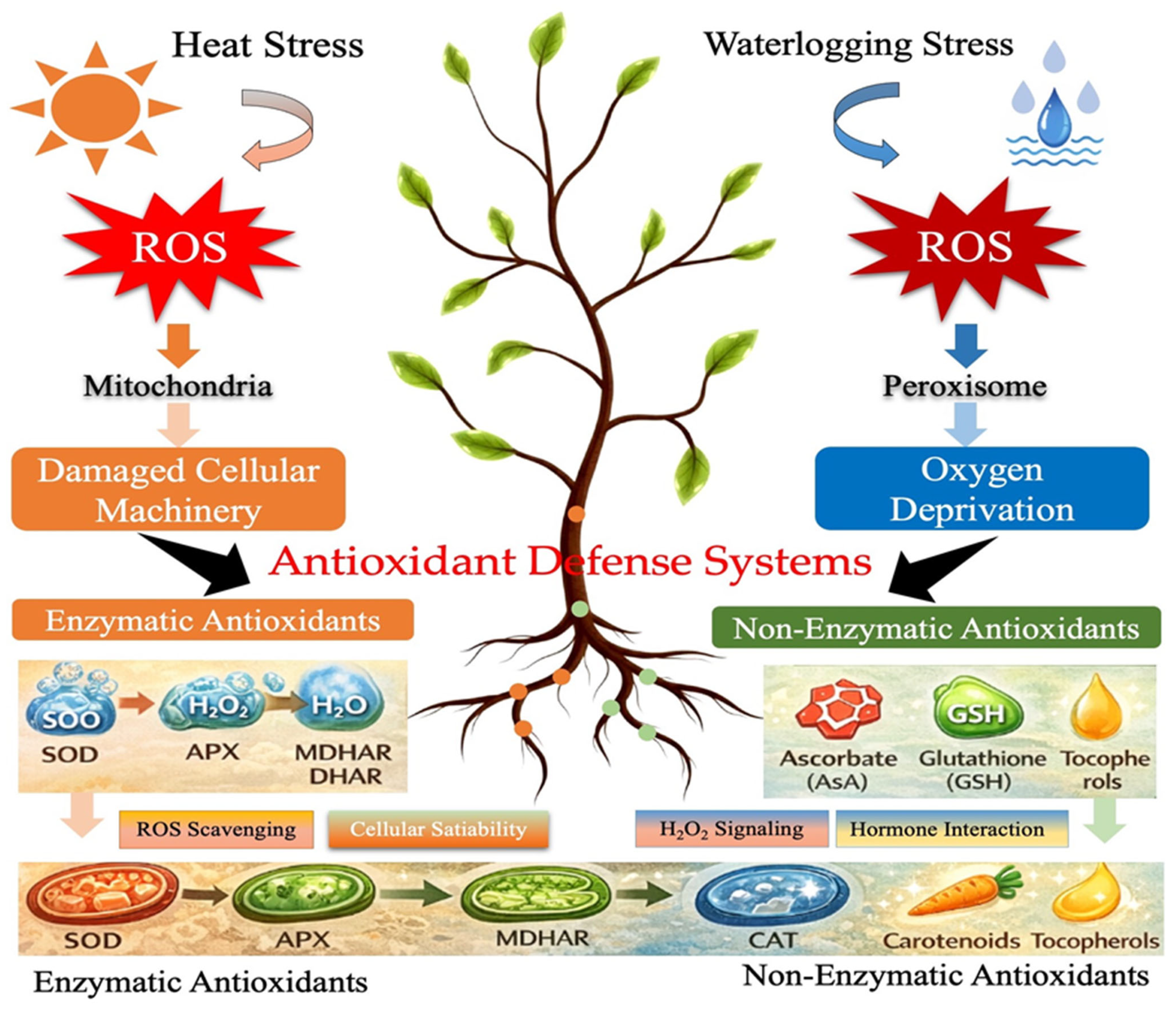
3.2. Antioxidant Defense Systems Against Heat and Waterlogging Stress
3.3. Comparative Mechanisms of Plant Responses to Heat and Waterlogging Stress
3.4. Adaptive Strategies of Plants Towards Stress Conditions
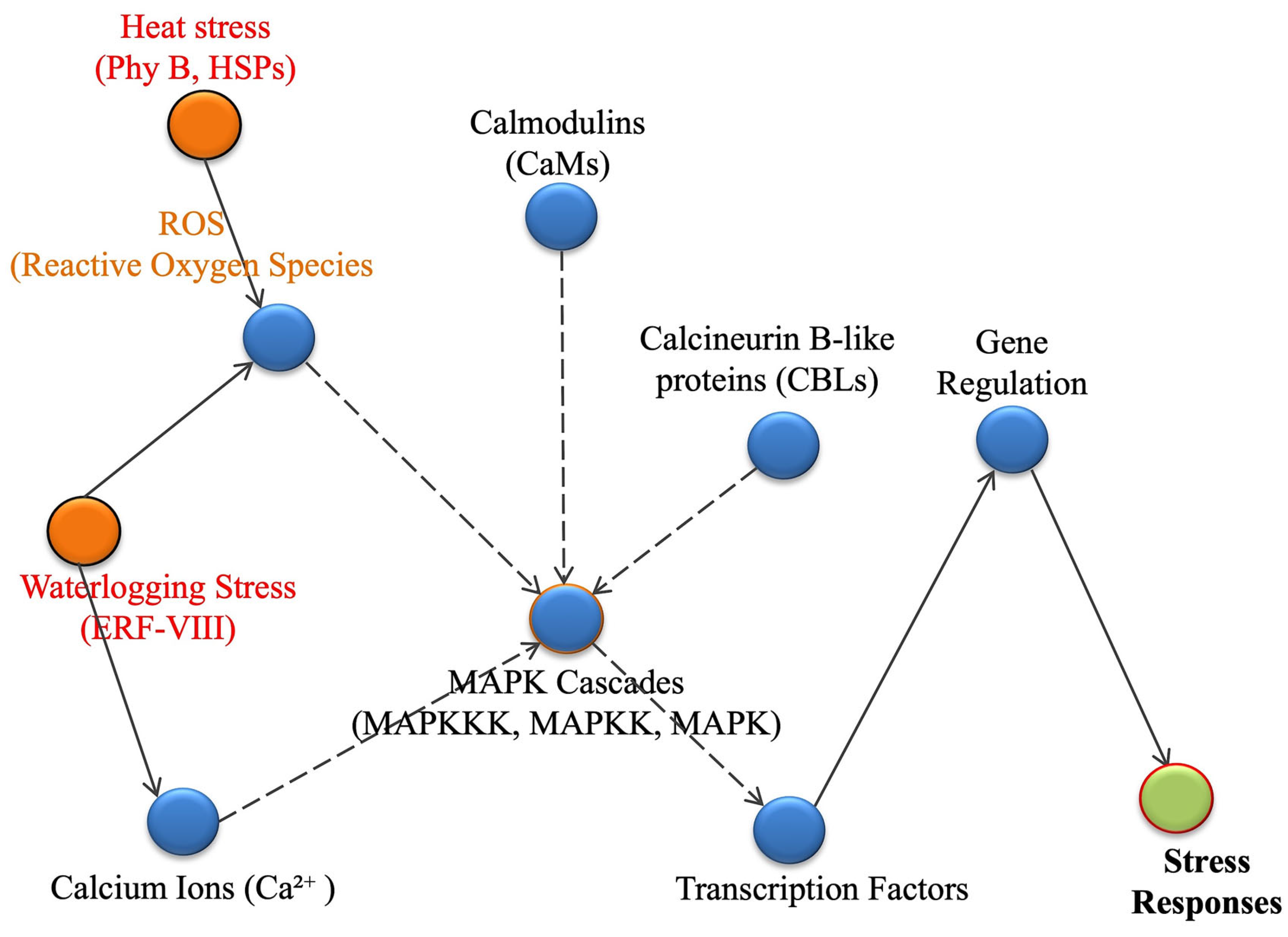
3.4.1. Stress Perception and Signal Transduction
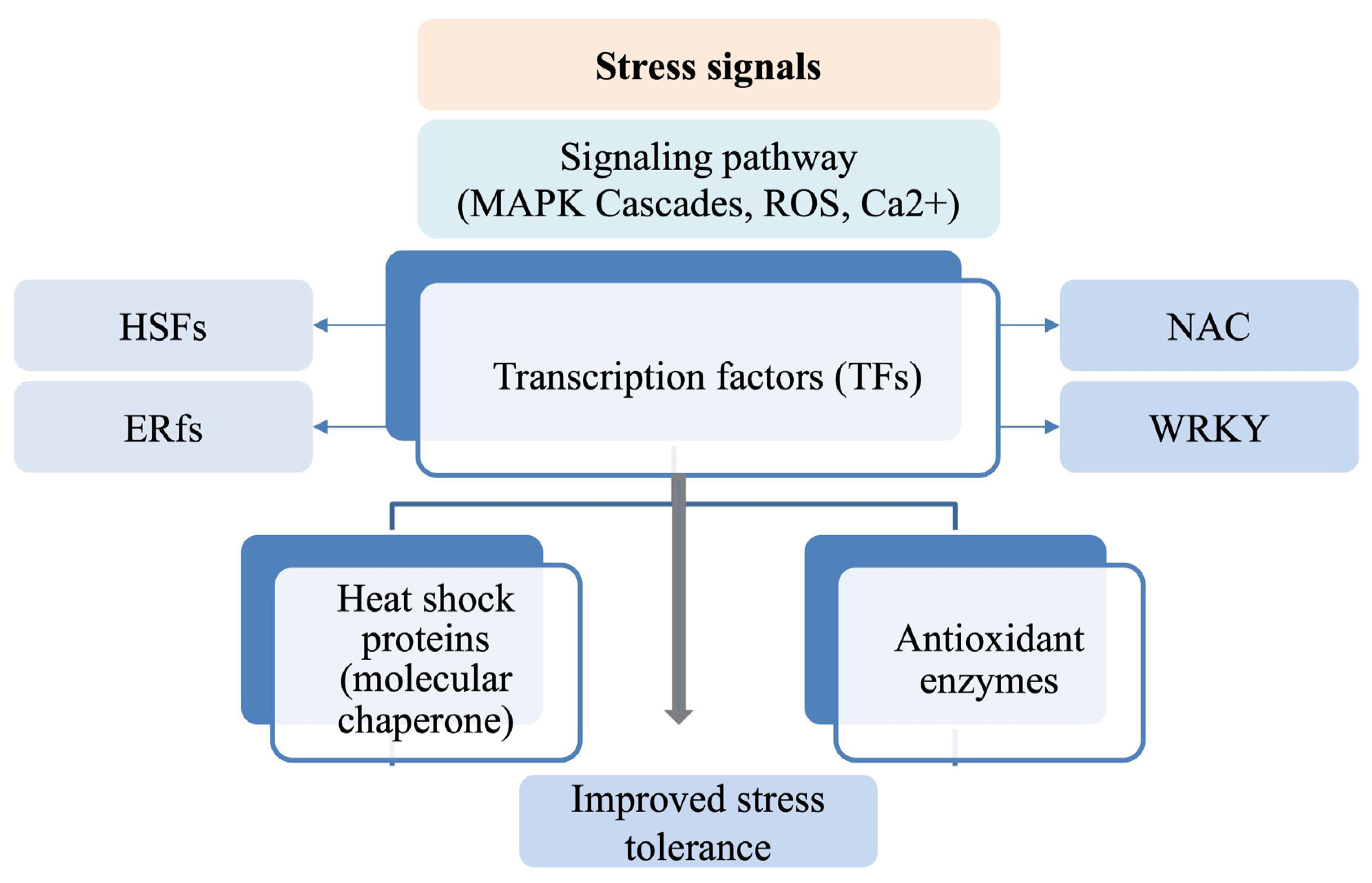
3.4.2. Transcriptional Reprogramming and Stress-Responsive Genes
3.4.3. Hormonal Crosstalk and Regulatory Networks
3.4.4. Physiology Responses and Morphological Outcomes
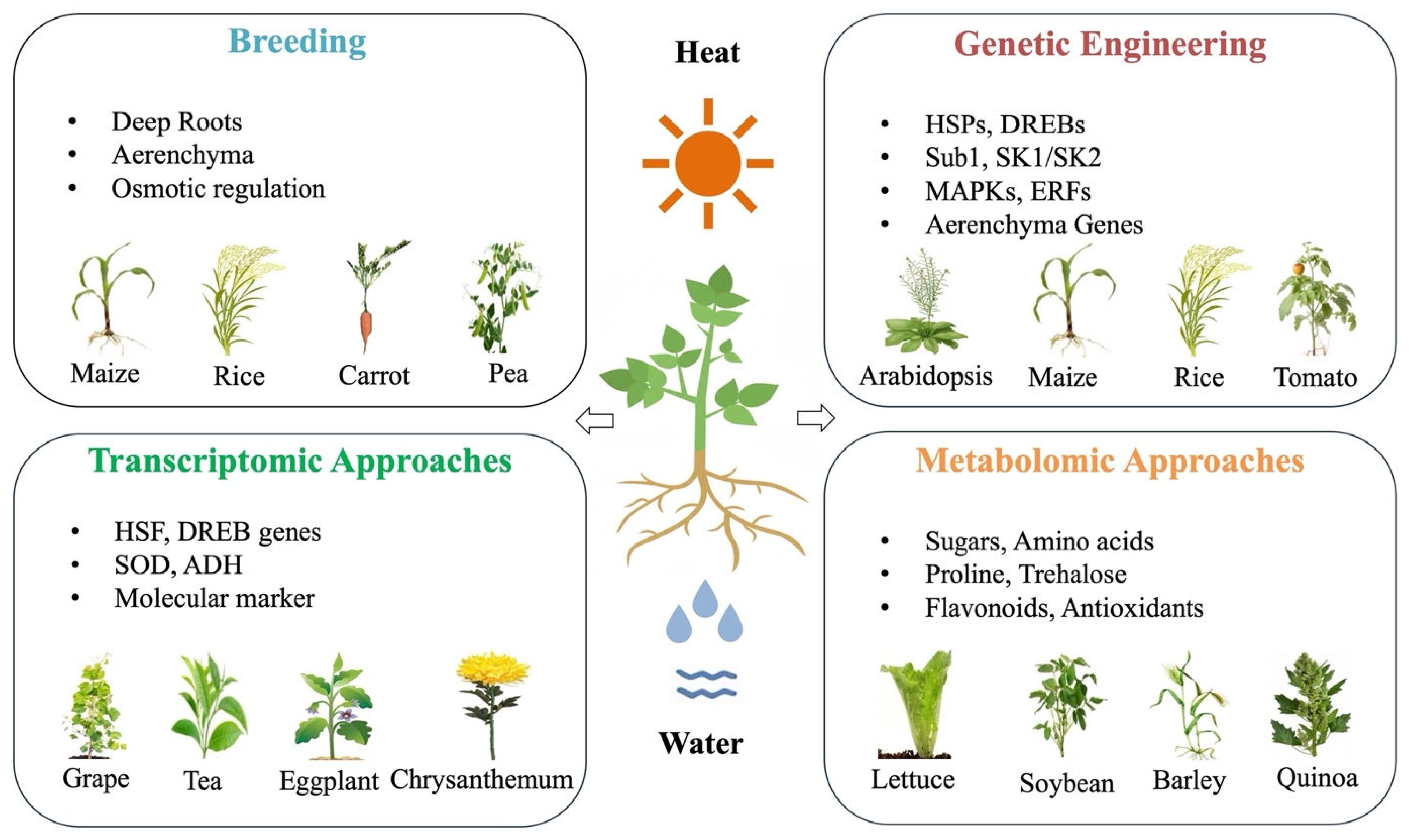
4. Strategies for Enhancing Plant Tolerance to Heat and Waterlogging Stress
4.1. Breeding for Stress Tolerance
4.2. Genetic Engineering Approaches
4.3. Transcriptomic Approaches to Identify Key Stress-Responsive Genes

| Gene Name | Stress Type | Crop Name | Gene Function | Reference |
|---|---|---|---|---|
| LlHsfA3A, LlHsfA3B | Heat stress | Lilium longiflorum | LlHsfA3A: Enhances thermotolerance. LlHsfA3B: Improves acquired thermotolerance. Both affect proline metabolism. | [150] |
| VvbZIP60, VvbZIP60s | Heat stress | Vitis vinifera | VvbZIP60: Regulates heat tolerance via UPR. VvbZIP60s: Unconventional form that interacts with VvHSP83. | [151] |
| CsHSFA2, CsHSP70, CsSOD1, CsSOD2 | Heat stress | Camellia sinensis | CsHSFA2: Responds to heat stress. CsHSP70: Stabilizes proteins. CsSOD1/CsSOD2: Detoxifies ROS. | [143] |
| SmHSP70, SmHSP90 | Heat stress | Solanum melongena | SmHSP70/90: Stabilizes proteins under heat stress. | [144] |
| IaHSP70, IaHSP90, IaHSFA2 | Heat stress | Ipomoea aquatica | IaHSP70/90: Stabilize proteins. IaHSFA2: Regulates heat stress. | [145] |
| SlyHSFs-1, SlyHSFs-2, SlyHSFs-8, SlyHSFs-5, | Heat stress | Solanum lycopersicum | SlyHSFs: Regulates heat tolerance pathways. | [152] |
| MdHSFA2, MdGols4/6 | Heat stress | Malus domestica | MdHSFA2: Regulates heat tolerance by activating heat stress-responsive genes. MdGolS4/6: Involved in heat stress response. | [153] |
| HvERF1, HvADH1, HvSOD1 | Waterlogging stress | Hordeum vulgare | HvERF1: Involved in ethylene signaling. HvADH1: Supports anaerobic metabolism. HvSOD1: Detoxifies ROS under waterlogging stress. | [146] |
| CmSOD, CmCAT, CmADH1 | Waterlogging stress | Chrysanthemum morifolium | CmSOD: Detoxifies ROS. CmCAT: Breaks down hydrogen peroxide. CmADH1: Supports anaerobic metabolism. | [147] |
| CmADH, CmPDC, CmSOD, CmCAT | Waterlogging stress | Cucumis melo | CmADH: Alcohol dehydrogenase for anaerobic respiration. CmPDC: Pyruvate decarboxylase. CmSOD: Detoxifies ROS. CmCAT: Reduces hydrogen peroxide. | [148] |
| MdADH, MdPDC, MdSOD | Waterlogging stress | Malus domestica | MdADH: Alcohol dehydrogenase for anaerobic metabolism. MdPDC: Pyruvate decarboxylase. MdSOD: Detoxifies ROS under waterlogging stress. | [149] |
| CabHLH18 | Waterlogging stress | Capsicum annuum | CabHLH18: A bHLH transcription factor that improves growth, root length, and stress-related metabolites under waterlogging stress. | [137] |
| OsSub1A, OsERF71 | Waterlogging stress | Oryza sativa | OsSub1A: Regulates ethylene response and anaerobic metabolism. OsERF71: Involved in submergence tolerance | [154] |
4.4. Metabolic Insights into Stress-Responsive Pathways
| Metabolite Name | Stress Type | Crop Name | Metabolic Pathway/Function | Reference |
|---|---|---|---|---|
| Proline | Heat stress | Zea mays | Maintains cellular hydration and acts as an antioxidant, protecting against heat stress | [160] |
| Phenylpropanoid | Heat stress | Cucumis sativus | Phenylpropanoids, including flavonoids, accumulate under heat stress, contributing to stress tolerance. | [169] |
| Glutathione, Amino Acids, Organic Acids, Flavonoids, Sugars | Heat stress | Capsicum annuum | Accumulation of glutathione, amino acids, organic acids, flavonoids, and sugars enhances heat stress tolerance by regulating osmotic balance and providing protective effects. | [170] |
| Cytokinins, Auxins, Gibberellins, Abscisic Acid, Salicylic Acid Ethylene | Heat stress | Eriobotrya japonica | Cytokinins, auxins, gibberellins, abscisic acid, salicylic acid and ethylene regulate heat stress by modulating stress tolerance pathways. | [171] |
| Glutathione, Nucleoredoxin, GABA pathway metabolites | Heat stress | Mangifera indica | Glutathione detoxifies ROS, nucleoredoxin and GABA-shunt metabolites help regulate oxidative stress. | [172] |
| Malondialdehyde (MDA), Superoxide Dismutase (SOD), Guaiacol Peroxidase (POD), Catalase (CAT) | Waterlogging stress | Citrus sinensis | MDA is a marker for oxidative stress; SOD, POD, and CAT detoxify ROS under waterlogging stress | [173] |
| Peroxidase (PERs), Cinnamoyl-CoA Reductases (CCRs) | Waterlogging stress | Hordeum vulgare | Peroxidases (PERs) and Cinnamoyl-CoA reductases (CCRs) enhance cell wall biogenesis and peroxidase activity in the phenylpropanoid pathway thus improving waterlogging tolerance. | [165] |
| GABA, Sucrose, Glucose, Trehalose | Waterlogging stress | Chenopodium quinoa | GABA regulates phenylpropanoid metabolism, enhancing flavonoid and phenolic acid biosynthesis. Sucrose, glucose, and trehalose provide energy for adventitious root production during waterlogging. | [166] |
| Ascorbate Peroxidase (APX), Glutathione (GSH) | Waterlogging stress | Sesamum indicum | APX and glutathione (GSH) are antioxidant enzymes that enhance the oxidative stress tolerance | [164] |
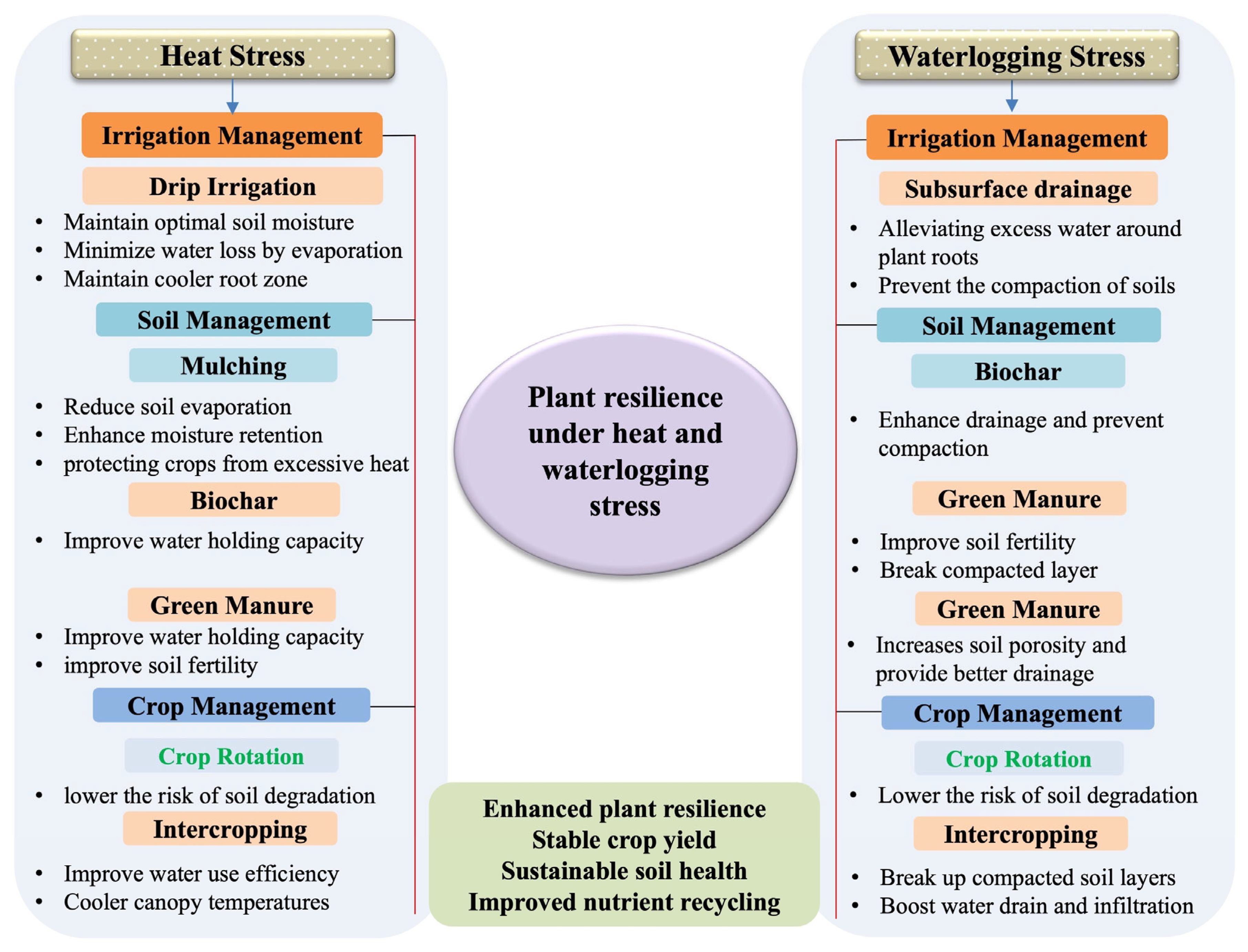
4.5. Agronomic Practices for Enhancing Plant Tolerance to Heat and Waterlogging Stress
4.5.1. Irrigation and Drainage Management
4.5.2. Soil Management
4.5.3. Crop Rotation and Intercropping

4.6. Integrated Strategies for Developing Stress-Resilient Crops: Translating Comparative Insights into Targeted Interventions
4.6.1. Conceptual Rationale
4.6.2. Strategic Logic
- 1.
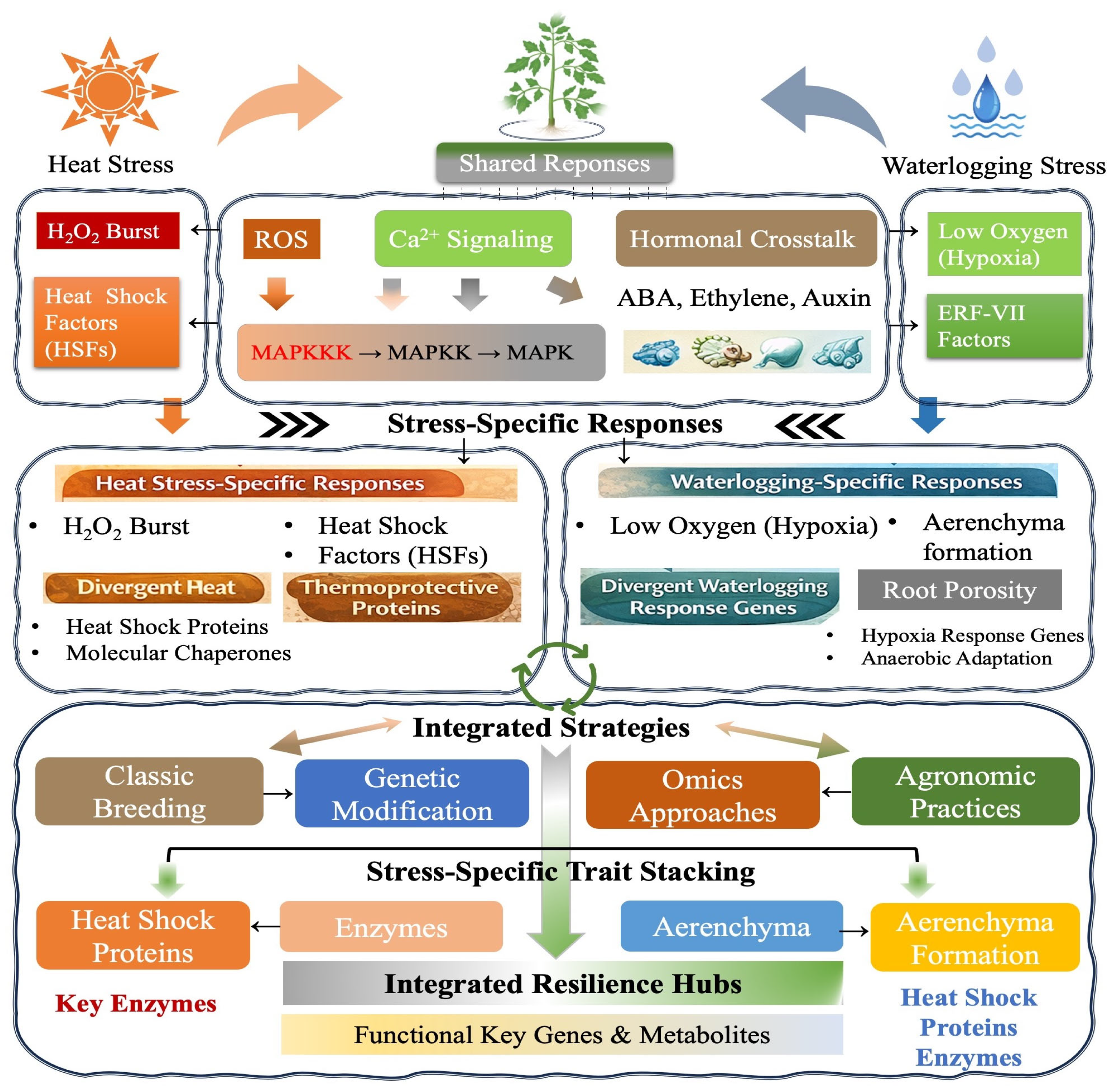
- Target Shared Regulatory Hubs for Broad Resilience: Central hubs like ROS-scavenging networks, calcium signaling components, and MAPK cascades operate across multiple stresses and represent high-leverage targets for broad tolerance. Enhancing these pathways strengthens basal resilience where stress occurrence is unpredictable [195]. However, the comparative framework underscores the importance of shared regulatory hubs between heat stress and waterlogging stress, including ROS scavenging, ABA signaling, and antioxidant defense systems. These mechanisms, which are activated in both stresses, present effective targets for broad resilience strategies that enable crops to withstand both environmental stressors. By focusing on these shared mechanisms, it is possible to enhance multi-stress tolerance, ensuring crops remain resilient even in unpredictable environments where both heat and waterlogging co-occur.
- A.
- Molecular Breeding
The application of GWAS and QTL mapping allows breeders to identify genetic markers linked to shared mechanisms such as ROS detoxification and ABA-mediated regulation. By targeting these markers, breeding programs can enhance multi-stress tolerance across different environments. Tools like marker-assisted selection (MAS) and CRISPR-Cas9 technology can facilitate the integration of these traits into crops, improving their ability to respond to both stresses simultaneously. For example, optimizing ROS management pathways through genetic modification can confer resilience to both heat and waterlogging stress, benefiting crops like rice, maize, and wheat.- B.
- Agronomic Practices
In addition to genetic strategies, agronomic practices play a critical role in reinforcing multi-stress resilience. Practices such as optimized irrigation management, which addresses waterlogging issues, and early planting, which mitigates the effects of heat stress, can complement genetic improvements. By implementing strategic field management, such as proper irrigation timing and planting schedules, we can help crops adapt to unpredictable environmental stressors. These practices, when integrated with molecular breeding, offer a holistic approach to enhancing crop resilience in regions where both heat and waterlogging stresses are prevalent. - 2.
- Stack Stress-Specific Traits for Predictable Co-occurrence: When heat and waterlogging reliably co-occur, combining heat-specific (HSF/HSP) and waterlogging-specific (ERF-VII, aerenchyma formation) traits maximizes adaptation tailored to local conditions [196]. In regions where heat and waterlogging stress co-occur predictably, a more effective strategy is to focus on stacking stress-specific traits that address the unique challenges posed by each stress. This approach leverages specific adaptations for each stressor to enhance crop performance under predictable stress environments. For example, combining heat shock proteins (HSPs), which improve heat tolerance, with ethylene-responsive transcription factors (ERF-VII) that promote aerenchyma formation under waterlogging stress can optimize crop resilience. By targeting these distinct mechanisms, we can tailor interventions to environments where both heat and waterlogging co-occur regularly, ensuring that crops are specifically adapted to these combined stresses.
- A.
- Molecular Tools
Genome editing technologies such as CRISPR-Cas9 allow for precise stacking of stress-specific traits, enabling crops to adapt to co-occurring stresses with high specificity. For example, stacking HSPs for heat stress tolerance and ERF-VII transcription factors for waterlogging tolerance offers a targeted approach to improve resilience under predictable environmental conditions. This stacking strategy ensures that the plant has the necessary mechanisms to survive and thrive in both heat and waterlogging stress scenarios, which are often seen together in certain geographic regions or seasons.- B.
- Phenomics Technologies
Phenomics technologies, particularly high-throughput phenotyping, provide a means to screen for key traits such as root architecture, stomatal regulation, and photosynthetic efficiency under combined heat and waterlogging stresses. These phenotypic traits are crucial for ensuring optimal plant performance under both stresses, allowing breeders to select plants that exhibit the best combinations of traits for multi-stress resilience. Phenomics thus accelerates the process of identifying stress-resilient plants, allowing for faster development of crops that are genetically and physiologically optimized for co-occurring stresses. - 3.
- Implementation Flow:Step 1: Characterize environmental stress patterns (heat only, waterlogging only, combined): Conduct a thorough assessment of the frequency, intensity, and timing of heat and waterlogging events in the target environment. Use historical climate data, predictive modeling, and in-field measurements to determine whether stresses occur independently or concurrently. For instance, in regions with seasonal monsoons followed by heat waves, crops may require stacked adaptations, while areas with sporadic heat events may benefit more from shared hub optimization. This step ensures that subsequent interventions are environmentally contextualized rather than generic [197].Step 2: Map key stress-specific and shared mechanisms: Identify the molecular, hormonal, physiological, and morphological pathways underlying tolerance to heat, waterlogging, and shared stress responses. Heat-specific mechanisms include HSF-HSP networks, ABA-mediated stomatal regulation, and thermos-tolerance-associated metabolites [198,199]. Waterlogging-specific mechanisms include ERF-VII transcription factors, aerenchyma and adventitious root formation, and anaerobic metabolism [200]. Shared hubs involve ROS scavenging, Ca2+-MAPK signaling, and antioxidant enzyme activation [195,198,199,200]. Mapping these pathways allows prioritization of targets for breeding, genome editing, or agronomic interventions.Step 3: Prioritize interventions targeting shared hubs or stress-specific stacks. For unpredictable or variable stress environments, prioritize interventions that enhance shared regulatory hubs to provide moderate tolerance to multiple stresses simultaneously [194,198]. For predictable dual-stress environments, implement trait stacking: combine stress-specific adaptations (e.g., HSP induction + ERF-VII-mediated root adaptations) to maximize resilience [197,201,202].Consider potential synergistic or antagonistic interactions between traits—for example, overexpressing HSPs may influence ROS dynamics, which also impact waterlogging tolerance—requiring integrated evaluation.Step 4: Select deployment pathways (breeding, editing, and agronomy) based on crop species and resource context. Decide whether interventions are best applied through molecular breeding, transgenic/genome-editing approaches, or agronomic management. Molecular breeding is suited for crops with extensive genomic resources and for stacking multiple loci. Transgenic or genome-editing approaches are optimal for precise modifications of key hubs, especially where trait stacking is required. Agronomic interventions—such as optimized irrigation, raised beds, or priming treatments—can complement genetic improvements and provide immediate stress mitigation [195,203]. The chosen deployment pathway should also consider economic feasibility, farmer adoption potential, and regulatory constraints.
4.6.3. Decision Matrix for Resilience Strategies
5. Conclusions
6. Future Directions
Author Contributions
Funding
Data Availability Statement
Acknowledgments
Conflicts of Interest
References
- Zandalinas, S.I.; Mittler, R.; Balfagón, D.; Arbona, V.; Gómez-Cadenas, A. Plant adaptations to the combination of drought and high temperatures. Physiol. Plant. 2018, 162, 2–12. [Google Scholar] [CrossRef] [PubMed]
- IPCC. Climate Change 2022: Impacts, Adaptation and Vulnerability; Contribution of Working Group II to the Sixth Assessment Report of the IPCC; Cambridge University Press: Cambridge, UK, 2022. [Google Scholar]
- Mittler, R. Abiotic stress, the field environment and stress combination. Trends Plant Sci. 2006, 11, 15–19. [Google Scholar] [CrossRef] [PubMed]
- Kotak, S.; Larkindale, J.; Lee, U.; von Koskull-Döring, P.; Vierling, E.; Scharf, K.D. Complexity of the heat stress response in plants. Curr. Opin. Plant Biol. 2007, 10, 310–316. [Google Scholar] [CrossRef] [PubMed]
- Bailey-Serres, J.; Voesenek, L.A.C.J. Flooding stress: Acclimations and genetic diversity. Ann. Rev. Plant Biol. 2008, 59, 313–339. [Google Scholar] [CrossRef]
- Gong, Y.; Rao, L.; Yu, D. Abiotic Stress in Plants. In Agricultural Chemistry; IntechOpen: London, UK, 2013. [Google Scholar]
- Fischer, E.M.; Oleson, K.W.; Lawrence, D.M. Contrasting urban and rural heat stress responses to climate change. Geophys. Res. Lett. 2012, 39, L03705. [Google Scholar] [CrossRef]
- Fukao, T.; Barrera-Figueroa, B.E.; Juntawong, P.; Peña-Castro, J.M. Submergence and Waterlogging Stress in Plants: A Review Highlighting Research Opportunities and Understudied Aspects. Front. Plant Sci. 2019, 10, 340. [Google Scholar] [CrossRef]
- Sasidharan, R.; Bailey-Serres, J.; Ashikari, M.; Atwell, B.J.; Colmer, T.D.; Fagerstedt, K.; Fukao, T.; Geigenberger, P.; Hebelstrup, K.H.; Hill, R.D.; et al. Community Recommendations on Terminology and Procedures Used in Flooding and Low Oxygen Stress Research. New Phytol. 2017, 214, 1403–1407. [Google Scholar] [CrossRef]
- Tong, C.; Hill, C.B.; Zhou, G.; Zhang, X.-Q.; Jia, Y.; Li, C. Opportunities for Improving Waterlogging Tolerance in Cereal Crops—Physiological Traits and Genetic Mechanisms. Plants 2021, 10, 1560. [Google Scholar] [CrossRef]
- Voesenek, L.A.C.J.; Sasidharan, R. Ethylene- and Oxygen-Signalling Drive Plant Survival during Flooding. Plant Biol. 2013, 15, 426–435. [Google Scholar] [CrossRef]
- Shabala, S. Physiological and cellular aspects of phytotoxicity tolerance in plants: The role of membrane transporters and implications for crop breeding for waterlogging tolerance. New Phytol. 2011, 190, 289–298. [Google Scholar] [CrossRef]
- Choudhury, F.K.; Rivero, R.M.; Blumwald, E.; Mittler, R. Reactive Oxygen Species, Abiotic Stress and Stress Combination. Plant J. 2017, 90, 856–867. [Google Scholar] [CrossRef] [PubMed]
- Mittler, R. Oxidative stress, antioxidants and stress tolerance. Trends Plant Sci. 2002, 7, 405–410. [Google Scholar] [CrossRef]
- Staacke, T.; Muller-Roeber, B.; Balazadeh, S. Stress resilience in plants: The complex interplay between heat stress memory and resetting. New Phytol. 2025, 245, 2402–2421. [Google Scholar] [CrossRef] [PubMed]
- Voesenek, L.A.C.J.; Bailey-Serres, J. Flooding tolerance: O2 sensing and survival strategies. Curr. Opin. Plant Biol. 2013, 16, 647–653. [Google Scholar] [CrossRef] [PubMed]
- Loreti, E.; van Veen, H.; Perata, P. Plant responses to flooding stress. Curr. Opin. Plant Biol. 2016, 33, 64–71. [Google Scholar] [CrossRef]
- Apel, K.; Hirt, H. Reactive oxygen species: Metabolism, oxidative stress, and signal transduction. Ann. Rev. Plant Biol. 2004, 55, 373–399. [Google Scholar] [CrossRef]
- Jaspers, P.; Kangasjärvi, J. Reactive oxygen species in abiotic stress signaling. Physiol. Plan. 2010, 138, 405–413. [Google Scholar] [CrossRef]
- Wahid, A.; Gelani, S.; Ashraf, M.; Foolad, M.R. Heat tolerance in plants: An overview. Environ. Exp. Bot. 2007, 61, 199–223. [Google Scholar] [CrossRef]
- Voesenek, L.A.C.J.; Bailey-Serres, J. Flood adaptive traits and processes: An overview. New Phytol. 2015, 206, 57–73. [Google Scholar] [CrossRef]
- Cui, Y.; Ouyang, S.; Zhao, Y.; Tie, L.; Shao, C.; Duan, H. Plant responses to high temperature and drought: A bibliometrics analysis. Front. Plant Sci. 2022, 13, 1052660. [Google Scholar] [CrossRef]
- Allakhverdiev, S.I.; Kreslavski, V.D.; Klimov, V.V.; Los, D.A.; Carpentier, R.; Mohanty, P. Heat stress: An overview of molecular responses in photosynthesis. Photosynth. Res. 2008, 98, 541–550. [Google Scholar] [CrossRef] [PubMed]
- Pierik, R.; Testerink, C. The art of being flexible: How to escape from shade, flooding and drought. Plant Physiol. 2014, 166, 5–22. [Google Scholar] [CrossRef] [PubMed]
- Pucciariello, C.; Perata, P. New insights into reactive oxygen species and nitric oxide signalling under low oxygen. Plant Cell Environ. 2017, 40, 473–482. [Google Scholar] [CrossRef] [PubMed]
- Foyer, C.H.; Noctor, G. Redox regulation in photosynthetic organisms: Signaling, acclimation, and stress tolerance. Plant Cell Environ. 2005, 28, 1056–1077. [Google Scholar] [CrossRef]
- Devireddy, A.R.; Zandalinas, S.I.; Fichman, Y.; Mittler, R. Integration of reactive oxygen species and hormone signaling during abiotic stress. Plant J. 2020, 101, 1084–1101. [Google Scholar] [CrossRef]
- Sui, N. Photoinhibition of Suaeda salsa to Chilling Stress Is Related to Energy Dissipation and Water-Water Cycle. Photosynthetica 2015, 53, 207–212. [Google Scholar] [CrossRef]
- Suzuki, N.; Rivero, R.M.; Shulaev, V.; Blumwald, E.; Mittler, R. Abiotic and Biotic Stress Combinations. New Phytol. 2014, 203, 32–43. [Google Scholar] [CrossRef]
- Gall, H.L.; Philippe, F.; Domon, J.M.; Gillet, F.; Pelloux, J.; Rayon, C. Cell Wall Metabolism in Response to Abiotic Stress. Plants 2015, 4, 112–166. [Google Scholar] [CrossRef]
- Hasanuzzaman, M.; Nahar, K.; Alam, M.M.; Roychowdhury, R.; Fujita, M. Physiological, biochemical, and molecular mechanisms of heat stress tolerance in plants. Int. J. Mol. Sci. 2013, 14, 9643–9684. [Google Scholar] [CrossRef]
- Hetherington, A.M.; Woodward, F.I. The Role of Stomata in Sensing and Driving Environmental Change. Nature 2003, 424, 901–908. [Google Scholar] [CrossRef]
- Zhang, Q.; Chen, G.; Ke, W.; Peng, C. Adaptation of the Invasive Plant Sphagneticola trilobata to Flooding Stress by Hybridization with Native Relatives. Int. J. Mol. Sci. 2024, 25, 6738. [Google Scholar] [CrossRef]
- Colmer, T.D.; Voesenek, L.A.C.J. Flooding Tolerance: Suites of Plant Traits in Variable Environments. Funct. Plant Biol. 2009, 36, 665–681. [Google Scholar] [CrossRef]
- Wang, R.; Wu, Y.; Wu, W.; Lyu, L.; Li, W. Research progress on the physiological, biochemical and molecular regulatory mechanisms of fruit tree responses to high-temperature stress. Hortic. Plant J. 2025, 11, 1–14. [Google Scholar] [CrossRef]
- Lawson, T.; Blatt, M.R. Stomatal Size, Speed, and Responsiveness Impact on Photosynthesis and Water Use Efficiency. Plant Physiol. 2014, 164, 1556–1570. [Google Scholar] [CrossRef] [PubMed]
- Cutler, S.R.; Rodriguez, P.L.; Finkelstein, R.R.; Abrams, S.R. Abscisic Acid: Emergence of a Core Signaling Network. Annu. Rev. Plant Biol. 2010, 61, 651–679. [Google Scholar] [CrossRef] [PubMed]
- Wilkinson, S.; Davies, W.J. ABA-based chemical signalling: The co-ordination of responses to stress in plants. Plant Cell Environ. 2002, 25, 195–210. [Google Scholar] [CrossRef]
- Salazar, C.; Hernández, C.; Pino, M.T. Plant water stress: Associations between ethylene and abscisic acid response. Chil. J. Agric. Res. 2015, 75, 71–79. [Google Scholar] [CrossRef]
- Islam, M.R.; Liza, A.A.; Sikdar, A.; Das, U.; Rahman, M.S.; Anwar, M.P. Cytokinin and Gibberellic Acid-Mediated Waterlogging Tolerance of Mungbean (Vigna radiata L. Wilczek). Peer J. 2022, 10, 12862. [Google Scholar] [CrossRef]
- Iida, S.; Ikeda, M.; Amano, M.; Sakayama, H.; Kadono, Y.; Kosuge, K. Loss of heterophylly in aquatic plants: Not ABA-mediated stress but exogenous ABA treatment induces stomatal leaves in Potamogeton perfoliatus. J. Plant Res. 2016, 129, 853–862. [Google Scholar] [CrossRef][Green Version]
- Zhu, J.K. Abiotic stress signaling and responses in plants. Cell 2016, 167, 313–324. [Google Scholar] [CrossRef]
- Daszkowska-Golec, A. The Role of Abscisic Acid in Drought Stress: How ABA Helps Plants to Cope with Drought Stress, in Drought Stress Tolerance in Plants, Vol 2: Molecular and Genetic Perspectives; Springer: Berlin/Heidelberg, Germany, 2016; pp. 123–151. [Google Scholar]
- De Ollas, C.; González-Guzmán, M.; Pitarch, Z.; Matus, J.T.; Candela, H.; Rambla, J.L.; Granell, A.; Gómez-Cadenas, A.; Arbona, V. Identification of ABA-mediated genetic and metabolic responses to soil flooding in tomato (Solanum lycopersicum L. Mill). Front. Plant Sci. 2021, 12, 613059. [Google Scholar] [CrossRef]
- Araki, H.; Hossain, M.A.; Takahashi, T. Waterlogging and hypoxia have permanent effects on wheat root growth and respiration. J. Agron. Crop Sci. 2012, 198, 264–275. [Google Scholar] [CrossRef]
- Koevoets, I.T.; Venema, J.H.; Elzenga, J.T.; Testerink, C. Roots withstanding their environment: Exploiting root system architecture responses to abiotic stress to improve crop tolerance. Front. Plant Sci. 2016, 7, 1335. [Google Scholar] [CrossRef] [PubMed]
- Lipiec, J.; Doussan, C.; Nosalewicz, A.; Kondrack, K. Effect of drought and heat stresses on plant growth and yield: A review. Int. Agrophys. 2013, 27, 463–467. [Google Scholar] [CrossRef]
- Muhammad Aslam, M.; Waseem, M.; Jakada, B.H.; Okal, E.J.; Lei, Z.; Saqib, H.S.A.; Yuan, W.; Xu, W.; Zhang, Q. Mechanisms of abscisic acid-mediated drought stress responses in plants. Int. J. Mol. Sci. 2022, 23, 1084. [Google Scholar] [CrossRef] [PubMed]
- Sajid, M.; Rashid, B.; Ali, Q.; Husnain, T. Mechanisms of heat sensing and responses in plants. It is not all about Ca2+ ions. Biol. Plant. 2018, 62, 409–420. [Google Scholar] [CrossRef]
- Hossain, M.A.; Uddin, S.N. Mechanisms of waterlogging tolerance in wheat: Morphological and metabolic adaptations under hypoxia or anoxia. Aust. J. Crop Sci. 2011, 5, 1094–1101. [Google Scholar]
- Wegner, L.H. Oxygen transport in waterlogged plants. In Waterlogging Signalling and Tolerance in Plants; Springer: Berlin/Heidelberg, Germany, 2010; pp. 3–22. [Google Scholar]
- Li, Y.; Liu, Y.; Jin, L.; Peng, R. Crosstalk between Ca2+ and other regulators assists plants in responding to abiotic stress. Plants 2022, 11, 1351. [Google Scholar] [CrossRef]
- Tiwari, M.; Kumar, R.; Min, D.; Jagadish, S.V.K. Genetic and molecular mechanisms underlying root architecture and function under heat stress—A hidden story. Plant Cell Environ. 2022, 45, 771–788. [Google Scholar] [CrossRef]
- Jia, W.; Zhai, L.; Li, C.; Liu, D.; Zhang, H.; Yang, L.; Li, W. Plant Morphological, Physiological and Anatomical Adaptation to Flooding Stress and the Underlying Molecular Mechanisms. Int. J. Mol. Sci. 2021, 22, 1088. [Google Scholar] [CrossRef]
- Suralta, R.R.; Yamauchi, A. Root Growth, Aerenchyma Development, and Oxygen Transport in Rice Genotypes Subjected to Drought and Waterlogging. Environ. Exp. Bot. 2008, 64, 75–82. [Google Scholar] [CrossRef]
- Evans, D.E. Aerenchyma Formation. New Phytol. 2004, 161, 35–49. [Google Scholar] [CrossRef]
- Yamauchi, T.; Rajhi, I.; Nakazono, M. Lysigenous Aerenchyma Formation in Maize Root Is Confined to Cortical Cells by Regulation of Genes Related to Generation and Scavenging of Reactive Oxygen Species. Plant Signal. Behav. 2011, 6, 759–761. [Google Scholar] [CrossRef] [PubMed]
- Yamauchi, T.; Nakazono, M. Modeling-based age-dependent analysis reveals the net patterns of ethylene-dependent and-independent aerenchyma formation in rice and maize roots. Plant Sci. 2022, 321, 111340. [Google Scholar] [CrossRef]
- Subbaiah, C.C.; Sachs, M.M. Molecular and cellular adaptations of maize to flooding stress. Ann. Bot. 2003, 91, 119–127. [Google Scholar] [CrossRef]
- Setter, T.L.; Waters, I. Review of Prospects for Germplasm Improvement for Waterlogging Tolerance in Wheat, Barley and Oats. Plant Soil 2003, 253, 1–34. [Google Scholar] [CrossRef]
- Yamauchi, T.; Abe, F.; Tsutsumi, N.; Nakazono, M. Root Cortex Provides a Venue for Gas-Space Formation and Is Essential for Plant Adaptation to Waterlogging. Front. Plant Sci. 2019, 10, 259. [Google Scholar] [CrossRef]
- Yamauchi, T.; Kuroha, T.; Hirabayashi, H.; Iwashita, T.; Yamada, H.; Motoda, J.; Saito, T.; Sato, T.; Matsui, K.; Fukao, T.; et al. Regulation of Root Traits for Internal Aeration and Tolerance to Soil Waterlogging-Flooding Stress. Plant Physiol. 2018, 176, 1118–1130. [Google Scholar] [CrossRef]
- Kolbert, Z.; Kiss, I.; Tóth, S.Z.; Vass, I.; Pető, A.; Horváth, E.; Tóbiás, M.; Szalai, G.; Erdei, L. Gasotransmitters in Action: Nitric Oxide-Ethylene Crosstalk During Plant Growth and Abiotic Stress Responses. Antioxidants 2019, 8, 167. [Google Scholar] [CrossRef]
- Ashraf, M.A. Waterlogging stress in plants: A review. Afr. J. Agric. Res. 2012, 7, 1976–1981. [Google Scholar] [CrossRef]
- Slimen, I.B.; Najar, T.; Ghram, A.; Dabbebi, H.; Ben Mrad, M.; Abdrabbah, M. Reactive oxygen species, heat stress and oxidative-induced mitochondrial damage. A review. Int. J. Hyperth. 2014, 30, 513–523. [Google Scholar] [CrossRef] [PubMed]
- Bratovcic, A. Antioxidant Enzymes and Their Role in Preventing Cell Damage. Acta Sci. Nutr. Health 2020, 4, 1–7. [Google Scholar] [CrossRef]
- Das, K.; Roychoudhury, A. Reactive Oxygen Species (ROS) and Response of Antioxidants as ROS-Scavengers during Environmental Stress in Plants. Front. Environ. Sci. 2014, 2, 53. [Google Scholar] [CrossRef]
- Mittler, R.; Vanderauwera, S.; Gollery, M.; Breusegem, F.V. Reactive Oxygen Gene Network of Plants. Trends Plant Sci. 2004, 9, 490–498. [Google Scholar] [CrossRef]
- Neill, S.; Desikan, R.; Hancock, J. Hydrogen Peroxide Signalling. Curr. Opin. Plant Biol. 2002, 5, 388–395. [Google Scholar] [CrossRef]
- Ravi, B.; Foyer, C.H.; Pandey, G.K. The Integration of Reactive Oxygen Species (ROS) and Calcium Signalling in Abiotic Stress Responses. Plant Cell Environ. 2023, 46, 1985–2006. [Google Scholar] [CrossRef]
- Xia, X.J.; Zhou, Y.H.; Shi, K.; Zhou, J.; Foyer, C.H.; Yu, J.Q. Interplay Between Reactive Oxygen Species and Hormones in the Control of Plant Development and Stress Tolerance. J. Exp. Bot. 2015, 66, 2839–2856. [Google Scholar] [CrossRef]
- Singh, A.; Mehta, S.; Yadav, S.; Nagar, G.; Ghosh, R.; Roy, A.; Chakraborty, A.; Singh, I.K. How to Cope with the Challenges of Environmental Stresses in the Era of Global Climate Change: An Update on ROS Stave off in Plants. Int. J. Mol. Sci. 2022, 23, 1995. [Google Scholar] [CrossRef]
- Kollist, H.; Zandalinas, S.I.; Sengupta, S.; Nuhkat, M.; Kangasjärvi, J.; Mittler, R. Rapid Responses to Abiotic Stress: Priming the Landscape for the Signal Transduction Network. Trends Plant Sci. 2019, 24, 25–37. [Google Scholar] [CrossRef]
- Potapov, A.P. Signal transduction and gene regulation networks. In Analysis of Biological Networks; John Wiley & Sons, Inc.: Hoboken, NJ, USA, 2008; pp. 181–206. [Google Scholar]
- Cheung, E.; Kraus, W.L. Genomic analyses of hormone signaling and gene regulation. Ann. Rev. Physiol. 2010, 72, 191–218. [Google Scholar] [CrossRef]
- Mittler, R.; Finka, A.; Goloubinoff, P. How Do Plants Feel the Heat? Trends Biochem. Sci. 2012, 37, 118–125. [Google Scholar] [CrossRef]
- Jung, J.-H.; Barbosa, A.D.; Hutin, S.; Kumita, J.R.; Gao, M.; Derwort, D.; Silva, C.S.; Lai, X.; Pierre, E.; Geng, F.; et al. A Prion-Like Domain in ELF3 Functions as a Thermosensor in Arabidopsis. Nature 2020, 585, 256–260. [Google Scholar] [CrossRef]
- Wilkinson, E.G.; Strader, L.C. A Prion-based Thermosensor in Plants. Mol. Cell 2020, 80, 181–182. [Google Scholar] [CrossRef] [PubMed]
- Gibbs, D.J.; Isa, N.M.; Movahedi, M.; Lozano-Juste, J.; Mendiondo, G.M.; Berckhan, S.; Marín-de la Rosa, N.; Conde, J.V.; Correia, C.S.; Pearce, S.P.; et al. Nitric Oxide Sensing in Plants Is Mediated by Proteolytic Control of Group VII ERF Transcription Factors. Mol. Cell 2014, 53, 369–379. [Google Scholar] [CrossRef] [PubMed]
- Bailey-Serres, J.; Lee, S.C.; Brinton, E. Waterproofing crops: Effective flooding survival strategies. Plant Physiol. 2012, 160, 1698–1709. [Google Scholar] [CrossRef] [PubMed]
- Taylor-Kearney, L.J.; Flashman, E. Targeting plant cysteine oxidase activity for improved submergence tolerance. Plant J. 2022, 109, 779–788. [Google Scholar] [CrossRef]
- Li, C.; Bai, T.; Ma, F.; Han, M. Hypoxia tolerance and adaptation of anaerobic respiration to hypoxia stress in two Malus species. Sci. Hortic. 2010, 124, 274–279. [Google Scholar] [CrossRef]
- Yin, D.; Sun, D.; Han, Z.; Ni, D.; Norris, A.; Jiang, C.Z. PhERF2, an ethylene-responsive element binding factor, plays an essential role in waterlogging tolerance of petunia. Hortic. Res. 2019, 6, 83. [Google Scholar] [CrossRef]
- Blokhina, O.; Fagerstedt, K.V. Oxidative Metabolism, ROS and NO under Oxygen Deprivation. Plant Physiol. Biochem. 2010, 48, 359–373. [Google Scholar] [CrossRef]
- Kudla, J.; Becker, D.; Grill, E.; Hedrich, R.; Hippler, M.; Kummer, U.; Parniske, M.; Romeis, T.; Schumacher, K. Advances and Current Challenges in Calcium Signaling. New Phytol. 2018, 218, 414–431. [Google Scholar] [CrossRef]
- Hasanuzzaman, M.; Bhuyan, M.H.M.; Zulfiqar, F.; Raza, A.; Mohammad, S.; Fotopoulos, V. Reactive Oxygen Species and Antioxidant Defense in Plants under Abiotic Stress: Revisiting the Crucial Role of a Universal Defense Regulator. Antioxidants 2020, 9, 681. [Google Scholar] [CrossRef]
- Fichman, Y.; Mittler, R. Rapid systemic signaling during abiotic and biotic stresses: Is the ROS wave master of all trades? Plant J. 2020, 102, 887–896. [Google Scholar] [CrossRef]
- Sohag, A.A.M.; Arif, M.T.-U.; Brestic, M.; Afrin, S.; Sakil, M.A.; Hossain, M.T.; Hossain, M.A.; Hossain, M.A. Exogenous Salicylic Acid and Hydrogen Peroxide Attenuate Drought Stress in Rice. Plant Soil Environ. 2020, 66, 7–13. [Google Scholar] [CrossRef]
- Rezatabar, S.; Karimian, A.; Rameshknia, V.; Parsian, H.; Majidinia, M.; Kopi, T.A.; Bishayee, A.; Sadeghinia, A.; Yousefi, M.; Monirialamdari, M.; et al. RAS/MAPK Signaling Functions in Oxidative Stress, DNA Damage Response, and Cancer Progression. J. Cell. Physiol. 2019, 234, 14951–14965. [Google Scholar] [CrossRef] [PubMed]
- Seger, R.; Krebs, E.G. The MAPK Signaling Cascade. FASEB J. 1995, 9, 726–735. [Google Scholar] [CrossRef] [PubMed]
- Danquah, A.; de Zelicourt, A.; Colcombet, J.; Hirt, H. The Role of ABA and MAPK Signaling Pathways in Plant Abiotic Stress Responses. Biotechnol. Adv. 2014, 32, 40–52. [Google Scholar] [CrossRef]
- Kumar, K.; Raina, S.K.; Sultan, S.M. Arabidopsis MAPK Signaling Pathways and Their Cross Talks in Abiotic Stress Response. J. Plant Biochem. Biotechnol. 2020, 29, 700–714. [Google Scholar] [CrossRef]
- Lindemose, S.; O’Shea, C.; Jensen, M.K.; Skriver, K. Structure, Function and Networks of Transcription Factors Involved in Abiotic Stress Responses. Int. J. Mol. Sci. 2013, 14, 5842–5878. [Google Scholar] [CrossRef]
- Mitsis, T.; Efthimiadou, A.; Bacopoulou, F.; Vlachakis, D.; Chrousos, G.P.; Eliopoulos, E. Transcription Factors and Evolution: An Integral Part of Gene Expression. World Acad. Sci. J. 2020, 2, 3–8. [Google Scholar] [CrossRef]
- Haider, S.; Raza, A.; Iqbal, J.; Shaukat, M.; Mahmood, T. Analyzing the Regulatory Role of Heat Shock Transcription Factors in Plant Heat Stress Tolerance: A Brief Appraisal. Mol. Biol. Rep. 2022, 49, 5771–5785. [Google Scholar] [CrossRef]
- Evrard, A.; Kumar, M.; Lecourieux, D.; Lucks, J.; von Koskull-Döring, P.; Hirt, H. Regulation of the heat stress response in Arabidopsis by MPK6-targeted phosphorylation of the heat stress factor HsfA2. PeerJ 2013, 1, e59. [Google Scholar] [CrossRef] [PubMed]
- Huang, Y.C.; Niu, C.Y.; Yang, C.R.; Jinn, T.L. The heat stress factor HSFA6b connects ABA signaling and ABA-mediated heat responses. Plant Physiol. 2016, 172, 1182–1199. [Google Scholar] [CrossRef] [PubMed]
- Wu, J.; Wang, J.; Hui, W.; Zhao, F.; Wang, P.; Su, S.; Gong, W. Physiology of plant responses to water stress and related genes: A review. Forests 2022, 13, 324. [Google Scholar] [CrossRef]
- Mithran, M.; Paparelli, E.; Novi, G.; Perata, P.; Loreti, E. Analysis of the Role of the Pyruvate Decarboxylase Gene Family in Arabidopsis thaliana under Low-Oxygen Conditions. Plant Biol. 2014, 16, 28–34. [Google Scholar] [CrossRef]
- Xiong, H.; He, H.; Chang, Y.; Miao, B.; Liu, Z.; Wang, Q.; Dong, F.; Xiong, L. Multiple Roles of NAC Transcription Factors in Plant Development and Stress Responses. J. Integr. Plant Biol. 2025, 67, 510–538. [Google Scholar] [CrossRef]
- Wani, S.H.; Anand, S.; Singh, B.; Bohra, A.; Joshi, R. WRKY transcription factors and plant defense responses: Latest discoveries and future prospects. Plant Cell Rep. 2021, 40, 1071–1085. [Google Scholar] [CrossRef]
- Miller, G.; Suzuki, N.; Ciftci-Yilmaz, S.; Mittler, R. Reactive oxygen species homeostasis and signalling during drought and salinity stresses. Plant Cell Environ. 2010, 33, 453–467. [Google Scholar] [CrossRef]
- Chen, H.; Jiang, J.G. Osmotic adjustment and plant adaptation to environmental changes related to drought and salinity. Environ. Rev. 2010, 18, 309–319. [Google Scholar] [CrossRef]
- Yang, L.; Zhang, H.; Liu, W.; Zhang, Z.; Yang, J.; Shi, W.; Li, X. Updates and Prospects: Morphological, Physiological, and Molecular Regulation in Crop Response to Waterlogging Stress. Agronomy 2023, 13, 2599. [Google Scholar] [CrossRef]
- Aerts, N.; Pereira Mendes, M.; Van Wees, S.C.M. Multiple levels of crosstalk in hormone networks regulating plant defense. Plant J. 2021, 105, 489–504. [Google Scholar] [CrossRef]
- Huot, B.; Yao, J.; Montgomery, B.L.; He, S.Y. Growth–Defense Tradeoffs in Plants: A Balancing Act to Optimize Fitness. Mol. Plant 2014, 7, 1267–1287. [Google Scholar] [CrossRef]
- Iqbal, J.; Zhang, W.; Fan, Y.; Dong, J.; Xie, Y.; Li, R.; Yang, T.; Zhang, J.; Che, D. Genome-Wide Bioinformatics Analysis of SWEET Gene Family and Expression Verification of Candidate PaSWEET Genes in Potentilla anserina. Plants 2024, 13, 406. [Google Scholar] [CrossRef]
- Sasidharan, R.; Voesenek, L.A. Ethylene-mediated acclimations to flooding stress. Plant Physiol. 2015, 169, 3–12. [Google Scholar] [CrossRef] [PubMed]
- Farnese, F.S.; Menezes, P.E.; Gusman, G.S. When bad guys become good ones: The key role of reactive oxygen species and nitric oxide in the plant responses to abiotic stress. Front. Plant Sci. 2016, 7, 471. [Google Scholar] [CrossRef] [PubMed]
- Shah, S.H.; Islam, S.; Mohammad, F.; Siddiqui, M.H. Gibberellic acid: A versatile regulator of plant growth, development and stress responses. J. Plant Growth Regul. 2023, 42, 7352–7373. [Google Scholar] [CrossRef]
- Daniel, K.; Hartman, S. How plant roots respond to waterlogging. J. Exp. Bot. 2024, 75, 511–525. [Google Scholar] [CrossRef]
- Bielach, A.; Hrtyan, M.; Tognetti, V.B. Plants under stress: Involvement of auxin and cytokinin. Int. J. Mol. Sci. 2017, 18, 1427. [Google Scholar] [CrossRef]
- Hilker, M.; Schwachtje, J.; Baier, M.; Balazadeh, S.; Bäurle, I.; Geiselhardt, S.; Hincha, D.K.; Kunze, R.; Mueller-Roeber, B.; Rillig, M.C.; et al. Priming and memory of stress responses in organisms lacking a nervous system. Biol. Rev. Camb. Philos. Soc. 2016, 91, 1118–1133. [Google Scholar] [CrossRef]
- Mauch-Mani, B.; Baccelli, I.; Luna, E.; Flors, V. Defense priming: An adaptive part of induced resistance. Annu. Rev. Plant Biol. 2017, 68, 485–512. [Google Scholar] [CrossRef]
- Basu, S.; Murmu, S.; Murmu, K.; Choudhury, A.; Upadhyay, M.K.; Hossain, A.; Moulick, D. Agronomic approaches to deal with the abiotic stress tolerance in root and tuber crops. In Abiotic Stress in Underground Vegetables Response and Mitigation; Academic Press: Cambridge, MA, USA, 2025; pp. 215–225. [Google Scholar]
- Acquaah, G. Conventional plant breeding principles and techniques. In Advances in Plant Breeding Strategies: Breeding, Biotechnology and Molecular Tools; Springer: Berlin/Heidelberg, Germany, 2015; pp. 115–158. [Google Scholar]
- Valliyodan, B.; Ye, H.; Song, L.; Murphy, M.; Grover Shannon, J.; Nguyen, H.T. Genetic diversity and genomic strategies for improving drought and waterlogging tolerance in soybeans. J. Exp. Bot. 2017, 68, 1835–1849. [Google Scholar] [CrossRef]
- Watson, D. Adaption to climate change: Climate adaptive breeding of maize, wheat and rice. In Sustainable Solutions for Food Security: Combating Climate Change by Adaptation; Springer: Berlin/Heidelberg, Germany, 2019; pp. 67–89. [Google Scholar]
- Yamauchi, T.; Shimamura, S.; Nakazono, M.; Mochizuki, T. Aerenchyma formation in crop species: A review. Field Crops Res. 2013, 152, 8–16. [Google Scholar] [CrossRef]
- Igbatayo, S.A. Drought tolerant maize in Africa: A novel technology fostering regional food security in sub-Saharan Africa. In Sustainable Agriculture and Food Security; Springer: Berlin/Heidelberg, Germany, 2022; pp. 215–229. [Google Scholar]
- Nishiuchi, S.; Yamauchi, T.; Takahashi, H.; Kotula, L.; Nakazono, M. Mechanisms for coping with submergence and waterlogging in rice. Rice 2012, 5, 2. [Google Scholar] [CrossRef] [PubMed]
- Junaid, M.D.; Öztürk, Z.N.; Gökçe, A.F. Exploitation of tolerance to drought stress in carrot (Daucus carota L.): An overview. Stress Biol. 2023, 3, 55. [Google Scholar] [CrossRef] [PubMed]
- Zaman, M.S.U.; Malik, A.I.; Kaur, P.; Ribalta, F.M.; Erskine, W. Waterlogging tolerance of pea at germination. J. Agron. Crop Sci. 2018, 204, 155–164. [Google Scholar] [CrossRef]
- Kumar, K.R.R.; Pandab, P. CRISPR-Based Genome Editing for Enhancing Crop Resilience to Climate Change-Induced Abiotic Stresses. In Handbook of Nature-Based Solutions to Mitigation and Adaptation to Climate Change; Springer: Berlin/Heidelberg, Germany, 2025; pp. 1–27. [Google Scholar]
- Hong, S.W.; Vierling, E. Mutants of Arabidopsis thaliana defective in the acquisition of tolerance to high temperature stress. Plant Biol. 2000, 97, 4392–4397. [Google Scholar] [CrossRef]
- Zhang, J.; Chen, H.; Wang, H.; Li, B.; Yi, Y.; Kong, F.; Liu, J.; Zhang, H. Constitutive Expression of a Tomato Small Heat Shock Protein Gene LeHSP21 Improves Tolerance to High-Temperature Stress by Enhancing Antioxidation Capacity in Tobacco. Plant Mol. Biol. Rep. 2016, 34, 399–409. [Google Scholar] [CrossRef]
- Li, G.; Zhang, Y.; Zhang, H.; Zhang, Y.; Zhao, L.; Liu, Z.; Guo, X. Characteristics and regulating role in thermotolerance of the heat shock transcription factor ZmHsf12 from Zea mays L. J. Plant Biol. 2019, 62, 329–341. [Google Scholar] [CrossRef]
- Chauhan, H.; Khurana, N.; Agarwal, P.; Khurana, P. Heat shock factors in rice (Oryza sativa L.): Genome-wide expression analysis during reproductive development and abiotic stress. Mol. Genet. Genom. 2011, 286, 171–187. [Google Scholar] [CrossRef]
- Muhammad, T.; Zhang, J.; Ma, Y.; Li, Y.; Zhang, F.; Zhang, Y.; Liang, Y. Overexpression of a mitogen-activated protein kinase SlMAPK3 positively regulates tomato tolerance to cadmium and drought stress. Molecules 2019, 24, 556. [Google Scholar] [CrossRef]
- Ding, X.; Guo, Q.; Li, Q.; Gai, J.; Yang, S. Comparative transcriptomics analysis and functional study reveal important role of high-temperature stress response gene GmHSFA2 during flower bud development of CMS-based F1 in soybean. Front. Plant Sci. 2020, 11, 600217. [Google Scholar] [CrossRef]
- Deng, Y.; Zhu, Z.; Chen, J.; Kuang, L.; Yan, T.; Li, L.; Wu, D.; Gao, F. Comparative transcriptomics of indica and japonica rice roots under heat stress reveals the crucial role of OsMAPK3 in heat response. Plant Physiol. Biochem. 2025, 221, 109668. [Google Scholar] [CrossRef]
- Mao, L.; Deng, M.; Jiang, S.; Zhu, H.; Yang, Z.; Yue, Y.; Zhao, K. Characterization of the DREBA4-type transcription factor (SlDREBA4), which contributes to heat tolerance in tomatoes. Front. Plant Sci. 2020, 11, 554520. [Google Scholar] [CrossRef]
- Qin, F.; Kakimoto, M.; Sakuma, Y.; Maruyama, K.; Osakabe, Y.; Tran, L.S.; Shinozaki, K.; Yamaguchi-Shinozaki, K. Regulation and functional analysis of ZmDREB2A in response to drought and heat stresses in Zea mays L. Plant J. 2007, 50, 54–69. [Google Scholar] [CrossRef] [PubMed]
- Parlanti, S. Plant Responses to Low Oxygen: Molecular and Physiological Mechanisms to Improve Tolerance. Ph.D. Thesis, University of Pisa, Pisa, Italy, 2012. [Google Scholar]
- Dai, Q.; Tian, Y.; Lu, X. Flooding response in rice: Ethylene networks and sugar signaling. Afr. J. Biotech. 2012, 11, 2822–2826. [Google Scholar]
- Teoh, E.Y.; Teo, C.H.; Baharum, N.A.; Tan, B.C. Expressing banana transcription factor MaERFVII3 in Arabidopsis confers enhanced waterlogging tolerance and root growth. PeerJ 2024, 12, e17285. [Google Scholar] [CrossRef]
- Tian, H.; Fan, G.; Xiong, X.; Wang, H.; Zhang, S.; Geng, G. Characterization and transformation of the CabHLH18 gene from hot pepper to enhance waterlogging tolerance. Front. Plant Sci. 2024, 14, 1285198. [Google Scholar] [CrossRef] [PubMed]
- Bai, D.; Gu, S.; Qi, X.; Sun, L.; Lin, M.; Wang, R.; Hu, C.; Li, Y.; Zhong, Y.; Fang, J. The ERF-VII transcription factor AvERF75 positively regulates the waterlogging tolerance by interacting with AvLOB41 in kiwifruit (Actinidia valvata). Environ. Exp. Bot. 2023, 212, 105401. [Google Scholar] [CrossRef]
- Behera, S.; Kar, I.; Yadav, A.; Sahu, A. Exploring Waterlogging Challenges, Causes and Mitigating Strategies in Maize (Zea mays L.). J. Agron. Crop Sci. 2025, 211, e70109. [Google Scholar] [CrossRef]
- Kamali, S.; Singh, A. Genomic and transcriptomic approaches to developing abiotic stress-resilient crops. Agronomy 2023, 13, 2903. [Google Scholar] [CrossRef]
- Shi, J.; Yan, B.; Lou, X.; Ma, H.; Ruan, S. Comparative transcriptome analysis reveals the transcriptional alterations in heat-resistant and heat-sensitive sweet maize (Zea mays L.) varieties under heat stress. BMC Plant Biol. 2017, 17, 26. [Google Scholar] [CrossRef]
- Liu, X.; Chen, H.; Li, S.; Lecourieux, D.; Duan, W.; Fan, P.; Liang, Z.; Wang, L. Natural variations of HSFA2 enhance thermotolerance in grapevine. Hortic. Res. 2023, 10, uhac250. [Google Scholar] [CrossRef] [PubMed]
- Huang, F.; Lei, Y.; Duan, J.; Kang, Y.; Luo, Y.; Ding, D.; Chen, Y.; Li, S. Investigation of heat stress responses and adaptation mechanisms by integrative metabolome and transcriptome analysis in tea plants (Camellia sinensis). Sci. Rep. 2024, 14, 10023. [Google Scholar] [CrossRef] [PubMed]
- Zhang, A.; Zhu, Z.; Shang, J.; Zhang, S.; Shen, H.; Wu, X.; Zha, D. Transcriptome profiling and gene expression analyses of eggplant (Solanum melongena L.) under heat stress. PLoS ONE 2020, 15, e0236980. [Google Scholar] [CrossRef]
- Guo, R.; Wang, X.; Han, X.; Chen, X.; Wang-Pruski, G. Physiological and transcriptomic responses of water spinach (Ipomoea aquatica) to prolonged heat stress. BMC Genom. 2020, 21, 533. [Google Scholar] [CrossRef] [PubMed]
- Borrego-Benjumea, A.; Carter, A.; Tucker, J.R.; Yao, Z.; Xu, W.; Badea, A. Genome-wide analysis of gene expression provides new insights into waterlogging responses in barley (Hordeum vulgare L.). Plants 2020, 9, 240. [Google Scholar] [CrossRef]
- Zhao, N.; Li, C.; Yan, Y.; Cao, W.; Song, A.; Wang, H.; Chen, S.; Jiang, J.; Chen, F. Comparative transcriptome analysis of waterlogging-sensitive and waterlogging-tolerant Chrysanthemum morifolium cultivars under waterlogging stress and reoxygenation conditions. Int. J. Mol. Sci. 2018, 19, 1455. [Google Scholar] [CrossRef]
- Zhang, H.; Li, G.; Yan, C.; Zhang, X.; Cao, N.; Le, M.; Hu, X.; Zhu, F.; Liu, W. Elucidating the Molecular Responses to Waterlogging Stress in Cucumis melo by Comparative Transcriptome Profiling. Horticulturae 2022, 8, 891. [Google Scholar] [CrossRef]
- Zhang, K.; Chen, X.; Yuan, P.; Song, C.; Song, S.; Jiao, J.; Wang, M.; Hao, P.; Zheng, X.; Bai, T. Comparative Physiological and Transcriptome Analysis Reveals Potential Pathways and Specific Genes Involved in Waterlogging Tolerance in Apple Rootstocks. Int. J. Mol. Sci. 2023, 24, 9298. [Google Scholar] [CrossRef]
- Wu, Z.; Liang, J.; Wang, C.; Zhao, X.; Zhong, X.; Cao, X.; Li, G.; He, J.; Qin, Y.; Hu, Y. Overexpression of Lily HsfA3s in Arabidopsis Confers Increased Thermotolerance and Salt Sensitivity via Alterations in Proline Catabolism. J. Exp. Bot. 2018, 69, 2005–2021. [Google Scholar] [CrossRef]
- Zha, Q.; Xi, X.; He, Y.; Jiang, A.; Chen, H.; Wang, L. Interaction of VvbZIP60s and VvHSP83 in Response to High-Temperature Stress in Grapes. Gene 2022, 810, 146053. [Google Scholar] [CrossRef]
- Aldubai, A.A.; Alsadon, A.A.; Migdadi, H.H.; Alghamdi, S.S.; Al-Faifi, S.A.; Afzal, M. Response of Tomato (Solanum lycopersicum L.) Genotypes to Heat Stress Using Morphological and Expression Study. Plants 2022, 11, 615. [Google Scholar] [CrossRef]
- Li, M.; Zhang, Y.; Zuo, D.; Wu, J.; Zhang, L.; Xiao, X.; Xing, L.; Zhang, C. MdHSFA2 Enhances Heat Stress Tolerance through Promoting the MdGolS4 Transcription in Apple. Sci. Rep. 2025, 15, 35436. [Google Scholar] [CrossRef] [PubMed]
- Singh, S.; Mackill, D.J.; Ismail, A.M. Physiological Basis of Tolerance to Complete Submergence in Rice Involves Genetic Factors in Addition to the SUB1 Gene. AoB Plants 2014, 6, 60. [Google Scholar] [CrossRef] [PubMed]
- Salam, U.; Ullah, S.; Tang, Z.-H.; Elateeq, A.A.; Khan, Y.; Khan, J.; Khan, A.; Ali, S. Plant Metabolomics: An Overview of the Role of Primary and Secondary Metabolites against Different Environmental Stress Factors. Life 2023, 13, 706. [Google Scholar] [CrossRef] [PubMed]
- Khan, N.; Ali, S.; Zandi, P.; Mehmood, A.; Ullah, S.; Ikram, M.; Ismail, M.I.; Shahid, M.A.; Babar, M.A. Role of Sugars, Amino Acids and Organic Acids in Improving Plant Abiotic Stress Tolerance. Pak. J. Bot. 2020, 52, 355–363. [Google Scholar] [CrossRef]
- Jogawat, A. Osmolytes and Their Role in Abiotic Stress Tolerance in Plants. In Molecular Plant Abiotic Stress: Biology and Biotechnology; Wiley: Hoboken, NJ, USA, 2019; pp. 91–104. [Google Scholar]
- Kaya, C. Microbial Modulation of Hormone Signaling, Proteomic Dynamics, and Metabolomics in Plant Drought Adaptation. Food Energy Secur. 2024, 13, 513. [Google Scholar] [CrossRef]
- Xalxo, R.; Yadu, B.; Chandra, J.; Chandrakar, V.; Keshavkant, S. Alteration in Carbohydrate Metabolism Modulates Thermotolerance of Plant under Heat Stress. In Heat Stress Tolerance in Plants: Physiological, Molecular and Genetic Perspectives; John Wiley & Sons Ltd.: Hoboken, NJ, USA, 2020; pp. 77–115. [Google Scholar]
- Tiwari, Y.K. Proline as a Key Player in Heat Stress Tolerance: Insights from Maize. Discov. Agric. 2024, 2, 121. [Google Scholar] [CrossRef]
- Wei, S.; Zhang, L.; Huo, G.; Ge, G.; Luo, L.; Yang, Q.; Yang, X.; Long, P. Comparative Transcriptomics and Metabolomics Analyses Provide Insights into Thermal Resistance in Lettuce (Lactuca sativa L.). Sci. Hortic. 2021, 289, 110423. [Google Scholar] [CrossRef]
- Qian, W.; Zhu, Y.; Chen, Q.; Wang, S.; Chen, L.; Liu, T.; Tang, H.; Yao, H. Comprehensive Metabolomic and Lipidomic Alterations in Response to Heat Stress during Seed Germination and Seedling Growth of Arabidopsis. Front. Plant Sci. 2023, 14, 1132881. [Google Scholar] [CrossRef]
- Das, A.; Rushton, P.J.; Rohila, J.S. Metabolomic Profiling of Soybeans (Glycine max L.) Reveals the Importance of Sugar and Nitrogen Metabolism under Drought and Heat Stress. Plants 2017, 6, 21. [Google Scholar] [CrossRef]
- Zhang, L.; Wang, S.; Yang, X.; He, L.; Hu, L.; Tang, R.; Li, J.; Liu, Z. Physiological and Multi-Omics Integrative Analysis Provides New Insights into Tolerance to Waterlogging Stress in Sesame (Sesamum indicum L.). Int. J. Mol. Sci. 2025, 26, 351. [Google Scholar] [CrossRef] [PubMed]
- Wang, F.; Zhou, Z.; Liu, X.; Zhu, L.; Guo, B.; Lv, C.; Zhu, J.; Chen, Z.-H.; Xu, R. Transcriptome and Metabolome Analyses Reveal Molecular Insights into Waterlogging Tolerance in Barley. BMC Plant Biol. 2024, 24, 385. [Google Scholar] [CrossRef] [PubMed]
- Guo, Y.; Wang, Q.; Xie, H.; Zhang, X.; Huang, T.; Zhang, P.; Liu, J.; Li, L.; Qin, P. Analysis of Root Response Mechanism of Quinoa Seedlings to Waterlogging Stress Based on Metabolome. J. Plant Growth Regul. 2024, 43, 2251–2264. [Google Scholar] [CrossRef]
- Cheng, T.; Zhou, X.; Lin, J.; Zhou, X.; Wang, H.; Chen, T. Transcriptomic and Metabolomic Analyses Reveal the Response Mechanism of Ophiopogon japonicus to Waterlogging Stress. Biology 2024, 13, 197. [Google Scholar] [CrossRef]
- Hong, B.; Zhou, B.; Peng, Z.; Yao, M.; Wu, J.; Wu, X.; Guan, C.; Guan, M. Tissue-Specific Transcriptome and Metabolome Analysis Reveals the Response Mechanism of Brassica napus to Waterlogging Stress. Int. J. Mol. Sci. 2023, 24, 6015. [Google Scholar] [CrossRef]
- Yuan, Y.; Ma, X.; Li, C.; Zhong, X.; Li, Y.; Zhao, J.; Zhang, X.; Zhou, Z. Integration of Transcriptome and Metabolome Reveals Key Regulatory Defense Pathways Associated with High Temperature Stress in Cucumber (Cucumis sativus L.). BMC Plant Biol. 2025, 25, 6. [Google Scholar] [CrossRef]
- Wang, J.; Lv, J.; Liu, Z.; Liu, Y.; Song, J.; Ma, Y.; Ou, L.; Zhang, X.; Liang, C.; Wang, F.; et al. Integration of Transcriptomics and Metabolomics for Pepper (Capsicum annuum L.) in Response to Heat Stress. Int. J. Mol. Sci. 2019, 20, 5042. [Google Scholar] [CrossRef]
- Chen, Y.; Deng, C.; Xu, Q.; Chen, X.; Jiang, F.; Zhang, Y.; Hu, W.; Zheng, S.; Su, W.; Jiang, J. Integrated Analysis of the Metabolome, Transcriptome and miRNome Reveals Crucial Roles of Auxin and Heat Shock Proteins in the Heat Stress Response of Loquat Fruit. Sci. Hortic. 2022, 294, 110764. [Google Scholar] [CrossRef]
- Khanum, Z.; Tiznado-Hernández, M.E.; Ali, A.; Musharraf, S.G.; Shakeel, M.; Khan, I.A. Adaptation Mechanism of Mango Fruit (Mangifera indica L. cv. Chaunsa White) to Heat Suggest Modulation in Several Metabolic Pathways. RSC. Adv. 2020, 10, 35531–35544. [Google Scholar] [CrossRef]
- He, W.; Luo, L.; Xie, R.; Chai, J.; Wang, H.; Wang, Y.; Chen, Q.; Wu, Z.; Yang, S.; Li, M.; et al. Transcriptome Sequencing Analyses Uncover Mechanisms of Citrus Rootstock Seedlings under Waterlogging Stress. Front. Plant Sci. 2023, 14, 1198930. [Google Scholar] [CrossRef]
- Vala, Y.B.; Sekhar, M.; Sudeepthi, B.; Thriveni, V.; Lallawmkimi, M.C.; Ranjith, R.; Eswara Reddy, S. A review on influence of climate change on agronomic practices and crop adaptation strategies. J. Exp. Agric. Int. 2024, 46, 671–686. [Google Scholar] [CrossRef]
- Bharadwaj, D.N. Sustainable Agriculture and Plant Breeding. In Advances in Plant Breeding Strategies: Agronomic, Abiotic and Biotic Stress Traits; Springer: Cham, Switzerland, 2016; pp. 3–34. [Google Scholar]
- Prasad, P.V.; Staggenborg, S.; Ristic, Z. Impacts of drought and/or heat stress on physiological, developmental, growth, and yield processes of crop plants. In Response of Crops to Limited Water: Understanding and Modeling Water Stress Effects on Plant Growth Processes, 1st ed.; American Society of Agronomy, Inc.: Madison, WI, USA, 2008; pp. 301–355. [Google Scholar]
- Al-Ghobari, H.M.; Dewidar, A.Z. Integrating deficit irrigation into surface and subsurface drip irrigation as a strategy to save water in arid regions. Agric. Water Manag. 2018, 209, 55–61. [Google Scholar] [CrossRef]
- El-Beltagi, H.S.; Ahmad, A.; Basit, A.; Mohamed, H.I.; Ali, Z.A.; Siddiqui, M.H.; Mohamed, A.A.R.A.; Ramadan, K.M.A.; Al-Huqail, A.A. Mulching as a Sustainable Water and Soil Saving Practice in Agriculture: A Review. Agronomy 2022, 12, 1881. [Google Scholar] [CrossRef]
- Parent, C.; Capeli, N.; Berger, A.; Crevecoeur, M.; Dat, J.F. An overview of plant responses to soil waterlogging. Plant Stress 2008, 2, 20–27. [Google Scholar]
- Stuyt, L.; Dierickx, W.; Beltrán, J.M. Materials for Subsurface Land Drainage Systems; FAO: Rome, Italy, 2005; Volume 60. [Google Scholar]
- Sayre, K.D. Raised-bed cultivation. In Encyclopedia of Soil Science; Marcel Dekker: New York, NY, USA, 2004. [Google Scholar]
- Kaur, G.; Singh, G.; Motavalli, P.P.; Nelson, K.A.; Orlowski, J.M.; Golden, B.R. Impacts and Management Strategies for Crop Production in Waterlogged or Flooded Soils: A Review. Agron. J. 2020, 112, 1475–1501. [Google Scholar] [CrossRef]
- Prajapati, S.K.; Mishra, U.; Kumar, V.; Dayal, P.; Srivastava, R.; Gairola, A. Green Manuring: A Sustainable Path to Improve Soil Health and Fertility. Int. J. 2023, 1, 24–33. [Google Scholar]
- Das, K.; Biswakarma, N.; Zhiipao, R.; Kumar, A.; Ghasal, P.C.; Pooniya, V. Significance and Management of Green Manures. In Soil Health; Springer: Cham, Switzerland, 2020; pp. 197–217. [Google Scholar]
- Saffari, N.; Hajabbasi, M.A.; Shirani, H.; Mosaddeghi, M.R.; Mamedov, A.I. Biochar Type and Pyrolysis Temperature Effects on Soil Quality Indicators and Structural Stability. J. Environ. Manag. 2020, 261, 110190. [Google Scholar] [CrossRef]
- Shekhar, M.; Shivashankar, E.; Pandey, S. Crop Rotation and Intercropping Techniques. Modern Concept in Agronomy, 1st ed.; ND Global Publication House: Uttar Pradesh, India, 2024. [Google Scholar]
- Tanveer, A.; Ikram, R.M.; Ali, H.H. Crop Rotation: Principles and Practices, in Agronomic Crops: Volume 2: Management Practices; Springer: Berlin/Heidelberg, Germany, 2019; pp. 1–12. [Google Scholar]
- Rodriguez, C.; Carlsson, G.; England, J.E.; Flohr, A.; Pelzer, E.; Jeuffroy, M.H.; Makowski, D.; Jensen, E.S. Grain legume-cereal intercropping enhances the use of soil-derived and biologically fixed nitrogen in temperate agroecosystems. A meta-analysis. Eur. J. Agron. 2020, 118, 126077. [Google Scholar] [CrossRef]
- Homulle, Z.; George, T.S.; Karley, A.J. Root traits with team benefits: Understanding belowground interactions in intercropping systems. Plant Soil 2022, 471, 1–26. [Google Scholar] [CrossRef]
- Manik, S.M.N.; Pengilley, G.; Dean, G.; Field, B.; Shabala, S.; Zhou, M. Soil and crop management practices to minimize the impact of waterlogging on crop productivity. Front. Plant Sci. 2019, 10, 140. [Google Scholar] [CrossRef]
- Dang, K.; Gong, X.; Zhao, G.; Wang, H.; Ivanistau, A.; Feng, B. Intercropping alters the soil microbial diversity and community to facilitate nitrogen assimilation: A potential mechanism for increasing proso millet grain yield. Front. Microbiol. 2020, 11, 601054. [Google Scholar] [CrossRef]
- Shah, K.K.; Modi, B.; Pandey, H.P.; Subedi, A.; Aryal, G.; Pandey, M.; Shrestha, J. Diversified Crop Rotation: An Approach for Sustainable Agriculture Production. Adv. Agric. 2021, 2021, 8924087. [Google Scholar] [CrossRef]
- Liu, H.; Gao, X.; Li, C.; Cai, Y.; Song, X.; Zhao, X. Intercropping increases plant water availability and water use efficiency: A synthesis. Agric. Ecosyst. Environ. 2025, 379, 109360. [Google Scholar] [CrossRef]
- Wang, M.; Zhao, Y.; Huang, Y.; Liu, J. Integrating Drought Stress Signaling and Smart Breeding for Climate-Resilient Crops: Regulatory Mechanisms and Genetic Strategies. Plants 2025, 14, 3714. [Google Scholar] [CrossRef] [PubMed]
- Que, Q.; Chilton, M.D.; de Fontes, C.M.; He, C.; Nuccio, M.; Zhu, T.; Wu, Y.; Chen, J.S.; Shi, L. Trait stacking in transgenic crops: Challenges and opportunities. GM Crops 2010, 1, 220–229. [Google Scholar] [CrossRef] [PubMed]
- Padilla, Y.; Fotopoulos, V.; Ntatsi, G.; Calatayud, Á.; Penella, C.; Sabatino, L.; Mozafarian, M. Strategies for Enhancing Resilience in Horticultural Crops Against Combined Abiotic Stresses. Physiol. Plant. 2025, 177, e70502. [Google Scholar] [CrossRef]
- Huang, L.Z.; Zhou, M.; Ding, Y.F.; Zhu, C. Gene Networks Involved in Plant Heat Stress Response and Tolerance. Int. J. Mol. Sci. 2022, 23, 11970. [Google Scholar] [CrossRef]
- Kamran, M.; Burdiak, P.; Karpiński, S. Crosstalk Between Abiotic and Biotic Stresses Responses and the Role of Chloroplast Retrograde Signaling in the Cross-Tolerance Phenomena in Plants. Cells 2025, 14, 176. [Google Scholar] [CrossRef]
- Fortunato, S.; Lasorella, C.; Dipierro, N.; Vita, F.; de Pinto, M.C. Redox Signaling in Plant Heat Stress Response. Antioxidants 2023, 12, 605. [Google Scholar] [CrossRef]
- Li, N.; Euring, D.; Cha, J.Y.; Lin, Z.; Lu, M.; Huang, L.J.; Kim, W.Y. Plant Hormone-Mediated Regulation of Heat Tolerance in Response to Global Climate Change. Front. Plant Sci. 2021, 11, 627969. [Google Scholar] [CrossRef]
- Anee, T.I.; Sewelam, N.A.; Bautista, N.S.; Hirayama, T.; Suzuki, N. Roles of ROS and NO in Plant Responses to Individual and Combined Salt Stress and Waterlogging. Antioxidants 2025, 14, 1455. [Google Scholar] [CrossRef]
- Khan, N.A.; Owens, L.; Nunez, M.A.; Khan, A.L. Complexity of combined abiotic stresses to crop plants: Integrated strategies considerations. Plant Stress 2025, 17, 100296. [Google Scholar] [CrossRef]
- Pan, J.; Sharif, R.; Xu, X.; Chen, X. Mechanisms of Waterlogging Tolerance in Plants: Research Progress and Prospects. Front. Plant Sci. 2021, 11, 627331. [Google Scholar] [CrossRef]


| Mechanism/Process | Heat Stress | Waterlogging Stress | Comparative Insight/Biological Significance |
|---|---|---|---|
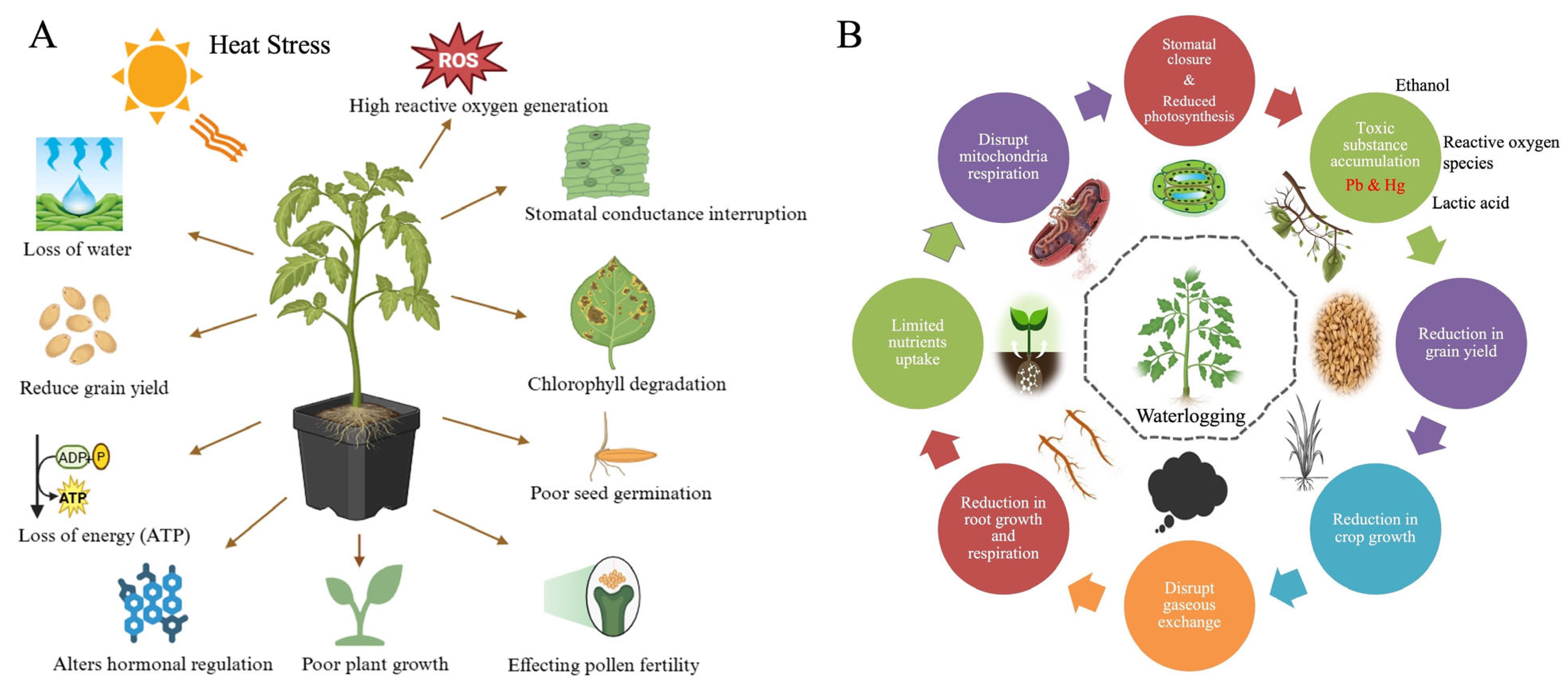
| Oxidative Stress | Increased ROS production in chloroplasts and mitochondria, leading to lipid peroxidation and chlorophyll degradation. | ROS production in roots due to hypoxia, causing mitochondrial dysfunction and anaerobic metabolism. | Both stresses induce ROS, but the organ-specific ROS sites differ: chloroplasts/mitochondria vs. roots. ROS management is critical under both stresses. |
| Respiration | Increased initially, but inhibited at high temperatures, leading to energy loss. | Reduced due to oxygen deprivation, inhibiting root growth. | Both stresses impair energy production, but mechanisms differ: thermal inhibition vs. hypoxic limitation. |
| Photosynthesis | Reduced CO2 assimilation due to stomatal closure and damaged photosynthetic enzymes. | Reduced photosynthesis due to stomatal closure, mesophyll conductance impairment, and chlorophyll degradation. | Stomatal closure is common, but mesophyll effects and enzyme stability differ; both result in lowered carbon assimilation. |
| Hormonal Regulation | ABA regulates stomatal closure; HSFs activate heat shock proteins for protection. | ABA regulates stomatal closure; ethylene regulates aerenchyma formation in roots. | ABA-mediated stomatal regulation is shared; stress-specific hormonal pathways (HSFs vs. ethylene) enable adaptation. |
| Energy Metabolism | Increased respiration to meet energy demands, but inhibited at high temperatures. | Oxygen deprivation restricts ATP production, inhibiting root growth and nutrient uptake. | Both stresses limit energy availability; heat increases demand, waterlogging limits production. |
| Stress-Specific Adaptations | Heat shock proteins (HSPs) protect cellular components; HSFs regulate their expression. | Ethylene-responsive transcription factors (ERF-VII) mediate root adaptations and aerenchyma formation. | Unique adaptive strategies reflect stress type: protein protection under heat vs. structural adaptation under waterlogging. |
| Feature | Heat Stress | Waterlogging Stress |
|---|---|---|
| Primary trigger | Elevated temperature and vapor pressure deficit (VPD) | Root hypoxia and impaired water uptake |
| Key hormone involved | Abscisic acid (ABA) | Abscisic acid (ABA) and ethylene |
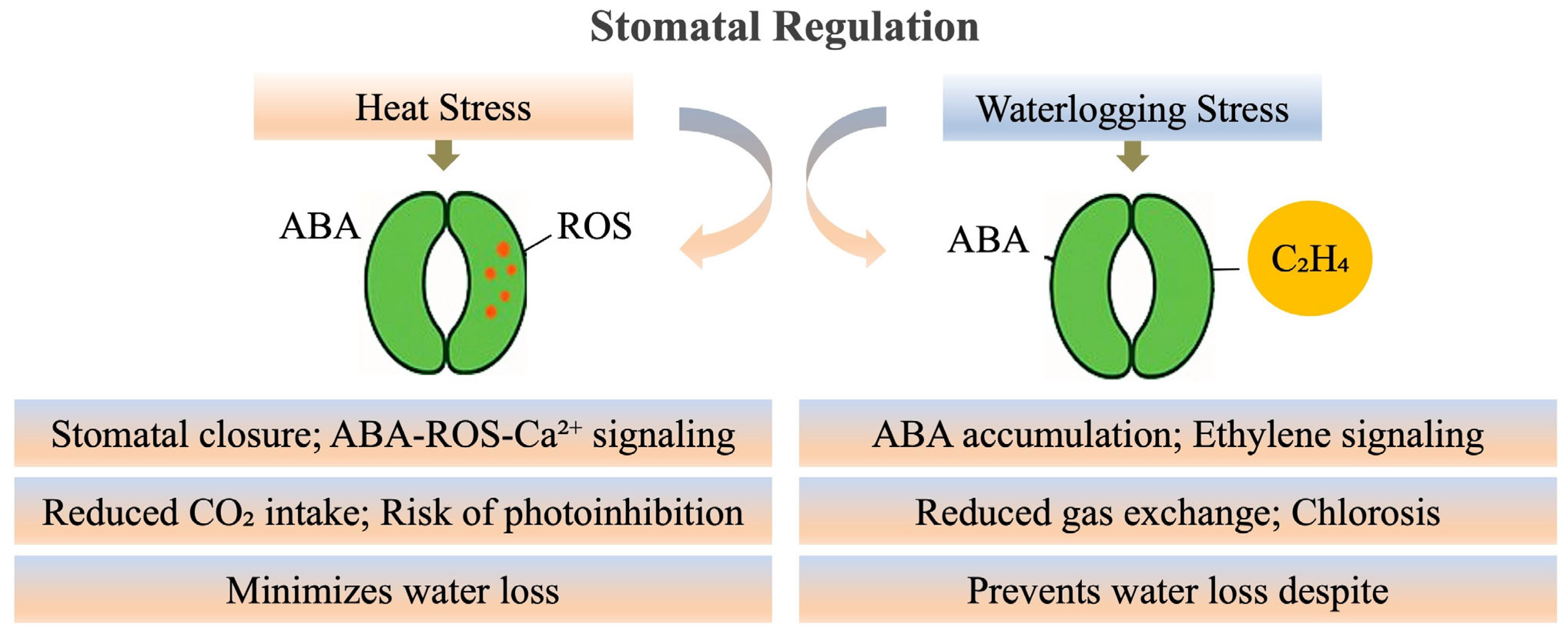
| Mechanism of closure | ABA-mediated ROS and Ca2+ signaling in guard cells | ABA accumulation due to root-zone hypoxia and ethylene |
| Photosynthetic impact | Reduced CO2 assimilation; increased risk of photoinhibition | Decreased gas exchange; chlorophyll degradation and leaf yellowing |
| Adaptive benefit | Limits transpiration water loss under high heat load | Conserves water despite saturated soil conditions |
| Long-term limitation | Reduced carbon fixation; potential overheating and growth suppression | Early senescence; reduced productivity due to prolonged gas exchange restriction |
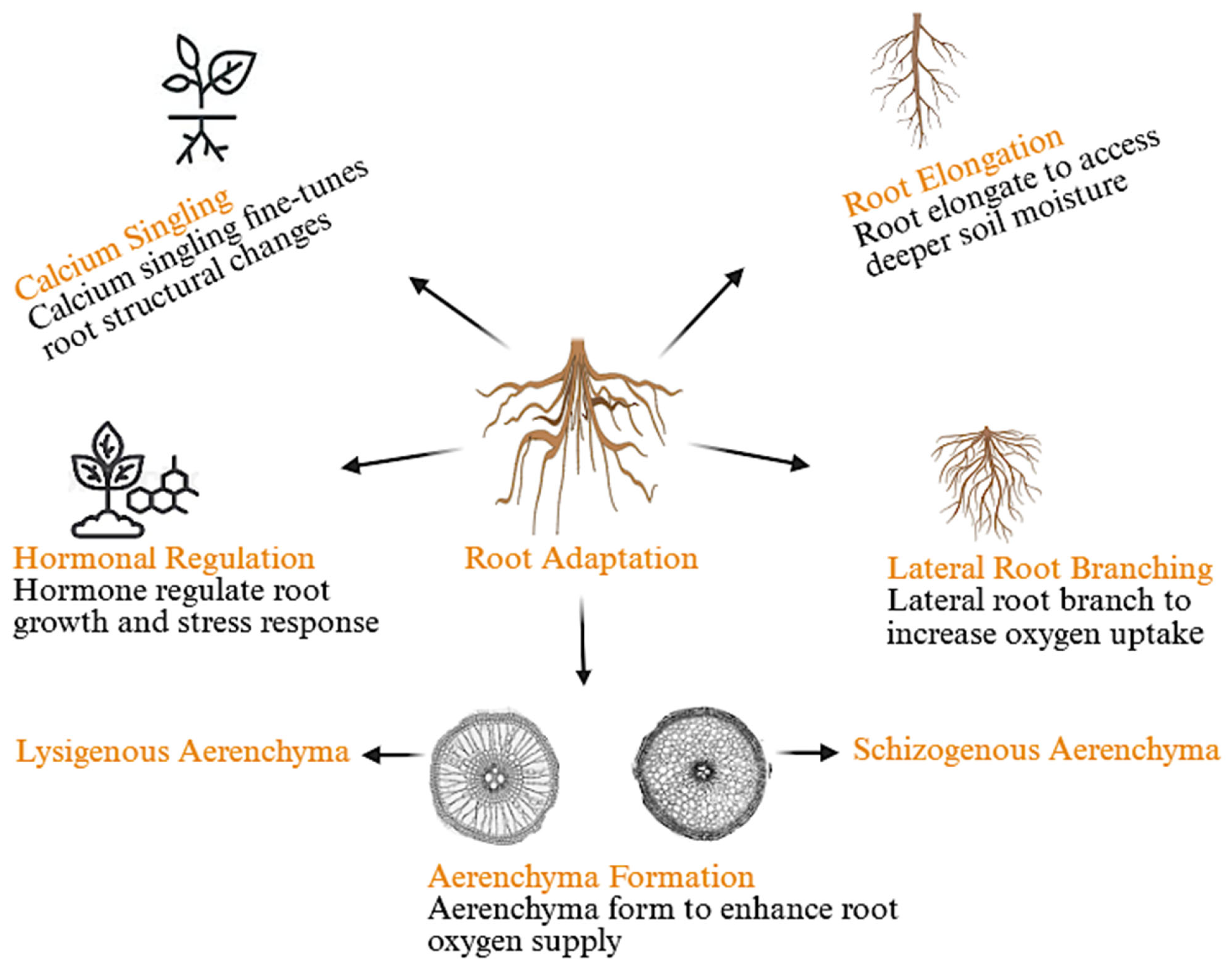
| Feature | Schizogenous Aerenchyma | Lysigenous Aerenchyma |
|---|---|---|
| Formation mechanism | Separation of pre-existing cells | Programmed cell death (PCD) and cell lysis |
| Energy cost | Lower | Moderate, due to enzymatic degradation |
| Species distribution | Less common; observed in some wetland species | Common in cereals like rice, maize, wheat, barley |
| Trigger | Sometimes constitutive | Induced by waterlogging, ethylene, ROS |
| Main regulator | Developmental control | Ethylene, ROS, NO, Ca2+ signaling |
| Adaptation benefit | Facilitates internal air movement | Reduces root respiration demand, enhances oxygen diffusion |
| Antioxidant Mechanism | Key Components | Functions | References |
|---|---|---|---|
| Enzymatic Antioxidants | Superoxide dismutase (SOD), Ascorbate peroxidase (APX), Catalase (CAT), Glutathione reductase (GR), etc. | Catalyze reactions to neutralize ROS (e.g., superoxide, hydrogen peroxide) | [20,66] |
| Non-Enzymatic Antioxidants | Ascorbate (AsA), Glutathione (GSH), Carotenoids, Tocopherols | Scavenge ROS directly, protecting cellular components from damage | [21] |
| ROS Generation and Scavenging | Hydrogen Peroxide (H2O2), Superoxide (O2−), Hydroxyl radical (-OH) | Generated under stress; involved in signaling and oxidative damage | [67] |
| ROS Signaling Pathways | MAPK, Ca2+ signaling, H2O2 signaling | Regulate stress responses and acclimation processes | [70] |
| Plant Hormones and ROS Interaction | Abscisic Acid (ABA), Ethylene (ET) | Enhance stress tolerance via cross-talk with ROS | [71] |
| Hormone | Primary Role | Stress Condition | Interaction with Other Hormones | Key Function |
|---|---|---|---|---|
| Abscisic Acid (ABA) | Stress response regulator | Heat and Drought | Work with ethylene | Promotes stomatal closure, Regulate root development, osmotic adjustments |
| Ethylene | Stress adaptation in low oxygen | Waterlogging (hypoxia) | Works with ABA | Forms aerenchyma tissue, aids in oxygen exchange, regulates stress tolerance |
| Gibberellins (GA) | Growth regulation | All stresses | Reduced activity during stress | Limits growth to conserve resources |
| Auxins | Root architecture regulation | Waterlogging | Interacts with cytokinins | Promotes root elongation and lateral root growth |
| Cytokinin | Cell division, shoot growth | All stresses | Works with auxins | Promotes cellular repair, stress tolerance mechanisms |
| Criteria | Broad Resilience (Shared Regulatory Hubs) | Stress-Specific Adaptations (Stacking Traits) |
|---|---|---|
| Predictability of Stress Co-occurrence | Unpredictable (Stresses occur at different times in varying region) | Predictable (Stresses co-occur in specific regions/seasons) |
| Target Mechanisms | ROS Scavenging, ABA Signaling, Antioxidant Systems: These shared mechanisms help manage oxidative stress and osmotic balance across different stress types, offering broad resilience to unpredictable stress environments. | HSPs for Heat Stress, ERF-VII for Waterlogging: These stress-specific adaptations target mechanisms critical to each stress, ensuring that plants can adapt effectively when both stresses co-occur in specific regions or seasons. |
| Application Strategy | Multi-Stress Resilience Across Various Regions: Targeting shared mechanisms like ROS scavenging and ABA signaling provides resilience against multiple stressors in varying environments | Tailored Solutions for Specific Stress Co-occurrence: Focusing on stacking traits (e.g., HSPs and ERF-VII) provides a customized solution for areas where heat and waterlogging predictably occur together. |
| Best Approach | Target shared mechanisms for broad resilience: By improving the plant’s ability to handle multiple stressors through shared regulatory hubs, crops become more resilient across a wide range of environmental conditions. | Stack stress-specific traits for local adaptation: By combining heat tolerance traits (HSPs) with waterlogging adaptations (ERF-VII), crops are optimized for the specific challenges of environments where these two stresses co-occur regularly. |
Disclaimer/Publisher’s Note: The statements, opinions and data contained in all publications are solely those of the individual author(s) and contributor(s) and not of MDPI and/or the editor(s). MDPI and/or the editor(s) disclaim responsibility for any injury to people or property resulting from any ideas, methods, instructions or products referred to in the content. |
© 2026 by the authors. Licensee MDPI, Basel, Switzerland. This article is an open access article distributed under the terms and conditions of the Creative Commons Attribution (CC BY) license.
Share and Cite
Iqbal, J.; Amanullah, S.; Li, C.; Qin, X.; Yu, P.; Chen, X.; Qiu, D. From Perception to Adaptation: A Comparative Study of Plant Regulatory Networks in Response to Heat and Waterlogging Stress. Plants 2026, 15, 328. https://doi.org/10.3390/plants15020328
Iqbal J, Amanullah S, Li C, Qin X, Yu P, Chen X, Qiu D. From Perception to Adaptation: A Comparative Study of Plant Regulatory Networks in Response to Heat and Waterlogging Stress. Plants. 2026; 15(2):328. https://doi.org/10.3390/plants15020328
Chicago/Turabian StyleIqbal, Javed, Sikandar Amanullah, Chengyue Li, Xiaohui Qin, Pengbo Yu, Xuanyang Chen, and Dongliang Qiu. 2026. "From Perception to Adaptation: A Comparative Study of Plant Regulatory Networks in Response to Heat and Waterlogging Stress" Plants 15, no. 2: 328. https://doi.org/10.3390/plants15020328
APA StyleIqbal, J., Amanullah, S., Li, C., Qin, X., Yu, P., Chen, X., & Qiu, D. (2026). From Perception to Adaptation: A Comparative Study of Plant Regulatory Networks in Response to Heat and Waterlogging Stress. Plants, 15(2), 328. https://doi.org/10.3390/plants15020328