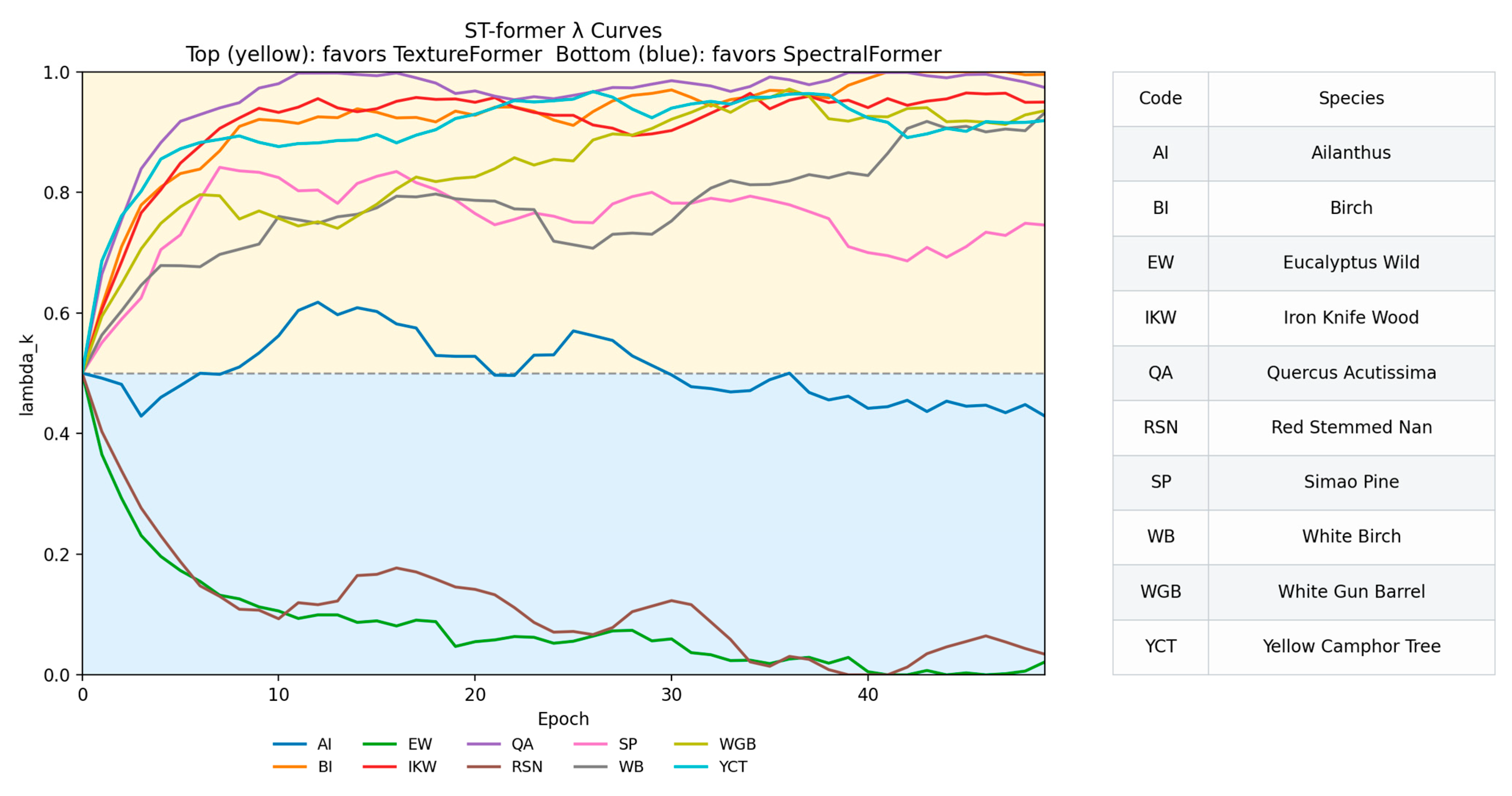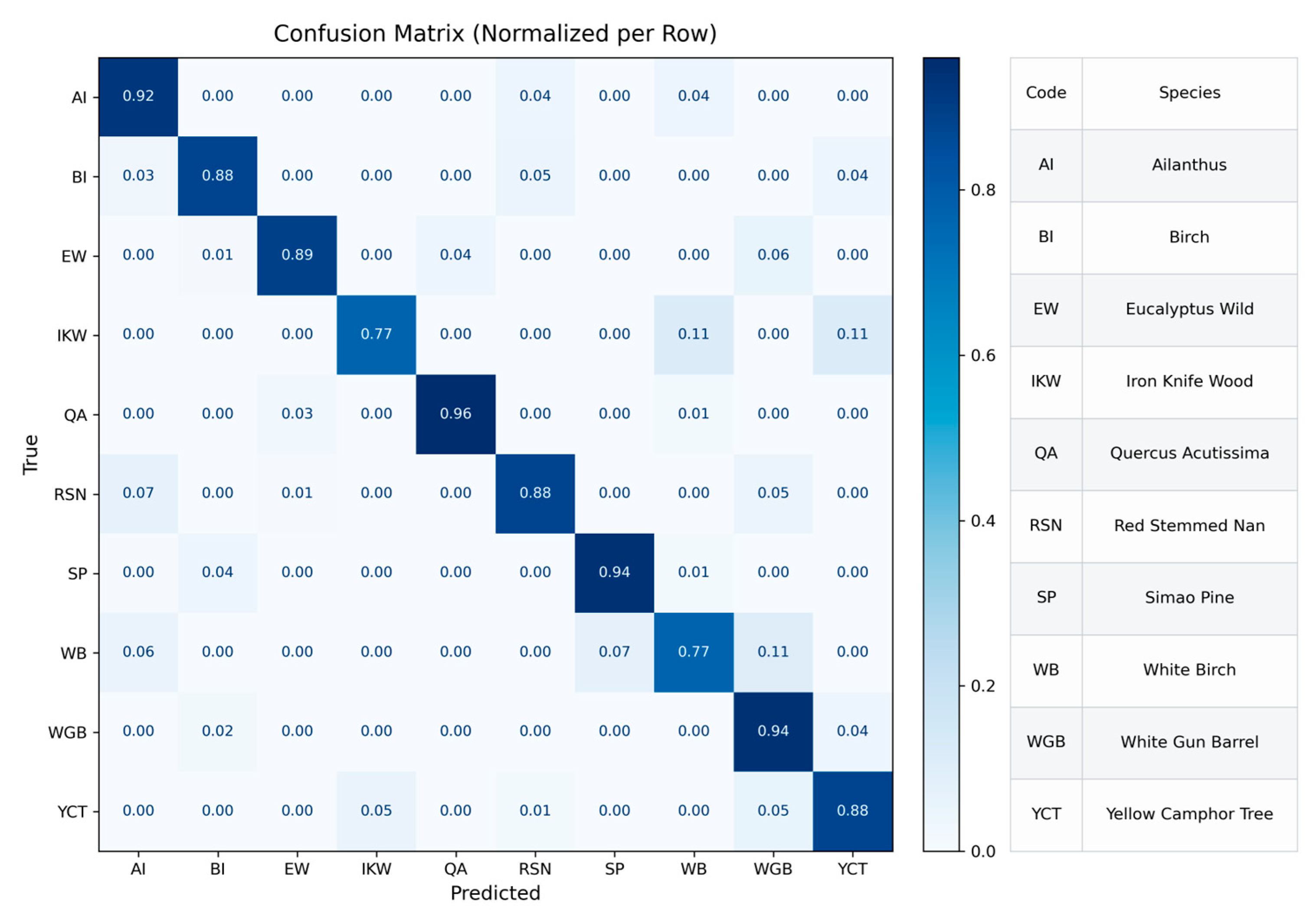
Research on Intelligent Wood Species Identification Method Based on Multimodal Texture-Dominated Features and Deep Learning Fusion
 , , ,
, , ,
Abstract
1. Introduction
2. Data Collection and Preprocessing
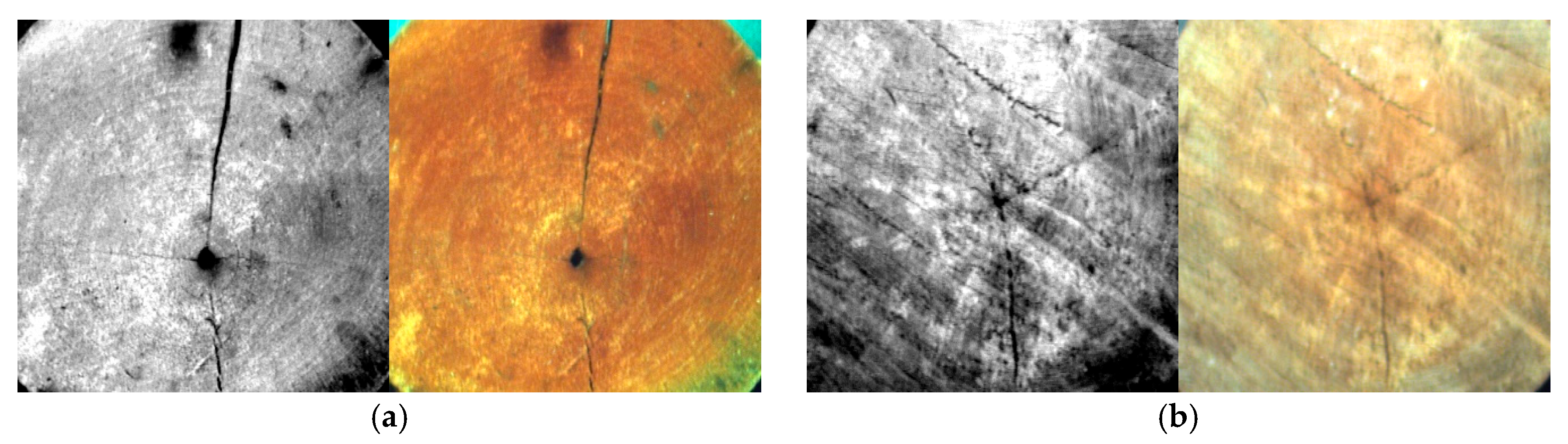
2.1. Wood Samples
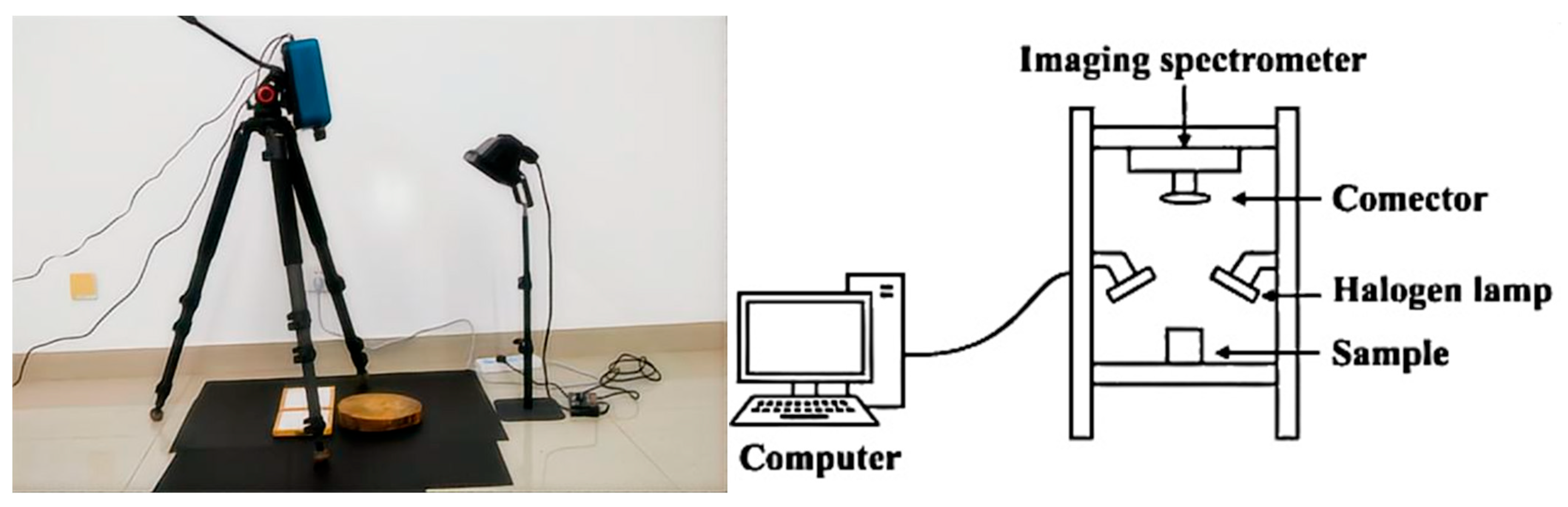
2.2. Collection Method
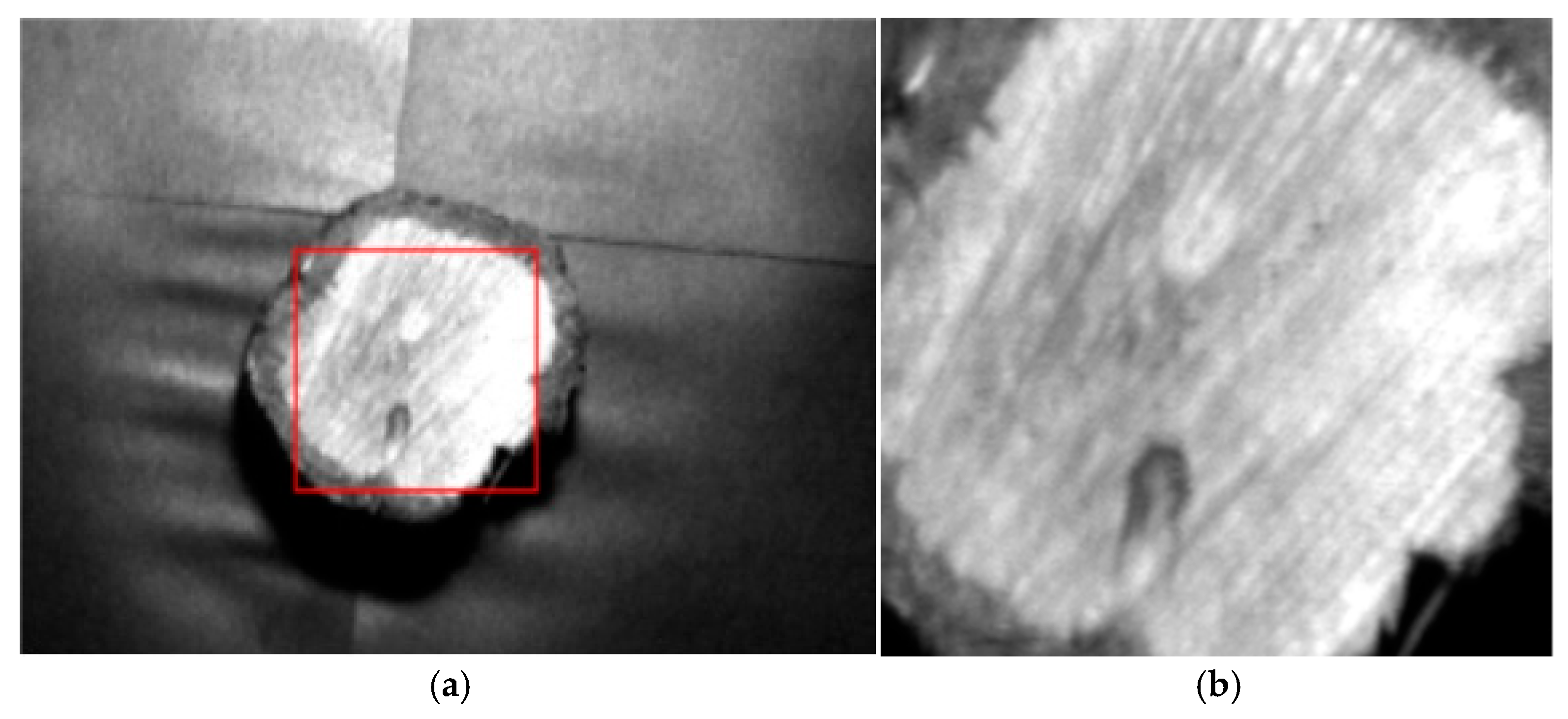
2.3. Dataset Preprocessing
3. Methods and Analysis
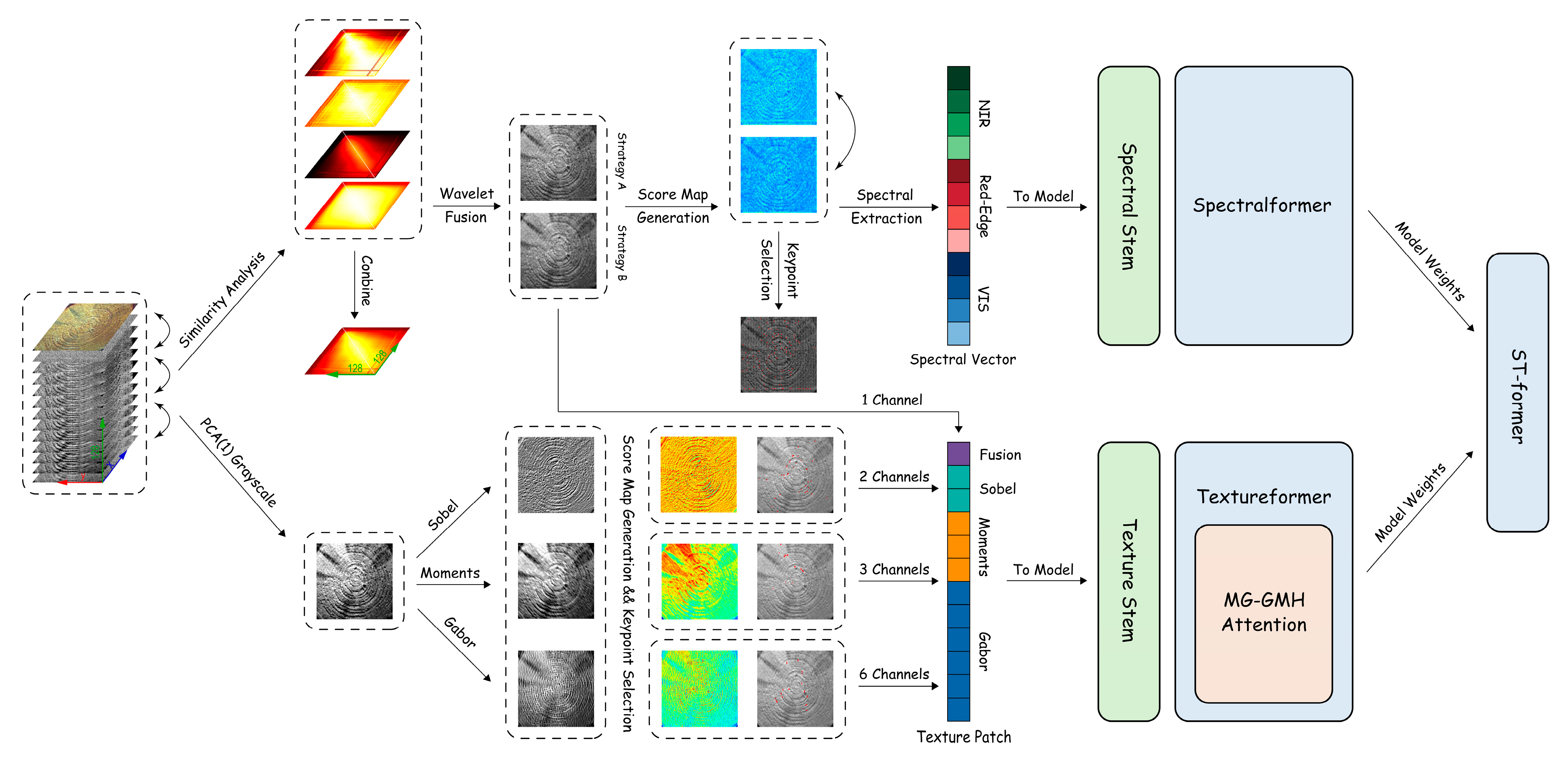
3.1. Multimodal Texture-Dominated Spectral Space Construction
3.1.1. A Hyperspectral Band Selection Method Based on Four Types of Indicators
- (1)
- Strategy A: Partition quota and maximum–min distance method (Max–Min)
- (2)
- Strategy B: Coverage-aware Max–Min method
3.1.2. Band Fusion Method Based on Wavelet Transform
3.1.3. Spectral Feature Extraction
- (1)
- Frequency domain notch degrid
- (2)
- Local enhancement and denoising
- (3)
- Multi-feature scoring map construction
- (4)
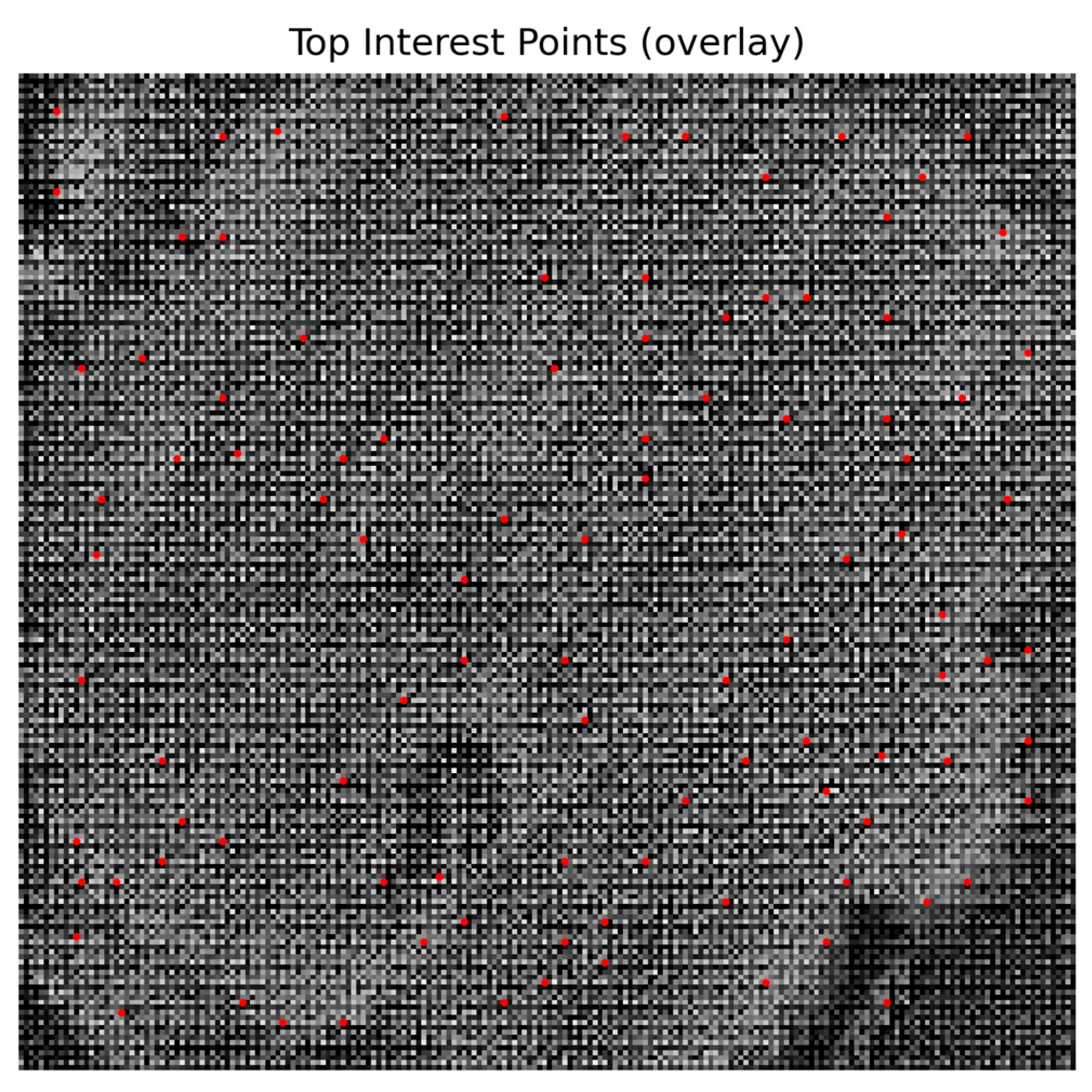
- Point of interest extraction
3.2. Multimodal Texture-Dominated Texture Space Construction
- (1)
- Principal component grayscale background image generation
- (2)
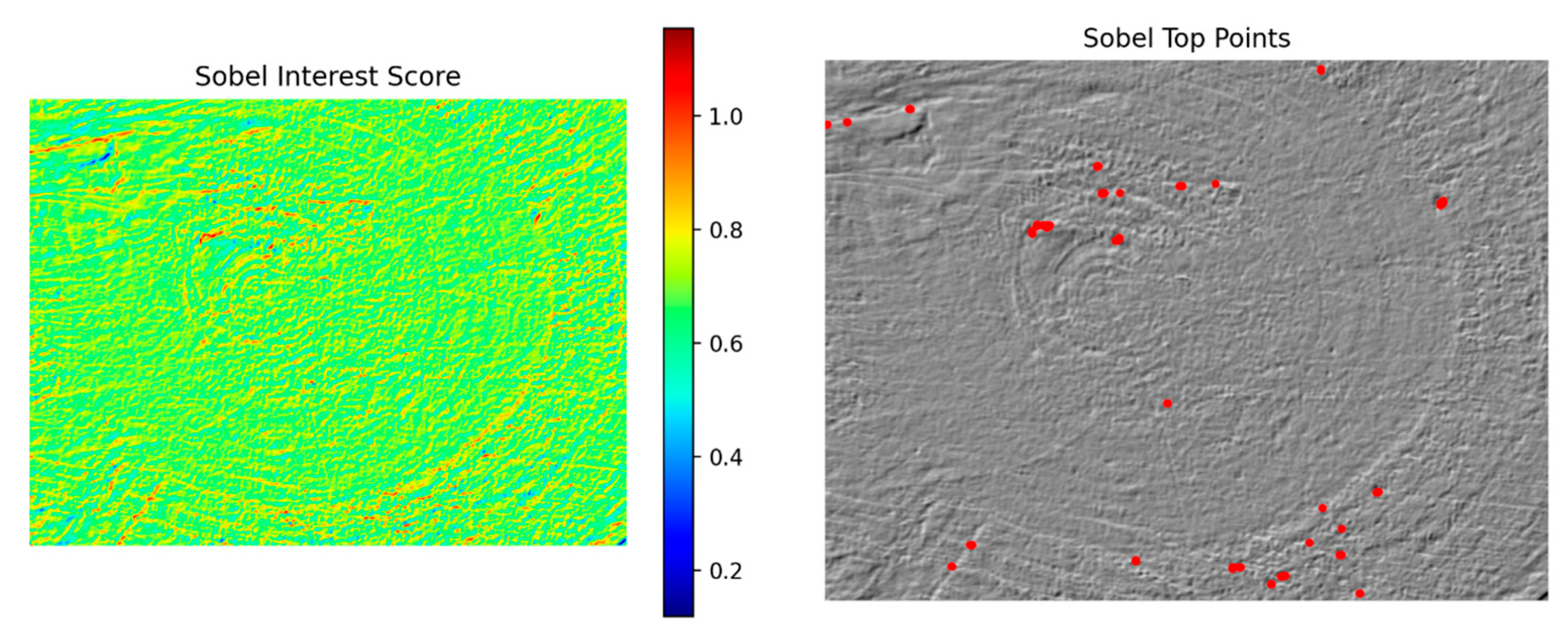
- Sobel edge features
- (3)
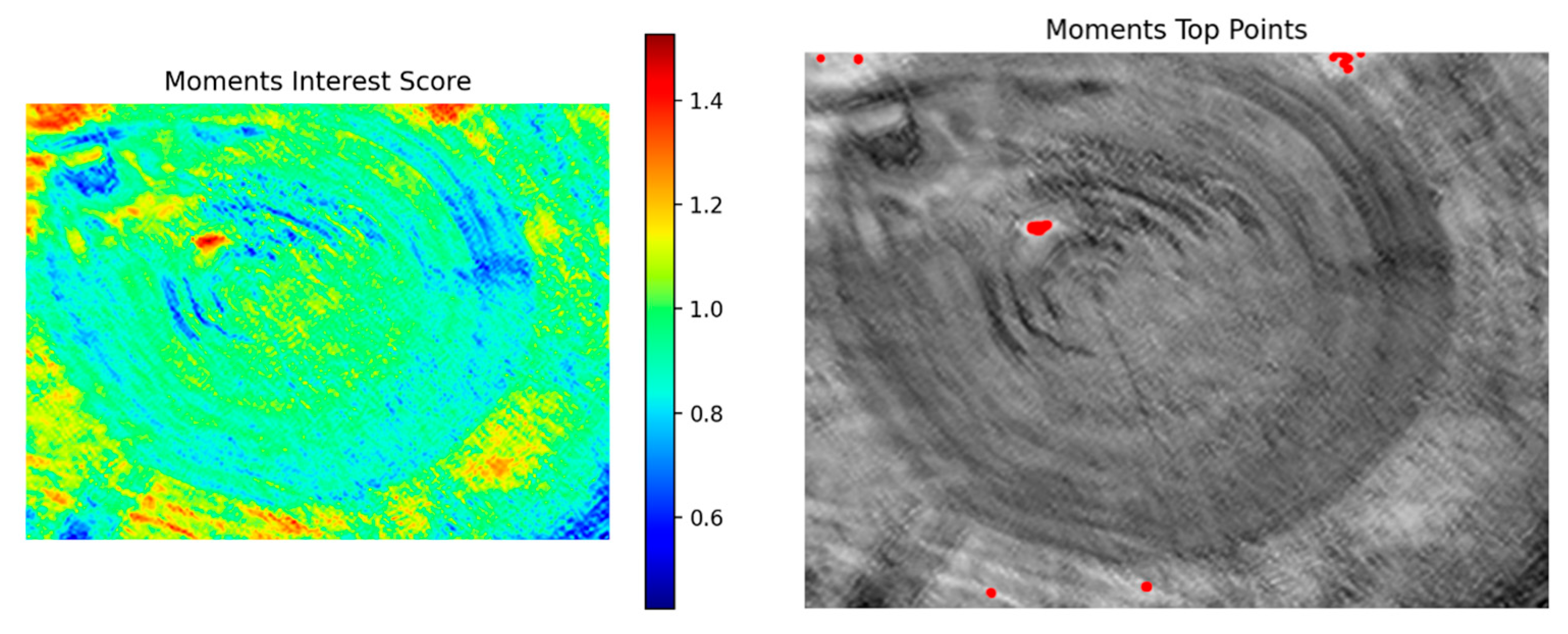
- Second-order geometric moment characteristics
- (4)
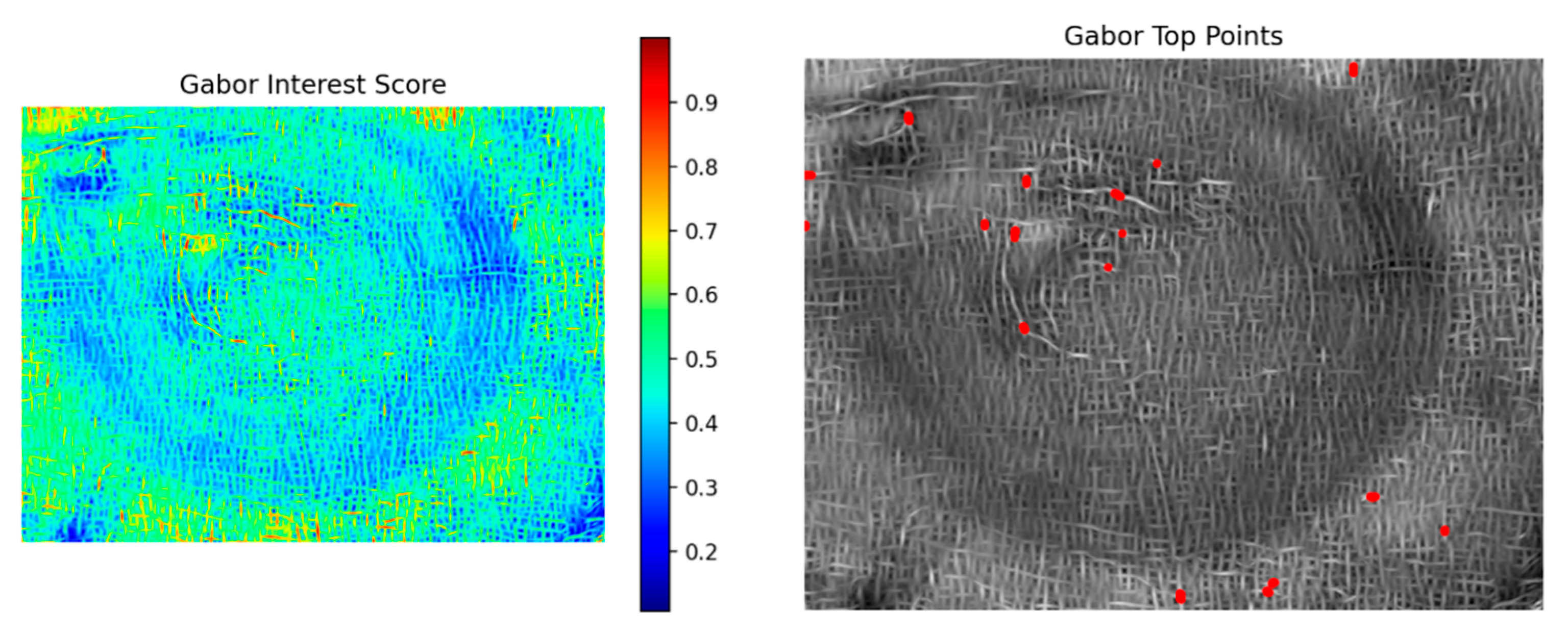
- Gabor energy characteristics
- (5)
- Intramodal Interest Point Filtering and Saving
3.3. Single Model Training
3.3.1. Spectralformer++
3.3.2. TextureFormer
- (1)
- Multi-channel input modeling based on Fusion–Sobel–Moments–Gabor
- (2)
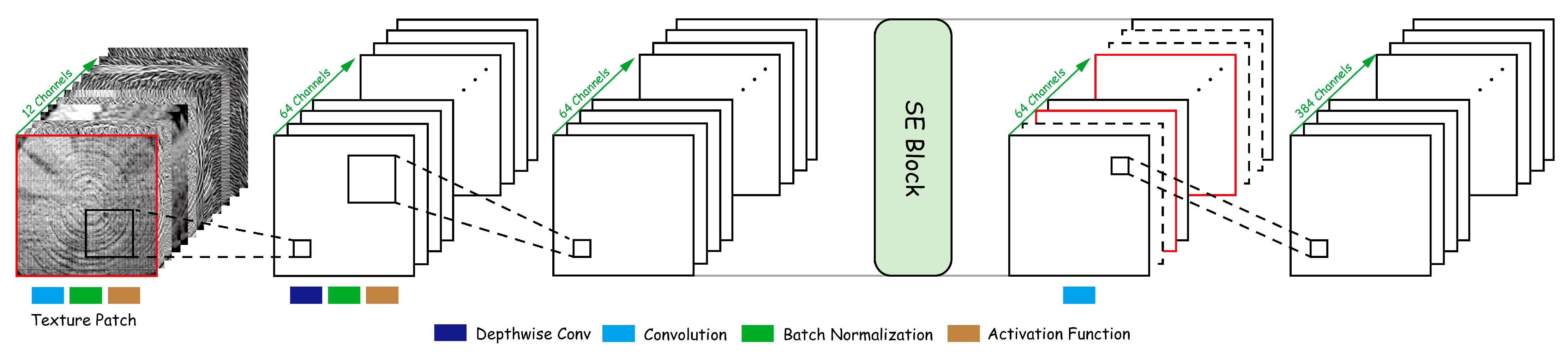
- Texture Stem: Lightweight Blending and Channel Recalibration
- Local fusion: The first layer of convolution mixes the 12 modal channels into a 64-dimensional feature space, completing the initial coupling of multi-source features:
- Spatial refinement: Depthwise separable convolution enhances spatial consistency while maintaining low parameter count:
- Channel recalibration via SE mechanism:
- High-dimensional embedding: The final convolution increases the feature dimension to :
- (3)
- Interest-guided group attention mechanism
- (1)
- Interest-Based Saliency Modeling
- (2)
- Modality-Based Attention Head Grouping
- (3)
- Saliency Bias Injection
3.4. Complementary and Collaborative Learning Training
3.4.1. Method Overview
3.4.2. Training Objective and Loss Function
4. Experiment and Results
4.1. Experimental Analysis of Wood Spectral Space Construction
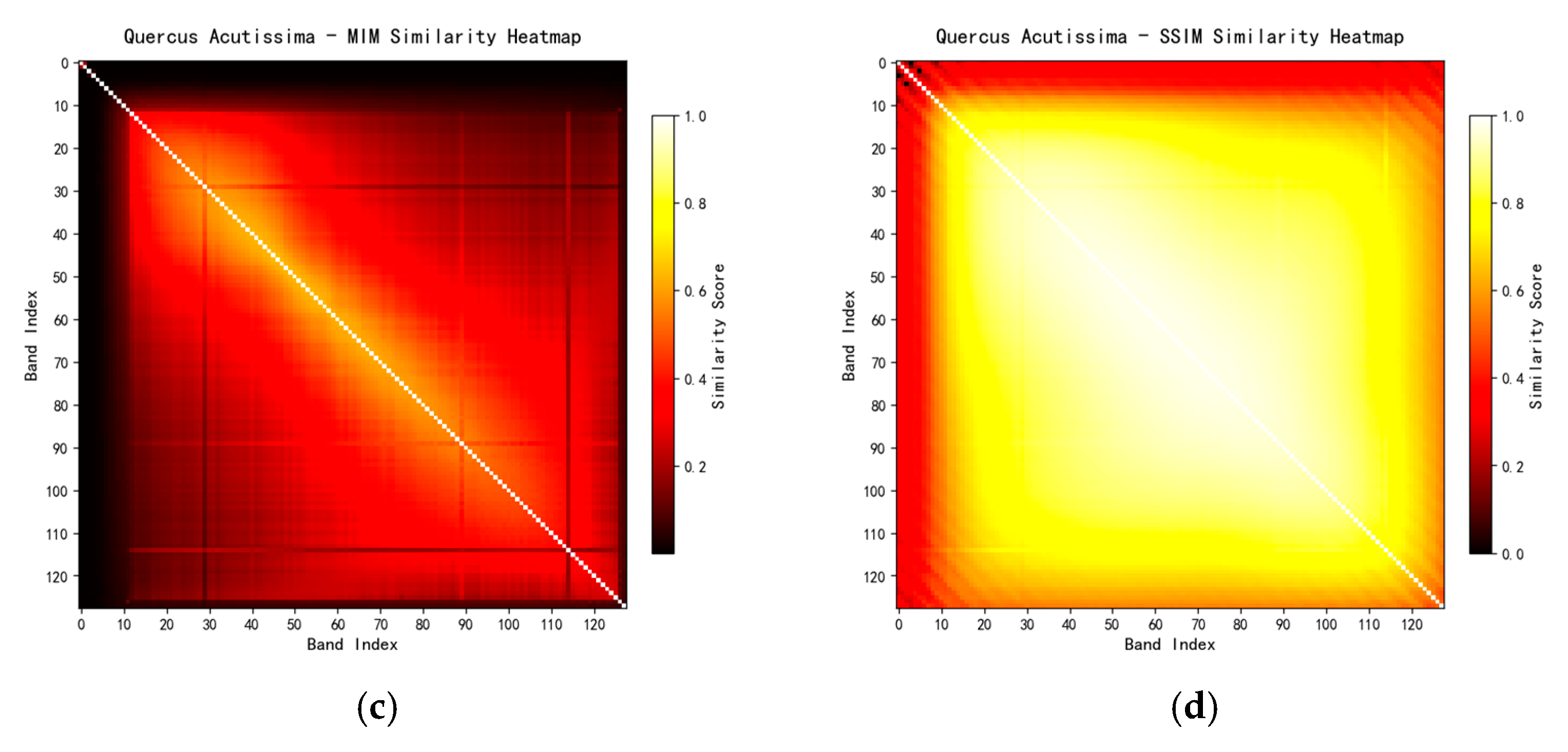
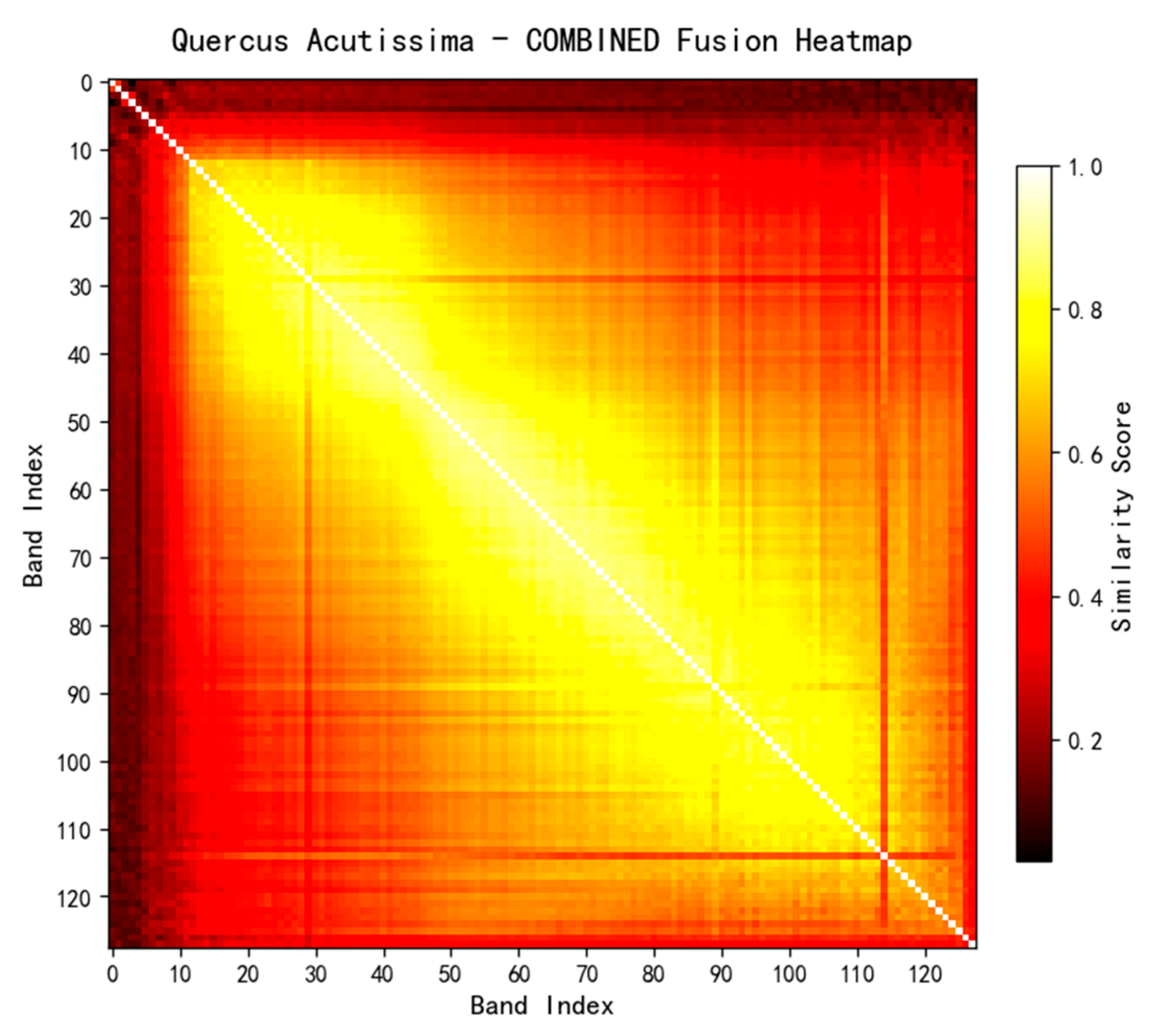
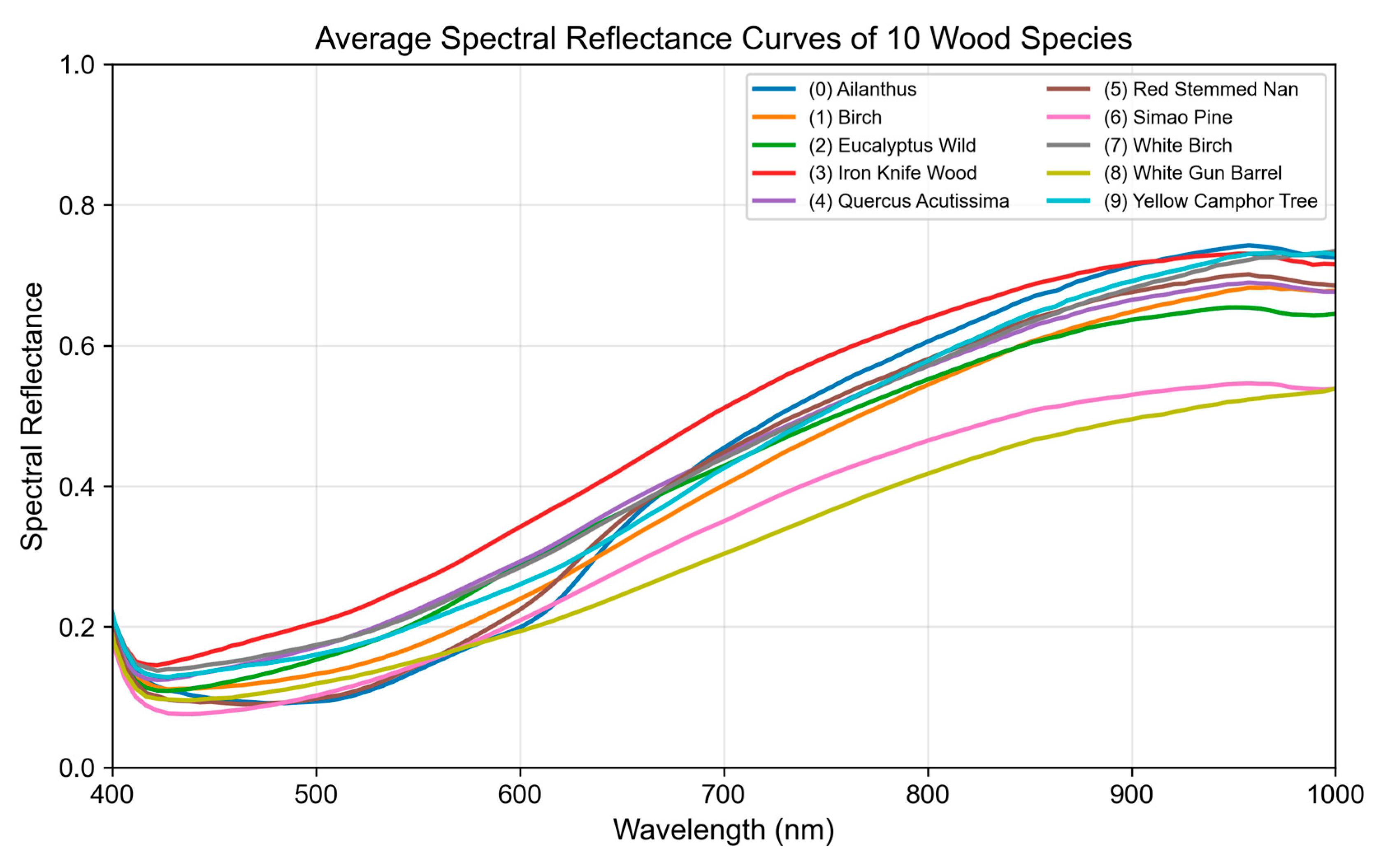
4.1.1. Experimental Analysis of Hyperspectral Band Selection
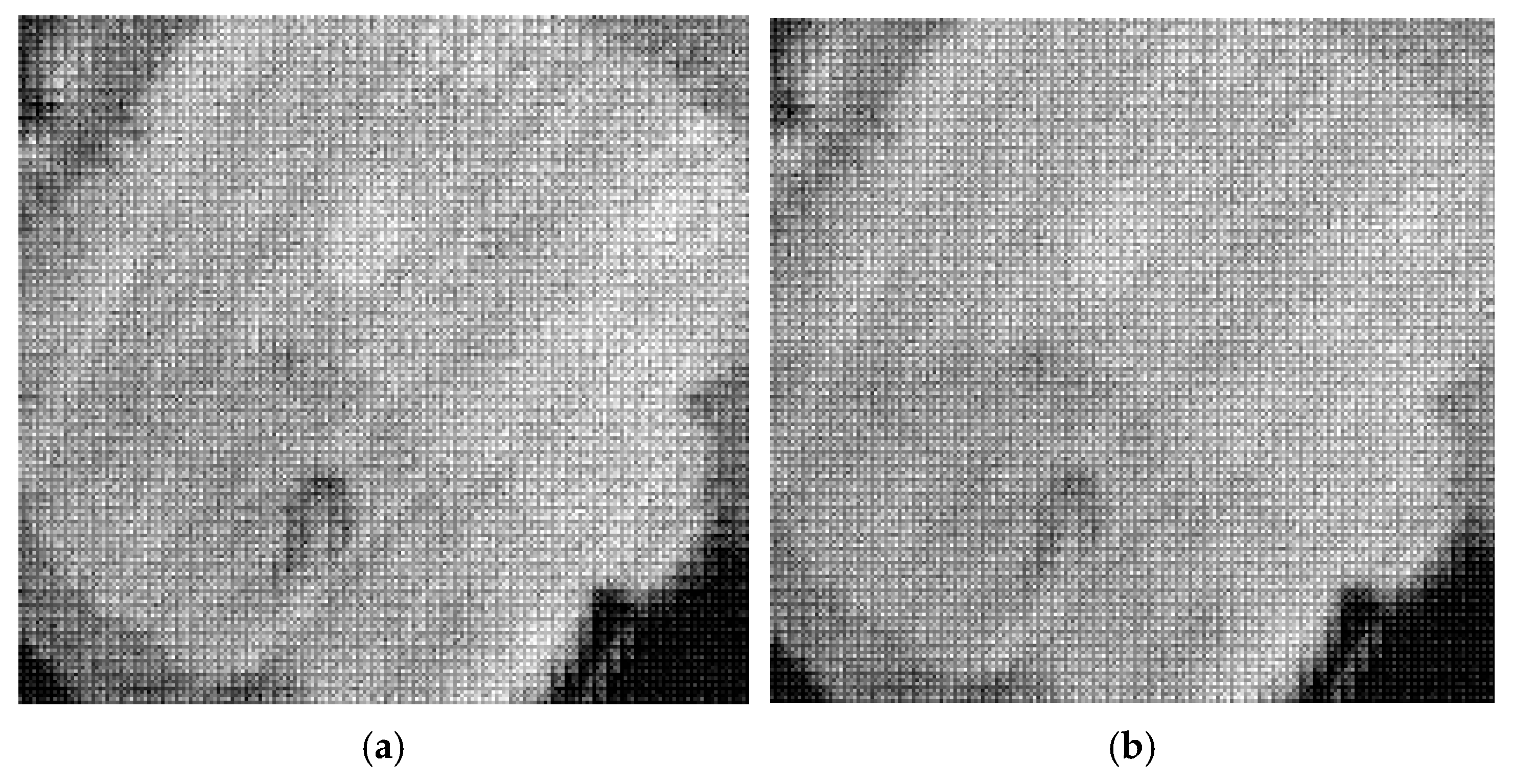
4.1.2. Experimental Analysis of Wavelet Transform Band Fusion
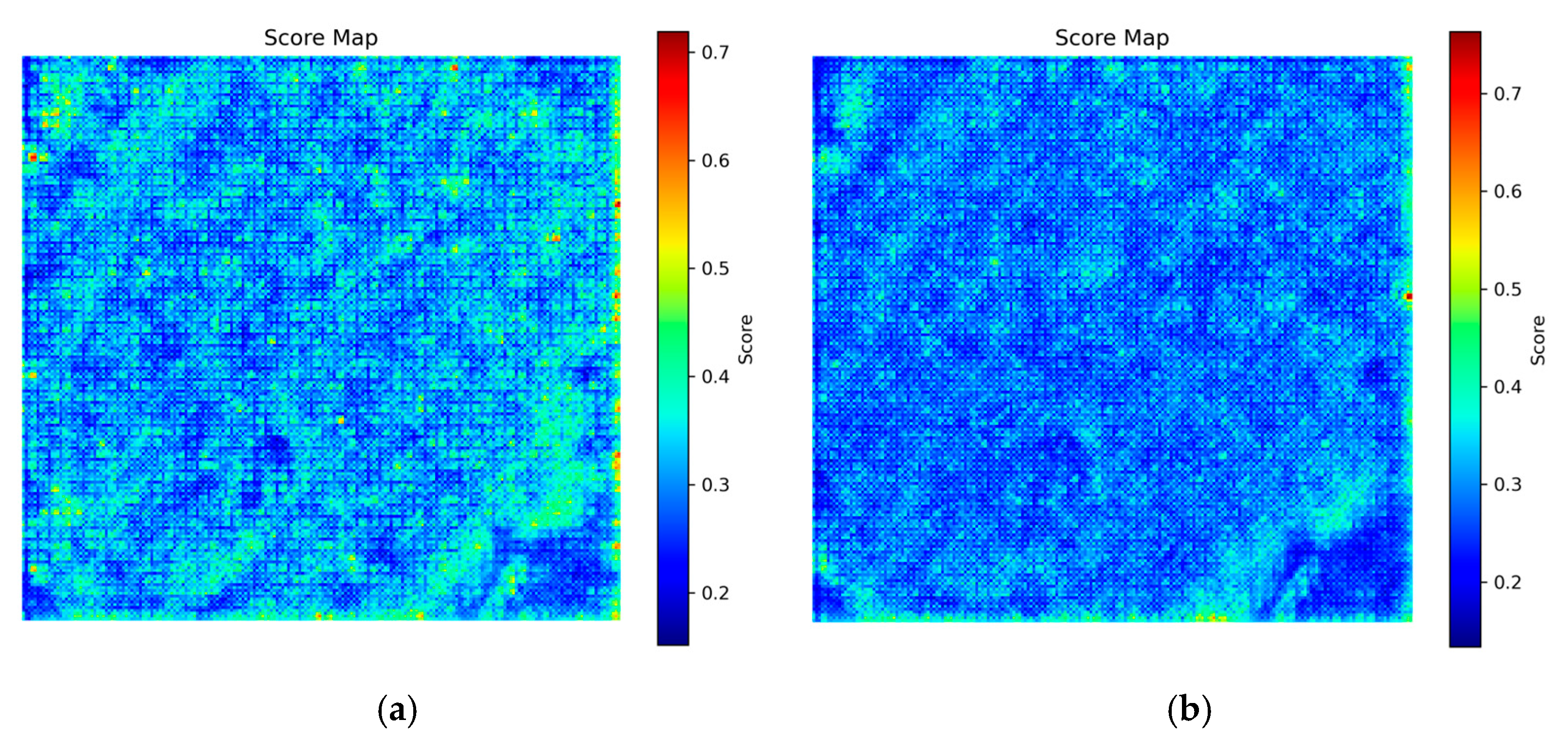
4.1.3. Experimental Analysis of Spectral Feature Extraction
4.2. Experimental Analysis of Wood Texture Space Construction
4.3. Experimental Analysis of Single Model Training
- (1)
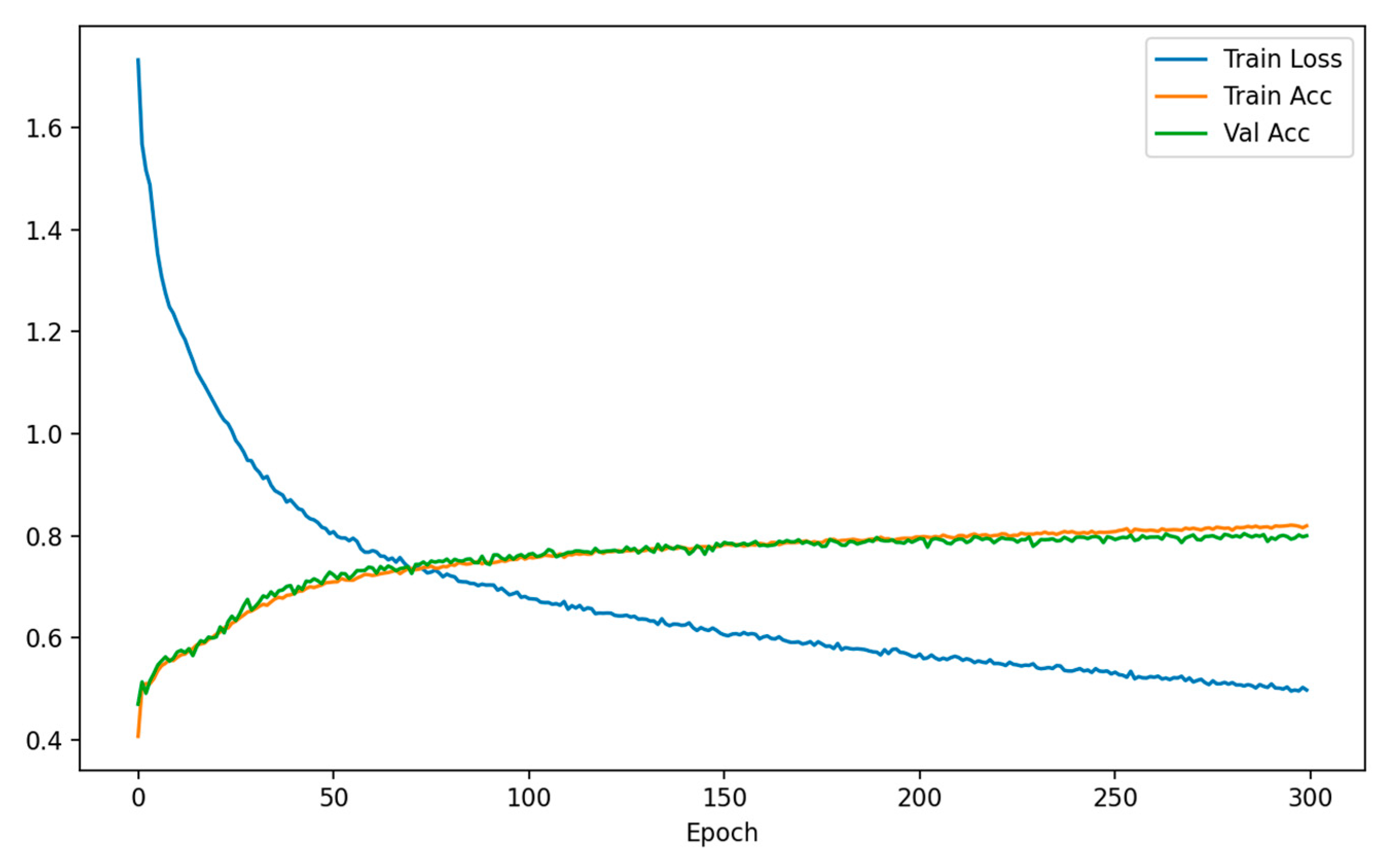
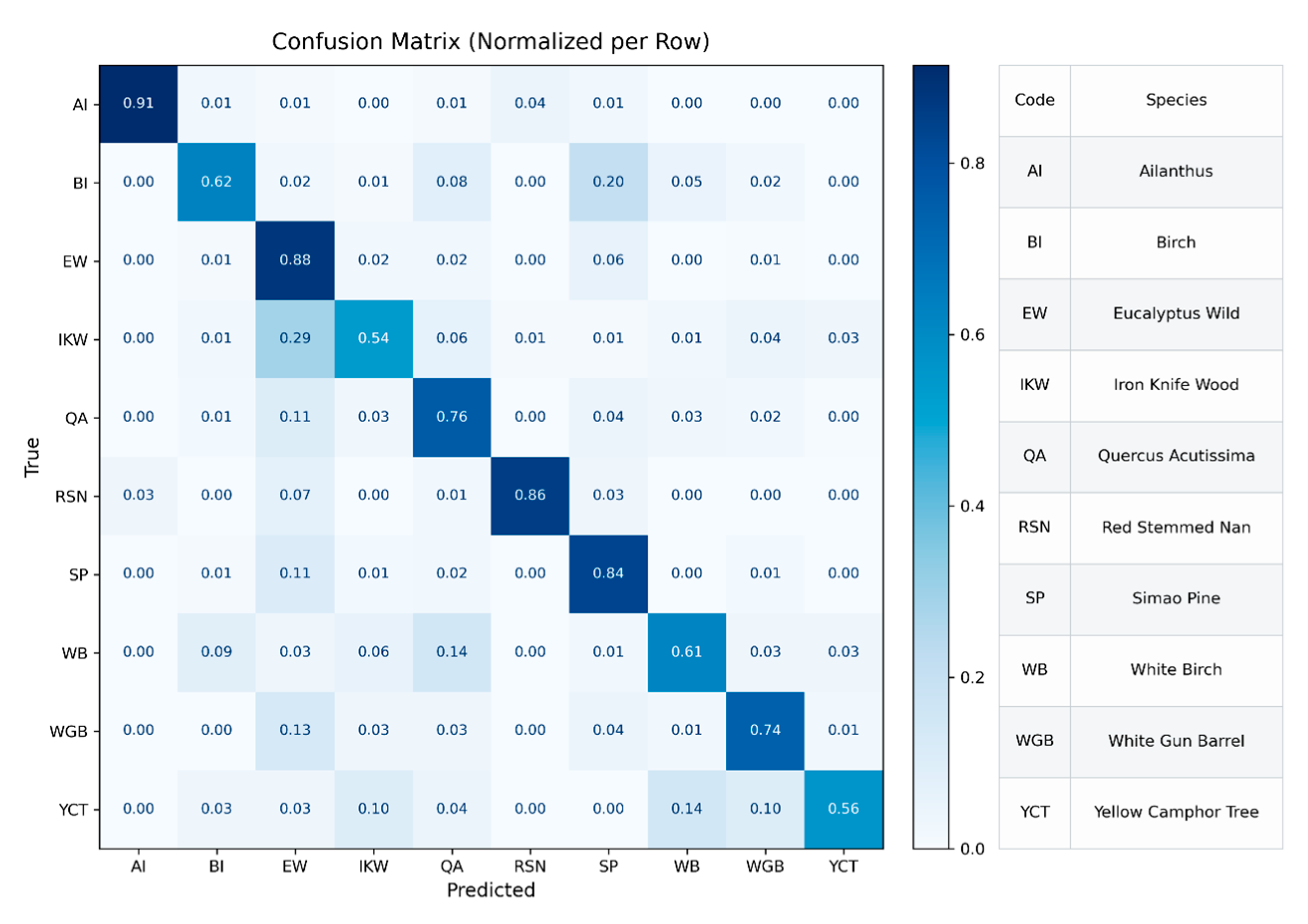
- Training and Performance Evaluation of the SpectralFormer++
- (2)
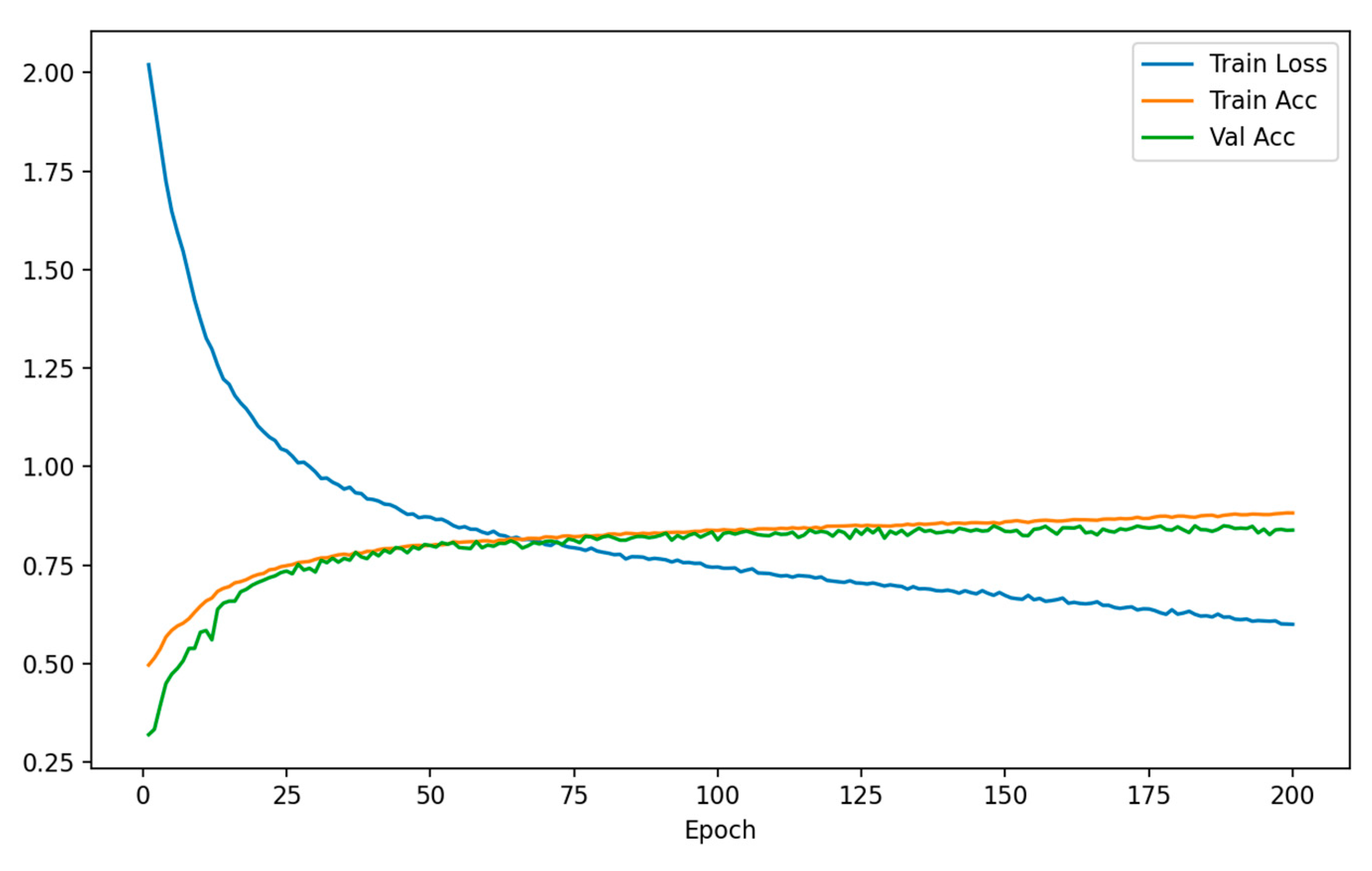
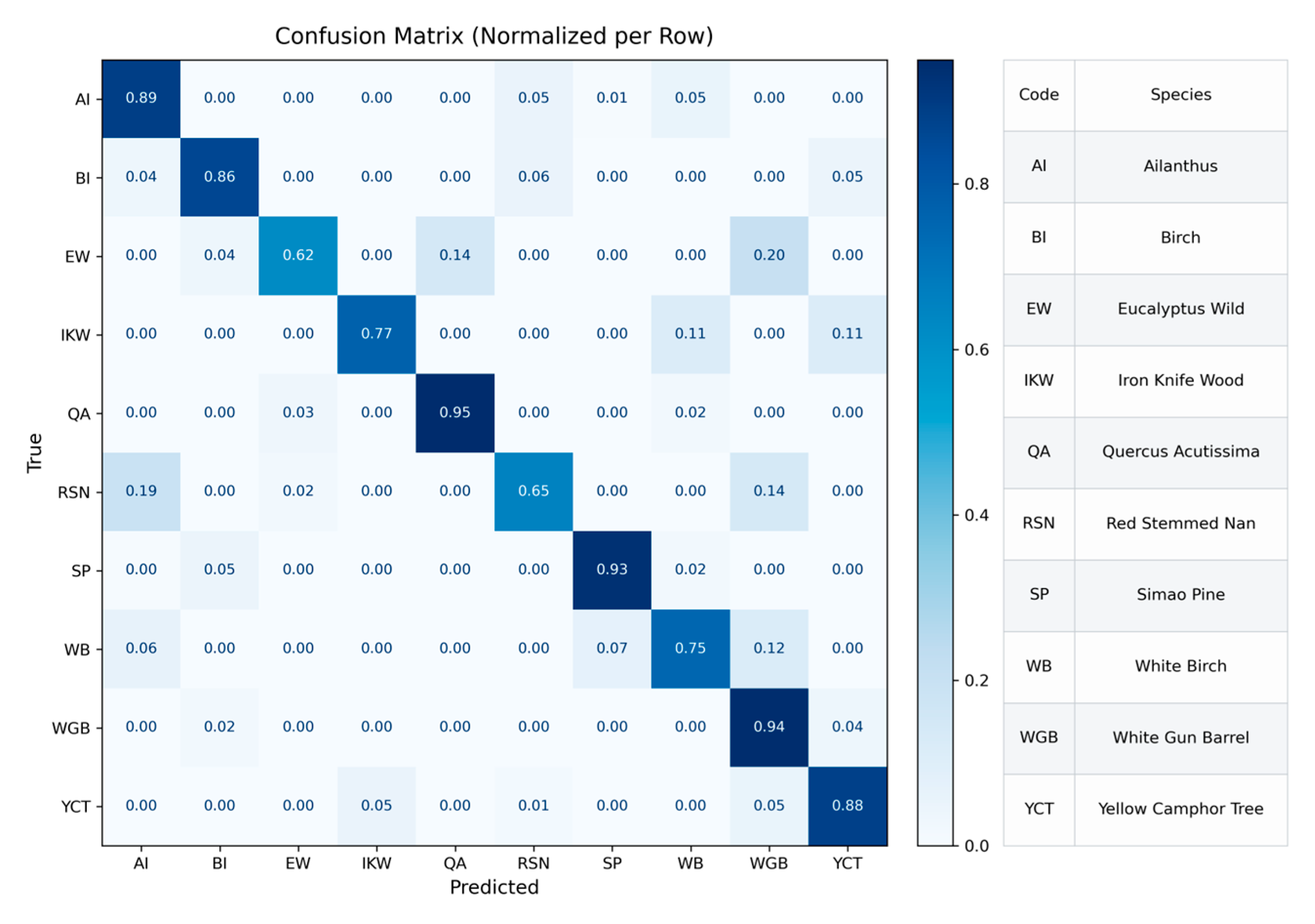
- Training and Performance Evaluation of the TextureFormer
4.4. Complementary Collaborative Learning Parameter Training and Performance Evaluation
5. Discussion
6. Conclusions
Author Contributions
Funding
Data Availability Statement
Conflicts of Interest
Abbreviations
| AI | Ailanthus | Ailanthus altissima (Mill.) Swingle |
| BI | Birch | Betula alnoides Buch.-Ham. ex D. Don |
| EW | Eucalyptus Wild | Eucalyptus rudis Endl |
| IKW | Iron Knife Wood | Senna siamea (Lam.) H. S. Irwin & Barneby |
| QA | Quercus Acutissima | Quercus aliena Blume |
| RSN | Red Stemmed Nan | Phoebe rufescens H. W. Li |
| SP | Simao Pine | Pinus kesiya var. langbianensis (A. Chev.) Gaussen |
| WB | White Birch | Betula platyphylla Sukaczev |
| WGB | White Gun Barrel | Fraxinus malacophylla Hemsl |
| YCT | Yellow Camphor Tree | Cinnamomum parthenoxylon (Jack) Meisn. |
| Symbol | Description | |
| Indices of spectral bands | ||
| , obtained by weighted fusion of multiple indicators | ||
| Set of selected spectral bands | ||
| Index of a candidate spectral band | ||
| Selected band maximizing the minimum distance to the current band set | ||
| Target number of selected spectral bands | ||
| Coverage reward factor in the coverage-aware Max–Min band selection strategy | ||
| belongs | ||
| Set of spectral regions already covered by the selected band set | ||
| Hyperspectral image cube after band filtering | ||
| Number of spectral bands after selection | ||
| Spatial height and width of the hyperspectral image | ||
| -th selected spectral band | ||
| ) | ||
| Decomposition level of the wavelet transform | ||
| Daubechies-4 wavelet basis function | ||
| Input fused image in the spatial domain | ||
| Fourier transform of the input image | ||
| -th periodic interference peak in the frequency domain | ||
| Gaussian notch filter mask in the frequency domain | ||
| Suppression intensity of the notch filter | ||
| Radius of the Gaussian notch filter | ||
| Image after notch filtering and inverse Fourier transform | ||
| Gamma correction parameter used in local enhancement | ||
| Original hyperspectral image cube | ||
| Grayscale base image obtained from the first principal component of the hyperspectral cube | ||
| Horizontal and vertical Sobel gradient responses | ||
| Two-channel Sobel edge feature map | ||
| Linear normalization operator applied to feature response maps | ||
| Window size for local geometric moment computation | ||
| Second-order geometric moment kernels | ||
| Second-order geometric moment response maps | ||
| Three-channel normalized geometric moment feature map | ||
| Gabor filter orientation angle | ||
| Rotated spatial coordinates in the Gabor filter | ||
| Wavelength of the Gabor filter | ||
| Standard deviation of the Gaussian envelope in the Gabor filter | ||
| Spatial aspect ratio of the Gabor filter | ||
| Six-channel Gabor energy feature map | ||
| Multi-feature scoring map for texture saliency | ||
| Harris corner response map | ||
| Local entropy feature map | ||
| Gradient magnitude feature map | ||
| Laplacian response map | ||
| Difference-of-Gaussians response map | ||
| Signal-to-noise ratio feature map | ||
| Relative threshold for interest point detection | ||
| Minimum spatial distance between interest points | ||
| ) | ||
| Three-channel spectral derivative input token consisting of original, first-order, and second-order spectral features | ||
| Linear projection matrix in the spectral embedding layer | ||
| Bias term of the spectral embedding layer | ||
| ) | ||
| Layer-normalized spectral embedding output | ||
| Layer normalization applied to the spectral embedding | ||
| Fusion-based texture feature map | ||
| Sobel-based texture feature map | ||
| Second-order geometric moment texture feature map | ||
| Gabor energy-based texture feature map | ||
| Multimodal texture feature tensor concatenated along the channel dimension | ||
| Output feature map of the Texture Stem module | ||
| convolution in the Texture Stem | ||
| Intermediate feature map after depthwise separable convolution in the Texture Stem | ||
| Channel-recalibrated feature map after SE attention | ||
| Channel-wise attention weight generated by the SE mechanism | ||
| ) | ||
| Modality index corresponding to fusion, Sobel, moments, or Gabor texture modality | ||
| Attention head index in the multi-head attention mechanism | ||
| -th interest point combining confidence strength and spatial dispersion | ||
| -th interest point | ||
| Normalization constant in the True Score computation | ||
| Trade-off parameter controlling confidence strength and spatial dispersion | ||
| Patch stride used to map spatial coordinates to Transformer tokens | ||
| within an attention window | ||
| -th attention head | ||
| -th attention head with saliency bias injection | ||
| Relative position bias in window-based self-attention | ||
| Query, key, and value matrices in the attention mechanism | ||
| Class-wise fusion coefficient in complementary collaborative learning | ||
| Sigmoid function applied to fusion coefficients | ||
| Cross-entropy loss for fused logits | ||
| Regularization loss preventing fusion weight collapse | ||
| Final training objective combining classification and regularization losses | ||
| Weighting factor for the regularization term | ||
| Batch size | ||
| Number of classes | ||
| ) | ||
| Training sample index | ||
| Class index | ||
| Class index for fusion coefficient | ||
References
- Chen, Y.; Meng, Y.; Zhang, J.; Xie, Y.; Guo, H.; He, M.; Shi, X.; Mei, Y.; Sheng, X.; Xie, D. Leakage Proof, Flame-Retardant, and Electromagnetic Shield Wood Morphology Genetic Composite Phase Change Materials for Solar Thermal Energy Harvesting. Nano-Micro Lett. 2024, 16, 196. [Google Scholar] [CrossRef]
- Mo, L.; Crowther, T.W.; Maynard, D.S.; Johan, V.D.H.; Ma, H.Z.; Lalasia, B.M.; Liang, J.J.; Sergio, D.M.; Nabuurs, G.J.; Reich, P.B. The global distribution and drivers of wood density and their impact on forest carbon stocks. Nat. Ecol. Evol. 2024, 8, 2195–2212. [Google Scholar] [CrossRef]
- Khoo, P.S.; Rizal, M.A.M.; Ilyas, R.A.; Yajid, M.A.M.; Shukur, A.H.; Yahya, M.Y.; Wahit, M.U. Unveiling Favorable Mechanical Properties of Lignocellulosic Wood—Reinforced Thermoplastic Composites as Future Green and Sustainable Materials. Fibers Polym. 2025, 26, 1425–1448. [Google Scholar] [CrossRef]
- Korjakins, A.; Sahmenko, G.; Lapkovskis, V. A Short Review of Recent Innovations in Acoustic Materials and Panel Design: Emphasizing Wood Composites for Enhanced Performance and Sustainability. Appl. Sci. 2025, 15, 4644. [Google Scholar] [CrossRef]
- DeLigne, L.; Fredriksson, M.; Thygesen, L.G.; Thybring, E.E. Influence of degradation products from thermal wood modification on wood-water interactions. J. Mater. Sci. 2025, 60, 3346–3364. [Google Scholar] [CrossRef]
- Zhu, Y.; Li, L. Wood of trees: Cellular structure, molecular formation, and genetic engineering. J. Integr. Plant Biol. 2024, 66, 443–467. [Google Scholar] [CrossRef] [PubMed]
- Fu, Z.; Lu, Y.; Wu, G.; Bai, L.; Daniel, B.R.; Lyu, J.; Liu, S.; Rojas, O. Wood elasticity and compressible wood-based materials: Functional design and applications. Prog. Mater. Sci. 2025, 147, 101354. [Google Scholar] [CrossRef]
- Hussein, A.; Bulbul, A.; Wu, Q.; Lin, H.; Kameshwar, H.; Mohammad, S. Effect of partial delignification and densification on chemical, morphological, and mechanical properties of wood: Structural property evolution. Ind. Crops Prod. 2024, 213, 118430. [Google Scholar]
- Everton, J.; Thiago, F.; Camila, C.; Miller, L.; Goncalves, D.; Oliveira, S.L.; Marangoni, B.; Cena, C. Making wood inspection easier: FTIR spectroscopy and machine learning for Brazilian native commercial wood species identification. RSC Adv. 2024, 14, 7283. [Google Scholar] [CrossRef]
- Reh, R.; Kristak, L.; Kral, P.; Pipiska, T.; Jopek, M. Perspectives on Using Alder, Larch, and Birch Wood Species to Maintain the Increasing Particleboard Production Flow. Polymers 2024, 16, 1532. [Google Scholar] [CrossRef]
- Niemz, P.; Sandberg, D. Critical wood-particle properties in the production of particleboard. Wood Mater. Sci. Eng. 2022, 17, 386–387. [Google Scholar] [CrossRef]
- Janceva, S.; Andersone, A.; Spulle, U.; Tupciauskas, R.; Papadopoulou, E.; Bikovens, O.; Andzs, M.; Zaharova, N.; Rieksts, G.; Telysheva, G.; et al. Eco-friendly adhesives based on the oligomeric condensed tannins-rich extract from alder bark for particleboard and plywood production. Materials 2022, 15, 3894. [Google Scholar] [CrossRef]
- Szadkowska, D.; Auriga, R.; Lesiak, A.; Szadkowski, J.; Marchwicka, M. Influence of Pine and Alder Woodchips Storage Method on the Chemical Composition and Sugar Yield in Liquid Biofuel Production. Polymers 2022, 14, 3495. [Google Scholar] [CrossRef] [PubMed]
- Lima, M.; Ramalho, F.; Trugilho, P.; Bufalino, L.; Moreira, M. Classifying waste wood from Amazonian species by near-infraredspectroscopy (NIRS) to improve charcoal production. Renew. Energy 2022, 193, 584–594. [Google Scholar] [CrossRef]
- Sydor, M.; Mirski, R.; Stuper-Szablewska, K.; Rogoziński, T. Efficiency of Machine Sanding of Wood. Appl. Sci. 2021, 11, 2860. [Google Scholar] [CrossRef]
- Singh, N.; Rana, A.; Badhotiya, G.K. Raw material particle terminologies for development of engineered wood. Mater. Today Proc. 2021, 46, 11243–11246. [Google Scholar] [CrossRef]
- Novaes, T.; Ramalho, F.; Araujo, E.D.; Lima, M.D.R.; Silva, M.G.; Ferreira, G.C.; Hein, P.R.G. Discrimination of amazonian forest species by NIR spectroscopy: Wood surface effects. Wood Prod. 2023, 81, 159–172. [Google Scholar] [CrossRef]
- Richardson, S.; Simeone, J.; Deklerck, V. The global wood species priority list: A living database of tree species most at risk for illegal logging, unsustainable deforestation, and high rates of trade globally. Wood Fiber Sci. 2023, 55, 31–42. [Google Scholar] [CrossRef]
- Zhuang, P.; Niu, J.; Cheng, J.; Lu, J.; Sun, J.; He, T. Spectral Identification of Pterocarpus santalinus Based on Peak and Valley Feature Extraction Technology. Spectrosc. Spectr. Anal. 2024, 44, 3463–3472. [Google Scholar]
- Raobelina, A.; Chaix, G.; Razafimahatratra, A.; Rakotoniaina, S.P.; Ramananantoandro, T. Use of a portable near infrared spectrometer for wood identification of four dalbergia species from Madagascar. Wood Fiber Sci. 2023, 55, 4–17. [Google Scholar] [CrossRef]
- Peng, H.; Yu, H.; Zhan, T.; Jiang, J.; Lyu, J. Photo-stabilization effect of extractives on the photo-degradation of Red pine. Eur. J. Wood Wood Prod. 2024, 82, 905–915. [Google Scholar] [CrossRef]
- Gao, J.; Kim, Y.; Liang, Y.; Qiu, J. Study on the Fractionation Law of C, H, O Stable Isotopes in Different Parts of Tree Plants. J. Southwest For. Univ. (Nat. Sci.) 2022, 42, 178–183. [Google Scholar]
- Broda, M.; Popescu, C.; Poszwa, K.; Roszyk, E. How thermal treatment affects the chemical composition and the physical, mechanical and swelling properties of Scots pine juvenile and mature wood. Wood Sci. Technol. 2024, 58, 1153–1180. [Google Scholar] [CrossRef]
- Chen, Z.; Xue, X.; Cheng, R.; Wu, H.; Gao, H.; Gao, Z. Geographical origin classification of Phoebe zhennan and Phoebe bournei by solid phase microextraction and gas chromatography-mass spectrometry. Wood Sci. 2023, 69, 21–35. [Google Scholar] [CrossRef]
- Landry, U.; Boivin, G.; Schorr, D.; Mottoul, M.; Mary, A.; Abid, L.; Carrere, M.; Laratte, B. Recent Developments and Trends in Sustainable and Functional Wood Coatings. Curr. For. Rep. 2023, 9, 319–331. [Google Scholar] [CrossRef]
- He, Y.; Sun, Q.; Guo, B.; Niu, R.; Wang, D. Study on Origin Traceability of Pueraria lobata Based on Mineral Element Fingerprint. J. Nucl. Agric. Sci. 2021, 35, 1565–1573. [Google Scholar]
- Tonouewa, J.; Biaou, S.; Assede, E.; Aguilar, A. Timber traceability, determining effective methods to combat illegal logging in Africa: A review. Trees For. People 2024, 18, 100709. [Google Scholar] [CrossRef]
- Kanbayashi, T.; Matsunaga, M.; Kobayashi, M. Cellular-level chemical changes in Japanese beech (Fagus crenata Blume) during artificial weathering. Holzforschung 2021, 75, 900–907. [Google Scholar] [CrossRef]
- Stukonyte, L.; Borrell, A.; Drago, M.; Lockyer, C.; Vikingsson, G. Effect of Formic Acid Treatment on Carbon and Nitrogen Stable Isotope Ratios in Sperm Whale Teeth Dentine. Rapid Commun. Mass Spectrom. 2023, 37, 9500–9523. [Google Scholar] [CrossRef]
- Hao, Y.; Lu, F.; Pyo, S.; Kim, M.; Ko, J.; Yan, X.; Ralph, J.; Li, Q. PagMYB128 regulates secondary cell wall formation by direct activation of cell wall biosynthetic genes during wood formation in poplar. J. Integr. Plant Biol. 2024, 66, 1658–1674. [Google Scholar] [CrossRef] [PubMed]
- Yan, H.; Shang, Y.; Wang, L.; Tian, X.; Tran, V.; Yao, L.; Zeng, B.; Hu, Z. Construction of a New Agrobacterium tumefaciens-Mediated Transformation System based on a Dual Auxotrophic Approach in Cordyceps militaris. J. Microbiol. Biotechnol. 2024, 34, 1178–1187. [Google Scholar] [CrossRef] [PubMed]
- Tran, U.; Thai, H.; Vu, T.; Nguyen, G.; Trinh, M.; Tran, H.; Pham, H.; Le, N. An efficient Agrobacterium-mediated system based on the pyrG auxotrophic marker for recombinant expression in the filamentous fungus Penicillium rubens. Biotechnol. Lett. 2023, 45, 689–702. [Google Scholar] [CrossRef] [PubMed]
- Mo, J.; Tamboli, D.; Haviarova, E. Prediction of the color change of surface thermally treated wood by artificial neural network. Eur. J. Wood Wood Prod. 2023, 81, 1135–1146. [Google Scholar] [CrossRef]
- Chen, F.; Zeng, Y.; Zeng, Y.; Cheng, Q.; Xiao, L.; Ji, J.; Hou, X.; Huang, Q.; Lei, Z. Tissue culture and Agrobacterium-mediated genetic transformation of the oil crop sunflower. PLoS ONE 2024, 19, 298–312. [Google Scholar] [CrossRef]
- Zoubir, B.; Imane, S.; Nassim, L.; Kenza, A.; Ibtihal, A. Fast and automatic solar module geo-labeling for optimized large-scale photovoltaic systems inspection from UAV thermal imagery using deep learning segmentation. Clean. Eng. Technol. 2025, 28, 101048. [Google Scholar]
- Lu, J.; Wang, K.; Ding, H.; Shao, Z.; Qin, R.; Huo, G. MSCA-Sp R-CNN: A segmentation algorithm for pneumonia small lesions integrating multi-scale channel attention and sub-pixel upsampling. Multimed. Syst. 2025, 31, 70–77. [Google Scholar] [CrossRef]
- Doaa, A.; Karma, M.; Sherin, M. Pan-BCS: An Enhanced Panoptic Biventricular 3D Cardiac Assistive Model Integrating Feature Pyramid Networks and Parallel Semantic Segmentation. In Proceedings of the 2024 International Conference on Machine Intelligence and Smart Innovation, Alexandria, Egypt, 12–14 May 2024; Volume 5, pp. 74–79. [Google Scholar]
- Oleh, Z.; Ihor, F. Using Neural Networks to Identify Objects in an Image. Comput. Des. Syst. Theory Pract. 2024, 6, 232–240. [Google Scholar]
- Bian, L.; Wang, Z.; Zhang, Y.; Li, L.; Zhang, Y.; Yang, C.; Fang, W.; Zhao, J.; Zhu, C.; Meng, Q.; et al. A broadband hyperspectral image sensor with high spatio-temporal resolution. Nature 2024, 635, 73–81. [Google Scholar] [CrossRef]
- Ahmad, M.; Ghous, U.; Usama, M.; Mazzara, M. WaveFormer: Spectral-Spatial Wavelet Transformer for Hyperspectral Image Classification. IEEE Geosci. Remote Sens. Lett. 2024, 21, 5502405. [Google Scholar] [CrossRef]
- Yang, J.; Yang, Z.; Wang, N.; Wang, Y.; Wang, L. DMTF-GAN: A Dual-Branch Mapping GAN With Transformer for Few-Shot Hyperspectral Image Classification. IEEE J. Sel. Top. Appl. Earth Obs. Remote Sens. 2025, 18, 25654–25671. [Google Scholar] [CrossRef]
- Ullah, F.; Irfan, U.; Khalil, K.; Salabat, K.; Wang, Q.; Algamdi, S.; Aldossary, H. Squeeze-SwinFormer: Spectral Squeeze and Excitation Swin Transformer Network for Hyperspectral Image Classification. IEEE J. Sel. Top. Appl. Earth Obs. Remote Sens. 2025, 18, 21400–21418. [Google Scholar] [CrossRef]
- Hong, D.; Han, Z.; Yao, J.; Gao, L.; Zhang, B.; Plaza, A.; Chanussot, J. SpectralFormer: Rethinking hyperspectral image classification with transformers. IEEE Trans. Geosci. Remote Sens. 2022, 60, 5518615. [Google Scholar] [CrossRef]
- Hu, J.; Shen, L.; Sun, G. Squeeze-and-Excitation Networks. In Proceedings of the 2018 IEEE/CVF Conference on Computer Vision and Pattern Recognition, Salt Lake City, UT, USA, 18–23 June 2018; Volume 42, pp. 2011–2023. [Google Scholar]
- Fu, R.; Fu, X.; Zhang, W.; Li, D.; Guan, C.; Zhang, H. A Qualitative and Quantitative NIRs Study on Larch Wood Surface Color Change by UV Light Irradiation. Spectrosc. Spectr. Anal. 2022, 42, 56–61. [Google Scholar]
- Noernberg, L.; Pasquini, C.; Cardoso, G.; Santos, O.; Quevedo, F.; Fernandes, M.; Missio, A.; Gomes, N. Application of near-infrared spectroscopy (NIRS) in the chemical characterization of Corymbia hybrid wood. J. Wood Chem. Technol. 2025, 45, 35–42. [Google Scholar] [CrossRef]
- Andrea, R.; Corona, C.; Poszwa, A.; Belingard, C.; Dominguez, M.; Stoffel, M.; Crivellaro, A.; Crouzevialle, R.; Cerbelaud, F.; Costa, G.; et al. Combining conventional tree-ring measurements with wood anatomy and strontium isotope analyses enables dendroprovenancing at the local scale. Sci. Total Environ. 2023, 858, 159887. [Google Scholar] [CrossRef] [PubMed]
- Buntgen, U.; Oulehle, F.; Oppenheimer, C.; Svoboda, J.; Kochergina, Y.; Rybnicek, M.; Kolar, T.; Novak, M.; Kempf, M.; Trnka, M. Potential and Limitations of Strontium Isotopic Fingerprinting in Wood. Geophys. Res. Lett. 2025, 52, e2025GL117556. [Google Scholar] [CrossRef]
- Kim, M.; Im, S.; Kim, T. DNA Barcodes for Wood Identification of Anatomically Similar Species of Genus Chamaecyparis. Forests 2024, 15, 1106. [Google Scholar] [CrossRef]
- Qi, J.; Gao, X.; Nan, J.; Ayaovi, A.; Zhao, M.; Fan, J.; He, H. Early detection and tracking of wood borers using improved environmental DNA aggregation and TaqMan quantitative PCR approaches in forests. Insect Sci. 2025, 52, 1–16. [Google Scholar] [CrossRef]
- Wang, Y.; Wang, T.; Crocetti, R.; Walinder, M. Effect of moisture on the edgewise flexural properties of acetylated and unmodified birch plywood: A comparison of strength, stiffness and brittleness properties. Eur. J. Wood Wood Prod. 2023, 82, 341–355. [Google Scholar] [CrossRef]







| Method | Characteristic Markers | Advantage | Disadvantage |
|---|---|---|---|
| NIRS | Detection of absorption spectra of molecules in the near-infrared region. | This method has the characteristics of fast, non-destructive, and efficient. | Difficult to identify characteristic chemical substances, interference caused by overlapping adjacent chromatographic peaks affects the detection results. |
| Stable Isotope | Isotopic ratio | High success rate of origin identification and minimal pollution. | δ13C, δ2H, δ18O, etc., are susceptible to interannual/seasonal driven radial fractionation interference; high requirements for instruments and equipment; the database of stable isotopes in wood is lacking. |
| Mineral Elements | Feature element | There are many types of candidate elements and high throughput. | The process of selecting feature element tags is cumbersome and labor-intensive; easy to be disturbed by artificial agricultural activities such as fertilizer application; the database of mineral elements in wood is lacking. |
| DNA | Characteristic gene fragments | Easy to classify, good repeatability, high stability, and less susceptible to environmental interference. | High quality DNA from deep processed wood products is difficult to obtain stably. |
| Strategy A | Strategy B |
|---|---|
| Band_8 (409.24 nm) | Band_8 (409.24 nm) |
| Band_11 (424.97 nm) | Band_12 (430.22 nm) |
| Band_16 (451.20 nm) | Band_16 (451.20 nm) |
| Band_58 (671.46 nm) | Band_40 (577.06 nm) |
| Band_64 (702.93 nm) | Band_67 (718.66 nm) |
| Band_69 (729.15 nm) | Band_111 (949.42 nm) |
| Band_72 (744.88 nm) | Band_115 (970.39 nm) |
| Band_115 (970.39 nm) | Band_120 (996.61 nm) |
| Band_125 (1022.84 nm) | Band_124 (1017.59 nm) |
| Band_128 (1038.57 nm) | Band_127 (1033.33 nm) |
Disclaimer/Publisher’s Note: The statements, opinions and data contained in all publications are solely those of the individual author(s) and contributor(s) and not of MDPI and/or the editor(s). MDPI and/or the editor(s) disclaim responsibility for any injury to people or property resulting from any ideas, methods, instructions or products referred to in the content. |
© 2025 by the authors. Licensee MDPI, Basel, Switzerland. This article is an open access article distributed under the terms and conditions of the Creative Commons Attribution (CC BY) license.
Share and Cite
Huang, Y.; Zhu, T.; Liang, Z.; Li, H.; Qin, M.; Niu, R.; Ma, Y.; Feng, Q.; Chen, M. Research on Intelligent Wood Species Identification Method Based on Multimodal Texture-Dominated Features and Deep Learning Fusion. Plants 2026, 15, 108. https://doi.org/10.3390/plants15010108
Huang Y, Zhu T, Liang Z, Li H, Qin M, Niu R, Ma Y, Feng Q, Chen M. Research on Intelligent Wood Species Identification Method Based on Multimodal Texture-Dominated Features and Deep Learning Fusion. Plants. 2026; 15(1):108. https://doi.org/10.3390/plants15010108
Chicago/Turabian StyleHuang, Yuxiang, Tianqi Zhu, Zhihong Liang, Hongxu Li, Mingming Qin, Ruicheng Niu, Yuanyuan Ma, Qi Feng, and Mingbo Chen. 2026. "Research on Intelligent Wood Species Identification Method Based on Multimodal Texture-Dominated Features and Deep Learning Fusion" Plants 15, no. 1: 108. https://doi.org/10.3390/plants15010108
APA StyleHuang, Y., Zhu, T., Liang, Z., Li, H., Qin, M., Niu, R., Ma, Y., Feng, Q., & Chen, M. (2026). Research on Intelligent Wood Species Identification Method Based on Multimodal Texture-Dominated Features and Deep Learning Fusion. Plants, 15(1), 108. https://doi.org/10.3390/plants15010108