Abstract
Flowers are key reproductive structures for many plant species. They are essential for seed and fruit production, and their development is tightly regulated by hormonal and genetic networks. The homeodomain transcription factors HAT3 and ATHB4 are known regulators of adaxial identity and hormone response. We demonstrate that flowers of the hat3 athb4 double mutant emerge at wider divergence angles relative to the wild type, a phenotype reflecting modified phyllotaxy and regulated by low auxin conditions. In addition, hat3 athb4 flowers exhibit aberrant trichome patterning on their sepals associated with enhanced sensitivity to cytokinin (CK). Through RNA-seq analysis of hat3 athb4 inflorescences, we identify the misregulation of genes involved in auxin biosynthesis (YUCCAs), auxin transport (PID), and CK metabolism (CKXs) and transport (PUPs). These findings suggest that HAT3 and ATHB4 fine-tune the auxin/CK balance and coordinate critical pattern events during reproductive development, offering new insight into hormone-mediated regulation of floral patterning.
1. Introduction
Flowers are the reproductive organs of angiosperms, playing a central role in the continuation of plant species. They are not only essential for the propagation of many crops but are directly responsible for the production of grains, fruits, and seeds that form the foundation of the human diet. A deeper understanding of floral development and function holds tremendous potential for agricultural innovation. Among the key regulators of flower formation are the phytohormones auxin and cytokinin (CK), which coordinate crucial developmental processes such as organ initiation, meristem activity, cell differentiation, and patterning within floral tissues [1,2,3,4]. Auxin gradients, for instance, help to determine the positioning of floral organs, while CK modulates meristem size, cell proliferation, and differentiation during trichome development [3,4,5,6,7,8]. Deciphering the molecular mechanisms and regulatory networks governed by these hormones offers valuable insights into how flower development can be manipulated. This knowledge may enable the targeted enhancement of reproductive traits, such as flower number, fertility, and fruit yield [9,10]. Such advances are particularly vital as modern agriculture grapples with the dual challenge of feeding a growing population and coping with increasingly unpredictable climatic conditions and shortages of fertilisers. In this context, flowers are not merely reproductive structures—they are a gateway to sustainable crop improvement, and hormone-guided strategies could be key to ensuring food security in the decades to come.
Flower organ identity, positioning, growth, and polarity are governed by a complex network of genetic interactions and hormonal signalling pathways. These regulatory systems coordinate the spatial and temporal expression of key developmental genes, ultimately directing groups of undifferentiated cells to adopt specific organ identities. In the model plant Arabidopsis thaliana, these organs are arranged in four concentric whorls, each giving rise to a distinct floral structure [11].
At the centre of the Arabidopsis flower lies the female reproductive organ, known as the gynoecium. This structure plays a pivotal role in ensuring successful fertilisation of the ovules by pollen and subsequently develops into a fruit that supports embryo development and seed maturation [12]. A critical feature for the efficiency of this process is the radial symmetry of the gynoecium’s apical end, the style. In wild-type Arabidopsis, the style forms as a radially symmetrical, cylindrical structure atop the fused carpels that constitute the bilaterally symmetrical ovary [13]. This radial symmetry is essential for the uniform reception and growth of pollen tubes, which in turn ensures successful fertilisation. This fundamental process is controlled, among others, by auxin and CK [14].
Given the critical role of hormonal signalling in coordinating flower development, particularly the interplay between auxin and CK, understanding the transcriptional regulators that modulate the development of flower organs is essential. Among these, the adaxial-specific HD-ZIP II transcription factors Homeobox Arabidopsis thaliana 3 (HAT3) and Arabidopsis thaliana HomeoBox4 (ATHB4) have emerged as key regulators of multiple developmental processes in plants [15]. Originally characterised for their roles in shade avoidance, embryogenesis, and leaf and root development, HAT3 and ATHB4 have also been shown to influence the development of reproductive structures, including the gynoecium [16,17,18,19].
Recent studies have highlighted the role of HAT3 and ATHB4 in maintaining hormonal homeostasis during the bilateral-to-radial symmetry transition occurring during gynoecium development, particularly through the modulation of light, auxin, and CK pathways [17,20]. In Arabidopsis embryos and gynoecia, these transcription factors regulate auxin distribution and accumulation, which is crucial for establishing proper organ patterning and polarity [17,19]. In a double loss-of-function mutant, hat3 athb4, the gynoecium exhibits marked morphological alterations, especially at the apical tip, due to disrupted auxin dynamics. Aberrant patterns of the auxin-responsive reporter DR5::GFP [21], which shows precocious and elevated auxin signalling in medial apical tissues and a lack of signal in regions typically associated with adaxial identity, lead to the formation of a split-style phenotype, which shows bilateral symmetry [17].
This misregulation of auxin distribution in the hat3 athb4 gynoecium can be partially rescued by the local application of NPA, an inhibitor of polar auxin transport [22], indicating that HAT3 and ATHB4 may regulate the expression of genes involved in auxin biosynthesis, degradation, or transport. Importantly, this aligns with the broader notion that organ shape and polarity, including the radial symmetry of the style, depend on finely tuned auxin biosynthesis and fluxes [23].
Moreover, HAT3 and ATHB4 also appear to function as repressors of CK output during reproductive development. In hat3 athb4 mutants, exogenous CK application results in exaggerated proliferation of apical gynoecial tissues and the ectopic formation of trichomes on the valves, producing leaf-like features not observed in wild-type gynoecia [17]. This phenotype is consistent with enhanced CK responsiveness, as increased trichome density and complexity are commonly associated with elevated CK levels or signalling sensitivity [6,24].
These observations led us to hypothesise that HAT3 and ATHB4 serve as central regulators of the auxin–CK balance during flower development. Accordingly, beyond their established role in the gynoecium, we found that hat3 athb4 mutants also show heightened sensitivity to CK in other floral organs, such as the sepals, again manifesting in altered trichome development. Furthermore, we show that the hat3 athb4 mutant’s inflorescence exhibits an altered phyllotactic pattern, defined as the spatial arrangement of organs around the stem, a phenotype tightly regulated by auxin [3].
To elucidate the molecular basis of these phenotypes and identify the downstream targets of HAT3 and ATHB4, we performed RNA-seq analysis comparing inflorescences from hat3 athb4 mutants and wild-type plants. Our transcriptomic data revealed that HAT3 and ATHB4 act upstream of a suite of genes involved in both CK and auxin metabolism and signalling. Specifically, they potentially regulate the expression of genes involved in CK degradation (CKXs) [25] and transport (PUPs) [26,27], as well as genes implicated in auxin biosynthesis (e.g., members of the IPyA and IAOx pathways) [28,29], transport (PID) [30], and signalling (ARF11) [31]. These findings support a model in which HAT3 and ATHB4 coordinate the spatial and temporal balance of phytohormones in floral tissues, thereby ensuring proper organ development and reproductive success.
2. Results
2.1. Loss of HAT3 and ATHB4 Leads to Cytokinin Hypersensitivity and Enhanced Trichome Complexity in Sepals
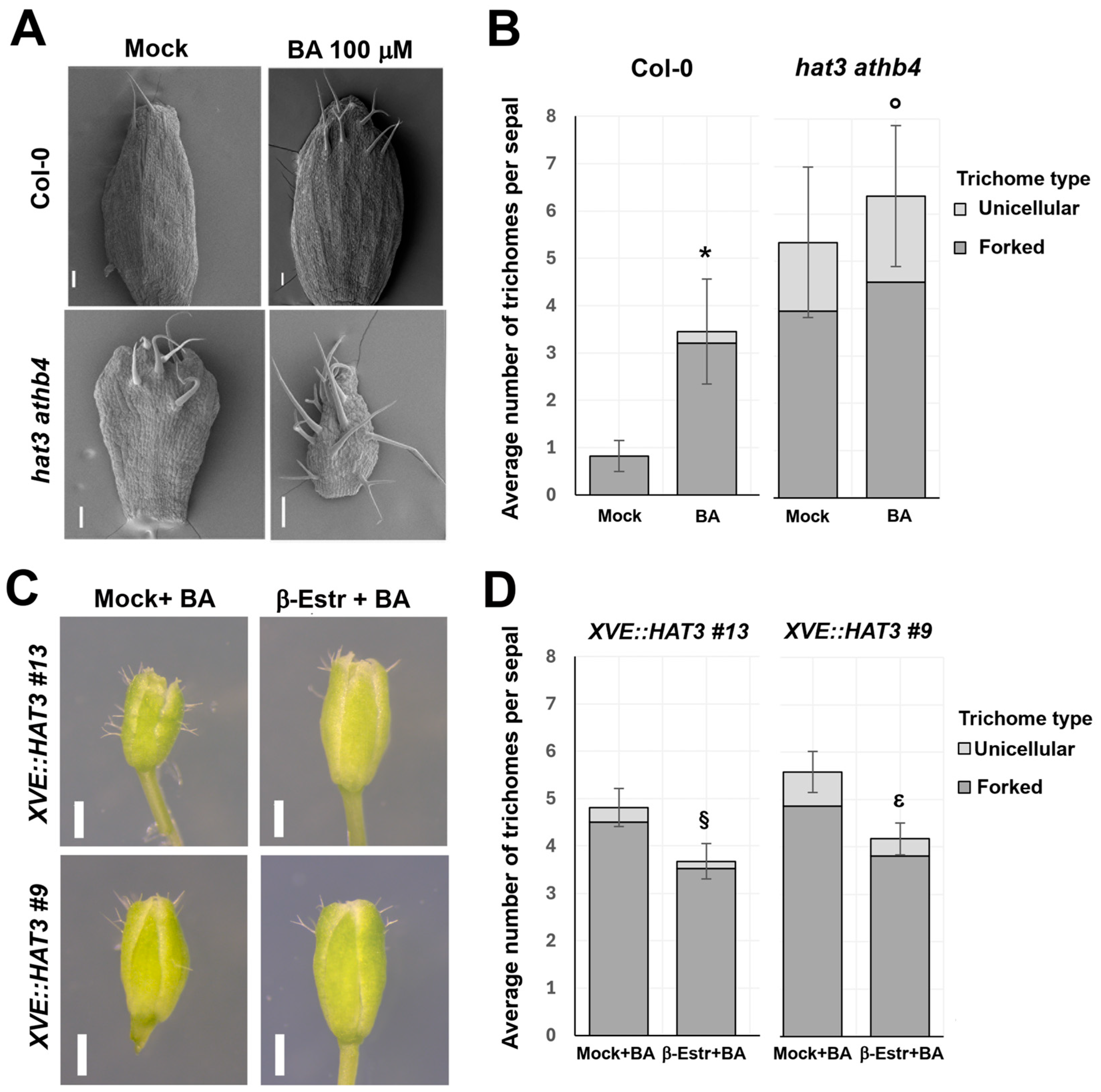
To investigate whether HAT3 and ATHB4 regulate trichome production through CK signalling, we treated flowers of both hat3 athb4 double mutants and wild-type (WT) plants with benzyladenine (BA, 100 µM) and analysed the density and morphology of the trichomes on sepals (Figure 1).
Figure 1.
HAT3 and ATHB4 control CK-mediated trichome development on sepals. (A) Representative SEM images of hat3 athb4 and wild-type (WT, Col-0) sepals, treated with 100 µM CK (+BA) or mock (−BA). Scale bars represent 100 µm. (B) Quantification of number of trichomes per sepal in Col-0 and hat3 athb4 treated as in (A). Quantification of forked trichomes (light-grey bars) and unicellular trichomes (dark-grey bars) is shown. (C) Stereo micrographs of two XVE::HAT3 lines treated with 100 μM BA and either mock or 20 μM β-estradiol to induce the overexpression of HAT3. (D) Quantification of number of trichomes per sepal of the two XVE::HAT3 lines and treatments showed in (C). Forked trichomes and unicellular trichomes are shown. The number of trichomes on sepals were compared using t-test analysis. Two-tailed p values are as follows: BA vs. mock in Col-0, p < 0.0001 (*); hat3 athb4 vs. Col-0 p < 0.0001 (°); β-Estr + BA vs. β-Estr + mock in XVE::HAT3 #13, p = 0.0374 (§); β-Estr + BA vs. β-Estr + mock in XVE::HAT3 #9, p = 0.0074 (ε). p values < 0.05 were considered statistically significant. p values < 0.001 were considered extremely statistically significant. n ≥ 129 sepals (collected from multiple flowers of the same plant as well as from different plants, treated as independent biological replicates).
Under mock (−BA) conditions, hat3 athb4 sepals exhibited a significantly higher number of trichomes compared to WT sepals, with an average of approximately 5.5 trichomes per sepal in the mutant versus 1 in the WT (Figure 1A,B). In addition to increased density, a notable proportion of trichomes in the double mutant displayed a branched morphology (39.2%), in contrast to WT trichomes, which were predominantly unicellular and unbranched (Figure 1A,B).
In agreement with altered trichome development in the hat3 athb4 sepals, we performed a gene network analysis using the GeneMANIA plugin in Cytoscape [32]. This analysis allowed us to predict functionally related genes by integrating co-expression, co-localization, and orthology prediction networks. This in silico analysis showed that HAT3 and ATHB4 are involved in developmental processes, including trichome morphogenesis (Supplementary Table S1 and Supplementary Figure S1), identifying interesting genes potentially regulated by HAT3 and ATHB4, such as members of the homeobox-leucine zipper family protein belonging to the HD-ZIP IV family and involved in trichome differentiation, such as HDG2, HDG11, and HDG12 (Supplementary Table S1 and Supplementary Figure S1) [33,34,35].
Upon CK treatment (+BA), the hat3 athb4 sepals responded with a further increase in both trichome density and the proportion of branched trichomes, whereas WT sepals showed a more modest response (Figure 1A,B). These findings indicate that hat3 athb4 sepals are hypersensitive to exogenous CK, mirroring the enhanced CK responsiveness previously observed in their gynoecia [17].
Next, we analysed two independent estradiol-inducible overexpressing lines on HAT3 (XVE::HAT3) [19]. We observed a reduction in the number of trichomes in the presence of CK, when HAT3 overexpression was induced by estradiol (Figure 1C,D). Moreover, the presence of CK-induced branched trichomes was also reduced in the overexpressing lines treated with estradiol and CK (Figure 1C,D). These data show that HAT3-overexpressing lines are resistant to CK applications. Furthermore, they suggest that HAT3 and ATHB4 may act at the level of catabolism (e.g., increasing CK degradation), signalling (attenuating CK responses), and/or transport (redistributing CK).
Altogether, our data indicate that HAT3 and ATHB4 modulate CK sensitivity and contribute to the maintenance of CK homeostasis during reproductive development, including trichome differentiation on floral organs such as sepals.
2.2. Loss of HAT3 and ATHB4 Leads to Altered Phyllotaxy
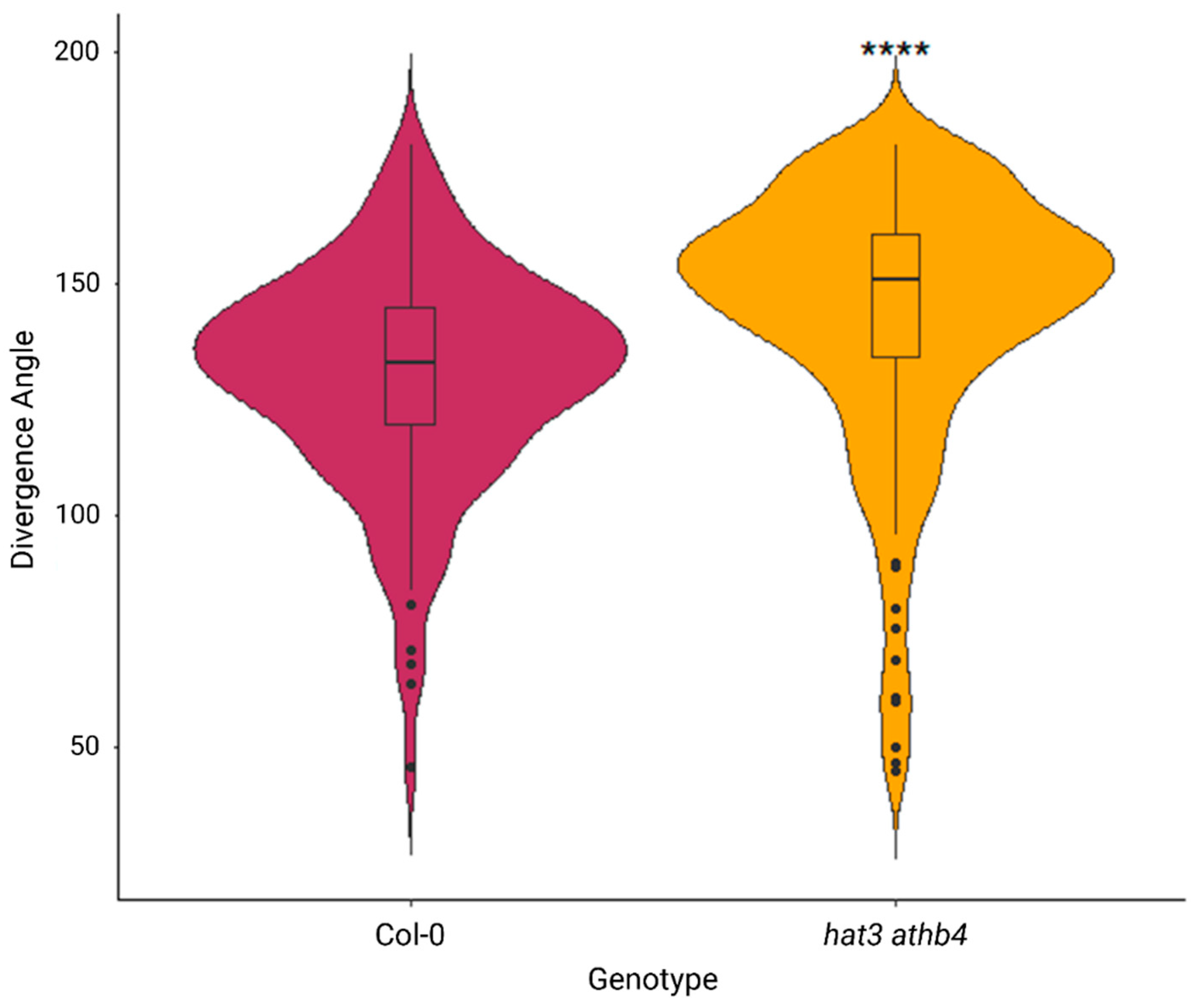
The emergence of shoot apical organs, known as phyllotaxy, is a process regulated by auxin [3]. To determine whether HAT3 and ATHB4 are involved in the regulation of auxin during the establishment of inflorescence architecture, we measured the divergence angle at which flowers emerge laterally from the central axis. This analysis revealed a significant increase in the divergence angle of hat3 athb4 flowers compared to the wild-type flowers (Figure 2). This phenotype suggests that HAT3 and ATHB4 may regulate auxin homeostasis, signalling, and/or transport, leading to misregulation of its patterning cues.
Figure 2.
Phyllotactic divergence angles between wild-type and hat3 athb4 emerged siliques. Significance was measured using Welch’s two tailed t-test, p < 0.0001 (****). n = 11 plants for WT (Col-0), with 132 divergence angles measured; n = 17 plants for hat3 athb4 with 172 divergence angles measured.
2.3. HAT3 and ATHB4 Transcriptionally Influence Hormonal Homeostasis
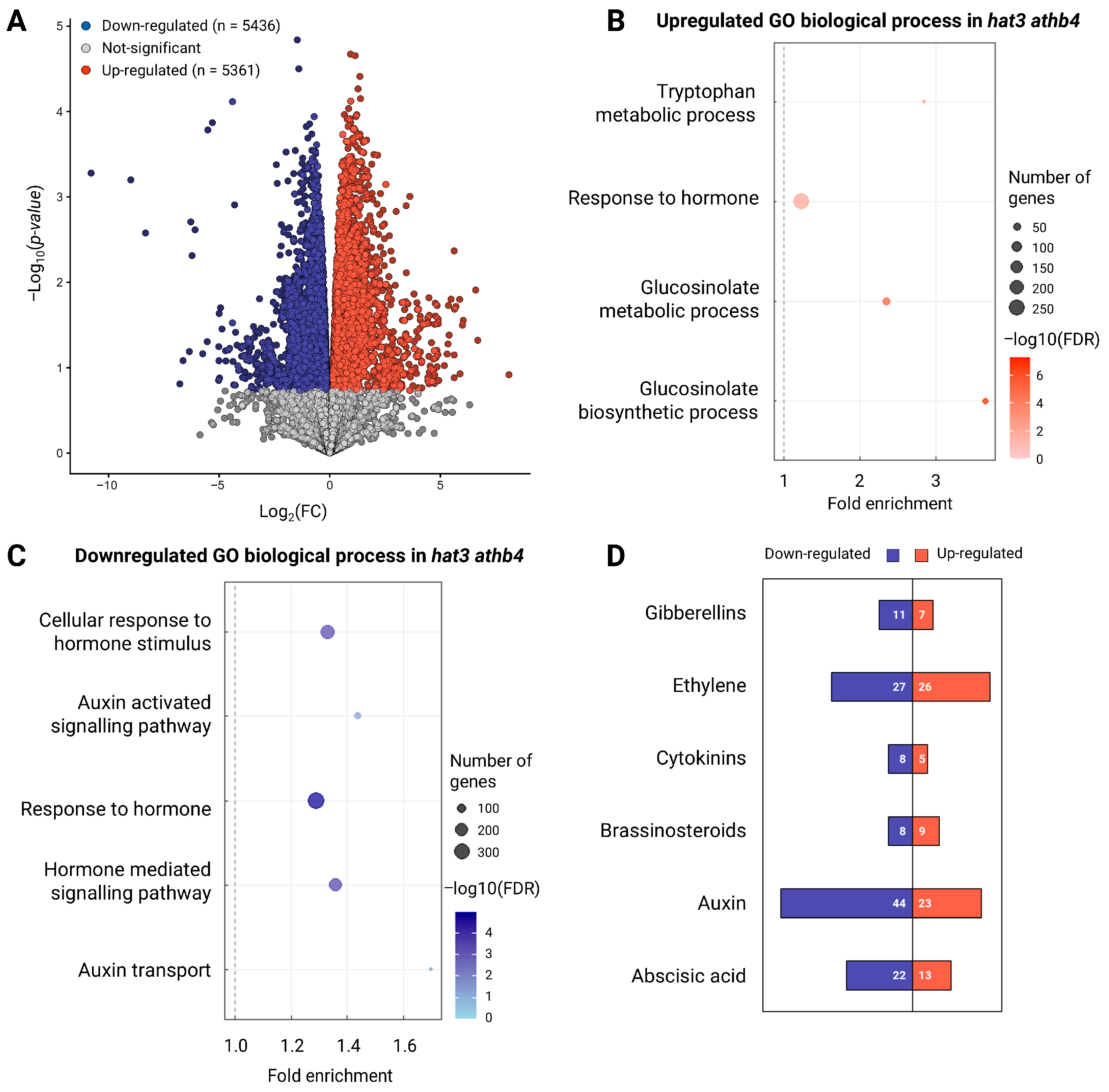
To investigate the molecular mechanisms by which HAT3 and ATHB4 modulate plant reproduction, we performed RNA-sequencing (RNA-seq) analysis on inflorescences of hat3 athb4 and WT (Col-0) plants. This analysis revealed a substantial number of differentially expressed genes (DEGs), with 5361 upregulated and 5436 downregulated in the mutant background compared with the wild-type (Figure 3A and Supplementary Table S2). DEGs below an FDR cutoff of 0.5 were identified and the gene ontology (GO) enrichment analysis of the DEGs revealed significant overrepresentation of terms associated with hormonal regulation (Figure 3B,C and Supplementary Table S2). In particular, genes involved in the Gibberellin, Ethylene, CK, Brassinosteroid, auxin, and Abscisic Acid pathways were misregulated in the hat3 athb4 inflorescences (Figure 3D and Supplementary Table S2). This enrichment highlights the involvement of HAT3 and ATHB4 in regulating hormonal networks in reproductive tissues.
2.4. HAT3 and ATHB4 Transcriptionally Influence Auxin and Cytokinin Homeostasis
To investigate the molecular mechanisms by which HAT3 and ATHB4 modulate auxin and CK biology, which could explain the observed defects in trichome development and altered phyllotaxy (Figure 1 and Figure 2), we further interrogated our RNA-seq data.
In particular, genes involved in pathways linked to tryptophan metabolism, hormone response, hormone-mediated signalling, and auxin-specific signalling processes were either up- or downregulated in the hat3 athb4 mutant background compared to WT (Figure 3B,C).
Figure 3.
Overview of RNA-seq analyses. (A) Volcano plot showing the number of downregulated (blue) or upregulated (red) genes identified in the RNA-seq analyses. (B,C) Representative and significant biological process gene ontology terms associated with differentially expressed genes in hat3 athb4 involved with hormone regulation, showing under-represented (B) and over-represented (C) biological processes in hat3 athb4 relative to Col-0. Dot size indicates the number of differentially expressed genes associated with the process. Colour shade indicates the significance of the enrichment (−log10(FDR-corrected p-values)). The grey dashed line represents a fold enrichment of 1. (D) Number of downregulated (blue) and upregulated (red) genes associated with different hormones classes.
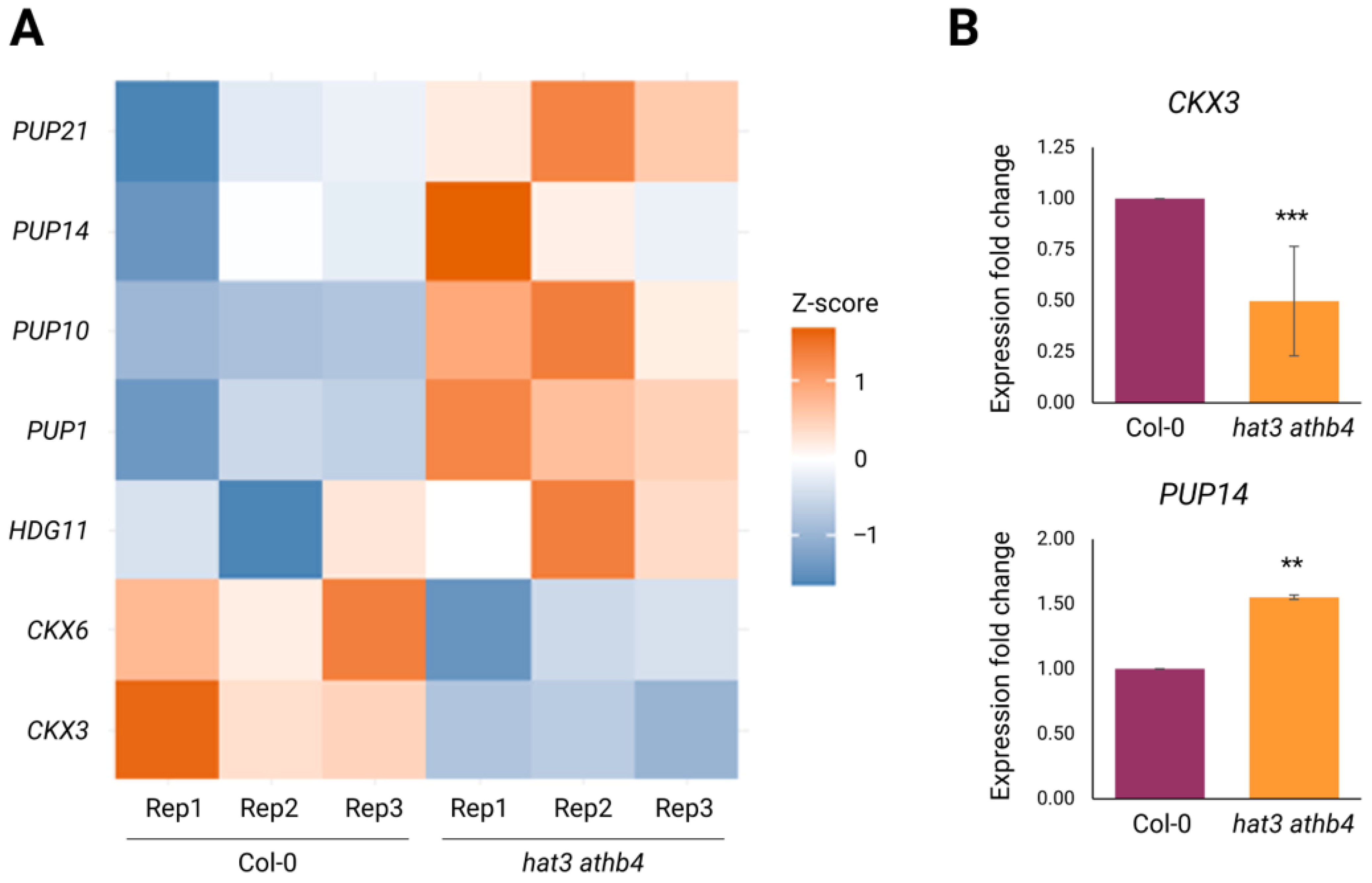
Focusing specifically on genes related to auxin and CK, our analysis revealed a clear transcriptional impact of HAT3 and ATHB4 on both hormone pathways. Notably, several genes involved in CK transport and degradation showed altered expression in the double mutant (Figure 4A). Among the hypothesised CK transporters, members of the PURINE PERMEASE (PUP) family were predominantly downregulated: four identified PUPs (PUP1, PUP10, PUP14, and PUP21) showed increased transcript levels in hat3 athb4 inflorescences (Figure 4A). Although the precise roles of PUPs in intercellular CK transport remain to be fully elucidated, this general upregulation suggests that HAT3 and ATHB4 may act to control CK distribution within cells and/or tissues under normal developmental conditions.
Figure 4.
Regulation of CK biosynthesis and transport by HAT3 and ATHB4. (A) Heatmap showing differentially expressed genes in hat3 athb4 identified by RNA-seq, related to CK biology. Z-score scale bar from −1 (downregulation in blue) to +1 (upregulation in red). Rep, biological replicate. (B) qRT-PCR results of CKX3 and PUP14 expression showing significant modulation in hat3 athb4 compared to WT (Col-0). Significance was calculated using Student’s two-tailed t-test and was plotted in R (**, p < 0.01; ***, p < 0.001), N ≥ 2.
In addition, our data revealed a change in the expression of CYTOKININ OXIDASE/DEHYDROGENASE (CKX) genes, which are involved in CK degradation. Both CKX6 and CKX3 were downregulated in the double mutant (Figure 4A).
We confirmed the roles of HAT3 and ATHB4 in CK degradation by analysing CKX3 gene expression in mutant and wild-type inflorescences using qRT-PCR experiments. Our data showed that the expression of CKX3 was downregulated in the hat3 athb4 double mutant (Figure 4B), consistent with the observed hypersensitivity of the mutant to CK applications during trichome development on sepals (Figure 1A,B). Among the CK transporters, we analysed the expression of PUP14 and confirmed the upregulation of its expression in the double mutant’s background (Figure 4B). Furthermore, our RNA-seq experiments also showed that HDG11 was misregulated in the hat3 athb4 double mutant, supporting the in silico analysis performed by using GeneMANIA (version 3.5.3) (Figure 4A, Supplementary Table S1).
Collectively, these findings provide evidence that HAT3 and ATHB4 are transcriptional regulators of multiple genes involved in the CK transport and degradation, as well as in the control of trichomes differentiation, establishing a complex role for these transcription factors in fine-tuning hormonal dynamics during flower development.
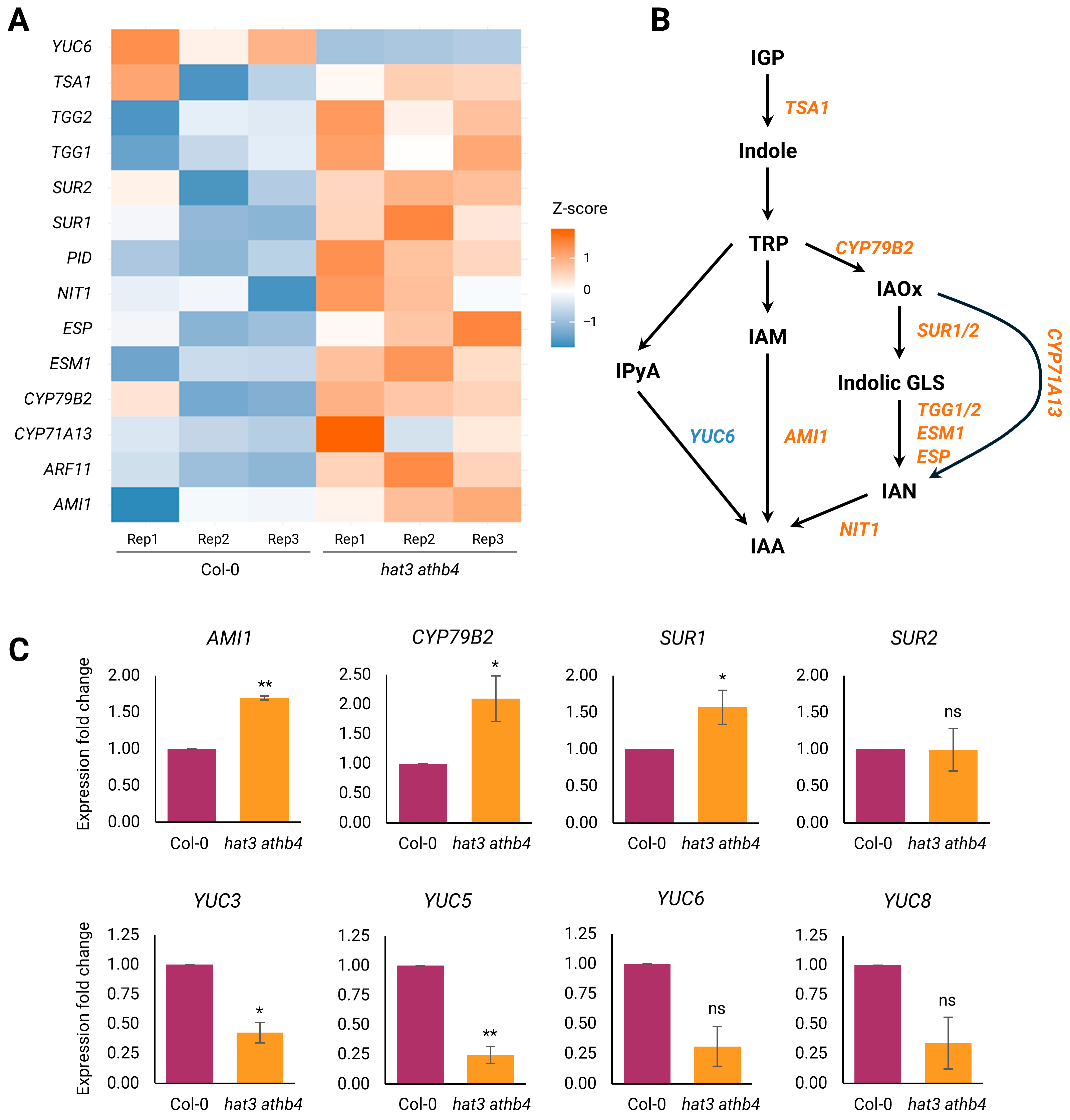
Next, we focused on the analysis of auxin-related genes in the inflorescences of hat3 athb4 mutants compared to the WT. Our RNA-seq revealed that these transcription factors regulate auxin transport, biosynthesis, and signalling (Figure 5 and Supplementary Table S2). Auxin transport, in hat3 athb4, appears to be affected by the transcriptional upregulation of PINOID (PID) (Figure 5A), a key kinase that modulates the plasma membrane distribution of the PIN family’s auxin transporters [30]. Meanwhile, auxin signalling may be impacted via the upregulation of AUXIN RESPONSE FACTOR 11 (ARF11) (Figure 5A).
Figure 5.
Regulation of auxin biosynthesis and transport by HAT3 and ATHB4. (A) Heatmap showing differentially expressed genes in hat3 athb4 identified by RNA-seq, related to auxin biology. Z-score scale bar from −1 (downregulation, in blue) to +1 (upregulation, in red). Rep, biological replicate. (B) Diagram of IAA biosynthetic pathways. Biosynthetic enzymes highlighted in blue and red were found in the RNA-seq analysis in (A) and were downregulated and upregulated, respectively, in hat3 athb4 compared to WT (Col-0). (C) qRT-PCR results of the expression of genes involved in IAA biosynthetic pathways in hat3 athb4 compared to WT (Col-0). Significance was calculated using Student’s two-tailed t-test and plotted in R (*, p < 0.05; **, p < 0.01; ns, not significant), N ≥ 2.
Most notably, a substantial number of genes involved in auxin biosynthesis were differentially expressed, encompassing two major metabolic branches: the indole-3-acetaldoxime (IAOx) pathway and the indole-3-pyruvate (IPyA) pathway [29,36,37,38] (Figure 5A,B).
In the IPyA pathway, the TRYPTOPHAN AMINOTRANSFERASE OF ARABIDOPSIS (TAA1/TAR) gene family catalyses the conversion of tryptophan (TRP) to IPyA [36,39]. IPyA is then transformed into indole-3-acetic acid (IAA) through the action of flavin-containing monooxygenases encoded by the YUCCA (YUC) gene family [36,40,41]. Arabidopsis thaliana possesses 11 YUC genes, and their overexpression has been shown to result in strong auxin-overproduction phenotypes [42,43,44,45,46]. Conversely, yuc loss-of-function mutants exhibit auxin-deficiency symptoms, which can be partially restored through exogenous auxin supplementation or endogenous tissue-specific auxin production [44,47,48,49,50]. In our dataset, YUC6 was downregulated in the double mutant (Figure 5A). To assess changes in YUCCA gene expression, we analysed the transcript levels of YUC6 and additional family members by qRT-PCR. Although YUC6 and YUC8 expression was reduced in the double mutant, the difference was not statistically significant relative to the wild type. In contrast, YUC5 and YUC3 exhibited a significant decrease in expression. The data support a model in which HAT3 and ATHB4 positively regulate local auxin biosynthesis within reproductive tissues by activating the IPyA pathway (Figure 5B).
On the other hand, the IAOx pathway operates at a metabolic junction where IAOx can be diverted either towards IAA biosynthesis or towards the synthesis of indole glucosinolates (GLSs) (Figure 5B) [51]. This branch point is critical: impairment of the GLS pathway has been linked to elevated auxin levels, and vice versa, indicating a tightly regulated metabolic balance [51,52].
Our RNA-seq data revealed the upregulation of several genes at the crux between IAA and GLS biosynthesis (Figure 5B). CYP79B2, a gene encoding an enzyme that catalyses the initial step in the conversion of TRP to IAOx, which is a precursor common to both the IAA and GLS biosynthetic branches [53], was found to be upregulated in the double mutant (Figure 5A). Notably, plants overexpressing CYP79B2 exhibit auxin overproduction traits, whereas double mutants of cyp79B2 and cyp79B3 show reduced IAA content and phenotypes consistent with impaired auxin biosynthesis [54]. Accordingly, qRT-PCR experiments revealed that the expression of CYP79B2 was upregulated in the double mutant’s background (Figure 5C). Therefore, the results of our analysis suggest that hat3 athb4 mutants may accumulate increased IAOx levels.
Moreover, several other genes involved in diverting IAOx towards GLS production were found to be upregulated in the hat3 athb4 background: these are SUPERROOT1 (SUR1) and SUPERROOT2 (SUR2), whose proteins convert IAOx in thiohydroximates and then to indolyl GLS (Figure 5A,B) [54,55,56,57]. Our qRT-PCR experiments showed that the expression of SUR1, but not SUR2, was statistically upregulated in the double mutant’s background (Figure 5C). Furthermore, the misregulation of genes involved in indolyl GLS turnover was also observed. Specifically, THIOGLUCOSIDE GLUCOHYDROLASE 1 (TGG1), TGG2, EPITHIOSPECIFIER PROTEIN (ESP) and EPITHIOSPECIFIER MODIFIER 1 (ESM1) catalyse myrosinase enzymes, which affects the production of indole-3-acetonitrile (IAN) and can be hydrolysed by nitrilases (such as NIT1) back to IAA (Figure 5B), and were found upregulated in the double mutant (Figure 5A,B). All these enzymes are critical in titrating IAA and GLS production, contributing to a trade-off between plant growth and defence [51,58].
Additionally, the gene encoding the enzyme amidase1 (AMI1) that converts indole-3-acetamide (IAM) into IAA (Figure 5B) was found to be upregulated in the hat3 athb4 mutant background in both our RNA-seq and qRT-PCR experiments (Figure 5A,C).
Collectively, these results point to a role for HAT3 and ATHB4 in maintaining hormonal homeostasis in developing inflorescences. These transcription factors seem to promote auxin biosynthesis via the IPyA/YUC pathway, although whether this regulation is direct or indirect remains to be clarified. Moreover, our data suggest that HAT3 and ATHB4 may also modulate GLS biosynthesis by titrating auxin production through the IAOx route. Their loss results in an imbalance that might shift precursor allocation, diminishing auxin production, which may have downstream consequences for floral patterning and development.
3. Discussion
In this study, we demonstrate that two HD-ZIP class II transcription factors, HAT3 and ATHB4, play crucial roles in modulating hormonal balance during flower development. Our phenotypical and molecular analyses show that hat3 athb4 double mutants produce ectopic and branched trichomes on sepals and display an altered phyllotaxy. These phenotypes, together with the previously reported disruption of gynoecium development [17,20], represent hallmarks of disturbed hormone homeostasis, particularly involving CK and auxin.
Our RNA-seq analysis reveals that HAT3 and ATHB4 regulate key components of both the auxin and CK pathways. Specifically, they appear to promote auxin biosynthesis, signalling, and transport (Figure 5) while modulating CK transport and degradation (Figure 4). These findings suggest that HAT3 and ATHB4 are pivotal in fine-tuning the auxin–CK balance in floral tissues, thereby ensuring correct organ specification and tissue identity. Our RNA-seq analysis highlighted downregulation of the CKX6 gene (Figure 4A). Consistently with the role of the HAT3 and ATHB4 transcription factors in the shade-avoidance response, CKX6 had been previously reported to be part of a regulatory circuit in canopy shade [59]. CKX6 was shown to be induced in low R/FR light [60], and it was found to promote auxin-induced CK breakdown in leaf primordia under low R/FR light, thereby reducing leaf cell proliferation in shade [61]. These findings are in line with our transcriptional analysis showing that another cytokinin oxidase, CKX3, was found to be downregulated in the hat3 athb4 background (Figure 4A,B). Moreover, they point to a broader role for HAT3 and ATHB4 as mediators between environmental cues and hormonal signals. Furthermore, the hypersensitivity of hat3 athb4 tissues to exogenous CK, showed by the higher trichome density and complexity (Figure 1A,B), supports the scenario in which these transcription factors normally function to dampen CK response, potentially by restricting its accumulation or signal output. It remains unclear whether the augmented differentiation of trichomes in the double mutant, and/or the hypersensitivity to CK, work via HDG11, as suggested by our in silico analysis (Supplementary Table S1 and Supplementary Figure S1) and the results from our RNA-seq (Figure 4A).
Auxin has long been recognised for its role as a developmental cue during organogenesis. Functioning as a morphogen, auxin gradients define positional information, influencing cell division, differentiation, and tissue patterning in a concentration-dependent manner [62,63]. Its importance during flower development, particularly in the gynoecium and associated reproductive structures, is well established [23,64]. The hat3 athb4 double mutants show several auxin-related phenotypes that have been previously described, such as asymmetrical ovaries [17,20], monocotyledonous seedlings, inactive shoot apical meristems, altered leaf shape and polarity, defective vascular patterning [19], and root apical meristem development [65]. These phenotypes align with perturbed auxin biosynthesis, signalling, and transport. Our RNA-seq suggest that potentially every part of auxin biology is misregulated in the double mutant, which showed altered expression of ARF11, PID, and several genes involved in its biosynthesis (Figure 5).
However, auxin does not act on its own. It interacts dynamically with other hormonal pathways, such as CK, as well as with metabolic networks, contributing to a robust but highly responsive developmental framework.
Another intriguing finding from our transcriptomic data is that HAT3 and ATHB4 may also potentially act as a molecular bridge between auxin and indolic GLS biosynthesis pathways. GLS are Brassicaceae-specific secondary metabolites with known defensive, flavour, and health-related properties. While their defensive roles are well-documented, their regulatory integration with hormone signalling, particularly auxin, remains poorly understood [51,66]. Our preliminary evidence suggests that HAT3 and ATHB4 not only control auxin biosynthesis but may also regulate genes in the GLS pathway, although metabolic measurements of endogenous GLS content will be required to confirm this possibility. Speculatively, this hints at a potential trade-off between growth/development and defence, a well-known yet complex relationship in plant biology. If supported by further quantitative and genetic data, it would be plausible to propose a scenario in which HAT3 and ATHB4 contribute to the balancing act between resource investment in growth versus defence by modulating both hormonal and metabolic gene networks in leaves as well as in the inflorescences.
Taken together, our findings position HAT3 and ATHB4 as central nodes in a complex network of developmental regulation, bridging hormonal signalling with secondary metabolism. Their role in controlling auxin and CK activity is particularly critical in reproductive tissues, where precise spatial and temporal coordination is essential for successful fertilisation and seed development. The potential link to GLS metabolism further expands the developmental relevance of these transcription factors and suggests broader roles in coordinating developmental and defence-related pathways.
Future studies should aim to dissect the tissue-specific regulatory mechanisms by which HAT3 and ATHB4 influence their downstream targets, as well as to explore how their activity integrates environmental cues, such as light and stress, into developmental outputs. Understanding the molecular links behind these interactions will not only enhance our fundamental knowledge of plant development but may also inform new strategies for crop improvement. Flowers are the cornerstone of sexual reproduction in angiosperms and are indispensable to human agriculture. They enable the propagation of crop species and the production of fruits and grains central to our food systems. In an era marked by climate instability and population growth, improving our understanding of floral development is more than a matter of scientific curiosity; it is a prerequisite for innovation in crop engineering and sustainable food production. Insight into the regulatory mechanisms guiding flower formation could facilitate precise manipulation of reproductive traits, ultimately contributing to efforts aimed at securing global food supply. For instance, targeted manipulation of HAT3/ATHB4 or their downstream pathways could enable the engineering of floral traits optimised for yield, resilience, or nutritional quality, particularly in Brassicaceae crops.
4. Materials and Methods
4.1. Plant Growth Conditions
The plant material used was Arabidopsis thaliana in the wild-type Col-0 ecotype background. hat3 athb4, a loss-of-function insertional line, and the inducible XVE::HAT3 overexpressing lines were developed by [19]. Plants were grown on Levington F2 soil under standard long-day conditions (16 h light/8 h dark) in controlled environment rooms.
4.2. RNA Extraction and Sequencing
RNA was extracted from inflorescences of Col-0 and hat3 athb4 plants. The material was collected between 10 and 11 am (to maintain circadian consistency) with three biological replicates per genotype at 3–5 weeks post-germination. Extraction was performed using the RNeasy Plant Mini Kit (Qiagen, Venlo, Netherlands) following the manufacturer’s protocol. RNA samples were shipped on dry ice to GENEWIZ for sequencing. Raw sequencing reads were quantified against the Arabidopsis thaliana reference transcriptome (TAIR CDS fasta) using Kallisto. Gene ontologies (GOs) were identified from the differentially expressed genes (DEGs) with an arbitrary false discovery rate (FDR) of 0.5 to balance false positives and gene retention. Within this threshold, a further false discovery rate (FDR) p < 0.05 was applied within Panther to obtain an overview of trends in the data. Plots were generated using the ggplot2 R package (version 4.0.0), following established protocols [67]. Heatmaps visualising differential gene expressions were generated and Z-scores were calculated using the normalised counts per million (CPM) data for each gene using the ggplot2 R package.
4.3. Reverse Transcription Quantitative Polymerase Chain Reaction (RT qPCR)
Total RNA from flowers of Col-0 and hat3 athb4 was isolated as described above. cDNA synthesis was performed using M-MLV Reverse Transcriptase (Promega, Madison, Wisconsin, USA) according to the manufacturer’s instructions. qRT-PCR experiments were carried out on a BioRad CFX96 system using gene-specific primers (see below) with three biological replicates per background and four technical replicates per sample using SYGREEN BLUE qPCR MIX (PCRBIO, London, UK). Expression levels were normalised to UBIQUITIN 10 and ACTIN2 (used as the housekeeping genes) and calculated using the 2−ΔΔCt method.
4.4. Primers for qRT-PCR
4.5. Cytokinin and β-Estradiol Treatments
Inflorescences of each background, hat3 athb4 and Col-0, were treated upon bolting with 100 µM 6-Benzylaminopurine (BA) (Merck, Darmstadt, Germany) and 0.01% Silwet-77. Mock-treated plants were only sprayed with a mock solution containing NaOH and 0.01% Silwet-77. Plants were sprayed either with mock or CK every 4 days, 4 times total, and flower samples were collected for phenotypic analysis 4 days after treatment.
Inflorescences of XVE::HAT3 plants were sprayed once a day for 4 consecutive days with a mix of 100 μM BA and mock or with 100 μM BA and 20 μM β-estradiol, as previously described [17]. All spray treatments used a 0.01% final concentration of Silwet L-77. Trichomes on sepals were counted under a stereomicroscope after 4 days.
Statistical analysis was performed using the GraphPad QuickCalcs free online page (https://www.graphpad.com/quickcalcs/ accessed on 14–15 November 2025).
4.6. Scanning Electron Microscopy
Col-0 and hat3 athb4 flower samples were collected and fixed in a prepared solution of Formaldehyde, Alcohol, and Acetic Acid (FAA) for four hours prior to a series of ethanol (EtOH) dilutions to 100% dry EtOH, prior to reaching the critical point of drying (CPD) using a Leica CPD300 (Leica Microsystems, Wetzlar, Germany). The dried samples were then dissected at the light microscope and placed on stubs prior to sputter coating using Au (gold) at 7.5 nm, using a Leica 600 ACE sputter coater (Leica Microsystems, Wetzlar, Germany). The samples were imaged using the FEI Nova NanoSEM (FEI, Hillsboro, OR, USA).
4.7. Phyllotaxy Measurements
The divergence angle of mature, non-senescing siliques was measured using plants approximately 3 weeks old. Only the main stem was measured by eye using a protractor. The circular (360°) protractor was held over a stand where the main stem was positioned upright and the clockwise divergence angle was measured between successive siliques, measuring from the point of emergence of the siliques from the stem. This was completed along the length of the stem for 17 plants for hat3 athb4 and 11 plants for Col-0.
Supplementary Materials
The following supporting information can be downloaded at: https://www.mdpi.com/article/10.3390/plants14243723/s1, Supplemental Table S1. Gene Ontology (GO) categories associated with genes predicted to be functionally related to HAT3 and ATHB-4 following GeneMANIA network analyses. Supplemental Table S2. GO categories analysis of RNA-seq experiments from hat3 athb4 inflorescence versus Col-0. Supplemental Table S3. List of primers used in the present study. Supplemental Figure S1. Gene-gene interaction network of the HAT3 and ATHB4 transcription factors. Data were obtained from GeneMANIA Cytoscape plugin. Query genes are represented by black circle, while functionally related genes are represented by grey circles. Genes involved in the GO category “Trichome differentiation” are highlighted in yellow. Edges highlighting interactions based on prediction, co-expression, or co-localization are shown in orange, pink, and blue, respectively. The thickness of each edge is proportional to the weight of the interaction.
Author Contributions
L.M., conceptualised the project; L.M., K.A.M., S.L., and M.C. designed the experimental research; K.A.M., S.L., and M.C. performed the experimental work. All authors analysed the data. K.A.M., S.L., and M.C. prepared the figures. L.M. wrote the manuscript. All authors commented on and edited the manuscript. All authors have read and agreed to the published version of the manuscript.
Funding
This research was funded by the Royal Society University Research Fellowship URF\R\231023 (L.M.), the Royal Society International Exchange Scheme (to L.M. and M.C.), the Biotechnology and Biological Sciences Research Council NRP Doctoral Training Programme Studentship BB/T008717/1 (to K.A.M. and L.M.), Agritech National Research Centre within the European Union Next Generation EU programme (the National Recovery and Resilience Plan, mission 4, component 2, investment 1.4-D.D. 1032 17/06/2022, project CN00000022, CUP-B83C22002840001) (to M.C.), and the Italian Ministry of University and Research PRIN-2022 programme (Prot. 20228Z8TXN) (to M.C.). This work has benefited from the equipment and framework of the COMP-R Initiative, funded by the ‘Departments of Excellence’ programme of the Italian Ministry for University and Research (MUR, 2023–2027).
Data Availability Statement
The raw RNA-seq data from hat3 athb4 and Col-0 inflorescences will be made available upon request.
Acknowledgments
We thank the JIC Imaging facility for support in microscopy analysis and the funding agencies listed above.
Conflicts of Interest
The authors declare no conflicts of interest.
References
- Heisler, M.G.; Ohno, C.; Das, P.; Sieber, P.; Reddy, G.V.; Long, J.A.; Meyerowitz, E.M. Patterns of Auxin Transport and Gene Expression during Primordium Development Revealed by Live Imaging of the Arabidopsis Inflorescence Meristem. Curr. Biol. 2005, 15, 1899–1911. [Google Scholar] [CrossRef]
- Gordon, S.P.; Chickarmane, V.S.; Ohno, C.; Meyerowitz, E.M. Multiple Feedback Loops through Cytokinin Signaling Control Stem Cell Number within the Arabidopsis Shoot Meristem. Proc. Natl. Acad. Sci. USA 2009, 106, 16529–16534. [Google Scholar] [CrossRef]
- Reinhardt, D.; Pesce, E.-R.; Stieger, P.; Mandel, T.; Baltensperger, K.; Bennett, M.; Traas, J.; Friml, J.; Kuhlemeier, C. Regulation of Phyllotaxis by Polar Auxin Transport. Nature 2003, 426, 255–260. [Google Scholar] [CrossRef] [PubMed]
- Kurakawa, T.; Ueda, N.; Maekawa, M.; Kobayashi, K.; Kojima, M.; Nagato, Y.; Sakakibara, H.; Kyozuka, J. Direct Control of Shoot Meristem Activity by a Cytokinin-Activating Enzyme. Nature 2007, 445, 652–655. [Google Scholar] [CrossRef] [PubMed]
- Riou-Khamlichi, C.; Huntley, R.; Jacqmard, A.; Murray, J.A. Cytokinin Activation of Arabidopsis Cell Division through a D-Type Cyclin. Science 1999, 283, 1541–1544. [Google Scholar] [CrossRef] [PubMed]
- Greenboim-Wainberg, Y.; Maymon, I.; Borochov, R.; Alvarez, J.; Olszewski, N.; Ori, N.; Eshed, Y.; Weiss, D. Cross Talk between Gibberellin and Cytokinin: The Arabidopsis GA Response Inhibitor SPINDLY Plays a Positive Role in Cytokinin Signaling. Plant Cell 2005, 17, 92–102. [Google Scholar] [CrossRef]
- Bartrina, I.; Otto, E.; Strnad, M.; Werner, T.; Schmülling, T. Cytokinin Regulates the Activity of Reproductive Meristems, Flower Organ Size, Ovule Formation, and Thus Seed Yield in Arabidopsis Thaliana. Plant Cell 2011, 23, 69–80. [Google Scholar] [CrossRef]
- Yang, W.; Cortijo, S.; Korsbo, N.; Roszak, P.; Schiessl, K.; Gurzadyan, A.; Wightman, R.; Jönsson, H.; Meyerowitz, E. Molecular Mechanism of Cytokinin-Activated Cell Division in Arabidopsis. Science 2021, 371, 1350–1355. [Google Scholar] [CrossRef]
- Park, S.J.; Eshed, Y.; Lippman, Z.B. Meristem Maturation and Inflorescence Architecture—Lessons from the Solanaceae. Curr. Opin. Plant Biol. 2014, 17, 70–77. [Google Scholar] [CrossRef]
- Sosnowski, J.; Truba, M.; Vasileva, V. The Impact of Auxin and Cytokinin on the Growth and Development of Selected Crops. Agriculture 2023, 13, 724. [Google Scholar] [CrossRef]
- Bowman, J.L.; Moyroud, E. Reflections on the ABC Model of Flower Development. Plant Cell 2024, 36, 1334–1357. [Google Scholar] [CrossRef]
- Roeder, A.H.K.; Yanofsky, M.F. Fruit Development in Arabidopsis. Arab. Book 2006, 4, e0075. [Google Scholar] [CrossRef] [PubMed]
- Moubayidin, L.; Ostergaard, L. Dynamic Control of Auxin Distribution Imposes a Bilateral-to-Radial Symmetry Switch during Gynoecium Development. Curr. Biol. 2014, 24, 2743–2748. [Google Scholar] [CrossRef] [PubMed]
- Jamil, I.; Giri, A.; Moubayidin, L. Organ Symmetry Establishment during Gynoecium Development. Curr. Opin. Plant Biol. 2025, 85, 102732. [Google Scholar] [CrossRef] [PubMed]
- Ciarbelli, A.R.; Ciolfi, A.; Salvucci, S.; Ruzza, V.; Possenti, M.; Carabelli, M.; Fruscalzo, A.; Sessa, G.; Morelli, G.; Ruberti, I. The Arabidopsis Homeodomain-Leucine Zipper II Gene Family: Diversity and Redundancy. Plant Mol. Biol. 2008, 68, 465–478. [Google Scholar] [CrossRef]
- Bou-Torrent, J.; Salla-Martret, M.; Brandt, R.; Musielak, T.; Palauqui, J.-C.; Martínez-García, J.F.; Wenkel, S. ATHB4 and HAT3, Two Class II HD-ZIP Transcription Factors, Control Leaf Development in Arabidopsis. Plant Signal. Behav. 2012, 7, 1382–1387. [Google Scholar] [CrossRef]
- Carabelli, M.; Turchi, L.; Morelli, G.; Østergaard, L.; Ruberti, I.; Moubayidin, L. Coordination of Biradial-to-Radial Symmetry and Tissue Polarity by HD-ZIP II Proteins. Nat. Commun. 2021, 12, 4321. [Google Scholar] [CrossRef]
- Carabelli, M.; Possenti, M.; Sessa, G.; Ruzza, V.; Morelli, G.; Ruberti, I. Arabidopsis HD-Zip II Proteins Regulate the Exit from Proliferation during Leaf Development in Canopy Shade. J. Exp. Bot. 2018, 69, 5419–5431. [Google Scholar] [CrossRef]
- Turchi, L.; Carabelli, M.; Ruzza, V.; Possenti, M.; Sassi, M.; Peñalosa, A.; Sessa, G.; Salvi, S.; Forte, V.; Morelli, G.; et al. Arabidopsis HD-Zip II Transcription Factors Control Apical Embryo Development and Meristem Function. Development 2013, 140, 2118–2129. [Google Scholar] [CrossRef]
- Reymond, M.C.; Brunoud, G.; Chauvet, A.; Martínez-Garcia, J.F.; Martin-Magniette, M.-L.; Monéger, F.; Scutt, C.P. A Light-Regulated Genetic Module Was Recruited to Carpel Development in Arabidopsis Following a Structural Change to SPATULA. Plant Cell 2012, 24, 2812–2825. [Google Scholar] [CrossRef]
- Friml, J.; Vieten, A.; Sauer, M.; Weijers, D.; Schwarz, H.; Hamann, T.; Offringa, R.; Jürgens, G. Efflux-Dependent Auxin Gradients Establish the Apical–Basal Axis of Arabidopsis. Nature 2003, 426, 147–153. [Google Scholar] [CrossRef] [PubMed]
- Abas, L.; Kolb, M.; Stadlmann, J.; Janacek, D.P.; Lukic, K.; Schwechheimer, C.; Sazanov, L.A.; Mach, L.; Friml, J.; Hammes, U.Z. Naphthylphthalamic Acid Associates with and Inhibits PIN Auxin Transporters. Proc. Natl. Acad. Sci. USA 2021, 118, e2020857118. [Google Scholar] [CrossRef] [PubMed]
- Larsson, E.; Franks, R.G.; Sundberg, E. Auxin and the Arabidopsis Thaliana Gynoecium. J. Exp. Bot. 2013, 64, 2619–2627. [Google Scholar] [CrossRef] [PubMed]
- An, L.; Zhou, Z.; Yan, A.; Gan, Y. Progress on Trichome Development Regulated by Phytohormone Signaling. Plant Signal. Behav. 2011, 6, 1959–1962. [Google Scholar] [CrossRef]
- Sakakibara, H. Cytokinins: Activity, Biosynthesis, and Translocation. Annu. Rev. Plant Biol. 2006, 57, 431–449. [Google Scholar] [CrossRef]
- Zürcher, E.; Liu, J.; di Donato, M.; Geisler, M.; Müller, B. Plant Development Regulated by Cytokinin Sinks. Science 2016, 353, 1027–1030. [Google Scholar] [CrossRef]
- Bürkle, L.; Cedzich, A.; Döpke, C.; Stransky, H.; Okumoto, S.; Gillissen, B.; Kühn, C.; Frommer, W.B. Transport of Cytokinins Mediated by Purine Transporters of the PUP Family Expressed in Phloem, Hydathodes, and Pollen of Arabidopsis. Plant J. 2003, 34, 13–26. [Google Scholar] [CrossRef]
- Solanki, M.; Shukla, L.I. Recent Advances in Auxin Biosynthesis and Homeostasis. 3 Biotech 2023, 13, 290. [Google Scholar] [CrossRef]
- Cao, X.; Yang, H.; Shang, C.; Ma, S.; Liu, L.; Cheng, J. The Roles of Auxin Biosynthesis YUCCA Gene Family in Plants. Int. J. Mol. Sci. 2019, 20, 6343. [Google Scholar] [CrossRef]
- Benjamins, R.; Quint, A.; Weijers, D.; Hooykaas, P.; Offringa, R. The PINOID Protein Kinase Regulates Organ Development in Arabidopsis by Enhancing Polar Auxin Transport. Development 2001, 128, 4057–4067. [Google Scholar] [CrossRef]
- Jing, H.; Strader, L.C. AUXIN RESPONSE FACTOR Protein Accumulation and Function. Bioessays 2023, 45, e2300018. [Google Scholar] [CrossRef]
- Montojo, J.; Zuberi, K.; Rodriguez, H.; Kazi, F.; Wright, G.; Donaldson, S.L.; Morris, Q.; Bader, G.D. GeneMANIA Cytoscape Plugin: Fast Gene Function Predictions on the Desktop. Bioinformatics 2010, 26, 2927–2928. [Google Scholar] [CrossRef]
- Kram, B.W.; Xu, W.W.; Carter, C.J. Uncovering the Arabidopsis Thaliana Nectary Transcriptome: Investigation of Differential Gene Expression in Floral Nectariferous Tissues. BMC Plant Biol. 2009, 9, 92. [Google Scholar] [CrossRef]
- Mustroph, A.; Zanetti, M.E.; Jang, C.J.H.; Holtan, H.E.; Repetti, P.P.; Galbraith, D.W.; Girke, T.; Bailey-Serres, J. Profiling Translatomes of Discrete Cell Populations Resolves Altered Cellular Priorities during Hypoxia in Arabidopsis. Proc. Natl. Acad. Sci. USA 2009, 106, 18843–18848. [Google Scholar] [CrossRef]
- Lee, I.; Ambaru, B.; Thakkar, P.; Marcotte, E.M.; Rhee, S.Y. Rational Association of Genes with Traits Using a Genome-Scale Gene Network for Arabidopsis Thaliana. Nat. Biotechnol. 2010, 28, 149–156. [Google Scholar] [CrossRef] [PubMed]
- Stepanova, A.N.; Yun, J.; Robles, L.M.; Novak, O.; He, W.; Guo, H.; Ljung, K.; Alonso, J.M. The Arabidopsis YUCCA1 Flavin Monooxygenase Functions in the Indole-3-Pyruvic Acid Branch of Auxin Biosynthesis. Plant Cell 2011, 23, 3961–3973. [Google Scholar] [CrossRef] [PubMed]
- Sato, A.; Soeno, K.; Kikuchi, R.; Narukawa-Nara, M.; Yamazaki, C.; Kakei, Y.; Nakamura, A.; Shimada, Y. Indole-3-Pyruvic Acid Regulates TAA1 Activity, Which Plays a Key Role in Coordinating the Two Steps of Auxin Biosynthesis. Proc. Natl. Acad. Sci. USA 2022, 119, e2203633119. [Google Scholar] [CrossRef]
- Sugawara, S.; Hishiyama, S.; Jikumaru, Y.; Hanada, A.; Nishimura, T.; Koshiba, T.; Zhao, Y.; Kamiya, Y.; Kasahara, H. Biochemical Analyses of Indole-3-Acetaldoxime-Dependent Auxin Biosynthesis in Arabidopsis. Proc. Natl. Acad. Sci. USA 2009, 106, 5430–5435. [Google Scholar] [CrossRef]
- Stepanova, A.N.; Robertson-Hoyt, J.; Yun, J.; Benavente, L.M.; Xie, D.-Y.; Dolezal, K.; Schlereth, A.; Jürgens, G.; Alonso, J.M. TAA1-Mediated Auxin Biosynthesis Is Essential for Hormone Crosstalk and Plant Development. Cell 2008, 133, 177–191. [Google Scholar] [CrossRef] [PubMed]
- Mashiguchi, K.; Tanaka, K.; Sakai, T.; Sugawara, S.; Kawaide, H.; Natsume, M.; Hanada, A.; Yaeno, T.; Shirasu, K.; Yao, H.; et al. The Main Auxin Biosynthesis Pathway in Arabidopsis. Proc. Natl. Acad. Sci. USA 2011, 108, 18512–18517. [Google Scholar] [CrossRef]
- Won, C.; Shen, X.; Mashiguchi, K.; Zheng, Z.; Dai, X.; Cheng, Y.; Kasahara, H.; Kamiya, Y.; Chory, J.; Zhao, Y. Conversion of Tryptophan to Indole-3-Acetic Acid by TRYPTOPHAN AMINOTRANSFERASES OF ARABIDOPSIS and YUCCAs in Arabidopsis. Proc. Natl. Acad. Sci. USA 2011, 108, 18518–18523. [Google Scholar] [CrossRef]
- Zhao, Y.; Christensen, S.K.; Fankhauser, C.; Cashman, J.R.; Cohen, J.D.; Weigel, D.; Chory, J. A Role for Flavin Monooxygenase-like Enzymes in Auxin Biosynthesis. Science 2001, 291, 306–309. [Google Scholar] [CrossRef]
- Woodward, A.W.; Bartel, B. Auxin: Regulation, Action, and Interaction. Ann. Bot. 2005, 95, 707–735. [Google Scholar] [CrossRef]
- Cheng, Y.; Dai, X.; Zhao, Y. Auxin Biosynthesis by the YUCCA Flavin Monooxygenases Controls the Formation of Floral Organs and Vascular Tissues in Arabidopsis. Genes. Dev. 2006, 20, 1790–1799. [Google Scholar] [CrossRef]
- Kim, J.I.; Sharkhuu, A.; Jin, J.B.; Li, P.; Jeong, J.C.; Baek, D.; Lee, S.Y.; Blakeslee, J.J.; Murphy, A.S.; Bohnert, H.J.; et al. Yucca6, a Dominant Mutation in Arabidopsis, Affects Auxin Accumulation and Auxin-Related Phenotypes. Plant Physiol. 2007, 145, 722–735. [Google Scholar] [CrossRef]
- Hentrich, M.; Böttcher, C.; Düchting, P.; Cheng, Y.; Zhao, Y.; Berkowitz, O.; Masle, J.; Medina, J.; Pollmann, S. The Jasmonic Acid Signaling Pathway Is Linked to Auxin Homeostasis through the Modulation of YUCCA8 and YUCCA9 Gene Expression. Plant J. 2013, 74, 626–637. [Google Scholar] [CrossRef] [PubMed]
- Cheng, Y.; Dai, X.; Zhao, Y. Auxin Synthesized by the YUCCA Flavin Monooxygenases Is Essential for Embryogenesis and Leaf Formation in Arabidopsis. Plant Cell 2007, 19, 2430–2439. [Google Scholar] [CrossRef]
- Chen, Q.; Dai, X.; De-Paoli, H.; Cheng, Y.; Takebayashi, Y.; Kasahara, H.; Kamiya, Y.; Zhao, Y. Auxin Overproduction in Shoots Cannot Rescue Auxin Deficiencies in Arabidopsis Roots. Plant Cell Physiol. 2014, 55, 1072–1079. [Google Scholar] [CrossRef]
- Zhao, Y. Auxin Biosynthesis. Arab. Book 2014, 12, e0173. [Google Scholar] [CrossRef] [PubMed]
- Di, D.W.; Wu, L.; Zhang, L.; An, C.W.; Zhang, T.Z.; Luo, P.; Gao, H.H.; Kriechbaumer, V.; Guo, G.Q. Functional roles of Arabidopsis CKRC2/YUCCA8 gene and the involvement of PIF4 in the regulation of auxin biosynthesis by cytokinin. Sci. Rep. 2016, 6, 36866. [Google Scholar] [CrossRef] [PubMed]
- Malka, S.K.; Cheng, Y. Possible Interactions between the Biosynthetic Pathways of Indole Glucosinolate and Auxin. Front. Plant Sci. 2017, 8, 2131. [Google Scholar] [CrossRef]
- Halkier, B.A.; Gershenzon, J. Biology and Biochemistry of Glucosinolates. Annu. Rev. Plant Biol. 2006, 57, 303–333. [Google Scholar] [CrossRef]
- Mikkelsen, M.D.; Hansen, C.H.; Wittstock, U.; Halkier, B.A. Cytochrome P450 CYP79B2 from Arabidopsis Catalyzes the Conversion of Tryptophan to Indole-3-Acetaldoxime, a Precursor of Indole Glucosinolates and Indole-3-Acetic Acid. J. Biol. Chem. 2000, 275, 33712–33717. [Google Scholar] [CrossRef]
- Zhao, Y.; Hull, A.K.; Gupta, N.R.; Goss, K.A.; Alonso, J.; Ecker, J.R.; Normanly, J.; Chory, J.; Celenza, J.L. Trp-Dependent Auxin Biosynthesis in Arabidopsis: Involvement of Cytochrome P450s CYP79B2 and CYP79B3. Genes. Dev. 2002, 16, 3100–3112. [Google Scholar] [CrossRef]
- Barlier, I.; Kowalczyk, M.; Marchant, A.; Ljung, K.; Bhalerao, R.; Bennett, M.; Sandberg, G.; Bellini, C. The SUR2 Gene of Arabidopsis Thaliana Encodes the Cytochrome P450 CYP83B1, a Modulator of Auxin Homeostasis. Proc. Natl. Acad. Sci. USA 2000, 97, 14819–14824. [Google Scholar] [CrossRef]
- Boerjan, W.; Cervera, M.T.; Delarue, M.; Beeckman, T.; Dewitte, W.; Bellini, C.; Caboche, M.; Van Onckelen, H.; Van Montagu, M.; Inzé, D. Superroot, a Recessive Mutation in Arabidopsis, Confers Auxin Overproduction. Plant Cell 1995, 7, 1405–1419. [Google Scholar] [CrossRef] [PubMed]
- Delarue, M.; Prinsen, E.; Onckelen, H.V.; Caboche, M.; Bellini, C. Sur2 Mutations of Arabidopsis Thaliana Define a New Locus Involved in the Control of Auxin Homeostasis. Plant J. 1998, 14, 603–611. [Google Scholar] [CrossRef] [PubMed]
- Xu, Z.; Escamilla-Treviño, L.; Zeng, L.; Lalgondar, M.; Bevan, D.; Winkel, B.; Mohamed, A.; Cheng, C.-L.; Shih, M.-C.; Poulton, J.; et al. Functional Genomic Analysis of Arabidopsis Thaliana Glycoside Hydrolase Family 1. Plant Mol. Biol. 2004, 55, 343–367. [Google Scholar] [CrossRef] [PubMed]
- Carabelli, M.; Possenti, M.; Sessa, G.; Ciolfi, A.; Sassi, M.; Morelli, G.; Ruberti, I. A Novel Regulatory Circuit Underlying Plant Response to Canopy Shade. Plant Signal. Behav. 2008, 3, 137–139. [Google Scholar] [CrossRef]
- Sessa, G.; Carabelli, M.; Sassi, M.; Ciolfi, A.; Possenti, M.; Mittempergher, F.; Becker, J.; Morelli, G.; Ruberti, I. A Dynamic Balance between Gene Activation and Repression Regulates the Shade Avoidance Response in Arabidopsis. Genes. Dev. 2005, 19, 2811–2815. [Google Scholar] [CrossRef]
- Carabelli, M.; Possenti, M.; Sessa, G.; Ciolfi, A.; Sassi, M.; Morelli, G.; Ruberti, I. Canopy Shade Causes a Rapid and Transient Arrest in Leaf Development through Auxin-Induced Cytokinin Oxidase Activity. Genes. Dev. 2007, 21, 1863–1868. [Google Scholar] [CrossRef]
- Sabatini, S.; Beis, D.; Wolkenfelt, H.; Murfett, J.; Guilfoyle, T.; Malamy, J.; Benfey, P.; Leyser, O.; Bechtold, N.; Weisbeek, P.; et al. An Auxin-Dependent Distal Organizer of Pattern and Polarity in the Arabidopsis Root. Cell 1999, 99, 463–472. [Google Scholar] [CrossRef] [PubMed]
- Benjamins, R.; Scheres, B. Auxin: The Looping Star in Plant Development. Annu. Rev. Plant Biol. 2008, 59, 443–465. [Google Scholar] [CrossRef] [PubMed]
- Cucinotta, M.; Cavalleri, A.; Chandler, J.W.; Colombo, L. Auxin and Flower Development: A Blossoming Field. Cold Spring Harb. Perspect. Biol. 2021, 13, a039974. [Google Scholar] [CrossRef]
- Possenti, M.; Sessa, G.; Alfè, A.; Turchi, L.; Ruzza, V.; Sassi, M.; Morelli, G.; Ruberti, I. HD-Zip II Transcription Factors Control Distal Stem Cell Fate in Arabidopsis Roots by Linking Auxin Signaling to the FEZ/SOMBRERO Pathway. Development 2024, 151, dev202586. [Google Scholar] [CrossRef]
- Cheng, B.; Ran, R.; Qu, Y.; Verkerk, R.; Henry, R.; Dekker, M.; He, H. Advancements in Balancing Glucosinolate Production in Plants to Deliver Effective Defense and Promote Human Health. Agric. Commun. 2024, 2, 100040. [Google Scholar] [CrossRef]
- Bonnot, T.; Gillard, M.; Nagel, D. A Simple Protocol for Informative Visualization of Enriched Gene Ontology Terms. Bio Protoc. 2019, 9, 1–9. [Google Scholar] [CrossRef]
- Ciolfi, A.; Sessa, G.; Sassi, M.; Possenti, M.; Salvucci, S.; Carabelli, M.; Morelli, G.; Ruberti, I. Dynamics of the Shade-Avoidance Response in Arabidopsis. Plant Physiol. 2013, 163, 331–353. [Google Scholar] [CrossRef]
- Pérez-Alonso, M.M.; Ortiz-García, P.; Moya-Cuevas, J.; Lehmann, T.; Sánchez-Parra, B.; Björk, R.G.; Karim, S.; Amirjani, M.R.; Aronsson, H.; Wilkinson, M.D.; et al. Endogenous indole-3-acetamide levels contribute to the crosstalk between auxin and abscisic acid, and trigger plant stress responses in Arabidopsis. J. Exp. Bot. 2021, 72, 459–475. [Google Scholar] [CrossRef]
- Wang, R.; Li, B.; Zhang, J.; Chang, L. Cytokinin oxidase gene CKX5 is modulated in the immunity of Arabidopsis to Botrytis cinerea. PLoS ONE 2024, 19, e0298260. [Google Scholar] [CrossRef]
- Kong, W.; Li, Y.; Zhang, M.; Jin, F.; Li, J. A Novel Arabidopsis MicroRNA Promotes IAA Biosynthesis via the Indole-3-acetaldoxime Pathway by Suppressing SUPERROOT1. Plant Cell Physiol. 2015, 56, 715–726. [Google Scholar] [CrossRef] [PubMed]
- Jiang, Y.; Curran-French, S.; Koh, S.W.H.; Jamil, I.; Gu, B.; Argirò, L.; Lopez, S.G.; Martins, C.; Saalbach, G.; Moubayidin, L. O-glycosylation of the transcription factor SPATULA promotes style development in Arabidopsis. Nat. Plants 2024, 10, 283–299. [Google Scholar] [CrossRef] [PubMed]
- Müller-Moulé, P.; Nozue, K.; Pytlak, M.L.; Palmer, C.M.; Covington, M.F.; Wallace, A.D.; Harmer, S.L.; Maloof, J.N. YUCCA auxin biosynthetic genes are required for Arabidopsis shade avoidance. PeerJ 2016, 4, e2574. [Google Scholar] [CrossRef] [PubMed]
Disclaimer/Publisher’s Note: The statements, opinions and data contained in all publications are solely those of the individual author(s) and contributor(s) and not of MDPI and/or the editor(s). MDPI and/or the editor(s) disclaim responsibility for any injury to people or property resulting from any ideas, methods, instructions or products referred to in the content. |
© 2025 by the authors. Licensee MDPI, Basel, Switzerland. This article is an open access article distributed under the terms and conditions of the Creative Commons Attribution (CC BY) license (https://creativecommons.org/licenses/by/4.0/).