


Abstract
The Australian Wet Tropics World Heritage Area (WTWHA) in northeast Queensland is home to approximately 18 percent of the nation’s total vascular plant species. Over the past century, human activity and industrial development have caused global climate changes, posing a severe and irreversible danger to the entire land-based ecosystem, and the WTWHA is no exception. The current average annual temperature of WTWHA in northeast Queensland is 24 °C. However, in the coming years (by 2030), the average annual temperature increase is estimated to be between 0.5 and 1.4 °C compared to the climate observed between 1986 and 2005. Looking further ahead to 2070, the anticipated temperature rise is projected to be between 1.0 and 3.2 °C, with the exact range depending on future emissions. We identified 84 plant species, endemic to tropical montane cloud forests (TMCF) within the WTWHA, which are already experiencing climate change threats. Some of these plants are used in herbal medicines. This study comprehensively reviewed the metabolomics studies conducted on these 84 plant species until now toward understanding their physiological and metabolomics responses to global climate change. This review also discusses the following: (i) recent developments in plant metabolomics studies that can be applied to study and better understand the interactions of wet tropics plants with climatic stress, (ii) medicinal plants and isolated phytochemicals with structural diversity, and (iii) reported biological activities of crude extracts and isolated compounds.
1. Introduction
Human activity and industrial development have led to significant and irreversible threats to the entire land-based ecosystem in the last century, primarily due to global climate changes. As the average global annual temperature continues to rise by 1 °C compared to the average temperature during the preindustrial era, experts have predicted that the temperature will further rise by 3–5 °C by the end of this century, owing to the increasing concentration of greenhouse gas (GHG), such as CO2 and methane, in the atmosphere [1,2]. Looking further ahead to 2070, the anticipated temperature rise ranges from 1.0 to 3.2 °C, based on the intensity of future GHG emission [3]. Climate change indirectly impacts species by diminishing the quantity and accessibility of habitat and eliminating species crucial for the survival of the species in question [4]. This impact is significantly felt in the tropical montane (TM) regions within the evergreen forests that are enveloped in persistent and frequent low-level clouds, forming unique ecosystems called TM cloud forests (TMCF) [5]. Indeed, recent studies, including climate model studies [6,7,8], predicted higher rates of temperature increase at higher elevations of TMCF regions than at lower elevations. Furthermore, alterations in reliability and quantity of precipitation in TMCF are anticipated due to reductions in cloud cover [5,9,10,11]. These factors would bring significant challenges to species in TMCF, leading to shifts in altitudinal ranges, reshuffling of species compositions, and increased risk of extinction [5].
The Australian TMCF, situated at or above 900 m in elevation (Figure 1) across the Wet Tropics World Heritage Area (WTWHA) of northeast Queensland, Australia, is no exception. Indeed, the impacts of climate change on Australian TMCF are anticipated to manifest within this century as the plant species are particularly vulnerable to climatic stress compared to the lowland species [7,12]. The WTWHA, which is considered the sixth most important protected area globally for conserving biodiversity [13], is home to over 3300 plant species, of which 700+ are endemic to the region, accounting for 18 percent of the nation’s total vascular plant species [14,15]. The ongoing project on climate-affected TMCF plants, led by the Australian Tropical Herbarium (ATH) at James Cook University, has identified 84 plant species vulnerable to climate change’s impact in the WTWHA. Some of these plants are used in traditional medicines, including Aboriginal bush medicines.
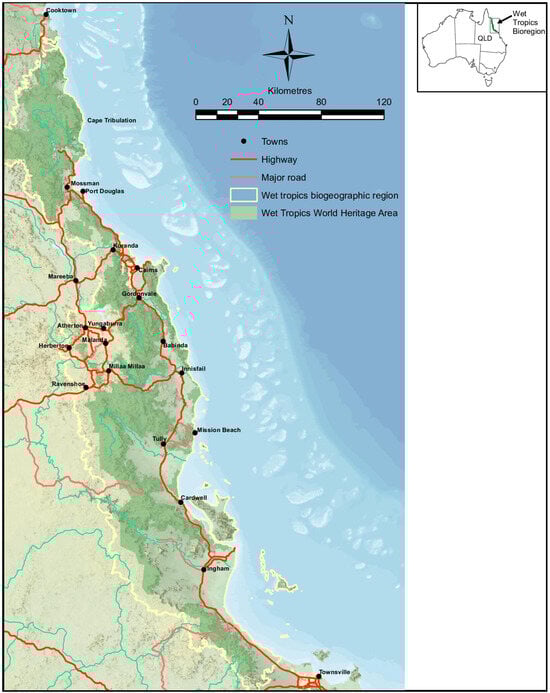
Figure 1.
Map of Australia showing the State of Queensland and the Wet Tropics World Heritage Area (WTWHA) shaded in green. Tropical montane cloud forest (TMCF) is restricted to the mountaintops of the WTWHA, typically in areas above 900 m above sea level. A map depicting WTWHA was generated from the Wet Tropics Plan zoning map Edition 3.0 with the help of the Wet Tropics Management Authority office, Queensland.
Plants affected by climate change or biotic stressors exhibit morphological and physiological plasticity to adapt, survive, and thrive [16]. Their adaptability relies on complex genetic or metabolic detection and communication systems that we are just starting to comprehend. Numerous research investigations have been carried out on various plants, such as Arabidopsis, aiming to unravel the intricate molecular mechanisms that plants exhibit in response to constantly changing environments [17,18,19,20,21]. More recently, technological advancements have enabled the acquisition of molecular data, including phenomics, epigenomics, transcriptomics, proteomics, and metabolomics data. These multidisciplinary approaches have enabled a better understanding of plants’ responses to various environmental changes linked to climate change, including drought and cold [22,23]. The plant produces various biomolecules, which serve different biological roles throughout plant life cycles. These biomolecules can be categorized under two major groups: primary metabolites (PMs) and secondary metabolites (SMs). Primary metabolites, such as proteins, sugars, and organic acids, are widely recognized for their role in essential plant physiological processes, including photosynthesis, photorespiration, and the tricarboxylic acid cycle [24,25]. Secondary metabolites, mainly phenolics, terpenoids, and alkaloids, are produced in response to competitive environmental factors for survival and fulfilling various physiological functions [26]. These SMs do not play a direct role in plants’ typical growth and survival; instead, they contribute to plant development and enhance resilience to stress [27]. For example, flavonoids are photo-protectants, shielding plants from damage caused by ultraviolet-B (UV-B) radiation [28,29]. Similarly, some terpenoids or alkaloids might act as antioxidants or osmotic regulators in response to abiotic stresses in plants [30,31]. In contrast, glucosinolates, limited to specific taxonomic groups, are considered to be essential antitoxins that play a crucial role in enabling plants to resist insect attacks [32].
Understanding the response patterns of these secondary metabolites to potential global climate changes is crucial due to their significance in plant growth, resistance, human health, and conservation efforts. Recently developed powerful omics techniques [33,34,35] and bioimaging [36] and biosensor tools [37,38] have been widely applied for understanding plant physiology, analysing the plant metabolome, and discovering novel metabolomic pathways in response to the changing environment [39]. However, there is no comprehensive review that examined recent metabolomic and phytochemical studies on climate-affected plants of Australian TMCF.
This review comprehensively analysed the literature on the available metabolomics studies conducted on the 84 TMCF plant species and discusses (i) recent developments in plant metabolomics studies that can be applied to study and understand the interactions of wet tropical plants with climatic stress, (ii) medicinal plants and isolated phytochemicals with structural diversity, and (iii) reported biological activities of crude extracts and isolated compounds. In doing so, we compiled and listed the plant species largely restricted to TMCF based on Hoyle et al. (2023) [5]. We compiled additional information from several sources: (i) records in the Atlas of Living Australia [40], (ii) the ‘Rainforest Key’ [41], and (iii) expert knowledge [42]. We searched for studies of metabolomic profiles, medicinal plants use, phytochemical contents, and biological activities in Google Scholar, MEDLINE Ovid, Scopus, PubMed, and journal websites using the following keywords: “wet tropics climate-affected plants”, “secondary metabolites in plants”, “metabolomics studies of plants”, “phytochemical analysis of plants affected by climatic impact”, “biological activities”, and accepted plant names and their synonyms. The information we collected was analysed and presented in tables and figures. Additionally, we utilized ChemDraw Professional software (v. 21.0.0) to create chemical structures, ensuring the accuracy of each structure by cross-referencing them with databases such as PubChem, ChemSpider, and HMDB databases.
2. Climate-Affected Australian Tropical Montane Cloud Forest Plants and Their Medicinal Uses
Using information from Hoyle et al. (2023) [5], expert opinion (botanists from the ATH at James Cook University in Cairns), and other literature, we found 84 climate-affected plant species largely restricted to Australian TMCF. The plant names were cross-checked using the Australian Plant Census [43], WFO Plant List [44], and Australian Tropical Rainforest Plants information system [41]. For these 84 plant species, we generated information on their botanical names, taxonomy, distribution, life form, and medicinal uses (Table 1).
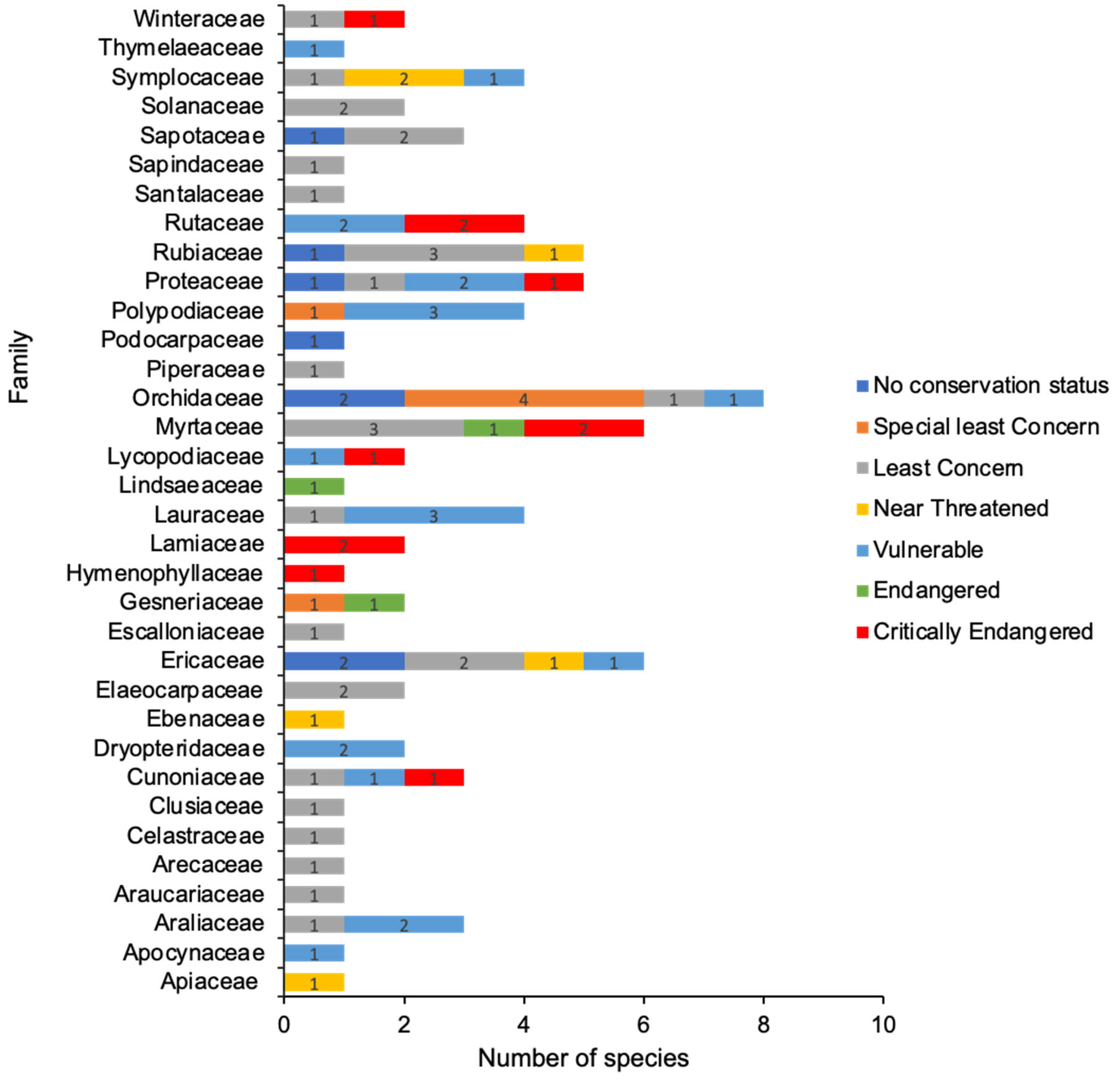
Of the 84 plant species, 54 are restricted to the WTWHA, 2 are endemic to TMCF within the WTWHA, and 4 are found outside Australia (Table 1 and Figure 2A). Of the 84 plant species, 29 were trees, followed by shrubs (28 species) and ferns (8 species) (Table 1 and Figure 2B). These 84 plant species belonged to 34 families, and the Orchidaceae family had the maximum number of species (8 species), trailed by the Ericaceae and Myrtaceae (6 species each) and Proteaceae and Rubiaceae (5 species each) (Figure 2C). Most of the families (15 families) had one species. When checked for their plant uses in traditional medicines, we found that most WTWHA plants were not used medicinally. This could be because most plants are endemic to WTWHA, and although they are used in Aboriginal bush medicines, these endemic species’ medicinal uses are not publicly available. Of 84 species, 43 belong to 29 medicinally important genera (Figure 2D). Of the 43 species, species of Planchonella, Tasmania, and Litsea were particularly indicated as traditionally used by Australian Aboriginal communities to treat various ailments, such as skin sores, scabies, and sore throat, as an antiseptic for boils, malaria, diarrhea, and cough (Table 1). Most of the genera were found to be used for medicinal purposes in traditional medicine systems of Asian countries, such as China, India, Indonesia, Malaysia, Japan, Taiwan, and Korea.
A report from 2010 by the Commonwealth Scientific and Industrial Research Organization (CSIRO) [45] indicates that numerous tree species are at risk of experiencing mean temperatures that exceed their typical tolerance levels. To illustrate, the recent increase in temperature may already be placing stress on a lowland tree species that has adapted to thrive within a mean annual temperature range of 23.0 to 24.0 (measured at 200 masl). To survive in a comparable temperature environment, they must relocate more than 1000 m upward by 2080. However, habitat fragmentation will severely constrain their capacity to respond in this way [14]. Table 1 shows the conservation status of 84 Australian TMCF plant species affected by climate change. Of these, nearly half (41 species) are of conservation significance under Queensland State legislation: 21 species are listed as Vulnerable (V, sky blue bar), 6 are Near Threatened (NT, yellow bar), 3 are Endangered (E, light green bar), and 11 are Critically Endangered (CR, light red bar) (Table 1 and Figure 3). The remainder (43 species) are not currently listed as threatened, i.e., are categorized as Least Concern (LC), Special Least Concern (SL), or no conservation status indicated (No).
Through modelling analysis, Costion et al. (2015) [7] projected significant declines in suitable habitat for 19 of the 84 TMCF plant species listed in Table 1, with estimates ranging from 17% to 100% by 2040 and at least 46% by 2080. Roeble (2018) [46] further refined these predictions, modelling 37 plant species (including 8 from Costion’s study) and predicting a mean habitat loss of 63% by 2085. The study predicted that 5 out of 37 modelled species (Acrotriche baileyana, Gynochthodes constipata, Hymenophyllum whitei, Syzygium fratris, Tasmania sp. Mt. Bellenden Ker) will experience a total loss of their suitable habitat by 2035 and another 2 species (Cinnamomum propinquum and Leucopogon malayanus) by 2085 [46]. A substantial increase in the suitable habitat through 2085 was only predicted for Bubbia whiteana. Overall, both studies [7,46] suggest that a significant portion of Australian TMCF plant species are either threatened or vulnerable to climatic stress. Hence, these plants must acclimatize and react swiftly to overcome environmental stresses or face extinction. Therefore, it is crucial to comprehend how plants react and adjust to shifts in their environment, striving to enhance their ability to withstand the challenges posed by climate change.

Table 1.
List of climate-affected Australian tropical montane cloud forest (TMCF) plants: their distribution, life form, conservation status and medicinal uses.
Table 1.
List of climate-affected Australian tropical montane cloud forest (TMCF) plants: their distribution, life form, conservation status and medicinal uses.
| Botanical Name, Family, and Synonyms | Distribution | Life Form | Medicinal Uses | Metabolomics Profile Studied | Conservation Status (QLD) |
|---|---|---|---|---|---|
| Pteridophyta | |||||
| Dryopteridaceae | |||||
| Parapolystichum grayi (D.J.Jones) J.J.S. Gardner & Nagalingum Syn. Lastreopsis grayi D.L.Jones | Africa, the Neotropics, north-eastern Australia, Madagascar, Pacific Island, and southern Asia | Fern | NU | No | V |
| Parapolystichum tinarooense (Tindale) Labiak, Sundue & R.C.Moran Syn. Lastreopsis tinarooensis Tindale | Wet Tropics region (Australia) | Fern | NU | No | V |
| Hymenophyllaceae | |||||
| Hymenophyllum whitei Goy | Wet Tropics region (Australia) | Fern | NU | No | CR |
| Lindsaeaceae | |||||
| Lindsaea terrae-reginae K.U.Kramer | Wet Tropics region (Australia) | Fern | NU | No | E |
| Lycopodiaceae | |||||
| Phlegmariurus creber (Alderw.) A.R.Field & Bostock Syn. Huperzia crebra (Alderw.) Holub | Wet Tropics region (Australia), PNG, Hawaii | Epiphyte | Phlegmariurus/Huperzia species are traditionally used as vermifuge, purgative, and laxative [47]. | No | CR |
| Phlegmariurus delbrueckii (Herter) A.R.Field & Bostock Syn. Huperzia delbrueckii (Herter) Holub | Wet Tropics region (Australia) | Epiphyte | No | V | |
| Polypodiaceae | |||||
| Oreogrammitis albosetosa (F.M.Bailey) Parris Syn. Polypodium albosetosum F. M.Bailey | Wet Tropics region (Australia) | Fern | NU | No | V |
| Oreogrammitis leonardii (Parris) Parris Syn. Grammitis leonardii Parris | Wet Tropics region (Australia) | Fern | NU | No | V |
| Oreogrammitis reinwardtii Blume | Wet Tropics region (Australia), Sri Lanka, Philippines, Papua New Guinea, Solomon Islands, Malaysia | Fern | NU | No | V |
| Oreogrammitis wurunuran (Parris) Parris Syn. Grammitis wurunuran Parris | Wet Tropics region (Australia) | Fern | NU | No | SL |
| Magnoliophyta | |||||
| Apiaceae | |||||
| Trachymene geraniifolia F.M.Bailey | Wet Tropics region (Australia) | Herb | NU | No | NT |
| Apocynaceae | |||||
| Parsonsia bartlensis J.B.Williams | Wet Tropics region (Australia) | Climber | NU | No | V |
| Araliaceae | |||||
| Hydrocotyle miranda A.R.Bean & Henwood | Wet Tropics region (Australia) | Herb | Hydrocotyle species are used as anti-inflammatory herbs in Taiwanese folk medicines [48]. | No | V |
| Polyscias bellendenkerensis (F.M.Bailey) Philipson | Wet Tropics region (Australia) | Shrub | Polyscias species are traditionally used to treat ailments, such as malaria, obesity, and mental disorders [49]. | No | V |
| Polyscias willmottii (F.Muell.) Philipson | Wet Tropics region (Australia) | Tree | No | LC | |
| Araucariaceae | |||||
| Agathis atropurpurea B.Hyland | Australia | Tree | Agathis species are traditionally used to treat myalgia and headaches [50]. | Yes | LC |
| Arecaceae | |||||
| Linospadix apetiolatus Dowe & A.K.Irivine | Wet Tropics region (Australia) | Tree | NU | No | LC |
| Celastraceae | |||||
| Hypsophila halleyana F.Muell. | Wet Tropics region (Australia) | Shrub | NU | No | LC |
| Clusiaceae | |||||
| Garcinia brassii C.T.White | Wet Tropics region (Australia) | Tree | Infusions prepared from fruits of Garcinia species are traditionally used to treat dysentery, ulcers, and wounds [51]. | No | LC |
| Cunoniaceae | |||||
| Ceratopetalum corymbosum C.T.White | Wet Tropics region (Australia) | Tree | NU | No | V |
| Ceratopetalum hylandii Rozefelds & R.W.Barnes | Wet Tropics region (Australia) | Tree | NU | No | LC |
| Eucryphia wilkiei B.Hyland | Wet Tropics region (Australia) | Shrub | NU | Yes | CR |
| Ebenaceae | |||||
| Diospyros granitica Jessup | Wet Tropics region (Australia) | Tree | Diospyros species are used traditionally used as sedative, astringent, carminative, febrifuge, anti-hypertensive, vermifuge, antidiuretic, and to relieve constipation [52]. | No | NT |
| Elaeocarpaceae | |||||
| Elaeocarpus linsmithii Guymer | Wet Tropics region (Australia) | Tree | Elaeocarpus species are the source of popular spiritual beads (known as Rudraksha in Asia), which are used to treat various ailments, including mental/neurological disorders (stress, depression, anxiety, hypertension, epilepsy, migraine, and neuralgia), asthma, and also used as analgesic [53]. | No | LC |
| Elaeocarpus hylobroma Y.Baba & Crayn | Wet Tropics region (Australia) | Tree | No | LC | |
| Ericaceae | |||||
| Acrotriche baileyana (Domin) J.M.Powell | Wet Tropics region (Australia) | Shrub | NU | No | NT |
| Dracophyllum sayeri F.Muell | Wet Tropics region (Australia) | Tree | NU | No | V |
| Leucopogon malayanus subsp. novoguineensis (Sleumer) Pedley Syn. Styphelia malayana subsp. novoguineensis (Sleumer) Hislop, Crayn & Puente-Lel. | Wet Tropics region (Australia) | Shrub | NU | No | No |
| Rhododendron lochiae F.Muell. Syn. Rhododendron notiale, Craven | Wet Tropics region (Australia) | Shrub | Rhododendron species are used to prevent and treat many ailments, including respiratory disorders like asthma and bronchitis, dysentery, diarrhea, constipation, fever, cardiac disorders, and inflammation [54]. | No | No |
| Rhododendron viriosum Craven | Wet Tropics region (Australia) | Tree | No | LC | |
| Trochocarpa bellendenkerensis Domin | Wet Tropics region (Australia) | Tree | NU | No | LC |
| Escalloniaceae | |||||
| Polyosma reducta F.Muell. | Wet Tropics region (Australia) | Tree | NU | No | LC |
| Gesneriaceae | |||||
| Boea kinneari (F.Muell.) B.L.Burtt | Wet Tropics region (Australia) | Herb | NU | No | E |
| Lenbrassia australiana (C.T.White) G.W.Gillett | Wet Tropics region (Australia) | Shrub | NU | No | SL |
| Lamiaceae | |||||
| Prostanthera albohirta C.T.White | Mount Emerald, Wet Tropics region (Australia) | Shrub | Some Prostanthera species are used for topical applications to treat skin sores and infections [55,56]. | No | CR |
| Prostanthera athertoniana B.J.Conn & T.C.Wilson | Wet Tropics region (Australia) | Shrub | No | CR | |
| Lauraceae | |||||
| Cinnamomum propinquum F.M.Bailey | Wet Tropics region (Australia) | Tree | Cinnamomum species are most commonly used in traditional Chinese medicines to treat multiple disorders, including indigestion, microbial infections, and cough and cold [57]. | Yes | V |
| Cryptocarya bellendenkerana B.Hyland | Wet Tropics region (Australia) | Tree | NU | Yes | LC |
| Endiandra jonesii B.Hyland | Wet Tropics region (Australia) | Tree | Endiandra species are traditionally used to treat rheumatism, headache, dysentery, pulmonary disorders, and uterine tumours [58]. | No | V |
| Litsea granitica B.Hyland | Wet Tropics region (Australia) | Tree | Litsea species are used traditionally by Aboriginal communities to treat skin infections such as sores and scabies, and also used an antiseptic [59]. | No | V |
| Myrtaceae | |||||
| Leptospermum wooroonooran F.M.Bailey | Wet Tropics region (Australia) | Tree | Leptospermum species are traditionally used in Malaysia to relieve menstrual and stomach disorders [60,61]. | Yes | LC |
| Micromyrtus delicata A.R.Bean | Wet Tropics region (Australia) | Shrub | NU | No | E |
| Pilidiostigma sessile N.Snow | Wet Tropics region (Australia) | Shrub | NU | No | LC |
| Rhodamnia longisepala N.Snow & A.J.Ford | Wet Tropics region (Australia) | Shrub | Rhodamnia species are used traditionally in Indonesia to treat scars, toothache, and cough [62]. | No | CR |
| Syzygium fratris Craven | Wet Tropic region (Australia) | Shrub | NU | No | CR |
| Uromyrtus metrosideros (F.M.Bailey) A.J.Scott | Wet Tropics region (Australia) | Shrub | NU | Yes | LC |
| Orchidaceae | |||||
| Bulbophyllum lilianiae Rendle | Wet Tropics region (Australia) | Epiphyte | Bulbophyllum species are traditionally used to treat skin diseases, cardiovascular diseases, and rheumatism [63]. | No | LC |
| Bulbophyllum wadsworthii Dockrill Syn. Oxysepala wadsworthii (Dockrill) D.L.Jones & M.A.Clem. | Australia | Epiphyte | No | SL | |
| Bulbophyllum windsorense B.Gray & D.L.Jones Syn. Oxysepala windsorensis (B.Gray & D.L.Jones) D.L.Jones & M.A.Clem. | Wet Tropics region (Australia) | Epiphyte | No | V | |
| Dendrobium brevicaudum D.L.Jones & M.A.Clem. Syn. Dockrillia brevicauda (D.L.Jones & M.A.Clem.) M.A.Clem. & D.L.Jones | Wet Tropics region (Australia) | Herb, Epiphyte | Dendrobium species are used in traditional Chinese and Indian medicine systems as a source of tonic for longevity and also as an antipyretic, analgesic, astringent, and anti-inflammatory agent [64]. | No | No |
| Dendrobium carrii Rupp & C.T.White Syn. Australorchis carrii (Rupp & C.T.White) D.L.Jones & M.A.Clem. | Wet Tropics region (Australia) | Herb, Epiphyte | No | SL | |
| Dendrobium finniganense D.L.Jones Syn. Thelychiton finniganensis (D.L.Jones) M.A.Clem. & D.L.Jones | Wet Tropics region (Australia) | Herb, Epiphyte | No | SL | |
| Liparis fleckeri Nicholls | Wet Tropics region (Australia) | Lithophyte | Liparis species are traditionally used in Chinese medicine to treat inflammatory diseases, including haemoptysis, metrorrhagia, traumatic haemorrhage, and pneumonia; they are also used to stop bleeding from wounds and to detoxify snakebite [65]. | No | No |
| Octarrhena pusilla (F.M.Bailey) M.A.Clem. & D.L.Jones Syn. Octarrhena pusilla (F.M.Bailey) Dockrill | Wet Tropics region (Australia) | Epiphyte | NU | No | SL |
| Piperaceae | |||||
| Peperomia hunteriana P.I.Forst. | Wet Tropics region (Australia) | Herb | Peperomia species are traditionally used for treating pain and inflammation, gastric ulcers, asthma, and bacterial infections [66,67]. | No | LC |
| Podocarpaceae | |||||
| Prumnopitys ladei (F.M.Bailey) de Laub Syn. Stachycarpus ladei (Bailey) Gaussen, Podocarpus ladei F.M.Bailey | Endemic to Wet Tropics Australia | Tree | Fruits and bark of Prunmnopitys species are considered medicinal [68]. | Yes | No |
| Proteaceae | |||||
| Austromuellera valida B.Hyland | Endemic to Wet Tropics region | Tree | NU | No | V |
| Helicia lewisensis Foreman | Endemic to Wet Tropics region | Tree | Helicia species are used for treating mouth and skin sores and also kidney and gastric problems [59,69,70,71]. | No | V |
| Helicia recurva Foreman | Endemic to Wet Tropics region | Tree | No | No | |
| Hollandaea porphyrocarpa A.J.Ford & P.H.Weston Syn. Hollandaea sp. Pinnacle Rock Track (P.I.Forster PIF10714) | Endemic to Wet Tropics region | Shrub | NU | No | CR |
| Nothorites megacarpus (A.S.George & B.Hyland) P.H.Weston & A.R.Mast Syn. Orites megacarpa A.S.George & B.Hyland | Endemic to Wet Tropics region | Tree | NU | No | LC |
| Rubiaceae | |||||
| Aidia gyropetala A.J.Ford and Halford | Endemic to Wet Tropics region | Tree | Aidia species are used for treating body/muscle pains and pains due to gastric disorders [72]. | No | LC |
| Gynochthodes constipata (Halford & A.J.Ford) Razafim. & B.Bremer Syn. Morinda constipata Halford & A.J.Ford | Endemic to Wet Tropics region | Climber | Gynochthodes/Morinda species are traditionally used for treating diabetes, inflammation, cancer, psychiatric disorders, and microbial infections [73]. | No | LC |
| Gynochthodes podistra (Halford & A.J.Ford) Razafim. & B.Bremer Syn. Morinda podistra Halford & A.J.Ford | Endemic to Wet Tropics region | Climber | No | LC | |
| Ixora orophila C.T.White Syn. Psydrax montigena S.T.Reynolds & R.J.F.Hend. | Endemic to Wet Tropics region | Shrub | Ixora species are used in Ayurvedic medicine against leucorrhoea, hypertension, menstrual irregularities, sprains, bronchitis fever, sores, chronic ulcers, scabies, and skin diseases [74]. | No | No |
| Wendlandia connata C.T.White | Endemic to Wet Tropics region | Shrub | Wendlandia species are traditionally used for treating fever, dysentery, cough, hypertension, diabetes, constipation, inflammations, and hyperlipidemia [75]. | No | NT |
| Rutaceae | |||||
| Flindersia oppositifolia (F.Muell.) T.G.Hartley & Jessup | Wet Tropics region (Australia) | Tree | NU | Yes | V |
| Leionema ellipticum Paul G. Wilson | Endemic to Wet Tropics region | Shrub | NU | Yes | V |
| Zieria alata Duretto & P.I.Forst. | Endemic to Wet Tropics region | Shrub | NU | No | CR |
| Zieria madida Duretto & P.I.Forst. | Endemic to Wet Tropics region | Shrub | NU | No | CR |
| Santalaceae | |||||
| Korthalsella grayi Barlow | Endemic to Wet Tropics region | Herb | No | LC | |
| Sapindaceae | |||||
| Mischocarpus montanus C.T.White Syn. Mischocarpus pyriformis subsp. retusus (Radlk.) R.W.Ham, Mischocarpus retusus Radlk. | Wet Tropics region (Australia), New Guinea | Tree | NU | No | LC |
| Sapotaceae | |||||
| Pleioluma singuliflora (C.T.White & W.D.Francis) Swenson Syn. Planchonella singuliflora (C.T.White & W.D.Francis) P.Royen, Pouteria singuliflora (C.T.White & W.D.Francis) Baehni | Endemic to Wet Tropic region | Shrub | NU | No | LC |
| Sersalisia sessiliflora (C.T.White) Aubrév. Syn. Pouteria sylvatica Baehni, Lucuma sessiliflora C.T.White | Endemic to Wet Tropics region | Tree | NU | No | LC |
| Planchonella sp. Mt. Lewis (B.Hyland 14048) Qld Herbarium | Endemic to Wet Tropics region | Tree | Planchonella species have been used by Aboriginal medicine system to treat sores/sore throat and as an antiseptic for boils [59]. | No | No |
| Solanaceae | |||||
| Solanum dimorphispinum C.T.White | Endemic to Wet Tropics region | Shrub | Solanum species have been traditionally used against infectious diseases and also as anti-microbial agents and insecticidal against mosquitoes [76]. | No | LC |
| Solanum eminens A.R.Bean | Endemic to Wet Tropics region | Climber | No | LC | |
| Symplocaceae | |||||
| Symplocos bullata Jessup Syn. Symplocos sp. North Mary (B. Gray 2543) | Endemic to Wet Tropics region | Shrub | Symplocos species are traditionally known for treating diseases such as malaria, ulcers, leprosy, leucorrhea, menorrhagia, and gynecological disorders [77]. | No | LC |
| Symplocos graniticola Jessup | Endemic to Wet Tropics region | Shrub | No | V | |
| Symplocos oresbia Jessup Syn. Symplocos sp. Mt Finnigan (L.J. Brass 20129) | Endemic to Wet Tropics region | Shrub | No | NT | |
| Symplocos wooroonooran Jessup Syn. Symplocos stawellii var. montana C.T.White, Symplocos cochinchinensis var. montana (C.T.White) Noot | Endemic to Wet Tropics region | Shrub | No | NT | |
| Thymelaeaceae | |||||
| Phaleria biflora (C.T.White) Herber Syn. Oreodendron biflorum C.T.White | Endemic to Wet Tropics region | Tree | Phaleria species are used for treating stomachache, general pain, diarrhea, lowering glucose/cholesterol levels in blood, and also known for anti-cancer properties [78]. | No | V |
| Winteraceae | |||||
| Bubbia whiteana A.C.Sm. Syn. Zygogynum semecarpoides var. whiteanum Vink, Bubbia semecarpoides var. whiteana Vink | Endemic to Wet Tropics region | Shrub | NU | No | CR |
| Tasmannia sp. Mt Bellenden Ker (J.R.Clarkson 6571) | Wet Tropics region (Australia) | Shrub | Tasmania species are traditionally used for treating malaria, diarrhea, and cough [79]. | No | LC |
The scientific names and plant families follow the Australian Plant Census. Where taxonomy differs in “Plants of the World Online” [80], the synonym is given; distribution and plant life forms were sourced from the Atlas of Living Australia Field [41], the Australian Tropical Rainforest Plants system Field [42], and the Australian Tropical Rainforest Orchids [81]. Conservation status is as per the Queensland Nature Conservation Act 1992 [82]. Abbreviations—SL: Special Least Concern; LC: Least Concern; NT: Near Threatened; V: Vulnerable; E: Endangered; CR: Critically Endangered; No: Species for which no conservation status is indicated; NU: Not used medicinally.
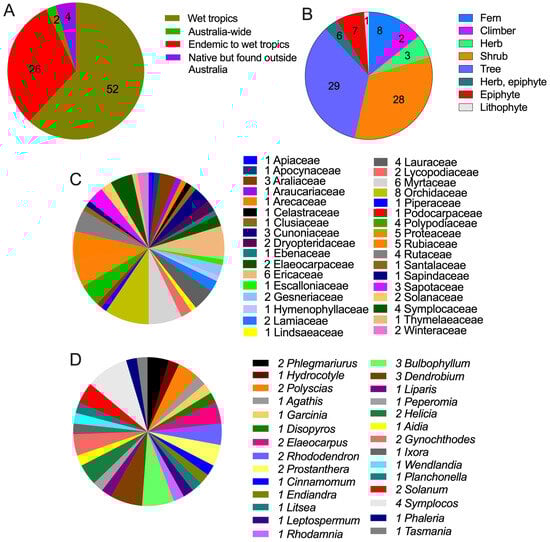
Figure 2.
Climate-affected Australian tropical montane cloud forest (TMCF) plants in the Wet Tropics World Heritage Area (WTWHA), northeast Queensland: (A) distribution, (B) life form, (C) family diversity, and (D) medicinally important genus with species number. Distribution and plant life forms were sourced from the Atlas of Living Australia Field [41], the Australian Tropical Rainforest Plants system Field [42], and the Australian Tropical Rainforest Orchids [81]. Conservation status is as per the Queensland Nature Conservation Act 1992 [82].
Figure 2.
Climate-affected Australian tropical montane cloud forest (TMCF) plants in the Wet Tropics World Heritage Area (WTWHA), northeast Queensland: (A) distribution, (B) life form, (C) family diversity, and (D) medicinally important genus with species number. Distribution and plant life forms were sourced from the Atlas of Living Australia Field [41], the Australian Tropical Rainforest Plants system Field [42], and the Australian Tropical Rainforest Orchids [81]. Conservation status is as per the Queensland Nature Conservation Act 1992 [82].
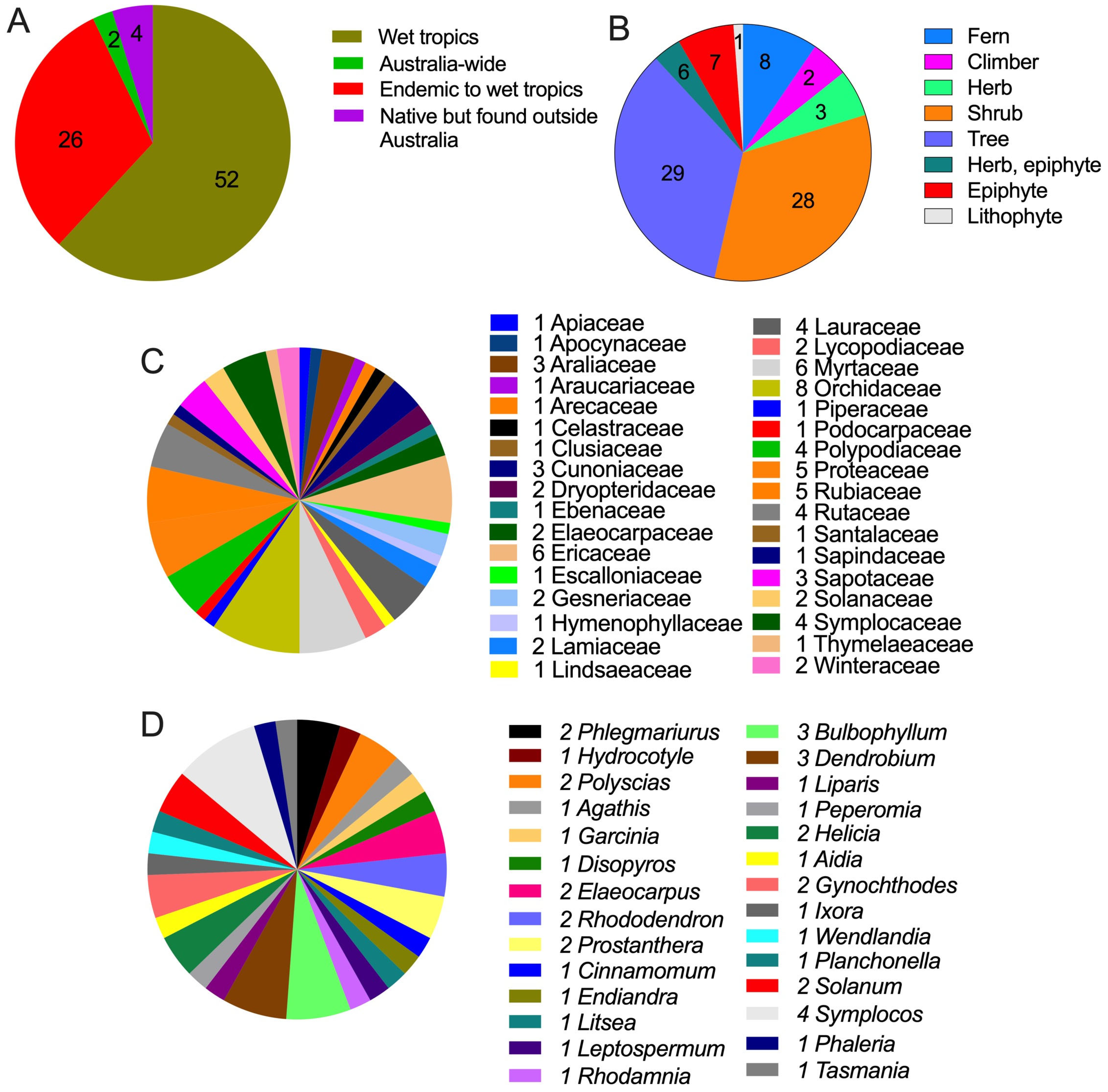
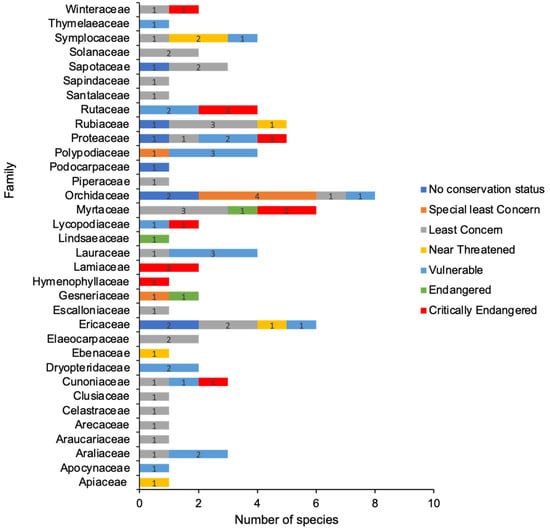
Figure 3.
Conservation status of climate-affected Australian tropical montane cloud forest (TMCF) plants in the Wet Tropics World Heritage Area (WTWHA) in northeast Queensland. Conservation status is as per the Queensland Nature Conservation Act 1992 [82]. Different conservation status categories are represented by different colour codes, as shown in the figure legend, and numbers on bar plots represent plant species numbers.
Figure 3.
Conservation status of climate-affected Australian tropical montane cloud forest (TMCF) plants in the Wet Tropics World Heritage Area (WTWHA) in northeast Queensland. Conservation status is as per the Queensland Nature Conservation Act 1992 [82]. Different conservation status categories are represented by different colour codes, as shown in the figure legend, and numbers on bar plots represent plant species numbers.
3. Metabolomic Profile of Climate-Affected Plants in WTWHA
The anticipated impact of global climate changes on plant secondary metabolism is significant, but a comprehensive understanding of these effects is currently absent. Changes in the metabolome (defined as the complete set of metabolites found in a biological sample) can occur rapidly in seconds or minutes due to living organisms’ responses, acclimation, and adaptation to environmental conditions [83,84,85]. Investigations into climate effects on plants have shown that plants growing under various climatic stresses in their natural habitat produce various SMs that could potentially have a role in adaptation to the changing environment [86,87,88]. Studies have also revealed that abiotic stress factors, such as increased temperature and ultraviolet (UV) radiation, stimulate plants to reprogram their genetic codes for metabolic pathways, leading to the accumulation of new and unique secondary metabolites [89].
For example, it was demonstrated that elevated temperatures can lead to increased production of terpenoids, phenolic acids, and flavonoids in plants [90,91]. These compounds act as protective pigments when trees are exposed to UV-B radiation (wavelengths between 280 and 315 nm) [92]. Likewise, higher ozone (O3) concentrations have been linked to heightened production of antioxidant compounds such as glutathione, gamma-aminobutyric acid (GABA), terpenoids, and volatile organic compounds (VOCs) [93]. For example, the production of phenolics in plants plays an integral part in protecting mesophyll tissue from UV radiation and water stress [94,95]. It was discovered that drought conditions enhance plant productivity, leading to increased production of SMs, terpenes, complex phenols, and alkaloids [96,97,98]. Moreover, secondary metabolites with antioxidant properties, such as phenolic compounds and tocopherols, were known to scavenge the reactive oxygen species (ROS) generated, thus adapting to a new environment [99].
In addition to metabolites, plants store proteins like hydrolases, enzymes for detoxifying ROS, and enzymes for modifying cell walls. These proteins act as regulatory agents, governing plant growth and development [100]. Similarly, salinity also impacts the plant’s growth and development. It leads to an abnormal ion composition, causing toxicity, osmotic stress, producing ROS, cellular harm, and degrading membrane lipids, proteins, and nucleic acids [99]. In response to saline soil stress, plants undergo a biochemical process that produces ions that can act against ion toxicity and abnormal osmotic pressure developed from salinity [101]. In addition, when a huge amount of sodium (Na+) ions prevails, plants respond to an abundance of Na+ ions by activating a sophisticated defence system, which enables them to regulate cellular and ion balance effectively [102].
These studies enable us to understand the metabolite/micronutrient change patterns, including compositions, variations, and biosynthetic pathways resulting from plants’ responses to biotic and abiotic stressors, collectively known as plant metabolomics [103,104]. It can provide insights into plant phenotypic relations to their physiological and resistance development and biodiversity [105]. More than 200,000 secondary metabolites (SMs) have been identified [106] from over 391,000 plant species known worldwide [107] through metabolomics studies. The projected number for the plant kingdom is expected to surpass 200,000 [108,109]. Hence, plant metabolomics poses a significant hurdle for researchers in plant science. The comprehensive research workflow in plant metabolomics encompasses experimental planning, sample gathering, sample handling, sample preparation, detection and examination, data handling, as well as the analysis of metabolic pathways and networks [110].
From our literature review on 84 plant species affected by climate change in WTWHA of northeast Queensland, only nine species were studied for their metabolomic profiles/phytochemical contents (Table 2). A total of 279 metabolites (251 identified and 18 isolated) were identified/isolated from parts of 9 plant species. The identified metabolites were mostly flavonoids, terpenoids, alkaloids, and glucosides (Table 2). However, none of these metabolomics studies included in Table 2 were conducted to investigate their response to climatic stress conditions under in situ or ex situ conditions. There is a need for this type of study, but the challenge would be to control various factors influencing plant responses, which is why we see most of the studies conducted under controlled conditions in glass houses. Currently, our group is conducting a first-of-its-kind study on selected WTWHA plants, in which we are comparing the metabolome profile and chemical variation between the wild and the domesticated plant population.
Table 2.
List of climate-affected Australian tropical montane cloud forest (TMCF) plants studied for their phytochemical contents and bioactivity.
4. Metabolomics Approaches, Tools, and Techniques Used in Plant Metabolomics
Understanding plants’ physiological and metabolomic responses to global change is key to identifying potential traits, including their genetic mutations and changes in their metabolomic pathways. Additionally, it is possible to predict potential changes in the composition of plant communities by assessing the ability of various plant species to adapt to environmental shifts [147,148]. Metabolites from living matters can be identified using (i) isolation techniques and (ii) metabolomics platforms. Metabolomics platforms, in general, rely on mass spectrometry (MS)-based techniques, namely capillary electrophoresis mass spectrometry (CE-MS), liquid chromatography-mass spectrometry (LC-MS), and gas chromatography-mass spectrometry (GC-MS) [149,150]. We found that GC-MS is the most used technique among the studies that analysed metabolites of Australian TMCF plants. Out of nine plants studied for metabolomics included in this review, metabolites from seven species were analysed using GC-MS (Table 2). Two innovative technological methods that do not require the use of metabolite chromatography include Nuclear Magnetic Resonance (NMR) analysis of unrefined extracts and the direct inspection of unrefined extracts using mass spectrometry (MS), specifically either quadrupole (Q) TOF-MS or ultra-high-resolution Fourier transform ion cyclotron MS (FT-MS) [105], which are discussed in-depth in later sections. Compared to conventional methods in the postgenomic era, metabolomics analysis offers numerous advantages and potential applications [150]. It has various steps, as shown in Figure 4, including sample preparation, spectra processing, data analysis, and metabolite identification.
The NMR-based metabolomic analysis offers a potent, non-invasive method, delivering precise structural details about metabolites [151]. While metabolomic analysis using mass spectrometry is inherently destructive, it is highly sensitive and can detect traces of metabolites, and thus, it has gained more popularity [152]. Mass spectrometry (MS) methods are frequently integrated with chromatographic separation methods, including gas chromatography (GC) and liquid chromatography (LC) [152]. Only one metabolomics study applied LC-MS and NMR techniques to analyse the alkaloid diversity in the leaves of Australian Flindersia species, including F. oppositifolia (Table 2). Since the metabolome is a complex mixture of many small molecules, chromatographic separation is necessary prior to ion detection, particularly to distinguish isobaric compounds with a similar mass. Alternatively, the direct-infusion mass spectrometry (DIMS) approach is applied to measure metabolites directly without a prior chromatographic separation [153]. However, none of the studies that analysed Australian TMCF plants have applied either of these techniques. Most of the studies on plant-based metabolomics published so far have used the Orbitrap or TOF (time-of-flight) equipment [154]. One of the main reasons for using TOF equipment could be due to its mass resolution values (i.e., 30,000–40,000) [155,156], and the resolution power is unaffected by chromatography acquisition rates [157,158,159]. On the contrary, Orbitrap mass spectrometers can rapidly acquire tandem MS spectra up to 240,000 mass resolution, and thus, they are mainly applied in the shotgun metabolomics [157,160,161].
The DIMS methodology has recently been expanded to swift, high-throughput fingerprinting techniques employing advanced mass spectrometers with high resolution, such as Fourier transform ion cyclotron resonance (FT-ICR) mass spectrometers (FT-ICR-MS) [157]. Its extensive usage in plant metabolomics greatly helped understand plant development, responses to biotic and abiotic stresses, and exploring novel natural nutraceutical compounds [154,162]. The FT-ICR-MS has a higher resolution power (105 to >106), mass accuracy (typically 0.1–2 ppm), and sensitivity [163,164]. For instance, FT-ICR-MS can analyse and evaluate approximately 50,000 molecular formulas in complex samples, such as plant-derived crude essential oils [165,166]. Another reason for more usage of FT-ICR-MS is that this instrument has a wide range of ionisation sources, including electron spray ionisation (ESI), atmospheric pressure chemical ionization, and photoionization, thus enabling analyses of different sample types [167]. For example, Shahbazya et al. (2020) [168] used FT-ICR-MS to study the response of thyme plants (Thymus vulgaris) to drought stress. The study identified galactose metabolism as the most significant factor in drought adaptive response in thyme. Other studies, including metabolomics changes in poplar species in response to salinity stress [169] and UV-B radiation, also applied the same technique [170].
Nevertheless, because metabolites exhibit various chemical properties and are found abundantly in various cells, no single analytical platform can encompass the entire metabolome. Therefore, multi-omics technology has enabled the exploration of genes and metabolites in response to various climatic stress factors, particularly by combining transcriptomics and metabolomics approaches. For instance, Wang et al. (2021) [23], in their study about Poa crymophila, applied transcriptomics and metabolomics and identified the phenylpropanoid pathway as the main mechanism that facilitates this plant to survive in the unfavourable environment of Qinghai-Tibet Plateau. Liu et al. (2021) [22] also applied a combination of transcriptomics with physiological analyses to understand the chilling response in pumpkins and found that α-linolenic acid biosynthesis was one of the key pathways in the response.
These instruments employ three approaches to characterize metabolites, namely, (i) targeted analysis, (ii) untargeted analysis, and (iii) metabolic fingerprinting [171]. Unlike the targeted approach (identify a set of targeted metabolites with reference to available standards), the untargeted approach generates a large volume and complex data requiring specialised computational methods, such as artificial intelligence (AI) and machine learning (ML) algorithms, to process and interpret data [171]. In contrast, metabolic fingerprinting or exometabolomics involves characterising extracellular metabolites (i.e., metabolic by-products of organisms produced in response to environmental factors in which they survive) [172,173]. For plant metabolomic profiling, “ecometabolomics” is a commonly applied technique. The term “ecometabolomics” first appeared in the scientific literature in 2009 [33,174]. This study investigates how living organisms respond, acclimate, and adapt to environmental conditions by a nontargeted approach [83,84,85]. Metabolite identification can be achieved at four metabolite standard initiative (MSI) levels. Metabolite standard initiative level-1 (MSI-1) is considered the highest level of identification as it identifies metabolites after comparing with their chemical standards [175,176]. Level-2 (MSI-2) and level-3 identifications are only putative, as metabolites (MSI-2) or metabolite class (MSI-3) are not compared to their chemical standards, whereas MSI level-4 (MSI-4) putatively annotates unknown metabolites [175,176].
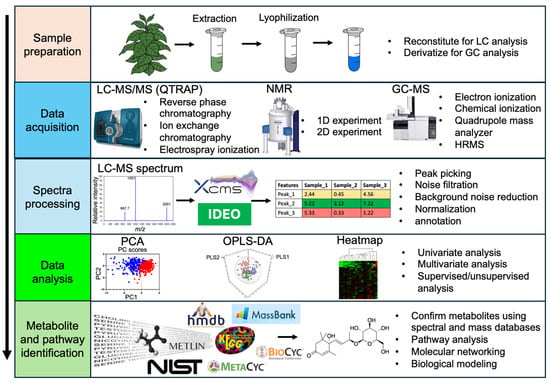
Figure 4.
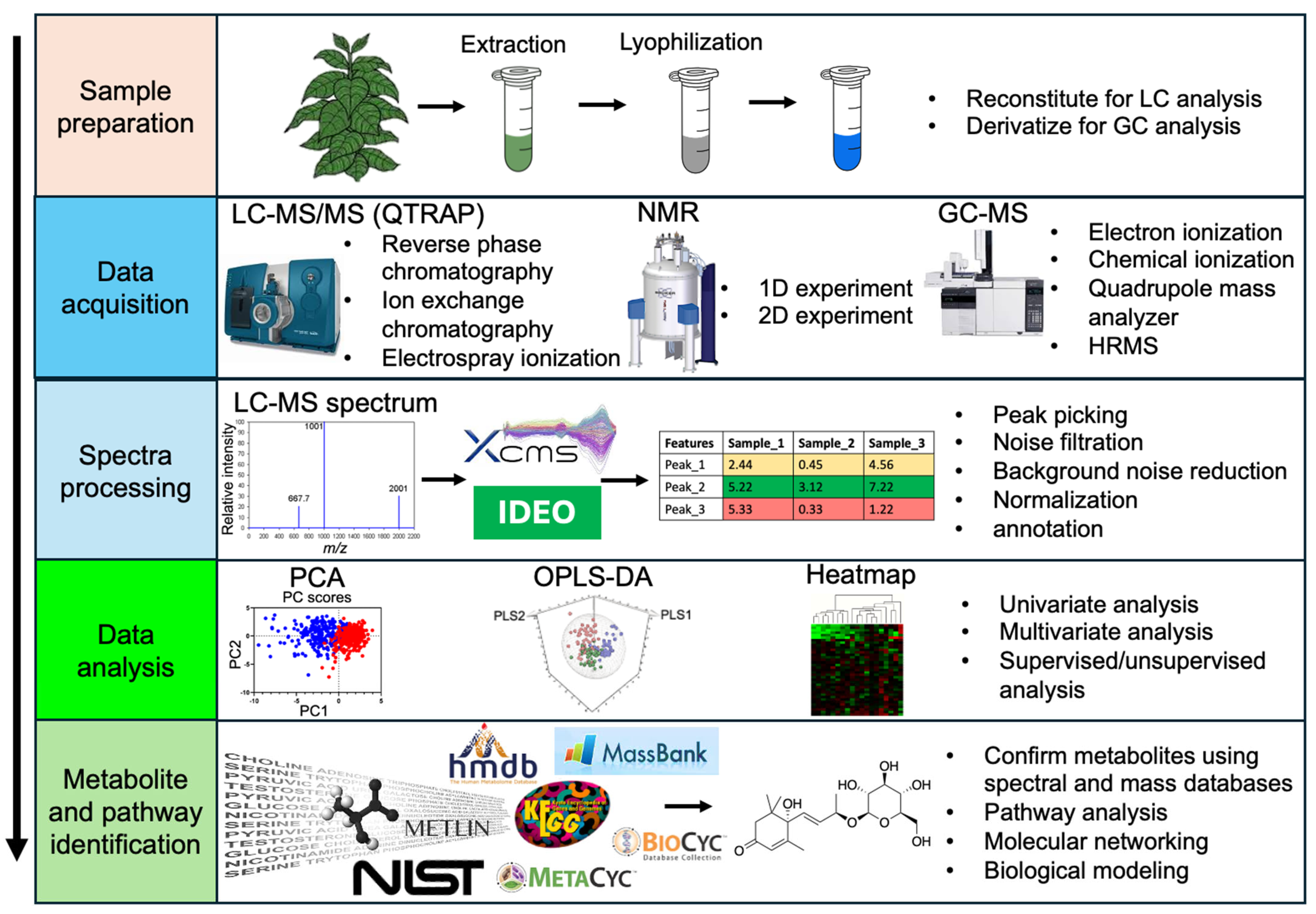
Common metabolomic workflow applied in plant metabolomics studies. The figure was adapted from Xu and Fu [177], and all databases’ logos used in this figure were obtained from their respective websites. Abbreviations—LC-MS: Liquid chromatography-mass spectrometry; NMR: Nuclear Magnetic Resonance; 1D: one-dimensional; 2D: two-dimensional; GC-MS: Gas chromatography-mass spectrometry; QTRAP: The Quadrupole Ion Trap; XCMS: eXtensible Computational Mass Spectrometry; HMDB: Human metabolome database; PCA: principal component analysis; OPLS-DA: Orthogonal Partial Least Squares Discriminant Analysis; NIST: National Institute of Standards and Technology; METLIN: Metabolite and chemical entity database.
Figure 4.
Common metabolomic workflow applied in plant metabolomics studies. The figure was adapted from Xu and Fu [177], and all databases’ logos used in this figure were obtained from their respective websites. Abbreviations—LC-MS: Liquid chromatography-mass spectrometry; NMR: Nuclear Magnetic Resonance; 1D: one-dimensional; 2D: two-dimensional; GC-MS: Gas chromatography-mass spectrometry; QTRAP: The Quadrupole Ion Trap; XCMS: eXtensible Computational Mass Spectrometry; HMDB: Human metabolome database; PCA: principal component analysis; OPLS-DA: Orthogonal Partial Least Squares Discriminant Analysis; NIST: National Institute of Standards and Technology; METLIN: Metabolite and chemical entity database.
5. Phytochemicals Isolated from Climate-Affected Plants in WTWHA
Out of 84 plant species included in this review, phytochemicals were isolated from only 3 plant species, namely, Uromyrtus metrosideros, Flindersia oppositifolia, and Leionema ellipticum (Table 2). A total of 19 compounds/secondary metabolites were isolated from these 3 plant species (Table 2), and these compounds belong to 4 different chemical groups (alkaloids, flavonoids, benzopyrans, and glucosides). For example, two new galloyl glucosides (galloyl-lawsoniaside A and uromyrtoside) and four known compounds were isolated from Uromyrtus metrosideros [132]. These six compounds were characterised using low- and high-resolution mass spectrometry (L/HRMS) and Nuclear Magnetic Resonance (NMR) spectroscopy. All three studies involving three plants were conducted to identify pharmacological drug leads (U. metrosideros and F. oppositifolia) and solve the taxonomic discrepancies (L. ellipticum). They did not suggest their role in response to climatic stress factors.
6. Pharmacological Activities of Isolated Phytochemicals of Climate-Affected Plants in WTWHA
Studies have suggested that SMs, which function as plant defence mechanisms, possess intriguing pharmacological properties, including antioxidant and anti-inflammatory properties [178]. For instance, a novel galloyl-lawsoniaside A isolated from U. metrosideros leaf significantly suppressed pro-inflammatory cytokines, such as interferon-gamma and interleukins-17 (IL-17) and IL-18, and thus was identified as a new anti-inflammatory drug-lead molecule [132]. Osthol isolated from Leionema ellipticum also showed anti-inflammatory activity [143,146]. A study by Yeshi et al. [178] analysed crude extracts from the leaves of seven plant species endemic to WTWHA of FNQ. Five of the seven plant species showed potent antioxidant and anti-inflammatory activities in in vitro human peripheral blood cells (PBMCs) assay [178]. About 30 plant species growing in the WTWHA were reported as medicinal plants used for many years by indigenous communities to treat various diseases and ailments, including inflammation-related diseases [179]. Many metabolites identified through metabolomic studies (Table 2) were also studied for numerous biological properties (Table 2). Some major and bioactive metabolites were α-pinene, p-cymene, β-endemol, limonene, viridiflorene, E-β-farnesene, copaene, and β-caryophyllene (Table 2). Figure 5 shows some interesting structures of these isolated compounds. They showed a wide array of pharmacological activities, from anti-microbial to anti-cancer and anti-plasmodial properties. Of nine plant species listed in Table 2, four were tested for anti-inflammatory and anti-cancer properties, three each were tested for anti-microbial and antioxidant activities, two were tested for anti-allergic reactions, and the rest were tested for anti-diabetic, anti-malarial, and neuro-protective properties (one plant species each). For instance, galloyl-lawsoniaside A isolated from U. metrosideros leaf showed promising anti-inflammatory activity through significant suppression of pro-inflammatory cytokines, interferon-gamma (IFN-γ), and interleukin-17A (IL-17A) by phorbol myristate acetate/ionomycin (P/I)-activated cells [132]. Moreover, it also significantly suppressed the release of IL-8 by the anti-CD3/anti-CD28-activated cells [132]. There are increasing studies on identifying anti-inflammatory molecules by targeting the 5-lipoxygenase (5-LOX) pathway, as 5-LOX drives inflammation by producing inflammatory mediators, such as leukotrienes [180,181]. Osthol isolated from aerial parts of Leionema ellipticum showed selective inhibition of the 5-LOX pathway [143]. The anti-cancer/anti-tumour activity was mainly tested with crude extracts or essential oils by studying their inhibitory effect on tumour growth using tumour cell lines such as sarcoma 180 ascites tumour cells [125]. The anti-cancer activity was attributed to the major metabolite constituents, such as limonene, p-cymene, α-pinene, and viridiflorene (Table 2), and was not tested against the single compound. A few isolated compounds also exhibited anti-plasmodial activity. For example, pimentelamine C, isolated from the leaf of Flindersia pimentaliana, showed moderate anti-plasmodial activity against Plasmodium falciparum with IC50 values of 3.6 ± 0.7 (against chloroquine-sensitive strain) and 2.7 ± 0.3 (against chloroquine-resistant strains) [141].
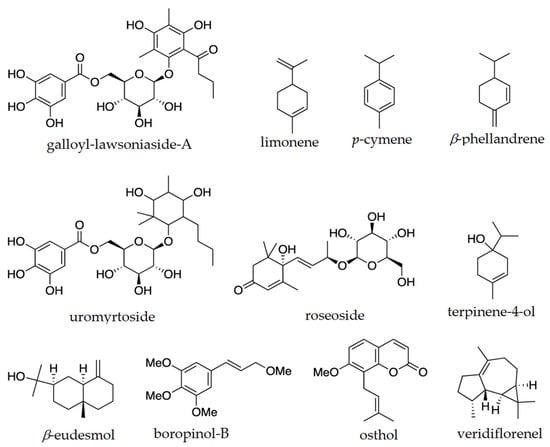
Figure 5.
Chemical structure of bioactive compounds isolated/identified from the climate-affected Australian montane cloud forest (TMCF) plants (also used medicinally) in the Wet Tropics World Heritage Area (WTWHA), northeast Queensland.
7. Conclusions and Future Directions
The Australian tropical montane cloud forest (TMCF), which lies in the Wet Tropics World Heritage Area in FNQ, has rich and unique biodiversity, with over 700 endemic plant species. The current study identified that 84 plant species were affected by climate change, with some species already being endangered in their natural habitat. Recent studies of 37 of these species predicted a total loss of suitable habitat for five species by 2035 and seven species by 2085 if greenhouse gas emission (e.g., CO2) into the atmosphere continues at the current speed. Recently, many powerful technologies have been developed, including omics techniques, bioimaging, and biosensor tools, which have been widely applied to understanding plants’ physiology and metabolome and discovering novel metabolomic pathways in response to global climate change. However, our literature review revealed that these 84 Australian TMCF plants were scarcely studied for their biomolecules, and that we understand little about their medicinal uses, chemical profiles, and biological functions. Of 84 species, 43 belong to 29 medicinally important genera with various medical properties, and only 7 species were studied for their metabolite compositions. There is an urgent need for enhanced metabolomics studies of these least-studied plants, given that they are at risk of significant habitat loss because of climate change. Additionally, it is urgent to understand and identify potential traits in these least-studied plants, including possible genetic mutations that may have led to the change in the pattern of secondary metabolite accumulation and their metabolomic pathways in the adaptive response to climatic stress factors. Such studies will produce more data to holistically understand the interactive effect of climate change on the growth and fitness of these plants. This, in turn, would enable us to predict the adaptive response of plants specific to future climatic conditions and, thus, design the appropriate conservation measures to rescue those already identified as endangered and nearly threatened plant species.
Many metabolites reported from those plants that have already been studied have shown numerous pharmacological activities. Studies have also reported that plants produce defensive/protective secondary metabolites in response to climate change. Most of these defensive secondary metabolites are antioxidative/anti-inflammatory. Therefore, Australian TMCF plants also present an exciting avenue for discovering novel pharmaceutical leads.
Author Contributions
Conceptualization, P.W. and K.Y.; writing—original draft preparation, N.G. and K.Y; writing—review and editing, P.W. and D.C.; supervision, P.W. and D.C. All authors have read and agreed to the published version of the manuscript.
Funding
This research was partially supported by the FNQH grant and the NHMRC Ideas grant (APP1183323) awarded to P.W and the Ian Potter Foundation grant awarded to D.C.
Data Availability Statement
Not Applicable.
Acknowledgments
Authors sincerely acknowledge the office of Wet Tropics Management Authority office, state of Queensland for generating and allowing us to use a map of the Wet Tropics bioregion depicting WTWHA in this study.
Conflicts of Interest
The authors declare no conflicts of interest.
References
- Arnell, N.W.; Lowe, J.A.; Challinor, A.J.; Osborn, T.J. Global and regional impacts of climate change at different levels of global temperature increase. Clim. Chang. 2019, 155, 377–391. [Google Scholar] [CrossRef]
- Cohen, I.; Zandalinas, S.I.; Huck, C.; Fritschi, F.B.; Mittler, R. Meta-analysis of drought and heat stress combination impact on crop yield and yield components. Physiol. Plant. 2021, 171, 66–76. [Google Scholar] [CrossRef] [PubMed]
- QLD. Climate Change in the Far North Queensland Region; Queensland Government: Queensland, Australia, 2019.
- Morris, R.J. Anthropogenic impacts on tropical forest biodiversity: A network structure and ecosystem functioning perspective. Philos. Trans. R. Soc. B Biol. Sci. 2010, 365, 3709–3718. [Google Scholar] [CrossRef] [PubMed]
- Hoyle, G.L.; Sommerville, K.D.; Liyanage, G.S.; Worboys, S.; Guja, L.K.; Stevens, A.V.; Crayn, D.M. Seed banking is more applicable to the preservation of tropical montane flora than previously assumed: A review and cloud forest case study. Glob. Ecol. Conserv. 2023, 47, e02627. [Google Scholar] [CrossRef]
- Helmer, E.H.; Gerson, E.A.; Baggett, L.S.; Bird, B.J.; Ruzycki, T.S.; Voggesser, S.M. Neotropical cloud forests and páramo to contract and dry from declines in cloud immersion and frost. PLoS ONE 2019, 14, e0213155. [Google Scholar] [CrossRef] [PubMed]
- Costion, C.M.; Simpson, L.; Pert, P.L.; Carlsen, M.M.; John Kress, W.; Crayn, D. Will tropical mountaintop plant species survive climate change? Identifying key knowledge gaps using species distribution modelling in Australia. Biol. Conserv. 2015, 191, 322–330. [Google Scholar] [CrossRef]
- Karger, D.N.; Kessler, M.; Lehnert, M.; Jetz, W. Limited protection and ongoing loss of tropical cloud forest biodiversity and ecosystems worldwide. Nat. Ecol. Evol. 2021, 5, 854–862. [Google Scholar] [CrossRef] [PubMed]
- Still, C.J.; Foster, P.N.; Schneider, S.H. Simulating the effects of climate change on tropical montane cloud forests. Nature 1999, 398, 608–610. [Google Scholar] [CrossRef]
- Foster, P. The potential negative impacts of global climate change on tropical montane cloud forests. Earth-Sci. Rev. 2001, 55, 73–106. [Google Scholar] [CrossRef]
- Hu, J.; Riveros-Iregui, D.A. Life in the clouds: Are tropical montane cloud forests responding to changes in climate? Oecologia 2016, 180, 1061–1073. [Google Scholar] [CrossRef] [PubMed]
- Williams, S.E.; Bolitho, E.E.; Fox, S. Climate change in Australian tropical rainforests: An impending environmental catastrophe. Proc. R. Soc. B Biol. Sci. 2003, 270, 1887–1892. [Google Scholar] [CrossRef] [PubMed]
- Le Saout, S.; Hoffmann, M.; Shi, Y.; Hughes, A.; Bernard, C.; Brooks, T.M.; Bertzky, B.; Butchart, S.H.; Stuart, S.N.; Badman, T.; et al. Conservation. Protected areas and effective biodiversity conservation. Science 2013, 342, 803–805. [Google Scholar] [CrossRef] [PubMed]
- UNESCO World Heritage Convention. Wet Tropics of Queensland. Available online: https://whc.unesco.org/en/list/486/ (accessed on 6 August 2023).
- Weber, E.T.; Catterall, C.P.; Locke, J.; Ota, L.S.; Prideaux, B.; Shirreffs, L.; Talbot, L.; Gordon, I.J. Managing a World Heritage Site in the Face of Climate Change: A Case Study of the Wet Tropics in Northern Queensland. Earth 2021, 2, 248–271. [Google Scholar] [CrossRef]
- Grossmann, G.; Krebs, M.; Maizel, A.; Stahl, Y.; Vermeer, J.E.M.; Ott, T. Green light for quantitative live-cell imaging in plants. J. Cell Sci. 2018, 131, 209270. [Google Scholar] [CrossRef]
- Awlia, M.; Alshareef, N.; Saber, N.; Korte, A.; Oakey, H.; Panzarová, K.; Trtílek, M.; Negrão, S.; Tester, M.; Julkowska, M.M. Genetic mapping of the early responses to salt stress in Arabidopsis thaliana. Plant J. 2021, 107, 544–563. [Google Scholar] [CrossRef] [PubMed]
- Berg, C.S.; Brown, J.L.; Weber, J.J. An examination of climate-driven flowering-time shifts at large spatial scales over 153 years in a common weedy annual. Am. J. Bot. 2019, 106, 1435–1443. [Google Scholar] [CrossRef] [PubMed]
- Cortijo, S.; Charoensawan, V.; Brestovitsky, A.; Buning, R.; Ravarani, C.; Rhodes, D.; van Noort, J.; Jaeger, K.E.; Wigge, P.A. Transcriptional regulation of the ambient temperature response by H2A. Z nucleosomes and HSF1 transcription factors in Arabidopsis. Mol. Plant 2017, 10, 1258–1273. [Google Scholar] [CrossRef] [PubMed]
- Sriden, N.; Charoensawan, V. Large-scale comparative transcriptomic analysis of temperature-responsive genes in Arabidopsis thaliana. Plant Mol. Biol. 2022, 110, 425–443. [Google Scholar] [CrossRef]
- Zhao, Y.; Antoniou-Kourounioti, R.L.; Calder, G.; Dean, C.; Howard, M. Temperature-dependent growth contributes to long-term cold sensing. Nature 2020, 583, 825–829. [Google Scholar] [CrossRef] [PubMed]
- Liu, W.; Zhang, R.; Xiang, C.; Zhang, R.; Wang, Q.; Wang, T.; Li, X.; Lu, X.; Gao, S.; Liu, Z.; et al. Transcriptomic and Physiological Analysis Reveal That alpha-Linolenic Acid Biosynthesis Responds to Early Chilling Tolerance in Pumpkin Rootstock Varieties. Front. Plant Sci. 2021, 12, 669565. [Google Scholar] [CrossRef] [PubMed]
- Wang, Y.; Li, X.Y.; Li, C.X.; He, Y.; Hou, X.Y.; Ma, X.R. The Regulation of Adaptation to Cold and Drought Stresses in Poa crymophila Keng Revealed by Integrative Transcriptomics and Metabolomics Analysis. Front. Plant Sci. 2021, 12, 631117. [Google Scholar] [CrossRef] [PubMed]
- Sun, Y.; Alseekh, S.; Fernie, A.R. Plant secondary metabolic responses to global climate change: A meta-analysis in medicinal and aromatic plants. Glob. Chang. Biol. 2023, 29, 477–504. [Google Scholar] [CrossRef] [PubMed]
- Hodges, M.; Dellero, Y.; Keech, O.; Betti, M.; Raghavendra, A.S.; Sage, R.; Zhu, X.-G.; Allen, D.K.; Weber, A.P. Perspectives for a better understanding of the metabolic integration of photorespiration within a complex plant primary metabolism network. J. Exp. Bot. 2016, 67, 3015–3026. [Google Scholar] [CrossRef] [PubMed]
- Ncube, B.; Van Staden, J. Tilting plant metabolism for improved metabolite biosynthesis and enhanced human benefit. Molecules 2015, 20, 12698–12731. [Google Scholar] [CrossRef]
- Yang, L.; Wen, K.-S.; Ruan, X.; Zhao, Y.-X.; Wei, F.; Wang, Q. Response of plant secondary metabolites to environmental factors. Molecules 2018, 23, 762. [Google Scholar] [CrossRef] [PubMed]
- Peng, M.; Shahzad, R.; Gul, A.; Subthain, H.; Shen, S.; Lei, L.; Zheng, Z.; Zhou, J.; Lu, D.; Wang, S. Differentially evolved glucosyltransferases determine natural variation of rice flavone accumulation and UV-tolerance. Nat. Commun. 2017, 8, 1975. [Google Scholar] [CrossRef] [PubMed]
- Tohge, T.; Fernie, A.R. Leveraging natural variance towards enhanced understanding of phytochemical sunscreens. Trends Plant Sci. 2017, 22, 308–315. [Google Scholar] [CrossRef] [PubMed]
- Boncan, D.A.T.; Tsang, S.S.; Li, C.; Lee, I.H.; Lam, H.-M.; Chan, T.-F.; Hui, J.H. Terpenes and terpenoids in plants: Interactions with environment and insects. Int. J. Mol. Sci. 2020, 21, 7382. [Google Scholar] [CrossRef] [PubMed]
- Matsuura, H.N.; Rau, M.R.; Fett-Neto, A.G. Oxidative stress and production of bioactive monoterpene indole alkaloids: Biotechnological implications. Biotechnol. Lett. 2014, 36, 191–200. [Google Scholar] [CrossRef] [PubMed]
- Bakhtiari, M.; Rasmann, S. Variation in below-to aboveground systemic induction of glucosinolates mediates plant fitness consequences under herbivore attack. J. Chem. Ecol. 2020, 46, 317–329. [Google Scholar] [CrossRef] [PubMed]
- Sardans, J.; Gargallo-Garriga, A.; Urban, O.; Klem, K.; Walker, T.W.N.; Holub, P.; Janssens, I.A.; Peñuelas, J. Ecometabolomics for a Better Understanding of Plant Responses and Acclimation to Abiotic Factors Linked to Global Change. Metabolites 2020, 10, 239. [Google Scholar] [CrossRef] [PubMed]
- Ma, A.; Qi, X. Mining plant metabolomes: Methods, applications, and perspectives. Plant Commun. 2021, 2, 100238. [Google Scholar] [CrossRef]
- Oh, S.-W.; Imran, M.; Kim, E.-H.; Park, S.-Y.; Lee, S.-G.; Park, H.-M.; Jung, J.-W.; Ryu, T.-H. Approach strategies and application of metabolomics to biotechnology in plants. Front. Plant Sci. 2023, 14, 1192235. [Google Scholar] [CrossRef] [PubMed]
- Colin, L.; Martin-Arevalillo, R.; Bovio, S.; Bauer, A.; Vernoux, T.; Caillaud, M.-C.; Landrein, B.; Jaillais, Y. Imaging the living plant cell: From probes to quantification. Plant Cell 2021, 34, 247–272. [Google Scholar] [CrossRef] [PubMed]
- Hsiao, A.-S.; Huang, J.-Y. Bioimaging tools move plant physiology studies forward. Front. Plant Sci. 2022, 13, 976627. [Google Scholar] [CrossRef] [PubMed]
- Uslu, V.V.; Grossmann, G. The biosensor toolbox for plant developmental biology. Curr. Opin. Plant Biol. 2016, 29, 138–147. [Google Scholar] [CrossRef] [PubMed]
- Gamalero, E.; Bona, E.; Glick, B.R. Current Techniques to Study Beneficial Plant-Microbe Interactions. Microorganisms 2022, 10, 1380. [Google Scholar] [CrossRef]
- Belbin, L.; Wallis, E.; Hobern, D.; Zerger, A. The Atlas of Living Australia: History, current state and future directions. Biodivers. Data J. 2021, 9, e65023. [Google Scholar] [CrossRef] [PubMed]
- Zich, F.A.; Hyland, B.P.M.; Whiffin, T.; Kerrigan, R.A. Australian Tropical Rainforest Plants, 8th ed.; CSIRO: Canberra, Australia, 2020.
- Crayn, D.; Worboys, S. Personal communication, Australian Tropical Herbarium, James Cook University, Cairns, Australia, 2023.
- APC. Australian Plant Census IBIS database, Centre for Australian National Biodiversity Research, Council of Heads of Australasian Herbaria. 2024. Available online: https://www.anbg.gov.au/cpbr/program/hc/hc-APC.html (accessed on 17 December 2023).
- WFO. World Flora Online. 2023. Available online: http://www.worldfloraonline.org (accessed on 15 December 2023).
- CSIRO. CSIRO Annual Report 2010-11; ACT: Sydney, Australia, 2011; pp. 1–176.
- Roeble, E. Modelling the Vulnerability of Endemic Montane Flora to Climate Change in the Australian Wet Tropics. Ph.D. Thesis, Imperial College, London, UK, 2018. [Google Scholar]
- Armijos, C.; Gilardoni, G.; Amay, L.; Lozano, A.; Bracco, F.; Ramirez, J.; Bec, N.; Larroque, C.; Finzi, P.V.; Vidari, G. Phytochemical and ethnomedicinal study of Huperzia species used in the traditional medicine of Saraguros in Southern Ecuador; AChE and MAO inhibitory activity. J. Ethnopharmacol. 2016, 193, 546–554. [Google Scholar] [CrossRef] [PubMed]
- Hamdy, S.A.; El Hefnawy, H.M.; Azzam, S.M.; Aboutabl, E.A. Botanical and genetic characterization of Hydrocotyle umbellata L. cultivated in Egypt. Bull. Fac. Pharm. Cairo Univ. 2018, 56, 46–53. [Google Scholar] [CrossRef]
- Śliwińska, A.; Figat, R.; Zgadzaj, A.; Wileńska, B.; Misicka, A.; Nałęcz-Jawecki, G.; Pietrosiuk, A.; Sykłowska-Baranek, K. Polyscias filicifolia (Araliaceae) Hairy Roots with Antigenotoxic and Anti-Photogenotoxic Activity. Molecules 2021, 27, 186. [Google Scholar] [CrossRef] [PubMed]
- Ho, Y.T.; Liu, I.H.; Chang, S.T.; Wang, S.Y.; Chang, H.T. In Vitro and In Vivo Antimelanogenesis Effects of Leaf Essential Oil from Agathis dammara. Pharmaceutics 2023, 15, 2269. [Google Scholar] [CrossRef] [PubMed]
- Espirito Santo, B.; Santana, L.F.; Kato Junior, W.H.; de Araújo, F.O.; Bogo, D.; Freitas, K.C.; Guimarães, R.C.A.; Hiane, P.A.; Pott, A.; Filiú, W.F.O.; et al. Medicinal Potential of Garcinia Species and Their Compounds. Molecules 2020, 25, 4513. [Google Scholar] [CrossRef] [PubMed]
- Rauf, A.; Uddin, G.; Patel, S.; Khan, A.; Halim, S.A.; Bawazeer, S.; Ahmad, K.; Muhammad, N.; Mubarak, M.S. Diospyros, an under-utilized, multi-purpose plant genus: A review. Biomed. Pharmacother. 2017, 91, 714–730. [Google Scholar] [CrossRef] [PubMed]
- Sudradjat, S.E.; Timotius, K.H. Pharmacological properties and phytochemical components of Elaeocarpus: A comparative study. Phytomedicine Plus 2022, 2, 100365. [Google Scholar] [CrossRef]
- Nisar, M.; Ali, S.; Qaisar, M.; Gilani, S.N.; Shah, M.R.; Khan, I.; Ali, G. Antifungal activity of bioactive constituents and bark extracts of Rhododendron arboreum. Bangladesh J. Pharmacol. 2013, 8, 218–222. [Google Scholar] [CrossRef]
- Sadgrove, N.J.; Padilla-González, G.F.; Telford, I.R.H.; Greatrex, B.W.; Jones, G.L.; Andrew, R.; Bruhl, J.J.; Langat, M.K.; Melnikovova, I.; Fernandez-Cusimamani, E. Prostanthera (Lamiaceae) as a ‘Cradle of Incense’: Chemophenetics of Rare Essential Oils from Both New and Forgotten Australian ‘Mint Bush’ Species. Plants 2020, 9, 1570. [Google Scholar] [CrossRef] [PubMed]
- Lassak, E.V.; McCarthy, T. Australian Medicinal Plants; Methuen Australia Publisher: North Ryde, Australia, 1983. [Google Scholar]
- Wang, J.; Su, B.; Jiang, H.; Cui, N.; Yu, Z.; Yang, Y.; Sun, Y. Traditional uses, phytochemistry and pharmacological activities of the genus Cinnamomum (Lauraceae): A review. Fitoterapia 2020, 146, 104675. [Google Scholar] [CrossRef] [PubMed]
- Salleh, W.M.N.H.W.; Farediah, A.; Khong, H.Y.; Zulkifli, R. A Review of Endiandric Acid Analogues. Int. J. Pharmacogn. Phytochem. Res. 2015, 7, 844–856. [Google Scholar]
- Cock, I.E. Medicinal and aromatic plants—Australia. In Ethnopharmacology Section, Biological, Physiological and Health Sciences, Encyclopedia of Life Support Systems (EOLSS), Developed under the Auspices of the UNESCO; EOLSS Publishers: Oxford, UK, 2011. [Google Scholar]
- Caputo, L.; Smeriglio, A.; Trombetta, D.; Cornara, L.; Trevena, G.; Valussi, M.; Fratianni, F.; De Feo, V.; Nazzaro, F. Chemical Composition and Biological Activities of the Essential Oils of Leptospermum petersonii and Eucalyptus gunnii. Front. Microbiol. 2020, 11, 518349. [Google Scholar] [CrossRef] [PubMed]
- Riley, M. Māori Healing and Herbal: New Zealand Ethnobotanical Sourcebook; Viking Sevenseas NZ: Wellington, New Zealand, 1994. [Google Scholar]
- Oktavia, D.; Pratiwi, S.D.; Munawaroh, S.; Hikmat, A.; Hilwan, I. The potential of medicinal plants from heath forest: Local knowledge from Kelubi Village, Belitung Island, Indonesia. Biodiversitas J. Biol. Divers. 2022, 23, 3553–3560. [Google Scholar] [CrossRef]
- Sharifi-Rad, J.; Quispe, C.; Bouyahya, A.; El Menyiy, N.; El Omari, N.; Shahinozzaman, M.; Ara Haque Ovey, M.; Koirala, N.; Panthi, M.; Ertani, A.; et al. Ethnobotany, Phytochemistry, Biological Activities, and Health-Promoting Effects of the Genus Bulbophyllum. Evid Based Complement Altern. Med. 2022, 2022, 6727609. [Google Scholar] [CrossRef] [PubMed]
- Cakova, V.; Bonte, F.; Lobstein, A. Dendrobium: Sources of Active Ingredients to Treat Age-Related Pathologies. Aging Dis. 2017, 8, 827–849. [Google Scholar] [CrossRef] [PubMed]
- Liang, W.; Guo, X.; Nagle, D.G.; Zhang, W.-D.; Tian, X.-H. Genus Liparis: A review of its traditional uses in China, phytochemistry and pharmacology. J. Ethnopharmacol. 2019, 234, 154–171. [Google Scholar] [CrossRef] [PubMed]
- Ware, I.; Franke, K.; Hussain, H.; Morgan, I.; Rennert, R.; Wessjohann, L.A. Bioactive Phenolic Compounds from Peperomia obtusifolia. Molecules 2022, 27, 4363. [Google Scholar] [CrossRef] [PubMed]
- Al-Madhagi, W.M.; Mohd Hashim, N.; Awad Ali, N.A.; Alhadi, A.A.; Abdul Halim, S.N.; Othman, R. Chemical profiling and biological activity of Peperomia blanda (Jacq.) Kunth. PeerJ 2018, 6, 4839. [Google Scholar] [CrossRef] [PubMed]
- Inostroza-Blancheteau, C.; Sandoval, Y.; Reyes-Díaz, M.; Tighe-Neira, R.; González-Villagra, J. Phytochemical characterization and antioxidant properties of Prumnopitys andina fruits in different ripening stages in southern Chile. Chil. J. Agric. Res. 2022, 82, 285–293. [Google Scholar] [CrossRef]
- Tlau, L.; Lalawmpuii, L. Commonly used medicinal plants in N. Mualcheng, Mizoram, India. Sci. Vis. 2020, 20, 156–161. [Google Scholar] [CrossRef]
- Ray, S.; Saini, M.K. Impending threats to the plants with medicinal value in the Eastern Himalayas Region: An analysis on the alternatives to its non-availability. Phytomed. Plus 2022, 2, 100151. [Google Scholar] [CrossRef]
- Palombo, E.A.; Semple, S.J. Antibacterial activity of traditional Australian medicinal plants. J. Ethnopharmacol. 2001, 77, 151–157. [Google Scholar] [CrossRef] [PubMed]
- Awang-Jamil, Z.; Basri, A.; Ahmad, N.; Taha, H. Phytochemical analysis, antimicrobial and antioxidant activities of Aidia borneensis leaf extracts. J. Appl. Biol. Biotechnol. 2019, 7, 92–97. [Google Scholar] [CrossRef]
- Singh, B.; Sharma, R.A. Indian Morinda species: A review. Phytother. Res. 2020, 34, 924–1007. [Google Scholar] [CrossRef] [PubMed]
- Baliga, M.S.; Kurian, P.J. Ixora coccinea Linn.: Traditional uses, phytochemistry and pharmacology. Chin. J. Integr. Med. 2012, 18, 72–79. [Google Scholar] [CrossRef] [PubMed]
- Hossain, M.J.; Maliha, F.; Hawlader, M.B.; Farzana, M.; Rashid, M.A. Ethnomedicinal uses, phytochemistry, pharmacology and toxicological aspects of genus Wendlandia: An overview. J. Bangladesh Acad. Sci. 2023, 47, 139–154. [Google Scholar] [CrossRef]
- Chidambaram, K.; Alqahtani, T.; Alghazwani, Y.; Aldahish, A.; Annadurai, S.; Venkatesan, K.; Dhandapani, K.; Thilagam, E.; Venkatesan, K.; Paulsamy, P.; et al. Medicinal Plants of Solanum Species: The Promising Sources of Phyto-Insecticidal Compounds. J. Trop. Med. 2022, 2022, 4952221. [Google Scholar] [CrossRef] [PubMed]
- Badoni, R.; Semwal, D.K.; Kothiyal, S.K.; Rawat, U. Chemical constituents and biological applications of the genus Symplocos. J. Asian. Nat. Prod. Res. 2010, 12, 1069–1080. [Google Scholar] [CrossRef] [PubMed]
- Ahmad, R.; Khairul Nizam Mazlan, M.; Firdaus Abdul Aziz, A.; Mohd Gazzali, A.; Amir Rawa, M.S.; Wahab, H.A. Phaleria macrocarpa (Scheff.) Boerl.: An updated review of pharmacological effects, toxicity studies, and separation techniques. Saudi Pharm. J. SPJ Off. Publ. Saudi Pharm. Soc. 2023, 31, 874–888. [Google Scholar] [CrossRef]
- Mohanty, S. Bioactive Properties of Australian Native Fruits, Tasmannia Lanceolata and Terminalia Ferdinandiana: The Characterization of Their Active Compounds; Griffith University: Queensland, Australia, 2016. [Google Scholar]
- POWO. Plants of the World Online. Facilitated by the Royal Botanic Gardens, Kew. Published on the Internet. 2023. Available online: http://www.plantsoftheworldonline.org/ (accessed on 28 December 2023).
- Jones, D.L.; Hopley, T.; Duffy, S.M. Australian Tropical Rainforest Orchids; Centre for Australian National Biodiversity Research (CPBR): Canberra, Australia, 2010.
- QLD. Nature Conservation Act 1992; Queensland Government: Queensland, Australia, 2017.
- Rivas-Ubach, A.; Pérez-Trujillo, M.; Sardans, J.; Gargallo-Garriga, A.; Parella, T.; Peñuelas, J. Ecometabolomics: Optimized NMR-based method. Methods Ecol. Evol. 2013, 4, 464–473. [Google Scholar] [CrossRef]
- Rivas-Ubach, A.; Peñuelas, J.; Hódar, J.A.; Oravec, M.; Paša-Tolić, L.; Urban, O.; Sardans, J. We are what we eat: A stoichiometric and ecometabolomic study of caterpillars feeding on two pine subspecies of Pinus sylvestris. Int. J. Mol. Sci. 2018, 20, 59. [Google Scholar] [CrossRef] [PubMed]
- Allevato, D.M.; Kiyota, E.; Mazzafera, P.; Nixon, K.C. Ecometabolomic analysis of wild populations of Pilocarpus pennatifolius (Rutaceae) using unimodal analyses. Front. Plant Sci. 2019, 10, 436140. [Google Scholar] [CrossRef] [PubMed]
- Berini, J.L.; Brockman, S.A.; Hegeman, A.D.; Reich, P.B.; Muthukrishnan, R.; Montgomery, R.A.; Forester, J.D. Combinations of abiotic factors differentially alter production of plant secondary metabolites in five woody plant species in the boreal-temperate transition zone. Front. Plant Sci. 2018, 9, 389321. [Google Scholar] [CrossRef] [PubMed]
- Steinbauer, M.J.; Grytnes, J.-A.; Jurasinski, G.; Kulonen, A.; Lenoir, J.; Pauli, H.; Rixen, C.; Winkler, M.; Bardy-Durchhalter, M.; Barni, E. Accelerated increase in plant species richness on mountain summits is linked to warming. Nature 2018, 556, 231–234. [Google Scholar] [CrossRef] [PubMed]
- Lavola, A.; Julkunen-Tiitto, R.; Aphalo, P.; de la Rosa, T.; Lehto, T. The effect of UV-B radiation on UV-absorbing secondary metabolites in birch seedlings grown under simulated forest soil conditions. New Phytol. 1997, 137, 617–621. [Google Scholar] [CrossRef]
- Salam, U.; Ullah, S.; Tang, Z.H.; Elateeq, A.A.; Khan, Y.; Khan, J.; Khan, A.; Ali, S. Plant Metabolomics: An Overview of the Role of Primary and Secondary Metabolites against Different Environmental Stress Factors. Life 2023, 13, 706. [Google Scholar] [CrossRef] [PubMed]
- Sallas, L.; Luomala, E.-M.; Utriainen, J.; Kainulainen, P.; Holopainen, J.K. Contrasting effects of elevated carbon dioxide concentration and temperature on Rubisco activity, chlorophyll fluorescence, needle ultrastructure and secondary metabolites in conifer seedlings. Tree Physiol. 2003, 23, 97–108. [Google Scholar] [CrossRef] [PubMed]
- Večeřová, K.; Klem, K.; Veselá, B.; Holub, P.; Grace, J.; Urban, O. Combined Effect of Altitude, Season and Light on the Accumulation of Extractable Terpenes in Norway Spruce Needles. Forests 2021, 12, 1737. [Google Scholar] [CrossRef]
- Yeshi, K.; Crayn, D.; Ritmejeryte, E.; Wangchuk, P. Plant Secondary Metabolites Produced in Response to Abiotic Stresses Has Potential Application in Pharmaceutical Product Development. Molecules 2022, 27, 313. [Google Scholar] [CrossRef] [PubMed]
- Pinto, D.M.; Blande, J.D.; Souza, S.R.; Nerg, A.M.; Holopainen, J.K. Plant volatile organic compounds (VOCs) in ozone (O3) polluted atmospheres: The ecological effects. J. Chem. Ecol. 2010, 36, 22–34. [Google Scholar] [CrossRef]
- Schneider, G.F.; Coley, P.D.; Younkin, G.C.; Forrister, D.L.; Mills, A.G.; Kursar, T.A. Phenolics lie at the centre of functional versatility in the responses of two phytochemically diverse tropical trees to canopy thinning. J. Exp. Bot. 2019, 70, 5853–5864. [Google Scholar] [CrossRef] [PubMed]
- Pinasseau, L.; Vallverdu-Queralt, A.; Verbaere, A.; Roques, M.; Meudec, E.; Le Cunff, L.; Peros, J.P.; Ageorges, A.; Sommerer, N.; Boulet, J.C.; et al. Cultivar Diversity of Grape Skin Polyphenol Composition and Changes in Response to Drought Investigated by LC-MS Based Metabolomics. Front. Plant Sci. 2017, 8, 1826. [Google Scholar] [CrossRef] [PubMed]
- Sampaio, B.L.; Edrada-Ebel, R.; Da Costa, F.B. Effect of the environment on the secondary metabolic profile of Tithonia diversifolia: A model for environmental metabolomics of plants. Sci. Rep. 2016, 6, 29265. [Google Scholar] [CrossRef] [PubMed]
- Niinemets, Ü. Uncovering the hidden facets of drought stress: Secondary metabolites make the difference. Tree Physiol. 2016, 36, 129–132. [Google Scholar] [CrossRef] [PubMed]
- Afzal, S.F.; Yar, A.K.; Ullah, R.H.; Ali, B.G.; Ali, J.S.; Ahmad, J.S.; Fu, S. Impact of drought stress on active secondary metabolite production in Cichorium intybus roots. J. Appl. Env. Biol. Sci. 2017, 7, 39–43. [Google Scholar]
- Punia, H.; Tokas, J.; Malik, A.; Bajguz, A.; El-Sheikh, M.A.; Ahmad, P. Ascorbate-Glutathione Oxidant Scavengers, Metabolome Analysis and Adaptation Mechanisms of Ion Exclusion in Sorghum under Salt Stress. Int. J. Mol. Sci. 2021, 22, 13249. [Google Scholar] [CrossRef] [PubMed]
- Singiri, J.R.; Swetha, B.; Sikron-persi, N.; Grafi, G. Differential response to single and combined salt and heat stresses: Impact on accumulation of proteins and metabolites in dead pericarps of Brassica juncea. Int. J. Mol. Sci. 2021, 22, 7076. [Google Scholar] [CrossRef] [PubMed]
- Munns, R.; Gilliham, M. Salinity tolerance of crops–what is the cost? New Phytol. 2015, 208, 668–673. [Google Scholar] [CrossRef]
- Goche, T.; Shargie, N.G.; Cummins, I.; Brown, A.P.; Chivasa, S.; Ngara, R. Comparative physiological and root proteome analyses of two sorghum varieties responding to water limitation. Sci. Rep. 2020, 10, 11835. [Google Scholar] [CrossRef] [PubMed]
- Xiao, Q.; Mu, X.; Liu, J.; Li, B.; Liu, H.; Zhang, B.; Xiao, P. Plant metabolomics: A new strategy and tool for quality evaluation of Chinese medicinal materials. Chin. Med. 2022, 17, 45. [Google Scholar] [CrossRef] [PubMed]
- Guy, C.; Kopka, J.; Moritz, T. Plant metabolomics coming of age. Physiol. Plant. 2008, 132, 113–116. [Google Scholar] [CrossRef] [PubMed]
- Hall, R.; Beale, M.; Fiehn, O.; Hardy, N.; Sumner, L.; Bino, R. Plant metabolomics: The missing link in functional genomics strategies. Plant Cell 2002, 14, 1437–1440. [Google Scholar] [CrossRef]
- Neilson, E.H.; Goodger, J.Q.; Woodrow, I.E.; Møller, B.L. Plant chemical defense: At what cost? Trends Plant Sci. 2013, 18, 250–258. [Google Scholar] [CrossRef] [PubMed]
- Kesselmeier, J.; Staudt, M. Biogenic volatile organic compounds (VOC): An overview on emission, physiology and ecology. J. Atmos. Chem. 1999, 33, 23–88. [Google Scholar] [CrossRef]
- Pichersky, E.; Gang, D.R. Genetics and biochemistry of secondary metabolites in plants: An evolutionary perspective. Trends Plant Sci. 2000, 5, 439–445. [Google Scholar] [CrossRef] [PubMed]
- Fiehn, O. Combining genomics, metabolome analysis, and biochemical modelling to understand metabolic networks. Comp. Funct. Genom. 2001, 2, 155–168. [Google Scholar] [CrossRef] [PubMed]
- Kim, H.K.; Verpoorte, R. Sample preparation for plant metabolomics. Phytochem. Anal. 2010, 21, 4–13. [Google Scholar] [CrossRef]
- Garrison, M.S.; Irvine, A.K.; Setzer, W.N. Chemical composition of the resin essential oil from Agathis atropurpurea from North Queensland, Australia. Am. J. Essent. Oils Nat. Prod. 2016, 4, 4–5. [Google Scholar]
- Risner, D.; Marco, M.L.; Pace, S.A.; Spang, E.S. The Potential Production of the Bioactive Compound Pinene Using Whey Permeate. Processes 2020, 8, 263. [Google Scholar] [CrossRef]
- Salehi, B.; Upadhyay, S.; Erdogan Orhan, I.; Kumar Jugran, A.L.D.; Jayaweera, S.; A. Dias, D.; Sharopov, F.; Taheri, Y.; Martins, N.; Baghalpour, N.; et al. Therapeutic Potential of α- and β-Pinene: A Miracle Gift of Nature. Biomolecules 2019, 9, 738. [Google Scholar] [CrossRef] [PubMed]
- Rivas da Silva, A.C.; Lopes, P.M.; Barros de Azevedo, M.M.; Costa, D.C.; Alviano, C.S.; Alviano, D.S. Biological activities of α-pinene and β-pinene enantiomers. Molecules 2012, 17, 6305–6316. [Google Scholar] [CrossRef] [PubMed]
- Türkez, H.; Celik, K.; Toğar, B. Effects of copaene, a tricyclic sesquiterpene, on human lymphocytes cells in vitro. Cytotechnology 2014, 66, 597–603. [Google Scholar] [CrossRef] [PubMed]
- Wollenweber, E.; Dörr, M.; Rozefelds, A.C.; Minchin, P.; Forster, P.I. Variation in flavonoid exudates in Eucryphia species from Australia and South America. Biochem. Syst. Ecol. 2000, 28, 111–118. [Google Scholar] [CrossRef]
- Brophy, J.J.; Goldsack, R.J.; Forster, P.I. The Leaf Oils of the Australian Species of Cinnamomum (Lauraceae). J. Essent. Oil Res. 2001, 13, 332–335. [Google Scholar] [CrossRef]
- Balahbib, A.; El Omari, N.; Hachlafi, N.E.L.; Lakhdar, F.; El Menyiy, N.; Salhi, N.; Mrabti, H.N.; Bakrim, S.; Zengin, G.; Bouyahya, A. Health beneficial and pharmacological properties of p-cymene. Food Chem. Toxicol. 2021, 153, 112259. [Google Scholar] [CrossRef] [PubMed]
- Han, N.R.; Moon, P.D.; Ryu, K.J.; Jang, J.B.; Kim, H.M.; Jeong, H.J. β-eudesmol suppresses allergic reactions via inhibiting mast cell degranulation. Clin. Exp. Pharmacol. Physiol. 2017, 44, 257–265. [Google Scholar] [CrossRef] [PubMed]
- Tshering, G.; Pimtong, W.; Plengsuriyakarn, T.; Na-Bangchang, K. Anti-angiogenic effects of beta-eudesmol and atractylodin in developing zebrafish embryos. Comp. Biochem. Physiol. C Toxicol. Pharmacol. 2021, 243, 108980. [Google Scholar] [CrossRef] [PubMed]
- Brophy, J.J.; Forster, P.I.; Goldsack, R.J. Coconut Laurels: The Leaf Essential Oils from Four Endemic Australian Cryptocarya Species: C. bellendenkerana, C. cocosoides, C. cunninghamii and C. lividula (Lauraceae). Nat. Prod. Commun. 2016, 11, 255–258. [Google Scholar] [CrossRef] [PubMed]
- Anandakumar, P.; Kamaraj, S.; Vanitha, M.K. D-limonene: A multifunctional compound with potent therapeutic effects. J. Food Biochem. 2021, 45, e13566. [Google Scholar] [CrossRef]
- Vieira, A.J.; Beserra, F.P.; Souza, M.C.; Totti, B.M.; Rozza, A.L. Limonene: Aroma of innovation in health and disease. Chem. Biol. Interact. 2018, 283, 97–106. [Google Scholar] [CrossRef] [PubMed]
- Thangaleela, S.; Sivamaruthi, B.S.; Kesika, P.; Tiyajamorn, T.; Bharathi, M.; Chaiyasut, C. A Narrative Review on the Bioactivity and Health Benefits of Alpha-Phellandrene. Sci. Pharm. 2022, 90, 57. [Google Scholar] [CrossRef]
- Ferraz, R.P.; Cardoso, G.M.; da Silva, T.B.; Fontes, J.E.; Prata, A.P.; Carvalho, A.A.; Moraes, M.O.; Pessoa, C.; Costa, E.V.; Bezerra, D.P. Antitumour properties of the leaf essential oil of Xylopia frutescens Aubl. (Annonaceae). Food Chem. 2013, 141, 196–200. [Google Scholar] [CrossRef] [PubMed]
- Minh, P.T.H.; Tuan, N.T.; Van, N.T.H.; Bich, H.T.; Lam, D.T. Chemical Composition and Biological Activities of Essential Oils of Four Asarum Species Growing in Vietnam. Molecules 2023, 28, 1–13. [Google Scholar] [CrossRef]
- Qin, Y.; Zhang, J.; Song, D.; Duan, H.; Li, W.; Yang, X. Novel (E)-β-Farnesene Analogues Containing 2-Nitroiminohexahydro-1,3,5-triazine: Synthesis and Biological Activity Evaluation. Molecules 2016, 21, 825. [Google Scholar] [CrossRef]
- Brophy, J.J.; Goldsack, R.J.; Punruckvong, A.; Bean, A.R.; Forster, P.I.; Lepschi, B.J.; Doran, J.C.; Rozefelds, A.C. Leaf essential oils of the genus Leptospermum (Myrtaceae) in eastern Australia. Part 7. Leptospermum petersonii, L. liversidgei and allies. Flavour Fragr. J. 2000, 15, 42–351. [Google Scholar] [CrossRef]
- Ryu, Y.; Lee, D.; Jung, S.H.; Lee, K.J.; Jin, H.; Kim, S.J.; Lee, H.M.; Kim, B.; Won, K.J. Sabinene Prevents Skeletal Muscle Atrophy by Inhibiting the MAPK-MuRF-1 Pathway in Rats. Int. J. Mol. Sci. 2019, 20, 4955. [Google Scholar] [CrossRef] [PubMed]
- Cordeiro, L.; Figueiredo, P.; Souza, H.; Sousa, A.; Andrade-Júnior, F.; Medeiros, D.; Nóbrega, J.; Silva, D.; Martins, E.; Barbosa-Filho, J.; et al. Terpinen-4-ol as an Antibacterial and Antibiofilm Agent against Staphylococcus aureus. Int. J. Mol. Sci. 2020, 21, 4531. [Google Scholar] [CrossRef] [PubMed]
- Brophy, J.J.; Goldsack, R.J.; Forster, P.I. The Essential Oils of the Australian Species of Uromyrtus (Myrtaceae). Flavour Fragr. J. 1996, 11, 133–138. [Google Scholar] [CrossRef]
- Ritmejeryte, E.; Ryan, R.Y.M.; Byatt, B.J.; Peck, Y.; Yeshi, K.; Daly, N.L.; Zhao, G.; Crayn, D.; Loukas, A.; Pyne, S.G.; et al. Anti-inflammatory properties of novel galloyl glucosides isolated from the Australian tropical plant Uromyrtus metrosideros. Chem. Biol. Interact. 2022, 368, 110124. [Google Scholar] [CrossRef]
- Hong, E.Y.; Kim, T.Y.; Hong, G.U.; Kang, H.; Lee, J.Y.; Park, J.Y.; Kim, S.C.; Kim, Y.H.; Chung, M.H.; Kwon, Y.I.; et al. Inhibitory Effects of Roseoside and Icariside E4 Isolated from a Natural Product Mixture (No-ap) on the Expression of Angiotensin II Receptor 1 and Oxidative Stress in Angiotensin II-Stimulated H9C2 Cells. Molecules 2019, 24, 414. [Google Scholar] [CrossRef] [PubMed]
- Yajima, A.; Oono, Y.; Nakagawa, R.; Nukada, T.; Yabuta, G. A simple synthesis of four stereoisomers of roseoside and their inhibitory activity on leukotriene release from mice bone marrow-derived cultured mast cells. Bioorg. Med. Chem. 2009, 17, 189–194. [Google Scholar] [CrossRef] [PubMed]
- Brophy, J.J.; Goldsack, R.J.; Forster, P.I. Chemistry of the Australian Gymnosperms Part VIII. The Leaf Oil of Prumnopitys ladei (Podocarpaceae). J. Essent. Oil Res. 2006, 18, 212–214. [Google Scholar] [CrossRef]
- Dahham, S.S.; Tabana, Y.M.; Iqbal, M.A.; Ahamed, M.B.; Ezzat, M.O.; Majid, A.S.; Majid, A.M. The Anticancer, Antioxidant and Antimicrobial Properties of the Sesquiterpene β-Caryophyllene from the Essential Oil of Aquilaria crassna. Molecules 2015, 20, 11808–11829. [Google Scholar] [CrossRef] [PubMed]
- Francomano, F.; Caruso, A.; Barbarossa, A.; Fazio, A.; La Torre, C.; Ceramella, J.; Mallamaci, R.; Saturnino, C.; Iacopetta, D.; Sinicropi, M.S. β-Caryophyllene: A Sesquiterpene with Countless Biological Properties. Appl. Sci. 2019, 9, 5420. [Google Scholar] [CrossRef]
- Fidyt, K.; Fiedorowicz, A.; Strządała, L.; Szumny, A. β-caryophyllene and β-caryophyllene oxide-natural compounds of anticancer and analgesic properties. Cancer Med. 2016, 5, 3007–3017. [Google Scholar] [CrossRef] [PubMed]
- Brophy, J.J.; Goldsack, R.J.; Forster, P.I. The Leaf Oils of the Australian Species of Flindersia (Rutaceae). J. Essent. Oil Res. 2005, 17, 388–395. [Google Scholar] [CrossRef]
- Robertson, L.P.; Hall, C.R.; Forster, P.I.; Carroll, A.R. Alkaloid diversity in the leaves of Australian Flindersia (Rutaceae) species driven by adaptation to aridity. Phytochemistry 2018, 152, 71–81. [Google Scholar] [CrossRef] [PubMed]
- Robertson, L.P.; Duffy, S.; Wang, Y.; Wang, D.; Avery, V.M.; Carroll, A.R. Pimentelamines A-C, Indole Alkaloids Isolated from the Leaves of the Australian Tree Flindersia pimenteliana. J. Nat. Prod. 2017, 80, 3211–3217. [Google Scholar] [CrossRef] [PubMed]
- Robertson, L.P.; Lucantoni, L.; Avery, V.M.; Carroll, A.R. Antiplasmodial Bis-Indole Alkaloids from the Bark of Flindersia pimenteliana. Planta Med. 2020, 86, 19–25. [Google Scholar] [CrossRef] [PubMed]
- Resch, M.; Steigel, A.; Chen, Z.-L.; Bauer, R. 5-Lipoxygenase and Cyclooxygenase-1 Inhibitory Active Compounds from Atractylodes lancea. J. Nat. Prod. 1998, 61, 347–350. [Google Scholar] [CrossRef] [PubMed]
- Mu, K.; Zhang, J.; Feng, X.; Zhang, D.; Li, K.; Li, R.; Yang, P.; Mao, S. Sedative-hypnotic effects of Boropinol-B on mice via activation of GABAA receptors. J. Pharm. Pharmacol. 2023, 75, 57–65. [Google Scholar] [CrossRef] [PubMed]
- Hu, Q.; Luo, L.; Yang, P.; Mu, K.; Yang, H.; Mao, S. Neuroprotection of boropinol-B in cerebral ischemia-reperfusion injury by inhibiting inflammation and apoptosis. Brain Res. 2023, 1798, 148132. [Google Scholar] [CrossRef]
- Liu, J.H.; Zschocke, S.; Reininger, E.; Bauer, R. Inhibitory effects of Angelica pubescens f. biserrata on 5-lipoxygenase and cyclooxygenase. Planta Med. 1998, 64, 525–529. [Google Scholar] [CrossRef] [PubMed]
- Barbier de Reuille, P.; Routier-Kierzkowska, A.-L.; Kierzkowski, D.; Bassel, G.W.; Schüpbach, T.; Tauriello, G.; Bajpai, N.; Strauss, S.; Weber, A.; Kiss, A.; et al. MorphoGraphX: A platform for quantifying morphogenesis in 4D. eLife 2015, 4, 05864. [Google Scholar] [CrossRef] [PubMed]
- Fernandez, R.; Das, P.; Mirabet, V.; Moscardi, E.; Traas, J.; Verdeil, J.-L.; Malandain, G.; Godin, C. Imaging plant growth in 4D: Robust tissue reconstruction and lineaging at cell resolution. Nat. Methods 2010, 7, 547–553. [Google Scholar] [CrossRef] [PubMed]
- Perez de Souza, L.; Alseekh, S.; Scossa, F.; Fernie, A.R. Ultra-high-performance liquid chromatography high-resolution mass spectrometry variants for metabolomics research. Nat. Methods 2021, 18, 733–746. [Google Scholar] [CrossRef] [PubMed]
- Jamtsho, T.; Yeshi, K.; Perry, M.J.; Loukas, A.; Wangchuk, P. Approaches, Strategies and Procedures for Identifying Anti-Inflammatory Drug Lead Molecules from Natural Products. Pharmaceuticals 2024, 17, 283. [Google Scholar] [CrossRef]
- Markley, J.L.; Brüschweiler, R.; Edison, A.S.; Eghbalnia, H.R.; Powers, R.; Raftery, D.; Wishart, D.S. The future of NMR-based metabolomics. Curr. Opin. Biotechnol. 2017, 43, 34–40. [Google Scholar] [CrossRef] [PubMed]
- Dunn, W.B.; Bailey, N.J.; Johnson, H.E. Measuring the metabolome: Current analytical technologies. Analyst 2005, 130, 606–625. [Google Scholar] [CrossRef] [PubMed]
- Castrillo, J.I.; Hayes, A.; Mohammed, S.; Gaskell, S.J.; Oliver, S.G. An optimized protocol for metabolome analysis in yeast using direct infusion electrospray mass spectrometry. Phytochemistry 2003, 62, 929–937. [Google Scholar] [CrossRef] [PubMed]
- Maia, M.; Figueiredo, A.; Cordeiro, C.; Sousa Silva, M. FT-ICR-MS-based metabolomics: A deep dive into plant metabolism. Mass Spectrom. Rev. 2023, 42, 1535–1556. [Google Scholar] [CrossRef] [PubMed]
- Andrews, G.L.; Simons, B.L.; Young, J.B.; Hawkridge, A.M.; Muddiman, D.C. Performance characteristics of a new hybrid quadrupole time-of-flight tandem mass spectrometer (TripleTOF 5600). Anal. Chem. 2011, 83, 5442–5446. [Google Scholar] [CrossRef] [PubMed]
- Pelander, A.; Decker, P.; Baessmann, C.; Ojanperä, I. Evaluation of a high resolving power time-of-flight mass spectrometer for drug analysis in terms of resolving power and acquisition rate. J. Am. Soc. Mass Spectrom. 2011, 22, 379–385. [Google Scholar] [CrossRef] [PubMed]
- Ghaste, M.; Mistrik, R.; Shulaev, V. Applications of fourier transform ion cyclotron resonance (FT-ICR) and orbitrap based high resolution mass spectrometry in metabolomics and lipidomics. Int. J. Mol. Sci. 2016, 17, 816. [Google Scholar] [CrossRef] [PubMed]
- Glauser, G.; Veyrat, N.; Rochat, B.; Wolfender, J.-L.; Turlings, T.C. Ultra-high pressure liquid chromatography–mass spectrometry for plant metabolomics: A systematic comparison of high-resolution quadrupole-time-of-flight and single stage Orbitrap mass spectrometers. J. Chromatogr. A 2013, 1292, 151–159. [Google Scholar] [CrossRef] [PubMed]
- Park, S.-G.; Mohr, J.P.; Anderson, G.A.; Bruce, J.E. Application of frequency multiple FT-ICR MS signal acquisition for improved proteome research. Int. J. Mass Spectrom. 2021, 465, 116578. [Google Scholar] [CrossRef] [PubMed]
- Schuhmann, K.; Herzog, R.; Schwudke, D.; Metelmann-Strupat, W.; Bornstein, S.R.; Shevchenko, A. Bottom-up shotgun lipidomics by higher energy collisional dissociation on LTQ Orbitrap mass spectrometers. Anal. Chem. 2011, 83, 5480–5487. [Google Scholar] [CrossRef] [PubMed]
- Schuhmann, K.; Almeida, R.; Baumert, M.; Herzog, R.; Bornstein, S.R.; Shevchenko, A. Shotgun lipidomics on a LTQ Orbitrap mass spectrometer by successive switching between acquisition polarity modes. J. Mass Spectrom. 2012, 47, 96–104. [Google Scholar] [CrossRef] [PubMed]
- Allwood, J.W.; Parker, D.; Beckmann, M.; Draper, J.; Goodacre, R. Fourier Transform Ion Cyclotron Resonance mass spectrometry for plant metabolite profiling and metabolite identification. Methods Mol. Biol. 2012, 860, 157–176. [Google Scholar] [CrossRef] [PubMed]
- Barrow, M.P.; Burkitt, W.I.; Derrick, P.J. Principles of Fourier transform ion cyclotron resonance mass spectrometry and its application in structural biology. Analyst 2005, 130, 18–28. [Google Scholar] [CrossRef] [PubMed]
- Hiraoka, K. Fundamentals of Mass Spectrometry; Springer: Berlin/Heidelberg, Germany, 2013; Volume 8. [Google Scholar]
- Folli, G.S.; Souza, L.M.; Araújo, B.Q.; Romão, W.; Filgueiras, P.R. Estimating the intermediate precision in petroleum analysis by (±) electrospray ionization Fourier transform ion cyclotron resonance mass spectrometry. Rapid Commun. Mass Spectrom. 2020, 34, 8861. [Google Scholar] [CrossRef] [PubMed]
- Hughey, C.A.; Rodgers, R.P.; Marshall, A.G. Resolution of 11000 compositionally distinct components in a single electrospray ionization Fourier transform ion cyclotron resonance mass spectrum of crude oil. Anal. Chem. 2002, 74, 4145–4149. [Google Scholar] [CrossRef] [PubMed]
- Allwood, J.W.; De Vos, R.C.; Moing, A.; Deborde, C.; Erban, A.; Kopka, J.; Goodacre, R.; Hall, R.D. Plant metabolomics and its potential for systems biology research: Background concepts, technology, and methodology. Methods Enzymol. 2011, 500, 299–336. [Google Scholar] [CrossRef] [PubMed]
- Shahbazy, M.; Moradi, P.; Ertaylan, G.; Zahraei, A.; Kompany-Zareh, M. FTICR mass spectrometry-based multivariate analysis to explore distinctive metabolites and metabolic pathways: A comprehensive bioanalytical strategy toward time-course metabolic profiling of Thymus vulgaris plants responding to drought stress. Plant Sci. 2020, 290, 110257. [Google Scholar] [CrossRef] [PubMed]
- Janz, D.; Behnke, K.; Schnitzler, J.-P.; Kanawati, B.; Schmitt-Kopplin, P.; Polle, A. Pathway analysis of the transcriptome and metabolome of salt sensitive and tolerant poplar species reveals evolutionary adaption of stress tolerance mechanisms. BMC Plant Biol. 2010, 10, 150. [Google Scholar] [CrossRef] [PubMed]
- Kaling, M.; Kanawati, B.; Ghirardo, A.; Albert, A.; Winkler, J.B.; Heller, W.; Barta, C.; Loreto, F.; Schmitt-Kopplin, P.; Schnitzler, J.P. UV-B mediated metabolic rearrangements in poplar revealed by non-targeted metabolomics. Plant Cell Environ. 2015, 38, 892–904. [Google Scholar] [CrossRef] [PubMed]
- Fiehn, O. Metabolomics—The link between genotypes and phenotypes. Plant Mol. Biol. 2002, 48, 155–171. [Google Scholar] [CrossRef] [PubMed]
- Silva, L.P.; Northen, T.R. Exometabolomics and MSI: Deconstructing how cells interact to transform their small molecule environment. Curr. Opin. Biotechnol. 2015, 34, 209–216. [Google Scholar] [CrossRef] [PubMed]
- Mapelli, V.; Olsson, L.; Nielsen, J. Metabolic footprinting in microbiology: Methods and applications in functional genomics and biotechnology. Trends Biotechnol. 2008, 26, 490–497. [Google Scholar] [CrossRef] [PubMed]
- Kuzina, V.; Ekstrøm, C.T.; Andersen, S.B.; Nielsen, J.K.; Olsen, C.E.; Bak, S. Identification of defense compounds in Barbarea vulgaris against the herbivore Phyllotreta nemorum by an ecometabolomic approach. Plant Physiol. 2009, 151, 1977–1990. [Google Scholar] [CrossRef]
- Salek, R.M.; Steinbeck, C.; Viant, M.R.; Goodacre, R.; Dunn, W.B. The role of reporting standards for metabolite annotation and identification in metabolomic studies. GigaScience 2013, 2, 2047–2217X. [Google Scholar] [CrossRef] [PubMed]
- Sumner, L.W.; Amberg, A.; Barrett, D.; Beale, M.H.; Beger, R.; Daykin, C.A.; Fan, T.W.; Fiehn, O.; Goodacre, R.; Griffin, J.L.; et al. Proposed minimum reporting standards for chemical analysis Chemical Analysis Working Group (CAWG) Metabolomics Standards Initiative (MSI). Metabolomics 2007, 3, 211–221. [Google Scholar] [CrossRef] [PubMed]
- Xu, Y.; Fu, X. Reprogramming of Plant Central Metabolism in Response to Abiotic Stresses: A Metabolomics View. Int. J. Mol. Sci. 2022, 23, 5716. [Google Scholar] [CrossRef] [PubMed]
- Yeshi, K.; Ruscher, R.; Miles, K.; Crayn, D.; Liddell, M.; Wangchuk, P. Antioxidant and Anti-Inflammatory Activities of Endemic Plants of the Australian Wet Tropics. Plants 2022, 11, 2519. [Google Scholar] [CrossRef] [PubMed]
- Yeshi, K.; Wangchuk, P. Bush Medicinal Plants of the Australian Wet Tropics and Their Biodiscovery Potential. In Bioprospecting of Tropical Medicinal Plants; Arunachalam, K., Yang, X., Puthanpura Sasidharan, S., Eds.; Springer Nature: Cham, Switzerland, 2023; pp. 357–379. [Google Scholar] [CrossRef]
- Giménez-Bastida, J.A.; González-Sarrías, A.; Laparra-Llopis, J.M.; Schneider, C.; Espín, J.C. Targeting Mammalian 5-Lipoxygenase by Dietary Phenolics as an Anti-Inflammatory Mechanism: A Systematic Review. Int. J. Mol. Sci. 2021, 22, 7937. [Google Scholar] [CrossRef] [PubMed]
- Rådmark, O.; Samuelsson, B. 5-Lipoxygenase: Mechanisms of regulation1. J. Lipid Res. 2009, 50, S40–S45. [Google Scholar] [CrossRef] [PubMed]
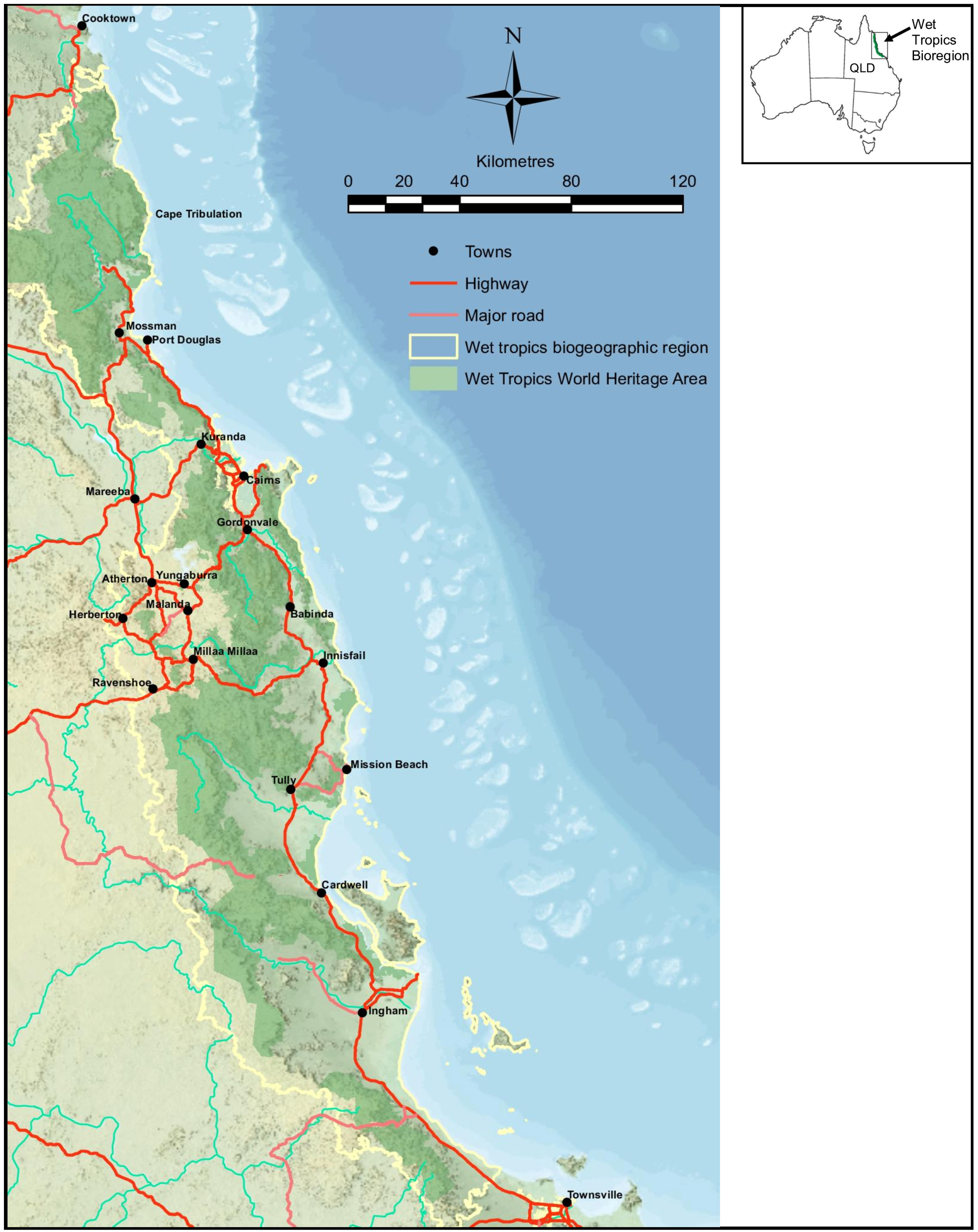
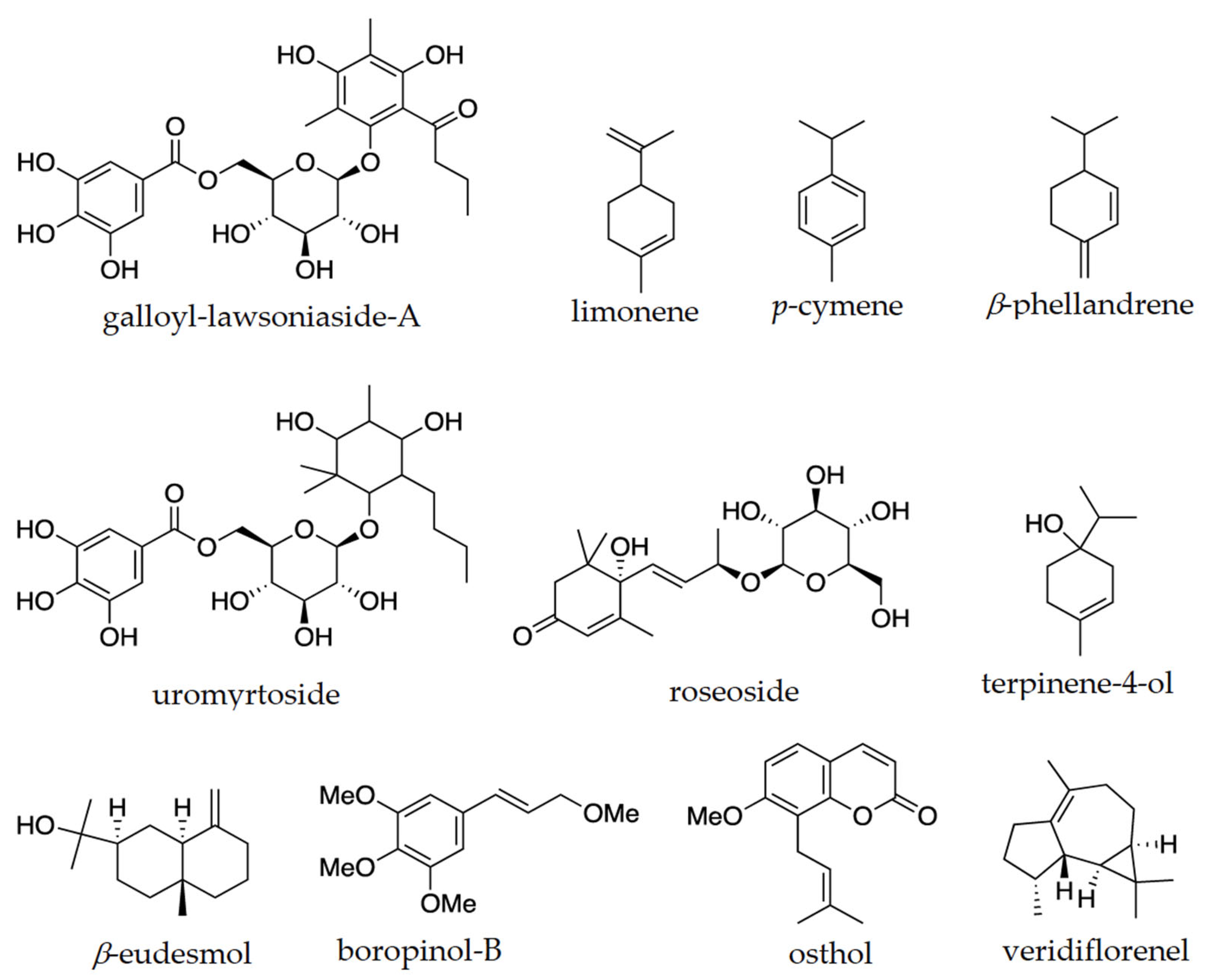
Disclaimer/Publisher’s Note: The statements, opinions and data contained in all publications are solely those of the individual author(s) and contributor(s) and not of MDPI and/or the editor(s). MDPI and/or the editor(s) disclaim responsibility for any injury to people or property resulting from any ideas, methods, instructions or products referred to in the content. |
© 2024 by the authors. Licensee MDPI, Basel, Switzerland. This article is an open access article distributed under the terms and conditions of the Creative Commons Attribution (CC BY) license (https://creativecommons.org/licenses/by/4.0/).