Ethnomedicinal Plants and Herbal Preparations Used by Rural Communities in Tehsil Hajira (Poonch District of Azad Kashmir, Pakistan)


 , and
, and 
Abstract
1. Introduction
2. Results and Discussion
2.1. Demographic Data of the Informants
2.2. Traditional Health Systems
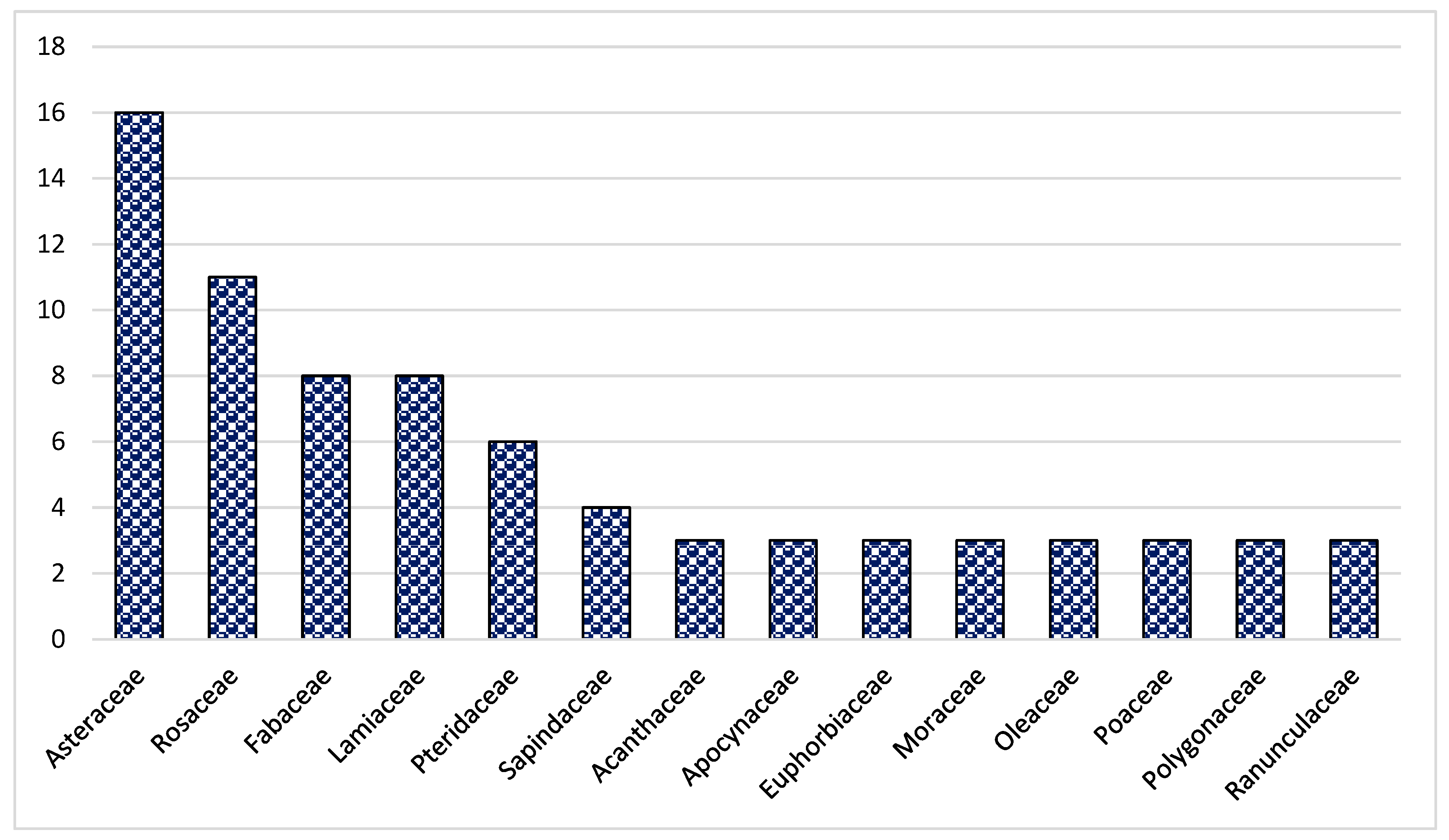
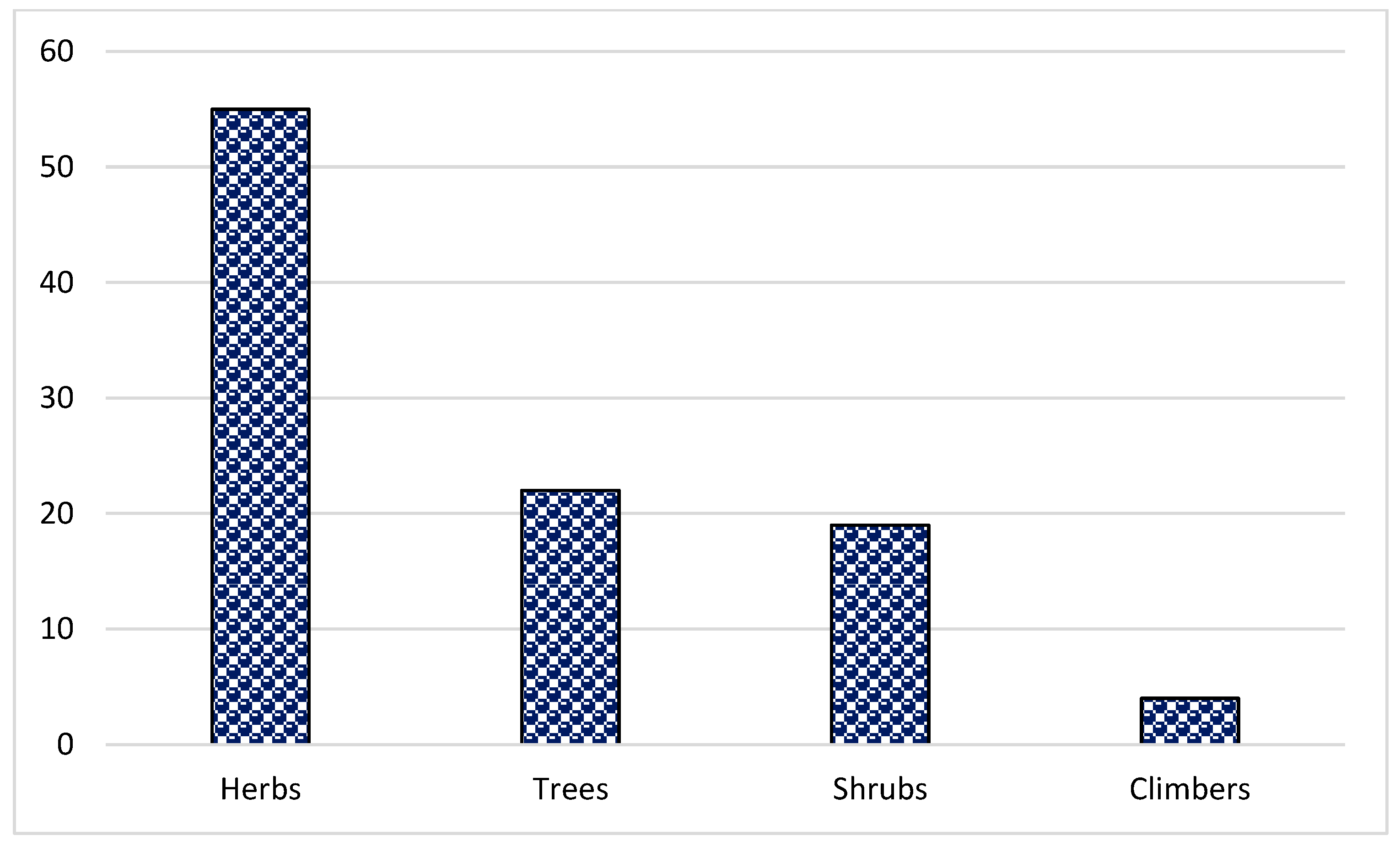
2.3. The Diversity of Ethnoflora
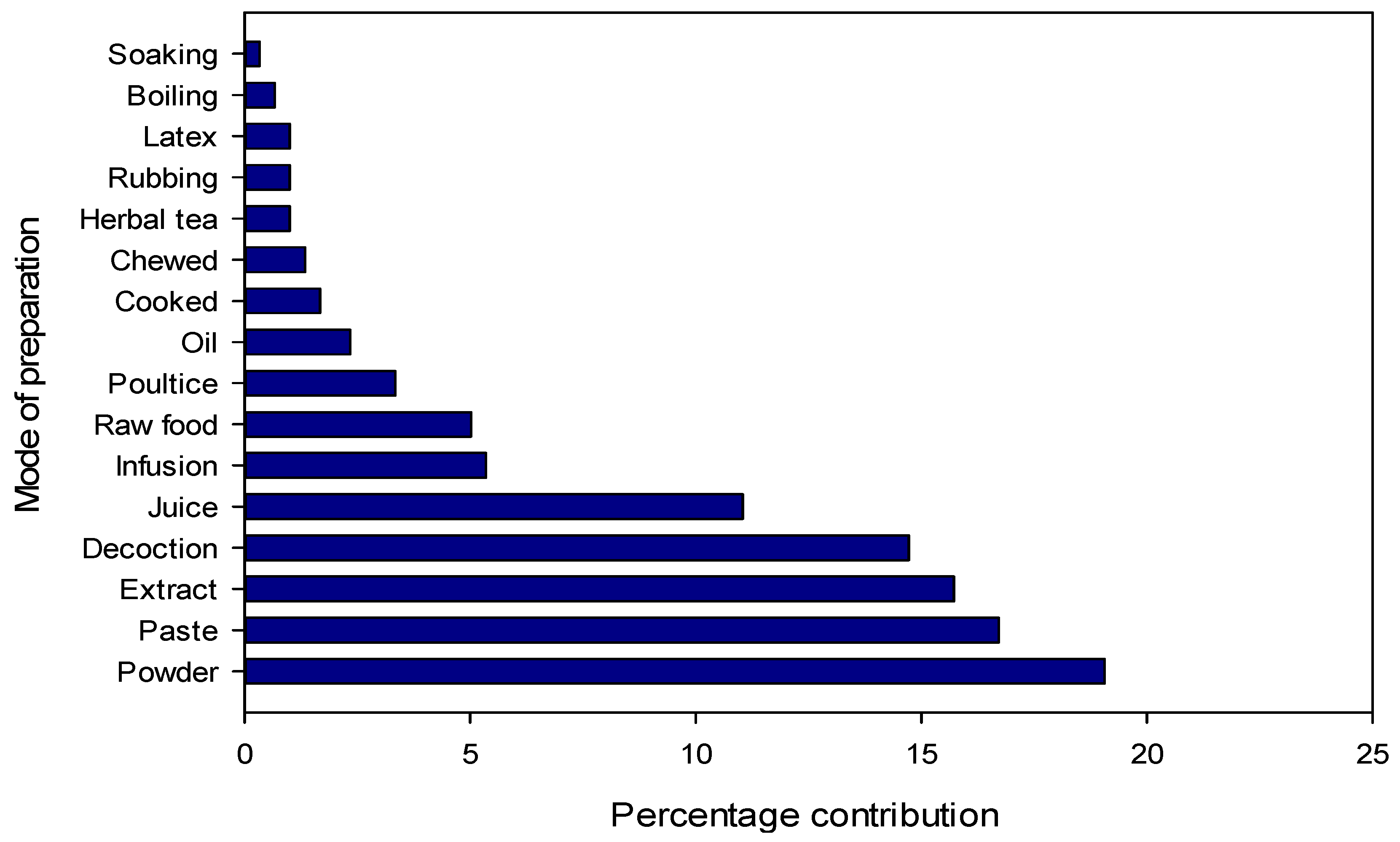
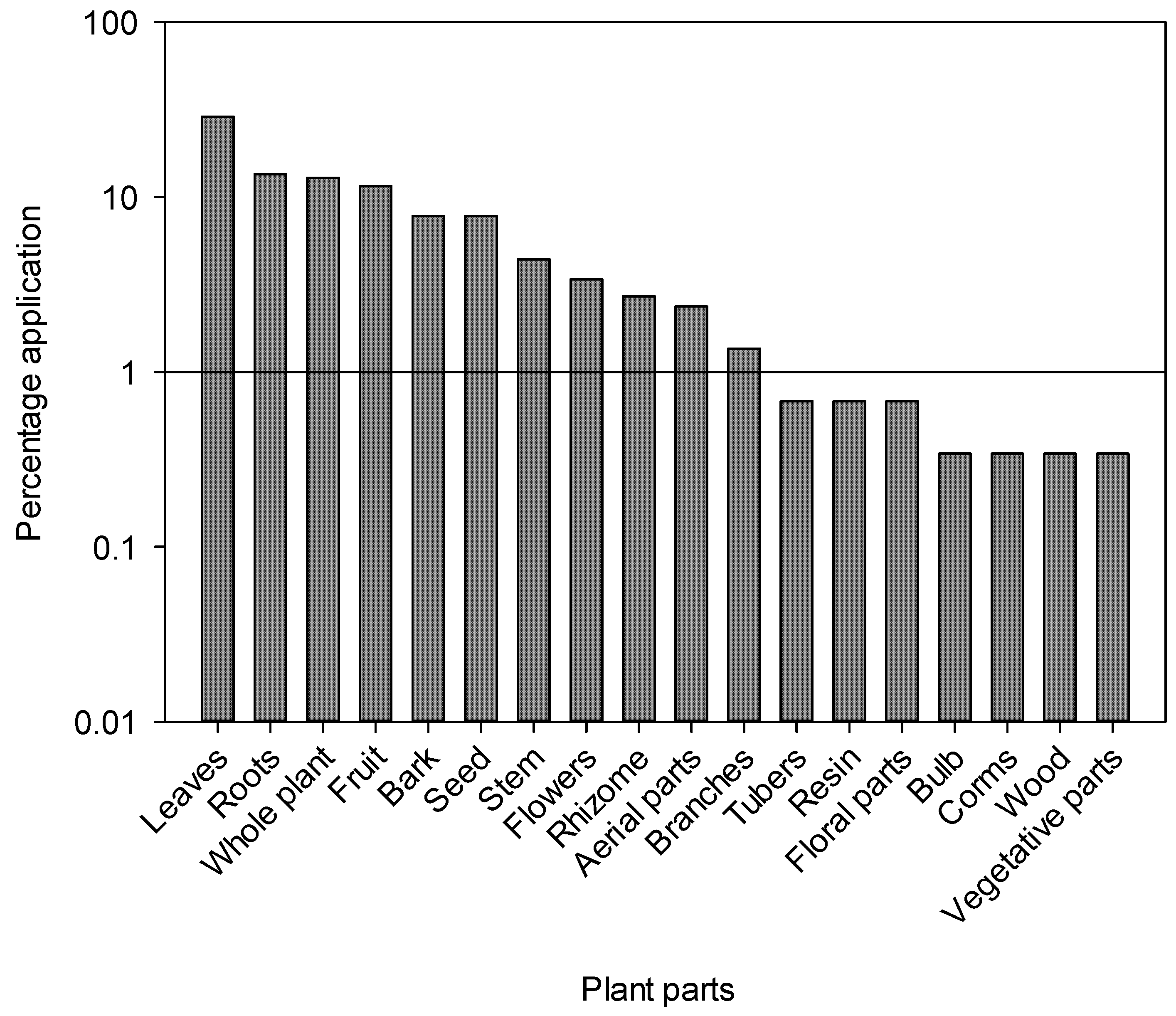
2.4. Mode of Administration and Plant Part(s) Used in Herbal Preparations
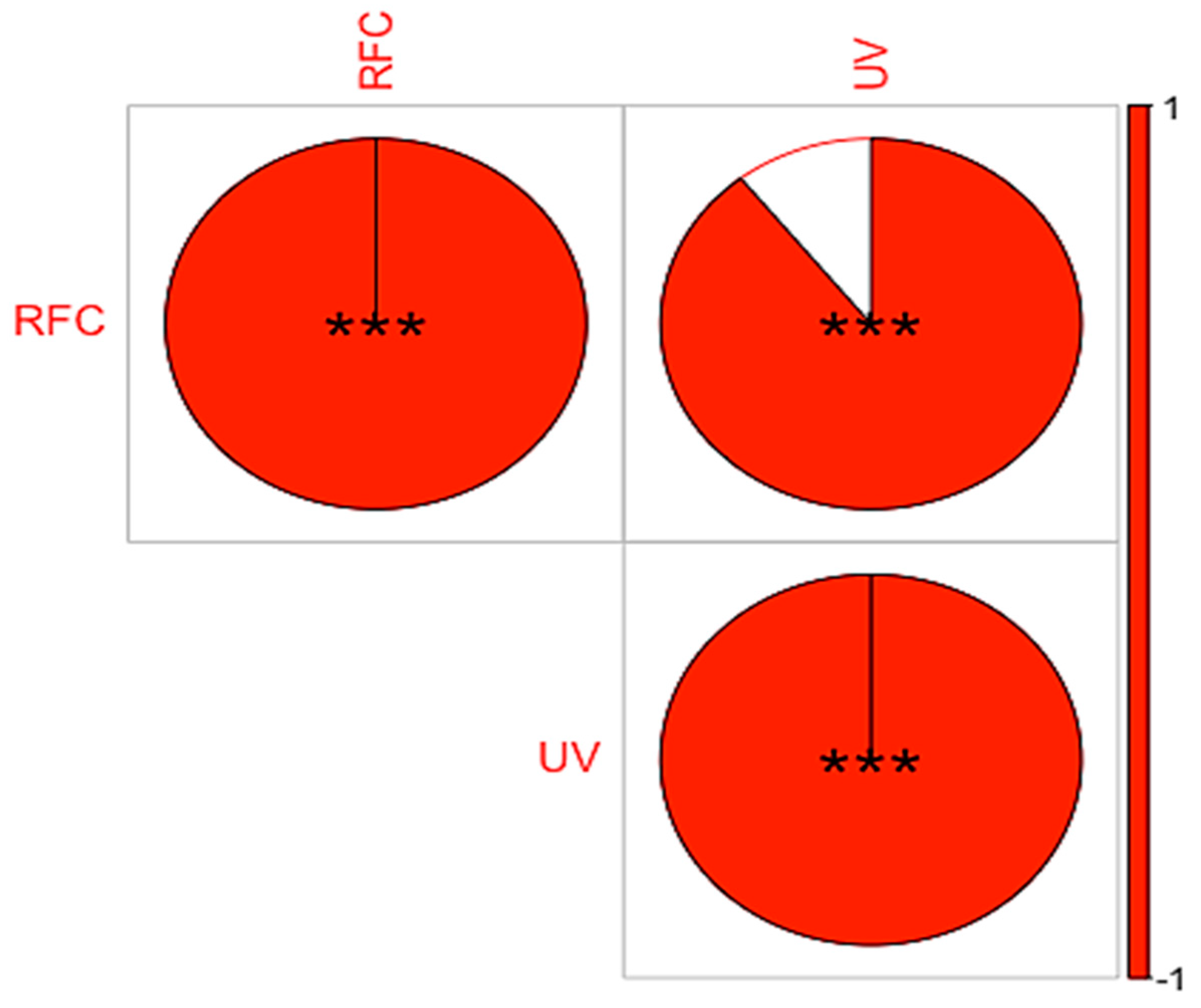
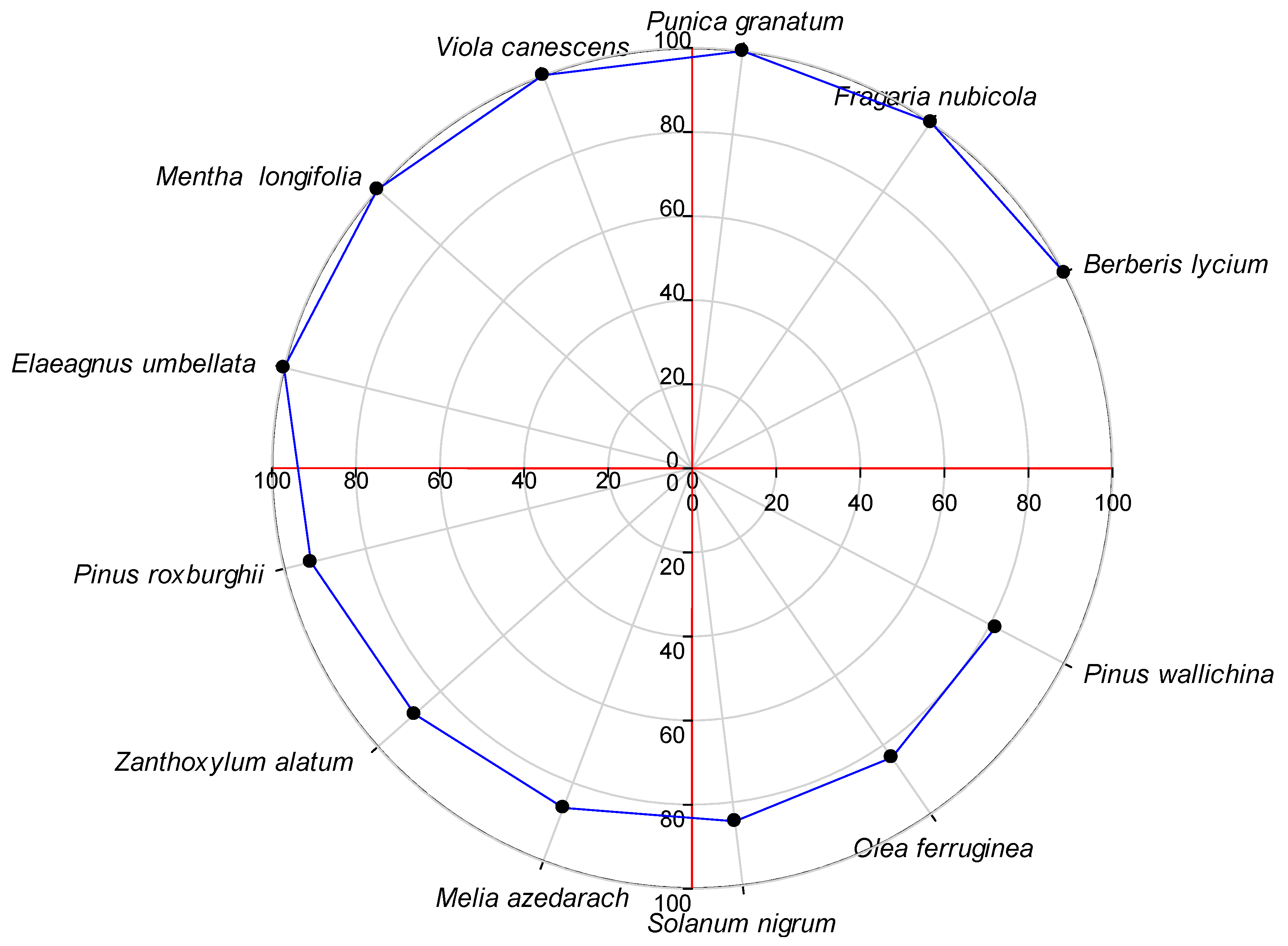
2.5. Relative Frequency of Citation (RFC)
2.6. Utilization Value (UV)
2.7. Relative Importance (RI)
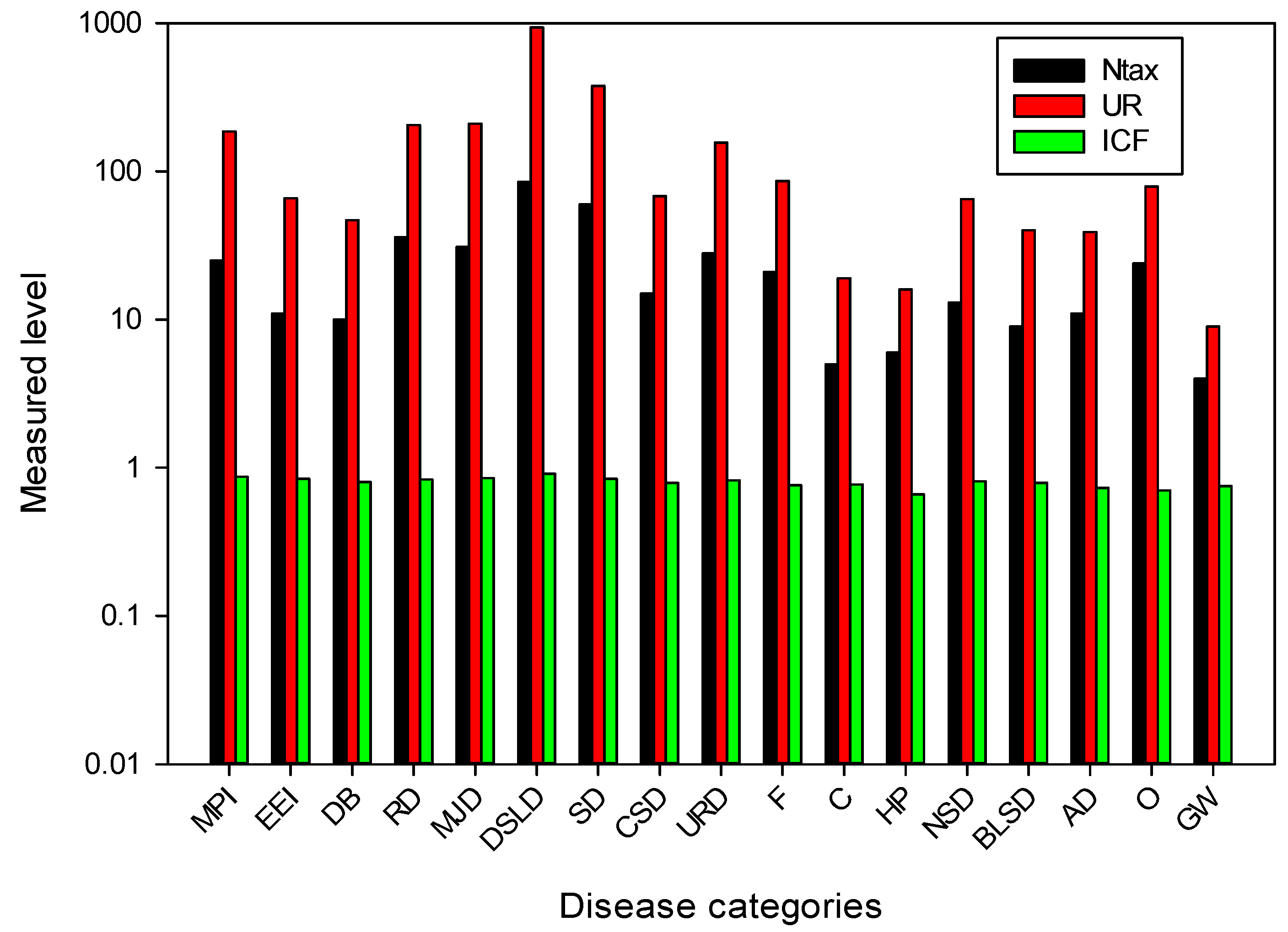
2.8. Informant Consensus Factor (ICF)
2.9. Fidelity Level (FL)
2.10. Novelty and Future Implications

| Study Area | SY | NRPs | NPSU | NPDU | TSCBA | SEAA | SESA | PPSU | PPDU | JI | C |
|---|---|---|---|---|---|---|---|---|---|---|---|
| From Azad Jammu and Kashmir (AJK), Pakistan | |||||||||||
| Poonch Valley | 2012 | 68 | 4 | 23 | 27 | 41 | 117 | 5.88 | 33.8 | 14.59 | [72] |
| Leepa Valley | 2012 | 36 | 2 | 11 | 13 | 23 | 131 | 5.55 | 30.55 | 7.78 | [74] |
| Pearl Valley | 2017 | 136 | 37 | 14 | 51 | 85 | 93 | 27.2 | 10.29 | 22.27 | [44] |
| Toli Peer | 2017 | 121 | 30 | 15 | 45 | 76 | 99 | 24.7 | 12.3 | 20.45 | [47] |
| Kotli | 2017 | 128 | 20 | 25 | 45 | 83 | 99 | 15.6 | 19.5 | 19.82 | [23] |
| Neelum Valley | 2017 | 50 | 2 | 18 | 20 | 30 | 124 | 4.00 | 36.00 | 11.49 | [21] |
| Kotli | 2019 | 80 | 12 | 28 | 40 | 40 | 104 | 15 | 35 | 21.74 | [82] |
| From Khyber Pakhtunkhwa (KPK), Pakistan | |||||||||||
| Dir Valley, KPK, | 2011 | 65 | 3 | 23 | 26 | 39 | 118 | 4.61 | 35.3 | 14.21 | [113] |
| Chail Valley, Swat | 2014 | 50 | 15 | 8 | 23 | 27 | 121 | 30 | 16 | 13.47 | [45] |
| Kabal, Swat | 2015 | 45 | 2 | 17 | 19 | 26 | 125 | 4.44 | 37.7 | 11.17 | [114] |
| Alpine and Sub-alpine regions of Pakistan | 2015 | 125 | 7 | 7 | 14 | 111 | 130 | 5.6 | 5.6 | 5.49 | [49] |
| Manoor Valley, KPK | 2016 | 44 | 1 | 13 | 14 | 30 | 130 | 2.27 | 29.54 | 8.05 | [80] |
| Northern Pakistani Afghan borders | 2018 | 92 | 1 | 26 | 27 | 65 | 117 | 1.09 | 18.06 | 12.91 | [85] |
| Mohmand Agency, FATA | 2018 | 64 | 1 | 12 | 13 | 51 | 131 | 1.56 | 8.33 | 6.67 | [31] |
| From other areas of Pakistan | |||||||||||
| Mastung District, Baluchistan | 2014 | 102 | 1 | 11 | 12 | 90 | 132 | 0.98 | 10.7 | 5.13 | [46] |
| Turmic Valley, Gilgit-Baltistan | 2015 | 42 | 1 | 2 | 3 | 39 | 141 | 2.38 | 4.76 | 1.63 | [115] |
| Hafizabad, Punjab, | 2017 | 85 | 6 | 10 | 16 | 69 | 128 | 7.05 | 11.7 | 7.51 | [79] |
| Wazirabad, Punjab, | 2018 | 31 | 1 | 7 | 8 | 23 | 136 | 3.22 | 22.5 | 4.79 | [81] |
| Chenab riverine area, Punjab Pakistan | 2019 | 129 | 9 | 11 | 20 | 109 | 124 | 6.97 | 8.52 | 7.91 | [83] |
| From other parts of the world | |||||||||||
| Blue Nile State, Sudan | 2011 | 53 | 0 | 2 | 2 | 51 | 142 | 0 | 3.77 | 1.02 | [77] |
| Alasehir (Manisa), Turkey | 2013 | 137 | 0 | 9 | 9 | 128 | 135 | 0 | 6.56 | 3.30 | [76] |
| Jhalawar, Rajasthan, India | 2015 | 19 | 0 | 2 | 2 | 17 | 42 | 0 | 10.5 | 1.24 | [78] |
3. Materials and Methods
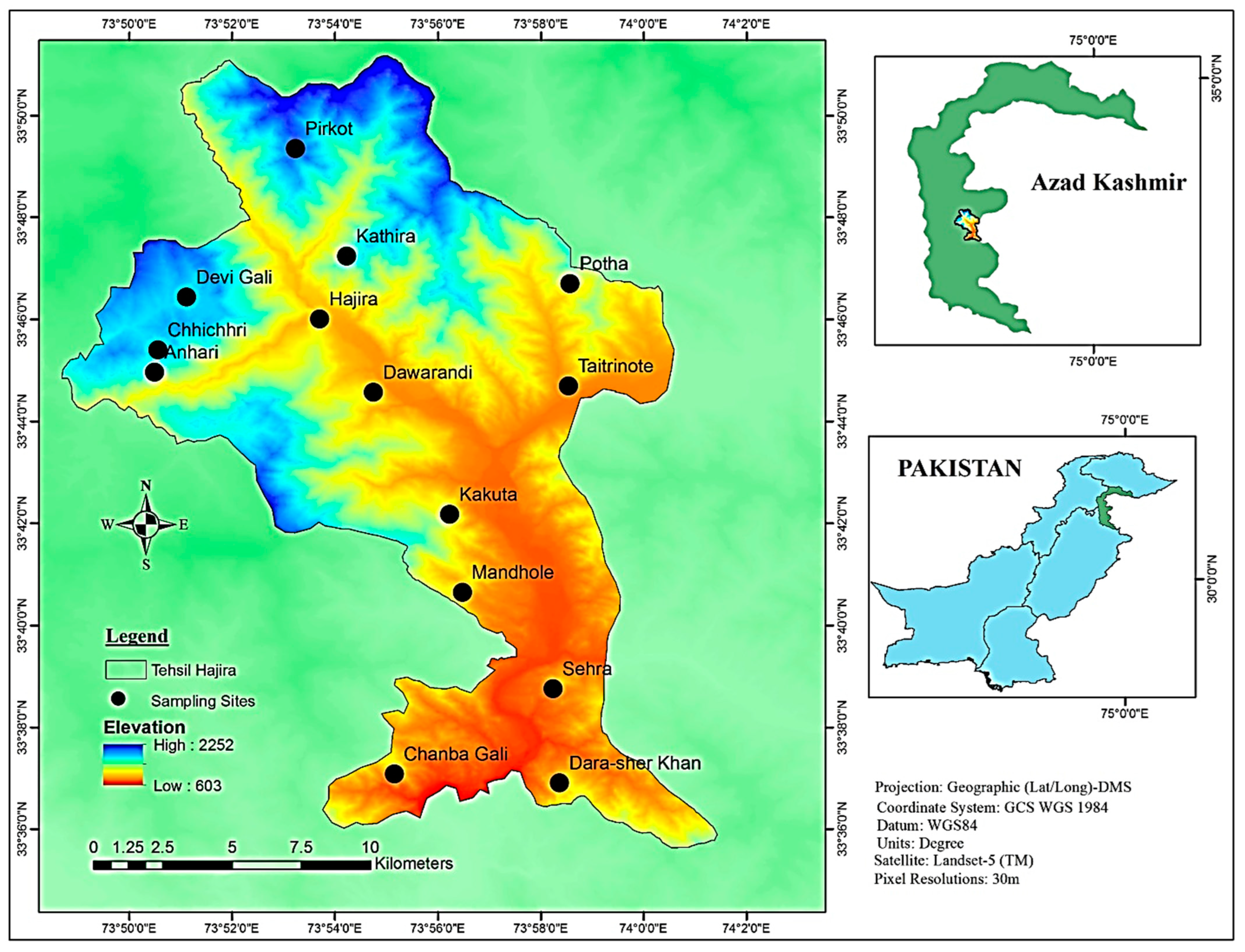
3.1. Study Area
3.2. Ethnobotanical Data Collection
3.3. Floristic Inventory and Botanical Identification
3.4. Data Analysis
3.4.1. Relative Frequency of Citation (RFC)
- FC = number of respondents who reported the use of a particular species;
- N = total number of respondents.
3.4.2. Use Value (UV)
3.4.3. Informant Consensus Factor (ICF)
3.4.4. Relative Importance (RI)
- PH = pharmacological property of the selected plant;
- BS = total body systems cured by a given plant species;
3.4.5. Jaccard Index (JI)
- a = species of our study area;
- b = species of the neighboring area;
- c = species occurring in both areas.
3.4.6. Fidelity Level (FL)
- Np = informants who requested the use of a specific plant species for a specific condition;
- N = respondents who named the plant species for any ailment.
3.4.7. Pearson Correlation Analysis
4. Conclusions
Author Contributions
Funding
Institutional Review Board Statement
Data Availability Statement
Acknowledgments
Conflicts of Interest
Appendix A
| Plant Species | FC | RFC | UI | UV | Rel PH | Rel BS | RI |
|---|---|---|---|---|---|---|---|
| Vachellia nilotica | 52 | 0.74 | 62 | 0.88 | 0.18 | 0.28 | 23 |
| Acer platanoides | 22 | 0.31 | 32 | 0.45 | 0.54 | 0.57 | 55.5 |
| Achillea millefolium | 41 | 0.59 | 61 | 0.87 | 0.18 | 0.28 | 23 |
| Achyranthes aspera | 23 | 0.33 | 31 | 0.44 | 0.27 | 0.42 | 34.5 |
| Acorus calamus | 10 | 0.14 | 17 | 0.24 | 0.27 | 0.28 | 27.5 |
| Adhatoda zeylanica | 23 | 0.33 | 36 | 0.51 | 0.36 | 0.28 | 32 |
| Adiantum capillus-veneris | 32 | 0.46 | 41 | 0.58 | 0.45 | 0.42 | 43.5 |
| Adiantum incisum | 34 | 0.49 | 40 | 0.57 | 0.45 | 0.57 | 51 |
| Aesculus indica | 28 | 0.40 | 56 | 0.8 | 0.27 | 0.42 | 34.5 |
| Ailanthus altissima | 35 | 0.50 | 45 | 0.64 | 0.18 | 0.14 | 16 |
| Ajuga bracteosa | 43 | 0.61 | 58 | 0.82 | 0.36 | 0.57 | 46.5 |
| Allium sativum | 59 | 0.84 | 64 | 0.91 | 0.27 | 0.28 | 27.5 |
| Amaranthus viridis | 46 | 0.66 | 51 | 0.72 | 0.27 | 0.42 | 34.5 |
| Anaphalis margaritacea | 13 | 0.19 | 23 | 0.32 | 0.54 | 0.57 | 55.5 |
| Arisaema utile | 34 | 0.49 | 44 | 0.62 | 0.27 | 0.42 | 34.5 |
| Artemisia dubia | 41 | 0.59 | 48 | 0.68 | 0.27 | 0.28 | 27.5 |
| Artemisia tridentata | 14 | 0.20 | 29 | 0.41 | 0.36 | 0.57 | 46.5 |
| Artemisia vulgaris | 6 | 0.09 | 12 | 0.17 | 0.18 | 0.28 | 23 |
| Asparagus racemosus | 31 | 0.44 | 41 | 0.58 | 0.36 | 0.42 | 39 |
| Asparagus gracilis | 26 | 0.37 | 36 | 0.51 | 0.27 | 0.28 | 27.5 |
| Asplenium dalhousiae | 16 | 0.23 | 27 | 0.38 | 0.36 | 0.42 | 39 |
| Astragalus psilocentros | 19 | 0.27 | 38 | 0.54 | 0.09 | 0.85 | 47 |
| Bauhinia variegata | 13 | 0.19 | 17 | 0.24 | 0.18 | 0.28 | 23 |
| Berberis lycium | 59 | 0.84 | 86 | 1.22 | 45 | 0.42 | 43.5 |
| Bidens bipinnata | 2 | 0.03 | 6 | 0.08 | 0.18 | 0.14 | 16 |
| Bidens biternata | 29 | 0.41 | 31 | 0.44 | 0.18 | 0.14 | 16 |
| Brassica compestris | 55 | 0.79 | 62 | 0.88 | 0.45 | 0.42 | 43.5 |
| Buddleja asiatica | 27 | 0.39 | 38 | 0.54 | 0.45 | 0.71 | 58 |
| Calendula officinalis | 24 | 0.34 | 39 | 0.55 | 0.18 | 0.28 | 23 |
| Cannabis sativa | 41 | 0.59 | 52 | 0.74 | 0.27 | 0.28 | 27.5 |
| Capsella bursa-pastoris | 21 | 0.30 | 37 | 0.52 | 0.45 | 0.57 | 51 |
| Carissa spinarum | 32 | 0.46 | 45 | 0.64 | 0.27 | 0.42 | 34.5 |
| Carthamus tinctorius | 41 | 0.59 | 56 | 0.8 | 0.27 | 0.28 | 27.5 |
| Caryopteris odorata | 11 | 0.16 | 22 | 0.31 | 0.81 | 0.57 | 69 |
| Cedrela toona | 36 | 0.51 | 42 | 0.6 | 0.54 | 0.71 | 62.5 |
| Chenopodium album | 26 | 0.37 | 33 | 0.47 | 0.45 | 0.42 | 43.5 |
| Dysphania ambrosioides | 4 | 0.06 | 16 | 0.22 | 0.36 | 0.14 | 25 |
| Cirsium vulgare | 11 | 0.16 | 26 | 0.41 | 0.36 | 0.42 | 39 |
| Cissampelos pareira | 21 | 0.30 | 34 | 0.45 | 0.36 | 0.42 | 39 |
| Clematis grata | 9 | 0.13 | 18 | 0.25 | 0.18 | 0.14 | 16 |
| Clematis orientalis | 7 | 0.10 | 10 | 0.14 | 0.36 | 0.57 | 46.5 |
| Colchicum luteum | 24 | 0.34 | 30 | 0.42 | 0.63 | 0.57 | 60 |
| Convolvulus arvensis | 15 | 0.21 | 19 | 0.27 | 0.27 | 0.28 | 27.5 |
| Erigeron canadensis | 14 | 0.20 | 26 | 0.37 | 0.36 | 0.28 | 32 |
| Cotinus coggygria | 6 | 0.09 | 10 | 0.14 | 0.36 | 0.57 | 46.5 |
| Cuscuta reflexia | 47 | 0.67 | 57 | 0.81 | 0.18 | 0.28 | 23 |
| Cynodon dactylon | 42 | 0.60 | 51 | 0.72 | 0.27 | 0.42 | 34.5 |
| Cyperus rotundus | 2 | 0.03 | 13 | 0.18 | 0.36 | 0.57 | 46.5 |
| Desmodium elegans | 20 | 0.29 | 48 | 0.68 | 0.45 | 0.42 | 43.5 |
| Dicliptera bupleuroides | 29 | 0.41 | 36 | 0.51 | 0.45 | 0.42 | 43.5 |
| Dioscorea deltoidea | 27 | 0.39 | 33 | 0.47 | 0.45 | 0.42 | 43.5 |
| Diospyros lotus | 25 | 0.36 | 36 | 0.51 | 0.27 | 0.14 | 20.5 |
| Dodonaea viscosa | 28 | 0.40 | 41 | 0.58 | 0.18 | 0.28 | 23 |
| Dryopteris filix-mas | 18 | 0.26 | 21 | 0.3 | 0.81 | 0.14 | 16 |
| Duchesnea indica | 43 | 0.61 | 54 | 0.77 | 0.36 | 0.42 | 39 |
| Elaeagnus umbellata | 52 | 0.74 | 71 | 1.01 | 0.36 | 0.57 | 46.5 |
| Eleusine indica | 13 | 0.19 | 28 | 0.4 | 0.63 | 0.71 | 67 |
| Eriobotrya japonica | 29 | 0.41 | 60 | 0.85 | 0.27 | 0.42 | 34.5 |
| Euphorbia helioscopia | 36 | 0.51 | 47 | 0.67 | 0.36 | 0.28 | 32 |
| Ficus carica | 53 | 0.76 | 64 | 0.91 | 0.54 | 0.57 | 55.5 |
| Ficus palmata | 33 | 0.47 | 62 | 0.88 | 0.27 | 0.28 | 27.5 |
| Fragaria nubicola | 66 | 0.94 | 83 | 1.18 | 0.45 | 0.57 | 51 |
| Galium aparine | 27 | 0.39 | 35 | 0.5 | 0.45 | 0.71 | 58 |
| Geranium wallichianum | 27 | 0.39 | 40 | 0.57 | 1 | 0.71 | 85.5 |
| Gerbera gossypina | 10 | 0.14 | 24 | 0.34 | 0.36 | 0.28 | 32 |
| Grewia asiatica | 22 | 0.31 | 34 | 0.48 | 0.09 | 1 | 54.5 |
| Habenaria digitata | 20 | 0.29 | 36 | 0.51 | 0.45 | 0.57 | 51 |
| Hedera nepalensis | 14 | 0.20 | 23 | 0.32 | 0.18 | 0.28 | 23 |
| Hypericum perforatum | 38 | 0.54 | 44 | 0.62 | 0.45 | 0.42 | 43.5 |
| Impatiens bicolor | 13 | 0.19 | 25 | 0.35 | 0.27 | 0.42 | 34.5 |
| Indigofera heterantha | 42 | 0.60 | 54 | 0.77 | 0.72 | 0.71 | 71.5 |
| Inula cappa | 28 | 0.40 | 38 | 0.54 | 0.45 | 0.42 | 43.5 |
| Ipomoea purpurea | 22 | 0.31 | 33 | 0.47 | 0.27 | 0.42 | 34.5 |
| Jasminum officinale | 25 | 0.36 | 50 | 0.71 | 0.18 | 0.28 | 23 |
| Juglans regia | 41 | 0.59 | 58 | 0.82 | 0.45 | 0.57 | 51 |
| Lespedeza juncea | 11 | 0.16 | 22 | 0.31 | 0.27 | 0.42 | 34.5 |
| Ligustrum lucidum | 22 | 0.31 | 37 | 0.52 | 0.81 | 0.85 | 83 |
| Lycopodium japonicum | 22 | 0.31 | 34 | 0.4 | 0.27 | 0.28 | 27.5 |
| Mallotus philippensis | 39 | 0.56 | 48 | 0.68 | 0.45 | 0.28 | 36.5 |
| Malvastrum Coromandelianum | 26 | 0.37 | 34 | 0.48 | 0.36 | 0.42 | 39 |
| Momordica charanta | 38 | 0.54 | 49 | 0.7 | 0.36 | 0.42 | 39 |
| Martynia annua | 23 | 0.33 | 30 | 0.42 | 0.63 | 0.57 | 60 |
| Melia azedarach | 41 | 0.59 | 69 | 0.98 | 0.36 | 0.57 | 46.5 |
| Mentha longifolia | 61 | 0.87 | 69 | 0.98 | 0.18 | 0.28 | 23 |
| Micromeria biflora | 22 | 0.31 | 44 | 0.62 | 0.54 | 3 | 48 |
| Mirabilis jalapa | 27 | 0.39 | 35 | 0.5 | 0.36 | 0.42 | 39 |
| Morus alba | 32 | 0.46 | 64 | 0.91 | 0.36 | 0.28 | 32 |
| Mucuna pruriens | 19 | 0.27 | 33 | 0.47 | 0.36 | 0.28 | 32 |
| Myrsine africana | 17 | 0.24 | 34 | 0.48 | 0.27 | 0.28 | 27.5 |
| Nepta lavigata | 6 | 0.09 | 18 | 0.25 | 0.09 | 0.14 | 11.5 |
| Olea ferruginea | 52 | 0.74 | 61 | 0.87 | 0.54 | 0.57 | 55.5 |
| Onychium japonicum | 11 | 0.16 | 27 | 0.38 | 0.18 | 0.14 | 16 |
| Oplismenus ndulatifolius | 12 | 0.17 | 27 | 0.38 | 0.45 | 0.57 | 51 |
| Origanum vulgare | 5 | 0.07 | 9 | 0.12 | 0.36 | 0.42 | 39 |
| Otostegia limbata | 10 | 0.14 | 16 | 0.22 | 0.45 | 0.42 | 43.5 |
| Oxalis corniculata | 39 | 0.56 | 51 | 0.72 | 0.63 | 0.71 | 67 |
| Parthenium hysterophorus | 31 | 0.44 | 40 | 0.57 | 0.18 | 0.28 | 23 |
| Physalis divaricata | 14 | 0.20 | 24 | 0.34 | 0.36 | 0.42 | 39 |
| Pinus roxburghii | 56 | 0.80 | 69 | 0.98 | 0.18 | 0.28 | 23 |
| Pinus wallichiana | 48 | 0.69 | 59 | 0.84 | 0.36 | 0.42 | 39 |
| Piper nigrum | 36 | 0.51 | 42 | 0.6 | 0.36 | 0.42 | 39 |
| Plantago lanceolata | 48 | 0.69 | 55 | 0.78 | 0.27 | 0.42 | 34.5 |
| Plantago major | 22 | 0.31 | 36 | 0.51 | 0.45 | 0.57 | 51 |
| Plumbago zeylanica | 8 | 0.11 | 16 | 0.22 | 0.36 | 0.42 | 39 |
| Polygonum aviculare | 25 | 0.36 | 44 | 0.42 | 0.72 | 0.42 | 57 |
| Populus alba | 42 | 0.60 | 53 | 0.75 | 0.72 | 0.71 | 71.5 |
| Prinsepia utilis | 12 | 0.17 | 22 | 0.31 | 0.36 | 0.28 | 32 |
| Prunus domestica | 33 | 0.47 | 41 | 0.58 | 0.18 | 0.28 | 23 |
| Prunus persica | 40 | 0.57 | 54 | 0.77 | 0.63 | 0.85 | 74 |
| Pteracanthus urticifolius | 5 | 0.07 | 15 | 0.21 | 0.36 | 0.42 | 39 |
| Pteris cretica | 8 | 0.11 | 8 | 0.11 | 0.09 | 0.14 | 11.5 |
| Pteris vittata | 5 | 0.07 | 11 | 0.15 | 0.27 | 0.28 | 27.5 |
| Punica granatum | 51 | 0.73 | 72 | 1.02 | 0.63 | 0.71 | 67 |
| Pyrus pashia | 41 | 0.59 | 52 | 0.74 | 0.45 | 0.42 | 43.5 |
| Quercus incana | 45 | 0.64 | 56 | 0.8 | 0.45 | 0.42 | 43.5 |
| Ricinus communis | 38 | 0.54 | 52 | 0.74 | 0.27 | 0.28 | 27.5 |
| Robinia pseudoacacia | 28 | 0.40 | 28 | 0.4 | 0.09 | 0.14 | 11.5 |
| Rosa brunonii | 41 | 0.59 | 56 | 0.8 | 0.63 | 0.57 | 60 |
| Rubia cordifolia | 21 | 0.30 | 34 | 0.48 | 0.45 | 0.42 | 43.5 |
| Rubus ellipticus | 34 | 0.49 | 49 | 0.7 | 0.18 | 0.28 | 23 |
| Rubus fruticosus | 53 | 0.76 | 62 | 0.88 | 0.36 | 0.57 | 46.5 |
| Rubus niveus | 38 | 0.54 | 61 | 0.87 | 0.45 | 0.42 | 43.5 |
| Rumex dentatus | 29 | 0.41 | 39 | 0.55 | 0.18 | 0.14 | 16 |
| Rumex hastatus | 33 | 0.47 | 42 | 0.6 | 0.27 | 0.28 | 27.5 |
| Salix nigra | 33 | 0.47 | 44 | 0.62 | 0.45 | 0.42 | 43.5 |
| Sapindus mukorossi | 46 | 0.66 | 57 | 0.81 | 0.18 | 0.28 | 23 |
| Sarcococca saligna | 32 | 0.46 | 46 | 0.65 | 0.36 | 0.57 | 46.5 |
| Smilax aspera | 8 | 0.11 | 13 | 0.18 | 0.36 | 0.57 | 46.5 |
| Solanum nigrum | 42 | 0.60 | 58 | 0.82 | 0.45 | 0.71 | 58 |
| Solena heterophylla | 17 | 0.24 | 27 | 0.38 | 0.63 | 0.71 | 67 |
| Swertia angustifolia | 5 | 0.07 | 15 | 0.21 | 0.36 | 0.57 | 46.5 |
| Swertia cordata | 4 | 0.06 | 10 | 0.14 | 0.54 | 0.42 | 48 |
| Tagetes minuta | 14 | 0.20 | 25 | 0.35 | 0.09 | 0.14 | 11.5 |
| Taraxacum officinale | 38 | 0.54 | 41 | 0.58 | 0.45 | 0.57 | 51 |
| Taxus wallichiana | 39 | 0.56 | 48 | 0.68 | 0.36 | 0.14 | 25 |
| Thalictrum foliolosum | 7 | 0.10 | 18 | 0.25 | 0.18 | 0.14 | 16 |
| Tylophora hirsuta | 11 | 0.16 | 24 | 0.34 | 0.45 | 0.57 | 51 |
| Verbascum thapsus | 12 | 0.17 | 23 | 0.32 | 0.27 | 0.28 | 27.5 |
| Vinca major | 12 | 0.17 | 25 | 0.35 | 0.54 | 0.42 | 52.5 |
| Viola canescens | 65 | 0.93 | 75 | 1.07 | 0.36 | 0.57 | 46.5 |
| Vitex negundo | 13 | 0.19 | 23 | 0.32 | 0.36 | 0.42 | 39 |
| Zanthoxylum alatum | 49 | 0.70 | 66 | 0.94 | 0.45 | 0.14 | 29.5 |
| Ziziphus jujuba | 19 | 0.27 | 30 | 0.42 | 0.27 | 0.42 | 34.5 |
| Ziziphus oxyphylla | 20 | 0.29 | 32 | 0.45 | 0.36 | 0.42 | 39 |
References
- Domfeh, K.A. Indigenous knowledge systems and the need for policy and institutional reforms. Tribes Tribals 2007, 1, 41–52. [Google Scholar]
- World Health Organization. Traditional Medicine: Report by the Secretariat; World Health Organization: Geneva, Switzerland, 2003. [Google Scholar]
- Tilburt, J.C.; Kaptchuk, T.J. Herbal medicine research and global health: An ethical analysis. Bull. World Health Organ. 2008, 86, 594–599. [Google Scholar] [CrossRef]
- Farnsworth, N.R. Ethnopharmacology and drug development. Ciba Found. Symp. Ethnobot. Search New Drugs 1994, 185, 42–51. [Google Scholar]
- Stickley, A.; Koyanagi, A.; Richardson, E.; Roberts, B.; Balabanova, D.; McKee, M. Prevalence and factors associated with the use of alternative (folk) medicine practitioners in 8 countries of the former Soviet Union. BMC Complement. Altern. Med. 2013, 13, 83. [Google Scholar] [CrossRef] [PubMed]
- El Nimr, N.; Wahdan, I.; Wahdan, A.; Kotb, R. Self-medication with drugs and complementary and alternative medicines in Alexandria, Egypt: Prevalence, patterns and determinants. EMHJ East. Mediterr. Health J. 2015, 21, 256–265. [Google Scholar] [CrossRef] [PubMed]
- Karou, S.D.; Tchacondo, T.; Djikpo Tchibozo, M.A.; Abdoul-Rahaman, S.; Anani, K.; Koudouvo, K.; Batawila, K.; Agbonon, A.; Simpore, J.; de Souza, C. Ethnobotanical study of medicinal plants used in the management of diabetes mellitus and hypertension in the Central Region of Togo. Pharm. Biol. 2011, 49, 1286–1297. [Google Scholar] [CrossRef] [PubMed]
- World Health Organization. WHO Traditional Medicine Strategy 2002–2005; World Health Organization: Geneva, Switzerland, 2002. [Google Scholar]
- James, P.B.; Wardle, J.; Steel, A.; Adams, J. Traditional, complementary and alternative medicine use in Sub-Saharan Africa: A systematic review. BMJ Glob. Health 2018, 3, e000895. [Google Scholar] [CrossRef]
- World Health Organization. The World Medicines Situation Report 2004; No. WHO/EDM/PAR/2004.5; World Health Organization: Geneva, Switzerland, 2004. [Google Scholar]
- Payyappallimana, U. Role of traditional medicine in primary health care: An overview of perspectives and challenging. Yokohama Int. Soc. Sci. Res. 2010, 14, e77. [Google Scholar]
- Langlois-Klassen, D.; Kipp, W.; Jhangri, G.S.; Rubaale, T. Use of traditional herbal medicine by AIDS patients in Kabarole District, western Uganda. Am. J. Trop. Med. Hyg. 2007, 77, 757–763. [Google Scholar] [CrossRef] [PubMed]
- Christenhusz, M.J.M.; Byng, J.W. The number of known plants species in the world and its annual increase. Phytotaxa 2000, 261, 201–217. [Google Scholar] [CrossRef]
- Gazzaneo, L.R.S.; De Lucena, R.F.P.; de Albuquerque, U.P. Knowledge and use of medicinal plants by local specialists in an region of Atlantic Forest in the state of Pernambuco (Northeastern Brazil). J. Ethnobiol. Ethnomed. 2005, 1, 9. [Google Scholar] [CrossRef] [PubMed]
- Hanazaki, N.; Tamashiro, J.Y.; Leitão-Filho, H.F.; Begossi, A. Diversity of plant uses in two Caiçara communities from the Atlantic Forest coast, Brazil. Biodivers. Conserv. 2000, 9, 597–615. [Google Scholar] [CrossRef]
- Verpoorte, R. Pharmacognosy in the new millennium: Lead finding and biotechnology. J. Pharm. Andppharmacol. 2000, 52, 253–262. [Google Scholar] [CrossRef] [PubMed]
- Yang, H.-Y.; Wang, J.-D.; Lo, T.-C.; Chen, P.-C. Increased mortality risk for cancers of the kidney and other urinary organs among Chinese herbalists. J. Epidemiol. 2009, 19, 17–23. [Google Scholar] [CrossRef]
- Van Wyk, B.-E.; Wink, M. Medicinal Plants of the World; CABI: Houston, TX, USA, 2018. [Google Scholar]
- Ishtiaq, M.; Qing, H.; Wang, Y.; Cheng, Y. A comparative study using chemometric and numerical taxonomic approaches in the identification and classification of traditional Chinese medicines of the genus Clematis. Plant Biosyst. 2010, 144, 288–297. [Google Scholar] [CrossRef]
- Verpoorte, R.; Choi, Y.H.; Kim, H.K. Ethnopharmacology and systems biology: A perfect holistic match. J. Ethnopharmacol. 2005, 100, 53–56. [Google Scholar] [CrossRef] [PubMed]
- Ahmad, K.S.; Qureshi, R.; Hameed, M.; Ahmad, F.; Nawaz, T. Conservation assessment and medicinal importance of someplants resources from Sharda, Neelum Valley, Azad Jammu and Kashmir, Pakistan. Int. J. Agric. Biol. 2012, 14, 997–1000. [Google Scholar]
- Jamila, F.; Mostafa, E. Ethnobotanical survey of medicinal plants used by people in Oriental Morocco to manage various ailments. J. Ethnopharmacol. 2014, 154, 76–87. [Google Scholar] [CrossRef]
- Amjad, M.S.; Arshad, M.; Saboor, A.; Page, S.; Chaudhari, S.K. Ethnobotanical profiling of the medicinal flora of Kotli, Azad Jammu and Kashmir, Pakistan: Empirical reflections on multinomial logit specifications. Asian Pac. J. Trop. Med. 2017, 10, 503–514. [Google Scholar] [CrossRef] [PubMed]
- Salhi, S.; Fadli, M.; Zidane, L.; Douira, A. Floristic and ethnobotanical study of medicinal plants of Kénitra (Maroc). Lazaroa 2010, 31, 133–146. [Google Scholar] [CrossRef]
- Salhi, N.; Bouyahya, A.; Fettach, S.; Zellou, A.; Cherrah, Y. Ethnopharmacological study of medicinal plants used in the treatment of skin burns in occidental Morocco (area of Rabat). South Afr. J. Bot. 2019, 121, 128–142. [Google Scholar] [CrossRef]
- Liu, Z.-H.; Niu, F.-J.; Xie, Y.-X.; Xie, S.-M.; Liu, Y.-N.; Yang, Y.-Y.; Zhou, C.-Z.; Wan, X.-H. A review: Natural polysaccharides from medicinal plants and microorganisms and their anti-herpetic mechanism. Biomed. Pharmacother. 2020, 129, 110469. [Google Scholar] [CrossRef] [PubMed]
- Fitzgerald, M.; Heinrich, M.; Booker, A. Medicinal Plant Analysis: A Historical and Regional Discussion of Emergent Complex Techniques. Front. Pharmacol. 2019, 10, 1480. [Google Scholar] [CrossRef] [PubMed]
- World Health Organization. The Promotion and Development of Traditional Medicine. In Proceedings of the Report of a WHO Meeting, Geneva, Switzerland, 28 November–2 December 1977; World Health Organization: Geneva, Switzerland, 1978. [Google Scholar]
- Boccolini, P.d.M.M.; Boccolini, C.S. Prevalence of complementary and alternative medicine (CAM) use in Brazil. BMC Complement. Med. Ther. 2020, 20, 1–10. [Google Scholar]
- Bannerman, R.H.; Burton, J.; Wen-Chieh, C. Traditional Medicine and Health Care Coverage: A Reader for Health Administrators and Practitioners; World Health Organization: Geneva, Switzerland, 1983; p. 342. [Google Scholar]
- Aziz, M.A.; Adnan, M.; Khan, A.H.; Shahat, A.A.; Al-Said, M.S.; Ullah, R. Traditional uses of medicinal plants practiced by the indigenous communities at Mohmand Agency, FATA, Pakistan. J. Ethnobiol. Ethnomed. 2018, 14, 2. [Google Scholar] [CrossRef] [PubMed]
- Mallick, S. Challenges of mainstreaming: Ayurvedic practice in Delhi Government health institutions. J. Ayurveda Integr. Med. 2016, 7, 57–61. [Google Scholar] [CrossRef] [PubMed][Green Version]
- Li, X.; Lu, J.; Hu, S.; Cheng, K.; De Maeseneer, J.; Meng, Q.; Mossialos, E.; Xu, D.R.; Yip, W.; Zhang, H. The primary health-care system in China. Lancet 2017, 390, 2584–2594. [Google Scholar] [CrossRef] [PubMed]
- Sen, S.; Chakraborty, R. Revival, modernization and integration of Indian traditional herbal medicine in clinical practice: Importance, challenges and future. J. Tradit. Complement. Med. 2017, 7, 234–244. [Google Scholar] [CrossRef] [PubMed]
- Redvers, N.; Marianayagam, J.; Blondin, B. Improving access to Indigenous medicine for patients in hospital-based settings: A challenge for health systems in northern Canada. Int. J. Circumpolar Health 2019, 78, 1589208. [Google Scholar] [CrossRef] [PubMed]
- Reyes-García, V. The values of traditional ecological knowledge. In Handbook of Ecological Economics; Edward Elgar Publishing: Northampton, MA, USA, 2015. [Google Scholar]
- Dar, E.M. Ethnobotanical uses of plants of Lawat district Muzaffarabad, Azad Jammu & Kashmir. Asian J. Plant Sci. 2014, 2, 3. [Google Scholar]
- Amjad, M.S.; Arshad, M. Ethnobotanical inventory and medicinal uses of some important woody plant species of Kotli, Azad Kashmir, Pakistan. Asian Pac. J. Trop. Biomed. 2014, 4, 952–958. [Google Scholar] [CrossRef]
- Rashid, S.; Ahmad, M.; Zafar, M.; Sultana, S.; Ayub, M.; Khan, M.A.; Yaseen, G. Ethnobotanical survey of medicinally important shrubs and trees of Himalayan region of Azad Jammu and Kashmir, Pakistan. J. Ethnopharmacol. 2015, 166, 340–351. [Google Scholar] [CrossRef] [PubMed]
- Shaukat, S.A.; Shah, S.Z.A.; Ahmad, M.J.; Shaukat, S.K.; Shoukat, S.W. Ethnobotanical study of some medicinal plants of union council Bangoin, Tehsil Rawalakot, AJ&K. Agric. Adv. 2012, 1, 105–109. [Google Scholar]
- Ikram, A.U.; Nadia, B.Z.; Zabta, K.S.; Mohammad, Q. Ethnomedicinal review resources and their utilization practices in village populations of Kashmir himalayas. Pak. J. Bot. 2012, 44, 739–745. [Google Scholar]
- Hamayun, M. Ethnobotanical profile of Utror and Gabral valleys, district Swat, Pakistan. Ethnobot. Leafl. 2005, 2005, 9. [Google Scholar]
- Khan, M.A.; Khan, M.A.; Hussain, M.; Ghulam, G.M. An ethnobotanical inventory of Himalayan region Poonch valley Azad Kashmir (Pakistan). Ethnobot. Res. Appl. 2010, 8, 107–123. [Google Scholar] [CrossRef]
- Shaheen, H.; Qaseem, M.F.; Amjad, M.S.; Bruschi, P. Exploration of ethno-medicinal knowledge among rural communities of Pearl Valley, Rawalakot, District Poonch Azad Jammu and Kashmir. PLoS ONE 2017, 12, e0183956. [Google Scholar] [CrossRef]
- Ahmad, M.; Sultana, S.; Fazl-i-Hadi, S.; Ben Hadda, T.; Rashid, S.; Zafar, M.; Khan, M.A.; Khan, M.P.Z.; Yaseen, G. An Ethnobotanical study of Medicinal Plants in high mountainous region of Chail valley (District Swat-Pakistan). J. Ethnobiol. Ethnomed. 2014, 10, 36. [Google Scholar] [CrossRef] [PubMed]
- Bibi, T.; Ahmad, M.; Tareen, R.B.; Tareen, N.M.; Jabeen, R.; Rehman, S.U.; Zafar, M. Ethnobotany medicinal Plants in district Mastung of Balochistan province-Pakistan. J. Ethnopharmacol. 2014, 157, 79–89. [Google Scholar] [PubMed]
- Amjad, M.S.; faisal Qaeem, M.; Ahmad, I.; Khan, S.U.; Chaudhari, S.K.; Malik, N.Z.; Shaheen, H.; Khan, A.M. Descriptive study of plant resources in the context of the ethnomedicinal relevance of indigenous flora: A case study from Toli Peer National Park, Azad Jammu and Kashmir, Pakistan. PLoS ONE 2017, 12, e0171896. [Google Scholar]
- Albuquerque, U.P.D.; Soldati, G.T.; Sieber, S.S.; Ramos, M.A.; Sa, J.C.D.; Souza, L.C.D. The use of plants in the medical system of the Fulni-o-people (NE Brazil): A perspective on age and gender. J. Ethnopharmacol. 2011, 133, 866–873. [Google Scholar] [CrossRef] [PubMed]
- Kayani, S.; Ahmad, M.; Sultana, S.; Shinwari, Z.K.; Zafar, M.; Yaseen, G.; Hussain, M.; Bibi, T. Ethnobotany of medicinal plants among the communities of Alpine and Sub-alpine regions of Pakistan. J. Ethnopharmacol. 2015, 164, 186–202. [Google Scholar] [CrossRef] [PubMed]
- Abbasi, A.M.; Khan, M.A.; Zafar, M. Ethnomedicinal assessment of some selected wild edible fruits and vegetables of lesser Himalayas, Pakistan. J. Ethnopharmacol. 2013, 45, 215–222. [Google Scholar]
- Giday, M.; Asfaw, Z.; Woldu, Z. Medicinal plants of the Meinit ethnic group of Ethiopia: An ethnobotanical study. J. Ethnopharmacol. 2009, 124, 513–521. [Google Scholar] [CrossRef] [PubMed]
- Tugume, P.; Esezah, K.K.; Buyinza, M.; Namaalwa, J.; Kamatenesi, M.; Mucunguzi, P.; Kalema, J. Ethnobotanical survey of medicinal plant species used by communities around Mabira Central Forest Reserve, Uganda. J. Ethnobiol. Ethnomed. 2010, 12, 5. [Google Scholar] [CrossRef] [PubMed]
- Farooq, A.; Amjad, M.S.; Ahmad, K.; Altaf, M.; Umair, M.; Abbasi, A.M. Ethnomedicinal knowledge of the rural communities of Dhirkot, Azad Jammu and Kashmir, Pakistan. J. Ethnobiol. Ethnomed. 2019, 15, 45. [Google Scholar] [CrossRef] [PubMed]
- Zuma, T.; Wight, D.; Rochat, T.; Moshabela, M. The role of traditional health practitioners in Rural KwaZulu-Natal, South Africa: Generic or mode specific? BMC Complement. Altern. Med. 2016, 16, 304. [Google Scholar] [CrossRef]
- Aletor, G. Domiciliary midwifery care, including traditional birth attendants. In Maternal and Child Health around the World; Springer: Berlin/Heidelberg, Germany, 1981; pp. 89–98. [Google Scholar]
- Campero, L.; García, C.; Díaz, C.; Ortiz, O.; Reynoso Sa Langer, A. “Alone, I wouldn’t have known what to do”: A qualitative study on social supportduring labor and delivery in Mexico. Soc. Sci. Med. 1998, 47, 395–403. [Google Scholar] [CrossRef] [PubMed]
- Napagoda, M.T.; Sundarapperuma, T.; Fonseka, D.; Amarasiri, S.; Gunaratna, P. An Ethnobotanical Study of the Medicinal Plants Used as Anti-Inflammatory Remedies in Gampaha District, Western Province, Sri Lanka. Scientifica 2018, 2018, 9395052. [Google Scholar] [CrossRef]
- Acharya, K.P.; Kaphle, K. Ethnomedicinal plants used by yak herders for management of health disorders. J. Intercult. Ethnopharmacol. 2015, 4, 270. [Google Scholar] [CrossRef]
- Yaseen, G.; Ahmad, M.; Shinwari, S.; Potter, D.; Zafar, M.; Zhang, G.; Shinwari, Z.K.; Sultana, S. Medicinal plants diversity used for livelihood of public health in desert and arid regions of Sindh, Pakistan. Pak. J. Bot. 2019, 2, 2409–2419. [Google Scholar] [CrossRef]
- Bano, A.; Ahmad, M.; Hadda, B.T.; Saboor, A.; Zafar, M.; Khan, M.P.Z.; Arshad, M.; Ashra, M.A. Quantitative ethnomedicinal study of plants used in the Skardu valley at high altitude of Karakoram-Himalayan range, Pakistan. J. Ethnobiol. Ethnomed. 2014, 10, 43–71. [Google Scholar] [CrossRef] [PubMed]
- Gebeyehu, G.; Asfaw, Z.; Enyew, A.; Raja, N. Ethnobotanical study of traditional medicinal plants and their conservation status in Mecha Wereda West Gojjam Zone of Ethiopia. Int. J. Pharm. Health Care Res. 2014, 2, 137–154. [Google Scholar]
- Merétika, A.H.C.; Peroni, N.; Hanazaki, N. Local knowledge of medicinal plants in three artisanal fishing communities (Itapoá, Southern Brazil), according to gender, age, and urbanization. Acta Bot. Bras. 2010, 24, 386–394. [Google Scholar] [CrossRef]
- Agarwal, K.; Varma, R. Some ethnomedicinal plants of Bhopal district used for treating stone diseases. Int. J. Pharm. Life Sci. 2012, 3, 1356. [Google Scholar]
- Khattak, N.S.; Nouroz, F.; Rahman, I.U.; Noreen, S. Ethno veterinary uses of medicinal plants of district Karak, Pakistan. J. Ethnopharmacol. 2015, 171, 273–279. [Google Scholar] [CrossRef] [PubMed]
- Giday, M.; Asfaw, Z.; Elmqvist, T.; Woldu, Z. An ethnobotanical study of medicinal plants used by the Zay people in Ethiopia. J. Ethnopharmacol. 2003, 85, 43–52. [Google Scholar] [CrossRef]
- Giday, M.; Teklehaymanot, T.; Animut, A.; Mekonnen, Y. Medicinal plants of the Shinasha, Agew-awi and Amhara peoples in northwest Ethiopia. J. Ethnopharmacol. 2007, 110, 516–525. [Google Scholar] [CrossRef] [PubMed]
- Uprety, Y.; Asselin, H.; Boon, E.K.; Yadav, S.; Shrestha, K.K. Indigenous use and bio-efficacy of medicinal plants in the Rasuwa District, Central Nepal. J. Ethnobiol. Ethnomed. 2010, 6, 3. [Google Scholar] [CrossRef]
- Megersa, M.; Asfaw, Z.; Kelbessa, E.; Beyene, A.; Woldeab, B. An ethnobotanical study of medicinal plants in Wayu Tuka district, east Welega zone of oromia regional state, West Ethiopia. J. Ethnobiol. Ethnomed. 2013, 9, 68. [Google Scholar] [CrossRef] [PubMed]
- Uniyal, S.K.; Singh, K.; Jamwal, P.; Lal, B. Traditional use of medicinal plants among the tribal communities of Chhota Bhangal, Western Himalaya. J. Ethnobiol. Ethnomed. 2006, 2, 14. [Google Scholar] [CrossRef] [PubMed]
- Mesfin, F.; Demissew, S.; Teklehaymanot, T. An ethnobotanical study of medicinal plants in Wonago Woreda, SNNPR, Ethiopia. J. Ethnobiol. Ethnomed. 2009, 5, 28. [Google Scholar] [CrossRef] [PubMed]
- Rashid, S.; Ahmad, M.; Zafar, M.; Anwar, A.; Sultana, S.; Tabassum, S.; Ahmed, S.N. Ethnopharmacological evaluation and antioxidant activity of some important herbs used in traditional medicines. J. Tradit. Chin. Med. 2016, 36, 689–694. [Google Scholar] [CrossRef] [PubMed]
- Khan, M.A.; Khan, M.A.; Hussain, M.; Mujtaba, G. Medicinal plants used in folk recipes by the inhabitants of Himalayan region Poonch Valley Azad Kashmir (Pakistan). J. Basic Appl. Sci. 2012, 8, 35–45. [Google Scholar] [CrossRef]
- Jan, G.; Khan, M.A.; Farhatullah, J.F.; Ahmad, M.; Jan, M.; Zafar, M. Ethnobotanical studies on some useful plants of Dir Kohistan valleys, KPK, Pakistan. Pak. J. Bot. 2011, 43, 1849–1852. [Google Scholar]
- Ishtiaq, M.; Mumtaz, A.S.; Hussain, T.; Ghani, A. Medicinal plant diversity in the flora of Leepa Valley, Muzaffarabad (AJK), Pakistan. Afr. J. Biotechnol. 2012, 11, 3087–3098. [Google Scholar]
- Ahmad, K.S.; Hamid, A.F.; Nawaz, F.; Hameed, M.; Ahmad, F.; Deng, J.; Mahroof, S. Ethnopharmacological studies of indigenous plants in Kel village, Neelum Valley, Azad Kashmir, Pakistan. J. Ethnobiol. Ethnomed. 2017, 13, 1–8. [Google Scholar] [CrossRef] [PubMed]
- Sargın, S.A.; Akçicek, E.; Selvi, S. An ethnobotanical study of medicinal plants used by the local people of Alaşehir (Manisa) in Turkey. J. Ethnopharmacol. 2013, 150, 860–874. [Google Scholar] [CrossRef] [PubMed]
- Musa, M.S.; Abdelrasool, F.E.; Elsheikh, E.A.; Ahmed, L.A.; Mahmoud, A.L.E.; Yagi, S.M. Ethnobotanical study of medicinal plants in the Blue Nile State, South-eastern Sudan. J. Med. Plants Res. 2011, 5, 4287–4297. [Google Scholar]
- Hada, B.S.; Katewa, S. Ethnomedicinal plants used against various diseases in Jhalawar district, Rajasthan, India. J. Glob. Biosci. 2015, 4, 2077–2086. [Google Scholar]
- Umair, M.; Altaf, M.; Abbasi, A.M. An ethnobotanical survey of indigenous medicinal plants in Hafizabad district, Punjab—Pakistan. PLoS ONE 2017, 12, e0177912. [Google Scholar] [CrossRef] [PubMed]
- Rahman, I.U.; Ijaz, F.; Afzal, A.; Iqbal, Z.; Ali, N.; Khan, S.M. Contributions to the phytotherapies of digestive disorders: Traditional knowledge and cultural drivers of Manoor Valley, Northern Pakistan. J. Ethnopharmacol. 2016, 192, 30–52. [Google Scholar] [CrossRef]
- Noreen, F.; Tamoor, M.; Adil, M.; Mushtaq, U.; Nisa, Q. Data of Ethnomedicinal Plants in Wazirabad, District Gujranwala, Punjab. Pak. J. Pharmacol. Care Health Syst. 2018, 5, 2376-0419. [Google Scholar]
- Qaseem, M.F.; Qureshi, R.; Amjad, M.S.; Waseem, M.; Sajid, A. Ethnobotanical evaluation of traditional medicinal plants among three rural communities of Goi and Dhanwa union council, District Kotli, Azad Jammu & Kashmir. Appl. Ecol. Environ. Res. 2019, 6, 340–349. [Google Scholar]
- Umair, M.; Altaf, M.; Bussmann, R.W.; Abbasi, A.M. Ethnomedicinal uses of the local flora in Chenab riverine area, Punjab province Pakistan. J. Ethnobiol. Ethnomed. 2019, 15, 7. [Google Scholar] [CrossRef] [PubMed]
- Khan, M.P.Z.; Ahmad, M.; Zafar, M.; Sultana, S.; Ali, M.I.; Sun, H. Ethnomedicinal uses of edible wild fruits (EWFs) in Swat Valley, Northern Pakistan. J. Ethnopharmacol. 2015, 173, 191–203. [Google Scholar] [CrossRef] [PubMed]
- Hussain, W.; Badshah, L.; Ullah, M.; Ali, M.; Ali, A.; Hussain, F. Quantitative study of medicinal plants used by the communities residing in Koh-e-Safaid Range, northern Pakistani-Afghan borders. J. Ethnobiol. Ethnomed. 2018, 14, 30. [Google Scholar] [CrossRef] [PubMed]
- Khan, S.M.; Page, S.; Ahmad, H.; Shaheen, H.; Ullah, Z.; Ahmad, M.; Harper, D.M. Medicinal flora and ethnoecological knowledge in the Naran Valley, Western Himalaya, Pakistan. J. Ethnobiol. Ethnomed. 2013, 9, 4. [Google Scholar] [CrossRef] [PubMed]
- Ngarivhume, T.; van’t Klooster, C.I.; de Jong, J.T.; Van der Westhuizen, J.H. Medicinal plants used by traditional healers for the treatment of malaria in the Chipinge district in Zimbabwe. J. Ethnopharmacol. 2015, 159, 224–237. [Google Scholar] [CrossRef] [PubMed]
- Shah, N.A.; Khan, M.R.; Adhmans, A.N. Antileishmanial, toxicity, and phytochemical evaluation of medicinal plants collected from Pakistan. Bio. Med. Res. Int. 2014, 2014, 384204. [Google Scholar] [CrossRef] [PubMed]
- Datta, T.; Patra, A.K.; Dastidar, S.G. Medicinal plants used by the tribal population of Coochbehar district, West Bengal, India-an ethnobotanical survey. Asian Pac. J. Trop. Biomed. 2014, 4, 478–482. [Google Scholar] [CrossRef] [PubMed]
- Belayneh, A.; Asfaw, Z.; Demissew, S.; Bussa, N.F. Medicinal plants potential and use by pastoral and agro-pastoral communities in Erer Valley of Babile Wereda, Eastern Ethiopia. J. Ethnobiol. Ethnomed. 2012, 8, 42. [Google Scholar] [CrossRef] [PubMed]
- Balde, A.M.; Traore, M.S.; Diallo, M.S.T.; Balde, E.S.; Huang, Y.; Liu, Z.; Pieters, L. Ethnobotanical survey, antimicrobial and anticomplementary activities of Guinean medicinal plants traditionally used in the treatment of inflammatory diseases in Conakry and Dubreka. J. Plant Sci. 2015, 3, 11–19. [Google Scholar]
- Cornara, L.; Rocca, A.L.; Marsili, S.; Mariotti, M.G. Raditional uses of plants in the Eastern Riviera (Liguria, Italy). J. Ethnopharmacol. 2009, 125, 16–30. [Google Scholar] [CrossRef]
- Neves, J.M.; Matos, C.; Moutinho, C.; Queiroz, G.; Gomes, L.R. Ethnopharmacological notes about ancient uses of medicinal plants inTras-os-Montes (northern of Portugal). J. Ethnopharmacol. 2009, 124, 270–283. [Google Scholar] [CrossRef] [PubMed]
- Mukherjee, P.K.; Nema, N.K.; Venkatesh, P.; Debnath, P.K. Changing scenario for promotion and development of Ayurveda±way forward. J. Ethnopharmacol. 2012, 43, 424–434. [Google Scholar] [CrossRef] [PubMed]
- Trotter, I.I.R.T.; Logan, M.H. Informant consensus: A new approach for identifying potentially effective medicinal plants. In Plants in Indigenous Medicine and Diet: Biobehavioral Approaches; Redgrave Publishing Company: Bedford Hills, NY, USA, 1986. [Google Scholar]
- Camou-Guerrero, A.; GarcõÂa, V.R.; Ramos, M.M.; Casas, A. Knowledge and use value of plant species in a RaraÂmuri community: A gender perspective for conservation. Hum. Ecol. 2008, 36, 259–272. [Google Scholar] [CrossRef]
- Bano, A.; Ahmad, M.; Zafar, M.; Sultana, S.; Rashid, S.; Khan, M.A. Ethnomedicinal knowledge of the most commonly used plants from Deosai Plateau, Western Himalayas, Gilgit Baltistan, Pakistan. J. Ethnopharmacol. 2014, 155, 1046–1052. [Google Scholar] [CrossRef] [PubMed]
- Albuquerque, U.P.; Lucena, R.F.; Monteiro, J.M.; Florentino, A.T.; Cecília de Fátima, C. Evaluating two quantitative ethnobotanical techniques. Ethnobot. Res. Appl. 2006, 4, 051–060. [Google Scholar] [CrossRef]
- Adzu, B.; Amos, S.; Amizan, M.; Gamaniel, K. Evaluation of the antidiarrheal effects of Zizyphus spina-christi stem bark in rats. Acta Trop. 2003, 87, 245–250. [Google Scholar] [CrossRef] [PubMed]
- Schlage, C.; Mabula, C.; Heinrich, R.M. Medicinal plants of the Washambaa (Tanzania): Documentation and ethnopharmacological evaluation. Plant Biol. 2000, 2, 83–92. [Google Scholar] [CrossRef]
- Ankli, A.; Sticher, O.; Heinrich, M. Medical ethnobotany of the Yucatec Maya: Healers’ consensus as a quantitative criterion. Econ. Bot. 1999, 53, 144–160. [Google Scholar] [CrossRef]
- Bennett, B.C.; Prance, G.T. Introduced plants in the indigenous pharmacopoeia of Northern South America. Econ. Bot. 2000, 54, 90–102. [Google Scholar] [CrossRef]
- Tangjitman, K.; Wongsawad, C.; Kamwong, K.; Sukkho, T.; Trisonthi, C. Ethnomedicinal plants used for digestive system disorders by the Karen of northern Thailand. J. Ethnobiol. Ethnomed. 2015, 11, 27. [Google Scholar] [CrossRef]
- Malla, B.; Gauchan, D.P.; Chhetri, R.B. An ethnobotanical study of medicinal plants used by ethnic people in Parbat district of western Nepal. J. Ethnopharmacol. 2015, 165, 103–117. [Google Scholar] [CrossRef] [PubMed]
- Murad, W.; Azizullah, A.; Adnan, M.; Tariq, A.; Khan, K.U.; Waheed, S. Ethnobotanical assessment of plant resources of Banda Daud Shah, District Karak, Pakistan. J. Ethnobiol. Ethnomed. 2013, 9, 77. [Google Scholar] [CrossRef] [PubMed]
- Rokaya, M.B.; Uprety, Y.; Poudel, R.C.; Timsina, B.; Münzbergová, Z.; Asselin, H.; Tiwari, A.; Shrestha, S.S.; Sigdel, S.R. Traditional uses of medicinal plants in gastrointestinal disorders in Nepal. J. Eethnopharmacol. 2014, 158, 221–229. [Google Scholar] [CrossRef]
- Ridvan, P.; Ugur, C.; Kaan, K.; Denizhan, U.M.; Zafer, T. An ethnobotanical study on medicinal plants in Espiye and its surrounding (Giresun-Turkey). J. Ethnopharmacol. 2015, 163, 1–11. [Google Scholar]
- Srithi, K.; Balslev, H.; Wangpakapattanawong, P.; Srisanga, P.; Trisonthi, C. Medicinal plant knowledge and its erosion among the Mien (Yao) in northern Thailand. J. Ethnopharmacol. 2009, 123, 335–342. [Google Scholar] [CrossRef]
- Hassan-Abdallah, A.; Merit, A.; Hassan, S.; DAboubaker Djama, M.; Asfaw, Z.; Kelbessa, E. Medicinal plants and their uses by the people in the region of Randa, Djibouti. J. Ethnopharmacol. 2013, 148, 8701–8713. [Google Scholar] [CrossRef] [PubMed]
- Chaudhary, N.I.; Schnapp, A.; Park, J.E. Pharmacologic differentiation of inflammation and fibrosis in the rat bleomycin model. Am. J. Respir. Crit. Care Med. 2006, 173, 769–776. [Google Scholar] [CrossRef] [PubMed]
- Leonti, M.; Casu, L.; Sanna, F.; Bonsignore, L. A comparison of medicinal plant use in Sardinia and Sicily—Ve material medicare visited. J. Ethnopharmacol. 2009, 121, 255–267. [Google Scholar] [CrossRef]
- Wolda, H. Similarity indices, sample size and diversity. Oecologia 1981, 50, 296–302. [Google Scholar] [CrossRef] [PubMed]
- Hazrat, A.; Nisar, M.; Sher, K.; Zaman, S. Role of economic plants in the community development of Dir valley Khyber Pakhtunkhwa, Pakistan. FUUAST J. Biol. 2015, 5, 137–143. [Google Scholar]
- Khan, S.; Din, N.U.; Sohail, I.; Rahman, F.I.; Iqbal, Z.; Ali, Z. Ethnobotanical study of some medicinal plants of tehsil Kabal, District Swat, KP, Pakistan. Med. Aromat. Plants 2015, 4, 2167-0412. [Google Scholar]
- Khan, S.W.; Abbas, Q.; Hassan, S.N.; Khan, H.; Hussain, A. Medicinal Plants of Turmic Valley (Central Karakoram National Park), Gilgit-Baltistan, Pakistan. J. Bioresour. Manag. 2015, 2, 11. [Google Scholar]
- Nasir, E.; Ali, S.; Stewart, R.R. Flora of West Pakistan: An annotated catalogue of the vascular plants of West Pakistan and Kashmir; Fakhri: Karachi, Pakistan, 1972. [Google Scholar]
- Nasir, Y.J.; Ali, S. Flora of Pakistan: Department of Botany, University of Karachi; National Herbarium 1994–2010.
- Chase, M.W.; Christenhusz, M.; Fay, M.; Byng, J.; Judd, W.S.; Soltis, D.; Mabberley, D.; Sennikov, A.; Soltis, P.S.; Stevens, P.F. An update of the Angiosperm Phylogeny Group classification for the orders and families of flowering plants: APG IV. Bot. J. Linn. Soc. 2016, 181, 1–20. [Google Scholar]
- Gardens, R.B. Kew MBG: The Plant List, Version 1.1.
- Vijayakumar, J.; Yabesh, M.; Prabhu, S.; Manikandanz, R.; Muralidharan, B. Quantitative ethnomedicinal study of plants used in the Nelliyampathy hills of Kerala, India. J. Ethnopharmacol. 2015, 161, 238–254. [Google Scholar] [CrossRef] [PubMed]
- Heinrich, M.; Ankli, A.; Frei, B.; Weimann, C.; Sticher, O. Medicinal plants in Mexico: Healers’ consensus and cultural importance. Soc. Sci. Med. 1998, 4, 1859–1871. [Google Scholar] [CrossRef] [PubMed]
- Gonza, T.M.; Casares, R.P.M.; Sanchez, R.C.P.; Ramiro, G.J.M.; Molero, M.J.; Pieroni, A. Medicinal plants in the Mediterranean area: Synthesis of the results of the project RUBIA. J. Ethnopharmacol. 2008, 116, 341–357. [Google Scholar]
- Alexiades, M.N.; Sheldon, J.W. Selected Guidelines for Ethnobotanical Research: A Field Manual; The New York Botanical Garden: Bronx, NY, USA, 1996. [Google Scholar]



| Variables | Informant Category | No of Inf. | ANSRI | ANURI |
|---|---|---|---|---|
| Gender | Male | 40 | 5.56 | 8.23 |
| Female | 30 | 6.22 | 9.68 | |
| Age-Class | 20–40 | 23 | 4.22 | 3.56 |
| 41–60 | 37 | 8.96 | 5.40 | |
| 60–80 | 10 | 12.10 | 10.90 | |
| Education level | Illiterate | 20 | 6.75 | 4.42 |
| Elementary education | 13 | 13.25 | 6.52 | |
| Secondary education | 10 | 12.90 | 6.15 | |
| HSE | 12 | 6.10 | 5.22 | |
| Bachelor degree | 8 | 6.10 | 5.22 | |
| Higher education | 7 | 11.70 | 6.41 | |
| Professions | THPs | 14 | 23.55 | 12.4 |
| Laborers | 03 | 4.95 | 5.10 | |
| Teachers | 05 | 7.01 | 7.90 | |
| Midwives | 06 | 14.2 | 9.83 | |
| Housewives | 15 | 6.65 | 6.10 | |
| Herders | 07 | 9.18 | 8.62 | |
| Farmers | 12 | 5.45 | 4.70 | |
| Shopkeepers | 03 | 4.55 | 3.33 | |
| Students | 05 | 5.02 | 4.18 |
| Scientific Name/Voucher Number | Local Name | Wild/Cultivated | Habit | Part Used | Method of Preparation | Mode of Application | Diseases Treated | Previous Use Reports |
|---|---|---|---|---|---|---|---|---|
| Acanthaceae | ||||||||
| Dicliptera bupleuroides Nees TJ-101 | Churu | Wild | H | RT | AEX | External | Wounds | 1•, 2•, 3•, 4∆, 5•, 6•, 7•, 8•, 9•, 10•, 11•, 12•, 13•, 14•, 15•, 16•, 17•, 18•, 19•, 20•, 21•, 22• |
| LE | AEX | Internal | Cough *, Fever | |||||
| LE | PD | External | Skin diseases *, Eczema * | |||||
| Justicia adhatoda L. TJ-100 | Baker | Wild | S | BA | PD | Internal | Stomachache | 1■, 2•, 3•, 4•, 5•, 6•, 7•, 8•, 9•, 10•, 11•, 12•, 13∆, 14•, 15•, 16•, 17•, 18■, 19•, 20•, 21•, 22• |
| LE | PD | Internal | Constipation | |||||
| RT | AEX | Internal | Asthma, Cough | |||||
| Pteracanthus urticifolius (Wall. ex Kuntze) Bremek TJ-132 | Herb | Wild | H | WP | DE | Internal | Antiulcer, Laxative, Diuretic, Rheumatism | 1•, 2•, 3•, 4•, 5•, 6•, 7•, 8•, 9•, 10•, 11•, 12•, 13•, 14•, 15•, 16•, 17•, 18•, 19•, 20•, 21•, 22• |
| Acoraceae | ||||||||
| Acorus calamus L. TJ-13 | Bach | Wild | H | RT | PD | Internal | Digestive disorders, Chronic dysentery | 1•, 2•, 3•, 4•, 5■, 6•, 7•, 8∆, 9•, 10•, 11•, 12•, 13•, 14•, 15•, 16•, 17•, 18•, 19•, 20•, 21•, 22• |
| Alliaceae | ||||||||
| Allium sativum L. TJ-21 | Lehsan | Cultivated | H | BL | RF | External | Earache | 1•, 2•, 3•, 4•, 5•, 6•, 7•, 8•, 9∆, 10•, 11•, 12•, 13•, 14•, 15•, 16∆, 17•, 18∆, 19•, 20•, 21∆, 22• |
| RF | Internal | Cough | ||||||
| AEX | Internal | Tuberculosis * | ||||||
| Amaranthaceae | ||||||||
| Achyranthes aspera L. TJ-123 | Puthkanda | Wild | H | WP | PA | External | Scorpion sting and snake bite | 1∆, 2•, 3•, 4∆, 5■, 6•, 7•, 8∆, 9∆, 10•, 11•, 12•, 13•, 14∆, 15•, 16•, 17•, 18■, 19■, 20•, 21•, 22• |
| ST | PD | Internal | High fever, Chest problem | |||||
| Amaranthus viridis L. TJ-114 | Ganhar | Wild | H | LE | PA | External | Burning of feet | 1•, 2•, 3∆, 4•, 5•, 6∆, 7•, 8∆, 9•, 10•, 11•, 12•, 13•, 14■, 15•, 16•, 17•, 18∆, 19■, 20•, 21∆, 22∆ |
| RT | PA | External | Scorpion sting and snake bite | |||||
| Anacardiaceae | ||||||||
| Cotinus coggygria Scop. TJ-98 | Bahan | Wild | S | LE | DE | Internal | Hepatitis, Anemia, Skin infections | 1•, 2•, 3•, 4•, 5•, 6■, 7•, 8•, 9•, 10•, 11•, 12•, 13•, 14•, 15•, 16•, 17•, 18•, 19•, 20•, 21•, 22• |
| WP | AEX | Internal | Anti-ageing | |||||
| Apocynaceae | ||||||||
| Carissa spinarum L.TJ-48 | Granada | Wild | S | FR, ST | PD | Internal | Pain, Inflammation | 1■, 2•, 3•, 4•, 5•, 6∆, 7•, 8•, 9•, 10•, 11•, 12•, 13•, 14•, 15•, 16•, 17•, 18∆, 19•, 20•, 21•, 22• |
| LE, SD | PD | Internal | Throat pain * | |||||
| FR | ET | Internal | Blood purifier | |||||
| Tylophora hirsuta Wight TJ-113 | Budhi bail | Wild | C | WP | PO | External | Wound or burn relief | 1•, 2•, 3•, 4•, 5•, 6∆, 7•, 8•, 9•, 10•, 11•, 12•, 13•, 14•, 15•, 16•, 17•, 18•, 19•, 20•, 21•, 22• |
| WP | DE | Internal | Asthma, High blood pressure, Diarrhea, Allergic conditions | |||||
| Vinca major Brot. TJ-41 | Sada bhari booti | Wild | H | WP | IN | External | Nose bleeding, Sore throat, Mouth ulcers, | 1•, 2•, 3•, 4•, 5•, 6•, 7•, 8•, 9•, 10•, 11•, 12•, 13•, 14•, 15•, 16•, 17•, 18•, 19•, 20•, 21•, 22• |
| WP | AEX | internal | Hardening of arteries, Uterine bleeding | |||||
| Araceae | ||||||||
| Arisaema utile Hook. f. ex Schott TJ-134 | Sanp ki khum | Wild | H | RH, LE | PA | External | Snake bite | 1•, 2•, 3•, 4•, 5•, 6•, 7•, 8•, 9•, 10•, 11•, 12•, 13•, 14•, 15•, 16•, 17•, 18•, 19•, 20•, 21•, 22• |
| RH | PA | External | Toothache | |||||
| Araliaceae | ||||||||
| Hedera nepalensis K. Koch TJ-05 | Batkal | Wild | C | LE | PA | External | Burning sensation of hand and feet * | 1■, 2■, 3•, 4•, 5■, 6∆, 7•, 8•, 9•, 10∆, 11•, 12•, 13•, 14•, 15∆, 16•, 17•, 18•, 19•, 20•, 21•, 22• |
| LE | DE | Internal | Diabetes | |||||
| Asparagaceae | ||||||||
| Asparagus gracilis Salisb. TJ-11 | Shatavari | Wild/cultivated | H | RT | AEX | Internal | Diarrhea, Dysentery | 1•, 2•, 3•, 4•, 5•, 6•, 7•, 8•, 9•, 10•, 11•, 12•, 13•, 14•, 15•, 16•, 17•, 18•, 19•, 20•, 21•, 22• |
| FR | PD | Internal | Aphrodisiac | |||||
| Asparagus racemosus Willd TJ-71 | Sainsarbuti | Wild/cultivated | H | WP | AEX | Internal | Antidiarrheal, Antispasmodic, Diuretic | 1•, 2•, 3•, 4•, 5•, 6•, 7•, 8•, 9•, 10•, 11•, 12•, 13•, 14•, 15•, 16•, 17•, 18•, 19•, 20•, 21∆, 22• |
| RH | PD | Internal | Body weakness | |||||
| Aspleniaceae | ||||||||
| Asplenium dalhousiae Hook TJ-32 | Naroky | Wild | H | WP | AEX | Internal | Antibacterial | 1•, 2•, 3•, 4•, 5•, 6•, 7•, 8•, 9•, 10•, 11•, 12•, 13•, 14•, 15•, 16•, 17•, 18•, 19•, 20•, 21•, 22• |
| WP | PA | External | Curing blisters | |||||
| RH | DE | Internal | Gonorrhea, Hepatitis | |||||
| Asteraceae | ||||||||
| Achillea millefolium L. TJ-63 | Kangi | Wild | H | RT, LE | JU | Internal | Pneumonia * | 1■, 2■, 3•, 4∆, 5•, 6∆, 7∆, 8•, 9•, 10■, 11•, 12• 13•, 14•, 15•, 16•, 17•, 18•, 19•, 20•, 21•, 22• |
| LE | PD | External | Toothache | |||||
| Anaphalis margaritacea L. TJ-31 | Chitti buti | Wild | H | WP | PO | Internal | Diarrhea, Pulmonary infections | 1•, 2•, 3•, 4•, 5•, 6•, 7■, 8•, 9•, 10•, 11•, 12•, 13•, 14• 15•, 16•, 17•, 18•, 19•, 20•, 21•, 22• |
| WP | IN | Internal | Burns, Ulcer, Headache, Sores | |||||
| Artemisia dubia Wall. ex Bess. TJ-22 | Asfanthene | Wild | H | LE | PA | External | Cuts and wound, Ear diseases | 1■, 2■, 3•, 4•, 5•, 6•, 7•, 8•, 9•, 10•, 11•, 12•, 13•, 14•, 15•, 16•, 17•, 18•, 19•, 20•, 21•, 22∆ |
| Artemisia scoparia Waldst. & Kit. TJ-129 | Chahu | Wild | H | LE | IN | External | Body ache | 1•, 2•, 3•, 4•, 5•, 6•, 7•, 8•, 9•, 10•, 11•, 12•, 13•, 14•, 15•, 16•, 17•, 18•, 19•, 20•, 21•, 22• |
| WP | DE | Internal | Internal bleeding, Headache, Cold | |||||
| Artemisia vulgaris L. TJ-96 | Chahu | Wild | H | LE | PD | Internal | Oral thrush, Tumors | 1•, 2•, 3•, 4•, 5•, 6•, 7•, 8•, 9•, 10∆, 11•, 12•, 13•, 14•, 15•, 16•, 17•, 18•, 19•, 20•, 21•, 22• |
| Bidens bipinnata L. TJ-103 | Bahanra buti | Wild | H | LE | AEX | External | Leprosy, Skin cut | 1•, 2•, 3•, 4•, 5•, 6∆, 7•, 8•, 9•, 10•, 11•, 12•, 13•, 14•, 15•, 16•, 17•, 18•, 19•, 20•, 21•, 22• |
| Bidens biternata (Lour.) Merr. & Sherff TJ-95 | Suryala | Wild | H | LE | IN | Internal | Sore throat | 1•, 2•, 3•, 4•, 5•, 6■, 7•, 8•, 9•, 10•, 11•, 12•, 13•, 14•, 15•, 16•, 17•, 18•, 19•, 20•, 21•, 22• |
| RT | PA | External | Toothache | |||||
| Calendula officinalis L. TJ-135 | Sadberga | Cultivated | H | LE | JU | Internal | Ear pain * | 1■, 2•, 3•, 4■, 5•, 6•, 7•, 8•, 9•, 10•, 11•, 12•, 13•, 14•, 15•, 16•, 17•, 18•, 19•, 20•, 21•, 22• |
| YB | AEX | Internal | Kidney stone | |||||
| Carthamus tinctorius L. TJ-53 | Kasumbaha | Cultivated | H | FL | JU | Internal | Chicken pox, measles * | 1■, 2•, 3•, 4•, 5•, 6•, 7•, 8•, 9•, 10•, 11•, 12•, 13•, 14•, 15•, 16•, 17•, 18■, 19•, 20•, 21•, 22• |
| FL | RB | External | Pneumonia | |||||
| Cirsium vulgare (Savi) Ten. TJ-84 | Kandyara | Wild | H | RT | DE | Internal | Worms | 1•, 2•, 3•, 4•, 5•, 6•, 7•, 8•, 9•, 10•, 11•, 12•, 13•, 14•, 15•, 16•, 17•, 18•, 19•, 20•, 21•, 22• |
| RT | IN | Internal | Tonic, Diuretic, Astringent | |||||
| Erigeron canadensis L. TJ-105 | Neeli buti | Wild | H | VP | DE | Internal | Diuretic, Astringent, Diarrhea, Dysentery | 1•, 2•, 3•, 4•, 5•, 6•, 7•, 8•, 9■, 10•, 11•, 12•, 13•, 14•, 15•, 16•, 17•, 18•, 19•, 20•, 21•, 22• |
| Gerbera gossypina (Royle) Beauverd TJ-136 | Put potula | Wild | H | LE | PA | External | Skin diseases, Cuts, Bone fracture | 1■, 2∆, 3•, 4•, 5•, 6•, 7•, 8•, 9•, 10•, 11•, 12•, 13•, 14•, 15•, 16•, 17•, 18•, 19•, 20•, 21•, 22• |
| AP | TE | Internal | Nerve disorders | |||||
| Inula cappa (Buch.-Ham.ex D. Don) DC TJ-104. | Guliston | Wild | H | RT | JU | Internal | Peptic ulcers, Indigestion, Gastric disorders | 1•, 2•, 3•, 4•, 5•, 6•, 7•, 8•, 9•, 10•, 11•, 12•, 13•, 14•, 15•, 16•, 17•, 18•, 19•, 20•, 21•, 22• |
| RT | DE | Internal | Fever, Miscarriage | |||||
| Parthenium hysterophorus L. TJ-12 | Gandi booti | Wild | H | RT | DE | Internal | Eczema | 1■, 2■, 3•, 4•, 5•, 6•, 7•, 8•, 9•, 10•, 11•, 12•, 13•, 14•, 15•, 16•, 17•, 18•, 19∆, 20•, 21•, 22• |
| Tagetes minuta L. SSTJ-33 | Sadberga | Wild/cultivated | H | LE | JU | Internal | Earache | 1•, 2•, 3•, 4•, 5•, 6•, 7•, 8•, 9•, 10•, 11•, 12•, 13•, 14•, 15•, 16•, 17•, 18∆, 19•, 20•, 21•, 22• |
| Taraxacum officinale Weber ex F.H. Wigg. TJ-125 | Hand | Wild/cultivated | H | RT | PA | External | Scorpion sting * | 1∆, 2∆, 3•, 4•, 5•, 6■, 7∆, 8•, 9•, 10∆, 11•, 12•, 13•, 14•, 15•, 16•, 17•, 18∆, 19•, 20•, 21∆, 22• |
| WP | DE | Internal | Jaundice, Constipation, Chronic disorders of kidney and liver | |||||
| Balsaminaceae | ||||||||
| Impatiens bicolor Royle TJ-90 | Tilcawli | Wild | H | SD | PD | Internal | Tonic, Diuretic | 1•, 2•, 3•, 4•, 5•, 6•, 7•, 8•, 9•, 10•, 11•, 12•, 13•, 14•, 15•, 16•, 17•, 18•, 19•, 20•, 21•, 22• |
| LE | PA | External | Joints pain | |||||
| Berberidaceae | ||||||||
| Berberis lycium Royle TJ-19 | Sumblu | Wild | S | RT | AEX | Internal | Diabetes, Jaundice | 1■, 2■, 3•, 4∆, 5∆, 6∆, 7•, 8∆, 9∆, 10∆, 11•, 12•, 13•, 14•, 15∆, 16•, 17∆, 18■, 19•, 20•, 21∆, 22∆ |
| RT | IN | Internal | Chronic diarrhea | |||||
| RT | PA | External | Skin diseases | |||||
| Brassicaceae | ||||||||
| Brassica compestris L. TJ-43 | Sarsuu | Cultivated | H | SD | PA | External | Skin infection * | 1•, 2•, 3•, 4•, 5•, 6•, 7•, 8•, 9∆, 10•, 11•, 12•, 13•, 14•, 15•, 16•, 17•, 18•, 19•, 20•, 21•, 22• |
| SD, LE | PO | External | Backache *, Joints pain * | |||||
| Capsella bursa-pastoris (L.) Medic. TJ-83 | Kangani | Wild | H | AP | CK | Internal | Diarrhea * | 1•, 2•, 3•, 4•, 5•, 6■, 7•, 8•, 9•, 10•, 11∆, 12•, 13•, 14•, 15•, 16•, 17•, 18•, 19•, 20•, 21•, 22• |
| RT | PA | External | Psoriasis * | |||||
| SD | PD | Internal | Cough, cold and fever | |||||
| Buxaceae | ||||||||
| Sarcococca saligna Müll. Arg. TJ-139 | Nadroon | Wild | S | LE, SH | DE | Internal | Joints pain, Blood purifier, Purgative | 1■, 2■, 3•, 4•, 5•, 6•, 7•, 8•, 9•, 10∆, 11•, 12•, 13•, 14•, 15•, 16•, 17•, 18•, 19•, 20•, 21•, 22• |
| LE | PD | External | Burns | |||||
| Cannabaceae | ||||||||
| Cannabis sativa L. TJ-35 | Bhang | Wild | H | LE | PA | External | Swelling joints | 1•, 2•, 3∆, 4∆, 5•, 6•, 7•, 8∆, 9∆, 10•, 11•, 12•, 13•, 14∆, 15∆, 16•, 17∆, 18■, 19■, 20•, 21∆, 22∆ |
| LE | PA | External | Leeches, Lice | |||||
| Chenopodiaceae | ||||||||
| Chenopodium album L. TJ-128 | Bathu | Wild | H | LE | CK | Internal | Constipation, Intestinal worms * | 1•, 2•, 3•, 4•, 5•, 6∆, 7∆, 8•, 9•, 10∆, 11•, 12•, 13•, 14∆, 15•, 16•, 17∆, 18■, 19∆, 20•, 21∆, 22∆ |
| LE | JU | Internal | Jaundice, Urinary disorders | |||||
| WP | PO | External | Swollen feet | |||||
| Dysphania ambrosioides (L.) Mosyakin & Clemants TJ-62 | Challa Baathu | Wild | H | LE | BO | Internal | Piles, Gas trouble *, Stomach griping, Indigestion | 1•, 2•, 3•, 4•, 5•, 6•, 7•, 8•, 9•, 10•, 11•, 12•, 13•, 14∆, 15•, 16•, 17•, 18•, 19■, 20•, 21∆, 22• |
| Colchicaceae | ||||||||
| Colchicum luteum Baker TJ-42 | Suranjan | Wild | H | CO | PD | Internal | Spleen, Liver disease, Blood purifier, Diuretic | 1•, 2•, 3•, 4∆, 5•, 6•, 7•, 8•, 9•, 10•, 11•, 12•, 13•, 14•, 15•, 16•, 17•, 18•, 19•, 20•, 21•, 22• |
| RT | PA | External | Gout, Arthritic pain | |||||
| Convolvulaceae | ||||||||
| Convolvulus arvensis L. TJ-72 | Hiranpadi | Wild | C | RT | PD | Internal | Laxative | 1•, 2•, 3•, 4•, 5•, 6•, 7•, 8•, 9•, 10•, 11•, 12•, 13•, 14∆, 15•, 16•, 17∆, 18•, 19∆, 20•, 21•, 22∆ |
| WP | AEX | Internal | Diabetes * | |||||
| WP | JU | Internal | Constipation | |||||
| Ipomoea purpurea (L.) Roth TJ-118 | Earh | Cultivated | C | SD | PD | Internal | Purgative, Tonic | 1•, 2•, 3•, 4•, 5•, 6•, 7•, 8•, 9•, 10•, 11•, 12•, 13•, 14•, 15•, 16•, 17•, 18•, 19•, 20•, 21•, 22• |
| WP | AEX | External | Skin disorders | |||||
| Cucurbitaceae | ||||||||
| Momordica charanta L. TJ-04 | Karella | Cultivated | C | FR | JU | Internal | Diabetes, Piles | 1■, 2•, 3∆, 4•, 5•, 6•, 7•, 8•, 9•, 10•, 11•, 12•, 13•, 14•, 15•, 16∆, 17•, 18■, 19•, 20•, 21∆, 22• |
| LE | PA | External | Inflammation | |||||
| Solena heterophylla Lour. TJ-122 | Bankakri | Wild | C | LE | PA | external | Inflamed skin | 1•, 2•, 3•, 4•, 5•, 6•, 7•, 8•, 9•, 10•, 11•, 12•, 13•, 14•, 15•, 16•, 17•, 18•, 19•, 20•, 21•, 22• |
| RT | JU | Internal | Dysuria, Spermatorrhea | |||||
| Cuscutaceae | ||||||||
| Cuscuta reflexa Roxb. TJ-144 | Neela dahri | Wild | C | WP | JU | Internal | Jaundice | 1■, 2•, 3•, 4•, 5•, 6•, 7•, 8•, 9•, 10•, 11•, 12•, 13•, 14•, 15•, 16•, 17•, 18■, 19∆, 20•, 21•, 22• |
| WP | AEX | External | Dandruff | |||||
| Cyperaceae | ||||||||
| Cyperus rotundus L. TJ-82 | Mutharr | Wild | H | RH | PA | External | Snake bite * | 1•, 2•, 3•, 4•, 5•, 6■, 7•, 8•, 9•, 10•, 11•, 12•, 13•, 14∆, 15•, 16•, 17•, 18•, 19∆, 20•, 21•, 22• |
| WP | AEX | Internal | Nausea, Inflammation, Fever | |||||
| Dioscoraceae | ||||||||
| Dioscorea deltoidea Wall ex Kunth TJ-79 | Saki ganda | Wild | C | TU | PD | Internal | Excretion, Constipation, Tonic, Productive cough, Worms’ expulsion | 1∆, 2∆, 3•, 4∆, 5•, 6•, 7•, 8•, 9•, 10•, 11•, 12•, 13•, 14•, 15•, 16•, 17•, 18•, 19•, 20•, 21•, 22• |
| TU | PA | Internal | Intestinal worms | |||||
| Dryopteridaceae | ||||||||
| Dryopteris filix-mas (L.) Schott TJ-66 | Kungi | Wild | H | RT | PD | Internal | Purgative | 1•, 2•, 3•, 4•, 5•, 6•, 7•, 8•, 9•, 10•, 11•, 12•, 13•, 14•, 15•, 16•, 17•, 18•, 19•, 20•, 21•, 22• |
| RT | AEX | Internal | Tapeworm * | |||||
| Ebenaceae | ||||||||
| Diospyros lotus L. TJ-59 | Amluk | Wild | T | FR | ET | Internal | Constipation * | 1•, 2•, 3•, 4■, 5•, 6•, 7•, 8•, 9•, 10•, 11•, 12•, 13•, 14•, 15•, 16•, 17•, 18•, 19•, 20•, 21∆, 22• |
| FR | ET | Internal | Purgative, Laxative | |||||
| Elaeagnaceae | ||||||||
| Elaeagnus umbellata Thunb TJ-37 | Kankoli | Wild | S | LE, FL | DE | Internal | Heart diseases, Cough | 1■, 2■, 3•, 4•, 5•, 6•, 7•, 8•, 9•, 10•, 11•, 12•, 13•, 14•, 15•, 16•, 17•, 18•, 19•, 20•, 21•, 22• |
| SD | RF | Internal | Immunity | |||||
| BR | PD | External | Toothache | |||||
| Euphorbiaceae | ||||||||
| Euphorbia helioscopia L. TJ-56 | Doodle | Wild | H | ST | LX | External | Ring worms *, Laxative | 1∆, 2∆, 3∆, 4•, 5•, 6∆, 7•, 8•, 9•, 10•, 11•, 12•, 13•, 14■, 15•, 16•, 17•, 18∆, 19■, 20•, 21•, 22∆ |
| SD | JU | Internal | Cholera | |||||
| SD | PD | internal | Constipation | |||||
| Mallotus philippensis (Lam.) Müll.Arg. TJ-100 | Kamilla | Wild | T | FR | PD | External | Tapeworm *, Skin diseases, Mumps measles | 1•, 2•, 3•, 4∆, 5•, 6∆, 7•, 8•, 9•, 10•, 11•, 12•, 13•, 14•, 15•, 16•, 17•, 18∆, 19•, 20•, 21•, 22• |
| Ricinus communis L. TJ-119 | Harnoli | Wild | S | LE | PA | External | Joints pain | 1•, 2•, 3∆, 4∆, 5■, 6•, 7•, 8•, 9•, 10∆, 11•, 12•, 13•, 14•, 15•, 16•, 17•, 18∆, 19•, 20•, 21•, 22∆ |
| LE | DE | Internal | Jaundice, Constipation | |||||
| Fabaceae | ||||||||
| Vachellia nilotica (L.) P.J.H. Hurter and Mabb. TJ-91 | Kiker | Wild/cultivated | T | BE/RT | PD | Internal | Back pain | 1•, 2•, 3•, 4•, 5•, 6•, 7•, 8•, 9•, 10•, 11•, 12∆, 13•, 14■, 15•, 16•, 17•, 18•, 19■, 20•, 21•, 22• |
| BA | DE | Internal | Stomach disorder | |||||
| Astragalus psilocentros Fisch TJ-36 | Tindni | Wild | S | RT | PD | Internal | Hepatitis, Heart diseases, Regulate immune system | 1•, 2•, 3•, 4•, 5•, 6•, 7•, 8•, 9•, 10•, 11•, 12•, 13•, 14•, 15•, 16•, 17•, 18•, 19•, 20•, 21•, 22• |
| RT | PA | External | Healing wounds | |||||
| WP | AEX | Internal | Diabetes, Chronic asthma, Diarrhea, Vomiting, Bone marrow | |||||
| Bauhinia variegata L. TJ-47 | Kachnar | Cultivated | S | LE, FL | PA | Internal | Diarrhea | 1•, 2•, 3•, 4•, 5•, 6•, 7•, 8•, 9•, 10•, 11•, 12•, 13•, 14•, 15•, 16•, 17•, 18•, 19•, 20•, 21•, 22• |
| BA | DE | Skin diseases | ||||||
| Desmodium elegans DC. TJ-75 | Thalbai | Wild | S | RT | PD | External | Scorpion sting and snake bite | 1•, 2•, 3•, 4•, 5•, 6•, 7•, 8•, 9•, 10•, 11•, 12•, 13•, 14•, 15•, 16•, 17•, 18•, 19•, 20•, 21•, 22• |
| RT | AEX | Internal | Carminative, Diuretic, Tonic | |||||
| BA | JU | Internal | Peptic ulcer | |||||
| Indigofera heterantha Brandis TJ-87 | Kanthi | Wild | S | WP | PD | Internal | Hepatitis, Whooping’s *, Cough * | 1•, 2•, 3•, 4•, 5•, 6∆, 7■, 8•, 9•, 10•, 11•, 12•, 13•, 14•, 15∆, 16•, 17•, 18•, 19•, 20•, 21•, 22• |
| RT | AEX | External | Dying of blackening of hair * | |||||
| Lespedeza juncea (L. f.) Pers. TJ-99 | Kuchani | Wild | S | RT | PA | External | Snake bite | 1•, 2•, 3•, 4•, 5•, 6•, 7•, 8•, 9•, 10•, 11•, 12•, 13•, 14•, 15•, 16•, 17•, 18•, 19•, 20•, 21•, 22• |
| ST | DE | Internal | Neuralgia, Rheumatism | |||||
| Mucuna pruriens (L.) DC. TJ-52 | Kunch kuri | Wild | H | BE | PA | External | Scorpion sting | 1•, 2•, 3•, 4•, 5•, 6•, 7•, 8•, 9•, 10•, 11•, 12•, 13•, 14•, 15•, 16•, 17•, 18•, 19•, 20•, 21•, 22• |
| SD | AEX | Internal | Parkinson’s disease | |||||
| WP | AEX | Internal | Neuroprotective, Analgesic | |||||
| Robinia pseudoacacia L. TJ-137 | Kikar | Wild | T | BA | CH | External | Toothache | 1■, 2■, 3•, 4•, 5•, 6•, 7•, 8•, 9•, 10•, 11•, 12•, 13•, 14•, 15•, 16•, 17•, 18•, 19•, 20•, 21•, 22• |
| Gentianaceae | ||||||||
| Swertia angustifolia Buch.-Ham. ex D. Don TJ-117 | Cheratbotay | Wild | H | WP | AEX | internal | Malarial fever, Bronchial asthma, Blood purification, Febrifuge | 1•, 2•, 3•, 4•, 5•, 6•, 7•, 8•, 9•, 10•, 11•, 12•, 13•, 14•, 15•, 16•, 17•, 18•, 19•, 20•, 21•, 22• |
| Swertia cordata (Wall. ex G. Don) C.B. Clarke TJ-65 | Charita | Wild | H | WP | DE, JU | Internal | Fever, Jaundice, Indigestion, Cough, Cold, Typhoid | 1•, 2•, 3•, 4•, 5•, 6•, 7■, 8•, 9•, 10•, 11•, 12•, 13•, 14•, 15•, 16•, 17•, 18•, 19•, 20•, 21•, 22• |
| Geraniaceae | ||||||||
| Geranium wallichianum D. Don.ex Sweet TJ-133 | Ratanjot | Wild | H | RH | PD, | Internal | Backache * | 1•, 2•, 3•, 4∆, 5∆, 6•, 7■, 8•, 9•, 10∆, 11•, 12•, 13•, 14•, 15•, 16•, 17∆, 18•, 19•, 20•, 21•, 22• |
| CK | Internal | Mouth ulcer *, Chronic diarrhea, High blood pressure, Stomach disorders * | ||||||
| LE | PA | External | Joints pain, Toothache | |||||
| RT | JU | Internal | Jaundice, Diarrhea | |||||
| Hypericaceae | ||||||||
| Hypericum perforatum L. TJ-50 | Chamba | Wild | H | LE, FL | DE | Internal | Carminative *, Stimulant * | 1∆, 2∆, 3•, 4•, 5•, 6•, 7•, 8∆, 9•, 10•, 11∆, 12•, 13•, 14•, 15•, 16•, 17•, 18•, 19•, 20•, 21•, 22• |
| LE | DE | Internal | Diuretic | |||||
| WP | AEX | External | Wounds, Bruises * | |||||
| Juglandaceae | ||||||||
| Juglans regia L. TJ-9 | Akhroat | Cultivated/wild | T | FR | ET | Internal | Brain weakness * | 1■, 2■, 3∆, 4∆, 5•, 6•, 7•, 8∆, 9•, 10∆, 11∆, 12•, 13•, 14•, 15∆, 16•, 17∆, 18∆, 19•, 20•, 21∆, 22• |
| RT, LE | PD | External | Antiseptic | |||||
| SD | Oil | External | Rheumatism | |||||
| Lamiaceae | ||||||||
| Ajuga bracteosa Wall. ex Benth. TJ-102 | Rati buti | Wild | H | LE | AEX | Internal | Earache, Throat pain | 1■, 2■, 3•, 4•, 5∆, 6∆, 7•, 8∆, 9■, 10∆, 11•, 12•, 13•, 14•, 15•, 16•, 17•, 18•, 19•, 20•, 21•, 22■ |
| AP | AEX | Internal | Blood purification, Pimples | |||||
| Caryopteris odorata (D. Don) B.L .Rob. TJ-01 | Bahata jari | H | LE | PD | External | Foot ulcer*, Wounds | 1•, 2•, 3•, 4∆, 5•, 6•, 7•, 8•, 9•, 10•, 11•, 12•, 13•, 14•, 15•, 16•, 17•, 18•, 19•, 20•, 21•, 22• | |
| FL | PD | internal | Diabetic*, Tumors* | |||||
| LE, BA | PD | Internal | Nausea*, Vomiting*, Abdominal pain* | |||||
| Mentha longifolia (L.) L. TJ-16 | Pudenda | Cultivated/wild | H | LE | PD | Internal | Digestive disorders | 1•, 2•, 3■, 4•, 5■, 6•, 7•, 8■, 9∆, 10∆, 11•, 12•, 13•, 14•, 15•, 16■, 17∆, 18∆, 19•, 20■, 21∆, 22∆ |
| LE, SH, FP | PD | Internal | Joints pain | |||||
| Micromeria biflora (Buch.-Ham. ex D. Don) Benth. TJ-69 | Boine | Wild | H | ST | JU | Internal | Urinary disorders | 1•, 2•, 3•, 4•, 5∆, 6■, 7•, 8•, 9•, 10•, 11•, 12•, 13•, 14•, 15•, 16•, 17•, 18•, 19•, 20•, 21•, 22• |
| LE | DE | Internal | Digestive disorders | |||||
| WP | AEX | Internal | Diuretic, Vomiting, Constipation, Headache | |||||
| Nepeta laevigata D. Don Hand.-Mazz. TJ-78 | Badrn boya | Wild | H | FR | IN | Internal | Dysentery | 1■, 2■, 3•, 4•, 5•, 6•, 7•, 8•, 9•, 10•, 11•, 12•, 13•, 14•, 15•, 16•, 17•, 18•, 19•, 20•, 21•, 22• |
| Origanum vulgare L. TJ-92 | Sahthar | Wild | H | LE | CH | External | Toothache, Mouth gum* | 1•, 2•, 3•, 4•, 5■, 6■, 7∆, 8∆, 9•, 10•, 11•, 12•, 13•, 14•, 15∆, 16•, 17•, 18•, 19•, 20•, 21•, 22• |
| WP | DE | Internal | Skin infection, Digestive disorders | |||||
| Otostegia limbata (Benth.)Boiss. TJ-97 | Chiti ptaki | Wild | S | LE | PD | Internal | Gum diseases | 1•, 2•, 3•, 4•, 5■, 6■, 7•, 8■, 9∆, 10•, 11•, 12•, 13•, 14•, 15•, 16•, 17•, 18∆, 19•, 20•, 21•, 22• |
| LE | AEX | Internal | Wounds, Mouth ulcer, Skin and eye diseases | |||||
| Vitex negundo L. TJ-115 | Bana | Wild | S | LE | AEX | Internal | Urinary disorders, Mild fever | 1•, 2•, 3•, 4∆, 5■, 6•, 7•, 8•, 9•, 10•, 11•, 12•, 13•, 14•, 15•, 16•, 17•, 18∆, 19•, 20•, 21•, 22• |
| Lycopodiaceae | ||||||||
| Lycopodium japonicum Thunb. TJ-74 | Bhanjabasa | Wild | H | WP | PD | External | Wounds healing | 1•, 2•, 3•, 4•, 5•, 6•, 7•, 8•, 9•, 10•, 11•, 12•, 13•, 14•, 15•, 16•, 17•, 18•, 19•, 20•, 21•, 22• |
| RT | AEX | External | Body aches, Swelling | |||||
| Lythraceae | ||||||||
| Punica granatum L. TJ-18 | Anardana | Cultivated | S | FR | JU | Internal | Jaundice, Heam synthesis * | 1■, 2■, 3∆, 4∆, 5•, 6∆, 7•, 8∆, 9•, 10•, 11∆, 12•, 13•, 14•, 15•, 16∆, 17∆, 18∆, 19•, 20•, 21∆. 22• |
| LE | JU | Internal | Dysentery | |||||
| FR | RF | Internal | Cough, Tonic | |||||
| BA, ST, RT | DE | Internal | Mouthwash | |||||
| RT | DE | Internal | Expectorant | |||||
| Malvaceae | ||||||||
| Grewia asiatica L. TJ-130 | Phalsa | Cultivated | T | RT, BA | IN | Internal | Febrifuge, Diarrhea | 1•, 2•, 3•, 4•, 5•, 6•, 7•, 8•, 9•, 10•, 11•, 12•, 13•, 14•, 15•, 16•, 17•, 18•, 19•, 20•, 21•, 22• |
| LE | DE | Internal | Urinary tract infection, Sexually transmitted diseases | |||||
| BA, RT | PA | External | Rheumatism, Arthritis | |||||
| FR | PD | Internal | Astringent, Stomachache, Burning sensation, Fever | |||||
| Malvastrum coromandelianum (L.) Garcke TJ-76 | Bariar | Wild | H | AP | DE | Internal | Kill worms, Dysentery | 1■, 2■, 3•, 4•, 5•, 6■, 7•, 8•, 9•, 10•, 11•, 12•, 13•, 14•, 15•, 16•, 17•, 18•, 19∆, 20•, 21•, 22• |
| FL | DE | Internal | Fever | |||||
| LE | PA | External | Wound healing | |||||
| Martyniaceae | ||||||||
| Martynia annua L. TJ-131 | Jawahta jori | Wild | H | SD | Oil | External | Itching, Skin infection | 1•, 2•, 3•, 4•, 5•, 6•, 7•, 8•, 9•, 10•, 11•, 12•, 13•, 14•, 15•, 16•, 17•, 18•, 19•, 20•, 21•, 22• |
| LE | PA | External | Wound healing | |||||
| WP | AEX | Internal | Epilepsy, Inflammation, Tuberculosis, Sore throat | |||||
| Meliaceae | ||||||||
| Cedrela toona Roxb. ex Rottler and Wild TJ-108 | Toon | Wild | T | LE | PD | Internal | Fever, Diabetes, Skin diseases, Blood purifier | 1•, 2•, 3•, 4•, 5•, 6•, 7•, 8•, 9•, 10•, 11•, 12•, 13•, 14•, 15•, 16•, 17•, 18•, 19•, 20•, 21•, 22• |
| BA | PD | Internal | Dysentery | |||||
| BA | PD | External | Healing wounds | |||||
| Melia azedarach L. TJ-29 | Dreak | Wild/cultivated | T | LE | JU | Internal | Malaria, Typhoid * | 1•, 2•, 3∆, 4∆, 5∆, 6•, 7•, 8•, 9•, 10•, 11•, 12•, 13∆, 14■, 15•, 16•, 17•, 18∆, 19■, 20•, 21∆, 22• |
| LE | PD | Internal | Urinary disorders | |||||
| LE, FR | PA | External | Wounds | |||||
| Menispermaceae | ||||||||
| Cissampelos pareira L. TJ-02 | Batrarr | Wild | C | LE | PO | External | Snake bite, Dropsy | 1•, 2•, 3•, 4•, 5•, 6■, 7•, 8•, 9•, 10•, 11•, 12•, 13•, 14•, 15•, 16•, 17•, 18•, 19•, 20•, 21•, 22• |
| WP | AEX | Internal | Diarrhea, Stomach diseases | |||||
| Moraceae | ||||||||
| Ficus carica L. TJ-28 | Anjeer | Wild/cultivated | T | FR | ET | Internal | Constipation, Urinary bladder problem, Piles, Anemia | 1■, 2■, 3∆, 4•, 5•, 6•, 7•, 8∆, 9•, 10•, 11∆, 12•, 13•, 14•, 15•, 16∆, 17∆, 18•, 19•, 20•, 21∆, 22∆ |
| LE | LX | External | Nail wounds | |||||
| LX | RB | External | Extract spines from feet or other body organs | |||||
| Ficus palmata Forssk. TJ-30 | Phagwar | Wild | T | FR | RF | Internal | Diseases of lungs and bladder | 1■, 2■, 3•, 4•, 5•, 6•, 7•, 8•, 9•, 10•, 11•, 12•, 13•, 14•, 15•, 16•, 17•, 18∆, 19•, 20•, 21•, 22• |
| AP | PA | External | Freckles | |||||
| Morus alba L. TJ-109 | Toot | Cultivated | T | FR | JU | Internal | Throat pain *, Tonsils | 1•, 2•, 3•, 4•, 5•, 6•, 7•, 8•, 9•, 10•, 11•, 12•, 13•, 14■, 15•, 16•, 17∆, 18•, 19■, 20•, 21∆, 22• |
| FR | ET | Internal | Cough, Chest problem * | |||||
| Nyctaginaceae | ||||||||
| Mirabilis jalapa L. TJ-110 | Altaa | Wild/cultivated | H | LE | CK | Internal | Jaundice, Dropsy | 1•, 2•, 3∆, 4•, 5•, 6•, 7•, 8•, 9•, 10•, 11•, 12•, 13•, 14•, 15•, 16•, 17•, 18•, 19•, 20•, 21•, 22∆ |
| FL | PD | Internal | Piles | |||||
| LE | PA | External | Wounds | |||||
| Oleaceae | ||||||||
| Jasminum officinale L. TJ-86 | Chambeli | Cultivated | S | LE | PA | External | Scorpion sting and snake bite | 1•, 2•, 3•, 4•, 5•, 6∆, 7•, 8•, 9•, 10•, 11•, 12•, 13•, 14∆, 15•, 16•, 17•, 18•, 19∆, 20•, 21•, 22• |
| LE | DE | External | Toothache | |||||
| Ligustrum lucidum W.T. Aiton TJ-138 | Guliston | Wild | S | AP | AEX | Internal | Antitumor | 1∆, 2∆, 3•, 4•, 5•, 6•, 7•, 8•, 9•, 10•, 11•, 12•, 13•, 14•, 15•, 16•, 17•, 18•, 19•, 20•, 21•, 22• |
| FR | PD | Internal | Hypertension *, Hepatitis *, Diuretic *, Tonic *, Antibacterial *, Antiseptic * | |||||
| LE | DE | Internal | Febrifuge * | |||||
| BA, ST | IN | Internal | Diaphoretic * | |||||
| Olea ferruginea Wall. ex Aitch. TJ-10 | Kove | Cultivated | T | LE | PD | Internal | Mouth ulcer, Skin diseases | 1•, 2•, 3•, 4∆, 5∆, 6■, 7•, 8∆, 9•, 10∆, 11•, 12•, 13•, 14•, 15•, 16•, 17•, 18∆, 19•, 20•, 21∆, 22• |
| FR | Oil | External | Hair growth * | |||||
| LE, BA | TE | Internal | Cold, Cough, Flu | |||||
| Orchidaceae | ||||||||
| Habenaria digitata Lindl. TJ-111 | Hirvi | Wild | H | LE | PA | External | Snake bite | 1•, 2•, 3•, 4•, 5•, 6•, 7•, 8•, 9•, 10•, 11•, 12•, 13•, 14•, 15•, 16•, 17•, 18•, 19•, 20•, 21•, 22• |
| TU | JU | Internal | Fever, Asthma, Skin diseases, Cough | |||||
| Oxalidaceae | ||||||||
| Oxalis corniculata L. TJ-85 | Khati buti | Wild | H | WP | PA | External | Eye pain, Vitiligo * | 1•, 2•, 3∆, 4•, 5∆, 6∆, 7∆, 8•, 9•, 10•, 11•, 12•, 13•, 14∆, 15∆, 16•, 17•, 18∆, 19∆, 20•, 21∆, 22∆ |
| LE | JU | Internal | Jaundice, Dysentery, Fever | |||||
| LE | PA | External | Worm *, Scorpion sting * | |||||
| Pinaceae | ||||||||
| Pinus roxburghii Sarg. TJ-88 | Cheer | Cultivated | T | WO, RS | PD | External | Scorpion sting and snake bite | 1■, 2■, 3•, 4•, 5•, 6∆, 7•, 8∆, 9•, 10•, 11•, 12•, 13•, 14•, 15•, 16•, 17•, 18∆, 19•, 20•, 21•, 22• |
| LE, BA | PD | Internal | Dysentery | |||||
| Pinus wallichiana A.B. Jacks. TJ-80 | Rahar | Cultivated/wild | T | RS | PO | External | Wounds | 1∆, 2∆, 3•, 4•, 5•, 6•, 7■, 8•, 9∆, 10•, 11•, 12•, 13•, 14•, 15∆, 16•, 17•, 18•, 19•, 20•, 21∆, 22• |
| BA, LE, SD | IN | internal | Cough, Fever, Asthma | |||||
| Piperaceae | ||||||||
| Piper nigrum L. TJ-27 | Kalimirch | Cultivated | S | SD | PD | Internal | Cough, Asthma | 1•, 2•, 3•, 4•, 5•, 6•, 7•, 8•, 9•, 10•, 11•, 12•, 13•, 14•, 15•, 16•, 17•, 18•, 19•, 20•, 21•, 22• |
| SD | DE | Internal | Diarrhea, Flu | |||||
| SD | PD | External | Toothache | |||||
| Plantaginaceae | ||||||||
| Plantago lanceolata L. TJ-45 | Ispagol | Wild | H | LE | PA | External | Wounds | 1■, 2■, 3∆, 4•, 5■, 6■, 7∆, 8∆, 9•, 10•, 11•, 12•, 13•, 14•, 15• 16•, 17∆, 18•, 19•, 20•, 21∆, 22• |
| SD | AEX | Internal | Dysentery | |||||
| External | Toothache | |||||||
| Plantago major L. TJ-54 | Achar | Wild | H | WP | PD | External | Infected hooves * | 1•, 2•, 3•, 4•, 5•, 6•, 7■, 8•, 9•, 10∆, 11∆, 12•, 13•, 14•, 15•, 16•, 17•, 18∆, 19•, 20∆, 21∆, 22• |
| SD, LE | AEX | Internal | Diarrhea, Asthma, Ulcer, Skin inflammation * | |||||
| Poaceae | ||||||||
| Cynodon dactylon (L.) Pers. TJ-142 | Khabal | Wild | H | WP | PA | External | Knee sprain *, Wound | 1•, 2•, 3•, 4•, 5•, 6■, 7•, 8•, 9•, 10•, 11•, 12•, 13•, 14∆, 15•, 16•, 17•, 18∆, 19∆, 20•, 21• 22∆ |
| WP | DE | Internal | Diuretic | |||||
| Eleusine indica (L.) Gaertn. TJ-44 | Madhana gass | Wild | H | WP | DE | Internal | Dysuria, Fever, Jaundice, Rheumatism, infantile, Indigestion | 1•, 2•, 3•, 4•, 5•, 6•, 7•, 8•, 9•, 10•, 11•, 12•, 13•, 14•, 15•, 16∆, 17•, 18•, 19∆, 20•, 21•, 22• |
| WP | PA | External | Centipede and scorpion poisons | |||||
| LE | AEX | Internal | Diuretic | |||||
| Oplismenus undulatifolius (Ard.) P. Beauv. TJ-140 | Tukri ghass | Wild | H | LE | PD | Internal | Aphrodisiac | 1•, 2•, 3•, 4•, 5•, 6•, 7•, 8•, 9•, 10•, 11•, 12•, 13•, 14•, 15•, 16•, 17•, 18•, 19•, 20•, 21•, 22• |
| LE | PD | External | Sore, Snake bite | |||||
| LE | AEX | Internal | Painkiller | |||||
| Polygonaceae | ||||||||
| Polygonum aviculare L. TJ-93 | Bandky | Wild | H | WP | PO | External | Swollen, Inflamed areas | 1•, 2•, 3•, 4•, 5•, 6•, 7•, 8•, 9•, 10•, 11•, 12•, 13•, 14•, 15•, 16•, 17•, 18•, 19•, 20•, 21•, 22• |
| WP | DE | Internal | Diarrhea, Dyspepsia, Itching skin, | |||||
| LE | CK | Internal | Anti-inflammatory, Astringent, Diuretic | |||||
| Rumex dentatus L. TJ-143 | Alfari | Wild | H | RT | PA | External | Skin problem | 1■, 2■, 3•, 4•, 5•, 6•, 7•, 8•, 9•, 10•, 11•, 12•, 13•, 14■, 15•, 16•, 17•, 18•, 19■, 20•, 21∆, 22■ |
| LE | PA | External | Wounds | |||||
| Rumex hastatus D. Don TJ-24 | Khatimal | Wild | H | LE, RT | AEX | Internal | Jaundice | 1∆, 2∆, 3•, 4∆, 5∆, 6•, 7•, 8•, 9•, 10•, 11•, 12•, 13•, 14•, 15•, 16•, 17•. 18∆, 19•, 20•, 21•, 22• |
| LE, SH | DE | Internal | Urinary disorders, Constipation | |||||
| Primulaceae | ||||||||
| Myrsine africana L. TJ-57 | Kathi | Wild | H | LE | DE | Internal | Blood purifier | 1■, 2■, 3•, 4•, 5•, 6■, 7•, 8∆, 9•, 10•, 11•, 12•, 13•, 14•, 15•, 16•, 17•, 18•, 19•, 20•, 21•, 22∆ |
| FR | PD | Internal | Stomach tonic, Laxative | |||||
| Pteridaceae | ||||||||
| Adiantum capillus-veneris L. TJ-116 | Ratanjot | Wild | H | FD | PA | External | Scorpion sting and snake bite * | 1■, 2■, 3•, 4•, 5•, 6•, 7•, 8•, 9•, 10•, 11•, 12•, 13•, 14•, 15∆, 16•, 17•, 18•, 19•, 20•, 21∆, 22• |
| LE | DE | Internal | Cough, Jaundice, Chest pain, Asthma | |||||
| Adiantum incisum Forssk. TJ-03 | Barheipani | Wild | H | LE | JU | Internal | Cough, Body ache, Scabies | 1■, 2∆, 3•, 4•, 5•, 6■, 7•, 8•, 9•, 10•, 11•, 12•, 13•, 14•, 15•, 16•, 17•, 18•, 19•, 20•, 21•, 22• |
| LE | IN | Internal | Bronchitis, Body Weakness | |||||
| Dryopteris filix-mas (L.) Schott TJ-66 | Kungi | Wild | H | RT | PD | Internal | Purgative | 1•, 2•, 3•, 4•, 5•, 6•, 7•, 8•, 9•, 10•, 11•, 12•, 13•, 14•, 15•, 16•, 17•, 18•, 19•, 20•, 21•, 22• |
| RT | AEX | Internal | Tapeworm * | |||||
| Onychium japonicum (Thunb.) Kunze TJ-94 | Pathba | Wild | H | LE | JU | Internal | Dysentery | 1•, 2•, 3•, 4•, 5•, 6•, 7•, 8•, 9•, 10•, 11•, 12•, 13•, 14•, 15•, 16•, 17•, 18•, 19•, 20•, 21•, 22• |
| RH | JU | Internal | Diarrhea | |||||
| Pteris cretica L. TJ-64 | Thandi booti | Wild | H | LE, FD | PA | External | Wound | 1■, 2■, 3•, 4•, 5•, 6•, 7•, 8•, 9•, 10•, 11•, 12•, 13•, 14•, 15•, 16•, 17•, 18•, 19•, 20•, 21•, 22• |
| Pteris vittata L. TJ-34 | Nanore | Wild | H | RH, LE | PA | External | Glandular swelling | 1•, 2•, 3•, 4•, 5•, 6•, 7•, 8•, 9•, 10•, 11•, 12•, 13•, 14•, 15•, 16•, 17•, 18•, 19•, 20•, 21•, 22• |
| WP | AEX | Internal | Antibacterial, Antifungal | |||||
| Pulmbaginaceae | ||||||||
| Plumbago zeylanica L. TJ-17 | Chitra | Wild | S | WP | AEX | Internal | Stimulant, Digestant, Laxative, Muscular pain, Rheumatic pain | 1•, 2•, 3•, 4•, 5•, 6•, 7•, 8•, 9•, 10•, 11•, 12∆, 13•, 14•, 15•, 16•, 17•, 18•, 19•, 20•, 21•, 22• |
| Ranunculaceae | ||||||||
| Clematis grata Wall. TJ-126 | Tootal | Wild | C | LE | AEX | External | Germicide * | 1•, 2•, 3•, 4•, 5•, 6■, 7•, 8•, 9∆, 10•, 11•, 12•, 13•, 14•, 15•, 16•, 17•, 18•, 19•, 20•, 21•, 22• |
| LE | PA | External | Wounds | |||||
| Clematis orientalis L. TJ-124 | Bail | Wild | C | WP | DE | Internal | Febrifuge | 1•, 2•, 3•, 4•, 5•, 6•, 7•, 8•, 9∆, 10•, 11•, 12•, 13•, 14•, 15•, 16•, 17•, 18•, 19•, 20•, 21•, 22• |
| WP | IN | Internal | Ulcerated throat | |||||
| Thalictrum foliolosum DC. TJ-23 | Marcir/Mameera | Wild | H | RT | JU | Internal | Stomachache | 1•, 2•, 3•, 4∆, 5•, 6•, 7■, 8•, 9•, 10•, 11•, 12•, 13•, 14•, 15•, 16•, 17•, 18•, 19•, 20•, 21•, 22• |
| RT | AEX | Internal | Dysentery | |||||
| Rhamnaceae | ||||||||
| Ziziphus jujuba Mill. TJ-58 | Beri | Wild | S | LE | CH | Internal | Lower blood glucose level * | 1•, 2•, 3•, 4•, 5■, 6•, 7•, 8∆, 9•, 10•, 11•, 12•, 13•, 14•, 15•, 16∆, 17∆, 18•, 19•, 20•, 21•, 22• |
| LE | CH | Internal | Skin infection | |||||
| FR | PD | Internal | Diabetes | |||||
| Ziziphus oxyphylla Edgew. TJ-107 | Beri | Wild | S | RT | AEX | Internal | Jaundice | 1•, 2•, 3•, 4∆, 5■, 6•, 7•, 8•, 9•, 10•, 11•, 12•, 13•, 14•, 15•, 16•, 17•, 18∆, 19•, 20•, 21•, 22∆ |
| FR | PD | Internal | Hepatitis | |||||
| LE | DE | Internal | Burning | |||||
| RT, BA | IN | Internal | Hypertension | |||||
| Rosaceae | ||||||||
| Duchesnea indica (Jacks.) Focke Teschem. TJ-15 | Budmeva | Cultivated | H | SD, LE | JU | Internal | Fever *, Jaundice * | 1•, 2∆, 3•, 4•, 5∆, 6∆, 7•, 8•, 9•, 10•, 11•, 12•, 13•, 14•, 15•, 16•, 17∆, 18•, 19•, 20•, 21•, 22∆ |
| FR | ET | Internal | Stomach disorders * | |||||
| Eriobotrya japonica (Thunb.) Lindl. TJ-60 | Locat | Cultivated | T | FR | ET | Internal | Sedative, Vomiting | 1■, 2■, 3•, 4•, 5•, 6•, 7•, 8•, 9•, 10•, 11•, 12•, 13•, 14•, 15•, 16•, 17•, 18•, 19•, 20•, 21•, 22• |
| LE | PO | External | Swelling | |||||
| Fragaria nubicola (Lindl. Ex Hook. f.) Lacaita TJ-55 | Budi meva | Cultivated | H | FR | CH | Internal | Laxative, Mouth infection | 1∆, 2■, 3•, 4■, 5■, 6•, 7∆, 8•, 9•, 10•, 11•, 12•, 13•, 14•, 15∆, 16•, 17•, 18•, 19•, 20•, 21•, 22• |
| LE, RT | PD | Internal | Skin infection, Diarrhea | |||||
| Prinsepia utilis Royle TJ-06 | Bekhal | Wild | S | SD | Oil | External | Rheumatism, Muscular pain | 1•, 2•, 3•, 4•, 5•, 6•, 7•, 8•, 9•, 10•, 11•, 12•, 13•, 14•, 15•. 16•, 17•, 18•, 19•, 20•, 21•, 22• |
| SD | PO | External | Treat ringworm, Eczema | |||||
| Prunus domestica L. TJ-49 | Alubukhara | Cultivated | T | FR | JU | Internal | Jaundice, Diabetes * | 1∆, 2∆, 3■, 4•, 5•, 6•, 7•, 8•, 9•, 10•, 11•, 12•, 13•, 14•, 15•, 16•, 17•, 18•, 19•, 20•, 21•, 22• |
| Prunus persica (L.) Batsch TJ-120 | Aruu | Cultivated | T | LE | JU | Internal | Whooping, Bronchitis, Kill intestinal worms, Cough | 1∆, 2■, 3•, 4•, 5•, 6■, 7•, 8•, 9•, 10•, 11•, 12•, 13•, 14•, 15•, 16•, 17•, 18∆, 19•, 20•, 21•, 22• |
| FR | ET | Internal | Control cholesterol level, Healthy vision, Healthy teeth and bones | |||||
| Pyrus pashia Buch.-Ham. ex D. Don TJ-51 | Tangi | Wild | T | LE | AEX | External | Tonic for hair loss * | 1∆, 2∆, 3•, 4•, 5•, 6•, 7•, 8•, 9•, 10•, 11•, 12•, 13•, 14•, 15∆, 16•, 17•, 18•, 19•, 20•, 21•, 22• |
| FR | ET | Internal | Constipation | |||||
| LE | DE | Internal | Dysentery *, Diarrhea | |||||
| FR | RF | Internal | Eye dark circles | |||||
| Rosa brunonii Lindl. TJ-68 | Tarnari | Wild | S | FL | DE | Internal | Constipation | 1■, 2■, 3•, 4∆, 5•, 6∆, 7∆, 8•, 9•, 10•, 11•, 12•, 13•, 14•, 15•, 16•, 17•, 18∆, 19•, 20•, 21•, 22• |
| FL | PD | Internal | Diarrhea, Heart tonic, Eye diseases | |||||
| LE | JU | External | Cuts, wounds | |||||
| RT | PA | External | Scabies | |||||
| Rubus ellipticus Sm./TJ-07 | Akhrah | Wild | S | ST | Oil | External | Teeth pain | 1•, 2•, 3•, 4•, 5•, 6•, 7•, 8•, 9•, 10∆, 11•, 12•, 13•, 14•, 15•, 16•, 17•, 18∆, 19•, 20•, 21•, 22• |
| FR | ET | Internal | Laxative | |||||
| Rubus fruticosus Hook. f. TJ-70 | Bari. Black berry | Wild | S | LE | IN | Internal | Diarrhea, Antipyretic | 1■, 2■, 3•, 4•, 5•, 6∆, 7•, 8•, 9∆, 10•, 11•, 12•, 13•, 14•, 15•, 16•, 17•, 18•, 19•, 20•, 21∆, 22• |
| BA | SO | Internal | Diabetes | |||||
| FR | AEX | Internal | Tonic | |||||
| Rubus niveus Thunb. TJ-141 | Akhrah | Wild | S | LE | PD | Internal | Diarrhea, Fever | 1■, 2■, 3•, 4•, 5•, 6•, 7•, 8•, 9•, 10•, 11•, 12•, 13•, 14•, 15•, 16•, 17•, 18•, 19•, 20•, 21•22• |
| RT | DE | Internal | Dysentery, Whooping, Cough | |||||
| Rubiaceae | ||||||||
| Galium aparine L. TJ-61 | Lainda | Wild | C | LE | PA | External | Wound healing * | 1∆, 2∆, 3•, 4•, 5•, 6■, 7•, 8•, 9•, 10•, 11•, 12•, 13•, 14•, 15∆, 16•, 17•, 18•, 19•, 20•, 21•, 22• |
| RT | JU | Internal | Fever * | |||||
| WP | JU | Internal | Diuretic, Cancer, Urinary bladder and kidney infection | |||||
| Rubia cordifolia L. TJ-14 | Lahndarsa bail | Wild | C | WP | PA | External | Pimple *, Itching * | 1•, 2•, 3•, 4•, 5•, 6■, 7•, 8•, 9•, 10•, 11•, 12•, 13•, 14•, 15•, 16•, 17•, 18∆, 19•, 20•, 21•, 22• |
| WP | JU | Internal | Amenorrhea, Menstruation and febrifuge | |||||
| Rutaceae | ||||||||
| Zanthoxylum alatum Roxb. TJ-38 | Timber | Wild | S | SD | PD | Internal | Gastric, Piles | 1•, 2•, 3•, 4∆, 5•, 6•, 7•, 8•, 9•, 10•, 11•, 12•, 13•, 14•, 15•, 16•, 17•, 18■, 19•, 20•, 21•, 22• |
| FR, BR | JU | Internal | Stomach disorder, Indigestion, Piles | |||||
| Salicaceae | ||||||||
| Populus alba L. TJ-67 | Sufaida | Wild | T | ST, BA | PD | Internal | Anti-inflammatory, antiseptic, Diuretic, Astringent, Tonic | 1•, 2•, 3•, 4•, 5•, 6•, 7•, 8•, 9•, 10•, 11∆, 12•, 13•, 14•, 15•, 16•, 17•, 18•, 19•, 20•, 21•, 22• |
| BA | PA | External | Infected wounds, Sprain | |||||
| BA | AEX | Internal | Hemorrhoids | |||||
| Salix nigra Marshall TJ-121 | Beesa | Wild | T | ST, BA, RT | BO | Internal | Fever, Headache, Paralysis | 1•, 2•, 3•, 4•, 5•, 6•, 7•, 8•, 9•, 10•, 11•, 12•, 13•, 14•, 15•, 16•, 17•, 18•, 19•, 20•, 21•, 22• |
| LE, BR | PA | External | Itching, Allergy | |||||
| Sapindaceae | ||||||||
| Acer caesium Wall. ex Brandis TJ-46 | Shrub | Wild | S | WP | DE | Internal | Cardiovascular diseases, Antitumor, Antimicrobial, Anti-inflammatory | 1•, 2•, 3•, 4•, 5•, 6•, 7•, 8•, 9•, 10•, 11•, 12•, 13•, 14•, 15•, 16•, 17•, 18•, 19•, 20•, 21•, 22• |
| BA | JU | Internal | Eye diseases, Bruises | |||||
| Aesculus indica (Wall. ex Cambess.) Hook. TJ-112 | Banakhor | Wild | T | FR | ET | Internal | Colic, Rheumatic pain | 1■, 2■, 3•, 4•, 5•, 6•, 7•, 8•, 9•, 10•, 11•, 12•, 13•, 14•, 15∆, 16•, 17•, 18•, 19•, 20•, 21•, 22• |
| SD | PD | Internal | Leucorrhea | |||||
| Dodonaea viscosa (L.) Jacq. TJ-08 | Sanatha | Wild | S | ST | Oil | External | Teeth pain | 1•, 2•, 3•, 4•, 5•, 6■, 7•, 8∆, 9•, 10•, 11•, 12•, 13•, 14•, 15•, 16•, 17•, 18■, 19•, 20•, 21•, 22• |
| BA | PA | External | Bone fracture * | |||||
| Sapindus mukorossi Gaertn. TJ-40 | Rantha | Cultivated | T | FR | AEX | Internal | Piles | 1∆, 2∆, 3•, 4■, 5•, 6•, 7•, 8•, 9•, 10•, 11•, 12•, 13•, 14•, 15•, 16•, 17•, 18■, 19•, 20•, 21•, 22• |
| FR, SD | AEX | External | Scorpion sting and snake bite | |||||
| LE, RT | PA | |||||||
| Scrophulariaceae | ||||||||
| Buddleja asiatica Lour. TJ-26 | Bana | Wild | S | RT, LE | DE | Internal | Head tumor | 1•, 2•, 3•, 4•, 5•, 6•, 7•, 8•, 9•, 10•, 11•, 12•, 13•, 14•, 15•, 16•, 17•, 18•, 19•, 20•, 21•, 22• |
| WP | AEX | Internal | Skin diseases, Abortion, Loss of weight | |||||
| Verbascum thapsus L. TJ-127 | Gidar tobacco | Wild | H | LE | DE | Internal | Diarrhea, Dysentery | 1∆, 2∆, 3•, 4∆, 5■, 6∆, 7•, 8•, 9•, 10∆, 11•, 12•, 13•, 14•, 15∆, 16•, 17•, 18∆, 19•, 20∆, 21∆, 22• |
| FP | DE | External | Skin infection | |||||
| Simaroubaceae | ||||||||
| Ailanthus altissima (Mill.) Swingle TJ-39 | Drave | Wild | T | BA | IN | Internal | Dysentery, Diarrhea | 1•, 2•, 3•, 4•, 5•, 6•, 7•, 8∆, 9•, 10•, 11•, 12•, 13•, 14•, 15•, 16•, 17•, 18•, 19•, 20•, 21•, 22• |
| Smilacaceae | ||||||||
| Smilax aspera L. TJ-81 | Shee Bail | Wild | C | RT | PD | Internal | Depurative, Diaphoretic, Tonic, Diuretic | 1•, 2•, 3•, 4•, 5•, 6•, 7•, 8•, 9•, 10•, 11•, 12•, 13•, 14•, 15•, 16•, 17•, 18•, 19•, 20•, 21•, 22• |
| Solanaceae | ||||||||
| Physalis divaricata D. Don TJ-20 | Hundusi | Wild | H | LE | AEX | External | Wound healing, Foot and heel cracks | 1•, 2•, 3•, 4•, 5•, 6■, 7•, 8•, 9•, 10•, 11•, 12•, 13•, 14•, 15•, 16•, 17•, 18•, 19•, 20•, 21•, 22• |
| FR | PD | Internal | Diuretic, Tonic | |||||
| Solanum nigrum L. TJ-73 | Kach Mach | Wild | H | LE | JU | Internal | Mouth ulcer | 1•, 2•, 3∆, 4∆, 5•, 6∆, 7•, 8•, 9•, 10•, 11•, 12•, 13•, 14∆, 15•, 16∆, 17•, 18∆, 19∆, 20•, 21∆, 22∆ |
| SH | PD | Internal | Dropsy, Jaundice | |||||
| FR, LE | DE | Internal | Swelling of body, Cough | |||||
| Taxaceae | ||||||||
| Taxus wallichiana Zucc. TJ-77 | Wild | T | FR, LE | IN | Internal | Whooping, Bronchitis, Asthma, Cough | 1•, 2•, 3•, 4•, 5•, 6•, 7•, 8■, 9∆, 10∆, 11•, 12•, 13•, 14•, 15•, 16•, 17•, 18•, 19•, 20•, 21•, 22• | |
| Violaceae | ||||||||
| Viola canescens Wall. TJ-25 | Gulbanafsha | Wild | H | FL, LE | JU | Internal | Fever, Cough, Throat irritation * Nervous disorders, Laxative | 1■, 2■, 3•, 4•, 5•, 6■, 7•, 8∆, 9•, 10•, 11•, 12•, 13•, 14•, 15•, 16•, 17•, 18∆, 19•, 20•, 21∆, 22• |
Disclaimer/Publisher’s Note: The statements, opinions and data contained in all publications are solely those of the individual author(s) and contributor(s) and not of MDPI and/or the editor(s). MDPI and/or the editor(s) disclaim responsibility for any injury to people or property resulting from any ideas, methods, instructions or products referred to in the content. |
© 2024 by the authors. Licensee MDPI, Basel, Switzerland. This article is an open access article distributed under the terms and conditions of the Creative Commons Attribution (CC BY) license (https://creativecommons.org/licenses/by/4.0/).
Share and Cite
Jabeen, T.; Amjad, M.S.; Ahmad, K.; Bussmann, R.W.; Qureshi, H.; Vitasović-Kosić, I. Ethnomedicinal Plants and Herbal Preparations Used by Rural Communities in Tehsil Hajira (Poonch District of Azad Kashmir, Pakistan). Plants 2024, 13, 1379. https://doi.org/10.3390/plants13101379
Jabeen T, Amjad MS, Ahmad K, Bussmann RW, Qureshi H, Vitasović-Kosić I. Ethnomedicinal Plants and Herbal Preparations Used by Rural Communities in Tehsil Hajira (Poonch District of Azad Kashmir, Pakistan). Plants. 2024; 13(10):1379. https://doi.org/10.3390/plants13101379
Chicago/Turabian StyleJabeen, Tahira, Muhammad Shoaib Amjad, Khalid Ahmad, Rainer W. Bussmann, Huma Qureshi, and Ivana Vitasović-Kosić. 2024. "Ethnomedicinal Plants and Herbal Preparations Used by Rural Communities in Tehsil Hajira (Poonch District of Azad Kashmir, Pakistan)" Plants 13, no. 10: 1379. https://doi.org/10.3390/plants13101379
APA StyleJabeen, T., Amjad, M. S., Ahmad, K., Bussmann, R. W., Qureshi, H., & Vitasović-Kosić, I. (2024). Ethnomedicinal Plants and Herbal Preparations Used by Rural Communities in Tehsil Hajira (Poonch District of Azad Kashmir, Pakistan). Plants, 13(10), 1379. https://doi.org/10.3390/plants13101379