


Glandular Trichomes and Essential Oils Variability in Species of the Genus Phlomis L.: A Review



Abstract
1. Introduction
2. Results
2.1. Glandular Trichomes in the Phlomis Genus
2.1.1. Structure of the Glandular Trichomes
2.1.2. Secretion of Glandular Trichomes
2.2. Essential Oils from Phlomis Species
2.2.1. Sesquiterpenes from Essential Oils
2.2.2. Monoterpenes from Essential Oils
2.2.3. Other Compounds from Essential Oils
3. Conclusions
Author Contributions
Funding
Data Availability Statement
Conflicts of Interest
References
- Fahn, A. Secretory Tissues in Vascular Plants. New Phytol. 1988, 108, 229–257. [Google Scholar] [CrossRef] [PubMed]
- Mahmoud, S.S.; Maddock, S.; Adal, A.M. Isoprenoid Metabolism and Engineering in Glandular Trichomes of Lamiaceae. Front. Plant Sci. 2021, 12, 699157. [Google Scholar] [CrossRef] [PubMed]
- Glas, J.; Schimmel, B.; Alba, J.; Escobar-Bravo, R.; Schuurink, R.; Kant, M. Plant Glandular Trichomes as Targets for Breeding or Engineering of Resistance to Herbivores. Int. J. Mol. Sci. 2012, 13, 17077–17103. [Google Scholar] [CrossRef] [PubMed]
- Zhou, S.; Han, C.; Zhang, C.; Kuchkarova, N.; Wei, C.; Zhang, C.; Shao, H. Allelopathic, Phytotoxic, and Insecticidal Effects of Thymus proximus Serg. Essential Oil and Its Major Constituents. Front. Plant Sci. 2021, 12, 689875. [Google Scholar] [CrossRef] [PubMed]
- Gostin, I.N.; Popescu, I.E. Evaluation of the Essential Oils Used in the Production of Biopesticides: Assessing Their Toxicity toward Both Arthropod Target Species and Beneficial Pollinators. Agriculture 2023, 14, 81. [Google Scholar] [CrossRef]
- POWO. Plants of the World Online. Facilitated by the Royal Botanic Gardens, 2024, Kew. Published on the Internet. Available online: http://www.plantsoftheworldonline.org/ (accessed on 18 February 2024).
- World Flora Online. Available online: http://www.worldfloraonline.org/ (accessed on 18 February 2024).
- The Angiosperm Phylogeny Group. An Update of the Angiosperm Phylogeny Group Classification for the Orders and Families of Flowering Plants: APG IV. Bot. J. Linn. Soc. 2016, 181, 1–20. [Google Scholar] [CrossRef]
- Çalış, İ.; Başer, K.H.C. Review of Studies on Phlomis and Eremostachys Species (Lamiaceae) with Emphasis on Iridoids, Phenylethanoid Glycosides, and Essential Oils. Planta Med. 2021, 87, 1128–1151. [Google Scholar] [CrossRef] [PubMed]
- Eyvazadeh Khosroshahi, E.; Salmaki, Y. Evolution of Trichome Types and Its Systematic Significance in the Genus Phlomoides (Lamioideae–Lamiaceae). Nord. J. Bot. 2019, 37, njb.02132. [Google Scholar] [CrossRef]
- Mathiesen, C.; Scheen, A.-C.; Lindqvist, C. Phylogeny and Biogeography of the Lamioid Genus Phlomis (Lamiaceae). Kew Bull. 2011, 66, 83–99. [Google Scholar] [CrossRef]
- Zhao, W.; Guo, L.; Yang, Y.; Wang, Y.; Yang, L.; Wei, C.; Guo, J.; Yan, K.; Chen, H.; Yang, Z.; et al. Complete Chloroplast Genome Sequences of Phlomis fruticosa and Phlomoides strigosa and Comparative Analysis of the Genus Phlomis Sensu Lato (Lamiaceae). Front. Plant Sci. 2022, 13, 1022273. [Google Scholar] [CrossRef]
- Azizian, D.; Cutler, D.F. Anatomical, Cytological and Phytochemical Studies on Phlomis L. and Eremostachys Bunge (Labiatae). Bot. J. Linn. Soc. 1982, 85, 249–281. [Google Scholar] [CrossRef]
- Ryding, O. Pericarp structure and phylogeny of the Phlomis group (Lamiaceae subfam. Lamioideae). Bot. Jahrbücher 2008, 130, 299. [Google Scholar] [CrossRef]
- Bakkali, F.; Averbeck, S.; Averbeck, D.; Idaomar, M. Biological Effects of Essential Oils—A Review. Food Chem. Toxicol. 2008, 46, 446–475. [Google Scholar] [CrossRef] [PubMed]
- Ramos Da Silva, L.R.; Ferreira, O.O.; Cruz, J.N.; De Jesus Pereira Franco, C.; Oliveira Dos Anjos, T.; Cascaes, M.M.; Almeida Da Costa, W.; Helena De Aguiar Andrade, E.; Santana De Oliveira, M. Lamiaceae Essential Oils, Phytochemical Profile, Antioxidant, and Biological Activities. J. Evid. Based Complement. Altern. Med. 2021, 2021, 6748052. [Google Scholar] [CrossRef] [PubMed]
- Couladis, M.; Tanimanidis, A.; Tzakou, O.; Chinou, I.B.; Harvala, C. Essential Oil of Phlomis lanata Growing in Greece: Chemical Composition and Antimicrobial Activity. Planta Med. 2000, 66, 670–672. [Google Scholar] [CrossRef] [PubMed]
- Mamadalieva, N.Z.; Akramov, D.K.; Böhmdorfer, S.; Azimova, S.S.; Rosenau, T. Extractives and Biological Activities of Lamiaceae Species Growing in Uzbekistan. Holzforschung 2020, 74, 96–115. [Google Scholar] [CrossRef]
- Ristíc, M.D.; Duletić-Lausević, S.; Knezević-Vukcević, J.; Marin, P.D.; Simić, D.; Vukojević, J.; Janaćković, P.; Vajs, V. Antimicrobial Activity of Essential Oils and Ethanol Extract of Phlomis fruticosa L. (Lamiaceae). Phytother. Res. 2000, 14, 267–271. [Google Scholar] [CrossRef] [PubMed]
- Bajalan, I.; Rouzbahani, R.; Pirbalouti, A.G.; Maggi, F. Variation in Chemical Composition and Antibacterial Activity of the Essential Oil of Wild Populations of Phlomis olivieri. Chem. Biodivers. 2017, 14, e1600444. [Google Scholar] [CrossRef] [PubMed]
- Nikan, M.; Saeidnia, S.; Manayi, A.; Saadatmand, S. Essential Oils of Four Phlomis Species Growing in Iran: Chemical Composition, Antimicrobial and Antifungal Activity. Progr. Nutr. 2017, 19, 75–79. [Google Scholar] [CrossRef]
- Aligiannis, N.; Kalpoutzakis, E.; Kyriakopoulou, I.; Mitaku, S.; Chinou, I.B. Essential Oils of Phlomis Species Growing in Greece: Chemical Composition and Antimicrobial Activity. Flavour Fragr. J. 2004, 19, 320–324. [Google Scholar] [CrossRef]
- Sarikurkcu, C.; Sabih Ozer, M.; Cakir, A.; Eskici, M.; Mete, E. GC/MS Evaluation and In Vitro Antioxidant Activity of Essential Oil and Solvent Extracts of an Endemic Plant Used as Folk Remedy in Turkey: Phlomis bourgaei Boiss. J. Evid. Based Complement. Altern. Med. 2013, 2013, 293080. [Google Scholar] [CrossRef] [PubMed]
- Sarikurkcu, C.; Uren, M.C.; Kocak, M.S.; Cengiz, M.; Tepe, B. Chemical Composition, Antioxidant, and Enzyme Inhibitory Activities of the Essential Oils of Three Phlomis Species as Well as Their Fatty Acid Compositions. Food Sci. Biotechnol. 2016, 25, 687–693. [Google Scholar] [CrossRef] [PubMed]
- Eruygur, N.; Kirci, D.; Ayaz, F.; Doğu, S.; Bağci, Y. Biological Activities of Three Phlomis Species. J. Res. Pharm. 2022, 26, 255–262. [Google Scholar] [CrossRef]
- Feng, Z.; Bartholomew, E.S.; Liu, Z.; Cui, Y.; Dong, Y.; Li, S.; Wu, H.; Ren, H.; Liu, X. Glandular Trichomes: New Focus on Horticultural Crops. Hortic. Res. 2021, 8, 158. [Google Scholar] [CrossRef] [PubMed]
- Ascensão, L.; Pais, M.S. The Leaf Capitate Trichomes of Leonotis leonurus: Histochemistry, Ultrastructure and Secretion. Ann. Bot. 1998, 81, 263–271. [Google Scholar] [CrossRef]
- Corsi, G.; Bottega, S. Glandular Hairs of Salvia officinalis: New Data on Morphology, Localization and Histochemistry in Relation to Function. Ann. Bot. 1999, 84, 657–664. [Google Scholar] [CrossRef]
- Moon, H.-K.; Hong, S.-P.; Smets, E.; Huysmans, S. Phylogenetic Significance of Leaf Micromorphology and Anatomy in the Tribe Mentheae (Nepetoideae: Lamiaceae). Bot. J. Linn. Soc. 2009, 160, 211–231. [Google Scholar] [CrossRef]
- Stefan, M.; Zamfirache, M.; Padurariu, C.; Trută, E.; Gostin, I. The Composition and Antibacterial Activity of Essential Oils in Three Ocimum Species Growing in Romania. Cent. Eur. J. Biol. 2013, 8, 600–608. [Google Scholar] [CrossRef]
- Tozin, L.R.D.S.; Rodrigues, T.M. Morphology and Histochemistry of Glandular Trichomes in Hyptis villosa Pohl Ex Benth. (Lamiaceae) and Differential Labeling of Cytoskeletal Elements. Acta Bot. Bras. 2016, 31, 330–343. [Google Scholar] [CrossRef]
- Naidoo, Y.; Dladla, T.; Dewir, Y.H.; Gangaram, S.; Naidoo, C.M.; Rihan, H.Z. The Micromorphology and Histochemistry of Foliar Mixed Indumentum of Leucas lavandulaefolia (Lamiaceae). Plants 2021, 10, 1767. [Google Scholar] [CrossRef]
- Werker, E. Function of Essential Oil-secreting Glandular Hairs in Aromatic Plans of Lamiaceae—A Review. Flavour Fragr. J. 1993, 8, 249–255. [Google Scholar] [CrossRef]
- Ascensão, L. Glandular Trichomes on Vegetative and Reproductive Organs of Leonotis leonurus (Lamiaceæ). Ann. Bot. 1995, 75, 619–626. [Google Scholar] [CrossRef]
- Muravnik, L.E. The Structural Peculiarities of the Leaf Glandular Trichomes: A Review. In Plant Cell and Tissue Differentiation and Secondary Metabolites; Ramawat, K.G., Ekiert, H.M., Goyal, S., Eds.; Reference Series in Phytochemistry; Springer International Publishing: Cham, Switzerland, 2020; pp. 1–35. ISBN 978-3-030-11253-0. [Google Scholar]
- Haratym, W.; Weryszko-Chmielewska, E. Ultrastructural and Histochemical Analysis of Glandular Trichomes of Marrubium vulgare L. (Lamiaceae). Flora 2017, 231, 11–20. [Google Scholar] [CrossRef]
- Baran, P.; Aktaş, K.; Özdemir, C. Structural Investigation of the Glandular Trichomes of Endemic Salvia smyrnea L. S. Afr. J. Bot. 2010, 76, 572–578. [Google Scholar] [CrossRef]
- Maleci Bini, L.; Giuliani, C. The Glandular Trichomes of The Labiatae. A Review. Acta Hortic. 2006, 723, 85–90. [Google Scholar] [CrossRef]
- Giuliani, C.; Bottoni, M.; Spada, A.; Falsini, S.; Santagostini, L.; Pieracci, Y.; Flamini, G.; Milani, F.; Fico, G. Micromorphological and Phytochemical Insights on Phlomis fruticosa L. Cultivated at the G.E. Ghirardi Botanical Garden (Lombardy, Northern Italy). Flora 2024, 314, 152505. [Google Scholar] [CrossRef]
- Siadati, S.; Salmaki, Y.; Bräuchler, C. Trichome Morphology Provides Phylogenetically Informative Signal for Generic Delimitation in Tribe Marrubieae (Lamiaceae). Flora 2020, 273, 151720. [Google Scholar] [CrossRef]
- Tozin, L.R.S.; De Melo Silva, S.C.; Rodrigues, T.M. Non-Glandular Trichomes in Lamiaceae and Verbenaceae Species: Morphological and Histochemical Features Indicate More than Physical Protection. N. Z. J. Bot. 2016, 54, 446–457. [Google Scholar] [CrossRef]
- El-Banhawy, A.; Al-Juhani, W. DNA Barcoding and Phylogeny of Phlomis aurea (Lamiaceae) Endemic to Sinai Peninsula, Egypt. Pak. J. Bot. 2019, 51, 1263–1271. [Google Scholar] [CrossRef]
- Albaladejo, R.G.; Aparicio, A.; Silvestre, S. Variation patterns in the Phlomis × composita (Lamiaceae) hybrid complex in the Iberian Peninsula. Bot. J. Linn. Soc. 2004, 145, 97–108. [Google Scholar] [CrossRef][Green Version]
- Nikolakaki, A.; Christodoulakis, N.S. Secretory Structures and Cytochemical Investigation of the Leaf of Phlomis fruticosa, a Seasonally Dimorphic Subshrub. Secreting Activity of the Leaf-Originating Calluses. Flora 2007, 202, 429–436. [Google Scholar] [CrossRef]
- Saeidnia, S.; Nikan, M.; Mirnezami, T.; Gohari, A.R.; Manayi, A. Micromorphological characterizations and phytochemicals contents of some Phlomis species from Iran. Int. J. Pharm. Sci. 2015, 8, 157–161. [Google Scholar]
- Gostin, I.N. Glandular and Non-Glandular Trichomes from Phlomis herba-venti subsp. pungens Leaves: Light, Confocal, and Scanning Electron Microscopy and Histochemistry of the Secretory Products. Plants 2023, 12, 2423. [Google Scholar] [CrossRef] [PubMed]
- Yousefi, H.; Amirahmadi, A.; Atri, M.; Naderi, R. An investigation of the anatomy, palynology and trichome types of Phlomis olivieri (Lamiaceae). Taxon. Biosyst. 2014, 21, 59–70. [Google Scholar]
- Yetişen, K. Morphological and Anatomical Study of the Endemic Species Phlomis monocephala (Lamiaceae). Phytol. Balc. 2014, 20, 49–55. [Google Scholar]
- Çalı, I.Ö. Anatomy and trichome characteristics of endemic taxon Phlomis russeliana (Sims.) Bentham and their systematic implications. Bangladesh J. Bot. 2016, 45, 297–304. [Google Scholar]
- Gangaram, S.; Naidoo, Y.; Dewir, Y.H. Foliar Micromorphology, Ultrastructure, and Histochemical Analysis of Barleria albostellata C.B. Clarke. S. Afr. J. Bot. 2020, 135, 212–224. [Google Scholar] [CrossRef]
- Ahmad, K.J. Epidermal hairs of Acanthaceae. Blumea 1978, 24, 101–117. [Google Scholar]
- Refulio-Rodriguez, N.F.; Olmstead, R.G. Phylogeny of Lamiidae. Am. J. Bot. 2014, 101, 287–299. [Google Scholar] [CrossRef]
- Xiang, C.-L.; Dong, Z.-H.; Peng, H.; Liu, Z.-W. Trichome Micromorphology of the East Asiatic Genus Chelonopsis (Lamiaceae) and Its Systematic Implications. Flora 2010, 205, 434–441. [Google Scholar] [CrossRef]
- Atalay, Z.; Celep, F.; Bara, F.; Doğan, M. Systematic Significance of Anatomy and Trichome Morphology in Lamium (Lamioideae; Lamiaceae). Flora 2016, 225, 60–75. [Google Scholar] [CrossRef]
- Kokkini, S.; Karousou, R.; Hanlidou, E. Herbs of the Labiatae. In Encyclopedia of Food Sciences and Nutrition; Elsevier Science Ltd.: Amsterdam, The Netherlands, 2003; pp. 3082–3090. [Google Scholar]
- Amor, I.L.-B.; Boubaker, J.; Sgaier, M.B.; Skandrani, I.; Bhouri, W.; Neffati, A.; Kilani, S.; Bouhlel, I.; Ghedira, K.; Chekir-Ghedira, L. Phytochemistry and Biological Activities of Phlomis Species. J. Ethnopharmacol. 2009, 125, 183–202. [Google Scholar] [CrossRef] [PubMed]
- Stefanakis, M.K.; Tsiftsoglou, O.S.; Mašković, P.Z.; Lazari, D.; Katerinopoulos, H.E. Chemical Constituents and Anticancer Activities of the Extracts from Phlomis × commixta Rech. f. (P. cretica × P. lanata). Int. J. Mol. Sci. 2024, 25, 816. [Google Scholar] [CrossRef]
- Sarkhail, P.; Amin, G.; Shafiee, A. Composition of the Essential Oil of Phlomis persica Boiss and Phlomis chorassanica Bunge from Iran. Flavour Fragr. J. 2004, 19, 538–540. [Google Scholar] [CrossRef]
- Heydari, F.; Ghafarzadegan, R.; Mofasseri, M.; Ghasemi, S.V.; Kashefi, M. Phytochemical Analysis and Biological Activities of Essential Oil and Extract of Phlomis rigida Labill. J. Med. Plant Res. 2021, 20, 13–22. [Google Scholar] [CrossRef]
- Wagner, G.J. Secreting Glandular Trichomes: More than Just Hairs. Plant Physiol. 1991, 96, 675–679. [Google Scholar] [CrossRef]
- Giuliani, C.; Maleci Bini, L. Insight into the Structure and Chemistry of Glandular Trichomes of Labiatae, with Emphasis on Subfamily Lamioideae. Plant Syst. Evol. 2008, 276, 199–208. [Google Scholar] [CrossRef]
- Bruni, A.; Modenesi, P. Development, Oil Storage and Dehiscence of Peltate Trichomes in Thymus vulgaris (Lamiaceae). Nord. J. Bot. 1983, 3, 245–251. [Google Scholar] [CrossRef]
- Løe, G.; Toräng, P.; Gaudeul, M.; Ågren, J. Trichome Production and Spatiotemporal Variation in Herbivory in the Perennial Herb Arabidopsis lyrata. Oikos 2007, 116, 134–142. [Google Scholar] [CrossRef]
- Javidnia, K.; Miri, R.; Soltani, M.; Khosravi, A.R. Essential Oil Composition of Two Species of Phlomis L. (Phlomis aucheri Boiss. and Phlomis elliptica Benth.) (Lamiaceae) from Iran. J. Essent. Oil Res. 2010, 22, 314–317. [Google Scholar] [CrossRef]
- Giuliani, C.; Ascrizzi, R.; Lupi, D.; Tassera, G.; Santagostini, L.; Giovanetti, M.; Flamini, G.; Fico, G. Salvia verticillata: Linking Glandular Trichomes, Volatiles and Pollinators. Phytochemistry 2018, 155, 53–60. [Google Scholar] [CrossRef] [PubMed]
- Miyake, T.; Yafuso, M. Pollination of Alocasia cucullata (Araceae) by Two Colocasiomyia Flies Known to Be Specific Pollinators for Alocasia odora. Plant Species Biol. 2005, 20, 201–208. [Google Scholar] [CrossRef]
- Demirci, B.; Toyota, M.; Demirci, F.; Dadandi, M.Y.; Can Baser, K.H. Anticandidal Pimaradiene Diterpene from Phlomis Essential Oils. C. R. Chim. 2009, 12, 612–621. [Google Scholar] [CrossRef]
- Amiri, H.; Ghiasvand, A.R. Changes in Composition and Antioxidant Activities of Essential Oils in Phlomis anisodonta (Lamiaceae) at Different Stages of Maturity. Progress Biol. Sci. 2016, 6, 205–212. [Google Scholar] [CrossRef]
- Yasar, S.; Fakir, H.; Erbas, S. Gas chromatographic (GC-GC/MS) analysis of essential oil of Phlomis armeniaca Willd. from mediterranean region in Turkey. Asian J. Chem. 2010, 22, 2887. [Google Scholar]
- Sarikaya, A.G.; Fakİr, H. The Effect of Reaping Times on Volatile Components of Natural Phlomis L. (Lamiaceae) Taxa In The Lakes District of Turkey. Appl. Ecol. Environ. Res. 2016, 14, 753–772. [Google Scholar] [CrossRef]
- Taherkahni, M.; Masoudi, S.; Karaminia, M.; Rustaiyan, A. Chemical Composition, Antimicrobial Activity, Antioxidant and Total Phenolic Content of the Essential Oil of Phlomis aucheri Boiss Growing Wild in Iran. Nashrieh Shimi Mohandesi Shimi Iran 2014, 33, 11–17. [Google Scholar]
- Karamian, R.; Azizi, A.; Asadbegy, M.; Pakzad, R. Essential Oil Composition and Antioxidant Activity of the Methanol Extracts of Three Phlomis Species from Iran. J. Biol. Act. Prod. Nat. 2014, 4, 343–353. [Google Scholar] [CrossRef]
- Masoudi, S. Volatile Constituents from Different Parts of Three Lamiacea Herbs from Iran. Iran J. Pharm. Res. 2018, 17, 365–376. [Google Scholar]
- Torky, Z.A.; Moussa, A.Y.; Abdelghffar, E.A.; Abdel-Hameed, U.K.; Eldahshan, O.A. Chemical Profiling, Antiviral and Antiproliferative Activities of the Essential Oil of Phlomis aurea Decne Grown in Egypt. Food Funct. 2021, 12, 4630–4643. [Google Scholar] [CrossRef]
- Liolios, C.; Laouer, H.; Boulaacheb, N.; Gortzi, O.; Chinou, I. Chemical Composition and Antimicrobial Activity of the Essential Oil of Algerian Phlomis bovei De Noé subsp. bovei. Molecules 2007, 12, 772–781. [Google Scholar] [CrossRef] [PubMed]
- Al-Qudah, M.A.; Obeidat, S.M.; Saleh, A.M.; El-Oqlah, A.A.; Al-Masaeed, E.; Al-Jaber, H.I.; Abu Orabi, S.T. Volatile Components Analysis, Total Phenolic, Flavonoid Contents, and Antioxidant Activity of Phlomis Species Collected from Jordan. J. Essent. Oil-Bear. Plants 2018, 21, 583–599. [Google Scholar] [CrossRef]
- Hanoğlu, A.; Yiğit Hanoğlu, D.; Demirci, B.; Özkum Yavuz, D.; Başer, K.H.C.; Çaliş, İ. Essential Oil Composition of Leaves and Flowers of Two Endemic Phlomis L. Species (Phlomis cypria Post and Phlomis brevibracteata Turrill) from Northern Cyprus. J. Essent. Oil Res. 2019, 31, 196–202. [Google Scholar] [CrossRef]
- Sarkhail, P.; Amin, G.; Surmaghi, M.H.S.; Shafiee, A. Composition of the Volatile Oils of Phlomis lanceolata Boiss. & Hohen., Phlomis anisodonta Boiss. and Phlomis bruguieri Desf. from Iran. Flavour Fragr. J. 2005, 20, 327–329. [Google Scholar] [CrossRef]
- Morteza-Semnani, K.; Saeedi, M. The Essential Oil Composition of Phlomis bruguieri Desf. from Iran. Flavour Fragr. J. 2005, 20, 344–346. [Google Scholar] [CrossRef]
- Akman, F.; Demirpolat, A.; Kazachenko, A.S.; Kazachenko, A.S.; Issaoui, N.; Al-Dossary, O. Molecular Structure, Electronic Properties, Reactivity (ELF, LOL, and Fukui), and NCI-RDG Studies of the Binary Mixture of Water and Essential Oil of Phlomis bruguieri. Molecules 2023, 28, 2684. [Google Scholar] [CrossRef]
- Mamadalieva, N.Z.; Youssef, F.S.; Ashour, M.L.; Akramov, D.K.; Sasmakov, S.A.; Ramazonov, N.S.; Azimova, S.S. A Comparative Study on Chemical Composition and Antimicrobial Activity of Essential Oils from Three Phlomis Species from Uzbekistan. Nat. Prod. Res. 2021, 35, 696–701. [Google Scholar] [CrossRef]
- Morteza-Semnani, K.; Moshiri, K.; Akbarzadeh, M. The Essential Oil Composition of Phlomis cancellata Bunge. J. Essent. Oil Res. 2006, 18, 672–673. [Google Scholar] [CrossRef]
- Aghakhani, F.; Kharazian, N.; Lori Gooini, Z. Flavonoid Constituents of Phlomis (Lamiaceae) Species Using Liquid Chromatography Mass Spectrometry. Phytochem. Anal. 2018, 29, 180–195. [Google Scholar] [CrossRef]
- Deylamsalehi, M.; Mahdavi, M.; Motavalizadehkakhky, A.; Akbarzadeh, M.; Mahmudi, J.; Mirahmadi, S.F.; Ebrahimi, Z.; Abedi, F. Chemical Compositions and Antimicrobial Activity of Essential Oil of Phlomis cancellata Bunge. from Mazandaran, Iran. J. Essent. Oil-Bear. Plants 2013, 16, 555–562. [Google Scholar] [CrossRef]
- Ullah, R.; Abd EI-Salam, N.M.; Hussain, I.; Ahmad, S. Essential oil composition of the medicinal plant Phlomis cashmeriana. Life Sci. J. 2013, 10, 905–906. [Google Scholar]
- Celik, S.; Suleyman Gokturk, R.; Flamini, G.; Luigi Cioni, P.; Morelli, I. Essential Oils of Phlomis leucophracta, Phlomis chimerae and Phlomis grandiflora var. grandiflora from Turkey. Biochem. Syst. Ecol. 2005, 33, 617–623. [Google Scholar] [CrossRef]
- Basta, A.; Tzakou, O.; Couladis, M. The Essential Oil Composition of Phlomis cretica C. Presl. Flavour Fragr. J. 2006, 21, 795–797. [Google Scholar] [CrossRef]
- Amor, I.L.-B.; Neffati, A.; Ben Sgaier, M.; Bhouri, W.; Boubaker, J.; Skandrani, I.; Bouhlel, I.; Kilani, S.; Ben Ammar, R.; Chraief, I.; et al. Antimicrobial Activity of Essential Oils Isolated from Phlomis crinita Cav. ssp. Mauritanica Munby. J. Am. Oil Chem. Soc. 2008, 85, 845–849. [Google Scholar] [CrossRef]
- Akramian, M.; Hadian, J.; Joharchi, M.R.; Asghari, B.; Mumivand, H. Volatile Constituents of Phlomis elliptica Benth., A Rare Plant Endemic to Iran. J. Essent. Oil-Bear. Plants 2010, 13, 747–752. [Google Scholar] [CrossRef]
- El Mokni, R.; Majdoub, S.; Chaieb, I.; Jlassi, I.; Joshi, R.K.; Hammami, S. Chromatographic Analysis, Antimicrobial and Insecticidal Activities of the Essential Oil of Phlomis floccosa D. Don. Biomed. Chromatogr. 2019, 33, e4603. [Google Scholar] [CrossRef] [PubMed]
- Özcan, M.M.; Chalchat, J.C.; Bagci, Y.; Dural, H.; Figueredo, G.; Savran, A. Chemical Composition of Essential Oils of Phlomis grandiflora H.S. Thompson var. grandiflora Flowers and Leaves of Turkish Origin. J. Food Biochem. 2011, 35, 125–132. [Google Scholar] [CrossRef]
- Morteza-Semnani, K.; Azadbakht, M.; Goodarzi, A. The Essential Oils Composition of Phlomis herba-venti L. Leaves and Flowers of Iranian Origin. Flavour Fragr. J. 2004, 19, 29–31. [Google Scholar] [CrossRef]
- Khalilzadeh, M.A.; Tajbakhsh, M.; Rineh, A. Study of the Essential Oils Composition of Leaves and Flowers of Two Subspecies Phlomis herba-venti (pungens and lenkoranica) from Iran. J. Essent. Oil Res. 2008, 20, 46–48. [Google Scholar] [CrossRef]
- Masoudi, S.; Rustaiyan, A.; Azar, P.A.; Larijani, K. Composition of the Essential Oils of Cyclotrichium straussii (Bornm.) Rech. f. and Phlomis pungens Willd. from Iran. J. Essent. Oil Res. 2006, 18, 16–18. [Google Scholar] [CrossRef]
- Delnavazi, M.R.; Baba-Ali, F.; Soufiabadi, S.; Sherafatmand, M.; Ghahremani, F.; Tavakoli, S.; Yassa, N. Essential Oil Composition, Antioxidant Activity and Total Phenolic Content of Some Lamiaceae Taxa Growing in Northwest of Iran. Pharm. Sci. 2014, 20, 22–28. [Google Scholar]
- Başer, K.H.C.; Demirci, B.; Yüzbaşıoğlu, E.; Dadandı, M.Y. Essential oils of Phlomis species of Turkey. In Proceedings of the 37th International Symposium on Essential Oils (37th ISEO), Grasse-Opio, France, 10–13 September 2006. [Google Scholar]
- Karadağ, A.E.; Demirci, B.; Kültür, Ş.; Demirci, F.; Başer, K.H.C. Antimicrobial, Anticholinesterase Evaluation and Chemical Characterization of Essential Oil Phlomis kurdica Rech. Fil. Growing in Turkey. J. Essent. Oil Res. 2020, 32, 242–246. [Google Scholar] [CrossRef]
- Sarikurkcu, C.; Ćavar Zeljković, S. Chemical Composition and Antioxidant Activity of Phlomis leucophracta, an Endemic Species from Turkey. Nat. Prod. Res. 2020, 34, 851–854. [Google Scholar] [CrossRef] [PubMed]
- Türkmenoğlu, G.; Sarikaya, A.G.; Fakir, H. Phlomis grandiflora H. S. Thompson var. grandiflora ve Phlomis leucophracta P. H. Davis & Hub.-Mor. Taksonlarının Farklı Toplama Zamanlarına Ait Uçucu Bileşenleri. Eur. J. Eng. Sci. Tech. 2019, 17, 145–151. [Google Scholar] [CrossRef]
- Demirci, B.; Dadandı, M.Y.; Paper, D.H.; Franz, G.; Başer, K.H.C. Chemical Composition of the Essential Oil of Phlomis linearis Boiss. & Bal., and Biological Effects on the CAM-Assay: A Safety Evaluation. Z. für Naturforschung C 2003, 58, 826–829. [Google Scholar] [CrossRef] [PubMed]
- Göger, G.; Türkyolu, Ü.; Gürşen, E.N.; Yur, S.; Karaduman, A.B.; Göger, F.; Tekİn, M.; Özek, G. Phytochemical Characterisation of Phlomis linearis Boiss. & Bal and Screening for Anticholinesterase, Antiamylase, Antimicrobial, and Cytotoxic Properties. Turk. J. Chem. 2021, 45, 387–399. [Google Scholar] [CrossRef] [PubMed]
- Asil, H. Chemical Components in the Essential Oils and Ultrasonic Extraction of Amanus Sage Pholomis longifolia var. longifolia Boiss. & Bl. Bangladesh J. Bot. 2023, 52, 799–803. [Google Scholar] [CrossRef]
- Demirci, F.; Guven, K.; Demirci, B.; Dadandi, M.Y.; Baser, K.H.C. Antibacterial Activity of Two Phlomis Essential Oils against Food Pathogens. Food Control 2008, 19, 1159–1164. [Google Scholar] [CrossRef]
- Hemmati Hassan Gavyar, P.; Amiri, H. Chemical Composition of Essential Oil and Antioxidant Activity of Leaves and Stems of Phlomis lurestanica. Int. J. Food Prop. 2018, 21, 1414–1422. [Google Scholar] [CrossRef]
- Sarikaya, A.G.; Fakir, H. Effects of Reaping Time On Volatile Components of Natural Phlomis rigida Labill. And Phlomis monocephala P.H.Davis in Turkey. Ecol. Env. Res. 2019, 17, 1923–1928. [Google Scholar] [CrossRef]
- Kirimer, N.; Başer, K.H.C.; Kürkcüoglu, M. Composition of the Essential Oil of Phlomis nissolii L. J. Essent. Oil Res. 2006, 18, 600–601. [Google Scholar] [CrossRef]
- Sarıkaya, A.G.; Fakir, H. Göller Yöresi Doğal Phlomis L. (Lamiaceae) Taksonlarının Morfolojik ve Yayılış Alanı Özellikleri. Turk. J. For. 2016, 17, 85. [Google Scholar] [CrossRef][Green Version]
- Salehi, M.; Kalvandi, R. New Insights into the Chemical Composition of Essential Oils from Phlomis olivieri Benth. Shoots. Biochem. Syst. Ecol. 2023, 108, 104642. [Google Scholar] [CrossRef]
- Mirza, M.; Nik, Z.B. Volatile Constituents of Phlomis olivieri Benth. from Iran. Flavour Fragr. J. 2003, 18, 131–132. [Google Scholar] [CrossRef]
- Khalilzadeh, M.A.; Rustaiyan, A.; Masoudi, S.; Tajbakhsh, M. Essential Oils of Phlomis persica Boiss. and Phlomis olivieri Benth. from Iran. J. Essent. Oil Res. 2005, 17, 624–625. [Google Scholar] [CrossRef]
- Tajbakhsh, M.; Rineh, A.; Khalilzadeh, M.A. Chemical Composition of the Essential Oils from Leaves, Flowers, Stem and Root of Phlomis olivieri Benth. J. Essent. Oil Res. 2007, 19, 501–503. [Google Scholar] [CrossRef]
- Jamzad, M.; Jamzad, Z.; Mokhber, F.; Ziareh, S. Essential Oil Composition of the Leaves and Flowers of Phlomis persica Boiss. and Phlomis olivieri Benth. from Iran. J. Essent. Oil-Bear. Plants 2013, 16, 451–455. [Google Scholar] [CrossRef]
- Mohammadifar, F.; Delnavazi, M.-R.; Yassa, N. Chemical Analysis and Toxicity Screening of Phlomis olivieri Benth. and Phlomis persica Boiss. Essential Oils. J. Pharm. Sci. 2015, 21, 12–17. [Google Scholar] [CrossRef]
- Ghavam, M. Phytochemical Analysis and Antibacterial/Antifungal Activity of the Essential Oil of Phlomis olivieri Benth in Iran. Inflammopharmacology 2023, 31, 2493–2504. [Google Scholar] [CrossRef]
- Mamadalieva, N.Z.; Youssef, F.S.; Ashour, M.L.; Sasmakov, S.A.; Tiezzi, A.; Azimova, S.S. Chemical Composition, Antimicrobial and Antioxidant Activities of the Essential Oils of Three Uzbek Lamiaceae Species. Nat. Prod. Res. 2019, 33, 2394–2397. [Google Scholar] [CrossRef]
- Demirci, B.; Baser, K.H.C.; Dadandi, M.Y. Composition of the Essential Oils of Phlomis rigida Labill. and P. samia L. J. Essent. Oil Res. 2006, 18, 328–331. [Google Scholar] [CrossRef]
- Azami, A.; Vahdat, S.M.; Ariayi, P.; Tavakoli, R. Chemical Composition of Essential Oil And Antioxidant Activity of Extract of Phlomis russeliana From North of Iran. In Proceedings of the 4th National Congress on Medicinal Plants, Tehran, Iran, 12–13 May 2015; p. 664. [Google Scholar]
- Ozdemir, F.A.; Kilic, O.; Yildirimli, S. Essential Oil Composition and Antimicrobial Activity of Endemic Phlomis sieheana Rech. From Bingol (Turkey). J. Essent. Oil-Bear. Plants 2017, 20, 516–523. [Google Scholar] [CrossRef]
- Formisano, C.; Senatore, F.; Bruno, M.; Bellone, G. Chemical Composition and Antimicrobial Activity of the Essential Oil of Phlomis ferruginea Ten. (Lamiaceae) Growing Wild in Southern Italy. Flavour Fragr. J. 2006, 21, 848–851. [Google Scholar] [CrossRef]
- Sobeh, M.; Mamadalieva, N.Z.; Mohamed, T.; Krstin, S.; Youssef, F.S.; Ashour, M.L.; Azimova, S.S.; Wink, M. Chemical Profiling of Phlomis thapsoides (Lamiaceae) and in Vitro Testing of Its Biological Activities. Med. Chem. Res. 2016, 25, 2304–2315. [Google Scholar] [CrossRef]
- Karaman, S.; Cömlekcioğolu, N. Essential oil of Nepeta cilicia Boiss. Apud Bentham and Phlomis viscosa Poiret from Turkey. Int. J. Bot. 2007, 3, 122–124. [Google Scholar] [CrossRef][Green Version]
- Németh-Zámboriné, É. Natural variability of essential oil components. In Handbook of Essential Oils, 2nd ed.; Başer, K.H.C., Buchbauer, G., Eds.; CRC Press-Taylor and Francis Group LLC: Boca Raton, FL, USA, 2016; p. 95. [Google Scholar]
- Zaini, N.N.M.; Salleh, W.M.N.H.W.; Salihu, A.S.; Shaharudin, S.M. Assessment of Variability of Essential Oil Components in the Genus Lindera (Lauraceae) by Multivariate Analysis. Malays. J. Chem. 2024, 26, 271–280. [Google Scholar] [CrossRef]
- Barra, A. Factors Affecting Chemical Variability of Essential Oils: A Review of Recent Developments. Nat. Prod. Commun. 2009, 4, 1147–1154. [Google Scholar] [CrossRef] [PubMed]
- Chizzola, R. Regular Monoterpenes and Sesquiterpenes (Essential Oils). In Natural Products; Ramawat, K.G., Mérillon, J.-M., Eds.; Springer: Berlin/Heidelberg, Germany, 2013; pp. 2973–3008. ISBN 978-3-642-22143-9. [Google Scholar]
- Noge, K.; Becerra, J. Germacrene D, A Common Sesquiterpene in the Genus Bursera (Burseraceae). Molecules 2009, 14, 5289–5297. [Google Scholar] [CrossRef] [PubMed]
- Montgomery, M.E.; Nault, L.R. Comparative response of aphids to the alarm pheromone, (E)-ß-Farnesen. Entomol. Exp. Appl. 1977, 22, 236–242. [Google Scholar] [CrossRef]
- Satyal, P.; Shrestha, S.; Setzer, W.N. Composition and Bioactivities of an (E)-β-Farnesene Chemotype of Chamomile (Matricaria chamomilla) Essential Oil from Nepal. Nat. Prod. Commun. 2015, 10, 1453–1457. [Google Scholar] [CrossRef]
- Mumm, R.; Hilker, M. The Significance of Background Odour for an Egg Parasitoid to Detect Plants with Host Eggs. Chem. Senses 2005, 30, 337–343. [Google Scholar] [CrossRef][Green Version]
- Loza-Tavera, H. Monoterpenes in Essential Oils. In Chemicals via Higher Plant Bioengineering; Shahidi, F., Kolodziejczyk, P., Whitaker, J.R., Munguia, A.L., Fuller, G., Eds.; Advances in Experimental Medicine and Biology; Springer: Boston, MA, USA, 1999; Volume 464, pp. 49–62. ISBN 978-1-4613-7143-4. [Google Scholar]
- Dos Santos, É.R.Q.; Maia, J.G.S.; Fontes-Júnior, E.A.; Do Socorro Ferraz Maia, C. Linalool as a Therapeutic and Medicinal Tool in Depression Treatment: A Review. Curr. Neuropharmacol. 2022, 20, 1073–1092. [Google Scholar] [CrossRef] [PubMed]
- Sarikurkcu, C.; Cengiz, M.; Kucukyumru, A.; Zengin, G. Determination of antioxidant activities of solvent extracts from an endemic plant: Phlomis leucophracta. Marmara Pharm. J. 2018, 22, 86–90. [Google Scholar] [CrossRef]
- Aprotosoaie, A.C.; Gille, E.; Trifan, A.; Luca, V.S.; Miron, A. Essential Oils of Lavandula Genus: A Systematic Review of Their Chemistry. Phytochem. Rev. 2017, 16, 761–799. [Google Scholar] [CrossRef]
- Cai, Z.-M.; Peng, J.-Q.; Chen, Y.; Tao, L.; Zhang, Y.-Y.; Fu, L.-Y.; Long, Q.-D.; Shen, X.-C. 1,8-Cineole: A Review of Source, Biological Activities, and Application. J. Asian Nat. Prod. Res. 2021, 23, 938–954. [Google Scholar] [CrossRef]
- Aggarwal, K.K.; Tripathi, A.K.; Prajapati, V.; Kumar, S. Toxicity of 1,8-Cineole towards Three Species of Stored Product Coleopterans. Int. J. Trop. Insect Sci. 2001, 21, 155–160. [Google Scholar] [CrossRef]
- Escobar, A.; Pérez, M.; Romanelli, G.; Blustein, G. Thymol Bioactivity: A Review Focusing on Practical Applications. Arab. J. Chem. 2020, 13, 9243–9269. [Google Scholar] [CrossRef]
- De Assis Alves, T.; Fontes Pinheiro, P.; Miranda Praça-Fontes, M.; Fonseca Andrade-Vieira, L.; Barelo Corrêa, K.; De Assis Alves, T.; Da Cruz, F.A.; Lacerda Júnior, V.; Ferreira, A.; Bastos Soares, T.C. Toxicity of Thymol, Carvacrol and Their Respective Phenoxyacetic Acids in Lactuca sativa and Sorghum bicolor. Ind. Crops. Prod. 2018, 114, 59–67. [Google Scholar] [CrossRef]
- Nabavi, S.M.; Marchese, A.; Izadi, M.; Curti, V.; Daglia, M.; Nabavi, S.F. Plants Belonging to the Genus Thymus as Antibacterial Agents: From Farm to Pharmacy. Food Chem. 2015, 173, 339–347. [Google Scholar] [CrossRef]
- Elbe, H.; Ozturk, F.; Yigitturk, G.; Baygar, T.; Cavusoglu, T. Anticancer Activity of Linalool: Comparative Investigation of Ultrastructural Changes and Apoptosis in Breast Cancer Cells. Ultrastruct. Pathol. 2022, 46, 348–358. [Google Scholar] [CrossRef]
- Han, E.-J.; Choi, E.-Y.; Jeon, S.-J.; Moon, J.-M.; Lee, S.-W.; Lee, J.-H.; Jung, G.-H.; Han, S.-H.; Jung, S.-H.; Yang, M.-S.; et al. Anticancer Effects of α-Pinene in AGS Gastric Cancer Cells. J. Med. Food 2024, 27, jmf.2023.K.0267. [Google Scholar] [CrossRef]
- Araújo-Filho, H.G.D.; Dos Santos, J.F.; Carvalho, M.T.B.; Picot, L.; Fruitier-Arnaudin, I.; Groult, H.; Quintans-Júnior, L.J.; Quintans, J.S.S. Anticancer Activity of Limonene: A Systematic Review of Target Signaling Pathways. Phytother. Res. 2021, 35, 4957–4970. [Google Scholar] [CrossRef] [PubMed]
- Ogunlesi, M.; Okiei, W.; Ofor, E.; Osibote, A.E. Analysis of the essential oil from the dried leaves of Euphorbia hirta Linn (Euphorbiaceae), a potential medication for asthma. Afr. J. Biotechnol. 2009, 8, 7042–7050. [Google Scholar]
- Francke, W.; Schulz, S. Pheromones. In Comprehensive Natural Products Chemistry; Elsevier: Amsterdam, The Netherlands, 1999; pp. 197–261. ISBN 978-0-08-091283-7. [Google Scholar]
- Mehrnia, M.; Jamzad, Z.; Jalili, A. The conservation status of Phlomis lurestanica. J. Iran. Nat. 2020, 5, 122860. [Google Scholar] [CrossRef]
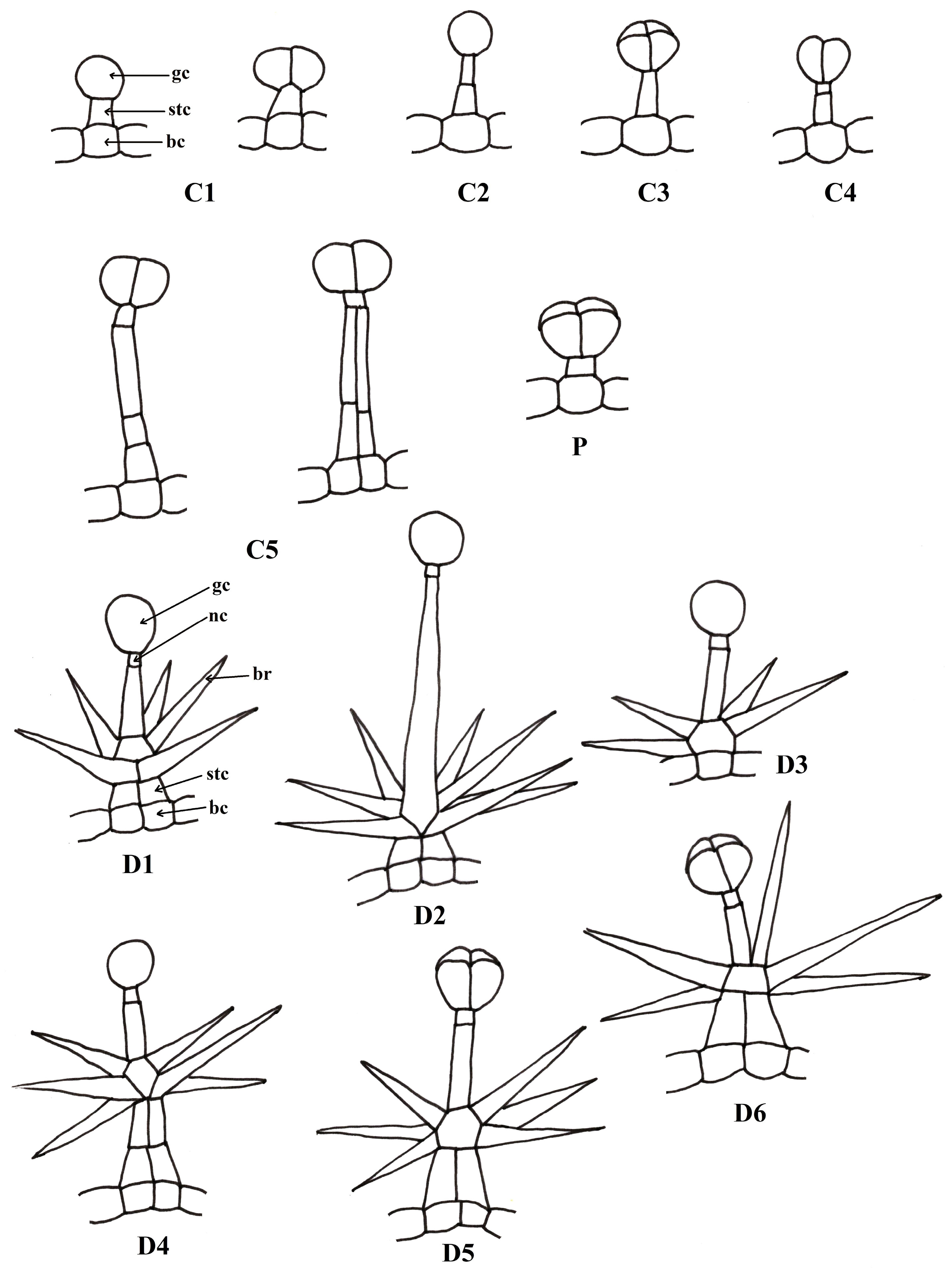
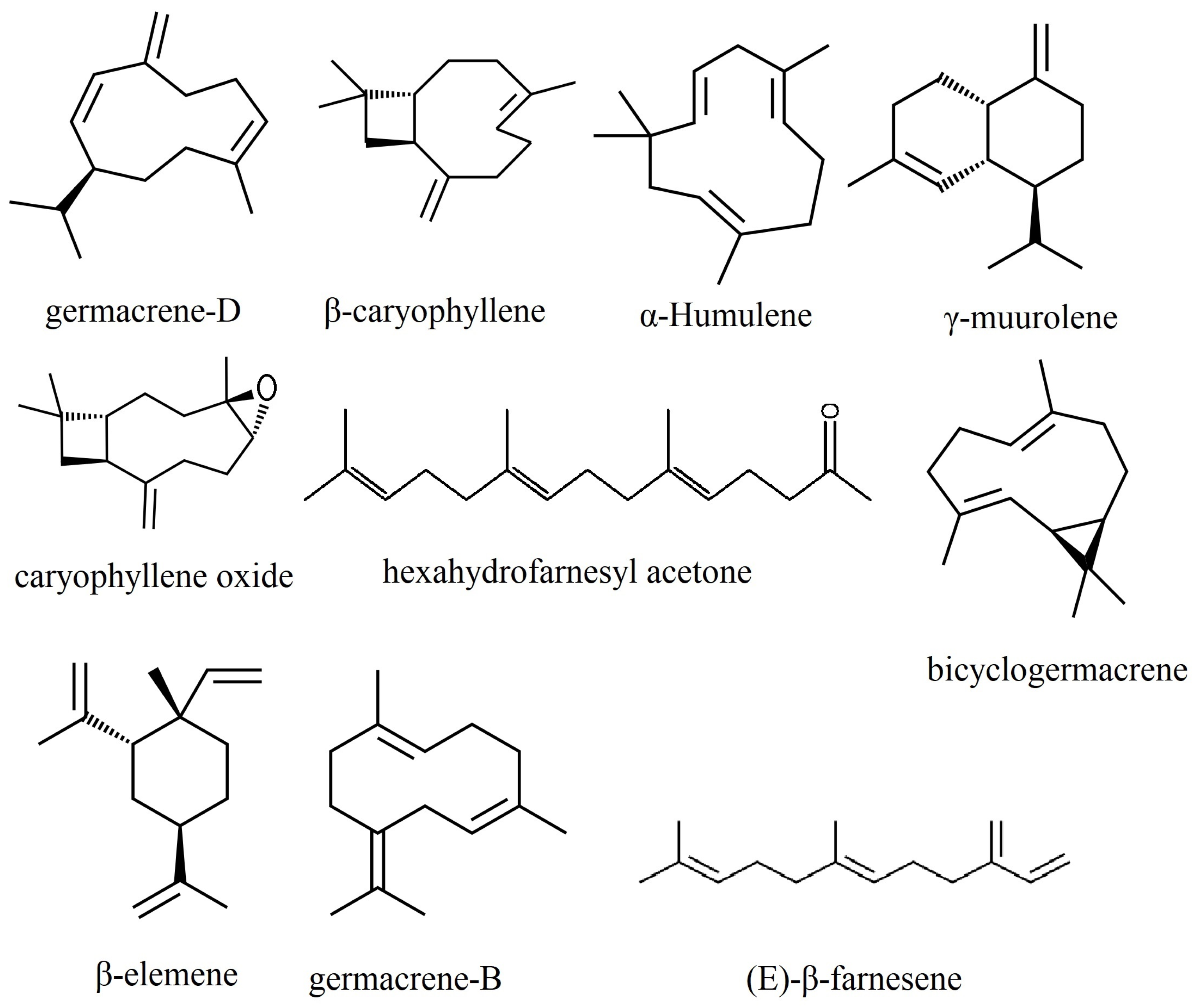
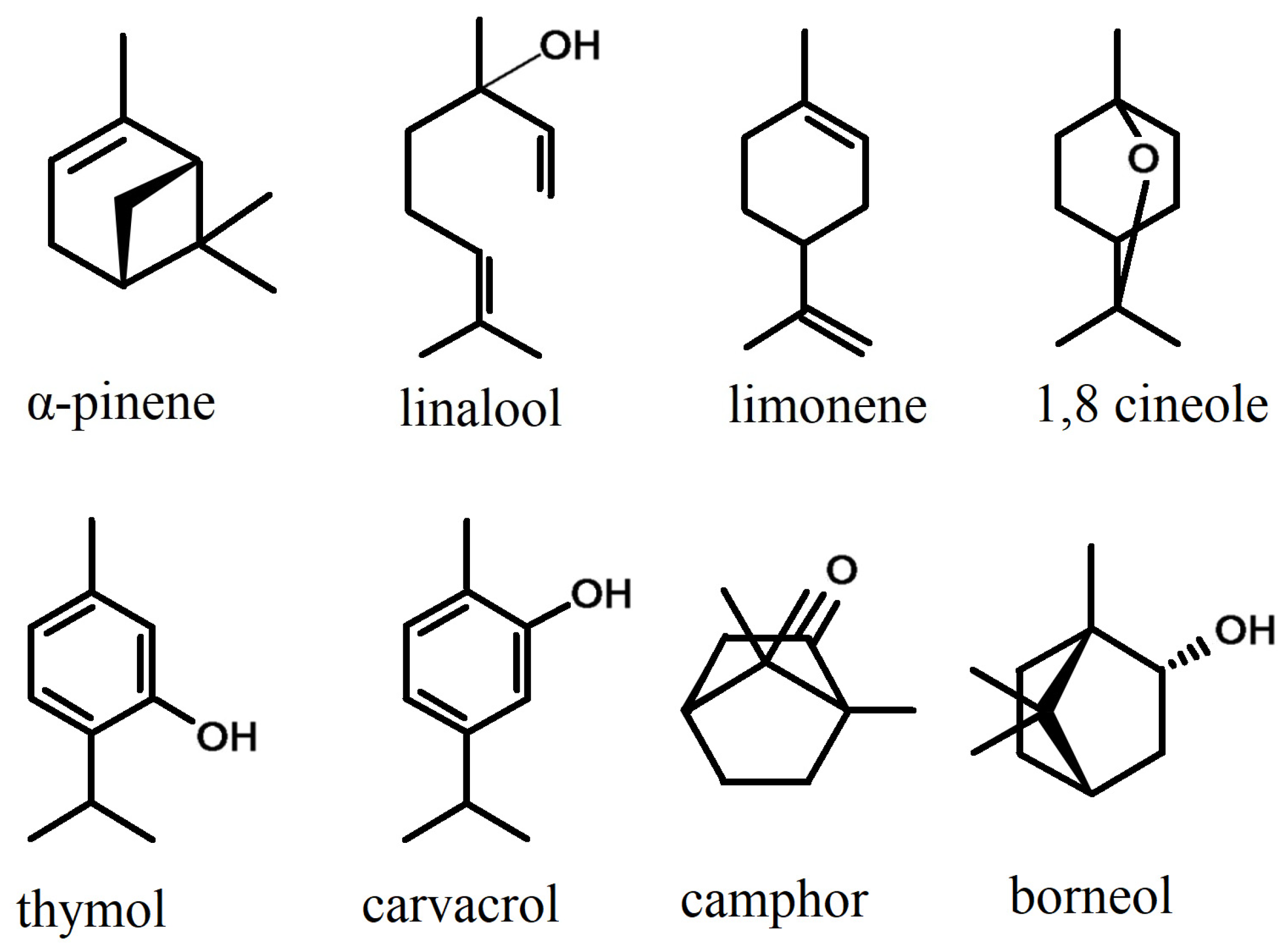

| Plant Species | Capitate Trichomes | Dendroid Trichomes | Author |
|---|---|---|---|
| Phlomis aurea Decne. | Type C1 | Type D1 | [42] |
| Type C2 | Type D2 | ||
| Type C3 | |||
| Phlomis brevilabris Ehrenb. ex Boiss. | Type C1 | Type D3 | [13] |
| Phlomis chimerae Boissieu | C1 | ||
| Type C4 | [13] | ||
| Phlomis crinita Cav. | Type C1 | Type D2, D4 | [43] |
| Type C5 | [13] | ||
| Phlomis fruticosa L. | Type C1 | Type D4 | [44] |
| Type C4 | |||
| Type C1 | Type D4 | [39] | |
| Type C 3 | |||
| Phlomis herba-venti L. | Type C1 | Type D3 | [46] |
| Type C3 | Type D4 | ||
| Type D5 | |||
| Type D6 | |||
| Phlomis kurdica Rech.f. | Type C1 | [45] | |
| Phlomis lanata Willd. | Type C1 | [13] | |
| Type C2 | |||
| Type C3 | |||
| Phlomis monocephala P.H.Davis | Type C1 | Type D3 | [48] |
| Type C2 | Type D4 | ||
| Type C5 | Type D6 | ||
| Phlomis olivieri Benth. | Type C3 (P?) | [47] | |
| Type C4 | |||
| Type C5 | |||
| Type D3 | [13] | ||
| Phlomis rigida Labill. | Type D2 | [45] | |
| Phlomis russeliana (Sims) Lag. ex Benth. | Type C3 (P?) | Type D1 | [49] |
| Type C2 | |||
| Type C4 | |||
| Phlomis samia L. | Type C1 | [13] |
| Plant Species | Species Range/Biome (cf. POWO) | Biologically Active Chemical Compounds from the Essential Oil | Percentage Content | Collection Site | Author |
|---|---|---|---|---|---|
| Phlomis amanica Vierh. | Turkey (Hatay)/ subtropical | germacrene-D | 14.17 | Hatay, Haymaseki village, Turkey | [67] |
| bicyclogermacrene | 10.70 | ||||
| 15-isopimaradien-11-ol | 22.8 | ||||
| (Z)-farnesene | 8.30 | ||||
| spathulenol | 6.30 | ||||
| Phlomis angustissima Hub.-Mor | SW Turkey/temperate | No data available. | — | — | — |
| Phlomis anisodonta Boiss | N. Iraq to Iran/ temperate | germacrene-D | 65.0 | Mazandaran province, Iran | [58] |
| β-caryophyllene | 11.0 | ||||
| bicyclogermacrene | 2.30 | ||||
| β-elemene | 2.60 | ||||
| trimethyl-2-pentadecanone | 2.80 | ||||
| germacrene-D | 52.60 | Lorestan province, West Iran | [68] | ||
| β-caryophyllene | 15.90 | ||||
| α-pinene | 6.80 | ||||
| spathulenol | 5.10 | ||||
| germacrene-B | 3.30 | ||||
| Phlomis antiatlantica J.P.Peltier | Morocco/subtropical | No data available. | — | — | — |
| Phlomis armeniaca Willd. | Turkey to Transcaucasus/ temperate | germacrene-D | 35.68 | Koprulu Canyon National Park, Turkey | [69] |
| β-caryophyllene | 18.08 | ||||
| caryophyllene oxide | 13.35 | ||||
| (E)-β-farnesene | 7.24 | ||||
| hexahydrofarnesyl acetone | 6.99 | ||||
| germacrene-D | 24.10 | Bolvadin Afyonkarahisar Turkey | [24] | ||
| hexahydrofarnesyl acetone | 13.70 | ||||
| spathulenol | 6.00 | ||||
| β-caryophyllene | 4.80 | ||||
| linalool | 3.60 | ||||
| β-farnesene | 6.20 | Kayseri, Turkey | [67] | ||
| germacrene-D | 23.40 | ||||
| hexadecanoic acid | 4.90 | ||||
| β-selinene | 2.60 | ||||
| bicyclogermacrene | 2.30 | ||||
| germacrene-D | 27.22 | Turkey | [70] | ||
| β-caryophyllene | 16.63 | ||||
| (E)-2-hexenal | 12.12 | ||||
| vinly amly carbinol | 5.45 | ||||
| benzaldehyde | 3.80 | ||||
| Phlomis aucheri Boiss. | W. Iran/ temperate | caryophyllene oxide | 33.50 | Fars province, Iran | [64] |
| β-caryophyllene | 27.00 | ||||
| β-selinene | 10.20 | ||||
| germacrene-D | 11.10 | Iran | [71] | ||
| bicyclogermacrene | 6.30 | ||||
| spathulenol | 6.01 | ||||
| β-caryophyllene | 5.58 | ||||
| neryl acetate | 4.58 | ||||
| germacrene B | 4.53 | ||||
| cyclopentane | 77.20 | Ardebil, Iran | [72] | ||
| n-octacosane | 7.30 | ||||
| germacrene-D | 1.60 | ||||
| n-pentacosane | 2.50 | ||||
| n-hexacosane | 2.30 | ||||
| germacrene-D | 28.31 | Province of Ilam, West of Iran | [73] | ||
| γ-elemene | 5.46 | ||||
| α-pinene | 4.81 | ||||
| β-caryophyllene | 4.96 | ||||
| Phlomis aurea Decne. | Sinai/ subtropical | germacrene-D | 51.56 | Saint Catherine, Sinai, Egypt | [74] |
| trans-β-farnesene | 11.36 | ||||
| α-pinene | 22.96 | ||||
| limonene | 6.26 | ||||
| B-Z-Ocimene | 1.85 | ||||
| Phlomis bourgaei Boiss. | East Aegean Islands to SW. Türkiye/subtropical | β-caryophyllene | 37.37 | Mugla, Turkey | [23] |
| (Z)-β-farnesene | 15.88 | ||||
| germacrene-D | 10.97 | ||||
| limonene | 8.97 | ||||
| α-cubebene | 7.43 | ||||
| β-caryophyllene | 21.98 | Turkey | [70] | ||
| α-cubebene | 16.04 | ||||
| germacrene-D | 15.12 | ||||
| limonene | 5.84 | ||||
| Β-cubebene | 4.59 | ||||
| Phlomis bovei de Noé | Algeria, Morocco, Tunisia/subtropical | germacrene-D | 21.45 | Megriss Mountain, Eastern Algeria | [75] |
| β-caryophyllene | 7.05 | ||||
| hexahydrofarnesyl acetone | 5.84 | ||||
| β-bourbonene | 2.96 | ||||
| caryophyllene oxide | 2.41 | ||||
| Phlomis brachyodon (Boiss.) Zohary ex Rech.f. | Lebanon–Syria, Palestine, Saudi Arabia/desert or dry shrubland | γ-muurolene | 15.85 | Shobak City, Southern Jordan | [76] |
| α-humulene | 19.00 | ||||
| linalool | 6.42 | ||||
| germacrene-B | 4.93 | ||||
| γ-himachalene | 8.12 | ||||
| Phlomis brevibracteata Turrill | Cyprus/subtropical | caryophyllene oxide | 26.00 | Geçitköy, North Cyprus | [77] |
| β-caryophyllene | 21.90 | ||||
| α-pinene | 4.50 | ||||
| isocaryophyllene oxide | 5.30 | ||||
| limonene | 3.20 | ||||
| Phlomis brevidentata H.W.Li | Tibet/temperate | No data available. | — | — | — |
| Phlomis brevilabris Ehrenb. ex Boiss. | Lebanon–Syria/subtropical | No data available. | — | — | — |
| Phlomis bruguieri Desf. | Iran, Iraq, Lebanon–Syria, Turkey/temperate | germacrene-D (%), | 60.50 | Fars province, Iran | [78] |
| γ-elemene | 16.50 | ||||
| germacrene B | 7.10 | ||||
| bicyclogermacrene | 4.10 | ||||
| germacrene-D | 23.60 | Mazandaran province, North of Iran | [79] | ||
| 4-hydroxy-4-methyl-2-pentanone | 15.0 | ||||
| α-pinene | 6.80 | ||||
| β-caryophyllene | 6.70 | ||||
| α-pinene | 5.50 | Kurdistan province, Iran | [21] | ||
| γ-muurolene | 15.50 | ||||
| caryophyllene oxide | 16.30 | ||||
| α-selinene | 7.10 | ||||
| cis-calamene | 6.70 | ||||
| caryophyllene oxide | 10.56 | Bingol, Yelesen village, Turkey | [80] | ||
| β-caryophyllene | 8.28 | ||||
| β-pinene | 9.63 | ||||
| α-cubebene | 8.89 | ||||
| p-cymen-8-ol | 4.70 | ||||
| Phlomis brunneogaleata Hub.-Mor. | Turkey/temperate | No data available. | — | — | — |
| Phlomis bucharica Regel | Tadzhikistan to N. Afghanistan/temperate | thymol | 20.41 | Uzbekistan | [81] |
| camphor | 14.46 | ||||
| 1,8-cineole | 13.69 | ||||
| borneol | 9.82 | ||||
| hexahydrofarnesyl acetone | 7.54 | ||||
| Phlomis cancellata Bunge | Afghanistan, Iran, Transcaucasus, Turkmenistan/temperate | germacrene-D | 25.60 | Northern Iran | [82] |
| α-pinene | 6.40 | ||||
| heptane | 4.30 | ||||
| hexahydrofarnesyl acetone | 4.10 | ||||
| β-caryophyllene | 3.60 | ||||
| germacrene-D | 26.40 | North of Soltan-Abad, Province of Khorasan, Iran | [83] | ||
| β-caryophyllene | 17.00 | ||||
| caryophyllene oxide | 10.40 | ||||
| α-humulene | 6.30 | ||||
| α-thujene | 6.00 | ||||
| hexadecanoic acid | 17.30 | [84] | |||
| germacrene-D | 14.60 | ||||
| eudesmol | 8.50 | ||||
| octacosane | 5.60 | ||||
| (E)-caryophyllene | 5.40 | ||||
| Phlomis capitata Boiss. | Turkey/temperate | No data available. | — | — | — |
| Phlomis carica Rech.f. | SW Turkey/subtropical | No data available. | — | — | — |
| Phlomis cashmeriana Royle ex Benth. | Afghanistan, Pakistan, Tadzhikistan, West Himalaya/temperate | o-cymene | 53.80 | Khyber Pakhtunkhwa, Pakistan | [85] |
| sabinen | 24.00 | ||||
| α-citral | 5.00 | ||||
| β-pinene | 4.97 | ||||
| 1,8-cineole (%). | 4.40 | ||||
| Phlomis cashmirica Wells | Kashmir/temperate | No data available. | |||
| Phlomis chimerae Boissieu | Turkey/subtropical | β-caryophyllene | 31.60 | Antalya, Tekirova, Çıralı, Turkey | [86] |
| α-pinene | 11.00 | ||||
| germacrene D | 6.10 | ||||
| limonene | 5.50 | ||||
| linalool | 4.70 | ||||
| Phlomis chorassanica Bunge | NE Iran/temperate | germacrene-D | 51.50 | Khorassan Province, Iran | [58] |
| β-caryophyllene | 25.00 | ||||
| camphor | 2.50 | ||||
| β-bourbonene | 1.50 | ||||
| hexahydrofarnesyl acetone | 2.50 | ||||
| Phlomis chrysophylla Boiss. | Lebanon–Syria, Palestine/subtropical | No data available. | — | — | — |
| Phlomis cretica C.Presl | East Aegean Is., Greece, Crete/subtropical | germacrene-D | 20.10 | Zaros, Crete, Greece | [22] |
| β-caryophyllene | 17.30 | ||||
| α-pinene | 9.40 | ||||
| linalool | 7.50 | ||||
| limonene | 7.10 | ||||
| germacrene-D | 47.90 | Chania, Crete, Greece | [87] | ||
| α-pinene | 11.20 | ||||
| β-himachalene | 7.30 | ||||
| germacrene B | 6.40 | ||||
| limonene | 6.10 | ||||
| Phlomis crinita Cav. | Algeria, Morocco, Spain, Tunisia/subtropical | trans-caryophyllene | 40.80 | Monastir, Tunisia | [88] |
| germacrene-D | 39.10 | ||||
| β-cadinene | 0.90 | ||||
| α-copaene | 0.39 | ||||
| d-3-Caren | 0.10 | ||||
| Phlomis cyclodon Knorring | Tadzhikistan/temperate | No data available. | — | — | — |
| Phlomis cypria Post | Cyprus/ subtropical | germacrene-D | 20.80 | Beşparmak Mountains, North Cyprus | [77] |
| β-caryophyllene | 37.40 | ||||
| α-pinene | 6.90 | ||||
| limonene | 4.40 | ||||
| palmito-γ-lactone | 4.50 | ||||
| Phlomis dincii Yıld. | Turkey/temperate | No data available. | |||
| Phlomis drobovii Popov | Kirgizstan, Tadzhikistan, Uzbekistan/temperate | No data available. | — | — | — |
| Phlomis elliptica Benth. | W and S Iran/temperate | β-farnesene | 28.90 | Fars province, Iran | [89] |
| trans-caryophyllene | 20.30 | ||||
| β-selinene | 10.00 | ||||
| α-gurjunene | 6.40 | ||||
| α-pinene | 11.30 | ||||
| hexadecanoic acid | 19.10 | Fars province, Iran | [64] | ||
| linoleic acid | 10.20 | ||||
| β-selinene | 9.90 | ||||
| hexahydrofarnesyl acetone | 7.30 | ||||
| (E)-b-farnesene | 6.20 | ||||
| Phlomis elongata Hand.-Mazz. | Iraq/subtropical | No data available. | — | — | — |
| Phlomis floccosa D.Don | Egypt, Crete (Greece), Libya, Tunisia/subtropical | germacrene-D | 19.70 | Touza, Governorate of Monastir, Tunisia | [90] |
| β-caryophyllene | 15.50 | ||||
| caryophyllene oxide | 8.30 | ||||
| hexadecanoic acid | 7.90 | ||||
| carvacrol | 6.10 | ||||
| Phlomis fruticetorum Gontsch. | Tadzhikistan/temperate | No data available. | — | — | — |
| Phlomis fruticosa L. | Subtropical Albania, Cyprus, East Aegean Is., Greece, Italy, Greece (Crete), Sardegna, Sicilia, Transcaucasus, Turkey, Ex-Yugoslavia/subtropical | α-pinene | 38.90 A, 56.60 B | Bar, Montenegro | [19] |
| 1,8-cineole | 8.00 A, 10.40 B | ||||
| β-caryophyllene | 8.70 A, 2.00 B | ||||
| α-thujone | 2.0 0A, 1.40 B | ||||
| limonene | 2.10 A, 2.20 B | ||||
| germacrene-D | 21.40 | Central-east Peloponnesus, Greece | [22] | ||
| α-pinene | 12.60 | ||||
| linalool | 8.00 | ||||
| β-caryophyllene | 12.60 | ||||
| -γ-bisabolene | 7.10 | ||||
| α-curcumene | 38.00 | Toscolano Maderno, Brescia, Italy | [39] | ||
| caryophyllene oxide | 46.00 | ||||
| α-cedrene | 28.00 | ||||
| α-cedrene | 12.80 | ||||
| trans-sesquisabinene hydrate | 3.90 | ||||
| Phlomis ghilanensis K.Koch | N. Iran/temperate | No data available. | — | — | — |
| Phlomis grandiflora H.S.Thomps. | E. Aegean Islands to SW and S Turkey/subtropical | germacrene-D | 45.40 | Antalya, Elmalı district, Turkey | [86] |
| β-caryophyllene | 22.80 | ||||
| bicyclogermacrene | 4.90 | ||||
| α-humulene | 2.80 | ||||
| limonene | 2.70 | ||||
| β-eudesmol | 61.48 | Tahtalı-Antalya, Turkey | [91] | ||
| β-curcumene | 5.81 | ||||
| E-β-farnesene | 2.35 | ||||
| α-zingiberene | 2.18 | ||||
| α-cedrene | 1.94 | ||||
| α-pinene | 26.40 | Turkey | [70] | ||
| α-cedrene | 28.15 | ||||
| α-curcumene | 13.92 | ||||
| β-humulene | 7.52 | ||||
| germacrene-D | 5.40 | ||||
| Phlomis herba-venti L. | Albania, Algeria, Bulgaria, East European Russia, France, Greece, Iran, Iraq, Italy, Kazakhstan, Krym, Lebanon-Syria, Morocco, North Caucasus, Palestine, Portugal, Romania, Sicilia, South European Russi, Spain, Transcaucasus, Tunisia, Turkey, Turkey-in-Europe, Turkmenistan, Ukraine, Ex-Yugoslavia/subtropical | germacrene-D | 33.90 | Mazandaran province, Northern Iran | [92] |
| hexadecanoic acid | 12.90 | ||||
| α-pinene | 9.40 | ||||
| 14-hydroxy-α-muurolene | 4.20 | ||||
| β-bourbonene | 4.00 | ||||
| germacrene-D | 31.10 | Mazandaran province, Northern Iran | [93] | ||
| T-muurolol | 11.0 | ||||
| β-caryophyllene | 1.70 | ||||
| β-bourbonene | 1.50 | ||||
| α-pinene | 7.10 | ||||
| germacrene-D | 24.50 | Orromieyeh, Province, Iran | [94] | ||
| β-farnesene | 13.40 | ||||
| bicyclogermacrene | 14.10 | ||||
| α-pinene | 13.50 | ||||
| hexadecanoic acid | 0.10 | ||||
| (E)-2-hexenal | 17.60 | Turkey | [70] | ||
| vinly amyl carbinol | 20.44 | ||||
| germacrene-D | 9.84 | ||||
| n-hexanal | 4.86 | ||||
| 3-methylbutanal | 4.41 | ||||
| n-hexadecanoic acid | 68.10 | Ankara, Turkey | [24] | ||
| germacrene D | 7.20 | ||||
| hexahydrofarnesyl acetone | 4.00 | ||||
| α-cadinol | 2.30 | ||||
| spathulenol | 2.20 | ||||
| germacrene-D | 11.70 | Shanjan Region, Iran | [95] | ||
| β-bourbonene | 7.30 | ||||
| α-pinene | 7.30 | ||||
| terpinolene | 9.10 | ||||
| hexadecanoic acid | 7.40 | ||||
| Phlomis hypoleuca Vved. | Kirgizstan, Tadzhikistan/temperate | No data available. | — | — | — |
| Phlomis integrifolia Hub.-Mor. | Turkey/temperate | germacrene-D | 20.00 | Turkey | [96] |
| (Z)-β-farnesene | 13.00 | ||||
| Phlomis iranica Joharchi & Vaezi | Iran/temperate | No data available. | — | — | — |
| Phlomis isiliae Yıld. | Turkey/temperate | No data available. | — | — | — |
| Phlomis italica L. | Baleares, Spain/subtropical | No data available. | — | — | — |
| Phlomis kotschyana Hub.-Mor. | Lebanon-Syria, Turkey/subtropical | No data available. | — | — | — |
| Phlomis kurdica Rech.f. | Iran, Iraq, Lebanon–Syria, Palestine, Turkey/temperate | germacrene-D | 55.40 | Malatya, Turkey | [97] |
| (Z)-β-farnesene | 11.20 | ||||
| hexadecanoic acid | 8.40 | ||||
| bicyclogermacrene | 3.80 | ||||
| δ-cadinene | 1.90 | ||||
| dodecanoic acid | 10.00 | Kurdistan Province, Iran | [21] | ||
| germacrene-D | 9.90 | ||||
| trans-caryophyllene | 8.70 | ||||
| α-selinen | 6.30 | ||||
| α-cubebene | 5.90 | ||||
| Phlomis lanata Willd | Crete, Greece/subtropical | α-Pinene | 25.41 | Heraklion, Crete, Greece | [17] |
| limonene | 15.67 | ||||
| trans-caryophyllene | 8.86 | ||||
| γ-muurolene | 4.53 | ||||
| isocomen | 4.91 | ||||
| Phlomis lanceolata Boiss. & Hohen. | SE. Turkey to W. Iran/temperate | germacrene-D | 47.00 | Ardebil province, Iran | [78] |
| (E)-β-farnesene | 10.50 | ||||
| α-pinene | 8.70 | ||||
| germacrene B | 8.00 | ||||
| bicyclogermacrene | 5.90 | ||||
| Phlomis leucophracta P.H.Davis & Hub.-Mor. | S Turkey/subtropical | β-caryophyllene | 20.20 | Alanya district, Alanya Castle, Turkey | [86] |
| α-pinene | 19.20 | ||||
| limonen | 11.00 | ||||
| nonanal | 8.80 | ||||
| germacrene-D | 4.50 | ||||
| linalool | 36.40 | Turkey | [98] | ||
| spathulenol | 8.40 | ||||
| caryophyllene oxid | 8.40 | ||||
| β-caryophyllene | 7.90 | ||||
| nonanal | 4.80 | ||||
| limonene | 27.86 | Haziran, Turkey | [99] | ||
| β-caryophyllene | 26.55 | ||||
| α-pinene | 11.59 | ||||
| nonana | 4.33 | ||||
| β-myrcene | 3.75 | ||||
| limonene | 14.56 | Turkey | [70] | ||
| β-caryophyllene | 22.45 | ||||
| germacrene-D | 8.32 | ||||
| (E)-2-hexenal | 8.74 | ||||
| n-hexanal | 3.54 | ||||
| Phlomis linearifolia Zakirov | Tadzhikistan, Uzbekistan/temperate | No data available. | — | — | — |
| Phlomis linearis Boiss. & Balansa | Central Turkey/temperate | β-caryophyllene | 24.20 | Kayseri, Erciyes Mountain, Turkey | [100] |
| germacrene-D | 22.30 | ||||
| caryophyllene oxide | 9.20 | ||||
| (Z)-β-farnesene | 6.60 | ||||
| hexahydrofarnesyl acetone | 5.80 | ||||
| α-pinene | 12.50 | Sivas Province, Turkey | [101] | ||
| β-caryophyllene | 10.70 | ||||
| α-cadinol | 10.40 | ||||
| germacrene-D | 8.80 | ||||
| acetophenone | 7.50 | ||||
| Phlomis longifolia Boiss. & C.I.Blanche | Cyprus, Lebanon–Syria, Turkey/subtropical | caryophyllene oxide | 27.20 | Hatay, Belen district, Turkey | [102] |
| fenchone | 18.63 | ||||
| 1,8-cineole | 6.12 | ||||
| camphor | 4.82 | ||||
| α-cubebene | 4.11 | ||||
| Phlomis lunariifolia Sm. | Cyprus, Turkey/subtropical | β-caryophyllene | 9.00 | Icel, Aydincik–Gulnar, Turkey | [103] |
| germacrene-D | 7.70 | ||||
| β-farnesene | 6.50 | ||||
| hexadecanoic acid | 9.70 | ||||
| spathuleno | 3.90 | ||||
| Phlomis lurestanica Jamzad | Iran/temperate | hexadecane | 8.97 | Lorestan province, Iran | [104] |
| 2-dodecnenal | 6.57 | ||||
| heptadecane | 6.32 | ||||
| α-pinene | 3.13 | ||||
| carvacrol | 3.50 | ||||
| Phlomis lychnitis L. | France, Morocco, Portugal, Spain/temperate | No data available. | — | — | — |
| Phlomis lycia D.Don | SW Turkey/subtropical | No data available. | — | — | — |
| Phlomis majkopensis (Novopokr.) Grossh. | N Caucasus/temperate | No data available. | — | — | — |
| Phlomis mazandaranica Jamzad | Iran/temperate | No data available. | — | — | — |
| Phlomis mindshelkensis Lazkov | Kazakhstan/temperate | No data available. | — | — | — |
| Phlomis monocephala P.H.Davis | S Turkey/subtropical | germacrene-D | 18.92 | Mersin Silifke Bahçederesi Village, Turkey | [105] |
| (E)-β-farnesene | 17.69 | ||||
| α-pinene | 15.59 | ||||
| 3-octen-2-one | 6.97 | ||||
| δ-cadinene | 4.27 | ||||
| germacrene-D | 6.00 | Icel, Adicike Gulnar Turkey | [67] | ||
| α-pinene | 4.90 | ||||
| limonene | 3.90 | ||||
| β-farnesene | 3.10 | ||||
| spathulenol | 3.00 | ||||
| Phlomis nana C.Y.Wu | Tibet/temperate | No data available. | — | — | — |
| Phlomis nissolii L. | Turkey/subtropical | germacrene-D | 33.90 | Konya, Turkey | [106] |
| bicyclogermacrene | 15.30 | ||||
| (Z)-β-farnesene | 10.70 | ||||
| carvacrol | 4.20 | ||||
| spathulenol | 4.00 | ||||
| germacrene-D | 15.10 | Konya, Turkey | [24] | ||
| β-caryophyllene | 12.70 | ||||
| linalool | 11.30 | ||||
| hexahydrofarnesyl acetone | 11.90 | ||||
| spathulenol | 4.00 | ||||
| germacrene-D | 20.73 | Turkey | [107] | ||
| (E)-2-hexenal | 10.57 | ||||
| α-pinene | 6.93 | ||||
| β-caryophyllene | 12.15 | ||||
| (E)-β-farnesene | 4.05 | ||||
| Phlomis nubilans Zakirov | Uzbekistan/temperate | No data available. | — | — | — |
| Phlomis nyalamensis H.W.Li | Tibet/temperate | No data available. | — | — | — |
| Phlomis olgae Regel | Tadzhikistan, Uzbekistan/ temperate | No data available. | — | — | — |
| Phlomis olivieri Benth. | Iraq to Iran/subtropical | germacrene-D | 5.30 to 36.90 | Hamedan province, Iran | [108] |
| (E)-β-caryophyllene | 6.30 to 61.90 | ||||
| (E)-β-farnesene | 5.10 to 18.40 | ||||
| bicyclogermacrene | 0.50 to 7.50 | ||||
| caryophyllene oxide | 1.70 to 10.10 | ||||
| germacrene-D | 28.10 | Tehran Province, Iran | [109] | ||
| β-caryophyllene | 16.10 | ||||
| α-pinene | 11.70 | ||||
| β-selinene | 10.20 | ||||
| bicyclogermacrene | 7.40 | ||||
| germacrene-D | 26.40 | Lorestan, Iran | [110] | ||
| bicyclogermacrene | 12.70 | ||||
| α-pinene | 7.70 | ||||
| limonene | 3.67 | ||||
| β-bourbonene | 4.00 | ||||
| germacrene-D | 48.00 | Mazandaran province, Northern Iran | [111] | ||
| α-pinene | 10.40 | ||||
| bicyclogermacrene | 4.40 | ||||
| germacrene-B | 3.80 | ||||
| δ-cadinene | 2.50 | ||||
| germacrene-D | 37.60 | Yasooj (province of Kohkiloye-Boyerahmad), Iran | [112] | ||
| β-caryophellene | 10.00 | ||||
| bicyclogermacrene | 8.00 | ||||
| β-selinene | 6.80 | ||||
| spathulenol | 4.80 | ||||
| β-caryophyllene | 25.70 | Gandoman region, Iran | [113] | ||
| germacrene-D | 19.50 | ||||
| α-pinene | 9.00 | ||||
| β-farnesene | 9.40 | ||||
| caryophyllene oxide | 4.20 | ||||
| germacrene-D | 26.54 to 56.41 | Zagros region, Iran | [20] | ||
| bicyclogermacrene | 6.38 to 30.55 | ||||
| β-caryophyllene | 5.32 to 24.52 | ||||
| α-pinene | 1.29 to 15.53 | ||||
| 1,8-cineole | 1.11 to 4.92 | ||||
| germacrene-D | 26.43 | Azeran and Kamoo in Kashan, Iran | [114] | ||
| β-caryophyllene | 20.72 | ||||
| elixene | 6.58 | ||||
| β-trans-farnesene | 6.17 | ||||
| β-cyclogermacrane | 5.04 | ||||
| Phlomis oppositiflora Boiss. & Hausskn. | Turkey/temperate | No data available. | — | — | — |
| Phlomis orientalis Mill. | Iran, Transcaucasus/temperate | No data available. | — | — | — |
| Phlomis pachyphylla Rech.f. | W and SW Iran/temperate | No data available. | — | — | — |
| Phlomis persica Boiss. | Iran/temperate | germacrene-D | 38.20 | Taleghan Iran | [110] |
| bicyclogermacrene | 16.30 | ||||
| α-pinene | 13.30 | ||||
| germacrene B | 8.80 | ||||
| γ-elemene | 2.60 | ||||
| germacrene-D | 26.50 | Yasooj (province of Kohkiloye-Boyerahmad), Iran | [112] | ||
| bicyclogermacrene | 18.70 | ||||
| spathulenol | 6.80 | ||||
| hexahydrofarnesyl acetone | 9.00 | ||||
| linoleic acid | 6.50 | ||||
| germacrene-D | 17.20 | Gandoman region, Iran | [113] | ||
| γ-elemene | 15.40 | ||||
| (e)-β-farnesene | 9.40 | ||||
| α-pinene | 9.00 | ||||
| caryophyllene oxide | 4.20 | ||||
| Phlomis physocalyx Hub.-Mor | Central Turkey/temperate | No data available. | — | — | — |
| Phlomis pichleri Vierh. | Creta, Greece/subtropical | No data available. | — | — | — |
| Phlomis platystegia Post | Israel to Jordan/subtropical | linalool | 7.72 | Ajloun City, North of Jordan | [76] |
| neo-dihydro carveol | 3.20 | ||||
| viridiflorol | 17.39 | ||||
| β-eudesmol | 13.07 | ||||
| ethyl-pentanoate | 3.35 | ||||
| Phlomis polioxantha Rech.f. | N Iraq, W and SW Iran/temperate | No data available. | — | — | — |
| Phlomis purpurea L. | Algeria, Morocco, Portugal, Spain/subtropical | No data available. | — | — | — |
| Phlomis regelii Popov | Uzbekistan/temperate | camphene | 17.10 | Uzbekistan | [115] |
| 1,8-cineole | 15.90 | ||||
| β-cymene | 7.90 | ||||
| limonene | 7.40 | ||||
| trans-2-hexenal | 4.60 | ||||
| Phlomis rigida Labill. | Iran, Iraq, Lebanon–Syria, Turkey/ subtropical | β-caryophyllene | 31.20 | Turkey | [116] |
| β-selinene | 13.10 | ||||
| α-selinene | 2.60 | ||||
| α-humulene | 3.00 | ||||
| hexahydrofarnesyl acetone | 1.40 | ||||
| (E)-2-hexenal | 9.21 | Konya Turkey | [105] | ||
| β-caryophyllene | 60.23 | ||||
| germacrene-D | 9.76 | ||||
| α-humulene | 1.25 | ||||
| vinyl amyl carbinol | 1.90 | ||||
| (Z)-β-ocimene | 22.50 | Hamadan Province, Iran | [59] | ||
| isobornyl acetate | 18.10 | ||||
| trans-verbenol | 9.30 | ||||
| α-pinene | 9.20 | ||||
| camphene | 3.70 | ||||
| Phlomis russeliana (Sims) Lag. ex Benth. | N Turkey/subtropical | β-caryophyllene | 23.00 | Bolu: Abant lake, Turkey | [103] |
| germacrene-D | 15.00 | ||||
| caryophyllene oxide | 8.10 | ||||
| hexahydrofarnesyl acetone | 3.90 | ||||
| α-humulene | 1.50 | ||||
| α-humulene | 26.89 | Mazandaran province, Iran | [117] | ||
| mono(2-ethylhexyl) phthalate | 20.42 | ||||
| caryophyllene | 18.74 | ||||
| borneol | 5.96 | ||||
| camphor | 4.45 | ||||
| Phlomis salicifolia Regel | Kirgizstan, Tadzhikistan, Uzbekistan/temperate | methyl palmitate | 51.15 | Uzbekistan | [81] |
| hexahydrofarnesyl acetone | 7.69 | ||||
| methyl linolenate | 5.99 | ||||
| Phlomis samia L. | Balkan Peninsula to SW and S Turkey/subtropical | (E)-β-farnesene | 20.70 | Mount Parnon-Peloponnesus, Greece | [22] |
| germacrene-D | 6.30 | ||||
| βcaryophyllene | 5.80 | ||||
| spathulenol | 3.70 | ||||
| caryophyllene oxide | 3.20 | ||||
| germacrene-D | 33.80 | Turkey | [116] | ||
| β-caryophyllene | 6.40 | ||||
| α-copaene | 3.20 | ||||
| hexahydrofarnesyl acetone | 2.80 | ||||
| bicyclogermacrene | 2.50 | ||||
| α-copaene | 10.59 | Isparta, Turkey | [70] | ||
| β-caryophyllene | 15.20 | ||||
| germacrene-D | 23.44 | ||||
| β-bourbonene | 7.47 | ||||
| δ-cadinene | 5.29 | ||||
| Phlomis sewerzowii Regel | Kirgizstan, Uzbekistan/temperate | thymol | 35.76 | Uzbekistan | [81] |
| carvacrol | 8.90 | ||||
| β-caryophyllene | 8.43 | ||||
| caryophyllene oxide | 8.32 | ||||
| hexahydrofarnesyl acetone | 8.25 | ||||
| Phlomis sieheana Rech.f. | Central Turkey/temperate | germacrene-D | 16.60 | Kayseri, Turkey | [67] |
| β-farnesene | 11.70 | ||||
| spathulenol | 3.00 | ||||
| β-bourbonene | 1.50 | ||||
| hexahydrofarnesyl acetone | 1.90 | ||||
| β-caryophyllene | 10.80 | Hazersah village (Solhan-Bingöl), Turkey | [118] | ||
| germacrene-D | 15.60 | ||||
| α-pinene | 7.80 | ||||
| β-farnesene | 5.90 | ||||
| caryophyllene oxide | 2.30 | ||||
| Phlomis sintenisii Rech.f. | E Turkey/temperate | spathulenol | 7.00 | [96] | |
| Phlomis spinidens Nevski | Tadzhikistan/temperate | No data available. | — | — | — |
| Phlomis stewartii Hook.f. | Afghanistan, Pakistan/temperate | No data available. | — | — | — |
| Phlomis syriaca Boiss. | S Turkey to SW Syria/subtropical | No data available. | — | — | — |
| Phlomis tathamiorum R.M.Haber & Semaan | Lebanon–Syria/subtropical | No data available. | — | — | — |
| Phlomis tenorei Soldano | S Italy/subtropical | β-caryophyllene | 15.60 | Monopoli, Bari Province, Italy | [119] |
| hexadecanoic acid | 12.80 | ||||
| germacrene-D | 8.90 | ||||
| caryophyllene oxide | 6.70 | ||||
| α-thujone | 5.50 | ||||
| Phlomis tenuis Knorring | Kazakhstan/temperate | No data available. | — | — | — |
| Phlomis thapsoides Bunge | Tadzhikistan, Uzbekistan/temperate | phenylethyl alcohol | 6.81 | Surkhondaryo region, Uzbekistan | [120] |
| trans-3-hexenol | 5.55 | ||||
| 1-octen-3-ol | 5.10 | ||||
| α-cadinol | 4.92 | ||||
| α-muurolol | 4.67 | ||||
| Phlomis tomentosa Regel | Tadzhikistan/temperate | No data available. | — | — | — |
| Phlomis trineura Rech.f. | N Afghanistan/temperate | No data available. | — | — | — |
| Phlomis viscosa Poir. | Lebanon–Syria, Palestine, Turkey/subtropical | germacrene-D | 4.70 | Bașkonuș Mountains, Turkey | [121] |
| β-caryophyllene | 24.40 | ||||
| α-monocyclo farnesyl acetone | 16.44 | ||||
| α-humulene | 6.10 | ||||
| alloaromadendrene | 11.00 | ||||
| germacrene-B | 20.15 | Ajloun City, North of Jordan | [76] | ||
| e-caryophyllene | 9.57 | ||||
| α-humulene | 2.92 | ||||
| γ-muurolene | 7.37 | ||||
| himachalene epoxide | 4.69 | ||||
| Phlomis zenaidae Knorring | Uzbekistan/temperate | No data available. | — | — | — |
Disclaimer/Publisher’s Note: The statements, opinions and data contained in all publications are solely those of the individual author(s) and contributor(s) and not of MDPI and/or the editor(s). MDPI and/or the editor(s) disclaim responsibility for any injury to people or property resulting from any ideas, methods, instructions or products referred to in the content. |
© 2024 by the authors. Licensee MDPI, Basel, Switzerland. This article is an open access article distributed under the terms and conditions of the Creative Commons Attribution (CC BY) license (https://creativecommons.org/licenses/by/4.0/).
Share and Cite
Gostin, I.N.; Blidar, C.F. Glandular Trichomes and Essential Oils Variability in Species of the Genus Phlomis L.: A Review. Plants 2024, 13, 1338. https://doi.org/10.3390/plants13101338
Gostin IN, Blidar CF. Glandular Trichomes and Essential Oils Variability in Species of the Genus Phlomis L.: A Review. Plants. 2024; 13(10):1338. https://doi.org/10.3390/plants13101338
Chicago/Turabian StyleGostin, Irina Neta, and Cristian Felix Blidar. 2024. "Glandular Trichomes and Essential Oils Variability in Species of the Genus Phlomis L.: A Review" Plants 13, no. 10: 1338. https://doi.org/10.3390/plants13101338
APA StyleGostin, I. N., & Blidar, C. F. (2024). Glandular Trichomes and Essential Oils Variability in Species of the Genus Phlomis L.: A Review. Plants, 13(10), 1338. https://doi.org/10.3390/plants13101338

