


Abstract
(Background) Culinary cultures undergo dramatic changes due to globalization; however, the shift in the use of culinary spices and herbs is little documented. We aimed to list seasoning products used in contemporary Polish cuisine and assess whether they have roots in historic recipes. (Methods) Via an online questionnaire distributed via social media, we gathered data from 916 respondents from all over Poland. (Results) Altogether 132 single-ingredient taxa of plant or fungi species were mentioned in the questionnaire. Capsicums, black pepper, turmeric, oregano, cinnamon, marjoram, ginger, basil, thyme, and bay leaf were the 10 most quoted seasonings throughout the year. While local herbs are likely to have been long used in local cooking, the most commonly used spices have been known in Poland since at least 17–18th c. However, a few Asian, mainly Indian spices have become mainstream in the last few years. In particular, these are turmeric, cumin, and fenugreek. The seasonings which decreased the most are various seasoning mixes and stock cubes, unpopular due to the large amount of monosodium glutamate and salt. (Conclusions) Polish cuisine is undergoing a strong process of globalization, and curry spices have become standard cooking ingredients.
1. Introduction
Spices are an important component in most human cuisines [1,2]. They have been studied in detail as a source of micronutrients or antioxidants but also as a part of the food-medicine continuum, and even as medicine [3,4,5]. They also play an important role in defining gastronomic traditions both for the communities from which they originate and for outsiders; Elizabeth Rozin famously discussed so-called flavor principles, unique combinations of flavors, including spices and sauces, that constitute a “marker, a defining characteristic of cuisine” [6].
We cannot say that all human cultures use spices, as in many hunter-gatherer and primitive agriculturalist cultures their use is non-existent, and in some, even salt is not added to food [7]. On the other hand, their use can now be found in different parts of the globe [1]. While local aromatic plants served as the first seasonings, with the development of trade, some particularly desirable species became expensive goods transported over large distances [1,2,8]. Spices like pepper and cinnamon already graced the tables of the upper classes in imperial Rome, symbolizing not only wealth but also the political and commercial reach of the Empire. Communities all across the Indian Ocean, from the Red Sea to Southern India to the islands of today’s Indonesia thrived thanks to the trade of spices that grew uniquely in specific locations [9]. During the Middle Ages and the Renaissance, the elites went to great lengths to employ spices in their dinners and banquets as forms of conspicuous consumption [10,11]. Later on, empires were built having among their first goal to ensure access to sources of spices [12]. However, the concept of “spice” is far from univocal; cultures had different perceptions of what constituted a spice, depending on time and place. For instance, sugar was considered an expensive and luxurious spice when it first appeared on Western European tables, to the point that medical properties were attributed to it [13]. Over time, however, as its production increased in territories controlled by Western powers, sugar lost its glamor and became a common, accessible ingredient. As contemporary globalization dynamics facilitate the circulation of ingredients, recipes, and ideas, food connoisseurs around the world continue their quest for new and exciting flavors that also contribute to their cultural and social distinction. At the same time, cuisines all around the world have always taken advantage of the local flora, especially herbs and aromatic plants. As interest in local and artisanal customs increases also among culinary professionals and experts, traditional combinations of herbs, berries, and other botanical elements are increasingly re-evaluated and integrated, also in fine dining cuisine [14,15].
One of the main features of medieval cuisine was the abundant use of Asian spices, which also included sugar. They became the basis of distinction through food and a tool of dietetics, which was cultivated in its ancient form by Arab and Jewish scholars from the Middle East and the Iberian Peninsula [16]. The familiar myth of using Asian spices to preserve meat, and especially to mask the taste of stale produce, is late and ahistorical [17].
Medieval people associated roots with paradise; they were one of the most effective tools of distinction and a means of correcting the humoral properties of food. Above all, however, they determined the attractive taste of the dishes. Stories about using exclusive products to mask the taste of spoiled meat, something much cheaper and more easily available, have all the characteristics of a myth. This simple explanation, despite its rather obvious historicity and repeated demythologization, sometimes penetrates into academic discourse [18].
The popularity of Asian spices was not due to a short-lived and superficial fashion. Fernand Braudel saw it as one of the most important examples of a cycle of longue durée (namely “long duration”). The fact that “roots” were known before ancient Roman times has led some researchers to consider the phenomenon in an even longer time frame, and to diminish the role of the Arab-Muslim model. Distinction by exoticism, ascribing medicinal and dietary value to spices, a predilection for their taste and aroma, and culinary aesthetics based on contrast and maximum processing are undoubtedly phenomena known since antiquity, but the range of used roots changed significantly and expanded in the Middle Ages, when the use of e.g., North African silphion (silphium) was discontinued, and cloves and nutmeg, unknown to the Romans, gained great popularity [19].
In the mid-seventeenth century, Asian spices were considered bad taste in France, and the new cuisine was based on local herbs and natural taste. However, in many European countries, including Poland, they have been used for much longer. Their distinctive, spicy taste was recognized in Poland as one of the features of its national cuisine. Spicy Eastern spices began to disappear from Polish culinary recipes only from the end of the 18th century. Paul Tremo, the chef of King Stanisław August, contributed to their reduction, proposing a combination of French and Polish culinary patterns and classicist aesthetics of taste in his recipes [20]. By the 19th century, the assortment of hot spices was already limited.
In English and some other languages, spices are often differentiated from aromatic herbs. In Polish, this distinction does exist but is not so pronounced, and in everyday language, the word “przyprawa” (“spice”) is used for all categories of seasoning. Newerli-Guz [21] analyzed official definitions of spices in the Polish legal system. According to the Polish Norm (Polska Norma) spices are plant ingredients or mixes used to improve the taste of dishes or to give them aroma [22,23,24]. This includes both whole and powdered ingredients [23]. The Polish Classification of Products and Services extends this definition to also include vinegar, sauces, flour, powdered mustard seed, processed spices, their mixes, and salt [25]. The definition of ESA further extends the meaning to seasoning, which must contain plant ingredients but may contain chemical substances to improve the aroma or function of the seasoning (e.g., emulsifiers, preservatives, thickening agents) [26]. The definition of spices/seasoning can be extended even further to include ash [8], sugar [13], monosodium glutamate, or extracts of animal origin [21].
The U.S. Food and Drug Administration (FDA) does not define identity standards for spices, but it supplies a guide of terminology that can be used for product labeling [27]. The FDA characterizes spice as an aromatic plant substance, whether in whole form, broken, or ground, whose main function is to season foods; no essential oil or other flavoring element is extracted from the spice. The CAC (Codex Alimentarius Commission) is aiming at standardizing spice quality and descriptions throughout the globe [28]. Given the large diversity of spices and their definitions, this is a work in progress.
Surprisingly, although thousands of papers have been published on the chemical and medicinal properties of spices, very few papers document the contemporary use of seasoning plants. For example, Łuczaj reviewed wild spices and herbs used traditionally in Poland and Slovakia [29], and Motti [30] performed a similar review for Italy. Khanal et al. reviewed spices traditionally used in Nepal [31] and Wu et al. [32] listed spices used for medicinal hot pots in China. Chironi et al. studied spices and herbs currently used in Sicily, Italy [33]. Spices used in a region of South Africa were also recorded [34]. A small study recorded the most commonly used spices in southern Poland [35]. It must be emphasized that we have not found any study that would look at spice use diachronically by comparing the contemporary use of spices in any country with the historical data on spice use from the same area.
There is no systematic overview of the use of all the spices in Polish culinary history. Information on the history of spice usage in this country can be found in a variety of sources [16,20,36,37,38,39,40,41,42,43,44,45,46,47,48,49,50,51,52,53,54,55,56,57,58,59,60,61,62,63,64,65,66,67,68,69,70,71,72,73,74,75,76,77,78,79,80,81,82,83,84]. Recently many historical cookbooks and recipe collections have been republished, published from manuscripts, or even discovered and published in a series titled “Monumenta Poloniae Culinaria” (e.g., [16,20,37,38,39,40,41,42]). Other important sources on the early use of spices are the earliest herbals and economic dictionaries [43,44,45,46,47,48,49,50,51], a recipe collection of the Teutonic order [52], and accounts of Polish royal courts [53,54]. Archaeobotanical studies tracing the presence of spices in latrines or household remnants provide another source [49,50,51]. The 18th and 19th-century cookbooks and economic dictionaries give us an account of further changes and introductions [52,53,54,55,56,57,58,59,60,61,62,63,64,65,66,67,68,69,70,71,72,73,74,75,76,77,78,79,80].
Łuczaj [29] has made an analysis of spices used by Polish peasants in the 19th and 20th centuries, but we do not know to what extent it correlates with the use of seasoning in pre-Medieval Slavic communities. We can presume that juniper pseudo-berries may have been used, as juniper beer was made in northern Poland and some other peri-Baltic regions [85], and remnants of such beer were found in Denmark in archeological sites from a few thousand years ago [86]. Hops may also be of ancient tradition in this area, as well as caraway and horseradish [87,88]. Some other foreign spices and herbs were later introduced between the Middle Ages and the 18th century [36], and will be discussed in detail further in the article.
In the Baroque period, there was a large interest in exotic, mainly Asian spices [36,89,90]. They were expensive and bought only by the rich, but still very popular. Polish food of that time was spicy (though lacking capsicums). Later, in the 18th century, recipes became more bland (parallel to what was happening in France at that time), and south European herbs used for bouquet garni, for example, replaced the Asian spices, which were mainly preserved in recipes for sweets and marinades. This trend continued in the 19th century.
The period of Socialism (1945–1989) after World War II caused a certain homogenization of cuisine, the destruction of manor houses, the emigration of aristocracy, and the simplification of cooking ingredients and recipes. During that time, restaurant tables were usually provided with salt, pepper, vinegar, and a bottle of Maggi™ seasoning (liquid seasoning based on lovage extract popular in many European countries). However, some spices and herbs were used in home cooking, for example, bay leaves (soups, marinades), juniper (sauerkraut, meat), caraway (bread, sauces), marjoram, or allspice. At the end of that period, a mix called “pieprz ziołowy” (“herbal pepper”), containing a mix of spices (e.g., coriander, white mustard, horseradish, etc.) was also quite widely available, although used only by some individuals [91,92].
Recently Polish cuisine has undergone dramatic changes. Chefs, producers, and stakeholders in gastronomy, from writers to event organizers, have been trying to dispel the idea that Polish food is bland, pointing to the wide use of spices in its past and the historical presence of various ethnic communities whose cuisine embraced strong flavors and spices [93,94].
Nowadays, Poland is one of the most ethnically homogenous countries of Europe following severe ethnic segregation of the regions of pre-war Poland after World War II. Poles inhabiting the territories that became a part of the Soviet Union after World War II moved to the new territory of Poland in the West, and many Ukrainians from SE Poland were moved to the Ukrainian Soviet Republic. Most of the Jewish population was either killed or emigrated to Israel. Most Germans in what had become Western Poland left for Germany. These demographic shifts resulted in a country inhabited 95% by Poles [95]. This can be seen as a historically tragic phenomenon but makes the analysis of spice use easier.
Nowadays, wide access to the Internet enables data to be gathered via online forms or email questionnaires [96,97]. Nevertheless, the use of such methods of obtaining information and interviewing is still not very widespread in ethnobotany [98,99,100,101,102]. This can probably be explained by the uncertainty of plant identification or the impossibility of gathering herbarium specimens [103]. However, in the instances when the plants in question are identified or widely known, the Internet can facilitate research [101,102].
The aim of our study was to document the current list of spices and culinary herbs used by contemporary Poles as well as the most recent changes in usage. We also aimed at comparing this list with historical data on spices and herbs used in Poland to establish the status of the currently used spices and herbs and to find out which are new to the Polish culinary tradition. Our hypothesis was that some of the spices which are contemporarily used are completely new to Polish cuisine, and there are no traces of their use in older cookbooks, ethnographic reports, or other culinary sources.
2. Results
Altogether, 132 single-ingredient taxa of plant or fungi spices were mentioned in the questionnaire as used at least once a year, 83 of which were listed by at least two respondents. Only 55 kinds of spices/herbs were used by more than 10% of the respondents (Table 1). Also, 31 kinds of other seasonings such as spice mixes, non-botanical ingredients (e.g., honey), or sauces (soy sauce) were mentioned. Twenty of them are used by more than one person (Table 2). The mean number of seasoning types mentioned per respondent was 4.3 (SD = 4.6) for spices used at least once a week, and 3.3 (SD = 4.9) for spices used at least once a year but less than once a week, which leaves us with 7.6 types or species of spices used per respondent in the last year.

Table 1.
Types of single-species botanical seasoning mentioned by more than one study participant. Spice mixes were excluded.
Table 2.
Spice mixes and liquid non-botanical or mixed types of seasoning.
Capsicum, black pepper, turmeric, oregano, cinnamon, marjoram, ginger, basil, thyme, and bay leaf were the 10 most mentioned seasonings throughout the year, followed by garlic, allspice, cloves, rosemary, cumin, nutmeg, green cardamom, caraway, coriander, and lovage. Besides single-species spices, the respondents frequently mentioned mixes and sauces used as a seasoning. Here curry mixes and soy sauce were mentioned most frequently (Table 2).
The interviewees generally claimed that they use more kinds of spices than 10 years ago or in their childhood (Compare Table 3 and Table 4). On the list of spices mentioned as only recently used, the most frequently mentioned are turmeric, cumin, capsicum products, coriander, nigella, ginger, green cardamom, curry mixes, fenugreek, and ramsons. All of the first 11 products are common ingredients of south Asian curries and other dishes, with the exception of ramsons (wild garlic), a native wild vegetable (Table 1). Most of the differences between the relative frequency of contemporarily used spices and the spices introduced to the respondents’ diets less than 10 years ago are statistically significant (Table 5).
Table 3.
Types of seasoning that the respondents started using less than 10 years ago. Scientific botanical names can be found in Table 1 and are provided here only for plants that were not previously mentioned.
Table 4.
Species and types of seasoning which respondents used 10 years ago and do not use anymore.
Table 5.
Chi-Squared (Χ2) table comparing the frequency of mention of spices in the questions about the use of spices. The expected frequency is based on the frequency of spices used at least once a year.
Some seasoning types have become less popular (Table 4). The most commonly mentioned among these are general-purpose soup seasoning products, often referred to by their brand name (Vegeta™, Kucharek™, Maggi™, and Podravka™). For decades, Maggi and Vegeta have been a common addition to soups, sauces, and meat dishes present on every Polish table and used in most restaurants, but now they are gradually being abandoned. Declining use has also been reported for capsicum products, salt, caraway, black pepper, turmeric, marjoram, “herbal pepper” mixes, curry mixes, thyme, Provence herb mix, etc. Although turmeric and capsicum occur in both lists, their use has more often increased than decreased. On average, respondents mentioned 0.42 types of spices they stopped using over the last 10 years and 2.17 new spices. This well illustrates the increase in the use of seasoning ingredients in cooking.
No significant correlation between the number of species of spices mentioned and the social characteristics of respondents was found (age, town size, gender, number of foreign journeys per year).
3. Discussion
Discussing the results of our questionnaire, we should start by stating that our sample was biased toward more literate people and those who are interested in food or plants. Most of our respondents were women with university degree living in large cities. We are aware that the frequency of the use of species in the general population may be lower, and new spices may be less frequently used. On the other hand, most of the spices listed by at least 10% of informants (those listed in Table 6) are, according to our observations, widely available in supermarkets, which suggests they are commonly used. The exceptions are cumin and green cardamom (available in some but not all supermarkets), lemongrass and kaffir leaves (available only in a minority of supermarkets), and sumac, which can be bought almost exclusively from small ethnic or specialist shops in cities.
Table 6.
A brief history of the use of spices and herbs in Poland (we included the species mentioned by at least 10% of the informants). For the scientific names of the plants see Table 1.
During the Socialist period as well as in the second half of the 20th century, salt and black pepper were the main ingredients used for “spicing” dishes and were always served alongside each other in restaurants. Sometimes vinegar and lovage-based Maggi seasoning were also served, suggesting that many consumers had no qualms about using artificial seasoning. The presented data show that both sweet and spicy Capsicum (paprika/chili etc.) are overtaking black pepper in popularity, or at least equaling it (Table 1). Capsicum products are quite a recent import to popular culinary culture in Poland and were first recorded only in 19th-century Hungarian-style recipes (Table 4) [62,74]. The first author of the paper (born in 1972) remembers trying it for the first time in 1984, around the age of 12, from people who went on holiday to Hungary and brought back both fresh red peppers and paprika powder. This was the first time that the author, brought up in the Polish countryside, saw red peppers! This must have been a common experience for many people traveling from Socialist Poland to Hungary between the 1970s and 1990s. Although spicy capsicums are not used in everyday Polish cuisine, they are ubiquitous in ethnic restaurants in every town and widely used. In the meantime, black pepper has been somewhat forgotten by the media as a boring spice from Socialist times, although it is of course widely used in a variety of dishes.
The answer to the question of which spices are treated as novelties in the diet is best illustrated by the Index of Change (Figure 1). This index enabled calibrating the number of answers about new uses with the number of citations for the contemporary use of spices (compare with Table 1, Table 2 and Table 6). Indeed, the spices with the lowest index, i.e., those never or rarely mentioned as used only recently, are those which were present in Polish cuisine before the 19th century (Table 6), e.g., black pepper, allspice, cinnamon, cloves, mint, caraway, mustard, marjoram, thyme, basil. A few of the spices in this group became popular only in the 19th century, such as capsicums (chili, paprika) and vanilla. Some of the spices with a low IC index are Mediterranean herbs, such as oregano, thyme, basil, and marjoram. Most of them have been present in the Polish culinary heritage. Although their use in recipes has intensified, they were not mentioned as ‘novel’. An interesting case is oregano, which became an extremely popular culinary herb in Poland only after the fall of Socialism, in the 1990s and 2000s, when pizza became widely eaten in Poland. Nowadays, 20 or 30 years later, it is seen as of the main ingredients of everyday dishes, and the fourth most commonly used spice after black pepper, capsicum, and turmeric. On the other hand, the spices with the highest index are those which are not recorded in older culinary sources (Table 6). The highest index was achieved by asafoetida, soy sauce, zatar, garam masala, harissa, ground ivy, kaffir, galangal, Sichuan pepper, sumac, and lemongrass. Most of them are Asian spices or their mixes, apart from the African harissa mix and the native ground ivy.
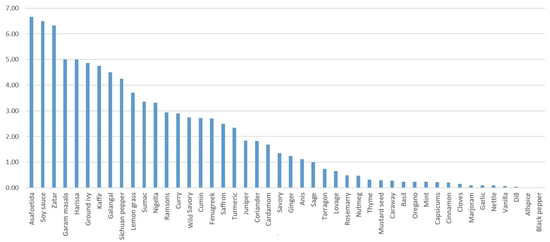
Figure 1.
Spices and spice mixes aligned according to the Index of Change (IC), from the most novel in use to those already used 10 years ago.
One of the striking findings of our study is the extreme popularity of what can be grouped as “curry spices”. Out of the list of spices that respondents report as only recently used (Table 3), the first 11 places in the ranking are members of this category. These are spices native to southern Asia and used in the cuisine of India, Thailand, and Indonesia [9,104]. The majority have been known since the Middle Ages or Renaissance and used, if not widely, then at least in aristocratic cuisine or as remedies (Table 6). They later became fashionable in the period of spicy Baroque cuisine. Here we should mention nutmeg, cinnamon, cloves, and fenugreek. Interestingly, mace, recorded in Old Polish cuisine, is hardly known in Poland now. However, some Asian spices, though listed in old herbals, have become fashionable only recently. Here we should list turmeric, green cardamom, cumin, and, to a lesser extent, lemongrass and kaffir leaves. These spices have never played any role in Polish cuisine and have become trendy only recently, as growing numbers of Poles have access to foreign restaurants and to long-distance traveling. It must be admitted that many of the Asian spices persisted in old recipes and as a part of the food-medicine continuum, and the present fashion for ethnic foods and spices only activated their use (chives, cinnamon, nutmeg). The wave of fashion for curry spices was preceded by the popularization of oregano in post-Socialist Poland in the 1990s when pizza became a common food. However, this process has been properly documented.
The popularity of turmeric and, to a lesser extent, cinnamon, cloves, and Mediterranean aromatic herbs may stem from their medicinal properties. Turmeric is now a frequent hero in health columns of magazines and blogs, and its use in Poland can even be classified as a strong fashion. The appearance of such fads for using “superfoods”, often on a global scale, is the result of easy access to information, concerns about health among the population [105], and the search for easy fixes to deal with dietary issues.
A surprising finding of our study is the fact that many respondents listed some wild plants which have never been a part of mainstream cuisine (Table 1). Ground ivy was frequently used in peasant food in some regions [15], but rarely appeared in cookbooks and only recently became popular in wild food dishes (Table 6). Ramsons were almost never used in Polish cuisine, but are now widely known and included in products sold by supermarkets. The increasing importance of some wild foods corresponds to the general worldwide trend of rediscovering local or foraged ingredients [14,15]. On the other hand, some of the most important traditionally collected wild seasonings in Polish cuisines, such as caraway, horseradish, and juniper [15,29], are rarely mentioned, applied mainly in traditional or festive dishes, and not included in fusion cuisine recipes.
This fascination of the Polish nation with exotic foods and spices can be contrasted with Croatia (also a Slavic country), where it is much more difficult to find ethnic foods and foreign spices in ordinary places (the first author’s personal observations). A recently performed survey of herbal liqueurs made in coastal Croatia found that out of over 100 species of ingredients only one, i.e., coffee is not grown in Croatia or does not occur in the wild in this country [106]. This contrasts with the long-standing fascination with liqueurs (nalewki) in Poland, which are often made using foreign ingredients such as cloves or cinnamon [107,108]. This can partly be explained by the harsher climate in Poland, which gives Poles a narrower choice of plants to cultivate than in Mediterranean Croatia, but also by a certain culinary conservatism in Croatian cuisine and the relatively low number and quantities of spices and herbs used, especially in Dalmatia.
Chironi et al. [33] looked at the contemporary use of spices by residents of Sicily (Italy). Similarly to our study, they found that a large proportion of respondents now use exotic spices. The authors described this phenomenon as “ethnic contamination”, which we think is derogative and judgmental. Similarly to the Polish population, the respondents frequently used cinnamon, cloves, curry mixes, ginger, nutmeg, or turmeric. There was, however, a large difference in the use of some spices. In Italy, saffron, vanilla, and sesame as well as wasabi and poppy seeds were used more frequently. The Italian respondents also mentioned the use of chia, goji berries, and açaí berries as seasoning. These products are already known in Poland but probably not treated as a seasoning, and that is why they were not mentioned. The term “ethnic contamination” used by the authors of the paper from Sicily [33] is an example of an attitude called “gastronationalism”—seeing a nation as bound to a certain static set of recipes, ingredients, and spices [109]. In Poland, two contrasting currents form the new culinary scene. One is the fascination with fusion cuisine, which can be easily observed in Warsaw, with its dozens of vegan, Vietnamese, Thai, Georgian, Lebanese, and Indian restaurants, among others [110]. The increasing use of Asian spices is another expression of this phenomenon, so visible in the results of our study. This current is strongly correlated with the growing number of vegans and vegetarians who are aware of the health benefits and taste values of new spices brought to Polish cuisine [111]. The growth in the use of spices is not only a Polish phenomenon. India is the world’s largest producer of spices, with a 60% share in output and 36% in the global spices trade [112]. Bagal et al. [112] found that between 2000 and 2017 the export of spices from India nearly tripled (on average 24% growth per annum), signifying a large global demand for Indian spices and spices in general. While the exports of black pepper have increased only a little in the past 16 years, the annual exports of chili, turmeric, and cumin have increased over 10, 12, and 30 times, respectively.
Another current is to retrieve old forgotten recipes, often lost during the uniformization of Polish cuisine during Socialism, and to go back to local wild ingredients, such as ramsons, nettle, or ground ivy. Some of these ingredients have been traditionally used (nettle, ground ivy); others, like ramsons, have not [15].
A few years ago, Żwirska et al. [35] studied spices used by residents of southern Poland. The list of most frequently used spices is similar but not identical. For example, the respondents do not mention turmeric, which suggests that, despite its rapidly increasing popularity, turmeric is a novelty in Polish cuisine.
What is the future of the use of spices in Poland? First of all, we predict a further popularization of the use of exotic spices. The data we obtained come mainly from the educated strata of society and those who are particularly interested in cooking. Their experiments and culinary attitudes will be later followed by the remaining part of the population. This was the case with the popularity of pizza and Italian food 20–25 years ago, and now can be observed for Asian food. One may predict that alongside Asian spices which are popular now (such as turmeric and cumin), in the future we will see the increasing popularity of lemon grass, kaffir, galangal, and zatar mix.
There are definitely a few drivers for the increasing use of spices. One is the already mentioned interest in the health properties of spices, another is the search for new flavors and curiosity, and the last one is the feeling that by using exotic spices and rare ingredients the consumers belong to the “upper” half of the society. This is analogous to the perception of species in Poland in the Baroque period [36]. At that time expensive spices were available only to the rich. Now, when spices are cheaper, the culinary gourmets and people aspiring to be posh or unique may turn to use a large number of spices or rare spices. We may call this “ingredientization”, a new term we want to introduce to gastronomic science. We define ingredientization of food as the search and appreciation of rare food ingredients and attempt to include large numbers of ingredients or previously unknown ingredients in the diet. The process of ingredientization can also be expressed by the search for new and often foraged ingredients [14]. The word ingredientization is nearly absent from Google Search and was previously used only in a slightly different context as “ingredientization” of commodities—previously untapped waste materials used for their potential functional and health benefits [113]. The fascination with long lists of ingredients is very characteristic of East Asian cuisines. Asian markets, e.g., in China and Laos, are rich in species of vegetables, fungi, and meat animals [114,115,116]. This search for a long list of culinary ingredients is now also sprouting in Europe.
4. Materials and Methods
An online questionnaire was used. It was constructed as a Google Form in Polish on 14.12.2021 (see additional file in Supplementary Materials) and originally advertised on the first author’s Facebook (Meta) profile, which is followed by around 12 thousand people. It was further shared by 28 other Facebook accounts and a few forums devoted to plants and cooking.
Altogether, 916 questionnaires were filled out from all regions of Poland. The population sample was biased toward more literate, well-educated people interested in plants, herbalism, or cooking. Most respondents were females (74%). Both the median and mean age of respondents was 43, ranging from 18 to 85. All 16 regions of Poland were represented, with the largest number from the following voivodeships: Mazowieckie—22%, Podkarpackie—12%, and Małopolskie—11%. As many as 79% of respondents had a university degree. Exactly 50% of respondents lived in large cities with over 100,000 inhabitants. Sixty-eight percent of respondents stated that they had an average income (68%). Most of them have never lived abroad (83%) and cook food every day (71%).
The spices were easy to identify in nearly all cases, as they have one or two commonly used trade or scientific names. The only problems were with clearly distinguishing various capsicum types, and with distinguishing Illicium and Pimpinella in the case of anise. That is why both capsicum and anise were treated as one category.
The Chi-squared Test [117] was used (Table 5) to test if the frequency of mention of spices in the questions about newly used or abandoned spices is statistically different from the frequency of spices used at least once a year (last column in Table 1).
Spearman rank correlation coefficient [117] was used to measure the correlation between the main sociological data (age, town size, gender, income, educational level, number of foreign journeys per year) of the informants and the number of spices they use at least once a week, and at least once a year.
An Index of Change (IC), introduced by the authors, ranging from 0 to infinity was applied to illustrate the novelty of a particular spice use:
where: N—number of times the spice was mentioned as used only for 10 or fewer years, C—number of times the spice was mentioned as used at least once a year. The index is close to zero for spices that are commonly used since the respondents’ youth, and close to, or even exceeding, 1 for spices in use since less than 10 years ago.
IC = (N + 1)/(C + 1)
5. Conclusions
Contemporary Poles tend to use growing numbers of spice and herb species in their food. The list of frequently used kinds is a mix of three categories: spices traditionally used since at least the Renaissance or the Baroque period, new (mainly Asian) spices which have recently become fashionable, and spices that were rarely used during Socialist times or were abandoned in the 19th and 20th c. but were present in the culinary culture of the Baroque social elites. The increasing popularity of Indian, Thai, and Middle-Eastern spices should be noted, together with the surge in the use of wild ingredients foraged from the surrounding environment, such as wild garlic or ground ivy.
Supplementary Materials
The following supporting information can be downloaded at: https://www.mdpi.com/article/10.3390/plants12030591/s1.
Author Contributions
Conceptualization, Ł.Ł. and C.M.; Methodology, Ł.Ł. and C.M.; Writing, Ł.Ł., J.D. and F.P.; Elaboration of historical material, J.D.; Statistical elaboration, Ł.Ł. All authors have read and agreed to the published version of the manuscript.
Funding
This research received no external funding.
Data Availability Statement
The original data matrix with the answers was deposited in the Repository of Rzeszów University [118].
Acknowledgments
Many thanks to Nasim Łuczaj (www.nasimluczaj.com) for linguistic corrections and proofreading.
Conflicts of Interest
The authors declare no conflict of interest.
References
- Davidson, A. The Oxford Companion to Food; Oxford University Press: Oxford, UK, 1999. [Google Scholar]
- Nabhan, G.P. Cumin, Camels, and Caravans: A Spice Odyssey; University of California Press: Berkeley, CA, USA, 2014; Volume 45. [Google Scholar]
- Viuda-Martos, M.; Ruiz-Navajas, Y.; Fernández-López, J.; Pérez-Álvarez, J. Spices as functional foods. Crit. Rev. Food Sci. Nutr. 2010, 51, 13–28. [Google Scholar] [CrossRef]
- Kapadiya, D.B.; Dabhi, B.K.; Aparnathi, K.D. Spices and herbs as a source of natural antioxidants for food. Int. J. Curr. Microbiol. Appl. Sci. 2016, 5, 280–288. [Google Scholar] [CrossRef]
- Pieroni, A.; Price, L. Eating and Healing: Traditional Food as Medicine; CRC Press: Boca Raton, FL, USA, 2006. [Google Scholar]
- Rozin, E. The structure of cuisine. In The Psychobiology of Human Food Selection; Barker, L.M., Ed.; AVI: Westport, CT, USA, 1982; pp. 189–203. [Google Scholar]
- Johns, T. With Bitter Herbs They Shall Eat It: Chemical Ecology and the Origins of Human Diet and Medicine; University of Arizona Press: Tucson, AZ, USA, 1990. [Google Scholar]
- Van der Veen, M.; Morales, J. The Roman and Islamic spice trade: New archaeological evidence. J. Ethnopharmacol. 2015, 167, 54–63. [Google Scholar] [CrossRef] [PubMed]
- Sharangi, A.B.; Acharya, S.K. Spices in India and Beyond: The Origin, History, Tradition and Culture. In Indian Spices; Sharangi, A., Ed.; Springer: New York, NY, USA, 2018. [Google Scholar]
- Montanari, M. A Cultural History of Food in the Medieval Age; Berg: Oxford, UK, 2012. [Google Scholar]
- Albala, K. A Cultural History of Food in the Renaissance; Berg: Oxford, UK, 2012. [Google Scholar]
- Kumin, B. A Cultural History of Food in the Early Modern Age; Berg: Oxford, UK, 2012. [Google Scholar]
- Dumanowski, J. Tatarskie Ziele w Cukrze czyli Staropolskie Słodycze; Muzeum Pałacu Króla Jana III w Wilanowie: Warszawa, Poland, 2010. [Google Scholar]
- Łuczaj, Ł.; Pieroni, A.; Tardío, J.; Pardo-de-Santayana, M.; Sõukand, R.; Svanberg, I.; Kalle, R. Wild food plant use in 21 st century Europe, the disappearance of old traditions and the search for new cuisines involving wild edibles. Acta Soc. Bot. Pol. 2012, 81, 359–370. [Google Scholar] [CrossRef]
- Łuczaj, Ł. Foraging in Eastern Europe: Wild Edible Plants Used in Polish Traditional Cuisine; Self-Published: Pietrusza Wola, Poland, 2021. [Google Scholar]
- Geller, E. Przewodnik po Drzewie Żywota Edycja Żydowskiego Poradnika Dietetycznego z XVII w; Series Monumenta Poloniae Culinaria 5; Muzeum Pałacu Króla Jana III w Wilanowie: Warszawa, Poland, 2015. [Google Scholar]
- Freedman, P. The Medieval Taste for Spices. In The Oxford Handbook of Food History; Oxford University Press: Oxford, UK, 2008; Volume 9, pp. 2–5. [Google Scholar]
- Küster, H. Spices and Flavorings. In The Cambridge World History of Food; Kiple, K.F., Ornelas, K.C., Eds.; Cambridge University Press: Cambridge, UK, 2000; Volume 1. [Google Scholar]
- Freedman, P. Out of the East. Spices and Medieval Imagination; Yale University Press: New Haven, CT, USA, 2008. [Google Scholar]
- Dumanowski, J. Przepisy Paula Tremo; Series Monumenta Poloniae Culinaria 9; Muzeum Pałacu Króla Jana III w Wilanowie: Warszawa, Poland, 2022. [Google Scholar]
- Newerli-Guz, J. Analiza rynku przypraw w Polsce. Mark. Manag. 2017, 48, 167–175. [Google Scholar]
- PN-A-86967; Przyprawy Ziołowe. Mieszanki Przyprawowe. Polski Komitet Normalizacyjny: Warszawa, Poland, 1998.
- PN-A-87022; Przyprawy Ziołowe. Nazewnictwo Botaniczne. Polski Komitet Normalizacyjny: Warszawa, Poland, 1994.
- PN-A-94000; Koncentraty Spożywcze. Klasyfikacja, Nazwy i Określenia. Polski Komitet Normalizacyjny: Warszawa, Poland, 1986.
- Rozporządzeniem Rady Ministrów. Polska Klasyfikacja Wyrobów i Usług (PKWiU 2015); Rozporządzeniem Rady Ministrów: Warszawa, Poland, 2015; p. 1676. [Google Scholar]
- Definition of Culinary Herbs and Spices; European Spice Association. Available online: http://www.esa-spices.org/index-esa.html/publications-esa/esa-defintions-for-culinary-Herbs-and-spices.pdf (accessed on 22 December 2022).
- U.S. Food and Drug Administration. Available online: https://www.fda.gov/ (accessed on 17 December 2022).
- Codex Alimentarius International Food Standards. Available online: http://www.fao.org/fao-who-codexalimentarius/committees/cac/about/en/ (accessed on 17 December 2022).
- Łuczaj, Ł.J. Traditional wild spice plants of Poland and Slovakia. Acta Fytotech. Zootech. 2011, 14, 40–41. [Google Scholar]
- Motti, R. Wild plants used as herbs and spices in Italy: An ethnobotanical review. Plants 2021, 10, 563. [Google Scholar] [CrossRef]
- Khanal, A.; Devkota, H.P.; Kaundinnyayana, S.; Gyawali, P.; Ananda, R.; Adhikari, R. Culinary herbs and spices in Nepal: A review of their traditional uses, chemical constituents, and pharmacological activities. Ethnobot. Res. Appl. 2021, 21, 1–18. [Google Scholar] [CrossRef]
- Wu, M.; Guo, P.; Tsui, S.W.; Chen, H.; Zhao, Z. An ethnobotanical survey of medicinal spices used in Chinese hotpot. Food Res. Int. 2012, 48, 226–232. [Google Scholar] [CrossRef]
- Chironi, S.; Bacarella, S.; Altamore, L.; Columba, P.; Ingrassia, M. Consumption of spices and ethnic contamination in the daily diet of Italians-consumers’ preferences and modification of eating habits. J. Ethn. Foods 2021, 8, 6. [Google Scholar] [CrossRef]
- Asowata-Ayodele, A.M.; Afolayan, A.J.; Otunola, G.A. Ethnobotanical survey of culinary herbs and spices used in the traditional medicinal system of Nkonkobe Municipality, Eastern Cape, South Africa. S. Afr. J. Bot. 2016, 104, 69–75. [Google Scholar] [CrossRef]
- Żwirska, J.; Żyła, K.; Błaszczyk, E.; Jagielski, I.P.; Schlegel-Zawadzka, M. Źródła wiedzy i zastosowanie przypraw ziołowych przez osoby dorosłe zamieszkujące okręg małopolski i śląski. Bromatol. Chem. Toksykol. 2015, 48, 594–598. [Google Scholar]
- Dumanowski, J.; Kasprzyk-Chevriaux, M. Kapłony i Szczeżuje: Opowieść o Zapomnianej Kuchni Polskiej; Czarne: Wołowiec, Poland, 2019. [Google Scholar]
- Czerniecki, S. Compendium Ferculorum Albo Zebranie Potraw; Series Monumenta Poloniae Culinaria 1 (Revised Version); Dumanowski, J., Ed.; Muzeum Pałacu Króla Jana III w Wilanowie: Warszawa, Poland, 2022. [Google Scholar]
- Wielądko, W.W. Kucharz Doskonały Pożyteczny dla Zatrudniających Się Gospodarstwem; Series Monumenta Poloniae Culinaria 3; Dumanowski, J., Kleśta-Nawrocka, A., Eds.; Muzeum Pałacu Króla Jana III w Wilanowie: Warszawa, Poland, 2012. [Google Scholar]
- Sikorska, M. Moda Bardzo Dobra Smażenia Różnych Konfektów i Innych Słodkości, a Także Przyrządzania Wszelakich Potraw, Pieczenia Chleba i Inne Sekreta Gospodarskie i Kuchenne; Series Monumenta Poloniae Culinaria 2; Dumanowski, J., Jankowski, R., Eds.; Muzeum Pałacu Króla Jana III w Wilanowie: Warszawa, Poland, 2011. [Google Scholar]
- Dumanowski, J.; Bułatowa, S. Zbiór dla Kuchmistrza Tak Potraw Jako Ciast Robienia Wypisany Roku 1757 dnia 24 Lipca; Series Monumenta Poloniae Culinaria 8; Muzeum Pałacu Króla Jana III w Wilanowie: Warszawa, Poland, 2021. [Google Scholar]
- Dumanowski, J.; Dias-Lewandowska, D.; Sikorska, M. Staropolskie Przepisy Kulinarne. Receptury Rozproszone z XVI-XVIII w. Źródła Drukowane; Series Monumenta Poloniae Culinaria Warszawa 6; Muzeum Pałacu Króla Jana III w Wilanowie: Warszawa, Poland, 2016. [Google Scholar]
- Dumanowski, J.; Dias-Lewandowska, D.; Sikorska, M. Staropolskie Przepisy Kulinarne. Receptury Rozproszone z XVI-XVIII w. Źródła Rękopiśmienne; Series Monumenta Poloniae Culinaria 7; Muzeum Pałacu Króla Jana III w Wilanowie: Warszawa, Poland, 2017. [Google Scholar]
- Rostafiński, J. Symbola ad Historiam Naturalem Medii Aevi; Akademia Umiejętności: Kraków, Poland, 1900. [Google Scholar]
- Marcin z Urzędowa. Herbarz Polski, to Jest o Przyrodzeniu Ziół i Drzew Rozmaitych; Drukarnia Łazarzowa: Kraków, Poland, 1595. [Google Scholar]
- Spiczyński, H. O Ziołach Tutecznych i Zamorskich i Mocy Ich; Florian Ungler: Kraków, Poland, 1542. [Google Scholar]
- Falimirz, S. O Ziołach i o Mocy Ich; Florian Ungler: Kraków, Poland, 1534. [Google Scholar]
- Siennik, M. Herbarz to Jest Ziół Tutecznych, Postronnych i Zamorskich Opisanie; Mikołaj Szarfenberger: Kraków, Poland, 1568. [Google Scholar]
- Crescentyn, P. O Pomnożeniu y Rozkrzewieniu Wszelakich Pożytkow Ksiąg Dwoienaście: Ludziom Stanu Każdego […] Potrzebne a Pożytecżne…; Stanisław Scharffenberg: Kraków, Poland, 1571. [Google Scholar]
- Umiastowski, P. Nauka o Morowym Powietrzu na Czwory Xięgi Rozlozona; W Drukarniey Andrzeia Piotrowczyka: Kraków, Poland, 1591. [Google Scholar]
- Haur, J.K. Oekonomika Ziemiańska Generalna… Obiaśniona przez Jakuba Kazimierza Haura… Pożyteczna y Potrzebna… z Nowym Przydatkiem GEOMETRYI GOSPODARSKIEY Napisaney…; W Drukarni Schedla: Kraków, Poland, 1679. [Google Scholar]
- Syrenius, S. Zielnik; Bazyli Skalski: Kraków, Poland, 1613. [Google Scholar]
- Böhm, A. B6, Codicology. In CoReMA—Cooking Recipes of the Middle Ages. Corpus-Analysis-Visualisation; Klug, H.W., Ed.; 2021; Available online: http://hdl.handle.net/11471/562.10.9 (accessed on 22 December 2022).
- Piekosiński, F. Rachunki Dworu Króla Władysława Jagiełły i Królowej JADWIGI z Lat 1388 do 1420; Akademia Umiejętności: Kraków, Poland, 1896. [Google Scholar]
- Dumanowski, J. Manna, Giersz, wyzina. Zróżnicowanie biologiczne w staropolskich tekstach kulinarnych. In Proceedings of the International Trade Fair of Environmental Protection (POLECO 2022), Poznań, Poland, 19–21 October 2022; Gwiazdowicz, D.J., Ed.; Natura i Kultura: Wiązowna, Poland, 2022; Volume 1, pp. 105–120. [Google Scholar]
- Badura, M. Pimenta officinalis Lindl.(pimento, myrtle pepper) from early modern latrines in Gdańsk (northern Poland). Veg. Hist. Archaeobot. 2003, 12, 249–252. [Google Scholar] [CrossRef]
- Badura, M.; Możejko, B.; Święta-Musznicka, J.; Latałowa, M. The comparison of archaeobotanical data and the oldest documentary records (14th–15th century) of useful plants in medieval Gdańsk, northern Poland. Veg. Hist. Archaeobot. 2015, 24, 441–454. [Google Scholar] [CrossRef]
- Mueller-Bieniek, A. Rośliny w Życiu Codziennym Mieszkańców Średniowiecznego Krakowa; Instytut Botaniki im. W. Szafera PAN: Kraków, Poland, 2012. [Google Scholar]
- Kluk, K. Dykcyonarz Roślinny; Drukarnia Pijarów: Warszawa, Poland, 1787. [Google Scholar]
- Leśniewska, B. Kucharz Polski Jaki być Powinien. Książka Podręczna dla Ekonomiczno-Troskliwych Gospodyń; S.H. Merzbach: Warszawa, Poland, 1856. [Google Scholar]
- Nakwaska, K. Dwór Wiejski: Dzieło Poświęcone Gospodyniom Polskim, Przydatne i Osobom w Mieście Mieszkającym Przerobione z fr. Pani Aglaë Adanson Wielu Dod. i Zupełnem Zastosowaniem do Naszych Obyczajów i Potrzeb. T. 2; Księgarnia Nowa J. Łukaszewicza: Poznań, Poland, 1843. [Google Scholar]
- Tukałło, M. Apteczka Domowa, Zawierająca Zbiór Lekarstw po Wielkiej Części Prostych, Których Materiały Łacno Się w Domu Znajdować Mogą […] dla Wygody i Poratowania Zdrowia […] przez Jednego z Księży Scholarum Piarum Prowincji Litewskiej; W drukarni J.K.M. y Rzeczypospolitey u XX. Piarów: Wilno, Lithuania, 1793. [Google Scholar]
- Szyttler, J. Kucharz Dobrze Usposobiony; W Drukarni Dyocesalnej XX. Misionarzy: Wilno, Lithuania, 1830. [Google Scholar]
- Szyttler, J.; Zuchowski, S. Kucharz Doskonały przez J.S. Jednego z Sławnieyszych Kuchmistrzów Europeyskich Wspólnie z S.Z. Ułożony; W Drukarni Biskupiey ob. gr. kat.: Przemyśl, Poland, 1834. [Google Scholar]
- Szyttler, J. Kucharka Oszczędna, Czyli Przepisy dla Gospodyń Wiejskich Łatwego i Niekosztownego Sporządzania Potraw, Opatrzenia Spiżarni w Potrzebne Zapasy oraz Dystyllowania Wódek; W Drukarni Dyocesalnej XX. Misionarzy: Wilno, Lithuania, 1835. [Google Scholar]
- Szyttler, J. Kuchmistrz Nowy Czyli Kuchnia Udzielna dla Osób Osłabionych, w Wieku Podeszłym Tudzież do Zdrowia Powracających. W Proporcji na Jedną Osobę Przez Jana Szyttlera; Drukarnia Dyecezalna: Wilno, Lithuania, 1837. [Google Scholar]
- Szyttler, J. Wyśmienity Niekosztowny Kuchmistrz za Którego Poradą Łatwo Sporządzać Można Najsmakowitsze i Najzdrowsze Razem Potrawy Przez Jana Szyttlerai; Autora Wielu Dzieł w Przedmiotach Sztuki Kucharskiej i Myśliwskiej itd; Druk. Dyecezalney u XX. Missyonarzów: Wilno, Lithuania, 1839. [Google Scholar]
- Szyttler, J. Poradnik dla Myśliwych; Nakładem Rubena Rafałowicza: Wilno, Lithuania, 1839. [Google Scholar]
- Szyttler, J. Spiżarnia Dostatecznie i Przezornie Urządzona dla Dogodnego Użytku Mieyskich i Wieyskich Skrzętnych Gospodyń; Ruben Rafałowicz: Wilno, Lithuania, 1841. [Google Scholar]
- Szyttler, J. Poradnik dla Gospodyń, Czyli Nauka o Ptactwie Domowem i Oswojonem; Drukarni M. Zymelowicza Typografa: Wilno, Lithuania, 1844. [Google Scholar]
- Szyttler, J. Kuchnia Myśliwska; Drukarnia A. Marcinkowskiego: Wilno, Lithuania, 1845. [Google Scholar]
- Szyttler, J. Skrzętna Gospodyni, Czyli Tom Drugi Kucharki Oszczędnej; Rafałowicz Ruben: Wilno, Lithuania, 1846. [Google Scholar]
- Szyttler, J. Kuchnia Postna Podająca Najoszczędniejsze Sposoby Sporządzania Potraw Rybnych Oraz Zup, Chłodników, Pieczystego, Marynat, Jarzyn, Melszpeizów, Ciast itp.; Ruben Rafałowicz: Wilno, Lithuania, 1847. [Google Scholar]
- Schmidt, J. Kuchnia Polska; Nakładem Braci Jeleniów: Przemyśl, Poland, 1856. [Google Scholar]
- Szczepański, J.J. Książka Kucharska Powszechna do Użytku w Każdem Gospodarstwie; P. Piller: Lwów, Ukraine, 1827. [Google Scholar]
- Gruszecka, M. Ilustrowany Kucharz Krakowski dla Oszczędnych Gospodyń; Księgarnia J. M. Himmelblaua: Kraków, Poland, 1892. [Google Scholar]
- Ćwierczakiewiczowa, L. 365 Obiadów za Pięć Złotych; Nakładem Autorki: Warszawa, Poland, 1860. [Google Scholar]
- Anonymous. Kuchnia Polska; Ernst Lambeck: Toruń, Poland, 1885. [Google Scholar]
- Ciundziewicka, A. Gospodyni Litewska; J. Zawadzki: Wilno, Lithuania, 1856. [Google Scholar]
- Scheibler, S.W. Doświadczona Gospodyni i Kucharka Doskonała dla Wszystkich Stanów; Wilhelm Bogumił Korn: Wrocław, Poland, 1835. [Google Scholar]
- Duńczewski, S. Kalendarz Polski y Ruski na Rok Panski 1752; Drukárnia Zamoyska: Zamość, Poland, 1751. [Google Scholar]
- Anonymous. Krótka nauka rządzenia ku ustrzeżeniu od zarażenia powietrza. In Dobrego Zdrowia Rządzenie 1532 i Nauka Rządzenia ku Ustrzeżeniu od Zarażenia Powietrza 1543; Wierzbowski, T., Ed.; Kowalewski K.: Warszawa, Poland, 1899. [Google Scholar]
- Rej, M. Źwierciadło albo Kstałt, w Którym Każdy Stan Snadnie Się Może Swym Sprawam Jako we Źwierciadle Przypatrzyć; Maciej Wirzbięta: Kraków, Poland, 1568. [Google Scholar]
- Wieczorkiewicz, A. Promptuarium Medicum Empiricum; Drukarni Franciszka Cezarego: Kraków, Poland, 1716. [Google Scholar]
- Kuberski, F. Kalendarz Polski, Ruski i Astronomiczno-Gospodarski na Rok Pański 1822, Ktory Jest Rokiem Zwyczaynym Maiącym Dni 365. Zawieraiący w Sobie Dni Galowe w Cesarstwie Rossyiskiém, Święta Żydowskie, Przychód i Odchód Poczt, Iarmarki i Wiele Użytecznych Zwłaszcza Gospodarskich i Zabawnych Wiadomości; Drukarnia Jana Karola Pruskiego: Lublin, Poland, 1821. [Google Scholar]
- McGovern, P.E.; Hall, G.R.; Mirzoian, A. A biomolecular archaeological approach to ‘Nordic grog’. Dan. J. Archaeol. 2013, 2, 112–131. [Google Scholar] [CrossRef]
- Madej, T.; Pirożnikow, E.; Dumanowski, J.; Łuczaj, Ł. Juniper beer in Poland: The story of the revival of a traditional beverage. J. Ethnobiol. 2014, 34, 84–103. [Google Scholar] [CrossRef]
- Lis, H.; Lis, P. Kuchnia Słowian: Czyli o Poszukiwaniu Dawnych Smaków; Warszawa, Poland; Wydawnictwo Nasza Księgarnia: Warszawa, Poland, 2018. [Google Scholar]
- Moszyński, K. O Sposobach Badania Kultury Materialnej Prasłowian; Zakład Narodowy im. Ossolińskich: Wrocław, Poland, 1962. [Google Scholar]
- Matras, A. “Pieprzno i szafranno, moja mościa panno”: Staropolskie książki kucharskie i obrazy staropolskiego ucztowania. Zesz. Nauk. Tow. Dr. Uniw. Jagiellońskiego. Nauk. Społeczne 2016, 14, 55–68. [Google Scholar]
- Staszczak-Ciałowicz, M. Magnetyzm monarszego stołu: Kulinarny hedonizm szlachty. In Monarchia: Alternatywa, Mit, Anachronizm; Kantor, R., Hołda, R., Eds.; Wydawnictwo Uniwersytetu Jagiellońskiego: Kraków, Poland, 2016; p. 334. [Google Scholar]
- Procner, A. Namiastki przypraw. In Technologia Gastronomiczna z Towaroznawstwem. Część 1, 14th ed.; Procner, A., Ed.; Wydawnictwa Szkolne i Pedagogiczne: Warszawa, Poland, 2007; pp. 52–53. [Google Scholar]
- Myślisz, że to Pieprz? Bardzo Się Mylisz. Fakt.pl, Ringier Axel Springer Polska, 29 sty 2019. Available online: https://kuchnia.fakt.pl/myslisz-ze-to-pieprz-bardzo-sie-mylisz/xm5ep11 (accessed on 21 December 2022).
- Halawa, M.; Parasecoli, F. Designing the future of Polish food: How cosmopolitan tastemakers prototype a national gastronomy. Gastron. J. Food Cult. 2022, 22, 8–18. [Google Scholar] [CrossRef]
- Bachórz, A.; Parasecoli, F. Savoring Polishness: History and Tradition in Contemporary Polish Food Media. East Eur. Politics Soc. 2021, 37, 103–124. [Google Scholar] [CrossRef]
- Davies, N. Heart of Europe: The Past in Poland’s Present; Oxford University Press: Oxford, UK, 2001. [Google Scholar]
- Sade-Beck, L. Internet Ethnography: Online and Offline. Int. J. Qual. Methods 2008, 3, 45–51. [Google Scholar] [CrossRef]
- Varis, P. Digital ethnography. In The Routledge Handbook of Language and Digital Communication; Routledge: London, UK, 2015; pp. 55–68. [Google Scholar]
- Kaufmann, M.; Tzanetakis, M. Doing Internet research with hard-to-reach communities: Methodological reflections on gaining meaningful access. Qual. Res. 2020, 20, 927–944. [Google Scholar] [CrossRef] [PubMed]
- Łuczaj, Ł. Brzozowy sok, “czeremsza” i zielony barszcz—Ankieta etnobotaniczna wśród botaników ukraińskich. Birch sap, ramsons and green borsch—An ethnobotanical survey among Ukrainian botanists. Etnobiol. Pol. 2012, 2, 15–22. [Google Scholar]
- Łuczaj, Ł.J.; Kujawska, M. Botanists and their childhood memories: An underutilized expert source in ethnobotanical research. Bot. J. Linn. Soc. 2012, 168, 334–343. [Google Scholar] [CrossRef]
- Sõukand, R.; Kalle, R. Where does the border lie: Locally grown plants used for making tea for recreation and/or healing, 1970s–1990s Estonia. J. Ethnopharmacol. 2013, 150, 162–174. [Google Scholar] [CrossRef] [PubMed]
- Sõukand, R. What are the main criteria of science? Unconventional methods in ethnopharmacology. J. Ethnopharmacol. 2014, 154, 475–478. [Google Scholar] [CrossRef]
- Leonti, M. Herbal teas and the continuum of the food-medicine complex: Field methods, contextualisation and cultural consensus. J. Ethnopharmacol. 2014, 151, 1028–1030. [Google Scholar] [CrossRef]
- Chauvet, M. Encyclopédie des Plantes Alimentaires; Belin: Paris, France, 2018. [Google Scholar]
- Cargill, K. Food Cults: How Fads, Dogma, and Doctrine Influence Diet; Rowman & Littlefield Publishers: Lanham, MD, USA, 2016. [Google Scholar]
- Łuczaj, Ł.; Jug-Dujaković, M.; Dolina, K.; Vitasović-Kosić, I. Plants in alcoholic beverages on the Croatian islands, with special reference to rakija travarica. J. Ethnobiol. Ethnomed. 2019, 15, 51. [Google Scholar] [CrossRef]
- Piątkowski, A. Gorzelnik i Piwowar Doskonały; Drukarnia Gröblowskiéy: Kraków, Poland, 1809. [Google Scholar]
- Szymanderska, H. Krupniki Likiery Nalewki; Prószyński i S-ka: Warszawa, Poland, 2004. [Google Scholar]
- Parasecoli, F. Gastronativism: Food, Identity, Politics; Columbia University Press: New York, NY, USA, 2022. [Google Scholar]
- Tilles, D. Warsaw Ranked Sixth Most Vegan-Friendly City in the World. Notes from Poland. Available online: https://notesfrompoland.com/2019/12/05/warsaw-named-sixth-most-vegan-friendly-city-in-the-world/ (accessed on 28 December 2022).
- Orszulak-Dudkowska, K. Dieta roślinna i zaangażowanie społeczne w praktykach dyskursywnych społeczności internetowych. Zesz. Wiej. 2020, 26, 307–325. [Google Scholar] [CrossRef]
- Bagal, N.U.; Kshirsagar, P.J.; Torane, S.R.; Manerikar, S.S. Export of spices from India: An instability analysis. Int. Res. J. Agric. Econ. Stat. 2020, 11, 55–63. [Google Scholar] [CrossRef]
- Purity, Authenticity, Sustainability among Top Food Trends for 2012. FOODStuff SA. Post from 24 November 2011. Available online: https://www.foodstuffsa.co.za/purity-authenticity-sustainability-among-top-food-trends-for-2012-1/ (accessed on 14 January 2023).
- Anderson, E.N. The Food of China; Yale University Press: New Haven, CT, USA, 1988. [Google Scholar]
- Hu, S.Y. Food Plants of China; Chinese University Press: Hong Kong, 2005. [Google Scholar]
- Łuczaj, Ł.; Lamxay, V.; Tongchan, K.; Xayphakatsa, K.; Phimmakong, K.; Radavanh, S.; Kanyasone, V.; Pietras, M.; Karbarz, M. Wild food plants and fungi sold in the markets of Luang Prabang, Lao PDR. J. Ethnobiol. Ethnomed. 2021, 17, 6. [Google Scholar] [CrossRef]
- Mohr, D.L.; Wilson, W.J.; Freund, R.J. Statistical Methods; Academic Press: London, UK, 2021. [Google Scholar]
- Łuczaj, Ł.; Marszałek, C. Użytkowanie Przypraw w Polsce/The Use of Spices in Poland. Repozytorium Uniwersytetu Rzeszowskiego. Uniwersytet Rzeszowski, Rzeszów. Available online: https://repozytorium.ur.edu.pl/items/b042b6e1-91b0-48d9-b5b6-dfa52db894a3/full (accessed on 1 January 2023).
Disclaimer/Publisher’s Note: The statements, opinions and data contained in all publications are solely those of the individual author(s) and contributor(s) and not of MDPI and/or the editor(s). MDPI and/or the editor(s) disclaim responsibility for any injury to people or property resulting from any ideas, methods, instructions or products referred to in the content. |
© 2023 by the authors. Licensee MDPI, Basel, Switzerland. This article is an open access article distributed under the terms and conditions of the Creative Commons Attribution (CC BY) license (https://creativecommons.org/licenses/by/4.0/).