


The global population is projected to increase to near 10 billion people by the year 2050 [1,2]; therefore, food demand will increase. Different projections show that feeding that world population would require raising overall food production by 25 to 70 percent between now and 2050 [2,3]—some authors go as far as 100% [4]. In order to produce that amount of food and other non-food agricultural goods, intensified and extended agricultural production is needed. These practices have led to many environmental problems, such as the degradation of natural resources, such as soil and water, the loss of microbiome diversity, the proliferation of new phytopathogens, pests, and weeds, and lower agro-ecosystem fertility, and is contributing to climate change [4,5,6]. Increasing agricultural production in ways that do not compromise environmental integrity and/or human health continues to be a big challenge to date.
The sustainable intensification of agricultural production is needed to meet food demand while maintaining functioning and healthy ecosystems. Currently, biotechnological tools are being used to complement conventional crop management; among them, the use of bio-products containing beneficial microorganisms, also known as microbial inoculants or bioinoculants, is gaining importance in this matter [7]. Fortune Business Insights has published a report stating that the global market size for agricultural bioinoculants was USD 4.27 billion in 2019 and is projected to reach 11.81 billion by 2027, with an annual growth rate of 14.27% [8]. Bioinoculants are eco-friendly and sustainable bio-products containing beneficial microorganisms that, when applied to seeds, plant surfaces, or soil, have the capability of promoting plant growth by increasing the supply or availability of nutrients to the host plant or by protecting them from biotic and/or abiotic stresses [7,9,10]. Beneficial microorganisms used in bioinoculants can be grouped as plant-growth-promoting microorganisms (PGPMs) or biological control agents (BCAs) [9,11,12]. According to their mechanisms of action, they can also be cataloged as nitrogen fixers, phosphate solubilizers, phytostimulators, inducers of plant resistance, and antagonists of phytopathogens, among other groups (Figure 1) [11,13].
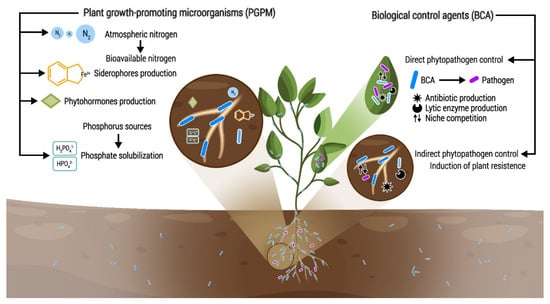
Figure 1.
Examples of action mechanisms by beneficial microorganisms in interactions with plants.
The integration of beneficial microorganism–plant interactions into crop production programs represents a promising sustainable solution to improve agricultural production. However, the success of bioinoculants applied in the field is highly determined by the scientific research and agro-biotechnological innovations behind them. Therefore, the study of and research focused on understanding the complex interactions between beneficial microorganisms, plants, and their environment, as well as the bioprospecting needed to massively exploit these interactions, are crucial to moving knowledge from labs to fields as commercial effective products.
As its Guest Editors, we are confident that this Special Issue will collect and inspire high-impact research activities, offering new insights into wide-ranging topics and approaches to the role of often-unexploited microbiota in agriculture for providing sustainable alternatives to warrant global food security.
Author Contributions
Conceptualization, S.d.l.S.-V., F.I.P.-C. and A.C.M.-M.; writing—original draft preparation, A.C.M.-M., F.I.P.-C. and S.d.l.S.-V.; review and editing, S.d.l.S.-V. and F.I.P.-C. All authors have read and agreed to the published version of the manuscript.
Funding
This research received no external funding.
Acknowledgments
A.C.M.-M. acknowledges Consejo Nacional de Ciencia y Tecnología (CONACYT) for funding their postdoctoral stay (application number 866971).
Conflicts of Interest
The authors declare no conflict of interest.
References
- FAO. How to feed the World in 2050. In Proceedings of the Expert Meeting on How to Feed the World in 2050, Rome, Italy, 12–13 October 2009. [Google Scholar]
- FAO. The Future of Food and Agriculture—Alternative Pathways to 2050. Summary Version; FAO: Rome, Italy, 2018; p. 60. ISBN 9789251309896. [Google Scholar]
- Hunter, M.C.; Smith, R.G.; Schipanski, M.E.; Atwood, L.W.; Mortensen, D.A. Agriculture in 2050: Recalibrating targets for sustainable intensification. Bioscience 2017, 67, 386–391. [Google Scholar] [CrossRef] [Green Version]
- Tilman, D.; Balzer, C.; Hill, J.; Befort, B.L. Global food demand and the sustainable intensification of agriculture. Proc. Natl. Acad. Sci. USA 2011, 108, 20260–20264. [Google Scholar] [CrossRef] [PubMed] [Green Version]
- Ibarra-Villarreal, A.L.; Parra-Cota, F.I.; Yepez, E.A.; Gutiérrez-Coronado, M.A.; Valdez-Torres, L.C.; de los Santos-Villalobos, S. Impact of a shift from conventional to organic wheat farming on soil cultivable fungal communities in the Yaqui Valley, Mexico. Agrociencia 2020, 54, 643–659. [Google Scholar] [CrossRef]
- Chaparro-Encinas, L.A.; Santoyo, G.; Peña-Cabriales, J.J.; Castro-Espinoza, L.; Parra-Cota, F.I.; de los Santos-Villalobos, S. Transcriptional regulation of metabolic and cellular processes in durum wheat (Triticum turgidum subsp. durum) in the face of temperature increasing. Plants 2021, 10, 2792. [Google Scholar] [CrossRef] [PubMed]
- Santoyo, G.; Guzmán-Guzmán, P.; Parra-Cota, F.I.; de los Santos-Villalobos, S.; Orozco-Mosqueda, M.d.C.; Glick, B.R. Plant Growth Stimulation by Microbial Consortia. Agronomy 2021, 11, 219. [Google Scholar] [CrossRef]
- Fortune Business Insights, Agricultural Microbials Market Size, Share & COVID-19 Impact Analysis, by Type (Bacteria, Fungi, Virus, and Others), Formulation (Dry and Liquid), Function (Soil Amendment and Crop Protection), Application Method (Foliar Spray, Soil Treatment, Seed Treatment, and Others), Crop (Cereals, Oilseeds & Pulses, Fruits & Vegetables, and Others), and Regional Forecast, 2020–2027. Available online: https://www.fortunebusinessinsights.com/industry-reports/agricultural-microbial-market-100412 (accessed on 19 January 2022).
- Lugtenberg, B.; Kamilova, F. Plant-growth-promoting rhizobacteria. Annu. Rev. Microbiol. 2009, 63, 541–556. [Google Scholar] [CrossRef] [PubMed] [Green Version]
- de los Santos-Villalobos, S.; Díaz-Rodríguez, A.M.; Ávila-Mascareño, M.F.; Martínez-Vidales, A.D.; Parra-Cota, F.I. COLMENA: A Culture Collection of Native Microorganisms for Harnessing the Agro-Biotechnological Potential in Soils and Contributing to Food Security. Diversity 2021, 13, 337. [Google Scholar] [CrossRef]
- Parnell, J.; Berka, R.; Young, H.; Sturino, J.; Kang, Y.; Barnhart, D.; Dileo, M. From the lab to the farm: An industrial perspective of plant beneficial microorganisms. Front. Plant Sci. 2016, 7, 1110. [Google Scholar] [CrossRef] [PubMed]
- Siddiqui, Z.A. PGPR: Biocontrol and Biofertilization; Siddiqui, Z.A., Ed.; Springer: Dordrecht, The Netherlands, 2006; ISBN 1402040024. [Google Scholar]
- Köhl, J.; Kolnaar, R.; Ravensberg, W.J. Mode of action of microbial biological control agents against plant diseases: Relevance beyond efficacy. Front. Plant Sci. 2019, 10, 845. [Google Scholar] [CrossRef] [PubMed] [Green Version]
Publisher’s Note: MDPI stays neutral with regard to jurisdictional claims in published maps and institutional affiliations. |
© 2022 by the authors. Licensee MDPI, Basel, Switzerland. This article is an open access article distributed under the terms and conditions of the Creative Commons Attribution (CC BY) license (https://creativecommons.org/licenses/by/4.0/).