You are currently viewing a new version of our website. To view the old version click .
ISPRS International Journal of Geo-Information
  • Editor’s Choice
  • Article
  • Open Access

22 October 2020

Spatial Knowledge Acquisition with Mobile Maps: Effects of Map Size on Users’ Wayfinding Performance with Interactive Interfaces


and
Department of Design, National Taiwan University of Science and Technology, Taipei City 10607, Taiwan
*
Author to whom correspondence should be addressed.

Abstract

Restricted by the small screen size, it is challenging for users to obtain all the wayfinding content they need when utilizing mobile devices. This study investigated the effects of map size and interactive interface on users’ wayfinding performance and preference when using mobile devices. Two types of interactive interfaces (i.e., panning and peephole interfaces) and three different map sizes (i.e., small, medium, and large) were examined. The experiment was a 2 × 3 between-subjects design. Sixty participants were invited to complete five wayfinding tasks (i.e., Euclidean distance judgment, route distance judgment, landmark recognition, map section rotation, and route recognition), a system usability scale (SUS) questionnaire, and the subjective preference questionnaire. The results showed that: (1) The participants’ wayfinding performance was affected by the map size and interactive interface; (2) the peephole interface was superior for the Euclidean distance judgment and the route recognition tasks; (3) it does not always take a significantly longer time to complete the task with the larger map when performing the map section rotation task with the panning interface; and (4) the usability scores of the peephole interface were considered above average, and it had a positive impact on the participants’ preferences.

1. Introduction

Interacting with a user interface to acquire spatial knowledge often occurs during wayfinding with a mobile device. Mobile devices such as tablets, mobile phones, and wearable devices are accessible and portable, and people can interact with the mobile device screen to observe and investigate maps. However, the limited screen size of mobile devices restricts the convenience of acquiring map information, and increases the difficulty of completing wayfinding with such devices [1,2]. With the rapid development of modern technology, the interactive interface of mobile devices could mitigate the shortcomings of their limited screen size. Furthermore, when users acquire spatial knowledge from a mobile map, the different map sizes may influence the wayfinding performance [3,4,5,6]. According to the literature, limited research has been conducted to investigate how interactive interfaces and map size affect usability. Most designers have focused on the functionality and convenience of the technique. However, it is also essential for designers to recognize the relationship between the interactive interface and the map size. When using a certain interactive interface, the map’s appropriate size is a crucial factor for improving the search performance and the user’s subjective preference in a field, for example, when conducting wayfinding tasks. It is also necessary to examine how efficiently users can acquire spatial knowledge. On the basis of our preliminary work [7], this study examined the effects of two factors (i.e., interactive interface and map size) on users’ wayfinding performance.

3. Research Objectives

This study investigated how map size affects users’ wayfinding performance and preferences by using panning or a peephole on the mobile user interface. Five questions were addressed in this study:
  • Which one of the interactive interfaces obtains better wayfinding performance?
  • Does the large map size consume more time when using the mobile device?
  • What is the interaction effect between map size and interactive interface?
  • Can the peephole and panning interfaces contribute to usability?
  • During wayfinding, can different interactive interfaces affect participants’ evaluation of their preferences using a mobile device?

4. Method

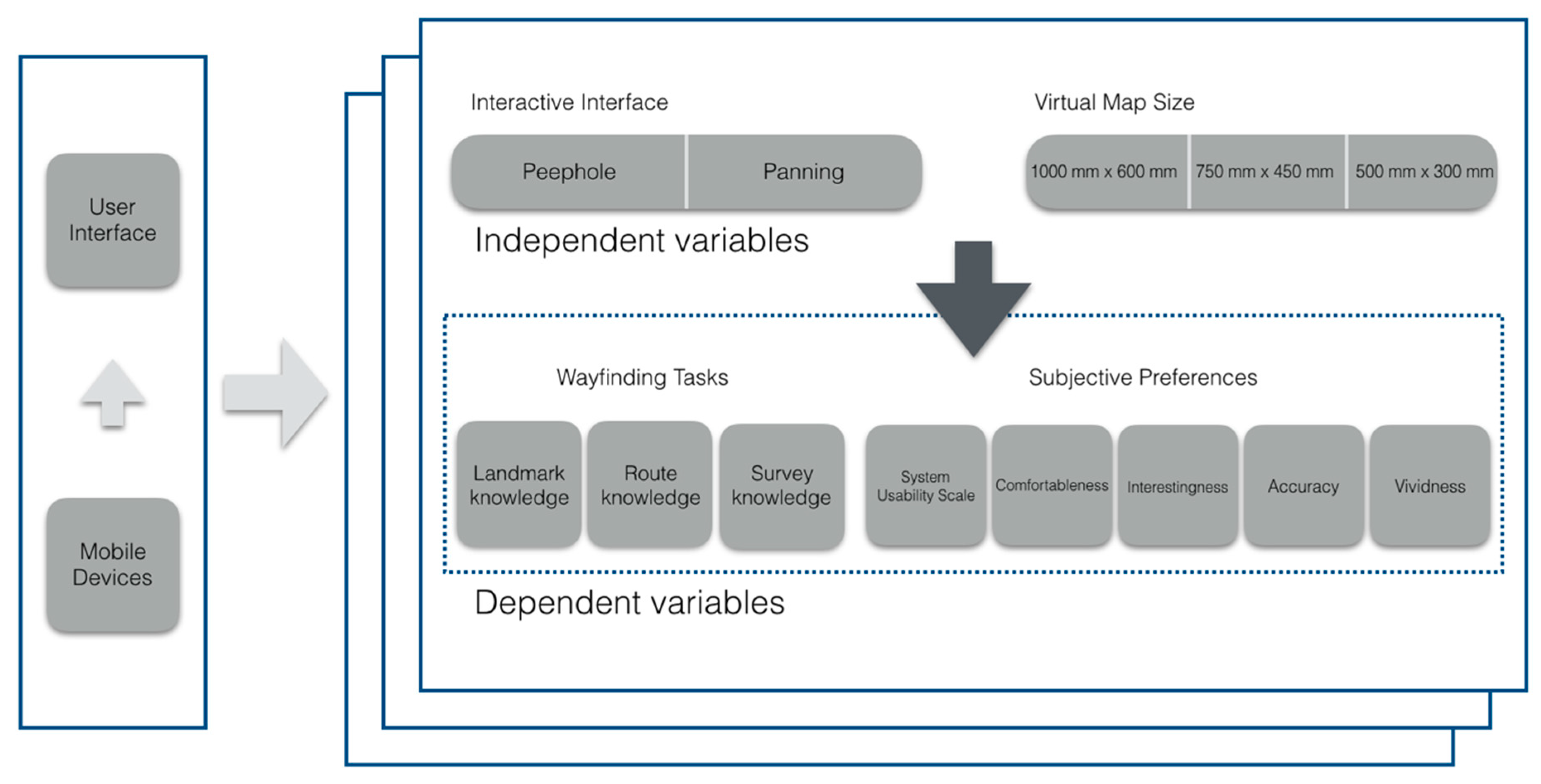
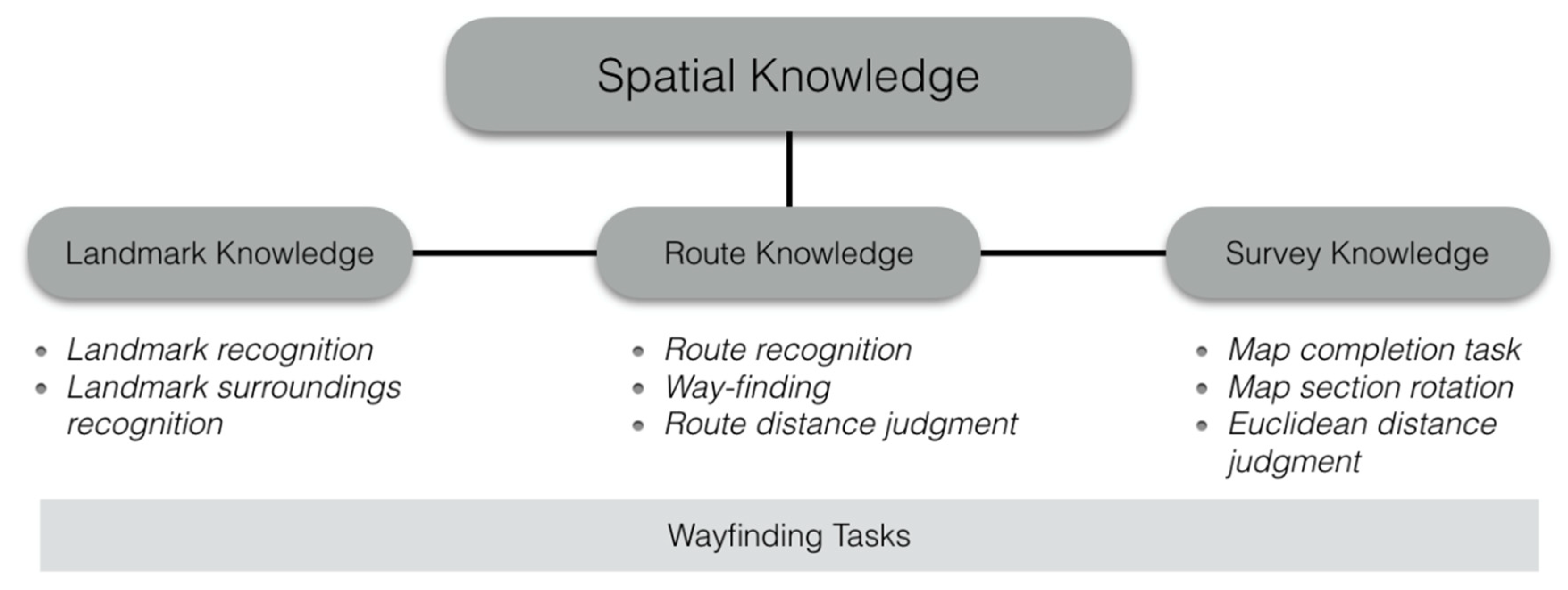
The study employed a 2 × 3 between-subjects design for the experiment, where the two independent variables were map size and interactive interface. The levels of map size were 1000 mm × 600 mm (large size), 750 mm × 450 mm (medium size), and 500 mm × 300 mm (small size). The levels of the interactive interface are the peephole interface and the panning interface. The dependent variables were the performance time, system usability scale (SUS), and subjective preference of “comfortableness,” “interestingness,” “accuracy,” and “vividness.” The five tasks of this study (i.e., Euclidean distance judgment, route distance judgment, landmark recognition, map section rotation, and route recognition) were examined, and the map used in this experiment was designed to help determine the participants’ wayfinding performance and preference, for which the participants’ actual actions were measured. The research model of this experiment is shown in Figure 2.
Figure 2. The research model of this study.

4.1. Participants

Using the convenience sampling method, 60 participants (31 males and 29 females) were invited to take part in the experiment in a counterbalanced order. According to the method of randomized block design, the participants were randomly assigned to one of the groups in this 2 × 3 between-subjects design. The ages of the participants ranged from 19 to 29 (M = 22.42, SD = 1.85). All of them had their own mobile devices, and 53 (88.33%) had experience of using their own mobile devices for wayfinding. Among the participants, 15 (25.00%) spend more than half an hour wayfinding per week, and 44 (73.33%) had more than two years’ experience of using mobile devices for wayfinding.

4.2. Materials and Apparatus

The letters used on the map were designed using the gothic typeface 24-point font, and there were five different letters: ‘A, B, C, D, and E’. The map contained 11 distributed targets, among which five were ‘A–E’ to indicate the names of green parks, and another five were also ‘A–E’ but indicated hospitals with a typical symbol. The last one was a black symbol representing “home.” The red dot, the starting point, was at the center of the map.
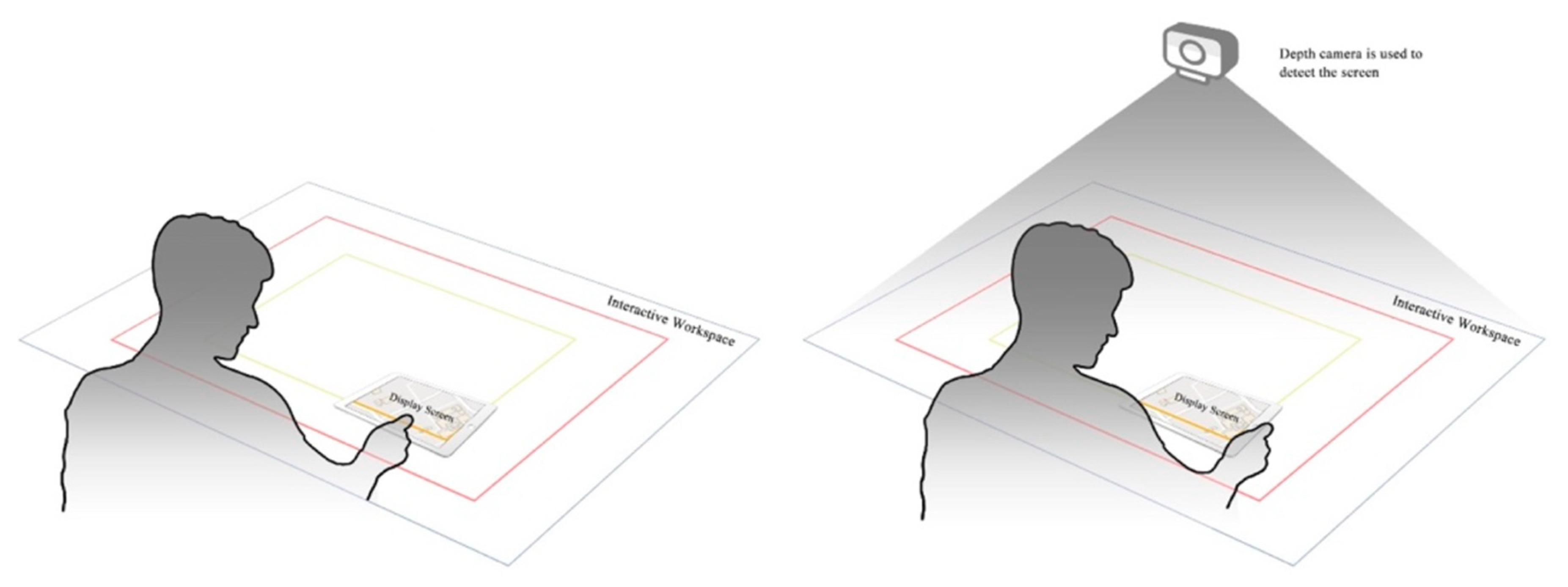
The test program of this experiment was realized using the C++ language and was based on the HuddleLamp research [37]. A Dell Venue 8 Pro installed with the Win8.1 system, equipped with an 8-inch screen was used to present the system to the participants. The resolution of the screen was 1280 × 800 pixels. In the peephole scenario, a depth camera was used to detect the mobile device. The wayfinding content was displayed on the screen of the mobile device. Figure 3 shows the technical setup of the experiment. The width and length of the interactive workspace were 0.6 and 1.0 m, respectively. The camera was placed in the middle of, and 0.8 m above the interactive workspace.
Figure 3. The technical setup for the panning (left) and peephole (right) interfaces of the experiment and the map sizes of 1000 mm × 600 mm (blue frame), 750 mm × 450 mm (red frame), and 500 mm × 300 mm (yellow frame).

4.3. Map Size and Interactive Interface

Three map sizes of the same aspect ratio (as shown in Figure 3) were used: 1000 mm × 600 mm (large size), 750 mm × 450 mm (medium size), and 500 mm × 300 mm (small size).
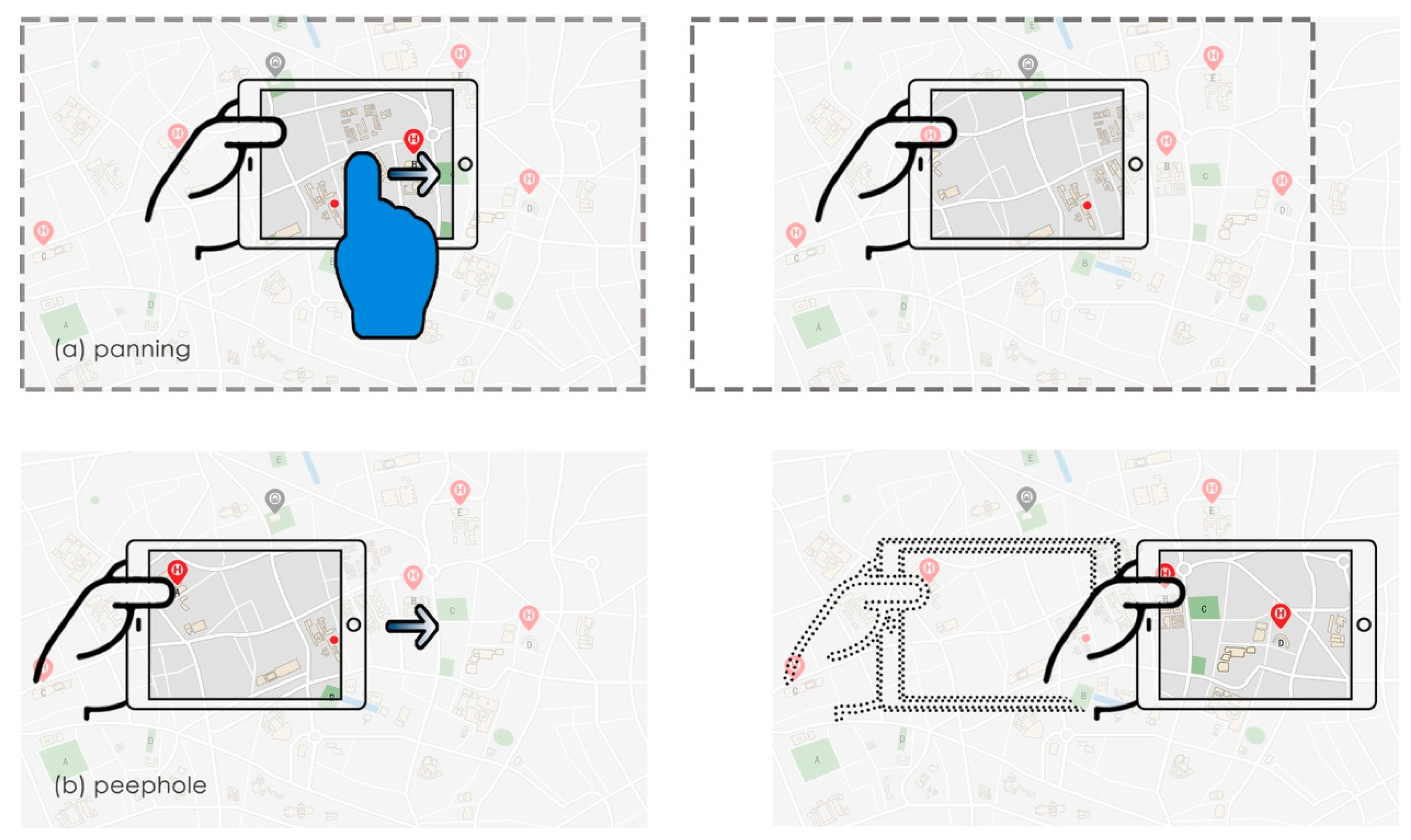
Because of the limitation of the screen size, the participants could not conveniently obtain all the wayfinding information. Two interactive interfaces, i.e., using the peephole and panning (as shown in Figure 4), were used to help the participants acquire the map information. The peephole interface enables the user to change the viewport and effectively extend the workspace through a mobile device [13]. More specifically, the peephole is formed by physically moving the device’s limited display to the expected position. Panning allows the user to pan the touch-screen to change the displayed content [38].
Figure 4. Panning (a) versus peephole interfaces (b). Note: (a) Panning allows the user to pan the touch-screen to change the displayed content. (b) peephole is formed by physically flat moving the limited display of the device to the expected position.

4.4. Task Type

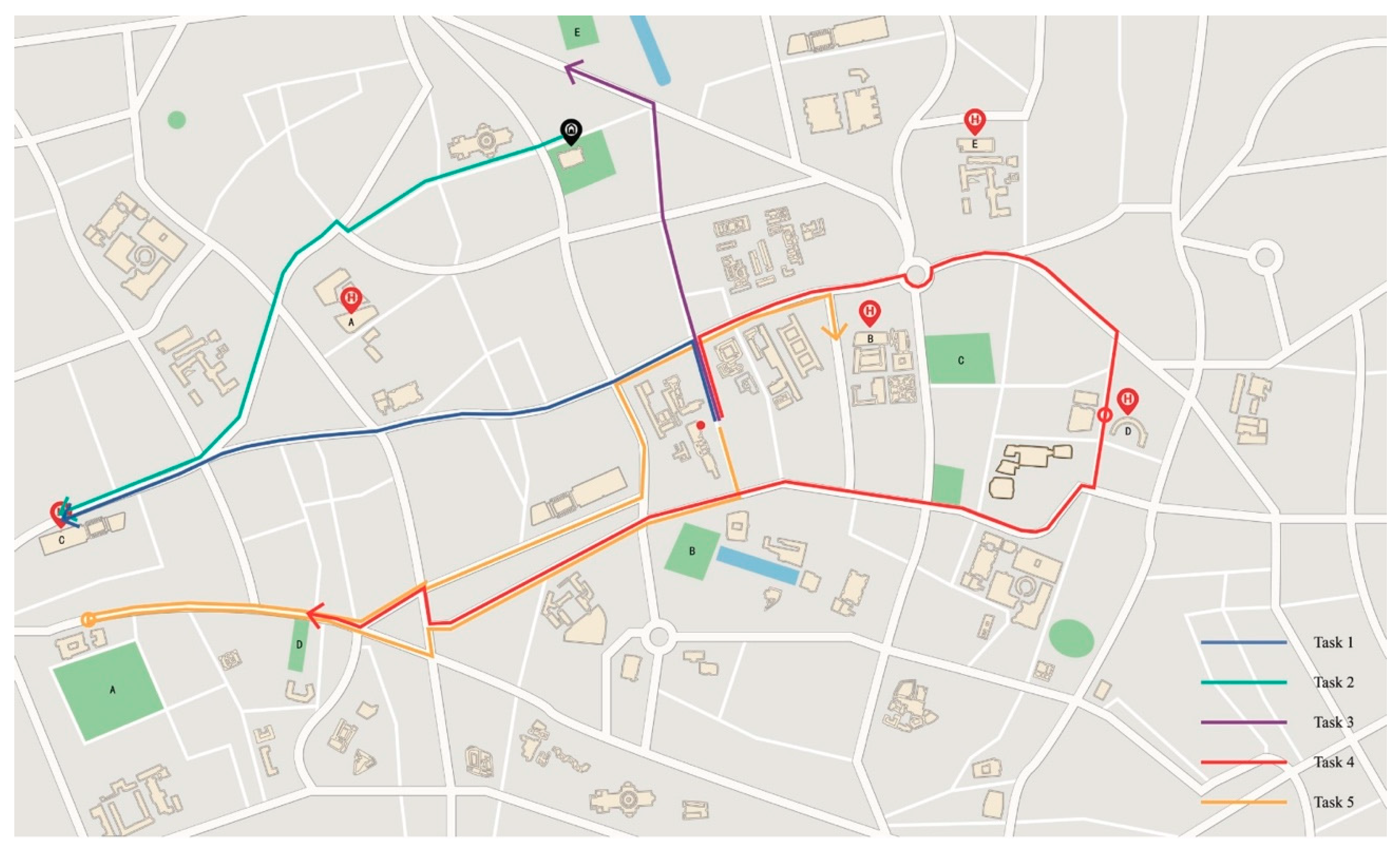
Coluccia et al. [32,35] defined different types of spatial knowledge, i.e., landmark, route, and survey knowledge, which is essential knowledge for wayfinding [28]. Thus, based on the existing literature, there has been a focus on the performance of each single task, Euclidean distance judgment [1,39], route distance judgment [35], landmark recognition [32,39], map section rotation [35] and route recognition [31,40]. The designed tasks with the wayfinding routes are shown in Figure 5. Participants completed tasks in each arranged set with the order and sequence effects controlled. Table 1 shows the designed tasks.
Figure 5. The designed tasks with the wayfinding routes of this study.
Table 1. Task types of the experiment with descriptions.

4.5. Procedure

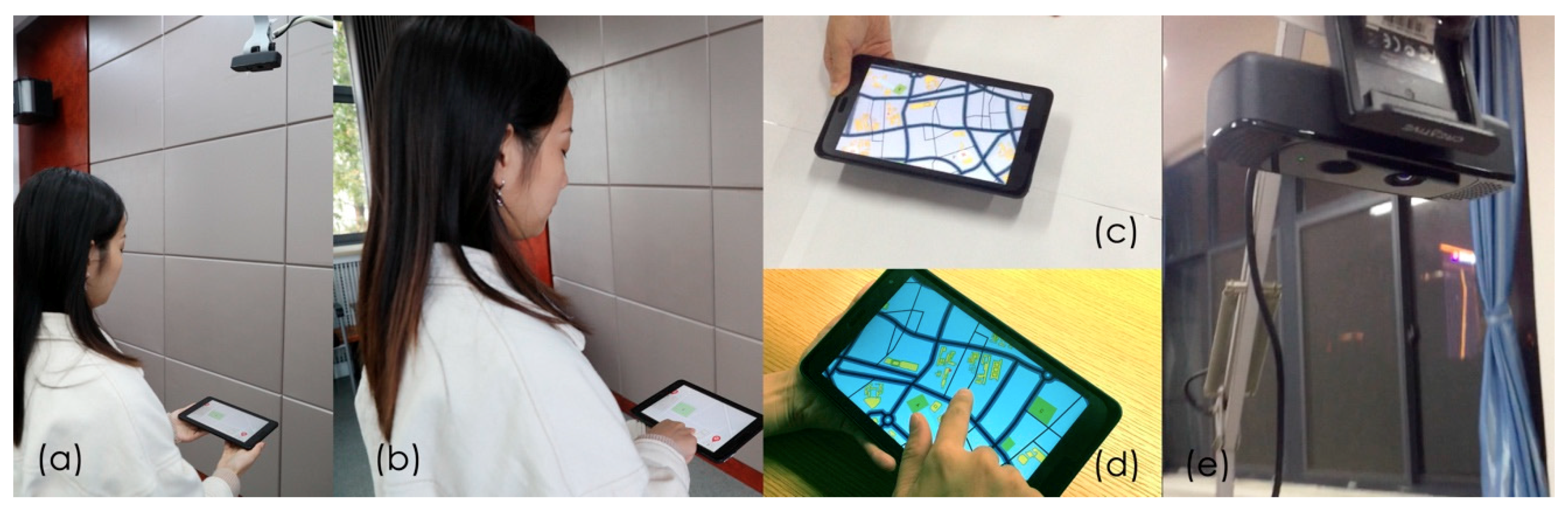
This study was conducted in a laboratory (see Figure 6). The experiment includes two parts, the investigations of search performance and of subjective preference. Overall, each participant took approximately 40 min to complete the designed tasks.
Figure 6. The experiment was conducted in a laboratory: (a,b) the main session; (c,d) the warm-up session; (e) a working depth camera.
First, participants were asked to complete a personal survey including some basic demographic questions (i.e., age, occupation) and their wayfinding use time and frequency of using mobile devices. The tasks’ specifications were explained to the participants who were allowed to adopt their most comfortable postures during the experiment. Second, in the warm-up session, the participants were allowed to interact freely with a test map for 5 min. Third, the main session began. The participants were asked to search for targets and were presented with instructions before completing each task. Each participant was asked to complete five tasks, and their performance was recorded.
Once the participants had completed the experiments, they were required to fill out the system usability scale (SUS) for assessing the usability of the interface, and were asked to complete a 7-point Likert scale questionnaire to rate the task in terms of subjective preferences with “comfortableness” (from 1 “least comfortable” to 7 “most comfortable”), “interestingness” (from 1 “least interesting” to 7 “most interesting”), “accuracy” (from 1 “least accurate” to 7 “most accurate”), and “vividness” (from 1 “least vivid” to 7 “most vivid”). The questionnaire’s content was designed based on the existing literature [9].

5. Experimental Results

Because the experiment is a 3 (map size) × 2 (interactive interface) between-subjects design, the results were analyzed using the two-way analysis of variance (ANOVA) in the statistical package for the social sciences (SPSS). Participants’ wayfinding performance was analyzed regarding task time measured in seconds. Significant factors were analyzed using the least significant difference (LSD) for post hoc comparison to help determine the differences between the factor levels. In the analyses, we estimated the main effects and interaction effects of map size and interactive interface on each participant’s wayfinding performance, SUS questionnaire and subjective preferences.

5.1. Analysis of Task Performance Time

The first task: “Please find the hospital farthest from your starting point” is a type of survey knowledge Euclidean distance judgment task. This type of task requires participants to identify the longest distances between designated landmarks. Participants are asked to search for the farthest hospital from the starting point (red dot). The results generated from the two-way ANOVA are shown in Table 2. It can be seen that there exists no significant difference in the interaction effect among the variables of the interactive interface and map size (F2,54 = 0.741, P = 0.481 > 0.05; η2 = 0.027) regarding the task performance. The main effect of the interactive interface shows a significant difference (F1,54 = 9.472, P = 0.003 < 0.05; η2 = 0.149). The participants using the peephole (M = 25.74, SD = 14.31) performed better than those using the panning interface (M = 41.79, SD = 26.32). Moreover, the main effect of map size exhibits a significant difference (F2,54 = 3.468, P = 0.038 < 0.05; η2 = 0.114). The post hoc comparison using LSD revealed that the task time of the large map (M = 44.43, SD = 28.64) was significantly longer than that of the medium (M = 29.70, SD = 18.33) and small (M = 28.69, SD = 17.77) maps.
Table 2. The two-way ANOVA results of the first task.
The second task: “Please plan the route from home to the hospital named C, and then plan the shortest route between the two targets provided” is a route knowledge route distance judgment task. This type of task requires participants to identify the shortest route distances between designated landmarks. In this experiment, the participants were required to plan the shortest route between the hospital C and home (black symbol). There exists no significant difference in the interaction effect between the variables of interactive interface and map size (F2,54 = 1.625, P = 0.206 > 0.05; η2 = 0.057) regarding task performance. In addition, no significant difference is observed for these two main effects.
The third task: “Please find the park named E” is a landmark knowledge landmark recognition task. This type of task requires participants to identify the correct landmark. In the experiment, the participants were asked to search for a named park. The results generated from the two-way ANOVA are presented in Table 3. It was found that no significant difference in the interaction effect between the variables of interactive interface and map size exists (F2,54 = 1.090, P = 0.343 > 0.05; η2 = 0.039) regarding task performance. Only the main effect of map size showed a significant difference (F2,54 = 8.843, P = 0.000 < 0.05; η2 = 0.247). The post hoc comparison with LSD shows that the task time of the large map (M = 19.28, SD = 11.82) is significantly longer than that of the medium (M = 12.54, SD = 7.36) and small (M = 8.46, SD = 3.79) maps.
Table 3. The two-way ANOVA results regarding the third task.
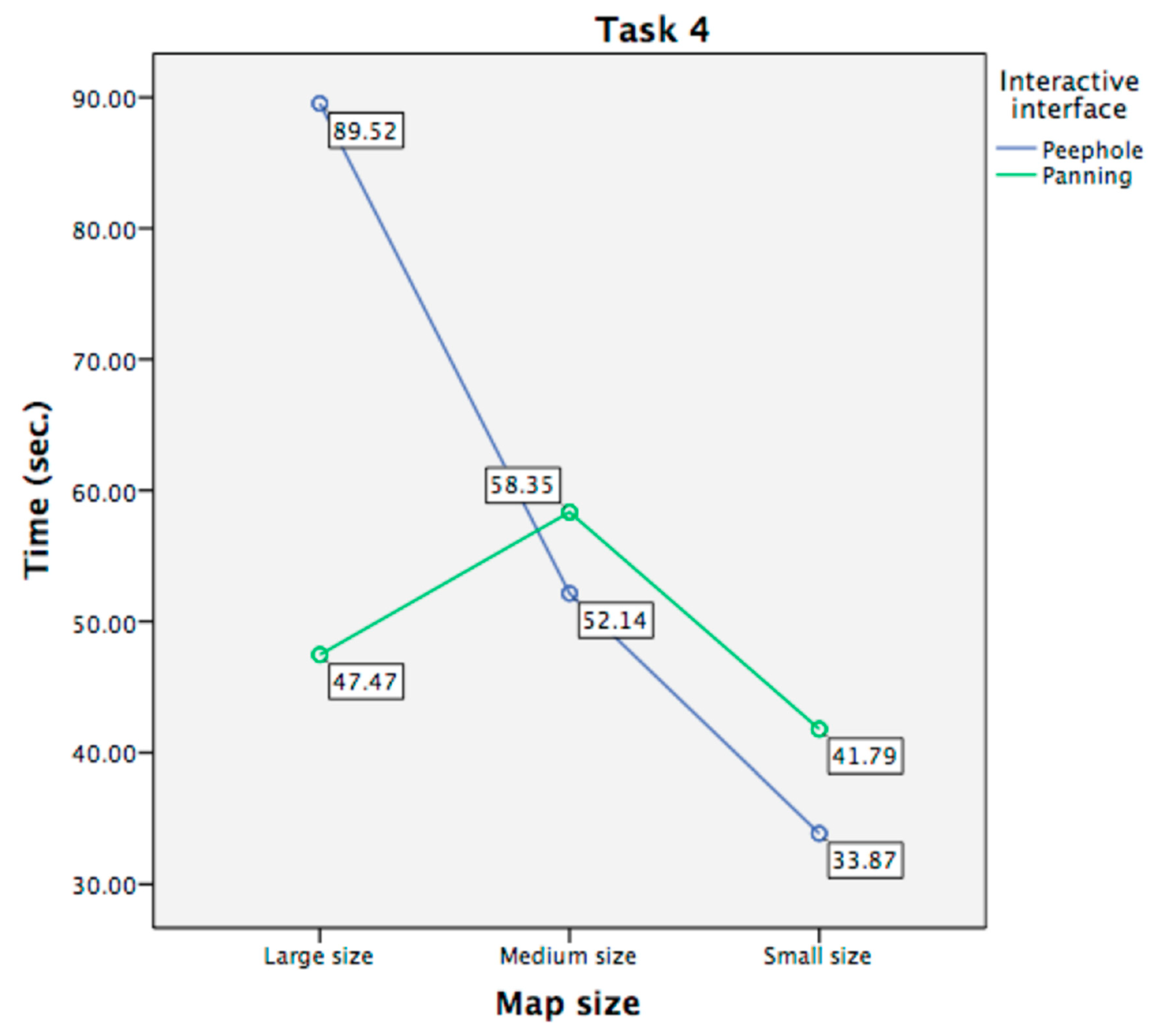
The fourth task: “Please find a building and a location with the same name. One is located east of your starting point and the other is located southwest of your starting point” is a survey knowledge map section rotation task. This type of task requires participants to identify the spatial relations among landmarks. The participants were allowed to distinguish targets in two directions with the same name from the starting point. The results generated from the two-way ANOVA are presented in Table 4. Figure 7 reveals that the variables of interactive interface and map size showed a significant interaction effect (F2,54 = 3.381, P = 0.041 < 0.05; η2 = 0.111) regarding task time. In the situation of the large map size, it took longer to complete the task for the participants when using the peephole (M = 89.52, SD = 51.34) than when using the panning interface (M = 47.47, SD = 25.34). On the contrary, the participants spent less time completing the wayfinding task with the medium map size when using the peephole (M = 52.14, SD = 32.79) than the panning interface (M = 58.35, SD = 38.25). In terms of the small map size, the results revealed that the participants spent a shorter task time when using the peephole (M = 33.87, SD = 15.86) than the panning (M = 41.79, SD = 28.85) interface. Furthermore, the main effect of map size shows a significant difference (F2,54 = 4.112, P = 0.022 < 0.05; η2 = 0.132). The post hoc comparison with LSD shows that the task time of the large map (M = 68.49, SD = 44.84) is significantly longer than that for the small map (M = 38.02, SD = 23.37).
Table 4. The two-way ANOVA results of the fourth task.
Figure 7. The interaction diagram of interactive interface and map size regarding performance time for completing task 4.
The fifth task: “Please find the park farthest from your starting point, then find the nearest hospital and find the route between the two targets” is a route knowledge route recognition task. This type of task requires participants to identify the correct pathways between two landmarks. In the experiment, it required the participants to search for the farthest and the nearest information and then plan a route for wayfinding. The results generated from the two-way ANOVA are illustrated in Table 5. It shows that no significant difference exists in the interaction effect between the variables of interactive interface and map size (F2,54 = 2.217, P = 0.119 > 0.05; η2 = 0.076) regarding task performance. Only the main effect of interactive interface showed a significant difference (F1,54 = 4.561, P = 0.037 < 0.05; η2 = 0.078). Participants adopting the peephole interface (M = 45.65, SD = 13.91) performed better than those using the panning interface (M = 54.10, SD = 20.43).
Table 5. The two-way ANOVA results of the fifth task.

5.2. Analysis of the System Usability Scale Questionnaire

The generated results from the system usability scale (SUS) questionnaire are listed in Table 6. It reveals that there exists no significant difference in the interaction effect between the variables of interactive interface and map size (F2,54 = 0.150, P = 0.861 > 0.05; η2 = 0.006) regarding SUS scores. Only the main effect of interactive interface shows a significant difference (F1,54 = 4.152, P = 0.047 < 0.05; η2 = 0.071). Participants adopting the peephole interface (M = 70.92, SD = 14.45) obtained higher SUS scores than those using the panning interface (M = 62.08, SD = 17.84).
Table 6. The two-way ANOVA results regarding the SUS questionnaire.

5.3. Summary of Task Performance Time and the SUS Questionnaire Results

Table 7 shows a summary of the performance time for tasks 1–5 and the SUS questionnaire results. It reveals that the main effect of the interactive interface shows a significant difference regarding tasks 1, 5, and SUS. The participants adopting the peephole interface always perform better than those using the panning interface. The participants using the peephole interface usually obtain higher SUS scores than those using the panning interface. Furthermore, for the main effects of map size, a significant difference in tasks 1, 3, and 4 were observed. The time to complete a task based on a larger map is significantly longer than that based on a smaller map. Moreover, in task 4, the variables of interactive interface and map size reveal a significant interaction effect. The participants spend a shorter task time completing the wayfinding task with the medium and small map size when using the peephole than the panning interface. On the contrary, in terms of the large map size, the results reveal that the participants take a longer task time when using the peephole than the panning interface.
Table 7. Summary of task performance time and SUS results.

5.4. Analysis of Subjective Preference

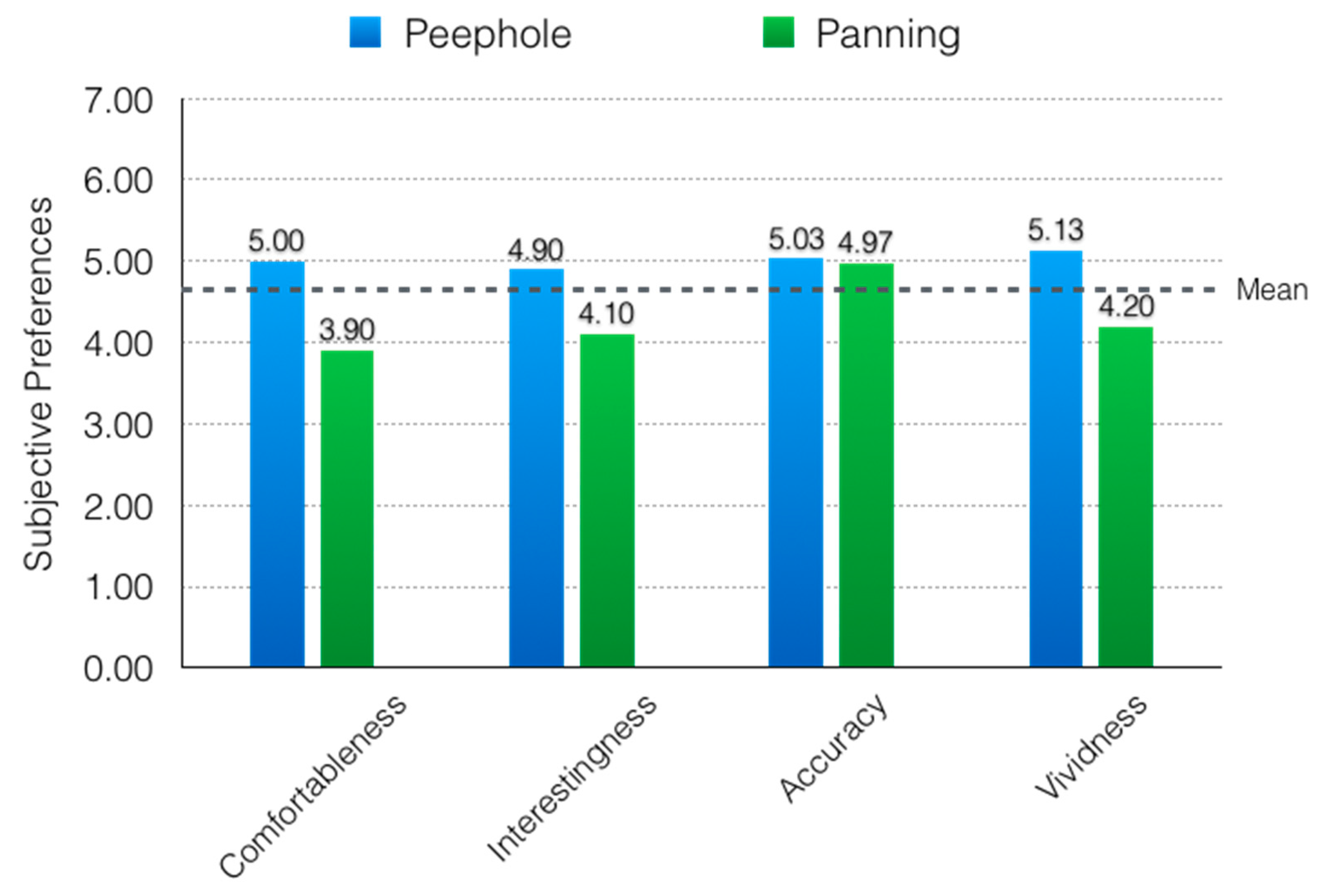
The results of the mean analysis regarding the subjective preferences are shown in Figure 8. The participants were asked to evaluate the interactive interface using a 7-point Likert scale (1 means least, and 7 means most) regarding the following four aspects: Comfortableness, interestingness, accuracy, and vividness. The subsequent ANOVA analyses revealed that, except for the subjective preference of “comfortableness” for using the panning interface, other subjective preference scores were larger than the medium of 4. More specifically, the subjective preference of “comfortableness” shows a significant difference (F1,54 = 7.691, P = 0.008 < 0.05; η2 = 0.125), and the peephole interface (M = 5.00, SD = 1.51) was graded with a higher score than the panning interface (M = 3.90, SD = 1.63) by the participants. However, no difference was found between the peephole (M = 4.90, SD = 1.48) and panning (M = 4.10, SD = 1.85) interfaces in terms of the subjective preference of “interestingness.” There also exists no significant difference between the peephole (M = 5.03, SD = 1.38) and the panning (M = 4.97, SD = 1.47) interfaces from the perspective of the subjective preference of “accuracy.” In addition, the subjective preference of “vividness” shows a significant difference (F1,54 = 5.923, P = 0.018 < 0.05; η2 = 0.099). The peephole interface (M = 5.13, SD = 1.31) was graded with a higher score than the panning interface (M = 4.20, SD = 1.73) by the participants.
Figure 8. The means of subjective preferences for the interactive interfaces. Note: The vertical axis represents the experienced degree (1–7). The higher the score the more positive it is. The horizontal axis represents the four subjective preferences.

6. Discussion

According to the task performance time, the peephole interface is significantly superior to the panning interface for wayfinding according to the experimental results of the Euclidean distance judgment and the route recognition tasks. The main effect results show that different interactive interfaces may affect the participants’ wayfinding performance. The result of the dynamic interface outperforming the panning interface is in agreement with the findings from recent studies, that using a peephole interface enhances wayfinding search efficiency [17,18]. The researchers indicated that spatial perception is the ability to perceive and visually understand spatial knowledge, such as measurement, position, and motion [41]. Kaufmann and Ahlström [8] claimed that by using a peephole interface, it was easier to remember the area of the map that had been searched or that remained. Furthermore, adopting the peephole interface enhances the users’ spatial awareness in terms of the map’s location and orientation. Moreover, Mehra et al. [17] demonstrated that the users’ reaction time is shorter when adopting the peephole interface, and it obtained better performance. Thus, this is a possible reason why the peephole interface outperforms the panning interface on the Euclidean distance judgment and the route recognition tasks.
The main effect results indicated that there are significant differences in the Euclidean distance judgment, landmark recognition, and map section rotation tasks by map size. The large map size takes longer to complete the wayfinding task than the small and medium map size. A possible explanation for the generated results is that when a user views different size map with a limited screen size on a mobile device, although the maps’ ratio aspects are the same, the smaller map reveals more content than a larger one. This may be the reason why participants took less time to complete the tasks with the smaller map. In contrast, there was no significant difference in the route distance judgment and route recognition type tasks by map size. A possible explanation for this phenomenon is that in the route knowledge tasks, the participants asked for and assessed the knowledge of directions between landmarks from an egocentric perspective [4,31,42,43]. Previous studies have found that when users operate a mobile device for wayfinding, it restricts the convenience of acquiring map content caused by the limited screen size [1,2].
According to the completion time of the map section rotation task, the interaction results indicated that it consumed a shorter time by utilizing the panning interface for the large wayfinding map. In contrast, it acquired superior performance by using the peephole interface to deal with the medium and small wayfinding maps. Thus, previous studies claimed that using a peephole interface enhances the users’ spatial awareness [15,16,17,38,44]. It is superior to using a peephole interface in a map size smaller than 750 mm × 450 mm to help deal with map section rotation task survey knowledge.
According to the results of the SUS scores, the participants assessed the usability of the peephole interface and the panning interface. The main effect results show that the peephole interface has a higher SUS score than the panning interface. The subjective view of usability for the peephole interface was higher than the medium level of 68. The panning interface’s SUS score was slightly below the medium level. In terms of subjective preference, “comfortableness” and “vividness” were found to have a significant difference. The subjective preference of “comfortableness,” “interestingness,” “accuracy,” and “vividness” was estimated. Only the “comfortableness” of the panning interface was below the median score of 4. Based on the results for the terms of “vividness” and “interestingness,” Grubert et al. [9] announced that the peephole mode engaged the practical value in emotional aspects. The dynamic peephole interface can be more fun compared to using the panning interface [45], which verifies the results of this study, that there was a positive impact on the participants’ preference for the peephole interface.

7. Conclusions

This study explored how different map sizes affect users’ wayfinding performance and preferences in the peephole and panning interface. Finally, the findings of this study are useful for wayfinding considerations. Designers may take the appropriate interactive interface and map size with different types of wayfinding scenarios to help mobile users acquire spatial knowledge. Therefore, the present research has produced several important findings:
  • Participants interacting with the peephole interface can gain better wayfinding performance than with a panning interface when performing the Euclidean distance judgment and the route recognition tasks.
  • In completing different types of tasks, the participants exhibit different wayfinding performances. When participants are dealing with the survey knowledge map section rotation task, the appropriateness of the interactive interface is the panning for a map larger than 750 mm × 450 mm. Using a peephole interface to obtain wayfinding information is a better choice when dealing with maps smaller than 750 mm × 450 mm.
  • According to the analysis of SUS, the peephole interface can contribute to increased usability, and it provided better interface usability than the panning interface when participants were wayfinding with their mobile devices.
  • There was a positive impact on the participants’ preferences in the peephole interface. Using the peephole interface may result in the participants experiencing more comfortableness and vividness.

Author Contributions

Conceptualization, Chien-Hsiung Chen and Xiao Li; formal analysis, Xiao Li; investigation, Xiao Li; methodology, Chien-Hsiung Chen and Xiao Li; software, Xiao Li; supervision, Chien-Hsiung Chen; visualization, Xiao Li; writing—original draft, Xiao Li; writing—review and editing, Chien-Hsiung Chen. All authors have read and agreed to the published version of the manuscript.

Funding

This research received no external funding.

Acknowledgments

The authors would like to thank all the reviewers for their helpful comments and suggestions.

Conflicts of Interest

The authors declare no conflict of interest.

References

  1. Burigat, S.; Chittaro, L. Visualizing references to off-screen content on mobile devices: A comparison of Arrows, Wedge, and Overview+ Detail. Interact. Comput. 2011, 23, 156–166. [Google Scholar] [CrossRef]
  2. Burigat, S.; Chittaro, L.; Gabrielli, S. Visualizing locations of off-screen objects on mobile devices: A comparative evaluation of three approaches. In Proceedings of the 8th Conference on Human-Computer Interaction with Mobile Devices and Services, Helsinki, Finland, 12–15 September 2006; pp. 239–246. [Google Scholar]
  3. Rohs, M.; Schleicher, R.; Schoning, J.; Essl, G.; Naumann, A.; Kruger, A. Impact of item density on the utility of visual context in magic lens interactions. Pers. Ubiquitous Comput. 2009, 13, 633–646. [Google Scholar] [CrossRef]
  4. Ahmadpoor, N.; Smith, A.D. Spatial knowledge acquisition and mobile maps: The role of environmental legibility. Cities 2020, 101, 102700. [Google Scholar] [CrossRef]
  5. Ishikawa, T.; Fujiwara, H.; Imai, O.; Okabe, A. Wayfinding with a GPS-based mobile navigation system: A comparison with maps and direct experience. J. Environ. Psychol. 2008, 28, 74–82. [Google Scholar] [CrossRef]
  6. Willis, K.S.; Hölscher, C.; Wilbertz, G.; Li, C. A comparison of spatial knowledge acquisition with maps and mobile maps. Comput. Environ. Urban Syst. 2009, 33, 100–110. [Google Scholar] [CrossRef]
  7. Li, X.; Chen, C.-H. The effect of peephole interaction mode and user experience on wayfinding performance. In Advances in Usability, User Experience, Wearable and Assistive Technology, Proceedings of the AHFE 2020: Virtual Conferences on Usability and User Experience, Human Factors and Assistive Technology, Human Factors and Wearable Technologies, and Virtual Environments and Game Design, San Diego, CA, USA, 16–20 July 2020; Springer: Berlin/Heidelberg, Germany, 2020; pp. 29–36. [Google Scholar]
  8. Kaufmann, B.; Ahlström, D. Studying spatial memory and map navigation performance on projector phones with peephole interaction. In Proceedings of the SIGCHI Conference on Human Factors in Computing Systems, Paris, France, 27 April–2 May 2013; pp. 3173–3176. [Google Scholar]
  9. Grubert, J.; Pahud, M.; Grasset, R.; Schmalstieg, D.; Seichter, H. The utility of Magic Lens interfaces on handheld devices for touristic map navigation. Pervasive Mob. Comput. 2015, 18, 88–103. [Google Scholar] [CrossRef]
  10. Goldiez, B.F.; Ahmad, A.M.; Hancock, P.A. Effects of augmented reality display settings on human wayfinding performance. IEEE Trans. Syst. Man Cybern. Part C Appl. Rev. 2007, 37, 839–845. [Google Scholar] [CrossRef]
  11. Chen, C.H.; Chen, S.C. Effects of 2D wedge design as a wayfinding facilitator in a 3D virtual environment. J. Soc. Inf. Disp. 2015, 23, 27–35. [Google Scholar] [CrossRef]
  12. Zheng, M.-C.; Chen, C.-I. Designing indoor navigation interfaces on smartphones compatible with human information processing in an emergency evacuation scenario. J. Asian Archit. Build. Eng. 2019, 18, 599–616. [Google Scholar] [CrossRef]
  13. Araki, T.; Komuro, T. On-mouse projector: Peephole interaction using a mouse with a mobile projector. Pervasive Mob. Comput. 2018, 50, 124–136. [Google Scholar] [CrossRef]
  14. Wu, F.-G.; Lin, H.; You, M. The enhanced navigator for the touch screen: A comparative study on navigational techniques of web maps. Displays 2011, 32, 284–295. [Google Scholar] [CrossRef]
  15. Fitzmaurice, G.W. Situated information spaces and spatially aware palmtop computers. Commun. ACM 1993, 36, 39–49. [Google Scholar] [CrossRef]
  16. Yee, K.-P. Peephole displays: Pen interaction on spatially aware handheld computers. In Proceedings of the SIGCHI Conference on Human Factors in Computing Systems, Ft. Lauderdale, FL, USA, 5–10 April 2003; pp. 1–8. [Google Scholar]
  17. Mehra, S.; Werkhoven, P.; Worring, M. Navigating on handheld displays: Dynamic versus static peephole navigation. ACM Trans. Comput. Hum. Interact. Tochi 2006, 13, 448–457. [Google Scholar] [CrossRef]
  18. Rohs, M.; Schöning, J.; Raubal, M.; Essl, G.; Krüger, A. Map navigation with mobile devices: Virtual versus physical movement with and without visual context. In Proceedings of the 9th International Conference on Multimodal Interfaces, Nagoya, Aichi, Japan, 12–15 November 2007; pp. 146–153. [Google Scholar]
  19. Guiard, Y.; Beaudouin-Lafon, M.; Bastin, J.; Pasveer, D.; Zhai, S. View size and pointing difficulty in multi-scale navigation. In Proceedings of the Working Conference on Advanced Visual Interfaces, Gallipoli, Italy, 25–28 May 2004; pp. 117–124. [Google Scholar]
  20. Jones, M.; Marsden, G.; Mohd-Nasir, N.; Boone, K.; Buchanan, G. Improving web interaction on small displays. Comput. Netw. Int. J. Comput. Telecommun. Netw. 1999, 31, 1129–1137. [Google Scholar] [CrossRef]
  21. Büring, T.; Gerken, J.; Reiterer, H. Zoom interaction design for pen-operated portable devices. Int. J. Hum. Comput. Stud. 2008, 66, 605–627. [Google Scholar] [CrossRef][Green Version]
  22. Baudisch, P.; Rosenholtz, R. Halo: A technique for visualizing off-screen objects. In Proceedings of the SIGCHI Conference on Human Factors in Computing Systems, Ft. Lauderdale, FL, USA, 5–10 April 2003; pp. 481–488. [Google Scholar]
  23. Brooke, J. SUS: A “quick and dirty’usability. Usability Eval. Ind. 1996, 189. [Google Scholar] [CrossRef]
  24. Nielsen, J. Usability Engineering; Morgan Kaufmann: Burlington, MA, USA, 1994. [Google Scholar]
  25. Morrison, A.; Oulasvirta, A.; Peltonen, P.; Lemmela, S.; Jacucci, G.; Reitmayr, G.; Näsänen, J.; Juustila, A. Like bees around the hive. In Proceedings of the 27th International Conference on Human factors in Computing Systems—CHI 09, Boston, MA, USA, 4–9 April 2009; pp. 1889–1898. [Google Scholar]
  26. Golledge, R.G. Human wayfinding and cognitive maps. In Wayfinding Behavior: Cognitive Mapping and Other Spatial Processes; The John Hopkins University Press: Baltimore, MD, USA, 1999; pp. 5–45. [Google Scholar]
  27. Montello, D.R. Navigation. In The Cambridge Handbook of Visuospatial Thinking; Miyake, A., Shah, P., Eds.; Cambridge University Press: Cambridge, UK, 2005; pp. 257–294. [Google Scholar]
  28. Huang, H.; Schmidt, M.; Gartner, G. Spatial knowledge acquisition in the context of GPS-based pedestrian navigation. In Maps for the Future: Children, Education and Internet; Zentai, L., Reyes Nunez, J., Eds.; Springer: Berlin/Heidelberg, Germany, 2012; pp. 127–137. [Google Scholar] [CrossRef]
  29. Wiener, J.M.; Büchner, S.J.; Hölscher, C. Taxonomy of human wayfinding tasks: A knowledge-based approach. Spat. Cogn. Comput. 2009, 9, 152–165. [Google Scholar] [CrossRef]
  30. König, S.U.; Clay, V.; Nolte, D.; Duesberg, L.; Kuske, N.; König, P. Learning of spatial properties of a large-scale virtual city with an Interactive map. Front. Hum. Neurosci. 2019, 13. [Google Scholar] [CrossRef]
  31. Löwen, H.; Krukar, J.; Schwering, A. Spatial learning with orientation maps: The influence of different environmental features on spatial knowledge acquisition. ISPRS Int. J. Geo. Inf. 2019, 8, 149. [Google Scholar] [CrossRef]
  32. Coluccia, E.; Iosue, G.; Brandimonte, M.A. The relationship between map drawing and spatial orientation abilities: A study of gender differences. J. Environ. Psychol. 2007, 27, 135–144. [Google Scholar] [CrossRef]
  33. Siegel, A.W.; White, S.H. The development of spatial representations of large-scale environments. In Advances in Child Development and Behavior; Reese, H.W., Ed.; JAI: Atlanta, GA, USA, 1975; Volume 10, pp. 9–55. [Google Scholar]
  34. Bosco, A.; Coluccia, E. Assessing age differences in spatial orientation tasks following map study. Imagin. Cogn. Personal. 2003, 23, 233–240. [Google Scholar] [CrossRef]
  35. Bosco, A.; Longoni, A.M.; Vecchi, T. Gender effects in spatial orientation: Cognitive profiles and mental strategies. Appl. Cogn. Psychol. 2004, 18, 519–532. [Google Scholar] [CrossRef] [PubMed]
  36. Montello, D.R. A new framework for understanding the acquisition of spatial knowledge in large-scale environments. Spat. Temporal Reason. Geogr. Inf. Syst. 1998, 143–154. [Google Scholar]
  37. Rädle, R.; Jetter, H.-C.; Marquardt, N.; Reiterer, H.; Rogers, Y. HuddleLamp: Spatially-aware mobile displays for ad-hoc around-the-table collaboration. In Proceedings of the Ninth ACM International Conference on Interactive Tabletops and Surfaces, Dresden, Germany, 16–19 November 2014; pp. 45–54. [Google Scholar]
  38. Hürst, W.; Bilyalov, T. Dynamic versus static peephole navigation of VR panoramas on handheld devices. In Proceedings of the 9th International Conference on Mobile and Ubiquitous Multimedia, Limassol, Cyprus, 1–3 December 2010; pp. 1–8. [Google Scholar]
  39. Li, R.; Zhao, J. Off-screen landmarks on mobile devices: Levels of measurement and the perception of distance on resized icons. Ki Künstliche Intell. 2017, 31, 141–149. [Google Scholar] [CrossRef]
  40. Burigat, S.; Chittaro, L.; Gabrielli, S. Navigation techniques for small-screen devices: An evaluation on maps and web pages. Int. J. Hum. Comput. Stud. 2008, 66, 78–97. [Google Scholar] [CrossRef]
  41. Simmons, A. Spatial perception from a Cartesian point of view. Philos. Top. 2003, 31, 395–423. [Google Scholar] [CrossRef]
  42. Montello, D.R.; Richardson, A.E.; Hegarty, M.; Provenza, M. A comparison of methods for estimating directions in egocentric space. Perception 1999, 28, 981–1000. [Google Scholar] [CrossRef]
  43. Münzer, S.; Zimmer, H.D.; Baus, J. Navigation assistance: A trade-off between wayfinding support and configural learning support. J. Exp. Psychol. Appl. 2012, 18, 18–37. [Google Scholar] [CrossRef]
  44. Pahud, M.; Hinckley, K.; Iqbal, S.; Sellen, A.; Buxton, B. Toward compound navigation tasks on mobiles via spatial manipulation. In Proceedings of the 15th International Conference on Human-Computer Interaction with Mobile Devices and Services, Munich, Germany, 27–30 August 2013; pp. 113–122. [Google Scholar]
  45. Grubert, J.; Langlotz, T.; Grasset, R. Augmented reality browser survey. In Technical Report; Institute for Computer Graphics and Vision, Graz University of Technology: Graz, Austria, 2011. [Google Scholar]
Publisher’s Note: MDPI stays neutral with regard to jurisdictional claims in published maps and institutional affiliations.

Article Metrics

Citations

Article Access Statistics

Multiple requests from the same IP address are counted as one view.