You are currently viewing a new version of our website. To view the old version click .
Robotics
  • Review
  • Open Access

25 September 2017

Resilient Robots: Concept, Review, and Future Directions

,
and
1
Department of Biomedical Engineering, University of Saskatchewan, Saskatoon, SK S7N 5A9, Canada
2
School of Mechatronics and Automation, Shanghai University, Shanghai 200444, China
3
Department of Mechanical Engineering, University of Saskatchewan, Saskatoon, SK S7N 5A9, Canada
*
Author to whom correspondence should be addressed.
This article belongs to the Special Issue Robust and Resilient Robots

Abstract

This paper reviews recent developments in the emerging field of resilient robots and the related robots that share common concerns with them, such as self-reconfigurable robots. This paper addresses the identity of the resilient robots by distinguishing the concept of resilience from other similar concepts and summarizes the strategies used by robots to recover their original function. By illustrating some issues of current resilient robots in the design of control systems, physical architecture modules, and physical connection systems, this paper shows several of the possible solutions to facilitate the development of the new and improved robots with higher resilience. The conclusion outlines several directions for the future of this field.

1. Introduction

Biological systems have the ability to recover themselves from severe damage such as lost limbs by creating new compensatory behaviors. Although such properties would be desirable in robotic systems, most robotic systems tend to fail due to material degradation and/or unanticipated disturbances from the world environment. Many applications such as space exploration and rescue tasks in dangerous tasks often require self-recovery abilities and resilient robots are considered as one of the solutions.
The inspiration for the biological systems and the growing demand of recovery abilities is a great motivator for research in the field of resilient robots. Resilient robots are robots that can recover their original function after partial damage. Though the number of robots that are named “resilient robots” is small, we believe that the resilient robot does have its identity and is worth the special attention of the scientific community.
In fact, resilience is the property of each system itself, and any system is resilient, but the major difference is the degree of resilience as per the requirement of the application. For instance, the majority of the existing self-reconfigurable robots have relatively low resilience. This is because the reliable autonomous control for reconfiguration (software) and the associated mechanism design (hardware) are very challenging. These challenges also occur in other robotic systems. Particularly, most robots’ resilience is restricted due to slow technological developments in the areas of hardware prototypes, actuators, and communications, and thus the system may not recover its original function even if it suffers slight failures.
Considering the number of robots described in the literature, so far only a few of them focused on resilience. There are a large number of modular self-reconfigurable robots (MSRR) prototypes. A recent review of the hardware architecture of the MSRRs is referred to [1], and a review of self-reconfiguration algorithms is referred to [2]. However, most of the literature reviews concentrate on self-reconfiguration solutions, and no other publication presents a summary of mechanical design and the control systems from the viewpoint of resilience. An assessment of different solutions would provide developers with an evaluation of the solutions, and thus allow them to learn from the successes as well as the shortfalls from other research teams.
The aim of this paper is to compare and summarize the robotic systems with resilience and related robots to provide a comprehensive reference about existing technical solutions in terms of the design of control systems, physical architecture modules, and physical interfaces, and to facilitate the development of the new and improved robots. Although many robots have resilience, it is reasonable to acknowledge that some robots with a certain of recovery ability (e.g., a robot with a robust controller dealing with motor noise or a robot with backup modules) will not be recovered, as they do not belong to resilient robots. The concept of both resilience and resilient robot will be detailed in Section 2. The scope of this paper is limited to studying the hardware architectures and the associated control systems when physical damages occur; failures of software are excluded from this survey. Nevertheless, this documentation is intended to be a valuable source of information for engineers and scientists working on new solutions for higher resilience of physical systems.
The remaining part of the paper is organized as follows. In Section 2, the distinction of the resilience concept from some other concepts that are closely related to the resilience concept is discussed, which thus gives the identity of the resilient robot. In Section 3, resilient robots, self-reconfigurable robots, and other related robots are reviewed. In Section 4, we present some principles for the design of resilient robots. There is a conclusion with a discussion of future directions in Section 5.

2. The Identity of Resilient Robots

2.1. Resilience and Resilient Robots

Resilience is associated with a system, and it is an ability of a system to recover its function due to partial damage of the system [3]. In different disciplines of systems, the resilience may be defined from different viewpoints. The resilience concept has been widely developed in sociology and ecology, and it is characterized as a property of the social and ecological system, which enables the system to absorb changes and persist [4]. The resilience concept in engineering has emerged only in recent years [5,6,7]. Hollnagel et al. [5] defined resilience as “the ability of an organization (system) to keep, or recover quickly to, a stable state, allowing it to continue operations during and after a major mishap or in the presence of continuous significant stresses.” Zhang and Lin [3] stated, “Hollnagel’s definition lacks a distinction of resilience from robustness” and defined resilience as “the ability of the system on how the system can still function to the desired level when the system suffers from a partial damage”.
The identity of a resilient robot depends on whether there is a unique challenge or problem with the concept of resilience, and thus a resilient robot. There are several concepts that are closely related to the concept of resilience, such as “self-healing”, “fault-tolerance”, “self-repairing”, “sustainability”, “reliability”, “dependability”, “survivability”, and “robustness”.
Self-healing is well known in biology [8]. When a biological cell encounters excessive stresses or stimuli, it may undergo adaptations to shift to a new state of the system to keep its original function (analogous to a robot: the robot changes its software or hardware). When there is no possible adaptive response, or a cell’s adaptive capability is exceeded, cell injuries may develop (analogous to a robot: physical damage occurs). Upon suffering a severe injury, the injured cells may die (analogous to a robot: the robot cannot recover its original function). Upon suffering a mild injury, an injured cell may “recover” to a normal state through a complicated chemical change (analogous to a robot: the robot recovers its original function by changing its physical system). For instance, amino acids can enable muscles to build up, repair, or regenerate. Even though our contemporary technology is not ready to interface with such a complex biological system [9], i.e., regeneratation of an identical part, we believe the recovery always involves reconfiguration and readjustment of some smaller elements in the cell. The concept of the resilient robot is inspired by biological self-healing, from both macro and micro viewpoints. However, it seems that most self-healing robots refer to a chemical reaction, which does not consider the reconfiguration and re-adjustment of robot components. For instance, the self-healing robot in [10] can grow skin back together without a catalyst. The self-repairing robot is more restricted to the repairing of damaged components: that is, to repair the damaged component with external resources. Compared with self-healing and self-repairing, the scope of recovery solutions for resilience is more general.
Fault tolerance is a classic notion in software engineering, and it is defined as the ability to deliver service in the presence of faults [11]. Here, fault refers to errors made at the phase of software development and/or errors in the system input at the phase of software operation [3]. Fault-tolerance also includes component damage. However, the recovery solutions of fault tolerance are usually based on the software development, and a classic approach to fault tolerance is to employ robust controller. Compared with fault tolerance, the solutions generated by a resilient system could change software and/or change hardware, no matter the faults caused by software or hardware.
Sustainability refers to a system’s ability to sustain or to maintain itself. A sustainable robot may have redundant parts which are used to replace the failed parts when failures happen. Survivability is the ability of a system or an object to live or exist, especially in spite of difficult conditions [12]. Long-term physical survivability of most robotic systems today is achieved through durable hardware [13]. Robustness is defined as “an ability that allows a system to maintain its functions against internal and external perturbations or noises” in [14]: that is, how a system is insensitive to noises. Reliability is defined as “the ability of a system or component to perform its required functions under stated conditions for a specified period of time” [15]; that is, how a system is sensitive to random failures. Reliable systems are close to the survival systems, and they are focused on how the system functions subject to the external disturbance; they are in the strategy of prevention (reliability) and absorption during the event (robustness). The definition of dependability is the ability of a system to deliver a service that can justifiably be trusted and to avoid failures [16]. The dependable system or robot refers to the faith in a robot for its fulfillment of functions under a condition from the perspective of the user of the robot. The reliable and robust system can add value to the faith of the user. The resilient robot adds more faith to the user. That is to say, a robot that has reliability, robustness, and resilience is a highly dependable robot.
In conclusion, resilient robots have the following four merits: (1) cost-effectiveness: the reusage of the remaining systems reduces costs by extending system life; (2) repairability: the redundancy may be brought in to deal with the faults caused by an internal/external environment; (3) durability: a component for one function can be trained to achieve another function of another component against the system malfunction; and (4) interconnectability: the ease of replacement of the damaged components.

2.2. The Concept of Resilient Robots

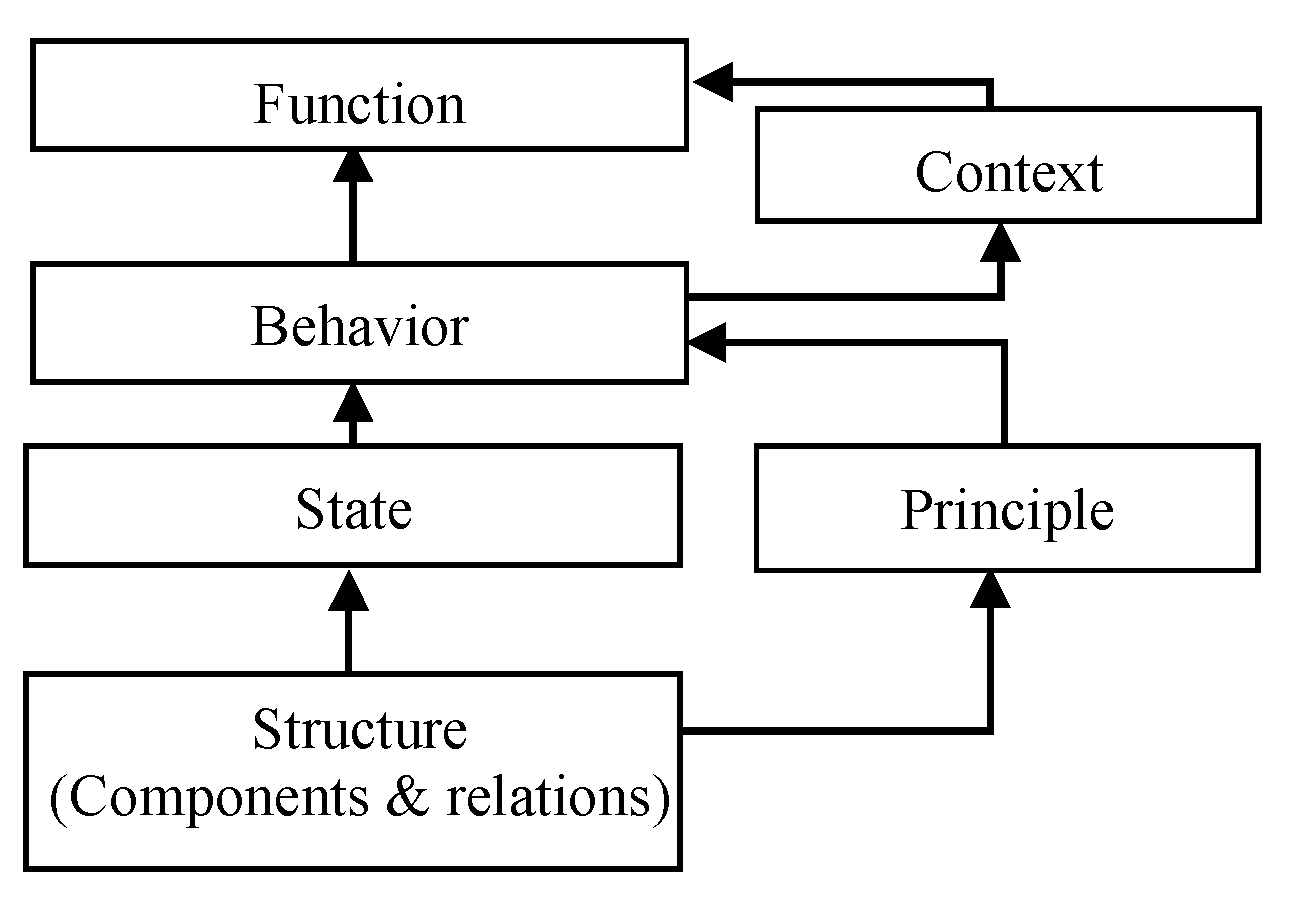
Another interpretation of the concept of resilience for robots lies in how a system’s function is recovered. In this paper, we employ a general system modeling tool named FCBPSS [17] to account for different views of the concept of resilience for a robotic system. The FCBPSS model has been used for the design of general products, and it provides a comprehensive approach to analyze and synthesize a system [18]. The FCBPSS model can be seen in Figure 1.
Figure 1. Function-context-behavior-principle-state-structure (FCBPSS) model. The Structure refers to components and connections among the components. The State refers to attributes of a structure. The Principle refers to fundamental laws and effects with which one can develop quantitative relationships among the state variables. The Behavior is represented as a sequence of states and transitions between them, which is governed by the Principle. The Function refers to utilities of a structure owing to its behavior in a context. The Context refers to environments that surround a particular system, which define a specific function of the system.
A key implication of the FCBPSS model with regard to the concept of resilient robots is that the function of a robot can be changed from many sources of means; structure, state, behavior, context, and/or principle, rather than the structure only (which is the case for self-reconfigurable robots). Along this line, we conclude the following strategies for recovery:
Strategy I:
Training a remaining system to perform a new behavior, e.g., regeneration of a control system. This strategy refers to the change of a function via behavioral change (i.e., change of the relationship between states). Furthermore, the change of behavior may be due to the change of the principle (e.g., physical effect).
Strategy II:
Changing the configuration of a system by re-arranging its components (see self-reconfigurable robot [19]). This strategy refers to the traditional configuration change in self-reconfigurable robots via the change of connectivity among components in a system [19].
Strategy III:
Changing the states of components, e.g., changing the length of a bar component; see the so-called adjustable mechanism [20]. This strategy refers to the change of a function via the change of component in itself.
A combination of the above strategies is also possible, which may be called hybrid recovery strategy. It is noted that the above strategies exist to change the function of a system via behavior, state, and/or structure.
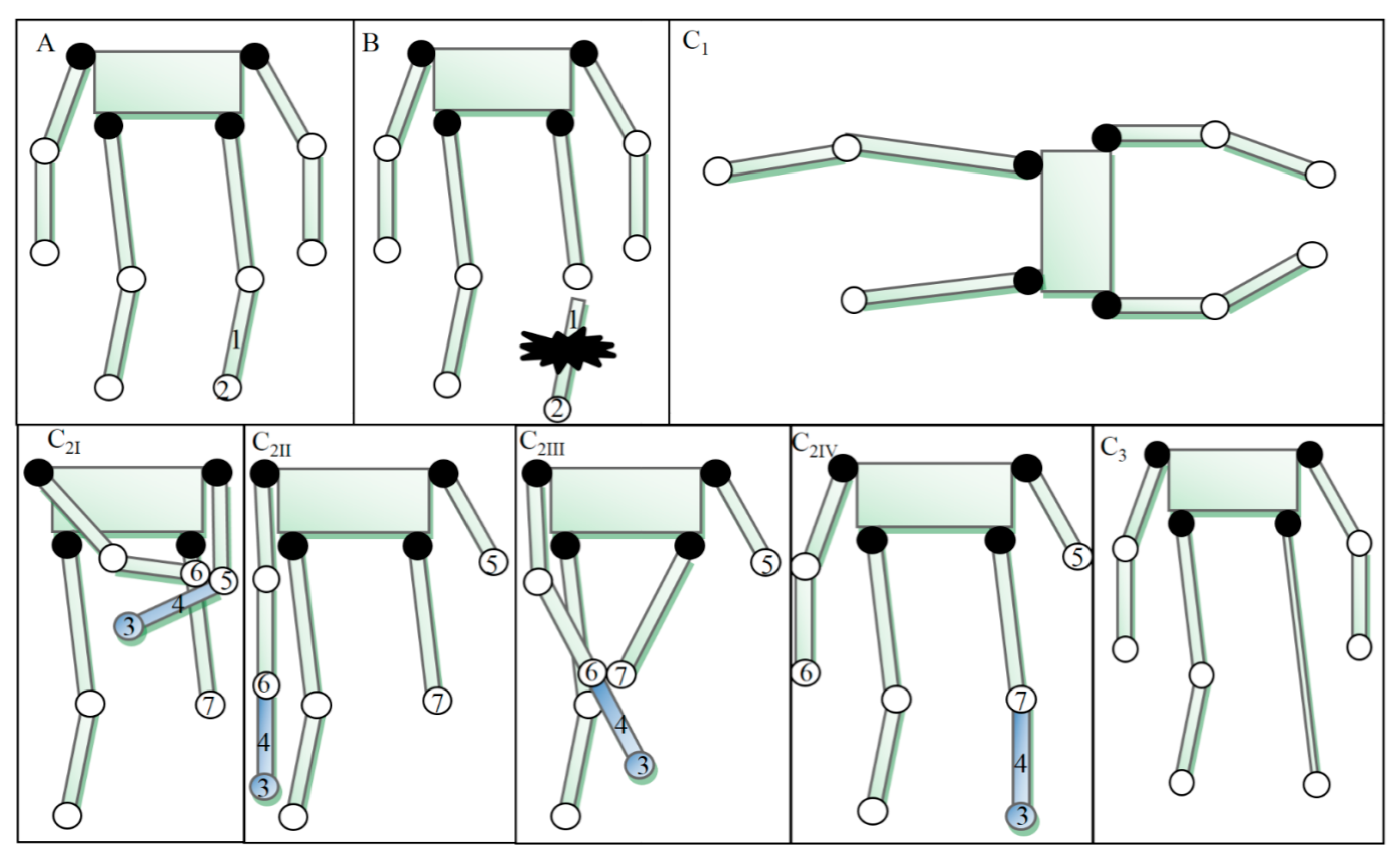
Figure 2 presents an example illustrating the three recovery strategies. Originally, the robot moves by walking (A). After one leg is broken (B), the robot tries to recover its function (i.e., moving) by crawling (C1 via strategy I), or re-arranging the remaining components (C2 via strategy II), or changing the shape of one component (C3 via strategy III).
Figure 2. Robot recovers to its original function through three strategies, denoted by C1, C2, and C3. (A) The original state of a robot; (B) Part 1 got damaged; (C1) The first recovery strategy: the remaining system is trained to perform a new capability; (C2) The second recovery strategy: the robot rearranges Part 3&4 (dark-colored) to the position of where Part 1&2 used to be by reconfiguring the remaining system. This strategy is as follows: (C2I) Part 6 connects with Part 4; (C2II) Part 4 disconnects with Part 5; (C2III) Part 7 connects with Part 4; (C2IV) Part 4 disconnects with Part 6. (C3) The third recovery strategy: the state of Part 1 changes (i.e., extending Part 1).

2.3. Summary of the Identity of Resilient Robots

In conclusion, the resilient robot has its unique identity. The resilient robot is defined as a robot that is able to recover its original function using its own resources after the system is partially damaged through at least one of the three recovery strategies. The concept of the resilient robot provides a promising method for reducing the loss of robots, and this is very useful for robots in a dangerous environment or a remote environment.
The degree of resilience depends on the degree of recovery of the original function. As seen from Figure 2, if the original function is to move from one place to another place within a certain time (i.e., walking normally), the resilience of the robot in (B) is higher than the robot in (A) as the former one recovers all of the original function, while the latter one recovers partial original function, assuming that walking is faster than crawling. Therefore, a resilient machine which can perform the same function at both a failed state and a new state is called strong resilient machine; otherwise, it is called weak resilient machine [21].
In general, the degree of resilience of robots are affected by: (1) the type of the recovery strategy and the number of the recovery strategies; (2) the performance of the function that can be recovered; (3) the amount of resources needed for the recovery of the function; (4) the amount of time that the damage recovery takes. The next section will give a review and an analysis of the existing work around these factors.

4. The Principles of Design of Resilient Robots

Two design principles can be drawn from the review of the existing resilient robots and relevant robots.
Principle I: A robot should be designed with function redundancy. Redundancy means that when one physical part or subsystem (say A) does not run out of its full capability; part of A can be trained to fulfill the role or partial role of another physical part or subsystem [21]. Function redundancy means that a system can perform one function with many configurations or states, that is, a robot has more than one configuration to achieve the same function. For instance, for Koo’s hexapod robot [32], the original state and the damaged state have the same function, i.e., walking from one place to another place. In contrast, the damaged resilient machine in Bongard’s work [22] has a relatively low resilience as the recovered function is crawling instead of walking.
Principle II: The structure of a resilient robot should follow modular architecture [20]. In a modular architecture, all components have standard interfaces to interact with each other, and thus the modular system can easily be changed in terms of configuration. A modular architecture can be further viewed as having two types: (1) both components and their interfaces are of standard; and (2) components are not of standard, but their interfaces are. It is noted that most modular self-reconfigurable robots refer to type (1) only. Type (2) of modular systems allow for a change of the function of components. For instance, when faced with joint failure, the underactuated resilient robot in [41] exhibits a higher degree of resilience than the homogeneous self-reconfigurable robots with all active modules because the damaged modules of the former robot change their roles and are reused rather than becoming useless.

5. Conclusions and Future Directions

The field of resilient robotics aims to create the science and applications of self-recovery machines by asking the questions: how do we design and control resilient robots, and how do we use these robots? Damaged robots capable of moving and self-reconfigurable robots capable of grasping rely on their function redundancy and modular architecture to adapt their behavior to their environment and task. These basic behaviors open the door to applications in which robots work in unknown or dangerous environments where replacement or repair of a damaged robot is impossible or cost-prohibited. For instance, the robot could rescue lives in an earthquake, where it could change into different configurations if some components were damaged. But how do we get to the point where resilient robots deliver on their full-potential? We need rapid design tools and fabrication recipes for low-cost but strong robots, novel algorithmic approaches to control behavior changing, and self-reconfiguration and/or state changes that account for fast damage recovery requirements, which are a must in an emergent situation.
But how resilient should a resilient robot be in order to meet its true potential? As with many aspects of robotics, this depends on the failures, task and environment. For domains that require strong resilience (for example, a rescue task) or deal with a great amount of uncertainty (for example, in space), resilient robots can bring the capabilities of robots to new levels. For a specified task, a robot has a relatively higher resilience if it addresses all the three recovery strategies and recovers the function to be the same as the original in the shortest time. As well, learning to predict what behavior should be avoided [68], diagnosing failures, and finding the roots of the failures is a good way to increase the resilience of a robot so that it can be applied to many situations in which a robot has to autonomously adapt its behavior. Improved hardware, such as sensors, actuators, and communication will also lead to higher resilience. We expect a comprehensive measurement of robots’ resilience [69] as well as the relationship with other system properties such as reliability and cost, resulting in strong resilient robots that can overcome more failures.
To sum up, the key directions for the future of this growing field are as follows.
  • Identifying the classification of robot failures, and developing methods to predict and prevent the failures.
  • Investigating the relationships between recovery strategies and failures, as there may be several strategies available at a point of time when a failure occurs, and one needs to find the best one.
  • Developing rapid design tools and fabrication recipes for low-cost but strong resilient robots; modules could switch their role when they fail.
  • Developing novel algorithmic approaches, such as learning-based approaches to get reliable autonomous control for resilient robots with consideration of hardware compatibility.
  • Developing soft computing techniques for morphological soft robots to allow self-assembly, self-reconfiguration, self-reproduction, self-recovery, etc.
  • Determining resilience measurement for different robots affected by different failures. A resilience measure approach would include failure identification and function recovery in terms of time and cost.
  • Developing a relationship between resilience and other system properties such as reliability and cost. This is important when a resilient robot is tailored for a particular application.

Acknowledgments

The author (Wenjun Zhang) wants to acknowledge a partial financial support to his involvement from NSF of China (No. 51375166) and NSERC Discovery Grant.

Conflicts of Interest

The authors declare no conflict of interest.

References

  1. Chennareddy, S.; Agrawal, A.; Karuppiah, A. Modular Self-Reconfigurable Robotic Systems: A Survey on Hardware Architectures. J. Robot. 2017, 2017. [Google Scholar] [CrossRef]
  2. Støy, K.; Brandt, D.; Christensen, J.D. Self-Reconfigurable Robots: An Introduction; MIT Press: Cambridge, MA, USA, 2010. [Google Scholar]
  3. Zhang, W.J.; Lin, Y. On the principle of design of resilient systems—Application to enterprise information systems. Enterp. Inf. Syst. 2010, 4, 99–110. [Google Scholar] [CrossRef]
  4. Holling, C.S. Resilience and stability of ecological systems. Ann. Rev. Ecol. Syst. 1973, 4, 1–23. [Google Scholar] [CrossRef]
  5. Hollnagel, E.; Woods, D.D.; Leveson, N. Resilience Engineering Concepts and Precepts; Ashgate Publishing, Ltd.: Farnham, UK, 2006. [Google Scholar]
  6. Patternson, E.S.; Woods, D.D.; Cook, R.I.; Render, M.L. Collaborative cross-checking to enhance resilience. Cognit. Technol. Work 2007, 9, 155–162. [Google Scholar] [CrossRef]
  7. Bursztein, E.; Goubault-Larrecq, J. A logical framework for evaluating network resilience against fault and attacks. In Lecture Notes in Computer Science; Hutchison, D., Kanade, T., Kittler, J., Kleinberg, J.M., Mattern, F., Mitchell, J.C., Naor, M., Pandu Rangan, C., Steffen, B., Terzopoulos, D., et al., Eds.; Springer: Cham, Switzerland, 2007; Volume 4846, pp. 212–227. [Google Scholar]
  8. Kumar, V.; Cotran, R.S.; Robbins, S.L. Basic Pathology; Saunders: Philadelphia, PA, USA, 1992. [Google Scholar]
  9. Madden, J.D. Mobile Robots: Motor challenges and material solutions. Science 2007, 318, 1094–1097. [Google Scholar] [CrossRef] [PubMed]
  10. Geekologie (19 September 2013). Available online: http://geekologie.com/2013/09/self-healing-robot-skin-grows-back-toget.php (accessed on 12 March 2014).
  11. Avižienis, A.; Laprie, J.; Randell, B.; Landwehr, C. Basic Concepts and Taxonomy of Dependable and Secure Computing. IEEE Trans. Dependable Secur. Comput. 2004, 1, 11–33. [Google Scholar] [CrossRef]
  12. Merriam-Webster Inc. Merriam-Webster’s Collegiate Dictionary; Merriam-Webster: Springfield, MA, USA, 2004. [Google Scholar]
  13. Zykov, V.; Mytilinaios, E.; Desnoyer, M.; Lipson, H. Evolved and designed self-reproducing modular robotics. IEEE Trans. Robot. 2007, 23, 308–319. [Google Scholar] [CrossRef]
  14. Kitano, H. Biological robustness. Nat. Rev. Genet. 2004, 5, 826–837. [Google Scholar] [CrossRef] [PubMed]
  15. Verma, A.K.; Ajit, S.; Karanki, D.R. Reliability and Safety Engineering; Springer: London, UK, 2010. [Google Scholar]
  16. Bischoff, R.; Graefe, V. HERMES—An Intelligent Humanoid Robot Designed and Tested for Dependability. In Experimental Robotics VIII; Siciliano, B., Dario, P., Eds.; Springer: Berlin/Heidelberg, Geymany, 2003; pp. 64–74. [Google Scholar]
  17. Zhang, W.J.; Lin, Y.; Sinha, N. On the function-behavior-structure model for design. In Proceedings of the 2nd Canadian Design Engineering Network Conference, Kaninaskis, AB, Canada, 18–20 July 2005. [Google Scholar]
  18. Lin, Y.; Zhang, W.J. Towards a novel interface design framework: Function-behavior-state paradigm. Int. J. Hum. Comput. Stud. 2004, 61, 259–297. [Google Scholar] [CrossRef]
  19. Støy, K.; Nagpal, R. Self-repair through scale independent self-reconfiguration. In Proceedings of the IEEE/RSJ International Conference on Robots and Systems, Sendai, Japan, 28 September–2 October 2004; pp. 2062–2067. [Google Scholar]
  20. Sun, Z.H.; Yang, G.S.; Zhang, B.; Zhang, W.J. On the Concept of the Resilient Machine. In Proceedings of the IEEE International Conference on Industrial Electronics and Application, Beijing, China, 21–23 June 2011; pp. 357–360. [Google Scholar]
  21. Zhang, W.J.; van Luttervelt, C.A. Toward a resilient manufacturing system. Ann. CIRP 2011, 60, 469–472. [Google Scholar] [CrossRef]
  22. Bongard, J.; Zykov, V.; Lipson, H. Resilient machines through continuous self-modeling. Science 2006, 314, 1118–1121. [Google Scholar] [CrossRef] [PubMed]
  23. Mahdavi, S.H.; Bentley, P.J. Innately adaptive robotics through embodied evolution. Auton. Robot. 2006, 20, 149–163. [Google Scholar] [CrossRef]
  24. Berenson, D.; Estevez, N.; Lipson, H. Hardware evolution of analog circuits for in-situ robotic fault-recovery. In Proceedings of the IEEE NASA/DoD Conference on Evolvable Hardware, Washington, DC, USA, 29 June–1 July 2005; pp. 12–19. [Google Scholar]
  25. Nguyen-Tuong, D.; Peters, J. Model Learning for Robot Control: A Survey. Cognit. Process. 2011, 12, 319–340. [Google Scholar] [CrossRef] [PubMed]
  26. Kober, J.; Peters, J. Reinforcement learning in robotics: A survey. Int. J. Robot. Res. 2013, 32, 1238–1274. [Google Scholar] [CrossRef]
  27. Sproewitz, A.; Moeckel, R.; Maye, J.; Ijspeert, A. Learning to move in modular robots using central pattern generators and online optimization. Int. J. Robot. Res. 2008, 27, 423–443. [Google Scholar] [CrossRef]
  28. Christensen, D.J.; Larsen, J.C.; Stoy, K. Fault-tolerant gait learning and morphology optimization of a polymorphic walking robot. Evol. Syst. 2014, 5, 21–32. [Google Scholar] [CrossRef]
  29. Mostafa, K.; Tsai, C.S.; Her, I. Alternative gaits for multiped robots with leg failures to retain maneuverability. Int. J. Adv. Robot. Syst. 2010, 7, 33–40. [Google Scholar] [CrossRef]
  30. Erden, M.S.; Leblebicioğlu, K. Free gait generation with reinforcement learning for a six-legged robot. Robot. Auton. Syst. 2008, 56, 199–212. [Google Scholar] [CrossRef]
  31. Peters, J.; Schaal, S. Reinforcement learning of motor skills with policy gradients. Neural Netw. 2008, 21, 682–697. [Google Scholar] [CrossRef] [PubMed]
  32. Koos, S.; Cully, A.; Mouret, J.B. Fast damage recovery in robotics with the T-resilience algorithm. Int. J. Robot. Res. 2013, 32, 1700–1723. [Google Scholar] [CrossRef]
  33. Faına, A.; Bellas, F.; Lopez-Pena, F.; Duro, R.J. EDHMoR: Evolutionary designer of heterogeneous modular robots. Eng. Appl. Artif. Intell. 2013, 26, 2408–2423. [Google Scholar] [CrossRef]
  34. Faına, A.; Bellas, F.; Orjales, F.; Souto, D.; Duro, R.J. An evolution friendly modular architecture to produce feasible robots. Robot. Auton. Syst. 2015, 63, 195–205. [Google Scholar] [CrossRef]
  35. Suh, J.W.; Homans, S.B.; Yim, M. Telecubes: Mechanical design of a module for self-reconfigurable robotics. In Proceedings of the IEEE International Conference on Robotics and Automation, Washington, DC, USA, 11–15 May 2002; pp. 4095–4101. [Google Scholar]
  36. Yim, M.; Shen, W.M.; Salemi, B.; Rus, D.; Moll, M.; Lipson, H. Modular self-reconfigurable robot systems—Challenges and opportunities for the future. IEEE Robot. Autom. Mag. 2007, 14, 43–52. [Google Scholar] [CrossRef]
  37. Murata, S.; Yoshida, E.; Kamimura, A.; Kurokawa, H.; Tomita, K.; Kokaji, S. M-TRAN: Self-reconfigurable modular robotic system. IEEE/ASME Trans. Mechatron. 2002, 7, 431–441. [Google Scholar] [CrossRef]
  38. Garcia, R.; Stoy, K. The Odin Modular Robot: Electronics and Communication. Master’s Thesis, The Maersk Mc-Kinney Moller Institute, University of Southern Denmark, Odense, Denmark, 2008. [Google Scholar]
  39. Ünsal, C.; Kiliççöte, H.; Khosla, P.K. A modular self-reconfigurable bipartite robotic system: Implementation and motion planning. Auton. Robot. 2001, 10, 23–40. [Google Scholar] [CrossRef]
  40. Yu, C.H.; Haller, K.; Ingber, D.; Nagpal, R. Morpho: A self-deformable modular robot inspired by cellular structure. In Proceedings of the IEEE International Conference on Intelligent Robots and Systems, Nice, France, 22–26 September 2008; pp. 3571–3578. [Google Scholar]
  41. Zhang, T.; Zhang, D.; Gupta, M.M.; Zhang, W.J. Design of a General Resilient Robotic System Based on Axiomatic Design Theory. In Proceedings of the IEEE International Conference on Advanced Intelligent Mechatronics, Pusan, Korea, 7–11 July 2015; pp. 71–78. [Google Scholar]
  42. Castano, A.; Shen, W.M.; Will, P. CONRO: Towards Deployable Robots with Inter-Robots Metamorphic Capabilities. Auton. Robot. 2000, 8, 309–324. [Google Scholar] [CrossRef]
  43. Rus, D.; Vona, M. Crystalline robots: Self-reconfiguration with compressible unit modules. Auton. Robot. 2001, 10, 107–124. [Google Scholar] [CrossRef]
  44. Davey, J.; Kwok, N.; Yim, M. Emulating self-reconfigurable robots-design of the SMORES system. In Proceedings of the IEEE/RSJ International Conference on Robots and Systems, Vilamoura, Algarve, Portugal, 7–12 October 2012; pp. 4464–4469. [Google Scholar]
  45. Zhang, T.; Liu, C.L.; Qian, Z.Q.; Zhang, D.; Gupta, M.M.; Zhang, W.J. Configuration Synthesis of Underactuated Resilient Robotic Systems. In Proceedings of the IEEE International Conference on Advanced Intelligent Mechatronics, Besançon, France, 7–11 July 2014; pp. 721–726. [Google Scholar]
  46. Rus, D.; Vona, M. Self-reconfiguration planning with compressible unit modules. In Proceedings of the IEEE International Conference on Robotics and Automation, Detroit, MI, USA, 10–15 May 1999; pp. 2513–2520. [Google Scholar]
  47. Bojinov, H.; Casal, A.; Hogg, T. Multiagent control of self-reconfigurable robots. Artif. Intell. 2000, 142, 99–120. [Google Scholar] [CrossRef]
  48. Stoy, K. Controlling self-reconfiguration using cellular automata and gradients. In Proceedings of the 8th International Conference on Intelligent Autonomous Systems, Amsterdam, The Netherlands, 11–14 December 2004; pp. 693–702. [Google Scholar]
  49. McNew, J.M.; Klavins, E. Locally interacting hybrid systems with embedded graph grammars. In Proceedings of the 45th IEEE Conference on Decision and Control, San Diego, CA, USA, 13–15 December 2006; pp. 6080–6087. [Google Scholar]
  50. Pamecha, A.; Ebert-Uphoff, I.; Chirikjian, G.S. Useful Metrics for Modular Robot Motion Planning. IEEE Trans. Robot. Autom. 1997, 13, 531–545. [Google Scholar] [CrossRef]
  51. Larkworthy, T.; Ramamoorthy, S. An efficient algorithm for self-reconfiguration planning in a modular robot. In Proceedings of the IEEE International Conference on Robotics and Automation, Anchorage, AK, USA, 3–7 May 2010; pp. 5139–5146. [Google Scholar]
  52. McNew, J.M.; Klavins, E. Non-deterministic reconfiguration of tree formations. In Proceedings of the American Control Conference, Seattle, WA, USA, 11–13 June 2008; pp. 690–697. [Google Scholar]
  53. Casal, A.; Yim, M. Self-Reconfiguration planning for a class of modular robots. In Proceedings of the SPIE Sensor Fusion and Decentralized Control in Robotic Systems II, Boston, MA, USA, 19 September 1999. [Google Scholar]
  54. Shen, W.M.; Salemi, B.; Will, P. Hormone-inspired adaptive communication and distributed control for CONRO self-reconfigurable robots. IEEE Trans. Robot. Autom. 2002, 18, 700–712. [Google Scholar] [CrossRef]
  55. Hou, F.L. Self-Reconfiguration Planning for Modular Robots. Ph.D. Thesis, Department of Computer Science, University of Southern California, Los Angeles, CA, USA, 2011. [Google Scholar]
  56. Butler, Z.; Kotay, K.; Rus, D.; Tomita, K. Cellular automata for decentralized control of self-reconfigurable robots. In Proceedings of the IEEE International Conference on Robotics and Automation, Seoul, Korea, 21–26 May 2001. [Google Scholar]
  57. Ostergaard, E.H.; Lund, H.H. Distributed cluster walk for the ATRON self-reconfigurable robot. Intell. Auton. Syst. 2004, 8, 291–298. [Google Scholar]
  58. Østergaard, E.H. Efficient distributed “hormone” graph gradients. In Proceedings of the 19th International joInt Conference on Artificial Intelligence, Edinburgh, UK, 30 July–5 August 2005; pp. 1489–1494. [Google Scholar]
  59. Zhang, T. Towards a Novel Resilient Robotic System. Ph.D. Thesis, Department of Mechanical Engineering, University of Saskatchewan, Saskatoon, SK, Canada, 2015. [Google Scholar]
  60. Mnih, V.; Kavukcuoglu, K.; Silver, D.; Rusu, A.A.; Veness, J.; Bellemare, M.G.; Graves, A.; Riedmiller, M.; Fidjeland, A.K.; Ostrovski, G.; et al. Human-level control through deep reinforcement learning. Nature 2015, 518, 529–533. [Google Scholar] [CrossRef] [PubMed]
  61. Levine, S.; Finn, C.; Darrell, T.; Abbeel, P. End-to-end training of deep visuomotor policies. J. Mach. Learn. Res. 2016, 17, 1334–1373. [Google Scholar]
  62. Katyal, K.D.; Staley, E.W.; Johannes, M.S.; Wang, I.J.; Reiter, A.; Burlina, P. In-Hand Robotic Manipulation via Deep Reinforcement Learning. In Proceedings of the Workshop on Deep Learning for Action and Interaction, in Conjunction with Annual Conference on Neural Information Processing Systems, Barcelona, Spain, 9 December 2016. [Google Scholar]
  63. Trivedi, D.; Rahn, C.; Kier, W.; Walker, I. Soft robotics: Biological inspiration, state of the art, and future research. Appl. Bionics Biomech. 2008, 5, 99–117. [Google Scholar] [CrossRef]
  64. Rus, D.; Tolley, M. Design, fabrication and control of soft robots. Nature 2015, 521, 467–475. [Google Scholar] [CrossRef] [PubMed]
  65. Caluwaerts, K.; Despraz, J.; Işçen, A.; Sabelhaus, A.P.; Bruce, J.; Schrauwen, B.; SunSpiral, V. Design and control of compliant tensegrity robots through simulation and hardware validation. J. R. Soc. Interface 2014, 11. [Google Scholar] [CrossRef] [PubMed]
  66. Bruce, J.; Caluwaerts, K.; Iscen, A.; Sabelhaus, A.; SunSpiral, V. Design and evolution of a modular tensegrity robot platform. In Proceedings of the IEEE International Conference on Robotics and Automation, Hong Kong, China, 31 May–7 June 2014; pp. 3483–3489. [Google Scholar]
  67. Wehner, M.; Truby, R.L.; Fitzgerald, D.J.; Mosadegh, B.; Whitesides, G.M.; Lewis, J.A.; Wood, R.J. An integrated design and fabrication strategy for entirely soft, autonomous robots. Nature 2016, 536, 451–455. [Google Scholar] [CrossRef] [PubMed]
  68. Van Kessel, P. Path to Cyber Resilience: Sense, Resist, React. EY’s 19th Global Information Security Survey 2016–17. Available online: http://www.ey.com/Publication/vwLUAssets/ey-global-information-security-survey-2016-pdf/%24FILE/GISS_2016_Report_Final.pdf (accessed on 15 September 2017).
  69. Saulnier, K.; Saldaña, D.; Prorok, A.; Pappas, G.J.; Kumar, V. Resilient Flocking for Mobile Robot Teams. IEEE Robot. Autom. Lett. 2017, 2, 1039–1046. [Google Scholar] [CrossRef]

Article Metrics

Citations

Article Access Statistics

Multiple requests from the same IP address are counted as one view.