PCSK9 in Cancer: Biological Mechanisms and Implications for Therapeutic Resistance

 , , , , and
Abstract
1. Introduction
2. The Biological Function of PCSK9 in Lipid Metabolism
3. Lipid Metabolism and Its Relevance to Cancer Biology
4. PCSK9 and Cancer

| Cancer Type | Methods | Results | Mechanism | Ref. |
|---|---|---|---|---|
| Breast cancer | Human clinical cohort | Significant elevated circulating PCSK9 levels are measured in stage III breast cancer patients, in comparison to healthy individuals. | Not indicated | [24] |
| In vivo study | Nanoliposomal anti-PCSK9 moderately improves breast cancer outcome by reducing tumor growth and extending lifespan in BALB/c mice inoculated with 4T1 breast carcinoma cells. | Systemic PCSK9 suppression improves LDLR activity and reduces pro-inflammatory signals, indirectly limiting tumor growth. | [56] | |
| In vitro study | PCSK9 inhibitor evolocumab, when combined with doxorubicin and trastuzumab, enhanced cell apoptosis and necrosis; inflammatory signaling-related molecules (MyD88-NLRP3-NF-κB-mTORC1 pathways) were suppressed. | PCSK9 inhibition attenuates chemo-induced cardiotoxicity by reducing MyD88/NLRP3 inflammasome activation, NF-κB signaling and downstream mTORC1 activation, while simultaneously improving anticancer efficacy. | [57] | |
| In vitro and in vivo studies | PCSK9 overexpression increases proliferation, sphere formation, and lung metastasis, while knockdown suppresses tumor growth and metastasis. | PCSK9 promotes LDLR degradation, altering membrane cholesterol and lipid-raft composition, thereby enhancing EGFR/HER3 signaling and a metastatic phenotype. | [58] | |
| Head and Neck Squamous Cell Carcinoma (HNSCC) | Clinical analysis, in vitro and in vivo studies | Expression of PCSK9 is associated with decreased survival in human HNSCC; PCSK9 knockdown decreases ALDH1A1, CD44, CD133, SOX2, and Bmi1; reduces spheroid formation; increases CD8+ T-cell infiltration in vivo; and improves response to PD-1 blockade. | PCSK9 maintained a stem-like phenotype and restricted antitumor immunity by suppressing antigen presentation and T-cell infiltration. | [59] |
| In silico and in vitro studies | In silico analysis suggests an association of PCSK9 with HNSCC progression. Yet, genetic deletion and pharmacologic inhibition of PCSK9 produce minimal changes in cell growth, spheroid formation, apoptosis, and invasion. | PCSK9 is considered a passenger gene in HNSCC, with no clear tumor-promoting mechanism identified. | [60] | |
| Hepatocellular Carcinoma (HCC) | Clinical analysis, in vitro and in vivo studies | PCSK9 promoted resistance to sorafenib by activating AKT-s473 phosphorylation. | PCSK9 is involved in AKT activation signaling through the degradation of PTEN due to the palmitoylation of PCSK9. | [25] |
| Clinical analysis, in vitro and in vivo studies | High PCSK9 correlated with poor prognosis; knockdown induced apoptosis and inhibited tumor growth. | PCSK9 suppressed mitochondrial apoptosis by regulating Bcl-2/Bax and caspase-9/3 activation. | [61] | |
| Gastric cancer | Clinical analysis, in vitro and in vivo studies | PCSK9 overexpression in gastric cancer tissues was correlated with tumor progression and poor survival. | By upregulating HSP70, PCSK9 activates the MAPK signaling pathway and thus contributes to metastasis and the suppression of apoptosis in gastric cancer. | [62] |
| Lung cancer | In vitro study | PCSK9 siRNA induces apoptosis of A549 human lung adenocarcinoma cells and mitochondrial dysfunction. | The apoptotic effect of PCSK9 inhibition in lung cancer cells was associated with perturbation of mitochondrial membrane via Bax/Bcl-2 regulation and endoplasmic reticulum stress. | [63] |
| Clinical and in vivo studies | High PCSK9 expression is associated with hindered effectiveness of anti-PD-1 immunotherapy, and the combination of PCSK9 inhibitor with anti-CD137 agonist retard tumor growth in Lewis lung carcinoma (LLC) mice model. | The antitumor effect of the PCSK9 inhibitor in combination with anti-CD137 was associated with the recruitment of CD8+ and GzmB+ CD8+ T cells, as well as the depletion of Tregs. | [64] | |
| Colorectal cancer | Clinical analysis, in vitro and in vivo studies | Overexpression of PCSK9 is associated with poor survival in APC/KRAS-mutant CRC patients, and its depletion suppresses tumor growth in vitro and in vivo. | PCSK9 promotes APC/KRAS-mutant CRC via GGPP-KRAS/MEK/ERK pathway. | [53] |
| In vitro and in vivo studies | PCSK9 inhibition increases CD8+ T-cell infiltration, reduces Treg accumulation, and sensitizes tumors to PD-1 blockade. | PCSK9 modulates the tumor immune microenvironment, limiting antigen presentation and cytotoxic T-cell recruitment. | [65] | |
| Melanoma | In vitro and in vivo studies | PCSK9 and its gain-of-function variant (D374Y) increase melanoma cell proliferation, migration, and tumor growth in vivo. PCSK9-high tumors accumulate more cholesterol and display transcriptional signatures of T-cell dysfunction. PCSK9-network genes predict poor prognosis and associate with reduced response to immune checkpoint blockade. | PCSK9 enhances LDLR-dependent cholesterol uptake, drives melanoma progression, and induces an immune-dysfunction program that suppresses effective antitumor T-cell activity, thereby promoting resistance to immune checkpoint therapy. | [54] |
| In vivo study | PCSK9 deficiency reduces liver metastatic burden and increases apoptotic signaling within metastatic lesions in Pcsk9−/− mice. | Loss of PCSK9 lowers circulating LDL-cholesterol and enhances TNFα-mediated apoptosis, thereby limiting metastatic colonization in the liver. | [66] | |
| Glioblastoma | In vitro study | PCSK9 knockdown induces apoptosis and mitochondrial dysfunction in U251 glioma cells, whereas PCSK9 overexpression supports cell survival. | PCSK9 modulates mitochondrial apoptosis through Bcl-2/Bax balance and caspase-9/3 activation, thereby controlling glioma cell viability. | [54] |
| Clinical study | Evolocumab penetrates tumor tissue and increases surface MHC-I expression in resected glioblastoma samples. | PCSK9 inhibition restores antigen presentation by preventing lysosomal degradation of MHC-I, thereby enhancing tumor immunogenicity. | [67] | |
| Pancreatic ductal adenocarcinoma (PDAC) | In vitro and in vivo studies | PCSK9 dictates organ tropism of PDAC metastasis—high PCSK9 directs metastasis toward the liver, whereas PCSK9 suppression shifts tropism toward the lung. | PCSK9 regulates LDL uptake and modifies cholesterol-intermediate pools that program organ-specific metastatic seeding. | [68] |
| Prostate cancer | In vitro study | PCSK9 knockdown reduces ionizing radiation-induced cell damage of PCa cell lines. | PCSK9 modulates radiation response by regulating the mitochondrial apoptosis pathway, which is linked to altered cytochrome c release, caspase-3 activation, and Bax/Bcl-2 balance. | [69] |
| Patient tissue analysis, in vitro and in vivo studies | PCSK9 is detectable in patient tissue samples; its suppression reduces motility and colony formation of prostate cancer cells and attenuates recurrence in metastatic castration-resistant prostate cancer models in vivo. | PCSK9 supports castration-resistant tumor fitness through the PCSK9-LDLR/cholesterol axis, by regulating LDLR availability and cholesterol homeostasis. | [70,71] | |
| Esophageal squamous cell carcinoma (ESCC) | Clinical analysis and in vitro study | PCSK9 is upregulated in ESCC, associated with poor prognosis; gain- and loss-of-function show functional effect in promoting proliferation, migration, and invasion. | PCSK9 promotes EMT via CCL25 secretion. | [72] |
| Clinical cohort study | Higher serum anti-PCSK9-Ab is associated with better post-operative prognosis, and its antigen is detectable in ESCC tissue. | Not indicated. | [73] |
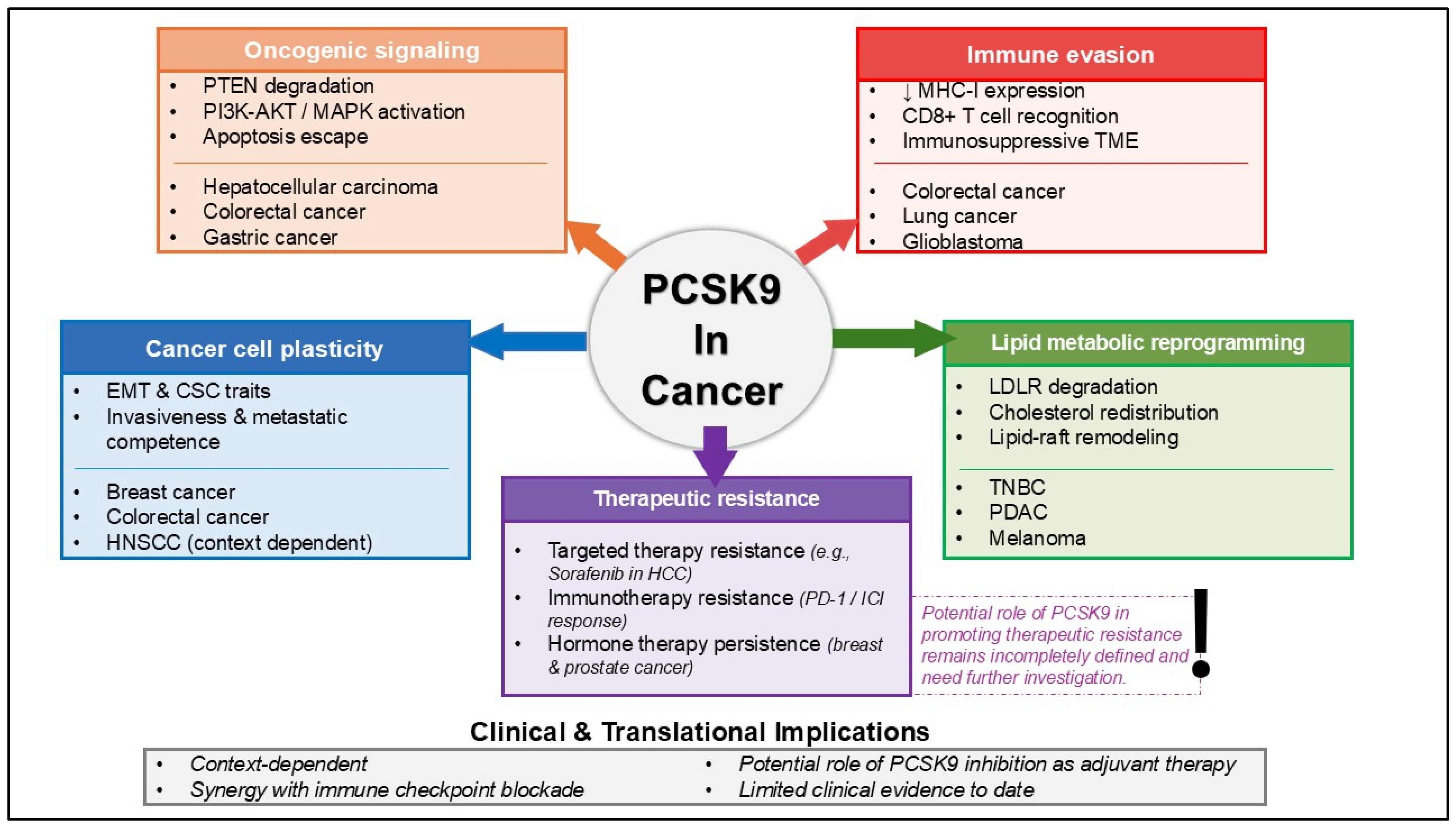
5. Mechanisms Related to the Involvement of PCSK9 in Cancer
5.1. PCSK9-Driven Oncogenic Signaling
5.2. PCSK9 and Cancer Cell Plasticity: EMT and Stemness
5.3. PCSK9 and Immune Evasion
5.4. PCSK9-Mediated Lipid Reprogramming
5.5. PCSK9, Endothelial Function, and Potential Tumor Angiogenesis
6. Genetic and Clinical Evidence
7. Contribution of PCSK9 in the Progression of Anticancer Drug Resistance
8. Conclusions and Future Directions
Author Contributions
Funding
Institutional Review Board Statement
Informed Consent Statement
Data Availability Statement
Conflicts of Interest
Abbreviations
References
- Kocarnik, J.M.; Compton, K.; Dean, F.E.; Fu, W.; Gaw, B.L.; Harvey, J.D.; Henrikson, H.J.; Lu, D.; Pennini, A.; Xu, R.; et al. Cancer Incidence, Mortality, Years of Life Lost, Years Lived With Disability, and Disability-Adjusted Life Years for 29 Cancer Groups From 2010 to 2019 A Systematic Analysis for the Global Burden of Disease Study 2019. JAMA Oncol. 2022, 8, 420–444. [Google Scholar] [CrossRef] [Scilit] [PubMed]
- Bukowski, K.; Kciuk, M.; Kontek, R. Mechanisms of Multidrug Resistance in Cancer Chemotherapy. Int. J. Mol. Sci. 2020, 21, 3233. [Google Scholar] [CrossRef] [Scilit] [PubMed]
- Han, J.; Lim, W.; You, D.; Jeong, Y.; Kim, S.; Lee, J.E.; Shin, T.H.; Lee, G.; Park, S. Chemoresistance in the Human Triple-Negative Breast Cancer Cell Line MDA-MB-231 Induced by Doxorubicin Gradient Is Associated with Epigenetic Alterations in Histone Deacetylase. J. Oncol. 2019, 2019, 1345026. [Google Scholar] [CrossRef] [Scilit] [PubMed]
- Abdulla, N.; Vincent, C.T.; Kaur, M. Mechanistic Insights Delineating the Role of Cholesterol in Epithelial Mesenchymal Transition and Drug Resistance in Cancer. Front. Cell Dev. Biol. 2021, 9, 728325. [Google Scholar] [CrossRef] [Scilit]
- Prieto-Vila, M.; Takahashi, R.U.; Usuba, W.; Kohama, I.; Ochiya, T. Drug Resistance Driven by Cancer Stem Cells and Their Niche. Int. J. Mol. Sci. 2017, 18, 2574. [Google Scholar] [CrossRef] [Scilit]
- Germain, N.; Dhayer, M.; Boileau, M.; Fovez, Q.; Kluza, J.; Marchetti, P. Lipid Metabolism and Resistance to Anticancer Treatment. Biology 2020, 9, 474. [Google Scholar] [CrossRef] [Scilit]
- Oza, P.P.; Kashfi, K. The Evolving Landscape of PCSK9 Inhibition in Cancer. Eur. J. Pharmacol. 2023, 949, 175721. [Google Scholar] [CrossRef] [Scilit]
- Abifadel, M.; Varret, M.; Rabès, J.P.; Allard, D.; Ouguerram, K.; Devillers, M.; Cruaud, C.; Benjannet, S.; Wickham, L.; Erlich, D.; et al. Mutations in PCSK9 Cause Autosomal Dominant Hypercholesterolemia. Nat. Genet. 2003, 34, 154–156. [Google Scholar] [CrossRef] [Scilit]
- Seidah, N.G.; Benjannet, S.; Wickham, L.; Marcinkiewicz, J.; Bélanger Jasmin, S.; Stifani, S.; Basak, A.; Prat, A.; Chrétien, M. The Secretory Proprotein Convertase Neural Apoptosis-Regulated Convertase 1 (NARC-1): Liver Regeneration and Neuronal Differentiation. Proc. Natl. Acad. Sci. USA 2003, 100, 928–933. [Google Scholar] [CrossRef] [Scilit]
- Horton, J.D.; Cohen, J.C.; Hobbs, H.H. Molecular Biology of PCSK9: Its Role in LDL Metabolism. Trends Biochem. Sci. 2007, 32, 71–77. [Google Scholar] [CrossRef] [Scilit]
- Lagace, T.A.; Curtis, D.E.; Garuti, R.; McNutt, M.C.; Sahng, W.P.; Prather, H.B.; Anderson, N.N.; Ho, Y.K.; Hammer, R.E.; Horton, J.D. Secreted PCSK9 Decreases the Number of LDL Receptors in Hepatocytes and in Livers of Parabiotic Mice. J. Clin. Investig. 2006, 116, 2995–3005. [Google Scholar] [CrossRef] [Scilit] [PubMed]
- Maxwell, K.N.; Fisher, E.A.; Breslow, J.L. Overexpression of PCSK9 Accelerates the Degradation of the LDLR in a Post-Endoplasmic Reticulum Compartment. Proc. Natl. Acad. Sci. USA 2005, 102, 2069–2074. [Google Scholar] [CrossRef] [Scilit] [PubMed]
- Robinson, J.G.; Nedergaard, B.S.; Rogers, W.J.; Fialkow, J.; Neutel, J.M.; Ramstad, D.; Somaratne, R.; Legg, J.C.; Nelson, P.; Scott, R.; et al. Effect of Evolocumab or Ezetimibe Added to Moderate- Or High-Intensity Statin Therapy on LDL-C Lowering in Patients with Hypercholesterolemia: The LAPLACE-2 Randomized Clinical Trial. JAMA 2014, 311, 1870–1883. [Google Scholar] [CrossRef] [Scilit]
- Robinson, J.G.; Farnier, M.; Krempf, M.; Bergeron, J.; Luc, G.; Averna, M.; Stroes, E.S.; Langslet, G.; Raal, F.J.; El Shahawy, M.; et al. Efficacy and Safety of Alirocumab in Reducing Lipids and Cardiovascular Events. N. Engl. J. Med. 2015, 372, 1489–1499. [Google Scholar] [CrossRef] [Scilit] [PubMed]
- Ray, K.K.; Wright, R.S.; Kallend, D.; Koenig, W.; Leiter, L.A.; Raal, F.J.; Bisch, J.A.; Richardson, T.; Jaros, M.; Wijngaard, P.L.J.; et al. Two Phase 3 Trials of Inclisiran in Patients with Elevated LDL Cholesterol. N. Engl. J. Med. 2020, 382, 1507–1519. [Google Scholar] [CrossRef] [Scilit]
- Sabatine, M.S.; Giugliano, R.P.; Keech, A.C.; Honarpour, N.; Wiviott, S.D.; Murphy, S.A.; Kuder, J.F.; Wang, H.; Liu, T.; Wasserman, S.M.; et al. Evolocumab and Clinical Outcomes in Patients with Cardiovascular Disease. N. Engl. J. Med. 2017, 376, 1713–1722. [Google Scholar] [CrossRef] [Scilit]
- Schwartz, G.G.; Steg, P.G.; Szarek, M.; Bhatt, D.L.; Bittner, V.A.; Diaz, R.; Edelberg, J.M.; Goodman, S.G.; Hanotin, C.; Harrington, R.A.; et al. Alirocumab and Cardiovascular Outcomes after Acute Coronary Syndrome. N. Engl. J. Med. 2018, 379, 2097–2107. [Google Scholar] [CrossRef] [Scilit]
- Schmidt, A.F.; Carter, J.-P.L.; Pearce, L.S.; Wilkins, J.T.; Overington, J.P.; Hingorani, A.D.; Casas, J.P. PCSK9 monoclonal antibodies for the primary and secondary prevention of cardiovascular disease. Cochrane Database Syst Rev. 2020, 10, CD011748. [Google Scholar] [CrossRef] [Scilit]
- Bao, X.; Liang, Y.; Chang, H.; Cai, T.; Feng, B.; Gordon, K.; Zhu, Y.; Shi, H.; He, Y.; Xie, L. Targeting Proprotein Convertase Subtilisin/Kexin Type 9 (PCSK9): From Bench to Bedside. Signal Transduct. Target. Ther. 2024, 9, 13. [Google Scholar] [CrossRef] [Scilit]
- Liu, X.; Bao, X.; Hu, M.; Chang, H.; Jiao, M.; Cheng, J.; Xie, L.; Huang, Q.; Li, F.; Li, C.Y. Inhibition of PCSK9 Potentiates Immune Checkpoint Therapy for Cancer. Nature 2020, 588, 693–698. [Google Scholar] [CrossRef] [Scilit]
- Bhattacharya, A.; Chowdhury, A.; Chaudhury, K.; Shukla, P.C. Proprotein Convertase Subtilisin/Kexin Type 9 (PCSK9): A Potential Multifaceted Player in Cancer. Biochim. Biophys. Acta Rev. Cancer 2021, 1876, 188581. [Google Scholar] [CrossRef] [Scilit]
- Sun, C.; Zhu, G.; Shen, C.; Huang, S.; Li, R.; Li, J.; Ma, Z.; Wang, Z. Identification and Validation of PCSK9 as a Prognostic and Immune-Related Influencing Factor in Tumorigenesis: A Pan-Cancer Analysis. Front. Oncol. 2023, 13, 1134063. [Google Scholar] [CrossRef] [Scilit] [PubMed]
- Wang, L.; Li, S.; Luo, H.; Lu, Q.; Yu, S. PCSK9 Promotes the Progression and Metastasis of Colon Cancer Cells through Regulation of EMT and PI3K/AKT Signaling in Tumor Cells and Phenotypic Polarization of Macrophages. J. Exp. Clin. Cancer Res. 2022, 41, 303. [Google Scholar] [CrossRef] [Scilit] [PubMed]
- Wong Chong, E.; Joncas, F.H.; Seidah, N.G.; Calon, F.; Diorio, C.; Gangloff, A. Circulating Levels of PCSK9, ANGPTL3 and Lp(a) in Stage III Breast Cancers. BMC Cancer 2022, 22, 1049. [Google Scholar] [CrossRef] [Scilit] [PubMed]
- Sun, Y.; Zhang, H.; Meng, J.; Guo, F.; Ren, D.; Wu, H.; Jin, X. S-Palmitoylation of PCSK9 Induces Sorafenib Resistance in Liver Cancer by Activating the PI3K/AKT Pathway. Cell Rep. 2022, 40, 111194. [Google Scholar] [CrossRef] [Scilit]
- Ferri, N.; Corsini, A.; Macchi, C.; Magni, P.; Ruscica, M. Proprotein Convertase Subtilisin Kexin Type 9 and High-Density Lipoprotein Metabolism: Experimental Animal Models and Clinical Evidence. Transl. Res. 2016, 173, 19–29. [Google Scholar] [CrossRef] [Scilit]
- Hummelgaard, S.; Vilstrup, J.P.; Gustafsen, C.; Glerup, S.; Weyer, K. Targeting PCSK9 to Tackle Cardiovascular Disease. Pharmacol. Ther. 2023, 249, 108480. [Google Scholar] [CrossRef] [Scilit]
- Xia, X.D.; Peng, Z.S.; Gu, H.M.; Wang, M.; Wang, G.Q.; Zhang, D.W. Regulation of PCSK9 Expression and Function: Mechanisms and Therapeutic Implications. Front. Cardiovasc. Med. 2021, 8, 764038. [Google Scholar] [CrossRef] [Scilit]
- Abifadel, M.; Rabès, J.P.; Devillers, M.; Munnich, A.; Erlich, D.; Junien, C.; Varret, M.; Boileau, C. Mutations and Polymorphisms in the Proprotein Convertase Subtilisin Kexin 9 (PCSK9) Gene in Cholesterol Metabolism and Disease. Hum. Mutat. 2009, 30, 520–529. [Google Scholar] [CrossRef] [Scilit]
- Cohen, J.C.; Boerwinkle, E.; Mosley, T.H.; Hobbs, H.H. Sequence Variations in PCSK9, Low LDL, and Protection against Coronary Heart Disease. N. Engl. J. Med. 2006, 354, 1264–1272. [Google Scholar] [CrossRef] [Scilit]
- Chen, H.; Chen, X. PCSK9 Inhibitors for Acute Coronary Syndrome: The Era of Early Implementation. Front. Cardiovasc. Med. 2023, 10, 1138787. [Google Scholar] [CrossRef] [Scilit] [PubMed]
- Lagace, T.A. PCSK9 and LDLR Degradation: Regulatory Mechanisms in Circulation and in Cells. Curr. Opin. Lipidol. 2014, 25, 387–393. [Google Scholar] [CrossRef] [Scilit] [PubMed]
- Raedler, L.A. Praluent (Alirocumab): First PCSK9 Inhibitor Approved by the FDA for Hypercholesterolemia. Am. Health Drug Benefits 2016, 9, 123. [Google Scholar] [PubMed]
- Fala, L. Repatha (Evolocumab): Second PCSK9 Inhibitor Approved by the FDA for Patients with Familial Hypercholesterolemia. Am. Health Drug Benefits 2016, 9, 136. [Google Scholar]
- Cicero, A.F.G.; Fogacci, F.; Zambon, A.; Toth, P.P.; Borghi, C. Efficacy and Safety of Inclisiran a Newly Approved FDA Drug: A Systematic Review and Pooled Analysis of Available Clinical Studies. Am. Heart J. Plus Cardiol. Res. Pract. 2022, 13, 100127. [Google Scholar] [CrossRef] [Scilit]
- Santos, C.R.; Schulze, A. Lipid Metabolism in Cancer. FEBS J. 2012, 279, 2610–2623. [Google Scholar] [CrossRef] [Scilit]
- Snaebjornsson, M.T.; Janaki-Raman, S.; Schulze, A. Greasing the Wheels of the Cancer Machine: The Role of Lipid Metabolism in Cancer. Cell Metab. 2020, 31, 62–76. [Google Scholar] [CrossRef] [Scilit]
- Koundouros, N.; Poulogiannis, G. Reprogramming of Fatty Acid Metabolism in Cancer. Br. J. Cancer 2020, 122, 4–22. [Google Scholar] [CrossRef] [Scilit]
- Griffiths, B.; Lewis, C.A.; Bensaad, K.; Ros, S.; Zhang, Q.; Ferber, E.C.; Konisti, S.; Peck, B.; Miess, H.; East, P.; et al. Sterol Regulatory Element Binding Protein-Dependent Regulation of Lipid Synthesis Supports Cell Survival and Tumor Growth. Cancer Metab. 2013, 1, 3. [Google Scholar] [CrossRef] [Scilit]
- Wen, Y.A.; Xiong, X.; Zaytseva, Y.Y.; Napier, D.L.; Vallee, E.; Li, A.T.; Wang, C.; Weiss, H.L.; Evers, B.M.; Gao, T. Downregulation of SREBP Inhibits Tumor Growth and Initiation by Altering Cellular Metabolism in Colon Cancer Article. Cell Death Dis. 2018, 9, 265. [Google Scholar] [CrossRef] [Scilit]
- Bensaad, K.; Favaro, E.; Lewis, C.A.; Peck, B.; Lord, S.; Collins, J.M.; Pinnick, K.E.; Wigfield, S.; Buffa, F.M.; Li, J.L.; et al. Fatty Acid Uptake and Lipid Storage Induced by HIF-1α Contribute to Cell Growth and Survival after Hypoxia-Reoxygenation. Cell Rep. 2014, 9, 349–365. [Google Scholar] [CrossRef] [Scilit] [PubMed]
- Jin, Y.; Tan, Y.; Wu, J.; Ren, Z. Lipid Droplets: A Cellular Organelle Vital in Cancer Cells. Cell Death Discov. 2023, 9, 1–9. [Google Scholar] [CrossRef] [Scilit] [PubMed]
- Simons, K.; Ikonen, E. Functional Rafts in Cell Membranes. Nature 1997, 387, 569–572. [Google Scholar] [CrossRef] [Scilit] [PubMed]
- Huang, B.; Song, B.-L.; Xu, C. Cholesterol Metabolism in Cancer: Mechanisms and Therapeutic Opportunities. Nat. Metab. 2020, 2, 132–141. [Google Scholar] [CrossRef] [Scilit]
- Civita, S.; Ruglioni, M.; Mariangeli, M.; Barachini, S.; Salvadori, T.; Cristiani, S.; Carnicelli, V.; Petrini, I.; Nepita, I.; Castello, M.; et al. Nanoscale Engagement of Programmed Death Ligand 1 (PD-L1) in Membrane Lipid Raft Domains of Cancer Cells. FEBS J. 2025, 292, 5979–5997. [Google Scholar] [CrossRef] [Scilit]
- Pascual, G.; Avgustinova, A.; Mejetta, S.; Martín, M.; Castellanos, A.; Attolini, C.S.O.; Berenguer, A.; Prats, N.; Toll, A.; Hueto, J.A.; et al. Targeting Metastasis-Initiating Cells through the Fatty Acid Receptor CD36. Nature 2017, 541, 41–45. [Google Scholar] [CrossRef] [Scilit]
- Peetla, C.; Vijayaraghavalu, S.; Labhasetwar, V. Biophysics of Cell Membrane Lipids in Cancer Drug Resistance: Implications for Drug Transport and Drug Delivery with Nanoparticles. Adv. Drug Deliv. Rev. 2013, 65, 1686–1698. [Google Scholar] [CrossRef] [Scilit]
- Li, J.; Dong, L.; Wei, D.; Wang, X.; Zhang, S.; Li, H. Fatty Acid Synthase Mediates the Epithelial-Mesenchymal Transition of Breast Cancer Cells. Int. J. Biol. Sci. 2014, 10, 171–180. [Google Scholar] [CrossRef] [Scilit]
- Li, H.; Feng, Z.; He, M.L. Lipid Metabolism Alteration Contributes to and Maintains the Properties of Cancer Stem Cells. Theranostics 2020, 10, 7053–7069. [Google Scholar] [CrossRef] [Scilit]
- Liu, H.; Zhang, Z.; Song, L.; Gao, J.; Liu, Y. Lipid Metabolism of Cancer Stem Cells (Review). Oncol. Lett. 2022, 23, 119. [Google Scholar] [CrossRef] [Scilit]
- Cui, C.; Yan, A.; Huang, S.; Chen, Y.; Zhao, J.; Li, C.; Wang, X.; Yang, J. PCSK9 Manipulates Lipid Metabolism and the Immune Microenvironment in Cancer. Onco Targets Ther. 2025, 18, 411–427. [Google Scholar] [CrossRef] [Scilit]
- Wang, H.; Zhang, X.; Zhang, Y.; Shi, T.; Zhang, Y.; Song, X.; Liu, B.; Wang, Y.; Wei, J. Targeting PCSK9 to Upregulate MHC-II on the Surface of Tumor Cells in Tumor Immunotherapy. BMC Cancer 2024, 24, 445. [Google Scholar] [CrossRef] [Scilit]
- Wong, C.C.; Wu, J.L.; Ji, F.; Kang, W.; Bian, X.; Chen, H.; Chan, L.S.; Luk, S.T.Y.; Tong, S.; Xu, J.; et al. The Cholesterol Uptake Regulator PCSK9 Promotes and Is a Therapeutic Target in APC/KRAS-Mutant Colorectal Cancer. Nat. Commun. 2022, 13, 3971. [Google Scholar] [CrossRef] [Scilit] [PubMed]
- Gu, Y.; Lin, X.; Dong, Y.; Wood, G.; Seidah, N.G.; Werstuck, G.; Major, P.; Bonert, M.; Kapoor, A.; Tang, D. PCSK9 Facilitates Melanoma Pathogenesis via a Network Regulating Tumor Immunity. J. Exp. Clin. Cancer Res. 2023, 42, 2. [Google Scholar] [CrossRef] [Scilit] [PubMed]
- Ungvari, Z.; Menyhart, O.; Lehoczki, A.; Fekete, M.; Bianchini, G.; Győrffy, B. PCSK9 Expression and Cancer Survival: A Prognostic Biomarker at the Intersection of Oncology and Geroscience. Geroscience 2025. [Google Scholar] [CrossRef] [Scilit] [PubMed]
- Momtazi-Borojeni, A.A.; Nik, M.E.; Jaafari, M.R.; Banach, M.; Sahebkar, A. Effects of Immunization against PCSK9 in an Experimental Model of Breast Cancer. Arch. Med. Sci. 2019, 15, 570–579. [Google Scholar] [CrossRef] [Scilit]
- Quagliariello, V.; Buccolo, S.; Iovine, M.; Paccone, A.; Bonelli, A.; Cavalcanti, E.; Rea, D.; De Laurentiis, M.; Botti, G.; Maurea, N. PCSK9 Inhibitor Evolocumab to Increase Anticancer Activities and Reduce Cardiotoxicity during Doxorubicin and Trastuzumab, as Sequential Treatment, through MyD88/NF-KB/MTORC1 Pathways. J. Clin. Oncol. 2021, 39, e15039. [Google Scholar] [CrossRef] [Scilit]
- Li, T.; Wu, R.; Luo, K.Q. PCSK9 Promotes the Malignancy of Triple-negative Breast Cancer Cells by Reducing Cholesterol Levels at the Plasma Membrane to Activate EGFR and HER3. Adv. Sci. 2025, 12, e2408514. [Google Scholar] [CrossRef] [Scilit]
- Yang, Q.C.; Wang, S.; Liu, Y.T.; Song, A.; Wu, Z.Z.; Wan, S.C.; Li, H.M.; Sun, Z.J. Targeting PCSK9 Reduces Cancer Cell Stemness and Enhances Antitumor Immunity in Head and Neck Cancer. iScience 2023, 26, 106916. [Google Scholar] [CrossRef] [Scilit]
- Kim, H.-J.; Park, D.-G.; Choi, S.-J.; Cho, S.-D. PCSK9 Is a Passenger Gene in Head and Neck Cancer with Minimal Pathological Influence. Arch. Oral Biol. 2025, 176, 106302. [Google Scholar] [CrossRef] [Scilit]
- Zhang, S.Z.; Zhu, X.D.; Feng, L.H.; Li, X.L.; Liu, X.F.; Sun, H.C.; Tang, Z.Y. PCSK9 Promotes Tumor Growth by Inhibiting Tumor Cell Apoptosis in Hepatocellular Carcinoma. Exp. Hematol. Oncol. 2021, 10, 25. [Google Scholar] [CrossRef] [Scilit] [PubMed]
- Xu, B.; Li, S.; Fang, Y.; Zou, Y.; Song, D.; Zhang, S.; Cai, Y. Proprotein Convertase Subtilisin/Kexin Type 9 Promotes Gastric Cancer Metastasis and Suppresses Apoptosis by Facilitating MAPK Signaling Pathway Through HSP70 Up-Regulation. Front. Oncol. 2021, 10, 609663. [Google Scholar] [CrossRef] [Scilit] [PubMed]
- Xu, X.; Cui, Y.; Cao, L.; Zhang, Y.; Yin, Y.; Hu, X. PCSK9 Regulates Apoptosis in Human Lung Adenocarcinoma A549 Cells via Endoplasmic Reticulum Stress and Mitochondrial Signaling Pathways. Exp. Ther. Med. 2017, 13, 1993–1999. [Google Scholar] [CrossRef] [Scilit] [PubMed]
- Gao, X.; Yi, L.; Jiang, C.; Li, S.; Wang, X.; Yang, B.; Li, W.; Che, N.; Wang, J.; Zhang, H.; et al. PCSK9 Regulates the Efficacy of Immune Checkpoint Therapy in Lung Cancer. Front. Immunol. 2023, 14, 1142428. [Google Scholar] [CrossRef] [Scilit]
- Wang, R.; Liu, H.; He, P.; An, D.; Guo, X.; Zhang, X.; Feng, M. Inhibition of PCSK9 Enhances the Antitumor Effect of PD-1 Inhibitor in Colorectal Cancer by Promoting the Infiltration of CD8+ T Cells and the Exclusion of Treg Cells. Front. Immunol. 2022, 13, 947756. [Google Scholar] [CrossRef] [Scilit]
- Sun, X.; Essalmani, R.; Day, R.; Khatib, A.M.; Seidah, N.G.; Prat, A. Proprotein Convertase Subtilisin/Kexin Type 9 Deficiency Reduces Melanoma Metastasis in Liver. Neoplasia 2012, 14, 1122-IN5. [Google Scholar] [CrossRef] [Scilit]
- Singh, K.; Foster, M.W.; Violette, M.J.; Corcoran, A.M.; Hotchkiss, K.M.; Railton, C.O.; Blandford, E.E.; Blethen, K.E.; Thomas, E.L.; McIntosh, W.C.; et al. A Surgical Window of Opportunity Trial Evaluating the Effect of the PCSK9 Inhibitor Evolocumab on Tumoral MHC-I Expression and CD8+ Infiltration in Glioma. Sci. Rep. 2025, 15, 37112. [Google Scholar] [CrossRef] [Scilit]
- Rademaker, G.; Hernandez, G.A.; Seo, Y.; Dahal, S.; Miller-Phillips, L.; Li, A.L.; Peng, X.L.; Luan, C.; Qiu, L.; Liegeois, M.A.; et al. PCSK9 Drives Sterol-Dependent Metastatic Organ Choice in Pancreatic Cancer. Nature 2025, 643, 1381–1390. [Google Scholar] [CrossRef] [Scilit]
- Gan, S.S.; Ye, J.Q.; Wang, L.; Qu, F.J.; Chu, C.M.; Tian, Y.J.; Yang, W.; Cui, X.G. Inhibition of PCSK9 Protects against Radiationinduced Damage of Prostate Cancer Cells. Onco Targets Ther. 2017, 10, 2139–2146. [Google Scholar] [CrossRef] [Scilit]
- Abdelwahed, K.S.; Siddique, A.B.; Qusa, M.H.; King, J.A.; Souid, S.; Abd Elmageed, Z.Y.; El Sayed, K.A. PCSK9 Axis-Targeting Pseurotin A as a Novel Prostate Cancer Recurrence Suppressor Lead. ACS Pharmacol. Transl. Sci. 2021, 4, 1771–1781. [Google Scholar] [CrossRef] [Scilit]
- Abdelwahed, K.S.; Siddique, A.B.; Ebrahim, H.Y.; Qusa, M.H.; Mudhish, E.A.; Rad, A.H.; Zerfaoui, M.; Abd Elmageed, Z.Y.; El Sayed, K.A. Pseurotin A Validation as a Metastatic Castration-Resistant Prostate Cancer Recurrence-Suppressing Lead via PCSK9-LDLR Axis Modulation. Mar. Drugs 2023, 21, 215. [Google Scholar] [CrossRef] [Scilit] [PubMed]
- Wang, H.; Guo, Q.; Wang, M.; Liu, C.; Tian, Z. PCSK9 Promotes Tumor Cell Proliferation and Migration by Facilitating CCL25 Secretion in Esophageal Squamous Cell Carcinoma. Oncol. Lett. 2023, 26, 500. [Google Scholar] [CrossRef] [Scilit] [PubMed]
- Ito, M.; Hiwasa, T.; Oshima, Y.; Yajima, S.; Suzuki, T.; Nanami, T.; Sumazaki, M.; Shiratori, F.; Funahashi, K.; Li, S.Y.; et al. Association of Serum Anti-PCSK9 Antibody Levels with Favorable Postoperative Prognosis in Esophageal Cancer. Front. Oncol. 2021, 11, 708039. [Google Scholar] [CrossRef] [Scilit] [PubMed]
- He, M.; Hu, J.; Fang, T.; Tang, W.; Lv, B.; Yang, B.; Xia, J. Protein Convertase Subtilisin/Kexin Type 9 Inhibits Hepatocellular Carcinoma Growth by Interacting with GSTP1 and Suppressing the JNK Signaling Pathway. Cancer Biol. Med. 2022, 19, 90–103. [Google Scholar] [CrossRef] [Scilit]
- Wang, Q.; Chen, Z.; Lu, X.; Lin, H.; Feng, H.; Weng, N.; Chen, L.; Liu, M.; Long, L.; Huang, L.; et al. Methionine Metabolism Dictates PCSK9 Expression and Antitumor Potency of PD-1 Blockade in MSS Colorectal Cancer. Adv. Sci. 2025, 12, e2501623. [Google Scholar] [CrossRef] [Scilit]
- Piao, M.X.; Bai, J.W.; Zhang, P.F.; Zhang, Y.Z. PCSK9 Regulates Apoptosis in Human Neuroglioma U251 Cells via Mitochondrial Signaling Pathways. Int. J. Clin. Exp. Pathol. 2015, 8, 2787. [Google Scholar]
- Naslavsky, N.; Weigert, R.; Donaldson, J.G. Characterization of a Nonclathrin Endocytic Pathway: Membrane Cargo and Lipid Requirements. Mol. Biol. Cell 2004, 15, 3542–3552. [Google Scholar] [CrossRef] [Scilit]
- Sun, S.; Ma, J.; Zuo, T.; Shi, J.; Sun, L.; Meng, C.; Shu, W.; Yang, Z.; Yao, H.; Zhang, Z. Inhibition of PCSK9: A Promising Enhancer for Anti-PD-1/PD-L1 Immunotherapy. Research 2024, 7, 0488. [Google Scholar] [CrossRef] [Scilit]
- Seidah, N.G.; Prat, A. The Multifaceted Biology of PCSK9. Endocr. Rev. 2021, 43, 558–582. [Google Scholar] [CrossRef] [Scilit]
- Zhang, D.W.; Garuti, R.; Tang, W.J.; Cohen, J.C.; Hobbs, H.H. Structural Requirements for PCSK9-Mediated Degradation of the Low-Density Lipoprotein Receptor. Proc. Natl. Acad. Sci. USA 2008, 105, 13045–13050. [Google Scholar] [CrossRef] [Scilit]
- Poirier, S.; Mayer, G.; Benjannet, S.; Bergeron, E.; Marcinkiewicz, J.; Nassoury, N.; Mayer, H.; Nimpf, J.; Prat, A.; Seidah, N.G. The Proprotein Convertase PCSK9 Induces the Degradation of Low Density Lipoprotein Receptor (LDLR) and Its Closest Family Members VLDLR and ApoER2. J. Biol. Chem. 2008, 283, 2363–2372. [Google Scholar] [CrossRef] [Scilit] [PubMed]
- Ajoolabady, A.; Pratico, D.; Mazidi, M.; Davies, I.G.; Lip, G.Y.H.; Seidah, N.; Libby, P.; Kroemer, G.; Ren, J. PCSK9 in Metabolism and Diseases. Metabolism 2025, 163, 156064. [Google Scholar] [CrossRef] [Scilit] [PubMed]
- Tsouka, A.; Koutsaliaris, I.; Tselepis, A. Recombinant PCSK9 Enhances Angiogenesis in Endothelial Cells, While Lipoproteins Suppress Vegf-Induced Angiogenic Activity in Vitro. Atherosclerosis 2025, 407, 119702. [Google Scholar] [CrossRef] [Scilit]
- Gao, J.J.; Wu, F.Y.; Liu, Y.J.; Li, L.; Lin, Y.J.; Kang, Y.T.; Peng, Y.M.; Liu, Y.F.; Wang, C.; Ma, Z.S.; et al. Increase of PCSK9 Expression in Diabetes Promotes VEGFR2 Ubiquitination to Inhibit Endothelial Function and Skin Wound Healing. Sci. China Life Sci. 2024, 67, 2635–2649. [Google Scholar] [CrossRef] [Scilit]
- Zhang, M.; Chen, Y.; Qiu, Y.; Sun, J.; He, J.; Liu, Z.; Shi, J.; Wei, W.; Wu, G.; Liang, J. PCSK9 Promotes Hypoxia-Induced EC Pyroptosis by Regulating Smac Mitochondrion-Cytoplasm Translocation in Critical Limb Ischemia. JACC Basic Transl. Sci. 2023, 8, 1060–1077. [Google Scholar] [CrossRef] [Scilit]
- Fang, S.; Yarmolinsky, J.; Gill, D.; Bull, C.J.; Perks, C.M.; Smith, G.D.; Gaunt, T.R.; Richardson, T.G. Association between Genetically Proxied PCSK9 Inhibition and Prostate Cancer Risk: A Mendelian Randomisation Study. PLoS Med. 2023, 20, e1003988. [Google Scholar] [CrossRef] [Scilit] [PubMed]
- WEISS, T.S.; BUECHLER, C. Proprotein Convertase Subtilisin/Kexin Type 9 Induction in Hypercholesterinemic Patients with Primary and Metastatic Liver Tumors. Anticancer Res. 2025, 45, 1171–1180. [Google Scholar] [CrossRef] [Scilit]
- ClinicalTrials.gov. A Phase I Clinical Study to Evaluate the Safety, Tolerability, Pharmacokinetics and Preliminary Efficacy of Recombinant Humanized Anti-PCSK9 Monoclonal Antibody (JS002) Combined with Toripalimab in Patients with Advanced Cancer; Identifier: NCT05128539. National Library of Medicine (US): Bethesda, MD, USA, 2022. Available online: https://clinicaltrials.gov/study/NCT05128539 (accessed on 20 December 2025).
- ClinicalTrials.gov. A Phase II Study Bolstering Outcomes by Optimizing Immunotherapy Strategies with Evolocumab and Nivolumab in Patients with Metastatic Renal Cell Carcinoma (BOOST-RCC); Identifier: NCT06284564. National Library of Medicine (US): Bethesda, MD, USA, 2024. Available online: https://clinicaltrials.gov/study/NCT06284564 (accessed on 20 December 2025).
- ClinicalTrials.gov. A Phase II Study of PCSK9 Inhibitor Alirocumab and PD-1 Inhibitor Cemiplimab in Patients with Metastatic, Refractory To Prior Anti PD-1 Non-small Cell Lung Cancer: TOP2201; Identifier: NCT05553834. National Library of Medicine (US): Bethesda, MD, USA, 2023. Available online: https://clinicaltrials.gov/study/NCT05553834 (accessed on 20 December 2025).
- Abdelwahed, K.S.; Siddique, A.B.; Mohyeldin, M.M.; Qusa, M.H.; Goda, A.A.; Singh, S.S.; Ayoub, N.M.; King, J.A.; Jois, S.D.; El Sayed, K.A. Pseurotin A as a Novel Suppressor of Hormone Dependent Breast Cancer Progression and Recurrence by Inhibiting PCSK9 Secretion and Interaction with LDL Receptor. Pharmacol. Res. 2020, 158, 104847. [Google Scholar] [CrossRef] [Scilit]
- Xu, W.; Hu, M.; Lu, X.; Lao, Y.; Ma, N.; Wang, Y.; Li, J.; Chen, X.; Liu, S.; Liu, J.; et al. Inhibition of PCSK9 Enhances the Anti-Hepatocellular Carcinoma Effects of TCR-T Cells and Anti-PD-1 Immunotherapy. Int. J. Biol. Sci. 2024, 20, 3942–3955. [Google Scholar] [CrossRef] [Scilit]
- Lao, M.; Zhang, X.; Li, Z.; Sun, K.; Yang, H.; Wang, S.; He, L.; Chen, Y.; Zhang, H.; Shi, J.; et al. Lipid Metabolism Reprograming by SREBP1-PCSK9 Targeting Sensitizes Pancreatic Cancer to Immunochemotherapy. Cancer Commun. 2025, 45, 1010–1037. [Google Scholar] [CrossRef] [Scilit]
- Li, Y.; Zhou, S.; Fu, W.; Li, X.; Chen, T.; Le, H.; Xu, Y.; Tang, Y.; Mi, P.; Gao, H.; et al. A Versatile Immunomodulated NanoCRISPR Converter Augments the Susceptibility and Visibility of Tumors to the Immune System. Proc. Natl. Acad. Sci. USA 2025, 122, e2415100122. [Google Scholar] [CrossRef] [Scilit]
- Scalambra, L.; Ruzzi, F.; Pittino, O.M.; Semprini, M.S.; Cappello, C.; Angelicola, S.; Palladini, A.; Nanni, P.; Goksøyr, L.; Fougeroux, C.; et al. Targeting PCSK9, through an Innovative CVLP-Based Vaccine, Enhanced the Therapeutic Activity of a CVLP-HER2 Vaccine in a Preclinical Model of HER2-Positive Mammary Carcinoma. J. Transl. Med. 2025, 23, 136. [Google Scholar] [CrossRef] [Scilit]
- Ahmed, N.A.; Mohyeldin, M.M.; Ebrahim, H.Y.; McGehee, O.C.; Tarun, M.T.I.; El Sayed, K.A. (−)-Oleuropein as a Novel Metastatic Castration-Resistant Prostate Cancer Progression and Recurrence Suppressor via Targeting PCSK9-LDLR Axis. Nutrients 2025, 17, 1445. [Google Scholar] [CrossRef] [Scilit]

| Functional Axis/Mechanisms | Mediators | Roles | Mechanistic Association with PCSK9 | Ref. |
|---|---|---|---|---|
| Antigen presentation/immune evasion | MHC class I (MHC-I/HLA-I) | Downstream molecular mediator | PCSK9 associates with MHC-I and promotes lysosomal degradation, reducing tumor cell surface MHC-I and antigen presentation. | [20] |
| Antitumor immunity | CD8+ T cells | Downstream cellular consequence | PCSK9 inhibition or knockdown increases intratumoral CD8+ T cell infiltration and improves antitumor activity, which is often enhanced with anti-PD-1. | [20] |
| Immunotherapy sensitization | Regulatory T cells (Tregs) | Downstream cellular consequence | PCSK9 inhibition enhances the antitumor effect of PD-1 blockade in CRC models and is reported to promote CD8+ infiltration with Treg exclusion. | [65] |
| LDLR-axis phenotypes | LDLR | Downstream molecular mediator | Canonical PCSK9 target; in cancer cells, PCSK9-driven LDLR turnover reshapes membrane cholesterol and lipid-raft organization, which can enhance receptor-dependent signaling and downstream malignant behaviors in a tumor type-dependent manner. | [58] |
| Growth factor signaling | EGFR & HER3 | Downstream signaling effector | PCSK9-LDLR-dependent plasma membrane cholesterol or lipid-raft remodeling is associated with increased EGFR and HER3 activation and malignant phenotypes in TNBC models. | [58] |
| Migration | CCL25 | Downstream effector | PCSK9 promotes ESCC proliferation/migration by facilitating CCL25 secretion. | [72] |
| Metastasis/apoptosis resistance | HSP70 | Downstream effector | PCSK9 upregulates HSP70 and facilitates MAPK signaling, linked to apoptosis suppression and metastasis in gastric cancer models. | [62] |
| Drug resistance | ZDHHC16 | Upstream regulator | ZDHHC16 mediates S-palmitoylation of PCSK9, increasing PCSK9-PTEN interaction and contributing to sorafenib resistance in HCC models. | [25] |
| Drug resistance | PTEN | Downstream effector | Palmitoylated PCSK9 promotes lysosomal PTEN degradation → AKT activation → reduced sorafenib sensitivity. | [25] |
| Tumor suppression | GSTP1 | Downstream interacting partner | PCSK9 interacts with GSTP1 and suppresses JNK signaling; reported tumor-suppressive effect in an HCC study. | [74] |
| Transcriptional regulation | DNMT1 & SIRT6 | Upstream epigenetic regulator | Methionine/SAM axis promotes PCSK9 transcription via DNMT1-dependent DNA methylation in colorectal cancer; reduced SIRT6 is linked to increased PCSK9 transcription within the same CRC methionine-PCSK9 axis. | [75] |
| Modality/Drug | Target and Mechanism of Action | Relevance in Cancer | Oncology Clinical Evaluation | Ref. |
|---|---|---|---|---|
| Evolocumab (mAb) | Neutralizes circulating PCSK9, preventing PCSK9-mediated LDLR degradation and enhancing LDLR recycling. | In preclinical tumor models, PCSK9 inhibition increases tumor cell surface MHC-I by preventing lysosomal degradation, improves antigen presentation, and synergizes with anti-PD-1 therapy. | Phase II: Registered oncology trial of evolocumab combined with Nivolumab PD-1 blockade in metastatic renal cell carcinoma. | [20,89] |
| Alirocumab (mAb) | Neutralizes circulating PCSK9, preventing PCSK9-mediated LDLR degradation and enhancing LDLR recycling. | Mechanistically expected to enhance antitumor immunity through PCSK9 inhibition based on the PCSK9-MHC-I axis; supports combination strategies with immune checkpoint blockade. | Phase II: Registered oncology trial of alirocumab combined with Cemiplimab PD-1 blockade in metastatic non-small cell lung cancer after ICI progression. | [90] |
| JS002 (mAb) | Neutralizes circulating PCSK9, preventing PCSK9-mediated LDLR degradation and enhancing LDLR recycling. | Evaluated clinically in combination with a PD-1 inhibitor for safety and preliminary efficacy in advanced solid tumors. | Phase I: JS002 in combination with toripalimab in advanced solid tumors (safety and preliminary efficacy). The trial has been terminated considering the prespecified efficacy criteria were not met. | [88] |
| Inclisiran (siRNA) | Hepatocyte-targeted siRNA that suppresses hepatic PCSK9 synthesis. | Provides sustained systemic PCSK9 suppression; proposed to relieve PCSK9-mediated immune evasion and support immunotherapy efficacy. | No established oncology trials identified (approved for lipid lowering; oncology relevance is currently rationale-based). | [15] |
| PCSK9 vaccine (experimental) | Active immunization to induce endogenous anti-PCSK9 antibodies enabling long-term PCSK9 neutralization. | Potential strategy for durable PCSK9 suppression to support long-term cancer immunotherapy combinations. | Preclinical. | [56] |
| Small-molecule/natural product PCSK9-axis inhibitors (e.g., pseurotin A) | Suppress PCSK9 expression and/or disrupt PCSK9-LDLR interaction. | Reduce migration, clonogenic growth, and recurrence in prostate and breast cancer models; useful for probing PCSK9-LDLR axis draggability. | Preclinical. | [70,71,91] |
| Genetic depletion (siRNA/CRISPR) | Direct suppression or deletion of PCSK9 in tumor or host cells. | Demonstrates tumor-intrinsic and host-mediated roles of PCSK9 in immune evasion, metastasis, and therapy resistance. | Not applicable (mechanistic validation). | [20] |
Disclaimer/Publisher’s Note: The statements, opinions and data contained in all publications are solely those of the individual author(s) and contributor(s) and not of MDPI and/or the editor(s). MDPI and/or the editor(s) disclaim responsibility for any injury to people or property resulting from any ideas, methods, instructions or products referred to in the content. |
© 2025 by the authors. Licensee MDPI, Basel, Switzerland. This article is an open access article distributed under the terms and conditions of the Creative Commons Attribution (CC BY) license.
Share and Cite
Azmi, N.U.; Syahdi, R.R.; Puteri, M.U.; Yanuar, A.; Kato, M.; Saputri, F.C. PCSK9 in Cancer: Biological Mechanisms and Implications for Therapeutic Resistance. Biomolecules 2026, 16, 67. https://doi.org/10.3390/biom16010067
Azmi NU, Syahdi RR, Puteri MU, Yanuar A, Kato M, Saputri FC. PCSK9 in Cancer: Biological Mechanisms and Implications for Therapeutic Resistance. Biomolecules. 2026; 16(1):67. https://doi.org/10.3390/biom16010067
Chicago/Turabian StyleAzmi, Nuriza Ulul, Rezi Riadhi Syahdi, Meidi Utami Puteri, Arry Yanuar, Mitsuyasu Kato, and Fadlina Chany Saputri. 2026. "PCSK9 in Cancer: Biological Mechanisms and Implications for Therapeutic Resistance" Biomolecules 16, no. 1: 67. https://doi.org/10.3390/biom16010067
APA StyleAzmi, N. U., Syahdi, R. R., Puteri, M. U., Yanuar, A., Kato, M., & Saputri, F. C. (2026). PCSK9 in Cancer: Biological Mechanisms and Implications for Therapeutic Resistance. Biomolecules, 16(1), 67. https://doi.org/10.3390/biom16010067