


Abstract
Polymyxins, including polymyxin B (PMB), are last-resort antibiotics against multidrug-resistant Gram-negative infections in humans and livestock. Residual polymyxins from wastewater and manure can accumulate in soil, facilitating the emergence and spread of polymyxin resistance. Paenibacillus polymyxa, a natural polymyxin producer used in crop cultivation, may increase soil polymyxin burden. Since PMB strongly adsorbs to soil, its reliable quantification has been challenging. To address this, the extraction solvent and solid-phase extraction procedure were optimized to improve recovery and reduce matrix effects. We developed and validated a UPLC-MS/MS method to quantify PMB in soil. The method showed linearity (10–1000 ng/g), with a limit of detection of 0.86 ng/g and a limit of quantification of 2.12 ng/g. Method validation confirmed acceptable analytical performance. A 28-day monitoring of PMB in soil inoculated with varying P. polymyxa doses revealed a dose-dependent increase over the first 14 days, followed by a decline; PMB remained detectable on day 28. Ecological risk assessment using the risk quotient (RQ) indicated that PMB levels in the high-dose group (2 × 10⁸ CFU/100 g) approached the high-risk threshold (RQ ≥ 1) on day 14, while lower doses posed low to medium risk. This work provides a soil PMB quantification method and insight into the ecological risk of P. polymyxa application.
1. Introduction
The overuse and misuse of antimicrobial drugs is increasingly leading to a rise in the global threat of antimicrobial resistance (AMR) [1]. By 2050, antibiotic resistance is estimated to cause up to 10 million deaths annually, which will far exceed the current estimate of about 700,000 deaths per year [2]. The widespread emergence of multidrug-resistant (MDR) and extensively drug-resistant (XDR) bacteria has made the selection and use of effective antibiotics increasingly challenging [3]. Polymyxins [polymyxin B (PMB) and polymyxin E (PME or colistin)] are associated with dose-dependent nephrotoxicity and neurotoxicity in humans and animals, which mainly manifest as acute kidney injury and neuromuscular disturbances [4,5]. Nevertheless, they have been reintroduced as the last line of defense against MDR Gram-negative pathogens [6]. A substantial proportion of globally produced polymyxins is currently used in food-producing animals (i.e., cattle and swine) for prophylactic, therapeutic, and growth promotion purposes [7]. Under the One Health framework, the surge in polymyxin resistance driven by its intensive usage poses a serious threat to the human–animal–environment ecosystem [8]. Initially, polymyxin resistance was believed to be solely chromosome-mediated and thus less likely to be transmitted [9]. However, the discovery of the first plasmid-mediated mobile colistin resistance (mcr-1) gene revealed an exponential increase in the global prevalence and dissemination of polymyxin resistance [10]. To date, mcr-1 and its nine homologs (mcr-2 to mcr-10) have been found disseminated worldwide and detected across humans, animals, and environmental reservoirs in over 60 countries [11]. The extensive utilization of polymyxins in medical and agricultural sectors acts as a potential source of AMR risk in soil environments. Evidence indicates that polymyxins are incompletely absorbed in humans and livestock, including sheep, cattle, and poultry [6,12]. A significant fraction of polymyxins is released into environmental matrices (clinical wastewater and animal manure) via the fecal and urinary routes. In many countries, particularly in livestock-producing regions of Asia and Latin America, these polymyxin-contaminated environmental matrices are applied to agricultural soil without proper treatment as part of crop management measures (irrigation or manure). Polymyxin residues in soils can enter both surface and ground waters. They may also be taken up by crops, ultimately returning to humans and livestock via drinking water and the food chain. However, published quantitative data on polymyxin concentrations in agricultural soils, manure, wastewater, and drinking water remain scarce, and environmental guideline values specifically for polymyxins in these matrices have not yet been established. As a central reservoir in this cycle, polymyxin-contaminated soils, together with associated AMR risks, have become a growing concern worldwide.
Soil is the largest reservoir of antibiotic-resistant bacteria (ARB) and antibiotic resistance genes (ARGs) [13]. In addition to the direct introduction of ARB and ARGs into soils through agricultural practices such as manure fertilization and wastewater irrigation [14,15], clinically and agriculturally used antibiotics exert selective pressure that further promotes ARB and ARG emergence and spread in soil [16]. Researchers have found a positive correlation between PME usage and the emergence and transfer of polymyxin resistance genes in livestock and soil environments [17,18,19]. A study on swine feedlots showed that continuous PME use resulted in soil residues and elevated mcr-1 abundance, and these effects were further disseminated to agricultural soils through manure application [20,21]. In addition, several pot experiments have demonstrated that exogenous addition of PMB or PME significantly elevated the total abundance of ARGs in soil and the risk of horizontal gene transfer (HGT) of ARGs [22,23]. These reports suggest that monitoring polymyxin levels in soil will help assess the risk of polymyxin resistance in soil environments at an early stage.
A comprehensive understanding of the source of polymyxins in soil is crucial for reducing their residues and alleviating polymyxin resistance risk. Although the ban on PME use in food-producing animals has indirectly reduced the residues in soil, another potential source of polymyxins has been overlooked for a long time. Paenibacillus polymyxa is a Gram-positive, rod-shaped, non-pathogenic, spore-forming bacterium widely distributed in plant roots. P. polymyxa exhibits multiple functions, such as nitrogen fixation, phosphate solubilization, and the synthesis of plant growth hormones and antimicrobial compounds [24]. It is combined with carriers such as peat and diatomaceous earth to form microbial inoculant, which promotes crop growth and controls plant diseases and pests [25]. Moreover, P. polymyxa has a strong antibiotic biosynthetic capacity, with polymyxins being its most well-known secondary metabolite [24]. Most polymyxins used in clinical practice were initially extracted from P. polymyxa fermentation broths. Previous researchers have assessed the effects of P. polymyxa on maize growth, fusarium wilt control, and nematode communities [26,27,28]. However, the effects of its secreted polymyxins on soil microorganisms and ARGs remain understudied. Therefore, quantifying soil polymyxin levels after P. polymyxa inoculation is essential for evaluating the safety of P. polymyxa and resistance risk in agricultural soils.
With the continuous development of diverse analytical techniques, the methods used to detect and quantify polymyxins have evolved from low-sensitivity ones, such as thin-layer chromatography and capillary electrophoresis, to high-sensitivity techniques like high-performance liquid chromatography-ultraviolet (HPLC-UV) and liquid chromatography-mass spectrometry (LC-MS). Currently, liquid chromatography-tandem mass spectrometry (LC-MS/MS) methods are widely used to quantify polymyxins in various matrices, including plasma, meat, milk, and water [29,30,31,32,33,34,35]. These techniques demonstrate high accuracy and sensitivity. However, methods for determining polymyxins in soil matrices, which are highly complex, remain underdeveloped. To date, only one study has reported a method combining solid-phase extraction (SPE) with ultraperformance liquid chromatography-tandem mass spectrometry (UPLC-MS/MS) for determining PME in soils [36]. Although this study provided valuable reference for polymyxins analysis in complex soil matrices, its primary focus was the adsorption, desorption, and degradation behavior of PME. It did not include the systematic development of quantitative methods for PMB in soil. While PMB and PME share a common peptide backbone, they differ in hydrophobicity, side-chain composition, and soil-adsorption behavior [37]. These differences may affect extraction efficiency and chromatographic performance. Moreover, the environmental accumulation and potential resistance risks of PMB remain insufficiently investigated. Thus, it is necessary to establish a dedicated and robust method specifically for PMB quantification in soil. Such a method is essential for accurately evaluating its environmental behavior and ecological risks.
In this study, we aimed to (i) develop and validate a sensitive and robust UPLC-MS/MS method for quantifying PMB in complex soil matrices, (ii) apply this method to elucidate the temporal dynamics of PMB in soils inoculated with different doses of P. polymyxa, and (iii) evaluate the ecological risk of PMB residues in soils using the risk quotient (RQ) method. Overall, our work provided a dedicated quantitative method for PMB in soils and a case study that together offer a practical basis for future monitoring and ecological risk assessment of PMB residues in soils.
2. Materials and Methods
2.1. Chemicals and Reagents
Polymyxin B sulfate (PMB; a mixture of polymyxin B1 and polymyxin B2) was purchased from INALCO SPA (Milano, Italy), while Polymyxin E sulfate (PME; a mixture of polymyxin E1 and polymyxin E2) was purchased from Biotopped Technology (Beijing, China). The stock solutions of PMB and PME (1 mg/mL) were prepared by dissolving the respective compounds in water and stored at −20 °C. The working standard solutions of PMB and PME were prepared by diluting the stock solution in water just before use. Methanol, formic acid, and acetonitrile of chromatographic grade were obtained from Aladdin Biochemical Technology (Shanghai, China). Phosphate-buffered saline (PBS) was purchased from Invitrogen Corporation (Carlsbad, CA, USA). Luria–Bertani (LB) broth was composed of 1% NaCl, 0.5% yeast extract, and 1% tryptone; for solid medium, 1.5% agar was added. The ingredients for the LB broth were purchased from Oxoid Ltd. (Basingstoke, UK). Ultrapure water used in this study was produced by a Milli-Q Plus water purification system (Millipore, Bedford, MA, USA). The cartridges Cleanert PEP (60 mg, 3 mL) from Agela Technologies (Tianjin, China), Oasis MCX (60 mg, 3 mL) and Sep-Pak C18 (200 mg, 3 mL) from Waters (Milford, MA, USA), and HLB (200 mg, 6 mL) from BKMAMLAB Biotechnology (Changde, China) were used to perform SPE. All other reagents of analytical grade were purchased from Sinopharm Chemical Reagent (Shanghai, China).
2.2. P. polymyxa Strains Isolation and Soil Sample Collection
To obtain a PMB-producing strain for the soil inoculation experiments, five P. polymyxa microbial inoculants were purchased from different pesticide markets in Beijing, China. Each inoculant was dissolved and diluted in PBS to obtain gradient concentrations, which were then spread onto LB agar plates. Single colonies appearing on these plates were picked and identified as P. polymyxa using matrix-assisted laser desorption ionization-time of flight mass spectrometry (MALDI-TOF MS) EXS 2600 from Zybio Inc. (Chongqing, China) and 16S rRNA sequencing performed by Majorbio Co., Ltd. (Shanghai, China). From these inoculants, five P. polymyxa isolates were obtained, and an additional reference strain, P. polymyxa ATCC 842, was purchased from BIOBW Biotechnology Co., Ltd. (Beijing, China). All six strains were cultured in LB broth for 24 h at 30 °C with shaking. Their LB cultures were subsequently analyzed using UPLC-MS/MS to determine polymyxin subtypes and quantify production levels. The strain that exclusively produced PMB and showed the highest PMB production level was selected for subsequent soil inoculation experiments.
Soil sample were collected using a five-point sampling method from a farmland in Changping District, Beijing, China (40°11′ N, 116°18′ E). The topsoil (0–20 cm) was obtained after removing visible impurities such as stones and grassroots. The soil was then air-dried, passed through a 4.0 mm sieve, and stored at 4 °C until further use. The collected soil was classified as loam, with a neutral pH of 7.41 and a total organic matter content of 23.2 g/kg.
2.3. Preparation of PMB-Spiked Soil Samples
For method development and validation, the collected soil samples were divided evenly into 500 g portions and placed in polyethylene plastic containers (14.4 cm × 22.2 cm × 12.5 cm) sterilized previously with 75% ethanol. The PMB stock solution was diluted with Milli-Q water to the desired concentrations and uniformly sprayed onto the soil in the container using an atomizing device, followed by thorough mixing to ensure homogeneous PMB distribution. The final concentration of the exogenously added PMB in the soil was adjusted to 10, 50, and 200 ng/g. Meanwhile, the control group was sprayed with an equal volume of Milli-Q water, and three biological replicates were established for each group. The treated samples in the containers were incubated in a controlled climate chamber (25 °C, 70% relative humidity) under dark conditions. During incubation, the soil moisture content was maintained at approximately 30% (equivalent to 70% of field capacity) by regularly weighing the soil and replenishing it with Milli-Q water [38]. The soil samples were collected 12 h after PMB was spiked into the soil and stored at −20 °C until further analysis.
2.4. Extraction of Polymyxin from Soil
Two grams of frozen soil was extracted with 10 mL of 10% trichloroacetic acid: acetonitrile (40:60, v/v) containing 0.01 M EDTA by incubating at 25 °C and 200 rpm for 2 h. This EDTA level is sufficient to chelate most metal ions, thereby reducing PMB-metal complexation [39]. The mixture was then centrifuged at 12,000 rpm for 10 min, and the supernatant was collected and subjected to liquid–liquid extraction with an equal volume of n-hexane. The resulting aqueous phase was used for subsequent SPE processing.
Waters Oasis MCX SPE cartridge (60 mg, 3 mL) was first preconditioned with 3 mL of methanol and 3 mL of 0.1% formic acid in water. After loading 5 mL of the extract (flow rate ≤ 1 mL/min), the cartridge was washed with 3 mL of 5% methanol in water containing 0.1% formic acid. The target compounds were then eluted with 5 mL of methanol: acetonitrile (2:1, v/v) containing 2% formic acid (flow rate ≤ 0.5 mL/min). The eluate was evaporated to dryness under vacuum at 50 °C. The residue was redissolved in 0.1% formic acid in water, filtered through a 0.22 μm membrane and subjected to UPLC-MS/MS analysis.
2.5. UPLC-MS/MS Analysis
The polymyxins (PMB or PME) in LB broth and soil samples were quantified using an LCMS-8060 triple quadrupole mass spectrometer (Shimadzu, Kyoto, Japan) equipped with an ACQUITY UPLC BEH C18 column (2.1 mm × 50 mm, 1.7 μm; Waters, Milford, MA, USA). The column temperature was maintained at 40 °C, and the injection volume was set at 10 μL. The mobile phases consisted of solvent A (acetonitrile with 0.1% formic acid and 2 mM ammonium formate) and solvent B (water with 0.1% formic acid and 2 mM ammonium formate). The gradient elution program was set as follows: 0–0.5 min, 10% A; 0.5–3.0 min, 10–95% A; 3.0–4.5 min, 95% A; and 4.5–6.0 min, 95–10% A. The flow rate was set at 0.4 mL/min.
Mass spectrometric detection was performed using an electrospray ionization (ESI) source in positive ion mode. The optimized ion source parameters were set as follows: nebulizing gas flow, 3.0 L/min; heating gas flow, 10.0 L/min; drying gas flow, 10.0 L/min; interface temperature, 300 °C; desolvation line (DL) temperature, 250 °C; heat block temperature, 400 °C; and desolvation temperature (ion source), 526 °C. Quantification was performed in multiple reaction monitoring (MRM) mode. Full-scan analyses showed that the doubly charged ions [M + 2H] 2+ were the most abundant precursor ions for the four polymyxin subtypes (PMB1, PMB2, PME1, and PME2) under the present conditions. Product-ion scans identified a dominant fragment at m/z 101 (z = +1), originating from the Dab residue, which was selected as the quantifier ion for all subtypes, consistent with previous polymyxin studies [32,40]. The collision energy (CE) was set to 30 eV for all transitions, as determined during method optimization. Concentrations of PMB and PME were determined as the sum of the peak areas of their respective components: PMB1 (m/z 602.25 > 100.80) and PMB2 (m/z 595.40 > 101.25) for PMB, and PME1 (m/z 585.85 > 101.20) and PME2 (m/z 578.95 > 101.00) for PME. Representative MS/MS spectra of the four polymyxin subtypes are shown in Figure S1. Data acquisition and processing were conducted using LabSolutions software (version 5.97, Shimadzu, Kyoto, Japan).
2.6. Method Validation
The selectivity, linearity, limit of detection (LOD), limit of quantification (LOQ), accuracy, precision, recovery and matrix effects (ME) were assessed to validate the developed UPLC-MS/MS method. To determine the selectivity, soil samples without exogenous PMB were used as blank controls. Both blank and PMB-spiked soil samples were analyzed under identical chromatographic conditions to ensure that no interfering peaks (within ± 5% of the target peak area) co-eluted with PMB. The linearity was evaluated using seven matrix-matched calibration standards (10, 20, 40, 100, 200, 500, and 1000 ng/g), prepared by spiking known concentrations of PMB into a single batch of blank soil extract. The peak area responses at each concentration were used to construct the calibration curve. The LOD and LOQ were defined based on signal-to-noise (S/N) ratios of 3 and 10, respectively. Accuracy was evaluated through spiking experiments at three concentrations (10, 50, and 200 ng/g), each analyzed in triplicate, and results falling within 85–115% were deemed satisfactory. Precision was expressed as the relative standard deviation (RSD) and assessed by intra-day (three replicates) and inter-day (three consecutive days) analyses, with RSD values below 15% considered within the allowable range. Recoveries were determined at the same spiking levels, and values between 80 and 120% were regarded as meeting method requirements. Matrix effects were assessed by comparing PMB responses in solvent and blank soil extract. ME values within 85–115% were considered acceptable.
2.7. Quantification of PMB in Soil Inoculated with P. polymyxa
The P. polymyxa strain was cultured in LB broth at 30 °C overnight with shaking at 180 rpm. The culture was then transferred to sterile tubes and centrifuged at 12,000× g for 3 min at 4 °C. The supernatant was removed, and the bacterial pellet was washed three times with PBS (pH 7.2) and resuspended in PBS. Then, P. polymyxa suspension was adjusted to the required concentrations using PBS, with OD600 = 1.5 corresponding to approximately 108 CFU/mL [41].
Currently, the application of P. polymyxa microbial inoculants in agricultural fields lacks standardized guidelines, and the recommended dosages vary considerably depending on the manufacturer, formulation type, application method, target crop, and pest or disease control objectives [42]. To simulate the range of doses used in agricultural practice, six different doses of P. polymyxa were applied to soil. The six doses were categorized into three groups: low-dose (0 and 102 CFU/100 g dry soil), medium-dose (104 and 106 CFU/100 g dry soil), and high-dose (108 and 2 × 10⁸ CFU/100 g dry soil). The adjusted P. polymyxa suspensions were individually sprayed onto the soil of each treatment using atomizing devices, followed by thorough mixing to ensure homogeneous distribution. The 0 CFU/100 g group was sprayed with an equal volume of PBS, and three biological replicates were established for each treatment. The incubation conditions in the controlled climate chamber were consistent with those used in the PMB-spiked soil process. Soil samples were collected on days 0, 7, 14, 21, and 28 after inoculation and stored at −20 °C for PMB quantification.
2.8. Ecological Risk Assessment of PMB in Soil
The ecological risk of PMB in soil was evaluated in accordance with the Technical Guidance Document (TGD) on Risk Assessment of the European Commission (European Commission, 2003) [43], following the equilibrium partitioning method as described by Ren et al. [44]. The risk quotient (RQ) was calculated as follows:
where MEC (mg/kg dry soil) represents the measured concentration of PMB in soil inoculated with P. polymyxa, and PNECsoil represents the predicted no-effect concentration of PMB in soil. According to the TGD, the PNECsoil of PMB was estimated from the aquatic PNECwater via the soil-water partition coefficient (Ksoil-water) as follows:
where Fwater-soil and Fsolid-soil are the volume fractions of water and solid phases in the soil, taken as 0.2 and 0.6 in this study, respectively, and ρsolid is the soil solid density (2500 kg/m3) as defined in TGD. The solid phase-water distribution coefficient KPsoil of PMB was approximated using the experimental adsorption data for PME reported by Peng et al. [36], due to the structural and physicochemical similarity between PME and PMB.
Specifically, the KPsoil value of 2500 L/kg for loam soil was derived from PME’s equilibrium adsorption capacity (Qe = 4599.8 ng/g) and desorption rate (0.04%) under an initial aqueous concentration of 1000 ng/mL. Based on these values, the final calculated Ksoil-water is 3750.2. Combined with the aquatic PNECwater of PMB (0.06 μg/L) proposed by the AMR Alliance Science-Based PNEC Targets [45], the predicted no-effect concentration of PMB in soil (PNECsoil) was estimated to be 0.225 mg/kg dry soil. The risk assessment criteria were categorized into the following three levels: (1) RQ < 0.1, low risk; (2) 0.1 ≤ RQ ≤ 1, medium risk; and (3) RQ > 1, high risk. The calculated RQ values were used to qualitatively and quantitatively assess the potential ecological risk of PMB residues in soil.
2.9. Statistical Analysis
Statistical analysis was performed using SPSS (version 20.0, IBM, Armonk, NY, USA), and the graphs were created using GraphPad Prism (version 9.0.0, GraphPad Software, San Diego, CA, USA). Data were represented as mean ± standard deviation (SD). Calibration curve of PMB was constructed using the least-squares method, and the determination coefficient (R2) was determined to assess linearity. The differences among the means of multiple groups were determined using one-way analysis of variance (ANOVA) and were considered significant at p < 0.05.
3. Results
3.1. Sample Preparation Optimization, and Method Validation
The present study aimed to develop a UPLC-MS/MS method to quantify the concentration of PMB in soil. Sorbent selection in the SPE process critically affects impurity removal and the extraction efficiency of target compounds. We first tested four different types of commercially available SPE cartridges, namely Cleanert PEP (60 mg), Oasis MCX (60 mg), BKMAMLAB HLB (200 mg), and Sep-Pak C18 (200 mg). All cartridges were activated, rinsed, and eluted according to the manufacturers’ instructions. This approach revealed that Oasis MCX, a mixed-mode cation exchange cartridge, exhibited the highest and most consistent recovery of PMB from soil (Figure 1), and was thus selected for subsequent UPLC-MS/MS method validation.
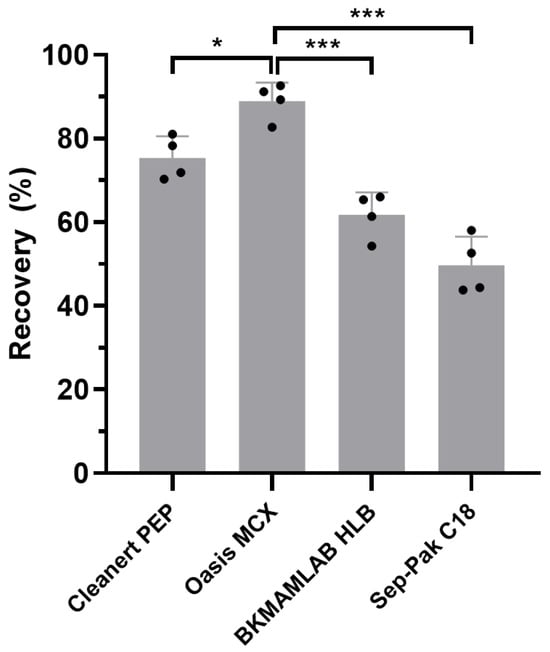
Figure 1.
Recovery of PMB from soil using different SPE cartridges. Data are presented as mean ± SD (n = 4). One-way ANOVA was used for statistical analysis. Asterisks indicate statistically significant differences between groups (* p < 0.05, *** p < 0.001).
Further, the chromatograms from blank and PMB-spiked soil samples were compared to verify the method’s selectivity. No endogenous interference from soil was observed at the retention time of PMB, confirming its specificity (Figure 2). In the calibration curve of PMB, good linearity was observed for the 10–1000 ng/g concentration range, with determination coefficient (R2) exceeding 0.99 (Table 1). The corresponding calibration curve is shown in Figure S2. The LOD and LOQ for PMB were 0.86 ng/g and 2.12 ng/g, respectively, based on spiked blank soil. Subsequently, spiked soil samples at three concentration levels (10, 50, and 200 ng/g) were analyzed to evaluate the accuracy, precision, and recovery of the method. The intra-day accuracy and precision ranged from 96.54% to 104.47% and 1.88% to 3.15%, respectively, while the inter-day values ranged from 97.09% to 100.28% for accuracy and 2.63% to 3.84% for precision (Table 2). The mean recovery in spiked soil samples ranged from 83.58% to 88.83%, which falls within the acceptable criteria. Further comparison of the analyte peak areas of post-extracted blank matrix with those of the pure solvent revealed that the ME values ranged from 87.7% to 90.2% (Table 2), indicating acceptable matrix-related interference for the established method. These observations indicated that the established method is specific, sensitive, and reliable for quantifying PMB in soil matrices, and therefore, suitable for environmental monitoring applications.
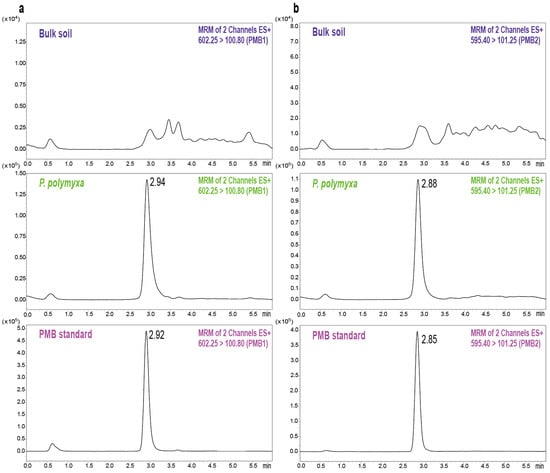
Figure 2.
Representative UPLC-MS/MS chromatograms of PMB1 (a) and PMB2 (b) in blank soil, P. polymyxa inoculated soil, and PMB standard solution.

Table 1.
Calibration curve, determination coefficient (R2), limit of detection (LOD), and limit of quantification (LOQ) of the UPLC-MS/MS method for PMB in soil matrix.
Table 2.
Accuracy, precision, recovery, and matrix effect of the UPLC-MS/MS method for PMB in soil matrix.
3.2. Temporal Dynamics of PMB in Soil Inoculated with P. polymyxa
To confirm the polymyxin subtype synthesized by the selected P. polymyxa strain, UPLC-MS/MS analysis was performed on LB broth after 24 h of incubation at 30 °C with shaking. As shown in Figure 3, this strain exclusively produced PMB, with no detectable PME.
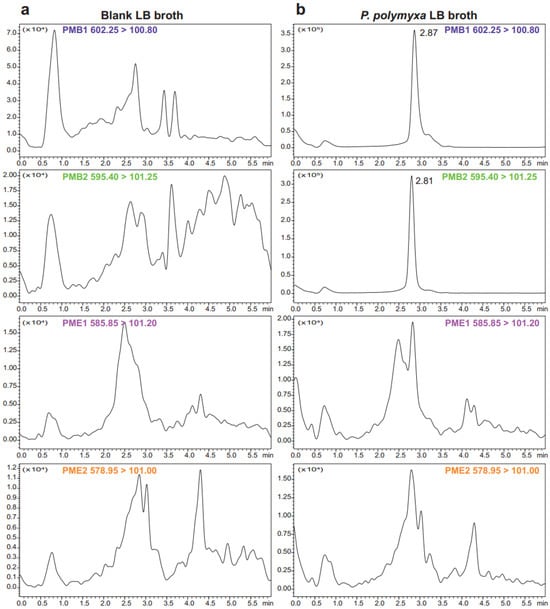
Figure 3.
UPLC-MS/MS chromatograms of blank LB broth (a) and P. polymyxa LB broth (b). The method detected PMB components (both PMB1 and PMB2) in the P. polymyxa LB broth and revealed no detectable levels of PME (both PME1 and PME2).
Under simulated cultivation conditions, we found a clear dose- and time-dependent dynamics of PMB concentrations in soil after inoculation with six doses of P. polymyxa (Figure 4). In the control group (0 CFU/100 g), PMB levels remained consistently low over the 28-day incubation period (0.020–0.027 mg/kg) without significant fluctuation (p > 0.05). These levels were far below the natural background levels of PME in soil predicted by Menz et al. [46]. In contrast, the inoculated groups exhibited distinct temporal dynamics in PMB levels. During the initial phase (0–7 days), high-dose groups (108 CFU/100 g and 2 × 10⁸ CFU/100 g) showed a rapid increase in PMB concentrations. Specifically, the 2 × 10⁸ CFU/100 g group exhibited the most pronounced rise, with PMB reaching 0.186 ± 0.015 mg/kg on day 7. The 108 CFU/100 g group showed a lower but still elevated level of approximately 0.134 ± 0.005 mg/kg at the same time. This early increase in PMB levels is likely attributed to the successful colonization of P. polymyxa and the initiation of PMB biosynthesis in soil. By contrast, the low- and medium-dose groups maintained a slower accumulation of PMB during this period.
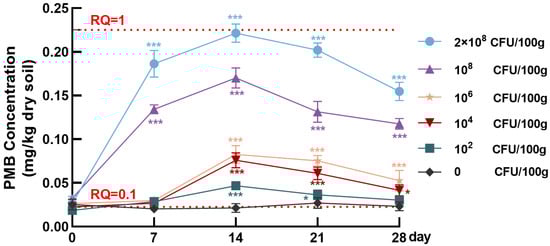
Figure 4.
Time-concentration profiles of PMB in soil inoculated with different doses of P. polymyxa. Each data point represents the mean ± SD (n = 3). One-way ANOVA was used for statistical analysis. Asterisks (*) indicate statistically significant differences between a specific time point and day 0 within a dose group (* p < 0.05, *** p < 0.001).
By day 14, two high-dose groups (108 CFU/100 g and 2 × 10⁸ CFU/100 g) reached their respective peak concentrations; the 2 × 10⁸ CFU/100 g group attained the highest level of 0.221 ± 0.011 mg/kg, and the 108 CFU/100 g group reached 0.170 ± 0.012 mg/kg of PMB. In contrast, the medium-dose groups (104 CFU/100 g and 106 CFU/100 g) exhibited a more gradual accumulation of PMB and peak values substantially lower than those observed in the high-dose groups. The low-dose group (102 CFU/100 g) maintained PMB concentrations below 0.05 mg/kg throughout the incubation period (days 0 to 28), showing only minor fluctuations. During the later phase (days 14–28), a drop in PMB concentration was observed across all dose groups. This decrease was most pronounced in the high-dose groups: PMB levels declined by approximately 70.14% in the 2 × 10⁸ CFU/100 g group by day 28, yet remained relatively high at 0.155 ± 0.010 mg/kg; similarly, a 69.41% reduction was observed in the 108 CFU/100 g group. In contrast, the low- and medium-dose groups experienced a more gradual decline, with concentrations stabilizing between 0.023 and 0.053 mg/kg by day 28. These reductions likely reflect decreased metabolic activity and cell viability of P. polymyxa over time, leading to a slowdown in PMB biosynthesis and possible degradation or adsorption losses in the soil. Overall, the data suggest that the inoculation dose of P. polymyxa and exposure duration jointly determine PMB dynamics in soil. Higher inoculation doses led to more rapid and pronounced PMB accumulation as well as longer environmental persistence. These findings indicate that the application dose of P. polymyxa as a microbial inoculant should be carefully determined to mitigate the potential risk of PMB accumulation in soil.
3.3. Ecological Risk Assessment of PMB in Soil Inoculated with P. polymyxa
Research on the ecological impact of PMB residues in soil remains limited. Studies have mainly provided qualitative evaluations, focusing on the effects of PMB on soil microbial community and soil macrofauna (e.g., earthworms) [22,47]. To date, no standardized quantitative method has been established to assess the ecological risks posed by PMB in soil environments. In light of this, the current study applied the risk quotient (RQ) method to quantitatively evaluate the ecological risk of PMB in soils inoculated with P. polymyxa.
Based on the measured concentrations of PMB and the estimated PNECsoil, the RQ values over 28 days were calculated for each P. polymyxa dose applied to the soil (Figure 4) in all groups. The temporal trends in RQ values were consistent with those of PMB concentrations across all groups. In the 2 × 10⁸ CFU/100 g group, the RQ value rose sharply during the early phase, surpassing the medium-risk threshold (RQ ≥ 0.1) as early as day 7 (RQ = 0.828) and approaching the high-risk threshold by day 14 (RQ = 0.984). Although PMB levels in this group decreased later, the RQ remained at 0.687 on day 28. The 108 CFU/100 g group exhibited a similar trend, with the RQ value peaking at 0.755 on day 14 and then declining to 0.523 by day 28. In both high-dose groups, RQ values consistently remained within the medium-risk range throughout the 28-day period.
The 106 CFU/100 g and 104 CFU/100 g groups exhibited similar trends, with RQ values peaking at approximately 0.35 on day 14, indicating only minor dose-dependent differences in PMB ecological risk at medium inoculation levels. In contrast, the 102 CFU/100 g group exhibited a brief and slight RQ rise, peaking at 0.208 on day 14 and falling back to 0.135 by day 28, remaining in the medium-risk zone only temporarily. The 0 CFU/100 g group consistently showed RQ values below 0.12, confirming the low ecological risk of PMB in the background soil. These results confirm that inoculation of P. polymyxa at high doses can lead to PMB accumulation in soil at levels sufficient to trigger moderate ecological risk for at least three weeks after application. This finding highlights the need for planning P. polymyxa dose management strategies and post-application monitoring measures to mitigate unintended PMB burden in agricultural soils.
4. Discussion
In the current study, we developed a sensitive and accurate UPLC-MS/MS method to quantify PMB concentrations in soil, helping to address the current lack of reliable analytical approaches for PMB quantification in soil environments. This method revealed a clear accumulation of PMB in soil 28 days after inoculation with P. polymyxa. Detailed analysis showed that this accumulation was dependent on both dosage and time after inoculation. In the collected loam soil, higher doses of P. polymyxa led to a rapid increase and prolonged persistence of PMB. Finally, the ecological risk assessment of PMB using the RQ method highlighted the potential environmental impact of high-dosage applications of P. polymyxa.
Polymyxins are cationic polypeptide antibiotics that tend to adsorb to soil via hydrophilic interactions and hydrogen bonding. Research has proven that PMB has a stronger affinity for soil than PME [37]. Accordingly, an effective method is essential for extracting and enriching PMB from soil for accurate quantification. Considering that PMB and PME share the same peptide backbone, the extraction solvent composition reported by Peng et al. provided a reasonable starting point [36]. However, due to the different metal-binding tendency of PMB, the solvent was further modified with 0.01 M EDTA as a cation chelator to reduce PMB-metal complexation, which led to satisfactory extraction performance [39,48]. Typically, soil matrices are rich in organic acids, micropollutants, and humic substances [49], which are non-selectively co-extracted with PMB during the extraction process. To overcome these challenges related to the matrix, lipid impurities in the extract were first removed by liquid–liquid partitioning with n-hexane. The resulting aqueous extract was purified using mixed-mode strong cation-exchange cartridges (Oasis MCX). In our tests, these cartridges achieved higher PMB recovery than hydrophilic-lipophilic balanced sorbents such as Cleanert PEP and BKMAMLAB HLB [50]. This advantage arises from the strong cation-exchange interaction between protonated PMB and the sulfonic acid groups on MCX under acidic conditions, enabling stronger retention and reducing loss during washing [51]. Although PMB is highly cationic, its amphiphilic structure still allows moderate hydrophobic interaction with C18 phases, explaining the measurable but lowest retention observed among the tested sorbents. In addition, polymyxins exhibit substantial instability in basic and neutral aqueous solutions [52,53]. Therefore, to enhance the stability of PMB during the chromatographic analysis process, 0.2% formic acid was added to both A and B mobile phases. This modification, in combination with gradient elution, significantly minimized peak tailing and improved PMB separation in chromatography. Overall, the linearity, sensitivity, and recovery of the developed PMB method fell within similar low-ng/g ranges to those reported for Peng et al.’s quantification method for PME in soils [36]. Our method also reports a more comprehensive set of validation parameters and provides reliable analytical performance. Further optimization, such as the use of alternative acid modifiers or ion-pairing agents, may help achieve higher sensitivity and robustness in PMB quantification. While this UPLC-MS/MS method showed good applicability and reliable analytical performance, it was validated using only one loam soil. Differences in organic-matter content, mineral composition, or co-extracted interferents in other types of soils may still influence PMB recovery and matrix effects. These limitations do not undermine the usefulness of the method, but they do suggest caution when extrapolating its accuracy to diverse field soils. Broader soil-type validation would help further strengthen its applicability in heterogeneous agricultural environments.
The changes in PMB levels in soil after P. polymyxa inoculation were attributed to the combined effects of P. polymyxa biosynthesis and environmental degradation. In this study, P. polymyxa at the late exponential growth phase was used for soil inoculation to maximize polymyxin synthetase activity [54], which led to a rapid increase in PMB concentration within 7 days in the high-dose treatment group. In contrast, only minor increases in PMB levels were observed in the low- and medium-dose P. polymyxa groups, with concentrations remaining close to background values. With the colonization and proliferation of P. polymyxa in soil, the rate of PMB synthesis exceeded its environmental degradation rate, resulting in a continuous increase in PMB concentration, which peaked around day 14. Subsequently, from day 14 to 28, a decline in PMB concentrations was observed across all treatment groups, probably due to nutrient starvation that drove a portion of the P. polymyxa population into dormancy or sporulation [55]; causing PMB synthesis to fall below its degradation in the latter phase. Studies have shown that the half-life of PME in sandy loam increases with its initial concentration [36]. The differences in the magnitude of PMB decline among treatment groups from day 14 to 28 in this study are consistent with this reported pattern, which suggests that PMB exhibits concentration-dependent environmental persistence. Previous studies have reported that degradation half-lives (DT50) of antibiotics in agricultural soils vary widely. β-lactams such as amoxicillin degrade rapidly, with DT50 values below 1 day [56], whereas tetracyclines and macrolides (e.g., chlortetracycline, azithromycin) can persist for several tens to hundreds of days [57,58]. And some fluoroquinolones last even longer under certain conditions [59]. Based on the first-order degradation curves reported by Peng et al. [36], and assuming no further synthesis in soil, 0.3 mg/kg of PMB in sandy loam would be expected to dissipate within roughly 11 days, indicating a moderate level of persistence. According to the pharmacokinetic principles, a compound is generally considered eliminated after about five DT50 [60]. In this study, PMB persisted in soil well beyond the timeframe expected from conventional first-order degradation kinetics, which reflects ongoing synthesis by P. polymyxa rather than a reduced degradation rate. Although PMB concentrations gradually declined over the 28-day period, repeated application of P. polymyxa in agricultural practice and the long-term persistence of its spores in soils could lead to sustained PMB release into soil. This may impose prolonged polymyxin selective pressure on soil microbiota, with ecological risks potentially extending far beyond the 28-day temporal scope of our experimental observation. It should also be noted that the soil inoculation experiment used in this study represents a simplified system, and PMB behavior may differ in field soils with more complex microbial communities. Field conditions also vary in soil structure and moisture dynamics, which can influence PMB persistence. These factors may limit the direct extrapolation of our temporal patterns to real agricultural soils.
Finally, we assessed the ecological risks of PMB in soil following P. polymyxa inoculation to evaluate its environmental safety and potential contribution to AMR. The RQ method has been effectively applied to assess the ecological risks of antibiotics or ARGs in diverse environmental matrices, such as soil and aquatic systems [44,61]. To our knowledge, this study represents the first attempt to evaluate the ecological risk of PMB in soil. Due to the lack of available PNECsoil data for PMB, this value was estimated using the equilibrium partitioning method recommended by the TGD of the European Commission [44]. In this method, PNECsoil was calculated as follows: PNECsoil = PNECwater × Ksoil-water, where Ksoil-water was derived from the experimentally determined adsorption–desorption behavior of PME in loam soil reported by Peng et al. [36]. We adopted this approach because PMB and PME share the same peptide backbone, and PME is currently the closest available analog with reported soil-water partitioning data. This provides a reasonable basis for estimating the PNECsoil value required for subsequent RQ calculation. However, PMB and PME differ in hydrophobicity and soil adsorption strength, and the physicochemical properties of the loam soil used in Peng’s study are not identical to those in our experiment. Therefore, the estimated PNECsoil may deviate slightly from the actual value. To reduce this discrepancy, future studies should measure Ksoil-water values accurately for specific soil types. The RQ data derived in this study offer valuable insights for ecological risk assessment of PMB in soil. Although the measured PMB concentrations in this study did not reach the conventional toxicity-based risk threshold (RQ ≥ 1), previous studies have confirmed resistance selection may occur at concentrations below the PNEC [62]. Therefore, we suggest that the RQ value should not be used as the sole indicator for ecological risk assessment of PMB, and the potential risk of polymyxin-associated AMR at sub-PNEC levels should not be overlooked.
Thus, using the UPLC-MS/MS method established in this study, P. polymyxa was identified to be a significant source of PMB in soil, with its biosynthesis contributing to the persistence of PMB following inoculation. Evidence suggests that polymyxins may alter microbial structure and function in a dose-dependent manner and contribute to the enrichment of ARGs (e.g., sugE, czcA) and mobile genetic elements (MGEs) (e.g., int1, IS26) in the soil [22,23,47,63,64]. These shifts may disrupt the homeostasis of soil microbes and enhance the environmental persistence and mobility of resistance genes, thereby increasing the likelihood of AMR dissemination. Future research should validate these findings under field conditions and explore the long-term impact of P. polymyxa on soil microbiota and resistance gene dynamics.
5. Conclusions
In the present study, we developed a sensitive UPLC-MS/MS method to quantify PMB concentrations in soil. This method was applied to monitor the temporal dynamics of PMB in soil after P. polymyxa inoculation. As an efficient analytical tool, it enables accurate quantification of PMB from various sources in complex soil matrices, particularly in cultivated farmlands. The method also provides methodological support for future studies on the behavior and transformation of PMB in soil systems. We also established a preliminary framework for assessing the ecological risks of PMB in soil using the RQ method. The findings underscore the need for evaluation of the long-term environmental impacts associated with P. polymyxa application, especially the emergence, enrichment, and persistence of PMB-resistant bacteria in soil environments. These insights support more informed and sustainable use of P. polymyxa in agricultural soils.
Supplementary Materials
The following supporting information can be downloaded at: https://www.mdpi.com/article/10.3390/biom15121694/s1, Figure S1: MS/MS spectra of four polymyxin subtypes obtained in MRM mode (collision energy = 30 eV): (a) Polymyxin B1 (m/z 602.25 > 100.80), (b) Polymyxin B2 (m/z 595.40 > 101.25), (c) Polymyxin E1 (m/z 585.85 > 101.20), and (d) Polymyxin E2 (m/z 578.95 > 101.00); Figure S2: Calibration curve of PMB in soil matrix obtained by the UPLC-MS/MS method.
Author Contributions
Conceptualization, B.K. and X.L. (Xin Lu); methodology, S.H. and X.L. (Xiaorui Li); software, S.H.; validation, S.H. and X.L. (Xiaorui Li); formal analysis, S.H.; investigation, X.L. (Xiaorui Li); resources, B.K. and X.L. (Xin Lu); data curation, X.L. (Xiaorui Li) and X.L. (Xin Lu); writing—original draft preparation, S.H.; writing—review and editing, B.K. and X.L. (Xin Lu); visualization, S.H.; supervision, B.K.; project administration, B.K.; funding acquisition, B.K. and X.L. (Xin Lu). All authors have read and agreed to the published version of the manuscript.
Funding
This research was funded by the National Key Research and Development Program of China, grant number 2022YFC2303900, and the Major Projects of the National Natural Science Foundation of China, grant number 22193064.
Institutional Review Board Statement
Not applicable.
Informed Consent Statement
Not applicable.
Data Availability Statement
The original contributions presented in this study are included in the article/Supplementary Material. Further inquiries can be directed to the corresponding author(s).
Acknowledgments
The authors would like to thank Weili Liang, Jie Li, and Baowei Diao from the Department of Diarrheal Diseases for their valuable technical and administrative support and constructive advice during this study. During the preparation of this work, the authors used ChatGPT version 4 to improve language. The authors have reviewed and edited the output and take full responsibility for the content of this publication.
Conflicts of Interest
The authors declare no conflicts of interest.
Abbreviations
The following abbreviations are used in this manuscript:
| AMR | Antimicrobial resistance |
| ARB | Antibiotic-resistant bacteria |
| ARG | Antibiotic resistance gene |
| Half-life | DT50 |
| HGT | Horizontal gene transfer |
| HPLC-UV | High-performance liquid chromatography-ultraviolet |
| LB | Luria–Bertani |
| LC-MS | Liquid chromatography-mass spectrometry |
| LC-MS/MS | Liquid chromatography-tandem mass spectrometry |
| LOD | Limit of detection |
| LOQ | Limit of quantification |
| MDR | Multidrug-resistant |
| ME | Matrix effects |
| MRM | Multiple reaction monitoring |
| PBS | Phosphate-buffered saline |
| PMB | Polymyxin B |
| PME | Polymyxin E |
| PNEC | Predicted no-effect concentration |
| P. polymyxa | Paenibacillus polymyxa |
| RQ | Risk quotient |
| SPE | Solid-phase extraction |
| UPLC-MS/MS | Ultraperformance liquid chromatography-tandem mass spectrometry |
| XDR | Extensively drug-resistant |
References
- Antibiotics Most Responsible for Drug Resistance Are Overused—WHO Report 2025. Available online: https://www.who.int/news/item/29-04-2025-antibiotics-most-responsible-for-drug-resistance-are-overused---who-report (accessed on 29 April 2025).
- Tackling Drug-Resistant Infections Globally—Final Report and Recommendations: Government of the United Kingdom. 2016. Available online: https://apo.org.au/sites/default/files/resource-files/2016-05/apo-nid63983.pdf (accessed on 10 June 2025).
- GBD 2021 Antimicrobial Resistance Collaborators. Global burden of bacterial antimicrobial resistance 1990–2021: A systematic analysis with forecasts to 2050. Lancet 2024, 404, 1199–1226. [Google Scholar] [CrossRef]
- Balli, F.N.; Ekinci, P.B.; Kurtaran, M.; Kara, E.; Dizman, G.T.; Sonmezer, M.C.; Hayran, M.; Demirkan, K.; Metan, G. Battle of polymyxin induced nephrotoxicity: Polymyxin B versus colistin. Int. J. Antimicrob. Agents 2024, 63, 107035. [Google Scholar] [CrossRef]
- Liu, X.; Chen, Y.; Yang, H.; Li, J.; Yu, J.; Yu, Z.; Cao, G.; Wu, X.; Wang, Y.; Wu, H.; et al. Acute toxicity is a dose-limiting factor for intravenous polymyxin B: A safety and pharmacokinetic study in healthy Chinese subjects. J. Infect. 2021, 82, 207–215. [Google Scholar] [CrossRef]
- Huang, X.; Liu, X.; Fan, Y.; Wang, Y.; Guo, B.; Wang, J.; Yu, J.; Wei, Q.; Wu, X.; Huang, H.; et al. Pharmacokinetics and safety of colistin sulfate after single and multiple intravenous doses in healthy Chinese subjects. Int. J. Antimicrob. Agents 2024, 64, 107326. [Google Scholar] [CrossRef]
- Global Polymyxins Market Research Report 2024 (Status and Outlook). 2024. Available online: https://www.marketresearch.com/Bosson-Research-v4252/Global-Polymyxins-Research-Status-Outlook-38233523/ (accessed on 17 June 2025).
- Kim, D.W.; Cha, C.J. Antibiotic resistome from the One-Health perspective: Understanding and controlling antimicrobial resistance transmission. Exp. Mol. Med. 2021, 53, 301–309. [Google Scholar] [CrossRef]
- Yang, Q.; Pogue, J.M.; Li, Z.; Nation, R.L.; Kaye, K.S.; Li, J. Agents of Last Resort: An Update on Polymyxin Resistance. Infect. Dis. Clin. N. Am. 2020, 34, 723–750. [Google Scholar] [CrossRef] [PubMed]
- Liu, Y.Y.; Wang, Y.; Walsh, T.R.; Yi, L.X.; Zhang, R.; Spencer, J.; Doi, Y.; Tian, G.; Dong, B.; Huang, X.; et al. Emergence of plasmid-mediated colistin resistance mechanism MCR-1 in animals and human beings in China: A microbiological and molecular biological study. Lancet Infect. Dis. 2016, 16, 161–168. [Google Scholar] [CrossRef]
- Liu, J.H.; Liu, Y.Y.; Shen, Y.B.; Yang, J.; Walsh, T.R.; Wang, Y.; Shen, J. Plasmid-mediated colistin-resistance genes: Mcr. Trends Microbiol. 2024, 32, 365–378. [Google Scholar] [CrossRef]
- Chowdhury, S.; Ghosh, S.; Aleem, M.A.; Parveen, S.; Islam, M.A.; Rashid, M.M.; Akhtar, Z.; Chowdhury, F. Antibiotic Usage and Resistance in Food Animal Production: What Have We Learned from Bangladesh? Antibiotics 2021, 10, 1032. [Google Scholar] [CrossRef] [PubMed]
- Zheng, D.; Yin, G.; Liu, M.; Hou, L.; Yang, Y.; Van Boeckel, T.P.; Zheng, Y.; Li, Y. Global biogeography and projection of soil antibiotic resistance genes. Sci. Adv. 2022, 8, eabq8015. [Google Scholar] [CrossRef] [PubMed]
- Zhang, Y.; Hao, X.; Thomas, B.W.; McAllister, T.A.; Workentine, M.; Jin, L.; Shi, X.; Alexander, T.W. Soil antibiotic resistance genes accumulate at different rates over four decades of manure application. J. Hazard. Mater. 2023, 443, 130136. [Google Scholar] [CrossRef] [PubMed]
- Kampouris, I.D.; Agrawal, S.; Orschler, L.; Cacace, D.; Kunze, S.; Berendonk, T.U.; Klümper, U. Antibiotic resistance gene load and irrigation intensity determine the impact of wastewater irrigation on antimicrobial resistance in the soil microbiome. Water Res. 2021, 193, 116818. [Google Scholar] [CrossRef] [PubMed]
- Wang, Y.; Ren, Z.; Wu, Y.; Li, Y.; Han, S. Antibiotic resistance genes transfer risk: Contributions from soil erosion and sedimentation activities, agricultural cycles, and soil chemical contamination. J. Hazard. Mater. 2024, 480, 136227. [Google Scholar] [CrossRef]
- Wang, Y.; Xu, C.; Zhang, R.; Chen, Y.; Shen, Y.; Hu, F.; Liu, D.; Lu, J.; Guo, Y.; Xia, X.; et al. Changes in colistin resistance and mcr-1 abundance in Escherichia coli of animal and human origins following the ban of colistin-positive additives in China: An epidemiological comparative study. Lancet Infect. Dis. 2020, 20, 1161–1171. [Google Scholar] [CrossRef]
- Miguela-Villoldo, P.; Moreno, M.A.; Rodriguez-Lazaro, D.; Gallardo, A.; Hernandez, M.; Serrano, T.; Sáez, J.L.; de Frutos, C.; Agüero, M.; Quesada, A.; et al. Longitudinal study of the mcr-1 gene prevalence in Spanish food-producing pigs from 1998 to 2021 and its relationship with the use of polymyxins. Porc. Health Manag. 2022, 8, 12. [Google Scholar] [CrossRef]
- Rhouma, M.; Madec, J.Y.; Laxminarayan, R. Colistin: From the shadows to a One Health approach for addressing antimicrobial resistance. Int. J. Antimicrob. Agents 2023, 61, 106713. [Google Scholar] [CrossRef]
- Xia, X.; Wang, Z.; Fu, Y.; Du, X.D.; Gao, B.; Zhou, Y.; He, J.; Wang, Y.; Shen, J.; Jiang, H.; et al. Association of colistin residues and manure treatment with the abundance of mcr-1 gene in swine feedlots. Environ. Int. 2019, 127, 361–370. [Google Scholar] [CrossRef]
- Walsh, T.R.; Wu, Y. China bans colistin as a feed additive for animals. Lancet Infect. Dis. 2016, 16, 1102–1103. [Google Scholar] [CrossRef]
- Li, L.; Zhu, D.; Yi, X.; Su, J.; Duan, G.; Tang, X.; Zhu, Y. Combined pollution of arsenic and Polymyxin B enhanced arsenic toxicity and enriched ARG abundance in soil and earthworm gut microbiotas. J. Environ. Sci. 2021, 109, 171–180. [Google Scholar] [CrossRef] [PubMed]
- Zhao, J.; Duan, G.; Chang, J.; Wang, H.; Zhu, D.; Li, J.; Zhu, Y. Co-exposure to cyazofamid and polymyxin E: Variations in microbial community and antibiotic resistance in the soil-animal-plant system. Environ. Res. 2025, 273, 121160. [Google Scholar] [CrossRef] [PubMed]
- Langendries, S.; Goormachtig, S. Paenibacillus polymyxa, a Jack of all trades. Environ. Microbiol. 2021, 23, 5659–5669. [Google Scholar] [CrossRef]
- Pandey, A.K.; Barbetti, M.J.; Lamichhane, J.R. Paenibacillus polymyxa. Trends Microbiol. 2023, 31, 657–659. [Google Scholar] [CrossRef] [PubMed]
- Finch, E.A.; Caruso, T.; Engl, C. Effects of Paenibacillus polymyxa inoculation on below-ground nematode communities and plant growth. Soil Biol. Biochem. 2018, 121, 1–7. [Google Scholar] [CrossRef]
- Wang, C.; Pei, J.; Li, H.; Zhu, X.; Zhang, Y.; Wang, Y.; Li, W.; Wang, Z.; Liu, K.; Du, B.; et al. Mechanisms on salt tolerant of Paenibacillus polymyxa SC2 and its growth-promoting effects on maize seedlings under saline conditions. Microbiol. Res. 2024, 282, 127639. [Google Scholar] [CrossRef] [PubMed]
- Zhai, Y.; Zhu, J.X.; Tan, T.M.; Xu, J.P.; Shen, A.R.; Yang, X.B.; Li, J.-L.; Zeng, L.-B.; Wei, L. Isolation and characterization of antagonistic Paenibacillus polymyxa HX-140 and its biocontrol potential against Fusarium wilt of cucumber seedlings. BMC Microbiol. 2021, 21, 75. [Google Scholar] [CrossRef] [PubMed]
- Kim, K.Y.; Kim, B.H.; Kwack, W.G.; Kwon, H.J.; Cho, S.H.; Kim, C.W. Simple and robust LC-MS/MS method for quantification of colistin methanesulfonate and colistin in human plasma for therapeutic drug monitoring. J. Pharm. Biomed. Anal. 2023, 236, 115734. [Google Scholar] [CrossRef]
- Fu, Q.; Li, X.; Zheng, K.; Ke, Y.; Wang, Y.; Wang, L.; Yu, F.; Xia, X. Determination of colistin in animal tissues, egg, milk, and feed by ultra-high performance liquid chromatography-tandem mass spectrometry. Food Chem. 2018, 248, 166–172. [Google Scholar] [CrossRef]
- Song, X.; Turiel, E.; He, L.; Martin-Esteban, A. Synthesis of Molecularly Imprinted Polymers for the Selective Extraction of Polymyxins from Environmental Water Samples. Polymers 2020, 12, 131. [Google Scholar] [CrossRef]
- Hu, S.; Guo, N.; Zeng, J.; Li, Y.; Zhang, Y.; Jiang, J.; Leng, B.; Shen, C. A simple HPLC-MS/MS method for the determination of polymyxin B in human plasma and its application in the pharmacokinetic study in elderly patients infected with multidrug-resistant Gram-negative bacteria. Front. Pharmacol. 2024, 15, 1396307. [Google Scholar] [CrossRef]
- Xiang, D.; Li, N.; Yang, G.; Yu, H.; Li, X.; Qiu, L.; Chen, Y.; Liu, L.; Gong, X. Development and validation of a liquid chromatography-tandem mass spectrometry method for the determination of polymixin B1, B2, ile-B1, E1, and E2 in human plasma and its clinical pharmacokinetic application. J. Pharm. Biomed. Anal. 2024, 250, 116403. [Google Scholar] [CrossRef]
- Wu, T.; Pu, L.; Liu, W.; Bai, Y.; Ma, J.; Song, X.; Cao, A.; Pan, S.; Yang, J.; Wang, C.; et al. Development and validation of a UPLC-MS/MS method for simultaneous quantification of polymyxins and caspofungin in human plasma for therapeutic drug monitoring. J. Chromatogr. B Anal. Technol. Biomed. Life Sci. 2025, 1252, 124465. [Google Scholar] [CrossRef]
- Chen, F.; Li, H.; Yang, X.; Deng, Z.; Wang, H.; Shi, Z.; Qiu, C. A simple, robust and high-throughput LC-MS/MS method for the therapeutic drug monitoring of polymyxin B1, polymyxin B2, polymyxin B3, isoleucine-polymyxin B1, polymyxin E1 and polymyxin E2 in human plasma. Biomed. Chromatogr. 2024, 38, e6034. [Google Scholar] [CrossRef]
- Peng, L.; Peng, C.; Fu, S.; Qiu, Y. Adsorption-desorption and degradation of colistin in soils under aerobic conditions. Ecotoxicol. Environ. Saf. 2022, 243, 113989. [Google Scholar] [CrossRef] [PubMed]
- Davis, C.A.; Janssen, E.M. Environmental fate processes of antimicrobial peptides daptomycin, bacitracins, and polymyxins. Environ. Int. 2020, 134, 105271. [Google Scholar] [CrossRef] [PubMed]
- Zhao, Y.; Ning, P.; Feng, X.; Ren, H.; Cui, M.; Yang, L. Characterization of Stem Nodes Associated with Carbon Partitioning in Maize in Response to Nitrogen Availability. Int. J. Mol. Sci. 2022, 23, 4839. [Google Scholar] [CrossRef]
- Lo, I.M.C.; Yang, X.Y. EDTA Extraction of Heavy Metals from Different Soil Fractions and Synthetic Soils. Water Air Soil Pollut. 1999, 109, 219–236. [Google Scholar] [CrossRef]
- Matar, K.M.; Al-Refai, B. Quantification of Colistin in Plasma by Liquid Chromatography-Tandem Mass Spectrometry: Application to a Pharmacokinetic Study. Sci. Rep. 2020, 10, 8198. [Google Scholar] [CrossRef]
- Cunha, I.; Silva, A.; Boleta, E.H.M.; Pellegrinetti, T.A.; Zagatto, L.F.G.; Zagatto, S.; de Chaves, M.G.; Mendes, R.; Patreze, C.M.; Tsai, S.M.; et al. The interplay between the inoculation of plant growth-promoting rhizobacteria and the rhizosphere microbiome and their impact on plant phenotype. Microbiol. Res. 2024, 283, 127706. [Google Scholar] [CrossRef]
- Pesticide Registration Data Query System. 2025. Available online: https://www.icama.cn/BasicdataSystem/pesticideRegistration/queryselect.do (accessed on 4 August 2025).
- Communities, E. Technical Guidance Document in Support of Commission Directive 93/67/EEC on Risk Assessment for New Notified Substances and Commission Regulation (EC) No. 1488/94 on Risk Assessment for Existing Substances; European Commission Joint Research Center, Institute for Health and Consumer: Luxembourg, 2003. [Google Scholar]
- Ren, J.; Shi, H.; Liu, J.; Zheng, C.; Lu, G.; Hao, S.; Jin, Y.; He, C. Occurrence, source apportionment and ecological risk assessment of thirty antibiotics in farmland system. J. Environ. Manag. 2023, 335, 117546. [Google Scholar] [CrossRef] [PubMed]
- AMR Alliance Science-Based PNEC Targets for Risk Assessments. 2025. Available online: https://www.amrindustryalliance.org/wp-content/uploads/AMRIA-PNEC-Table.pdf (accessed on 20 July 2025).
- Menz, J.; Schneider, M.; Kummerer, K. Usage pattern-based exposure screening as a simple tool for the regional priority-setting in environmental risk assessment of veterinary antibiotics: A case study of north-western Germany. Chemosphere 2015, 127, 42–48. [Google Scholar] [CrossRef]
- Zhao, J.; Duan, G.; Zhu, Y.; Zhu, D. Gut microbiota and transcriptome response of earthworms (Metaphire guillelmi) to polymyxin B exposure. J. Environ. Sci. 2023, 133, 37–47. [Google Scholar] [CrossRef]
- Dybczynski, R.S.; Samczynski, Z.; Chajduk, E. Comparison of Usefulness of Four Chelating Agents (EDTA, NTA, ODA and IDA) for the Chromatographic Separation of Micro and Macro Amounts of Rare Earth Elements. Crit. Rev. Anal. Chem. 2023, 53, 1012–1026. [Google Scholar] [CrossRef]
- Pena, A. A comprehensive review of recent research concerning the role of low molecular weight organic acids on the fate of organic pollutants in soil. J. Hazard. Mater. 2022, 434, 128875. [Google Scholar] [CrossRef]
- Olesova, D.; Galba, J.; Piestansky, J.; Celusakova, H.; Repiska, G.; Babinska, K.; Ostatnikova, D.; Katina, S.; Kovac, A. A Novel UHPLC-MS Method Targeting Urinary Metabolomic Markers for Autism Spectrum Disorder. Metabolites 2020, 10, 443. [Google Scholar] [CrossRef] [PubMed]
- Stoszko, M.; Al-Hatmi, A.M.S.; Skriba, A.; Roling, M.; Ne, E.; Crespo, R.; Mueller, Y.M.; Najafzadeh, M.J.; Kang, J.; Ptackova, R.; et al. Gliotoxin, identified from a screen of fungal metabolites, disrupts 7SK snRNP, releases P-TEFb, and reverses HIV-1 latency. Sci. Adv. 2020, 6, eaba6617. [Google Scholar] [CrossRef] [PubMed]
- Sharma, E.; Kelso, C.; Zhang, S.; Guo, Y.; Sivakumar, M.; Jiang, G. Stability of colistin and carbapenems in water and wastewater. ACS EST Water 2023, 3, 3496–3504. [Google Scholar] [CrossRef]
- Orwa, J.A.; Govaerts, C.; Gevers, K.; Roets, E.; Van Schepdael, A.; Hoogmartens, J. Study of the stability of polymyxins B(1), E(1) and E(2) in aqueous solution using liquid chromatography and mass spectrometry. J. Pharm. Biomed. Anal. 2002, 29, 203–212. [Google Scholar] [CrossRef] [PubMed]
- Cui, Y.; Zhao, D.; Liu, K.; Mei, X.; Sun, S.; Du, B.; Ding, Y. Abh, AbrB3, and Spo0A play distinct regulatory roles during polymyxin synthesis in Paenibacillus polymyxa SC2. Microbiol. Spectr. 2024, 12, e0229323. [Google Scholar] [CrossRef]
- Setlow, P.; Christie, G. Bacterial Spore mRNA—What’s up with That? Front. Microbiol. 2020, 11, 596092. [Google Scholar] [CrossRef]
- Braschi, I.; Blasioli, S.; Fellet, C.; Lorenzini, R.; Garelli, A.; Pori, M.; Giacomini, D. Persistence and degradation of new beta-lactam antibiotics in the soil and water environment. Chemosphere 2013, 93, 152–159. [Google Scholar] [CrossRef]
- Walters, E.; McClellan, K.; Halden, R.U. Occurrence and loss over three years of 72 pharmaceuticals and personal care products from biosolids-soil mixtures in outdoor mesocosms. Water Res. 2010, 44, 6011–6020. [Google Scholar] [CrossRef]
- Wang, Z.; Li, Y.; Wang, J.; Li, S. Tetracycline antibiotics in agricultural soil: Dissipation kinetics, transformation pathways, and structure-related toxicity. Sci. Total Environ. 2024, 949, 175126. [Google Scholar] [CrossRef]
- Cycon, M.; Mrozik, A.; Piotrowska-Seget, Z. Antibiotics in the Soil Environment-Degradation and Their Impact on Microbial Activity and Diversity. Front. Microbiol. 2019, 10, 338. [Google Scholar] [CrossRef] [PubMed]
- Hui, M.Q.; Mi, Y.N.; Ma, Y.F.; Chen, T.; Cao, Y.X. Preparation and Evaluation of Lipid Emulsion Containing 13 Vitamins for Injection Without Anaphylactoid Reactions. Int. J. Nanomed. 2021, 16, 3317–3327. [Google Scholar] [CrossRef] [PubMed]
- Wang, Y.; Dong, X.; Zang, J.; Zhao, X.; Jiang, F.; Jiang, L.; Xiong, C.; Wang, N.; Fu, C. Antibiotic residues of drinking-water and its human exposure risk assessment in rural Eastern China. Water Res. 2023, 236, 119940. [Google Scholar] [CrossRef]
- Murray, A.K.; Stanton, I.; Gaze, W.H.; Snape, J. Dawning of a new ERA: Environmental Risk Assessment of antibiotics and their potential to select for antimicrobial resistance. Water Res. 2021, 200, 117233. [Google Scholar] [CrossRef]
- Zhao, J.; Duan, G.; Zhu, D.; Li, J.; Zhu, Y. Microbial-influenced pesticide removal co-occurs with antibiotic resistance gene variation in soil-earthworm-maize system. Environ. Pollut. 2024, 342, 123010. [Google Scholar] [CrossRef]
- Fan, T.; Sun, Y.; Peng, J.; Wu, Q.; Ma, Y.; Zhou, X. Combination of amplified rDNA restriction analysis and high-throughput sequencing revealed the negative effect of colistin sulfate on the diversity of soil microorganisms. Microbiol. Res. 2018, 206, 9–15. [Google Scholar] [CrossRef] [PubMed]
Disclaimer/Publisher’s Note: The statements, opinions and data contained in all publications are solely those of the individual author(s) and contributor(s) and not of MDPI and/or the editor(s). MDPI and/or the editor(s) disclaim responsibility for any injury to people or property resulting from any ideas, methods, instructions or products referred to in the content. |
© 2025 by the authors. Licensee MDPI, Basel, Switzerland. This article is an open access article distributed under the terms and conditions of the Creative Commons Attribution (CC BY) license (https://creativecommons.org/licenses/by/4.0/).