


Leucosceptosides A and B: Two Phenyl-Ethanoid Glycosides with Important Occurrence and Biological Activities

 ,
, 

 , , , ,
Abstract
1. Introduction
2. Occurrence in the Plant Kingdom
3. Biological Activities
3.1. Leucosceptoside A
3.1.1. Antioxidant and Radical Scavenging Activity
3.1.2. Radical Scavenging
3.1.3. Anti-Inflammatory Activity
3.1.4. Enzyme Inhibitory Activity
3.1.5. Hepatoprotective Activity
3.1.6. Neuroprotective Activity
3.1.7. Cytoprotective Activity
3.1.8. Anticomplementary Activity
3.1.9. Anti-HIV Activity
3.1.10. Cytotoxic Activity
3.1.11. Inhibitory Activities
3.1.12. Antimicrobial Activities
3.1.13. Antifungal Activities
3.2. Leucosceptoside B
3.2.1. Antioxidant Activity
3.2.2. Radical Scavenging Activity
3.2.3. Anti-Inflammatory Activity
3.2.4. Enzyme Inhibitory Activity
3.2.5. Neuroprotective Activity
3.2.6. Inhibitory Activities
3.2.7. Antimicrobial Activity
3.2.8. Antimicrobial Activity
3.3. Comparing the Biological Results of Leucosceptosides A and B
4. Conclusions
Author Contributions
Funding
Institutional Review Board Statement
Informed Consent Statement
Data Availability Statement
Conflicts of Interest
References
- Wu, L.; Georgiev, M.I.; Cao, H.; Nahar, L.; El-Seedi, H.-R.; Sarker, S.D.; Xiao, J.; Lu, B. Therapeutic potential of phenylethanoid glycosides: A systematic review. Med. Res. Rev. 2020, 40, 2605–2649. [Google Scholar] [CrossRef] [PubMed]
- Heldt, H.W.; Heldt, F. Phenylpropanoids comprise a multitude of plant secondary metabolites and cell wall components. In Plant Biochemistry, 3rd ed.; Elsevier Academic Press: San Diego, CA, USA, 2005; pp. 435–454. [Google Scholar]
- Tian, X.-Y.; Li, M.-X.; Lin, T.; Qiu, Y.; Zhu, Y.-T.; Li, X.-L.; Tao, W.-D.; Wang, P.; Ren, X.-X.; Chen, L.-P. A review on the structure and pharmacological activity of phenylethanoid glycosides. Eur. J. Med. Chem. 2021, 209, 112563. [Google Scholar] [CrossRef]
- Jiménez, C.; Riguera, R. Phenylethanoid glycosides in plants: Structure and biological activity. Nat. Prod. Rep. 1994, 11, 591–606. [Google Scholar] [CrossRef]
- Kanchanapoom, T.; Kasai, R.; Picheansoonthon, C.; Yamasaki, K. Megastigmane, aliphatic alcohol and benzoxazinoid glycosides from Acanthus ebracteatus. Phytochemistry 2001, 58, 811–817. [Google Scholar] [CrossRef] [PubMed]
- Prasansuklab, A.; Tencomnao, T. Acanthus ebracteatus leaf extract provides neuronal cell protection against oxidative stress injury induced by glutamate. BMC Complement. Altern. Med. 2018, 18, 278. [Google Scholar] [CrossRef] [PubMed]
- Harput, U.S.; Arihan, O.; Iskit, A.B.; Nagatsu, A.; Saracoglu, I. Antinociceptive, free radical-scavenging, and cytotoxic activities of Acanthus hirsutus Boiss. J. Med. Food 2011, 14, 767–774. [Google Scholar] [CrossRef] [PubMed]
- Noiarsa, P.; Ruchirawat, S.; Kanchanapoom, T. Acanmontanoside, a new phenylethanoid diglycoside from Acanthus montanus. Molecules 2010, 15, 8967–8972. [Google Scholar] [CrossRef]
- Ashour, M.A.-G. Isolation, HPLC/UV characterization and antioxidant activity of phenylethanoids from Blepharis edulis (Forssk.) Pers. growing in Egypt. Bull. Fac. Pharm. Cairo Univ. 2012, 50, 67–72. [Google Scholar] [CrossRef]
- Vo, T.N.; Nguyen, P.L.; Tran, T.T.N.; Nguyen, K.P.P.; Nguyen, N.S. Some phenylethanoids from roots of Pseuderanthemum carruthersii (Seem.) Guill var. atropurpureum (Bull.) Fosb. Vietnam J. Chem. 2010, 48, 325–331. [Google Scholar]
- Piccinelli, A.L.; De Simone, F.; Passi, S.; Rastrelli, L. Phenolic constituents and antioxidant activity of Wendita calysina leaves (Burrito), a folk Paraguayan tea. J. Agric. Food Chem. 2004, 52, 5863–5868. [Google Scholar] [CrossRef] [PubMed]
- Kanchanapoom, T.; Kasai, R.; Yamasaki, K. Lignan and phenylpropanoid glycosides from Fernandoa adenophylla. Phytochemistry 2001, 57, 1245–1248. [Google Scholar] [CrossRef] [PubMed]
- Shen, T.; Li, X.; Hu, W.; Zhang, L.; Xu, X.; Wu, H.; Ji, L. Hepatoprotective effect of phenylethanoid glycosides from Incarvillea compacta against CCl4-induced cytotoxicity in HepG2 cells. J. Korean Soc. Appl. Biol. Chem. 2015, 58, 617–625. [Google Scholar] [CrossRef]
- Ihtesham, Y.; Khan, U.; Dogan, Z.; Kutluay, V.M.; Saracoğlu, I. Evaluation of some biological effects of Incarvillea emodi (Royle ex Lindl.) Chatterjee and determination of its active constituents. Kafkas Univ. Vet. Fak. Derg. 2019, 25, 171–178. [Google Scholar]
- Arevalo, C.; Ruiz, I.; Piccinelli, A.L.; Campone, L.; Rastrelli, L. Phenolic derivatives from the leaves of Martinella obovata (Bignoniaceae). Nat. Prod. Commun. 2011, 6, 957–960. [Google Scholar] [CrossRef] [PubMed]
- Vien, L.T.; Hanh, T.T.H.; Quang, T.H.; Cuong, N.T.; Cuong, N.X.; Oh, H.; Sinh, N.V.; Nam, N.H.; Minh, C.V. Phenolic glycosides from Oroxylum indicum. Nat. Prod. Res. 2022, 36, 2336–2340. [Google Scholar] [CrossRef]
- Kanchanapoom, T.; Kasai, R.; Yamasaki, K. Phenolic glycosides from Barnettia kerrii. Phytochemistry 2002, 59, 565–570. [Google Scholar] [CrossRef]
- Plaza, A.; Montoro, P.; Benavides, A.; Pizza, C.; Piacente, S. Phenylpropanoid glycosides from Tynanthus panurensis: Characterization and LC-MS quantitative analysis. J. Agric. Food Chem. 2005, 53, 2853–2858. [Google Scholar] [CrossRef]
- Çalis, I.; Başaran, A.; Saracoğlu, I.; Sticher, O. Iridoid and phenylpropanoid glycosides from Stachys macrantha. Phytochemistry 1992, 31, 167–169. [Google Scholar] [CrossRef]
- Yuan, J.-Q.; Qiu, L.; Zouc, L.-H.; Wei, Q.; Miao, J.-H.; Yao, X.-S. Two new phenylethanoid glycosides from Callicarpa longissima. Helv. Chim. Acta 2015, 98, 482–489. [Google Scholar] [CrossRef]
- Wang, J. N-butanol-soluble chemical constituents from Callicarpa nudiflora. Chin. Pharm. J. 2017, 24, 1983–1987. [Google Scholar]
- Zhao, D.P.; Matsunami, K.; Otsuka, H. Iridoid glucoside, (3R)-oct-1-en-3-ol glycosides, and phenylethanoid from the aerial parts of Caryopteris incana. J. Nat. Med. 2009, 63, 241–247. [Google Scholar] [CrossRef] [PubMed]
- Park, S.; Son, M.J.; Yook, C.-S.; Jin, C.; Lee, Y.S.; Kim, H.J. Chemical constituents from aerial parts of Caryopteris incana and cytoprotective effects in human HepG2 cells. Phytochemistry 2014, 101, 83–90. [Google Scholar] [CrossRef]
- Yoshikawa, K.; Harada, A.; Iseki, K.; Hashimoto, T. Constituents of Caryopteris incana and their antibacterial activity. J. Nat. Med. 2014, 68, 231–235. [Google Scholar] [CrossRef]
- Nugroho, A.; Lee, S.K.; Kim, D.; Choi, J.S.; Park, K.-S.; Song, B.-M.; Park, H.-J. Analysis of essential oil, quantification of six glycosides, and nitric oxide synthase inhibition activity in Caryopteris incana. Nat. Prod. Sci. 2018, 24, 181–188. [Google Scholar] [CrossRef]
- Li, Y.B.; Li, J.; Li, P.; Tu, P.F. Isolation and characterization of phenylethanoid glycosides from Clerodendron bungei. Acta Pharm. Sin. 2005, 40, 722–727. [Google Scholar]
- Liu, Q.; Hu, H.-J.; Li, P.-F.; Yang, Y.-B.; Wu, L.-H.; Chou, G.-X.; Wang, Z.-T. Diterpenoids and phenylethanoid glycosides from the roots of Clerodendrum bungei and their inhibitory effects against angiotensin converting enzyme and α-glucosidase. Phytochemistry 2014, 103, 196–202. [Google Scholar] [CrossRef] [PubMed]
- Gao, L.M.; Wei, X.M.; He, Y.Q. Studies on chemical constituents in leaves of Clerodendron fragrans. China J. Chin. Mat. Med. 2003, 28, 948–951. [Google Scholar]
- Uddin, J.; Çiçek, S.S.; Willer, J.; Shulha, O.; Abdalla, M.A.; Sönnichsen, F.; Girreser, U.; Zidorn, C. Phenylpropanoid and flavonoid glycosides from the leaves of Clerodendrum infortunatum (Lamiaceae). Biochem. Syst. Ecol. 2020, 92, 104131. [Google Scholar] [CrossRef]
- Yadav, A.K.; Gupta, M.M. Quantitative determination of bioactive phenylethanoid glycosides in Clerodendrum phlomidis using HPTLC. Med. Chem. Res. 2014, 23, 1654–1660. [Google Scholar] [CrossRef]
- Yadav, A.K.; Thakur, J.K.; Agrawal, J.; Saikia, D.; Pal, A.; Gupta, M.M. Bioactive chemical constituents from the root of Clerodendrum phlomidis. Med. Chem. Res. 2015, 24, 1112–1118. [Google Scholar] [CrossRef]
- Kim, H.J.; Woo, E.-R.; Shin, C.-G.; Hwang, D.J.; Park, H.; Lee, Y.S. HIV-1 integrase inhibitory phenylpropanoid glycosides from Clerodendron trichotomum. Arch. Pharm. Res. 2001, 24, 286–291. [Google Scholar] [CrossRef] [PubMed]
- Kang, D.G.; Lee, Y.S.; Kim, H.J.; Lee, Y.M.; Lee, H.S. Angiotensin converting enzyme inhibitory phenylpropanoid glycosides from Clerodendron trichotomum. J. Ethnopharmacol. 2003, 89, 151–154. [Google Scholar] [CrossRef] [PubMed]
- Lee, J.-W.; Bae, J.J.; Kwak, J.H. Glycosides from the flower of Clerodendrum trichotomum. Korean J. Pharmacogn. 2016, 47, 301–306. [Google Scholar]
- Miyase, T.; Koizumi, A.; Ueno, A.; Noro, T.; Kuroyanagi, M.; Fukushima, S.; Akiyama, Y.; Takemoto, T. Studies on the acyl glycosides from Leucosceptrum japonicum (Miq.) Kitamura et Murata. Chem. Pharm. Bull. 1982, 30, 2732–2737. [Google Scholar] [CrossRef]
- Murata, T.; Arai, Y.; Miyase, T.; Yoshizaki, F. An alkaloidal glycoside and other constituents from Leucosceptrum japonicum. J. Nat. Med. 2009, 63, 402–407. [Google Scholar] [CrossRef]
- Olennikov, D.N. Synanthropic plants as an underestimated source of bioactive phytochemicals: A case of Galeopsis bifida (Lamiaceae). Plants 2020, 9, 1555. [Google Scholar] [CrossRef]
- Zhang, J.; Huang, Z.; Huo, H.-X.; Li, Y.-T.; Pang, D.-R.; Zheng, J.; Zhang, Q.; Zhao, Y.-F.; Tu, P.-F.; Li, J. Chemical constituents from Lagopsis supina (Steph.) Ik.-Gal. ex Knorr. Biochem. Syst. Ecol. 2015, 61, 424–428. [Google Scholar] [CrossRef]
- Yang, L.; He, J. Lagopsis supina extract and its fractions exert prophylactic effects against blood stasis in rats via anti-coagulation, anti-platelet activation and anti-fibrinolysis and chemical characterization by UHPLC-qTOF-MS/MS. Biomed. Pharmacother. 2020, 132, 110899. [Google Scholar] [CrossRef]
- He, J.; Yang, L. Diuretic effect of Lagopsis supina fraction in saline-loaded rats is mediated through inhibition of aquaporin and renin-angiotensin-aldosterone systems and up-regulation of atriopeptin. Biomed. Pharmacother. 2021, 139, 111554. [Google Scholar] [CrossRef]
- Olennikov, D.N.; Chirikova, N.K. Caffeoylglucaric acids and other phenylpropanoids from Siberian Leonurus species. Chem. Nat. Compd. 2016, 52, 915–917. [Google Scholar] [CrossRef]
- Tasdemir, D.; Scapozza, L.; Zerbe, O.; Linden, A.; Calis, I.; Sticher, O. Iridoid glycosides of Leonurus persicus. J. Nat. Prod. 1999, 62, 811–816. [Google Scholar] [CrossRef] [PubMed]
- Schmidt, S.; Jakab, M.; Jav, S.; Streif, D.; Pitschmann, A.; Zehl, M.; Purevsuren, M.; Glasl, S.; Ritter, M. Extracts from Leonurus sibiricus L. increase insulin secretion and proliferation of rat INS-1E insulinoma cells. J. Ethnopharmacol. 2013, 150, 85–94. [Google Scholar] [CrossRef] [PubMed]
- Pitschmann, A.; Zehl, M.; Heiss, E.; Purevsuren, S.; Urban, E.; Dirsch, M.V.; Glasl, S. Quantitation of phenylpropanoids and iridoids in insulin-sensitising extracts of Leonurus sibiricus L. (Lamiaceae). Phytochem. Anal. 2015, 27, 23–31. [Google Scholar] [CrossRef] [PubMed]
- Çaliş, I.; Hosny, M.; Khalifa, T.; Rüedi, P. Phenylpropanoid glycosides from Marrubium alysson. Phytochemistry 1992, 31, 3624–3626. [Google Scholar]
- Argyropoulou, A.; Samara, P.; Tsitsilonis, O.; Skaltsa, H. Polar constituents of Marrubium thessalum Boiss. & Heldr. (Lamiaceae) and their cytotoxic/cytostatic activity. Phytother. Res. 2012, 26, 1800–1806. [Google Scholar]
- Karioti, A.; Skaltsa, H.; Heilmann, J.; Sticher, O. Acylated flavonoid and phenylethanoid glycosides from Marrubium velutinum. Phytochemistry 2003, 64, 655–660. [Google Scholar] [CrossRef]
- Masoodi, M.; Ali, Z.; Liang, S.; Yin, H.; Wang, W.; Khan, I.A. Labdane diterpenoids from Marrubium vulgare. Phytochem. Lett. 2015, 13, 275–279. [Google Scholar] [CrossRef]
- Saracoglu, I.; Inoue, M.; Çalis, I.; Ogihara, Y. Studies on constituents with cytotoxic and cytostatic activity of two Turkish medicinal plants Plomis armeniaca and Scutellaria salviifolia. Biol. Pharm. Bull. 1995, 18, 1396–1400. [Google Scholar] [CrossRef]
- Kırmızıbekmez, H.; Montoro, P.; Piacente, S.; Pizza, C.; Dönmez, A.; Çalıs, I. Identification by HPLC-PAD-MS and quantification by HPLC-PAD of phenylethanoid glycosides of five Phlomis species. Phytochem. Anal. 2005, 16, 1–6. [Google Scholar] [CrossRef]
- Ersöz, T.; Saracoğlu, I.; Kırmızıbekmez, H.; Yalçın, F.N.; Harput, Ü.S.; Dönmez, A.A.; Çalıs, I. Iridoid, phenylethanoid and phenol glycosides from Phlomis chimerae. Hacet. Univ. J. Fac. Pharm. 2001, 21, 23–33. [Google Scholar]
- Stojković, D.; Gašić, U.; Drakulić, D.; Zengin, G.; Stevanović, M.; Rajčević, N.; Soković, M. Chemical profiling, antimicrobial, anti-enzymatic, and cytotoxic properties of Phlomis fruticosa L. J. Pharm. Biomed. Anal. 2021, 195, 113884. [Google Scholar] [CrossRef] [PubMed]
- Saracoglu, I.; Varel, M.; Çalıs, I.; Dönmez, A.A. Neolignan, flavonoid, phenylethanoid and iridoid glycosides from Phlomis integrifolia. Turk. J. Chem. 2003, 27, 739–747. [Google Scholar]
- Harput, U.S.; Çalıs, I.; Saracoglu, I.; Dönmez, A.A.; Nagatsu, A. Secondary metabolites from Phlomis syriaca and their antioxidant activities. Turk. J. Chem. 2006, 30, 383–390. [Google Scholar]
- Ersöz, T.; Schühly, W.; Popov, S.; Handjieva, N.; Sticher, O.; Çalıs, I. Iridoid and phenylethanoid glycosides from Phlomis longifolia var. longifolia. Nat. Prod. Lett. 2001, 15, 345–351. [Google Scholar] [CrossRef]
- Kırmızıbekmez, H.; Piacente, S.; Pizza, C.; Dönmez, A.A.; Çalıs, I. Iridoid and phenylethanoid glycosides from Phlomis nissolii and P. capitata. Z. Naturforsch. B 2004, 59, 609–613. [Google Scholar] [CrossRef]
- Çaliş, I.; Bedir, E.; Kirmizibekmez, H.; Ersöz, T.; Dönmez, A.A.; Khan, I.A. Secondary metabolites from Phlomis oppositiflora. Nat. Prod. Res. 2005, 19, 493–501. [Google Scholar] [CrossRef]
- Ersöz, T.; Alipieva, K.I.; Yalçın, F.N.; Akbay, P.; Handjieva, N.; Dönmez, A.A.; Popov, S.; Çaliş, I. Physocalycoside, a new phenylethanoid glycoside from Phlomis physocalyx Hub.-Mor. Z. Naturforsch. C 2003, 58, 471–476. [Google Scholar] [CrossRef]
- Ersöz, T.; Harput, U.S.; Çaliş, I.; Dönmez, A.A. Iridoid, phenylethanoid and monoterpene glycosides from Phlomis sieheana. Turk. J. Chem. 2002, 26, 1–8. [Google Scholar]
- Çaliş, I.; Kırmızıbekmez, H.; Beutler, J.A.; Dönmez, A.A.; Yalçın, F.N.; Kilic, E.; Özalp, M.; Rüedi, P.; Tasdemir, D. Secondary metabolites of Phlomis viscosa and their biological activities. Turk. J. Chem. 2005, 29, 71–81. [Google Scholar]
- Delazar, A.; Shoeb, M.; Kumarasamy, Y.; Byres, M.; Nahar, L.; Modarresi, M.; Sarker, S.D. Two bioactive ferulic acid derivatives from Eremostachys glabra. DARU J. Pharm. Sci. 2004, 12, 49–53. [Google Scholar]
- Çaliş, I.; Guevenc, A.; Armagan, M.; Koyuncu, M.; Gotfredsen, C.H.; Jensen, S.R. Secondary metabolites from Eremostachys laciniata. Nat. Prod. Commun. 2008, 3, 117–124. [Google Scholar] [CrossRef]
- Wang, J.; Gao, Y.-L.; Chen, Y.-L.; Chen, Y.-W.; Zhang, Y.; Xiang, L.; Pan, Z. Lamiophlomis rotata identification via ITS2 barcode and quality evaluation by UPLC-QTOF-MS coupled with multivariate analyses. Molecules 2018, 23, 3289. [Google Scholar] [PubMed]
- Li, T.; Jia, L.; Du, R.; Liu, C.; Huang, S.; Lu, H.; Han, L.; Chen, X.; Wang, Y.; Jiang, M. Comparative investigation of aerial part and root in Lamiophlomis rotata using UPLC-Q-Orbitrap-MS coupled with chemometrics. Arab. J. Chem. 2022, 15, 103740. [Google Scholar] [CrossRef]
- Çaliş, I.; Kırmızıbekmez, H.; Ersöz, T.; Dönmez, A.A.; Gotfredsen, C.H.; Jensen, S.R. Iridoid glucosides from Turkish Phlomis tuberosa. Z. Naturforsch. B 2005, 60, 1295–1298. [Google Scholar] [CrossRef]
- Wu, S.-J.; Chan, Y.-Y. Five new iridoids from roots of Salvia digitaloides. Molecules 2014, 19, 15521–15534. [Google Scholar] [CrossRef] [PubMed]
- Rungsimakan, S.; Rowan, M.G. Terpenoids, flavonoids and caffeic acid derivatives from Salvia viridis L. cvar. Blue Jeans. Phytochemistry 2014, 108, 177–188. [Google Scholar] [CrossRef]
- Grzegorczyk-Karolak, I.; Kiss, A.K. Determination of the phenolic profile and antioxidant properties of Salvia viridis L. shoots: A comparison of aqueous and hydroethanolic extracts. Molecules 2018, 23, 1468. [Google Scholar] [CrossRef]
- Zengin, G.; Mahomoodally, F.; Picot-Allain, C.; Diuzheva, A.; Jekőd, J.; Cziáky, Z.; Cvetanović, A.; Aktumsek, A.; Zeković, Z.; Rengasamy, K.R.R. Metabolomic profile of Salvia viridis L. root extracts using HPLC–MS/MS technique and their pharmacological properties: A comparative study. Ind. Crops Prod. 2019, 131, 266–280. [Google Scholar] [CrossRef]
- Xu, H.-T.; Zhang, C.-G.; He, Y.-Q.; Shi, S.-S.; Wang, Y.-L.; Chou, G.-X. Phenylethanoid glycosides from the Schnabelia nepetifolia (Benth.) P.D.Cantino promote the proliferation of osteoblasts. Phytochemistry 2019, 164, 111–121. [Google Scholar] [CrossRef]
- Matsa, M.; Bardakci, H.; Gousiadou, C.; Kirmizibekmez, H.; Skaltsa, H. Secondary metabolites from Scutellaria albida L. ssp. velenovskyi (Rech. f.) Greuter & Burdet. Biochem. Syst. Ecol. 2019, 83, 71–76. [Google Scholar]
- Olennikov, D.N.; Chirikova, N.K.; Tankhaeva, L.M. Phenolic compounds of Scutellaria baicalensis Georgi. Russ. J. Bioorg. Chem. 2010, 36, 816–824. [Google Scholar] [CrossRef]
- Qiao, X.; Li, R.; Song, W.; Miao, W.-J.; Liu, J.; Chen, H.-B.; Guo, D.; Ye, M. A targeted strategy to analyze untargeted mass spectral data: Rapid chemical profiling of Scutellaria baicalensis using ultra-highperformance liquid chromatography coupled with hybrid quadrupole orbitrap mass spectrometry and key ion filtering. J. Chromatogr. A 2016, 1441, 83–95. [Google Scholar] [CrossRef] [PubMed]
- Yang, Z.-W.; Xu, F.; Liu, X.; Cao, Y.; Tang, Q.; Chen, Q.-Y.; Shang, M.-Y.; Liu, G.-X.; Wang, X.; Cai, S.-Q. An untargeted metabolomics approach to determine component differences and variation in their in vivo distribution between Kuqin and Ziqin, two commercial specifications of Scutellaria Radix. RSC Adv. 2017, 7, 54682–54695. [Google Scholar] [CrossRef]
- Zhang, F.; Li, Z.; Li, M.; Yuan, Y.; Cui, S.; Chen, J.; Li, R. An integrated strategy for profiling the chemical components of Scutellariae Radix and their exogenous substances in rats by ultra-high-performance liquid chromatography/quadrupole time-of-flight mass spectrometry. Rapid Commun. Mass Spectrom. 2020, 34, e8823. [Google Scholar] [CrossRef]
- Shah, M.; Rahman, H.; Khan, A.; Bibi, S.; Ullah, O.; Ullah, S.; Ur Rehman, N.; Murad, W.; Al-Harrasi, A. Identification of α-glucosidase inhibitors from Scutellaria edelbergii: ESI-LC-MS and computational approach. Molecules 2022, 27, 1322. [Google Scholar] [CrossRef]
- Kuroda, M.; Iwabuchi, K.; Mimaki, Y. Chemical constituents of the aerial parts of Scutellaria lateriflora and their α-glucosidase inhibitory activities. Nat. Prod. Commun. 2012, 7, 471–474. [Google Scholar] [CrossRef]
- Çaliş, I.; Saracoğlu, I.; Başaran, A.A.; Sticher, O. Two phenethyl alcohol glycosides from Scutellaria orientalis subsp. pinnatifida. Phytochemistry 1993, 32, 1621–1623. [Google Scholar] [CrossRef]
- Kikuchi, Y.; Miyaichi, Y.; Yamaguchi, Y.; Kizu, H.; Tomimori, T. Studies on the Nepalese crude drugs. XII. On the phenolic compounds from the root of Scutellaria prostrata Jacq. ex Benth. Chem. Pharm. Bull. 1991, 39, 1047–1050. [Google Scholar] [CrossRef][Green Version]
- Lytra, K.; Tomou, E.-M.; Chrysargyris, A.; Drouza, C.; Skaltsa, H.; Tzortzakis, N. Traditionally used Sideritis cypria Post.: Phytochemistry, nutritional content, bioactive compounds of cultivated populations. Front. Pharmacol. 2020, 11, 650. [Google Scholar] [CrossRef]
- Lytra, K.; Tomou, E.-M.; Chrysargyris, A.; Christofi, M.-D.; Miltiadous, P.; Tzortzakis, N.; Skaltsa, H. Bio-guided investigation of Sideritis cypria methanol extract driven by in vitro antioxidant and cytotoxic assays. Chem. Biodivers. 2021, 18, e2000966. [Google Scholar] [CrossRef]
- Tomou, E.-M.; Chatzopoulou, P.; Skaltsa, H. NMR analysis of cultivated Sideritis euboea Heldr. Phytochem. Anal. 2020, 31, 147–153. [Google Scholar] [CrossRef] [PubMed]
- Tomou, E.-M.; Papaemmanouil, C.D.; Diamantis, D.A.; Kostagianni, A.D.; Chatzopoulou, P.; Mavromoustakos, T.; Tzakos, A.G.; Skaltsa, H. Anti-ageing potential of S. euboea Heldr. phenolics. Molecules 2021, 26, 3151. [Google Scholar] [CrossRef] [PubMed]
- Akcos, Y.; Ezer, N.; Çalis, I.; Demirdamar, R.; Tel, B.C. Polyphenolic Compounds of Sideritis lycia and their anti-inflammatory activity. Pharm. Biol. 1999, 37, 118–122. [Google Scholar] [CrossRef]
- Şahin, F.P.; Ezer, N.; Çalış, I. Three acylated flavone glycosides from Sideritis ozturkii Aytac & Aksoy. Phytochemistry 2004, 65, 2095–2099. [Google Scholar] [PubMed]
- Charami, M.-T.; Lazari, D.; Karioti, A.; Skaltsa, H.; Hadjipavlou-Litina, D.; Souleles, C. Antioxidant and antiinflammatory activities of Sideritis perfoliata subsp. perfoliata (Lamiaceae). Phytother. Res. 2008, 22, 450–454. [Google Scholar] [CrossRef]
- Petreska, J.; Stefkov, G.; Kulevanova, S.; Alipieva, K.; Bankova, V.; Stefova, M. Phenolic compounds of mountain tea from the Balkans: LC/DAD/ESI/MSn profile and content. Nat. Prod. Commun. 2011, 6, 21–30. [Google Scholar] [CrossRef]
- Pljevljakušić, D.; Šavikin, K.; Janković, K.; Zdunić, G.; Ristić, M.; Godjevac, D.; Konić-Ristić, A. Chemical properties of the cultivated Sideritis raeseri Boiss. & Heldr. subsp. raeseri. Food Chem. 2011, 124, 226–233. [Google Scholar]
- Menković, N.; Gođevac, D.; Šavikin, K.; Zdunić, G.; Milosavljević, S.; Bojadži, A.; Avramoski, O. Bioactive compounds of endemic species Sideritis raeseri subsp. raeseri grown in National Park Galičica. Rec. Nat. Prod. 2013, 7, 161–168. [Google Scholar]
- Kokras, N.; Poulogiannopoulou, E.; Sotiropoulos, M.G.; Paravatou, R.; Goudani, E.; Dimitriadou, M.; Papakonstantinou, E.; Doxastakis, G.; Perrea, D.N.; Hloupis, G.; et al. Behavioral and neurochemical effects of extra virgin olive oil total phenolic content and Sideritis extract in female mice. Molecules 2020, 25, 5000. [Google Scholar] [CrossRef]
- Tomou, E.-M.; Lytra, K.; Chrysargyris, A.; Christofi, M.-D.; Miltiadous, P.; Corongiu, G.L.; Tziouvelis, M.; Tzortzakis, N.; Skaltsa, H. Polar constituents, biological effects and nutritional value of Sideritis sipylea Boiss. Nat. Prod. Res. 2022, 36, 4200–4204. [Google Scholar] [CrossRef]
- Miyase, T.; Ueno, A.; Kitani, T.; Kobayashi, H.; Kawahara, Y.; Yamahara, J. Studies on Stachys sieboldii Miq. I. Isolation and structures of new glycosides. J. Pharm. Soc. Jpn. 1990, 110, 652–657. [Google Scholar] [CrossRef] [PubMed]
- Nishimura, H.; Sasaki, H.; Inagaki, N.; Chin, M.; Mitsuhashi, H. Nine phenylethyl alcohol glycosides from Stachys sieboldii. Phytochemistry 1991, 30, 965–969. [Google Scholar] [CrossRef]
- Venditti, A.; Frezza, C.; Celona, D.; Bianco, A.; Serafini, M.; Cianfaglione, K.; Fiorini, D.; Ferraro, S.; Maggi, F.; Lizzi, A.R.; et al. Polar constituents, protection against reactive oxygen species, and nutritional value of Chinese artichoke (Stachys affinis Bunge). Food Chem. 2017, 221, 473–481. [Google Scholar] [CrossRef]
- Pritsas, A.; Tomou, E.-M.; Tsitsigianni, E.; Papaemmanouil, C.D.; Diamantis, D.A.; Chatzopoulou, P.; Tzakos, A.G.; Skaltsa, H. Valorisation of stachysetin from cultivated Stachys iva Griseb. as anti-diabetic agent: A multi-spectroscopic and molecular docking approach. J. Biomol. Struct. Dyn. 2020, 39, 6452–6466. [Google Scholar] [CrossRef] [PubMed]
- Delazar, A.; Delnavazi, M.R.; Nahar, L.; Moghadam, S.B.; Mojara, M.; Gupta, A.; Williams, A.S.; Rahman, M.M.; Sarker, S.D. Lavandulifolioside B: A new phenylethanoid glycoside from the aerial parts of Stachys lavandulifolia Vahl. Nat. Prod. Res. 2011, 25, 8–16. [Google Scholar] [CrossRef]
- Ergun, B.; Goger, F.; Kose, Y.B.; Iscan, G. Determination of phenolic compounds of Stachys rupestris Montbret et Aucher ex Bentham by LC-MS/MS and its biological activities. Fresenius Environ. Bull. 2018, 27, 1176–1182. [Google Scholar]
- Afouxenidi, A.; Milošević-Ifantis, T.; Skaltsa, H. Secondary metabolites from Stachys tetragona Boiss. & Heldr. ex Boiss. and their chemotaxonomic significance. Biochem. Syst. Ecol. 2018, 81, 83–85. [Google Scholar]
- Kanchanapoom, T.; Kasai, R.; Chumsri, P.; Hiraga, Y.; Yamasaki, K. Megastigmane and iridoid glucosides from Clerodendrum inerme. Phytochemistry 2001, 58, 333–336. [Google Scholar] [CrossRef]
- Passon, M.; Weber, F.; Jung, N.U.; Bartels, D. Profiling of phenolic compounds in desiccation-tolerant and non-desiccation-tolerant Linderniaceae. Phytochem. Anal. 2021, 32, 521–529. [Google Scholar] [CrossRef] [PubMed]
- Bai, H.; Li, S.; Yin, F.; Hu, L. Isoprenylated naphthoquinone dimers firmianones A, B, and C from Firmiana platanifolia. J. Nat. Prod. 2005, 68, 1159–1163. [Google Scholar] [CrossRef]
- Wu, L.; Liu, J.; Huang, W.; Wang, Y.; Chen, Q.; Lu, B. Exploration of Osmanthus fragrans Lour.’s composition, nutraceutical functions and applications. Food Chem. 2022, 377, 131853. [Google Scholar] [CrossRef]
- Shi, R.; Zhang, C.; Gong, X.; Yang, M.; Ji, M.; Jiang, L.; Leonti, M.; Yao, R.; Li, M. The genus Orobanche as food and medicine: An ethnopharmacological review. J. Ethnopharmacol. 2020, 263, 113154. [Google Scholar] [CrossRef]
- Jedrejek, D.; Pawelec, S.; Piwowarczyk, R.; Pecio, Ł.; Stochmal, A. Identification and occurrence of phenylethanoid and iridoid glycosides in six Polish broomrapes (Orobanche spp. and Phelipanche spp., Orobanchaceae). Phytochemistry 2020, 170, 112189. [Google Scholar] [CrossRef]
- Yang, M.-Z.; Wang, X.-Q.; Li, C. Chemical constituents from Orobanche cernua. Chin. Tradit. Herb. Drugs 2014, 45, 2447–2452. [Google Scholar]
- Qu, Z.-Y.; Zhang, Y.-W.; Yao, C.-L.; Jin, Y.-P.; Zheng, P.-H.; Sun, C.-H.; Liu, J.-X.; Wang, Y.-S.; Wang, Y.-P. Chemical constituents from Orobanche cernua Loefling. Biochem. Syst. Ecol. 2015, 60, 199–203. [Google Scholar] [CrossRef]
- Wang, X.; Li, C.; Jiang, L.; Huang, H.; Li, M. Phenylethaniod glycosides from Orobanche pycnostachya Hance and their chemotaxonomic significance. Biochem. Syst. Ecol. 2020, 93, 104168. [Google Scholar] [CrossRef]
- Ersöz, T.; Berkman, M.Z.; Taşdemir, D.; Çaliş, I.; Ireland, C.M. Iridoid and phenylethanoid glycosides from Euphrasia pectinata. Turk. J. Chem. 2002, 26, 179–188. [Google Scholar]
- Ersöz, T.; Berkman, M.Z.; Taşdemir, D.; Ireland, C.M.; Çaliş, I. An iridoid glucoside from Euphrasia pectinata. J. Nat. Prod. 2000, 63, 1449–1450. [Google Scholar] [CrossRef]
- Akdemir, Z.; Çaliş, I. Iridoid and phenylpropanoid glycosides from Pedicularis comosa var. acmodonta Boiss. Doga Turk. J. Pharm. 1992, 2, 63–70. [Google Scholar]
- Gao, J.J.; Jia, Z.J. Lignan: Iridoid and phenylpropanoid glycosides from Pedicularis alaschanica. Ind. J. Chem. Sect. B-Org. Chem. Incl. Med. Chem. 1995, 34, 466–468. [Google Scholar]
- Wang, P.; Kung, J.; Zheng, R.; Yung, Z.; Lu, J.; Guo, J.; Jiu, Z. Scavenging effects of phenylpropanoid glycosides from Pedicularis on superoxide anion and hydroxyl radical by the spin trapping method (95)02255-4. Biochem. Pharmacol. 1996, 51, 687–691. [Google Scholar] [CrossRef] [PubMed]
- Yin, J.-G.; Yuan, C.-S.; Jia, Z.-J. A new iridoid and other chemical constituents from Pedicularis kansuensis forma albiflora Li. Arch. Pharm. Res. 2007, 30, 431–435. [Google Scholar] [CrossRef] [PubMed]
- Chu, H.B.; Tan, N.H.; Xiong, J.; Zhang, Y.M.; Ji, C.J. Chemical constituents of Pedicularis dolichocymba Hand.-Mazz. Nat. Prod. Res. Dev. 2007, 19, 584–587. [Google Scholar]
- Ma, S.; Yang, A.; Yang, L.; Guo, W.; Li, C.; Shang, Q. Chemical constituents of Pedicularis kansuensis. Chem. Nat. Compd. 2017, 53, 586–588. [Google Scholar] [CrossRef]
- Venditti, A.; Frezza, C.; Serafini, M.; Bianco, A. Iridoids and phenylethanoid from Pedicularis kerneri Dalla Torre growing in Dolomites, Italy. Nat. Prod. Res. 2016, 30, 327–331. [Google Scholar] [CrossRef] [PubMed]
- Lan, Y.; Chi, X.; Zhou, G.; Zhao, X. Antioxidants from Pedicularis longiflora var. tubiformis (Klotzsch) P. C. Tsoong. Rec. Nat. Prod. 2018, 12, 332–339. [Google Scholar] [CrossRef]
- Akdemir, Z.; Çaliş, I.; Junior, P. Iridoids and phenyipropanoid glycosides from Pedicularis nordmanniana. Planta Med. 1991, 57, 584–585. [Google Scholar] [CrossRef]
- Wang, Y.; Shao, M.-H.; Yuan, S.-W.; Lu, Y.; Wang, Q. A new monoterpene glycoside from Pedicularis verticillata and anticomplementary activity of its compounds. Nat. Prod. Res. 2021, 35, 1–8. [Google Scholar] [CrossRef]
- Takeda, Y. A new phenolic glycoside from Phtheirospermum japonicum. J. Nat. Prod. 1988, 51, 180–183. [Google Scholar] [CrossRef]
- Friščić, M.; Bucar, F.; Hazler Pilepić, K. LC-PDA-ESI-MSn analysis of phenolic and iridoid compounds from Globularia spp. J. Mass Spectrom. 2016, 51, 1211–1236. [Google Scholar] [CrossRef]
- Friščić, M.; Petlevski, R.; Kosalec, I.; Madunić, J.; Matulić, M.; Bucar, F.; Hazler Pilepić, K.; Maleš, Ž. Globularia alypum L. and related species: LC-MS profiles and antidiabetic, antioxidant, anti-inflammatory, antibacterial and anticancer potential. Pharmaceuticals 2022, 15, 506. [Google Scholar] [CrossRef] [PubMed]
- Kirmizibekmez, H.; Çaliş, I.; Piacente, S.; Pizza, C. Phenolic compounds from Globularia cordifolia. Turk. J. Chem. 2004, 28, 455–460. [Google Scholar]
- Çaliş, I.; Kirmizibekmez, H.; Taşdemir, D.; Ireland, C.M. Iridoid glycosides from Globularia davisiana. Chem. Pharm. Bull. 2002, 50, 678–680. [Google Scholar] [CrossRef] [PubMed]
- Çaliş, I.; Kirmizibekmez, H.; Taşdemir, D.; Sticher, O.; Ireland, C.M. Sugar esters from Globularia orientalis. Z. Naturforsch. C 2002, 57, 591–596. [Google Scholar] [CrossRef] [PubMed]
- Kirmizibekmez, H.; Çaliş, I.; Piacente, S.; Pizza, C. Iridoid and phenylethyl glycosides from Globularia sintenisii. Helv. Chim. Acta 2004, 87, 1172–1179. [Google Scholar] [CrossRef]
- Li, C.; Liu, Y.; Abdulla, R.; Aisa, H.A.; Suo, Y. Determination of phenylethanoid glycosides in Lagotis brevituba Maxim. by high-performance liquid chromatography-electrospray ionization tandem mass spectrometry. Anal. Lett. 2014, 47, 1862–1873. [Google Scholar] [CrossRef]
- Yang, A.-M.; Lu, R.-H.; Shi, Y.-P. Phenylpropanoids from Lagotis ramalana. Nat. Prod. Res. Dev. 2007, 19, 263–265. [Google Scholar]
- Ye, M.; Zhao, Y.; Norman, V.L.; Starks, C.M.; Rice, S.M.; Goering, M.G.; O’Neil-Johnson, M.; Eldridge, G.R.; Hu, J.-F. Antibiofilm phenylethanoid glycosides from Penstemon centranthifolius. Phytother. Res. 2010, 24, 778–781. [Google Scholar] [CrossRef]
- Ismail, L.D.; El-Azizi, M.M.; Khalifa, T.I.; Stermitz, F.R. Verbascoside derivatives and iridoid glycosides from Penstemon crandallii. Phytochemistry 1995, 39, 1391–1393. [Google Scholar] [CrossRef]
- Zhou, B.-N.; Bahler, B.D.; Hofmann, G.A.; Mattern, M.R.; Johnson, R.K.; Kingston, D.G.I. Phenylethanoid glycosides from Digitalis purpurea and Penstemon linarioides with PKCr-inhibitory activity. J. Nat. Prod. 1998, 61, 1410–1412. [Google Scholar] [CrossRef]
- Miyase, T.; Ishino, M.; Akahori, C.; Ueno, A.; Ohkawa, Y.; Tanizawa, H. Phenylethanoid glycosides from Plantago asiatica. Phytochemistry 1991, 30, 2015–2018. [Google Scholar] [CrossRef]
- Qi, M.; Xiong, A.; Geng, F.; Yang, L.; Wang, Z. A novel strategy for target profiling analysis of bioactive phenylethanoid glycosides in Plantago medicinal plants using ultra-performance liquid chromatography coupled with tandem quadrupole mass spectrometry. J. Sep. Sci. 2012, 35, 1470–1478. [Google Scholar] [CrossRef] [PubMed]
- Wang, D.; Qi, M.; Yang, Q.; Tong, R.; Wang, R.; Annie Bligh, S.W.; Yang, L.; Wang, Z. Comprehensive metabolite profiling of Plantaginis Semen using ultra high-performance liquid chromatography with electrospray ionization quadrupole time-of-flight tandem mass spectrometry coupled with elevated energy technique. J. Sep. Sci. 2016, 39, 1842–1852. [Google Scholar] [CrossRef]
- Mazzutti, S.; Salvador Ferreira, S.R.; Herrero, M.; Ibãnez, E. Intensified aqueous-based processes to obtain bioactive extracts from Plantago major and Plantago lanceolata. J. Supercrit. Fluids 2017, 119, 64–71. [Google Scholar] [CrossRef]
- Afifi, M.S.A.; Amer, M.M.A.; ZaghIoul, A.M.; Ahmad, M.M.; Kinghorn, A.D.; Zaghloul, M.G. Chemical constituents of Plantago squarrosa. Mansoura J. Pharm. Sci. 2001, 17, 65–84. [Google Scholar]
- Genc, Y.; Sohretoglu, D.; Harput, U.S.; Ishiuchi, K.; Makino, T.; Saracoglu, I. Chemical constituents of Plantago holosteum and evaluation of their chemotaxonomic significance. Chem. Nat. Compd. 2020, 56, 566–568. [Google Scholar] [CrossRef]
- Dereli, F.T.G.; Genc, Y.; Saracoglu, I.; Akkol, E.K. Enzyme inhibitory assessment of the isolated constituents from Plantago holosteum Scop. Z. Naturforsch. C 2020, 75, 121–128. [Google Scholar] [CrossRef]
- Sasaki, H.; Nishimura, H.; Chin, M.; Mitsuhashi, H. Hydroxycinnamic acid esters of phenylalcohol glycosides from Rehmannia glutinosa var. purpurea. Phytochemistry 1989, 28, 875–879. [Google Scholar] [CrossRef]
- Nishimura, H.; Morota, T.; Yamaguchi, T.; Chin, M. Extraction of Phenethyl Alcohol Derivatives as Aldose Reductase Inhibitors for Treatment of Diabetes-Related Diseases. Japan Kokai Tokkyo Koho Patent JP 02036189, 1990. p. 13. [Google Scholar]
- Anh, N.T.H.; Sung, T.V.; Franke, K.; Wessjohann, L.A. Phytochemical studies of Rehmannia glutinosa rhizomes. Pharmazie 2003, 58, 593–595. [Google Scholar]
- Li, X.; Zhou, M.; Shen, P.; Zhang, J.; Chu, C.; Ge, Z.; Yan, J. Chemical constituents form Rehmannia glutinosa. China J. Chin. Mater. Med. 2011, 36, 3125–3129. [Google Scholar]
- Li, M.-N.; Dong, X.; Gao, W.; Liu, X.-G.; Wang, R.; Li, P.; Yang, H. Global identification and quantitative analysis of chemical constituents in traditional Chinese medicinal formula Qi-Fu-Yin by ultra-high performance liquid chromatography coupled with mass spectrometry. J. Pharm. Biomed. Anal. 2015, 114, 376–389. [Google Scholar] [CrossRef] [PubMed]
- Song, Q.-Q. Establishment of HPLC fingerprint of Rehmanniae Radix and its HPLC-ESI-MS analysis. Chin. Tradit. Herb. Drugs 2016, 24, 4247–4252. [Google Scholar]
- Zhang, B.; Weston, P.A.; Gu, L.; Zhang, B.; Li, M.; Wang, F.; Tu, W.; Wang, J.; Weston, L.A.; Zhang, Z. Identification of phytotoxic metabolites released from Rehmannia glutinosa suggest their importance in the formation of its replant problem. Plant Soil 2019, 441, 439–454. [Google Scholar] [CrossRef]
- Thu, V.K.; Thoa, N.T.; Hien, N.T.T.; Hang, D.T.T.; Kiem, P.V. Iridoid glycosides link with phenylpropanoids from Rehmannia glutinosa. Nat. Prod. Res. 2022, in press. [Google Scholar] [CrossRef] [PubMed]
- Ochi, M.; Matsunami, K.; Otsuka, H.; Takeda, Y. A new iridoid glycoside and NO production inhibitory activity of compounds isolated from Russelia equisetiformis. J. Nat. Med. 2012, 66, 227–232. [Google Scholar] [CrossRef]
- Yamamoto, A.; Nitta, S.; Miyase, T.; Ueno, A.; Wu, L.-J. Phenylethanoid and lignan-iridoid complex glycosides from roots of Buddleja davidii. Phytochemistry 1993, 32, 421–425. [Google Scholar] [CrossRef]
- Lu, J.-H.; Pu, X.-P.; Li, Y.-Y.; Zhao, Y.-Y.; Tu, G.Z. Bioactive phenylethanoid glycosides from Buddleia lindleyana. Z. Naturforsch. B 2005, 60, 211–214. [Google Scholar] [CrossRef]
- Huang, F.-B.; Liang, N.; Hussain, N.; Zhou, X.-D.; Ismail, M.; Xie, Q.-L.; Yu, H.-H.; Jian, Y.-Q.; Peng, C.-Y.; Li, B.; et al. Anti-inflammatory and antioxidant activities of chemical constituents from the flower buds of Buddleja officinalis. Nat. Prod. Res. 2022, 36, 3031–3042. [Google Scholar] [CrossRef]
- Han, M.-F.; Zhang, X.; Zhang, L.-Q.; Li, Y.-M. Iridoid and phenylethanol glycosides from Scrophularia umbrosa with inhibitory activity on nitric oxide production. Phytochem. Lett. 2018, 28, 37–41. [Google Scholar] [CrossRef]
- Frezza, C.; Bianco, A.; Serafini, M.; Foddai, S.; Salustri, M.; Reverberi, M.; Gelardi, L.; Bonina, A.; Bonina, F.P. HPLC and NMR analysis of the phenyl-ethanoid glycosides pattern of Verbascum thapsus L. cultivated in the Etnean area. Nat. Prod. Res. 2019, 33, 1310–1316. [Google Scholar] [CrossRef]
- de la Luz Cádiz-Gurrea, M.; Olivares-Vicente, M.; Herranz-López, M.; Arraez-Roman, D.; Fernández-Arroyo, S.; Micol, V.; Segura-Carretero, A. Bioassay-guided purification of Lippia citriodora polyphenols with AMPK modulatory activity. J. Funct. Foods 2018, 46, 514–520. [Google Scholar] [CrossRef]
- Ono, M.; Oda, E.; Tanaka, T.; Iida, Y.; Yamasaki, T.; Masuoka, C.; Ikeda, T.; Nohara, T. DPPH radical-scavenging effect on some constituents from the aerial parts of Lippia triphylla. J. Nat. Med. 2008, 62, 101–106. [Google Scholar] [CrossRef]
- Olivares-Vicente, M.; Sánchez-Marzo, N.; Encinar, J.A.; De la Luz Cádiz-Gurrea, M.; Lozano-Sánchez, J.; Segura-Carretero, A.; Arraez-Roman, D.; Riva, C.; Barrajón-Catalán, E.; Herranz-López, M.; et al. The potential synergistic modulation of AMPK by Lippia citriodora compounds as a target in metabolic disorders. Nutrients 2019, 11, 2961. [Google Scholar] [CrossRef]
- Sánchez-Marzo, N.; Lozano-Sánchez, J.; De la Luz Cádiz-Gurrea, M.; Herranz-López, M.; Micol, V.; Segura-Carretero, A. Relationships between chemical structure and antioxidant activity of isolated phytocompounds from Lemon Verbena. Antioxidants 2019, 8, 324. [Google Scholar] [CrossRef]
- Saidi, I.; Waffo-Teguo, P.; Ayeb-Zakhama, A.E.L.; Harzallah-Skhiri, F.; Marchal, A.; Jannet, H.B. Phytochemical study of the trunk bark of Citharexylum spinosum L. growing in Tunisia: Isolation and structure elucidation of iridoid glycosides. Phytochemistry 2018, 146, 47–55. [Google Scholar] [CrossRef]
- Timóteo, P.; Karioti, A.; Leitão, S.G.; Vincieri, F.F.; Bilia, A.R. A validated HPLC method for the analysis of herbal teas from three chemotypes of Brazilian Lippia alba. Food Chem. 2015, 175, 366–373. [Google Scholar] [CrossRef]
- Abe, F.; Nagao, T.; Okabe, H. Antiproliferative constituents in plants 9.1) Aerial parts of Lippia dulcis and Lippia canescens. Biol. Pharm. Bull. 2002, 25, 920–922. [Google Scholar] [CrossRef]
- Froelich, S.; Gupta, M.P.; Siems, K.; Jenett-Siems, K. Phenylethanoid glycosides from Stachytarpheta cayennensis (Rich.) Vahl, Verbenaceae, a traditional antimalarial medicinal plant. Braz. J. Pharmacogn. 2008, 18, 517–520. [Google Scholar] [CrossRef]
- Toledo de Silva, M.V.; Garrett, R.; Simas, D.L.R.; Ungaretti Paleo Konno, T.; Frazão Muzitano, M.; Corrêa Pinto, S.; Barth, T. Chemical profile of Stachytarpheta schottiana by LC-HRMS/MS dereplication and molecular networking. Rodriguésia 2021, 72, 1–11. [Google Scholar]
- Ono, M.; Oishi, K.; Abe, H.; Masuoka, C.; Okawa, M.; Ikeda, T.; Nohara, T. New iridoid glucosides from the aerial parts of Verbena brasiliensis. Chem. Pharm. Bull. 2006, 54, 1421–1424. [Google Scholar] [CrossRef] [PubMed]
- Yokosuka, A.; Honda, M.; Kondo, H.; Mimaki, Y. Chemical constituents of the whole plant of Verbena hastata and their inhibitory activity against the production of AGEs. Nat. Prod. Commun. 2021, 16, 1–5. [Google Scholar] [CrossRef]
- Martin, F.; Hay, A.-E.; Corno, L.; Gupta, M.P.; Hostettmann, K. Iridoid glycosides from the stems of Pithecoctenium crucigerum (Bignoniaceae). Phytochemistry 2007, 68, 1307–1311. [Google Scholar] [CrossRef] [PubMed]
- Yang, Z.-Y.; Yuan, H.; Zhou, Y.; Lin, C.-Z.; Peng, G.-T.; Wu, A.-Z.; Zhu, C.-C. Phenylpropanoid compounds isolated from Callicarpa kwangtungensis and antibacterial activity research. Nat. Prod. Res. Dev. 2019, 31, 1928–1933. [Google Scholar]
- Niu, C.; Li, Q.; Yang, L.-P.; Zhang, Z.-Z.; Zhang, W.-K.; Liu, Z.-Q.; Wang, J.-H.; Wang, Z.-H.; Wang, H. Phenylethanoid glycosides from Callicarpa macrophylla Vahl. Phytochem. Lett. 2020, 38, 65–69. [Google Scholar] [CrossRef]
- Khitri, W.; Smati, D.; Mitaine-Offer, A.-C.; Paululat, T.; Lacaille-Dubois, M.-A. Chemical constituents from Phlomis bovei Noë and their chemotaxonomic significance. Biochem. Syst. Ecol. 2020, 91, 104054. [Google Scholar] [CrossRef]
- Saracoglu, I.; Harput, U.S.; Kojima, K.; Ogihara, Y. Iridoid and phenylpropanoid glycosides from Phlomis pungens var. pungens. Hacet. Univ. J. Fac. Pharm. 1997, 17, 63–72. [Google Scholar]
- Saracoglu, I.; Kojima, K.; Harput, U.S.; Ogihara, Y. Anew phenylethanoid glycoside from Phlomis pungens Willd. var. pungens. Chem. Pharm. Bull. 1998, 46, 726–727. [Google Scholar] [CrossRef]
- Saracoglu, I.; Suleimanov, T.; Shukurova, A.; Dogan, Z. Iridoids and phenylethanoid glycosides from Phlomis pungens of the flora of Azerbaijan. Chem. Nat. Compd. 2017, 53, 576–579. [Google Scholar] [CrossRef]
- Harput, U.S.; Saracoglu, I.; Çaliş, I.; Dönmez, A.A.; Nagatsu, A. Secondary Metabolites from Phlomis kotschyana. Turk. J. Chem. 2004, 28, 767–774. [Google Scholar]
- Bader, A.; Tuccinardi, T.; Granchi, C.; Martinelli, A.; Macchia, M.; Minutolo, F.; De Tommasi, N.; Braca, A. Phenylpropanoids and flavonoids from Phlomis kurdica as inhibitors of human lactate dehydrogenase. Phytochemistry 2015, 116, 262–268. [Google Scholar] [CrossRef]
- Saracoglu, I.; Harput, U.S.; Çaliş, I.; Ogihara, Y. Phenolic constituents from Phlomis lycia. Turk. J. Chem. 2002, 26, 133–142. [Google Scholar]
- Yue, H.-L.; Zhao, X.-H.; Mei, L.-J.; Shao, Y. Separation and purification of five phenylpropanoid glycosides from Lamiophlomis rotata (Benth.) Kudo by a macroporous resin column combined with high-speed counter-current chromatography. J. Sep. Sci. 2013, 36, 3123–3129. [Google Scholar] [CrossRef] [PubMed]
- Nguyen, D.H.; Le, D.D.; Zhao, B.T.; Ma, E.S.; Min, B.S.; Woo, M.H. Antioxidant compounds isolated from the roots of Phlomis umbrosa Turcz. Nat. Prod. Sci. 2018, 24, 119–124. [Google Scholar] [CrossRef]
- Dou, H.; Liao, X.; Peng, S.-L.; Pan, Y.-J.; Ding, L.S. Chemical constituents from the roots of Schnabelia tetradonta. Helv. Chim. Acta 2003, 86, 2797–2804. [Google Scholar] [CrossRef]
- Li, B.J.; Chen, C.-X.; Dou, H.; Li, R.; Ding, L.-S. Chemical constituents from the aerial parts of Schnabelia tetradonta. Nat. Prod. Res. Dev. 2006, 18, 61–64. [Google Scholar]
- Miyase, T.; Yamamoto, R.; Ueno, A. Phenylethanoid glycosides from Stachys officinalis. Phytochemistry 1996, 43, 475–479. [Google Scholar] [CrossRef] [PubMed]
- Georgiev, M.I.; Ali, K.; Alipieva, K.; Verpoorte, R.; Choi, Y.H. Metabolic differentiations and classification of Verbascum species by NMR-based metabolomics. Phytochemistry 2011, 72, 2045–2051. [Google Scholar] [CrossRef] [PubMed]
- Warashina, T.; Miyase, T.; Ueno, A. Phenylethanoid and lignan glycosides from Verbascum thapsus. Phytochemistry 1992, 31, 961–965. [Google Scholar] [CrossRef]
- Abou Gazar, H.; Bedir, E.; Khan, I.A.; Çaliş, I. Wiedemanniosides A-E: New phenylethanoid glycosides from the roots of Verbascum wiedemannianum. Planta Med. 2003, 69, 814–819. [Google Scholar]
- Georgiev, M.I.; Alipieva, K.; Orhna, I.; Abrashev, R.; Denev, P.; Angelova, M. Antioxidant and cholinesterase inhibitory activities of Verbascum xanthophoeniceum Griseb. and its phenylethanoid glycosides. Food Chem. 2011, 128, 100–105. [Google Scholar] [CrossRef]
- Dimitrova, P.; Kostadinova, E.; Milanova, V.; Alipieva, K.; Georgiev, M.I.; Ivanovska, N. Anti-inflammatory properties of extracts and compounds isolated from Verbascum xanthophoeniceum Griseb. Phytother. Res. 2012, 26, 1681–1687. [Google Scholar] [CrossRef] [PubMed]
- Abdel-Hady, H.; El-Sayed, M.M.; Abdel-Hady, A.A.; Hashash, M.M.; Abdel-Hady, A.M.; Aboushousha, T.; Abdel-Hameed, E.-S.S.; Abdel-Lateef, E.E.-S.; Morsi, E.A. Nephroprotective activity of methanolic extract of Lantana camara and squash (Cucurbita pepo) on cisplatin-induced nephrotoxicity in rats and identification of certain chemical constituents of Lantana camara by HPLC-ESI- MS. Pharmacogn. J. 2018, 10, 136–147. [Google Scholar] [CrossRef]
- Heilmann, J.; Çaliş, I.; Kirmizibekmez, H.; Schühly, W.; Harput, U.S.; Sticher, O. Radical scavenger activity of phenylethanoid glycosides in FMLP stimulated human polymorphonuclear leukocytes: Structure-activity relationships. Planta Med. 2000, 66, 746–748. [Google Scholar] [CrossRef] [PubMed]
- Saidi, I.; Nimbarte, V.D.; Schwalbe, H.; Waffo-Téguo, P.; Harrathe, A.H.; Mansoure, L.; Alwasele, S.; Jannet, H.B. Anti-tyrosinase, anti-cholinesterase and cytotoxic activities of extracts and phytochemicals from the Tunisian Citharexylum spinosum L.: Molecular docking and SAR analysis. Bioorg. Chem. 2020, 102, 104093. [Google Scholar] [CrossRef] [PubMed]
- Li, P.; Qi, M.; Hu, H.; Liu, Q.; Yang, Q.; Wang, D.; Guo, F.; Bligh, S.W.A.; Wang, Z.; Yang, L. Structure-inhibition relationship of phenylethanoid glycosides on angiotensin-converting enzyme using ultra-performance liquid chromatography-tandem quadrupole mass spectrometry. RSC Adv. 2015, 5, 51701–51707. [Google Scholar] [CrossRef]
- Karioti, A.; Protopappa, A.; Megoulas, N.; Skaltsa, H. Identification of tyrosinase inhibitors from Marrubium velutinum and Marrubium cylleneum. Bioorg. Med. Chem. 2007, 15, 2708–2714. [Google Scholar] [CrossRef]
- Li, Y.-Y.; Lu, J.-H.; Li, Q.; Zhao, Y.-Y.; Pu, X.-P. Pedicularioside A from Buddleia lindleyana inhibits cell death induced by 1-methyl-4-phenylpyridinium ions (MPP+) in primary cultures of rat mesencephalic neurons. Eur. J. Pharmacol. 2008, 579, 134–140. [Google Scholar] [CrossRef]
- Li, W.; Zheng, R.; Jia, Z.; Zou, Z.; Lin, N. Repair effect of phenylpropanoid glycosides on thymine radical anion induced by pulse radiolysis. Biophys. Chem. 1997, 67, 281–286. [Google Scholar] [CrossRef]
- Cespedes, C.L.; Muñoz, E.; Salazar, J.R.; Yamaguchi, L.; Werner, E.; Alarcon, J.; Kubo, I. Inhibition of cholinesterase activity by extracts, fractions and compounds from Calceolaria talcana and C. integrifolia (Calceolariaceae: Scrophulariaceae). Food Chem. Toxicol. 2013, 62, 919–926. [Google Scholar] [CrossRef]
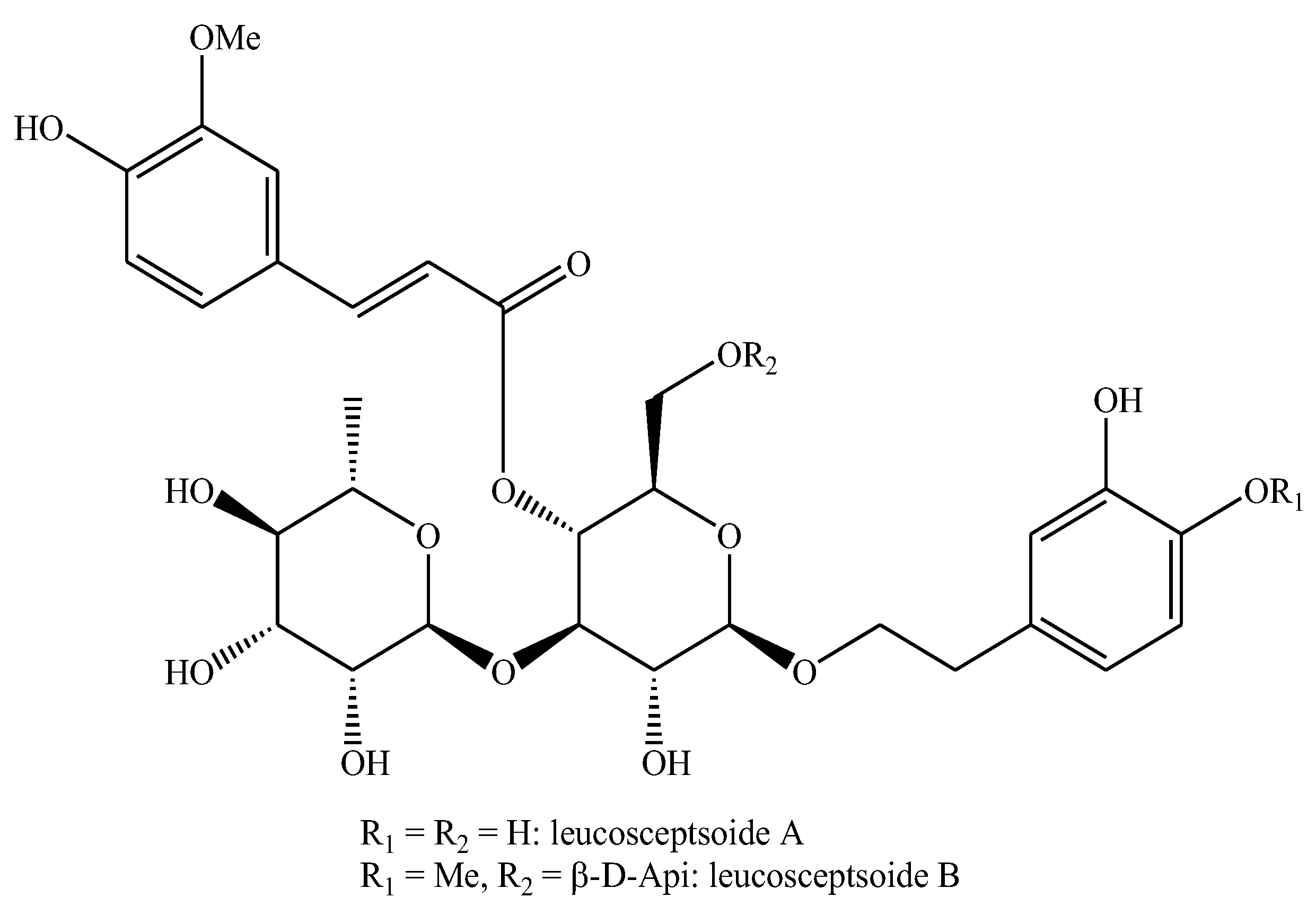

| Leucosceptoside A | |||||
|---|---|---|---|---|---|
| Family | Plant Species | Collection Area | Organs | Methodology of Isolation and Identification | Reference |
| Acanthaceae Juss. | Acanthus ebracteatus Vahl | Thailand | Aerial parts | SE, DP, CC, p-HPLC-UV, NMR | [5] |
| Thailand (obtained from a botanical garden) | Leaves | SE, UHPLC-MS | [6] | ||
| Acanthus hirsutus Boiss. | Turkey (obtained from a botanical garden) | Aerial parts | SE, PP, CC, UV, IR, NMR, MS | [7] | |
| Acanthus montanus (Nees) T. Anderson | Thailand (obtained from a botanical garden) | Aerial parts | SE, PP, CC, p-HPLC-RID, NMR | [8] | |
| Blepharis edulis (Forssk.) Pers. | Egypt | Aerial parts | SE, VLC, CC, TLC, HPLC-UV, NMR, MS | [9] | |
| Pseuderanthemum carruthersii (Seem.) Guillaumin | n.a. | n.a. | n.a. | [10] | |
| Asteraceae Giseke | Balbisia calycina Hunz. and Ariza Esp. | Paraguay (purchased from a company) | Leaves | SE, DP, CC, TLC, HPLC-UV, NMR, MS | [11] |
| Bignoniaceae Juss. | Fernandoa adenophylla (Wall. ex G.Don) Steenis | Thailand (obtained from a botanical garden) | Leaves and branches | SE, DP, CC, TLC, p-HPLC-UV, NMR | [12] |
| Incarvillea compacta Maxim. | China | Roots | SE, PP, CC, rp-CC, sp-LC-UV, NMR, MS | [13] | |
| Incarvillea emodi (Royle ex Lindl.) Chatterjee | Pakistan (several populations) | Whole plant | SE, CC, HPLC-DAD | [14] | |
| Martinella obovata (Kunth) Bureau and K.Schum. | Honduras | Leaves | SE, CC, TLC, HPLC-RID, NMR, MS | [15] | |
| Oroxylum indicum (L.) Kurz | Vietnam | Stem bark | USE, PP, CC, rp-MPLC, NMR | [16] | |
| Santisukia kerrii (Barnett and Sandwith) Brummitt | Thailand (obtained from a botanical garden) | Leaves and branches | SE, DP, CC, TLC, p-HPLC-UV, NMR | [17] | |
| Tynanthus panurensis (Bureau ex Baill.) Sandwith | Peru | Bark | SE, CC, HPLC-DAD, NMR, MS | [18] | |
| Lamiaceae Martinov | Betonica macrantha C. Koch. | Turkey | Aerial parts | SE, DP, PP, CC, IR, IV, NMR | [19] |
| Callicarpa longissima (Hemsl.) Merr. | China | Leaves and stems | SER, CC, TLC, p-HPLC-UV, NMR | [20] | |
| Callicarpa nudiflora Hook. and Arn. | n.a. | n.a. | n.a. | [21] | |
| Caryopteris incana (Thunb. ex Houtt.) Miq. | Japan | Aerial parts | SE, PP, CC, DCCC, NMR | [22] | |
| South Korea (obtained from a botanical garden) | Aerial parts | SE, PP, CC, TLC, NMR | [23] | ||
| Japan (cultivated) | Whole plant | SE, PP, CC, p-HPLC-UV, TLC, NMR | [24] | ||
| South Korea | Leaves | SER, PP, CC, TLC, UV, IR, HPLC-UV, NMR | [25] | ||
| Clerodendrum bungei Steud. | n.a. | n.a. | n.a. | [26] | |
| China | Roots | SER, PP, CC, sp-HPLC-UV, NMR | [27] | ||
| Clerodendrum chinense (Osbeck) Mabb. | n.a. | n.a. | n.a. | [28] | |
| Clerodendrum infortunatum L. | Bangladesh | Leaves | SE, PP, CC, TLC, sp-HPLC-UV, NMR | [29] | |
| Clerodendrum phlomidis L. f. | India (obtained from a botanical garden) | Roots | SPE, PP, CC, HPTLC, NMR, MS | [30] | |
| India (obtained from a botanical garden) | Roots | SPE, PP, TLC, CC, p-TLC, NMR | [31] | ||
| Clerodendrum trichotomum Thunb. | South Korea | Stems | SE, PP, CC, [α]D, UV, NMR, MS | [32] | |
| South Korea | Stems | SE, PP, CC, NMR | [33] | ||
| n.a. | n.a. | n.a. | [34] | ||
| Comanthosphace japonica (Miq.) S.Moore | Japan | Roots | HSE, PP, CC, [α]D, IR, UV, NMR | [35] | |
| Japan | Whole plant | HSE, PP, CC, rp-CC, p-LPLC-UV, p-HPLC-UV, NMR | [36] | ||
| Galeopsis bifida Boenn. | Siberia (several populations) | Leaves | USE, SPE, HPLC-DAD-MS | [37] | |
| Siberia (several populations) | Flowers | USE, SPE, HPLC-DAD-MS | [37] | ||
| Siberia (several populations) | Stems | USE, SPE, HPLC-DAD-MS | [37] | ||
| Siberia (several populations) | Roots | USE, SPE, HPLC-DAD-MS | [37] | ||
| Lagopsis supina (Steph. ex Willd.) Ikonn.-Gal. | China | Whole plant | SE, PP, CC, LC-UV, rp-HPLC-UV, NMR | [38] | |
| Mongolia (obtained from a botanical garden) | Whole plant | SE, HPLC-DAD, UHPLC-MSn | [39] | ||
| Mongolia | Whole plant | SE, PP, FP, TLC, UHPLC-MS | [40] | ||
| Leonurus cardiaca L. | Siberia | Aerial parts | HSE, PP, HPLC-UV | [41] | |
| Leonurus deminutus V.I.Krecz. | Siberia | Aerial parts | HSE, PP, CC, HPLC-UV, NMR, MS | [41] | |
| Leonurus glaucescens Bunge | Siberia | Aerial parts | HSE, PP, HPLC-UV | [41] | |
| Leonurus mongolicus V.I.Krecz. and Kuprian. | Siberia | Aerial parts | HSE, PP, HPLC-UV | [41] | |
| Leonurus persicus Boiss. | Turkey | Aerial parts | SE, PP, VLC, TLC, NMR, MS | [42] | |
| Leonurus quinquelobatus Gilib. | Siberia | Aerial parts | HSE, PP, HPLC-UV | [41] | |
| Leonurus sibiricus L. | Siberia | Aerial parts | HSE, PP, HPLC-UV | [41] | |
| Mongolia | Aerial parts | ASE, DP, PP, HPLC-MS | [43] | ||
| Mongolia (several populations) | Aerial parts | ASE, PP, CC, sp-HPLC-UV, HPLC-DAD-MS | [44] | ||
| Leonurus tataricus L. | Siberia | Aerial parts | HSE, PP, HPLC-UV | [41] | |
| Marrubium alysson L. | Egypt | Aerial parts | HSE, DP, CC, MPLC, NMR | [45] | |
| Marrubium thessalum Boiss. and Heldr. | Greece | Aerial parts | SE, VLC, CC, TLC, NMR | [46] | |
| Marrubium velutinum Sm | Greece | Aerial parts | SE, VLC, CC, rp-HPLC-UV | [47] | |
| Marrubium vulgare L. | India | Whole plant | SE, PP, CC, TLC, p-TLC, NMR | [48] | |
| Phlomis armeniaca Willd. | Turkey | Aerial parts | SE, PP, CC, TLC, NMR, MS | [49] | |
| Phlomis bruguieri Desf. | Turkey | Aerial parts | HSE, PP, CC, HPLC-PAD, HPLC-PAD-MS | [50] | |
| Phlomis chimerae Boissieu | n.a. | n.a. | n.a. | [51] | |
| Phlomis fruticosa L. | Montenegro | Aerial parts | SE, UHPLC-MS | [52] | |
| Phlomis integrifolia Hub.-Mor. | Turkey | Aerial parts | HSE, PP, CC, MPLC, TLC, IR, UV, NMR | [53] | |
| n.a. | n.a. | n.a. | [54] | ||
| Phlomis kurdica Rech.f. | Turkey | Aerial parts | HSE, PP, CC, HPLC-PAD, HPLC-PAD-MS | [50] | |
| Phlomis leucophracta P.H.Davis and Hub.-Mor. | Turkey | Aerial parts | HSE, PP, CC, HPLC-PAD, HPLC-PAD-MS | [50] | |
| Phlomis longifolia Boiss. and Blanche | Turkey | Aerial parts | SE, PP, VLC, MPLC, CC, TLC, rp-MPLC, NMR | [55] | |
| Phlomis nissolii L. | Turkey | Aerial parts | SE, PP, CC, MPLC, HPLC, TLC, NMR, MS | [56] | |
| Turkey | Aerial parts | HSE, PP, CC, HPLC-PAD, HPLC-PAD-MS | [50] | ||
| Phlomis oppositiflora Boiss. and Hausskn. | Turkey | Whole plant | SE, PP, CC, MPLC, TLC, NMR | [57] | |
| Phlomis physocalyx Hub.-Mor. | Turkey | Aerial parts | SE, CC, LPLC-UV, NMR | [58] | |
| Phlomis russeliana (Sims) Lag. ex Benth. | Turkey | Aerial parts | HSE, PP, CC, HPLC-PAD, HPLC-PAD-MS | [50] | |
| Phlomis sieheana Rech. F. | Turkey | Aerial parts | HSE, PP, CC, MPLC, TLC, NMR | [59] | |
| Phlomis syriaca Boiss. | Turkey | Aerial parts | HSE, PP, CC, MPLC, TLC, IR, UV, NMR, MS | [54] | |
| Phlomis viscosa Poir. | Turkey | Whole plant | SE, PP, CC, TLC, NMR, MS | [60] | |
| Phlomoides glabra (Boiss. ex Benth.) Kamelin and Makhm. | Iran | Rhizomes | SXE, VLC, p-TLC, p-rp-HPLC-UV, NMR, UV, MS | [61] | |
| Phlomoides laciniata (L.) Kamelin and Makhm. | Turkey | Aerial parts | HSE, DP, PP, rp-VLC, TLC, NMR | [62] | |
| Phlomoides rotata (Benth. ex Hook.f.) Mathiesen | China (several populations) | Stems | USE, UPLC-MS | [63] | |
| Tibet (several collections) | Aerial parts | USE, UPLC-MS | [64] | ||
| Tibet (several collections) | Roots | USE, UPLC-MS | [64] | ||
| Phlomoides tuberosa (L.) Moench | Turkey | Aerial parts | HSE, PP, CC, TLC, NMR, MS | [65] | |
| Salvia digitaloides Diels | China | Roots | SE, PP, CC, TLC, NMR | [66] | |
| Salvia viridis L. | England (cultivated) | Aerial parts | SE, PP, CC, TLC, HPLC-UV | [67] | |
| Poland (obtained from a botanical garden) | Aerial parts | HSE, UPLC-DAD, UPLC-DAD-MS | [68] | ||
| Turkey | Roots | SXE, UHPLC-MSn | [69] | ||
| Turkey | Roots | USE, UHPLC-MSn | [69] | ||
| Turkey | Roots | MAE, UHPLC-MSn | [69] | ||
| Turkey | Roots | SE, UHPLC-MSn | [69] | ||
| Schnabelia nepetifolia (Benth.) P.D.Cantino | China | Whole plant | SE, PP, CC, MPLC, p-HPLC-UV, NMR | [70] | |
| Scutellaria albida subsp. velenovskyi (Rech.f.) Greuter and Burdet | Turkey | Whole plant | SE, MPLC, rp-HPLC-UV, NMR | [71] | |
| Scutellaria baicalensis Georgi | n.r. | n.r. | n.r. | [72] | |
| China (purchased from a company) | Roots | USE, UHPLC-UV-MS | [73] | ||
| China (several commercial samples) | Roots | USE, UPLC-MS | [74] | ||
| China (purchased from a company) | Roots | SER, UPLC-MS | [75] | ||
| Scutellaria edelbergii Rech.f. | Pakistan | Whole plant | SE, PP, LC-MS | [76] | |
| Scutellaria lateriflora L. | Japan (purchased from a company) | Aerial parts | SE, DP, PP, CC, TLC, NMR | [77] | |
| Scutellaria pinnatifida A.Ham. | Turkey | Aerial parts | SE, PP, CC, TLC, IR, UV, NMR | [78] | |
| Scutellaria prostrata Jacquem. ex Benth. | Nepal | Roots | SE, TLC, GLC, NMR | [79] | |
| Scutellaria salviifolia Benth. | Turkey | Aerial parts | SE, PP, CC, TLC, NMR, MS | [49] | |
| Sideritis cypria Post | Cyprus (cultivated) | Flowers | SE, CC, TLC, p-TLC, NMR | [80] | |
| Cyprus (cultivated) | Leaves | SE, CC, TLC, p-TLC, NMR | [80] | ||
| Cyprus (cultivated) | Aerial parts | SE, CC, TLC, p-TLC, NMR | [81] | ||
| Sideritis euboea Heldr. | Greece (cultivated) | Aerial parts | SE, PP, VLC, CC, TLC, NMR | [82] | |
| Greece (cultivated) | Aerial parts | SE, CC, p-TLC, NMR | [83] | ||
| Sideritis lycia Boiss. and Heldr. | Turkey | Aerial parts | SE, PP, CC, MPLC, TLC, UV, IR, NMR | [84] | |
| Sideritis ozturkii Aytaç and Aksoy | Turkey | Aerial parts | SE, CC, VLC, MPLC, TLC, NMR | [85] | |
| Sideritis perfoliata L. | Greece | Aerial parts | SXE, PP, VLC, CC, TLC, UV, NMR | [86] | |
| Turkey | Aerial parts | HP, SE, HPLC-DAD-MSn | [87] | ||
| Sideritis raeseri Boiss. and Heldr. | Albania (several populations) | Aerial parts | HP, SE, HPLC-DAD-MSn | [87] | |
| Macedonia (several populations) | Aerial parts | HP, SE, HPLC-DAD-MSn | [87] | ||
| Serbia (cultivated) | Aerial parts | SXE, HPLC-DAD, HPLC-MS | [88] | ||
| Serbia (several populations) | Aerial parts | SXE, DP, CC, HPLC-DAD-MS | [89] | ||
| Sideritis scardica Griseb. | Macedonia (several populations) | Aerial parts | HP, SE, HPLC-DAD-MSn | [87] | |
| Bulgaria | Aerial parts | HP, SE, HPLC-DAD-MSn | [87] | ||
| Serbia (several populations) | Aerial parts | SXE, DP, CC, HPLC-MS | [89] | ||
| Greece (purchased from a company) | Aerial parts | USE, UPLC-MS, HPLC-DAD | [90] | ||
| Sideritis sipylea Boiss. | Greece | Aerial parts | HSE, CC, p-TLC, NMR | [91] | |
| Sideritis syriaca L. | Bulgaria | Aerial parts | HP, SE, HPLC-DAD-MSn | [87] | |
| Greece | Aerial parts | HP, SE, HPLC-DAD-MSn | [87] | ||
| Stachys affinis Bunge | n.a. | n.a. | n.a. | [92] | |
| Japan (cultivated) | Leaves | SE, CC, NMR | [93] | ||
| Italy (cultivated) | Tubers | SE, CC, NMR, MS | [94] | ||
| Stachys iva Griseb. | Greece (cultivated) | Aerial parts | HSE, CC, p-TLC, NMR | [95] | |
| Stachys lavandulifolia Vahl | Azerbaijan | Aerial parts | SXE, SPE, p-rp-HPLC-UV, NMR, MS | [96] | |
| Stachys rupestris Montbret and Aucher ex Benth. | Turkey | n.r. | SE, HPLC-MS | [97] | |
| Stachys tetragona Boiss. and Heldr. | Greece | Aerial parts | SE, VLC, CC, rp-HPLC, NMR | [98] | |
| Volkameria inermis L. | Thailand (obtained from a botanical garden) | Aerial parts | SE, DP, CC, TLC, p-HPLC-UV, NMR | [99] | |
| Linderniaceae Borsch, Kai Müll. & Eb.Fisch. | Craterostigma plantagineum Hochst. | Rwanda (cultivated) | Leaves | USE, HPLC-DAD-MS | [100] |
| Lindernia brevidens Skan | Kenya (cultivated) | Leaves | USE, HPLC-DAD-MS | [100] | |
| Lindernia subracemosa De Wild. | Rwanda (cultivated) | Leaves | USE, HPLC-DAD-MS | [100] | |
| Malvaceae Juss. | Firmiana simplex (L.) W.Wight | China | Roots | SE, PP, CC, TLC, NMR | [101] |
| Oleaceae Hoffmanns. & Link | Osmanthus fragrans Lour. | China | Leaves | n.r. | [102] |
| Orobanchaceae Vent. | Orobanche aegyptiaca Pers. | n.r. | n.r. | n.r. | [103] |
| Orobanche arenaria Borkh. | Poland | Whole plant | ASE, SPE, rp-HPLC-UV, UHPLC-PDA-MS, sp-HPLC-PDA | [104] | |
| Orobanche artemisiae-campestris subsp. picridis (F. Schulz) O. Bolòs, Vigo, Masalles and Ninot | Poland | Whole plant | ASE, SPE, rp-HPLC-UV, UHPLC-PDA-MS, sp-HPLC-PDA | [104] | |
| Orobanche caryophyllacea Sm. | Poland | Whole plant | ASE, SPE, rp-HPLC-UV, UHPLC-PDA-MS, sp-HPLC-PDA | [104] | |
| Orobanche caerulescens K.Koch | Poland | Whole plant | ASE, SPE, rp-HPLC-UV, UHPLC-PDA-MS, sp-HPLC-PDA | [104] | |
| Orobanche cernua Loefl. | China | Whole plant | SER, HPLC-MS, NMR | [105] | |
| China | Whole plant | SE, PP, CC, sp-HPLC-UV, NMR, MS | [106] | ||
| Orobanche pycnostachya Hance | n.r. | n.r. | n.r. | [103] | |
| China | Whole plant | SE, PP, CC, TLC, UV, NMR, MS | [107] | ||
| Euphrasia pectinata Ten. | Turkey | Aerial parts | HSE, PP, VLC, CC, TLC, MPLC, NMR | [108] | |
| Turkey | Aerial parts | HSE, VLC, MPLC, IR, UV, NMR | [109] | ||
| Pedicularis acmodonta Boiss. | n.a. | n.a. | n.a. | [110] | |
| Pedicularis alaschanica Maxim. | n.a. | n.a. | n.a. | [111] | |
| n.a. | n.a. | n.a. | [112] | ||
| Pedicularis albiflora Prain | China | Whole plant | SE, PP, CC, TLC, NMR, MS | [113] | |
| Pedicularis dolichocymba Hand.-Mazz. | n.a. | n.a. | n.a. | [114] | |
| Pedicularis kansuensis Maxim. | Tibet | Whole plant | SER, PP, CC, TLC, ESP, NMR, MS | [115] | |
| Pedicularis kerneri Dalla Torre | Italy | Aerial parts | SE, CC, NMR, MS | [116] | |
| Pedicularis longiflora var. tubiformis (Klotzsch) Tsoong | China | Whole plant | SE, PP, CC, HSCCC, rp-HPLC-UV, NMR | [117] | |
| Pedicularis nordmanniana Bunge | Turkey | Aerial parts | SE, DP, CC, NMR | [118] | |
| Pedicularis verticillata L. | China | Whole plant | SE, PP, CC, TLC, NMR | [119] | |
| Phtheirospermum japonicum (Thunb.) Kanitz | Japan | Aerial parts | SE, PP, CC, TLC, p-HPLC-UV, [α]D, NMR | [120] | |
| Plantaginaceae Juss. | Globularia alypum L. | Croatia | Aerial parts | HP, SER, HPLC-PDA-MS | [121] |
| Croatia | Aerial parts | USE, PP, HPLC-PDA-MS | [122] | ||
| Croatia | Aerial parts | SXE, PP, HPLC-PDA-MS | [122] | ||
| Globularia cordifolia L. | Turkey | Underground parts | HSE, PP, VLC, MPLC, CC, NMR, MS | [123] | |
| Croatia | Aerial parts | HP, SER, HPLC-PDA-MS | [121] | ||
| Croatia | Aerial parts | USE, PP, HPLC-PDA-MS | [122] | ||
| Croatia | Aerial parts | SXE, PP, HPLC-PDA-MS | [122] | ||
| Globularia davisiana O.Schwarz | Turkey | Aerial parts | HSE, PP, VLC, CC, TLC, rp-MPLC, NMR | [124] | |
| Globularia meridionalis (Podp.) O.Schwarz | Croatia | Aerial parts | HP, SER, HPLC-PDA-MS | [121] | |
| Croatia | Aerial parts | USE, PP, HPLC-PDA-MS | [122] | ||
| Croatia | Aerial parts | SXE, PP, HPLC-PDA-MS | [122] | ||
| Globularia orientalis L. | Turkey | Aerial parts | HSE, PP, VLC, MPLC, NMR | [125] | |
| Globularia punctata Lapeyr. | Croatia | Aerial parts | HP, SER, HPLC-PDA-MS | [121] | |
| Croatia | Aerial parts | USE, PP, HPLC-PDA-MS | [122] | ||
| Croatia | Aerial parts | SXE, PP, HPLC-PDA-MS | [122] | ||
| Globularia sintenisii Hausskn. and Wettst. | Turkey | Underground parts | SE, CC, MPLC, TLC, NMR | [126] | |
| Lagotis brevituba Maxim. | China (purchased from a company) | Whole plant | SE, PP, HPLC-UV-MS | [127] | |
| Lagotis ramalana Batalin | n.a. | n.a. | n.a. | [128] | |
| Penstemon centranthifolius (Benth.) Benth. | California | Aerial parts | SE, FCC, CC, TLC, NMR, MS | [129] | |
| Penstemon crandallii A. Nelson | Colorado | Leaves | SE, PP, VLC, NMR | [130] | |
| Penstemon linarioides A. Gray | New Mexico | Whole plant | SE, PP, CC, TLC, [α]D, UV, NMR, MS | [131] | |
| Plantago asiatica L. | Japan | Whole plant | HSE, CC, NMR | [132] | |
| China (several populations) | Seeds | HSE, UPLC-MSn | [133] | ||
| China | Seeds | USE, UHPLC-MS | [134] | ||
| Plantago depressa Willd. | China (several populations) | Seeds | HSE, UPLC-MSn | [133] | |
| China | Seeds | USE, UHPLC-MS | [134] | ||
| Plantago lanceolata L. | Brazil (purchased from a company) | Aerial parts | SWE, HPLC-DAD-MS | [135] | |
| Plantago major L. | China | Seeds | USE, UHPLC-MS | [134] | |
| Brazil (purchased from a company) | Aerial parts | SWE, HPLC-DAD-MS | [135] | ||
| Plantago squarrosa Murray | Egypt | Whole plant | PE, PP, TLC, CC, UV, IR, NMR, MS | [136] | |
| Plantago subulata L. | n.r. | Aerial parts | HSE, PP, CC, MPLC, UV, IR, NMR, MS | [137] | |
| Turkey | Aerial parts | HSE, PP, CC, MPLC, TLC, NMR | [138] | ||
| Turkey | Roots | HSE, PP, CC, MPLC, TLC, NMR | [138] | ||
| Rehmannia glutinosa (Gaertn.) DC. | Japan (purchased from a company) | Roots | SE, CC, HPLC-UV, TLC, NMR | [139] | |
| n.a. | n.a. | n.a. | [140] | ||
| China (purchased from a local market) | Rhizomes | SE, PP, CC, TLC, NMR | [141] | ||
| n.a. | n.a. | n.a. | [142] | ||
| China | Roots | SER, UHPLC-MS | [143] | ||
| China | Tuber root | SE, HPLC-UV, UHPLC-MS | [144] | ||
| China (cultivated) | Leaves | SE, UHPLC-MS | [145] | ||
| China (cultivated) | Tubers | SE, UHPLC-MS | [145] | ||
| Vietnam | Roots | HSE, PP, DP, CC, TLC, NMR | [146] | ||
| Russelia equisetiformis Schltdl. and Cham. | Japan | Aerial parts | SE, PP, CC, TLC, DCCC, HPLC-UV, NMR | [147] | |
| Scrophulariaceae Juss. | Buddleja davidii Franch. | China | Roots | SER, PP, CC, TLC, p-HPLC-UV, NMR | [148] |
| Buddleja lindleyana Fortune | China | Powder | SE, PP, CC, rp-CC, NMR | [149] | |
| Buddleja officinalis Maxim. | China | Flower buds | SE, PP, CC, TLC, NMR | [150] | |
| Scrophularia umbrosa L. | China | Whole plant | SER, PP, CC, sp-rp-HPLC-UV, NMR | [151] | |
| Verbascum thapsus L. | Italy (cultivated) | Leaves | SE, HPLC-DAD-MS, NMR | [152] | |
| Verbenaceae J.St.-Hil. | Aloysia citriodora Palau | Spain | Commercial extract | HPLC-UV, HPLC-MS | [153] |
| Peru (purchased from a company) | Aerial parts | SER, PP, CC, HPLC-UV, NMR | [154] | ||
| Spain (commercial extract) | Leaves | SE, sp-HPLC-UV, rp-HPLC-DAD- MS | [155] | ||
| Spain (commercial extract) | Leaves | SE, HPLC-UV, HPLC-MS, sp-HPLC-UV | [156] | ||
| Citharexylum flexuosum (Ruiz and Pav.) D.Don | Tunisia (obtained from a botanical garden) | Trunk bark | SE, CC, p-HPLC-UV, NMR | [157] | |
| Lippia alba (Mill.) N.E.Br. ex Britton and P.Wilson | Brazil (different chemotypes) | Leaves | HSE, HPLC-DAD-MS | [158] | |
| Phyla canescens (Kunth) Greene | Japan (obtained from a botanical garden) | Aerial parts | SE, PP, CC, HPLC-UV, NMR, MS | [159] | |
| Stachytarpheta cayennensis (Rich.) Vahl | Panama | Whole plant | SE, PP, CC, p-TLC, NMR, MS | [160] | |
| Stachytarpheta schottiana Schauer | Brazil (obtained from a botanical garden) | Aerial parts | SE, DP, LC-MS | [161] | |
| Verbena brasiliensis Vell. | Japan | Aerial parts | SE, PP, CC, HPLC, NMR | [162] | |
| Verbena hastata L. | Canada (purchased from a company) | Whole plant | SE, DP, CC, TLC, pHPLC, NMR | [163] | |
| Leucosceptoside B | |||||
|---|---|---|---|---|---|
| Family | Plant Species | Collection Area | Organs | Methodology of Isolation and Identification | Reference |
| Bignoniaceae Juss. | Amphilophium crucigerum (L.) L.G.Lohmann | Panama | Stems | SE, PP, MPLC, LPLC-UV, NMR | [164] |
| Lamiaceae Martinov | Callicarpa kwangtungensis Chun | n.a. | n.a. | n.a. | [165] |
| Callicarpa macrophylla Vahl | China | Whole plant | SE, PP, CC, sp-rp-HPLC-UV, NMR | [166] | |
| Comanthosphace japonica (Miq.) S.Moore | Japan | Roots | HSE, PP, CC, [α]D, IR, UV, NMR | [35] | |
| Marrubium alysson L. | Egypt | Aerial parts | HSE, DP, CC, MPLC, NMR, MS | [45] | |
| Phlomis bovei Noë | Algeria | Roots | VLC, CC, MPLC, rp-MPLC, NMR, MS | [167] | |
| Phlomis herba-venti subsp. pungens (Willd.) Maire ex DeFilipps | n.a. | n.a. | n.a. | [168] | |
| Turkey | Aerial parts | HSE, PP, CC, rp-MPLC, NMR | [169] | ||
| Azerbaijan | Aerial parts | SE, PP, CC, UV, IR, NMR, MS | [170] | ||
| Phlomis kotschyana Hub.-Mor. | Turkey | Aerial parts | HSE, PP, CC, rp-MPLC, UV, IR, NMR | [171] | |
| Phlomis kurdica Rech.f. | Jordan | Aerial parts | SE, CC, rp-HPLC-UV, NMR | [172] | |
| Turkey | Aerial parts | HSE, PP, CC, HPLC-PAD, HPLC-PAD-MS | [50] | ||
| Phlomis lycia D.Don | Turkey | Aerial parts | HSE, PP, CC, MPLC, TLC, IR, UV, NMR, MS | [173] | |
| Phlomis nissolii L. | Turkey | Aerial parts | SE, PP, CC, MPLC, HPLC-UV, TLC, NMR, MS | [56] | |
| Turkey | Aerial parts | HSE, PP, CC, HPLC-PAD, HPLC-PAD-MS | [50] | ||
| Phlomis russeliana (Sims) Lag. ex Benth. | Turkey | Aerial parts | HSE, PP, CC, HPLC-PAD, HPLC-PAD-MS | [50] | |
| Phlomis viscosa Poir. | Turkey | Whole plant | SE, PP, CC, MPLC, TLC, NMR, MS | [60] | |
| Phlomoides rotata (Benth. ex Hook.f.) | China | Whole plant | SER, PP, CC, HSCCC, HPLC-UV | [174] | |
| Phlomoides umbrosa (Turcz.) Kamelin and Makhm. | South Korea | Roots | SE, PP, CC, TLC, rp-HPLC-UV, sp-HPLC-UV, NMR | [175] | |
| Schnabelia nepetifolia (Benth.) P.D.Cantino | China | Whole plant | SE, PP, CC, MPLC, HPLC-UV, LC-UV, NMR | [70] | |
| Schnabelia tetradonta (Y.Z.Sun) C.Y.Wu and C.Chen | China | Roots | SE, PP, CC, NMR | [176] | |
| n.a. | n.a. | n.a. | [177] | ||
| Stachys officinalis (L.) Trevis. | Japan (cultivated) | Aerial parts | SE, CC, p-HPLC-UV, NMR | [178] | |
| Orobanchaceae Vent. | Pedicularis longiflora var. tubiformis (Klotzsch) Tsoong | China | Whole plant | SE, PP, CC, HSCCC, rp-HPLC-UV, NMR | [117] |
| Plantaginaceae Juss. | Lagotis brevituba Maxim. | China (purchased from a company) | Whole plant | SE, PP, HPLC-UV-MS | [127] |
| Scrophulariaceae Juss. | Buddleja davidii Franch. | China | Roots | SER, PP, CC, p-HPLC-UV, | [148] |
| Buddleja lindleyana Fortune | China | Powder | SE, PP, CC, rp-CC, NMR | [149] | |
| Verbascum densiflorum Bertol. | Bulgaria (cultivated) | Leaves | SE, HPLC-DAD, NMR | [179] | |
| Verbascum nigrum L. | Bulgaria (cultivated) | Leaves | SE, HPLC-DAD, NMR | [179] | |
| Verbascum phlomoides L. | Bulgaria (cultivated) | Leaves | SE, HPLC-DAD, NMR | [179] | |
| Verbascum phoeniceum L. | Bulgaria (cultivated) | Leaves | SE, HPLC-DAD, NMR | [179] | |
| Verbascum thapsus L. | Japan (obtained from a botanical garden) | Whole plant | SE, CC, NMR | [180] | |
| Italy (cultivated) | Leaves | SE, HPLC-DAD-MS, NMR | [152] | ||
| Verbascum wiedemannianum Fisch. and C.A.Mey. | Turkey | Roots | SER, VLC, MPLC, CC, TLC, [α]D, NMR, MS | [181] | |
| Verbascum xanthophoeniceum Griseb. | Bulgaria (several populations) | Aerial parts | SE, PP, CC, rp-HPLC-UV, NMR | [182] | |
| Bulgaria (cultivated) | Leaves | SE, HPLC-DAD, NMR | [179] | ||
| Bulgaria (several populations) | Whole plant | SE, PP, CC, LC-MS, NMR | [183] | ||
| Verbenaceae J.St.-Hil. | Lantana camara L. | Egypt (obtained from a botanical garden) | Leaves | SE, DP, PP, HPLC-MS | [184] |
| Leucosceptoside A | ||||
|---|---|---|---|---|
| Biological Activity | Studied Element | Specific Methodology and/or Studied Cells | Efficacy Value | Reference |
| Antioxidant | DPPH.+ | IC50 = 18.43 µg/mL | [7] | |
| IC50 = 53.32 µM | [13] | |||
| IC50 = 76.0 µM | [58] | |||
| IC50 = 125.4 µM | [60] | |||
| IC50 = 72.14 µM | [150] | |||
| EC50 = 11.26 µM | [117] | |||
| EC50 = 25.7 µM | [154] | |||
| RC50 = 0.0148 µg/mL | [61] | |||
| Inhibition % = 41.8% (at the concentration of 200 µM) | [54] | |||
| - Inhibition % = 88.3% (after 20 min at the concentration of 0.1 mM) - Inhibition % = 89.0% (after 60 min at the concentration of 0.1 mM) | [86] | |||
| Radical scavenging | Superoxide anion | Luminol-enhanced chemiluminescence assay in stimulated human polymorphonuclear neutrophils | SC50 = 0.294 mM | [112] |
| Hydroxyl radical | Luminol-enhanced chemiluminescence assay in stimulated human polymorphonuclear neutrophils | Inhibition % = 27.8% (at the concentration of 0.55 mM) | [112] | |
| Iron reductor | Luminol-enhanced chemiluminescence assay in stimulated human polymorphonuclear neutrophils | Inhibition % = 17.86% (at the concentration of 1.57 mM) | [112] | |
| N-formyl-methionyl-leucyl-phenylalanine | Luminol-enhanced chemiluminescence assay in stimulated human polymorphonuclear neutrophils | IC50 = 0.18 µM | [185] | |
| Anti-inflammatory | NO production | Griess assay in LPS-stimulated BV2 microglial cells | IC50 = 61.1 µM | [14] |
| Cell culture supernatants of LPS-stimulated RAW264.7 macrophages | Inhibition % = 40.0% (at the concentration of 100 µM) | [147] | ||
| Raw 264.7 cells | IC50 = 9.0 µM | [151] | ||
| Enzyme inhibitory | A-glucosidase | IC50 = 0.7 mM | [27] | |
| IC50 = 273.0 µM | [146] | |||
| Acetylcholinesterase | IC50 = 423.7 µg/mL | [33] | ||
| IC50 = 72.85 µM | [186] | |||
| Scheffe’s test | IC50 = 3.86 mM | [187] | ||
| Protein kinase C alpha | IC50 = 19.0 µM | [131] | ||
| Tyrosinase | - Inhibition % = 39.5% (at the concentration of 100 µM) | [186] | ||
| - Inhibition % = 21.65% (at the concentration of 0.051 mM) | [188] | |||
| Hyaluronidase | No activity | [138] | ||
| Hepatoprotective | CCl4 intoxication | MTT assay and flow cytometry in HepG2 cells | - Cell number % > 80% - Cell viability % > 80% - Inhibition % of CCl4-induced lipid peroxidation = 177.73% - SOD decrease attenuation % = 76.58% | [13] |
| Neuroprotective | 1-methyl-4-phenylpyridinium ion (MPP+)-induced cell death | MTT assay in mesencephalic neurons of rats | - Cell death reduction % = 7% (at the concentration of 4 µM) - Cell growth increase % = 3.7% (at the concentration of 16 µM) | [189] |
| Cytoprotective | t-BHP-induced toxicity | HepG2 cells | IC50 = 21.1 µM | [23] |
| Anticomplementary | CH50 = 0.23 mM | [119] | ||
| Anti-HIV | IC50 = 29.4 µM | [32] | ||
| Cytotoxic | A549 | IC50 = 99.00 µM | [186] | |
| B16F10 | GI50 = 28 µM | [159] | ||
| dRLh-88 | No activity | [49] | ||
| Hela | IC50 = 200 µg/mL | [46] | ||
| IC50 = 80.87 µM | [186] | |||
| GI50 = 42 µM | [159] | |||
| No activity | [49] | |||
| HC7-116 | IC50 = 182.33 µg/mL | [46] | ||
| MCF7 | IC50 = 189.08 µg/mL | [46] | ||
| MK-1 | GI50 = 33 µM | [159] | ||
| Melanoma | No activity | [46] | ||
| P-388-d1 | No activity | [49] | ||
| S-180 | No activity | [49] | ||
| Inhibitory | ADP + NADPH-induced lipid peroxidation | Rat liver microsome | IC50 = 1.69 µM | [132] |
| Protonation of thymine radical anion induced by pulse radiolysis | Reaction rate constant = 1.54 × 10⁹ dm3 mol−1 s−1 | [190] | ||
| Antimicrobial | Staphylococcus aureus ATCC29213 | MIC = 1000 µg/mL | [60] | |
| Enterococcus faecalis ATCC29212 | MIC = 1000 µg/mL | [60] | ||
| Bacillus subtilis NBRC3134 | No activity | [24] | ||
| Escherichia coli ATCC25922 | No activity | [60] | ||
| Klebsiella pneumoniae NBRC3512 | No activity | [24] | ||
| Mycobacterium tuberculosis H37Rv | No activity | [30] | ||
| Pseudomonas aeruginosa ATCC27853 | No activity | [60] | ||
| Antifungal | Candida albicans ATCC90028 | No activity | [60] | |
| Candida krusei ATCC6258 | No activity | [60] | ||
| Candida parapsilosis ATCC22019 | No activity | [60] | ||
| Leucosceptoside B | ||||
|---|---|---|---|---|
| Biological Activity | Studied Element | Specific Methodology and/or Studied Cells | Efficacy Value | Reference |
| Antioxidant | DPPH.+ | IC50 = 61.3 µM | [166] | |
| IC50 = 31.16 µM | [166] | |||
| IC50 = 96 µM | [182] | |||
| EC50 = 13.05 µM | [117] | |||
| EC50 = 25.7 µM | [154] | |||
| Radical scavenging | FRAP | Absorbance value = 0.602 (at 700 nm) | [183] | |
| HORAC | 3885.1 HORACFL/g | [182] | ||
| ORAC | 16264.7 ORACFL/g | [182] | ||
| Superoxide anion | IC50 = about 45 µg/mL | [182] | ||
| N-formyl-methionyl-leucyl-phenylalanine | Luminol-enhanced chemiluminescence assay in stimulated human polymorphonuclear neutrophils | IC50 = 0.17 µM | [185] | |
| Anti-inflammatory | Cobra venom factor induced alternative pathway activation | Mouse sera | Inhibition % = 40% | [183] |
| COX-2 production | Inhibition % = about 30% | [183] | ||
| IL-10 production | Value not reported | [183] | ||
| NO production | Value not reported | [183] | ||
| Enzyme inhibitory | Acetylcholinesterase | inhibition % = about 50% (at the concentration of 100 µg/mL) | [182] | |
| IC50 = 20.1 µg/mL | [191] | |||
| Butyrylcholinesterase | Inhibition % = a little above 10% (at the concentration of 100 µg/mL) | [182] | ||
| No activity | [191] | |||
| Neuroprotective | 1-methyl-4-phenylpyridinium ion (MPP+)-induced cell death | MTT assay in mesencephalic neurons of rats | Optical density value = 1.06 (at the concentration of 40 µg/mL) | [149] |
| Inhibitory | Human lactate dehydrogenase | No activity | [172] | |
| Antimicrobial | Staphylococcus aureus ATCC29213 | MIC = 1000 µg/mL | [60] | |
| Enterococcus faecalis ATCC29212 | MIC = 1000 µg/mL | [60] | ||
| Bacillus subtilis NBRC3134 | No activity | [24] | ||
| Escherichia coli ATCC25922 | No activity | [60] | ||
| Pseudomonas aeruginosa ATCC27853 | No activity | [60] | ||
| Antifungal | Candida albicans ATCC90028 | No activity | [60] | |
| Candida krusei ATCC6258 | No activity | [60] | ||
| Candida parapsilosis ATCC22019 | No activity | [60] | ||
Publisher’s Note: MDPI stays neutral with regard to jurisdictional claims in published maps and institutional affiliations. |
© 2022 by the authors. Licensee MDPI, Basel, Switzerland. This article is an open access article distributed under the terms and conditions of the Creative Commons Attribution (CC BY) license (https://creativecommons.org/licenses/by/4.0/).
Share and Cite
Frezza, C.; De Vita, D.; Toniolo, C.; Sciubba, F.; Tomassini, L.; Venditti, A.; Bianco, A.; Serafini, M.; Foddai, S. Leucosceptosides A and B: Two Phenyl-Ethanoid Glycosides with Important Occurrence and Biological Activities. Biomolecules 2022, 12, 1807. https://doi.org/10.3390/biom12121807
Frezza C, De Vita D, Toniolo C, Sciubba F, Tomassini L, Venditti A, Bianco A, Serafini M, Foddai S. Leucosceptosides A and B: Two Phenyl-Ethanoid Glycosides with Important Occurrence and Biological Activities. Biomolecules. 2022; 12(12):1807. https://doi.org/10.3390/biom12121807
Chicago/Turabian StyleFrezza, Claudio, Daniela De Vita, Chiara Toniolo, Fabio Sciubba, Lamberto Tomassini, Alessandro Venditti, Armandodoriano Bianco, Mauro Serafini, and Sebastiano Foddai. 2022. "Leucosceptosides A and B: Two Phenyl-Ethanoid Glycosides with Important Occurrence and Biological Activities" Biomolecules 12, no. 12: 1807. https://doi.org/10.3390/biom12121807
APA StyleFrezza, C., De Vita, D., Toniolo, C., Sciubba, F., Tomassini, L., Venditti, A., Bianco, A., Serafini, M., & Foddai, S. (2022). Leucosceptosides A and B: Two Phenyl-Ethanoid Glycosides with Important Occurrence and Biological Activities. Biomolecules, 12(12), 1807. https://doi.org/10.3390/biom12121807

