


Abstract
Cross sections for electron scattering from atomic and molecular iodine are calculated based on the R-matrix (close-coupling) method. Elastic and electronic excitation cross sections are presented for both I and I. The dissociative electron attachment and vibrational excitation cross sections of the iodine molecule are obtained using the local complex potential approximation. Ionization cross sections are also computed for I using the BEB model.
1. Introduction
Electron-scattering cross-section data for atomic and molecular iodine are important for plasma simulations and electric propulsion (EP) applications. In an EP system [1,2], an ionized gas (plasma) is accelerated electrostatically to generate thrust. This form of thrust generation significantly increases the payload-to-spacecraft mass ratio as compared to conventional chemical propulsion. To date, the state-of-the-art propellant gas for EP has been xenon (Xe) due to its high atomic mass, low ionization potential, and lack of toxicity. However, xenon has its own disadvantages. For example, it must be stored in high-pressure environments. Furthermore, Xe is not abundant in the Earth’s crust, thus making it expensive and thereby limiting the industrial demand [3]. Therefore, replacements for Xe as a propellant have long been sought after. Iodine (I) is a viable candidate, as it not only has high atomic mass and low ionization potential, but can also be stored as a solid at lower pressures. Iodine is also more abundant in the Earth’s crust (about 25,000 times compared to xenon [4]), thus making it a cheaper substitute.
The motivation for the present work is twofold. First, the recent developments in iodine-compatible EP thrusters such as iodine Hall-effect thrusters (iHETs) [5] resulted in a growing interest for I/I scattering data for plasma simulations. In this type of thruster, electrons emitted from the cathode spiral around the thruster axis due to the combination of an axial electric and a radial magnetic field [2,6]. These electrons interact with the anode-fed gas, producing ions that are then accelerated by the electric field. Therefore, a systematic study of electron-driven processes and cross sections for I/I collisions will help to improve the performance of iodine-based EP thrusters. As the second motivation, this work was initiated from one of the final projects that Oleg Zatsarinny was involved with before his untimely death on 2 March 2021. Therefore, the present paper is a dedication to his legacy remembering the pioneering work he did in the field of atomic, molecular, and optical (AMO) physics [7].
In the present paper, we employ the semirelativistic Breit-Pauli B-spline R-matrix (BPBSR) method to obtain cross section for I collisions. For the molecular target, we perform electron scattering calculations using the UK molecular R-matrix codes [8,9] through using Quantemol expert systems [10,11]. Dissociative attachment and vibrational excitation cross sections are computed within the framework of the local complex potential (LCP) using a new code developed for this purpose.
Table 1 lists the summary of reactions that will be discussed in the present paper.

Table 1.
Summary of the processes discussed in the present paper.
2. Theoretical Method
In this section, we briefly describe the methodologies used for the atomic and molecular targets. We begin with the atomic target and then discuss the molecule.
2.1. Breit-Pauli B-spline R-matrix (BPBSR)
For the I calculations, we used the semirelativistic Breit-Pauli B-spline R-matrix approach [12] with either 10 or 29 target states in the close-coupling expansion. These models will be referred to as BPBSR-10 and BPBSR-29 below. The target states were generated by running a collision calculation for and then looking for bound states. The BPBSR-10 model included the lowest 10 states (total) with configurations , , and , while the BPBSR-29 model included the next 19 states that could be built with the configurations and , respectively.
Table 2 lists the excitation energies and configurations of the first ten excited states from ground-state iodine: . The excitation energies are compared with the available data from NIST [13]. The overall agreement is not perfect, but sufficient for the accuracy needed for the purpose of the present paper. In fact, in order to make a direct comparison with state-selected experimental excitation results possible (should they become available), we adjusted the thresholds of these states to their NIST-recommended values.
Table 2.
Configurations and excitation energies (eV) for the lowest ten states of I in the BPBSR calculations.
2.2. Molecular R-matrix Method
The electron-scattering problem for a molecule involves two types of motion: the electron and the nuclear motion. The scattering electron plus the target molecule is conveniently solved using the fixed-nuclei approximation, i.e., the molecule remains frozen at equilibrium geometry. The electron collisions calculations are performed using the molecular R-matrix theory. For an extensive review of the R-matrix theory for molecular targets, the reader is referred to ref. [14].
Electronic-structure calculations for I were carried out using MOLPRO [15]. This involves the computation of the neutral as well as the resonance-state potential energy curves. For electronic excitation and elastic scattering calculations, we employ the R-matrix approach using the UKRMOL suite of codes [9] implemented in the Quantemol-N (QN) software [10]. The QN interface takes in the MOLPRO-optimized geometry of I and the calculations are completed with the static-exchange plus polarization (SEP) scattering model [14]. A 6-311G GTO target basis set [16,17] is employed for all calculations and the R-matrix radius is set at 10 a. The same QN calculation setup is used to obtain the resonance parameters, which are required to treat the motion of the nuclei.
2.3. Local Complex Potential Approximation
The accurate treatment of the nuclear motion in the negative molecular-ion state is important for the calculations of resonant vibrational excitation and DEA cross sections. In the present work, we employ the LCP [18] approximation to treat the nuclear dynamics and use the resonant parameters obtained from fixed-nuclei R-matrix calculations as described in Section 2.2.
In the LCP approximation, the nuclear dynamics in the resonant state is governed by the Schrödinger equation
where is the reduced mass, is the potential energy curve for the anion, is the resonance width, is the electron-capture amplitude into the resonance state, and is the vibrational wavefunction of the neutral molecule in its th vibrational state. In brief, Equation (1) describes the dynamics of nuclei moving in a complex potential of which the real part is of either repulsive or attractive nature. The complex part of the energy is physically indicative of the decaying nature of the resonance state. It is important to note that in the case of broad shape resonances [18,19] or when the long-range dipolar interaction strongly affects the calculated cross sections, one has to go beyond the LCP approximation. However, employing the LCP approach in the present work is justified by the small resonance widths we obtained in our calculations (see below). We can construct a solution of Equation (1) in terms of the Green’s function according to
where and the Green’s function satisfies
Note that has the same outgoing wave boundary condition as . The Green’s function can be constructed from the solutions of the homogeneous equation by setting the RHS to zero in Equation (3). Next, let and be the regular and irregular solutions of the homogeneous equation with the following asymptotic forms at :
Here S is the scattering matrix and . With these two linearly independent solutions, we can construct the Green’s function
where is the Heaviside function. If the resonant state supports bound states, then the asymptotic conditions should be modified accordingly (). If the latter situation occurs, it is instructive to construct the Green’s function directly by numerically solving the homogeneous equation. Then the Green’s function reads
where , , and . For the case of outgoing-wave boundary condition, substituting Equation (6) into Equation (2) yields
To obtain the regular solution , one can start with the quasi-classical conditions (exponentially decaying solutions) in the classically-forbidden region and then integrate outward. For , one can again start with the boundary conditions in Equation (5) and then integrate inward. Normalization procedures of the numerical solutions can be avoided if Equation (7) for the Green’s function is used directly.
The DEA cross section is given by [20]
where is the energy of the incident electron and K is defined before in Equation (5). The symbol g denotes the ratio of the statistical weights of the resonant state and the target electronic state. The asymptotic factor in Equation (9) can be obtained from the second term in Equation (8) according to
The vibrational excitation cross section is given by [21] as
For the evaluation of the matrix elements, we must now use the full solution for given in Equation (8). It is well known that the local theory fails to describe the magnitude of the cross section near threshold. The local theory yields an infinite cross section for . However, according to the Wigner threshold law [22], the exothermic DEA cross section for nonpolar molecules at threshold should depend on energy E as [23], where l is the lowest orbital angular momentum allowed by the symmetry of the resonant state. To modify this deficiency in the local theory, we introduce a correction factor [21] into the capture amplitude: . The correction factor has the form [21]
where the resonance energy , and is the potential energy of the neutral molecule. For or sufficiently far away from the threshold, our calculations showed that does not play a significant role and can be taken as unity. For nonpolar molecules, the threshold exponent is according to the Wigner law.
3. Results
3.1. Atomic Iodine
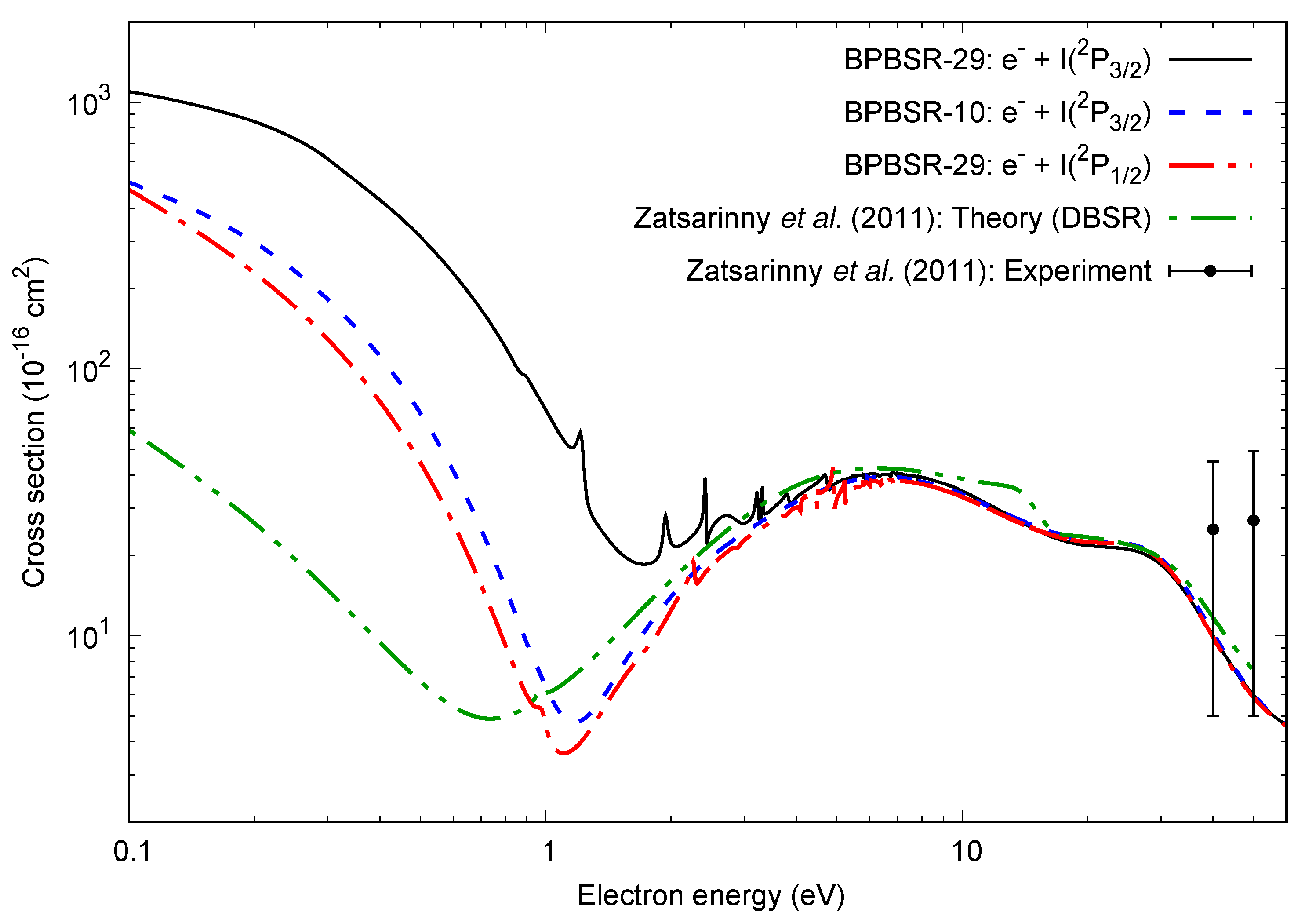
Figure 1 shows the elastic scattering cross sections for atomic iodine when it is in the ground and the first excited state (BSR-29 only). The elastic cross section exhibits a Ramsauer minimum, which is clearly visible for the state at about 1 eV. Previous fullrelativistic D(irac) B-Spline R-matrix (DBSR) [24] calculations by Zatsarinny et al. reported a Ramsauer minimum at lower energy of 0.7 eV [25]. Their cross section for energies less than about 0.1 eV is about one order of magnitude smaller than the present results. This is an indication of the extreme sensitivity of the predictions in this energy regime. In contrast to the present calculation, the DBSR model contained configurations that were built with pseudo-orbitals to specifically account for polarization effects on the two lowest states. The difference by an order of magnitude at 0.1 eV drops to a factor of ≈2 around 0.5 eV, and the results are much closer beyond the Ramsauer minimum.
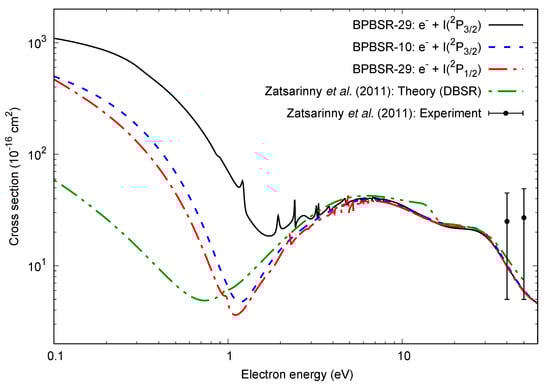
Figure 1.
Elastic scattering cross section as a function of the electron energy. Cross sections for the ground state obtained in the BPBSR-10 and BPBSR-29 models are shown, as well the BPBSR-29 prediction for the first excited state and the result from the DBSR calculation reported by Zatsarinny et al. [25]. The experimental data at 40 eV and 50 eV are taken from ref. [25].
The two experimental data points at 40 and 50 eV are taken from ref. [25] (while the uncertainties are larger than the differences between the values at the two energies, it appears as if the two points were accidentally interchanged between Table II (correct) and Figure 3 of [25]). No experimental data below 40 eV were found in the literature. Without experimental data, it is difficult to judge which of these theoretical predictions is most reliable. If accurate results at these very low energies were required, a separate study should be performed that is specifically devoted to this energy regime.
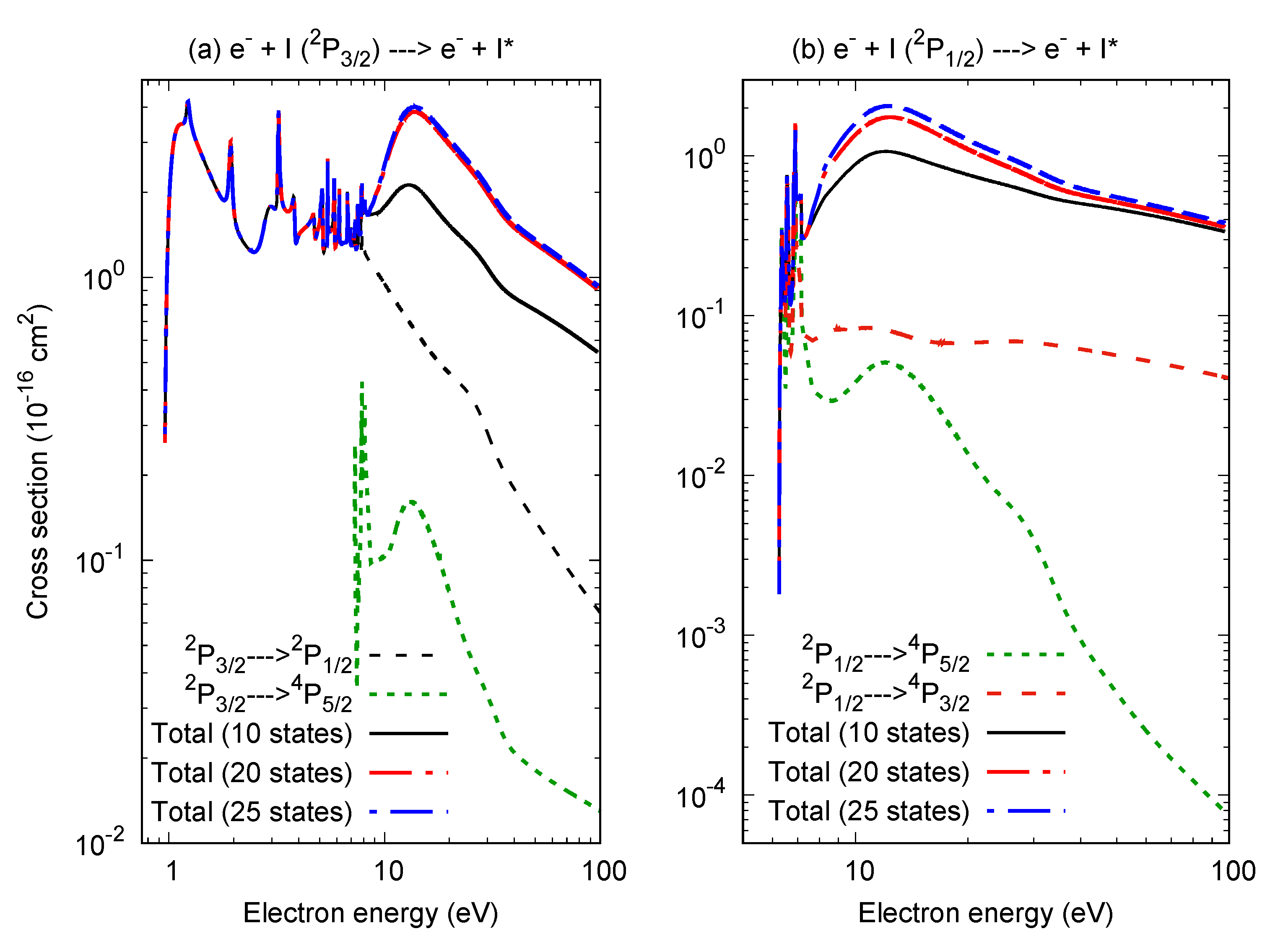
Figure 2 exhibits electronic excitation cross sections from the and states. In each case, cross sections for excitation into the next two higher levels are plotted. For the state, specifically, the next higher level is the state with the same configuration but a different total electronic angular momentum, resulting in a fine-structure splitting of nearly one eV (cf. Table 2). The total cross section is obtained by summing the partial excitation cross sections to 10, 20, and 25 final states, respectively. As seen from Figure 2, the total excitation cross section converges after including about 20 target states. Unfortunately, no experimental data for electron-impact excitation of atomic iodine were found in the literature.
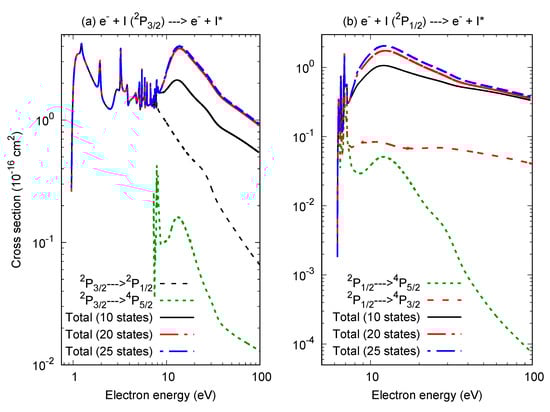
Figure 2.
Electron-impact excitation cross section from (a) the ground state and (b) the first excited state of atomic iodine. The total cross sections shown are obtained by summing the partial cross sections into 10, 20, and 25 final states as shown in the legend.
3.2. Molecular Iodine
Table 3 lists the ground-state properties of I. The results were obtained by performing MOLPRO-CASSCF calculations with the 6-311G basis set. The ground-state configuration of I is (1-13A,1-6B,1-6B,1-2B,1-12B,1-6B,1-6B,1-2A).
Table 3.
Ground-state properties of I.
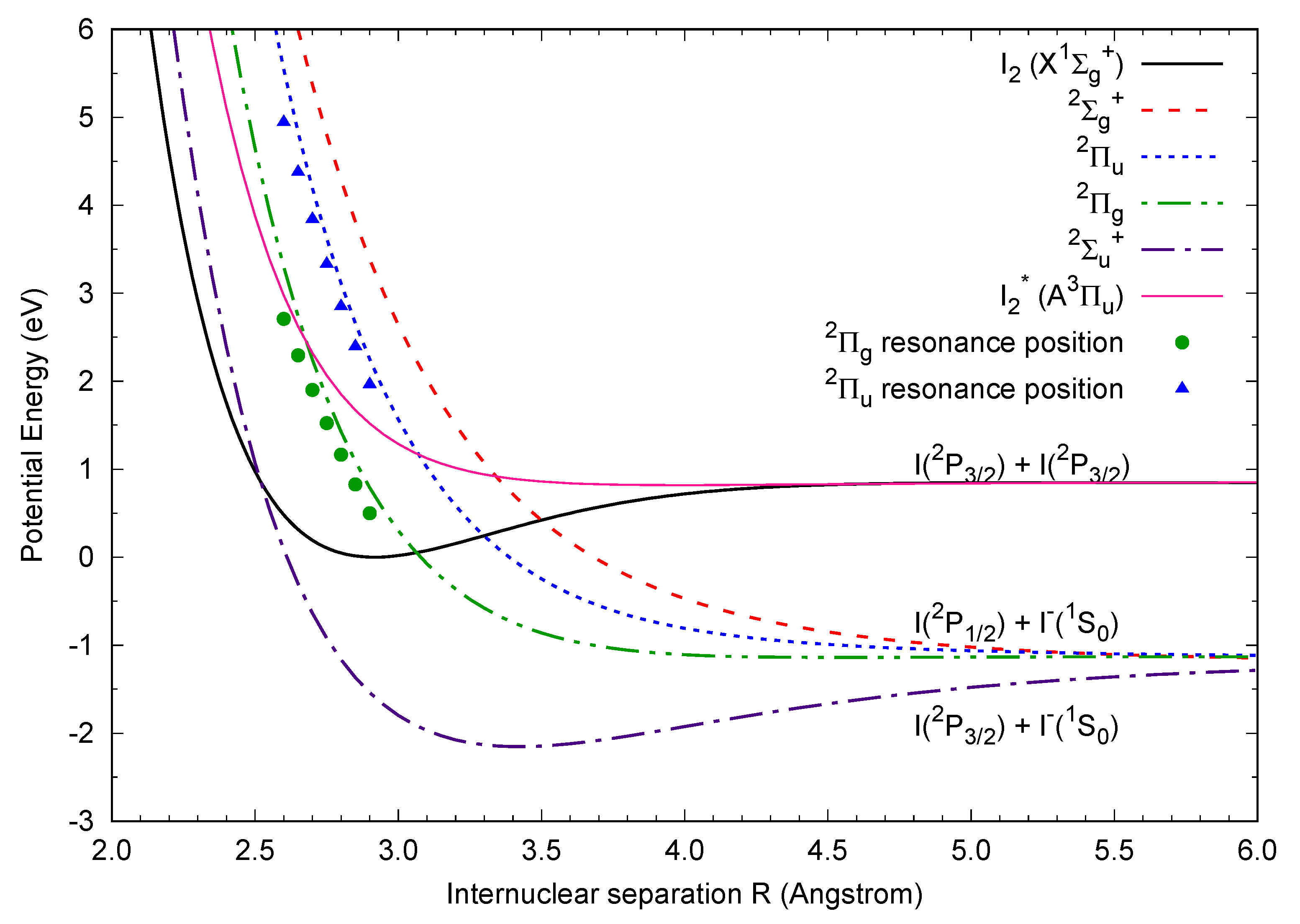
For the calculations of the cross sections, accurate details of the neutral and anion potential energy surfaces (PES) are important. In the present work, we obtained the PESs using MOLPRO (CASSCF with the 6-311G basis). In Figure 3, the ab initio calculations for the potential-energy curves of the neutral, anion, and the lowest excited state of I are shown. For the anion state, several scattering-state symmetries are considered. The calculated resonance positions for the and states using the R-matrix approach agree well with the standard MOLPRO bound-state calculations. This confirms the accuracy of the crossing points of the neutral and anion potential curves.
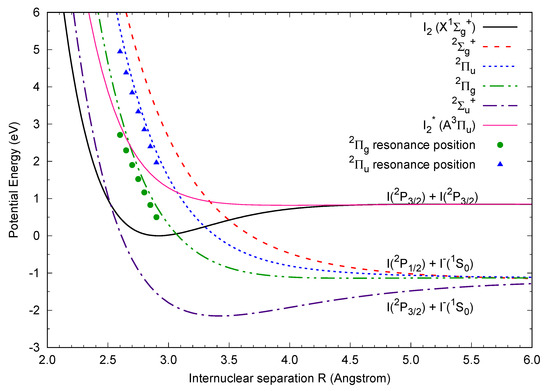
Figure 3.
Ab initio calculations of the neutral and anion (resonance) potential energy curves. MOLPRO results are shown for the four resonant symmetries , and . The and resonance positions calculated with the R-matrix method agree well with the bound-state results.
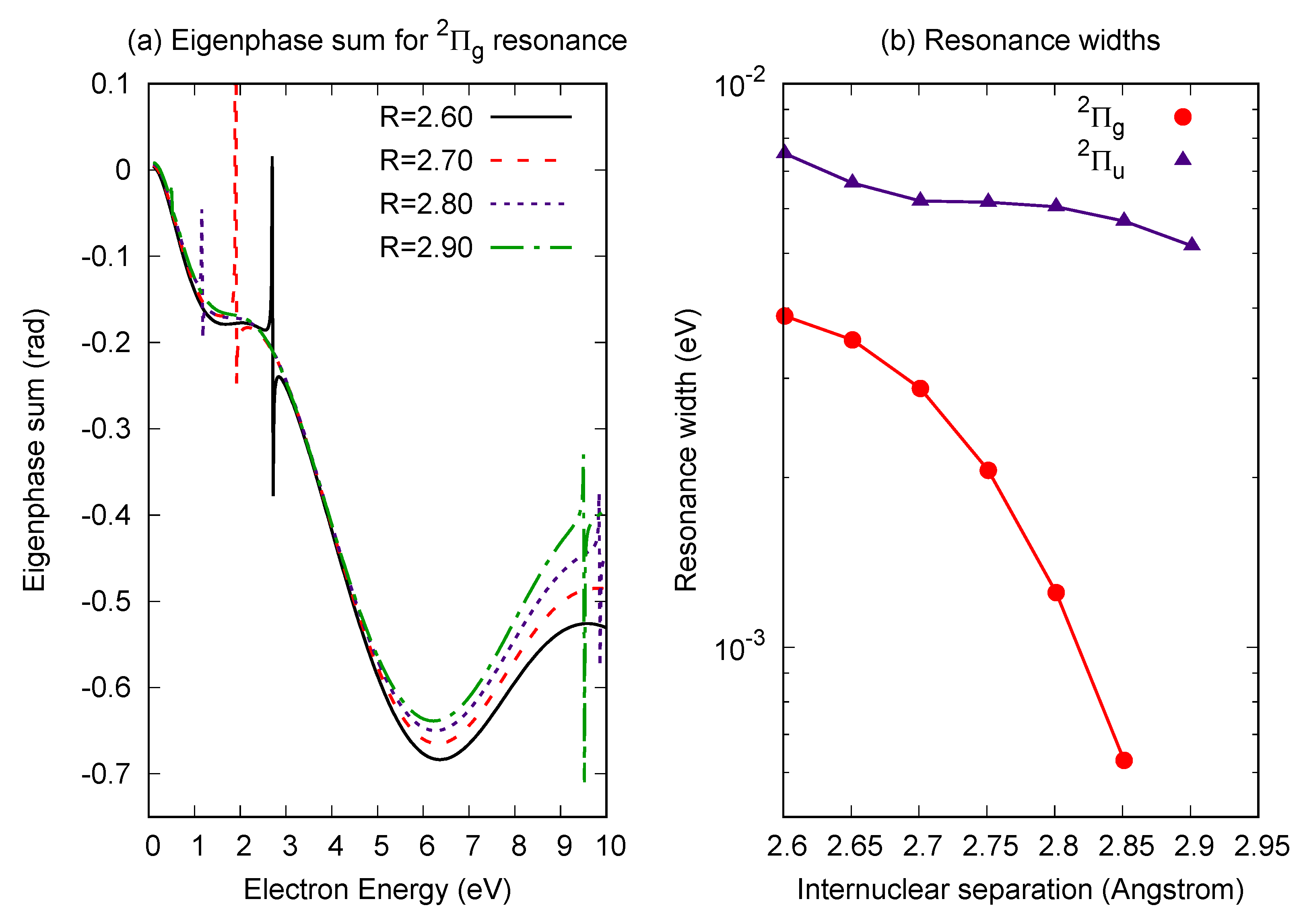
For calculating the resonance parameters, we first obtain the eigenphase sum for the relevant scattering symmetry at several internuclear separations. The scattering calculations are performed with the SEP scattering model. In QN, the eigenphase sum is fitted to a Breit-Wigner form and produces the corresponding resonance widths and positions [27]. Figure 4 shows the eigenphase sum for symmetry evaluated at several internuclear separations near the equilibrium geometry. This illustrates the stability in our scattering calculations for the resonance parameters. In Figure 4, the calculated resonance widths for the and resonances are shown as function of the internuclear separation.
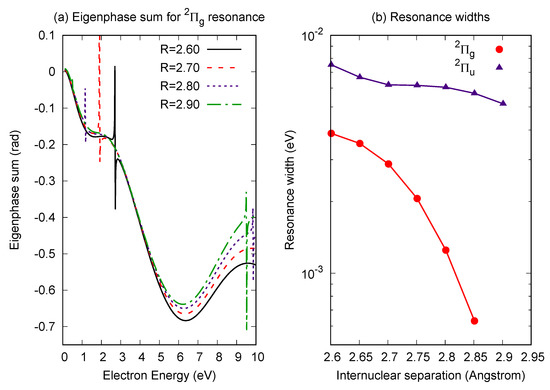
Figure 4.
(a) Eigenphase sum for the symmetry evaluated at several internuclear separations R. (b) Resonance widths for the two scattering symmetries considered in the present calculations.
3.2.1. Dissociative Electron Attachment
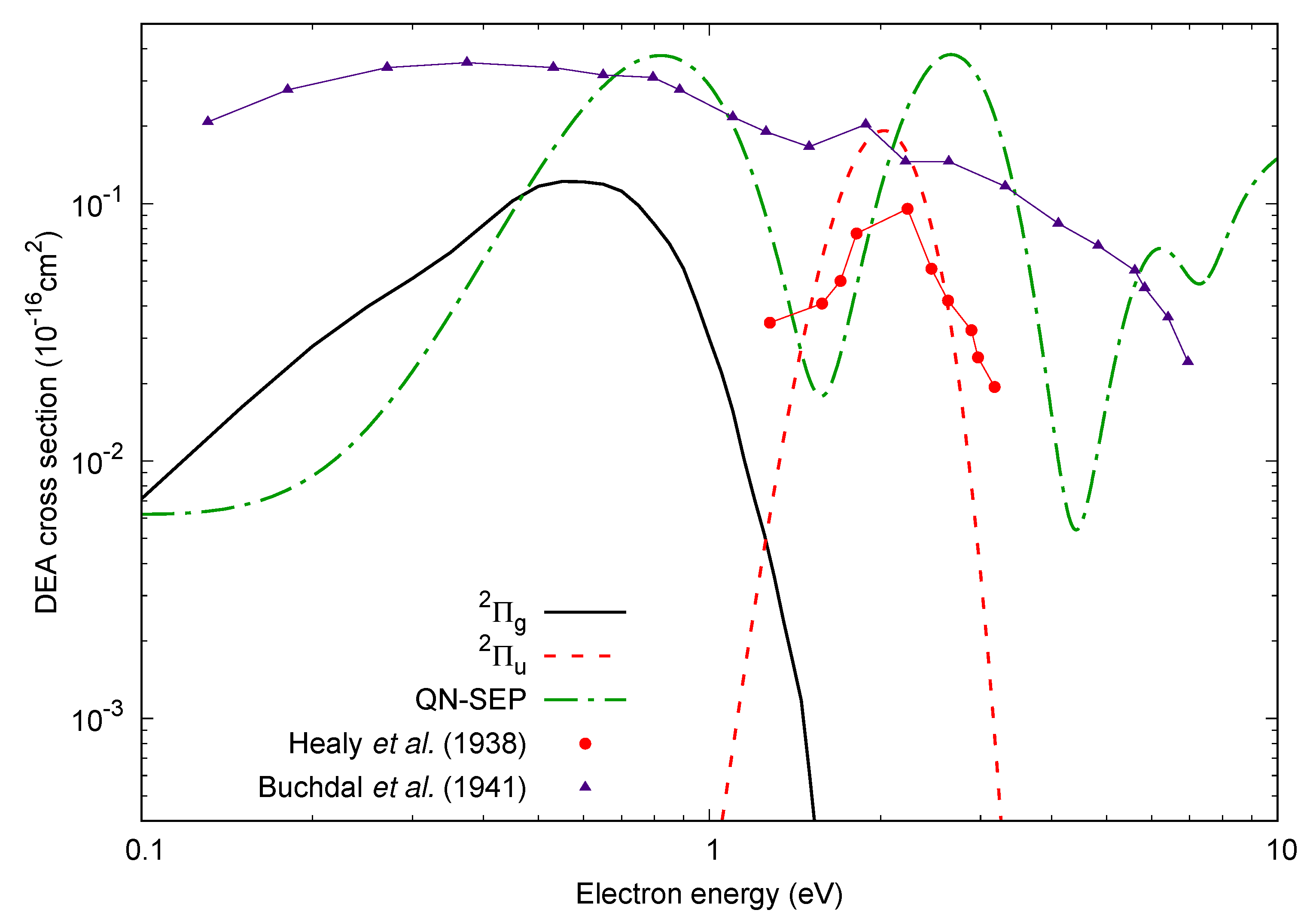
Figure 5 shows the DEA cross section of I in the energy range 0.1–10.0 eV. The cross sections are obtained for two scattering symmetries in the LCP approximation. The present local calculations show peaks around 0.6 and 2.0 eV, which agree with the low-energy peaks reported in ref. [28]. The experimental data from ref. [29] exhibit a smaller peak similar to the resonance. We also show the DEA cross section estimates [30] obtained from QN. As seen in Figure 5, SEP results show good agreement with the LCP calculations. However, the peaks are shifted to higher energies by about 0.5 eV. For the QN results we set the vibrational frequency at 214 cm, dissociation energy at 1.58 eV, and electron affinity at 3.059 eV [13].
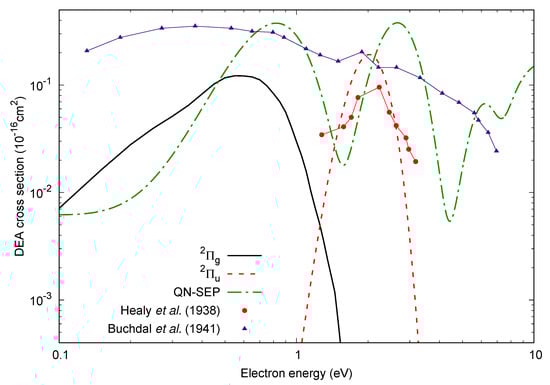
Figure 5.
DEA cross section of I. In the LCP framework (solid and dashed lines), the cross section shows maxima at 0.6 and 2 eV similar to Buchdal et al. [28]. The results from Healy et al. [29] agree with the resonance position. QN’s SEP calculations (dashed-dotted line) exhibit the same structures with shifted peaks compared to the present results.
3.2.2. Vibrational Excitation
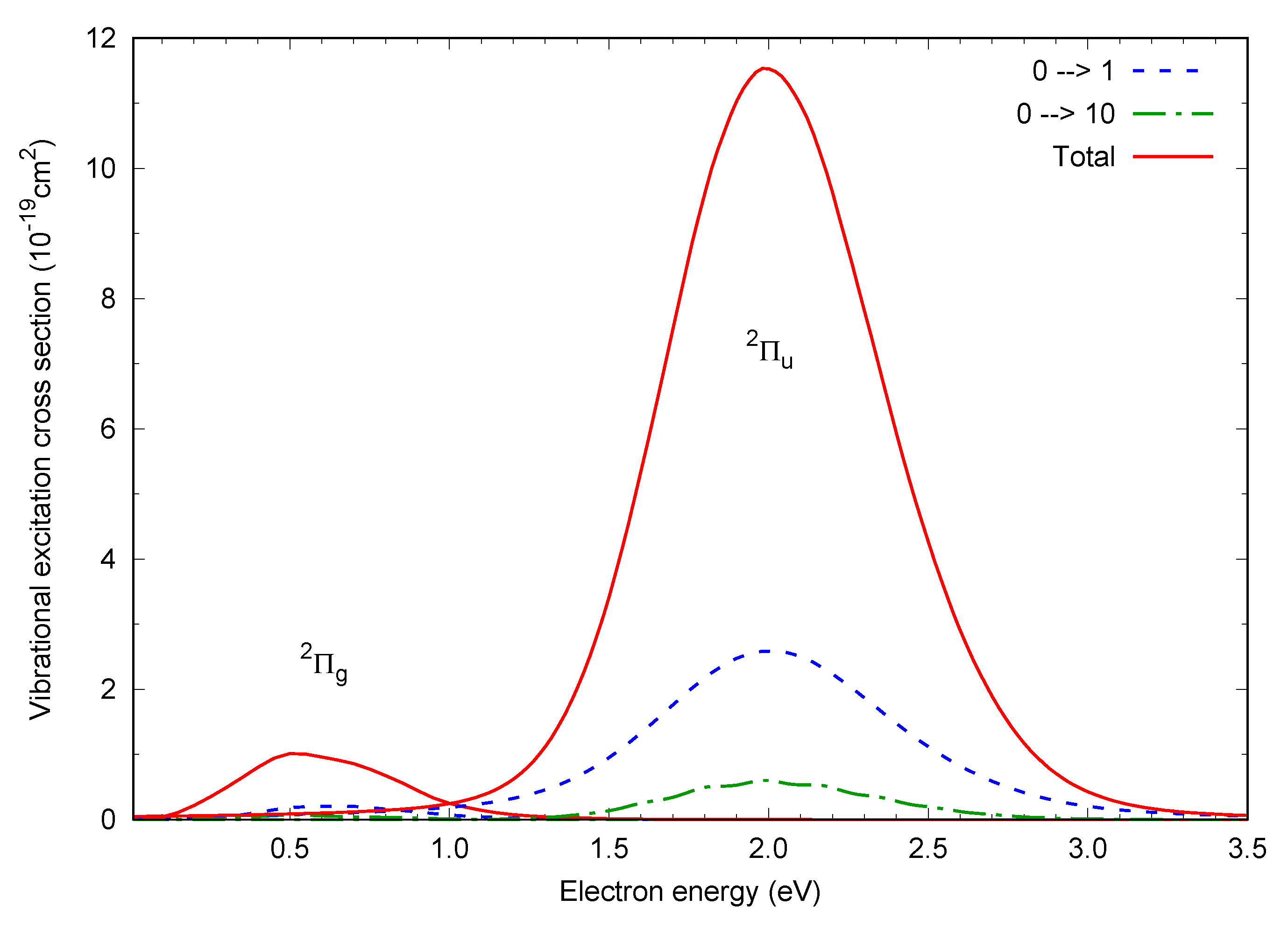
The VE cross sections from the ground vibrational state to the and states are shown in Figure 6. As the resonant states () considered in the present work are purely repulsive, only isolated peaks in the cross section around 0.5 and 2 eV are observed. The total vibrational excitation cross section is obtained by summing the cross sections into the channels.
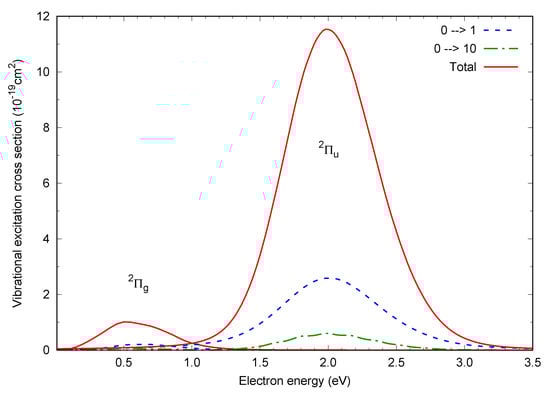
Figure 6.
VE cross sections obtained for the and symmetries. Dashed and dashed-dotted lines show the results and the solid line shows total VE cross section, respectively.
3.2.3. Electron-Impact Excitation
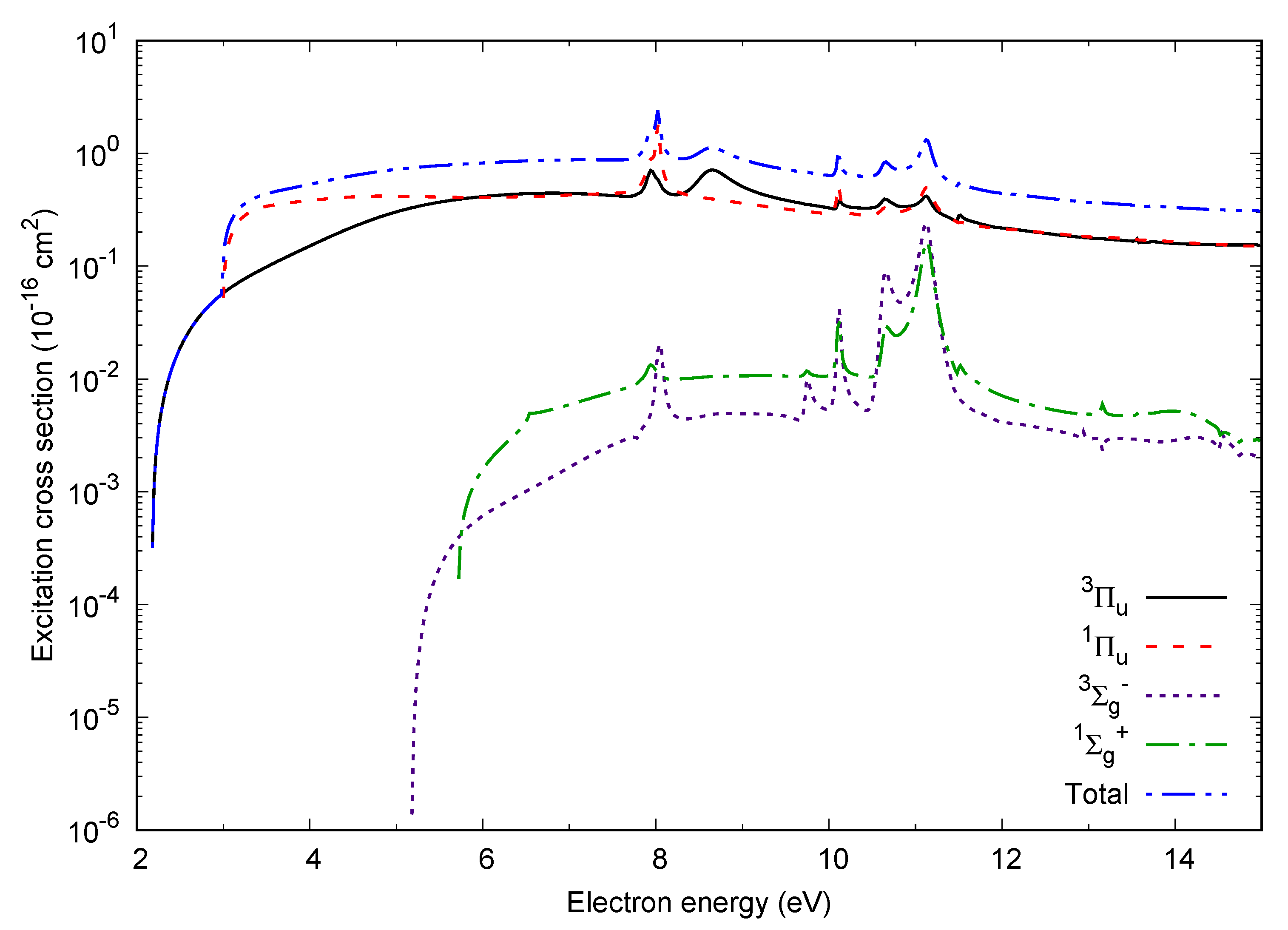
The excitation cross sections are computed with the ground-state configuration mentioned at the beginning of Section 3. In configuration-interactions (CI) calculations, only four electrons are allowed in the active space consisting of 14–16, 13, 6, 6 orbitals. Figure 7 exhibits the cross sections for electronic excitation into the lowest four excited states with term symbols , and , respectively. Table 4 lists the vertical excitation energies of the excited states from the ground state. Reference data from the theoretical work of Mulliken [31] are also given.
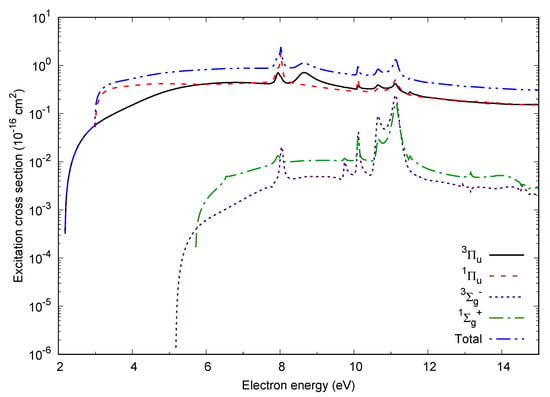
Figure 7.
Cross sections for excitation to the , , , and states from the ground state.
Table 4.
Vertical excitation energies (eV) from the ground state.
3.2.4. Ionization
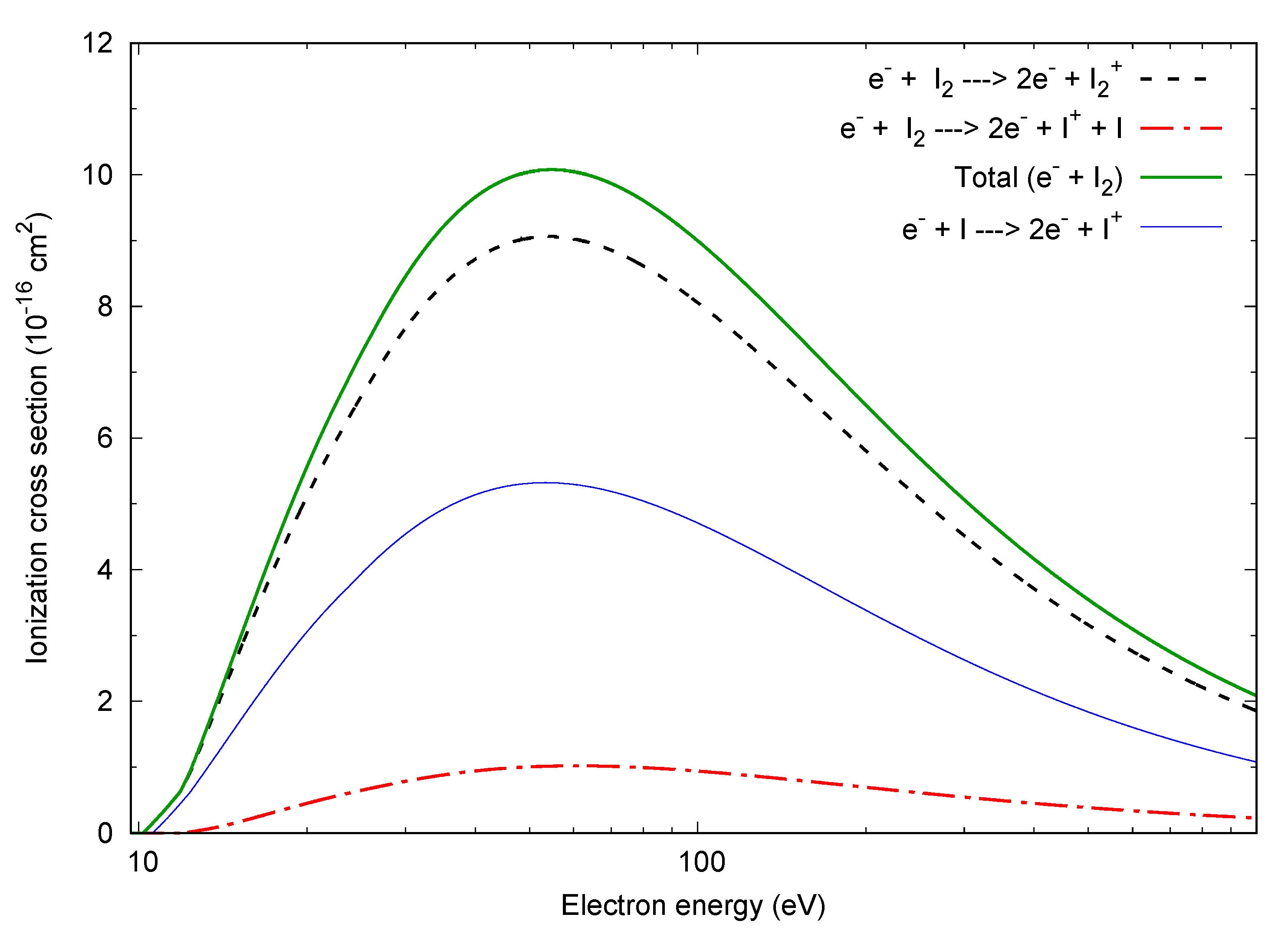
Figure 8 shows the electron-impact ionization cross sections of I and I obtained using the binary-encounter Bethe (BEB) method [32]. These calculations were set up in QEC [11] after implementing the use of effective-core potentials (ECP) [33]. For the estimate of partial ionization cross sections, we used approximate branching ratios of 0.1 and 0.9 for reactions leading to I, and I/I products, respectively. The ECP calculations give the ionization threshold for I as 10.19 eV. For dissociative ionization, the threshold was taken as 11.94 eV [13].
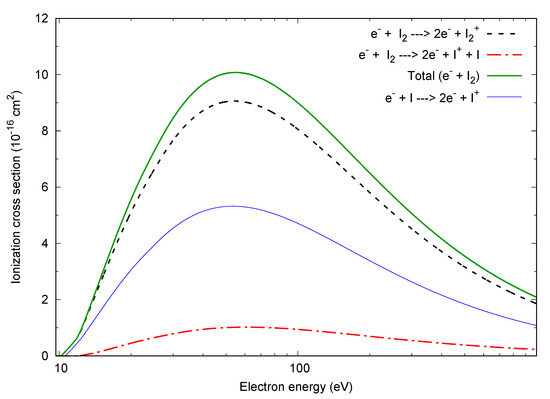
Figure 8.
Electron-impact ionization cross section obtained for I and I. Also shown are the partial ionization cross sections for I leading to products I (dashed line) and I (dashed-dotted line).
3.2.5. Elastic Scattering
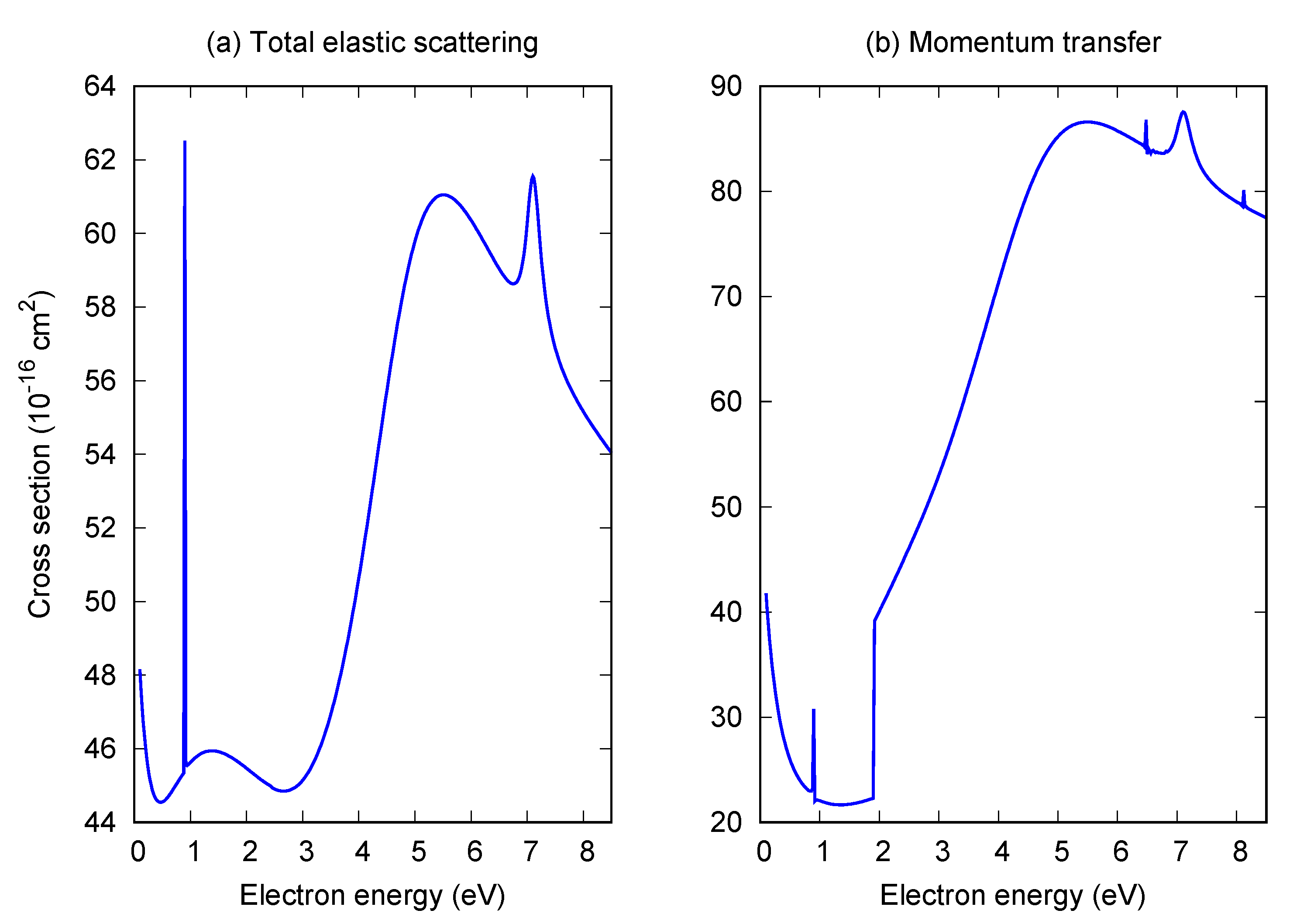
In this section, we present the results for elastic scattering of electron from the I molecule. Figure 9 shows the total elastic scattering and momentum transfer cross sections. A strong spike in the elastic cross section is observed for electron energies at 1 eV, which corresponds to the resonance.
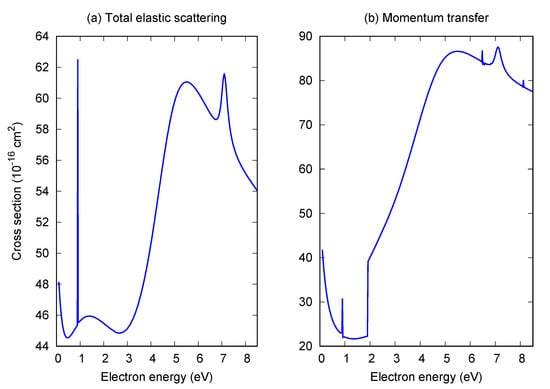
Figure 9.
(a) Total elastic scattering and (b) momentum transfer cross section.
4. Conclusions and Outlook
In the present work, we computed cross sections for electron collisions with atomic and molecular iodine. For the atomic case, we employed a semirelativistic B-spline R-matrix approach and compared the results obtained with 10 and 29 states included in the close-coupling expansion. For elastic scattering, we also compared with predictions from an earlier fullrelativistic DBSR calculation [25].
The overall agreement between predictions from these models is good for energies above the Ramsauer minimum at ≈1 eV, while very large differences were found at lower energies. This suggests that a semirelativistic approach to the collision problem is generally sufficient, but also that much more work would be required before one can be confident in any of these predictions at thermal energies. Unfortunately, no experimental data at all are available for comparison in the low-energy regime, and the uncertainties of the two published experimental points at 40 eV and 50 eV were estimated to be about 80% of their actual values. Nevertheless, we believe that the present calculations represent a valuable basis for further studies, and that they should significantly improve the available database to describe energy-loss processes in collisions between electrons and atomic iodine.
We also carried out R-matrix calculations to obtain excitation and elastic scattering cross sections for molecular iodine. Electronic-excitation and elastic electron-scattering cross sections for I were obtained using the Quantemol-N expert system. Compared to previous work reported in [34], we used an enhanced basis set (6-311G vs. 3-211G), which led to more accurate resonance parameters. In addition, we computed resonant vibrational excitation and dissociative attachment to I in the framework of the LCP approximation. Improving on these calculations will require the use ECPs in the scattering calculations; this is currently being investigated.
Diatomic halogens are highly reactive gases that can bleach the surfaces of the electron spectrometer causing changes in the contact potentials. This makes experiments for low-energy DEA and VE to be extremely difficult. After comparing the present DEA calculations with the only available experimental data, low-energy peaks in the experimental cross section were assigned to the and resonances of I. Similar observations were made by Tam and Wong [35] who reported three resonance peaks for 0–8 eV electrons. Typically, DEA to diatomic halogens is exothermic and results in large cross sections at low energy. In the case of F and Cl, the low-energy DEA cross section is dominated by the symmetry [36,37,38]. For I, however, the potential-energy curve for state crosses the neutral curve further left to the Franck-Condon region. This suggests that the contribution from the state should be rather weak. Similar observations in DEA to Br were reported by Kurepa et al. [39]. More experimental evidence and calculations beyond the LCP approximation are necessary to characterize the low-energy behavior of DEA to I. The results from the DEA estimator [30] in QN showed overall agreement with the LCP results in the considered energy range. This suggests the applicability of the DEA estimator program for complicated molecules where the local calculations become computationally challenging.
Author Contributions
Conceptualization: K.B., J.T., H.B.A.; methodology: O.Z., J.T., H.B.A.; software: O.Z., M.A.P.T., A.D.; validation: K.B., K.R.H., J.T., H.B.A.; formal analysis: H.B.A.; investigation: K.B., J.T., M.A.P.T.; resources: K.B. and A.D.; data curation: H.B.A. and K.B.; original draft preparation: H.B.A.; review and editing: H.B.A., K.R.H., K.B., J.T.; visualization: H.B.A.; supervision: K.B. and J.T.; project administration, K.B., J.T., M.A.P.T., A.D.; funding acquisition: K.B., J.T., A.D. All authors have read and agreed to the published version of the manuscript.
Funding
The work of O.Z., K.R.H. and K.B. was supported by the NSF under grant Nos. PHY-1803844, OAC-1834740, PHY-2110023, and the XSEDE allocation TG-PHY-090031. This project was supported by STFC grant ST/R005133/1.
Informed Consent Statement
All authors have read and agreed to the published version of the manuscript.
Data Availability Statement
Tabulated data for cross sections are available from the authors upon reasonable request.
Acknowledgments
The authors acknowledge the stimulating discussions with Anne Bourdon and her team at LPP.
Conflicts of Interest
The authors declare no conflict of interest. The funders had no role in the design of the study; in the collection, analyses, or interpretation of data; in the writing of the manuscript, or in the decision to publish the results.
Abbreviations
The following abbreviations are used in this manuscript:
| BEB | Binar Encounter Bethe |
| BPBSR | Breit-Pauli B-Spline R-matrix |
| CASSCF | Complete Active Space Self-Consistent Field |
| DEA | Dissociative Electron Attachment |
| ECP | Effective core potential |
| EP | Electric Propulsion |
| LCP | Local Complex Potential |
| QEC | Quantemol Electron Collisions |
| QN | Quantemol-N |
| VE | Vibrational Excitation |
References
- Choueiri, E. Plasma Propulsion-McGraw-Hill Encyclopedia of Science and Technology; McGraw-Hill: New York, NY, USA, 2007. [Google Scholar]
- Goebel, D.M.; Katz, I. Fundamentals of Electric Propulsion: Ion and Hall Thrusters; JPL: Pasadena, CA, USA, 2008. [Google Scholar]
- Kieckhafer, A.; King, L.B. Energetics of Propellant Options for High-Power Hall Thrusters. J. Propuls. Power 2007, 23, 21. [Google Scholar] [CrossRef]
- Dressler, R.A.; Chiu, Y.H.; Levandier, D. Propellant alternatives for ion and Hall effect thrusters. In Proceedings of the 38th Aerospace Sciences Meeting and Exhibit, Reno, NV, USA, 10–13 January 2000. [Google Scholar]
- Smith, T.D.; Kamhawi, H.; Hickman, T.; Haag, T.; Dankanich, J.; Polzin, K.; Byrne, L.; Szabo, J. Overview of NASA Iodine Hall Thruster Propulsion System Development; Technical Report; NASA: Washington, DC, USA, 2016.
- Kaganovich, I.D.; Smolyakov, A.; Raitses, Y.; Ahedo, E.; Mikellides, I.G.; Jorns, B.; Taccogna, F.; Gueroult, R.; Tsikata, S.; Bourdon, A.; et al. Physics of E × B discharges relevant to plasma propulsion and similar technologies. Phys. Plasmas 2020, 27, 120601. [Google Scholar] [CrossRef]
- Bartschat, K.; Fischer, C.F.; Grum-Grzhimailo, A.N. A Tribute to Oleg Zatsarinny (1953–2021): His Life in Science. Atoms 2021, 9, 53. [Google Scholar] [CrossRef]
- Carr, J.M.; Galiatsatos, P.G.; Gorfinkiel, J.D.; Harvey, A.G.; Lysaght, M.A.; Madden, D.; Mašín, Z.; Plummer, M.; Tennyson, J.; Varambhia, H.N. UKRmol: A low-energy electron- and positron-molecule scattering suite. Eur. Phys. J. D 2012, 66, 58. [Google Scholar] [CrossRef]
- Mašín, Z.; Benda, J.; Gorfinkiel, J.D.; Harvey, A.G.; Tennyson, J. UKRmol+: A suite for modelling electronic processes in molecules interacting with electrons, positrons and photons using the R-matrix method. Comp. Sci. Commun. 2019, 249, 107092. [Google Scholar] [CrossRef] [Green Version]
- Tennyson, J.; Brown, D.B.; Munroy, J.J.; Rozum, I.; Varambhia, H.N.; Vinci, N. Quantemol-N: An expert system for performing electron molecule collision calculations using the R-matrix method. J. Phys. Conf. Ser. 2007, 86, 012001. [Google Scholar] [CrossRef]
- Cooper, B.; Tudorovskaya, M.; Mohr, S.; O’Hare, A.; Hanicinec, M.; Dzarasova, A.; Gorfinkiel, J.D.; Benda, J.; Mašín, Z.; Al-Refaie, A.F.; et al. Quantemol Electron Collisions (QEC): An Enhanced Expert System for Performing Electron Molecule Collision Calculations Using the R-Matrix Method. Atoms 2019, 7, 97. [Google Scholar] [CrossRef] [Green Version]
- Zatsarinny, O. BSR: B-spline atomic R-matrix codes. Comp. Phys. Commun. 2006, 174, 273. [Google Scholar] [CrossRef]
- NIST Chemistry WebBook. Available online: https://webbook.nist.gov/chemistry/ (accessed on 21 September 2021).
- Tennyson, J. Electron–molecule collision calculations using the R-matrix method. Phys. Rep. 2010, 491, 29. [Google Scholar] [CrossRef]
- Werner, H.J.; Knowles, P.J.; Knizia, G.; Manby, F.R.; Schütz, M. Molpro: A general-purpose quantum chemistry program package. Rev. Comp. Mol. Sci. 2011, 2, 242. [Google Scholar] [CrossRef]
- Schuchardt, K.L.; Didier, B.T.; Elsethagen, T.; Sun, L.; Gurumoorthi, V.; Chase, J.; Li, J.; Windus, T.L. Basis Set Exchange: A Community Database for Computational Sciences. J. Chem. Inf. Model. 2007, 47, 1045. [Google Scholar] [CrossRef] [Green Version]
- Glukhovtsev, M.N.; Pross, A.; McGrath, M.P.; Radom, L. Extension of Gaussian-2 (G2) theory to bromine- and iodine-containing molecules: Use of effective core potentials. J. Chem. Phys. 1995, 103, 1878. [Google Scholar] [CrossRef]
- Bardsley, J.N.; Mandle, F. Resonant scattering of electrons by molecules. Rep. Prog. Phys. 1968, 31, 471. [Google Scholar] [CrossRef]
- Domcke, W. Theory of resonance and threshold effects in electron-molecule collisions: The projection-operator approach. Phys. Rep. 1991, 208, 97. [Google Scholar] [CrossRef]
- Bardsley, J.N. Configuration interaction in the continuum states of molecules. J. Phys. B At. Mol. Phys. 1968, 1, 349. [Google Scholar] [CrossRef]
- Bardsley, J.N. Molecular resonance phenomena. In Electron-Molecule and Photon-Molecule Collisions; Rescigno, T., McKoy, V., Schneider, B., Eds.; Plenum: New York, NY, USA, 1979. [Google Scholar]
- Wigner, E.P. On the Behavior of Cross Sections Near Thresholds. Phys. Rev. 1948, 73, 1002. [Google Scholar] [CrossRef]
- Fabrikant, I.I.; Hotop, H. Low-energy behavior of exothermic dissociative electron attachment. Phys. Rev. A 2001, 63, 022706. [Google Scholar] [CrossRef]
- Zatsarinny, O.; Bartschat, K. Relativistic B-spline R-matrix method for electron collisions with atoms and ions: Application to low-energy electron scattering from Cs. Phys. Rev. A 2008, 77, 062701. [Google Scholar] [CrossRef]
- Zatsarinny, O.; Bartschat, K.; Garcia, G.; Blanco, F.; Hargreaves, L.R.; Jones, D.B.; Murrie, R.; Brunton, J.R.; Brunger, M.J.; Hoshino, M.; et al. Electron-collision cross sections for iodine. Phys. Rev. A 2011, 83, 042702. [Google Scholar] [CrossRef] [Green Version]
- Computational Chemistry Comparison and Benchmark Database. Available online: https://cccbdb.nist.gov/ (accessed on 21 September 2021).
- Tennyson, J.; Noble, C.J. RESON—A program for the detection and fitting of Breit-Wigner resonances. Comp. Phys. Commun. 1984, 33, 421. [Google Scholar] [CrossRef]
- Buchdal, R.J. Negative Ion Formation in Iodine Vapor by Electron Impacts. J. Chem. Phys. 1941, 9, 146. [Google Scholar] [CrossRef]
- Healy, R.H. The behaviour of electrons in iodine vapour. Philos. Mag. J. Sci. 1938, 26, 940. [Google Scholar] [CrossRef]
- Munro, J.J.; Harrison, S.; Fujimoto, M.M.; Tennyson, J. A dissociative electron attachment cross-section estimator. Phys. Conf. Ser. 2012, 388, 012013. [Google Scholar] [CrossRef]
- Mulliken, R.S. Iodine Revisited. J. Chem. Phys. 1971, 55, 288. [Google Scholar] [CrossRef]
- Kim, Y.K.; Rudd, M.E. Binary-encounter-dipole model for electron-impact ionization. Phys. Rev. A 1994, 50, 3954. [Google Scholar] [CrossRef] [PubMed] [Green Version]
- Graves, V.; Cooper, B.; Tennyson, J. The efficient calculation of electron impact ionization cross sections with effective core potentials. J. Chem. Phys. 2021, 154, 114104. [Google Scholar] [CrossRef] [PubMed]
- Yadav, H.; Vinodhkumar, M.; Limbachiya, C.; Vinodhkumar, P.C.; Mason, N.J. Low energy electron interactions with Iodine molecule (I2). J. Quant. Spectrosc. Radiat. Transf. 2020, 250, 107035. [Google Scholar] [CrossRef]
- Tam, W.C.; Wong, S.F. Dissociative attachment of halogen molecules by 0–8 eV electrons. J. Chem. Phys. 1978, 68, 5626. [Google Scholar] [CrossRef]
- Fabrikant, I.I.; Eden, S.; Mason, N.J.; Fedor, J. Recent Progress in Dissociative Electron Attachment: From Diatomics to Biomolecules. Adv. At. Mol. Opt. Phys. 2017, 66, 545. [Google Scholar]
- Ruf, M.W.; Barsotti, S.; Braun, M.; Hotop, H.; Fabrikant, I.I. Dissociative attachment and vibrational excitation in low-energy electron collisions with chlorine molecules. J. Phys. B At. Mol. Opt. Phys. 2003, 37, 41. [Google Scholar] [CrossRef]
- Braun, M.; Ruf, M.W.; Fabrikant, I.I.; Hotop, H. Observation of p-Wave Threshold Behavior in Electron Attachment to F2 Molecules. Phys. Rev. Lett. 2007, 99, 253202. [Google Scholar] [CrossRef] [PubMed]
- Kurepa, M.V.; Babic, D.S.; Belic, D.S. Electron-bromine-molecule total ionisation and electron attachment cross sections. J. Phys. B. At. Mol. Phys. 1981, 14, 375. [Google Scholar] [CrossRef]
Publisher’s Note: MDPI stays neutral with regard to jurisdictional claims in published maps and institutional affiliations. |
© 2021 by the authors. Licensee MDPI, Basel, Switzerland. This article is an open access article distributed under the terms and conditions of the Creative Commons Attribution (CC BY) license (https://creativecommons.org/licenses/by/4.0/).