


Abstract
Using Griem’s semi-empirical approach, we have calculated the Stark broadening parameters (line widths and shifts) of 35 UV–Blue spectral lines of neutral vanadium (V I). These lines have been detected in the Sun, the metal-poor star HD 84937, and Arcturus, among others. In addition, these parameters are also relevant in industrial and laboratory plasma. The matrix elements required were obtained using the relativistic Hartree–Fock (HFR) method implemented in Cowan’s code.
1. Introduction
Chemical elements belonging to the iron group, from Scandium to Zirconium (Z = 21–30), are critical for an understanding of nucleosynthesis in different super-nova types. In particular, Vanadium (together with Scandium and Titanium) is produced by explosive silicon burning and oxygen burning in the core-collapse supernova (SN) phase [1]. In recent works, this element has been analyzed in detail, especially in metal-poor stars [2]. In particular, Cowan et al. [3]—and references therein—find a correlation among Scandium, Titanium, and Vanadium in metal-poor stars. Therefore, the interest in Vanadium spectra has increased, and information about them is relevant for improving its abundance determination accuracy.
Among all the effects that have an impact on atomic spectral lines, the knowledge of the broadening and shift produced by charged particles is essential. Accurate measurements of Stark broadening and shift parameters are required to properly analyze astrophysical data. In the case of Vanadium, Manrique et al. [4] have provided experimental information related to the Stark broadening and shift parameters of the spectral lines of ionized Vanadium (V II).
In addition, the neutral Vanadium has been studied in detail. Infrared spectral lines of neutral vanadium (V I)—7363.1, 8027.3, 8255.8, 9037.6 Å, and so on—have been detected in the Solar spectrum, the spectrum of the metal-poor star HD 84937, and the spectrum of Arcturus ([5,6,7], respectively).
The levels of V I have been the subject of both experimental and theoretical studies. The earliest works were compiled by [8,9]. The most recent works [10,11,12] were collected in an exhaustive compilation, revision, and expansion of the V I levels that was carried out by Thorne et al. [13].
As this is an element of great interest, there are relatively recent publications in the literature with transition probabilities that are both theoretical and experimental. A critical analysis of these parameters can be found in [14].
A similar situation is found in the case of other parameters: There are excellent works devoted to the level lifetimes. The most recent are those of Hartog et al. [15], Wang et al. [16], and Holmes et al. [17].
However, despite its interest, we have not found data on the parameters of broadening and displacement of the spectral lines of neutral Vanadium by collision with electrons (Stark parameters) in the National Institute of Standards and Technology (NIST) database [18], nor in the Stark-B database [19].
In addition to its astrophysical interest, the role of vanadium in the corrosion protection of alloys of high industrial interest, as in the case of Ti-6Al-4V [20], is well known. In laser-generated plasma in Laser Sock Process (LSP) experiments with samples of the material mentioned above, intense spectral lines of neutral vanadium and single ionized vanadium can be seen [21,22].
Therefore, electron impact line widths and shifts of V I are relevant in the diagnostics of the plasma of stellar atmospheres, but they are also necessary in the analysis of the plasma in industrial processes.
In this work, electron impact line widths and shifts for 35 spectral lines of neutral vanadium have been calculated using a semi-empirical formalism [23]. The parameters are presented at an electron density of 10 cm. We have chosen that electron density because of its proximity to the densities that appear in the LSP experiments. To use them with other densities, they must be multiplied by the appropriate factor; the Stark parameters scale proportionally with the electron density in the semi-empirical approximation.
In the next section, we present our theoretical calculations, which, unlike in previous works, have used previous results of other authors. Below, we present our results for several level lifetimes (comparing them with experimental values obtained from the literature) and Stark broadening parameters. Regarding some lines of astrophysical interest, we show their Stark broadening parameters versus temperature in a graphical representation.
2. Materials and Methods
The semi-empirical formalism in which Griem considered the 1958 Baranger formulation [24] uses Equations (1) and (2), where and d represent the Stark line width (half-width at half-maximum, HWHM) and the Stark line shift, respectively, in angular frequency units, E is the hydrogen ionization energy, E=(3/2) kT means the energy of the perturbing electron, N is the free electron density, and T is the electron temperature. The initial and final levels of the transitions are denoted by i and f, respectively. In these equations, and are the effective Gaunt factors proposed by Seaton [25] and Van Regemorter [26], respectively.
The expression = / was used to convert the units of angular frequency (obtained in Griem’s expressions) into wavelength units. In this equation, is the Stark broadening (full-width at half maximum, FWHM), is the wavelength, and c is the light speed.
Cowan’s Code [27] was used to obtain the necessary matrix elements included in the Equations (1) and (2). This code is a relativistic Hartree–Fock (HFR) approach that uses an intermediate coupling scheme (IC). It allows us to get a complete set of transition probabilities (A) of the V I spectral lines by obtaining through them the required matrix elements.
Since the neutral vanadium is an element with a large number of known levels (346 odd levels and 198 even levels in the previously cited work [13]), we preferred not to repeat the very tedious calculations that had already been carried out successfully by this last author Thorne et al. [13]. We used the energies from Thorne et al. [13] and the transition probabilities from Cowan’s code to determine the necessary matrix elements in Equations (1) and (2).
The calculations of the present authors were made using the following configurations: even parity, 3d4s + 3d4s + 3d5s + 3d6s + 3d4d+3d5d+3d+3d4s5s+3d4s6s+3d4s4d+3d4s5d + 3d4p, and odd parity, 3d4p +3d5p +3d4s4p +3d4s5p + 3d4f + 3d4s4f + 3d4s4p. The atomic parameters that were derived from these calculations and that were used (as input) in our work can be found in Table 6 of Thorne et al. [13].
As there are no previous experimental or theoretical data on the Stark broadening parameters of the spectral lines of the V I, we can only compare atomic data without the effects of the plasma environment, i.e., the intermediate results obtained for the transition probabilities or the level lifetimes. In this case, there are a lot of spectral lines with experimental transition probabilities to include in the comparison (which was made successfully) in our text. We preferred to test the lifetimes of the upper levels of the 35 spectral lines that we considered.
3. Results
Our results for the lifetimes of the upper levels corresponding to the 35 spectral lines with the Stark broadening parameters calculated in this work are presented in Table 1. The first three columns show the level energy, the configuration (as it appears in the NIST databases: using spin-orbit coupling notation and keeping the component with the highest weight), and the wavelengths of the transitions studied. The remaining columns show the values of the experimental level lifetimes found in the literature and the theoretical values obtained in our calculations.
Table 1.
Lifetimes of upper levels corresponding to spectral lines with the Stark broadening parameters calculated in this work.
As can be seen, the theoretical values obtained are close to the experimental values, with the noticeable exception of the lifetime value of 3d4pI, which is experimentally (25.8 ns) a factor of two greater than the theoretical value (12.37 ns) obtained in our calculations. This result contrasts with the results obtained for levels of the same multiplet, such as the 3d4pI level, in which the results obtained are 12.3 and 11.9 ns, respectively.
A possible explanation is found by observing the theoretical values obtained with Cowan’s code (ab initio) before adjusting the parameters with the experimental values of the energy levels. For the level 3d4pI, 17.04 ns was obtained, and for the level 3d4pI, 13.85 ns was obtained. This is a known effect: In this case, the energy-optimized Cowan method produces an undesired effect on the result of the transition probabilities for level 3d4pI. It is clearly observed that, in the 37,285 cm level, the relative weight of the vectors (in the spin–orbit coupling notation) 3d4pI, 3d4pH and 3d4s4pH changes slightly when adjustments have been made to the experimental levels, significantly affecting the level lifetime.
However, as noted above, our results for the transition probabilities and the oscillator strengths are close to the experimental results in almost all the experimental spectral lines. Stark broadening calculations that depend on all transition probabilities (as can be seen from Equations (1) and (2)) will certainly reflect this effect beyond the effect of any particular transition probability.
Our results for the Stark broadening parameters calculated in this work are presented in Table 2. The first column presents the wavelength and the experimental transition probability of the spectral line. Columns two and three present the transition levels’ configurations. The remaining columns show the Stark line widths and shifts at 5, 10, 20 and 30 · 10 K and at an electron density of 10 cm. It should be noted that Stark’s change parameters could be poorly evaluated. This is due to the fact that the different addends in Equation (2) sometimes carry different signs and are, therefore, very sensitive to possible inaccuracies in the calculations of the matrix elements. This does not happen with the Stark magnification parameter when all terms are positive.
Table 2.
Neutral vanadium (V I) line-widths (FWHM), (pm), and shifts (d(pm)) normalized to Ne = 10 cm.
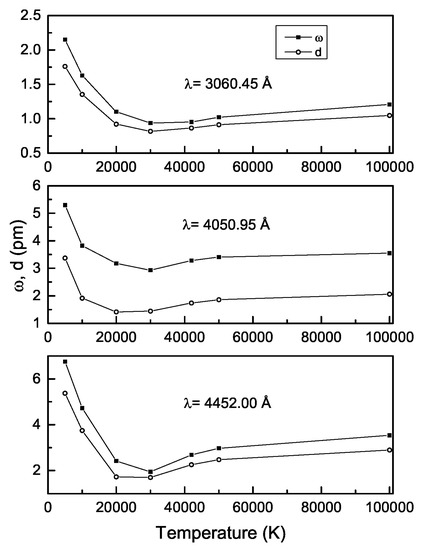
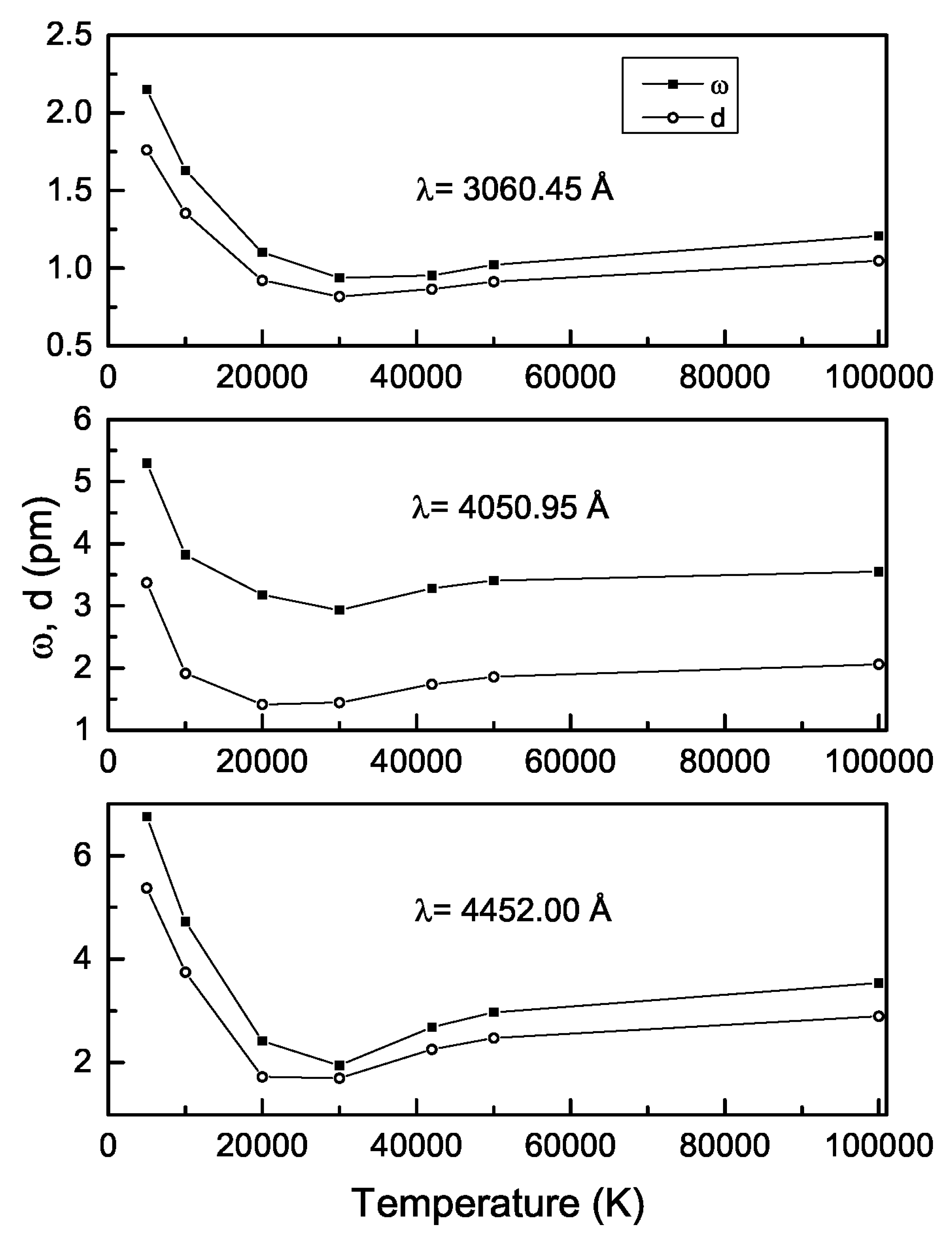
As an example, we present the Stark broadening parameters versus temperature for three intense spectral lines of neutral vanadium in Figure 1.
Figure 1.
Calculated Stark width (full-width at half maximum (FWHM)) (pm), and shifts (d(pm)) normalized to Ne= 10 cm vs. temperature for spectral lines of neutral vanadium of astrophysical interest.
4. Conclusions
In this work, we presented theoretical Stark broadening parameters of 35 spectral lines of V I of astrophysical and industrial interest in the ultraviolet–blue range. It is the first time that these values, for which there are no experimental measurements, have been calculated. To get the required matrix elements, we used the transition probabilities obtained from Cowan’s code (around 190,000). The theoretical lifetimes of the upper levels of these transitions are also shown.
Author Contributions
Conceptualization: C.C., M.I.d.A.-G., L.I.-G., and A.M.; Methodology: C.C., M.I.d.A.-G., L.I.-G., and A.M.; Investigation: C.C., M.I.d.A.-G., L.I.-G., and A.M.; Writing—review and editing: C.C. and L.I.-G. All authors have read and agreed to the published version of the manuscript.
Funding
This research received no external funding.
Acknowledgments
This work was financially supported by the Spanish DGI project MAT2015- 63974-C4-2-R.
Conflicts of Interest
The authors declare no conflict of interest.
References
- Woosley, S.E.; Weaver, A.T. The Evolution and Explosion of Massive Stars. II. Explosive Hydrodynamics and Nucleosynthesis. Rev. Mod. Phys. 1995, 101, 181. [Google Scholar]
- Ou, X.; Roederer, I.U.; Sneden, C.; Cowan, J.J.; Lawler, J.E.; Shectman, S.A.; Thompson, I.B. Vanadium Abundance Derivations in 255 Metal-poor Stars. arXiv 2020, arXiv:2008.05500. [Google Scholar] [CrossRef] [Scilit]
- Cowan, J.J.; Sneden, C.; Roederer, I.U.; Lawler, J.E.; Hartog, E.A.D.; Sobeck, J.S.; Boesgaard, A.M. Detailed Iron-peak Element Abundances in Three Very Metal-poor Stars. Astrophys. J. 2020, 890, 119. [Google Scholar] [CrossRef] [Scilit]
- Manrique, J.; Pace, D.M.D.; Aragón, C.; Aguilera, J.A. Experimental Stark widths and shifts of V II spectral lines. Mon. Not. R. Astron. Soc. 2020. [Google Scholar] [CrossRef] [Scilit]
- Lawler, J.E.; Wood, M.P.; Hartog, E.A.D.; Feigenson, T.; Sneden, C.; Cowan, J.J. Improved V I log(gf) values and abundance determinations in the photospheres of the sun and metal-poor star hd 84937. Astrophys. J. Suppl. Ser. 2014, 215, 20. [Google Scholar] [CrossRef] [Scilit]
- Scott, P.; Asplund, M.; Grevesse, N.; Bergemann, M.; Jacques Sauval, A. The elemental composition of the Sun-II. The iron group elements Sc to Ni. Astron. Astrophys. 2015, 573, A26. [Google Scholar] [CrossRef] [Scilit]
- Wood, M.P.; Sneden, C.; Lawler, J.E.; Hartog, E.A.D.; Cowan, J.J.; Nave, G. Vanadium Transitions in the Spectrum of Arcturus. Astrophys. J. Suppl. Ser. 2018, 234, 25. [Google Scholar] [CrossRef] [Scilit]
- Moore, C.E. Atomic Energy Levels; NBS 467-11C; U.S.GPO: Washington, DC, USA, 1958.
- Sugar, P.; Corliss, C. Atomic Energy Levels of the Iron-Period Elements: Potassium through Nickel. J. Phys. Chem. Ref. Data 1985, 14 (Suppl. 2), 203. [Google Scholar]
- Palmeri, P.; Biemont, E.; Aboussaid, A.; Godefroid, M. Hyperfine structure of infrared vanadium lines. J. Phys. B At. Mol. Opt. Phys. 1995, 28, 3741–3752. [Google Scholar] [CrossRef] [Scilit]
- Palmeri, P.; Biémont, E.; Quinet, P.; Dembczyński, J.; Szawiola, G.; Kurucz, R.L. Term analysis and hyperfine structure in neutral vanadium. Phys. Scr. 1997, 55, 586–598. [Google Scholar] [CrossRef] [Scilit]
- Lefèbvre, P.H.; Garnir, H.P.; Biémont, E. Hyperfine Structure of Neutral Vanadium Lines and Levels. Phys. Scr. 2002, 66, 363–366. [Google Scholar] [CrossRef] [Scilit]
- Thorne, A.P.; Pickering, J.C.; Semeniuk, J. The spectrum and term analysis of V I. Astrophys. J. Suppl. Ser. 2010, 192, 11. [Google Scholar] [CrossRef] [Scilit]
- Saloman, E.B.; Kramida, A. Critically Evaluated Energy Levels, Spectral Lines, Transition Probabilities, and Intensities of Neutral Vanadium (V i). Astrophys. J. Suppl. Ser. 2017, 231, 18. [Google Scholar] [CrossRef] [Scilit]
- Hartog, E.A.D.; Lawler, J.E.; Wood, M.P. Radiative lifetimes of V I and V II. Astrophys. J. Suppl. Ser. 2014, 215, 7. [Google Scholar] [CrossRef] [Scilit]
- Wang, Q.; Jiang, L.Y.; Quinet, P.; Palmeri, P.; Zhang, W.; Shang, X.; Tian, Y.S.; Dai, Z.W. TR-LIF lifetime measurements and HFR+CPOL calculations of radiative parameters in vanadium atom (V I). Astrophys. J. Suppl. Ser. 2014, 211, 31. [Google Scholar] [CrossRef] [Scilit]
- Holmes, C.E.; Pickering, J.C.; Ruffoni, M.P.; Blackwell-Whitehead, R.; Nilsson, H.; Engström, L.; Hartman, H.; Lundberg, H.; Belmonte, M.T. Experimentally measured radiative lifetimes and oscillator strengths in neutral vanadium. Astrophys. J. Suppl. Ser. 2016, 224, 35. [Google Scholar] [CrossRef] [Scilit]
- Kramida, A.; Ralchenco, Y.; Reader, J. NIST ASD Team (2013) NIST Atomic Spectra Database (v.5.3). 2013. Available online: http://physics.nist.gov/asd (accessed on 20 August 2020).
- Sahal-Brechot, S.; Dimitrijevic, M.; Nessib, N.B.; Moreau, N. STARK-B. 2020. Available online: http://stark-b.obspm.fr/index.php/contact (accessed on 20 August 2020).
- Iqbal, A.; Suhaimi, H.; Zhao, W.; Jamil, M.; Nauman, M.M.; He, N.; Zaini, J. Sustainable Milling of Ti-6Al-4V: Investigating the Effects of Milling Orientation, Cutterś Helix Angle, and Type of Cryogenic Coolant. Metals 2020, 10, 258. [Google Scholar] [CrossRef] [Scilit]
- Carreón, H.; Barriuso, S.; González, J.A.P.; González-Carrasco, J.L.; Moreno, J.L.O. Thermoelectric assessment of laser peening induced effects on a metallic biomedical Ti6Al4V. In Proceedings of the Frontiers in Ultrafast Optics: Biomedical, Scientific, and Industrial Applications XIV, San Francisco, CA, USA, 2–5 February 2014; SPIE: Bellingham WA, USA, 2014; Volume 8972, p. 89721Q-1–89721Q-7. [Google Scholar]
- De Andrés García, M.I. Utilización de la línea Hα del hidrógeno en la caracterización de los plasmas generados por láser para aplicaciones industriales (técnicas LSP) y espectroscópicas. Ph.D. Thesis, ETSIDI, Madrid, Spain, 2017. [Google Scholar] [CrossRef] [Scilit]
- Griem, H.T. Semiempirical formulas for the Electron-Impact widths and shifts of isolated ion lines in plasmas. Phys. Rev. 1968, 165, 258–266. [Google Scholar] [CrossRef] [Scilit]
- Baranger, M. General Impact Theory of Pressure Broadening*. Phys. Rev. 1958, 112, 855–865. [Google Scholar] [CrossRef] [Scilit]
- Seaton, M.J. The Theory of Excitation and Ionization by Electron Impact. In Proceedings of the Atomic and Molecular Processes; Bates, D.R., Ed.; Elsevier: Amsterdam, The Netherlands, 1962. [Google Scholar]
- Van Regemorter, H. Rate of Collisional Excitation in Stellar Atmospheres. Astrophys. J. 1962, 136, 906. [Google Scholar] [CrossRef] [Scilit]
- Cowan, R. The Theory of Atomic Struture and Spectra; University of California Press: Berkeley, CA, USA, 1981; p. 57. [Google Scholar] [CrossRef] [Scilit]

© 2020 by the authors. Licensee MDPI, Basel, Switzerland. This article is an open access article distributed under the terms and conditions of the Creative Commons Attribution (CC BY) license (http://creativecommons.org/licenses/by/4.0/).