
Study of the Triplet States in the Autoionizing Electron Spectra of He and Ar Induced by Low-Energy Electrons



Abstract
1. Introduction
2. Experimental Procedures and Methods
3. Results and Discussion
3.1. Helium
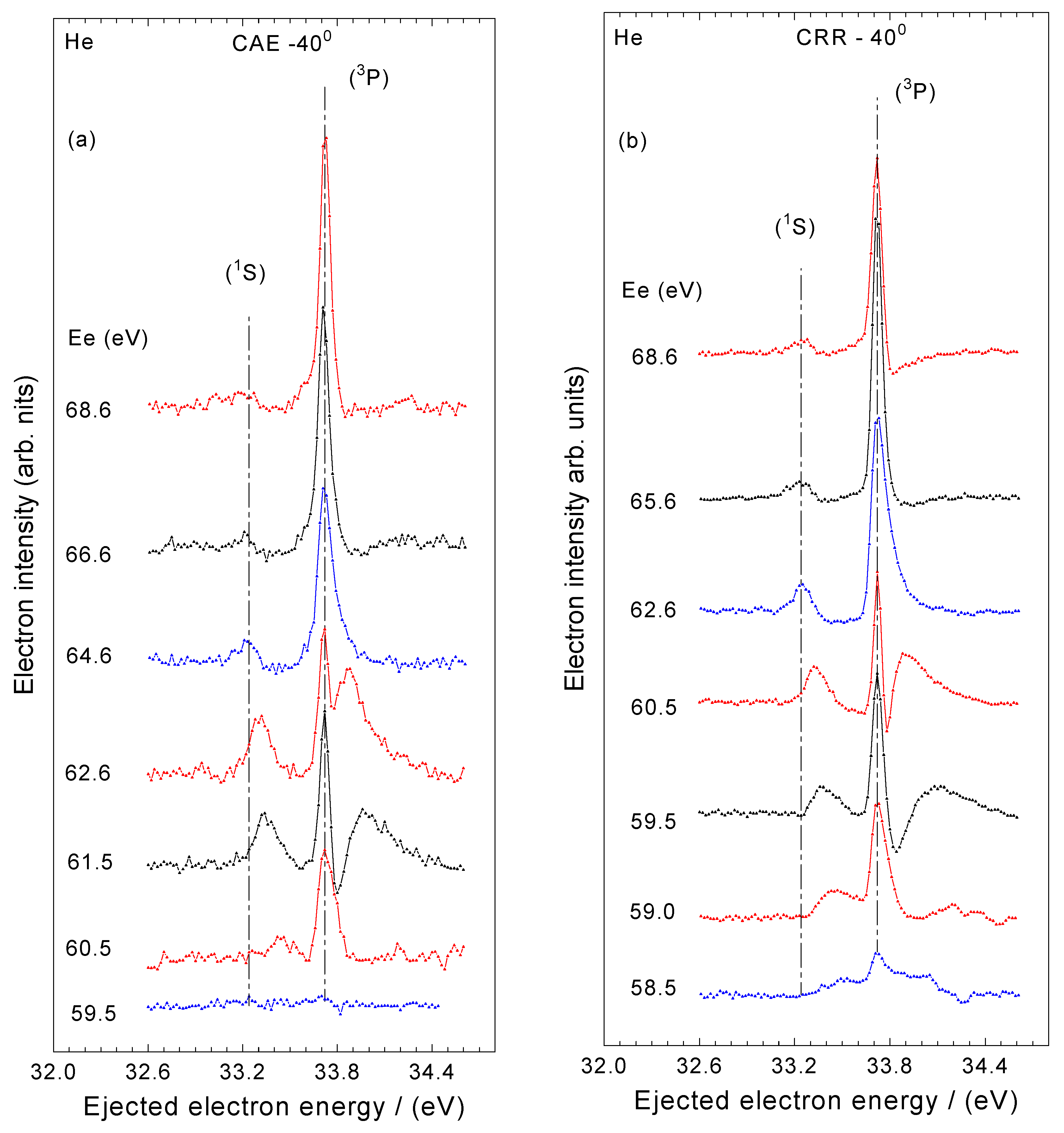
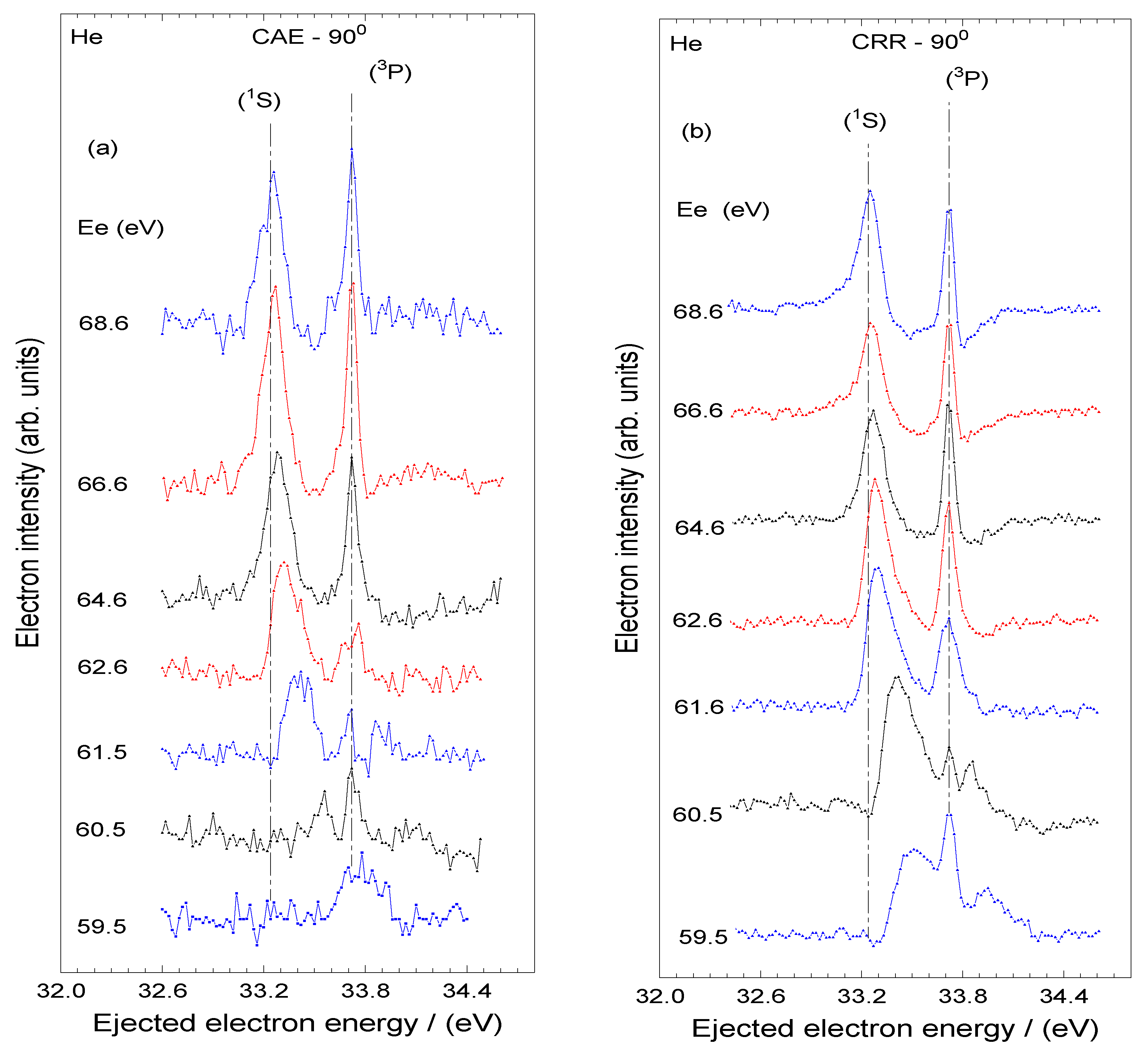
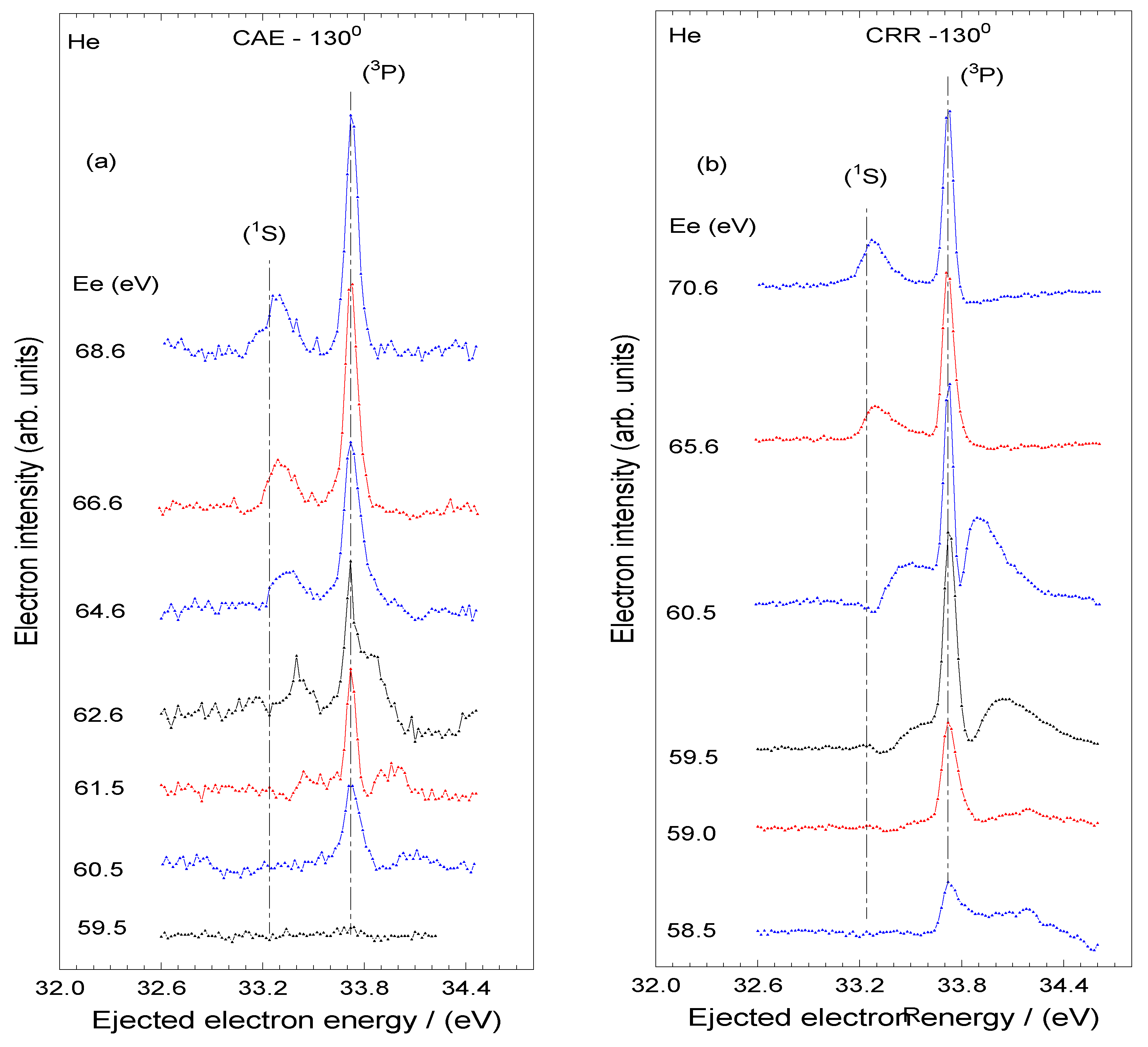
3.1.1. Energy Dependence of the 2s2(1S) and 2s2p(3P) States
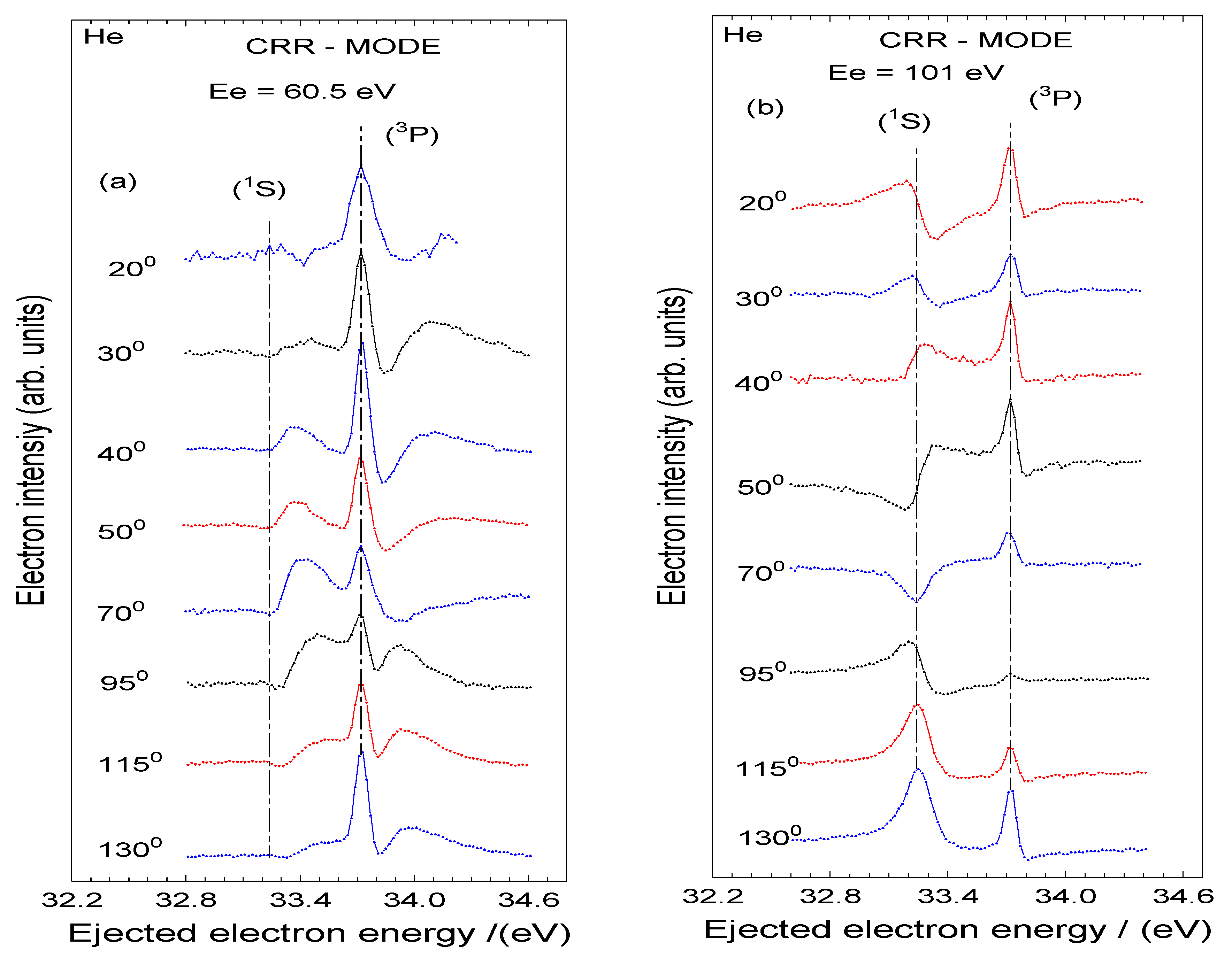
3.1.2. Angular Dependence of the 2s2(1S) and 2s2p(3P) States
3.1.3. Intensity Ratio of the 2s2(1S) and 2s2p(3P) States
3.1.4. The PCI Effect on the (2s2)1S State
3.2. Argon
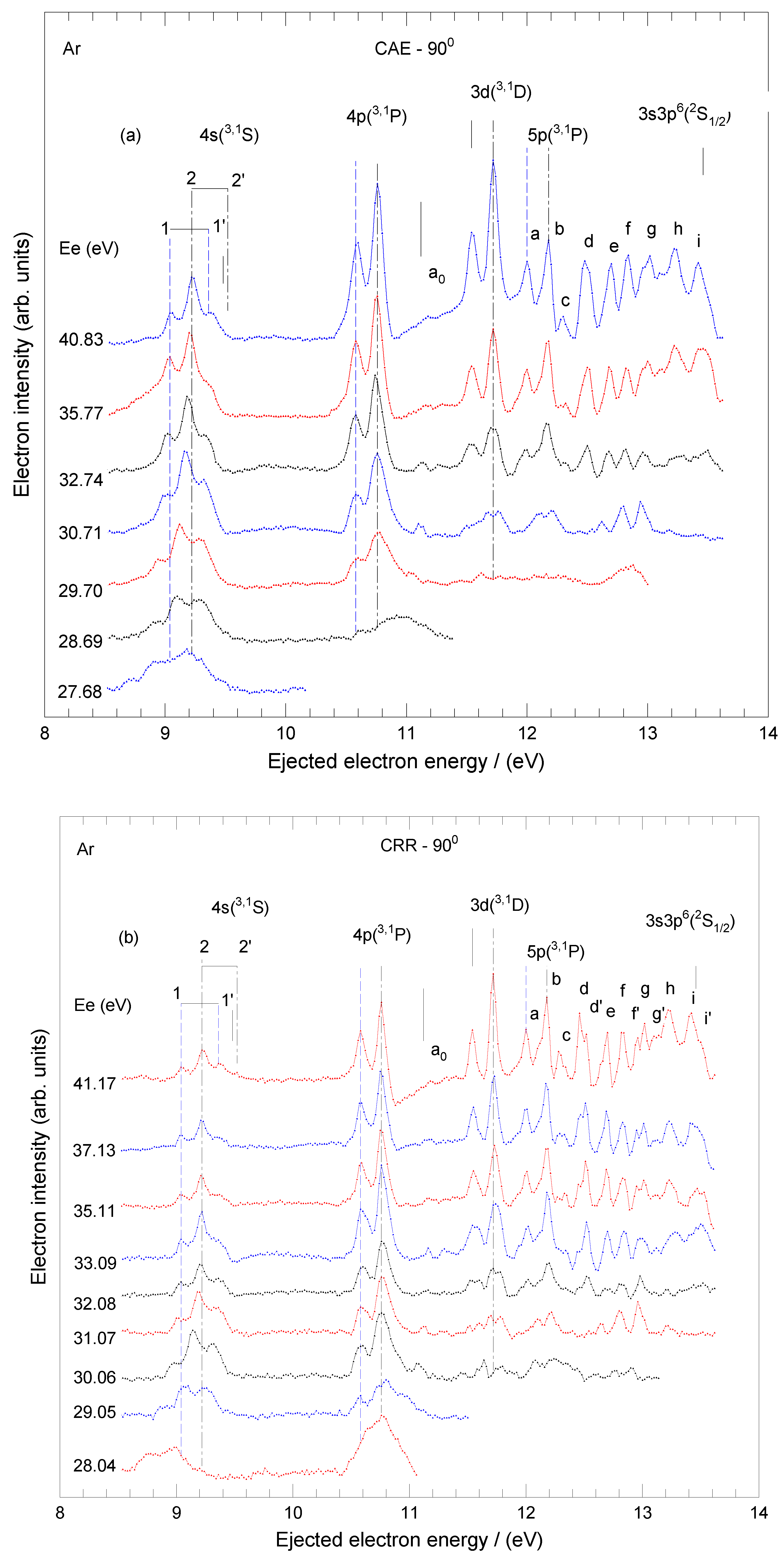
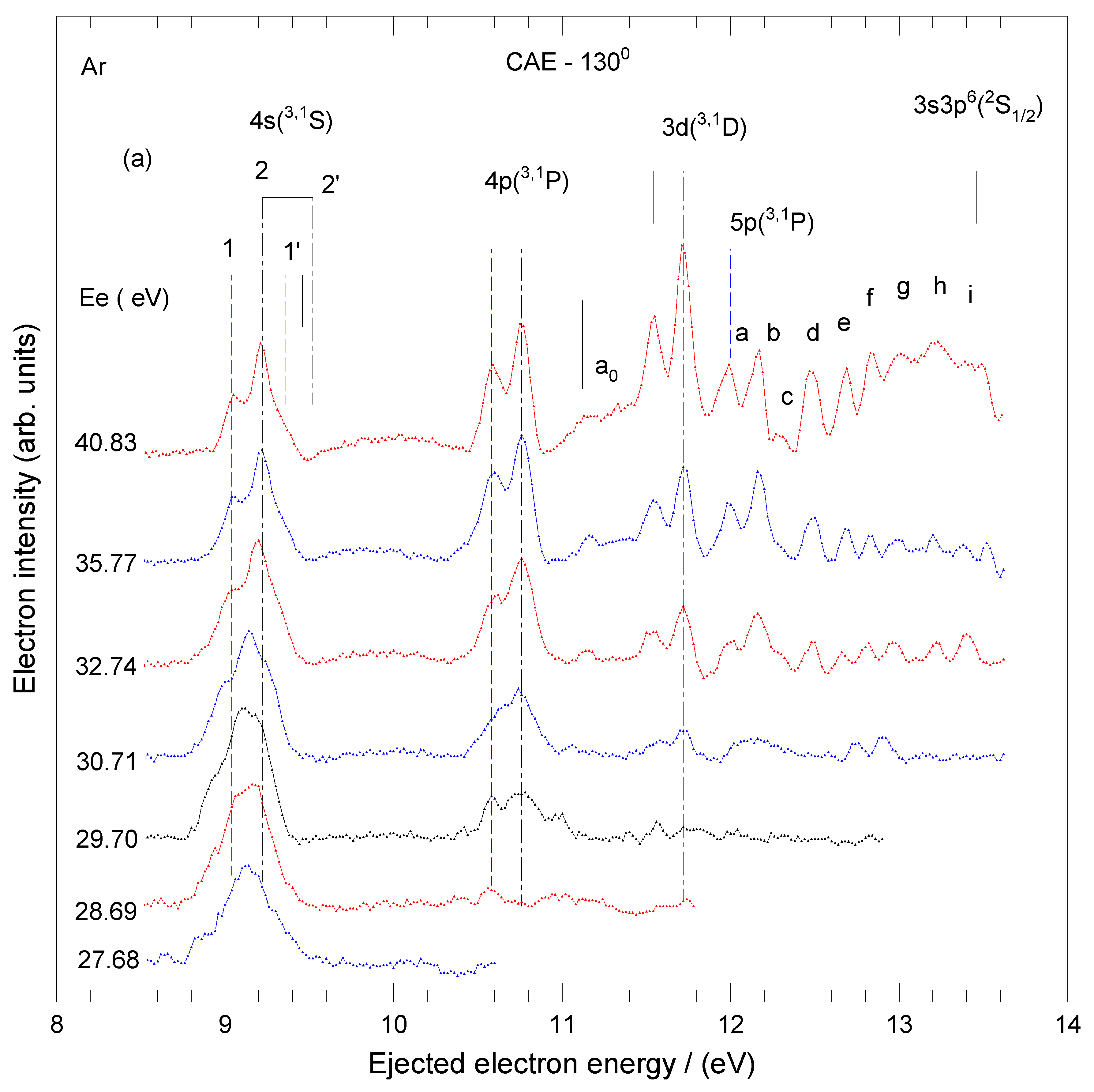
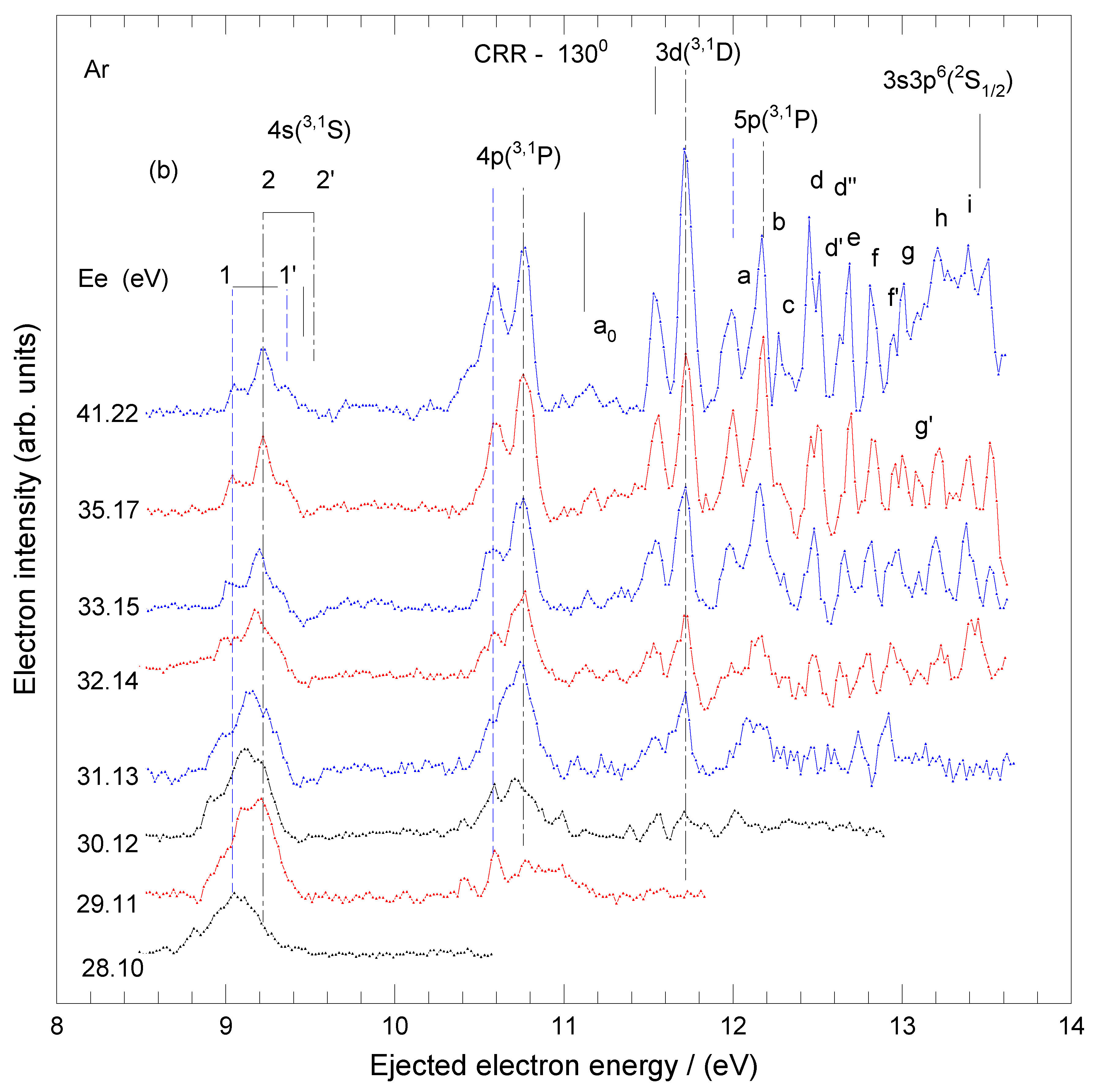
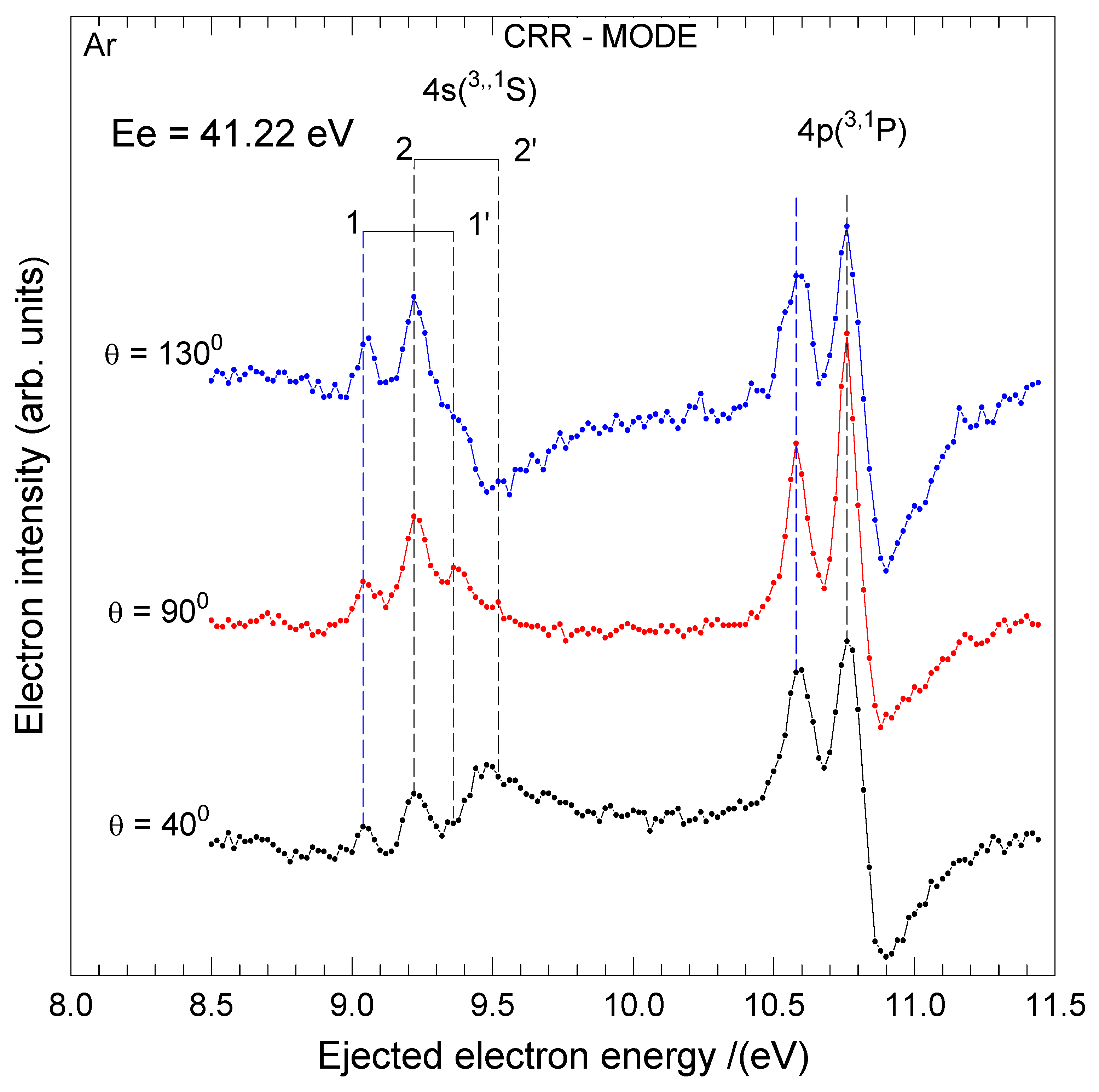
3.2.1. The 4s(3,1S) States
3.2.2. The 4p(3,1P) States
3.2.3. Doubly Excited 3s23p4(3P, 1D, 1S)nln’l’ States
3.2.4. The 3d(3,1D) States
3.2.5. The 5p(3,1P) States
3.2.6. The 4d(3,1D) States
3.2.7. The 6p(3,1P) States
3.2.8. The 5d(3,1D) States
3.2.9. Higher n States

| This Work | Reference | Exc. En. (eV) | Assignment | |
|---|---|---|---|---|
| Label | KE (eV) | |||
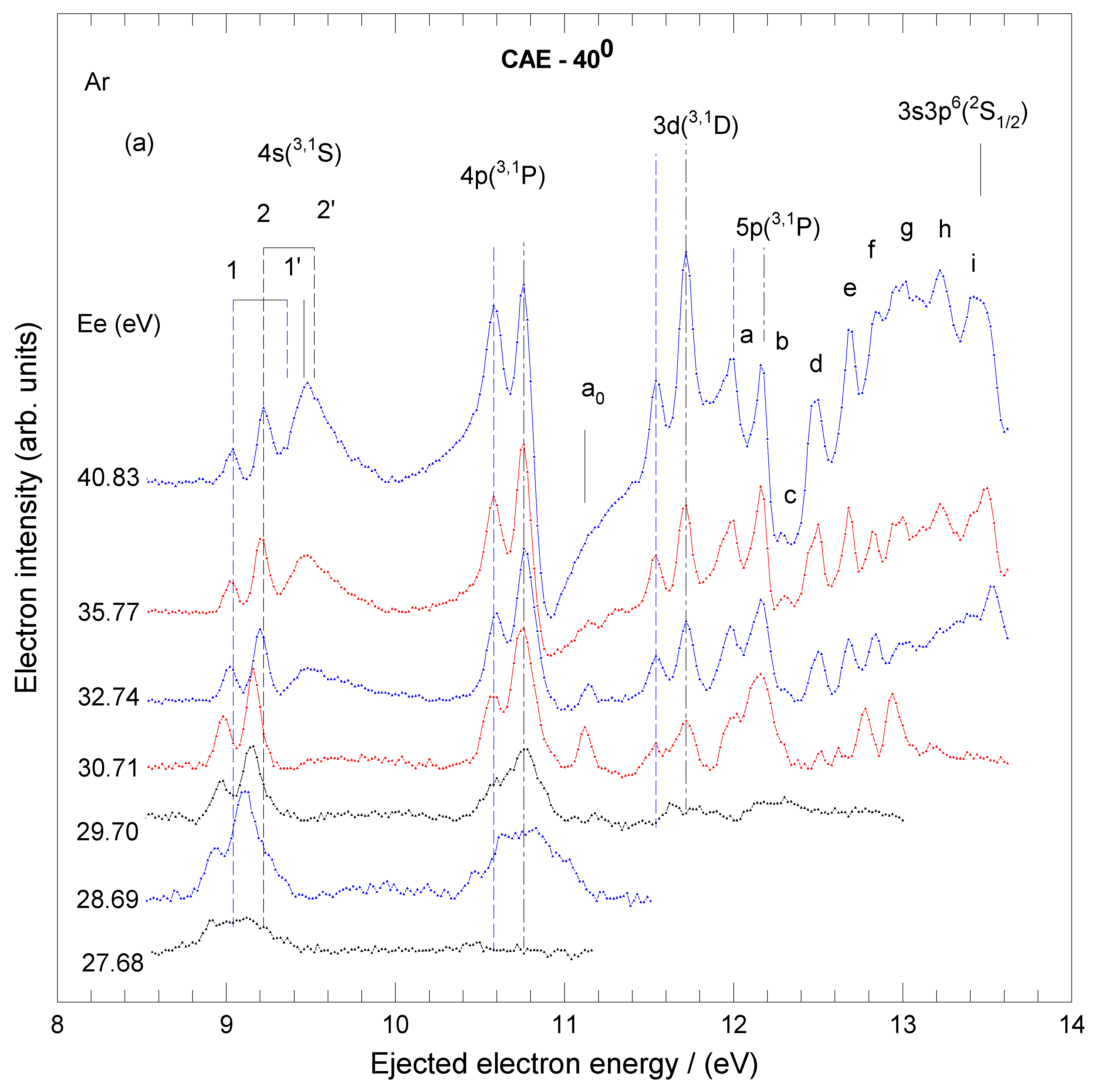
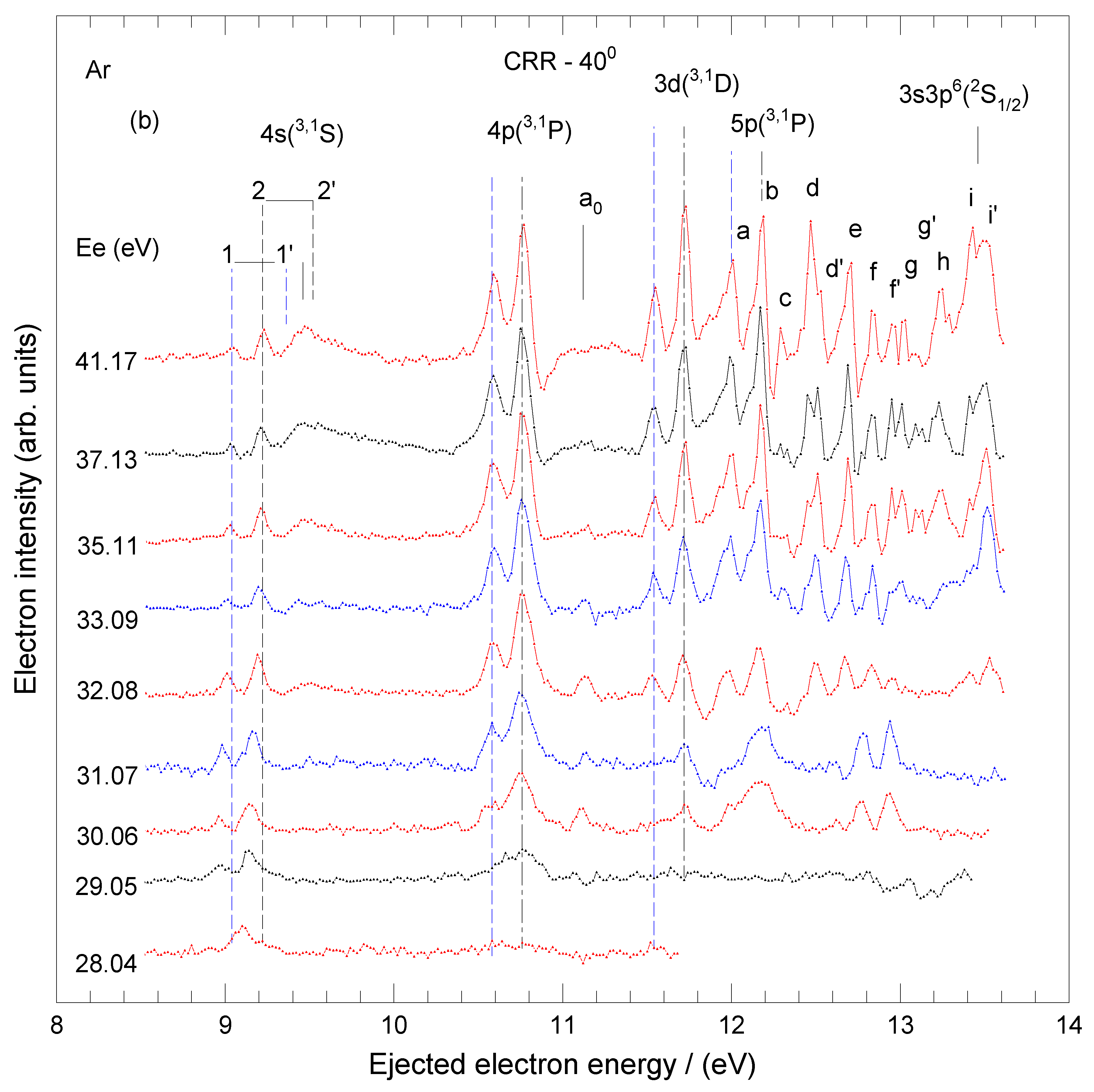
| 1–2 | 9.05 9.22 | This work, Ee = 41 eV | 24.985 | 3s3p64s(3S) |
| [10,11,12,13,14,17,26,28] | 25.02, 25.02, 25.03, 25.03, 25.03, 25.02,24.96, 24.95 | |||
| 1′–2′ | 9.36 | This work, Ee = 41 eV | 25.29 | 3s3p64s(1S) |
| 9.52 | [4,10,11,12,13,14,17,26,27,28,33] | 25.22, 25.26, 25.27, 25.23, 25.20, 25.21, 25.20, 25.25, 25.25, 25.20, 25.22 | ||
| 10.58 | This work, Ee = 41 eV | 26.52 | 3s3p64p(3P) | |
| 10.76 | [10,11,12,13,14,17,28] | 26.41, 26.46, 26.56, 26.55, 26.59, 26.41, 26.35 | ||
| / | [10,11,13,14,17,18,25,26,28,32,33] | 26.58, 26.62, 26.61, 26.62, 26.59, 26.606, 26.60, 26.60, 26.65, 26.62, 26.63 | 3s3p64p(1P) | |
| (a0): | 11.12 | This work | 26.88 | 3s23p4(3P) 4s2(3P) |
| [28,30,31] | 26.82, 26.80, 26.85 | |||
| 11.54 | This work | 27.48 | 3s3p63d(3D) | |
| 11.72 | [10,26,28] | 27.42, 27.43, 27.45 | ||
| / | [10,11,13,14,17,25,26,28,32,33] | 27.63, 27.48, 27.50, 27.51, 27.48, 27.54, 27.61, 27.65, 27.51, 27.48 | 3s3p63d(1D) | |
| (a) | 12.00 | This work | 27.94 | 3s3p65p(3P) |
| (b) | 12.18 | [11] | 27.93 | |
| / | [11,17,18,25,32,33,34,35] | 27.99, 27.98, 27.996, 27.99, 27.997, 28.02, 28.00, 27.994 | 3s3p65p(1P) | |
| (c) | 12.30 | This work | 28.24 | 3s3p64d(3D) |
| (d) | 12.48 | |||
| / | [4,11,13,17,25,32,33,34,35] | 28.30, 28.24, 28.27, 28.24, 28.35, 28.27, 28.29, 28.35, 28.33 | 3s3p64d(1D) | |
| (d’) | 12.52 | This work | 28.46 | 3s3p66p(3P) |
| (e) | 12.70 | |||
| / | [11,17,18,25,32,33,34,35] | 28.49, 28.49, 28.509, 28.51, 28.51, 28.50, 28.55, 28.509 | 3s3p66p(1P) | |
| (d″) | 12.64 | This work | 28.58 | 3s3p65d(3D) |
| (f) | 12.82 | |||
| / | [4,11,17,25,32,33,35] | 28.64, 28.59, 28.58, 28.70, 28.62, 28.70, 28.70 | 3s3p65d(1D) | |
| (f’) | 12.96 | This work | 28.72 | 3s3p67p(3,1P) |
| [11,18,33] | 28.71, 28.75, 28.75 | |||
| (g) | 13.01 | This work | 28.77 | 3s3p66d(3,1D) |
| [4,11], (calc.) | 28.83, 28.79 | |||
| (g′) | 13.10 | This work | 28.86 | 3s3p68p(3,1P) |
| [11,18,33], (calc.) | 28.86, 28.89, 28.89 | |||
| (h) | 13.23 | This work | 28.99 | 3s3p67d(3,1D) |
| [4,11], (calc.) | 29.01, 28.99 | |||
| (i) | 13.42 | This work | 29.18 | |
| 13.46 | [29,32], I.P.(3s) | 29.24, 29.22 | Ar+ 3s3p6(2S1/2) | |
4. Conclusions
Author Contributions
Funding
Data Availability Statement
Acknowledgments
Conflicts of Interest
Abbreviations
| CEA | Constant Analyzer Energy |
| CRR | Constant Retarding Ratio |
| PCI | Post-Collision Interaction |
| FWHM | Full Width at Half Maximum |
References
- de Harak, B.A.; Childers, J.G.; Martin, N.L.S. Ejected electron spectrum of He below the N = 2 threshold. Phys. Rev. A 2006, 74, 032714. [Google Scholar] [CrossRef]
- Avaldi, L.; Jureta, J.J.; Marinković, B.P. Energy analysis of ejected electrons in the region of the Ar L1-L2,3M Coster-Kronig transitions (25–56 eV) induced by electron impact. J. Electron Spectrosc. Rel. Phenom. 2019, 237, 146898. [Google Scholar] [CrossRef]
- Comer, J.; Read, F.H. Electron impact studies of autoionizing states in neon and helium. J. Electron Spectrosc. Rel. Phenom. 1972, 1, 3–11. [Google Scholar] [CrossRef]
- Brion, C.E.; Olsen, L.A.R. Threshold electron impact excitation of the rare gases. J. Phys. B Atom. Mol. Phys. 1970, 3, 1020–1033. [Google Scholar] [CrossRef]
- Oda, N.; Nishimura, F.; Tachira, S. Energy spectra of electrons from autoionization states in helium by electron impact. Phys. Rev. Lett. 1970, 24, 42–45. [Google Scholar] [CrossRef]
- Hicks, P.J.; Cvejanović, S.; Comer, J.; Read, F.H.; Sharp, J.M. Displacements of electron ejection energies in near- threshold excitation of autoionizing levels of helium by electron impact. Vacuum 1974, 24, 573–580. [Google Scholar] [CrossRef]
- Smith, A.J.; Hicks, P.J.; Read, F.H.; Cvejanovic, S.; King, G.C.M.; Comer, J.; Sharp, J.M. Phenomena associated with near-threshold excitation of autoionizing levels of helium by electron impact. J. Phys. B Atom. Mol. Phys. 1974, 7, L496–L502. [Google Scholar] [CrossRef]
- Hicks, P.J.; Comer, J. Ejected electron spectroscopy of autoionizing states excited by low energy electron impact. J. Phys. B Atom. Mol. Phys. 1975, 8, 1866–1879. [Google Scholar] [CrossRef]
- Spence, D. Cross sections and threshold effects for electron-impact excitation of the (2s2)1S and (2s2p)3P states of helium. Phys. Rev. A 1975, 12, 2353–2359. [Google Scholar] [CrossRef]
- Veillette, P.; Marchand, P. Excitation par impact électronique des états 3s3p6nl de l’argon. Can. J. Phys. 1974, 52, 930–934. [Google Scholar] [CrossRef]
- Fryar, J.; McConkey, J.W. Analysis of the ejected-electron spectra of Ar following controlled electron impact. J. Phys. B Atom. Mol. Phys. 1976, 9, 619–629. [Google Scholar] [CrossRef]
- Wilden, D.G.; Comer, J.; Hicks, P.J. Threshold effects in the excitation of autoionising states of argon atom by electron impact. Nature 1978, 273, 651–653. [Google Scholar] [CrossRef]
- Mitchell, P.; Baxter, J.A.; Comer, J.; Hicks, P. The excitation of autoionising states of argon by electron impact. J. Phys. B Atom. Mol. Phys. 1980, 13, 4481–4494. [Google Scholar] [CrossRef]
- Roy, D.; Poulin, A.; Hubin-Franskin, M.J.; Delwiche, J. Electron scattering and electron ejection by argon in the range 24–29 eV. J. Electron Spectros. Relat. Phenom. 1980, 19, 101–114. [Google Scholar] [CrossRef]
- Bartschat, K.; Bray, I.; Fursa, D.V. Benchmark Calculations for Near-Threshold Electron-Impact Excitation of the (1s3s)3,1S States of Helium. Atoms 2025, 13, 27. [Google Scholar] [CrossRef]
- Jureta, J.J.; Milosavljević, A.R.; Marinković, B.P. High energy electron impact study on autoionizing region in helium by detection of ejected electrons. Int. J. Mass. Spectrom. 2014, 365–366, 114–120. [Google Scholar] [CrossRef]
- Jureta, J.J.; Marinković, B.P.; Avaldi, L. Energy and angular analysis of ejected electrons (6–26 eV) from the autoionization regions of argon at incident electron energies 505 and 2018 eV. Eur. Phys. J. D 2016, 70, 199. [Google Scholar] [CrossRef]
- Madden, R.P.; Ederer, D.L.; Codling, K. Resonances in the Photo-ionization Continuum of Ar I (20–150 eV). Phys. Rev. 1969, 177, 136–151. [Google Scholar] [CrossRef]
- Madden, R.P.; Codling, K. New autoionizing atomic energy levels in He, Ne, and Ar. Phys. Rev. Lett. 1963, 10, 516–518. [Google Scholar] [CrossRef]
- van den Brink, J.P.; van Eck, J.; Heideman, H.G. Interference between scattered and ejected electrons in e-He collisions: A new probe for coherence studies. Phys. Rev. Lett. 1988, 61, 2106–2108. [Google Scholar] [CrossRef]
- van der Burgt, P.J.M.; van Eck, J.; Heideman, H.G.M. Orbital Angular Momentum Exchange in Post-Collision Interaction. In Fundamental Processes in Atomic Collision Physics; Kleinpoppen, H., Briggs, J.S., Lutz, H.O., Eds.; NATO ASI Series; Springer: Boston, MA, USA, 1985; Volume 134, pp. 619–625. [Google Scholar] [CrossRef]
- van der Burgt, P.J.M.; van Eck, J.; Heideman, H.G.M. Orbital angular momentum exchange in post-collision interaction. J. Phys. B Atom. Mol. Phys. 1985, 18, 999–1009. [Google Scholar] [CrossRef]
- Jureta, J.J.; Marinković, B.P.; Avaldi, L. The N4,5-OO Auger and “N3”-M4,5O2,3 Coster-Kronig spectra of xenon induced by electron impact. Adv. Space Res. 2023, 71, 1338–1351. [Google Scholar] [CrossRef]
- van den Brink, J.P.; den Outer, P.N.; van Eck, J.; Eideman, H.G.M. Coherence and correlation in electron impact autoionisation of neon and argon. J. Phys. B At. Mol. Opt. Phys. 1990, 23, 2349–2362. [Google Scholar] [CrossRef]
- Tweed, R.J.; Gelebart, F.; Peresse, J. Autoionization by electron impact: Experiments on Ar, Kr and Xe. J. Phys. B Atom. Mol. Phys. 1976, 9, 2643–2656. [Google Scholar] [CrossRef]
- Bolduc, E.; Quéméner, J.J.; Marmet, P. Electron-Impact Excitation of 3s3p6nl States of Ar. Can. J. Phys. 1971, 49, 3095–3098. [Google Scholar] [CrossRef]
- Simpson, J.A.; Chamberlain, G.E.; Mielczarek, S.R. Excitation of Optically Forbidden States in the Ionization Continuum by Electron Impact. Phys. Rev. 1965, 139, A1039–A1041. [Google Scholar] [CrossRef]
- Marchand, P.; Cardinal, J. Metastable yield of argon between 23 and 37 eV by electron impact. Can. J. Phys. 1979, 57, 1624–1633. [Google Scholar] [CrossRef]
- Kramida, A.; Ralchenko, Y.; Reader, J.; NIST ASD Team. NIST Atomic Spectra Database (Ver. 5.12); National Institute of Standards and Technology: Gaithersburg, MD, USA, 2024. Available online: https://physics.nist.gov/asd (accessed on 16 December 2025). [CrossRef]
- Lefaivre, D.; Marmet, P. Electron excitation of Ar between 26 and 34 eV. Int. J. Mass Spectrom. Ion Phys. 1975, 18, 153–164. [Google Scholar] [CrossRef]
- Veillette, P.; Marchand, P. Photon detection of doubly excited states of argon produced by electron impact. Int. J. Mass Spectrom. Ion Phys. 1975, 18, 165–178. [Google Scholar] [CrossRef]
- McConkey, J.W.; Preston, J.A. Autoionizing states in argon. J. Phys. B Atom. Mol. Phys. 1973, 6, L138–L141. [Google Scholar] [CrossRef]
- Bergmark, T.; Spohr, R.; Magnusson, N.; Werme, L.O.; Nordhng, C.; Siegbahn, K. Uppsala University Institute of Physics Report No. 589; Uppsala University Institute of Physics: Uppsala, Sweden, 1969. [Google Scholar]
- Wu, S.L.; Zhong, Z.P.; Feng, R.F.; Xing, S.L.; Yang, B.X.; Xu, K.Z. Electron-impact study in valence and autoionization resonance regions of argon. Phys. Rev. A 1995, 51, 4494–4500. [Google Scholar] [CrossRef] [PubMed]
- Peresse, J.; Gelebart, F.; Le Nadan, A. Autoionisation de l’argon par impacts d’électrons lents. C. R. Acad. Sci. Ser. B 1972, 275, 255–257. [Google Scholar]


Disclaimer/Publisher’s Note: The statements, opinions and data contained in all publications are solely those of the individual author(s) and contributor(s) and not of MDPI and/or the editor(s). MDPI and/or the editor(s) disclaim responsibility for any injury to people or property resulting from any ideas, methods, instructions or products referred to in the content. |
© 2026 by the authors. Licensee MDPI, Basel, Switzerland. This article is an open access article distributed under the terms and conditions of the Creative Commons Attribution (CC BY) license.
Share and Cite
Marinković, B.P.; Avaldi, L.; Jureta, J.J. Study of the Triplet States in the Autoionizing Electron Spectra of He and Ar Induced by Low-Energy Electrons. Atoms 2026, 14, 9. https://doi.org/10.3390/atoms14020009
Marinković BP, Avaldi L, Jureta JJ. Study of the Triplet States in the Autoionizing Electron Spectra of He and Ar Induced by Low-Energy Electrons. Atoms. 2026; 14(2):9. https://doi.org/10.3390/atoms14020009
Chicago/Turabian StyleMarinković, Bratislav P., Lorenzo Avaldi, and Jozo J. Jureta. 2026. "Study of the Triplet States in the Autoionizing Electron Spectra of He and Ar Induced by Low-Energy Electrons" Atoms 14, no. 2: 9. https://doi.org/10.3390/atoms14020009
APA StyleMarinković, B. P., Avaldi, L., & Jureta, J. J. (2026). Study of the Triplet States in the Autoionizing Electron Spectra of He and Ar Induced by Low-Energy Electrons. Atoms, 14(2), 9. https://doi.org/10.3390/atoms14020009