


Abstract
The field-theoretic renormalization group is applied to a simple model of a random walk on a rough fluctuating surface. We consider the Fokker–Planck equation for a particle in a uniform gravitational field. The surface is modeled by the generalized Edwards–Wilkinson linear stochastic equation for the height field. The full stochastic model is reformulated as a multiplicatively renormalizable field theory, which allows for the application of the standard renormalization theory. The renormalization group equations have several fixed points that correspond to possible scaling regimes in the infrared range (long times and large distances); all the critical dimensions are found exactly. As an example, the spreading law for the particle’s cloud is derived. It has the form with the exactly known critical dimension of frequency and, in general, differs from the standard expression for an ordinary random walk.
1. Introduction
Over decades, stochastic growth processes, kinetic roughening phenomena, and fluctuating surfaces or interfaces have been attracting constant attention. The most prominent examples include the deposition of a substance on a surface and the growth of the corresponding phase boundary; propagation of flame, smoke, and solidification fronts; growth of vicinal surfaces and bacterial colonies; erosion of landscapes and seabed profiles; molecular beam epitaxy; and many others, see [1,2,3,4,5,6,7,8,9,10,11,12,13] and references therein.
Another vast area of research is that of diffusion and random walks in a random environment, such as disordered, inhomogeneous, porous, or turbulent media, see, e.g., [14,15,16,17,18,19,20,21,22,23,24].
In this paper, we study a simple model of a random walk on a rough fluctuating surface. We consider the Fokker–Planck equation for a particle in a uniform gravitational field. The surface is modeled by the generalized Edwards–Wilkinson linear stochastic equation for the height field [1]. The generalized model involves two arbitrary exponents, and , related to the spectrum and the dispersion law of the height field, respectively. A detailed description of the model and its relation to various special cases is given in Section 2.
Using the general Martin–Siggia–Rose–de Dominicis–Janssen theorem, the original stochastic problem is reformulated as a certain field-theoretic model. This allows one to apply the well-developed formalism of Feynman diagrammatic techniques, renormalization theory, and a renormalization group (RG). The model is shown to be multiplicatively renormalizable, so that the RG equation can be derived in a standard way. The corresponding renormalization constants and the RG functions (anomalous dimensions and functions) are explicitly calculated in the leading one-loop order of the RG perturbation theory. These issues are discussed in Section 3 and Section 4.
The RG equations have two Gaussian (free) fixed points and two nontrivial ones. Those points are infrared (IR) attractive depending on the values of the parameters and , which implies the existence of scaling (self-similar) asymptotic regimes in the IR range (long times and large distances) for the various response and correlation functions of the model (Section 4). The critical dimensions for those regimes are found exactly as functions of and . As an indicative application, the time dependence of the mean-square radius of a cloud of randomly walking particles is obtained (Section 5). It is described by a power law with the exponent that depends on the fixed point, is known exactly as a function of and , and for nontrivial points, it differs from the ordinary random walk: .
Some implications and possible generalizations are discussed in Section 6.
2. Description of the Model
We consider the random walk of a point particle on a two-dimensional rough surface embedded into the -dimensional space. The particle is located on the surface on the height , where is the particle’s coordinate projection on the d-dimensional substrate, . Thus, d is an arbitrary (for generality) dimension of the substrate space.
While the coordinates with determine the particle’s location, the coordinate with is not treated as an independent Cartesian coordinate but is restricted to the surface, . This setup excludes the possibility for a particle to “jump off” or “escape” the surface; such interesting phenomena are not included in our simple model.
The basic stochastic equation of motion of a particle located at the point in an external drift field F has the form [14,15,16,17,18,19,20,21,22,23,24]:
Here, is a Gaussian noise with zero mean and a given pair correlation function, will play a role of the diffusion coefficient, and F is an external drift field (a force or an advecting velocity, depending on the specific context).1
The probability distribution function satisfies the Fokker–Planck equation
Here and below, summation over repeated indices is implied.
From physics reasons, the drift F in a gravitational field should obey the symmetry and the invariance with the respect to the shift const, so that it should be built of gradients of the field h. Thus, in the simplest linear approximation, it is taken in the form
with the parameter proportional to the particle’s mass m and the gravitational acceleration g. Possible higher-order corrections to the linear approximation should also be constructed from gradients of the field h and obey the symmetry, for example, . They have higher canonical dimensions in comparison with (3) (see Section 3), are IR irrelevant (in the sense of Wilson), and should be dropped in the analysis of IR scaling.
Careful interpretation of the gradient for a rough surface and the very existence (in a rigorous mathematical sense) of corresponding continuous equations is a serious problem. Recently, important progress was achieved for the Kardar–Parisi–Zhang (KPZ) model, see [25,26,27,28,29] and references therein.
From a more practical physical point of view, there is a very small microscopical scale a below which the field h becomes smooth and differentiable. In our and the KPZ’s treatment, this scale is tacitly set to zero, so that the field becomes rough. There is an apparent analogy with the well-known dissipative anomaly in turbulence, see, e.g., [30]. Practically, in this study, we use the formal perturbation theory, where this problem does not arise, and the expression (3) is applied without further comments.
The simplest model of surface roughening, proposed within the context of landscape erosion, is the one due to Edwards and Wilkinson [1]. In the continuous formulation, it is described by the diffusion-type stochastic equation for the height field :
where is (a kind of) surface tension coefficient, is the Laplace operator, and f is a Gaussian random noise with zero mean and a given pair correlation function. The most popular choices are the white noise
with the positive amplitude and the quenched noise; the simplified version of the latter is
In this paper, we consider a generalized equation
written here in the symbolic notation with k being the wave number,2 while the correlation function is taken in a power-like form:
Here, and y are arbitrary exponents and d is the dimension of space. Clearly, the choice , corresponds to the model (4) and (5); as we will see, the model (4) and (6) can also be obtained from (7) and (8).
For a linear stochastic equation with a Gaussian additive random noise, the field h is also a Gaussian field defined by its pair correlation function. For the model (7) and (8), the latter has the following form in the Fourier (–) representation
In the second relation, we introduced the new variables: the exponent and the amplitudes , , defined by the relations
They are convenient, in particular, because the equal-time correlation function
involves the parameters , , while the dispersion law
is expressed only via , .
The choice can be justified by the ideas of self-organized criticality (SOC), according to which the evolution of a sandpile surface is not an ordinary diffusion-type process but involves several discrete steps: expectation period, reaching a threshold, and avalanche, see, e.g., [31,32,33].
Thus, according to [32], self-organized critical dynamical systems give rise to the so-called noise because the characteristic size of an avalanche is related to its lifetime via a power law , where the exponent is the rate at which the event propagates across the system, see also, e.g., Section 1.3.2 in the book [31] and papers [33,34]. In the – representation, this corresponds to the dispersion law (12) with the exponent . It is also worth noting that the noise appears also in models of random walks in random media, see, e.g., [14,15].
The model (9) includes two special cases interesting on their own. In the limit and fixed, the function becomes independent of the frequency , and the field becomes white in time. Indeed, one obtains in the (t–) representation
Here, the exponent plays a role of a Hölder’s exponent that measures “roughness” of the field h (“Batchelor limit” corresponds to a smooth field).
In the limit and fixed, the function in (11) remains finite, so that (9) tends to
which corresponds to the time-independent (quenched or frozen) field h. Surprisingly enough, for , this reproduces the model (4) and (6) where one has .
Substituting the gravitational force (3) with the random height field from (7) and (8) into the Fokker–Planck equation (2) turns the latter into a stochastic equation in its own right. It has the form
where the random field can be interpreted as the density of walking particles, while the role of the (deterministic) probability distribution function is now conveyed to the linear response function, see Equation (44) in Section 5.
This completes formulation of the problem.
3. Field-Theoretic Formulation and Renormalization of the Model
According to the general theorem (see, e.g., Section 5.3 in the monograph [35]), the full stochastic problem (8), (15) is equivalent to the field-theoretic model for the doubled set of fields with the de Dominicis–Janssen action functional:
Here, is the correlator (8), is the density field, h is the height field, and , are the corresponding Martin–Siggia–Rose response fields; all the needed integrations over their arguments and summations over repeated indices are implied. The field-theoretic formulation means that various correlation and response functions of the original stochastic problem are represented by functional averages with the weight . The field can easily be removed by Gaussian integration, then would be replaced with with from (9), but the expanded representation (17) is more convenient for the renormalization purposes. The constant can be removed by rescaling of the fields and other parameters. Thus, in the following, with no loss of generality, we set .
The model (16) and (17) corresponds to Feynman diagrammatic technique with bare propagators , , (the latter does not enter into relevant diagrams) and the only vertex .
It is well known that an analysis of ultraviolet (UV) divergences is based on an analysis of canonical dimensions, see, e.g., [35] (Sections 1.15 and 1.16). In contrast to conventional static models, dynamic ones have two independent scales: a time scale and a spatial scale , see [35] (Sections 1.17 and 5.14). Thus, the canonical dimension of any quantity F (a field or a parameter) is determined by two numbers: the frequency dimension and the momentum dimension :
The dimensions are found from obvious normalization conditions
and from the requirement that all terms in the action functional be dimensionless with respect to both the canonical dimensions separately. The total canonical dimension is defined as (the coefficient 2 follows from the relation in the free theory). In the renormalization procedure, plays the same role as the conventional (momentum) dimension does in static models, see Section 5.14 in [35].
Canonical dimensions of all the fields and parameters of our model are given in Table 1. It also involves renormalized parameters (without subscript “0”) and the reference mass , an additional parameter of the renormalized theory; they all will appear later on.

Note that for the fields , all these dimensions can be unambiguously defined only for the product . Formally, this follows from the invariance of the action functional (16) under the dilatation , .
As can be seen from Table 1, the model becomes logarithmic (both coupling constants , become dimensionless) for (or equivalently for ) and arbitrary d.3 According to the general strategy of renormalization, the exponents , y, or that “measure” the deviation from the logarithmicity should be treated as formal small parameters of the same order. The UV divergences manifest themselves as singularities at , etc., in the correlation functions; in the one-loop approximation, they have the form of simple poles.
The total canonical dimension of a certain 1-irreducible Green’s function is given by
where are the numbers of the fields entering the Green’s function and are their total canonical dimensions.
The formal index of divergence is the total dimension of the Green’s function in the logarithmic theory (), that is, . Superficial UV divergences, whose removal requires introducing counterterms, can be present in the Green’s function if is a non-negative integer.
When analyzing the divergences in the model (16) and (17), the following additional considerations should be taken into account, see, e.g., [35] (Section 5.15) and [36] (Section 1.4).
(i) For any dynamic model of this type, all the 1-irreducible functions without the response fields contain closed circuits of retarded propagators and vanish. Thus, it is sufficient to consider the functions with .
(ii) For all non-vanishing functions, (otherwise no diagrams can be constructed). Formally, this is a consequence of the invariance of the action functional (16) with respect to dilatation , .
(iii) Using integration by parts, one derivative in the vertex can be moved onto the field , i.e., . Thus, in any 1-irreducible diagram, each external field or “releases” the external momentum, and the real index of divergence decreases by the corresponding number of units, i.e., . Furthermore, these fields enter the counterterms only in the form of spatial gradients. This observation excludes the counterterms and , the latter allowed by the formal index for .
(iv) It is clear that the fields , do not affect the statistics of the field h. In the field-theoretic terms, this “passivity” means that any 1-irreducible Green’s function with , , and vanishes: no corresponding diagrams can be constructed.
Taking into account these considerations, one obtains:
(we recall that , so that only is indicated).
Then, the straightforward analysis shows that the superficial divergences in our model are present only in the 1-irreducible functions and , and the corresponding counterterms necessarily contract to the forms (, ) and (, ). Such terms are already present in the action (16), which means that our model (16) and (17) is multiplicatively renormalizable with only two independent renormalization constants and .
The renormalized action has the form
which is naturally reproduced as renormalization of the field h and the coefficient ; no renormalization of the product is needed:
The functional (17) is not renormalized, , but it should be expressed in renormalized variables, taking into account Equations (8) and (9):
where the renormalization mass is introduced so that renormalized couplings g and u are completely dimensionless. Then, it follows from the absence of renormalization of that
Along with (21), this finally gives the following relations:
We calculated the renormalization constants and in the leading one-loop approximation (the first order of the perturbative expansion in g). It is sufficient to find them for , because the anomalous dimensions in the minimal subtraction (MS) renormalization scheme are independent of the parameters such as and y, while the exponent y alone provides UV regularization. Then, one obtains:
with the higher-order corrections in g. Here, , is the surface area of the unit sphere in d-dimensional space. It is convenient to absorb overall factors into the coupling constant g, which gives
4. RG Equations, RG Functions, and Fixed Points
Because our model is multiplicatively renormalizable, the corresponding RG equations are derived in a standard fashion. In particular, for a certain renormalized (full or connected) Green’s function , the RG equation reads
Here, the ellipsis stands for other variables (times and coordinates or frequencies and momenta), , for any variable x, and the sum runs over all fields .
The coefficients in the RG differential operator (27)—the anomalous dimensions and the functions—are defined as
where is the differential operation at fixed bare (unrenormalized) parameters, see, e.g., Sections 1.24 and 1.25 in the monograph [35].
The IR asymptotic behavior of the Green’s functions is determined by IR attractive fixed points of the corresponding RG equations. The coordinates of fixed points , are found from the requirement that all the functions vanish simultaneously:
The type of a fixed point is determined by the matrix of derivatives at the given point : for an IR attractive point, all the eigenvalues should have positive real parts.
An analysis of the expressions (32) reveals four fixed points:
(i) Gaussian (free) fixed point:
(ii) Nontrivial fixed point:
The point (i) is IR attractive for , while the point (ii) is IR attractive for .
Two more points are found in the following way. In order to explore the limiting case with fixed, we have to pass to new variables: and . For this case, we obtain
Finding the zeros of the functions, we find two additional fixed points:
(iii) Gaussian (free) fixed point:
(iv) Nontrivial fixed point:
The point (iii) is IR attractive if , and the point (iv) is IR attractive if or .
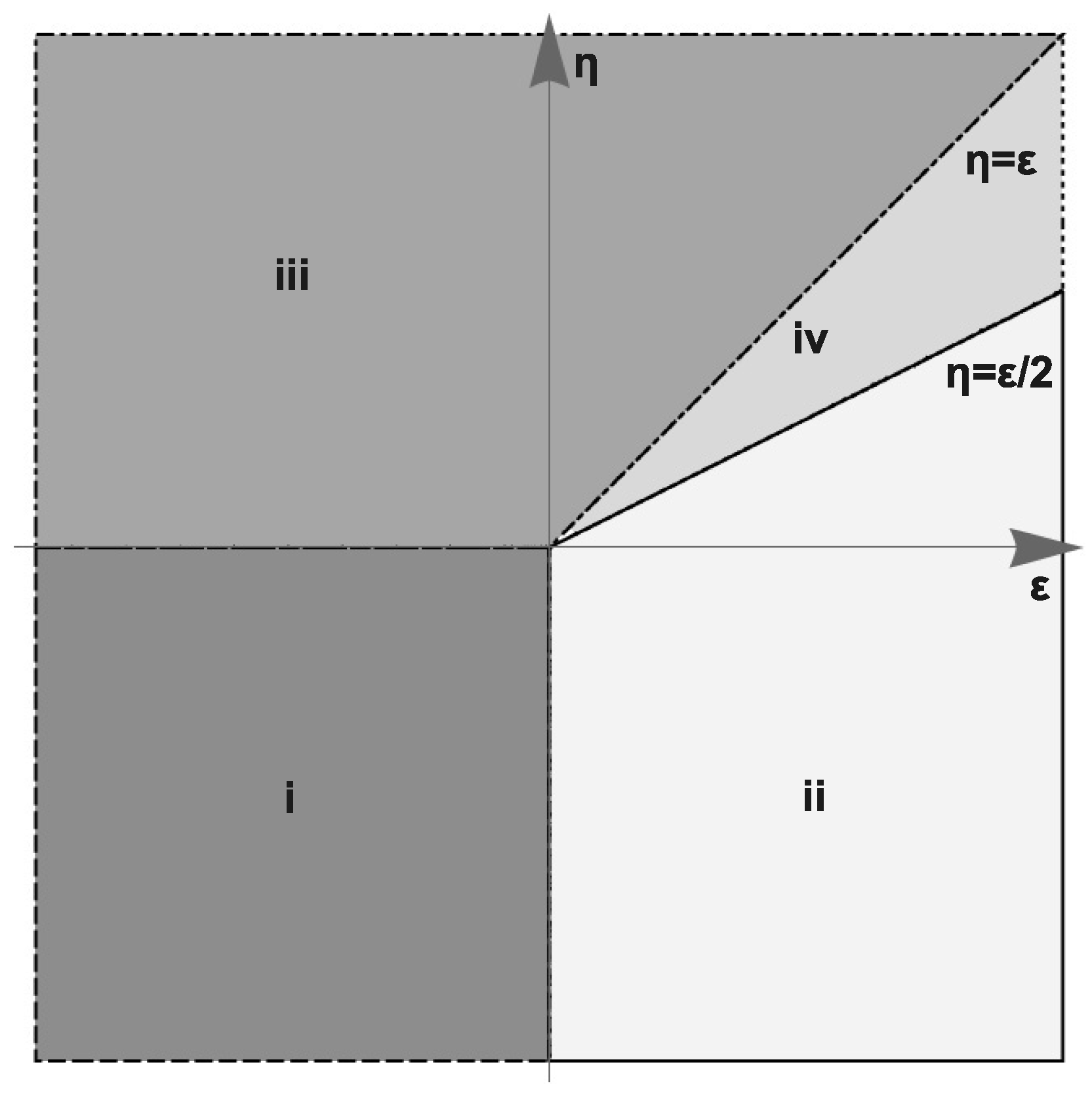
The general stability pattern of the fixed points in the – plane is shown in Figure 1.
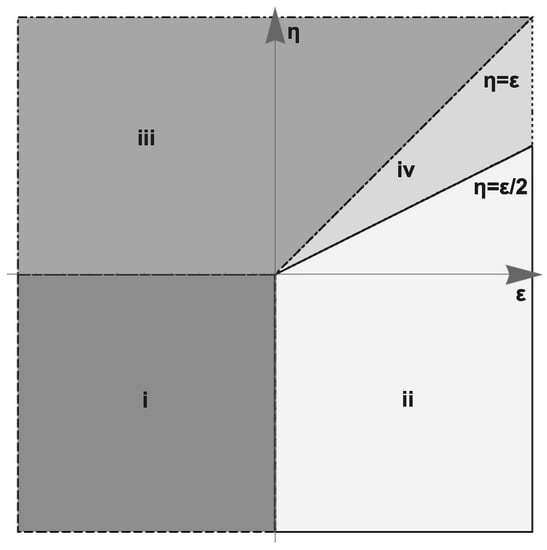
Figure 1.
Regions of stability of the fixed points (i)–(iv).
In the one-loop approximation, the regions of IR stability for all the points are given by sectors that cover the full plane without gaps or overlaps between them.
Some remarks are in order. Clearly, the Gaussian points correspond to cases in which the dynamics of the field are not affected by the statistics of the height field h (only in the leading order of the IR asymptotic behavior!). In these cases, we deal with an ordinary random walk.
The point (iv) corresponds to the limiting case (13) when the field h, in comparison with , behaves as if it was correlated in time.
However, we did not find a nontrivial point that would correspond to the frozen limit (14). This follows from the fact that the function in (32) becomes trivial for : . A similar triviality was observed earlier in models of diffusion in time-independent potential vector fields where it was shown to be exact in all orders of perturbation theory [18,19]. Because those models have a close formal resemblance with the limit (14) of our model and its special case (4) and (6), we believe that in the latter cases is also trivial exactly.
5. Critical Dimensions and Scaling Behavior
The existence of IR attractive fixed points of the RG equations implies the existence of the scaling behavior of the correlation functions in the IR range.
In dynamical models, the critical dimension of any quantity F (a field or a parameter) is given by the expression (see, e.g., Sections 5.16 and 6.7 in [35] and Section 2.1 in [36])
(with the standard normalization convention that ). Here and below, denotes the value of the anomalous dimension at a fixed point.
For the Gaussian points (i) and (iii), one has
As already mentioned, the point (iv) corresponds to the limit (13), where the propagator becomes -correlated in time. As a result, closed circuits of retarded propagators appear in almost all diagrams relevant for a renormalization procedure and they therefore vanish. The only exception is the one-loop diagram contributing to . Thus, one has identically, while is given exactly by the one-loop expression, cf. the discussion of Kraichnan’s rapid-change model of passive scalar advection [38]. Then, one readily derives the exact expressions for the critical dimensions:
As an illustrative application, consider the mean-square distance of a random walker on a rough surface. For such a particle that started moving at from the origin , it is given by
where is a later time and is the corresponding current position. Substituting the scaling representation for the linear response function
gives
Taking into account the exact relation , valid for all fixed points (i)-(iv), one arrives at the spreading law
with the exact expressions for the points (i), (iii), for (ii), and for (iv).
6. Conclusions
We studied a model of a random walk of a particle on a rough fluctuating surface described by the Fokker–Planck equation for a particle in a constant gravitational field while the surface was modeled by the (generalized) Edwards–Wilkinson model. The full stochastic problem, (2), (3), (7) and (8), is mapped onto a multiplicatively renormalizable field-theoretic model (16) and (17).
The corresponding RG equations reveal two Gaussian (free) and two nontrivial fixed points, which means that the system exhibits various types of IR scaling behavior (long times and large distances). Although the practical calculation is confined within the leading one-loop approximation, the main critical dimensions are found exactly.
As an illustrative example, we considered the mean-square displacement of a walking particle (in another interpretation, the radius of particles’ cloud). It shows that the particle is not trapped in a finite area but travels all across the system with a spreading law similar to the ordinary random walk but, in general, with different exponents, see (46) and the text below.
As one can see, even a comparatively simple model demonstrates interesting types of IR behavior. Thus, it is interesting to study more involved situations. There are several directions for possible generalizations.
Linear stochastic equations such as (4) and (7) (corresponding to Gaussian statistics for the height field) can be replaced by nonlinear models, such as the KPZ [2] or Pavlik’s [5,8] ones.
Although our expressions (41) and (42) for the critical dimensions are exact, they are derived within perturbation theory based on the assumption that the expansion parameters and are small. Then, it is supposed that the one-loop pattern of fixed points is qualitatively correct. However, in some cases, a crossover in the scaling behavior occurs for finite values of parameters analogous to and [37,39]. In the field-theoretic approach, this effect can be related to the appearance of composite operators with negative dimensions [37]. This issue requires a special investigation.
On some occasions, the motion of a particle is not an ordinary random walk (1) but is described, e.g., by Lévy flights, see, e.g., [21]. This possibility is supported by the ideas of self-organized criticality that the underlying surface evolves via avalanches [31,32,33,34], while the particle can slide upon the surface. If so, it is natural to replace the Laplace operator in the Fokker–Planck equation (2) with a fractional derivative, , with a certain new exponent .
It is especially interesting to include anisotropy (as a consequence of an overall tilt of the surface). This can be done by describing the field h by the Pastor-Satorras–Rothman model for an eroding landscape [9,10] or the Hwa–Kardar model of a running sandpile [40,41].
This work remains for the future and is partly in progress.
Author Contributions
All authors contributed equally to this paper. All authors have read and agreed to the published version of the manuscript.
Funding
The work of P.I.K. was supported by the Foundation for the Advancement of Theoretical Physics and Mathematics “BASIS”, project 22-1-3-33-1, and by the Ministry of Science and Higher Education of the Russian Federation, agreement no. 075-15-2022-287.
Acknowledgments
The authors are indebted to M.A. Reiter for the discussion.
Conflicts of Interest
The authors declare no conflict of interest.
Notes
| 1 | Here and below, the subscript 0 refers to bare parameters which will be renormalized in the following. |
| 2 | Detailed discussion of fractional derivatives can be found in [21]. |
| 3 | Although is not an expansion parameter in perturbation theory, its renormalized counterpart is dimensionless, enters into renormalization constants and RG functions, and should be treated on equal footing with . We also recall that . |
References
- Edwards, S.F.; Wilkinson, D.R. The Surface Statistics of a Granular Aggregate. Proc. R. Soc. 1982, 381, 17–31. [Google Scholar]
- Kardar, M.; Parisi, G.; Zhang, Y.-C. Dynamic scaling of growing interfaces. Phys. Rev. Lett. 1986, 56, 889–892. [Google Scholar] [CrossRef] [PubMed]
- Yan, H.; Kessler, D.A.; Sander, L.M. Roughening phase transition in surface growth. Phys. Rev. Lett. 1990, 64, 926–929. [Google Scholar] [CrossRef] [PubMed]
- Yan, H.; Kessler, D.A.; Sander, L.M. Kinetic Roughening in Surface Growth. MRS Online Proc. Libr. 1992, 278, 237–247. [Google Scholar] [CrossRef]
- Pavlik, S.I. Scaling for a growing phase boundary with nonlinear diffusion. JETP 1994, 79, 303, [Translated from the Russian: ZhETF 1994, 106, 553.]. [Google Scholar]
- Halpin-Healy, T.; Zhang, Y.-C. Kinetic roughening phenomena, stochastic growth, directed polymers and all that. Aspects of multidisciplinary statistical mechanics. Phys. Rep. 1995, 254, 215–414. [Google Scholar] [CrossRef]
- Barabási, A.-L.; Stanley, H.E. Fractal Concepts in Surface Growth; Cambridge University Press: Cambridge, MA, USA, 1995. [Google Scholar]
- Antonov, N.V.; Vasil’ev, A.N. The quantum-field renormalization group in the problem of a growing phase boundary. JETP 1995, 81, 485, [Translated from the Russian: ZhETF 1995, 108, 885.]. [Google Scholar]
- Pastor-Satorras, R.; Rothman, D.H. Stochastic equation for the erosion of inclined topography. Phys. Rev. Lett. 1998, 80, 4349–4352. [Google Scholar] [CrossRef]
- Pastor-Satorras, R.; Rothman, D.H. Scaling of a slope: The erosion of tilted landscapes. J. Stat. Phys. 1998, 93, 477–500. [Google Scholar] [CrossRef]
- Antonov, N.V.; Kakin, P.I. Scaling in erosion of landscapes: Renormalization group analysis of a model with infinitely many couplings. Theor. Math. Phys. 2017, 190, 193–203. [Google Scholar] [CrossRef]
- Duclut, C.; Delamotte, B. Nonuniversality in the erosion of tilted landscapes. Phys. Rev. E 2017, 96, 012149. [Google Scholar] [CrossRef]
- Song, T.; Xia, H. Kinetic roughening and nontrivial scaling in the Kardar–Parisi–Zhang growth with long-range temporal correlations. J. Stat. Mech. 2021, 2021, 073203. [Google Scholar] [CrossRef]
- Marinari, E.; Parisi, G.; Ruelle, D.; Windey, P. Random Walk in a Random Environment and 1/f Noise. Phys. Rev. Lett. 1983, 50, 1223. [Google Scholar] [CrossRef]
- Marinari, E.; Parisi, G.; Ruelle, D.; Windey, P. On the interpretation of 1/f noise. Commun. Math. Phys. 1983, 89, 1–12. [Google Scholar] [CrossRef]
- Fisher, D.S. Random walks in random environments. Phys. Rev. A 1984, 30, 960. [Google Scholar] [CrossRef]
- Fisher, D.S.; Friedan, D.; Qiu, Z.; Shenker, S.J.; Shenker, S.H. Random walks in two-dimensional random environments with constrained drift forces. Phys. Rev. A 1985, 31, 3841–3845. [Google Scholar] [CrossRef]
- Kravtsov, V.E.; Lerner, I.V.; Yudson, V.I. The Einstein relation and exact Gell-Mann-Low function for random walks in media with random drifts. Phys. Lett. A 1986, 119, 203–206. [Google Scholar] [CrossRef]
- Honkonen, J.; Pis’mak, Y.M.; Vasil’ev, A.N. Zero beta function for a model of diffusion in potential random field. J. Phys. A Math. Gen. 1988, 21, L835–L841. [Google Scholar] [CrossRef]
- Bouchaud, J.-P.; Georges, A. Anomalous diffusion in disordered media: Statistical mechanisms, models and physical applications. Phys. Rep. 1990, 195, 127–293. [Google Scholar] [CrossRef]
- Metzler, R.; Klafter, J. The random walk’s guide to anomalous diffusion: A fractional dynamics approach. Phys. Rep. 2000, 339, 1–77. [Google Scholar] [CrossRef]
- Zeitouni, O. Random walks in random environment. In Computational Complexity; Meyers, R., Ed.; Springer: New York, NY, USA, 2012. [Google Scholar]
- Révész, P. Random Walk in Random and Non-Random Environments, 3rd ed.; World Scientific Book: Singapore, 2013. [Google Scholar]
- Haldar, A.; Basu, A. Marching on a rugged landscape: Universality in disordered asymmetric exclusion processes. Phys. Rev. Res. 2020, 2, 043073. [Google Scholar] [CrossRef]
- Hairer, M. Solving the KPZ equation. Ann. Math. 2013, 178, 559–664. [Google Scholar] [CrossRef]
- Hairer, M.; Shen, H. A central limit theorem for the KPZ equation. arXiv 2016, arXiv:1507.01237. [Google Scholar] [CrossRef]
- Hairer, M. Exactly solving the KPZ equation. In Random Growth Models. Proceedings of Symposia in Applied Mathematics; Damron, M., Rassoul-Agha, F., Seppäläinen, T., Damron, M., Rassoul-Agha, F., Seppäläinen, T., Eds.; American Mathematical Society: Providence, RI, USA, 2018; Volume 75, p. 75. [Google Scholar]
- Corwin, I.; Shen, H. Some recent progress in singular stochastic partial differential equations. Bull. Am. Math. Soc. 2020, 57, 409–454. [Google Scholar] [CrossRef]
- Barraquand, G.; Corwin, I. Stationary measures for the log-gamma polymer and KPZ equation in half-space. arXiv 2022, arXiv:2203.11037. [Google Scholar]
- Falkovich, G.; Gawȩdzki, K.; Vergassola, M. Particles and fields in fluid turbulence. Rev. Mod. Phys. 2001, 73, 913–975. [Google Scholar] [CrossRef]
- Pruessner, G. Self-Organized Criticality: Theory, Models and Characterisation; Cambridge University Press: Cambridge, MA, USA, 2012. [Google Scholar]
- Bak, P.; Tang, C.; Wiesenfeld, K. Self-organized criticality: An explanation of the 1/f noise. Phys. Rev. Lett. 1987, 59, 381–384. [Google Scholar] [CrossRef]
- Bak, P.; Tang, C.; Wiesenfeld, K. Self-organized criticality. Phys. Rev. A 1988, 38, 364–374. [Google Scholar] [CrossRef]
- Maslov, S.; Tang, C.; Zhang, Y.-C. 1/f Noise in Bak-Tang-Wiesenfeld Models on Narrow Stripes. Phys. Rev. Lett. 1999, 83, 2449–2452. [Google Scholar] [CrossRef]
- Vasiliev, A.N. The Field Theoretic Renormalization Group in Critical Behaviour Theory and Stochastic Dynamics; Chapman & Hall/CRC: Boca Raton, FL, USA, 2004; [Translated from the Russian: St Petersburg Institute of Nuclear Physics: Gatchina, Russia, 1999; ISBN 5-86763-122-2. [Google Scholar]
- Adzhemyan, L.T.; Antonov, N.V.; Vasil’ev, A.N. The Field Theoretic Renormalization Group in Fully Developed Turbulence; Gordon & Breach: London, UK, 1999. [Google Scholar]
- Antonov, N.V. Anomalous scaling regimes of a passive scalar advected by the synthetic velocity field. Phys. Rev. E 1999, 60, 6691–6707. [Google Scholar] [CrossRef]
- Adzhemyan, L.T.; Antonov, N.V.; Vasil’ev, A.N. Renormalization group, operator product expansion, and anomalous scaling in a model of advected passive scalar. Phys. Rev. E 1998, 58, 1823–1835. [Google Scholar] [CrossRef]
- Avellaneda, M.; Majda, A. Mathematical models with exact renormalization for turbulent transport II: Non-Gaussian statistics, fractal interfaces, and the sweeping effect. Commun. Math. Phys. 1992, 146, 139–204. [Google Scholar] [CrossRef]
- Hwa, T.; Kardar, M. Dissipative transport in open systems: An investigation of self-organized criticality. Phys. Rev. Lett. 1989, 62, 1813–1816. [Google Scholar] [CrossRef]
- Hwa, T.; Kardar, M. Avalanches, hydrodynamics and great events in models of sandpiles. Phys. Rev. A 1992, 45, 7002–7023. [Google Scholar] [CrossRef]
Disclaimer/Publisher’s Note: The statements, opinions and data contained in all publications are solely those of the individual author(s) and contributor(s) and not of MDPI and/or the editor(s). MDPI and/or the editor(s) disclaim responsibility for any injury to people or property resulting from any ideas, methods, instructions or products referred to in the content. |
© 2023 by the authors. Licensee MDPI, Basel, Switzerland. This article is an open access article distributed under the terms and conditions of the Creative Commons Attribution (CC BY) license (https://creativecommons.org/licenses/by/4.0/).