


Abstract
We show that a Minkowski phase space endowed with a bracket relatively to a conformable differential realizes a Poisson algebra, confering a bi-Hamiltonian structure to the resulting manifold. We infer that the related Hamiltonian vector field is an infinitesimal Noether symmetry, and compute the corresponding deformed recursion operator. Besides, using the Hamiltonian–Jacobi separability, we construct recursion operators for Hamiltonian vector fields in conformable Poisson–Schwarzschild and Friedmann–Lemaître–Robertson–Walker (FLRW) manifolds, and derive the related constants of motion, Christoffel symbols, components of Riemann and Ricci tensors, Ricci constant and components of Einstein tensor. We highlight the existence of a hierarchy of bi-Hamiltonian structures in both the manifolds, and compute a family of recursion operators and master symmetries generating the constants of motion.
1. Introduction
Conformable fractional calculus has a long and rich history. In 1695, Gottfried Leibniz asked Guillaume l’Hôspital if the (integer) order of derivatives and integrals could be extended [1]. Would it be possible if the order was some irrational, fractional or complex number? This idea motivated many mathematicians, physicists and engineers to develop the concept of fractional calculus in diverse fields of science and engineers (see, e.g., [2,3,4,5,6,7,8,9], and references therein). Over four centuries, many famous mathematicians contributed to this development. It is still nowadays one of the most intensively developing areas of mathematical analysis, including several definitions of fractional operators like Riemann–Liouville, Caputo, Grünwald–Letnikov, Riesz and Weyl definitions [5,10,11,12]. Two of these definitions, namely Riemann–Liouville and Caputo, are famous. Mathematicians prefer the Riemann–Liouville fractional derivative while physicists and engineers use the Caputo fractional one. Indeed, the Riemann–Liouville fractional derivative of a constant is not zero, and it requires fractional initial conditions that are not generally specified [5]. In contrast, the Caputo derivative of a constant is zero, and a fractional differential equation expressed in terms of a Caputo fractional derivative requires standard boundary conditions. Unfortunately, the Riemann–Liouville derivative and Caputo derivative do not obey the Leibniz rule and chain rule, which sometimes prevents us from applying these derivatives to ordinary physical systems with a standard Newton derivative. In 2014, Khalil et al. [13] introduced the new fractional derivative called the conformable fractional derivative and the integral obeying the Leibniz rule and chain rule. One year later, i.e., in 2015, Chung [5] used this conformable fractional derivative and integral to discuss the fractional version of the Newtonian mechanics. In that work, he constructed the fractional Euler–Lagrange equation from the fractional version of the calculus of variations and used this equation to discuss some mechanical problems such as fractional harmonic oscillator problem, the fractional damped oscillator problem and the forced oscillator problem. In 2017, Chung et al. [14] discussed the dynamics of a particle in a viscoelastic medium using the conformable fractional derivative of order with respect to time. Further, in 2019, the same authors [15] discussed the fractional classical mechanics and applied it to the anomalous diffusion relation from the -deformed Langevin equation. During the same year, Kiskinov et al. [16] investigated the Cauchy problem for nonlinear systems with conformable derivatives and variable delays. Furthermore, Khalil et al. gave the geometric meaning of a conformable derivative via fractional cords in 2019 [17]. In 2020, Chung et al. [18] studied the deformed special relativity based on -deformed binary operations. In that work, they gave the -translation invariant distance (-distance) of infinitesimally close space-time based on the definition of -translation invariant infinitesimal displacement and -translation invariant infinitesimal time interval.
In addition, in the last few decades, there was a renewed interest in completely integrable Hamiltonian systems (IHS), the concept of which goes back to Liouville in 1897 [19] and Poincaré in 1899 [20]. In short, IHS are defined as nonlinear differential equations admitting a Hamiltonian description and possessing enough constants of motion so that they can be integrated by quadratures [21]. This Liouville formalism does not provide a method for obtaining the integrals of motion; it has therefore been necessary to elaborate different methods for obtaining constants of motion (Hamilton–Jacobi separability, Lax pairs formalism, Noether symmetries, Hidden symmetries, etc). A relevant progress in the analysis of the integrability was the important remark that many of these systems are Hamiltonian dynamics with respect to two compatible symplectic structures [22,23,24], permitting a geometrical interpretation of the so-called recursion operator [25,26,27]. A description of integrability working both for systems with finitely many degrees of freedom and for field theory can be given in terms of an invariant, diagonalizable mixed -tensor field, having bidimensional eigenspaces and vanishing Nijenhuis torsion. One of the powerful methods of describing IHS with involutive Hamiltonian functions or constants of motion uses the recursion operator admitting a vanishing Nijenhuis torsion. In 2015, Takeuchi constructed recursion operators of Hamiltonian vector fields of geodesic flows for some Riemannian and Minkowski metrics [28], and obtained related constants of motion. In his work, Takeuchi used five particular solutions of the Einstein equation in the Schwarzschild, Reissner–Nordström, Kerr, Kerr–Newman, and FLRW metrics, and constructed recursion operators inducing the complete integrability of the Hamiltonian functions. Further, in 2019, we investigated the same problem in a noncommutative Minkowski phase space [29].
In the present work, we investigate Noether symmetry and recursion operators induced by a conformable Poisson algebra in a Minkowski phase space. We construct recursion operators using conformable Schwarzschild and Friedmann–Lemaître–Robertson–Walker (FLRW) metrics and discuss their relevant master symmetries.
The paper is organized as follows. In Section 2, we give the notion of conformable differential and related formulation of the wellknown Takeuchi Lemma [28]. In Section 3, we construct a conformable Poisson algebra and the Lie algebra of deformed vector fields, prove the existence of infinitesimal Noether symmetry and bi-Hamiltonian structure, and compute the corresponding recursion operator in a conformable Minkowski phase space. In Section 4, we construct recursion operators for Hamiltonian vector fields, related constants of motion, Christoffel symbols, components of Riemann and Ricci tensors, Ricci constant, and components of Einstein tensor in the framework of conformable Schwarzschild and FLRW metrics. In Section 5, we derive a hierarchy of master symmetries and compute the conserved quantities. In Section 6, we end with some concluding remarks.
2. Conformable Differential and Formulation of Takeuchi Lemma
A Hamiltonian system is a triple , where is a symplectic manifold and H is a smooth function on , called Hamiltonianor Hamiltonian function [30].
Given a general dynamical system defined on the -dimensional manifold [31,32], its evolution can be described by the equation
If the system (1) admits two different Hamiltonian representations:
its integrability as well as many other properties are subject to Magri’s approach. The bi-Hamiltonian vector field is defined by two pairs of Poisson bivectors and Hamiltonian functions Such a manifold equipped with two Poisson bivectors is called a double Poisson manifold, and the quadruple is called a bi-Hamiltonian system. and are two compatible Poisson bivectors with a vanishing Schouten–Nijenhuis bracket [33]:
A recursion operator is defined by
A Noether symmetry is a diffeomorphism such that [34]:
An infinitesimal Noether symmetry is a vector field (the set of all differentiable vector fields on ) such that:
Definition 1.
Consider the map g and its inverse :
where and Then, for this map, the α-addition, α-subtraction, α-multiplication, and α-division are given by:
where .
Definition 2.
Let h be a differentiable coordinates function on . The conformable differential, also called α-differential in the sequel, with respect to the position q and its associated momentum p is defined by:
satisfying the following properties:
- (i)
- for all ;
- (ii)
- for all ;
- (iii)
- for all constant functions ;
- (iv)
- ;
- (iv)
- , where f is also a differentiable coordinates function on .
The -differential produces a new deformed phase space called a conformable phase space. The ordinary differential is obtained for . Using the -addition and -subtraction, we obtain the following infinitesimal distance between two points of coordinates and
In the , Takeuchi Lemma [28] takes the following form:
Lemma 1.
Consider the conformable vector fields
on and
a -tensor field on . Then, we have that the Nijenhuis torsion of is vanishing, and that is, the -tensor field is a conformable recursion operator of .
3. Recursion Operator in Conformable Minkowski Phase Space
In this section, we derive the recursion operator of Hamiltonian vector fields of geodesic flow for a free particle in a conformable Minkowski phase space and obtain the associated constants of motion.
3.1. Symplectic Structure, Poisson Bracket and Lie Algebra
We consider our configuration space as a manifold that is, a four-dimensional real Euclidean vector space with the origin removed. The cotangent bundle has a natural symplectic structure which, in local coordinates , is given by
Since is non-degenerate, it induces an inverse map, called bivector field : (tangent bundle) defined by
and is used to construct the Hamiltonian vector field of a Hamiltonian function f by the relation
We consider now the next conformable Minkowski metric on the manifold :
where for commodity yielding the tensor metric and its inverse
In our framework, the equation of the geodesic on the manifold is given by
where
are Christoffel symbols. From (20), we have
and obtain that the Riemann tensor components are vanished, i.e., . Then, the Minkowski phase space endowed with the metric is a flat space. Thus, we notice that this result does not change the geometric structure of the ordinary Minkowski phase space. Further, the presence of the Christoffel symbols means that the parallel displacement of any basic vector of our considered manifold with respect to itself always remains parallel with this same basic vector. The ordinary Minkowski phase space is obtained for
Since the quantities do not change the geometric structure of the Minkowski phase space, we replace by in (19). Then, the equation of the geodesic becomes:
If we put , we have a first order differential equation on the tangent bundle of the manifold :
From the above equations, we get the geodesic spray
By setting the vector field is equivalently transformed to the vector field on the cotangent bundle such that
The vector field is a Hamiltonian vector field of a certain Hamiltonian function .
Proposition 1.
The set of differentiable functions defined on endowed with the bracket
is a conformable Poisson algebra.
Proof of Proposition 1.
.
where and
which proves the derivative property: .
To prove this Proposition, we just have to prove that the bracket is a conformable Poisson bracket.
Let us consider and h as the three arbitrary elements of .
- Antisymmetry
- Jacobi identity
- Derivation
Thus, the bracket is antisymmetric and satisfies the Jacobi identity and the derivation property. Therefore, it is a Poisson bracket and is a conformable Poisson algebra. □
Proposition 2.
The set of Hamiltonian vector fields endowed with the Lie bracket given by the commutator is a conformable Lie algebra.
Proof of Proposition 2.
Using the Jacoby identity, we have:
The left hand side of this identity can be handled as:
leading to
Then, the map is a conformable Lie algebra morphism . Therefore, is a conformable Lie algebra. □
3.2. Noether Symmetry and Recursion Operator
By definition, we have
This function is called the Hamiltonian function. For , we naturally obtain the Hamiltonian function of a free particle on the ordinary Minkowski phase space.
The vector field
is a master symmetry, i.e.,
and the following relations hold:
where
We notice that satisfies the relation
where is the interior product of with respect to the vector field Since is a dynamical symmetry, i.e., is a first integral, also called a constant of motion. Thus, we arrive at the following property:
Proposition 3.
The vector field is an infinitesimal Noether symmetry.
Proof of Proposition 3.
We have:
Since is a dynamical symmetry, then
In the sequel, we consider the following Poisson bivector
and define the conformable Poisson bracket
with respect to the symplectic form .
Thus, the vector field is a bi-Hamiltonian vector field with respect to i.e.,
where
are first integrals for
Therefore, the associated recursion operator is given by:
providing the constants of motion
This work can be considered as a conformable case of previous investigations [28,29]. The only difference resides in the fact that we here use the method of Noether symmetry to obtain the integrals of motion instead of the method of Hamilton–Jacobi separability, developed in [27,28,29].
4. Conformable Einstein Field Equation
In this section, we investigate the solutions of the Einstein field equation in the conformable Schwarzschild and Friedmann–Lemaître–Robertson–Walker (FLRW) metrics. We consider the Einstein field equation shortly written in the tensor form as:
where the tensor
is the Einstein tensor, the constant is the cosmological constant, is a constant; and are the tress-energy tensor and Ricci tensor measuring the geodesic deviation, respectively. is the metric tensor, and is the scalar curvature. The energy-momentum tensor , determines how the geometry is.
4.1. Recursion Operator in Conformable Schwarzschild Metric
The Schwarzschild metric is the simplest one among the particular solutions of the Einstein field equation.
Here, we consider the following conformable Schwarzschild metric
where M is a positive constant representing the mass of the black hole, and .
The metric is defined on a manifold
For we recover the Karl Schwarzschild metric [35].
For our purpose, let us consider the phase space and the Hamiltonian function
The Hamiltonian vector field of in a conformable Schwarzschild metric with respect to the canonical symplectic structure is given by
where
with and
Then, we get in conformable Schwarzschild metric, the Christoffel symbols the components of the Riemann and Ricci tensors the Ricci scalar and the components of the Einstein tensor , , see Appendix A.
Note that the components of defined geometric objects are obtained in the usual undeformed Schwarzschild metric by setting
Now, we consider the Hamilton–Jacobi equation for the Hamiltonian function
where is a constant and is the generating function. In particular, we put , where a is a constant. This equation is a type of separation of variables; then, the above Hamilton–Jacobi equation becomes
which can be rewritten through a constant K as:
From the above, we set:
and obtain
where A is a constant.
Then, a generating function W takes the form:
Now, we consider the canonical system , where
In this new canonical system, we define the following Poisson bracket
with respect to the symplectic form
Then, the Hamiltonian vector field takes the form:
Now, we consider a -tensor field as
We can put and where in this case and . Then, by Lemma 1, satisfies , and . Hence, is a recursion operator of . The constants of motion of the Hamiltonian vector field for the conformable Schwarzschild metric are finally obtained as:
4.2. Recursion Operator in Conformable FLRW Metric
Now, we consider the following conformable Friedmann–Lemaître–Robertson–Walker (FLRW) metric:
defined on the same manifold (54), where is a scale factor and k is a constant representing the curvature of the space. Considering the Hamiltonian function
we obtain the following Hamiltonian vector field
with respect to the symplectic structure
where
with and
Here, we perform in a conformable FLRW metric, the computation of the Christoffel symbols, the components of the Riemann and Ricci tensors, the Ricci scalar and the components of the Einstein tensor, see Appendix A.
Remark that for we recover the components of these geometric objects in the usual FLRW metric, as expected.
The Hamiltonian–Jacobi equation here takes the form:
where is a constant and is the generating function. The above equation can be rewritten as
which is of a type of separation of variables. Thus, we can also express them via a constant K as:
Moreover, from Equation (80), we get
Since Equation (81) is of a type of separation of variables, we can introduce a constant L, such that
and the Equation (83) can be expressed as
From (86), we obtain
where C is a constant, and, hence,
Considering now the canonical system , where
the Hamiltonian vector field and the -tensor field are given by
respectively.
Similarly, by Lemma 1, satisfies , and . Thus, is a recursion operator of and the constants of motion of the vector field for the conformable FLRW metric are provided in the form
5. Family of Conserved Quantities
In this section, we consider the Hamiltonian system for which the Hamiltonian function , the vector field , the symplectic form , the bivector field , and the recursion operator are given in both the conformable Schwarzschild and FLRW metrics by:
In the sequel, we introduce the functions
and obtain the vector fields
satisfying the relation
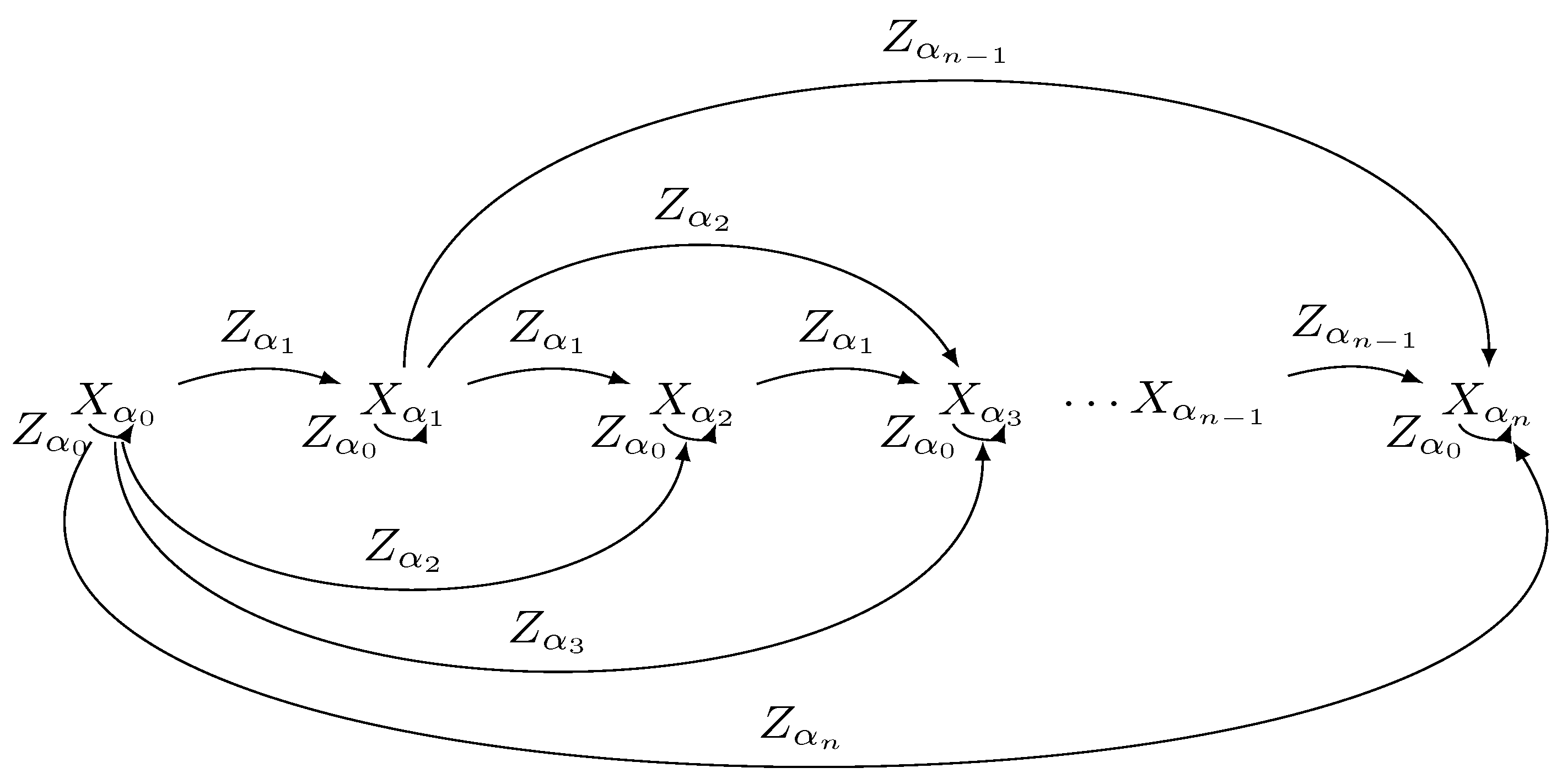
Then, it is straightforward to notice that the symplectic structure generates a set of Hamiltonian systems on the same manifold The Lie bracket between the vector fields and obeys the relations
with
These relations are diagrammatically well represented in Figure 1. In terms of differential geometry, and are called master symmetries for and master integrals, respectively. For more details on these symmetries, see [36,37,38,39,40].
Figure 1.
Diagrammatical illustration of Equation (98).
Thus, we can generate a family of Hamiltonian functions:
The recursion operator can be written as:
where
and are two compatible Poisson bivectors with the vanishing Schouten–Nijenhuis bracket
Furthermore, we put with and introduce the following -Poisson bracket
with respect to the symplectic form
and get
proving that are bi-Hamiltonian vector fields defined by the two Poisson bivectors and Then, the quadruple is a bi-Hamiltonian system for each k.
The associated recursion operators are given by
In addition, we have
permitting to conclude that the vector field
is a conformal symmetry for and [39].
Defining now the families of quantities and by , where and denoting the adjoint of we obtain
and for each , we derive the following plethora of conserved quantities:
satisfying the following relations linking the master symmetries to the conformal symmetry for and , and to a set of conformal symmetries generated by successive applications of the recursion operator on :
This is reminiscent to the well-known Oevel formulas (see [26,31,32,39,41,42]).
Finally, it is worth mentioning a generalization of the conformable Poisson brackets (103), as follows:
where leading to a set of generalized bi-Hamiltonian vector fields
the main ingredients governing the Hamiltonian dynamics and pertaining symmetries.
6. Concluding Remarks
In this work, we have proved that a Minkowski phase space endowed with a bracket relatively to a conformable differential realizes a conformable Poisson algebra, conferring a bi-Hamiltonian structure to the resulting manifold. We have deduced that the related conformable Hamiltonian vector field for a free particle is an infinitesimal Noether symmetry. We have computed the corresponding conformable recursion operator. Using the Hamiltonian–Jacobi separability, we have constructed recursion operators in the framework of conformable Schwarzschild and Friedmann–Lemaître–Robertson–Walker (FLRW) metrics, and obtained related constants of motion. We have highlighted the existence of a hierarchy of bi-Hamiltonian structures in both the metrics, and derived a family of conformable recursion operators and master symmetries generating the constants of motion. This study has also shown that Hamiltonian dynamics hint at a connection between the geometry of our physical system, (conformable symplectic manifolds and related Hamiltonian vector fields), and conservation laws. In this connection, the free particle positions on the conformable manifolds are viewed as states and vector fields as laws governing how those states evolve.
Further, we have calculated the conformable Christoffel symbols, Ricci scalar, components of the Riemann, Ricci, and Einstein tensors. This study has revealed that the Christoffel symbols ( ) in conformable Minkowski metric are no longer null, contrary to the ordinary case corresponding to . Similarly, the Christoffel symbols () are not equal zero in conformable Schwarzschild and FLRW metrics. The existence of these symbols informs us about the way in which the parallel displacement of any basic vector on the conformable manifolds with respect to itself always remains parallel to the same basic vector.
Author Contributions
Conceptualization, M.N.H., M.J.L. and M.M. All authors contributed equally to the present work in all steps of its conceptualization, computation, draft writing and finalization. All authors have read and agreed to the published version of the manuscript.
Funding
This research received no external funding.
Institutional Review Board Statement
Not applicable.
Informed Consent Statement
Not applicable.
Data Availability Statement
Not applicable.
Acknowledgments
The ICMPA-UNESCO Chair is in partnership with the Association pour la Promotion Scientifique de l’Afrique (APSA), France, and Daniel Iagolnitzer Foundation (DIF), France, supporting the development of mathematical physics in Africa. M. M. is supported by the Faculty of Mechanical Engineering, University of Niš, Serbia, Grant “Research and development of new generation machine systems in the function of the technological development of Serbia”.
Conflicts of Interest
The authors declare that they have no conflict of interest.
Appendix A
Table A1.
Christoffel symbols in conformable Schwarzschild metric.
Table A1.
Christoffel symbols in conformable Schwarzschild metric.
Table A2.
Components of the Riemann tensor in conformable Schwarzschild metric.
Table A2.
Components of the Riemann tensor in conformable Schwarzschild metric.
Table A3.
Components of the Ricci tensor in conformable Schwarzschild metric.
Table A3.
Components of the Ricci tensor in conformable Schwarzschild metric.
Table A4.
Ricci scalar in conformable Schwarzschild metric.
Table A4.
Ricci scalar in conformable Schwarzschild metric.
Table A5.
Components of the Einstein tensor in conformable Schwarzschild metric.
Table A5.
Components of the Einstein tensor in conformable Schwarzschild metric.
Table A6.
Christoffel symbols in conformable FLRW metric.
Table A6.
Christoffel symbols in conformable FLRW metric.
Table A7.
Components of the Riemann tensor in conformable FLRW metric.
Table A7.
Components of the Riemann tensor in conformable FLRW metric.
Table A8.
Components of the Ricci tensor in conformable FLRW metric.
Table A8.
Components of the Ricci tensor in conformable FLRW metric.
Table A9.
Ricci scalar in conformable FLRW metric.
Table A9.
Ricci scalar in conformable FLRW metric.
Table A10.
Components of the Einstein tensor in conformable FLRW metric.
Table A10.
Components of the Einstein tensor in conformable FLRW metric.
References
- Valéro, D.; Machado, J.; Kiryakova, V. Some pioneers of the applications of fractional calculus. Fract. Calc. Appl. Anal. 2014, 17, 552–578. [Google Scholar] [CrossRef]
- Agrawal, O. Formulation of Euler-Lagrange equations for fractional variational problems. J. Math. Anal. Appl. 2002, 272, 368–379. [Google Scholar] [CrossRef]
- Almeida, R.; Torres, D. Calculus of variations with fractional derivatives and fractional integrals. Appl. Math. Lett. 2009, 22, 1816–1820. [Google Scholar] [CrossRef]
- Baleanu, D. Fractional variational principles in action. Phys. Scr. 2009, T136, 014006. [Google Scholar] [CrossRef]
- Chung, W.S. Fractional Newton mechanics with conformable fractional derivative. J. Comput. Appl. Math. 2015, 290, 150–158. [Google Scholar] [CrossRef]
- Efe, M. Battery power loss compensated fractional order sliding mode control of a quadrotor UAV. Asian J. Control 2012, 14, 413–425. [Google Scholar] [CrossRef]
- Herrmann, R. Gauge invariance in fractional field theories. Phys. Lett. A 2008, 372, 5515. [Google Scholar] [CrossRef][Green Version]
- Iomin, A. Fractional-time quantum dynamics. Phys. Rev. E 2009, 80, 022103. [Google Scholar] [CrossRef]
- Metzler, R.; Klafter, J. The restaurant at the end of the random walk: Recent developments in the description of anomalous transport by fractional dynamics. J. Phys. A 2004, 37, R161. [Google Scholar] [CrossRef]
- Jahanshahi, S.; Babolian, E.; Torres, D.F.M.; Vahidi, A. Solving Abel integral equations of first kind via fractional calculus. J. King Saud Univ. Sci. 2015, 27, 161–167. [Google Scholar] [CrossRef]
- Machado, J.T.; Kiryakova, V.; Mainardi, F. Recent history of fractional calculus. Commun. Nonlinear Sci. Numer. Simul. 2011, 16, 1140–1153. [Google Scholar] [CrossRef]
- Tarasov, V.E. Lattice fractional calculus. Appl. Math. Comput. 2015, 257, 12–33. [Google Scholar] [CrossRef]
- Khalil, R.; Al Horani, M.; Yousef, A.; Sababheh, M. A new definition of fractional derivative. J. Comput. Appl. Math. 2014, 264, 65–70. [Google Scholar] [CrossRef]
- Chung, W.S.; Hassanabadi, H. Dynamics of a Particle in a Viscoelastic Medium with Conformable Derivative. Int. J. Theor. Phys. 2017, 56, 851. [Google Scholar] [CrossRef]
- Chung, W.S.; Hassanabadi, H. Deformed classical mechanics with α-deformed translation symmetry and anomalous diffusion. Mod. Phys. Lett. 2019, B33, 1950368. [Google Scholar] [CrossRef]
- Kiskinov, H.; Petkova, M.; Zahariev, A. About the Cauchy Problem for Nonlinear System with Conformable Derivatives and Variable Delays. AIP Conf. Proc. 2019, 2172, 050006. [Google Scholar]
- Khalil, R.; Al Horani, M.; Yousef, A.; Hammad, M.A. Geometric meaning of conformable derivative via fractional cords. J. Math. Comput. Sci. 2019, 19, 241–245. [Google Scholar] [CrossRef]
- Chung, W.S.; Hounkonnou, M.N. Deformed special relativity based on α-deformed binary operations. arXiv 2020, arXiv:2005.11155. [Google Scholar]
- Liouville, R. Sur le mouvement d’un corps solide pesant suspendu par l’un de ses points. Acta Math. 1897, 20, 239–284. [Google Scholar] [CrossRef]
- Poincaré, H. Sur les quadratures mécaniques. Acta Math. 1899, 13, 1. [Google Scholar] [CrossRef]
- De Filippo, S.; Marmo, G.; Salerno, M.; Vilasi, G. A New Characterization of Completely Integrable Systems. Nuovo Cimento B 1984, 83, 97–112. [Google Scholar] [CrossRef]
- Gelfand, I.M.; Dorfman, I.Y. The Schouten Bracket and Hamiltonian Operators. Funct. Anal. Appl. 1980, 14, 71–74. [Google Scholar] [CrossRef]
- Magri, F. A simple model of the integrable Hamiltonian equation. J. Math. Phys. 1978, 19, 1156–1162. [Google Scholar] [CrossRef]
- Vilasi, G. On the Hamiltonian Structures of the Korteweg-de Vries and Sine- Gordon Theories. Phys. Lett. B 1980, 94, 195–198. [Google Scholar] [CrossRef]
- Lax, P.D. Integrals of nonlinear equations of evolution and solitary ways. Commun. Pure Appl. Math. 1968, 21, 467–490. [Google Scholar] [CrossRef]
- Hounkonnou, M.N.; Landalidji, M.J.; Mitrović, M. Noncommutative Kepler Dynamics: Symmetry groups and bi-Hamiltonian structures. Theor. Math. Phys. 2021, 207, 751–769. [Google Scholar] [CrossRef]
- Hounkonnou, M.N.; Landalidji, M.J. Hamiltonian dynamics for the Kepler problem in a deformed phase space. In Trends in Mathematics, Proceedings of the XXXVII Workshop on Geometric Methods in Physics, Bialowieża, Poland, 1–7 July 2018; Springer Nature Switzerland AG: Cham, Switzerland, 2019; pp. 34–48. [Google Scholar]
- Takeuchi, T. A Construction of a Recursion Operator for Some Solutions of Einstein Field Equations. Proc. Fifteenth Int. Conf. Geom. Integr. Quantization 2014, 15, 249–258. [Google Scholar]
- Hounkonnou, M.N.; Landalidji, M.J.; Baloïtcha, E. Recursion Operator in a Noncommutative Minkowski Phase Space. In Trends in Mathematics, Proceedings of the XXXVI Workshop on Geometric Methods in Physics, Bialowieża, Poland, 2–8 July 2017; Springer Nature Switzerland AG: Cham, Switzerland, 2019; pp. 83–93. [Google Scholar]
- Rudolph, G.; Schmidt, M. Differential Geometry and Mathematical Physics, Part I. Manifolds, Lie Group and Hamiltonian Systems; Springer: New York, NY, USA, 2013. [Google Scholar]
- Smirnov, R.G. Magri-Morosi-Gel’fand-Dorfman’s bi-Hamiltonian constructions in the action-angle variables. J. Math. Phys. 1997, 38, 6444. [Google Scholar] [CrossRef]
- Smirnov, R.G. The action-angle coordinates revisited: Bi-Hamiltonian systems. Rep. Math. Phys. 1999, 44, 199–204. [Google Scholar] [CrossRef]
- Dubrovin, B. Bihamiltonian Structures of PDEs and Frobenius Manifolds, Lectures at the ICTP Summer School “Poisson Geometry”, Trieste, 2005. Available online: https://indico.ictp.it/event/a04198/session/47/contribution/26/material/0/0.pdf (accessed on 21 April 2017).
- Román-Roy, N. A summary on symmetries and conserved quantities of autonomous Hamiltonian systems. J. Geom. Mech. 2020, 12, 3. [Google Scholar] [CrossRef]
- Bretón, N. An introduction to general relativity, black holesand gravitational waves, VIII Workshop of the Gravitation and Mathematical Physics Division of the Mexican Physical Society. AIP Conf. Proc. 2011, 1396, 5–25. [Google Scholar]
- Rañada, M.F. A system of n=3 coupled oscillators with magnetic terms: Symmetries and integrals of motion. SIGMA 2005, 1, 004. [Google Scholar] [CrossRef]
- Caseiro, R. Master integrals, superintegrability and quadratic algebras. Bull. Sci. Math. 2002, 126, 617–630. [Google Scholar] [CrossRef]
- Damianou, P.A. Symmetries of Toda equations. J. Phys. A 1993, 26, 3791–3796. [Google Scholar] [CrossRef]
- Fernandes, R.L. On the master symmetries and bi-Hamiltonian structure of the Toda lattice. J. Phys. A Math. Gen. 1993, 26, 3797–3803. [Google Scholar] [CrossRef]
- Rañada, M.F. Superintegrability of the Calogero-Moser system: Constants of motion, master symmetries, and time-dependent symmetries. J. Math. Phys. 1999, 40, 236–247. [Google Scholar] [CrossRef]
- Hounkonnou, M.N.; Landalidji, M.J.; Mitrović, M. Hamiltonian Dynamics of a spaceship in Alcubierre and Gödel metrics: Recursion operators and underlying master symmetries. Theor. Math. Phys. 2022; in press. [Google Scholar]
- Oevel, W. A Geometrical Approach to Integrable Systems Admitting Time Dependent Invatiants. In Proceedings of the Conference on Nonlinear Evolution Equations, Solitons and the Inverse Scattering Transform, Oberwolfach, Germany, 27 July–2 August 1986; Ablowitz, M., Fuchssteiner, B., Kruskal, M., Eds.; World Scientific: Singapore, 1987. [Google Scholar]
Publisher’s Note: MDPI stays neutral with regard to jurisdictional claims in published maps and institutional affiliations. |
© 2022 by the authors. Licensee MDPI, Basel, Switzerland. This article is an open access article distributed under the terms and conditions of the Creative Commons Attribution (CC BY) license (https://creativecommons.org/licenses/by/4.0/).


