


Abstract
We study the low energy effective dynamics of four-dimensional superconformal theories on their generalized Coulomb branch. The low energy effective gauge couplings are naturally encoded in algebraic curves , which we derive for general values of the couplings and mass deformations. We then recast these IR curves to the UV or M-theory form : the punctured Riemann surfaces on which the M5 branes are compactified giving the four-dimensional theories. We find that the UV curves and their corresponding meromorphic differentials take the same form as those for their mother four-dimensional theories of class . They have the same poles, and their residues are functions of all the exactly marginal couplings and the bare mass parameters which we can compute exactly.
1. Introduction
Famously, the low energy dynamics of four-dimensional (4D) supersymmetric gauge theories can be determined using the constraints of holomorphy, global symmetries and consistency in various limits. The low energy effective action on the Coulomb branch is fully encoded in the Seiberg-Witten curve [1,2]. Shortly after the seminal work by Seiberg and Witten, Intriligator and Seiberg pointed out that similar techniques can be employed to study the infrared (IR) dynamics of gauge theories as long as they possess an abelian Coulomb branch [3]. In [4,5,6,7,8,9,10] a modern approach to the curves was taken. For theories engineered by wrapping M5 branes on a Riemann surface which is embedded in a local Calabi-Yau threefold [11], their IR curves are given by the spectral curves of the generalized Hitchin systems which involve a pair of commuting Hitchin fields.
SCFTs of class [12] can be obtained via orbifolding SCFTs of Class [13,14]. They can also be engineered using M-theory on with M5 branes lying along with the Riemann surface . It is an active field of research to examine theories of class and the broader theories of class where the singularity is generalized to any ADE orbifold singularity [15,16,17,18,19,20,21,22,23,24,25,26,27,28,29,30].
A supersymmetric theory often possesses several inequivalent supersymmetry-preserving ground states which give rise to the so called moduli space of supersymmetric vacua of the theory. In many cases the moduli space is a manifold (possibly with singularities) parametrized by the vacuum expectation values (vevs) of a set of gauge-invariant operators. Depending on the behavior of the potential for test charges, the moduli space can generically be classified into different ‘branches’, leading to different ‘phases’ of the theory. These phases may be Coulomb, Higgs, confining or, more generally, a mixture between them.
theories, due to their large R-symmetry, possess distinct Coulomb and Higgs branches (as well as mixed branches). For generic theories it is not possible to separate distinct branches of supersymmetric vacua, thus the study of their moduli space is in general complicated. Nonetheless, it has been recently understood [15,16,17,19,20] that there is a special but very broad and interesing class of superconformal theories (SCFTs), the so called theories of class [12], for which it is possible to distinguish between generalized Coulomb and Higgs branches precisely as for gauge theories. This is due to the fact that in addition to the R-symmetry they enjoy, by construction, extra global symmetries. Consequently, a generalized Coulomb branch can be isolated and has been successfully studied [15,16,17,19,20].
For theories of class , the curves on the generalized Coulomb branch simplify and instead of a generalized Hitchin system, they are associated to a usual Hitchin system with only one Hitchin field [15]. This is because as for theories we can isolate the piece of the geometry to be . What is more, in [15] the class curves were derived at special points of the conformal manifold, the so called orbifold points, where the coupling constants arising from the same gauge group of the mother theory in class are taken to be equal. One of our goals in this paper is to obtain these curves at a generic point of the conformal manifold using the techniques developed in [3].
The construction of [3] produces the curves in a form which can be thought of as the IR form, capturing low energy data on the generalized Coulomb branch. Their derivation is presented in Section 3. In this paper we will denote the IR curves by . Following the seminal work of Gaiotto [13] we can bring an IR curve to the Gaiotto form, which is the UV or M-theory curve . The UV curve describes the Riemann surface on which N M5 branes wrap in the M-theory realization of theories of class , and is a ramified cover of the IR curve [12,15]. Doing so, in Section 4, we find that these curves and the associated meromorphic differentials have a very similar pole structure as their mother theories of class . The novel (genuinely ) information is contained in the residues of the meromorphic differentials. They capture the mass deformations, and turn out to be functions of all the exactly marginal couplings and the bare mass parameters. This can be interpreted as a finite renormalization of the bare masses that appear in the Lagrangian. Amazingly, we are able to compute these renormalized masses exactly.
2. Intriligator-Seiberg Curves
In this section we wish to briefly review the techiques of Intriligator and Seiberg [3] together with a few examples of curves which we will use in Section 3.
2.1. General Principles
At a generic point of the generalized Coulomb branch of the moduli space, the low energy effective theory is described in terms of r abelian vector multiplets with the associated field strength superfields (where r is the rank of the gauge group), and possibly neutral moduli fields . In terms of superspace, the gauge kinetic term in the low energy effective action takes the form
where with is the matrix of the effective holomoprhic gauge couplings. Supersymmetry requires that must be holomorphic in all the holomorphic coupling constants of the underlying microscopic theory and in the neutral chiral superfields . Since the massless photons are subject to the electric-magnetic duality, any transformation of leaves physics invariant. On the other hand, is not single-valued, and can have nontrivial monodromies as one changes and along a closed path. Hence, should be viewed as a section of an bundle over the parameter space of and .
Following [1,2,3], it is convenient to identify with a normalized period matrix of an algebraic curve of genus r. This curve is called the IR curve and in this paper we will denote it by . It is given by an equation in two complex variables ,
where is a polynomial in x of degree or , with the coefficients depending on , , and masses . The matrix of the effective gauge couplings is then computed from
where we have picked a symplectic homology basis for , and the canonical basis of holomorphic differentials .
The curve should be compatible with all the global symmetries of the theory, and becomes singular at the submanifolds of the moduli space where extra charged particles become massless. One can determine the electric and magnetic charges of these charged massless particles from the monodromies associated with the singularities. Only if all charged massless particles are mutually local can the low energy effective theory be a free field theory in an appropriate electric-magnetic duality frame. Otherwise, the low energy effective theory will be an interacting superconformal field theory.
The curve varies at different points of . Therefore, it is useful to consider a family of holomorphic curves , which is the total space of holomorphic curves fibered over the moduli space ,
There are major differences between the low energy solutions for genuine theories and those for theories. First of all, one does not have a complete solution to the low-energy dynamics for a genuine theory, since the Kähler potential is not holomorphic and is therefore not protected from quantum corrections. Second, the curve may be not accompanied by a meromorphic differential which encodes central charges and masses of BPS states. To obtain the meromorphic differential, the string theory or M-theory description is usually needed [5,6,7,8,9,10,31]. If the theory is engineered using M-theory on the geometry , we can further use the holomorphic three form
where the map between the M-theory coordinates (with ) and the IR coordinates will be specified in Section 4. The is locally comprised of two line bundles fibered over the UV curve . For theories of class , the first Chern class , allowing us to select an meromorphic two form ,
As described in [15], we can eventually obtain after a parameter map which will be presented in Section 4.
What is more, the moduli fields in theories often satisfy intricate relations, which are absent in theories. Therefore, one has to take one more step in determining the curve, namely solving the relations among the moduli fields. Going to the generalized Coulomb branch, as we will do in this paper, one can avoid this complication.
2.2. Examples
2.2.1. Pure Gauge Theory
The first example is the supersymmetric Yang-Mills theory, which is the supersymmetric gauge theory with a massless adjoint chiral multiplet. The curve that encodes the low-energy dynamics of the theory with gauge group is given by [1,2]
where is a gauge-invariant order parameter of the Coulomb moduli space, with the adjoint scalar field, and is the dynamically generated scale.
2.2.2. Gauge Theory
Perhaps the most relevant example for us that has been studied in [3] is the gauge theory with gauge group and two chiral superfields in the representation of G, labelled by respectively. Notice that the representation of is pseudo-real and therefore isomorphic to the . The theory has an flavour symmetry where . The theory can be understood as a orbifold of the above pure gauge theory. Equivalently, the theory can be obtained by compactifying the 6d theory on a punctured Riemann surface of genus zero in the presence of a certain set of defect operators associated to so called ‘wild’ punctures. As in [13], the curve is a double covering of .
The theory has a three complex dimensional moduli space of supersymmetric vacua parametrized by the gauge invariant quantities
where the determinant is taken over G.
The classical scalar potential vanishes along the D-flat directions,
where U is a unitary matrix, and v is a complex number. Such field configurations do not break supersymmetry, but break the gauge group G by the Higgs mechanism down to a subgroup , where is a diagonal embedding of . Therefore, the theory is in the abelian Coulomb phase with an one complex-dimensional moduli space. Due to the constraint of symmetries, no superpotential can be dynamically generated, and the classical vacuum degeneracy is not lifted quantum mechanically. Thus, the quantum theory also has an one complex-dimensional abelian Coulomb moduli space of vacua, parametrized by a single gauge and flavour singlet .
The holomorphic effective gauge coupling is , where are the dynamically generated scales. We may deduce the form of the curve describing the moduli space by considering two different limits. Firstly consider the limit where acquires a large diagonal vev but the vev of is vanishing. The gauge group is broken to , and decomposes into of . There is also a heavy singlet field . If we decouple all the singlet fields, the theory is approximately pure gauge theory, and the curve of that theory is
where
After rescaling x and y, (10) becomes
Then, using the analyticity, dimensional analysis, and the symmetry exchanging and , we can determine the general form of the curve,
up to a numerical constant . We see that the curve becomes singular when either or .
To fix the remaining parameter , we can take a decoupling limit, . The theory in this limit is approximately an gauge theory coupled to the adjoint field and three singlets , , . These fields satisfy the following quantum constraint [32]
where E is a dimensionful normalization, and
Decoupling the singlets, the theory is approximately pure gauge theory with holomorphic scale . The low-energy dynamics is encoded in the curve
which becomes singular at , or equivalently at . On the other hand, (13) is singular at . Thus, we find that , and therefore the curve of this theory is given by
Interestingly, the solution of this gauge theory is isomorphic to that of the gauge theory, with the isomorphism given by the map .
3. IR Curves of Class Theories
In this section we derive the curves for the ‘core theories’ of class , namely those associated to spheres with two maximal and minimal punctures. See Figure 1 for the example and notation.
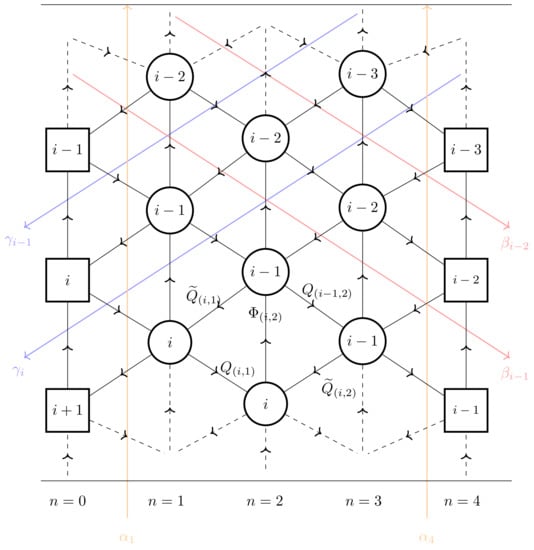
Figure 1.
Quiver for a theory of class . The gauge nodes are labelled by , where is the index for the orbifold, and is the label from the mother theory. In this example we set .
Before plunging into the details, a short review of a few facts and notations about class is in order. Theories of class arise as twisted compactifications of the 6d SCFT which is the worldvolume theory on N coincident M5-branes probing the transverse singularity. As discussed in detail in [20] these compactifications enjoy an R-symmetry, which is given by the linear combination
where are the Cartan generators of the R-symmetry algebra. Another independent linear combination
generates the symmetry inside the ‘intrinsic’ global symmetry carried by all theories of class [12]. We summarize the field content and the transformation properties in Table 1.

Table 1.
Field content and transformation properties of a class theory.
For further details the reader is encouraged to look at [20], the notation in which we closely follow.
3.1. Classical Analysis
The theory admits a rather intricate phase structure. However, different phases do not mix because they may be differentiated using the symmetry, as we have shown in [20]. Thus, we may restrict our attention to the gemeralized Coulomb branch defined by giving nonzero vevs to ’s while have vanishing vevs. Generically the gauge group is spontaneously broken from down to .
In terms of , the Coulomb branch may be parametrized by vevs of the following gauge-invariant operators of dimension ,
for each , as well as the ‘baryonic’ gauge-invariant operators of dimension N,
for each and . We also introduce
Classically these operators obey the relations
which are modified quantum mechanically as [32]
Here is the dynamically generated holomorphic scale associated to the th gauge group. Its expression in terms of the coupling constants and the mass parameters will be discussed in detail later.
Note that there is an over-parametrization since the and are not all independent but rather related by applying the Cayley-Hamilton theorem to the matrix :
where and for
with the lth complete exponential Bell polynomial. Here we have defined , which are related to by
Taking the trace of (25) implies, for generic , a single relation between (20) and (21)
In particular, this implies that can be completely written in terms of the and the . Hence, the coordinate ring of the Coulomb branch for is expected to be a freely generated ring of dimension ,
3.2. Mass Parameters
We may regard the masses corresponding to the flavour symmetries for and as expectation values for background superfields , . Hence we may construct flavour symmetry invariant combinations of masses in the same fashion. We define
for . Moreover, may be diagonalized by transformations such that they take the form
Additionally, when , the flavour symmetry enhances to and in that case we find it convenient to combine the mass parameters as
and to write the invariants as
where now .
3.3. Curves for
For the sake of starting smoothly, we will first compute the curve for the simplest example, namely the quiver with and . We will drop the index n for compactness, e.g., here .
3.3.1. Diagonal Limit
Initially let us consider the limit where, say, gets a large diagonal vev . By examining the Lagrangian one sees that the gauge group is broken down to a diagonal subgroup just as in [3], under which both bifundamentals decompose into an adjoint and a singlet, among which the adjoint associated to becomes the longitudinal modes of the massive gauge bosons, while the (anti)fundamentals of the ’s decompose into (anti)fundamentals of the . The uneaten adjoint gives . Below the scale the quarks , , , can be integrated out, and the superpotential (without the singlets) is then “diagonal”1. In general there will also be a singlet associated to which there can be a mass deformation to the diagonal superpotential ,
Then below the singlet can be integrated out and can be neglected when we deal with the low energy dynamics of gauge field [3,4,33]. Hence the low energy effective theory is QCD with flavors [34] whose solution is encoded in the curve [1,35]
Here the curve is written in the quartic form. We can express , , and the exponentiated coupling for the in terms of the parameters in the theory as
After rescaling , and substituting in the above relations we have
where and is defined as in (34),
Now consider integrating out all of the flavours from this curve, leaving us with pure gauge theory. As indicated in [35], we should hold fixed the relation
On the other hand, we know from [3] that2
should be held fixed. Equating them implies that
should be held fixed in the limit, with defined in (34). Because of the symmetry between two gauge groups, we must have the matching condition
Positivity of demands that we take the plus sign.
Now we can write down the most general ansatz for the curve, which is both polynomial in masses and Coulomb moduli, and is compactible with all of the symmetries and the diagonal limit,
where , , and are all symmetric functions in . Note however that we may immediately restrict the dependence of on by demanding agreement with the curves [3,36] upon integrating out some of the flavours. To have a well defined limit, must be power series in with vanishing constant term.
3.3.2. Limit
Analogous to the treatment in [3], we now consider a decoupling limit, . The low energy effective theory in this limit is described by an gauge theory with an adjoint field and three singlets and . Here E is a chosen energy scale. There are also singlets involving fundamental ’s which do not appear in the curve for reasons discussed earlier. If we are only interested in the effective gauge coupling in the Coulomb phase, we can neglect these singlets and the theory in this limit is approximately an gauge theory with the exponentiated coupling and mass matrix . The fields are constained, implementing the matching relation, by the quantum relation [32]
with .
To fix and , we need only consider the mass configurations , . Then the theory has an order 4 singularity, associated to the quarks becoming massless, when . For these mass configurations the discriminant of (46) has a point of vanishing order 4 at
which implies that
The remaining functions can be fixed by considering the limit
while holding and the matching condition (45) fixed. Then we can integrate out all the massive modes and arrive at the quiver theory with 2 chiral multiplets and 2 anti-chiral multiplets in , and a chiral multiplet and an anti-chiral multiplet in . The resulting curve is well defined only when .3
Hence, the curve is
or by substituting the relations
we have
3.3.3. Checks
It can be immediately verified that our curve (51) reproduces those of [3,36]. It is illustrative to consider the limit and check consistency for a few choices of mass deformations:
,
In this configuration the adjoint field of is singular at the order 4 quark singularity whilst the corresponding vanishing order 4 point of (51) is at
which agrees nicely with (47).
,
The curve has an order 3 quark singularity at . On the other hand (51) has a vanishing order 3 point at
which is in agreement with (47).
,
3.4. Curve for General N
The generalization from to general N is rather straightforward. We again consider the diagonal limit and the limit .
3.4.1. Diagonal Limit
The same diagonal limit is reached by giving diagonal vev. In this limit the theory is again approximately gauge theory with flavours and the adjoint field is . The curve of that theory is given by [35]
where , , and is associated to the coupling for . After rescaling , , and substituting in the above relations we have
Now consider integrating out all of the flavours from this curve to obtain pure gauge theory, holding fixed the relation [35]
Meanwhile, we should also hold fixed [33]
Equating them implies that
should be held fixed under the limit, with defined in (34). Due to the symmetry between two gauge groups, we must have that
and we should pick the plus sign if we want to have .
The most general ansatz for the curve takes the form
where is a function with mass dimension (or equivalently R-charge) and satisfies . In other words is always subdominant compared to in the large limit. Following the same argument as before, we know that the dependence of on the holomorphic couplings can only be of the combination .
3.4.2. Limit
To determine the remaining parameters in (64), we again consider the limit . In that limit, the theory is approximately gauge theory with fundamental hypermultiplets and the exponentiated coupling . There is an adjoint field . There is also a quantum modified constraint on moduli space [32]
This is implemented on the curves by
3.5. Curve for General N & k
The generalization to arbitrary k is largely the same. It is the extension of [33] to include flavours. The only new phenomena is the implementation of the quantum relation (65) for the quiver. We will simply state the result. The curve may be written as
where the are defined by (25), , . Finally the brackets mean to replace the pairs appearing in with the corresponding mass condition in all possible ways. For example at the brackets should be read as
where we used .
4. UV Curves of Class Theories
In this section we will derive the UV curves by rewriting our IR curves following the procedure introduced by Gaiotto [13]. Then we will compare our results with the results obtained in [15] which are valid only at the orbifold point of the conformal manifold.
4.1. Review of UV Curves of Class Theories
Let us begin by reviewing the manipulation needed for class theories. The Seiberg-Witten curve of gauge theory with flavors reads [35]
with given in terms of the masses as
The dimensions of , which are minus the charges, are . After making a change of variables
we obtain
which is the natural expression obtained by lifting the Type IIA string theory construction using the D4/NS5 brane system to M-theory [37]. If we write , this curve is brought to the canonical form introduced by Gaiotto [13],
where are degree l differentials on the Riemann surface , t is a local coordinate on and on . In the massless case, , the curve is
In the massive case, we have
where and is given by the expansion
Accordingly, the differentials are
Notice that at and , has poles of order l. These are interpreted as maximal punctures. On the other hand, has simple poles at , and these are the locations of the minimal punctures. This is in complete agreement with the findings of [15].
4.2. Class
Let us extend the above manipulations to the theories of class . We first consider the case when . Recall that the curve (68) is given by
The dimensions of are . If we perform the change of variables
with
the curve becomes
Following the analysis of class theories, we can bring the curve to the canonical form by writing ,
where
and is given by (78). We see that have dimensions . We can interpret as local canonical coordinates in the cotangent bundle of a punctured Riemann surface .
It is then straightforward to generalize our discussion to arbitrary k. The IR curve is given by (69), with the dimensions of being . We can again obtain the canonical form of the curve from (69) by first changing of variables from to and then write . The resulting curve takes the form
where
Here are again local canonical coordinates in the cotangent bundle of a punctured Riemann surface , and
Notice that, as discussed in [15], has order l poles at and simple poles at . These signify the locations of the maximal and minimal punctures, respectively. The curve simplifies in the absence of mass deformations, and becomes
5. Conclusions
In this paper we apply the techniques of Intriligator and Seiberg [3] to derive the IR curves encoding the low energy dynamics of theories of class on their generalized Coulomb branch. We then bring these curves to the Gaiotto form, obtaining the UV curve . We interpret as a punctured Riemann surface embedded in , and the class theory arises from the compactification of the 6D SCFT on . The final forms (86) and (87) can be directly compared to the expressions derived in [15], which is from M-theory and is valid only at the orbifold point of the conformal manifold. We also analyze the meromorphic differentials.
In the case of the a four-punctured sphere, the positions of the poles of the meromorphic differentials are identical () to the ones in [15], but now with , being interpreted as the “average coupling”. As we move away from the orbifold point, the novelty is that the mass parameters change as functions of the marginal couplings , in a way we can compute.
In this paper we concentrated on four-punctured spheres with two maximal and two simple punctures. The curves of other theories with a Lagrangian description of class should be easy to obtain as well as non-Lagrangian theories which are obtained as strong coupling limit (pants decompositions) of Lagrangian ones. What is more, it would be very interesting to study what are the possible punctures (classification) in class .
The curves, while not encoding enough information to ‘solve’ the low energy effective theory due to the Kähler part of the action being unconstrained by holomorphicity, still encode a large amount of information regarding the theory. In particular, they may prove invaluable for deriving new theories and dualities, as was performed for class in [13]. We even believe that through their M-theory interpretation they may even allow us to compute the low energy BPS spectrum.
It is well known that the techniques of instanton counting provide a purely field theoretical derivation of Seiberg-Witten curves of 4D supersymmetric gauge theories [38,39,40,41]. In a separate paper, we will extend this approach to theories realized by brane box models [42,43]. These theories can be formulated in the version of the -background, and the partition function on the generalized Coulomb branch can be exactly computed. We can then determine the curves from the partition function in the flat space limit. This is work that will appear.
Finally, very interestingly, our work can be used to study fractons [44], emergent topological quasiparticles, through the recent relation discovered in [45]. See also [46,47,48,49,50]. As discovered in [45] the fracton excitations live on which we are now able to compute.
Author Contributions
Conceptualization, E.P.; methodology, E.P.; formal analysis, E.P.; T.B. and X.Z.; investigation, E.P.; data curation, E.P.; writing—original draft preparation, E.P.; writing—review and editing, E.P. and X.Z.; supervision, E.P.; project administration, E.P.; funding acquisition, E.P. All authors have read and agreed to the published version of the manuscript.
Funding
This research was funded in part by the GIF Research Grant I-1515-303./2019.
Institutional Review Board Statement
Not applicable.
Informed Consent Statement
Not applicable.
Acknowledgments
We wish to thank Ioana Coman, Shlomo Razamat and Futoshi Yagi for valuable correspondence.
Conflicts of Interest
The authors declare no conflict of interest.
Notes
| 1 | The “diagonal” quark masses can be calculated by solving the F-term’s for , , , . |
| 2 | Note that to save on various factors of we define instead of , accounting for factor 4 instead of 16. |
| 3 | For example the term explodes unless . |
| 4 | Notice that the definition of in this paper differs from that in [15] by and . |
References
- Seiberg, N.; Witten, E. Electric-magnetic duality, monopole condensation, and confinement in N = 2 supersymmetric Yang-Mills theory. Nucl. Phys. 1994, 426, 19–52. [Google Scholar] [CrossRef]
- Seiberg, N.; Witten, E. Monopoles, duality and chiral symmetry breaking in N = 2 supersymmetric QCD. Nucl. Phys. 1994, 431, 484–550. [Google Scholar] [CrossRef]
- Intriligator, K.A.; Seiberg, N. Phases of N = 1 supersymmetric gauge theories in four-dimensions. Nucl. Phys. 1994, 431, 551–568. [Google Scholar] [CrossRef]
- Tachikawa, Y.; Yonekura, K. N = 1 curves for trifundamentals. J. High Energy Phys. 2011, 2011, 25. [Google Scholar] [CrossRef]
- Maruyoshi, K.; Tachikawa, Y.; Yan, W.; Yonekura, K. = 1 dynamics with TN theory. J. High Energy Phys. 2013, 2013, 10. [Google Scholar] [CrossRef][Green Version]
- Xie, D.; Yonekura, K. Generalized Hitchin system, Spectral curve and = 1 dynamics. J. High Energy Phys. 2014, 2014, 1. [Google Scholar] [CrossRef][Green Version]
- Bonelli, G.; Giacomelli, S.; Maruyoshi, K.; Tanzini, A. N = 1 Geometries via M-theory. J. High Energy Phys. 2013, 2013, 227. [Google Scholar] [CrossRef]
- Giacomelli, S. Four dimensional superconformal theories from M5 branes. J. High Energy Phys. 2015, 2015, 44. [Google Scholar] [CrossRef][Green Version]
- Xie, D. N = 1 Curve. arXiv 2014, arXiv:1409.8306. [Google Scholar]
- Tachikawa, Y. Lectures on 4d N = 1 dynamics and related topics. arXiv 2018, arXiv:1812.08946. [Google Scholar]
- Bah, I.; Beem, C.; Bobev, N.; Wecht, B. Four-Dimensional SCFTs from M5-Branes. J. High Energy Phys. 2012, 2012, 5. [Google Scholar] [CrossRef]
- Gaiotto, D.; Razamat, S.S. = 1 theories of class k. J. High Energy Phys. 2015, 2015, 73. [Google Scholar] [CrossRef]
- Gaiotto, D. N = 2 dualities. J. High Energy Phys. 2012, 2012, 34. [Google Scholar] [CrossRef]
- Gaiotto, D.; Moore, G.W.; Neitzke, A. Wall-crossing, Hitchin Systems, and the WKB Approximation. Adv. Math. 2013, 234, 239–403. [Google Scholar] [CrossRef]
- Coman, I.; Pomoni, E.; Taki, M.; Yagi, F. Spectral curves of = 1 theories of class k. arXiv 2015, arXiv:1512.06079. [Google Scholar]
- Mitev, V.; Pomoni, E. 2D CFT blocks for the 4D class k theories. J. High Energy Phys. 2017, 2017, 9. [Google Scholar] [CrossRef]
- Bourton, T.; Pomoni, E. Instanton counting in class k. J. Phys. A 2020, 53, 165401. [Google Scholar] [CrossRef]
- Bah, I.; Hanany, A.; Maruyoshi, K.; Razamat, S.S.; Tachikawa, Y.; Zafrir, G. 4d = 1 from 6d = (1, 0) on a torus with fluxes. J. High Energy Phys. 2017, 2017, 22. [Google Scholar] [CrossRef]
- Razamat, S.S.; Sabag, E. A freely generated ring for = 1 models in class k. J. High Energy Phys. 2018, 2018, 150. [Google Scholar] [CrossRef]
- Bourton, T.; Pini, A.; Pomoni, E. The Coulomb and Higgs branches of = 1 theories of Class k. J. High Energy Phys. 2021, 2021, 137. [Google Scholar] [CrossRef]
- Razamat, S.S.; Vafa, C.; Zafrir, G. 4d = 1 from 6d (1, 0). J. High Energy Phys. 2017, 2017, 64. [Google Scholar] [CrossRef]
- Heckman, J.J.; Jefferson, P.; Rudelius, T.; Vafa, C. Punctures for theories of class Γ. J. High Energy Phys. 2017, 2017, 171. [Google Scholar] [CrossRef]
- Kim, H.-C.; Razamat, S.S.; Vafa, C.; Zafrir, G. E-String Theory on Riemann Surfaces. Fortsch. Phys. 2018, 66, 1700074. [Google Scholar] [CrossRef]
- Kim, H.-C.; Razamat, S.S.; Vafa, C.; Zafrir, G. Compactifications of ADE conformal matter on a torus. J. High Energy Phys. 2018, 2018, 110. [Google Scholar] [CrossRef]
- Kim, H.-C.; Razamat, S.S.; Vafa, C.; Zafrir, G. D-type Conformal Matter and SU/USp Quivers. J. High Energy Phys. 2018, 2018, 58. [Google Scholar] [CrossRef]
- Apruzzi, F.; Heckman, J.J.; Morrison, D.R.; Tizzano, L. 4D Gauge Theories with Conformal Matter. J. High Energy Phys. 2018, 2018, 88. [Google Scholar] [CrossRef]
- Razamat, S.S.; Sabag, E. Sequences of 6d SCFTs on generic Riemann surfaces. J. High Energy Phys. 2020, 2020, 86. [Google Scholar] [CrossRef]
- Razamat, S.S.; Sabag, E. SQCD and pairs of pants. J. High Energy Phys. 2020, 2020, 28. [Google Scholar] [CrossRef]
- Chen, J.; Haghighat, B.; Kim, H.-C.; Sperling, M.; Wang, X. E-string Quantum Curve. arXiv 2021, arXiv:2103.16996. [Google Scholar] [CrossRef]
- Nazzal, B.; Nedelin, A.; Razamat, S.S. Minimal (D, D) conformal matter and generalizations of the van Diejen model. arXiv 2021, arXiv:2106.08335. [Google Scholar]
- Witten, E. Branes and the dynamics of QCD. Nucl. Phys. B 1997, 507, 658–690. [Google Scholar] [CrossRef]
- Seiberg, N. Exact results on the space of vacua of four-dimensional SUSY gauge theories. Phys. Rev. 1994, 49, 6857–6863. [Google Scholar] [CrossRef] [PubMed]
- Csaki, C.; Erlich, J.; Freedman, D.Z.; Skiba, W. N = 1 supersymmetric product group theories in the Coulomb phase. Phys. Rev. 1997, 56, 5209–5217. [Google Scholar]
- Leigh, R.G.; Strassler, M.J. Accidental symmetries and N = 1 duality in supersymmetric gauge theory. Nucl. Phys. 1997, 496, 132–148. [Google Scholar] [CrossRef][Green Version]
- Argyres, P.C.; Plesser, M.R.; Shapere, A.D. The Coulomb phase of N = 2 supersymmetric QCD. Phys. Rev. Lett. 1995, 75, 1699–1702. [Google Scholar] [CrossRef]
- Gremm, M. The Coulomb branch of N = 1 supersymmetric SU(N(c)) × SU(N(c)) gauge theories. Phys. Rev. 1998, 57, 2537–2542. [Google Scholar]
- Witten, E. Solutions of four-dimensional field theories via M theory. Nucl. Phys. 1997, 500, 3–42. [Google Scholar] [CrossRef]
- Nekrasov, N.A. Seiberg-Witten prepotential from instanton counting. Adv. Theor. Math. Phys. 2003, 7, 831–864. [Google Scholar] [CrossRef]
- Nekrasov, N.; Okounkov, A. Seiberg-Witten theory and random partitions. Prog. Math. 2006, 244, 525–596. [Google Scholar]
- Nekrasov, N.; Pestun, V. Seiberg-Witten geometry of four dimensional N = 2 quiver gauge theories. arXiv 2012, arXiv:1211.2240. [Google Scholar]
- Zhang, X. Seiberg-Witten geometry of four-dimensional N = 2 SO–USp quiver gauge theories. Phys. Rev. D 2019, 100, 125015. [Google Scholar] [CrossRef]
- Hanany, A.; Zaffaroni, A. On the realization of chiral four-dimensional gauge theories using branes. J. High Energy Phys. 1998, 1998, 1. [Google Scholar] [CrossRef]
- Hanany, A.; Uranga, A.M. Brane boxes and branes on singularities. J. High Energy Phys. 1998, 1998, 13. [Google Scholar] [CrossRef]
- Haah, J. Local stabilizer codes in three dimensions without string logical operators. Phys. Rev. A 2011, 83, 042330. [Google Scholar] [CrossRef]
- Razamat, S.S. Quivers and Fractons. Phys. Rev. Lett. 2021, 127, 141603. [Google Scholar] [CrossRef] [PubMed]
- Geng, H.; Kachru, S.; Karch, A.; Nally, R.; Rayhaun, B.C. Fractons and exotic symmetries from branes. Fortsch. Phys. 2021, 69, 2100133. [Google Scholar] [CrossRef]
- Vijay, S.; Haah, J.; Fu, L. A New Kind of Topological Quantum Order: A Dimensional Hierarchy of Quasiparticles Built from Stationary Excitations. Phys. Rev. B 2015, 92, 235136. [Google Scholar] [CrossRef]
- Nandkishore, R.M.; Hermele, M. Fractons. Ann. Rev. Condensed Matter Phys. 2019, 10, 295–313. [Google Scholar] [CrossRef]
- Pretko, M.; Chen, X.; You, Y. Fracton Phases of Matter. Int. J. Mod. Phys. A 2020, 35, 2030003. [Google Scholar] [CrossRef]
- Seiberg, N.; Shao, S.-H. Exotic Symmetries, Duality, and Fractons in 2 + 1-Dimensional Quantum Field Theory. SciPost Phys. 2021, 10, 27. [Google Scholar] [CrossRef]
Publisher’s Note: MDPI stays neutral with regard to jurisdictional claims in published maps and institutional affiliations. |
© 2022 by the authors. Licensee MDPI, Basel, Switzerland. This article is an open access article distributed under the terms and conditions of the Creative Commons Attribution (CC BY) license (https://creativecommons.org/licenses/by/4.0/).