

You are currently viewing a new version of our website. To view the old version click .

Universe, Volume 6, Issue 4

April 2020 - 13 articles

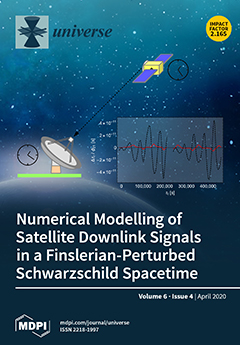
Cover Story: The article explores methods for testing Finsler gravity theories. A satellite with an on-board atomic clock, orbiting in the Finslerian-perturbed gravitational field of the earth, is considered, whose time signal is transmitted to a ground station. There its receive time and frequency are measured with respect to another atomic clock; a configuration that is realized by the Galileo 5 and 6 satellites that have gone astray and are now on non-circular orbits. One of the main findings, obtained by numerical integration of the satellite’s orbit, followed by an iterative procedure which provides the numerically integrated signals from the satellite to the ground station, is that, for sufficiently eccentric orbits, Finslerian effects can be separated from the effects of perturbations of the Schwarzschild spacetime within the Lorentzian geometry. View this paper.
  • Issues are regarded as officially published after their release is announced to the table of contents alert mailing list .
  • You may sign up for email alerts to receive table of contents of newly released issues.
  • PDF is the official format for papers published in both, html and pdf forms. To view the papers in pdf format, click on the "PDF Full-text" link, and use the free Adobe Reader to open them.

Articles (13)

  • Article
  • Open Access
5 Citations
3,138 Views
23 Pages

Automated Classification of Massive Spectra Based on Enhanced Multi-Scale Coded Convolutional Neural Network

  • Bin Jiang,
  • Donglai Wei,
  • Jiazhen Liu,
  • Shuting Wang,
  • Liyun Cheng,
  • Zihao Wang and
  • Meixia Qu

The Large Sky Area Multi-Object Fiber Spectroscopic Telescope (LAMOST) has produced massive medium-resolution spectra. Data mining for special and rare stars in massive LAMOST spectra is of great significance. Feature extraction plays an important ro...

  • Editorial
  • Open Access
1 Citations
4,480 Views
3 Pages

Black holes are fantastic laboratories for probing new physics. Both theoretically and experimentally, many new ideas are emerging to use them as tools for understanding better quantum gravity or classical gravity beyond general relativity. I briefly...

  • Article
  • Open Access
19 Citations
2,826 Views
13 Pages

It is well-known that static vacuum solutions of Einstein equations are analytic in suitable coordinates. We ask here for an extension of this result in the context of Finsler gravity. We consider Finsler spacetimes that retain several properties of...

  • Article
  • Open Access
3 Citations
2,975 Views
28 Pages

The work presented in this paper aims to contribute to the problem of testing Finsler gravity theories by means of experiments and observations in the solar system. Within a class of spherically symmetric static Finsler spacetimes we consider a satel...

  • Article
  • Open Access
34 Citations
3,974 Views
41 Pages

We derive generalised uncertainty relations (GURs) for orbital angular momentum and spin in the recently proposed smeared-space model of quantum geometry. The model implements a minimum length and a minimum linear momentum and recovers both the gener...

  • Article
  • Open Access
2 Citations
2,823 Views
10 Pages

High-Energy and Very High-Energy Constraints from Log-Parabolic Spectral Models in Narrow-Line Seyfert 1 Galaxies

  • Stefano Vercellone,
  • Luigi Foschini,
  • Patrizia Romano,
  • Markus Böttcher and
  • Catherine Boisson

Narrow-line Seyfert 1 galaxies (NLSy1s) are a well established class of γ -ray sources, showing the presence of a jet like the more common flat-spectrum radio quasars. The evidence of γ -ray emission poses the issue of the locat...

  • Article
  • Open Access
37 Citations
4,907 Views
39 Pages

Foundations of Finsler Spacetimes from the Observers’ Viewpoint

  • Antonio N. Bernal,
  • Miguel A. Javaloyes and
  • Miguel Sánchez

Physical foundations for relativistic spacetimes are revisited in order to check at what extent Finsler spacetimes lie in their framework. Arguments based on inertial observers (as in the foundations of special relativity and classical mechanics) are...

  • Article
  • Open Access
13 Citations
3,475 Views
19 Pages

At the second post-Newtonian (2PN) order, the secular pericenter precession ω ˙ 2 PN of either a full two-body system made of well-detached non-rotating monopole masses of comparable size and a restricted two-body system composed...

  • Review
  • Open Access
9 Citations
4,846 Views
24 Pages

After a long a glorious history, marked by the first direct proofs of neutrino existence and of the mixing between the first and third neutrino generations, the reactor antineutrino experiments are still well alive and will continue to give important...

  • Article
  • Open Access
1 Citations
3,769 Views
8 Pages

As nano-scale metal-oxide-semiconductor devices are cooled to temperatures below 1 K, detrimental effects due to unintentional dots become apparent. The reproducibility of the location of these unintentional dots suggests that there are other mechani...

of 2

Get Alerted

Add your email address to receive forthcoming issues of this journal.

XFacebookLinkedIn
Universe - ISSN 2218-1997