
Future Perspectives on Black Hole Jet Mechanisms: Insights from Next-Generation Observatories and Theoretical Developments


Abstract
1. Introduction
2. Observational Perspectives
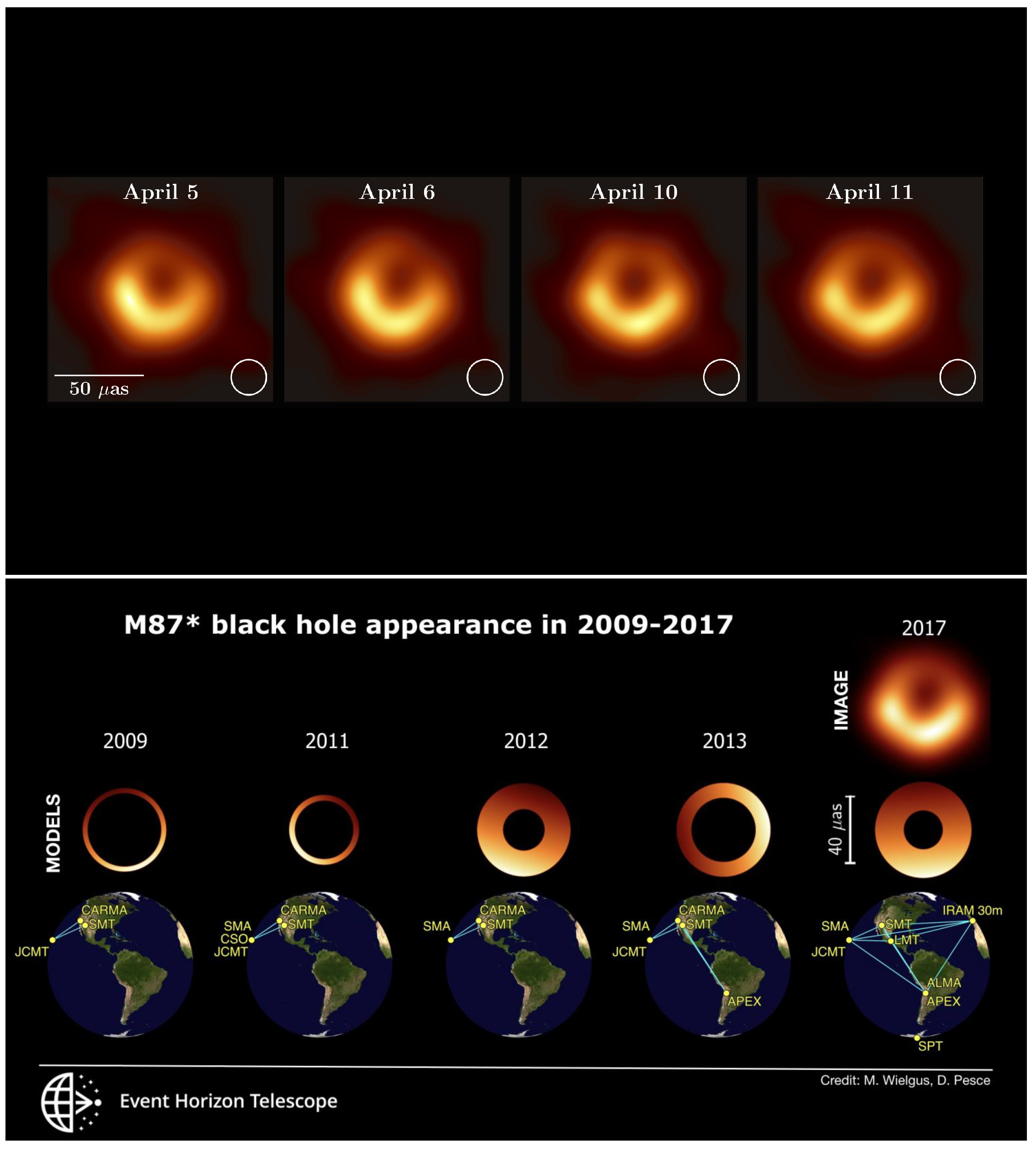
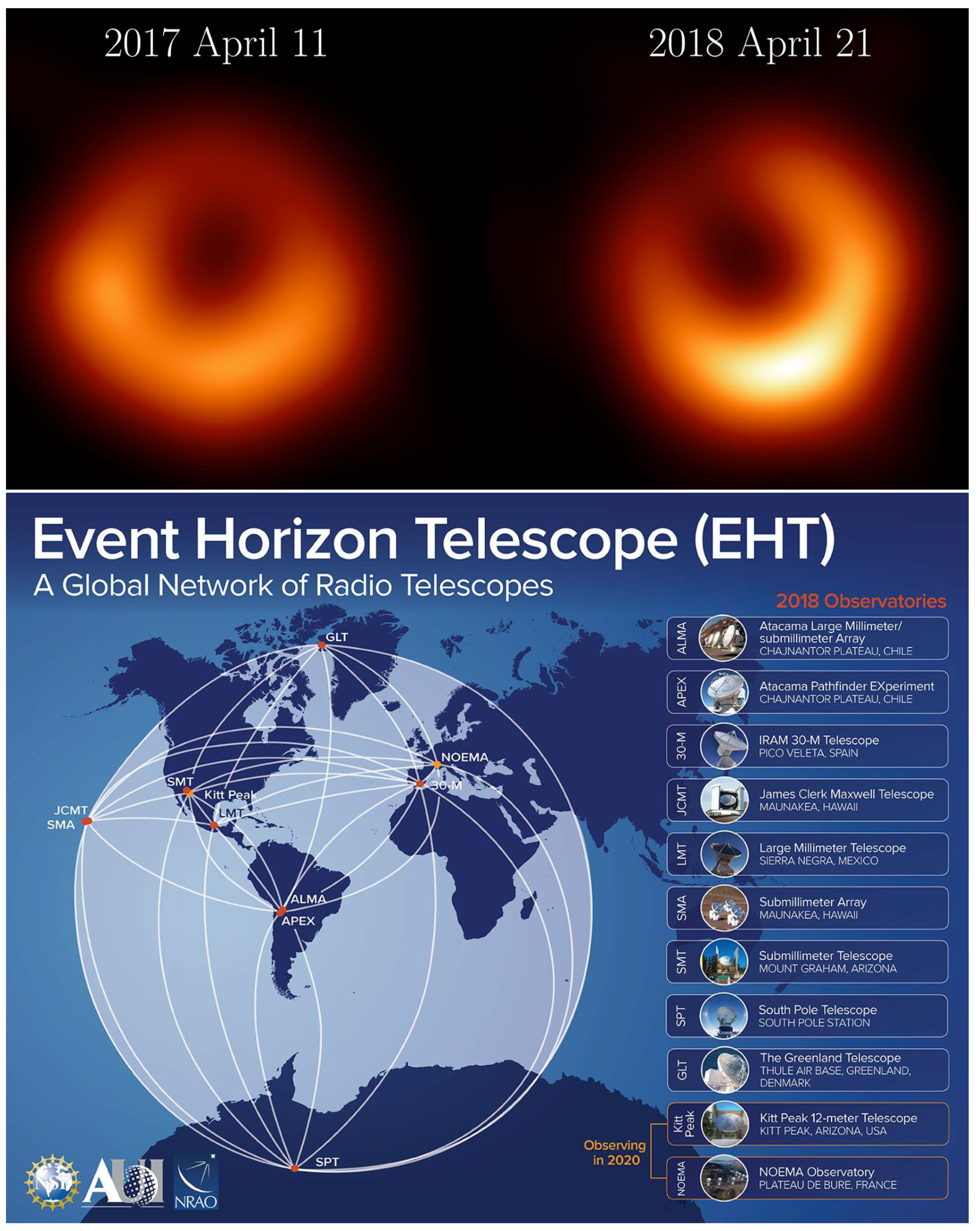
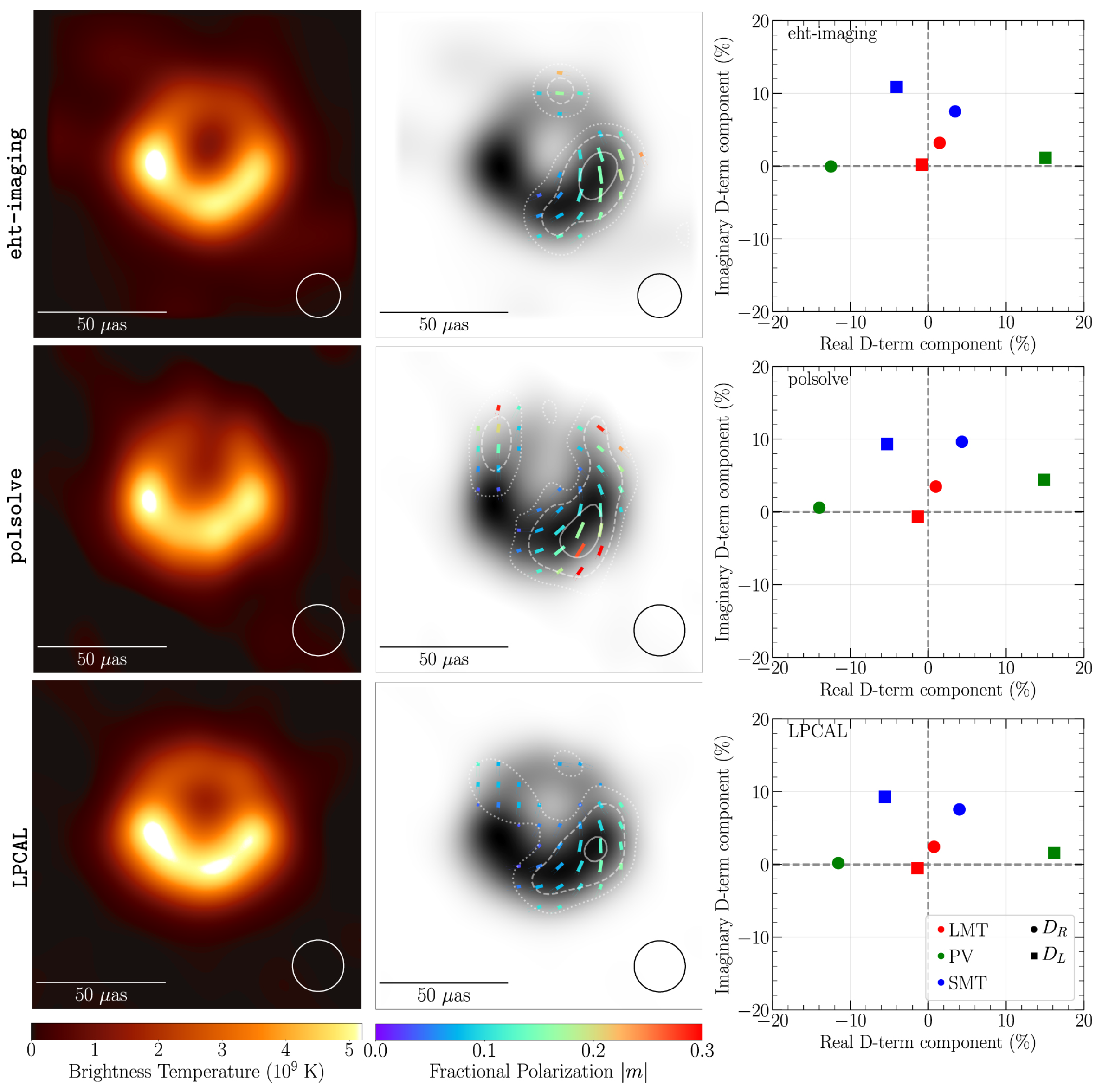
2.1. The Event Horizon Telescope (EHT)
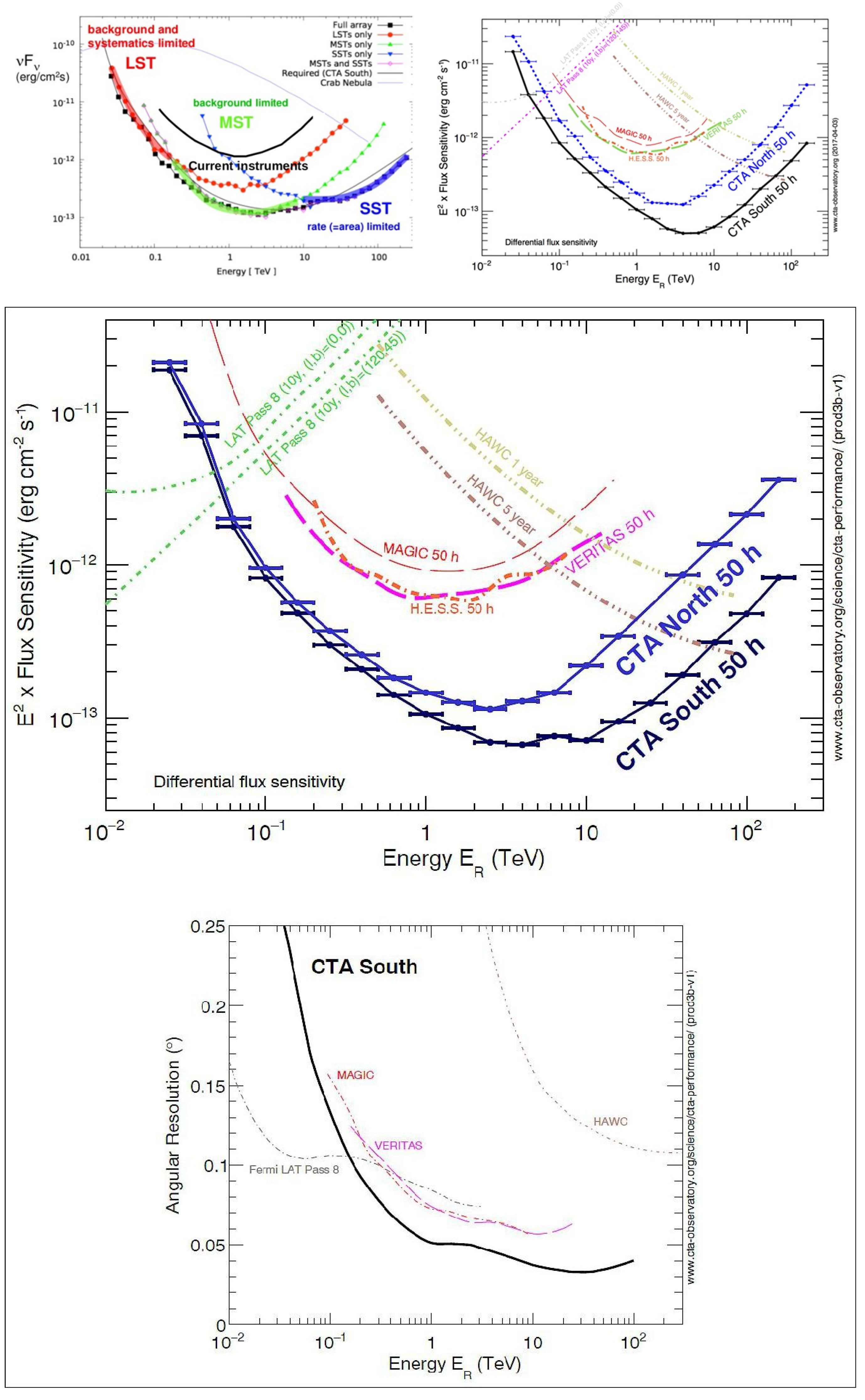
2.2. The Cherenkov Telescope Array (CTA)

2.3. The Vera C. Rubin Observatory (LSST)
2.4. The Whole Earth Blazar Telescope (WEBT)
2.5. Synergies and Multi-Messenger Astronomy
3. Jet Diversity Across Astrophysical Systems
3.1. Stellar-Mass Black Holes and Microquasars
3.2. Gamma-Ray Bursts as Extreme Jets
3.3. Tidal Disruption Events with Jets
3.4. Scaling Relations and Universal Properties
4. Theoretical Advances and Challenges
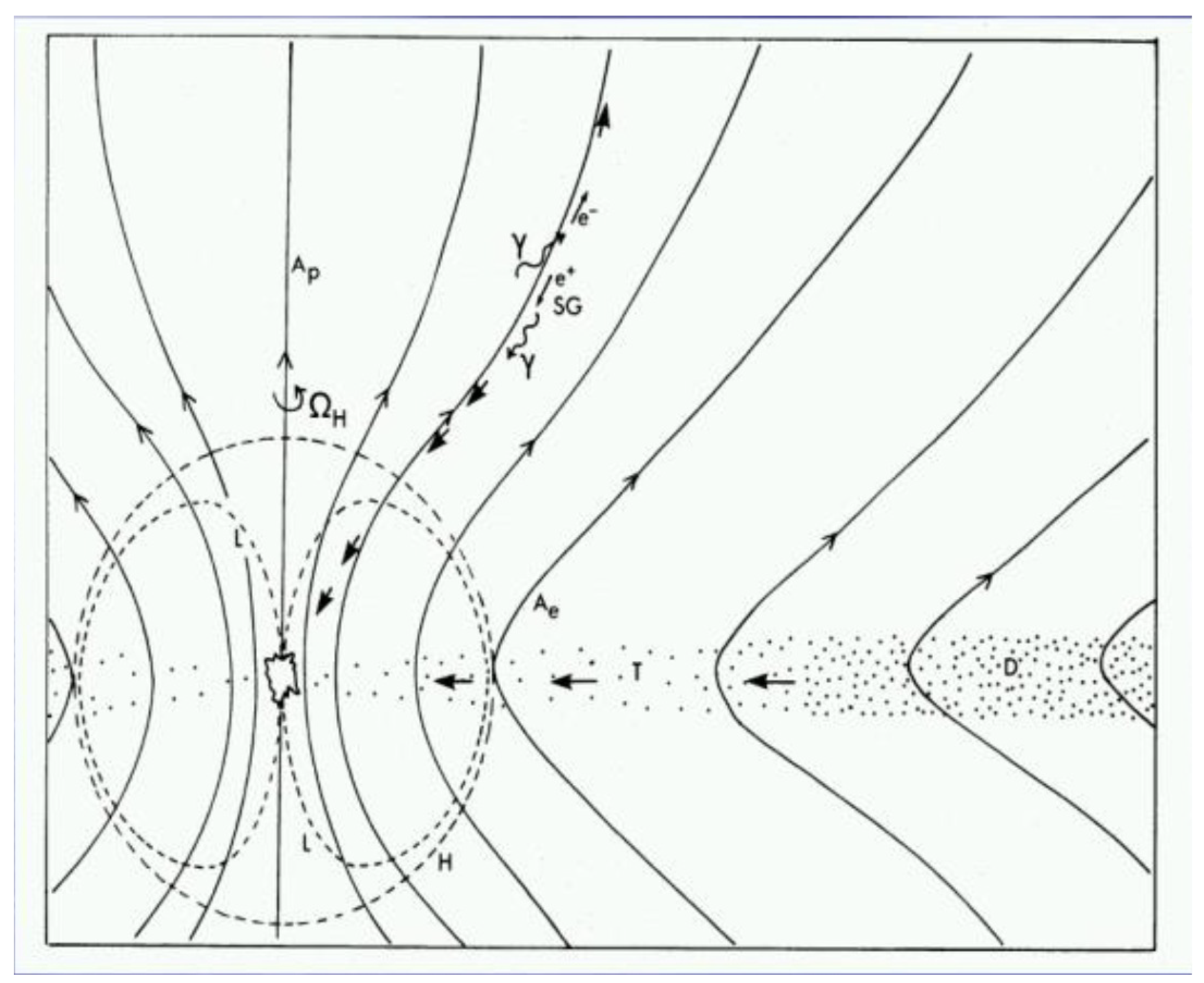
4.1. GRMHD Simulations and Jet Launching
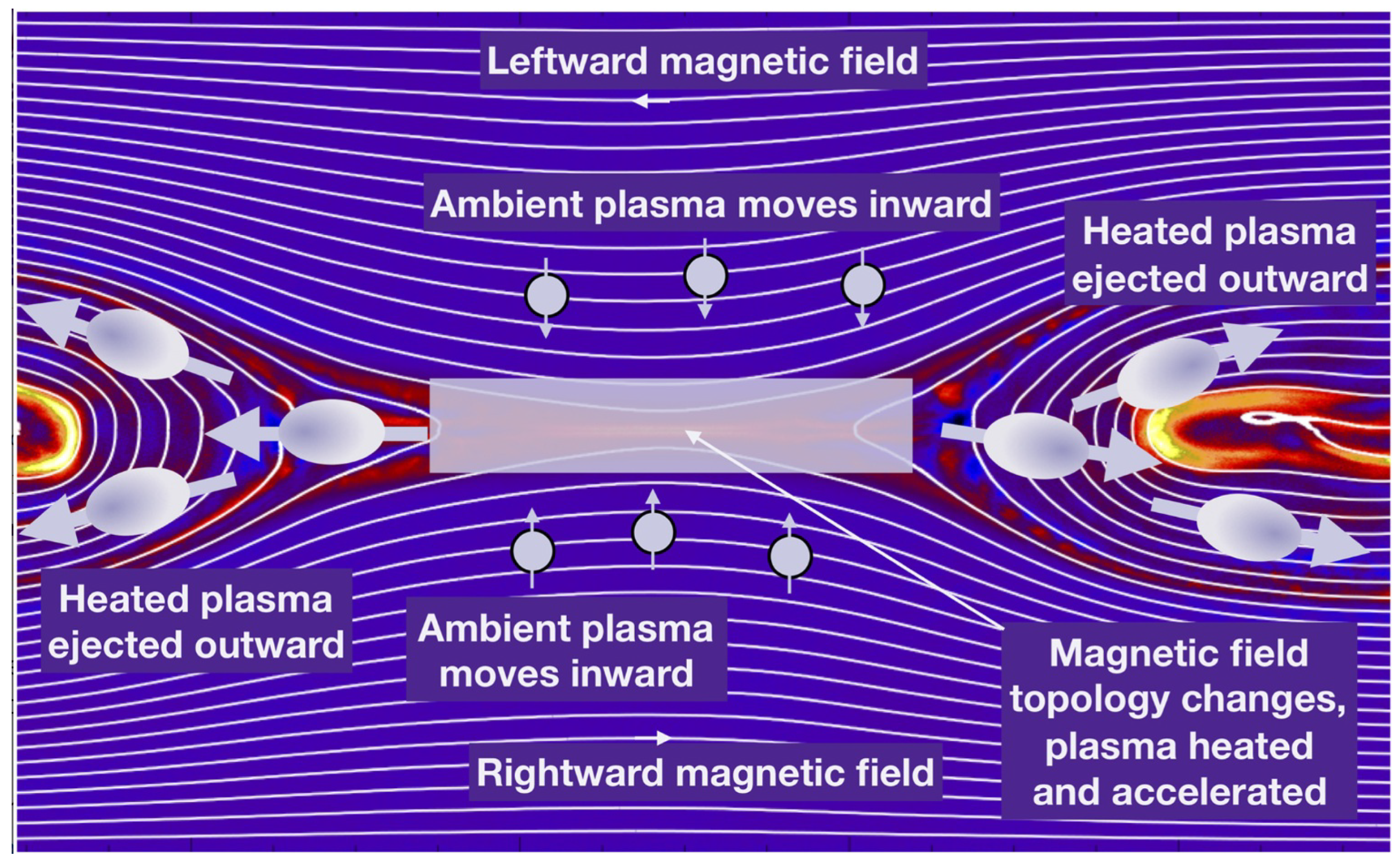
4.2. Plasma Microphysics and Particle Acceleration
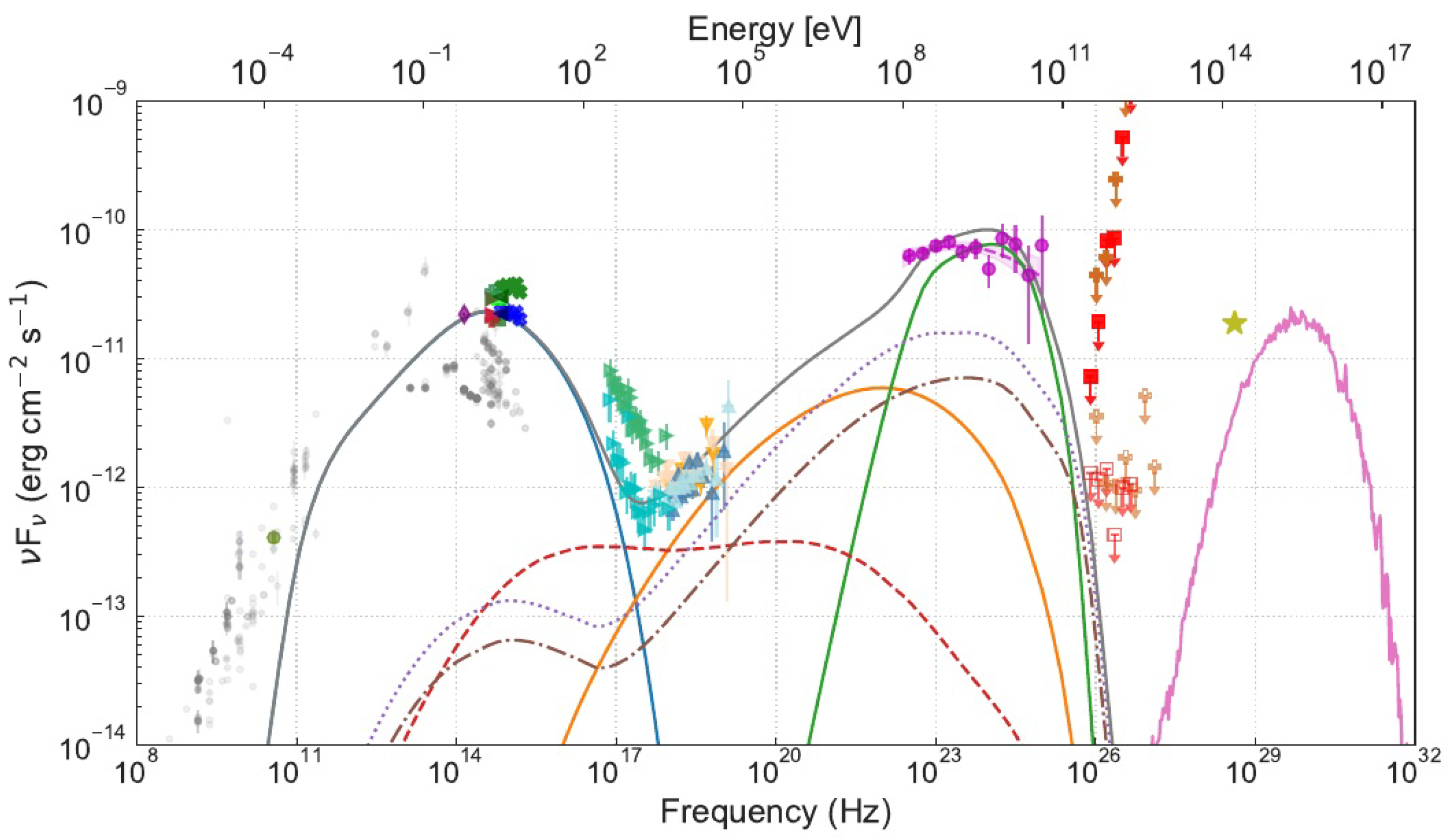
4.3. Radiative Feedback and Observables
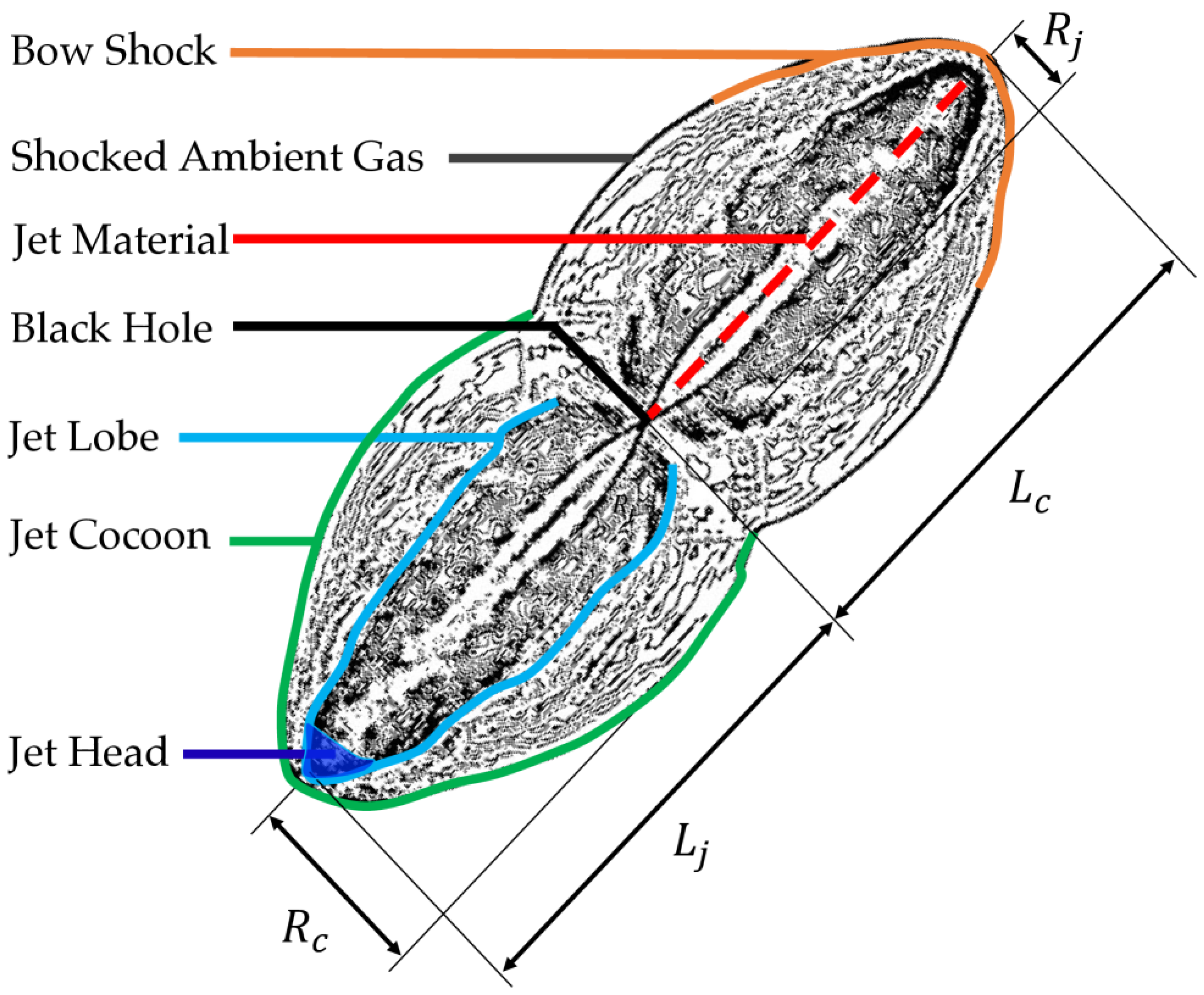
4.4. Jet-Environment Interactions
5. Open Questions and Future Directions
5.1. Fundamental Physics Questions
5.1.1. Jet Composition and Plasma Physics
5.1.2. Acceleration Sites and Mechanisms
5.2. Jet Dynamics and Structure
5.2.1. Jet Stability and Collimation
5.2.2. Energy Dissipation and Transport
5.3. Feedback and Environmental Impact
5.3.1. Feedback Efficiency
5.3.2. Duty Cycles and Triggering
5.4. Multi-Messenger Connections
5.4.1. Cosmic Ray and Neutrino Production
5.4.2. Gravitational Wave Associations
5.5. Technological and Methodological Advances
5.5.1. Computational Challenges
5.5.2. Data Analysis and Interpretation
6. Conclusions
Author Contributions
Funding
Data Availability Statement
Acknowledgments
Conflicts of Interest
Abbreviations
| EHT | Event Horizon Telescope |
| CTA | Cherenkov Telescope Array |
| LSST | Vera C. Rubin Observatory’s Legacy Survey of Space and Time |
| MADs | Magnetically Arrested Disks |
| GRMHD | General Relativistic Magnetohydrodynamic |
| AGN | Active Galactic Nuclei |
| H.E.S.S. | High Energy Stereoscopic System |
| MHD | Magnetohydrodynamic |
| PIC | particle-in-cell |
| TDEs | Tidal Disruption Events |
| LISA | Laser Interferometer Space Antenna |
| GRBs | Gamma-ray Bursts |
| SSC | Synchrotron Self-Compton |
| EC | External Compton |
| GPU | Graphics Processing Unit |
| UHECRs | Ultra-High-Energy Cosmic Rays |
| IceCube | Cubic-Kilometer Cherenkov Particle Detector |
| KM3NeT | Cubic Kilometre Neutrino Telescope |
| LIGO | Laser Interferometer Gravitational-Wave Observatory |
| WEBT | Whole Earth Blazar Telescope |
| JCMT | James Clerk Maxwell Telescope |
| CARMA | Combined Array for Research in Millimeter-wave Astronomy |
| SMT | Heinrich Hertz Submillimeter Telescope |
| SMA | Submillimeter Array |
| CSO | Caltech Submillimeter Observatory |
| APEX | Atacama Pathfinder Experiment |
| LMT | Large Millimeter Telescope |
| IRAM | Institute for Radio Astronomy in the Millimetre Range |
| SPT | South Pole Telescope |
References
- Blandford, R.D.; Payne, D.G. Hydromagnetic flows from accretion discs and the production of radio jets. Mon. Not. R. Astron. Soc. 1982, 199, 883–903. [Google Scholar] [CrossRef]
- Blandford, R.D.; Znajek, R.L. Electromagnetic extraction of energy from Kerr black holes. Mon. Not. R. Astron. Soc. 1977, 179, 433–456. [Google Scholar] [CrossRef]
- Meier, D.L. Black Hole Astrophysics: The Engine Paradigm, 1st ed.; Springer Science & Business Media: Berlin/Heidelberg, Germany, 2012; p. 596. [Google Scholar]
- Fabian, A.C. Observational Evidence of Active Galactic Nuclei Feedback. Annu. Rev. Astron. Astrophys. 2012, 50, 455–489. [Google Scholar] [CrossRef]
- Heckman, T.M.; Best, P.N. The Coevolution of Galaxies and Supermassive Black Holes: Insights from Surveys of the Contemporary Universe. Annu. Rev. Astron. Astrophys. 2014, 52, 589–660. [Google Scholar] [CrossRef]
- Begelman, M.C.; Fabian, A.C.; Rees, M.J. Implications of very rapid TeV variability in blazars. Mon. Not. R. Astron. Soc. Lett. 2008, 384, L19–L23. [Google Scholar] [CrossRef]
- Krolik, J.H. Active Galactic Nuclei. From the Central Black Hole to the Galactic Environment; Princeton University Press: Princeton, NJ, USA, 1999. [Google Scholar]
- McKinney, J.C.; Tchekhovskoy, A.; Blandford, R.D. General relativistic magnetohydrodynamic simulations of magnetically choked accretion flows around black holes. Astrophys. J. 2012, 423, 3083–3117. [Google Scholar] [CrossRef]
- Tchekhovskoy, A.; Narayan, R.; McKinney, J.C. Black hole spin and the radio loud/quiet dichotomy of active galactic nuclei. Astrophys. J. 2010, 711, 50. [Google Scholar] [CrossRef]
- Komissarov, S.S. Magnetic acceleration of relativistic active galactic nucleus jets. Mon. Not. R. Astron. Soc. 2007, 380, 51–70. [Google Scholar] [CrossRef]
- Lyubarsky, Y. Asymptotic structure of poynting-dominated jets. Astrophys. J. 2009, 698, 1570. [Google Scholar] [CrossRef]
- Degrange, B.; Fontaine, G. Introduction to high-energy gamma-ray astronomy. Comptes Rendus. Phys. Gamma-Ray Astron./Astron. Des. Rayons Gamma 2015, 16, 587–599. [Google Scholar] [CrossRef]
- Urry, C.M.; Padovani, P. Unified schemes for radio-loud active galactic nuclei. Publ. Astron. Soc. Pac. 1995, 107, 803. [Google Scholar] [CrossRef]
- Böttcher, M.; Reimer, A.; Sweeney, K.; Prakash, A. Leptonic and hadronic modeling of Fermi-detected blazars. Astrophys. J. 2013, 768, 54. [Google Scholar] [CrossRef]
- Ackermann, M.; Anantua, R.; Asano, K.; Baldini, L.; Barbiellini, G.; Bastieri, D.; Becerra Gonzalez, J.; Bellazzini, R.; Bissaldi, E.; Blandford, R.D.; et al. Minute-timescale >100 MeV γ-ray variability during the giant outburst of 3C 279 observed by Fermi-LAT. Astrophys. J. 2016, 824, L20. [Google Scholar] [CrossRef]
- Aharonian, F.; Akhperjanian, A.G.; Bazer-Bachi, A.R.; Behera, B.; Beilicke, M.; Benbow, W.; Berge, D.; Bernlöhr, K.; Boisson, C.; Bolz, O.; et al. An exceptional very high energy gamma-ray flare of PKS 2155-304. Astrophys. J. Lett. 2007, 664, L71. [Google Scholar] [CrossRef]
- Event Horizon Telescope Collaboration. First M87 Event Horizon Telescope Results. I. The Shadow of the Supermassive Black Hole. Astrophys. J. Lett. 2019, 875, L1. [Google Scholar] [CrossRef]
- Event Horizon Telescope Collaboration. First M87 Event Horizon Telescope Results. V. Physical Origin of the Asymmetric Ring. Astrophys. J. Lett. 2019, 875, L5. [Google Scholar] [CrossRef]
- Event Horizon Telescope Collaboration. First M87 Event Horizon Telescope Results. VII. Polarization of the Ring. Astrophys. J. Lett. 2021, 910, L12. [Google Scholar] [CrossRef]
- Dexter, J.; Jiménez-Rosales, A.; Ressler, S.M.; Tchekhovskoy, A.; Bauböck, M.; de Zeeuw, P.T.; Eisenhauer, F.; von Fellenberg, S.; Gao, F.; Genzel, R.; et al. A parameter survey of Sgr A* radiative models from GRMHD simulations with self-consistent electron heating. Mon. Not. R. Astron. Soc. 2020, 494, 4168–4186. [Google Scholar] [CrossRef]
- Event Horizon Telescope Collaboration. First M87 Event Horizon Telescope Results. VI. The Shadow and Mass of the Central Black Hole. Astrophys. J. Lett. 2019, 875, L6. [Google Scholar] [CrossRef]
- Narayan, R.; Johnson, M.D.; Gammie, C.F. The Shadow of a Spherically Accreting Black Hole. Astrophys. J. Lett. 2019, 885, L33. [Google Scholar] [CrossRef]
- Albert, J.; Aliu, E.; Anderhub, H.; Antoranz, P.; Armada, A.; Baixeras, C.; Barrio, J.A.; Bartko, H.; Bastieri, D.; Becker, J.K.; et al. Variable very high energy γ-ray emission from Markarian 501. Astrophys. J. 2007, 669, 862. [Google Scholar] [CrossRef]
- HESS Collaboration. Characterizing the gamma-ray long-term variability of PKS 2155-304 with H.E.S.S. and Fermi-LAT. Astron. Astrophys. 2017, 598, A39. [Google Scholar]
- Ghisellini, G.; Tavecchio, F.; Foschini, L.; Ghirlanda, G.; Maraschi, L.; Celotti, A. General physical properties of bright Fermi blazars. Mon. Not. R. Astron. Soc. 2010, 402, 497–518. [Google Scholar] [CrossRef]
- Tavecchio, F.; Ghisellini, G.; Foschini, L.; Bonnoli, G.; Ghirlanda, G.; Coppi, P. The intergalactic magnetic field constrained by Fermi/Large Area Telescope observations of the TeV blazar 1ES 0229+200. Mon. Not. R. Astron. Soc. Lett. 2010, 406, L70–L74. [Google Scholar] [CrossRef]
- Jorstad, S.G.; Marscher, A.P.; Lister, M.L.; Stirling, A.M.; Cawthorne, T.V.; Gear, W.K.; Gómez, J.L.; Stevens, J.A.; Smith, P.S.; Forster, J.R.; et al. Polarimetric Observations of 15 Active Galactic Nuclei at High Frequencies: Jet Kinematics from Bimonthly Monitoring with the Very Long Baseline Array. Astrophys. J. 2005, 130, 1418. [Google Scholar] [CrossRef]
- Marscher, A.P.; Jorstad, S.G.; Larionov, V.M.; Aller, M.F.; Aller, H.D.; Lähteenmäki, A.; Agudo, I.; Smith, P.S.; Gurwell, M.; Hagen-Thorn, V.A.; et al. Probing the inner jet of the quasar PKS 1510-089 with multi-waveband monitoring during strong gamma-ray activity. Astrophys. J. Lett. 2010, 710, L126. [Google Scholar] [CrossRef]
- Narayan, R.; Chael, A.; Chatterjee, K.; Ricarte, A.; Curd, B. Jets in magnetically arrested hot accretion flows: Geometry, power, and black hole spin-down. Mon. Not. R. Astron. Soc. 2022, 511, 3795–3813. [Google Scholar] [CrossRef]
- White, C.J.; Stone, J.M.; Quataert, E. A Resolution Study of Magnetically Arrested Disk. Astrophys. J. 2019, 874, 168. [Google Scholar] [CrossRef]
- Tchekhovskoy, A.; Narayan, R.; McKinney, J.C. Magnetohydrodynamic simulations of gamma-ray burst jets: Beyond the progenitor star. New Astron. 2010, 15, 749–754. [Google Scholar] [CrossRef]
- Liska, M.; Hesp, C.; Tchekhovskoy, A.; Ingram, A.; van der Klis, M.; Markoff, S. Formation of precessing jets by tilted black hole discs in 3D general relativistic MHD simulations. Mon. Not. R. Astron. Soc. Lett. 2017, 31, L81–L85. [Google Scholar] [CrossRef]
- Ripperda, B.; Liska, M.; Chatterjee, K.; Musoke, G.; Philippov, A.A.; Markoff, S.B.; Tchekhovskoy, A.; Younsi, Z. Black Hole Flares: Ejection of Accreted Magnetic Flux through 3D Plasmoid-mediated Reconnection. Astrophys. J. Lett. 2022, 924, L32. [Google Scholar] [CrossRef]
- Nemmen, R.S.; Georganopoulos, M.; Guiriec, S.; Meyer, E.T.; Gehrels, N.; Sambruna, R.M. A Universal Scaling for the Energetics of Relativistic Jets from Black Hole Systems. Science 2012, 338, 1445–1448. [Google Scholar] [CrossRef] [PubMed]
- Calhau, J.; Sobral, D.; Santos, S.; Matthee, J.; Paulino-Afonso, A.; Stroe, A.; Simmons, B.; Barlow-Hall, C.; Adams, B. The X-ray and radio activity of typical and luminous Ly alpha emitters from z ∼ 2 to z ∼ 6: Evidence for a diverse, evolving population. Mon. Not. R. Astron. Soc. 2020, 493, 3341–3362. [Google Scholar] [CrossRef]
- Mizuno, Y.; Gómez, J.L.; Nishikawa, K.-I.; Meli, A.; Hardee, P.E.; Rezzolla, L. Recollimation Shocks in Magnetized Relativistic Jets. Astrophys. J. 2015, 809, 38. [Google Scholar] [CrossRef]
- Sironi, L.; Spitkovsky, A. Relativistic reconnection: An efficient source of non-thermal particles. Astrophys. J. Lett. 2014, 783, L21. [Google Scholar] [CrossRef]
- Porth, O.; Mizuno, Y.; Younsi, Z.; Fromm, C.M. Flares in the Galactic Centre—I. Orbiting flux tubes in magnetically arrested black hole accretion discs. Mon. Not. R. Astron. Soc. 2021, 502, 2023–2032. [Google Scholar] [CrossRef]
- Wardle, J.; Homan, D.C.; Ojha, R.; Roberts, D.H. Electron-positron jets associated with the quasar 3C279. Nature 1998, 395, 457–461. [Google Scholar] [CrossRef]
- Hardcastle, M.J.; Croston, J.H. Radio galaxies and feedback from AGN jets. New Astron. Rev. 2020, 88, 101539. [Google Scholar] [CrossRef]
- Mukherjee, D.; Wagner, A.Y.; Bicknell, G.V.; Morganti, R.; Oosterloo, T.; Nesvadba, N.; Sutherl, R.S. The jet-ISM interactions in IC 5063. Mon. Not. R. Astron. Soc. 2018, 476, 80–95. [Google Scholar] [CrossRef]
- Blackburn, L.; Doeleman, S.; Dexter, J.; Gómez, J.L.; Johnson, M.D.; Palumbo, D.C.; Weintroub, J.; Bouman, K.L.; Chael, A.A.; Farah, J.R.; et al. Studying Black Holes on Horizon Scales with VLBI Ground Arrays. arXiv 2019, arXiv:1909.01411v2. [Google Scholar] [CrossRef]
- Johnson, M.D.; Lupsasca, A.; Strominger, A.; Wong, G.N.; Hadar, S.; Kapec, D.; Narayan, R.; Chael, A.; Gammie, C.F.; Galison, P.; et al. Universal interferometric signatures of a black hole’s photon ring. Sci. Adv. 2020, 6, 12. [Google Scholar] [CrossRef]
- Palumbo, D.C.M.; Wong, G.N.; Prather, B.S. Discriminating Accretion States via Rotational Symmetry in Simulated Polarimetric Images of M87. Astrophys. J. 2020, 894, 156. [Google Scholar] [CrossRef]
- Roelofs, F.; Janssen, M.; Natarajan, I.; Deane, R.; Davelaar, J.; Olivares, H.; Porth, O.; Paine, S.N.; Bouman, K.L.; Tilanus, R.P.J.; et al. SYMBA: An end-to-end VLBI synthetic data generation pipeline. Astron. Astrophys. 2020, 636, A5. [Google Scholar] [CrossRef]
- The CTA Consortium; Actis, M.; Agnetta, G.; Aharonian, F.; Akhperjanian, A.; Aleksić, J.; Aliu, E.; Allan, D.; Allekotte, I.; Antico, F.; et al. Design concepts for the Cherenkov Telescope Array CTA: An advanced facility for ground-based high-energy gamma-ray astronomy. Exp. Astron. 2011, 32, 193–316. [Google Scholar] [CrossRef]
- CTA Consortium. Science with the Cherenkov Telescope Array, 1st ed.; World Scientific: Singapore, 2019; p. 364. [Google Scholar]
- Acharya, B.S.; Actis, M.; Aghajani, T.; Agnetta, G.; Aguilar, J.; Aharonian, F.; Ajello, M.; Akhperjanian, A.; Alcubierre, M.; Aleksić, J.; et al. Introducing the CTA concept. Astropart. Phys. 2013, 43, 3–18. [Google Scholar] [CrossRef]
- Abell, P.A.; Allison, J.; Anderson, S.F.; Andrew, J.R.; Angel, J.R.; Armus, L.; Arnett, D.; Asztalos, S.J.; Axelrod, T.S.; Bailey, S.; et al. LSST Science Book, Version 2.0, 1st ed.; LSST Science Collaborations and LSST Project: Tucson, AZ, USA, 2009; p. 596. [Google Scholar]
- Ivezić, Ž.; Kahn, S.M.; Tyson, J.A.; Abel, B.; Acosta, E.; Allsman, R.; Alonso, D.; AlSayyad, Y.; Anderson, S.F.; Andrew, J.; et al. LSST: From Science Drivers to Reference Design and Anticipated Data Products. Astrophys. J. 2019, 873, 111. [Google Scholar] [CrossRef]
- Brandt, W.N.; Ni, Q.; Yang, G.; Anderson, S.F.; Assef, R.J.; Barth, A.J.; Bauer, F.E.; Bongiorno, A.; Chen, C.T.; De Cicco, D.; et al. Active Galaxy Science in the LSST Deep-Drilling Fields: Footprints, Cadence Requirements, and Total-Depth Requirements. arXiv 2018, arXiv:1811.06542. [Google Scholar]
- MacLeod, C.L.; Ivezić, Ž.; Sesar, B.; de Vries, W.; Kochanek, C.S.; Kelly, B.C.; Becker, A.C.; Lupton, R.H.; Hall, P.B.; Richards, G.T.; et al. A description of quasar variability measured using repeated SDSS and POSS Imaging. Astrophys. J. 2012, 753, 106. [Google Scholar] [CrossRef]
- Jorstad, S.G.; Marscher, A.P.; Raiteri, C.M.; Villata, M.; Weaver, Z.R.; Zhang, H.; Dong, L.; Gómez, J.L.; Perel, M.V.; Savchenko, S.S.; et al. Rapid quasi-periodic oscillations in the relativistic jet of BL Lacertae. Nature 2022, 609, 265–268. [Google Scholar] [CrossRef]
- Webb, J.R.; Sanz, I.P. The Structure of Micro-Variability in the WEBT BL Lacertae Observation. Galaxies 2023, 11, 108. [Google Scholar] [CrossRef]
- Blandford, R.; Meier, D.; Readhead, A. Relativistic Jets from Active Galactic Nuclei. Annu. Rev. Astron. Astrophys. 2019, 57, 467–509. [Google Scholar] [CrossRef]
- Chael, A.A.; Johnson, M.D.; Narayan, R.; Doeleman, S.S.; Wardle, J.F.C.; Bouman, K.L. High-Resolution Linear Polarimetric Imaging for the Event Horizon Telescope. Astrophys. J. 2016, 829, 11. [Google Scholar] [CrossRef]
- Ressler, S.M.; Tchekhovskoy, A.; Quataert, E.; Chandra, M.; Gammie, C.F. Electron thermodynamics in GRMHD simulations of low-luminosity black hole accretion. Mon. Not. R. Astron. Soc. 2015, 454, 1848–1870. [Google Scholar] [CrossRef]
- Werner, G.R.; Uzdensky, D.A.; Begelman, M.C.; Cerutti, B.; Nalewajko, K. Non-thermal particle acceleration in collisionless relativistic electron-proton reconnection. Mon. Not. R. Astron. Soc. 2017, 473, 4840–4861. [Google Scholar] [CrossRef]
- Zenitani, S.; Hesse, M.; Klimas, A.; Kuznetsova, M. New Measure of the Dissipation Region in Collisionless Magnetic Reconnection. Phys. Rev. Lett. 2011, 106, 195003. [Google Scholar] [CrossRef] [PubMed]
- Christie, I.M.; Petropoulou, M.; Sironi, L.; Giannios, D. Radiative signatures of plasmoid-dominated reconnection in blazar jets. Mon. Not. R. Astron. Soc. 2019, 482, 65–82. [Google Scholar] [CrossRef]
- Sironi, L.; Spitkovsky, A.; Arons, J. The maximum energy of accelerated particles in relativistic collisionless shocks. Astrophys. J. Lett. 2013, 771, 54. [Google Scholar] [CrossRef]
- Zhdankin, V.; Werner, G.R.; Uzdensky, D.A.; Begelman, M.C. Kinetic Turbulence in Relativistic Plasma: From Thermal Bath to Nonthermal Continuum. Phys. Rev. Lett. 2017, 118, 055103. [Google Scholar] [CrossRef]
- Nakamura, T.K.M.; Genestreti, K.J.; Liu, Y.; Nakamura, R.; Teh, W.; Hasegawa, H.; Daughton, W.; Hesse, M.; Torbert, R.B.; Burch, J.L.; et al. Measurement of the Magnetic Reconnection Rate in the Earth’s Magnetotail. J. Geophys. Res. Space Phys. 2018, 123, 9150–9168. [Google Scholar] [CrossRef]
- Liu, Y.H.; Hesse, M.; Genestreti, K.; Nakamura, R.; Burch, J.L.; Cassak, P.A.; Bessho, N.; Eastwood, J.P.; Phan, T.; Swisdak, M.; et al. Ohm’s law, the reconnection rate, and energy conversion in collisionless magnetic reconnection. Space Sci. Rev. 2025, 221, 16. [Google Scholar] [CrossRef]
- Ripperda, B.; Bacchini, F.; Teunissen, J.; Xia, C.; Porth, O.; Sironi, L.; Lapenta, G.; Keppens, R. A Comprehensive Comparison of Relativistic Particle Integrators. Astrophys. J. Suppl. Ser. 2018, 235, 21. [Google Scholar] [CrossRef]
- Etienne, Z.B.; Liu, Y.T.; Shapiro, S.L. Relativistic magnetohydrodynamics in dynamical spacetimes: A new adaptive mesh refinement implementation. Mon. Not. R. Astron. Soc. 2010, 82, 084031. [Google Scholar] [CrossRef]
- Font, J.A. Numerical hydrodynamics and magnetohydrodynamics in general relativity. Living Rev. Relativ. 2008, 11, 7. [Google Scholar] [CrossRef]
- Liska, M.; Chatterjee, K.; Issa, D.; Yoon, D.; Kaaz, N.; Tchekhovskoy, A.; van Eijnatten, D.; Musoke, G.; Hesp, C.; Rohoza, V.; et al. H-AMR: A New GPU-accelerated GRMHD Code for Exascale Computing with 3D Adaptive Mesh Refinement and Local Adaptive Time Stepping. Astrophys. J. Suppl. Ser. 2022, 263, 26. [Google Scholar] [CrossRef]
- White, C.J.; Stone, J.M.; Gammie, C.F. An Extension of the Athena++ Code Framework for GRMHD Based on Advanced Riemann Solvers and Staggered-Mesh Constrained Transport. Astrophys. J. Suppl. Ser. 2016, 225, 22. [Google Scholar] [CrossRef]
- Doeleman, S.S.; Fish, V.L.; Schenck, D.E.; Beaudoin, C.; Blundell, R.; Bower, G.C.; Broderick, A.E.; Chamberlin, R.; Freund, R.; Friberg, P.; et al. Jet-Launching Structure Resolved Near the Supermassive Black Hole in M87. Science 2012, 338, 355–358. [Google Scholar] [CrossRef] [PubMed]
- Krawczynski, H. Tests of General Relativity in the Strong-gravity Regime Based on X-Ray Spectropolarimetric Observations of Black Holes in X-Ray Binaries. Astrophys. J. 2012, 754, 133. [Google Scholar] [CrossRef]
- Psaltis, D.; Medeiros, L.; Christian, P.; Özel, F.; Akiyama, K.; Alberdi, A.; Alef, W.; Asada, K.; Azulay, R.; Ball, D.; et al. Gravitational Test beyond the First Post-Newtonian Order with the Shadow of the M87 Black Hole. Phys. Rev. Lett. 2020, 125, 141104. [Google Scholar] [CrossRef]
- The Event Horizon Telescope Collaboration; Akiyama, K.; Alberdi, A.; Alef, W.; Asada, K.; Azulay, R.; Baczko, A.K.; Ball, D.; Baloković, M.; Barrett, J.; et al. First M87 Event Horizon Telescope Results. II. Array and Instrumentation. Astrophys. J. Lett. 2019, 875, L2. [Google Scholar]
- Narayan, R.; Palumbo, D.C.M.; Johnson, M.D.; Gelles, Z.; Himwich, E.; Chang, D.O.; Ricarte, A.; Dexter, J.; Gammie, C.F.; Chael, A.A.; et al. The Polarized Image of a Synchrotron-emitting Ring of Gas Orbiting a Black Hole. Astrophys. J. 2021, 912, 35. [Google Scholar] [CrossRef]
- Christie, I.M. The role of magnetic field geometry in the evolution of neutron star merger accretion discs. Mon. Not. R. Astron. Soc. 2019, 490, 4811–4825. [Google Scholar] [CrossRef]
- Raymond, A.W.; Palumbo, D.; Paine, S.N.; Blackburn, L.; Rosado, R.C.; Doeleman, S.S.; Farah, J.R.; Johnson, M.D.; Roelofs, F.; Tilanus, R.P.J.; et al. Evaluation of new submillimeter VLBI sites for the Event Horizon Telescope. Astrophys. J. Suppl. Ser. 2021, 253, 5. [Google Scholar] [CrossRef]
- Issaoun, S.; Johnson, M.D.; Blackburn, L.; Brinkerink, C.D.; Mościbrodzka, M.; Chael, A.; Goddi, C.; Martí-Vidal, I.; Wagner, J.; Doeleman, S.S.; et al. The Size, Shape, and Scattering of Sagittarius A* at 86 GHz: First VLBI with ALMA. Astrophys. J. 2019, 871, 30. [Google Scholar] [CrossRef]
- Bower, G.C.; Wright, M.C.H.; Falcke, H.; Backer, D.C. Interferometric detection of linear polarization from Sagittarius A* at 230 GHz. Astrophys. J. 2003, 588, 331. [Google Scholar] [CrossRef]
- Ortiz-León, G.N.; Johnson, M.D.; Doeleman, S.S.; Blackburn, L.; Fish, V.L.; Loinard, L.; Reid, M.J.; Castillo, E.; Chael, A.A.; Hernández-Gómez, A.; et al. The intrinsic shape of Sagittarius A* at 3.5 mm wavelength. Astron. Astrophys. 2016, 824, 40. [Google Scholar] [CrossRef]
- Do, T.; Hees, A.; Ghez, A.; Martinez, G.D.; Chu, D.S.; Jia, S.; Sakai, S.; Lu, J.R.; Gautam, A.K.; O’neil, K.K.; et al. Relativistic redshift of the star S0-2 orbiting the Galactic Center supermassive black hole. Science 2019, 365, 664–668. [Google Scholar] [CrossRef]
- Wielgus, M.; Akiyama, K.; Blackburn, L.; Chan, C.-K.; Dexter, J.; Doeleman, S.S.; Fish, V.L.; Issaoun, S.; Johnson, M.D.; Krichbaum, T.P.; et al. Monitoring the Morphology of M87* in 2009–2017 with the Event Horizon Telescope. Astrophys. J. 2020, 901, 67. [Google Scholar] [CrossRef]
- Doeleman, S.; Weintroub, J.; Rogers, A.E.E.; Plambeck, R.; Freund, R.; Tilanus, R.P.J.; Friberg, P.; Ziurys, L.M.; Moran, J.M.; Corey, B.; et al. Event-horizon-scale structure in the supermassive black hole candidate at the Galactic Centre. Nature 2008, 455, 78–80. [Google Scholar] [CrossRef]
- Gold, R.; McKinney, J.C.; Johnson, M.D.; Doeleman, S.S. Probing the magnetic field structure in Sgr A* on black hole horizon scales with polarized radiative transfer simulations. Astrophys. J. 2017, 837, 180. [Google Scholar] [CrossRef]
- Bower, G.C.; Falcke, H.; Herrnstein, R.M.; Zhao, J.-H.; Goss, W.M.; Backer, D.C. Detection of the Intrinsic Size of Sagittarius A* Through Closure Amplitude Imaging. Science 2004, 304, 704–708. [Google Scholar] [CrossRef]
- Marrone, D.P.; Moran, J.M.; Zhao, J.-H.; Rao, R. An Unambiguous Detection of Faraday Rotation in Sagittarius A*. Astrophys. J. 2007, 654, L57. [Google Scholar] [CrossRef]
- Mościbrodzka, M.; Falcke, H.; Shiokawa, H.; Gammie, C.F. Observational appearance of inefficient accretion flows and jets in 3D GRMHD simulations: Application to Sagittarius A*. Astron. Astrophys. 2014, 570, A7. [Google Scholar] [CrossRef]
- Muñoz, D.J.; Marrone, D.P.; Moran, J.M.; Rao, R. The Circular Polarization of Sagittarius A* at Submillimeter Wavelenghts. Astrophys. J. 2012, 745, 115. [Google Scholar] [CrossRef]
- Goddi, C.; Falcke, H.; Kramer, M.; Rezzolla, L.; Brinkerink, C.; Bronzwaer, T.; Davelaar, J.R.J.; Deane, R.; De Laurentis, M.; Desvignes, G.; et al. BlackHoleCam: Fundamental physics of the galactic center. Int. J. Mod. Phys. D 2017, 26, 1730001. [Google Scholar] [CrossRef]
- Plambeck, R.L.; Bower, G.C.; Rao, R.; Marrone, D.P.; Jorstad, S.G.; Marscher, A.P.; Doeleman, S.S.; Fish, V.L.; Johnson, M.D. Probing the Parsec-Scale Accretion Flow of 3C 84 with Millimeter Wavelength Polarimetry. Astrophys. J. 2014, 797, 66. [Google Scholar] [CrossRef]
- Chael, A.A.; Johnson, M.D.; Bouman, K.L.; Blackburn, L.L.; Akiyama, K.; Narayan, R. Interferometric Imaging Directly with Closure Phases and Closure Amplitudes. Astrophys. J. 2018, 857, 23. [Google Scholar] [CrossRef]
- Mościbrodzka, M.; Dexter, J.; Davelaar, J.; Falcke, H. Faraday rotation in GRMHD simulations of the jet launching zone of M87. Mon. Not. R. Astron. Soc. 2017, 468, 2214–2221. [Google Scholar] [CrossRef]
- Finke, J.D.; Razzaque, S.; Dermer, C.D. Modeling the extragalactic background light from stars and dust. Astrophys. J. 2010, 712, 238. [Google Scholar] [CrossRef]
- Lidman, C.; Rosati, P.; Demarco, R.; Nonino, M.; Mainieri, V.; Stanford, S.A.; Toft, S. Deep near-infrared imaging of RDCS J1252. 9–2927 at z = 1.237*—The colour-magnitude diagram. Astron. Astrophys. 2004, 416, 829–837. [Google Scholar] [CrossRef]
- Aharonian, F.; Akhperjanian, A.G.; Anton, G.; de Almeida, U.B.; Bazer-Bachi, A.R.; Becherini, Y.; Behera, B.; Bernlöhr, K.; Boisson, C.; Bochow, A.; et al. Simultaneous observations of PKS 2155-304 with H.E.S.S., Fermi, RXTE, and ATOM: Spectral energy distributions and variability in a low state. Astrophys. J. Lett. 2009, 696, L150. [Google Scholar] [CrossRef]
- Albert, J.; Aliu, E.; Anderhub, H.; Antonelli, L.A.; Antoranz, P.; Backes, M.; Baixeras, C.; Barrio, J.A.; Bartko, H.; Bastieri, D.; et al. Very high energy gamma-ray observations of strong flaring activity in M87 in 2008 February. Astrophys. J. Lett. 2008, 685, L23. [Google Scholar] [CrossRef]
- Giannios, D.; Uzdensky, D.A.; Begelman, M.C. Fast TeV variability in blazars: Jets in a jet. Mon. Not. R. Astron. Soc. Lett. 2009, 395, L29–L33. [Google Scholar] [CrossRef]
- Sharma, A.; Prince, R.; Bose, D. From microquasars to AGN: A uniform jet variability. Phys. Rev. D 2025, 111, 083049. [Google Scholar] [CrossRef]
- Nalewajko, K.; Giannios, D.; Begelman, M.C.; Uzdensky, D.A.; Sikora, M. Radiative properties of reconnection-powered minijets in blazars. Mon. Not. R. Astron. Soc. 2011, 413, 333–346. [Google Scholar] [CrossRef]
- Abramowski, A.; Stinzing, F.; Huan, H.; Aune, T.; Feinstein, F.; Vorster, M.; Maneva, G.; Hui, C.M.; Hofverberg, P.; Perlman, E.S.; et al. The 2010 very high energy γ-ray flare and 10 years of multi-wavelength observations of M 87. Astrophys. J. 2012, 746, 151. [Google Scholar] [CrossRef]
- MAGIC Collaboration; Aleksić, J.; Antonelli, L.A.; Antoranz, P.; Backes, M.; Barrio, J.A.; Bastieri, D.; González, J.B.; Bednarek, W.; Berdyugin, A.; et al. Detection of very high energy γ-ray emission from the Perseus cluster head-tail galaxy IC 310 by the MAGIC telescopes. Astrophys. J. Lett. 2012, 723, L207. [Google Scholar] [CrossRef]
- Veritas Collaboration; VLBA 43 GHz M87 Monitoring Team; HESS Collaboration; Magic Collaboration; Acciari, V.A.; Aliu, E.; Arlen, T.; Bautista, M.; Beilicke, M.; Benbow, W.; et al. Radio imaging of the very-high-energy γ-ray emission region in the central engine of a radio galaxy. Science 2009, 325, 444–448. [Google Scholar]
- Aharonian, F.; Akhperjanian, A.G.; Bazer-Bachi, A.R.; Beilicke, M.; Benbow, W.; Berge, D.; Bernlöhr, K.; Boisson, C.; Bolz, O.; Borrel, V.; et al. Fast variability of tera-electron volt γ rays from the radio galaxy M87. Science 2006, 314, 1424–1427. [Google Scholar] [CrossRef]
- Hardcastle, M.J.; Evans, D.A.; Croston, J.H. The active nuclei of z < 1.0 3CRR radio sources. Mon. Not. R. Astron. Soc. 2009, 396, 1929–1952. [Google Scholar]
- Stawarz, Ł.; Aharonian, F.; Kataoka, J.; Ostrowski, M.; Siemiginowska, A.; Sikora, M. Dynamics and high-energy emission of the flaring HST-1 knot in the M 87 jet. Mon. Not. R. Astron. Soc. 2006, 370, 981–992. [Google Scholar] [CrossRef]
- Aartsen, M.G.; Ackermann, M.; Adams, J.; Aguilar, J.; Ahlers, M.; Ahrens, M.; Altmann, D.; Andeen, K.; Anderson, T.; Ansseau, I.; et al. The IceCube Neutrino Observatory: Instrumentation and online systems. J. Instrum. 2017, 12, P03012. [Google Scholar] [CrossRef]
- IceCube Collaboration. Neutrino emission from the direction of the blazar TXS 0506+056 prior to the IceCube-170922A alert. Science 2018, 361, 147–151. [Google Scholar] [CrossRef] [PubMed]
- Petropoulou, M.; Psarras, F.; Giannios, D. Hadronic signatures from magnetically dominated baryon-loaded AGN jets. Mon. Not. R. Astron. Soc. 2023, 518, 2719–2734. [Google Scholar] [CrossRef]
- Petropoulou, M.; Dimitrakoudis, S.; Padovani, P.; Mastichiadis, A.; Resconi, E. Photohadronic origin of γ-ray BL Lac emission: Implications for IceCube neutrinos. Mon. Not. R. Astron. Soc. 2015, 448, 2412–2429. [Google Scholar] [CrossRef]
- Padovani, P.; Giommi, P.; Resconi, E.; Glauch, T.; Arsioli, B.; Sahakyan, N.; Huber, M. Dissecting the region around IceCube-170922A: The blazar TXS 0506+056 as the first cosmic neutrino source. Mon. Not. R. Astron. Soc. 2018, 480, 192–203. [Google Scholar] [CrossRef]
- Rodrigues, X.; Fedynitch, A.; Gao, S.; Boncioli, D.; Winter, W. Neutrinos and Ultra-high-energy Cosmic-ray Nuclei from Blazars. Astrophys. J. 2018, 854, 54. [Google Scholar] [CrossRef]
- Kathirgamaraju, A.; Duran, R.B.; Giannios, D. Off-axis short GRBs from structured jets as counterparts to GW events. Mon. Not. R. Astron. Soc. Lett. 2017, 473, L121–L125. [Google Scholar] [CrossRef]
- Metzger, B.D.; Martínez-Pinedo, G.; Darbha, S.; Quataert, E.; Arcones, A.; Kasen, D.; Thomas, R.; Nugent, P.; Panov, I.V.; Zinner, N.T. Electromagnetic counterparts of compact object mergers powered by the radioactive decay of r-process nuclei. Mon. Not. R. Astron. Soc. 2010, 406, 2650–2662. [Google Scholar] [CrossRef]
- Bartos, I.; Kowalski, M. Multimessenger Astronomy; IOP Publishing Ltd.: Bristol, UK, 2017; p. 26. [Google Scholar]
- Jorstad, S.G.; Marscher, A.P.; Larionov, V.M.; Agudo, I.; Smith, P.S.; Gurwell, M.; Lähteenmäki, A.; Tornikoski, M.; Markowitz, A.; Arkharov, A.A.; et al. Flaring behavior of the quasar 3C 454.3 across the electromagnetic spectrum. Astrophys. J. 2010, 715, 362. [Google Scholar] [CrossRef]
- Ota, N.; Murase, K.; Kitayama, T.; Komatsu, E.; Hattori, M.; Matsuo, H.; Oshima, T.; Suto, Y.; Yoshikawa, K. Suzaku broad-band spectroscopy of RX J1347.5-1145: Constraints on the extremely hot gas and non-thermal emission. Astron. Astrophys. 2008, 491, 363–377. [Google Scholar] [CrossRef]
- Tavecchio, F.; Maraschi, L.; Pian, E.; Chiappetti, L.; Celotti, A.; Fossati, G.; Ghisellini, G.; Palazzi, E.; Raiteri, C.M.; Sambruna, R.M.; et al. Theoretical Implications from the Spectral Evolution of Markarian 501 Observed with BeppoSAX. Astrophys. J. 2001, 554, 725. [Google Scholar] [CrossRef]
- Sikora, M.; Stawarz, Ł.; Moderski, R.; Nalewajko, K.; Madejski, G.M. Constraining emission models of luminous blazar sources. Astrophys. J. 2009, 704, 38. [Google Scholar] [CrossRef]
- Kaiser, C.R. Cherenkov Telescope Array Status Report. arXiv 2017, arXiv:1705.07805. [Google Scholar]
- CTA (Cherenkov Telescope Array). Available online: https://www.eoportal.org/other-space-activities/cta (accessed on 29 December 2025).
- Schwamb, M.E.; Jones, R.L.; Yoachim, P.; Volk, K.; Dorsey, R.C.; Opitom, C.; Greenstreet, S.; Lister, T.; Snodgrass, C.; Bolin, B.T.; et al. Tuning the Legacy Survey of Space and Time (LSST) Observing Strategy for Solar System Science. Astrophys. J. Suppl. Ser. 2023, 266, 22. [Google Scholar] [CrossRef]
- Caplar, N.; Lilly, S.J.; Trakhtenbrot, B. Optical Variability of AGNs in the PTF/iPTF Survey. Astrophys. J. 2017, 834, 111. [Google Scholar] [CrossRef]
- Hickox, R.C.; Mullaney, J.R.; Alexander, D.M.; Chen, C.-T.J.; Civano, F.M.; Goulding, A.D.; Hainline, K.N. Black hole variability and the star formation-active galactic nucleus connection: Do all star-forming galaxies host an active galactic nucleus? Astrophys. J. 2014, 782, 9. [Google Scholar] [CrossRef]
- Schawinski, K.; Urry, C.M.; Simmons, B.D.; Fortson, L.; Kaviraj, S.; Keel, W.C.; Lintott, C.J.; Masters, K.L.; Nichol, R.C.; Sarzi, M.; et al. The green valley is a red herring: Galaxy Zoo reveals two evolutionary pathways towards quenching of star formation in early- and late-type galaxies. Mon. Not. R. Astron. Soc. 2014, 440, 889–907. [Google Scholar] [CrossRef]
- Best, P.N.; Heckman, T.M. On the fundamental dichotomy in the local radio-AGN population: Accretion, evolution and host galaxy properties. Mon. Not. R. Astron. Soc. 2012, 421, 1569–1582. [Google Scholar] [CrossRef]
- Sabater, J.; Best, P.N.; Hardcastle, M.J.; Shimwell, T.W.; Tasse, C.; Williams, W.L.; Brüggen, M.; Cochrane, R.K.; Croston, J.H.; de Gasperin, F.; et al. The LoTSS view of radio AGN in the local Universe. The most massive galaxies are always switched on. Astron. Astrophys. 2019, 622, A17. [Google Scholar] [CrossRef]
- Martini, P.; Sivakoff, G.R.; Mulchaey, J.S. The evolution of active galactic nuclei in clusters of galaxies to redshift 1.3. Astrophys. J. 2009, 701, 66. [Google Scholar] [CrossRef]
- Schulze, A.; Bongiorno, A.; Gavignaud, I.; Schramm, M.; Silverman, J.; Merloni, A.; Zamorani, G.; Hirschmann, M.; Mainieri, V.; Wisotzki, L.; et al. The cosmic growth of the active black hole population at 1 < z < 2 in zCOSMOS, VVDS and SDSS. Mon. Not. R. Astron. Soc. 2015, 447, 2085–2111. [Google Scholar] [CrossRef]
- Mosta, P.; Radice, D.; Haas, R.; Schnetter, E.; Bernuzzi, S. A magnetar engine for short GRBs and kilonovae. Astrophys. J. Lett. 2020, 901, L37. [Google Scholar] [CrossRef]
- Komossa, S. Tidal disruption of stars by supermassive black holes: Status of observations. J. High Energy Astrophys. 2015, 7, 148–157. [Google Scholar] [CrossRef]
- Nugent, A.E.; Fong, W.-F.; Castrejon, C.; Leja, J.; Zevin, M.; Ji, A.P. A Population of Short-duration Gamma-Ray Bursts with Dwarf Host Galaxies. Astrophys. J. 2024, 962, 5. [Google Scholar] [CrossRef]
- Tchekhovskoy, A.; Bromberg, O. Three-dimensional relativistic MHD simulations of active galactic nuclei jets: Magnetic kink instability and Fanaroff–Riley dichotomy. Mon. Not. R. Astron. Soc. Lett. 2016, 461, L46–L50. [Google Scholar] [CrossRef]
- Auchettl, K.; Guillochon, J.; Ramirez-Ruiz, E. New Physical Insights about Tidal Disruption Events from a Comprehensive Observational Inventory at X-Ray Wavelengths. Astrophys. J. 2017, 838, 149. [Google Scholar] [CrossRef]
- Van Velzen, S.; Farrar, G.R.; Gezari, S.; Morrell, N.; Zaritsky, D.; Östman, L.; Smith, M.; Gelf, J.; Drake, A.J. Optical discovery of probable stellar tidal disruption flares. Astrophys. J. 2011, 741, 73. [Google Scholar] [CrossRef]
- Harrison, C.M.; Costa, T.; Tadhunter, C.N.; Flütsch, A.; Kakkad, D.; Perna, M.; Vietri, G. AGN outflows and feedback twenty years on. Nat. Astron. 2018, 2, 198–205. [Google Scholar] [CrossRef]
- Ellison, S.L.; Jones, C.; Forman, W.R.; Murray, S.S.; Kochanek, C.S.; Eisenstein, D.; Jannuzi, B.T.; Dey, A.; Brown, M.J.I.; Stern, D.; et al. Galaxy pairs in the Sloan Digital Sky Survey—IV. Interactions trigger active galactic nuclei. Mon. Not. R. Astron. Soc. 2011, 418, 2043–2053. [Google Scholar] [CrossRef]
- Hickox, R.C.; Jones, C.; Forman, W.R.; Murray, S.S.; Kochanek, C.S.; Eisenstein, D.; Jannuzi, B.T.; Dey, A.; Brown, M.J.I.; Stern, D.; et al. Host galaxies, clustering, Eddington ratios, and evolution of radio, X-ray, and infrared-selected AGNs. Astrophys. J. 2009, 696, 891. [Google Scholar] [CrossRef]
- Bower, G.C.; Schaye, J.; Frenk, C.S.; Theuns, T.; Schaller, M.; Crain, R.A.; McAlpine, S. The dark nemesis of galaxy formation: Why hot haloes trigger black hole growth and bring star formation to an end. Mon. Not. R. Astron. Soc. 2017, 465, 32–44. [Google Scholar] [CrossRef]
- Croton, D.J.; Springel, V.; White, S.D.M.; De Lucia, G.; Frenk, C.S.; Gao, L.; Jenkins, A.; Kauffmann, G.; Navarro, J.F.; Yoshida, N. The many lives of active galactic nuclei: Cooling flows, black holes and the luminosities and colours of galaxies. Mon. Not. R. Astron. Soc. 2006, 365, 11–28. [Google Scholar] [CrossRef]
- Graham, M.J.; Ross, N.P.; Stern, D.; Drake, A.J.; McKernan, B.; Ford, K.E.S.; Djorgovski, S.G.; A Mahabal, A.; Glikman, E.; Larson, S.; et al. Understanding extreme quasar optical variability with CRTS—II. Changing-state quasars. Mon. Not. R. Astron. Soc. 2020, 491, 4925–4948. [Google Scholar] [CrossRef]
- Bañados, E.; Venemans, B.P.; Mazzucchelli, C.; Farina, E.P.; Walter, F.; Wang, F.; Decarli, R.; Stern, D.; Fan, X.; Davies, F.B.; et al. An 800-million-solar-mass black hole in a significantly neutral Universe at a redshift of 7.5. Nature 2018, 553, 473–476. [Google Scholar] [CrossRef] [PubMed]
- Volonteri, M.; Haardt, F.; Madau, P. The Assembly and Merging History of Supermassive Black Holes in Hierarchical Models of Galaxy Formation. Astrophys. J. 2003, 582, 559. [Google Scholar] [CrossRef]
- Di Matteo, T.; Springel, V.; Hernquist, L. Energy input from quasars regulates the growth and activity of black holes and their host galaxies. Nature 2005, 433, 604–607. [Google Scholar] [CrossRef]
- Hopkins, P.F.; Hernquist, L.; Cox, T.J.; Di Matteo, T.; Robertson, B.; Springel, V. A Unified, Merger-driven Model of the Origin of Starbursts, Quasars, the Cosmic X-Ray Background, Supermassive Black Holes, and Galaxy Spheroids. Astrophys. J. Suppl. Ser. 2006, 163, 1. [Google Scholar] [CrossRef]
- Bentz, M.C.; Denney, K.D.; Grier, C.J.; Barth, A.J.; Peterson, B.M.; Vestergaard, M.; Bennert, V.N.; Canalizo, G.; De Rosa, G.; Filippenko, A.V.; et al. The low-luminosity end of the radius–luminosity relationship for active galactic nuclei. Astrophys. J. 2013, 767, 149. [Google Scholar] [CrossRef]
- Peterson, B.M.; Ferrarese, L.; Gilbert, K.M.; Kaspi, S.; Malkan, M.A.; Maoz, D.; Merritt, D.; Netzer, H.; Onken, C.A.; Pogge, R.W.; et al. Central Masses and Broad-Line Region Sizes of Active Galactic Nuclei. II. A Homogeneous Analysis of a Large Reverberation-Mapping Database. Astrophys. J. 2004, 613, 682. [Google Scholar] [CrossRef]
- Fausnaugh, M.M.; Denney, K.D.; Barth, A.J.; Bentz, M.C.; Bottorff, M.C.; Carini, M.T.; Croxall, K.V.; De Rosa, G.; Goad, M.R.; Horne, K.; et al. Space Telescope and Optical Reverberation Mapping Project. III. Optical continuum emission and broad-band time delays in NGC 5548. Astrophys. J. 2016, 821, 56. [Google Scholar] [CrossRef]
- Grier, C.J.; Peterson, B.M.; Horne, K.; Bentz, M.C.; Pogge, R.W.; Denney, K.D.; De Rosa, G.; Martini, P.; Kochanek, C.S.; Zu, Y.; et al. The structure of the broad-line region in active galactic nuclei. I. Reconstructed velocity-delay maps. Astrophys. J. 2013, 764, 47. [Google Scholar] [CrossRef]
- Mészáros, P.; Fox, D.B.; Hanna, C.; Murase, K. Multi-messenger astrophysics. Nat. Rev. Phys. 2019, 1, 585–599. [Google Scholar] [CrossRef]
- Fuhrmann, L.; Larsson, S.; Chiang, J.; Angelakis, E.; Zensus, J.A.; Nestoras, I.; Krichbaum, T.P.; Ungerechts, H.; Sievers, A.; Pavlidou, V.; et al. Detection of significant cm to sub-mm band radio and gamma-ray correlated variability in Fermi bright blazars. Mon. Not. R. Astron. Soc. 2014, 441, 1899–1909. [Google Scholar] [CrossRef]
- Max-Moerbeck, W.; Hovatta, T.; Richards, J.L.; King, O.G.; Pearson, T.J.; Readhead, A.C.S.; Reeves, R.; Shepherd, M.C.; Stevenson, M.A.; Angelakis, E.; et al. Time correlation between the radio and gamma-ray activity in blazars and the production site of the gamma-ray emission. Mon. Not. R. Astron. Soc. 2014, 445, 428–436. [Google Scholar] [CrossRef]
- Bellm, E.C.; Kulkarni, S.R.; Graham, M.J.; Dekany, R.; Smith, R.M.; Riddle, R.; Masci, F.J.; Helou, G.; Prince, T.A.; Adams, S.M.; et al. The Zwicky Transient Facility: System Overview, Performance, and First Results. Publ. Astron. Soc. Pac. 2018, 131, 018002. [Google Scholar] [CrossRef]
- Perna, R.; Lazzati, D.; Giacomazzo, B. Short gamma-ray bursts from the merger of two black holes. Astrophys. J. Lett. 2016, 821, L18. [Google Scholar] [CrossRef]
- Ciolfi, R.; Kastaun, W.; Giacomazzo, B.; Endrizzi, A.; Siegel, D.M.; Perna, R. General relativistic magnetohydrodynamic simulations of binary neutron star mergers forming a long-lived neutron star. Phys. Rev. D 2017, 95, 063016. [Google Scholar] [CrossRef]
- Ruiz, M.; Lang, R.N.; Paschalidis, V.; Shapiro, S.L. Binary neutron star mergers: A jet engine for short gamma-ray bursts. Astrophys. J. Lett. 2016, 824, L6. [Google Scholar] [CrossRef]
- Amaro-Seoane, P.; Audley, H.; Babak, S.; Baker, J.; Barausse, E.; Bender, P.; Berti, E.; Binetruy, P.; Born, M.; Bortoluzzi, D.; et al. Laser Interferometer Space Antenna. arXiv 2017, arXiv:1702.00786. [Google Scholar] [CrossRef]
- Haiman, Z. Electromagnetic chirp of a compact binary black hole: A phase template for the gravitational wave inspiral. Phys. Rev. D 2017, 96, 023004. [Google Scholar] [CrossRef]
- Palenzuela, C.; Lehner, L.; Ponce, M.; Liebling, S.L.; Anderson, M.; Neilsen, D.; Motl, P. Electromagnetic and Gravitational Outputs from Binary-Neutron-Star Coalescence. Phys. Rev. Lett. 2013, 111, 061105. [Google Scholar] [CrossRef]
- Baron, D. Machine Learning in Astronomy: A practical overview. arXiv 2019, arXiv:1904.07248v1. [Google Scholar] [CrossRef]
- Bloom, J.S.; Richards, J.W.; Nugent, P.E.; Quimby, R.M.; Kasliwal, M.M.; Starr, D.L.; Poznanski, D.; Ofek, E.O.; Cenko, S.B.; Butler, N.R.; et al. Automating Discovery and Classification of Transients and Variable Stars in the Synoptic Survey Era. Publ. Astron. Soc. Pac. 2012, 124, 1175. [Google Scholar] [CrossRef]
- Belloni, T.; Homan, J.; Casella, P.; van der Klis, M.; Nespoli, E.; Lewin, W.H.G.; Miller, J.M.; Méndez, M. The evolution of the timing properties of the black-hole transient GX 339–4 during its 2002/2003 outburst. Astron. Astrophys. 2005, 440, 207–222. [Google Scholar] [CrossRef]
- Fender, R.P.; Homan, J.; Belloni, T.M. Jets from black hole X-ray binaries: Testing, refining and extending empirical models for the coupling to X-rays. Mon. Not. R. Astron. Soc. 2009, 396, 1370–1382. [Google Scholar] [CrossRef]
- Fender, R.; Belloni, T. Stellar-Mass Black Holes and Ultraluminous X-ray Sources. Science 2012, 337, 540–544. [Google Scholar] [CrossRef]
- Remillard, R.A.; McClintock, J.E. X-Ray Properties of Black-Hole Binaries. Annu. Rev. Astron. Astrophys. 2006, 44, 49–92. [Google Scholar] [CrossRef]
- Gallo, E.; Fender, R.; Kaiser, C.; Russell, D.; Morganti, R.; Oosterloo, T.; Heinz, S. A dark jet dominates the power output of the stellar black hole Cygnus X-1. Nature 2005, 436, 819–821. [Google Scholar] [CrossRef]
- Mirabel, I.; Rodríguez, L. A superluminal source in the Galaxy. Nature 1994, 371, 46–48. [Google Scholar] [CrossRef]
- Fender, R.P.; Belloni, T.M.; Gallo, E. Towards a unified model for black hole X-ray binary jets. Mon. Not. R. Astron. Soc. 2004, 355, 1105–1118. [Google Scholar] [CrossRef]
- Ho, L.C.; Wang, J.W. The Central Engine of Active Galactic Nuclei, 1st ed.; Conference Series; Astronomical Society of the Pacific: San Francisco, CA, USA, 2007; Volume 373. [Google Scholar]
- Merloni, A.; Keppens, R. Decelerating relativistic two-component jets. Mon. Not. R. Astron. Soc. 2003, 345, 1057–1076. [Google Scholar] [CrossRef]
- Gültekin, K.; King, A.L.; Cackett, E.M.; Nyland, K.; Miller, J.M.; Di Matteo, T.; Markoff, S.; Rupen, M.P. The Fundamental Plane of Black Hole Accretion and Its Use as a Black Hole-Mass Estimator. Astrophys. J. 2019, 871, 80. [Google Scholar] [CrossRef]
- Plotkin, R.M.; Gallo, E.; Jonker, P.G. The X-Ray Spectral Evolution of Galactic Black Hole X-Ray Binaries toward Quiescence. Astrophys. J. 2013, 773, 59. [Google Scholar] [CrossRef]
- Kumar, P.; Zhang, B. The physics of gamma-ray bursts & relativistic jets. Phys. Rep. 2015, 561, 1–109. [Google Scholar] [CrossRef]
- Piran, T. The physics of gamma-ray bursts. Rev. Mod. Phys. 2005, 76, 1143. [Google Scholar] [CrossRef]
- Berger, E. Short-duration gamma-ray bursts. Annu. Rev. Astron. Astrophys. 2014, 52, 43–105. [Google Scholar] [CrossRef]
- Woosley, S.E.; Bloom, J.S. Monitoring the Morphology of M87* in 2009–2017 with the Event Horizon Telescope. The Supernova–Gamma-Ray Burst Connection. Annu. Rev. Astron. Astrophys. 2006, 44, 507–556. [Google Scholar] [CrossRef]
- Abbott, B.P.; Abbott, R.; Abbott, T.D.; Acernese, F.; Ackley, K.; Adams, C.; Adams, T.; Addesso, P.; Adhikari, R.X.; Adya, V.B.; et al. GW170817: Observation of gravitational waves from a binary neutron star inspiral. Phys. Rev. Lett. 2017, 119, 161101. [Google Scholar] [CrossRef]
- Goldstein, A.; Veres, P.; Burns, E.; Briggs, M.S.; Hamburg, R.; Kocevski, D.; Wilson-Hodge, C.A.; Preece, R.D.; Poolakkil, S.; Roberts, O.J.; et al. An ordinary short gamma-ray burst with extraordinary implications: Fermi-GBM detection of GRB 170817A. Astrophys. J. Lett. 2017, 848, L14. [Google Scholar] [CrossRef]
- Lazzati, D.; Perna, R.; Morsony, B.J.; Lopez-Camara, D.; Cantiello, M.; Ciolfi, R.; Giacomazzo, B.; Workman, J.C. Late Time Afterglow Observations Reveal a Collimated Relativistic Jet in the Ejecta of the Binary Neutron Star Merger GW170817. Phys. Rev. Lett. 2018, 120, 241103. [Google Scholar] [CrossRef]
- Mooley, K.P.; Deller, A.T.; Gottlieb, O.; Nakar, E.; Hallinan, G.; Bourke, S.; Frail, D.A.; Horesh, A.; Corsi, A.; Hotokezaka, K. Superluminal motion of a relativistic jet in the neutron-star merger GW170817. Nature 2018, 561, 355–359. [Google Scholar] [CrossRef]
- Cucchiara, A.; Levan, A.J.; Fox, D.B.; Tanvir, N.R.; Ukwatta, T.N.; Berger, E.; Krühler, T.; Yoldaş, A.K.; Wu, X.F.; Toma, K.; et al. A Photometric Redshift of z ∼ 9.4 for GRB 090429B. Astrophys. J. 2006, 736, 7. [Google Scholar] [CrossRef]
- Tanvir, N.R.; Fox, D.B.; Levan, A.J.; Berger, E.; Wiersema, K.; Fynbo, J.P.; Cucchiara, A.; Krühler, T.; Gehrels, N.; Bloom, J.S.; et al. A γ-ray burst at a redshift of z ≈ 8.2. Nature 2009, 461, 1254–1257. [Google Scholar] [CrossRef]
- Perley, D.A.; Krühler, T.; Schulze, S.; Postigo, A.d.U.; Hjorth, J.; Berger, E.; Cenko, S.B.; Chary, R.; Cucchiara, A.; Ellis, R.; et al. The Swift GRB host galaxy legacy survey. I. Sample selection and redshift distribution. Astrophys. J. 2016, 817, 7. [Google Scholar] [CrossRef]
- Salvaterra, R.; Campana, S.; Vergani, S.D.; Covino, S.; D’Avanzo, P.; Fugazza, D.; Ghirlanda, G.; Ghisellini, G.; Melandri, A.; Nava, L.; et al. A complete sample of bright swift long gamma-ray bursts. I. Sample presentation, luminosity function and evolution. Astrophys. J. 2012, 749, 68. [Google Scholar] [CrossRef]
- Phinney, E.S. Manifestations of a Massive Black Hole in the Galactic Center. Symp.-Int. Astron. Union 1989, 136, 543–553. [Google Scholar] [CrossRef]
- Rees, M. Tidal disruption of stars by black holes of 106–108 solar masses in nearby galaxies. Nature 1988, 333, 523–528. [Google Scholar] [CrossRef]
- Bloom, J.S.; Giannios, D.; Metzger, B.D.; Cenko, S.B.; Perley, D.A.; Butler, N.R.; Tanvir, N.R.; Levan, A.J.; Brien, P.T.O.; Strubbe, L.E.; et al. A Possible Relativistic Jetted Outburst from a Massive Black Hole Fed by a Tidally Disrupted Star. Annu. Rev. Astron. Astrophys. 2011, 333, 203–206. [Google Scholar] [CrossRef]
- Burrows, D.N.; Kennea, J.A.; Ghisellini, G.; Mangano, V.; Zhang, B.; Page, K.L.; Eracleous, M.; Romano, P.; Sakamoto, T.; Falcone, A.D.; et al. Relativistic jet activity from the tidal disruption of a star by a massive black hole. Nature 2011, 476, 421–424. [Google Scholar] [CrossRef]
- Jorstad, S.G.; Marscher, A.P.; Morozova, D.A.; Troitsky, I.S.; Agudo, I.; Casadio, C.; Foord, A.; Gómez, J.L.; MacDonald, N.R.; Molina, S.N.; et al. Kinematics of Parsec-scale Jets of Gamma-Ray Blazars at 43 GHz within the VLBA-BU-BLAZAR Program. Astrophys. J. 2017, 846, 98. [Google Scholar] [CrossRef]
- Pushkarev, A.B.; Kovalev, Y.Y.; Lister, M.L.; Savolainen, T. Jet opening angles and gamma-ray brightness of AGN*. Astron. Astrophys. 2009, 507, L33–L36. [Google Scholar] [CrossRef]
- Tchekhovskoy, A.; Narayan, R.; McKinney, J.C. Efficient generation of jets from magnetically arrested accretion on a rapidly spinning black hole. Mon. Not. R. Astron. Soc. Lett. 2011, 418, L79–L83. [Google Scholar] [CrossRef]
- Gammie, C.F.; McKinney, J.C.; Toth, G. HARM: A Numerical Scheme for General Relativistic Magnetohydrodynamics. Astrophys. J. 2003, 589, 444. [Google Scholar] [CrossRef]
- Komissarov, S.S. General relativistic magnetohydrodynamic simulations of monopole magnetospheres of black holes. Mon. Not. R. Astron. Soc. 2004, 350, 1431–1436. [Google Scholar] [CrossRef]
- Igumenshchev, I.V.; Narayan, R.; Abramowicz, M.A. Three-dimensional Magnetohydrodynamic Simulations of Radiatively Inefficient Accretion Flows. Astrophys. J. 2003, 592, 1042. [Google Scholar] [CrossRef]
- McKinney, J.C. General relativistic magnetohydrodynamic simulations of the jet formation and large-scale propagation from black hole accretion systems. Monthly Notices of the Royal Astronomical Society 2006, 368, 1561–1582. [Google Scholar] [CrossRef]
- Beckwith, K.; Hawley, J.F.; Krolik, J.H. The Influence of Magnetic Field Geometry on the Evolution of Black Hole Accretion Flows: Similar Disks, Drastically Different Jets. Astrophys. J. 2008, 678, 1180. [Google Scholar] [CrossRef]
- Nealon, R.; Price, D.J.; Nixon, C.J. On the Bardeen–Petterson effect in black hole accretion discs. Mon. Not. R. Astron. Soc. 2015, 448, 1526–1540. [Google Scholar] [CrossRef]
- Narayan, R.; Sądowski, A.; Penna, R.F.; Kulkarni, A.K. GRMHD simulations of magnetized advection-dominated accretion on a non-spinning black hole: Role of outflows. Mon. Not. R. Astron. Soc. 2012, 426, 3241–3259. [Google Scholar] [CrossRef]
- Lalakos, A.; Gottlieb, O.; Kaaz, N.; Chatterjee, K.; Liska, M.; Christie, I.M.; Tchekhovskoy, A.; Zhuravleva, I.; Nokhrina, E. Bridging the bondi and event horizon scales: 3d grmhd simulations reveal x-shaped radio galaxy morphology. Astrophys. J. Lett. 2022, 936, L5. [Google Scholar] [CrossRef]
- Igumenshchev, I.V. Magnetically Arrested Disks and the Origin of Poynting Jets: A Numerical Study. Astrophys. J. 2008, 677, 317. [Google Scholar] [CrossRef]
- Dexter, J.; McKinney, J.C.; Agol, E. The size of the jet launching region in M87. Mon. Not. R. Astron. Soc. 2012, 421, 1517–1528. [Google Scholar] [CrossRef]
- Yamamoto, R.; Takasao, S. Magnetic field transport in geometrically thick discs: Multidimensional effects on the field strength and inclination angle. Mon. Not. R. Astron. Soc. 2024, 530, 1218–1234. [Google Scholar] [CrossRef]
- Jiang, Y.-F.; Stone, J.M.; Davis, S.W. Super-Eddington Accretion Disks around Supermassive Black Holes. Astrophys. J. 2019, 880, 67. [Google Scholar] [CrossRef]
- Sadowski, A.; Narayan, R.; Penna, R.; Zhu, Y. Energy, momentum and mass outflows and feedback from thick accretion discs around rotating black holes. Mon. Not. R. Astron. Soc. 2013, 436, 3856–3874. [Google Scholar] [CrossRef]
- Olivares, H.; Porth, O.; Davelaar, J.; Most, E.R.; Fromm, C.M.; Mizuno, Y.; Younsi, Z.; Rezzolla, L. Constrained transport and adaptive mesh refinement in the Black Hole Accretion Code. Astron. Astrophys. 2019, 629, A61. [Google Scholar] [CrossRef]
- Porth, O.; Olivares, H.; Mizuno, Y.; Younsi, Z.; Rezzolla, L.; Moscibrodzka, M.; Falcke, H.; Kramer, M. The black hole accretion code. Comput. Astrophys. Cosmol. 2017, 4, 1. [Google Scholar] [CrossRef]
- Dedner, A.; Kemm, F.; Kröner, D.; Munz, C.-D.; Schnitzer, T.; Wesenberg, M. Hyperbolic Divergence Cleaning for the MHD Equations. J. Comput. Phys. 2002, 175, P. 645–673. [Google Scholar] [CrossRef]
- Tóth, G. The ∇ · B = 0 constraint in shock-capturing magnetohydrodynamics codes. J. Comput. Phys. 2000, 161, 605–652. [Google Scholar] [CrossRef]
- Londrillo, P.; Zanna, L.D. High-Order Upwind Schemes for Multidimensional Magnetohydrodynamics. Astrophys. J. 2000, 530, 508. [Google Scholar] [CrossRef]
- Mignone, A.; Zanni, C.; Tzeferacos, P.; van Straalen, B.; Colella, P.; Bodo, G. The PLUTO code for adaptive mesh computations in astrophysical fluid dynamics. Astrophys. J. Suppl. Ser. 2012, 198, 7. [Google Scholar] [CrossRef]
- Ripperda, B.; Bacchini, F.; Porth, O.; Most, E.R.; Olivares, H.; Nathanail, A.; Rezzolla, L.; Teunissen, J.; Keppens, R. General-relativistic Resistive Magnetohydrodynamics with Robust Primitive-variable Recovery for Accretion Disk Simulations. Astrophys. J. Suppl. Ser. 2019, 244, 10. [Google Scholar] [CrossRef]
- Ressler, S.M.; White, C.J.; Quataert, E.; Stone, J.M. Ab Initio Horizon-scale Simulations of Magnetically Arrested Accretion in Sagittarius A* Fed by Stellar Winds. Astrophys. J. Lett. 2020, 896, L6. [Google Scholar] [CrossRef]
- Punsly, B. Spectral Diagnostics of Blazar Central Engines. I. Observational Implications. Astrophys. J. 1996, 473, 152. [Google Scholar] [CrossRef][Green Version]
- Punsly, B. Spectral Diagnostics of Blazar Central Engines. II. Hydromagnetic Theory. Astrophys. J. 1996, 473, 178. [Google Scholar] [CrossRef]
- Punsly, B. Spectral Diagnostics of Blazar Central Engines. III. Submillimeter Flares in Blazars. Astrophys. J. 1997, 474, 612. [Google Scholar] [CrossRef][Green Version]
- Petropoulou, M.; Mastichiadis, A. Bethe–Heitler emission in BL Lacs: Filling the gap between X-rays and γ-rays. Mon. Not. R. Astron. Soc. 2015, 447, 36–48. [Google Scholar] [CrossRef]
- Loureiro, N.F.; Samtaney, R.; Schekochihin, A.A.; Uzdensky, D.A. Magnetic reconnection and stochastic plasmoid chains in high-Lundquist-number plasmas. Phys. Plasmas 2012, 19, 042303. [Google Scholar] [CrossRef]
- Guo, F.; Li, H.; Daughton, W.; Liu, Y.-H. Formation of hard power laws in the energetic particle spectra resulting from relativistic magnetic reconnection. Phys. Rev. Lett. 2014, 113, 155005. [Google Scholar] [CrossRef]
- Ji, H.; Daughton, W.; Jara-Almonte, J.; Le, A.; Stanier, A.; Yoo, J. Magnetic reconnection in the era of exascale computing and multiscale experiments. Nat. Rev. Phys. 2021, 4, 263–282. [Google Scholar] [CrossRef]
- Yamada, M.; Kulsrud, R.; Ji, H. Magnetic reconnection. Rev. Mod. Phys. 2010, 82, 603. [Google Scholar] [CrossRef]
- Hoshino, M.; Arons, J.; Gallant, Y.A.; Langdon, A.B. Relativistic magnetosonic shock waves in synchrotron sources—Shock structure and nonthermal acceleration of positrons. Astrophys. J. 1992, 390, 454. [Google Scholar] [CrossRef]
- Zenitani, S.; Hoshino, M. The Generation of Nonthermal Particles in the Relativistic Magnetic Reconnection of Pair Plasmas. Astrophys. J. 2001, 562, L63. [Google Scholar] [CrossRef]
- Hesse, M.; Cassak, P.A. Magnetic Reconnection in the Space Sciences: Past, Present, and Future. J. Geophys. Res. Space Phys. 2019, 125, 2. [Google Scholar] [CrossRef]
- Guo, F.; Liu, Y.-H.; Daughton, W.; Li, H. Particle acceleration and plasma dynamics during magnetic reconnection in the magnetically dominated regime. Astrophys. J. 2015, 806, 167. [Google Scholar] [CrossRef]
- Kagan, D.; Sironi, L.; Cerutti, B.; Giannios, D. Relativistic Magnetic Reconnection in Pair Plasmas and Its Astrophysical Applications. Space Sci. Rev. 2015, 191, 545–573. [Google Scholar] [CrossRef]
- Sironi, L.; Giannios, D.; Petropoulou, M. Plasmoids in relativistic reconnection, from birth to adulthood: First they grow, then they go. Mon. Not. R. Astron. Soc. 2016, 462, 48–74. [Google Scholar] [CrossRef]
- Werner, G.R.; Uzdensky, D.A.; Cerutti, B.; Nalewajko, K.; Begelman, M.C. The extent of power-law energy spectra in collisionless relativistic magnetic reconnection in pair plasmas. Astrophys. J. Lett. 2016, 816, L8. [Google Scholar] [CrossRef]
- Comisso, L.; Sironi, L. Particle Acceleration in Relativistic Plasma Turbulence. Astrophys. J. 2018, 121, 255101. [Google Scholar] [CrossRef]
- Alves, E.P.; Grismayer, T.; Martins, S.F.; Fiúza, F.; Fonseca, R.A.; Silva, L.O. Large-scale magnetic field generation via the kinetic Kelvin-Helmholtz instability in unmagnetized scenarios. Astrophys. J. Lett. 2012, 746, L14. [Google Scholar] [CrossRef]
- Grismayer, T.; Alves, E.P.; Fonseca, R.A.; Silva, L.O. dc-Magnetic-Field Generation in Unmagnetized Shear Flows. Phys. Rev. Lett. 2013, 111, 015005. [Google Scholar] [CrossRef]
- Squire, J.; Hopkins, P.F. Resonant drag instabilities in protoplanetary discs: The streaming instability and new, faster growing instabilities. Mon. Not. R. Astron. Soc. 2018, 477, 5011–5040. [Google Scholar] [CrossRef]
- Martins, S.F.; Fonseca, R.A.; Silva, L.O.; Mori, W.B. Ion dynamics and acceleration in relativistic shocks. Astrophys. J. 2009, 695, L189. [Google Scholar] [CrossRef]
- Spitkovsky, A. Particle Acceleration in Relativistic Collisionless Shocks: Fermi Process at Last? Astrophys. J. 2016, 682, L5. [Google Scholar] [CrossRef]
- Nishikawa, K.I.; Hardee, P.; Richardson, G.; Preece, R.; Sol, H.; Fishman, G.J. Particle Acceleration in Relativistic Jets Due to Weibel Instability. Astrophys. J. 2003, 595, 555. [Google Scholar] [CrossRef]
- Sironi, L.; Spitkovsky, A. Particle acceleration in relativistic magnetized collisionless electron-ion shocks. Astrophys. J. 2011, 726, 75. [Google Scholar] [CrossRef]
- Caprioli, D.; Spitkovsky, A. Simulations of Ion Accleration at Non-relativistic Shocks. I. Acceleration Effciency. Astrophys. J. 2014, 783, 91. [Google Scholar] [CrossRef]
- Park, J.; Caprioli, D.; Spitkovsky, A. Simultaneous Acceleration of Protons and Electrons at Nonrelativistic Quasiparallel Collisionless Shocks. Phys. Rev. Lett. 2015, 114, 085003. [Google Scholar] [CrossRef]
- Amano, T.; Hoshino, M. Electron injection at high Mach number quasi-perpendicular shocks: Surfing and drift acceleration. Astrophys. J. 2007, 661, 190. [Google Scholar] [CrossRef]
- Kunz, M.W.; Stone, J.M.; Bai, X.-N. Pegasus: A new hybrid-kinetic particle-in-cell code for astrophysical plasma dynamics. J. Comput. Phys. 2014, 259, 154–174. [Google Scholar] [CrossRef]
- Comisso, L.; Sironi, L. The Interplay of Magnetically Dominated Turbulence and Magnetic Reconnection in Producing Nonthermal Particles. Astrophys. J. 2019, 886, 122. [Google Scholar] [CrossRef]
- Caprioli, D. Understanding hadronic gamma-ray emission from supernova remnants. J. Cosmol. Astropart. Phys. 2011, JCAP05, 026. [Google Scholar] [CrossRef]
- Riquelme, M.A.; Spitkovsky, A. Electron Injection by Whistler Waves in Non-Relativistic Shocks. Astrophys. J. 2011, 733, 63. [Google Scholar] [CrossRef]
- Liu, Y.-H.; Hesse, M.; Guo, F.; Daughton, W.; Li, H.; Cassak, P.A.; Shay, M.A. Why does Steady-State Magnetic Reconnection have a Maximum Local Rate of Order 0.1? Phys. Rev. Lett. 2017, 118, 085101. [Google Scholar] [CrossRef] [PubMed]
- Bessho, N.; Chen, L.; Shuster, J.R.; Wang, S. Electron distribution functions in the electron diffusion region of magnetic reconnection: Physics behind the fine structures. Geophys. Res. Lett. 2014, 41, 8688–8695. [Google Scholar] [CrossRef]
- MacDonald, N.R.; Marscher, A.P.; Jorstad, S.G.; Joshi, M. Through the Ring of Fire: Gamma-Ray Variability in Blazers by a Moving Plasmoid Passing a Local Source of Seed Photons. Astrophys. J. 2015, 804, 111. [Google Scholar] [CrossRef]
- Wardle, J. The variable rotation measure distribution in 3C 273 on parsec scales. Galaxies 2018, 6, 5. [Google Scholar] [CrossRef]
- Gold, R.; Broderick, A.E.; Younsi, Z.; Fromm, C.M.; Gammie, C.F.; Mościbrodzka, M.; Pu, H.-Y.; Bronzwaer, T.; Davelaar, J.; Dexter, J.; et al. Verification of Radiative Transfer Schemes for the EHT. Astrophys. J. 2020, 897, 148. [Google Scholar] [CrossRef]
- Mościbrodzka, M.; Gammie, C.F.; Dolence, J.C.; Shiokawa, H.; Leung, P.K. Radiative models of SGR A* from GRMHD simulations. Astrophys. J. 2009, 706, 497. [Google Scholar] [CrossRef]
- Acharyya, A. Multiwavelength Observations of the Blazar PKS 0735+178 in Spatial and Temporal Coincidence with an Astrophysical Neutrino Candidate IceCube-211208A. arXiv 2023, arXiv:2306.17819. [Google Scholar] [CrossRef]
- Dolence, J.C.; Gammie, C.F.; Mościbrodzka, M.; Leung, P.K. grmonty: A Monte Carlo code for relativistic radiative transport. Astrophys. J. Suppl. Ser. 2009, 184, 387. [Google Scholar] [CrossRef]
- Noble, S.C.; Gammie, C.F.; McKinney, J.C.; Del Zanna, L. Primitive Variable Solvers for Conservative General Relativistic Magnetohydrodynamics. Astrophys. J. 2006, 641, 626. [Google Scholar] [CrossRef]
- Shcherbakov, R.V.; Penna, R.F.; McKinney, J.C. Sagittarius A* accretion flow and black hole parameters from general relativistic dynamical and polarized radiative modeling. Astrophys. J. 2012, 755, 133. [Google Scholar] [CrossRef]
- Broderick, A.E.; Loeb, A.; Narayan, R. The Event Horizon of Sagittarius A*. Astrophys. J. 2009, 701, 1357. [Google Scholar] [CrossRef]
- Rybicki, G.B.; Lightman, A.P. Radiative Processes in Astrophysics; John Wiley & Sons: Hoboken, NJ, USA, 2024; p. 400. [Google Scholar]
- Jones, T.W.; O’Dell, S.L.; Stein, W.A. Physics of Compact Nonthermal Sources. I. Theory of Radiation Processes. Astrophys. J. 1974, 188, 353–368. [Google Scholar] [CrossRef]
- Marscher, A.P.; Gear, W.K. Models for high-frequency radio outbursts in extragalactic sources, with application to the early 1983 millimeter-to-infrared flare of 3C 273. Astrophys. J. 1985, 298, 114–127. [Google Scholar] [CrossRef]
- Dermer, C.D.; Reinhard, S. Model for the High-Energy Emission from Blazars. Astrophys. J. 1993, 416, 458. [Google Scholar] [CrossRef]
- Sikora, M.; Begelman, M.C.; Rees, M.J. Comptonization of diffuse ambient radiation by a relativistic jet: The source of gamma rays from blazars? Astrophys. J. 1994, 421, 153. [Google Scholar] [CrossRef]
- Finke, J.D. External Compton scattering in blazar jets and the location of the gamma-ray emitting region. Astrophys. J. 2016, 830, 94. [Google Scholar] [CrossRef]
- Nalewajko, K.; Zrake, J.; Yuan, Y.; East, W.E.; Blandford, R.D. Kinetic simulations of the lowest-order unstable mode of relativistic magnetostatic equilibria. Astrophys. J. 2016, 826, 115. [Google Scholar] [CrossRef]
- Mannheim, K. The proton blazar. Astron. Astrophys. 1993, 269, 67–76. [Google Scholar]
- Atoyan, A.M.; Dermer, C.D. Neutral beams from blazar jets. Astron. Astrophys. 2003, 586, 79. [Google Scholar] [CrossRef]
- Mashchenko, S. Modelling the light curve of ‘Oumuamua: Evidence for torque and disc-like shape. Mon. Not. R. Astron. Soc. 2019, 489, 3003–3021. [Google Scholar] [CrossRef]
- Celotti, A.; Ghisellini, G. The power of blazar jets. Mon. Not. R. Astron. Soc. 2008, 385, 283–300. [Google Scholar] [CrossRef]
- Finke, J.D. The Compton dominance and the blazar sequence. Astrophys. J. 2013, 763, 134. [Google Scholar] [CrossRef]
- Moderski, R.; Sikora, M.; Coppi, P.S.; Aharonian, F. Klein—Nishina effects in the spectra of non-thermal sources immersed in external radiation fields. Mon. Not. R. Astron. Soc. 2005, 363, 954–966. [Google Scholar] [CrossRef]
- Webb, J.R. Multi-Frequency Blazar Micro-Variability as a Tool to Investigate Relativistic Jets. Galaxies 2016, 4, 15. [Google Scholar] [CrossRef]
- Tahani, K.; Plume, R.; Bergin, E.A.; Tolls, V.; Phillips, T.G.; Caux, E.; Cabrit, S.; Goicoechea, J.R.; Goldsmith, P.F.; Johnstone, D.; et al. Analysis of the Herschel/Hexos Spectral Survey Toward Orion South: A Massive Protostellar Envelope with Strong External Irradiation. Astrophys. J. 2016, 832, 12. [Google Scholar] [CrossRef]
- Levermore, C.D. Relating Eddington factors to flux limiters. J. Quant. Spectrosc. Radiat. Transf. 1984, 31, 149–160. [Google Scholar] [CrossRef]
- Sadowski, A.; Wielgus, M.; Narayan, R.; Abarca, D.; McKinney, J.C.; Chael, A. Radiative, two-temperature simulations of low-luminosity black hole accretion flows in general relativity. Mon. Not. R. Astron. Soc. 2017, 466, 705–725. [Google Scholar] [CrossRef]
- Jiang, Y.-F.; Stone, J.M.; Davis, S.W. A Godunov method for multidimensional radiation magnetohydrodynamics based on a variable Eddington tensor. Astrophys. J. Suppl. Ser. 2012, 199, 14. [Google Scholar] [CrossRef]
- Sadowski, A.; Lasota, J.-P.; Abramowicz, M.A.; Narayan, R. Energy flows in thick accretion discs and their consequences for black hole feedback. Mon. Not. R. Astron. Soc. 2016, 456, 3915–3928. [Google Scholar] [CrossRef]
- Carleo, G.; Cirac, I.; Cranmer, K.; Daudet, L.; Schuld, M.; Tishby, N.; Vogt-Maranto, L.; Zdeborová, L. Machine learning and the physical sciences. Rev. Mod. Phys. 2019, 91, 045002. [Google Scholar] [CrossRef]
- Cranmer, K.; Brehmer, J.; Louppe, G. The frontier of simulation-based inference. Proc. Natl. Acad. Sci. USA 2020, 117, 30055–30062. [Google Scholar] [CrossRef] [PubMed]
- Ntampaka, M.; Avestruz, C.; Boada, S.; Caldeira, J.; Cisewski-Kehe, J.; Di Stefano, R.; Dvorkin, C.; Evrard, A.E.; Farahi, A.; Finkbeiner, D.; et al. The Role of Machine Learning in the Next Decade of Cosmology. arXiv 2019, arXiv:1902.10159. [Google Scholar]
- McNamara, B.R.; Nulsen, P.E.J. Heating Hot Atmospheres with Active Galactic Nuclei. Annu. Rev. Astron. Astrophys. 2007, 45, 117–175. [Google Scholar] [CrossRef]
- Gaibler, V.; Khochfar, S.; Krause, M.; Silk, J. Jet-induced star formation in gas-rich galaxies. Mon. Not. R. Astron. Soc. 2012, 425, 438–449. [Google Scholar] [CrossRef]
- Mukherjee, D.; Bicknell, G.V.; Sutherl, R.; Wagner, A. Relativistic jet feedback in high-redshift galaxies—I. Dynamics. Mon. Not. R. Astron. Soc. 2016, 461, 967–983. [Google Scholar] [CrossRef]
- Clarke, D.A.; Norman, M.L.; Burns, J.O. Numerical Simulations of a Magnetically Confined Jet. Astrophys. J. 1986, 311, L63–L67. [Google Scholar] [CrossRef]
- Norman, M.L.; Winkler, K.H.; Smarr, L.; Smith, M.D. Structure and dynamics of supersonic jets. Astron. Astrophys. 1982, 113, 285–302. [Google Scholar]
- Begelman, M.C.; Blandford, R.D.; Rees, M.J. Theory of extragalactic radio sources. Phys. Rev. J. 1984, 56, 255. [Google Scholar] [CrossRef]
- Kaiser, C.R. The environments and ages of extragalactic radio sources inferred from multi-frequency radio maps. arXiv 2000, arXiv:astro-ph/0007261. [Google Scholar] [CrossRef]
- Krause, M. Very light jets-I. Axisymmetric parameter study and analytic approximation. Astron. Astrophys. 2003, 398, 113–125. [Google Scholar] [CrossRef]
- Weinberger, R.; Springel, V.; Hernquist, L.; Pillepich, A.; Marinacci, F.; Pakmor, R.; Nelson, D.; Genel, S.; Vogelsberger, M.; Naiman, J.; et al. Simulating galaxy formation with black hole driven thermal and kinetic feedback. Mon. Not. R. Astron. Soc. 2017, 465, 3291–3308. [Google Scholar] [CrossRef]
- Dong, C.; Wiliardy, A.; Nagamine, K.; Oku, Y.; Oh, B.K.; Cen, R. AGN jet evolution simulation with GADGET4-OSAKA. arXiv 2025, arXiv:2508.21282. [Google Scholar] [CrossRef]
- Birkinshaw, M. Beams and Jets in Astrophysics: The Stability of Jets; Cambridge University Press: Cambridge, UK, 1991; p. 278. [Google Scholar]
- Perucho, M.; Martí, J.M.; Cela, J.M.; Hanasz, M.; de la Cruz, R.; Rubio, F. Stability of three-dimensional relativistic jets: Implications for jet collimation. Astron. Astrophys. 2010, 519, A41. [Google Scholar] [CrossRef]
- Meliani, Z.; Keppens, R. Decelerating relativistic two-component jets. Astrophys. J. 2009, 705, 1594. [Google Scholar] [CrossRef]
- Rossi, P.; Mignone, A.; Bodo, G.; Massaglia, S.; Ferrari, A. Formation of dynamical structures in relativistic jets: The FRI case. Astron. Astrophys. 2008, 488, 795–806. [Google Scholar] [CrossRef]
- Hardee, P.E. On Three-dimensional Structures in Relativistic Hydrodynamic Jets. Astrophys. J. 2000, 533, 176. [Google Scholar] [CrossRef]
- Mizuno, Y.; Lyubarsky, Y.; Nishikawa, K.-I.; Hardee, P.E. Three-dimensional relativistic magnetohydrodynamic simulations of current-driven instability. I. Instability of a static column. Astrophys. J. 2009, 700, 684. [Google Scholar] [CrossRef]
- Appl, S.; Lery, T.; Baty, H. Current-driven instabilities in astrophysical jets. Linear analysis. Astron. Astrophys. 2000, 355, 818–828. [Google Scholar]
- Mizuno, Y.; Pohl, M.; Niemiec, J.; Zhang, B.; Nishikawa, K.-I.; Hardee, P.E. Magnetic field amplification and saturation in turbulence behind a relativistic shock. Mon. Not. R. Astron. Soc. 2014, 439, 3490–3503. [Google Scholar] [CrossRef]
- Li, H.; Lapenta, G.; Finn, J.M.; Li, S.; Colgate, S.A. Modeling the Large-Scale Structures of Astrophysical Jets in the Magnetically Dominated Limit. Astrophys. J. 2006, 643, 92. [Google Scholar] [CrossRef]
- O’Neill, S.M.; Beckwith, K.; Begelman, M.C. Local simulations of instabilities in relativistic jets—I. Morphology and energetics of the current-driven instability. Mon. Not. R. Astron. Soc. 2012, 422, 1436–1452. [Google Scholar] [CrossRef]
- Nakamura, M.; Li, H.; Li, S. Stability Properties of Magnetic Tower Jets. Astrophys. J. 2007, 656, 721. [Google Scholar] [CrossRef][Green Version]
- Singh, C.B.; Mizuno, Y.; Pino, E.M.d.G.D. Spatial growth of current-driven instability in relativistic rotating jets and the search for magnetic reconnection. Astrophys. J. 2016, 824, 48. [Google Scholar] [CrossRef]
- Lyutikov, M. Magnetocentrifugal launching of jets from discs around Kerr black holes. Mon. Not. R. Astron. Soc. 2009, 461, 1545–1552. [Google Scholar] [CrossRef][Green Version]
- Wagner, A.Y.; Bicknell, G.V.; Umemura, M. Driving outflows with relativistic jets and the dependence of active galactic nucleus feedback efficiency on interstellar medium inhomogeneity. Astrophys. J. 2012, 757, 136. [Google Scholar] [CrossRef]
- King, A. Black holes, galaxy formation, and the MBH-σ relation. Astrophys. J. 2003, 596, L27. [Google Scholar] [CrossRef]
- Silk, J.; Rees, M.J. Quasars and galaxy formation. Astron. Astrophys. 1998, 331, L1–L4. [Google Scholar]
- Sijacki, D.; Springel, V.; Di Matteo, T.; Hernquist, L. A unified model for AGN feedback in cosmological simulations of structure formation. Mon. Not. R. Astron. Soc. 2007, 380, 877–900. [Google Scholar] [CrossRef]
- Bourne, M.A.; Sijacki, D. AGN jet feedback on a moving mesh: Cocoon inflation, gas flows and turbulence. Mon. Not. R. Astron. Soc. 2017, 472, 4707–4735. [Google Scholar] [CrossRef]
- Fragile, P.C.; Murray, S.D.; Lin, D.N.C. Ejection of Supernova-enriched Gas from Dwarf Disk Galaxies. Astrophys. J. 2004, 617, 1077. [Google Scholar] [CrossRef][Green Version]
- Pfrommer, C.; Pakmor, R.; Schaal, K.; Simpson, C.M.; Springel, V. Simulating cosmic ray physics on a moving mesh. Mon. Not. R. Astron. Soc. 2017, 465, 4500–4529. [Google Scholar] [CrossRef]
- Ruszkowski, M.; Yang, H.-Y.K.; Zweibel, E. Global simulations of galactic winds including cosmic-ray streaming. Astrophys. J. 2017, 834, 208. [Google Scholar] [CrossRef]
- Barniol Duran, R.; Bošnjak, Ž.; Kumar, P. Inverse-Compton cooling in Klein-Nishina regime and gamma-ray burst prompt spectrum. Mon. Not. R. Astron. Soc. 2012, 424, 3192–3200. [Google Scholar] [CrossRef][Green Version]
- Pfrommer, C.; Springel, V.; Ensslin, T.A.; Jubelgas, M. Detecting shock waves in cosmological smoothed particle hydrodynamics simulations. Mon. Not. R. Astron. Soc. 2006, 367, 113–131. [Google Scholar] [CrossRef]
- Guo, F.; Oh, S.P. Feedback heating by cosmic rays in clusters of galaxies. Mon. Not. R. Astron. Soc. 2008, 384, 251–266. [Google Scholar] [CrossRef]
- Salem, M.; Bryan, G.L.; Hummels, C. Cosmological Simulations of Galaxy Formation with Cosmic Rays. Astrophys. J. Lett. 2014, 797, L18. [Google Scholar]
- Sikora, M.; Begelman, M.C.; Madejski, G.M.; Lasota, J.P. Are Quasar Jets Dominated by Poynting Flux? Astrophys. J. 2005, 625, 72. [Google Scholar] [CrossRef]
- Homan, D.C.; Kovalev, Y.Y.; Lister, M.L.; Ros, E.; Kellermann, K.I.; Cohen, M.H.; Vermeulen, R.C.; Zensus, J.A.; Kadler, M. Intrinsic Brightness Temperatures of AGN Jets. Astrophys. J. 2006, 642, L115. [Google Scholar] [CrossRef]
- Jones, T.W.; De Young, D.S. Magnetohydrodynamic Simulations of Relic Radio Bubbles in Clusters. Astrophys. J. 2005, 624, 586. [Google Scholar] [CrossRef]
- Broderick, A.E.; McKinney, J.C. Parsec-Scale Faraday Rotation Measures from General Relativistic Magnetohydrodynamic Simulations of Active Galactic Nucleus Jets. Astrophys. J. 2010, 725, 750. [Google Scholar] [CrossRef]
- Lyutikov, M.; Pariev, V.I.; Gabuzda, D.C. Polarization and structure of relativistic parsec-scale AGN jets. Mon. Not. R. Astron. Soc. 2005, 360, 869–891. [Google Scholar] [CrossRef]
- Donea, A.C.; Protheroe, R.J. Radiation fields of disk, BLR and torus in quasars and blazars: Implications for gamma-ray absorption. Astropart. Phys. 2003, 18, 377–393. [Google Scholar] [CrossRef]
- Gould, R.J.; Schréder, G.P. Pair Production in Photon-Photon Collisions. Phys. Rev. 1967, 155, 1404. [Google Scholar] [CrossRef]
- Kirk, J.G.; Guthmann, A.W.; Gallant, Y.A.; Achterberg, A. Particle Acceleration at Ultrarelativistic Shocks: An Eigenfunction Method. Astrophys. J. 2000, 542, 235. [Google Scholar] [CrossRef]
- Lemoine, M.; Li, Z.; Wang, X.-Y. On the magnetization of gamma-ray burst blast waves. Mon. Not. R. Astron. Soc. 2013, 435, 3009–3016. [Google Scholar] [CrossRef]
- Bell, A.R. The acceleration of cosmic rays in shock fronts—I. Mon. Not. R. Astron. Soc. 1978, 182, 147–156. [Google Scholar] [CrossRef]
- Blandford, R.D.; Ostriker, J.P. Particle acceleration by astrophysical shocks. Astrophys. J. 1978, 221, L29–L32. [Google Scholar] [CrossRef]
- Cerutti, B.; Werner, G.R.; Uzdensky, D.A.; Begelman, M.C. Three-Dimensional Relativistic Pair Plasma Reconnection with Radiative Feedback in the Crab Nebula. Astrophys. J. 2014, 782, 104. [Google Scholar] [CrossRef]
- Uzdensky, D.A.; Loureiro, N.F.; Schekochihin, A.A. Fast magnetic reconnection in the plasmoid-dominated regime. Phys. Rev. Lett. 2010, 105, 235002. [Google Scholar] [CrossRef] [PubMed]
- Schlickeiser, R. Cosmic Ray Astrophysics, 1st ed.; Springer: Berlin/Heidelberg, Germany; New York, NY, USA, 2002; p. 519. [Google Scholar]
- Loureiro, N.F.; Boldyrev, S. Role of Magnetic Reconnection in Magnetohydrodynamic Turbulence. Phys. Rev. Lett. 2017, 118, 245101. [Google Scholar] [CrossRef] [PubMed]
- Lemoine, M. Generalized Fermi acceleration. Phys. Rev. D 2019, 99, 083006. [Google Scholar] [CrossRef]
- Sebastian, S.T.; Comisso, L. Magnetic Field-line Curvature and Its Role in Particle Acceleration by Magnetically Dominated Turbulence. Astrophys. J. Lett. 2025, 994, L1. [Google Scholar] [CrossRef]
- Das, S.; Xu, S.; Nättilä, J. Studying mirror acceleration via kinetic simulations of relativistic plasma turbulence. arXiv 2025, arXiv:2506.04212. [Google Scholar] [CrossRef]
- Tanner, R.; Weaver, K.A. Simulations of AGN-driven Galactic Outflow Morphology and Content. Astron. J. 2022, 163, 134. [Google Scholar] [CrossRef]
- Lynden-Bell, D. Magnetic collimation by accretion discs of quasars and stars. Mon. Not. R. Astron. Soc. 1996, 279, 389–401. [Google Scholar] [CrossRef]
- Spruit, H. Theory of Magnetically Powered Jets. Astrophys. J. 2010, 794, 233–263. [Google Scholar]
- Mimica, P.; Aloy, M.-A.; Agudo, I.; Martí, J.M.; Gómez, J.L.; Miralles, J.A. Spectral evolution of superluminal components in parsec-scale jets. Astrophys. J. 2009, 696, 1142. [Google Scholar] [CrossRef]
- Reynolds, C.S. Observational Constraints on Black Hole Spin. Annu. Rev. Astron. Astrophys. 2021, 59, 117–154. [Google Scholar] [CrossRef]
- Morabito, L.K.; Williams, W.L.; Duncan, K.J.; Röttgering, H.J.A.; Miley, G.; Saxena, A.; Barthel, P.; Best, P.N.; Bruggen, M.; Brunetti, G.; et al. Investigating the unification of LOFAR-detected powerful AGN in the Boötes field. Mon. Not. R. Astron. Soc. 2017, 469, 1883–1896. [Google Scholar] [CrossRef]
- Alves, B.R.; Biteau, J.; Bustamante, M.; Dolag, K.; Engel, R.; Fang, K.; Kampert, K.H.; Kostunin, D.; Mostafa, M.; Murase, K.; et al. Open questions in cosmic-ray research at ultrahigh energies. Front. Astron. Space Sci. 2019, 6, 23. [Google Scholar] [CrossRef]
- Kotera, K.; Allard, D.; Olinto, A. Cosmogenic neutrinos: Parameter space and detectabilty from PeV to ZeV. J. Cosmol. Astropart. Phys. 2010, 2010, 013. [Google Scholar] [CrossRef]
- Bell, A.R.; Schure, K.M.; Reville, B.; Giacinti, G. Cosmic-ray acceleration and escape from supernova remnants. Mon. Not. R. Astron. Soc. 2013, 431, 415–429. [Google Scholar] [CrossRef]
- Murase, K.; Dermer, C.D.; Takami, H.; Migliori, G. Blazars as ultra-high-energy cosmic-ray sources: Implications for TeV gamma-ray observations. Astrophys. J. 2012, 749, 63. [Google Scholar] [CrossRef]
- Aartsen, M.G.; Abbasi, R.; Ackermann, M.; Adams, J.; A Aguilar, J.; Ahlers, M.; Ahrens, M.; Alispach, C.; Allison, P.; Amin, N.M.; et al. IceCube-Gen2: The window to the extreme Universe. J. Phys. G Nucl. Part. Phys. 2021, 48, 060501. [Google Scholar] [CrossRef]
- LHAASO Collaboration. A tera–electron volt afterglow from a narrow jet in an extremely bright gamma-ray burst. Science 2023, 380, 1390–1396. [Google Scholar] [CrossRef]
- Burns, E. GRB 221009A: The BOAT. Astrophys. J. Lett. 2023, 946, L31. [Google Scholar] [CrossRef]
- IceCube Collaboration. Evidence for neutrino emission from the nearby active galaxy NGC 1068. Science 2022, 378, 538–543. [Google Scholar] [CrossRef]
- Telescope Array Collaboration. An extremely energetic cosmic ray observed by a surface detector array. Science 2023, 382, 903–907. [Google Scholar] [CrossRef]
- Das, S.; Hazra, S.; Gupta, N. Cosmic Clues from Amaterasu: Blazar-driven Ultrahigh-energy Cosmic Rays? Astrophys. J. Lett. 2025, 988, L8. [Google Scholar] [CrossRef]
- Anchordoqui, L.A. Ultra-high-energy cosmic rays. Phys. Rep. 2019, 801, 1–93. [Google Scholar] [CrossRef]
- Abbott, B.P.; Abbott, R.; Abbott, T.D.; Abernathy, M.R.; Acernese, F.; Ackley, K.; Adams, C.; Adams, T.; Addesso, P.; Adhikari, R.X.; et al. Observation of gravitational waves from a binary black hole merger. Phys. Rev. Lett. 2016, 116, 061102. [Google Scholar] [CrossRef] [PubMed]
- Ghirlanda, G.; Salafia, O.S.; Paragi, Z.; Giroletti, M.; Yang, J.; Marcote, B.; Blanchard, J.; Agudo, I.; An, T.; Bernardini, M.G.; et al. Compact radio emission indicates a structured jet was produced by a binary neutron star merger. Science 2019, 363, 968–971. [Google Scholar] [CrossRef]
- Reitze, D.; Adhikari, R.X.; Ballmer, S.; Barish, B.; Barsotti, L.; Billingsley, G.; Brown, D.A.; Chen, Y.; Coyne, D.; Eisenstein, R.; et al. Cosmic Explorer: The U.S. Contribution to Gravitational-Wave Astronomy beyond LIGO. arXiv 2019, arXiv:1907.04833. [Google Scholar]
- Porth, O.; Chatterjee, K.; Narayan, R.; Gammie, C.F.; Mizuno, Y.; Anninos, P.; Baker, J.G.; Bugli, M.; Chan, C.-K.; Davelaar, J.; et al. The Event Horizon General Relativistic Magnetohydrodynamic Code Comparison Project. Astrophys. J. Suppl. Ser. 2019, 243, 26. [Google Scholar] [CrossRef]



| Observatory | Wavelength/ Energy Range | Angular Resolution (or Scale) | Sensitivity (Flux Limit) | Sky Coverage/ Field of View | Temporal Cadence | Key Contributions to Jet Physics |
|---|---|---|---|---|---|---|
| EHT (Event Horizon Telescope) | Millimeter waves (e.g., 1.3 mm, 0.87 mm) | Horizon scales (as) | High (for bright, nearby objects) | Pointed targets (Sgr A*, M87*) | Rapid variability (minutes seconds) | Direct imaging of jet launching regions, magnetic field structures, GR tests |
| CTA (Cherenkov Telescope Array) | Gamma-rays (GeV-TeV) | Significant angular improvement (arcmin) | ∼1 order of magnitude better than current | Wide sky coverage, rapid slewing | Blazar variability (sub-hour) | Particle acceleration, emission models, transient event detection, neutrino correlation |
| LSST (Vera C. Rubin Observatory) | Optical (u, g, r, i, z, y bands) | Wide, for galactic surveys | Down to 27.5 mag | Half sky (Southern Hemisphere) | High cadence (few nights) | AGN variability, jet duty cycles, feedback, TDEs with jets, statistical studies |
| WEBT (Whole Earth Blazar Telescope) | Multi-wavelength Optical | No intrinsic spatial resolution (point-like) | High (for blazar monitoring) | Selected point targets | Dense, continuous monitoring (h/days) | Rapid variability (QPOs, micro-variability), turbulent plasma physics, kink instability |
Disclaimer/Publisher’s Note: The statements, opinions and data contained in all publications are solely those of the individual author(s) and contributor(s) and not of MDPI and/or the editor(s). MDPI and/or the editor(s) disclaim responsibility for any injury to people or property resulting from any ideas, methods, instructions or products referred to in the content. |
© 2026 by the authors. Licensee MDPI, Basel, Switzerland. This article is an open access article distributed under the terms and conditions of the Creative Commons Attribution (CC BY) license.
Share and Cite
Ribeiro, A.L.B.; da Rocha, N.M.N. Future Perspectives on Black Hole Jet Mechanisms: Insights from Next-Generation Observatories and Theoretical Developments. Universe 2026, 12, 24. https://doi.org/10.3390/universe12010024
Ribeiro ALB, da Rocha NMN. Future Perspectives on Black Hole Jet Mechanisms: Insights from Next-Generation Observatories and Theoretical Developments. Universe. 2026; 12(1):24. https://doi.org/10.3390/universe12010024
Chicago/Turabian StyleRibeiro, Andre L. B., and Nathalia M. N. da Rocha. 2026. "Future Perspectives on Black Hole Jet Mechanisms: Insights from Next-Generation Observatories and Theoretical Developments" Universe 12, no. 1: 24. https://doi.org/10.3390/universe12010024
APA StyleRibeiro, A. L. B., & da Rocha, N. M. N. (2026). Future Perspectives on Black Hole Jet Mechanisms: Insights from Next-Generation Observatories and Theoretical Developments. Universe, 12(1), 24. https://doi.org/10.3390/universe12010024