Article

A Case Study of a Companion Galaxy Outshining Its AGN Neighbour in a Distant Merger System

1
Konkoly Observatory, HUN-REN Research Centre for Astronomy and Earth Sciences, Konkoly Thege Miklós út 15–17, 1121 Budapest, Hungary
2
CSFK, MTA Centre of Excellence, Konkoly Thege Miklós út 15–17, 1121 Budapest, Hungary
*
Author to whom correspondence should be addressed.
Universe 2026, 12(1), 23; https://doi.org/10.3390/universe12010023
Submission received: 2 December 2025 / Revised: 8 January 2026 / Accepted: 12 January 2026 / Published: 15 January 2026
(This article belongs to the Special Issue Advances in Studies of Galaxies at High Redshift)

Abstract

The study of high-redshift active galactic nuclei (AGN) and their small-scale environment is necessary to investigate the different processes that control and influence the evolution of massive galaxies. In this paper we present a case study of cid_1253 ( z = 2.15 ) and its companion galaxy using archive CO(3–2) and 340 GHz continuum observations with the Atacama Large Millimeter/submillimeter Array, supplemented by multi-wavelength photometry. Previous studies treated the system as a whole, without separating its components in order to match large-beam infrared observations. Our goal is to study cid_1253 and its companion separately by re-analysing the available archive data of the system. Based on our analysis, the companion galaxy is not only more gas-rich ( M H 2 10 11 M ) but also has a higher dust mass, indicative of obscured star formation. Moreover, as cid_1253 is not detected at 340 GHz, it is possible that a large fraction of the unresolved, Herschel-detected infrared emission is associated with the companion, rather than cid_1253. The presented case study highlights the need to be more cautious with blended sources before drawing our conclusions and the necessity of high-resolution observations.

1. Introduction

The study of high-redshift active galactic nuclei (AGN) is necessary to investigate the different processes that control and influence the evolution of massive galaxies. AGN harbour actively feeding supermassive black holes in their centre, and they can influence the growth of the surrounding host galaxies through feedback processes by either inducing star formation or redistributing/removing gas from the system (for reviews see [1,2,3]). In addition, galaxies can evolve via interactions and mergers, which in turn can trigger AGN and star formation activity in the participating galaxies or lead to gas loss through gas accretion, shocks, and gas stripping depending on their mass ratio and gas content (e.g., [4,5,6,7,8,9,10]).
As molecular hydrogen is necessary for star formation and galaxy growth, it is crucial to study it in great detail in the case of high-z AGN. Carbon monoxide (CO) is a widely used indicator of molecular hydrogen and tracer of the cold phase of the molecular gas. Different CO transitions can be used to trace the gas-rich regions of host galaxies, to investigate their excitation conditions, gas kinematics, and dynamics and search for potential companion galaxies (e.g., [11,12,13]).
Indeed, high-resolution observations at submillimetre (submm) wavelengths revealed that many AGN are surrounded by star-forming, gas-rich companion galaxies, both on small and large scales, and show evidence for ongoing interaction (e.g., [14,15,16,17,18,19,20,21,22]). Therefore, by studying the molecular gas content and star formation activity of close galaxy neighbours, especially ones harbouring AGN, we can obtain a better understanding of how massive galaxies evolve and acquire their stellar mass.
The target of this paper is the narrow-line AGN COSMOS2015 666869 (optical position: RA = 10 h 01 min 30.57 s ; Dec = 02 18 42.46  [23]), commonly known as cid_1253 (at redshift z = 2.147  [24]), and its close neighbour COSMOS2015 666121 (hereafter companion) at a 2.19 (∼ 18 kpc ) distance to the south-east (optical position: RA = 10 h 01 min 30.69 s ; Dec = 02 18 41.22 [23]). While in the X-ray regime of the electromagnetic spectrum, only cid_1253 is detected by Chandra [25,26], the companion galaxy has a significant detection at both 1.4 and 3 GHz in deep radio maps of the COSMOS field [27,28] acquired by the Karl G. Jansky Very Large Array (VLA; Figure 1).
Observations of the CO(3–2) transition line with the Atacama Large Millimeter/submillimeter Array (ALMA) uncovered a massive molecular gas reservoir around the sources ( M H 2 4.5 × 10 11 M ; [29]). In the analyses of [29], the whole system was considered when extracting the spectrum as the 2 σ CO(3–2) contours of cid_1253 include its companion ( 1 σ = 0.49 mJy beam 1 in [29]). Since the majority of infrared observations of this system have a lower resolution than the separation between the sources, this strategy seemed to be an appropriate one for their science goals. However, based on the velocity integrated intensity (moment 0) image presented in [29], the companion galaxy seems to have a brighter and more robust CO(3–2) detection. Our aim is to determine the relative contribution of cid_1253 and its companion to the total gas mass of the system and characterise their individual properties. Therefore, we study the sources separately using publicly available archival UV-to-submm observations, including the aforementioned ALMA CO(3–2) line data.
Throughout this work, we assume a flat Λ CDM Universe with cosmological parameters Ω m = 0.3 , Ω Λ = 0.7 , and H 0 = 70 km s 1 Mpc 1 ( 1 corresponds to 8.342 kpc at z = 2.147 ).

2. Materials and Methods

2.1. Observations

For the analysis in this paper, we used publicly available archive ALMA band 3 and band 7 data. The calibrated band 3 data were provided by the European ARC CalMS Service upon request. In band 3, cid_1253 was observed during ALMA Cycle 4 on 1 December 2016 in the C40-4 configuration, using 43 antennas (project code: 2016.1.00798.S; P.I.: V. Mainieri). The total on-source integration time was 11.7 min. During data calibration, J058+0133 was used as the bandpass and flux density calibrator source and J0948+022 as the phase calibrator.
Band 7 observations at 340 GHz were carried out during Cycle 0 on 21 April 2012 with an on-source integration time of 4 min (project code: 2011.0.00097.S; P.I.: N. Scoville). We obtained the calibrated and reduced fits file of the target from the A 3 C O S M O S ALMA continuum photometry catalogues [30], which is sufficient to achieve our science goals.

2.2. Data Imaging

The imaging of the calibrated band 3 data was carried out using the Common Astronomy Software Applications (CASA v.6.4.4.31; [31]) and the TCLEAN algorithm with natural weighting in order to maximise sensitivity. We set the cleaning threshold as 2.5 σ , where σ is the rms of the dirty continuum and cube images.
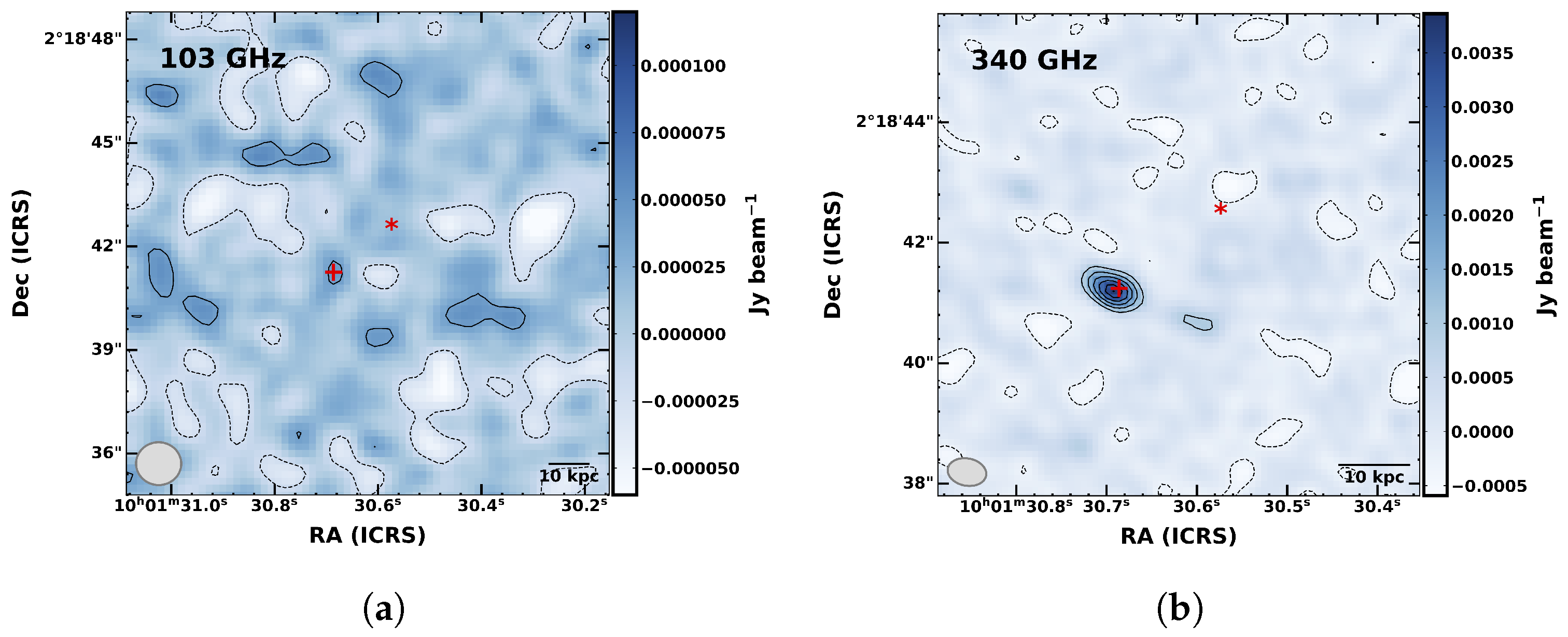
The band 3 continuum was imaged at 103 GHz using all spectral windows (spws; CASA parameter). There is a slight overlap between the two spws in the upper sideband, resulting in one of the spws to be centred on the expected frequency of the CO(3–2) emission line (denoted as spw0 in CASA) and the other spw covering a fraction of the line emission (denoted as spw1 CASA). In order to avoid contamination from CO emission to the continuum image, we only used line-free channels during imaging. The resulting continuum image is presented in Figure 2. The final band 3 continuum image has an rms of 20 μ Jy beam 1 .
The CO(3–2) line data were imaged without re-binning the native channel width and have an rms of 0.5 0.6 mJy beam 1 per 21.3 km s 1 velocity channel. Since the continuum rms level is much lower than the spectral channel rms, no continuum subtraction was performed. As the sources are very close to the centre of the primary beam, we did not apply primary beam correction.
The imaging of the band 7 data was carried out using “Briggs” weighting with a robust parameter of 2, a cleaning threshold of 4 σ , and masking based on the noise of the dirty image [30]. For the analysis, the primary beam-corrected image was used as the companion galaxy lies farther out from the phase centre. Based on the A 3 C O S M O S photometry catalogues [30], the final image has an rms of 0.3 mJy beam 1 . The beam sizes and rms noise values of the presented observations are summarised in Table 1.

2.3. SED Fitting

We model the spectral energy distribution (SED) of cid_1253 and its companion using the commonly used SED fitting code magphys with high-z extensions (publicly available at https://www.iap.fr/magphys/, accessed on 18 November 2025 [32,33]). magphys models the star formation history, dust attenuation, and metallicity of galaxies and adopts an energy balance technique to link the stellar emission with dust emission. The optical model library of the code is generated using the Bruzual and Charlot [34] population synthesis code, while dust attenuation is included via the two-component model of Charlot and Fall [35]. The infrared model library is computed by combining the infrared emission from stellar birth clouds and the ambient interstellar medium. The χ 2 goodness of fit parameter is calculated by comparing the observed flux densities with the model flux densities in each band. The main advantage of the magphys code is the consistent modelling of the ultraviolet-to-infrared SEDs of galaxies. However, it is not possible to control or fix the fitting parameters, and the effect of AGN on the SED is not included in the model.
For the SED fitting, we gathered photometry measurements from publicly available catalogues of the COSMOS field, namely the COSMOS2015 catalogue [23] and the “Super-deblended” photometry catalogue [36]. We only used observations where the system is resolved and its components can be separated, thus blended emission due to poor spatial resolution is not taken into account. The only exception to this is the Spitzer MIPS 24 μ m observation, where we used the “Super-deblended” photometry catalogue [36] to acquire separate measurements of the sources at this important wavelength, which traces emission absorbed and re-emitted by dust, originating from the accretion disk of AGN [37]. While this criterion limits the number of photometry points for the fit, especially at mid- and far-infrared wavelengths, it still enables a good estimation of the star formation history and stellar mass of the sources. In the case of the catalogue in [23], we used the AB magnitudes calculated for a 3 diameter aperture. In order to calculate the corrected AB magnitudes and flux densities of the sources, we followed the description in Appendix A.2. and Table 3 of [23]. The photometry measurements used for the SED fitting are presented in Table A1 in Appendix A.

3. Results

3.1. Continuum Emission

Compared with the results of [29], we did not detect band 3 continuum emission from either of the sources (Figure 2). One plausible explanation for this discrepancy is that during the continuum imaging, ref. [29] did not remove the CO(3–2) line contamination of one of the overlapping spectral windows, leading to a false detection. To test this scenario, we intentionally used the line-contaminated part of spw1 and re-imaged the continuum. This resulted in the same false detection (see Figure A1 in Appendix B). Thus we conclude that at the frequency of 103 GHz and at the achieved continuum sensitivity, both the AGN and its companion are undetected.
In contrast to band 3, the companion galaxy has a robust detection in band 7 at 340 GHz, while cid_1253 remains undetected. According to the A 3 C O S M O S photometry catalogues [30], the companion galaxy has a total 340 GHz flux density of 4.26 ± 0.45 m Jy in the primary beam-corrected image. Assuming a 3 σ upper limit for cid_1253 yields a flux density of < 0.9 m Jy . In band 7, the observed frequency samples close to the peak of the SED of the sources at their redshift, which is closely related to their dust content and star-forming activity. Based on the band 7 results, the companion galaxy dominates the 340 GHz frequency range, thus it is plausible that the majority of infrared emission detected by Herschel also originates from the companion, rather than cid_1253.

3.2. CO(3–2) Line Emission

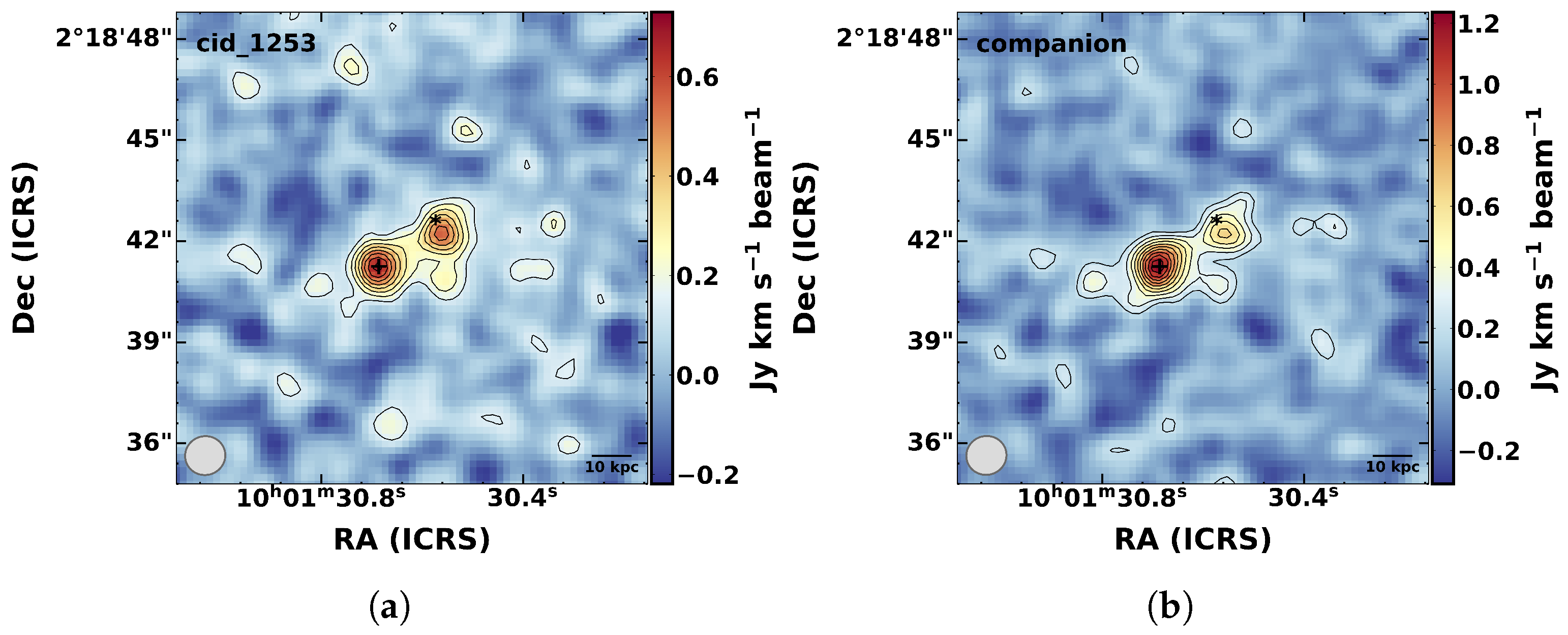
As expected from [29], we detect CO(3–2) line emission from two regions, one at the position of the AGN and one at a 2.19 distance from it, coincident with COSMOS2015 666121 (Figure 3). Based on the velocity integrated intensity (moment 0) maps of the sources, the 2 σ contours of cid_1253 include its companion galaxy, therefore in [29], the whole system was studied together. However, the sources separate at the 4 σ contours on the moment 0 maps, and we use these 4 σ contours to define polygon regions around the sources to extract their spectra from the line data cube and determine their line properties separately. To define extraction regions and extract the spectra, we used CARTA [38].
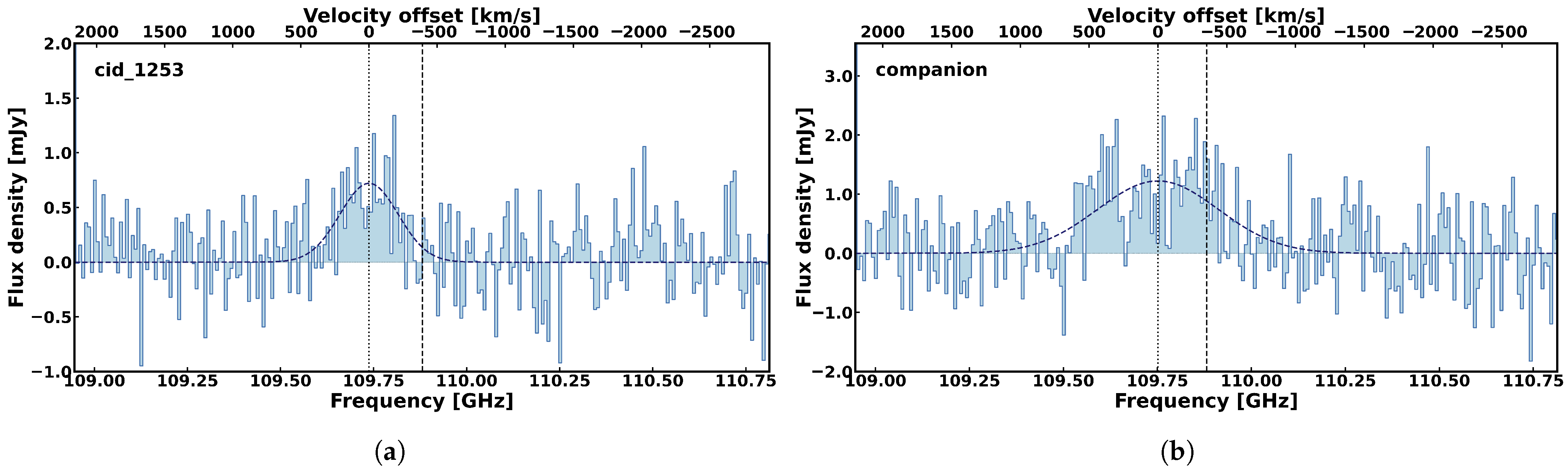
The line profile of cid_1253 is single-peaked, while the spectrum of the companion galaxy seems more complex with at least two peaks. These peaks might represent CO emission from different regions of the companion galaxy, but we do not have sufficient resolution and line sensitivity to confirm this. In order to simplify the fitting procedure and to be consistent with [29], we fitted the spectra of both sources with single Gaussian line profiles (Figure 4). Based on the fit results, the velocity integrated flux densities of cid_1253 and its companion are 0.386 ± 0.079 Jy km s 1 and 1.345 ± 0.220 Jy km s 1 , respectively. The CO(3–2) line profiles of the sources are quite broad with a full width at half maximum (FWHM) of 503 ± 78 km s 1 in the case of cid_1253 and 1033 ± 128 km s 1 in the case of the companion. The CO line profile of cid_1253 is shifted by ∼ 400 km s 1 with respect to the optical redshift of the AGN. The CO(3–2) line properties of the sources are summarised in Table 2.

3.3. SED Fitting Results

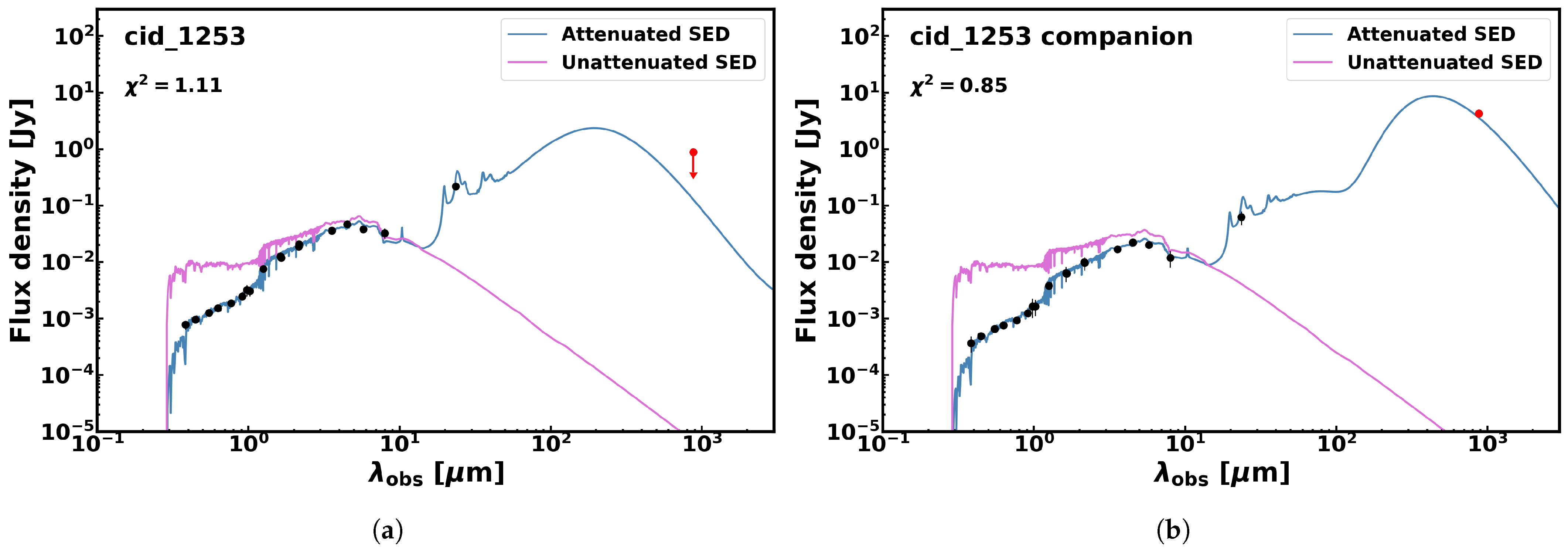
In spite of the lack of resolved far-infrared (FIR) measurements, magphys was able to provide a good fit to the observed data, obtaining a χ 2 of 1.11 and 0.85 for cid_1253 and its companion, respectively (Figure 5). The stellar mass and star formation rate of the system are estimated by the median of their likelihood distributions, while the 1 σ confidence range is approximated by the 16th–84th percentile range. Based on the best-fit magphys models, both sources have a moderate star formation rate (SFR) of ∼ 90 M yr 1 and a stellar mass of ∼ ( 1 2 ) × 10 11 M . These estimates are consistent with the results of [39] within their uncertainties. The magphys-estimated median stellar mass and star formation rate values are presented in Table 2.

4. Discussion

4.1. Molecular Gas Mass of the System

To estimate the relative contribution of the sources to the molecular gas mass of the system, we first derived the CO(3–2) line luminosities of the sources using the following equation:
L CO = 3.25 × 10 7 × S CO Δ V × ν obs 2 × D L 2 × ( 1 + z ) 3 ,
where S CO Δ V is the velocity integrated flux density in Jy km s 1 , ν obs is the frequency of the observation in GHz, and D L is the luminosity distance in Mpc [40]. The CO(3–2) line luminosities of cid_1253 and its companion are ( 0.9 ± 0.2 ) × 10 10 K km s 1 pc 2 and ( 3.4 ± 0.6 ) × 10 10 K km s 1 pc 2 , respectively. However, the conversion of CO(3–2) line luminosities to molecular gas masses is challenging as it requires multiple assumptions about the sources. In order to be consistent with [29], we adopted uniform assumptions for both sources and used the luminosity ratios of L CO ( 3 2 ) / L CO ( 1 0 ) = r 32 = 0.5 and assumed a CO H 2 conversion factor of 3.6 M ( K km s 1 pc 2 ) 1 , commonly used for high-redshift star-forming galaxies (e.g., [41,42,43,44]). This yields a molecular gas mass of ( 6.9 ± 1.4 ) × 10 10 M for cid_1253 and ( 24.1 ± 3.9 ) × 10 10 M for the companion. The estimated molecular gas mass of cid_1253 is comparable to that of quasars at similar redshifts (e.g., [14,29,45]), while the companion seems extremely gas-rich.
The sum of the calculated molecular gas masses is a bit lower than the value reported by [29], which is mainly due to the fact that the regions from where the spectra were extracted are smaller in our case and that there is CO emission at a lower significance level than 4 σ in both sources, which is not taken into account in our analysis. By extracting spectra in a similar manner as in [29], including emission at 2 σ levels and thus covering the whole system, the total line luminosity and molecular gas mass values are L CO ( 3 2 ) = ( 7.0 ± 0.9 ) × 10 10 K km s 1 pc 2 and M H 2 = ( 5.0 ± 0.7 ) × 10 11 M . These values are consistent within the uncertainties of their results.
However, it is important to note that depending on the adopted luminosity ratios and conversion factor, the obtained molecular gas masses can be vastly different. Assuming a luminosity ratio of L CO ( 3 2 ) / L CO ( 1 0 ) = r 32 = 0.97 , based on the value given for quasars and submillimetre galaxies in [46], and a CO H 2 conversion factor of 0.8 M ( K km s 1 pc 2 ) 1 , commonly used for starburst galaxies [40,46], the calculated molecular gas masses are lower by a factor of 8. This clearly demonstrates the flaws of deriving molecular gas masses in high-redshift galaxies, where information about their star formation conditions such as metallicity, pressure, and gas dynamics might not be available. While the exact amount of molecular gas mass cannot be determined due to these systematic uncertainties in such systems, the line luminosity ratios give a clue about the relative contribution to the total gas content of close galaxy pairs, which might undergo a merger event. In the studied system, the CO line luminosity of the companion galaxy is substantially larger, about 3.5 times that of cid_1253, implying that it has a larger contribution to the system’s molecular gas mass. Companions that are richer in cold molecular gas than their close AGN neighbour have been reported in several cases, implying that such a scenario is not rare and these gas-rich companions might be responsible for triggering the AGN through interactions [10,47,48,49,50].

4.2. Dust Emission and Star Formation

The companion galaxy is much fainter at optical wavelengths than cid_1253, but it has a prominent detection in ALMA band 7. This could be explained by high levels of dust obscuration and attenuation within the companion. Although dust mass estimation is included in magphys, the lack of resolved infrared observations makes it difficult to provide a good estimate. However, the dust emission at submm wavelengths is optically thin, and the observed continuum flux density is linearly dependent on the dust mass [51,52]. In the optically thin Rayleigh–Jeans tail of the FIR emission, M dust can be expressed as
M dust M = 5.7 × 10 7 × S ν obs mJy × ν obs 350 GHz ( β + 3 ) × ( 1 + z ) ( β + 4 ) × D L Gpc 2 × exp ( h ν r / k T d 1 ) ,
where S ν obs is the observed flux density at the frequency ν obs , ν r = ν obs ( 1 + z ) is the rest-frame frequency, β is the dust emissivity index, and T d is the dust temperature in K. Assuming a dust temperature of 35 K commonly found for high-z star-forming galaxies [53] and β = 1.8  [51], this yields a dust mass of ( 3.4 ± 0.4 ) × 10 8 M for the companion galaxy and imposes an upper limit of ≤ 7.2 × 10 7 M for the dust mass of cid_1253. The derived dust mass of the companion is within the average range found for high-z star-forming galaxies, while cid_1253 lies on the lower end of the dust mass distribution of such sources [53].
Given the robust submm detection of the companion, its implied dust mass, and the non-detection of cid_1253, it is possible that the majority of the Herschel-detected unresolved FIR emission of the system originates from the companion, rather than cid_1253. This would imply that the companion galaxy is not only more gas-rich than cid_1253, but it also has ongoing obscured star formation traced by dust emission.
This case highlights the need to be more cautious with blended sources before drawing our conclusions and the necessity of high-resolution observations. Studies of high-redshift AGN often rely on infrared observations taken by Herschel/SPIRE and JCMT/SCUBA to fit their SEDs and infer their physical properties. However, these observations do not have sufficient resolution to resolve close galaxy pairs; thus the contamination from unresolved sources cannot be neglected. Indeed, in a recent ALMA study, ref. [21] found that in a sample of 152 Herschel/SPIRE-detected quasars, about 35% showed multiplicity at submm wavelengths, and the multiplicity rate increased by a factor of ∼ 2.5 between z = 1 and 2.5 . Though the secondary counterparts do not have redshift information, it is likely that a fraction of these quasar–companion systems are interacting pairs.

5. Conclusions

We presented a case study of cid_1253 and its companion galaxy COSMOS2015 666121, using archive ALMA CO(3–2) and 340 GHz continuum observations. Previous ALMA studies of this system did not separate its components during their analyses and treated the system as a whole, in order to be consistent with the pre-ALMA era, large-beam infrared observations (e.g., Herschel SPIRE, Spitzer MIPS), which could not resolve the system but were used to construct its SED [29,39]. Hence, our goal was to study cid_1253 and its companion separately. With this aim, we re-analysed archive CO(3–2) observations and determined the relative contribution of the two galaxies to the total gas mass of the system. We found that the molecular gas mass of the companion is ∼ 3.5 times higher than that of cid_1253, and it has a much wider CO line profile. Using archive optical-to-infrared photometry, we fitted the SEDs of the sources with magphys and estimated their star formation rates and stellar and dust masses. Based on our analysis, the companion galaxy is not only more gas-rich but also has a higher dust mass, indicative of obscured star formation. This suggests that a large fraction of the Herschel-detected emission is associated with the companion, rather than cid_1253.
In the system of cid_1253, the sources have very similar CO redshifts, and the projected distance between them is quite small (∼ 18 kpc ), implying that they might be interacting. Moreover, the very broad FWHM of the companion galaxy could be a sign that this galaxy also harbours an AGN. However, the resolution and line sensitivity of the ALMA data and the available ancillary data do not allow us to further investigate these scenarios. Follow-up higher-resolution observations tracing both dust emission closer to the peak of the SED and the dynamics of the molecular gas are needed to fully characterise this system. Such observations with a bigger, statistically meaningful sample would help us to reveal how and when massive elliptical galaxies grew their stellar mass and what kind of galaxies their progenitors were.

Author Contributions

Conceptualisation, J.F.; methodology, J.F.; validation, J.F. and K.P.; formal analysis, J.F.; writing—original draft preparation, J.F.; writing—review and editing, K.P.; visualisation, J.F. All authors have read and agreed to the published version of the manuscript.

Funding

This research was funded by the Hungarian National Research, Development and Innovation Office (NKFIH), grant number OTKA PD146947.

Data Availability Statement

The data presented in this study are publicly available in the ALMA Science Archive and in the Strasbourg astronomical Data Centre.

Acknowledgments

The authors acknowledge the anonymous reviewers for their helpful suggestions, which improved the manuscript. J. F. thanks Sándor Frey for reading and commenting on the manuscript and Kirsten Knudsen for her useful suggestions. The authors acknowledge assistance from Allegro, the European ALMA Regional Center node in the Netherlands. This paper makes use of the following ALMA data: ADS/JAO.ALMA#2011.0.00097.S and ADS/JAO.ALMA#2016.1.00798.S. ALMA is a partnership of ESO (representing its member states), NSF (USA), and NINS (Japan), together with NRC (Canada), NSTC and ASIAA (Taiwan), and KASI (Republic of Korea), in cooperation with the Republic of Chile. The Joint ALMA Observatory is operated by ESO, AUI/NRAO, and NAOJ. This study was based on data products from observations made with ESO Telescopes at the La Silla Paranal Observatory under ESO programme ID 179.A-2005 and on data products produced by TERAPIX and the Cambridge Astronomy Survey Unit on behalf of the UltraVISTA consortium.

Conflicts of Interest

The authors declare no conflicts of interest.

Abbreviations

The following abbreviations are used in this manuscript:
AGNactive galactic nucleus
ALMAAtacama Large Millimeter/submillimeter Array
CASACommon Astronomy Software Applications
FIRfar-infrared
FWHMfull width at half maximum
SEDspectral energy distribution
SFRstar formation rate
SPWspectral window
SUBMMsubmillimetre
VLAKarl G. Jansky Very Large Array

Appendix A. Multi-Wavelength Photometry of cid_1253 and Its Companion Galaxy

Table A1. Photometry of cid_1253 and its companion galaxy COSMOS2015 666121.
cid_1253COSMOS2015 666121
Filter NameAB MagnitudeFlux Density ( μ Jy ) 1AB MagnitudeFlux Density ( μ Jy ) 1
CFHT/Megacam u 24.449 ± 0.058 0.78 ± 0.14 25.129 ± 0.104 0.37 ± 0.12
Subaru/Suprime B 24.353 ± 0.051 0.95 ± 0.08 24.931 ± 0.071 0.49 ± 0.06
Subaru/Suprime V 23.775 ± 0.051 1.26 ± 0.11 24.334 ± 0.069 0.66 ± 0.08
Subaru/Suprime r 23.656 ± 0.039 1.54 ± 0.09 24.279 ± 0.056 0.76 ± 0.07
Subaru/Suprime i + 23.458 ± 0.034 1.88 ± 0.10 24.075 ± 0.050 0.94 ± 0.07
Subaru / Suprime z + + 23.038 ± 0.035 2.49 ± 0.23 23.644 ± 0.058 1.26 ± 0.19
HSC/Subaru Y 22.822 ± 0.092 3.23 ± 0.74 23.416 ± 0.151 1.65 ± 0.62
VISTA Y 22.886 ± 0.069 3.09 ± 0.63 23.434 ± 0.109 1.64 ± 0.53
VISTA J 21.924 ± 0.032 7.56 ± 0.64 22.528 ± 0.053 3.82 ± 0.54
CFHT/WIRCAM H 21.307 ± 0.062 12.70 ± 2.33 21.921 ± 0.104 6.36 ± 1.95
VISTA H 21.463 ± 0.0283 11.91 ± 0.90 22.024 ± 0.045 6.26 ± 0.76
VISTA K s 20.908 ± 0.025 18.80 ± 1.13 21.453 ± 0.039 10.03 ± 0.94
CFHT/WIRCAM K s 20.877 ± 0.049 20.60 ± 3.13 21.558 ± 0.086 9.70 ± 2.62
Spitzer/IRAC 3.6 μ m 20.181 ± 0.006 35.80 ± 0.19 20.858 ± 0.005 16.92 ± 0.08
Spitzer/IRAC 4.5 μ m 19.905 ± 0.006 47.0 ± 0.26 20.572 ± 0.006 22.40 ± 0.12
Spitzer/IRAC 5.8 μ m 20.076 ± 0.117 38.1 ± 4.09 20.636 ± 0.141 20.05 ± 2.60
Spitzer/IRAC 8.0 μ m 20.282 ± 0.219 32.57 ± 6.56 21.237 ± 0.349 11.91 ± 3.83
Spitzer/MIPS 24 μ m 220.75 ± 10.93 62.73 ± 16.95
ALMA 870 μ m <891 2 4256.3 ± 446.0
1 Photometric corrections are applied to the presented flux density values. 2 In the case of non-detection, 3 σ upper limit is given.

Appendix B. Line Contamination to the Band 3 Continuum
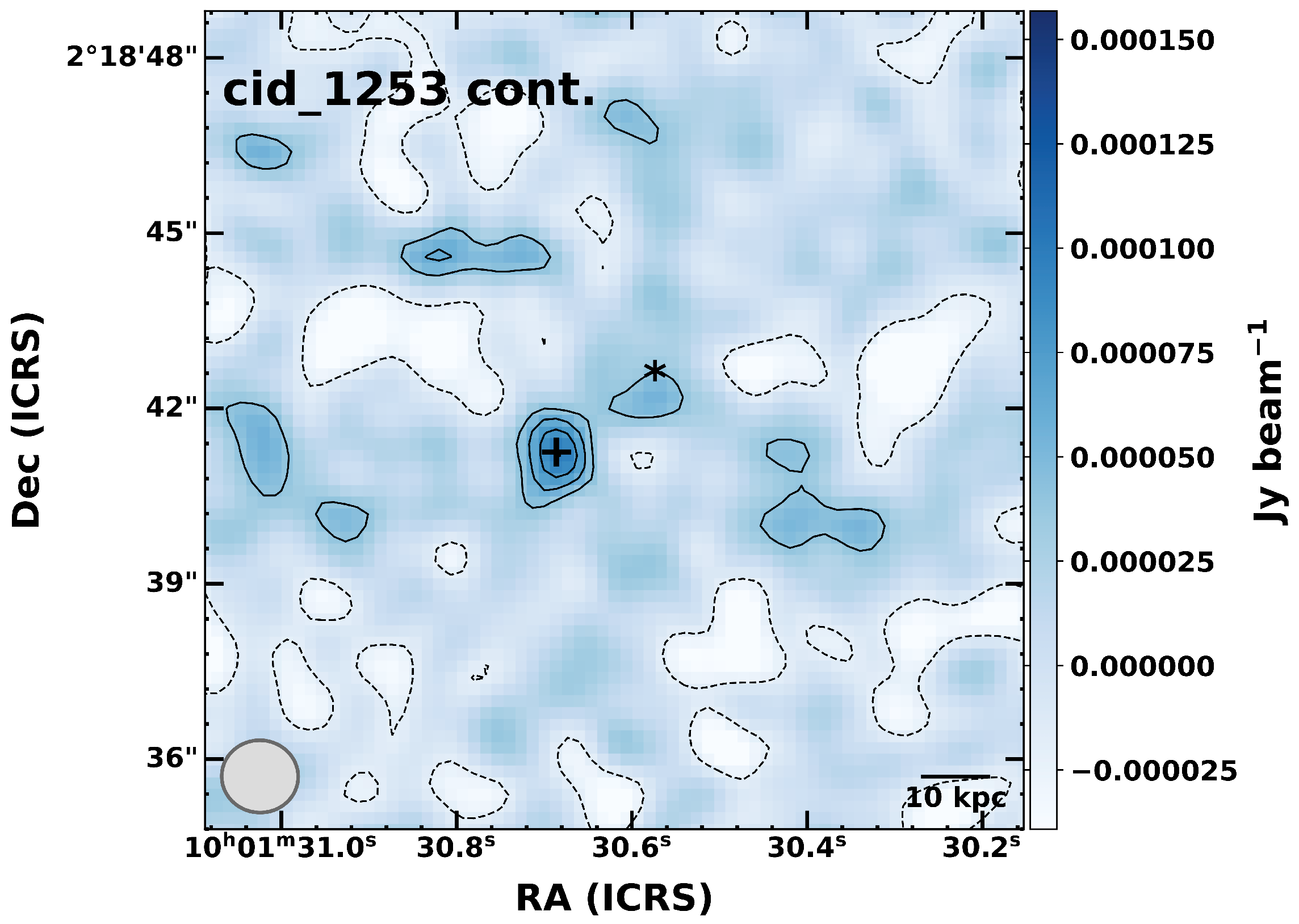
Figure A1. ALMA band 3 line-contaminated continuum image of cid_1253 and its companion galaxy COSMOS2015 666121. The contour levels are at ( 1 , 2 , 3 , 4 , 6 ) σ , where σ = 20 μ Jy beam 1 . Negative contours are shown with dotted contours. The star and cross mark the optical position of cid_1253 and its companion, respectively.
Universe 12 00023 g0a1

References

  1. Fabian, A.C. Observational Evidence of Active Galactic Nuclei Feedback. Annu. Rev. Astron. Astrophys. 2012, 50, 455–489. [Google Scholar] [CrossRef]
  2. Harrison, C.M.; Costa, T.; Tadhunter, C.N.; Flütsch, A.; Kakkad, D.; Perna, M.; Vietri, G. AGN outflows and feedback twenty years on. Nat. Astron. 2018, 2, 198–205. [Google Scholar] [CrossRef]
  3. Harrison, C.M.; Ramos Almeida, C. Observational Tests of Active Galactic Nuclei Feedback: An Overview of Approaches and Interpretation. Galaxies 2024, 12, 17. [Google Scholar] [CrossRef]
  4. Glikman, E.; Simmons, B.; Mailly, M.; Schawinski, K.; Urry, C.M.; Lacy, M. Major Mergers Host the Most-luminous Red Quasars at z ~ 2: A Hubble Space Telescope WFC3/IR Study. Astrophys. J. 2015, 806, 218. [Google Scholar] [CrossRef]
  5. Moreno, J.; Torrey, P.; Ellison, S.L.; Patton, D.R.; Hopkins, P.F.; Bueno, M.; Hayward, C.C.; Narayanan, D.; Kereš, D.; Bluck, A.F.L.; et al. Interacting galaxies on FIRE-2: The connection between enhanced star formation and interstellar gas content. Mon. Not. R. Astron. Soc. 2019, 485, 1320–1338. [Google Scholar] [CrossRef]
  6. Sparre, M.; Whittingham, J.; Damle, M.; Hani, M.H.; Richter, P.; Ellison, S.L.; Pfrommer, C.; Vogelsberger, M. Gas flows in galaxy mergers: Supersonic turbulence in bridges, accretion from the circumgalactic medium, and metallicity dilution. Mon. Not. R. Astron. Soc. 2022, 509, 2720–2735. [Google Scholar] [CrossRef]
  7. Stacey, H.R.; Arrigoni Battaia, F. Luck of the Irish? A companion of the Cloverleaf connected by a bridge of molecular gas. Mon. Not. R. Astron. Soc. 2022, 517, L11–L15. [Google Scholar] [CrossRef]
  8. Breiding, P.; Chiaberge, M.; Lambrides, E.; Meyer, E.T.; Willner, S.P.; Hilbert, B.; Haas, M.; Miley, G.; Perlman, E.S.; Barthel, P.; et al. Powerful Radio-loud Quasars Are Triggered by Galaxy Mergers in the Cosmic Bright Ages. Astrophys. J. 2024, 963, 91. [Google Scholar] [CrossRef]
  9. Comerford, J.M.; Nevin, R.; Negus, J.; Barrows, R.S.; Eracleous, M.; Müller-Sánchez, F.; Roy, N.; Stemo, A.; Storchi-Bergmann, T.; Wylezalek, D. An Excess of Active Galactic Nuclei Triggered by Galaxy Mergers in MaNGA Galaxies of Stellar Mass ∼1011 M . Astrophys. J. 2024, 963, 53. [Google Scholar] [CrossRef]
  10. Wang, W.; De Breuck, C.; Wylezalek, D.; Lehnert, M.D.; Faisst, A.L.; Vayner, A.; Nesvadba, N.; Vernet, J.; Kukreti, P.; Stern, D. Gas-poor Hosts and Gas-rich Companions of z ≈ 3.5 Radio Active Galactic Nuclei: ALMA Insights into Jet Triggering and Feedback. Astrophys. J. Lett. 2025, 987, L37. [Google Scholar] [CrossRef]
  11. Molyneux, S.J.; Calistro Rivera, G.; De Breuck, C.; Harrison, C.M.; Mainieri, V.; Lundgren, A.; Kakkad, D.; Circosta, C.; Girdhar, A.; Costa, T.; et al. The Quasar Feedback Survey: Characterizing CO excitation in quasar host galaxies. Mon. Not. R. Astron. Soc. 2024, 527, 4420–4439. [Google Scholar] [CrossRef]
  12. Xu, F.; Wang, R.; Li, J.; Neri, R.; Pensabene, A.; Decarli, R.; Shao, Y.; Bañados, E.; Cox, P.; Bertoldi, F.; et al. Constraining the Excitation of Molecular Gas in Two Quasar-starburst Systems at z ∼ 6. Astrophys. J. 2024, 977, 190. [Google Scholar] [CrossRef]
  13. Audibert, A.; Ramos Almeida, C.; García-Burillo, S.; Speranza, G.; Lamperti, I.; Pereira-Santaella, M.; Panessa, F. Molecular gas excitation and outflow properties of obscured quasars at z ∼ 0.1. Astron. Astrophys. 2025, 699, A83. [Google Scholar] [CrossRef]
  14. Bischetti, M.; Feruglio, C.; Piconcelli, E.; Duras, F.; Pérez-Torres, M.; Herrero, R.; Venturi, G.; Carniani, S.; Bruni, G.; Gavignaud, I.; et al. The WISSH quasars project. IX. Cold gas content and environment of luminous QSOs at z ∼ 2.4–4.7. Astron. Astrophys. 2021, 645, A33. [Google Scholar] [CrossRef]
  15. Fossati, M.; Fumagalli, M.; Lofthouse, E.K.; Dutta, R.; Cantalupo, S.; Arrigoni Battaia, F.; Fynbo, J.P.U.; Lusso, E.; Murphy, M.T.; Prochaska, J.X.; et al. MUSE analysis of gas around galaxies (MAGG)—III. The gas and galaxy environment of z = 3–4.5 quasars. Mon. Not. R. Astron. Soc. 2021, 503, 3044–3064. [Google Scholar] [CrossRef]
  16. Fogasy, J.; Knudsen, K.K.; Varenius, E. VLA detects CO(1-0) emission in the z = 3.65 quasar SDSS J160705+533558. Astron. Astrophys. 2022, 660, A60. [Google Scholar] [CrossRef]
  17. García-Vergara, C.; Rybak, M.; Hodge, J.; Hennawi, J.F.; Decarli, R.; González-López, J.; Arrigoni-Battaia, F.; Aravena, M.; Farina, E.P. ALMA Reveals a Large Overdensity and Strong Clustering of Galaxies in Quasar Environments at z ~ 4. Astrophys. J. 2022, 927, 65. [Google Scholar] [CrossRef]
  18. Fuentealba-Fuentes, M.; Lira, P.; Díaz-Santos, T.; Trakhtenbrot, B.; Netzer, H.; Videla, L. Study of the ∼50 kpc circumgalactic environment around the merger system J2057-0030 at z ∼ 4.6 using ALMA. Astron. Astrophys. 2024, 687, A62. [Google Scholar] [CrossRef]
  19. Liu, F.Y.; Dai, Y.S.; Omont, A.; Liu, D.; Cox, P.; Neri, R.; Krips, M.; Yang, C.; Wu, X.B.; Huang, J.S. Dust and Cold Gas Properties of Starburst HyLIRG Quasars at z ∼ 2.5. Astrophys. J. 2024, 964, 136. [Google Scholar] [CrossRef]
  20. Pensabene, A.; Cantalupo, S.; Cicone, C.; Decarli, R.; Galbiati, M.; Ginolfi, M.; de Beer, S.; Fossati, M.; Fumagalli, M.; Lazeyras, T.; et al. ALMA survey of a massive node of the Cosmic Web at z ∼ 3. I. Discovery of a large overdensity of CO emitters. Astron. Astrophys. 2024, 684, A119. [Google Scholar] [CrossRef]
  21. Hatziminaoglou, E.; Messias, H.; Souza, R.; Borkar, A.; Farrah, D.; Feltre, A.; Magdis, G.; Pitchford, L.K.; Pérez-Fournon, I. An ALMA Band 7 survey of SDSS/Herschel quasars in Stripe 82: I. The properties of the 870 micron counterparts. Astron. Astrophys. 2025, 702, A183. [Google Scholar] [CrossRef]
  22. Wang, W.; De Breuck, C.; Wylezalek, D.; Vernet, J.; Lehnert, M.D.; Stern, D.; Rupke, D.S.N.; Nesvadba, N.P.H.; Vayner, A.; Zakamska, N.L.; et al. JWST + ALMA ubiquitously discover companion systems within ≲18 kpc around four z ≈ 3.5 luminous radio-loud AGN. Astron. Astrophys. 2025, 696, A88. [Google Scholar] [CrossRef]
  23. Laigle, C.; McCracken, H.J.; Ilbert, O.; Hsieh, B.C.; Davidzon, I.; Capak, P.; Hasinger, G.; Silverman, J.D.; Pichon, C.; Coupon, J.; et al. The COSMOS2015 Catalog: Exploring the 1 < z < 6 Universe with Half a Million Galaxies. Astrophys. J. Suppl. Ser. 2016, 224, 24. [Google Scholar] [CrossRef]
  24. Marchesi, S.; Civano, F.; Elvis, M.; Salvato, M.; Brusa, M.; Comastri, A.; Gilli, R.; Hasinger, G.; Lanzuisi, G.; Miyaji, T.; et al. The Chandra COSMOS Legacy survey: Optical/IR identifications. Astrophys. J. 2016, 817, 34. [Google Scholar] [CrossRef]
  25. Elvis, M.; Civano, F.; Vignali, C.; Puccetti, S.; Fiore, F.; Cappelluti, N.; Aldcroft, T.L.; Fruscione, A.; Zamorani, G.; Comastri, A.; et al. The Chandra COSMOS Survey. I. Overview and Point Source Catalog. Astrophys. J. Suppl. Ser. 2009, 184, 158–171. [Google Scholar] [CrossRef]
  26. Civano, F.; Marchesi, S.; Comastri, A.; Urry, M.C.; Elvis, M.; Cappelluti, N.; Puccetti, S.; Brusa, M.; Zamorani, G.; Hasinger, G.; et al. The Chandra Cosmos Legacy Survey: Overview and Point Source Catalog. Astrophys. J. 2016, 819, 62. [Google Scholar] [CrossRef]
  27. Schinnerer, E.; Sargent, M.T.; Bondi, M.; Smolčić, V.; Datta, A.; Carilli, C.L.; Bertoldi, F.; Blain, A.; Ciliegi, P.; Koekemoer, A.; et al. The VLA-COSMOS Survey. IV. Deep Data and Joint Catalog. Astrophys. J. Suppl. Ser. 2010, 188, 384–404. [Google Scholar] [CrossRef]
  28. Smolčić, V.; Novak, M.; Bondi, M.; Ciliegi, P.; Mooley, K.P.; Schinnerer, E.; Zamorani, G.; Navarrete, F.; Bourke, S.; Karim, A.; et al. The VLA-COSMOS 3 GHz Large Project: Continuum data and source catalog release. Astron. Astrophys. 2017, 602, A1. [Google Scholar] [CrossRef]
  29. Circosta, C.; Mainieri, V.; Lamperti, I.; Padovani, P.; Bischetti, M.; Harrison, C.M.; Kakkad, D.; Zanella, A.; Vietri, G.; Lanzuisi, G.; et al. SUPER. IV. CO(J = 3-2) properties of active galactic nucleus hosts at cosmic noon revealed by ALMA. Astron. Astrophys. 2021, 646, A96. [Google Scholar] [CrossRef]
  30. Liu, D.; Lang, P.; Magnelli, B.; Schinnerer, E.; Leslie, S.; Fudamoto, Y.; Bondi, M.; Groves, B.; Jiménez-Andrade, E.; Harrington, K.; et al. Automated Mining of the ALMA Archive in the COSMOS Field (A3COSMOS). I. Robust ALMA Continuum Photometry Catalogs and Stellar Mass and Star Formation Properties for ∼700 Galaxies at z = 0.5–6. Astrophys. J. Suppl. Ser. 2019, 244, 40. [Google Scholar] [CrossRef]
  31. McMullin, J.P.; Waters, B.; Schiebel, D.; Young, W.; Golap, K. CASA Architecture and Applications. In Astronomical Data Analysis Software and Systems XVI, Proceedings of the 16th Annual Conference on Astronomical Data Analysis Software and Systems (ADASS XVI), Tucson, AZ, USA, 15–18 October 2007; Shaw, R.A., Hill, F., Bell, D.J., Eds.; Astronomical Society of the Pacific Conference Series; Astronomical Society of the Pacific: San Francisco, CA, USA, 2007; Volume 376, p. 127. [Google Scholar]
  32. da Cunha, E.; Charlot, S.; Elbaz, D. A simple model to interpret the ultraviolet, optical and infrared emission from galaxies. Mon. Not. R. Astron. Soc. 2008, 388, 1595–1617. [Google Scholar] [CrossRef]
  33. da Cunha, E.; Walter, F.; Smail, I.R.; Swinbank, A.M.; Simpson, J.M.; Decarli, R.; Hodge, J.A.; Weiss, A.; van der Werf, P.P.; Bertoldi, F.; et al. An ALMA Survey of Sub-millimeter Galaxies in the Extended Chandra Deep Field South: Physical Properties Derived from Ultraviolet-to-radio Modeling. Astrophys. J. 2015, 806, 110. [Google Scholar] [CrossRef]
  34. Bruzual, G.; Charlot, S. Stellar population synthesis at the resolution of 2003. Mon. Not. R. Astron. Soc. 2003, 344, 1000–1028. [Google Scholar] [CrossRef]
  35. Charlot, S.; Fall, S.M. A Simple Model for the Absorption of Starlight by Dust in Galaxies. Astrophys. J. 2000, 539, 718–731. [Google Scholar] [CrossRef]
  36. Jin, S.; Daddi, E.; Liu, D.; Smolčić, V.; Schinnerer, E.; Calabrò, A.; Gu, Q.; Delhaize, J.; Delvecchio, I.; Gao, Y.; et al. “Super-deblended” Dust Emission in Galaxies. II. Far-IR to (Sub)millimeter Photometry and High-redshift Galaxy Candidates in the Full COSMOS Field. Astrophys. J. 2018, 864, 56. [Google Scholar] [CrossRef]
  37. Padovani, P.; Alexander, D.M.; Assef, R.J.; De Marco, B.; Giommi, P.; Hickox, R.C.; Richards, G.T.; Smolčić, V.; Hatziminaoglou, E.; Mainieri, V.; et al. Active galactic nuclei: What’s in a name? Astron. Astrophys. Rev. 2017, 25, 2. [Google Scholar] [CrossRef]
  38. Comrie, A.; Wang, K.S.; Hwang, Y.H.; Pińska, A.; Harris, P.; Raul-Omar, C.; Hou, K.C.; Aikema, D.; Chiang, C.C.; Ming-Yi, L.; et al. CARTA: The Cube Analysis and Rendering Tool for Astronomy. Zenodo 2025. [Google Scholar] [CrossRef]
  39. Circosta, C.; Mainieri, V.; Padovani, P.; Lanzuisi, G.; Salvato, M.; Harrison, C.M.; Kakkad, D.; Puglisi, A.; Vietri, G.; Zamorani, G.; et al. SUPER. I. Toward an unbiased study of ionized outflows in z ∼ 2 active galactic nuclei: Survey overview and sample characterization. Astron. Astrophys. 2018, 620, A82. [Google Scholar] [CrossRef]
  40. Solomon, P.M.; Vanden Bout, P.A. Molecular Gas at High Redshift. Annu. Rev. Astron. Astrophys. 2005, 43, 677–725. [Google Scholar] [CrossRef]
  41. Daddi, E.; Bournaud, F.; Walter, F.; Dannerbauer, H.; Carilli, C.L.; Dickinson, M.; Elbaz, D.; Morrison, G.E.; Riechers, D.; Onodera, M.; et al. Very High Gas Fractions and Extended Gas Reservoirs in z = 1.5 Disk Galaxies. Astrophys. J. 2010, 713, 686–707. [Google Scholar] [CrossRef]
  42. Kakkad, D.; Mainieri, V.; Brusa, M.; Padovani, P.; Carniani, S.; Feruglio, C.; Sargent, M.; Husemann, B.; Bongiorno, A.; Bonzini, M.; et al. ALMA observations of cold molecular gas in AGN hosts at z ∼ 1.5—Evidence of AGN feedback? Mon. Not. R. Astron. Soc. 2017, 468, 4205–4215. [Google Scholar] [CrossRef]
  43. Aravena, M.; Decarli, R.; Gónzalez-López, J.; Boogaard, L.; Walter, F.; Carilli, C.; Popping, G.; Weiss, A.; Assef, R.J.; Bacon, R.; et al. The ALMA Spectroscopic Survey in the Hubble Ultra Deep Field: Evolution of the Molecular Gas in CO-selected Galaxies. Astrophys. J. 2019, 882, 136. [Google Scholar] [CrossRef]
  44. Cassata, P.; Liu, D.; Groves, B.; Schinnerer, E.; Ibar, E.; Sargent, M.; Karim, A.; Talia, M.; Fèvre, O.L.; Tasca, L.; et al. ALMA Reveals the Molecular Gas Properties of Five Star-forming Galaxies across the Main Sequence at 3. Astrophys. J. 2020, 891, 83. [Google Scholar] [CrossRef]
  45. Li, J.; Emonts, B.H.C.; Cai, Z.; Li, J.; Battaia, F.A.; Prochaska, J.X.; Yoon, I.; Lehnert, M.D.; Sarazin, C.; Wu, Y.; et al. The SUPERCOLD-CGM Survey. I. Probing the Extended CO(4-3) Emission of the Circumgalactic Medium in a Sample of 10 Enormous Lyα Nebulae at z ∼ 2. Astrophys. J. 2023, 950, 180. [Google Scholar] [CrossRef]
  46. Carilli, C.L.; Walter, F. Cool Gas in High-Redshift Galaxies. Annu. Rev. Astron. Astrophys. 2013, 51, 105–161. [Google Scholar] [CrossRef]
  47. Riechers, D.A. SMM J04135+10277: A Candidate Early-stage “Wet-Dry” Merger of Two Massive Galaxies at z = 2.8. Astrophys. J. Lett. 2013, 765, L31. [Google Scholar] [CrossRef]
  48. Fogasy, J.; Knudsen, K.K.; Drouart, G.; Lagos, C.D.P.; Fan, L. SMM J04135+10277: A distant QSO-starburst system caught by ALMA. Mon. Not. R. Astron. Soc. 2020, 493, 3744–3756. [Google Scholar] [CrossRef]
  49. Lee, K.; Kohno, K.; Hatsukade, B.; Egusa, F.; Yamashita, T.; Schramm, M.; Ichikawa, K.; Imanishi, M.; Izumi, T.; Nagao, T.; et al. Massive Molecular Gas Companions Uncovered by Very Large Array CO(1-0) Observations of the z = 5.2 Radio Galaxy TN J0924-2201. Astrophys. J. 2023, 944, 35. [Google Scholar] [CrossRef]
  50. Pensabene, A.; Cantalupo, S.; Wang, W.; Bacchini, C.; Fraternali, F.; Bischetti, M.; Cicone, C.; Decarli, R.; Pezzulli, G.; Galbiati, M.; et al. ALMA survey of a massive node of the Cosmic Web at z ∼ 3: II. A dynamically cold and massive disk galaxy in the proximity of a hyper-luminous quasar. Astron. Astrophys. 2025, 701, A120. [Google Scholar] [CrossRef]
  51. Scoville, N.; Aussel, H.; Sheth, K.; Scott, K.S.; Sanders, D.; Ivison, R.; Pope, A.; Capak, P.; Vanden Bout, P.; Manohar, S.; et al. The Evolution of Interstellar Medium Mass Probed by Dust Emission: ALMA Observations at z = 0.3–2. Astrophys. J. 2014, 783, 84. [Google Scholar] [CrossRef]
  52. Wiklind, T.; Conselice, C.J.; Dahlen, T.; Dickinson, M.E.; Ferguson, H.C.; Grogin, N.A.; Guo, Y.; Koekemoer, A.M.; Mobasher, B.; Mortlock, A.; et al. Properties of Submillimeter Galaxies in the CANDELS GOODS-South Field. Astrophys. J. 2014, 785, 111. [Google Scholar] [CrossRef]
  53. Traina, A.; Magnelli, B.; Gruppioni, C.; Delvecchio, I.; Parente, M.; Calura, F.; Bisigello, L.; Feltre, A.; Pozzi, F.; Vallini, L. A3COSMOS: Dust mass function and dust mass density at 0.5 <z <6. Astron. Astrophys. 2024, 690, A84. [Google Scholar] [CrossRef]
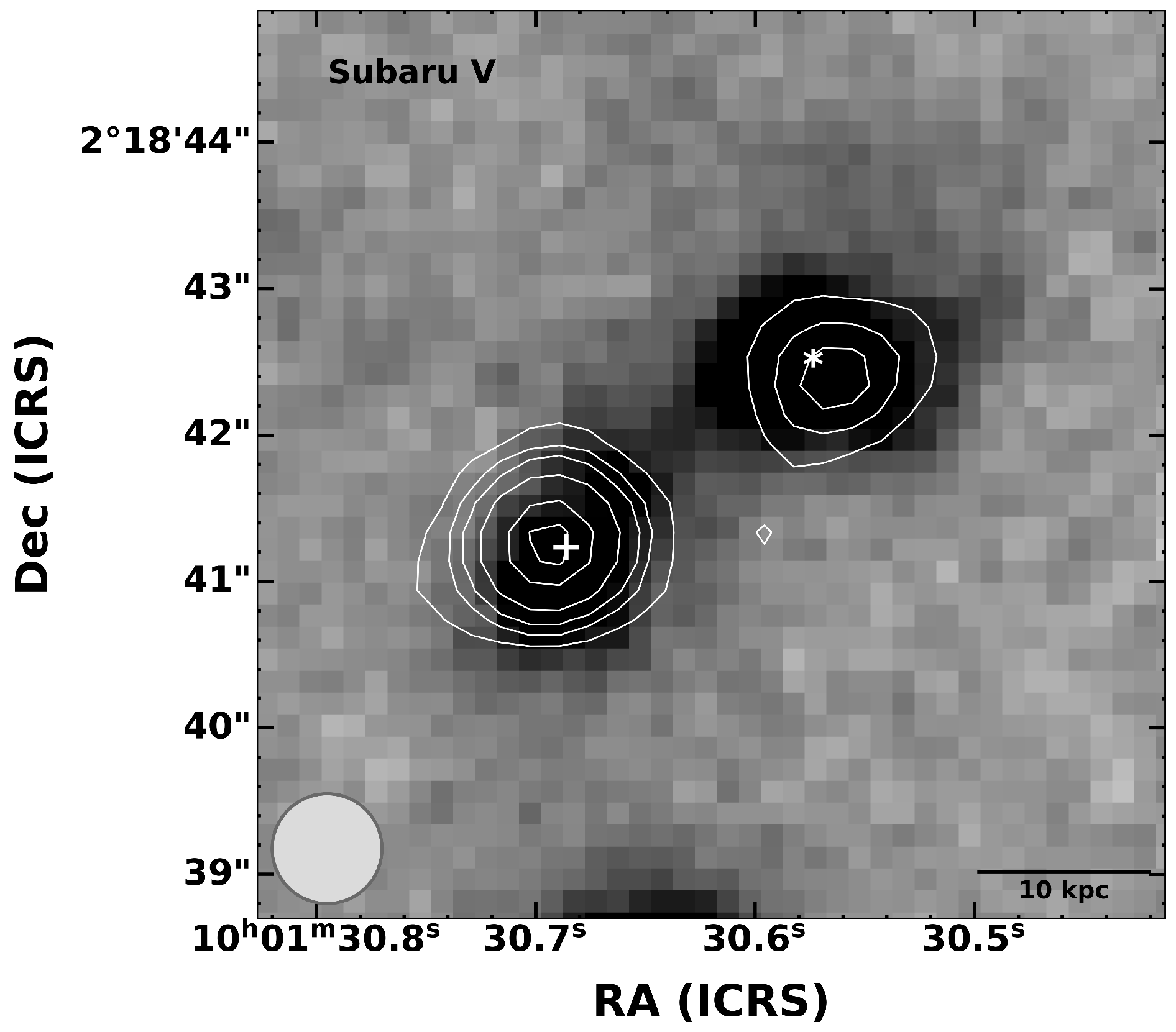
Figure 1. Subaru V-band image of cid_1253 and its companion galaxy COSMOS2015 666121. The white contours show the VLA 3 GHz detection of the sources. The contour levels are at ( 3 , 6 , 9 , 15 , 27 , 36 ) σ , where σ = 2.29 μ Jy . The star and the cross mark the optical position of cid_1253 and its companion, respectively.
Universe 12 00023 g001
Figure 2. ALMA continuum images of cid_1253 and its companion galaxy. (a) 103 GHz continuum image obtained by combining all spectral windows while excluding channels containing line emission. The contours are at ( 1 , 2 , 3 ) σ levels, where σ = 20 μ Jy beam 1 . (b) 340 GHz continuum image. The contour levels are at ( 1 , 3 , 5 , 7 , 9 , 11 , 12.5 ) σ , where σ = 0.3 mJy beam 1 . On all panels, the dotted contours represent negative contours at 1 σ , the beam size is indicated as a grey ellipse in the bottom left corner, and the star and cross mark the optical position of cid_1253 and its companion, respectively.
Universe 12 00023 g002
Figure 3. CO emission of cid_1253 and its companion galaxy. (a) Integrated intensity (moment 0) map of cid_1253. The contour levels start at 2 σ and increase in steps of 1 σ , where σ = 0.073 Jy beam 1 km s 1 . The moment 0 map is integrated over the frequency range of 109.64 109.86 GHz . (b) Integrated intensity (moment 0) map of the companion galaxy. The contour levels start at 2 σ , where σ = 0.103 Jy beam 1 km s 1 , and increase in steps of 1 σ . The moment 0 map is integrated over the frequency range of 109.52 109.97 GHz . The star and cross mark the optical position of cid_1253 and its companion, respectively. The beam size is indicated as a grey ellipse in the bottom left corner.
Universe 12 00023 g003
Figure 4. CO(3–2) emission line spectra of the sources. (a) CO(3–2) spectrum of cid_1253. (b) CO(3–2) spectrum of the companion galaxy. The spectra are binned to 21.3 km s 1 per channel. The blue dashed curves show the Gaussian fits to the line profiles. The vertical dashed line indicates the optical redshift of cid_1253 ( z = 2.147 ). The vertical dotted line indicates the CO(3–2) redshift of the sources obtained from the Gaussian fits. The top axis shows the relative velocity offset with respect to the fitted CO(3–2) redshift of the sources.
Universe 12 00023 g004
Figure 5. The spectral energy distributions of the sources. (a) SED of cid_1253. (b) SED of the companion galaxy. Black dots mark the measured flux densities of the sources, while the blue and pink curves show the attenuated and unattenuated magphys-fitted SEDs. The ALMA band 7 measurement is highlighted in red. Upper limits and error bars are indicated.
Universe 12 00023 g005
Table 1. Details of the presented observations.
Observing BandObserving Frequency (GHz)Beam Size ( ) rms ( mJy beam 1 )
Band 3103 1.31 × 1.24 0.020
Band 7340 0.65 × 0.45 0.3
Band 3 (CO line)109 1.19 × 1.15   1 0.5 0.6  2
1 In the case of the CO(3–2) line data, the median beam is presented. 2 Corresponding to 1 σ rms per 21.3 km s 1 velocity channel.
Table 2. ALMA continuum flux densities, CO(3–2) line properties, and magphys-fitted values of cid_1253 and its companion galaxy COSMOS2015 666121.
cid_1253COSMOS2015 666121
S 103 GHz ( μ Jy beam 1 ) 1<60<60
S 340 GHz ( mJy beam 1 ) 1< 0.9 4.26 ± 0.45
S Δ V CO ( 3 2 ) ( Jy km s 1 ) 0.386 ± 0.079 1.345 ± 0.220
FWHM ( km s 1 ) 503 ± 78 1033 ± 128
z CO ( 3 2 ) 2.1511 + 0.0004 2.1507 + 0.0006
L CO ( 3 2 ) ( 10 10 K km s 1 pc 2 ) 0.9 ± 0.2 3.4 ± 0.6
M H 2 ( 10 10 M ) 2 6.9 ± 1.4 24.1 ± 3.9
M dust ( 10 8 M ) 3< 0.7 3.4 ± 0.4
M ( 10 11 M ) 2.0 0.3 + 0.2 1.2 0.3 + 0.1
S F R ( M yr 1 ) 89 10 + 12 93 8 + 20
1 In the case of non-detection, 3 σ upper limits are given. 2 A conversion factor of α = 3.6 M ( K km s 1 pc 2 ) 1 was used to calculate the molecular gas mass. 3 M dust is calculated based on Equation (2).
Disclaimer/Publisher’s Note: The statements, opinions and data contained in all publications are solely those of the individual author(s) and contributor(s) and not of MDPI and/or the editor(s). MDPI and/or the editor(s) disclaim responsibility for any injury to people or property resulting from any ideas, methods, instructions or products referred to in the content.