Next Article in Journal
Effective Direct Power Control for a Sensor-Less Doubly Fed Induction Generator with a Losses Minimization Criterion
Next Article in Special Issue
A 2.4 GHz 20 W 8-channel RF Source Module with Solid-State Power Amplifiers for Plasma Generators
Previous Article in Journal
IoT-Enabled High Efficiency Smart Solar Charge Controller with Maximum Power Point Tracking—Design, Hardware Implementation and Performance Testing
Previous Article in Special Issue
Optimization Considerations for Short Channel Poly-Si 1T-DRAM
 
 
Retraction published on 8 February 2021, see Electronics 2021, 10(4), 408.
Article

RETRACTED: Achievement of Gradual Conductance Characteristics Based on Interfacial Phase-Change Memory for Artificial Synapse Applications


1
Department of Electronic Engineering, Hanyang University, Seoul 04763, Korea
2
Department of Nanoscale Semiconductor Engineering, Hanyang University, Seoul 04763, Korea
3
Department of Electronics Engineering, Korea National University of Transportation, 50 Daehak-ro, Chungju-si, Chungbuk 380-702, Korea
*
Authors to whom correspondence should be addressed.
Electronics 2020, 9(8), 1268; https://doi.org/10.3390/electronics9081268

Submission received: 13 July 2020 / Revised: 28 July 2020 / Accepted: 6 August 2020 / Published: 7 August 2020
(This article belongs to the Special Issue New CMOS Devices and Their Applications)

Abstract

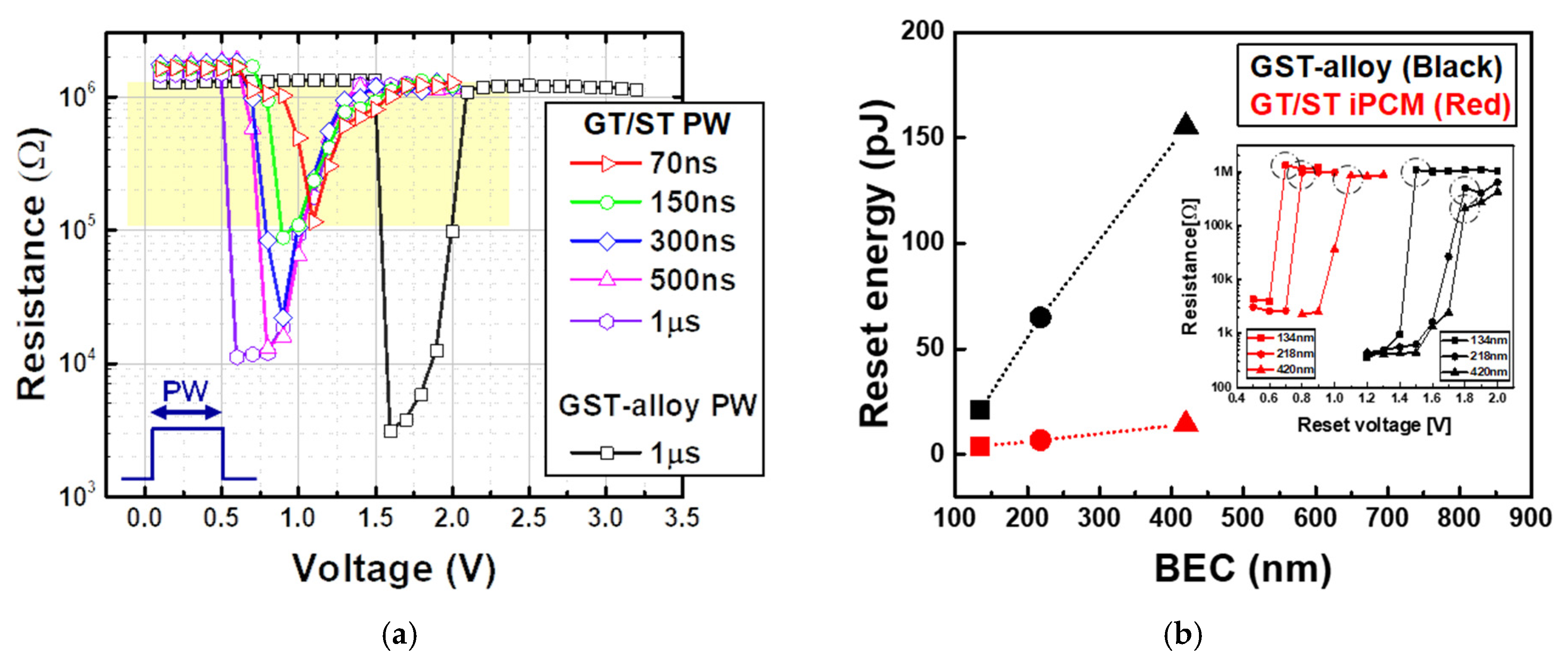
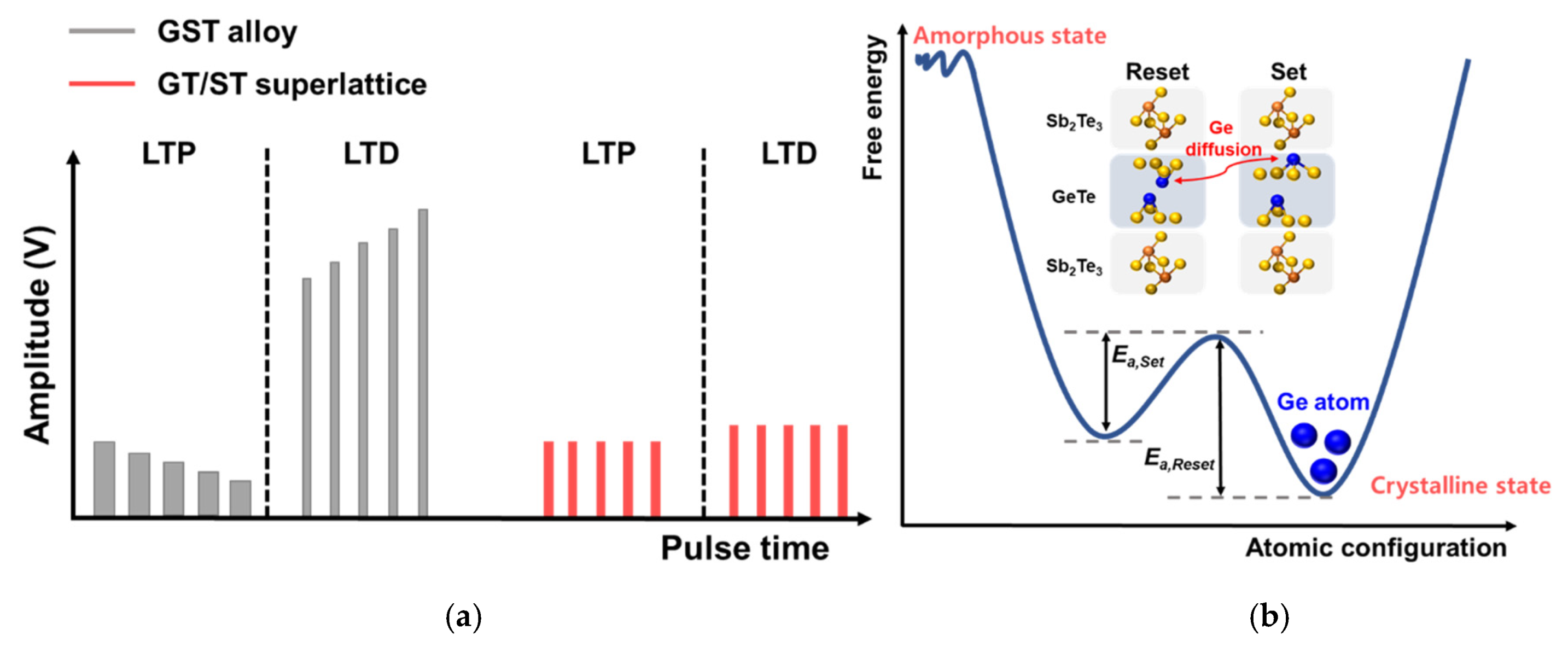
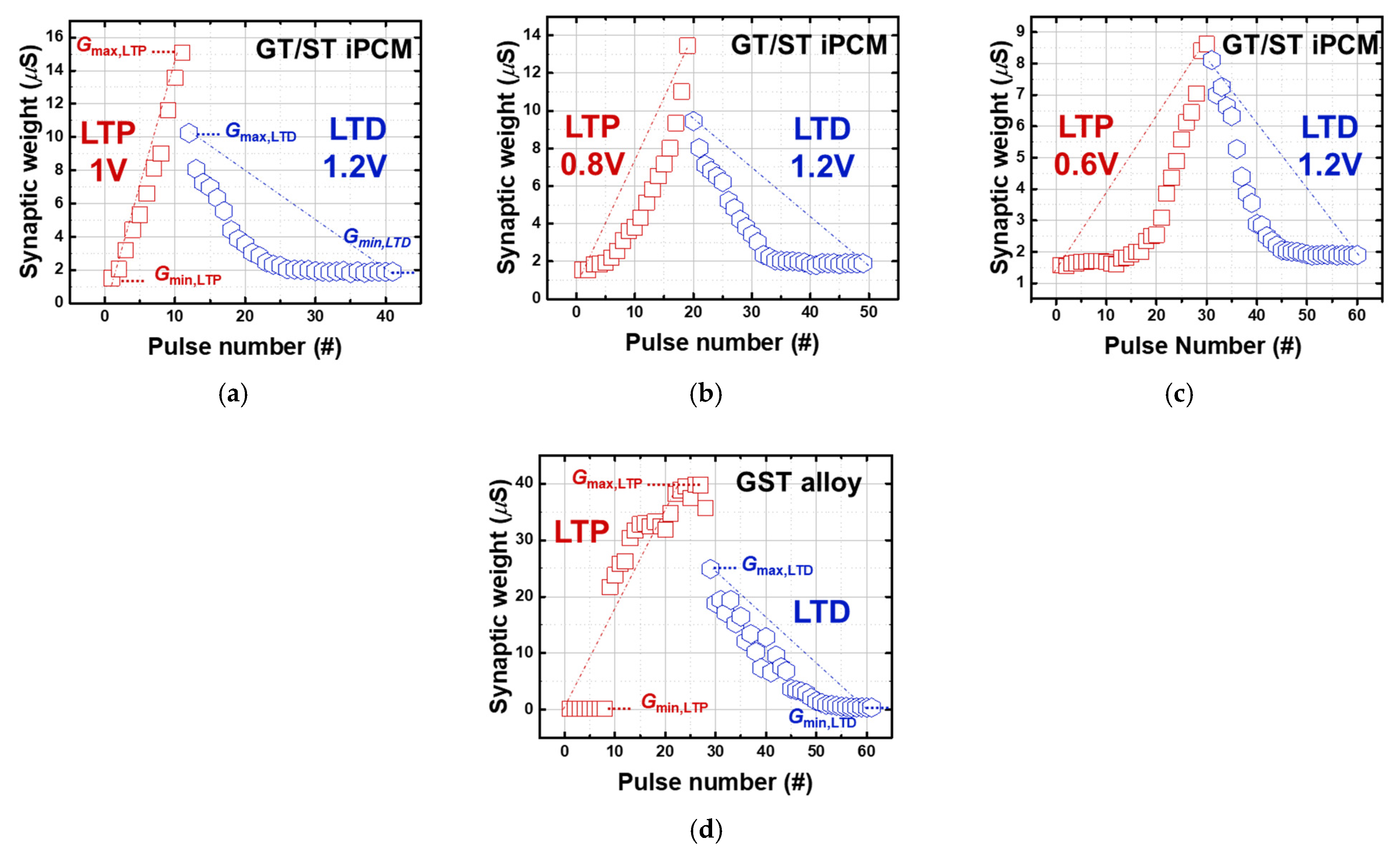
In this paper, gradual and symmetrical long-term potentiation (LTP) and long-term depression (LTD) were achieved by applying the optimal electrical pulse condition of the interfacial phase-change memory (iPCM) based on a superlattice (SL) structure fabricated by stacking GeTe/Sb2Te3 alternately to implement an artificial synapse in neuromorphic computing. Furthermore, conventional phase-change random access memory (PCRAM) based on a Ge–Sb–Te (GST) alloy with an identical bottom electrode contact size was fabricated to compare the electrical characteristics. The results showed a reduction in the reset energy consumption of the GeTe/Sb2Te3 (GT/ST) iPCM by more than 69% of the GST alloy for each bottom electrode contact size. Additionally, the GT/ST iPCM achieved gradual conductance tuning and 90.6% symmetry between LTP and LTD with a relatively unsophisticated pulse scheme. Based on the above results, GT/ST iPCM is anticipated to be exploitable as a synaptic device used for brain-inspired computing and to be utilized for next-generation non-volatile memory.
Keywords: interfacial phase-change memory; phase-change memory; artificial synaptic device; superlattice; neuromorphic devices interfacial phase-change memory; phase-change memory; artificial synaptic device; superlattice; neuromorphic devices