1. Introduction
Digital systems are widely used in our daily life [
1]. They can be viewed as combinations of various sequential and combinational blocks [
2,
3]. To implement the circuit of a sequential block, it is necessary to formally describe its behavior. Very often, models of finite state machines (FSMs) [
4,
5] are used for this purpose. The quality of an FSM circuit is determined by a combination of such characteristics as: a chip area occupied by the circuit, maximum operating frequency and consumption of power. As follows from [
6], there is a direct relationship between these circuit characteristics. To reduce the occupied chip area, various methods of structural decomposition can be applied [
7]. These methods produce circuits with multiple levels of logic, which are significantly slower than their single-level counterparts.
However, very often the performance is a critical factor for a digital system. For example, it is true for real-time embedded systems [
8,
9]. If a multi-level circuit does not provide the required performance, then the number of levels should be decreased. This conversion must be performed in a way that increases the amount of resources used as little as possible. In this paper, we propose a method for the solution of this problem in the case in which circuits of Mealy FSMs are implemented using field programmable gate arrays (FPGAs).
There are two models of FSMs, namely, Mealy and Moore FSMs [
4,
5]. Problems related to the synthesis of FSM circuits are discussed in a huge number of scientific articles and books. These works are mainly devoted to the synthesis and design of Mealy automata. This determined our choice of Mealy FSMs in the current research.
To optimize the characteristics of FSM circuits, a designer should use the main features of context in which these circuits are implemented [
2,
10]. In this article we consider methods of implementing FSM circuits in the context of field programmable gate arrays [
11,
12,
13]. These chips are very popular devices used for implementations of digital systems [
2,
14,
15,
16,
17,
18]. This fact explains our choice of FPGA-based Mealy FSMs as a research object. The current article deals with FSM circuits, which are implemented using look-up table (LUT) elements, flip-flops and programmable interconnections of FPGAs. Since the Xilinx is the largest manufacturer of FPGA chips [
13], we focus our research on its solutions.
A LUT is a single-output block having
inputs [
19,
20]. If a Boolean function depends on up to
Boolean variables, then its logic circuit includes only one LUT. However, a LUT has a very small number of inputs [
11,
13]. At the same time, FSMs can be represented by very complex systems of Boolean functions (SBFs) having dozens of arguments [
4]. For LUT-based FSMs, this contradiction leads to the necessity of functional decomposition of initial SBFs [
21]. In turn, the functional decomposition gives rise to FSM circuits having many logic levels and very complex interconnections [
22,
23].
To implement a LUT-based FSM circuit, it is necessary to execute the step of technology mapping [
24,
25,
26,
27]. The technology mapping is a very important stage of the FPGA-based design process [
28]. Its outcome significantly determines the characteristics of a resulting FSM circuit.
As a rule, LUT-based circuits of sequential blocks use five components of FPGA fabric. These components include LUTs, synced memory elements (flip-flops), programmable interconnections, synchronization circuits and blocks of input–output. Our current article is devoted to synthesis of multi-level LUT-based circuits of Mealy FSMs obtained using the methods of structural decomposition. As follows from [
24,
29], it is very important to optimize the system of interconnections between different elements of a circuit. The article [
24] notes that time delays of the interconnection system are starting to play a major role in comparison with logic delays. Additionally, more than 70% of the power dissipation is due to the interconnections [
29]. Thus, the optimization of interconnections leads to improving main characteristics of LUT-based FSM circuits. This can be done, for example, using an encoding of collections of outputs.
The main goal of our article is to increase the operating frequency of LUT-based Mealy FSM circuits. To achieve this goal, we try to reduce the number of levels of LUTs between the FSM inputs and FSM outputs. We determine the number of levels of LUTs as the number of LUT elements connected in series in the longest path connecting FSM inputs with FSM outputs. Reducing the number of levels reduces the number of interconnections in the FSM circuit [
24]. Since interconnections significantly affect performance [
29], a simultaneous decrease in the number of levels of LUTs and the number of interconnections leads to a significant increase in frequency.
Research [
19,
20] has shown that there is no point in increasing the number of LUT inputs. If the number of inputs exceeds six, it violates the balance between the main characteristics of a LUT circuit. However, the increasing complexity of modern digital systems is accompanied by an increase in the number of arguments in representing FSM functions. Therefore, there is a need for new methods and improvements to existing methods of LUT-based FSM design.
The methods of structural decomposition [
7] are designed to reduce the numbers of LUTs in FSM circuits. As a rule, FSM circuits with three levels of logic blocks require the smallest numbers of LUTs. However, three-level FSMs have a much lower operating frequency compared to their single-level counterparts. FSM circuits with two levels of logic blocks represent a compromise on the number of LUTs and operating frequency. The main contribution of this paper is a novel design method aimed at increasing the operating frequency of two-level LUT-based Mealy FSMs. The main idea of the proposed approach is to use together two methods of structural decomposition. They are: (1) the known method of transformation of codes of collections of outputs into FSM state codes and (2) a new method of extension of state codes. Due to it, there are exactly three levels of LUTs in the part of FSM circuit implementing the system of outputs. Additionally, it produces FSM circuits having regular system of interconnections, where each level of logic has its unique systems of inputs and outputs. The proposed method allows obtaining FSM circuits that have slightly more LUTs and a higher operating frequency than their three-level counterparts [
30]. The experimental results presented in the article show that the advantage of the proposed approach increases as the number of FSM inputs increases.
The further text of the article includes five sections.
Section 2 presents the background of single-level LUT-based Mealy FSMs.
Section 3 discusses the methods currently used in design of FPGA-based FSMs. The main idea of our method is considered in
Section 4. In
Section 5, we discuss an example synthesis, and the main ways for improving the characteristics of the resulting FSM circuit. In
Section 6, we present the results of research on the effectiveness of the proposed method for benchmarks FSMs from [
31]. The article ends with a brief summary.
2. Single-Level LUT-Based Mealy FSMs
As follows from [
13], FPGAs manufactured by Xilinx are based on “island-style” architecture [
19,
20]. The configurable logic blocks (CLBs) are “islands” surrounded by a “sea” of programmable interconnections that form a general routing matrix [
13]. In this paper, we discuss a case of CLBs including LUTs and programmable flip-flops. The flip-flops are used to organize hidden distributed registers keeping FSM state codes [
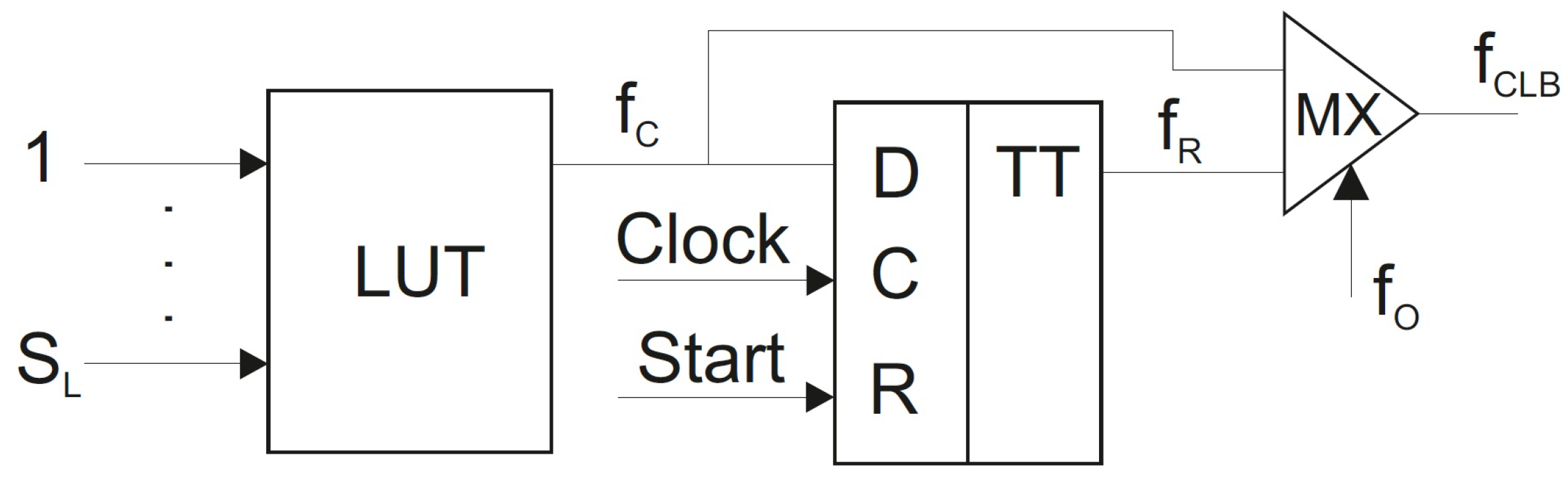
2]. A LUT-based CLB includes a LUT, a flip-flop and a multiplexer (
Figure 1).
A LUT can implement a function dependent on up to arguments. A LUT is a combinational block. Thus, the value of could be changed by changing the values of arguments. Using the pulse of synchronization clock, the current value of is written into the D flip-flop. The output of flip-flop represents a registered function . The multiplexer selects an appropriate form of CLB’s output. The output is either combinational () or registered ().
An FSM circuit is represented by some SBF. For practical digital systems, an SBF can include around 50–70 literals [
3,
4]. However, a LUT has not more than six inputs. This limitation makes it necessary to transform SBFs representing FSM circuits. The transformation is executed using different methods of functional decomposition (FD) [
32]. The FD-based transformation leads to FSM circuits with many levels of LUT-based CLBs and systems of unordered (irregular) interconnections. The functional decomposition leads to CLB-based circuits having “spaghetti-type” interconnections [
33].
A Mealy FSM is represented as a six-component vector
[
34]. The vector
S includes a set of inputs
, a set of outputs
, a set of internal states
, a function of transitions
, a function of output
and an initial state
. Various tools can be applied to represent the vector
S. The most commonly used tools are: graph-schemes of algorithms [
3,
34], binary decision diagrams [
35,
36], state transition graphs [
4] and inverter graphs [
37]. In this article, we use state transition tables (STTs) to represent Mealy FSMs.
An STT includes the following columns [
4]: a current state
; a state of transition (a next state)
; an input signal
(it determines a transition from
to
); a collection of outputs
(it is generated during the transition from the current state into the next state). The column
h includes the numbers of transitions (
). For example, a Mealy FSM
is represented by the STT (
Table 1).
As follows from
Table 1, the FSM
has two inputs, four outputs, three states and five transitions. From
Table 1 we can find, for example, that
and
(these formulae follow from the first row of
Table 1). The following steps should be executed to construct SBFs describing logic circuits of FSMs [
3,
34]: (1) the encoding of FSM states
by binary codes
; (2) the constructing sets of state variables
and input memory functions (IMFs)
; and (3) constructing a direct structure table (DST). To encode the states
, the step of state assignment should be executed [
2].
In this paper, we use the style of binary state assignment where the number state variables (R) is determined as
The binary state assignment is used, for example, in the system SIS [
38]. The number of bits of the state code can vary from the minimum value determined by (
1) to the number of states,
M. If
, then the corresponding state codes are one-hot codes. This style is used, for example, by the academic system ABC [
37] of Berkeley.
A special state register (
) keeps FSM state codes. It is controlled by two internal pulses. The pulse start causes the loading of the initial state code into the
. The pulse clock sets the time when the
can be changed. For CLB-based FSMs, state registers are constructed on the basis of D flip-flops [
2]. In this article, we also use state registers based on D flip-flops. The pulse clock allows the functions
to change the
content.
After the state assignment, each state
is represented by its code
. The Boolean systems representing an FSM circuit can be derived from a DST. Compared to the initial STT, a DST includes three additional columns:
,
and
. The column
includes the symbols
corresponding to 1s in the code of the state
from the row
h of a DST. A DST is a base for finding the following SBFs:
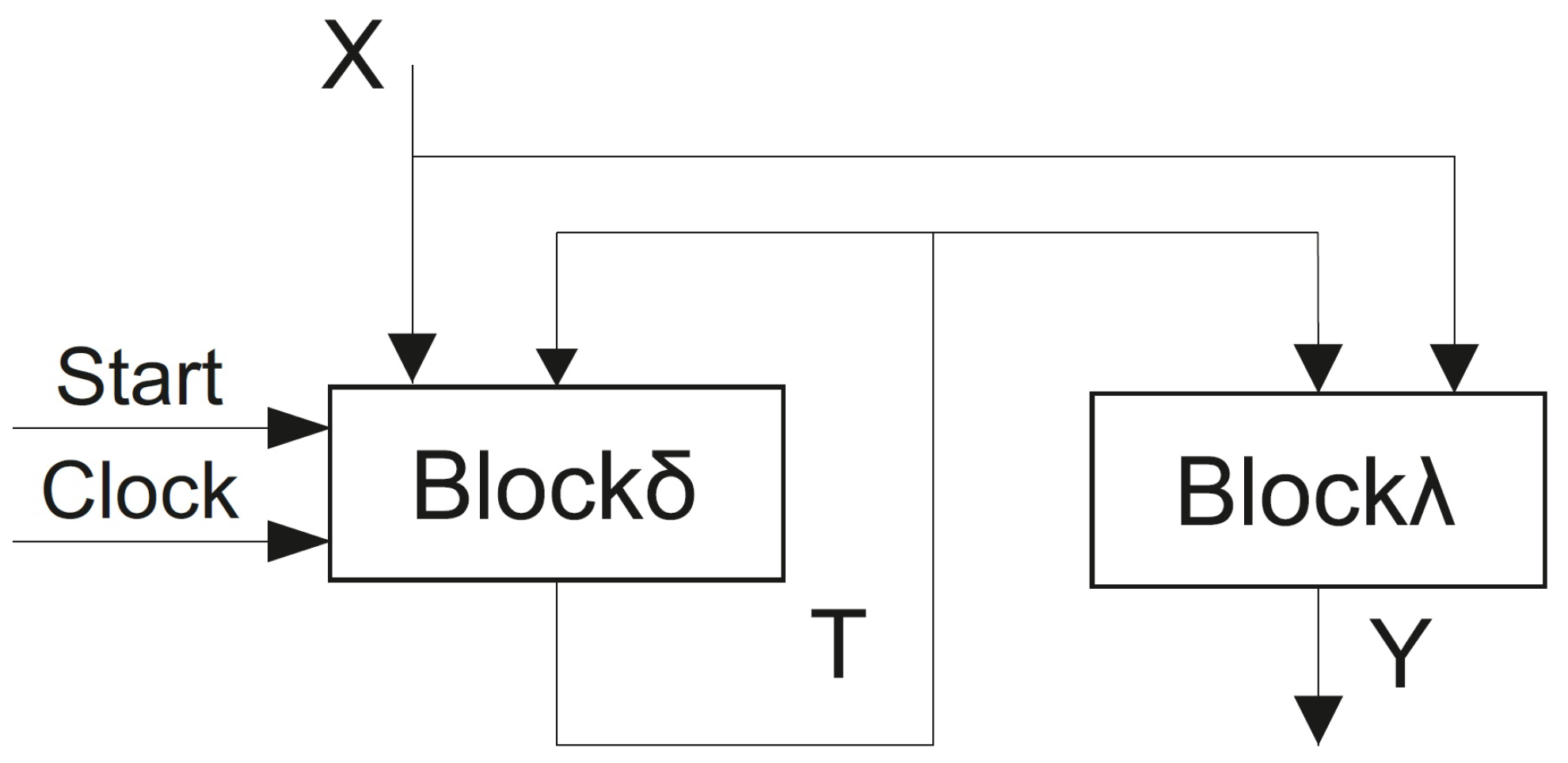
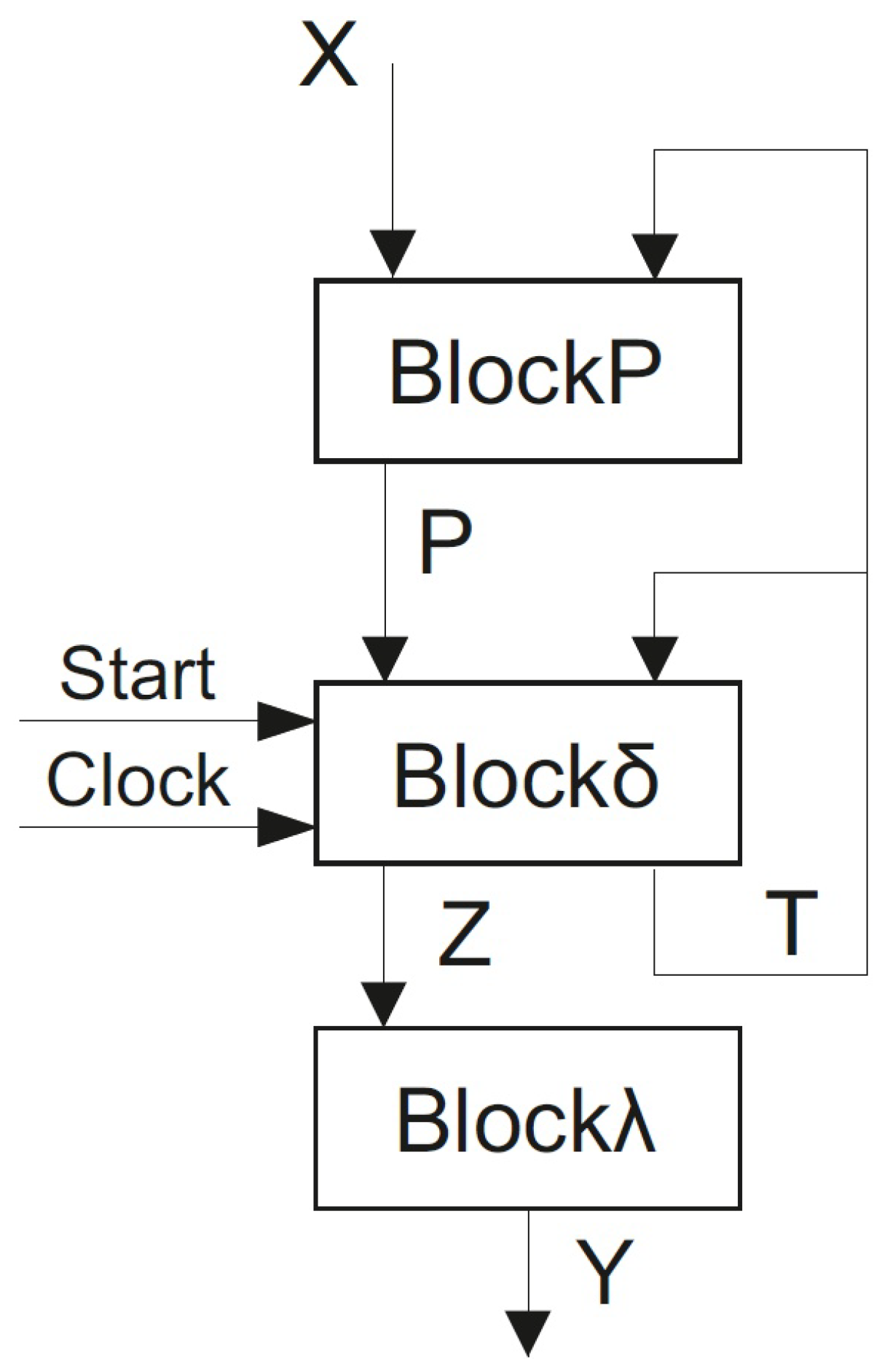
The architecture of a Mealy FSM
is defined by these systems of Boolean functions (SBFs). It is shown in
Figure 2.
Let us analyze this architecture. The SBF (
2) is implemented by
. This block includes the distributed register. The
is controlled by IMFs (
2) and mutual pulses of synchronization and reset. The SBF (
3) is implemented using
. Both blocks are implemented with CLBs (
Figure 1).
Analysis of systems
and
Y shows that they depend on the same variables. It is the main peculiarity of Mealy FSMs. Many design methods [
7,
39] use this specific to reduce the numbers of LUTs in circuits represented by SBFs (
2) and (
3).
3. State-Of-The-Art
As a rule, the process of designing digital systems involves solving some optimization problems [
2,
4]. In the case of FPGA-based sequential blocks, these problems are the following [
2,
24]: (1) the reduction of chip resources required to implement a LUT-based circuit; (2) the decreasing the propagation time (the increasing the maximum operating frequency); and (3) the reducing power consumption. Our current article is devoted to improving the maximum operating frequency of LUT-based Mealy FSMs.
The characteristics of FPGA-based FSM circuits can be improved due to optimal state assignment [
2,
8,
37,
38,
39,
40,
41,
42]. Additionally, this can be done using embedded memory blocks (EMBs) instead of LUT-based CLBs [
43,
44,
45,
46,
47,
48,
49,
50]. Let us analyze these approaches.
We call optimal state codes such codes that allow reducing the numbers of arguments in SBFs (
2) and (
3). For example, the numbers of arguments is significantly reduced by the algorithm JEDI [
38]. It is one of the best state assignments algorithms [
2]. Due to it, we chose JEDI-based FSMs to compare with FSMs based on our proposed approach.
Modern industrial CAD tools include various state assignment strategies. For example, the following state assignment methods are used in the Xilinx design tool Vivado [
40]: automatic state assignment (auto); sequential encoding; the one-hot; Gray encoding and Johnson codes. The same methods can be found in the package XST by Xilinx [
51].
The one-hot state assignment is very popular in LUT-based design [
41], because FPGAs include many programmable flip-flops. The one-hot state assignment leads to increasing the number of input memory functions compared with (
1). However, these IMFs are much simpler than in the case of binary state assignment [
2]. As follows from [
41], it is better to use the one-hot codes if an FSM has more than 16 states. However, the characteristics of LUT-based FSM circuits significantly depend on the number of inputs [
2]. As follows from [
42], the binary state encoding allows producing better FSM circuits if
. Since each approach is good under certain conditions, we compare both of these encoding styles with our proposed method. The method of binary state assignment auto of Vivado is used as a baseline for comparison with the proposed method.
To reduce the power consumption, it is very important to diminish the number of interconnections inside an FSM circuit. Therefore, to diminish the number of interconnections, it is necessary to minimize the numbers of arguments in SBFs (
2) and (
3) [
2]. Thus, it is always useful to apply the optimal state assignment to improve the characteristics of FSM circuits.
The second approach to optimizing CLB-based FSMs is related to using EMBs instead of LUTs [
47]. There are many design methods targeting EMB-based FSMs [
47,
48,
49,
52,
53,
54,
55,
56,
57].The survey of different methods of EMB-based design can be found in [
47]. In the best case, only a single EMB is necessary to implement an FSM circuit [
49]. However, if the number of arguments in systems (
2) and (
3) exceeds the maximum possible number of EMB address inputs, then an FSM is represented by a network of EMBs. To diminish the number of EMBs in such a network, it is necessary to implement some functions using LUTs [
2,
49].
Thus, an FSM circuit can be implemented as either a network of EMBs, or a network of LUTs, or a joint network of LUTs and EMBs. In this article, we discuss the second case, when FSM circuits are implemented using LUT-based CLBs. This approach makes sense if: (1) all EMBs are used to implement other parts of a digital system or (2) the number of arguments in SBFs (
2) and (
3) exceeds 15 (this is a maximum possible number of modern EMBs [
11,
12,
13]).
Denote as
the number of literals [
4] in sum-of-products (SOPs) of functions (
2) and (
3). If the condition
takes place, then a logic circuit for any function
is represented by exactly one LUT. If
, then the corresponding logic circuit can be obtained using various methods of FD [
21,
23,
27,
35,
36,
48,
58,
59]. The FD can be viewed as a process during which decomposed functions are broken down into smaller and smaller components. If any component depends on no more than
arguments, the process of FD for a given function is completed. Of course, this results in multi-level LUT-based circuits. For these circuits, it is typical that the same inputs
or state variables appear on several logic levels. It significantly complicates the system of interconnection between LUTs of FD-based FSM circuits (with all the ensuing consequences).
In the best case, the LUT count of an FSM circuit is equal to the total number of inputs and state variables. However, if the condition (
4) is violated, the LUT count increases by the value of
, where
is a set of additional functions different from (
2) and (
3). These additional functions are components of functions (
2) and (
3) produced during the process of FD. We do not discuss these methods in our article.
The reducing LUT counts in circuits of Mealy FSMs can be achieved using the various methods of structural decomposition [
7,
39]. These methods eliminate a direct dependence of functions
and
on inputs
. The methods of structural decomposition are also connected with introducing new functions
. Functions
depend on variables
and
. The structural decomposition allows reducing LUT counts if there is
These new functions are divided into subsystems having unique input and output variables. Each subsystem determines a separate LUT-based block of logic. When the condition (
5) takes place, the total LUT count for a decomposed FSM is significantly less than it is for equivalent FSM
. The new functions are arguments of functions (
2) and (
3). If the condition
takes place, then the total LUT count of a decomposed FSM circuit is significantly less than it is for an equivalent multi-level circuit . A survey of different methods of structural decomposition is represented in [
7].
In this article, we discuss three known methods of structural decomposition [
7,
34]: replacement of inputs, encoding of outputs and transformation of codes of collections of outputs into state codes. Consider these approaches.
To reduce the LUT count, the inputs
could be replaced by additional variables
, where
[
34]. As a rule, the value of
G is determined as [
34]:
The system of additional variables
is represented by the SBF
The functions
are represented by the following SBFs:
Collections of outputs (COs)
include functions
generated simultaneously. To synthesize an FSM circuit, it is necessary to represent each CO
by a binary code
. As a rule, the number of bits in these codes is determined as
To create codes
, it is necessary to use additional variables
. This allows representing outputs of FSM as the following:
The additional variables
are represented by the following system:
To generate functions (
13), an additional block of logic should be used.
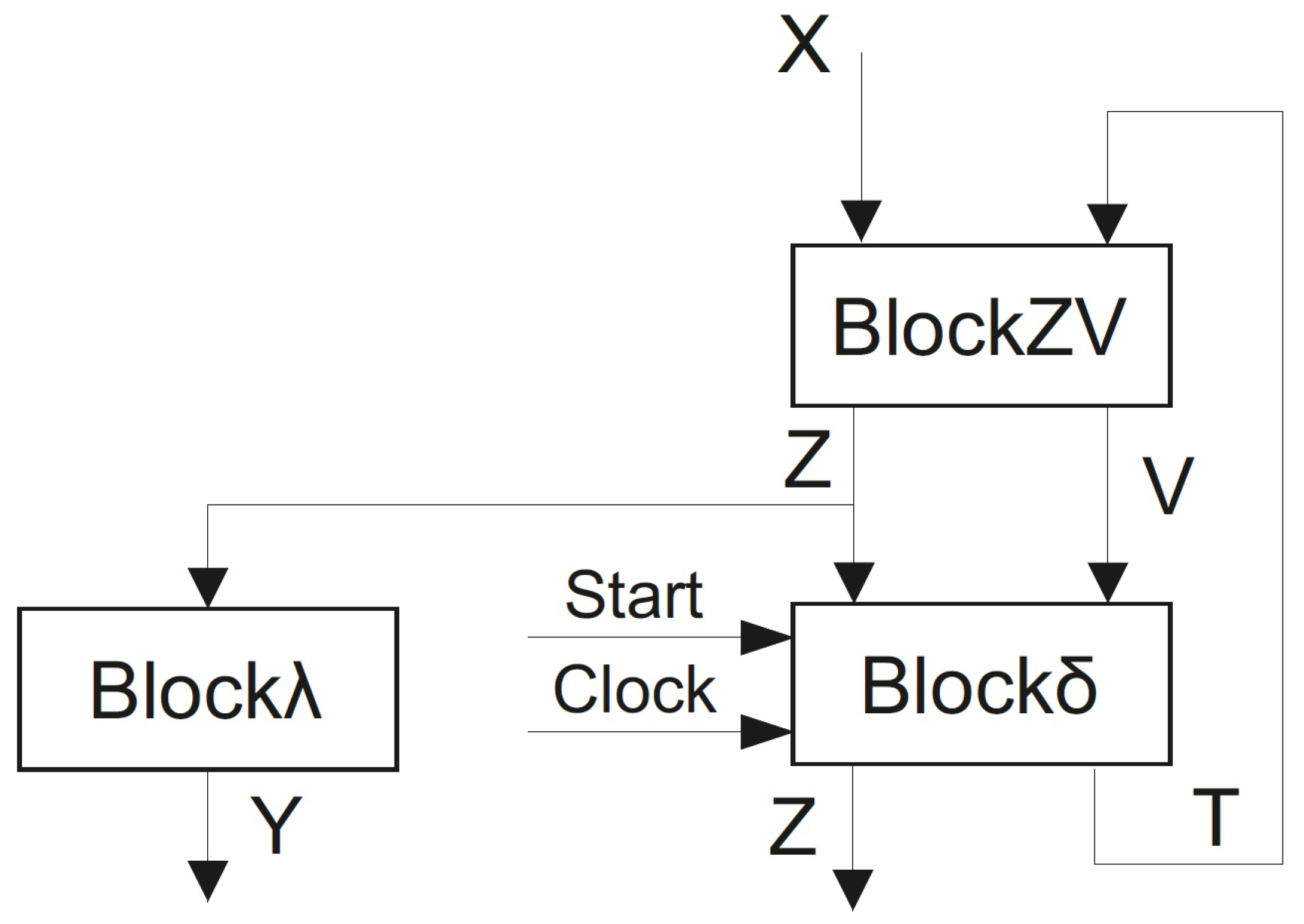
In the work [
30], two known methods of structural decomposition are used for reducing LUT count for FPGA-based Mealy FSMs. It results in Mealy FSM
shown in
Figure 3.
The logic circuit of Mealy FSM
has three logic levels. The
executes the replacement of inputs
by additional variables
and implements the SBF (
8). The
generates input memory functions (
9) and additional variables
used for encoding of collections of outputs
. This block includes a distributed register keeping state codes. To generate variables
, it is necessary to implement the system
implements the system (
12) dependent on additional variables
.
As our investigations [
30] show, this approach allows significantly reducing the LUT count as compared to equivalent FSM
. However, this solution has a serious drawback: the performance of FSM
is always less than it is for an equivalent Mealy FSM
.
In [
36], different models of Mealy FSMs based on transformation of object codes are discussed. One of the typical methods from this group is a transformation of codes
into state codes
.
The main idea of this approach is the following. For example, some CO is generated during transitions into states and . Using CO , it is possible to determine these states. To do it, it is necessary to use identifiers and . Using two pairs allows the following representation of these states of transition: and . Thus, each state can be represented by one or more pairs . To create the set of identifiers , it is necessary to find the maximum amount of pairs () including the same CO .
Each identifier
is represented by a binary code
having
bits, where
To encode identifiers, the elements of the set are used.
It allows representing the IMFs by the following system:
The variables
are represented by the following system:
Thus, an FSM based on this principle implements systems (
12), (
13), (
16) and (
17). It is an FSM
shown in
Figure 4.
In FSM
, the
implements systems (
13) and (
17); the
implements input memory functions represented as (
16); the
implements the system (
12). Thus, there are only two levels of logic between inputs and outputs in the case of FSM
. As follows from
Figure 3, there are three levels of logic between inputs and outputs in the case of FSM
.
This property of FSM
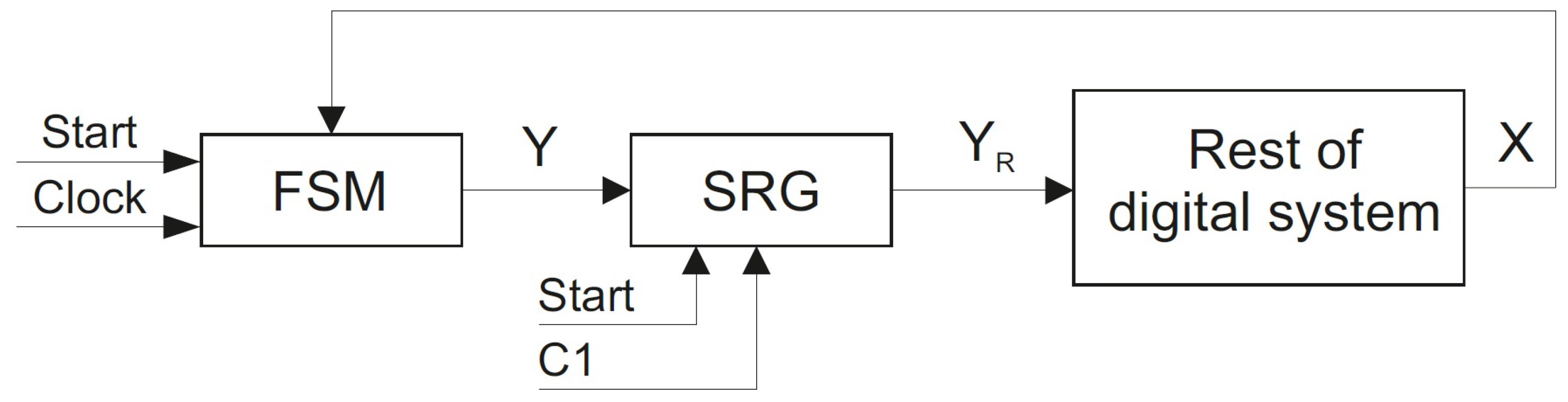
can be used for acceleration of a digital system. As is known [
2], outputs (
3) of Mealy FSM are not stable. If inputs are changing during a clock cycle, the outputs (
3) may also change. This may cause the digital system as a whole to crash. To prevent failures, it is necessary to prohibit the access of incorrect outputs (
3) to a digital system. To do it, a special register
is introduced (
Figure 5).
If all transients in the FSM circuit are completed and the values of outputs are stable, then a pulse of synchronization is generated. It allows loading outputs into . Next, the registered outputs enter the digital system. The system executes the corresponding operations and generates the values of inputs . Such an interaction should be organized for any model of Mealy FSM.
Thus, in the case of FSM , the pulse may be generated when the correct values are set for the outputs of two blocks ( and ). In the case of FSM , the correct outputs are set after all three blocks are triggered sequentially. Thus, the model can provide better performance than the model .
There is one very serious disadvantage of FSM
compared to equivalent FSM
. If the relation
is true, then the number of LUTs (and maybe their levels) in
is significantly more than in
of equivalent FSM
. In this article, we propose a method which allows reducing the number of LUTs in FSM
.
4. Main Idea of the Proposed Method
In this article, we discuss a case when the condition (
4) is violated for some functions
. It leads to a multi-level circuit of
with an irregular system of interconnections. Obviously, it degenerates the performance of FSM
. To diminish the number of levels of LUTs in the circuit of
, we propose the following approach.
As it is in the case of two-fold state assignment [
7,
60], we propose to construct a partition
of the set
A such that the following condition takes place:
Using methods [
7,
60] allows creating the required partition
having the minimum possible number of classes,
J.
If a class
includes
states
,
then there are enough state variables to encode the states
. To do it, the state variables
are used. There are
elements in the sets
T and
:
If
, then
for
. It explains the presence of 1 in (
20).
Now, we can encode each state by a code having bits. In this code, variables are equal to zero. Only variables identify a state as an element of .
As
, the codes
are extended state codes [
7]. However, only
state variables are used to represent functions dependent on states
.
To find SBFs (
13) and (
17), it is necessary to construct a table of
(
). It includes the columns
,
,
,
,
,
,
,
,
,
and
h.
A class
determines a table
which is a subtable of
. A table
determines sets
,
and
. These variables are written in the columns
,
and
of
, respectively. Additionally, a table
determines SBFs
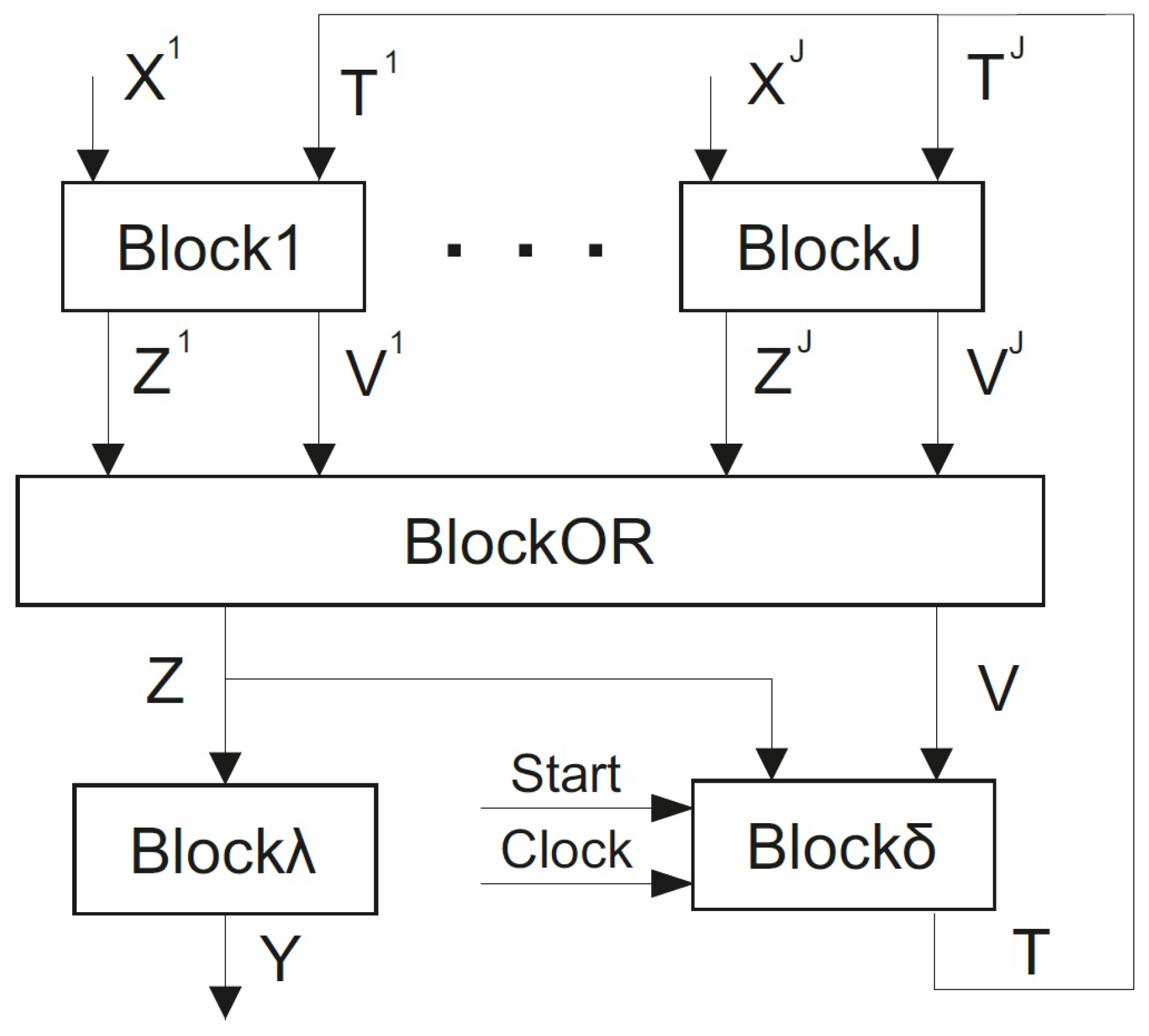
Using this preliminary information, we propose an architecture of Mealy FSM
(
Figure 6).
In FSM
, the
implements functions (
22) and (
23). Due to (
19), each
has only a single level of LUTs.
implements functions
and
as disjunctions:
In (
24) and (
25), the superscript
j means that the corresponding function is generated by the
.
If , then there is only a single level of LUTs in the circuit of . Otherwise, it is a multi-level block.
and
execute the same functions as these blocks in FSM
. The
generates functions (
12), the
the functions (
16). If
, then
includes only a single level of LUTs.
Thus, in the best case, there are three levels of LUTs between inputs
and outputs
. If the condition (
4) is violated for equivalent FSM
, then the FSM
provides higher operating frequency.
Comparison of
Figure 4 and
Figure 6 shows that: (1)
of
is replaced by
Block1, …,
,
and (2)
of
has
outputs. These two issues are the main specifics of FSM
.
In this paper, we propose a method of synthesis of finite state machine . If an FSM is represented by an STT, then the method includes the following steps:
Representing states by pairs .
Encoding of collections of outputs and identifiers. Constructing SBF (
12) representing
.
Constructing the partition of the set A.
Creating tables determining Block1–.
Constructing SBFs representing –.
Constructing SBFs (
24) and (
25) representing
.
Constructing SBF (
16) representing
.
Implementing the logic circuit of FSM .
The first step is executed using an initial STT. If CO
is generated during transitions into
different states
, then there are
identifiers. Each identifier determines an unique state represented by
. The cardinality of the set
is determined as
Step 2 is executed on the basis of STT. The COs should be encoded in a way optimizing the number of literals in SBF (
12). Identifiers can be encoded in the trivial way.
The partition
is constructed using methods from [
7,
43]. After finding classes
, we can encode the states
. It gives sets
and
.
A table of has the following columns: , , , , , h. The states are written in the column . As if , we can write only parts of created from state variables . A column includes variables , a column variables . The outcome of step 4 is tables of Block1–BlockJ.
A table
is a base to derive the SBFs (
24) and (
25). The terms of corresponding SOPs are conjunctions
, where
is a conjunction of variables
. All other state variables are treated as insignificant. The SBF (
24) and (
25) are used to implement circuits of
Block1–
BlockJ.
The step 6 is executed in the trivial way. If , then there is a single level of LUTs in BlockOR. In this case, its circuit includes exactly LUTs.
To find the SBF (
16), it is necessary to construct a table of
. This table includes the following columns:
,
,
,
,
,
,
,
h. Each row of this table corresponds to a pair
determining the state
. The terms of SOPs (
16) are conjunctions of variables
and
. The corresponding literals are determined by codes
and
.
The last step is executed using standard CAD tools. It is based on program tools translating initial STT into required SBFs. These SBFs are used into VHDL models of FSMs.
Now, we would like to show the difference between the two-fold state assignment [
60] and the proposed method. In the first case, there are two sets of state variables. The set
is used to encode states
as elements of set
A. The set
is used to encode states
as elements of sets
. Due to it, there are two levels of logic creating inputs of the
Block1–
BlockJ. In the proposed approach, the inputs of these block are generated by
. Thus, the proposed approach leads to faster FSMs than for the two-fold state assignment.
5. Example of Synthesis
In this article, we use a symbol
to show that an FSM model
is used to synthesize an FSM
. An example of synthesis of Mealy FSM
is shown in this section. A Mealy FSM
is represented by
Table 2.
The following characteristics of
follow from
Table 2: the number of states
, the number of transitions
, the number of inputs
and the number of outputs
. Additionally, the following collections of outputs can be found from
Table 2:
,
,
,
,
,
,
. Thus, there is
.
1. Representing states by pairs .
Using STT (
Table 2), it is possible to find pairs
representing the states
. For example, the CO
is written in the rows 1, 9, 12 and 13. Additionally, these rows include the states of transitions
(rows 1 and 12) and
(rows 9 and 13). Thus, it is necessary two identifiers (
,
) to distinguish these states:
,
.
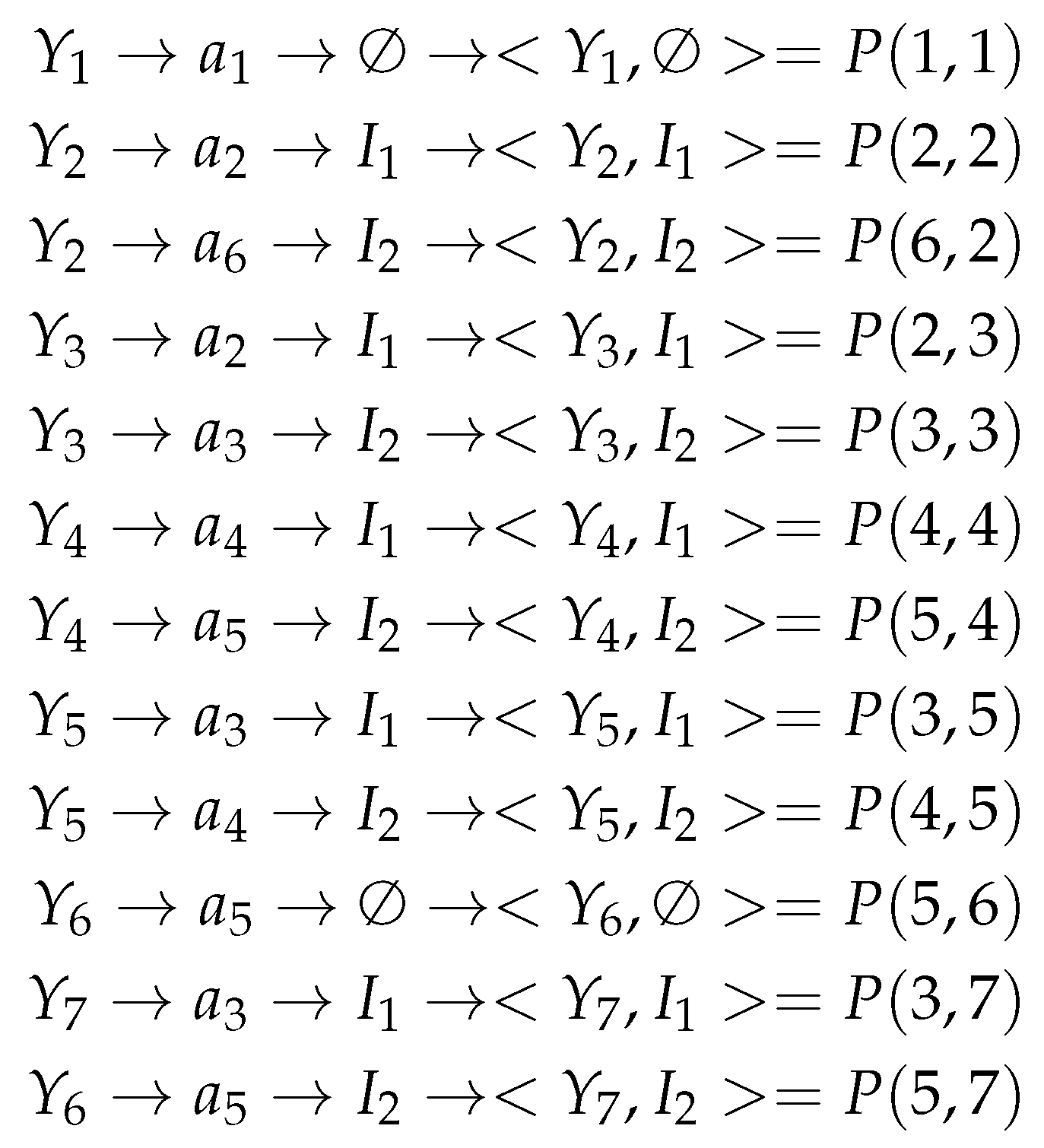
Using the same approach, we can find all pairs
for the given example. The process is shown in
Figure 7. Using (
26) gives
and
.
In the discussed case, there is , where is a number of pairs . Thus, the will be represented by the table having 12 rows.
2. Encoding of COs and identifiers . There is
,
. Using (
11) gives
and the set
. Using (
15) gives
and the set
.
There is
. Therefore, each equation from SBF (
16) is implemented using only a single look-up table. Thus, there is no need in encoding of COs in a way optimizing (
16). Let us encode COs
in a way optimizing the SBF (
12).
Using contents of COs, the following SBF can be obtained:
To diminish the number of interconnections between
and
, it is necessary to reduce the number of literals in functions (
12). It can be done using approach [
61]. One of the possible solutions is shown in
Figure 8.
Using codes from
Figure 8 and rules of minimization [
4], we can transform the SBF (
27) into the following system:
The system (
28) represents
of
. This block has 18 interconnections with
. In the common case, there are
literals (and 24 interconnections). Thus, the number of interconnections is reduced by 1.33 times thanks to encoding of COs shown in
Figure 8.
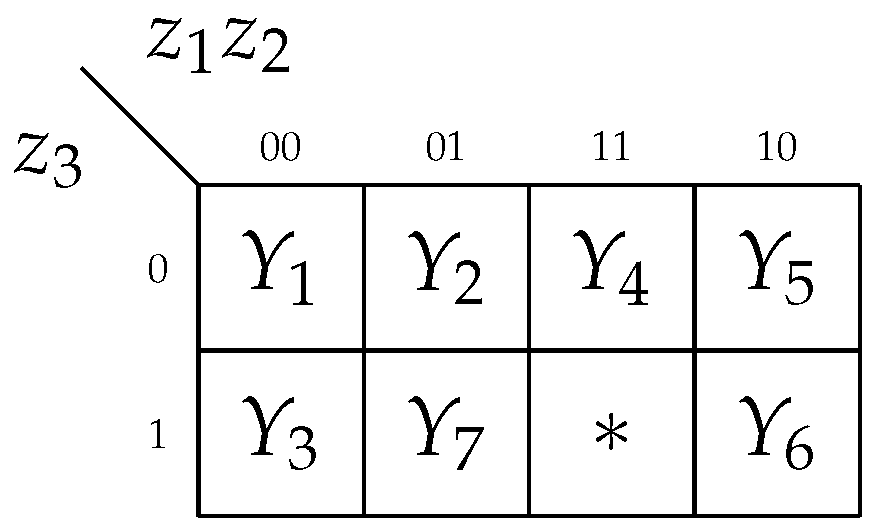
The identifiers can be encoded in a trivial way: and . Now, the identifier is determined by , and by .
3. Constructing the partition of the set A. There is in the discussed example. It means that each block should satisfy the condition .
This step is very important because it determines significantly the characteristics of FSM
[
60]. We do not discuss this step in detail. Instead, we use the approach [
60] to create the partition
with classes
and
. Using
Table 2 gives the sets
and
.
Using (
20) gives
,
,
,
and
. There is
. It means that
. Thus, the found partition satisfies the condition (
19).
Due to it, state codes do not affect the number of look-up tables in circuits of Block1 and Block2. We can encode them in the following way: , , , , and .
4. Creating tables of Block1 and Block2. To do it, we should construct a table of of equivalent FSM . Next, this table is divided by two tables using classes and codes .
Table of
is constructed using an initial STT. To do it, the states of transitions are replaced by corresponding pairs
. Additionally, the codes
,
and columns
,
are introduced instead of the column
of STT. In the discussed example, the
is represented by
Table 3.
In
Table 3, we used codes
from
Figure 8. The pairs <
> were taken from
Figure 7. To design circuits of
Block1–
BlockJ,
Table 3 should be transformed into a set of tables representing blocks of the first level of logic.
Consider the row
of
Table 3. It corresponds the pair
. Thus, the column
includes
and the column
includes
. The column
includes
, the column
the code
. It explains the contents of columns
and
of the row 1. The column
is the same as for initial STT (
Table 2). All other rows are filled in the same way.
To create tables of a
Blockj, we should: (1) choose state
and (2) take rows of table of
BlockZV for these states. In this case, the
Block1 is represented by
Table 4 and the
Block2 by
Table 5. In
Table 4 and
Table 5 the superscripts 1 and 2 mean that corresponding functions are implemented by
Block1 or
Block2, respectively.
5. Constructing systems representing blocks of the first level. These systems are constructed using
Table 4 and
Table 5. Each system includes
equations.
The
Block1 is represented by the following SBF:
The
Block2 is represented by the following SBF:
6. Constructing the system for BlockOR. This system is constructed in a trivial way. Each function
is represented by a disjunction of functions of the same name with different upper indexes. It is the following SBF in the discussed case:
7. Constructing the system for . To find the system (
16), it is necessary to create a table of
. It is constructed using pairs
and codes
,
and
. In the discussed case, this is
Table 6. The table uses data from
Figure 7 and
Figure 8. The following SBF is derived from
Table 6:
Now, we have systems for each block of FSM . Next step is the implementation of the logic circuit.
8. Implementing the logic circuit of FSM . This step is executed using special synthesis tools, e.g., Quartus Prime [
50] or Vivado by Xilinx [
40]. During this step, each LUT is represented by its truth table. Such complicated tasks are executed as mapping, placement and routing [
6]. We just focus on finding the number of LUTs in the circuit and do not discuss this step for our example.
The
Block1 is represented by the SBF (
29). The corresponding circuit includes four LUTs. The
Block2 is represented by the SBF (
30). Its circuit also includes four LUTs. Thus, the first level of logic includes eight LUTs having
.
The
BlockOR is represented by the SBF (
31). To implement its circuit, it is enough to have four LUTs.
is represented by the SBF (
28). Its circuit consist of 8 LUTs. At last, the system (
32) represents
. Its circuit has four LUTs.
Thus, the circuit of FSM includes 24 LUTs. There are three levels of LUTs between inputs and outputs . The same is true for inputs and input memory functions .
This example is very simple. We show it to explain all steps of the proposed method. The next Section shows results of experiments with more complex FSMs.
6. Experimental Results
In this section we show the results of experiments based on benchmark FSMs from the library [
31]. There are 48 benchmarks in the library. They are very often used to compare outcomes of different design methods. The benchmark Mealy FSMs are represented in the format KISS2. We do not show the characteristics of these benchmarks in this article. They can be found, for example, in [
30].
To implement FPGA-based FSM, we used VHDL-based FSM models. Our CAD tool K2F [
2] translated the benchmarks into VHDL-based FSM models. The synthesis and simulation of FSMs were executed by the Active-HDL environment. As a target platform, we used Xilinx VC709 Evaluation Board (Virtex 7, XC7VX690T-2FFG1761C) [
62]. This chip includes LUTs having
. To execute the technology mapping and produce reports with characteristics of resulting FSM circuits, we used Xilinx CAD tool Vivado—version 2019.1 [
40].
When we investigated FSM
[
30], we found that this model allows producing circuits with less area and power consumption if
. In [
30], we divided the benchmarks into five groups using the values of
and
. If
, then benchmarks belong to group 0 (trivial FSMs); if
, then to group 1 (simple FSMs); if
, then to group 2 (average FSMs); if
, then to group 3 (big FSMs); otherwise, they belong to group 4 (very big FSMs). As our research [
30] shows, the larger the group number, the bigger the gain from using our method. We use the same division of benchmarks in this article too.
Group 0 includes the following benchmarks: bbtas, dk17, dk27, dk512, ex3, ex5, lion, lion9, mc, modulo12 and shiftreg. Group 1 contains the most benchmarks. They are the following: bbara, bbsse, beecount, cse, dk14, dk15, dk16, donfile, ex2, ex4, ex6, ex7, keyb, mark1, opus, s27, s386, s840 and sse. Group 2 consists of the following 12 benchmarks: ex1, kirkman, planet, planet1, pma, s1, s1488, s1494, s1a, s208, styr and tma. There is only a single benchmark: sand in Group 3. Group 4 includes the following benchmarks: s420, s510, s820 and s832.
In the section State-of-the-art, we have justified the choice of three methods for comparison with our approach. We chose the method auto of Vivado as a method based on binary state codes. Additionally, we used the method one-hot of Vivado. Due to its high reputation, we chose JEDI-based FSMs as a basis for comparison too. Our approach is a competitor to the method from work [
30]. Thus, we chose
-based FSMs with three levels of logic blocks as the fourth method used in experiments. The results of experiments are shown in
Table 7 (the number of LUTs) and
Table 8 (the maximum operating frequency). These results were taken from reports generated by Vivado.
We use the same organization of
Table 7 and
Table 8. Their rows are marked by the names of benchmarks, the columns by investigated design methods. The row “Total” includes results of summation for corresponding values. The summarized characteristics of our approach (
-based FSMs) were taken as 100%. The row “Percentage” shows the percentages of summarized characteristics of FSM circuits implemented by other methods, respectively, compared to benchmarks based on our approach. Let us point out that the model
was used for designs with auto, one-hot, and JEDI.
As follows from
Table 7, the
-based FSMs require fewer LUTs than other investigated methods. Our approach produces circuits having 8.84% more LUTs than equivalent
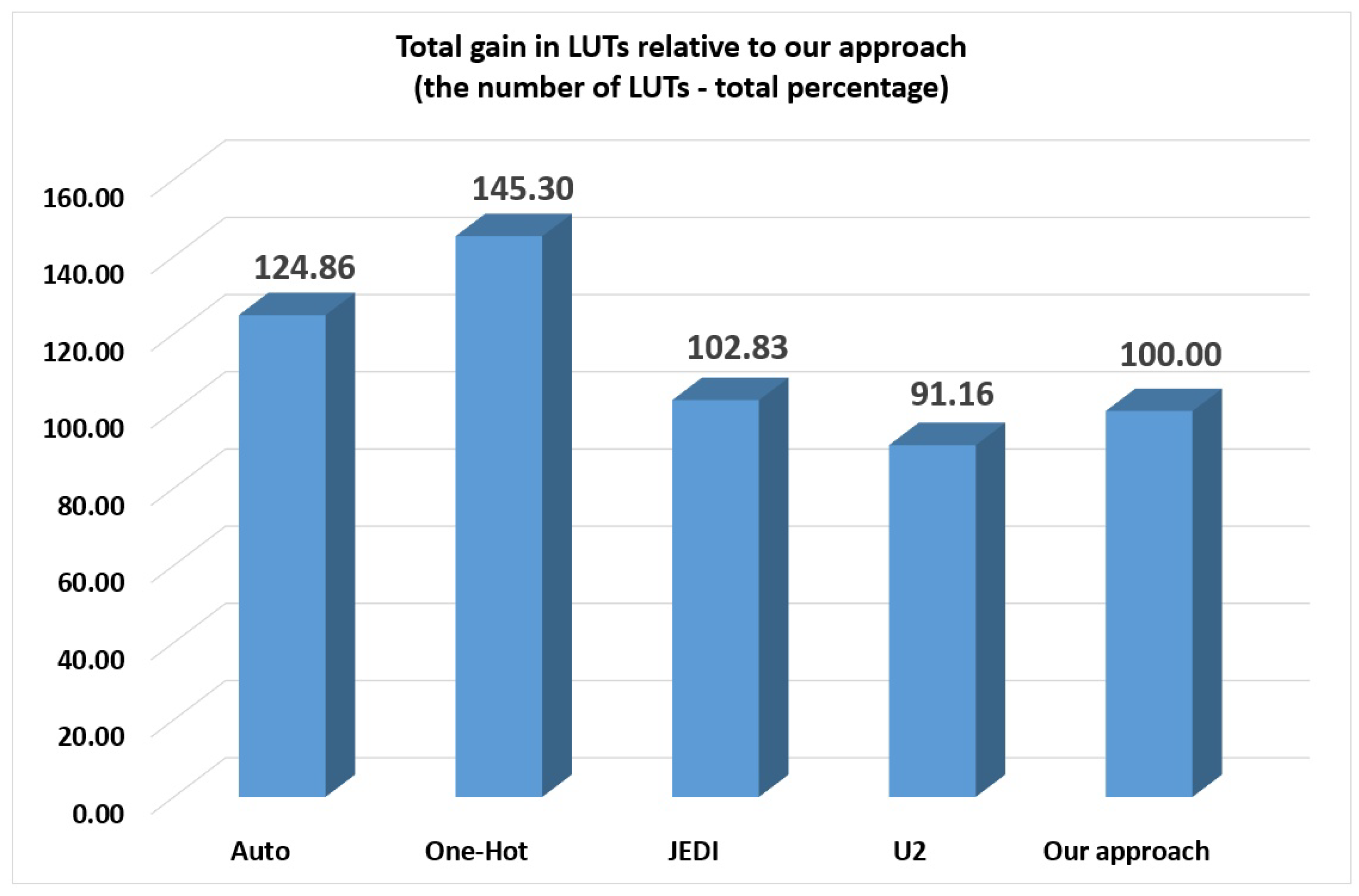
-based FSMs. However, our approach requires fewer LUTs than auto (24.86% of gain), one-hot (45.3% of gain) and JEDI-based FSMs (2.83% of gain). The higher is the group, the greater is the gain in LUTs respectively auto, one-hot and JEDI-based FSMs. We show these results in
Figure 9.
Analysis of
Table 8 shows that the
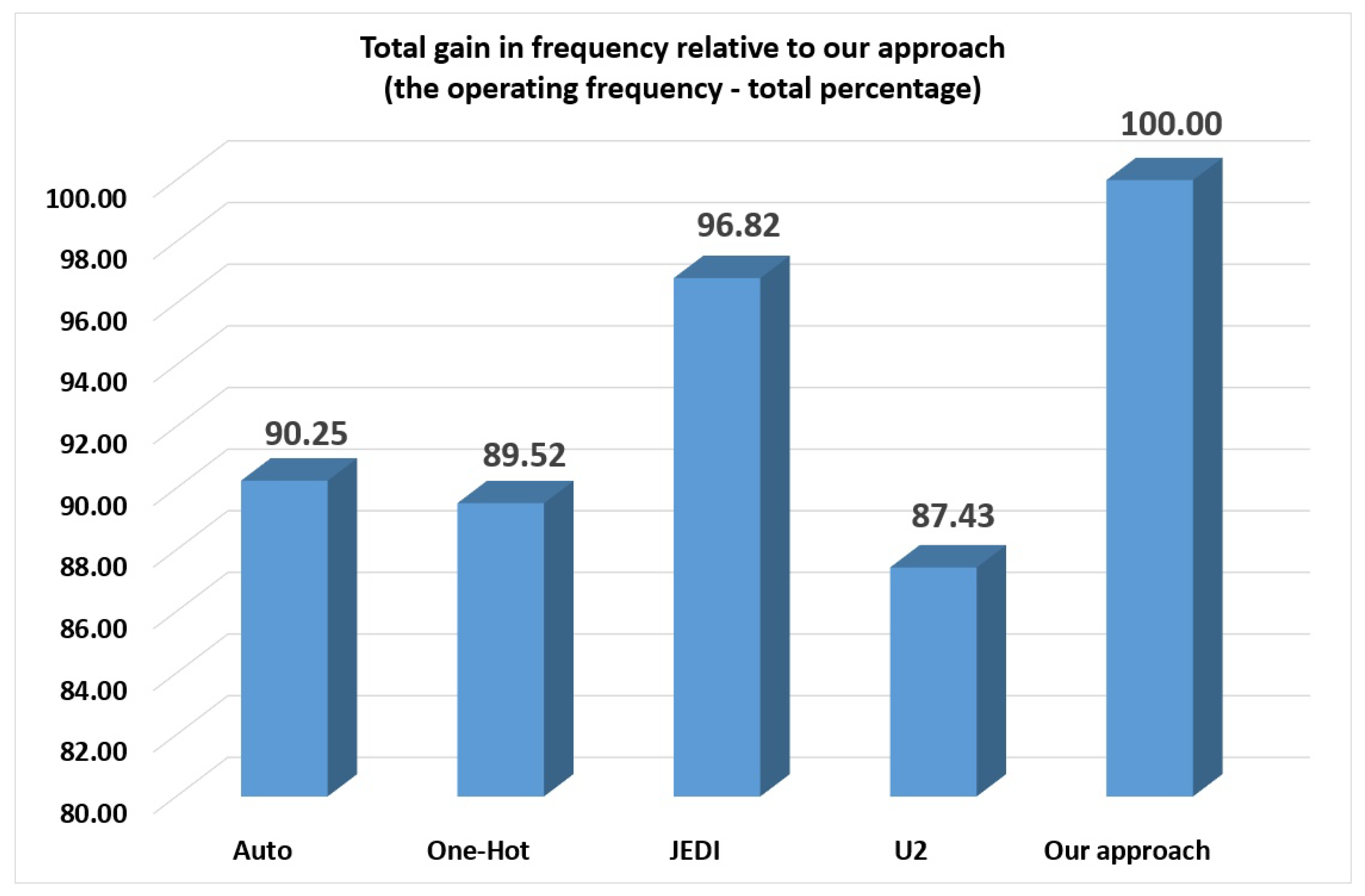
-based FSMs have the highest operating frequency of the investigated methods. Our method gives us a 9.85% advantage over the auto. The one-hot of Vivado loses 10.48% to our approach. The
-based FSMs provide a 3.18% gain compared to JEDI-based FSMs. At last, the
-based FSMs have an average frequency of 12.57% less than it is for FSM based on our approach. These results are shown in
Figure 10.
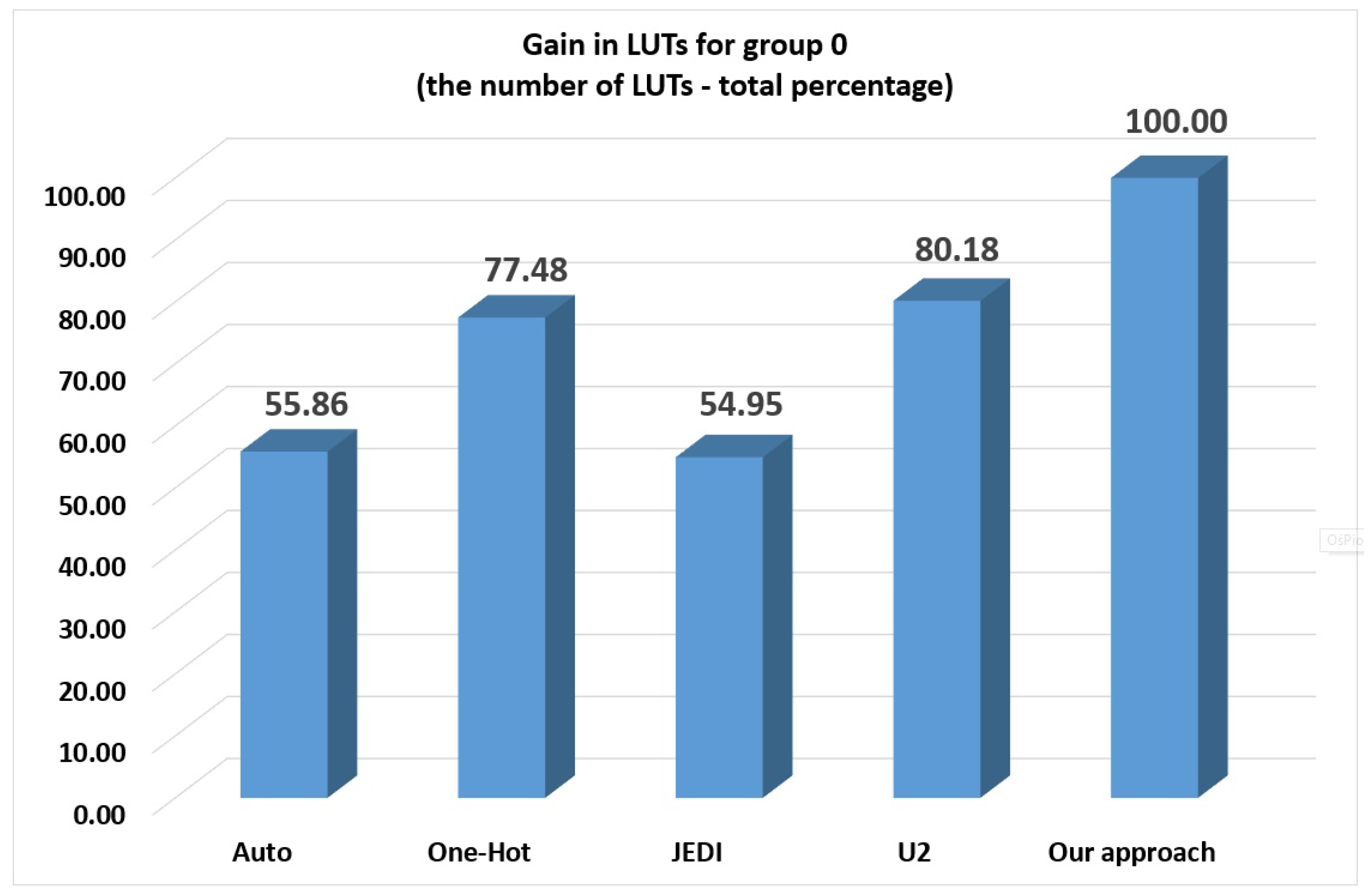
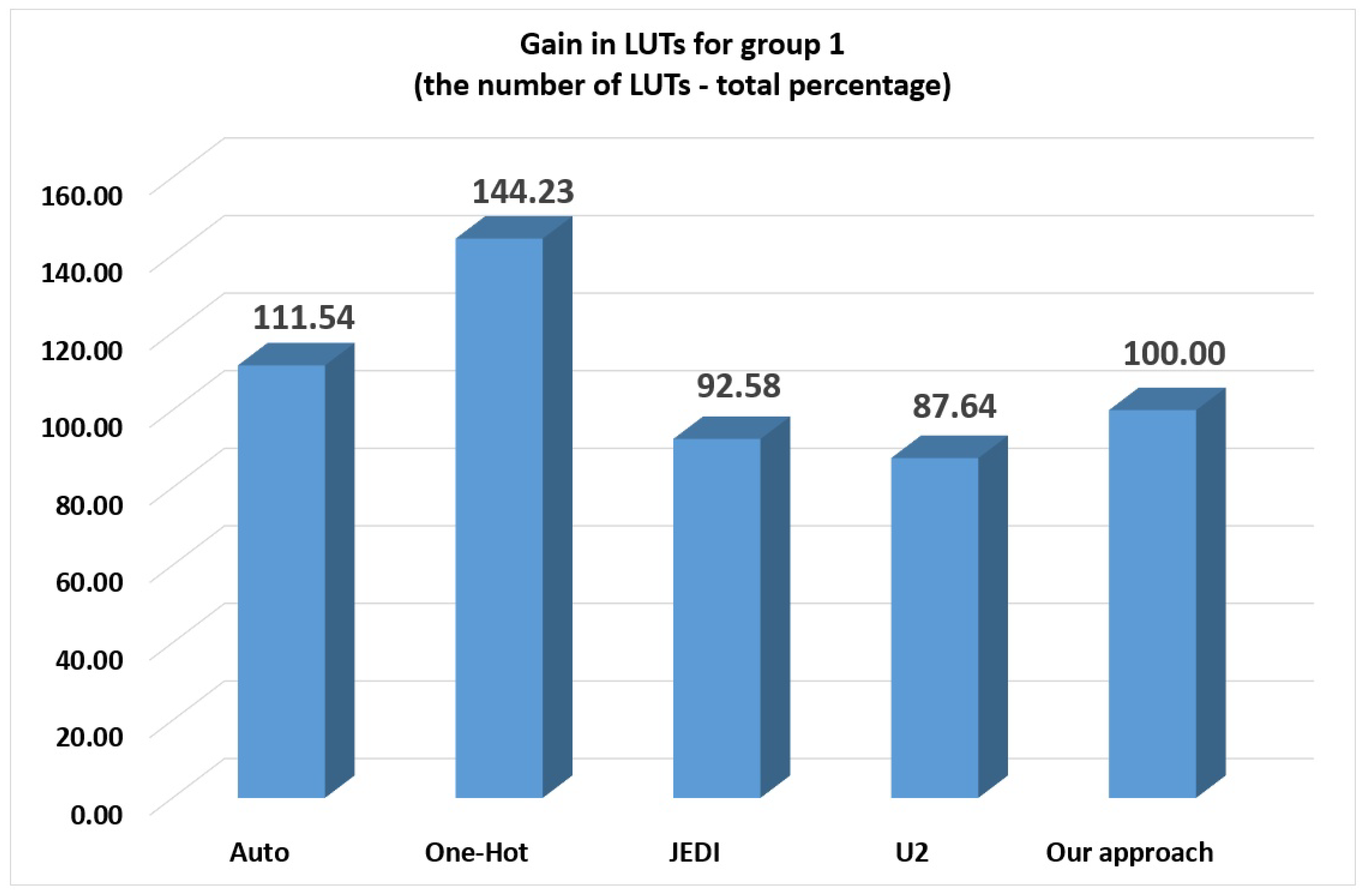
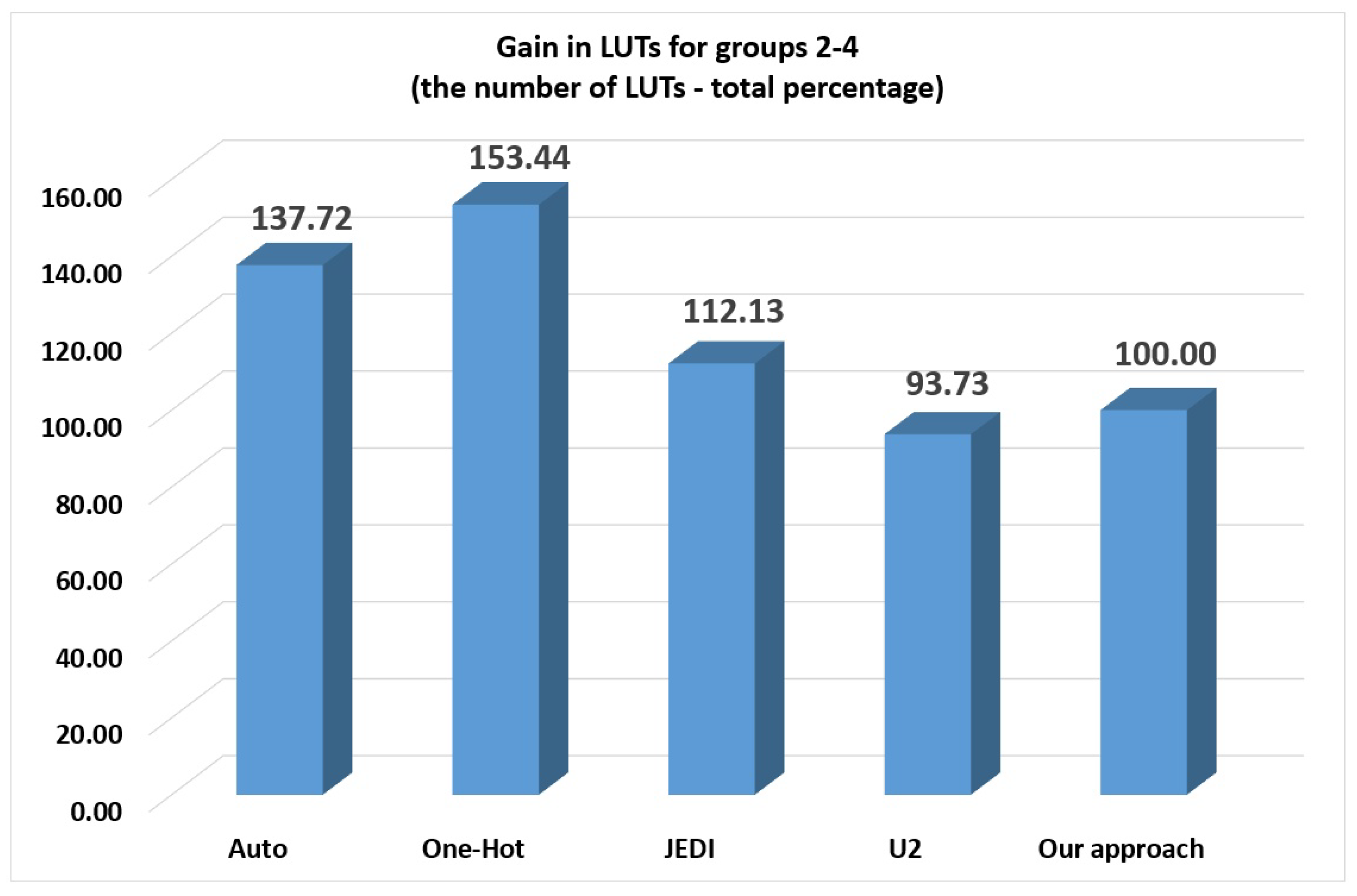
To clarify how the gain in LUTs depends on the FSM group, we have created
Table 9 (gain in LUTs for group 0),
Table 10 (gain in LUTs for group 1) and
Table 11 (gain in LUTs for groups 2–4). Additionally, we present these results by graphs on
Figure 11,
Figure 12 and
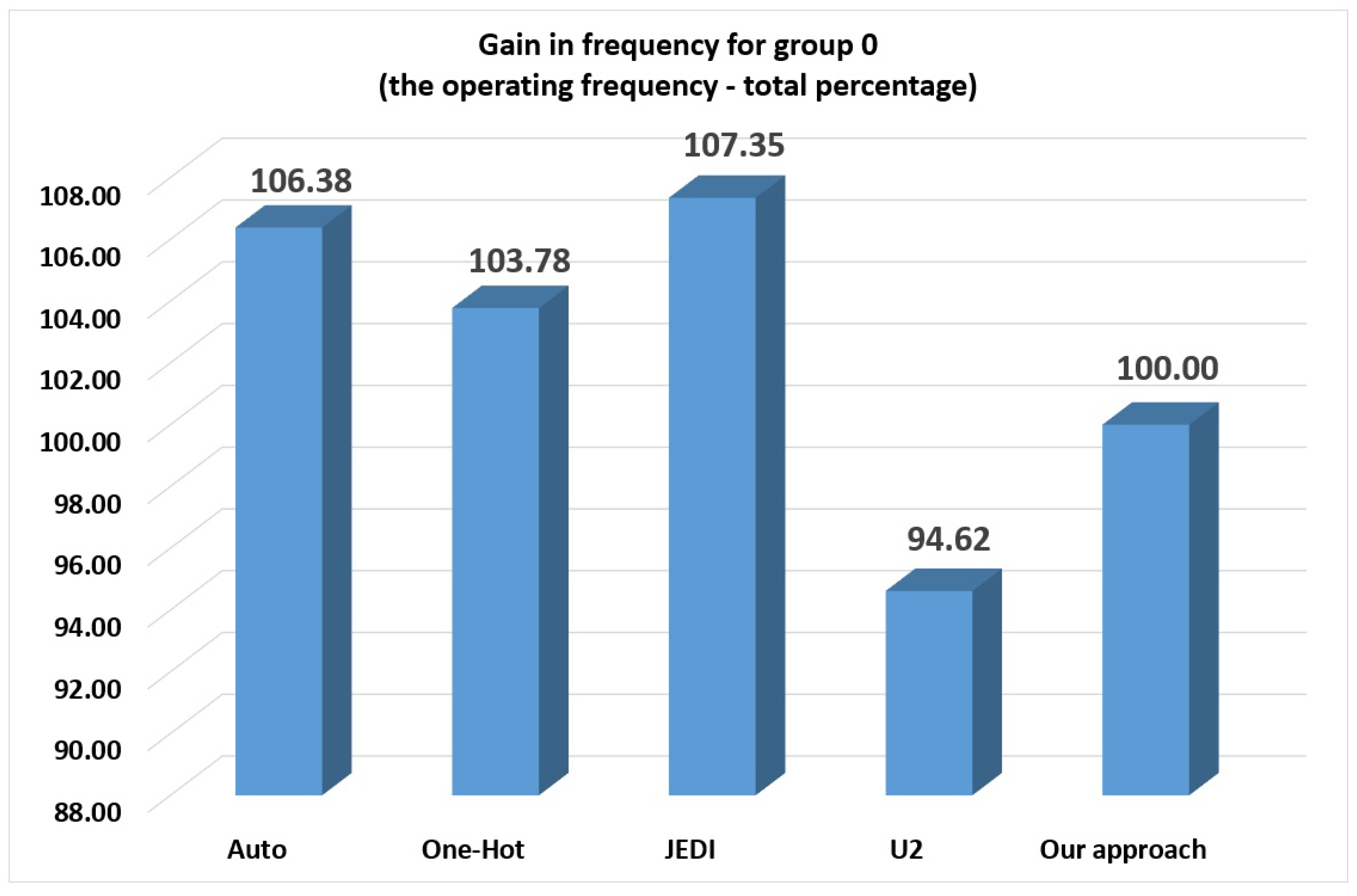
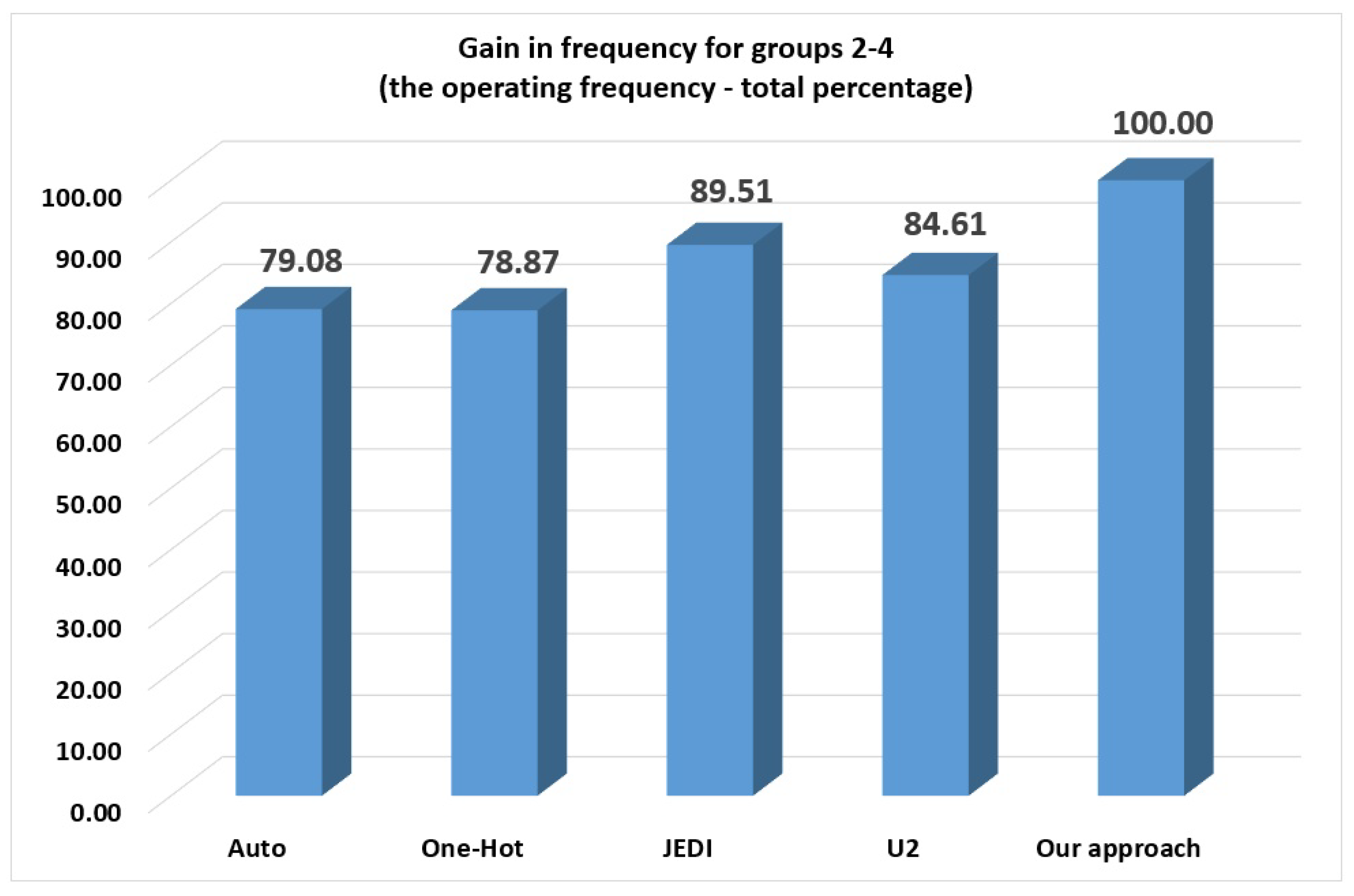
Figure 13, respectively. To clarify how the gain in frequency depends on the FSM group, we have created
Table 12 (gain in frequency for group 0),
Table 13 (gain in frequency for group 1) and
Table 14 (gain in frequency for groups 2–4). Additionally, we present these results by graphs on
Figure 14,
Figure 15 and
Figure 16, respectively.
Analysis of
Table 9 and
Figure 10 shows that the
-based FSMs have more used LUTs than other investigated methods. Our method has the following loss: 44.14% compared to auto, 22.52% compared to one-hot, 45.05% compared to JEDI-based FSMs and 19.82% compared to
-based FSMs. Thus, this method is not suitable for small FSMs.
As follows from
Table 10 and
Figure 12, the
-based FSMs of group 1 required fewer LUTs than FSMs based on auto (11.54% of gain) and one-hot (44.23% of gain). However, we still lose to the JEDI-based FSMs (7.42% of loss) and
-based FSMs (12.36% of loss). Note that the loss decreased in comparison with the group 0.
As follows from
Table 11 and
Figure 10, the
-based FSMs of groups 2–4 required fewer LUTs than FSMs based on auto (37.72% of gain), one-hot (53.44% of gain) and JEDI-based FSMs (12.13% of gain). Only
-based FSMs have better results and our approach has 6.27% of loss. Note that the loss decreased in comparison with the group 1. Thus, starting from average FSMs, our approach loses only to the
-based FSMs.
As follows from
Table 12 and
Figure 14, the
-based FSMs of group 0 are faster than
-based FSMs (5.38% of gain). In this group, the best results belong to JEDI-based FSMs. They have the following gains: (1) 0.9% regarding auto; (2) 3.57% regarding one-hot; (3) 12.73% regarding
-based FSMs; (4) 7.35% regarding our approach. Thus, for the group 0, there is no sense in applying our approach. However, starting from the group 1, our method allows producing faster circuits than the other investigated methods.
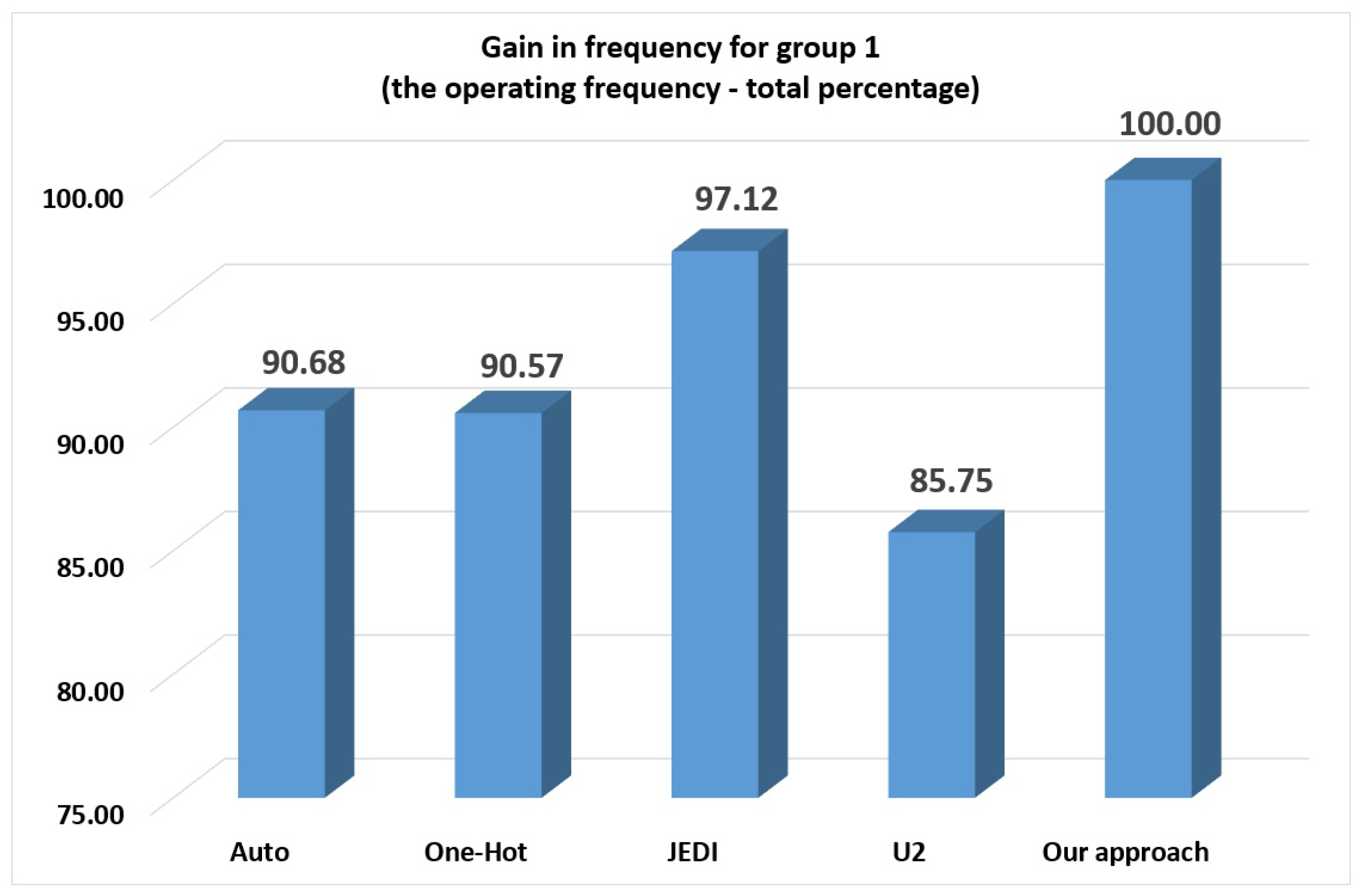
The proposed approach produces the best results for FSMs from group 1 (
Table 13 and
Figure 15). There are the following gains: (1) 9.32% regarding auto; (2) 9.43% regarding one-hot; (3) 2.88% regarding JEDI-based FSMs; and (4) 14.25% regarding
-based FSMs. Our approach provides even better results (
Table 14 and
Figure 16) for FSMs from groups 2–4. The gain increases and amounts to: (1) 20.92% regarding auto; (2) 21.13% regarding one-hot; (3) 10.49% regarding JEDI-based FSMs; and (4) 15.39% regarding
-based FSMs.
As can be seen from
Table 8, the
-based FSMs require fewer LUTs compared to other methods. Analysis of
Table 9 shows that
-based FSMs are the ones with the highest maximum operating frequency compared to other methods. The overall design quality can be estimated by the product of used resources [
63] (for example, chip area occupied by a circuit) and the latency time. As it is in [
63], we use the number of LUTs to compare areas required for FSM circuits based on different models (auto, one-hot, JEDI,
and
). As a rule, an FSM is only a part of a digital system. We do not know how many cycles a system needs to perform a required task. Thus, we cannot find absolute values of latency times. However, for a relative evaluation of different models, it is sufficient to know only the time of cycle.
In this article, we have performed a generalized comparison of the models used in experiments. As a generalized assessment, we used the result of multiplying the number of LUTs in an FSM circuit by the cycle time. The numbers of LUTs are taken from
Table 7. To calculate the cycle times in nanoseconds, we used the operating frequencies from
Table 8. The area-time products measured in
×
are shown in Table 16.
To better evaluate the chip resources used by FSM circuits, we have created
Table 15. It contains the numbers of flip-flops required for implementing the state registers. As follows from
Table 15, there are the same number of flip-flops in registers of FSMs obtained using methods auto, JEDI and
-based FSMs. For these FSMs the number of memory elements is the same. They use the least number of flip-flops determined as
. The largest number of flip-flops is consumed by FSMs based on the one-hot state assignment (eight times more than, for example,
-based FSMs and 4.97 times more than
-based FSMs). Our approach gives a gain of 397% compared to one-hot-based FSMs, but loses 37% to other investigated methods. If we find the difference between, for example, the number of flip-flops in registers of
- and
-based FSMs, we can see that the difference decreases as the group number decreases.
As follows from
Table 16, our approach produces FSM circuits with better area-time products than those of other investigated methods. Our approach gives the following gains: (1) 55.24% regarding auto; (2) 79.87% regarding one-hot; (3) 12.28% regarding JEDI-based FSMs; and (4) 8.6% regarding
-based FSMs. If we compare results for different groups, we can draw the following conclusions. Our approach loses out to all other models for group 0. For group 1,
-based FSMs lose out only to JEDI-based FSMs (4.46% of loss). However, our approach provides significantly better area-time products for FSMs from groups 2–4. In this case, our approach gives the following gains: (1) 76.79% regarding auto; (2) 97.55% regarding one-hot; (3) 24.71% regarding JEDI-based FSMs; and (4) 12.63% regarding
-based FSMs.
The results of our experiments show that the proposed approach can be used instead of other models starting from simple FSMs. The -based FSMs have fewer LUTs than other models. However, starting from average FSMs, our approach allows producing circuits having slightly larger numbers of LUTs with significantly higher maximum operating frequencies. Additionally, our approach provides better area-time products starting from average FSMs. It has rather good potential and can be used in targeting FPGA-based Mealy FSMs.