An Enhanced Trust Mechanism with Consensus-Based False Information Filtering Algorithm against Bad-Mouthing Attacks and False-Praise Attacks in WSNs



Abstract
:1. Introduction
- We propose an enhanced trust mechanism with a consensus-based false information filtering algorithm (TM-CFIFA) that can effectively defend against bad-mouthing attacks and false-praise attacks.
- We conduct experiments that show our TM-CFIFA can better defend against two attacks by comparing it with a representative RS used in various trust-aware routing algorithms including light-weight trust aware routing protocol (LTRP) [17,18,19,20]. The results show that our TM-CFIFA not only better defends against bad-mouthing attacks and false-praise attacks but also extends the network lifetime of WSNs by at least 15.8% in our experimental setups.
2. Background and Related Works
2.1. Insider Attacks in WSNs
2.2. Trust Mechanism (TM) and Reputation System (RS)
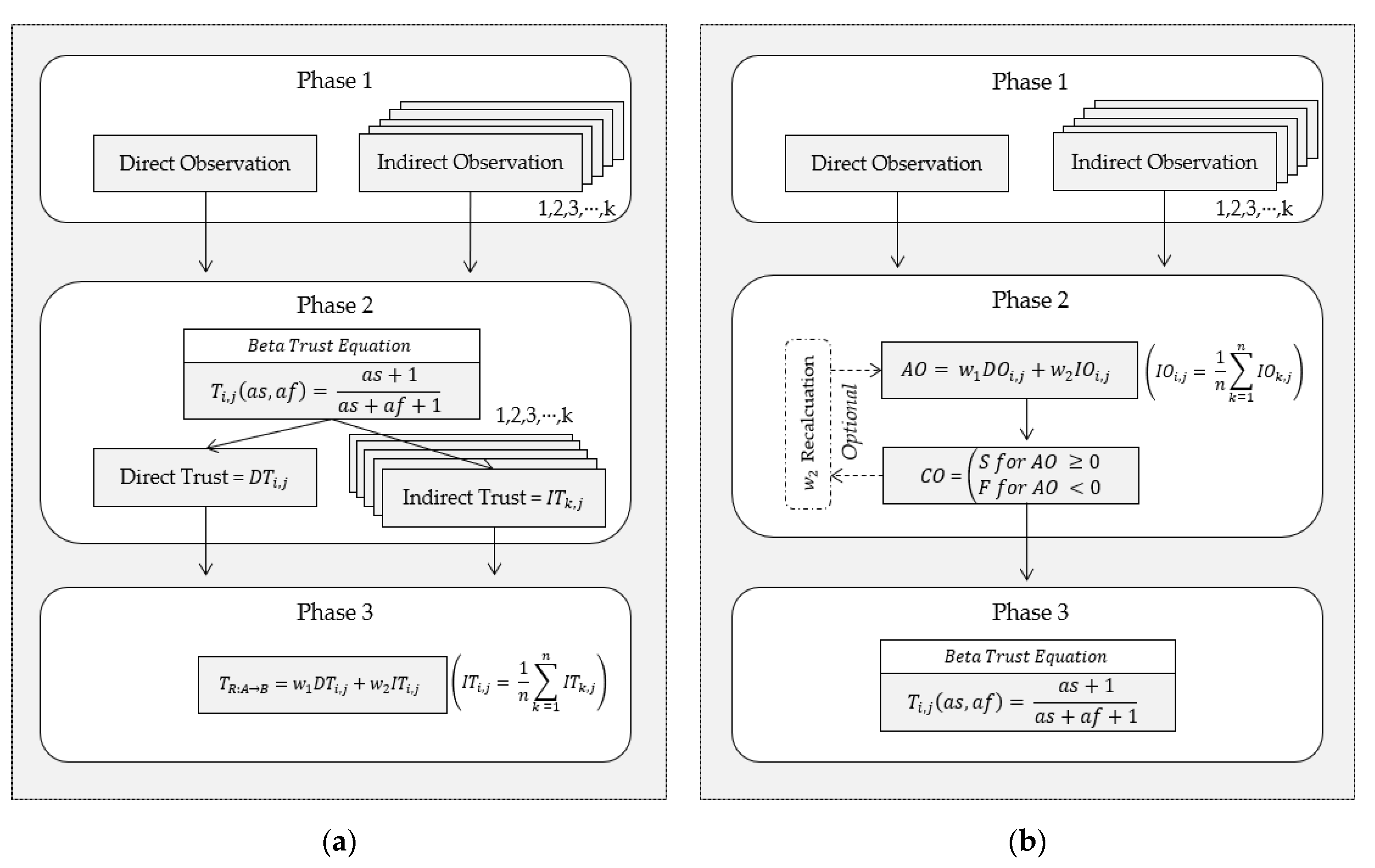
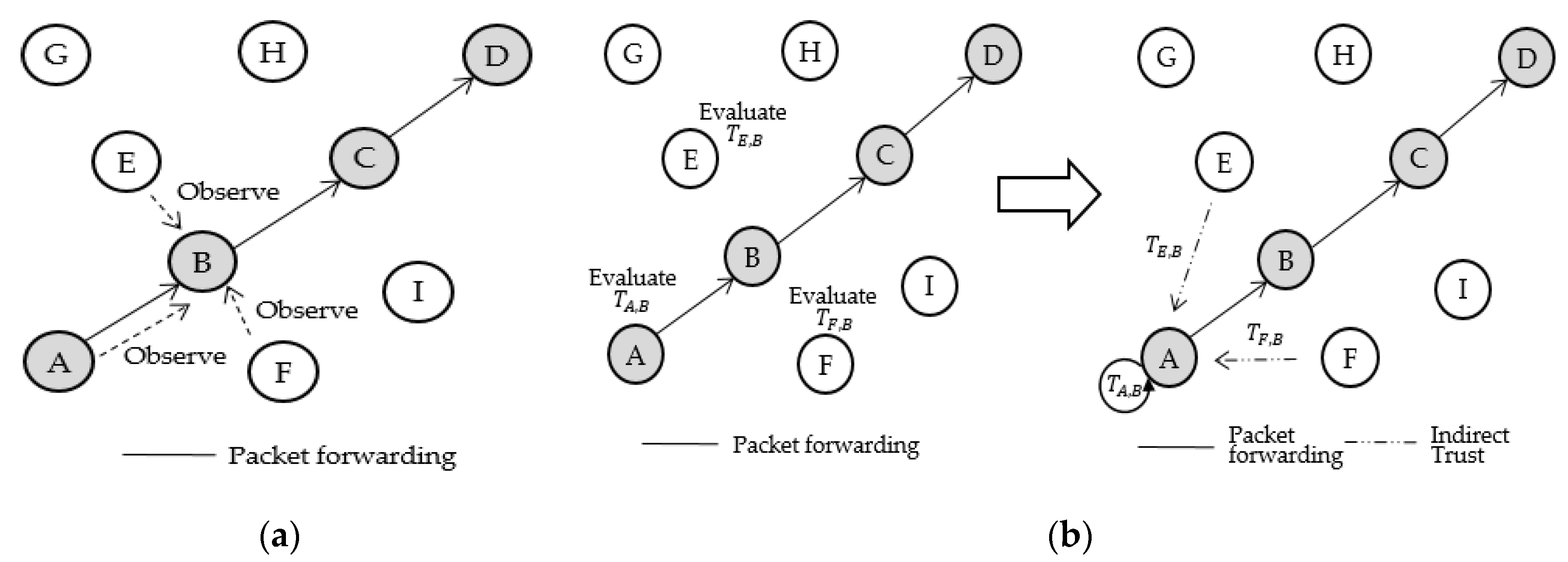
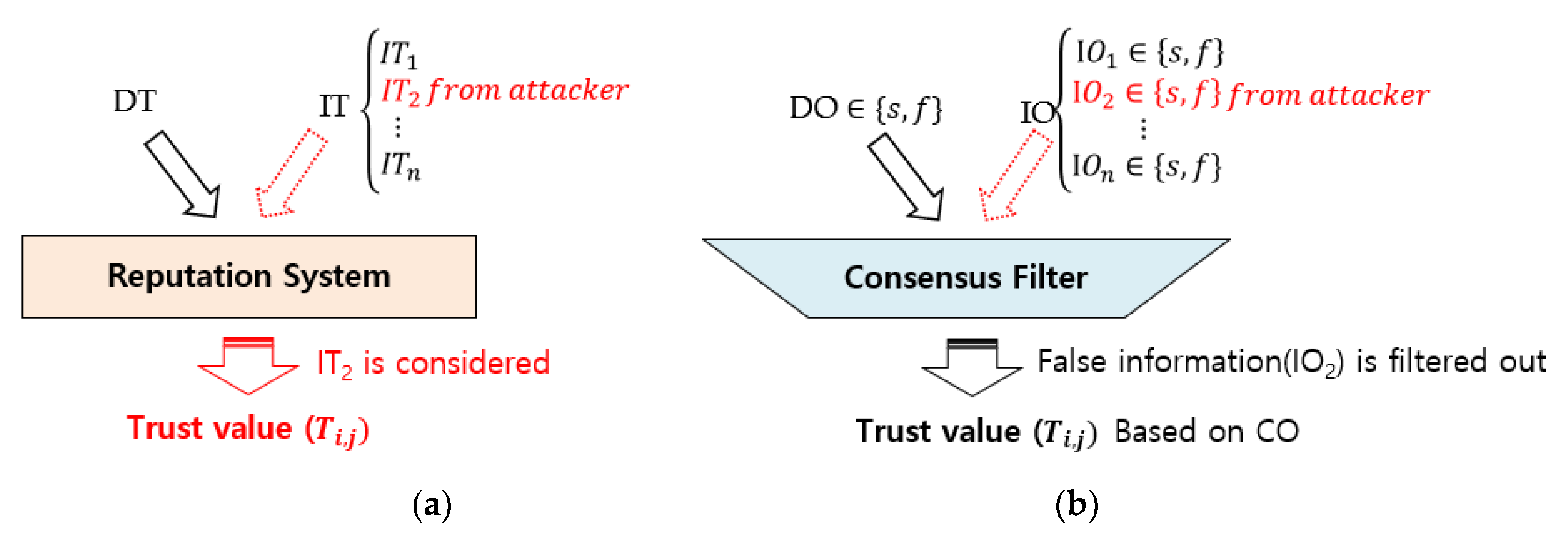
- Phase 1 (Monitoring/Recording): Each sensor node monitors its neighbor nodes’ behaviors, for example, packet forwarding/relaying, and then records whether their behaviors are performed successfully and cooperatively (see Figure 1a). Watchdog is a representative, widely adopted monitoring mechanism for this phase [24,25]. Basically, Watchdog uses two counters such as a success counter and a failure counter and these counters increase and are recorded according to the observed behaviors of neighbor nodes.
- Phase 2 (Trust Measurement): Based on the observation results in Phase 1, each node evaluates the trustworthiness of its neighbor nodes. For trust evaluation, various mathematical trust models have been proposed [18,26]. The Beta trust model [27] is representative of trust models for WSNs because it is lightweight and mathematically sound. When node i evaluates node j’s trust value, the Beta trust model calculates the trust value Ti,j by Equation (1).where as is the accumulated number of successes and af is the accumulated number of failures. Ti,j has a value between 0 and 1, and the higher Ti,j, the more trustworthy the evaluated node is. As we can see in (1), the Beta trust model uses only two parameters (as and af), and thus the combined implementation of the Beta trust model and Watchdog are widely used for Phase 1 and Phase 2 in WSNs [28].
- Phase 3 (Attack Detection): In this phase, a sensor node determines whether its neighbor nodes are trustworthy for cooperation. That is, if a certain neighbor node’s measured trust value is lower than a certain trust threshold (), then it is detected as an inside attacker and removed from the WSN.
| Algorithm 1 Reputation System (RS) |
| Input: Num. of neighbor nodes which provided node i with their indirect observations: n Weight factor , Node i’s direct observation to node j: # s: success, f: failure Node k’s indirect observation to node j: Output: Direct trust value: Indirect trust value: Overall trust value: |
| 1: Begin 2: # Direct trust calculation 3: if DOi,j == s: 4: as = as + 1 # increase accumulated success count (as) by 1 5: else: 6: af = af + 1 # increase accumulated failure count (af) by 1 7: 8: 9: 10: # Indirect trust calculation 11: for each neighbor node k where 1 ≤ k ≤ n: 12: if IOk,j == s: 13: ask,j = ask,j + 1 14: else: 15: afk,j = afk,j + 1 16: 17: 18: 19: 20: 21: # Overall trust calculation 22: 23: End |
2.3. Intelligent Insider Attacks: Bad-Mouthing Attack and False-Praise Attack
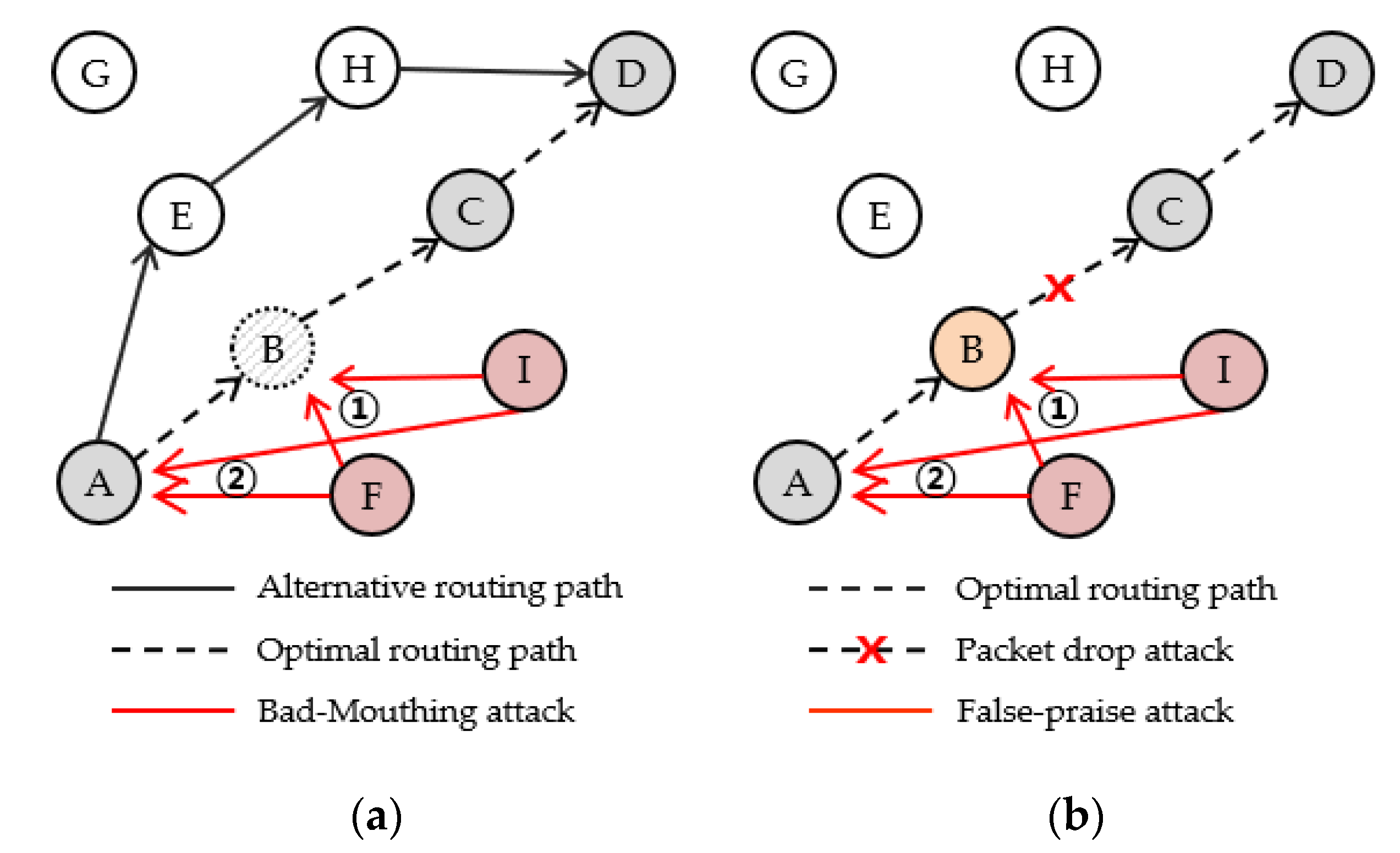
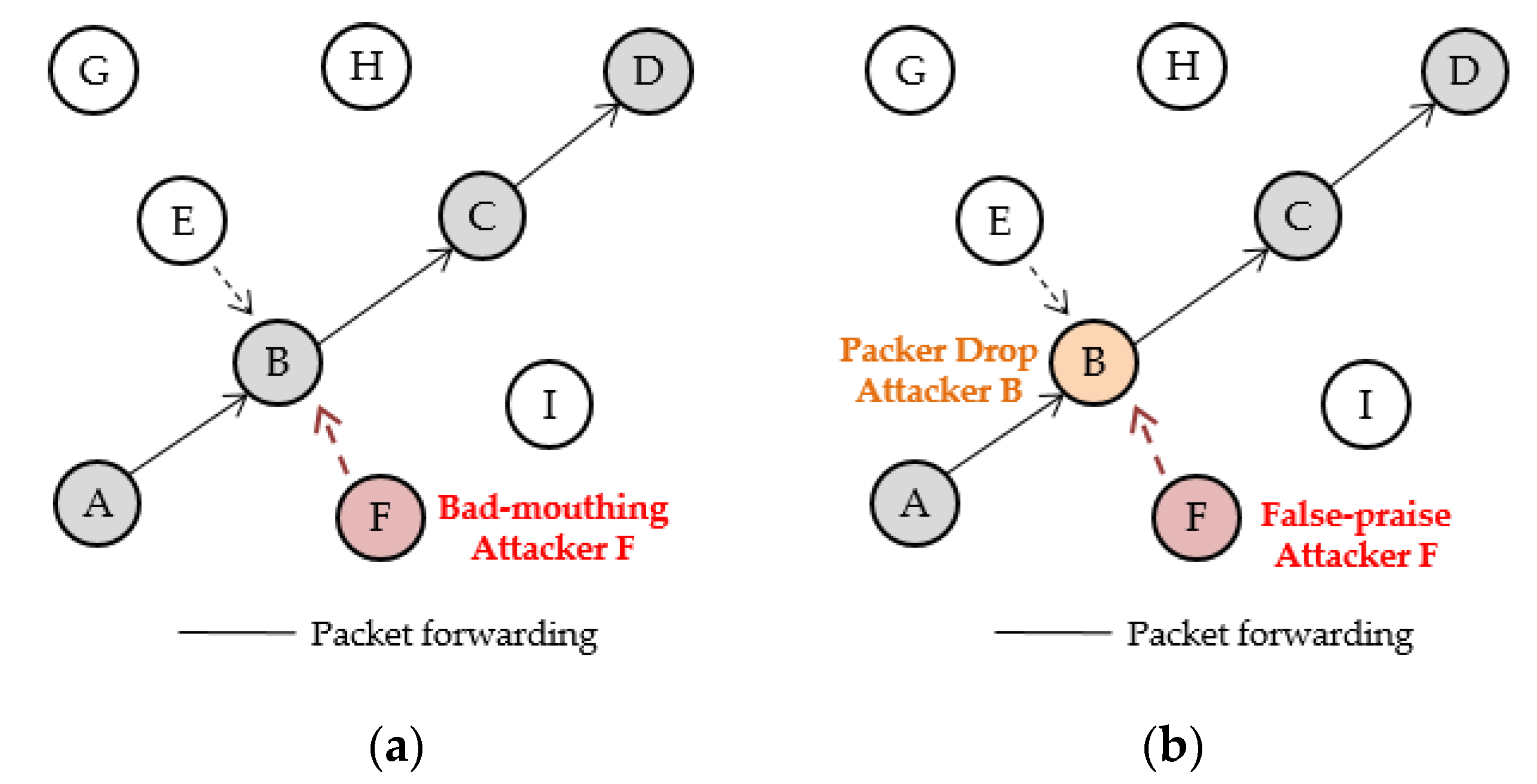
- Bad-MouthingAttack: As shown in Figure 2a, the bad-mouthing attacker (node F or I) intentionally provides the evaluating node (node A) with false information about the evaluated node (node B) such that B does not forward A’s packets correctly, although B forwards A’s packets to node C correctly. If the bad-mouthing attacker continues to launch attacks, B’s trust value will become lower than a trust threshold and eventually B will be removed from its neighbor list. Once B is removed, A will find another neighbor node (node E) as its next hop and then A’s packets will be routed along the path E → H → D, which is less optimal than the original optimal routing path A→B→C→D in terms of energy efficiency or routing distance. Consequently, bad-mouthing attacks can degrade the entire network performance by eliminating many normal nodes in WSNs.
- False-Praise Attack: As shown in Figure 2b, this attacker (node F or I) deliberately increases the trust value of an evaluated node (node B); in this example, B is a packet drop attacker and is collaborating with these false-praise attackers. As the attack name shows, the false-praise attackers (node F and I) continue to provide node A with false information such that node B behaves correctly although B drops all packets from node A. As a result, node B’s trust in A may not significantly decrease due to false observations or indirect trust values from the two false-praise attackers (see Equation (2)).
2.4. Existing Defense Approaches against Bad-Mouthing Attacks and False-Praise Attacks
3. Proposed Trust Mechanism with Consensus-Based False Information Filtering Algorithm
3.1. Weakness in Existing Reputation Systems
3.2. Our Idea: Filter False Information based on Consensus Observations about Evaluated Nodes’ Behaviors
3.3. Design of TM-CFIFA
- Step 1.
- Node A records its direct observations (DOA,B) and receives indirect observations (IOE,B and IOF,B) from neighbor nodes (node E and F) after monitoring node B’s behavior; each observation is recorded as either s (for success) or f (for failure) in A’s local memory.
- Step 2.
- TM-CFIFA calculates the aggregated observation (AOA, B) by using DOA, B, IOE,B and IOF,B by Equation (3); AOA,B will be used later to generate the consensus observation in Step 3.where and are weight factors for DO and IO, respectively, and + = 1. In addition, we define IOA,B as the aggregated indirect observation by considering A’s neighbor’s observations on node B and IOA,B is calculated by Equation (4).where NSA is the neighbor set of node A, and NSA = {E, F} in this example, and n is the number of A’s neighbor nodes, and n = 2 in this example. To ease the calculation of IOA,B, we used 1 for s (success) and -1 for f (fail). For example, if w1 = w2 = 0.5, DOA,B = s, IOE,B = s, and IOF,B = f, then IOA,B = 0 and AOA,B = 0.5 by (4) and (3), respectively. We will explain how AOA,B can be used for generating consensus observations in Step 3. Meanwhile, although we set the initial weight factors and to 0.5, these weights can be updated periodically by using reinforcement learning techniques [30,31] by considering them after each trust evaluation process ends.
- Step 3.
- Based on AOA,B, TM-CFIFA generates consensus observation (CO) by using (5).
Algorithm 2 TM-CFIFA Input:
Num. of neighbor nodes which provided node i with their indirect observations: n
Weight factor ,
Node i’s direct observation to node j:
Node k’s indirect observation to node j:
Output:
Aggregation observation:
Consensus observation:
Overall trust value: Ti,j1: Begin
2: # For ease calculation, set DO = 1 for success (s) and DO = -1 for failure (f)
3: if == s:
4: = 1
5: else:
6: = −1
7: # For ease calculation, set IOk,j = 1 for success (s) and IOk,j = -1 for failure (f)
8: for each neighbor node k where 1 ≤ k ≤ n (n: the number of neighbor nodes)
9: if == s:
10: = 1
11: else:
12: = −1
13: # Calculate AO by using DO and IO
14: =
15: # Determine CO according to AO
16: if :
17: CO = s
18: as = as + 1
19: else:
20: CO = f
21: af = af + 1
22: # Final trust calculation
23:
24: End
4. Experiment and Analysis
4.1. Experimental Environment and Methods
- Wireless Network Model: We considered a simple WSN with nine sensor nodes as shown in Figure 5. In this WSN, node A (source node) generates packets and wants to deliver them to the destination node D. As depicted in Figure 5, we assume that the optimal routing path from A to D is determined as A → B → C → D by a routing algorithm in A. Considering natural packet losses in WSNs, the packet forwarding success rate is set to 70%. Each node can monitor its neighbor nodes’ packet forwarding behaviors by using the Watchdog mechanism. In this network topology, node A’s neighbor nodes are B, E, and F which means that the observation of nodes E and F will be provided to node A.
- Attack Models
- (1)
- Bad-mouthing attack model: Node F (red-colored) launches bad-mouthing attacks to node B (see Figure 5a). That is, F will send false information about B to A such that even though node B successfully forwards A’s packets to C, the bad-mouthing attacker F will falsely say B did not send A’s packet to C in order to let A mistakenly decrease B’s trust value.
- (2)
- False-praise attack model: Unlike the bad-mouthing attack model, as shown in Figure 5b, node B and F are inside attackers and collaborate with each other; B is a packet drop attacker and F is a false-praise attacker. In this attack model, when node A sends its packet to node B, the packet drop attacker B randomly drops the packet with a drop rate of 70%. However, the false-praise attacker F sends false information to node A such that node B correctly forwarded A’s packet to node C in order to let A mistakenly increase B’s trust value.
4.2. Experiment Results and Analysis
4.2.1. Experiment 1: Comparison of Defense Performance in the Presence of Bad-Mouthing Attacks
4.2.2. Experiment 2: Comparison of Defense Performance in the Presence of False-Praise Attacks
5. Conclusions and Future Works
Author Contributions
Funding
Conflicts of Interest
References
- Ericson Home Page. Available online: https://www.ericsson.com/en/mobility-report/internet-of-things-forecast (accessed on 3 October 2019).
- Amin, R.; Islam, S.K.H.; Biswas, G.P.; Khan, M.K. A robust and anonymous patient monitoring system using wireless medical sensor networks. Future Gener. Comput. Syst. 2018, 80, 483–495. [Google Scholar] [CrossRef]
- Cheung, W.F.; Lin, T.H.; Lin, Y.C. A real-time construction safety monitoring system for hazardous gas integrating wireless sensor network and building information modeling technologies. Sensors 2018, 18, 436. [Google Scholar] [CrossRef] [PubMed]
- Ahmedi, F.; Ahmedi, L.; O’Flynn, B.; Kurti, A. InWaterSense: An Intelligent Wireless sensor network for monitoring surface water quality to a river in Kosovo. In Innovations and Trends in Environmental and Agricultural Informatics; IGI Global: Hershey, PA, USA, 2018; pp. 58–85. [Google Scholar]
- Patil, D.; Thanuja, T.C.; Melinamath, B.C. Air Pollution Monitoring System Using Wireless Sensor Network (WSN). In Proceedings of the 2016 IEEE International WIE Conference on Electrical and Computer Engineering (WIECON-ECE), Pune, India, 19–21 December 2016; pp. 391–400. [Google Scholar]
- Ismail, M.N.; Shukran, M.A.; Isa, M.R.M.; Adib, M. Establishing a soldier wireless sensor network (WSN) communication for military operation monitoring. Int. J. Inf. Commun. Technol. 2018, 7, 89–95. [Google Scholar] [CrossRef]
- Shi, E.; Perrig, A. Designing secure sensor networks. IEEE Wirel. Commun. 2004, 11, 38–43. [Google Scholar]
- Ali, S.; Bulushi, T.A.; Nadir, Z. Improving the resilience of Wireless Sensor Networks against security threats: A survey and open research issues. Int. J. Technol. 2018, 9, 828–839. [Google Scholar] [CrossRef]
- Daia, A.S.A.; Ramadan, R.A.; Fayek, M.B. Sensor Networks Attacks Classifications and Mitigation. Ann. Emerg. Technol. Comput. (AETiC) 2018, 2, 28–43. [Google Scholar] [CrossRef]
- Singh, O.; Rishiwal, V.; Kumar, L. Secure Energy Aware Routing in Wireless Sensor Networks. In Proceedings of the 2019 4th International Conference on Internet of Things: Smart Innovation and Usages (IoT-SIU), Ghaziabad, India, India, 18–19 April 2019. [Google Scholar]
- Rehman, E.; Sher, M.; Naqvi, S.H.A. Energy efficient secure trust based clustering algorithm for mobile wireless sensor network. J. Comput. Netw. Commun. 2017, 2017, 1630673. [Google Scholar] [CrossRef]
- Yu, Y.; Li, K.; Zhou, W.; Li, P. Trust mechanisms in wireless sensor networks: Attack analysis and countermeasures. J. Netw. Comput. App. 2012, 35, 867–880. [Google Scholar] [CrossRef]
- Garg, S.; Varshney, M.; Nailwal, A. Insider Threats in Wireless Sensor Networks and Their Countermeasures. Mon. J. Comput. Sci. Inf. Technol. 2016, 5, 476–486. [Google Scholar]
- Ishmanov, F.; Bin Zikria, Y. Trust mechanisms to secure routing in wireless sensor networks: Current state of the research and open research issues. J. Sens. 2017, 2017, 4724852. [Google Scholar] [CrossRef]
- Kang, S.; Wu, Y. A trust-based pollution attack prevention scheme in peer-to-peer streaming networks. Comput. Netw. 2014, 72, 62–73. [Google Scholar] [CrossRef]
- Esposito, C.; Castiglione, A.; Palmieri, F. Information theoretic-based detection and removal of slander and/or false-praise attacks for robust trust management with Dempster-Shafer combination of linguistic fuzzy terms. Concurr. Comput. Pract. Exp. 2018, 30, e4302. [Google Scholar] [CrossRef]
- Ahmed, A.; Haseeb, K.; Khokhar, S. A light-weight trust aware routing protocol for wireless sensor network. Gomal. Univ. J. Res. (Sci.) 2017, 33, 102–112. [Google Scholar]
- Khalid, O.; Khan, S.U.; Madani, S.A.; Hayat, K. Comparative study of trust and reputation systems for wireless sensor networks. Secur. Commun. Netw. 2013, 6, 669–688. [Google Scholar] [CrossRef]
- Duan, J.; Yang, D.; Zhu, H.; Zhang, S.; Zhao, J. TSRF: A trust-aware secure routing framework in wireless sensor networks. Int. J. Distrib. Sens. Netw. 2014, 10, 209436. [Google Scholar] [CrossRef]
- Tornos, J.L.; Salazar, J.L.; Piles, J.J. Secure Trust Management with Source Routing Protocol for MANETs. Netw. Protoc. Algorithms 2015, 7, 42–59. [Google Scholar]
- Tsiropoulou, E.E.; Baras, J.S.; Papavassiliou, S. On the Mitigation of Interference Imposed by Intruders in Passive RFID Networks. In Proceedings of the International Conference on Decision and Game Theory for Security, New York, NY, USA, 2–4 November 2016. [Google Scholar]
- Cho, Y.; Qu, G. Enhancing Trust-Aware Routing by False Alarm Detection and Recovery. In Proceedings of the 2014 IEEE Military Communications Conference, Baltimore, MD, USA, 6–8 October 2014. [Google Scholar]
- Ahmed, A.; Bakar, K.A.; Channa, M.I.; Haseeb, K. A survey on trust based detection and isolation of malicious nodes in ad-hoc and sensor networks. Front. Comput. Sci. 2015, 9, 280–296. [Google Scholar] [CrossRef]
- Reddy, V.B.; Negi, A.; Venkataraman, S. A Similarity based Trust Model to Mitigate Badmouthing Attacks in Internet of Things (IoT). In Proceedings of the 2019 IEEE 5th World Forum on Internet of Things (WF-IoT), Limerick, Ireland, 15–18 April 2019. [Google Scholar]
- Subba, B.; Biswas, S.; Karmakar, S. Intrusion detection in Mobile Ad-hoc Networks: Bayesian game formulation. Eng. Sci. Technol. Int. J. 2016, 19, 782–799. [Google Scholar] [CrossRef]
- Wu, Y.; Zhao, Y.; Riguidel, M.; Wang, G. Security and trust management in opportunistic networks: A survey. Secur. Commun. Netw. 2015, 8, 1812–1827. [Google Scholar] [CrossRef]
- Oracevic, A.; Akbas, S.; Ozdemir, S. Secure and reliable object tracking in wireless sensor networks. Comput. Secur. 2017, 70, 307–318. [Google Scholar] [CrossRef]
- Cho, Y.; Qu, G.; Wu, Y. Insider threats against trust mechanism with watchdog and defending approaches in wireless sensor networks. In Proceedings of the 2012 IEEE Symposium on Security and Privacy Workshops, San Francisco, CA, USA, 24–25 May 2012; pp. 134–141. [Google Scholar]
- Kiefhaber, R. Calculating and Aggregating Direct Trust and Reputation in Organic Computing Systems. Ph.D. Thesis, University of Augsburg, Augsburg, Germany, 2014. [Google Scholar]
- Ghobaei-Arani, M.; Jabbehdari, S.; Pourmina, M.A. An autonomic resource provisioning approach for service-based cloud applications: A hybrid approach. Future Gener. Comput. Syst. 2018, 78, 191–210. [Google Scholar] [CrossRef]
- Chu, Y.; Kosunalp, S.; Mitchell, P.D.; Grace, D. Application of reinforcement learning to medium access control for wireless sensor networks. Eng. Appl. Artif. Intell. 2015, 46, 23–32. [Google Scholar] [CrossRef]
- Azad, M.A.; Bag, S.; Hao, F.; Salah, K. M2m-rep: Reputation system for machines in the internet of things. Comput. Secur. 2018, 79, 1–16. [Google Scholar] [CrossRef]
- Michiardi, M.; Molva, R. Core: A collaborative reputation mechanism to enforce node cooperation in mobile ad hoc networks. In Advanced Communications and Multimedia Security; Springer: Boston, MA, USA, 2002; pp. 107–121. [Google Scholar]
- Zahariadis, T.; Leligou, H.; Karkazis, P. Design and implementation of a trust-aware routing protocol for large WSNs. Int. J. Netw. Secur. Its Appl. (IJNSA) 2010, 2, 52–68. [Google Scholar] [CrossRef]
- Chen, Z.; He, M.; Liang, W.; Chen, K. Trust-aware and low energy consumption security topology protocol of wireless sensor network. J. Sens. 2015, 2015, 716468. [Google Scholar] [CrossRef]
- Labraoui, N.; Gueroui, M.; Sekhri, L. On-off attacks mitigation against trust systems in wireless sensor networks. In Proceedings of the IFIP International Conference on Computer Science and Its Applications, Saida, Algeria, 20–21 May 2015; Springer: Cham, Switzerland, 2015. [Google Scholar]



| Step | Reputation System (RS) | TM-CFIFA |
|---|---|---|
| Phase2 | O(n) | O(n) |
| Phase3 | O(1) | O(1) |
| Overall | O(n) | O(n) |
| Parameters | Values | |
|---|---|---|
| Experiment 1 (Bad-Mouthing) | Experiment 2 (False-Praise) | |
| Max simulation time | 20 min | 20 min |
| Number of Attackers | 1 bad-mouthing attacker | 1 packet drop attacker 1 false-praise attacker |
| Initial trust value | 0.99 | 0.99 |
| Trust threshold () | 0.3~0.9 | 0.3~0.9 |
| Packet forwarding rate | 70% | 70% |
| θT | DT (Detection Time of Node B) | Comparison Result | ||
|---|---|---|---|---|
| RS | TM-CFIFA | Lifetime (Δt) | Improvement (%) | |
| 0.95 | 6 | 11 | + 5 | 83 |
| 0.9 | 20 | 42 | + 22 | 210 |
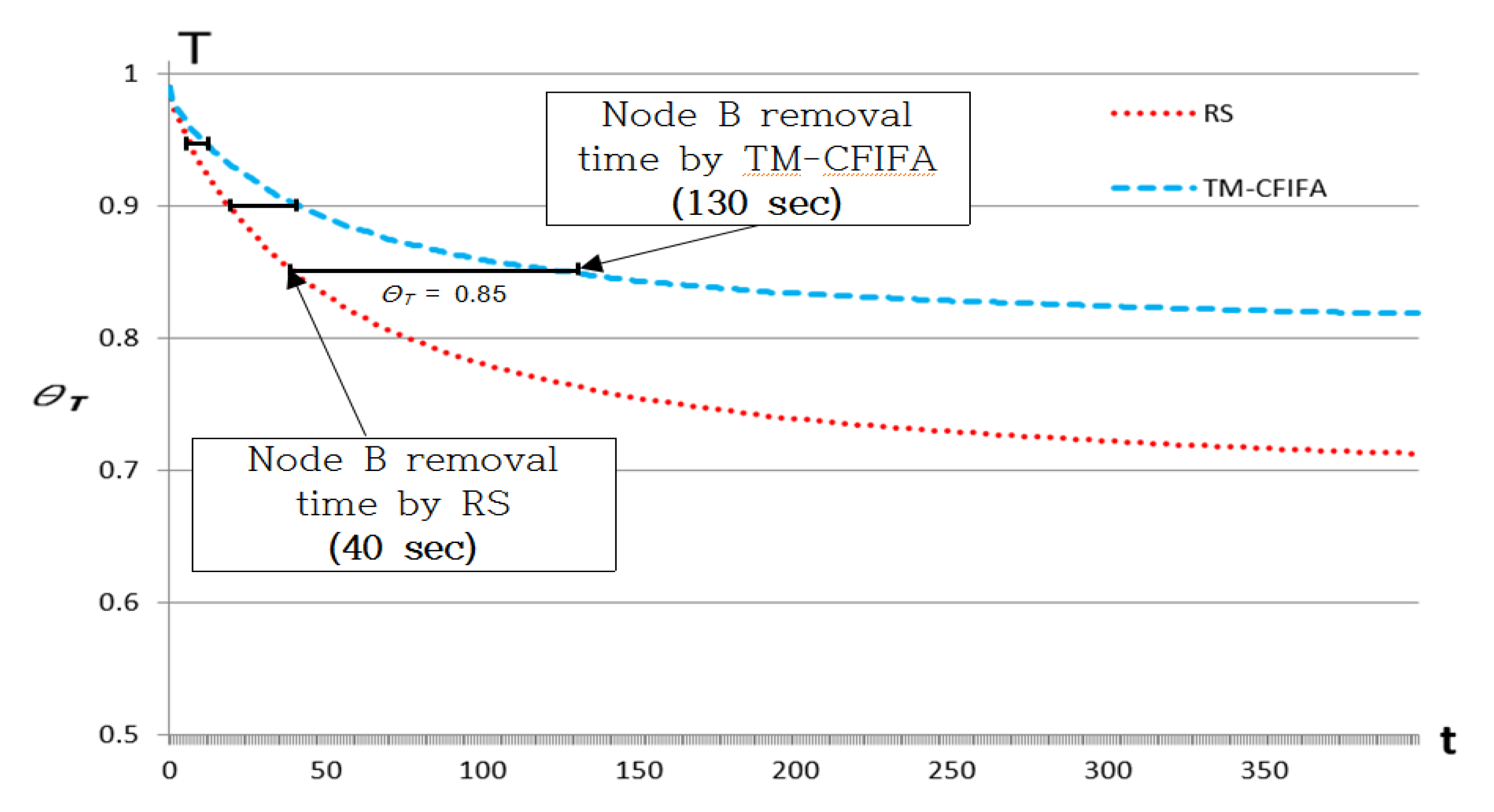
| 0.85 | 40 | 130 | + 90 | 325 |
| 0.8 | 78 | Active (not removed) | - | - |
| 0.75 | 165 | Active (not removed) | - | - |
| 0.70 | Active (not removed) | Active (not removed) | - | - |
| θT | DT (Detection Time of Node B) | Comparison Result | ||
|---|---|---|---|---|
| RS | TM-CFIFA | Detection time (Δt) | Improvement (%) | |
| 0.9 | 19 | 16 | −3 | 15.8% |
| 0.8 | 50 | 40 | −10 | 20% |
| 0.7 | 102 | 77 | −25 | 24.5% |
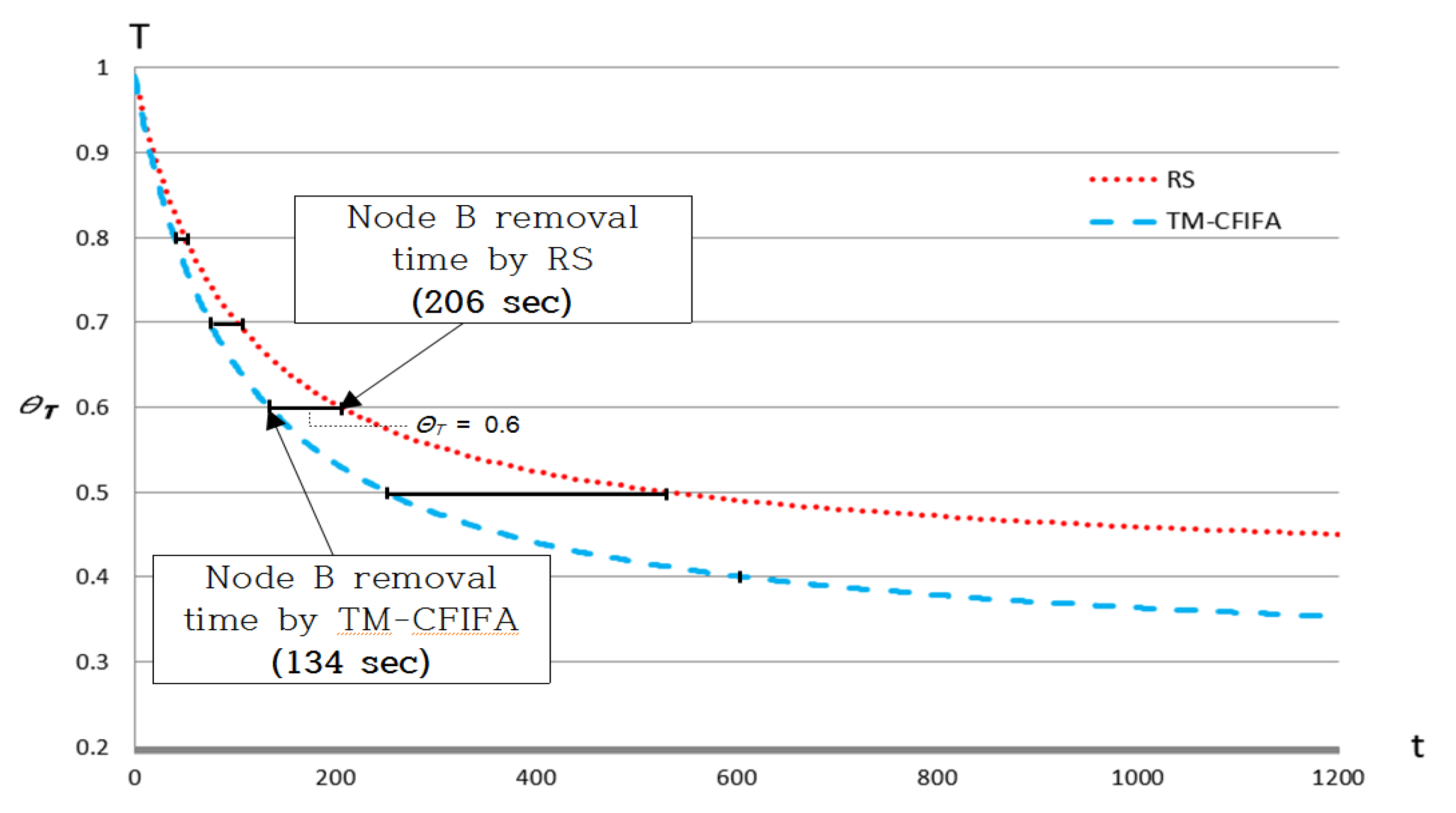
| 0.6 | 206 | 134 | −72 | 35% |
| 0.5 | 533 | 251 | −282 | 53% |
| 0.4 | Active (Not removed) | 607 | - | - |
| 0.3 | Active (Not removed) | Active (Not removed) | - | - |
© 2019 by the authors. Licensee MDPI, Basel, Switzerland. This article is an open access article distributed under the terms and conditions of the Creative Commons Attribution (CC BY) license (http://creativecommons.org/licenses/by/4.0/).
Share and Cite
Suh, T.; Cho, Y. An Enhanced Trust Mechanism with Consensus-Based False Information Filtering Algorithm against Bad-Mouthing Attacks and False-Praise Attacks in WSNs. Electronics 2019, 8, 1359. https://doi.org/10.3390/electronics8111359
Suh T, Cho Y. An Enhanced Trust Mechanism with Consensus-Based False Information Filtering Algorithm against Bad-Mouthing Attacks and False-Praise Attacks in WSNs. Electronics. 2019; 8(11):1359. https://doi.org/10.3390/electronics8111359
Chicago/Turabian StyleSuh, Taisuk, and Youngho Cho. 2019. "An Enhanced Trust Mechanism with Consensus-Based False Information Filtering Algorithm against Bad-Mouthing Attacks and False-Praise Attacks in WSNs" Electronics 8, no. 11: 1359. https://doi.org/10.3390/electronics8111359
APA StyleSuh, T., & Cho, Y. (2019). An Enhanced Trust Mechanism with Consensus-Based False Information Filtering Algorithm against Bad-Mouthing Attacks and False-Praise Attacks in WSNs. Electronics, 8(11), 1359. https://doi.org/10.3390/electronics8111359