You are currently viewing a new version of our website. To view the old version click .
Electronics
  • Article
  • Open Access

21 November 2017

Performance Evaluation of Downlink Multi-Beam Massive MIMO with Simple Transmission Scheme at Both Base and Terminal Stations


,
,
,
and
1
Faculty of Engineering, Niigata University, Ikarashi 2-nocho 8050, Nishi-ku Niigata 950-2181, Japan
2
Faculty of Engineering, Nippon Institute of Technology, 4-1 Gakuendai, Miyashiro-machi, Minamisaitama-gun, Saitama 345-8501, Japan
*
Author to whom correspondence should be addressed.
This article belongs to the Special Issue Smart Antennas and MIMO Communications

Abstract

Multi-beam massive multiple-input–multiple-output (MIMO) configurations that utilize high-power beam selection in the analog parts and blind algorithms such as the constant modulus algorithm (CMA), which do not require channel state information (CSI), in the digital parts, have been proposed in the literature to improve the transmission rates and efficiency. In this paper, we evaluate the transmission performance in the downlink, with simple control at the base station (BS) and user terminal (UTs), for massive MIMO transmissions. Through computer simulations, it is shown that the analog multi-beam selection at the BS and the application of CMA at the UT with two antennas can effectively realize transmissions with high-order modulation schemes. In addition, the weight update switching by the CMA is proposed in order to obtain fast and stable performance with a realistic data size.

1. Introduction

The multiuser multiple-input–multiple-output (MU-MIMO) systems have been incorporated into the Long Term Evolution (LTE)-Advanced and IEEE 802.11ac standards [1]. MU-MIMO achieves high-speed communication through advanced signal processing. However, in the IEEE 802.11ac and LTE-Advanced standards, the number of antennas at the base station (BS) can reach up to eight [2]. It has been found that the transmission rate per user in MU-MIMO is reduced severely when the total number of antennas at the user terminals (UTs) approaches the number of antennas at the BS [3,4].
The amount of data being transferred over wireless communication channels is almost doubling every year. Moreover, the total wireless communication traffic volume in 2021 is estimated to be nearly 200 times the traffic volume in 2010 [5,6]. Because of the increase in the number of small cells being introduced in the 5th generation mobile communication systems (5th Generation: 5G) after LTE-Advanced, BSs that can accommodate the further number of users are required [7,8].
Massive MIMO transmission, in which the number of antennas is much larger than the number of UTs, has been attracting much attention as one of the key technologies for the next-generation mobile communication systems, because it enables service area securing and spatial multiplexing in small cells [9,10,11,12]. Massive MIMO has the advantage that the transmission rate is not reduced even if the number of users increases [11].
However, when using transmit beamforming in massive MIMO systems such as MU-MIMO, the communication efficiency decreases considerably because of the channel state information (CSI) feedback from the UTs [3]. As a counter-measure for this, implicit beamforming (IBF) has been proposed [13]. However, even if IBF is implemented in the massive MIMO systems, the CSI estimation itself will be a large overhead when considering short packet communications such as that in wireless local area network (LAN) systems [3].
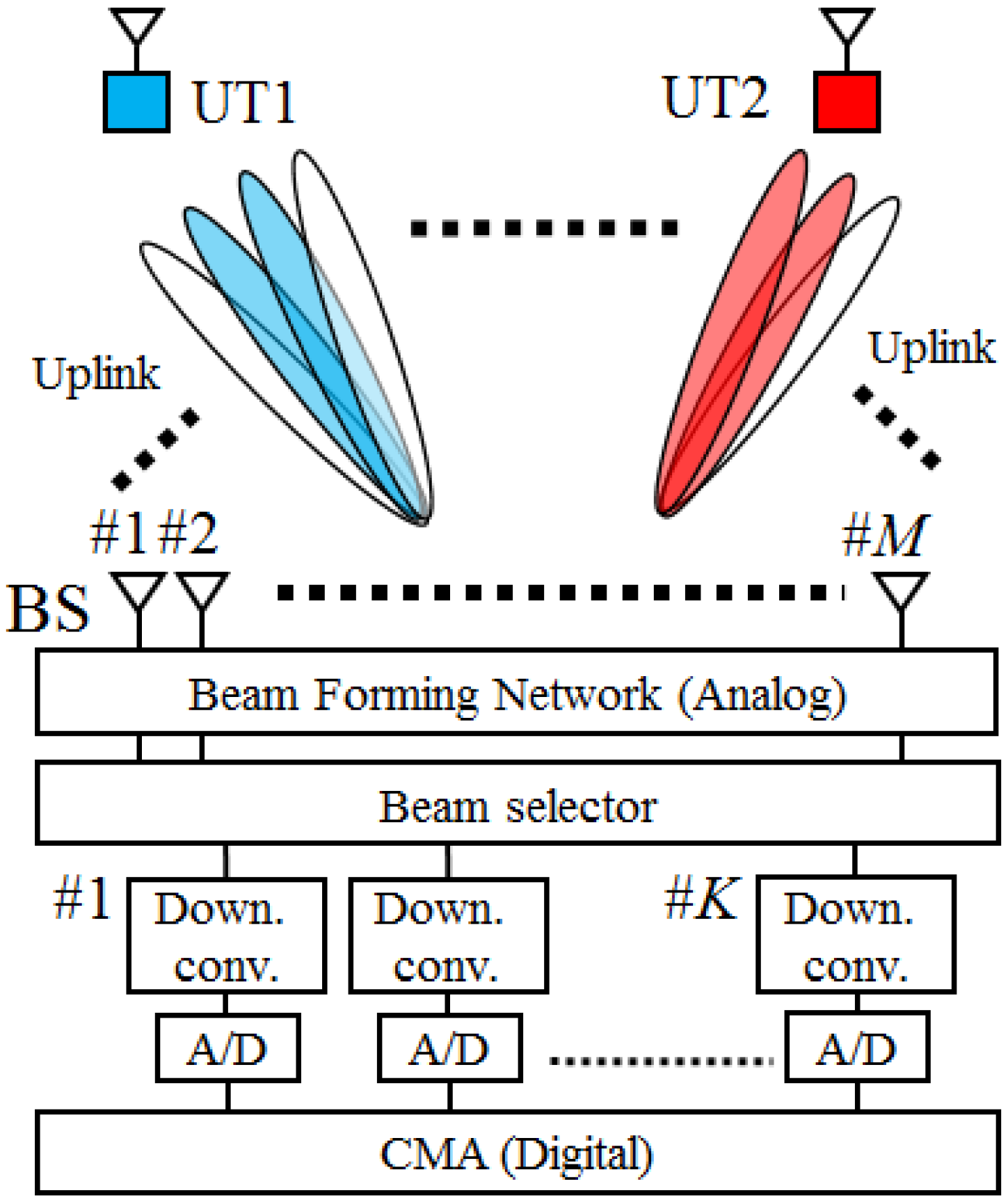
The authors proposed an analog–digital hybrid massive MIMO configuration that eliminates CSI estimation, in a previous work [14]. In conventional analog–digital hybrid massive MIMO configurations [15,16], a beam scanning is required for user tracking in each sub-array, and overheads are incurred in determining the analog weight values. In the proposed configuration, unlike conventional analog–digital hybrid massive MIMO configurations, analog multi-beams are created and several beams with large received powers are selected in the analog part without the overhead for the beamforming [14]. Owing to the selected narrow beams, interference signals can be mitigated, and the residual interference can be cancelled using the constant modulus algorithm (CMA) [17], which does not require training signals in the digital part. Via computer simulations, the basic performance and effectiveness of the uplink channel is evaluated, for the proposed method [14,18].
Previous studies regarding multi-beam massive MIMO mainly focused on the uplink channel [14,18]. However, in the next-generation wireless communication systems, including the latest wireless communication systems, the data rate improvement in the downlink channel is essential, and massive MIMO is mainly expected to improve the transmission rate in the downlink.
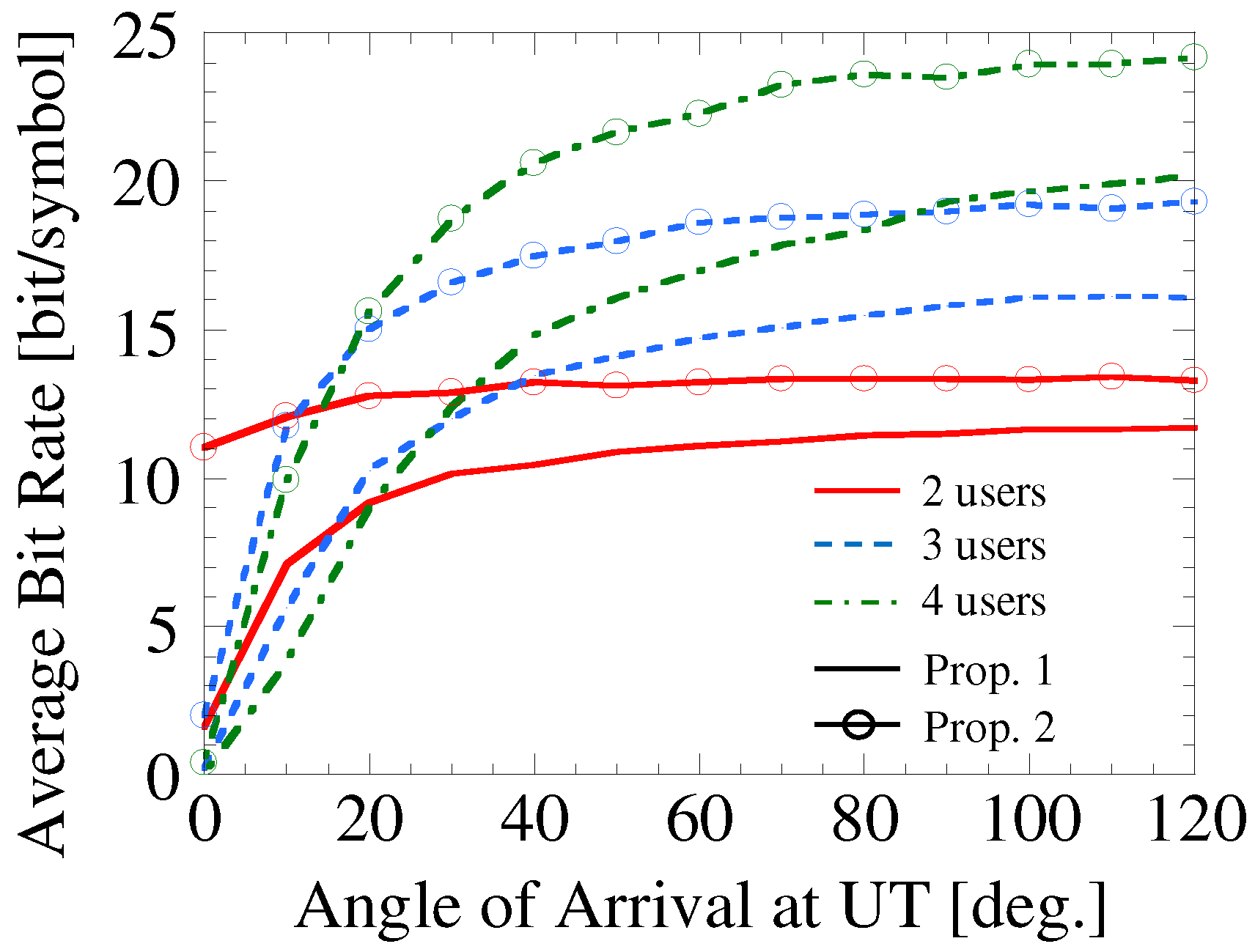
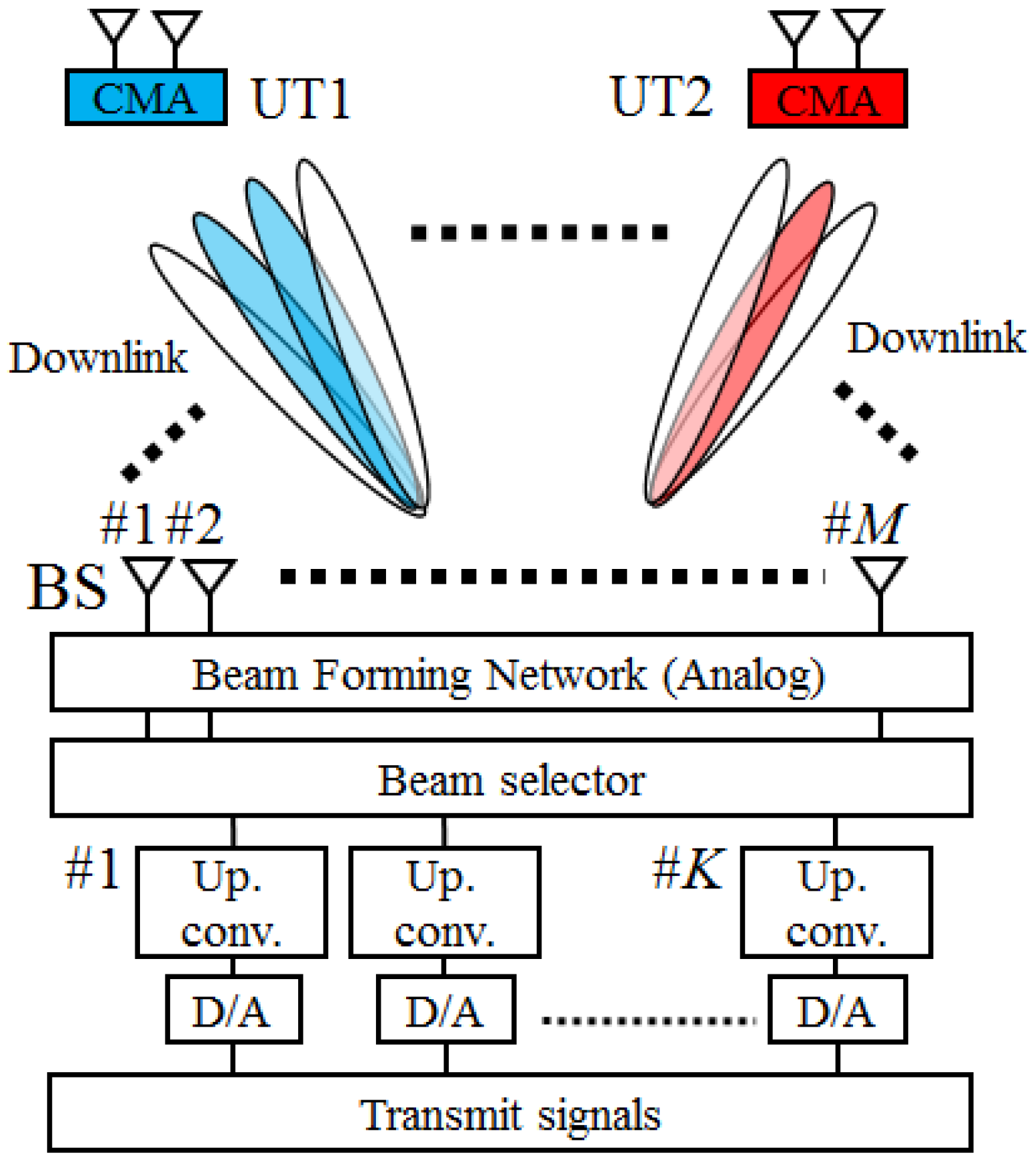
In this paper, we propose a transmission beamforming method that uses multi-beam massive MIMO configuration and control method in the uplink channel; the proposed method does not require CSI in the downlink. It is necessary to consider the control of the analog part and the digital part in the downlink respectively, because the proposed configuration employs the analog–digital hybrid method, unlike conventional digital beamforming (DBF). In this paper, first, we verify the effectiveness of the analog part using analog weight which is selected in the uplink channel alone. Owing to the selected narrow beams, it is shown that the interference signals can be mitigated. However, when the angle of arrivals (AoAs) are close among users, we show that the effect of the analog part is not sufficient. In order to solve this problem, we propose using the CMA for the UT side as well as the elimination of the CSI estimation at the BS. In addition, we propose a method combining the least-square CMA (LS-CMA) and the steepest-descent CMA (SD-CMA) methods in order to utilize CMA stably, with realistic data sizes even for high-order modulation schemes. Finally, the effectiveness of the proposed method is verified using the evaluation of the signal to interference plus noise power ratio (SINR) and the bit rate by the bit error rate (BER).
The remainder of this paper is organized as follows. In Section 2, we describe the principle of analog multi-beam massive MIMO with CMA in the digital part. In Section 3, we show the proposed configuration and propose the control method for the downlink. Moreover, the basic performances are presented to verify the effectiveness of the proposed method. In Section 4, the issues related to CMA when using quadrature amplitude modulated (QAM) signals are discussed, and the solution combining the LS-CMA and SD-CMA is presented. The performances with realistic data sizes are presented to verify the effectiveness of the proposed method.

4. Modified Weight Update Method by LS-CMA and SD-CMA

4.1. Issue on LS-CMA Snd Switching Algorithm of CMA

In Section 3, the ideal performance of the proposed method, where the sufficient iteration and data smoothing number by CMA is given, was verified. Next, assuming that the CMA operates in an actual system, we focus on evaluating the performance for realistic data sizes, because, it is not possible to secure the large number of symbols required for controlling the weights. Although CMA focuses on modulation schemes with constant modulus, such as the Gaussian minimum shift keying (GMSK) or quadrature phase shift keying (QPSK) [17], it has been reported that QAM signals can also be used [18,26,27].
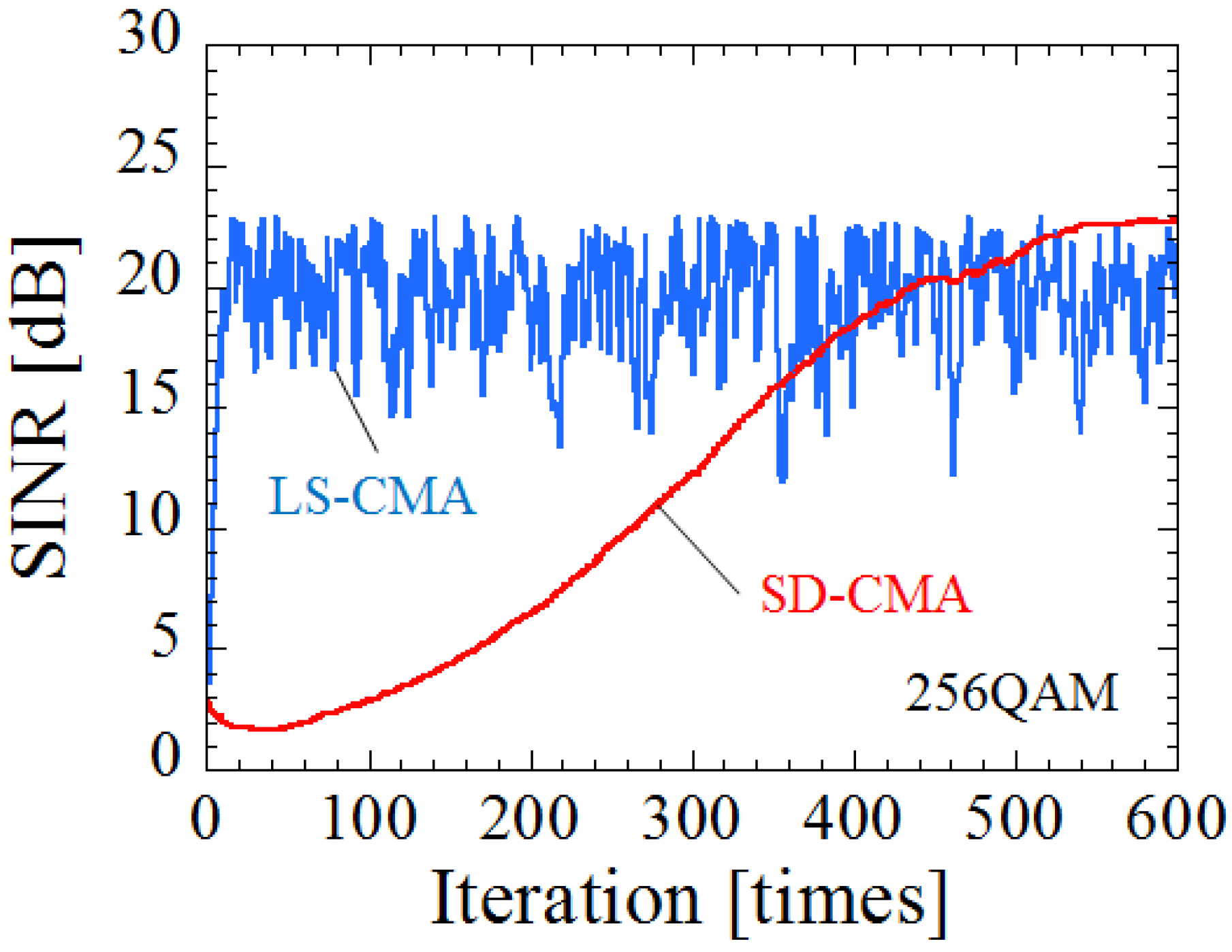
Figure 8 shows the SINR by the weight update using LS-CMA and SD-CMA versus the iteration, when the AoA between two UTs is 60 degree and the smoothing size is 100 symbols for both. In the case of the LS-CMA method, convergence is rapid because the fluctuation in weight is large with one update. However, as can be seen in Figure 8, the weight does not stabilize after convergence. This issue can be solved by using data smoothing wherein the weights of the CMA are averaged for multiple samples. However, the number of symbols used increases according to the increase in the smoothing sizes. On the other hand, in the case of the SD-CMA method, the weight stabilizes after convergence because the fluctuation in weight is small with one update. Therefore, we propose a method that combines the LS-CMA and the SD-CMA approaches.
Figure 8. SINR by weight update of LS-CMA and SD-CMA versus iteration.
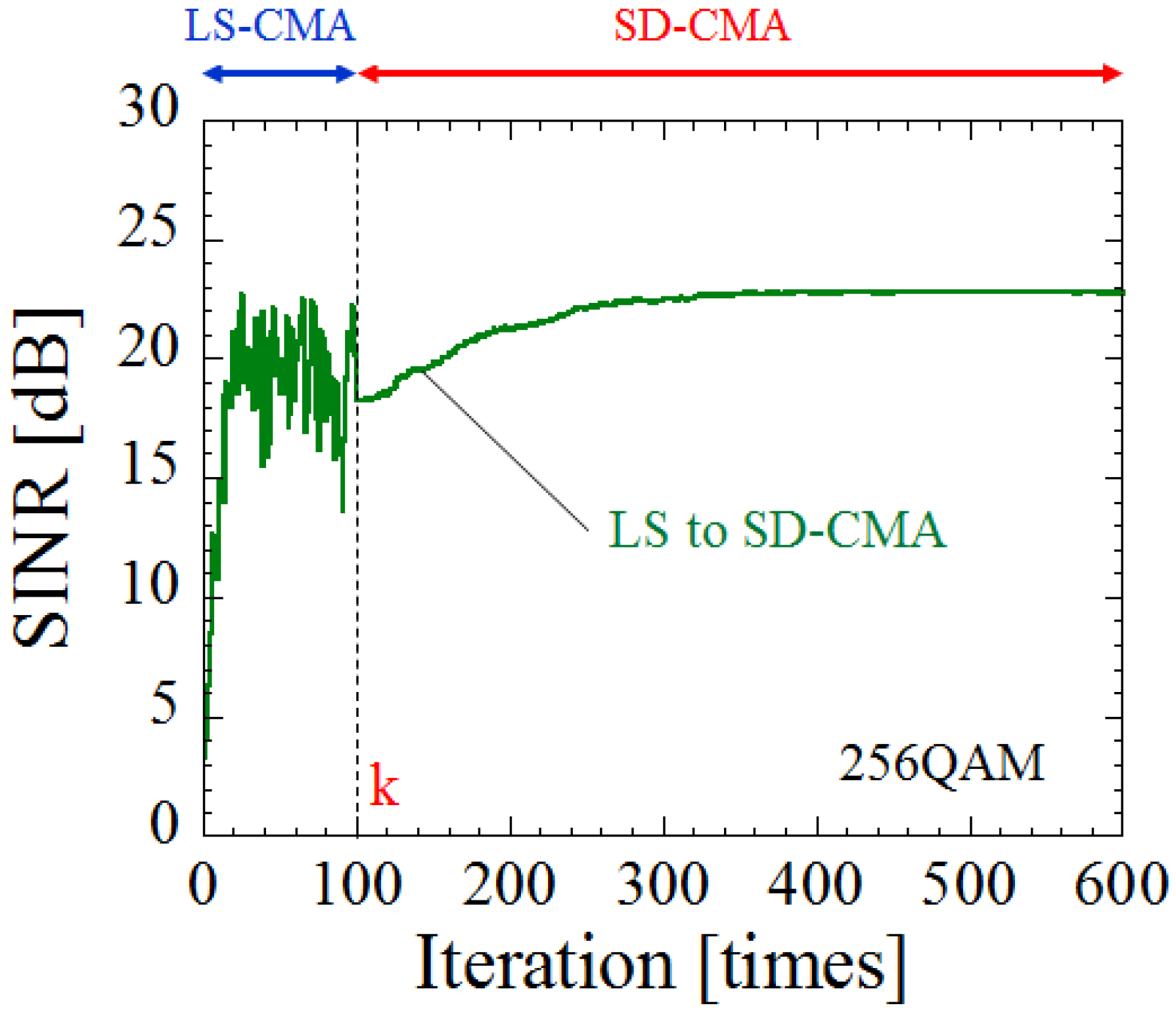
When the total number of weight updates is n, the weight is updated ( 1 , 2 , , k ) times with the (3), which is the expression for the LS-CMA method. Next, using that weight, the weight is updated ( k + 1 , k + 2 , , n ) times with the (2) which is the expression for the SD-CMA method. Hence, speed improvement and stabilization of weight convergence can be realized. In this paper, this proposed method is called the LS-to-SD-CMA.

4.2. Effectiveness of Proposed Method Verified through Computer Simulations

The effectiveness of proposed method is verified through computer simulations. Figure 9 shows the SINR by weight update of the LS-to-SD-CMA versus iteration. The parameters are the same as those in Figure 8. As can be seen from Figure 9, in the LS-to-SD-CMA method, a high SINR is maintained after the SINR is improved with the first few updates. Because the weight stabilizes without increasing the smoothing sizes as in LS-CMA, it is possible to reduce the number of symbols.
Figure 9. SINR by weight update of least-square to steepest-descent-CMA (LS-to-SD-CMA) versus iteration.
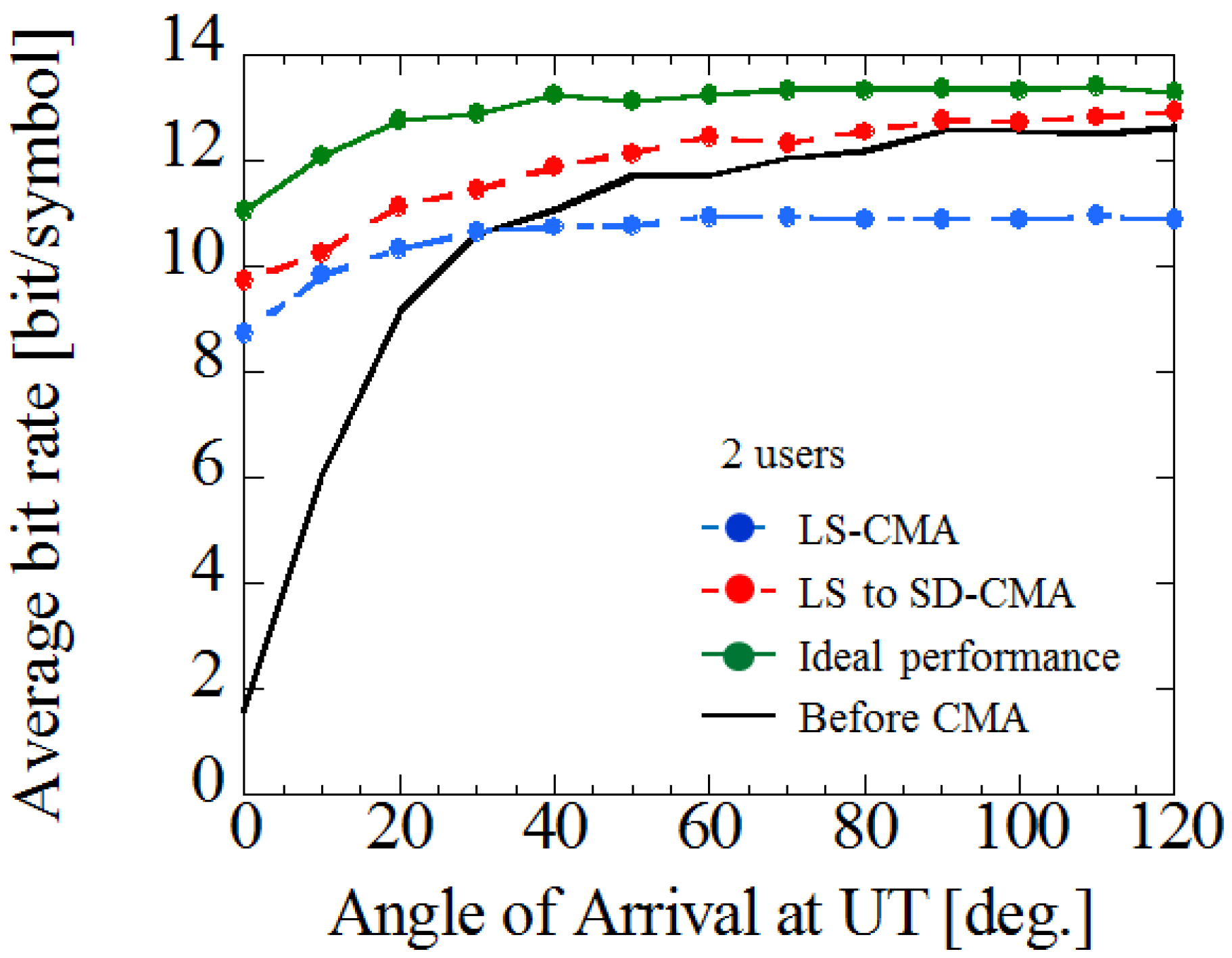
Finally, by using the LS-to-SD-CMA, the effectiveness of the proposed method is verified for the downlink. Figure 10 shows the average bit rate versus AoA at the UTs when the LS-CMA or LS-to-SD-CMA is applied. Table 2 shows the simulation conditions of the smoothing size and the iteration. Moreover, in order to reduce the amount of calculations and stabilize the CMA, the LS-to-SD-CMA is not applied when a high SINR has already been obtained by only analog beam patterns. As can be seen in Figure 10, in the case of LS-CMA, the bit rate decreases to a value less than the value before applying CMA, when the number of smoothing size is small. However, by applying the proposed method, even with the same number of smoothing size, the performance is improved than when using only beam control. In addition, because this result is approaching the ideal performance securing a sufficient number of symbols and iterations, this control method in the downlink is effective with realistic data sizes.
Figure 10. Average bit rate versus AoA at UTs using LS-to-SD-CMA.
Table 2. Simulation conditios of the smoothing size.

5. Conclusions

In this paper, a simple control method for the downlink of multi-beam massive MIMO, which did not need CSI estimation at both BS ans UTs, was proposed. The effectiveness of proposed method was verified through computer simulations. It was shown that the analog multi-beam selection at the BS, and the application of CMA to the UTs with two antennas, could realize transmissions with high-order modulation schemes effectively. Moreover, by using LS-to-SD–CMA, it was shown that the proposed method was effective even for realistic data sizes.

Acknowledgments

Part of this work was supported by the SCOPE #165004002 and KAKENHI, Grant-in-Aid for Scientific Research (B) (17H03262, 17H01738).

Author Contributions

This study was led by S.O. while K.N., R.T., T.H. and T.M. assisted with the computer simulations.

Conflicts of Interest

The authors declare no conflict of interest.

References

  1. Gesbert, D.; Kountouris, M.; Heath, R.W., Jr.; Chae, C.-B.; Salzer, T. Shifting the MIMO Paradigm. IEEE Signal Process. Mag. 2007, 24, 36–46. [Google Scholar] [CrossRef]
  2. IEEE P802.11ac./D5.0, Part 11: Wireless LAN Medium Access Control (MAC and Physical Layer (PHY) specifications. Available online: http://ieeexplore.ieee.org/servlet/opac?punumber=6560343 (accessed on 20 November 2017).
  3. Hiraguri, T.; Nishimori, K. Survey of transmission methods and efficiency using MIMO technologies for wireless LAN systems. IEICE Trans. Commun. 2015, E98-B, 1250–1267. [Google Scholar] [CrossRef]
  4. Nishimori, K.; Hiraguri, T.; Makino, H. Transmission Rate by User Antenna Selection for Block Diagonalization Based Multiuser MIMO System. IEICE Trans. Commun. 2014, E97-B, 2118–2126. [Google Scholar] [CrossRef]
  5. Cisco Visual Networking Index: Global Mobile Data Traffic Forecast Update, 2010–2015. Available online: https://ja.scribd.com/document/49195955/Cisco-Global-Mobile-Data-Traffic-Forecast-Update-2010-2015-Feb-11 (accessed on 20 November 2017).
  6. Cisco Visual Networking Index: Global Mobile Data Traffic Forecast Update, 2016–2021. Available online: https://www.cisco.com/c/en/us/solutions/collateral/service-provider/visual-networking-index-vni/mobile-white-paper-c11-520862.html (accessed on 20 November 2017).
  7. Nakamura, T.; Nagata, S.; Benjebbour, A.; Kishiyama, Y.; Hai, T.; Xiaodong, S.; Ning, Y.; Nan, L. Trends in Small Cell Enhancements in LTE Advanced. IEEE Commun. Mag. 2013, 51, 98–105. [Google Scholar] [CrossRef]
  8. Kishiyama, Y.; Benjebbour, A.; Nakamura, T.; Ishii, H. Future Steps of LTE-A Evolution Toward Integration of Local Area and Wide Area Systems. IEEE Wirel. Commun. 2013, 20, 12–18. [Google Scholar]
  9. Larsson, E.G. Very Large MIMO systems. In Proceedings of the ICASSP 2012—IEEE International Conference on Acoustics, Speech and Signal Processing, Kyoto, Japan, 25–30 March 2012. [Google Scholar]
  10. Rusek, F.; Persson, D.; Lau, B.K.; Larsson, E.G.; Marzetta, T.L.; Edfors, O.; Tufvesson, F. Scaling Up MIMO: Opportunities and Challenges with Very Large Arrays. IEEE Signal Process. Mag. 2013, 30, 40–60. [Google Scholar] [CrossRef]
  11. Hoydis, J.; ten Brink, S.; Debbah, M. Massive MIMO in the UL/DL of Cellular Networks: How Many Antennas Do We Need? IEEE J. Sel. Areas Commun. 2013, 31, 160–171. [Google Scholar] [CrossRef]
  12. Papadopoulos, H.; Wang, C.; Bursalioglu, O.; Hou, X.; Kishiyama, Y. Massive MIMO Technologies and Challenges towards 5G. IEICE Trans. Commun. 2016, E99-B, 602–621. [Google Scholar] [CrossRef]
  13. Murakami, T.; Fukuzono, H.; Takatori, Y.; Mizoguchi, M. Multiuser MIMO with Implicit Channel Feedback in Massive Antenna Systems. IEICE Commun.Express 2013, 2, 336–342. [Google Scholar] [CrossRef]
  14. Nishimori, K.; Hiraguri, T.; Seki, T.; Yamada, H. Multi-beam Massive MIMO Using Analog Beamforming and DBF Based Blind Algorithm. In Proceedings of the 2015 International Symposium Antennas and Propagation (ISAP), Hobart, Australia, 9–12 November 2015. [Google Scholar]
  15. Hou, X.; Jiang, H.; Kayama, H.; Xi, W. A Novel Hybrid Beamforming Transmission Scheme for Common Channels and Signals. In Proceedings of the 2015 21st Asisa-Pacific Conference on Communications, Kyoto, Japan, 14–16 October 2015. [Google Scholar]
  16. Geng, J.; Wei, Z.; Wang, X.; Xiang, W.; Yang, D. Multiuser Hybrid Analog/Digital Beamforming for Relatively Large-scale Antenna Arrays. In Proceedings of the 2013 IEEE Globecom Workshops, Atlanta, GA, USA, 9–13 December 2013. [Google Scholar]
  17. Treichler, J.R.; Agee, B.G. A New Approach to Multipath Correction of Constant Modulus Signals. IEEE Trans. Acoust. Speech Signal Process. 1983, 31, 459–472. [Google Scholar] [CrossRef]
  18. Taniguchi, R.; Nishimori, K.; Makino, H. Multi-beam Massive MIMO using Constant Modulus Algorithm for QAM Signal employing Amplitude and Phase Offset Compensation. IEICE Trans. Commun. 2017, E100-B, 262–268. [Google Scholar] [CrossRef]
  19. Butler, J.; Lowe, R. Beamforming Matrix Simplifies Design of Electronically Scanned Antennas. Electron. Des. 1961, 9, 170–173. [Google Scholar]
  20. Zeng, Y.; Zhang, R.; Chen, Z.N. Electromagnetic Lens-Focusing Antenna Enabled Massive MIMO. In Proceedings of the IEEE/CIC International Conference Communication in China (ICCC), Xi’an, China, 12–14 August 2013; pp. 454–459. [Google Scholar]
  21. Heath, R.W., Jr.; Gonzalez-Prelcic, N.; Rangan, S.; Roh, W.; Sayeed, A. An Overview of Signal Processing Techniques for Millimeter Wave MIMO Systems. IEEE J.Sel. Top. Signal Process. 2016, 10, 436–453. [Google Scholar] [CrossRef]
  22. Yamamoto, S.-I.; Hirokawa, J.; Ando, M. A Single-Layer Hollow-Waveguide 8-Way Butler Matrix with Modified Phase Shifters. In Proceedings of the ISAP2005, Seoul, Korea, 3–5 August 2005. [Google Scholar]
  23. Tanaka, T.; Miura, R.; Chiba, I.; Karasawa, Y. An ASIC Implementation Scheme to Realize a BeamSpace CMA Adaptive Array Antenna. IEICE Trans. Commun. 1995, E78-B, 1467–1473. [Google Scholar]
  24. Agee, B.G. The Least-Square CMA: A New Technique for Rapid Correction of Constant Modulus Signals. In Proceedings of the IEEE International Conference on ICASSP ’86 Acoustics, Speech, and Signal Processing, Tokyo, Japan, 7–11 April 1986; pp. 953–956. [Google Scholar]
  25. Nishimori, K.; Yomo, H.; Popovski, P. Distributed Interference Cancellation for Cognitive Radios using Periodic Signals of the Primary System. IEEE Trans. Wirel. Commun. 2011, 10, 2791–2981. [Google Scholar]
  26. Kikuma, K.; Takai, K.; Nishimori, K.; Saito, F.; Inagaki, N. Consideration on Performance of the CMA Adaptive Array Antenna for 16QAM Signals. In Proceedings of the Personal, Indoor and Mobile Radio Communications (PIMRC) 1995, Toronto, ON, Canada, 27–29 September 1995; Volume 2, pp. 677–681. [Google Scholar]
  27. Nishimori, K.; Kikuma, K.; Inagaki, N. Performance analysis of CMA adaptive array for QAM signals. Electron. Commun. Jpn. (Part 1 Commun.) 1997, 80, 11–21. [Google Scholar] [CrossRef]

Article Metrics

Citations

Article Access Statistics

Multiple requests from the same IP address are counted as one view.