1. Introduction
Cognitive diagnosis stands as one of the key technologies in personalized intelligent education. It aims to infer students’ proficiency across various knowledge concepts based on their historical response records [
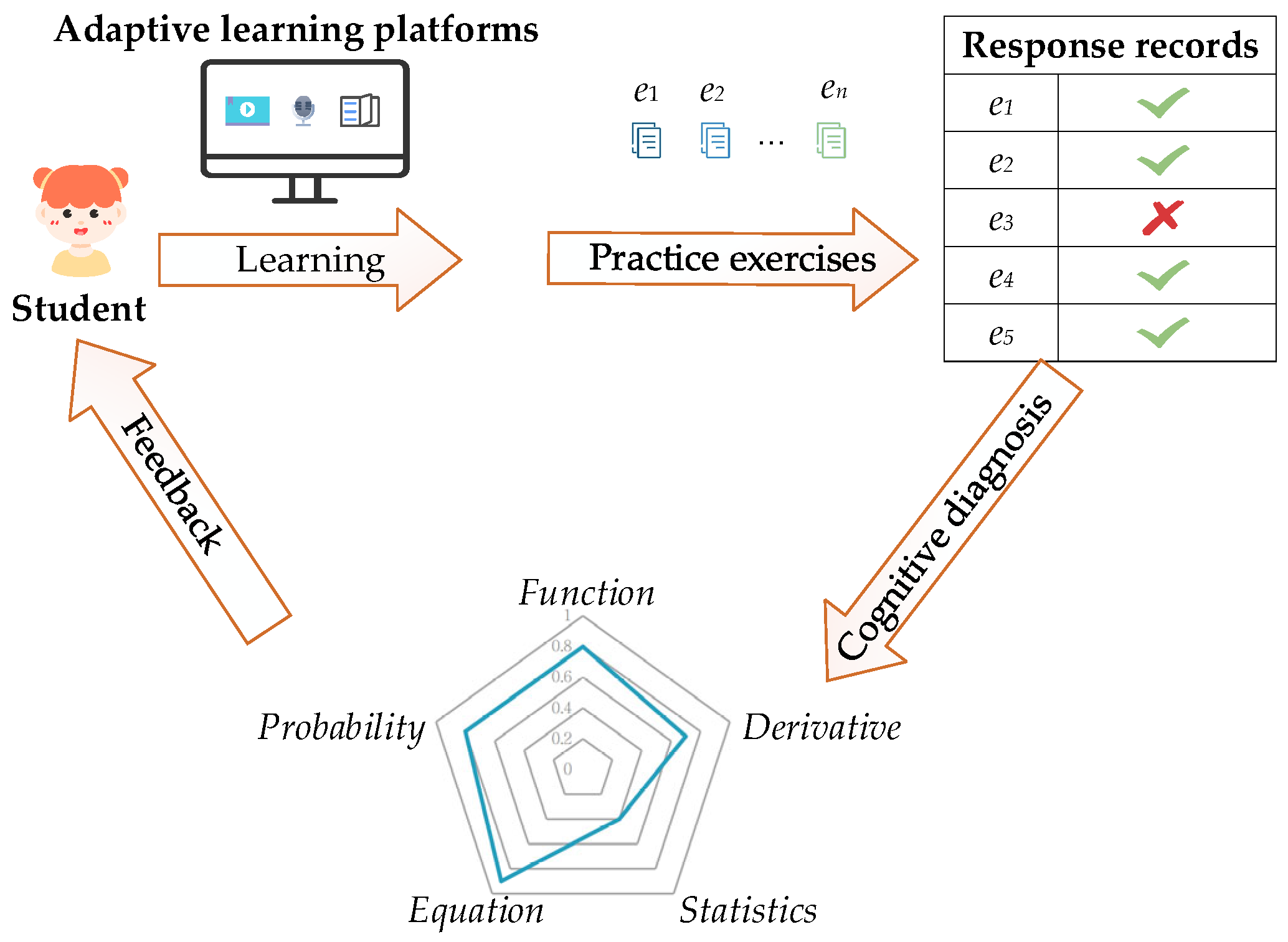
1]. This technology not only captures students’ knowledge states with precision but also provides a ctheoretical foundation for constructing adaptive learning pathways and optimizing instructional strategies (As shown in
Figure 1). Today, cognitive diagnosis is widely applied across multiple educational scenarios, including adaptive testing [
2,
3], exercise recommendation [
4], and personalized learning systems [
5], making it an integral component of modern intelligent education ecosystems.
In recent years, diagnostic models that integrate student response behavior with exercise textual information have gradually advanced. By incorporating neural networks, graph structures, and other representation learning techniques, these models have achieved notable improvements in both diagnostic accuracy and interpretability.
However, as these methods explore student data features more deeply, they often inadvertently introduce fairness risks. For instance, Zhang et al. [
6] conducted statistical analyses revealing that students’ family economic status and regional development level significantly influence their response performance. Such disparities often stem from inequitable distribution of educational resources—students from more affluent backgrounds generally have better access to extracurricular tutoring, high-quality teachers, and supportive learning environments. When models indiscriminately use all available data during training, they may implicitly capture statistical associations between sensitive attributes (e.g., household wealth, geographic location) and response behavior, leading to systematic bias in diagnostic outcomes.
Further supporting this, Li et al. [
7] surveyed Chinese middle school students and found that parental education, teacher quality, and school resources all exert varying degrees of influence on academic performance. In addition, Zhang et al. [
8] trained Item Response Theory (IRT) and neural cognitive diagnosis models on the PISA dataset [
9], grouped by gender and region, and evaluated their predictive fairness. Their experimental results indicated that model predictions were noticeably influenced by sensitive attributes such as gender and region. For example, if the actual knowledge proficiency gap between two student groups is only 0.1, a diagnostic model might exaggerate it to 0.25. Such distortion—whether it amplifies or reduces the real gap—reflects group-level assessment bias, which ultimately undermines educational equity.
To address these challenges, recent research on fairness-aware cognitive diagnosis has sought to reduce models’ reliance on sensitive information, thereby enhancing the fairness of predictions. Some studies have attempted to decompose overall proficiency into “biased” and “fair” dimensions, using adversarial discriminators to extract sensitive information, or applying multi-layer perceptron to generate embeddings of sensitive attributes. While existing fairness-aware methods have made meaningful progress, they exhibit several notable limitations: (1) they often treat students as independent entities, ignoring the relational structures (e.g., shared school resources, regional networks) that can propagate bias; (2) their fairness interventions are primarily based on statistical correlations or adversarial feature removal, lacking a causal perspective to explicitly model and mitigate the effect of sensitive attributes; and (3) their representation of context is frequently abstract and non-relational, unable to leverage the interconnected nature of educational ecosystems.
To bridge this gap, this paper proposes a Fairness-Aware Cognitive Diagnosis model (FACD) based on counterfactual graph representation learning. The model workflow proceeds as follows: after constructing the causal subgraphs, a GVAE learns node-level latent representations, while an adversarial component mitigates the influence of sensitive attributes. The dual-perturbation strategy then produces counterfactual samples, and a Siamese network ensures representation consistency across these scenarios, resulting in fair contextual embeddings. Finally, in the diagnostic module, these fair representations are integrated with students’ cognitive states and exercise parameters and fed into established cognitive diagnosis frameworks—such as IRT or NeuralCDM—to achieve accurate and equitable modeling of knowledge proficiency. The novelty of our proposed FACD model lies in the following three aspects:
- (1)
Causal Subgraph Construction. Unlike methods that process students in isolation, FACD explicitly models educational context by building student-centered causal subgraphs via the personalized PageRank algorithm, thereby capturing the relational structure among students and their environments.
- (2)
Counterfactual Intervention via Graph Perturbation. Moving beyond adversarial feature removal, FACD introduces a novel dual-perturbation strategy—applied to both the central node and its neighbors—to generate diverse counterfactual samples. This enables the model to learn representations that remain robust to changes in sensitive attributes, aligning with a causal notion of fairness.
- (3)
Structure-Aware Fair Representation Learning. FACD integrates a Graph Variational Autoencoder (GVAE) with adversarial training and a Siamese network to learn node embeddings that are both diagnostically informative and invariant to sensitive attributes within the graph context. This offers a principled pathway to disentangle genuine cognitive proficiency from confounding socio-economic factors.
2. Related Word
Cognitive diagnosis emerged from the intersection of psychometrics and education, with its primary objective being the systematic assessment and diagnosis of students’ cognitive processes. The task fundamentally relies on students’ exercise response records, analyzing the complex interactions among students, exercises, and knowledge components to construct mathematical models that evaluate students’ mastery of various knowledge concepts and predict their performance on unseen exercises. Over decades of development, the field has established a relatively complete theoretical system and methodology, accumulating substantial research outcomes. From the perspective of model construction, existing cognitive diagnosis models can be divided into two main categories: one based on psychometric theory, and the other built upon machine learning approaches.
The first category of models, grounded in psychometrics, primarily includes Item Response Theory (IRT) [
10], Multidimensional Item Response Theory (MIRT) [
11], and the Deterministic Inputs, Noisy “And” gate model (DINA) [
12]. Chen and Liang [
13] proposed a Bayesian Network-based Multiprocess Incremental DINA (BNMI-DINA) model, which aims to enhance the effectiveness of personalized learning by providing accurate and detailed assessments of students’ cognitive abilities. These models typically rely on manually designed parametric functions to diagnose cognitive states through parameter estimation from student response data. However, such linear models based on statistical theory exhibit certain limitations in capturing the complex nonlinear interactions between students and exercises, prompting researchers to turn to more expressive machine learning methods.
The second category of models builds upon machine learning techniques and can be further divided into non-deep learning models and deep learning models. As early as the late 20th century, researchers began exploring the application of machine learning in cognitive diagnosis. For instance, Zheng et al. [
14] proposed a support vector machine-based approach for cognitive diagnosis classification, while Liu [
15] employed fuzzy set theory combined with educational hypotheses to model students’ skill proficiency and problem mastery. Zhang et al. [
16]. discusses a graph representation-based diagnostic method. With the rapid advancement of deep learning technologies, researchers have developed various neural network-based cognitive diagnosis models. According to their architectural characteristics, these deep cognitive diagnosis models can be classified into three types:
The first category follows a mastery pattern classifier architecture. This approach adopts a diagnostic logic opposite to traditional models, taking students’ response records as direct input and outputting their cognitive states. The attribute hierarchy method (AHM) proposed by Gierl et al. [
17] can be regarded as an early representative of this architecture. Mo et al. [
18] proposed a convolutional neural network based cognitive diagnosis model.
The second category employs a cognitive interaction simulator architecture, currently the most widely applied type. Maintaining the fundamental principles of traditional cognitive diagnosis, it infers students’ cognitive states by modeling their response processes to exercises. The Neural Cognitive Diagnosis Model (NeuralCDM) introduced by Wang et al. [
19] serves as a typical example of this architecture. This model maps students and exercises into feature vectors and uses a three-layer fully connected neural network to model their interactions, effectively overcoming the limited expressive power of linear functions in traditional statistical methods. Tao et al. [
20] proposed a Q-matrix-constrained neural network method for cognitive diagnosis, which enhances the reliability and interpretability of the network structure.
The third category utilizes an encoder–decoder architecture, combining features from the previous two types. This framework takes student response records as input, employs an encoder to extract latent representations of student states and exercise features, and then uses a decoder to reconstruct the input data. The Identifiable Cognitive Diagnosis Framework (ID-CDF) proposed by Li et al. [
21] represents a notable work in this category. Fu and Fang [
22] proposed a curriculum-aware graph neural cognitive diagnosis framework, which integrates curriculum priors into graph-based neural modeling.
3. Problem Formulation
Consider a set of students, exercises, knowledge concepts, and student contextual features, denoted by sets , respectively. Student exercise response records are represented as triplets , where indicates the score of student on exercise . The relationship between exercises and knowledge concepts is defined by a binary matrix , where signifies that exercise involves knowledge concept , and otherwise.
Furthermore, student contextual features are structured as a graph , where is the set of nodes denoting students and , is the set of edges, and is the set of node features, with representing the -dimensional feature vector of the node or the student . The adjacency matrix describes the graph structure, where if there exists a directed edge from node to node , and otherwise. Each node is associated with a sensitive attribute , and the set of sensitive attributes for all nodes is denoted by and is included in .
The cognitive diagnosis task can be formally defined as follows: given student response records
and the exercise-concept association matrix
, the objective is to infer a proficiency vector
for each student over all knowledge concepts through a student performance prediction process. The main symbols used in this paper and their meanings are presented in
Table 1.
4. Methods
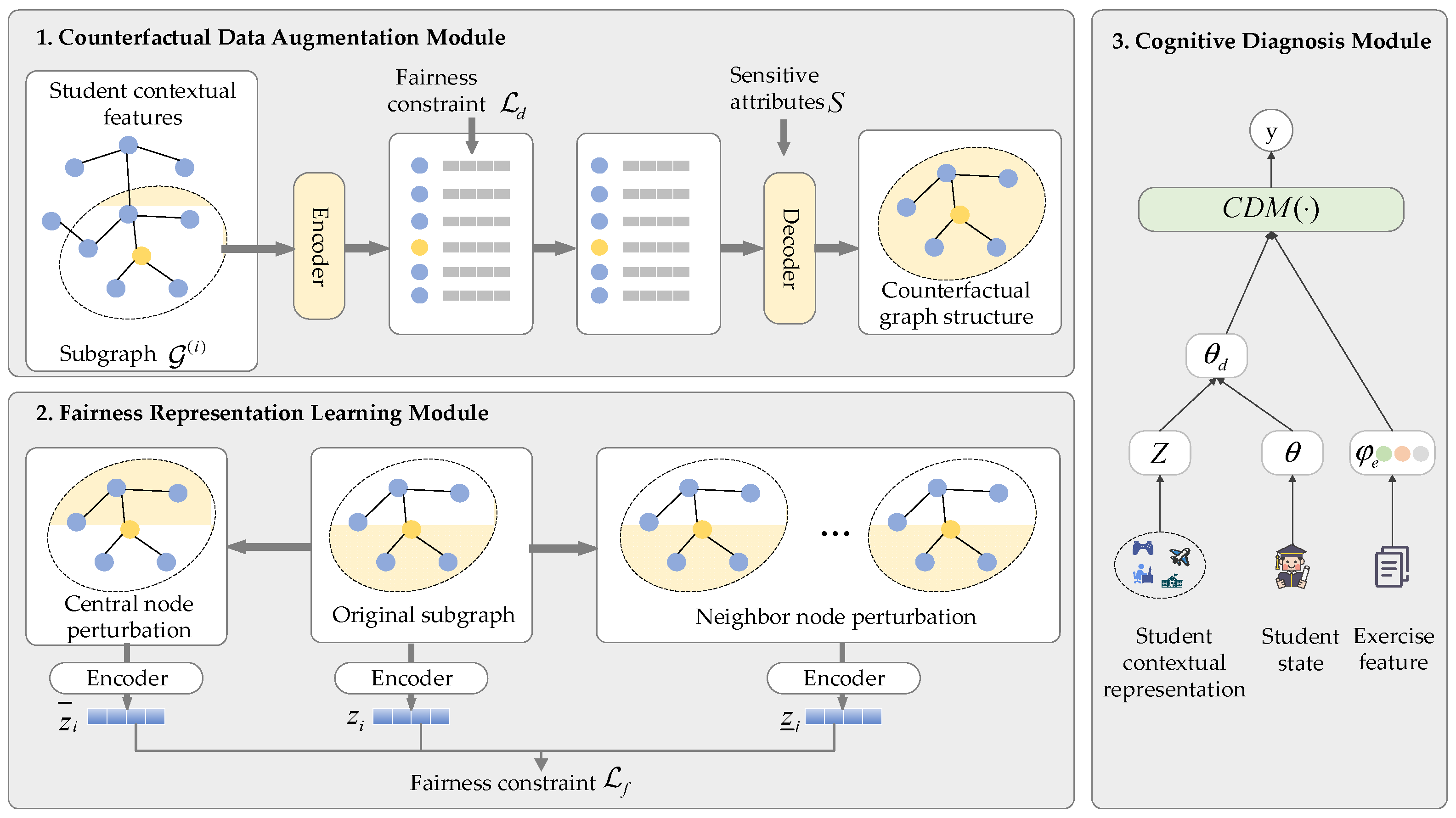
This section provides a detailed description of the proposed FACD model architecture, whose overall framework is depicted in
Figure 2. The FACD model consists of three core modules: the counterfactual data augmentation module, the counterfactual fairness learning module, and the cognitive diagnosis module.
To address the challenge of obtaining true causal structures in large-scale graph data, this work adopts a node-centric local subgraph construction strategy. The personalized PageRank algorithm is employed to precisely quantify node importance, selecting the most influential neighbor nodes for each central node to build local subgraphs containing crucial structural information. Subsequently, the constructed student context feature subgraphs are fed into a Graph Variational Autoencoder (GVAE) to learn latent node embeddings. Building upon this, the decoder reconstructs the subgraph structure while an adversarial learning mechanism is introduced, where a discriminator is trained to identify and eliminate information related to sensitive attributes in the embeddings, thereby mitigating the causal effect of sensitive attributes on node representations.
To further enhance model fairness, a counterfactual data augmentation strategy is designed. By applying two perturbation operations to the original subgraphs-central node sensitive attribute flipping and neighbor node sensitive attribute random sampling-diverse counterfactual samples are generated. These samples provide a rich data foundation for subsequent fair graph representation learning. During the fairness learning stage, a Siamese network encodes the original subgraphs, central-node-perturbed subgraphs, and neighbor-node-perturbed subgraphs separately. By minimizing the distance between central node representations of original subgraphs and various counterfactual subgraphs, the counterfactual fairness loss is optimized, ensuring representation consistency across different counterfactual scenarios.
Finally, in the cognitive diagnosis module, the model integrates the fair student context feature representations, student cognitive state vectors, and exercise-related parameters, feeding them into existing cognitive diagnosis frameworks (such as IRT, NeuralCDM, etc.) to achieve accurate prediction of students’ knowledge mastery.
The core innovation of the FACD architecture lies in its graph-structured counterfactual learning framework. Traditional fairness methods are applied to i.i.d. student data. However, students exist within a network of shared influences (schools, regions, socio-economic circles). By modeling this as a graph, we can capture and intervene on bias propagation pathways. Our method’s novelty stems from performing counterfactual fairness learning within this relational structure.
4.1. Counterfactual Data Augmentation Module
Acquiring accurate causal models from large-scale graph structures presents considerable challenges. Following the approach of Ma et al. [
23], this work confines causal modeling to node-centered local subgraphs, where each subgraph comprises a central node and its most influential neighbors. Specifically, we first compute node importance scores using the personalized PageRank algorithm [
24], expressed as:
here,
, and
quantifies the importance of node
to node
,
denotes the teleportation constant parameter, and
is the identity matrix. The term
represents the column-normalized adjacency matrix, where
is the diagonal matrix with entries
. Using the computed importance scores, we construct a local subgraph
for each central node
as follows:
In these expressions, is a preset subgraph size parameter, and selects the top- neighbor nodes with the highest importance scores from the -th row of the matrix.
To learn fair student contextual feature representations, we pre-train a counterfactual data augmentation module based on a Graph Variational Autoencoder (GVAE). The GVAE defines a probabilistic generative model for the local subgraph . This module encodes each subgraph, mapping nodes into latent embeddings , with the set of latent representations denoted as . The decoder then reconstructs the original subgraph using both the latent embeddings and the sensitive attribute values from the subgraph. Throughout counterfactual generation, the graph topology (adjacency structure) is held constant; only sensitive attributes in node features are modified to create counterfactual scenarios. When generating counterfactual instances, we modify only the node’s sensitive attribute values while preserving the graph structure . The decoder reconstructs the node features using the modified sensitive attributes along with the original embeddings.
4.1.1. Probabilistic Model and Reconstruction
The encoder is a graph neural network that maps the subgraph into a latent variable distribution, assumed to be a Gaussian: ).
The decoder reconstructs both the node feature matrix and the adjacency matrix from the latent embeddings and the sensitive attributes of the subgraph. Specifically, the decoder models:
Node feature reconstruction: via a multi-layer perceptron that outputs the parameters of a distribution (i.e., Gaussian for continuous features).
Graph structure reconstruction: via a pairwise inner product followed by a sigmoid activation to predict edge probabilities: .
The variational evidence lower bound (ELBO) loss, which serves as our reconstruction objective, is defined as:
where
is the standard Gaussian prior. The first term encourages accurate reconstruction of both features and structure, while the KL divergence term regularizes the latent space.
4.1.2. Adversarial Fairness Constraint
To reduce the causal effect of sensitive attributes, we introduce an adversarial discriminator . Its goal is to predict the discretized statistical summary of sensitive attributes within the subgraph from the latent embeddings . The process is as follows:
- (a)
Compute Subgraph Sensitive Statistic: For each subgraph
, we compute the average sensitive attribute value:
- (b)
Discretization into Bins: The continuous value is uniformly partitioned into intervals. Each interval is assigned a categorical label This transforms the problem into a B-class classification task for the discriminator.
- (c)
Discriminator Supervision: The discriminator takes the set of latent embeddings (often pooled into a subgraph-level representation) and outputs a probability distribution over the classes. It is trained to minimize the cross-entropy loss:
where
is the indicator function.
The overall objective for the GVAE integrates reconstruction and adversarial fairness:
where
is a hyperparameter controlling the weight of the fairness constraint. The training follows an adversarial min-max strategy:
Step 1 (Update GVAE parameters ): Minimize to improve reconstruction while making the latent embeddings uninformative for the discriminator.
Step 2 (Update Discriminator parameters ): Minimize alone (i.e., maximize its ability to predict the sensitive statistic from ).
The training follows an alternating strategy: (1) update all parameters except the discriminator to minimize ; (2) update the discriminator parameters to minimize . This adversarial dynamic encourages the GVAE to generate latent representations that are effective for reconstructing the graph but invariant to the protected sensitive attribute distribution.
The encoder is a two-layer Graph Convolutional Network (GCN). It maps node features to a 256-dimensional hidden space (ReLU activation), then outputs parameters for a Gaussian latent distribution of dimension . The decoder reconstructs node features via a two-layer MLP (input: latent vector concatenated with sensitive attribute; hidden layer: 128 units, ReLU) and reconstructs edges via pairwise inner product: . The latent prior is a standard Gaussian . A discriminator (three-layer MLP with 64 and 32 hidden units) is attached to the latent embeddings. It classifies the subgraph’s average sensitive attribute into discrete bins. The GVAE is trained to minimize reconstruction loss while fooling this discriminator via the adversarial objective.
4.1.3. Original Subgraph Perturbation
To generate diverse counterfactual samples, we perturb the original subgraphs while strictly preserving the graph topology (i.e., the adjacency matrix remains unchanged). For each subgraph , two perturbation strategies are applied:
Central Node Perturbation: Flip the sensitive attribute
of the central node using the operation
(i.e., changing the value of
from 0 to 1 or from 1 to 0), while keeping all other nodes’ sensitive attributes
unchanged for all
.
Neighbor Node Perturbation: Randomly resample the sensitive attributes of all non-central nodes (
) from
, while the central node’s attribute remains fixed.
where
samples uniformly from the sensitive attribute value space
.
In both cases, only the sensitive attributes in the node features are altered; the graph structure is unchanged. The perturbed attributes, together with the original node embeddings, are passed to the pre-trained decoder to reconstruct counterfactual subgraphs.
4.2. Fairness Representation Learning Module
To achieve fair representation learning of student contextual features, this module aims to maintain consistent node representations across different counterfactual scenarios. Specifically, we employ a Siamese network [
23,
25] to encode three types of subgraphs: the original subgraph, the central-node-perturbed counterfactual subgraph, and the neighbor-node-perturbed counterfactual subgraph. A subgraph encoder
is trained to generate the corresponding representations
,
,
for each central node
i on these three kinds of subgraphs:
Here,
,
, and
denote the representations learned from the original subgraph, central-node-perturbed counterfactual subgraph, and neighbor-node-perturbed counterfactual subgraph, respectively. The subgraph encoder
(
) maps each subgraph into a representation vector, projecting each node into a latent space. The
function serves as mean aggregation operator that combines node representations from multiple sampling instances to produce the final representation for the central node.
We then minimize the distance between central node representations from original and counterfactual subgraphs to enforce consistency across different counterfactual scenarios. The counterfactual fairness loss is defined as:
where
represents a distance metric (such as cosine distance), and
is a hyperparameter that controls the weight of neighbor perturbation.
4.3. Cognitive Diagnosis Module
This module integrates the fair student contextual feature representations into the cognitive diagnosis process. Specifically, we derive students’ cognitive state matrix
regarding knowledge concepts based on their one-hot representations
and a trainable matrix
:
where
denotes the latent cognitive state matrix representing all students’ mastery level across
knowledge concepts, and
denotes the sigmoid activation function.
The cognitive state matrix
is then adaptively fused with the fair contextual feature representations
to generate fair student proficiency vectors:
where
is a fusion weight parameter,
is the cognitive state vectors,
is the fair contextual embedding, and
is a learnable projection matrix. The fusion weight
is determined through validation experiments and can also be made adaptive based on the confidence of contextual features.
The resulting
is fed into existing cognitive diagnosis models (such as IRT, NeuralCDM, or KaNCD) to predict student performance on exercises:
where
represents the cognitive diagnosis model,
denotes exercise-related parameters (such as difficulty and discrimination), and
is the predict result on exercise set
. The model is optimized by minimizing the cross-entropy loss between predictions and ground-truth labels:
where
indicates the predicted score of the student
on the exercise
, and
represents the corresponding ground-truth label from the exercise response triplet
records
of the student
.
The overall loss function combines the main task loss with the counterfactual fairness loss:
where
is a hyperparameter that controls the strength of the fairness constraint.
5. Experiments and Results Analysis
5.1. Dataset and Experimental Setup
We evaluate the effectiveness of the proposed FACD model using the PISA dataset [
9]. The Programme for International Student Assessment (PISA), initiated by the Organization for Economic Co-operation and Development (OECD), represents a large-scale international assessment program designed to systematically evaluate the core subject competencies of 15-year-old students worldwide. Conducted every three years, each assessment cycle focuses on one of three major domains (including mathematics, reading, or science) as the primary testing subject.
Recent datasets released by the PISA project include PISA 2015, PISA 2018, and PISA 2022. The PISA 2015 dataset, centered on scientific literacy, measures socioeconomic status (SES) through three dimensions: parental education level, occupational status, and household wealth (including assets such as computer ownership and home library size). Each dimension comprises 3–5 specific items. In this dataset, variations in cognitive performance primarily stem from differences in knowledge mastery and cognitive skill proficiency. The influence pathway of sensitive attributes is relatively direct: disparities in educational resources → cognitive performance. The PISA 2018 dataset introduces additional complexity: cognitive performance is not only shaped by traditional sensitive attributes but also moderated by digital device accessibility and digital skill proficiency, resulting in a more intricate causal pathway (sensitive attributes → digital skills → cognitive performance). The PISA 2022 dataset focuses on mathematical literacy under pandemic disruption. Here, cognitive performance disparities are predominantly driven by learning interruptions and unequal allocation of online educational resources. Crucially, the pandemic acts as a strong confounding variable that significantly obscures the independent effects of sensitive attributes.
This study aims to address the interference of sensitive attributes (e.g., gender, geographic region, family socioeconomic status) with result fairness in cognitive diagnostic assessments. The core challenge lies in disentangling genuine cognitive ability disparities from association biases induced by sensitive attributes—a requirement demanding datasets that explicitly delineate the causal pathways through which sensitive attributes influence cognitive performance. PISA 2015’s straightforward pathway structure aligns optimally with this study’s core requirement to disentangle “ability versus bias.” Furthermore, fairness evaluation metrics (e.g., group-wise prediction bias in cognitive attributes, proficiency estimation error) derived from this dataset have achieved scholarly consensus, enabling direct comparison with existing research. Thus, PISA 2015 is selected as the experimental dataset for this study.
To ensure data quality and modeling feasibility, we filter the dataset to include only students with at least 20 response records, thereby maintaining sufficient interactive data for each student during training. The final dataset is randomly split into training, validation, and test sets with a ratio of 70%:10%:20%.
Table 2 summarizes the basic statistics of the dataset.
During model training, we employ the Xavier initialization method [
26] to initialize all weight matrices. This method samples initial values from a normal distribution
, where
. Here,
and
denote the input and output dimensions of the layer, respectively. The model is optimized using the Adam optimizer with a learning rate of 0.001 and a batch size of 64. PISA systematically collects specific characteristics of students through multiple background questionnaires, which are primarily used to analyze the relationship between student performance and background factors. In this paper, 50 key characteristics are selected as contextual features of students. Therefore, we set the dimension of student feature/representations
and
. Key hyperparameters are tuned through experiments and set as follows:
,
,
,
, and
. The GVAE and Siamese network were trained with Adam (lr = 0.001). During adversarial training, the discriminator was updated five times per GVAE update. Training used early stopping (patience = 10 epochs) based on validation reconstruction loss. All experiments are conducted on the same server environment, with detailed configurations provided in
Table 3.
5.2. Baseline Models and Evaluation Metrics
To comprehensively evaluate the effectiveness of the proposed method, we select four mainstream cognitive diagnosis models as baselines and further design different fairness intervention strategies for comparative analysis. The selected baseline models include:
IRT [
10]: This model employs a logistic function to model student-exercise interactions, representing both student ability and exercise characteristics using one-dimensional vectors.
MIRT [
11]: As a multidimensional extension of IRT, MIRT represents both student ability and exercise features as multidimensional vectors to reflect proficiency across different knowledge concepts.
NeuralCDM [
18]: This model pioneers the introduction of neural networks into cognitive diagnosis, capturing complex interaction patterns between students and exercises through multi-layer nonlinear networks.
KaNCD [
27]: A neural cognitive diagnosis model that incorporates knowledge structure awareness, enhancing the accuracy of cognitive state estimation by integrating structured information such as knowledge graphs.
To further analyze the effect of fairness processing strategies, we construct two variants based on the aforementioned baseline models:
- (1)
Base+: This variant concatenates student contextual features with the original input and projects them through a fully connected layer, enabling joint estimation of knowledge proficiency.
- (2)
Reg: This variant introduces a fairness regularization term into the objective function to constrain the model’s dependence on student contextual features, thereby reducing the potential impact of sensitive information on predictions.
In cognitive diagnosis tasks, since students’ true cognitive states cannot be directly observed, model performance is typically assessed indirectly through students’ exercise response behavior. Accordingly, this paper adopts both classification and regression evaluation metrics, including:
ACC: Prediction accuracy, reflecting the model’s ability to judge the correctness of student responses.
AUC: Area under the ROC curve, measuring the model’s overall classification performance across different thresholds.
RMSE: Root mean square error, evaluating the deviation between predicted scores and ground-truth scores from a regression perspective.
5.3. Comparative Experimental Results and Analysis
To validate the effectiveness of the proposed Fairness-Aware Cognitive Diagnosis (FACD) model, we conducted systematic comparisons with four mainstream cognitive diagnosis models—IRT, MIRT, NeuralCDM, and KaNCD—along with their fairness-enhanced variants. The experimental results are summarized in
Table 4.
The experimental results demonstrate that the FACD model achieves optimal or near-optimal overall performance compared to all baseline models and their variants. Specifically, under the four foundational cognitive diagnosis frameworks, FACD exhibits consistent advantages across all three metrics—ACC, AUC, and RMSE—confirming its accuracy and robustness in diagnosing students’ knowledge states.
Notably, the Base+ variant, which simply incorporates student contextual features, fails to improve performance across all baseline models and even leads to metric degradation. Taking AUC as an example, the Base+ variants of IRT, MIRT, NeuralCDM, and KaNCD show decreases of 0.0072, 0.0057, 0.0035, and 0.0056, respectively, compared to their Base counterparts. This suggests that directly introducing contextual features may introduce noise and reinforce model dependency on specific subgroups, thereby compromising both generalization capability and fairness.
In contrast, the Reg variant, which incorporates fairness regularization, generally improves upon the Base models, indicating that constraining the model’s reliance on sensitive features is beneficial. However, the performance gains achieved by Reg are consistently smaller than those of FACD. Particularly under the MIRT framework, FACD improves AUC by 1.55 percentage points and reduces RMSE by 3.78 percentage points compared to Reg, significantly outperforming other comparative methods.
Overall, by integrating counterfactual data augmentation with fairness-aware representation learning, the FACD model effectively enhances fairness while maintaining diagnostic accuracy, offering a viable solution for fairness-aware cognitive diagnosis.
5.4. Fairness Metric Comparison
Beyond predictive accuracy, we quantitatively evaluate the fairness of each model using Group Difference in RMSE (GD-RMSE) and Equalized Odds Difference (EOD). GD-RMSE measures the disparity in prediction error between demographic groups (e.g., high vs. low SES), defined as
. EOD quantifies the difference in true positive rates and false positive rates across groups, with lower values indicating better fairness. As shown in
Table 5, FACD consistently achieves the lowest GD-RMSE and EOD across all base diagnosis frameworks (IRT, MIRT, NeuralCDM, KaNCD). This demonstrates that FACD not only maintains high accuracy but also significantly reduces performance disparities between groups, validating its effectiveness in promoting fairness. In contrast, the Base+ variant often exacerbates unfairness due to its unconstrained use of contextual features, while the Reg variant shows moderate improvements but is less effective than FACD.
5.5. Ablation Study
To thoroughly evaluate the contribution of each key component in the FACD model, we designed a series of ablation experiments by systematically removing specific modules. The following four model variants are constructed:
w/o NS: Removes the central node self-perturbation module
w/o NN: Removes the neighbor node perturbation module
w/o NP: Removes all node perturbation modules, retaining only the original subgraph
w/o DA: Completely removes the counterfactual data augmentation module
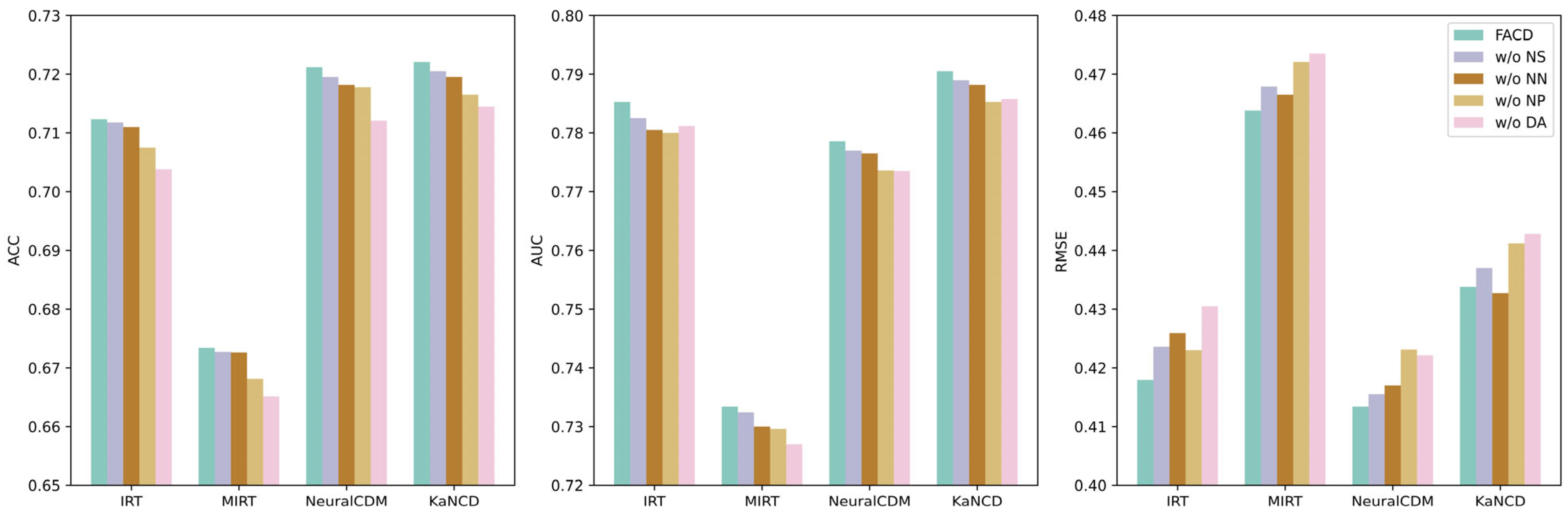
The performance comparisons of these variants across different cognitive diagnosis models are shown in
Figure 3. The results indicate that the complete FACD model achieves the best overall performance across all baseline architectures (IRT, MIRT, NeuralCDM, KaNCD), demonstrating the most balanced results in ACC, AUC, and RMSE, which validates the effectiveness of the overall design.
Regarding individual module contributions, removing the central node self-perturbation module (-w/o NS) leads to slight decreases in ACC and AUC, along with an increase in RMSE across all baseline models. This indicates that central node perturbation effectively enhances the model’s ability to capture individual student characteristics and improves diagnostic precision. Similarly, removing the neighbor node perturbation module (-w/o NN) also causes performance degradation, though to a lesser extent than central node perturbation, suggesting that neighbor node perturbation provides complementary enhancement.
Notably, when both perturbation strategies are removed simultaneously (-w/o NP), model performance declines more significantly, indicating that central and neighbor node perturbations have synergistic effects. Together, they cover different counterfactual scenarios more comprehensively, thereby improving model robustness and representation capability. The most substantial performance drop occurs when the counterfactual data augmentation module is completely removed (-w/o DA). This variant shows the largest performance degradation in both ACC and AUC metrics, strongly demonstrating that counterfactual data augmentation is the most critical component in the FACD model. It provides the foundation for learning fair and discriminative feature representations by generating diverse counterfactual samples.
In summary, the ablation experiments confirm that all components in the FACD model contribute to the final performance. The counterfactual data augmentation module plays a central role, while the two node perturbation strategies enhance the model’s diagnostic capability and fairness at both individual and group levels, respectively.
5.6. Parameter Sensitivity Analysis
To investigate the impact of key hyperparameters on FACD performance, we systematically evaluated how variations in the counterfactual fairness constraint weight
, neighbor perturbation weight
, fairness constraint parameter
, and subgraph size
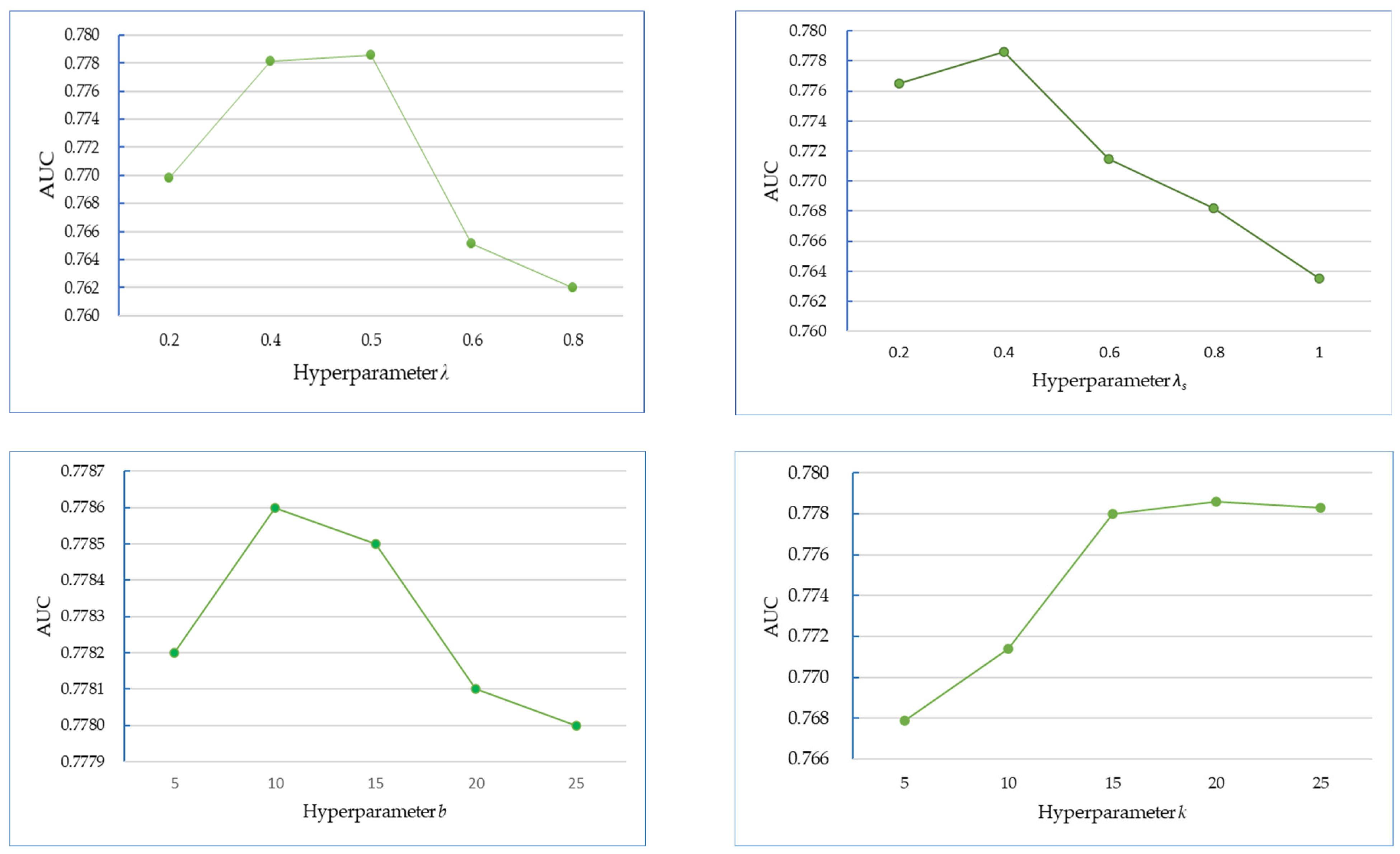
affect the model’s AUC values. The experimental results are shown in
Figure 4.
The analysis reveals that as the fairness constraint weight increases, the model’s AUC first rises and then declines, peaking at . This suggests that an appropriate level of fairness constraint enhances model generalization, while excessive constraint may compress individual feature representations too much, reducing prediction accuracy.
In experiments with the neighbor perturbation weight , the model achieves optimal performance at . Overall, AUC shows relatively small fluctuations as varies within [0, 1], indicating that the model has relatively low sensitivity to this parameter and that the neighbor perturbation mechanism functions stably across different weight configurations.
The fairness constraint parameter has limited impact on model performance. Although AUC is slightly higher when compared to other settings, the differences between configurations are not significant, suggesting that the adversarial learning component effectively extracts features independent of sensitive attributes across different constraint strengths.
The subgraph size k significantly affects model performance. AUC increases rapidly with k initially, then gradually declines, reaching its optimum at . When is too small, the subgraph contains insufficient structural information, limiting the model’s ability to utilize contextual features. Conversely, when k is too large, excessive noisy nodes may be introduced, interfering with the modeling of core relationships. These results highlight the importance of selecting an appropriate subgraph size to balance information utilization and noise control.
6. Conclusions
This paper proposed FACD, a novel fairness-aware cognitive diagnosis model grounded in counterfactual graph representation learning. Its primary contributions and points of differentiation from prior work are (1) the formulation of fairness-aware diagnosis as a graph counterfactual learning problem, where student-centered causal subgraphs model educational context; (2) the introduction of a dual-perturbation strategy over the graph structure to generate counterfactual samples for learning fair representations, moving beyond static adversarial removal; and (3) a modular framework that integrates GVAEs, adversarial learning, and Siamese networks to enforce representation consistency across factual and counterfactual scenarios. Experiments confirm that this integrated approach not only enhances fairness but also improves diagnostic accuracy, offering a more reliable pathway toward equitable educational assessment.
Experimental results on the PISA dataset demonstrate that FACD achieves significant improvements across multiple cognitive diagnosis frameworks, with both classification and regression performance generally surpassing traditional baseline models and their fairness-aware variants (Base+ and Reg). Ablation studies further verify that the three core components—counterfactual data augmentation, central and neighbor node perturbation, and fairness-aware representation learning—all contribute substantially to model performance, and their synergistic interaction is crucial for achieving both accurate and fair diagnostic outcomes. This research provides a viable technical pathway for developing more reliable and equitable cognitive diagnosis systems, offering practical value for building fair educational assessment tools in intelligent learning environments.
Beyond algorithmic contributions, this work opens pathways for more equitable intelligent education systems. Translating FACD into practice requires considering deployment costs and scalability. The model’s computational overhead is front-loaded in training, making it suitable for periodic, centralized diagnostic updates in regional or institutional platforms. Its graph-based nature leverages existing administrative data structures (e.g., school networks), facilitating integration. Future work will focus on developing lightweight variants and exploring federated learning paradigms to address data privacy and distributed deployment challenges, ensuring that fairness-aware diagnosis is not only effective but also practically viable.